



Abstract
Violence against children is a widespread problem with devastating consequences, and corporal punishment is a risk factor for more serious forms of physical abuse. One reason for the persistence of corporal punishment may be the lack of awareness of positive disciplinary alternatives. Nonviolent options offered to caregivers and teachers must be effective in addressing challenging behavior, or they may be rejected in favor of a return to physical punishment. There is an urgent need to determine which discipline options are evidence-supported and what that evidence says so that robust alternatives to corporal punishment can be made available. The primary objective of this research was to find, and explore the state of the science on, individual nonviolent interventions for challenging behavior, in so doing forming a “tool kit” for use by caregivers and teachers. A systematic overview of systematic reviews was conducted. Included systematic reviews were peer-reviewed and published in English between 1999 and 2018. Screening, quality assessment using AMSTAR, and data extraction were performed independently by two reviewers. A total of 223 reviews were included, covering data from 3,921 primary studies. A wide range of evidence-supported interventions exist, many of which have been found effective with severely challenging behavior. Important positive outcomes shown suggest that the use of these tools should be promoted not only for the prevention of violence but also for optimum child development. More research is needed on the use of these methods in home situations and on de-escalation skills.
Violence against children is a serious problem worldwide (United Nations Children’s Fund [UNICEF], 2017). Worse, the violence children experience is most often at the hands of people whom they should be able to trust, such as parents, teachers, and other caregivers (Meinck et al., 2016; UNICEF, 2017). Most often, this violence is meted out as punishment for misbehavior (Durrant & Ensom, 2017; Mbugua et al., 2015).
Not only is the experience of violence meted out by caregivers traumatic and damaging for children (Jedd et al., 2015; Karen, 1994), there is evidence that violence against children feeds violence in the wider society. A coercive approach, in which the adult tries to force a certain reaction from the child using threats, intimidation, and punishment, has been found to foster aggression and conduct problems in children (Patterson, 1976, 1982; Patterson & Dishion, 1985). This may persist into adolescence and adulthood, in the form of delinquency, crime, intimate partner violence, and abuse of their own children (Gershoff, 2002; Gershoff et al., 2017). As long as the response to children’s challenging behavior is violent, there is the potential for an ongoing cycle of violence (Dodge et al., 1990). Considering that even mild forms of corporal punishment have been shown to have negative effects (Gershoff, 2013; Gershoff et al., 2017), dealing with this problem is urgent.
Vital work is being done by child protection organizations in advocating for a ban on corporal punishment in all the contexts, but even where there are bans, many children still experience corporal punishment (Heekes et al., 2020; Meinck et al., 2016). One reason corporal punishment is still used as “discipline” seems to be the lack of understanding of what an alternative nonviolent approach would be (Mbugua et al., 2015). These findings together highlight the need for robust nonviolent discipline options, clearly articulated and accessible to caregivers and teachers. These methods need to be effective, or people may feel justified in returning to corporal punishment, arguing that they have tried a positive approach, and found it ineffective.
On the other end of the scale, caregivers afraid to discipline, for fear of damaging their children, also need education about skills that are safe to use. Permissive parenting has been shown to have negative effects (Baumrind, 1966, 1967), with an overly indulgent parenting style tending to produce children who are lower in social skills, low in self-control, and more aggressive and disrespectful to others. Later, as college students, they are more likely to show academic entitlement, higher perceived stress, and poorer mental health (Barton & Hirsch, 2016), and, as adults, they are less able to resolve relationship problems constructively and more likely to engage in hostile marital conflict (Topham et al., 2005).
Baumrind (1966, 1967) identified that the parenting style with the best outcomes for child development was neither authoritarian (i.e., punitive, restrictive, repressive, and coercive) nor permissive and indulgent, but one she termed “authoritative.” This style is characterized by both responsiveness and appropriate demandingness. Responsiveness describes characteristics such as parental warmth, affection, attunement, and support of children’s autonomy, while demandingness describes necessary confrontation of misbehavior, firmness, and noncoercive power assertion (Baumrind, 2013). Questions have been raised about whether these styles are ethnocentric and perhaps only predictive of these results in a Western context where individualism is valued (Chao, 1994), but more detailed review of cross-cultural studies has shown that, although differently expressed, these parenting styles exist and have similar effects in both collectivist and individualist cultures (Sorkhabi, 2005). Further, Baumrind did not rule out smacking as part of the authoritative approach (Baumrind et al., 2002); thus, the concept needs to be updated to keep pace with developments in psychological science, human rights, and ethics, which now clearly delineate smacking as harmful (Gershoff, 2002, 2013; Gershoff et al., 2017).
It seems regardless of culture, effective nonviolent discipline would need to be both responsive and appropriately demanding. However, it is very difficult to obtain information on effective nonviolent demandingness or positive discipline skills (Embry & Biglan, 2008; Mbugua et al., 2015). Many parenting programs, although well-intentioned, are not evidence-based (Wessels & Ward, 2015), give advice that has no evidence base (Corralejo et al., 2018), or give advice that actually contradicts what research has found (Corralejo et al., 2018). Information on discipline skills on the internet, in parenting books, and classroom management literature is often inaccurate and misleading (Alter & Haydon, 2017; Corralejo et al., 2018; Drayton et al., 2014). There is advice against time-outs (Durrant & Stewart-Tufescu, 2017; Siegel & Payne Bryson, 2014a, 2014b) or praise and rewards (Kohn, 1999), when in fact these are evidence-supported skills that, used appropriately, have positive effects on behavior (Embry & Biglan, 2008; Kaminski et al., 2008; Owen et al., 2012). Thus, information available to the public on nonviolent discipline seems to range from significantly inaccurate to helpful but limited in the range of skills described.
Evidence-based parenting and classroom behavior management programs can be identified and upscaled (Collins & Fetsch, 2012; Gardner & Leijten, 2017; Knerr et al., 2013; Reinke et al., 2012), but this approach has some significant limitations (Embry & Biglan, 2008). Aside from the high costs involved in upscaling, and the challenge of ensuring that programs are implemented with fidelity, there is the fact that most people will never attend such a program due to factors such as cost or opportunity (Embry & Biglan, 2008). Embry and Biglan (2008) make the point that many problem behaviors could be alleviated by a teacher or caregiver using a single skill or method without having to undergo lengthy, expensive training. Aside from difficulties of access, concerns are being raised about flexibility and cross-cultural applicability of manualized evidence-supported programs (Barth et al., 2012; Lyon et al., 2014). With a manualized evidence-based program approach, fidelity to the program may take a higher priority than fit with the unique needs of the client (Barth et al., 2012). This may be of particular concern where clients differ, culturally, from the group a manualized approach was tested with (Lyon et al., 2014), as may be the case if a parenting program from a more individualist context in Europe or America were imported into a more collectivist context in Africa or Asia (Triandis, 2018).
However, these differences are most likely unrelated to the effectiveness of individual skills, and there are several calls for an alternative approach, variously identified as “kernels” (Embry & Biglan, 2008) or a modular approach (Barth et al., 2012). With a database of individual skills, or “kernels” (Embry & Biglan, 2008), accessibility and fit with diverse client needs may be more achievable. Evidence-based tools could be made available for use in whatever combination best suited client needs (Barth et al., 2012), allowing caregivers and teachers to choose and use effective nonviolent methods within the framework of their own values and cultural norms.
An example of a “kernels” approach can be found in the field of public health, where Michie and colleagues (2011, 2013) have created and refined a taxonomy of behavior change techniques to address problems such as low physical activity, unhealthy eating, smoking, alcohol abuse, and sexually transmitted infections. The usefulness of the taxonomy is demonstrated in the number of recent studies and reviews that make use of its components and terms (e.g., Epton et al., 2017; Hynynen et al., 2016), and empirical data are thus building on each different technique. Similarly, a classroom tool kit for Jamaican preschools has been developed from Embry and Biglan’s (2008) “kernels,” providing teachers with culturally acceptable, nonviolent behavior management options that can be selected according to teaching style and personal preference (Baker-Henningham, 2018).
In order to develop a tool-kit approach to nonviolent discipline, the evidence supporting each tool or method must be assessed. However, extensive search of the literature yielded no systematic review or overview on nonviolent discipline methods. There are reviews which address effective components of evidence-based interventions (Kaminski et al., 2008; Leijten, Gardner, Melendez-Torres, van Aar, et al., 2018). Other reviews cover a range of skills for a specific setting, condition, or behavior problem, for example, classroom management skills (Simonsen et al., 2008), interventions for children with autism (Heyvaert et al., 2014; Wong et al., 2015), or interventions for noncompliance (Leijten, Gardner, Melendez-Torres, Knerr, & Overbeek, 2018), school bullying (Farrington & Ttofi, 2009), or truancy (Sutphen et al., 2010). Although these reviews contain relevant and useful information, they are specialized and therefore also limited.
Objectives
The primary objective of the current research was therefore to find, and explore the state of the science on, positive discipline options that could be used by caregivers or teachers to reduce challenging behavior and increase appropriate behavior in children or adolescents. The following research questions were addressed: (1) Which nonviolent discipline interventions can be considered evidence-supported? (2) What does the evidence on nonviolent discipline interventions show about their use and effectiveness? (3) Where are there gaps in the research on nonviolent discipline interventions?
Definitions
Positive discipline options or tools are defined here as discrete, nonviolent interventions that can be used to address a child’s resistance, lack of cooperation, problem behavior or dysregulation, or to teach and support appropriate behavior. Tools or interventions in this context describe individual practices such as distraction, modeling, or time-out rather than programs. Although a tool-kit approach is similar to the kernels approach described by Embry and Biglan (2008), tools differ from kernels in that a kernel is defined as “a behavior–influence procedure…that is indivisible in the sense that removing any of its components would render it inert” (Embry & Biglan, 2008, p. 75), while a tool may still be divisible by component kernels. For example, classroom group contingencies usually contain several kernels, such as rules, goal setting, rewards, and praise, but are still simple enough to be used by teachers without manualized training, and thus a useful addition to the tool kit.
Whether or not the disciplinary intervention is aversive to the child is not the criterion for determining whether it is positive. Defining positive interventions as nonaversive is problematic (Horner, Dunlap, et al., 2005) since children may find certain containing or restorative actions aversive even though they are entirely appropriate, for instance, insistence that the child wears a seat belt if they wish to ride in the car, or prompting them to apologize to someone.
The term caregiver is often used to refer to the person who provides primary parenting responsibilities (e.g., Meinck et al., 2016). In this report, the definition is widened to include any others, such as relatives, nannies, or after-school care supervisors, who may be responsible for childcare and therefore discipline, for at least part of the day.
This article refers throughout to children and adolescents, but, in most cases, the word child is used as a shorthand to refer to both. The term evidence-supported is used to refer to interventions for which evidence of effectiveness is found. Thresholds for the amount of evidence required to meet this classification are described in the Data Synthesis section below.
Method
To achieve the objectives described, information from a very large number of relevant primary studies needed to be found and assessed, and therefore, a systematic overview method was chosen. Overviews are designed to create a “friendly front end” to available reviews, making evidence from multiple systematic reviews easily accessible in one document (Becker & Oxman, 2008, p. 608). There are a number of advantages that make the overview a particularly suitable method for the objectives described above: Overviews can cover a much broader field and answer much broader questions than a primary study or systematic review. They can integrate information on multiple interventions for a problem, where systematic reviews usually only focus on one. They can show gaps where more reviews are needed and synthesize large amounts of evidence. These attributes make overviews particularly useful for policy makers and others needing to make evidence-informed decisions (Becker & Oxman, 2008; Pollock et al., 2016; Thomson et al., 2013; Wright & Walwyn, 2016). The protocol for this overview was based on the approach taken by the Cochrane Handbook for Systematic Reviews of Interventions (Becker & Oxman, 2008) and approved by a review committee in the Department of Psychology at the University of Cape Town. Ethics approval was not required, as overviews do not directly involve any participants.
A challenge inherent in the overview method is overlap of primary studies across included reviews (Becker & Oxman, 2008; Thomson et al., 2013). There are two recommended methods to avoid double counting of data (Pollock et al., 2016; Thomson et al., 2013): one is to choose one review per intervention (for instance, the latest, the best quality, or the most relevant to the overview question). Another way is to include all the reviews found for each intervention but report any overlap. Although more complicated and time-intensive, the latter method was more suitable for this overview. Review questions are usually more specialized than the overview question (e.g., interventions for children with attention deficit hyperactivity disorder [ADHD] vs. for children in general) so that several were needed to cover each intervention.
Search Strategy
A detailed account of the search strategy and intensive search process, including search terms used, can be found in Online Supplement 1. The difficulty in identifying interventions and finding effective search terms confirmed the urgent need for an overview of this nature. Working from a list of positive discipline options known to the authors, search terms for each of the interventions were tested and the literature yielded broadly surveyed. Both general search terms (e.g., discipline and behavior) and specific search terms (e.g., “time-out” or “praise”) were used. Relevant articles, abstracts, and key word lists were searched for alternative terms and further interventions. In addition to academic databases, relevant reviews (e.g., Embry & Biglan, 2008; Kaminski et al., 2008; Simonsen et al., 2008) were consulted and general Google searches were conducted to identify further interventions, behavior management terms, and layman’s terms for these. Any new terms discovered were added and tested. Once searches were conducted, any new terms discovered in the process of abstract or full-text screening were added to subsequent rounds of searches.
The following databases were searched: Academic Search Premier, Africa-Wide Information, CINAHL, Communication and Mass Media Complete, ERIC, Health Source: Nursing/Academic Edition, Humanities International Complete, MasterFILE Premier, MEDLINE, PsycARTICLES, PsycINFO, SocINDEX, Teacher Reference Centre, The Cochrane and Campbell libraries, and Education Database. All searches were run independently by two reviewers, the last completed by October 31, 2018. All abstracts were independently screened using an inclusion checklist, which can be found in Online Supplement 1. Results were then compared. Abstracts either clearly or possibly meeting inclusion criteria were agreed upon, and their full texts were downloaded and independently screened. Differences of opinion on inclusion were resolved by discussion and consensus between the two reviewers, occasionally involving the second author. Reference lists of all included reviews were searched independently by the first author and an assistant reviewer. Full texts of reviews found in this way were independently screened for inclusion. A Preferred Reporting Items for Systematic Reviews and Meta-Analyses (PRISMA) flow diagram showing the overview process is shown in Figure 1.
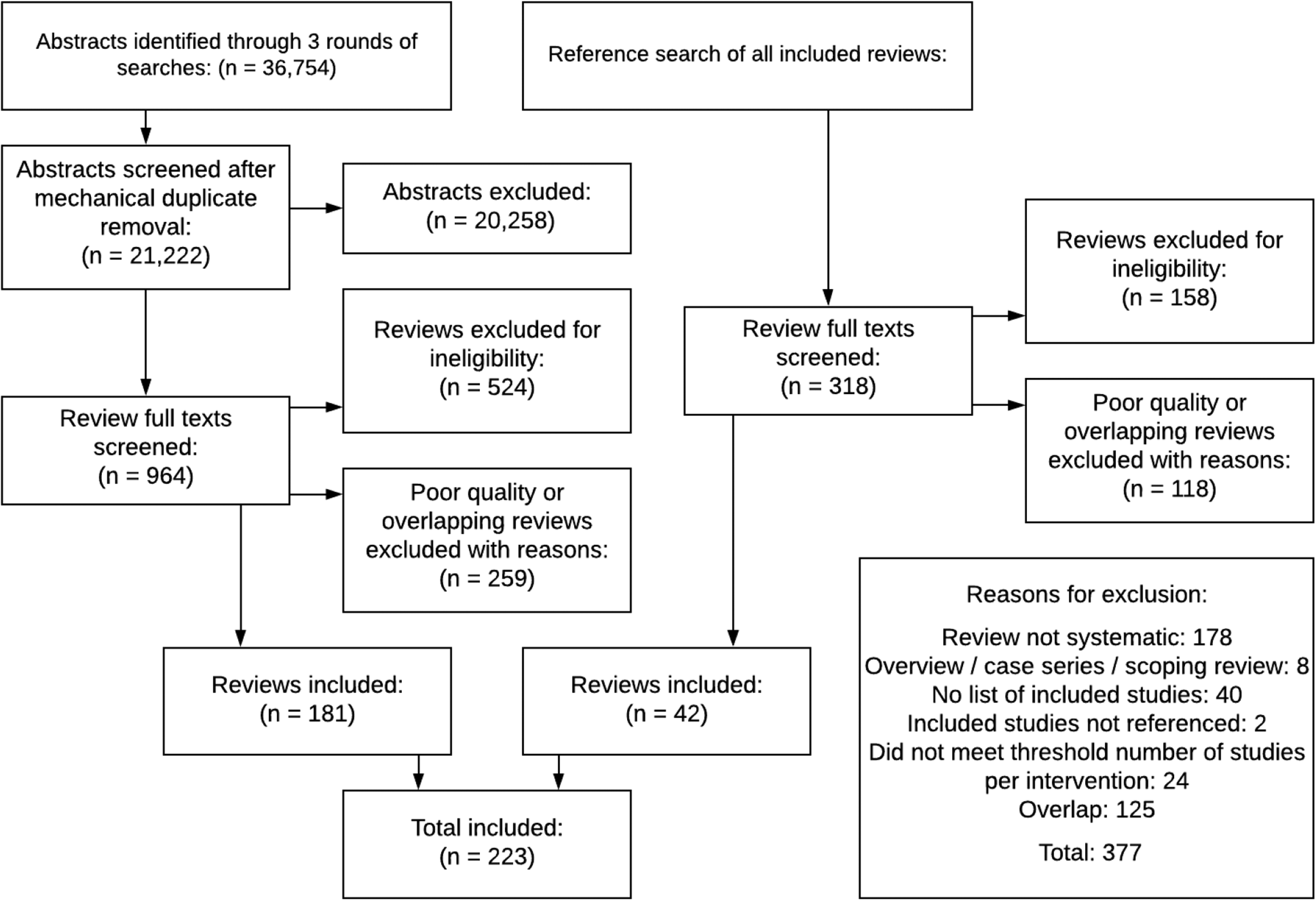
PRISMA flow diagram.
Inclusion and Exclusion Criteria
Reviews were screened both for eligibility and quality. In terms of eligibility, inclusion criteria for reviews were that the review was in English, published in a peer-reviewed journal in 1999 or later, presented evidence on at least one nonviolent intervention, and described participants of reviewed studies as children, adolescents, juveniles, age 18 and under, or schoolgoing. Where there was a mixture of adult and child participants, the results had to be differentiated, or age had to be tested and found not to moderate results. Reviews had to include behavioral outcomes or outcomes clearly related to child behavior (e.g., impact of child behavior changes on caregivers). A full range of participants, with and without disabilities or medical conditions, was included. Target behaviors could be negative (undesirable) or positive, such as on-task or prosocial behavior, and range from mild to extremely challenging, disturbed, or criminal.
Exclusion criteria were as follows: gray literature; violent or coercive interventions; purely architectural environmental interventions such as changes to building or playground structure; and reviews with purely academic or nonbehavioral outcomes, such as whether a participant improved spelling or reading level. Since the focus was on adult–child interactions, reviews of peer interventions such as peer mediation and peer tutoring were excluded. The exception to this was adult involvement of peers in modeling a behavior, for example, in video modeling.
Where overviews of reviews were found, the relevant constituent reviews were screened for inclusion rather than extracting data from the overview. Reviews that did not contain any unique primary studies were excluded, which is a recommended practice for overviews (Lunny et al., 2017).
In terms of quality, the inclusion criteria were that a review had to be systematic, that is, describe the search strategy and inclusion criteria for the studies reviewed. Included primary studies had to be clearly referenced so that overlap of studies between reviews could be determined. To be included, a review had to contribute at least three unique (nonoverlapping between reviews) single-case design (SCD) studies or two unique group design studies on at least one intervention. In cases where a choice needed to be made between reviews to avoid overlap, the following considerations guided decisions: which review was of better quality, or, if they were of similar quality, which was the most recent; which review contributed the most information relevant to the research questions (e.g., if one looked at positive target behaviors and one looked at positive and challenging target behaviors, the latter was chosen); and which contributed the most studies (e.g., if one drew its conclusions from 10 studies and the other from 30, the latter was chosen). Multiple criteria such as these are necessary to avoid the problem inherent in the use of a single criterion (e.g., most recent) of unintended loss of information through exclusion of important systematic reviews (e.g., if the most recent was not the best quality; Lunny et al., 2017).
If poor quality reviews met inclusion criteria and were not overlapping, they were included, a decision that can be constructive in cases where the only available evidence is poor or where the aim is to give a more complete picture of the evidence on an intervention (Pollock et al., 2017). The list of included reviews can be found in Online Supplement 2. The list of excluded reviews, with reasons for exclusion, can be found in Online Supplement 3.
Data Extraction and Management
Data were independently extracted by the first author and an assistant reviewer according to the predetermined extraction protocol using data extraction forms that can be found in Online Supplement 4. Both reviewers checked that each review met inclusion criteria, extracted a list of interventions covered by the review, scored the review for quality using the AMSTAR checklist (A Measurement Tool to Assess Systematic Reviews), and extracted any relevant references from the reference list for screening. A consensus process was followed, with any areas of uncertainty resolved in discussion with the second author. The first author completed a more detailed extraction of all other information required, such as demographic information, target behaviors, outcomes, and so on. Samples of completed data extraction forms were checked by the second author. Extracted data from each included review were summarized on the review characteristics table, which can be viewed in Online Supplement 5.
A table showing the overlap of studies between the reviews can be found in Online Supplement 6. For ease of reference, overlap is also clearly summarized per review in three columns of the review characteristics table (Online Supplement 5). Overlap was coded as follows: “partial overlap” where three or more studies overlap with another review on the same intervention, “slight overlap” where one or two studies overlap on the same intervention, “no information overlap” where studies overlap but not on the same intervention, or “none” where there are no overlapping studies.
Scope mismatch between the overview and individual included reviews is a further challenge inherent in the overview method (Ballard & Montgomery, 2017). If an included review provided information irrelevant to the overview questions, only the relevant information was extracted. For example, if an included review provided data for adolescents and adults, only the data on adolescents were extracted, or if a review covered various interventions, only information on relevant interventions was extracted. Where possible, the relevant fraction of each review was reported on the review characteristics table (Online Supplement 5) by showing the number of relevant studies in relation to the total number of studies in each review.
Data Synthesis
Because of vast heterogeneity between reviews, and as is usual for an overview, extracted data are presented as a narrative synthesis using text and tables, without further statistical analysis (Hartling et al., 2012; Thomson et al., 2013). One advantage of this is that it removes the danger that overlap between reviews would confound statistical results. Since overlap is clearly reported and summarized, the authors suggest that the reader interpret reviews with a high degree of overlap as partial replications of each other, confirming or raising questions about results.
A table summarizing which interventions were found to have supporting evidence (Table 1) is included in the results section below, while a more detailed narrative summary of data for each intervention is provided in Online Supplement 7. Criteria for the category “Interventions with a moderate to large amount of reviewed evidence showing positive effects on behavior” (Table 1) were as follows: at least one systematic review dedicated to the intervention, or including that intervention, showing overall positive effects, with at least 10 of the reviewed studies showing positive effects or several reviews showing positive effects across a total of 10 or more nonoverlapping studies or a meta-analysis showing clear positive effects or a systematic review declaring the intervention evidence-based according to recognized criteria. Interventions with a small amount of reviewed evidence suggesting positive effects, that is, with less evidence than the above threshold, are shown in Appendix Table S7, which can be found in Online Supplement 9.
Interventions With a Moderate to Large Amount of Reviewed Evidence Showing Positive Effects on Behavior. a

a More precise reporting on age, disability, review quality, and so on is available in the review characteristics table (Online Supplement 5) and narrative summary of data (Online Supplement 7).
b Numbers correspond with included reviews in Online Supplement 2.
Different criteria can be used to classify interventions as evidence-based or not (e.g., Chambless & Hollon, 1998; Horner, Carr, et al., 2005; Kratochwill et al., 2013). Evaluation of whether individual interventions can be considered evidence-based is beyond the scope of the overview method, as this would require access to, and quality appraisal of, the primary studies included in the systematic reviews. Some included systematic reviews classified interventions as evidence-based using recognized criteria such as the 5-3-20 threshold (five quality SCD studies conducted by three or more different research teams across 20 or more cases; Kratochwill et al., 2013). This was recorded and displayed on the review characteristics table (Online Supplement 5) and in the narrative summary of data (Online Supplement 7).
Assessment of Methodological Quality of Included Reviews
Using the AMSTAR checklist, a tool commonly used in overviews to assess methodological quality of reviews (Lunny et al., 2018; Pollock et al., 2016), all included reviews were independently scored by two reviewers, and a consensus process was followed, involving a third person if needed. If the review used statistical meta-analysis, it was scored out of 11. Narrative reviews, for which AMSTAR Questions 9 and 10 were not relevant, were given a score out of 9. These summary scores were captured on the review characteristics table (Online Supplement 5). Summary scores were used for ease of reference so that, while perusing the data on the table, readers would be able to see by the score whether each review was of higher or lower methodological quality and whether statistical meta-analysis was used or not. As is recommended (Pollock et al., 2017), however, a separate table showing scoring for each AMSTAR question, for all included reviews that were completed, can be found in Online Supplement 8.
It was not feasible to assess the risk of bias of the primary studies included in each review, but the design of included studies is reported on the review characteristics table (Online Supplement 5) to give some indication of strength of evidence.
Results
A total of 223 reviews were included, covering 3,921 relevant primary studies and providing data on a wide range of interventions. Reviews varied widely in quality and were drawn from different fields such as applied behavior analysis, education, medicine, public health, and restorative justice. Reviewed studies varied in design, with single-case designs (SCDs), randomized controlled trials, cross-sectional, and longitudinal being some of the most common. There was considerable heterogeneity across reviews in terms of population, and a wide range of target behaviors, both positive and negative. Participants in the reviewed studies ranged in age from infancy to late adolescence. Ethnicity and socioeconomic status varied. Most studies were set in high-income countries such as the United States, European countries, and Australia. Low- and middle-income countries were far less represented. Children and adolescents with disabilities and more severe behavior problems were well represented. Detail on population, target behavior, and outcomes for each intervention is provided in narrative form in Online Supplement 7. Further detail can be found in the review characteristics table in Online Supplement 5.
Interventions With Supporting Evidence
Table 1 shows interventions with a moderate to large amount of reviewed evidence showing positive effects on child behavior. These include over 50 tools in the following categories: antecedent interventions, behavior contracts, communication, cost, distraction, extinction, feedback on behavior, goal setting, graduated exposure, modeling, monitoring, opportunities to respond, problem-solving, prompting, reinforcement, restorative justice interventions, restraint, self-management, structure, and time-out. Descriptions of each tool can be found in the table, with further detail available online in the narrative summary of data (Online Supplement 7).
A table showing interventions with a small amount of reviewed evidence suggesting positive effects can be found in Online Supplement 9. Among others, this category includes the relatively well-known tools of preparation and routine.
Interventions Included in the Search but for Which No Reviewed Evidence Was Found
A number of interventions included in the search were not covered in any review. No reviewed evidence was found for any intervention referred to as “logical consequences”; however, several of the tools found effective, such as increased monitoring, daily report cards, time-out from a specific activity the child is not managing, contingent protective restraint, response cost, and restorative justice interventions which involve making amends, could be used as logical consequences, depending on how they are framed. Although there was strong evidence for the importance of communication, no reviewed evidence was found for separate components of communication, such as active listening, open-ended questions, or allowing a child to “vent” (speak freely when they are upset or angry). There is implicit evidence for active listening, however, in the important positive results for good parent–child communication (e.g., Mynttinen et al., 2017; Ryan et al., 2010) and child disclosure (e.g., Hoeve et al., 2009). Certain aspects of structure such as deadlines (“I’m counting to three”) or turn-taking were not represented in reviews. Reviews on family rituals were found, but none met the inclusion criteria for this overview. No reviews were found addressing remedial stories other than Social Stories™ (Gray & Garand, 1993) or making amends in contexts other than restorative justice interventions. No reviews were found on talking circles, or Adlerian-style family or class meetings, although evidence on student participation and collaborative problem-solving suggests that these could be useful approaches. No reviews were found on natural consequences, cooldown time for children in a hyperactive state, quiet time for sensory overstimulation, or assertive repetition of an instruction. No reviews were found on skills to de-escalate explosive or aggressive situations.
Discussion
A wide range of evidence-supported interventions exists (see Table 1), many of which have been found effective across age, gender, and disability status, in ethnically diverse samples and with severely challenging behavior. In the two cases where reviews tested this statistically, effectiveness of individual interventions was not moderated by ethnicity (de Vries et al., 2015; Johnson et al., 2017) suggesting that these tools may be good candidates for use in different cultural contexts. This would be consistent with findings that parenting programs, many of which teach selections of these tools, seem to transfer effectively from one cultural context to another (Gardner et al., 2016). However, this is not firm evidence that all skills are applicable cross-culturally, and further research should explore this.
There are further interventions for which the small amount of available evidence suggests positive effects (see Online Supplement 9), and more research is needed on these. Gaps in the literature include that no specific systematically reviewed evidence could be found for some relatively well-known interventions such as active listening, family rituals, talking circles, or class meetings, although, in some cases, evidence suggesting efficacy can be found in closely related interventions. Another gap in the literature concerns the use of many of the interventions in typical home settings. Their successful use in more extreme or challenging situations, however, bodes well for their use in more common situations.
When we consider that discipline situations often involve dysregulation, anger, and other heightened emotions; that the behavior that may need containing may be aggressive or violent; and that this could easily prompt a violent response from caregivers, it is clear that the lack of reviews on skills to de-escalate explosive or aggressive situations is a serious gap in the literature. Since time-out is often effective for aggression, it could be useful in this kind of situation. Listening and empathy could also apply, as they have been found to be key components of de-escalation in violent and aggressive situations with adults (Price & Baker, 2012); however, no similar reviews were found addressing children or adolescents. Life Space Crisis Intervention (Long et al., 2001), an approach to crisis intervention with children and adolescents, includes a step called “drain-off,” which usually involves listening empathically to “drain-off” heated emotions, but may also involve allowing the child some time to cool off on their own, which could be seen as a kind of time-out. While LSCI as a whole has shown positive effects (Dawson, 2003; D’Oosterlinck et al., 2008), no reviews were found on the effects of the individual components such as “drain-off.” There is an urgent need to test and review time-out, listening, and other skills specifically as de-escalation tools.
Aside from their effectiveness and thus usefulness as alternatives to physical punishment, a significant finding of this overview concerns the important and often long-term positive outcomes associated with the use of the nonviolent methods reviewed (see Table 1, the review characteristics table in Online Supplement 5, and narrative summary in Online Supplement 7). Examples include improved school engagement, academic achievement, participation, communication and social relationships, better self-regulation, higher self-esteem and independence, and lower rates of depression, suicide, substance abuse, sexual risk behavior, conduct disorders, aggression, and crime. These positive outcomes suggest that the use of these tools would be beneficial not only as alternatives to physical punishment but to foster optimum child development.
It was clear that the tools were more effective in certain situations or for certain children than for others, for example, rewards undermined intrinsic motivation for children who were already motivated but had positive effects where motivation was low (Deci et al., 1999), and were found to be particularly important for children with ADHD (Luman et al., 2005; Ma et al., 2016). This suggests the need for attunement on the part of the adult, matching the use of discipline tools to the needs and signals of the child.
Overview Limitations
It is important to remember that overviews give a description of reviewed evidence rather than all available evidence on each intervention. Systematic reviews are limited in scope, often only covering a narrow population or target behavior. Thus, the evidence presented on each intervention should not be considered comprehensive. Likewise, the absence of reviews on an intervention should not be understood as proof of no evidence, as this could simply indicate that the available evidence has not yet been systematically reviewed.
Some included reviews were of excellent quality, but many were less rigorous, limiting the conclusions that can be drawn about intervention effectiveness (see AMSTAR scores in Online Supplement 8). However, the inclusion of more than one review on each intervention provided some confirmation of results.
Although studies indexed under the term “discipline” are relatively rare, the field of possibly relevant studies is huge. The chance of missing reviews is therefore relatively high, even with a rigorous and sensitive search process.
Risk of bias of primary studies included in each review was not assessed. Although this is recommended (Becker & Oxman, 2008), there is conflicting guidance in methodological texts on how exactly to collect and present data on primary study quality in an overview of reviews (Pollock et al., 2016). Methods proposed include extracting and reporting the quality assessments conducted within each review, but there are as yet no guidelines on how to manage the difficulties inherent in this approach, such as the use of different quality assessment tools in different reviews (Pollock et al., 2016), or the fact that not all reviews assess study quality. Another option would be to refer back to each primary study to conduct quality assessments (Pollock et al., 2016), which would not have been feasible considering there were 3,921 studies covered by the included reviews.
Gray literature was not included to ensure that all included reviews had been through the peer-review process involved in publication, as an indicator of quality. However, many of the included reviews did search for and include gray literature. Those that did not increase the likelihood of publication bias, as studies finding positive results are more likely to be published. This is not a serious impediment to this overview, however, as the aim of this overview was to build a nonviolent tool kit rather than to find a single solution. It is thus not necessary to prove that each intervention is always or even mostly effective. The fact that it has been found effective for certain target behaviors (see table 1) is enough for a skill to be considered a useful addition to the tool kit. That an intervention will not always be effective is expected and one of the reasons why it is necessary to provide a range of options so that, if one does not prove effective, another can be tried. This also suggests that, in addition to providing caregivers and teachers with discipline tools, a focus on attunement may be necessary.
Conclusion
In this overview, most of the included reviews did not have positive discipline options as a focus. Most examined a specific behavior problem, a specific intervention, or perhaps a few interventions for problems in a specific population or setting (e.g., autistic children or the classroom setting). The overview method enabled extraction of relevant data from each of these focused reviews to answer the broader question of what nonviolent, evidence-based discipline interventions could be used by caregivers and teachers, a topic which, to the best of the authors’ knowledge, has never been systematically examined in this breadth before.
The lack of reference materials on positive discipline methods has been an impeding factor in the prevention of violence against children. Listing and reviewing these evidence-supported nonviolent interventions is an important step toward providing caregivers and teachers in different cultural contexts with a tool kit of effective interventions for challenging behavior. Although there are some gaps in the literature, this research has shown that a wide range of well-tested, evidence-supported interventions exist and are effective even with severely challenging behavior. Many important and often long-term positive outcomes were found in review of these methods. It is reasonable to conclude therefore that the use of these nonviolent tools should be promoted not only for prevention of violence but also for optimum child development.
Implications for Practice, Policy, and Research
Listing and reviewing these evidence-supported tools is an important step toward providing caregivers and teachers in different cultural contexts with a tool kit of effective alternatives to corporal punishment.
Policy makers should not hesitate to legislate against corporal punishment, as this research has shown that a wide range of well-tested, evidence-supported alternatives exist and are effective even with severely challenging behavior.
Since legislation alone has limited effects, policy should also support caregivers and teachers to learn these nonviolent alternatives.
The positive outcomes shown suggest that policy should promote nonviolent discipline not only as an alternative to physical punishment but also to foster optimum child development.
There is a need for more research on the use of many of the tools in typical home settings.
The lack of evidence on tools to de-escalate explosive or aggressive situations is a serious gap in the literature with implications for child safety. There is an urgent need to test and review time-out, listening, and other skills specifically as de-escalation tools.
Supplemental Material
Supplemental Material, sj-pdf-1-tva-10.1177_1524838020967340 - Nonviolent Discipline Options for Caregivers and Teachers: A Systematic Overview of the Evidence
Supplemental Material, sj-pdf-1-tva-10.1177_1524838020967340 for Nonviolent Discipline Options for Caregivers and Teachers: A Systematic Overview of the Evidence by Karen R. Quail and Catherine L. Ward in Trauma, Violence, & Abuse
Supplemental Material
Supplemental Material, sj-pdf-2-tva-10.1177_1524838020967340 - Nonviolent Discipline Options for Caregivers and Teachers: A Systematic Overview of the Evidence
Supplemental Material, sj-pdf-2-tva-10.1177_1524838020967340 for Nonviolent Discipline Options for Caregivers and Teachers: A Systematic Overview of the Evidence by Karen R. Quail and Catherine L. Ward in Trauma, Violence, & Abuse
Supplemental Material
Supplemental Material, sj-pdf-3-tva-10.1177_1524838020967340 - Nonviolent Discipline Options for Caregivers and Teachers: A Systematic Overview of the Evidence
Supplemental Material, sj-pdf-3-tva-10.1177_1524838020967340 for Nonviolent Discipline Options for Caregivers and Teachers: A Systematic Overview of the Evidence by Karen R. Quail and Catherine L. Ward in Trauma, Violence, & Abuse
Supplemental Material
Supplemental Material, sj-pdf-4-tva-10.1177_1524838020967340 - Nonviolent Discipline Options for Caregivers and Teachers: A Systematic Overview of the Evidence
Supplemental Material, sj-pdf-4-tva-10.1177_1524838020967340 for Nonviolent Discipline Options for Caregivers and Teachers: A Systematic Overview of the Evidence by Karen R. Quail and Catherine L. Ward in Trauma, Violence, & Abuse
Supplemental Material
Supplemental Material, sj-xlsx-5-tva-10.1177_1524838020967340 - Nonviolent Discipline Options for Caregivers and Teachers: A Systematic Overview of the Evidence
Supplemental Material, sj-xlsx-5-tva-10.1177_1524838020967340 for Nonviolent Discipline Options for Caregivers and Teachers: A Systematic Overview of the Evidence by Karen R. Quail and Catherine L. Ward in Trauma, Violence, & Abuse
Supplemental Material
Supplemental Material, sj-xlsx-6-tva-10.1177_1524838020967340 - Nonviolent Discipline Options for Caregivers and Teachers: A Systematic Overview of the Evidence
Supplemental Material, sj-xlsx-6-tva-10.1177_1524838020967340 for Nonviolent Discipline Options for Caregivers and Teachers: A Systematic Overview of the Evidence by Karen R. Quail and Catherine L. Ward in Trauma, Violence, & Abuse
Supplemental Material
Supplemental Material, sj-pdf-7-tva-10.1177_1524838020967340 - Nonviolent Discipline Options for Caregivers and Teachers: A Systematic Overview of the Evidence
Supplemental Material, sj-pdf-7-tva-10.1177_1524838020967340 for Nonviolent Discipline Options for Caregivers and Teachers: A Systematic Overview of the Evidence by Karen R. Quail and Catherine L. Ward in Trauma, Violence, & Abuse
Supplemental Material
Supplemental Material, sj-pdf-8-tva-10.1177_1524838020967340 - Nonviolent Discipline Options for Caregivers and Teachers: A Systematic Overview of the Evidence
Supplemental Material, sj-pdf-8-tva-10.1177_1524838020967340 for Nonviolent Discipline Options for Caregivers and Teachers: A Systematic Overview of the Evidence by Karen R. Quail and Catherine L. Ward in Trauma, Violence, & Abuse
Supplemental Material
Supplemental Material, sj-pdf-9-tva-10.1177_1524838020967340 - Nonviolent Discipline Options for Caregivers and Teachers: A Systematic Overview of the Evidence
Supplemental Material, sj-pdf-9-tva-10.1177_1524838020967340 for Nonviolent Discipline Options for Caregivers and Teachers: A Systematic Overview of the Evidence by Karen R. Quail and Catherine L. Ward in Trauma, Violence, & Abuse
Footnotes
Authors’ Note
Opinions expressed are those of the authors and not of the National Research Foundation or University Research Committee. The protocol for this overview was approved by a review committee in the Department of Psychology, University of Cape Town. See Online Supplements 2 and 3 for included and excluded reviews, respectively.
Acknowledgments
Thanks to the three research assistants, who worked alongside the first author at different times during screening and data extraction. They are Ayabonga Timakwe, Tamsyn Naylor, and Stijn de Leeuw. Thanks to Mikha Davids for technical support, help in designing figures, and customized software automating repetitive aspects of data management.
Declaration of Conflicting Interests
The author(s) declared the following potential conflicts of interest with respect to the research, authorship, and/or publication of this article: There are no conflicts of interest for either author or for the research assistants. The first author runs workshops on positive discipline interventions. Workshop materials were adjusted in light of the evidence found here and not the other way around.
Funding
The author(s) disclosed receipt of the following financial support for the research, authorship, and/or publication of this article: This research was supported by grants to the second author from the National Research Foundation (Grant no. 109479) and the University of Cape Town Research Committee.

Supplemental Material
The supplemental material for this article is available online.
References
Supplementary Material
Please find the following supplemental material available below.
For Open Access articles published under a Creative Commons License, all supplemental material carries the same license as the article it is associated with.
For non-Open Access articles published, all supplemental material carries a non-exclusive license, and permission requests for re-use of supplemental material or any part of supplemental material shall be sent directly to the copyright owner as specified in the copyright notice associated with the article.
