



Abstract
Sex workers face high risks of violence both during and after the performance of their job, yet the prevalence and willingness to report victimization to the police is extremely low. International research on the motives of sex workers not to report violent crimes to police is scarce and fragmented. To address this knowledge gap, a systematic review was conducted to answer the following question: What reasons do sex workers articulate to explain their reluctance to report victimization to the police? After searching for peer-reviewed and grey literature in various databases, using systematic search terms, nine studies met the inclusion criteria. After thematic analysis, four main motivations for not reporting victimization emerged: (i) fear of punishment, (ii) fear of maltreatment, (iii) fear of exposure, and (iv) fear of impunity. The impact of intersectional and personal characteristics of sex workers (i.e., gender, migration status, type of sex work, etc.) were explored. The findings show that sex workers experience low levels of trust in the police which results in unwillingness to report victimization. The article argues that decriminalization of the sex industry, and action to improve procedural justice, are likely to increase the inclination of sex workers to report a crime to police.
Introduction
An appreciable amount of international research has shown the prevalence of a high incidence of work-related violence among sex workers 1 (Bungay et al., 2012; Deering et al., 2014; Kinnell, 2013; Kloek & Dijkstra, 2018). The prevalence of such work-related violence worldwide is estimated to have affected between 45% and 75% of sex workers (Deering et al., 2014), and manifests itself in different types of violent experiences (physical, sexual, emotional, or economic) from different types of perpetrators (clients, other sex workers, intimate partners) (Kloek & Dijkstra, 2018; Surratt et al., 2004). In addition, several international studies cite examples of police violence toward sex workers (Kinnell, 2013; Klambauer, 2018; Rhodes et al., 2008; South African Litigation Centre, 2016).
The extant literature identifies particular factors that heighten the risk of work-related violence among sex workers, such as the type of sex work undertaken, location, gender, and drug abuse (Deering et al., 2014; Raine, 2021). For instance, street-based sex workers appear to have an increased risk of work-related violence, in contrast to sex workers who work indoors (Church et al., 2001; Deering et al., 2014; Kinnell, 2006; Sanders & Campbell, 2007). Male and transgender sex workers have a higher risk of exposure to violence during and after work than cisgender female sex workers (Kloek & Dijkstra, 2018; Lyons et al., 2017; Raine, 2021). In addition, in locations where (aspects of) sex work is criminalized, the risk of violence against sex workers is especially acute (Deering et al., 2014). Sex workers even report violence as being “part of the job” and thus, is regarded as intrinsically connected to the nature of sex work (Armstrong, 2017; Bungay et al., 2012; Dalla et al., 2003; Lyons et al., 2017; Sanders et al., 2018; Ślęzak, 2017).
Despite the increased prevalence of violence against sex workers, there is a consensus among researchers that sex workers seldom report victimization to the police and are generally unwilling to do so (Brooks-Gordon, 2006; Dalla et al., 2003; Kinnell, 2006, 2013; Pitcher & Wijers, 2014; Sullivan, 2007). The prevalence of reporting victimization to police by sex workers ranges from 16.5% to 41%, with migrant sex workers, for example, less likely to report crime to the police (12.7%, in contrast to 38.2% of all participants) (Church, 2003; Church et al., 2001; Crago et al., 2021; Kloek & Dijkstra, 2018; McBride et al., 2020). Church (2003) noted that the chance of sexual violence being reported to police was higher than that of physical violence (resp. 41% and 22%), while outdoor sex workers are more likely to report victimization to police than indoor sex workers (resp. 44% and 18%) (Church et al., 2001). Significantly though, Crago et al. (2021), found that most of the sex workers (42%) that reported victimization to police described the experience as negative, with only 31.5% experiencing the interaction as positive.
The limited willingness of sex workers to report victimization to police can be explained by the low levels of confidence sex workers have in the police (Benoit et al., 2016; Fey, 2019). For example, no less than 63% of the sex workers who participated in the study of Benoit et al. (2016) reported very low levels of confidence in the police. Such levels of distrust serve to create a distance between sex workers and police, where the legitimacy of police is de facto questioned by inaction. Police legitimacy is a well-researched topic where the quality of decision-making (e.g., the levels of transparency and objectivity) and the treatment of citizens (e.g., the respect and equal consideration given) is the focus of procedural justice (Tankebe, 2014; Tyler, 2011). It is assumed that negative experiences with police in interaction with citizens have a greater impact on police legitimacy than positive experiences (Skogan, 2006). This is intrinsically related to the ambiguity that acknowledging sex workers as possible victims of work-related violence, contributes to their recognition as citizens with equal civil rights and worthy of adequate police protection.
To better understand the reasons why sex workers choose not to report victimization to the police, this article provides a systematic review and analysis and synthesizes the existing international literature to distil the key elements and distinctions. In so doing, the barriers described by sex workers in their assessment of whether to report or not to report a crime committed against them, are examined. The central research question of this systematic review is: What reasons do sex workers articulate to explain their reluctance to report victimization to the police? The focus here is on female, male, and transgender sex workers in different types of sex work and where there is consensual, physical, contact with paying clients.
Methodology
To our knowledge, no systematic review has been previously undertaken on sex workers’ willingness to report victimization to the police. To address this knowledge gap, and to generate a coherent understanding of the extant evidence and scholarship related to this topic, a systematic and comprehensive review was conducted.
Our research team used three methods to identify relevant empirical studies: (1) database searches of peer-reviewed literature, (2) internet searches for grey literature, and (3) reference harvesting. We first conducted a systematic search of twelve databases 2 first in March and April 2020 and then again in April and July 2021. For these searches, we used variations of the following keywords and Boolean operators: Prostitut* OR sex work* OR red-light district OR hidden prostitut* AND violence OR victim* OR harassment OR declar* OR report* OR willingness to declare OR willingness to report NOT online* OR internet* OR webcam* OR child* OR disease* OR health*. Secondly, we searched Google Search and Google Scholar to identify additional studies, which generated six examples. Finally, from the already included studies, we systematically reviewed the reference lists to identify relevant cited articles that were not visible in the previous search methods. This identified 30 additional articles. In total, the three search strategies resulted in 2,799 articles (after eliminating duplicates) as illustrated by Figure 1.

Flow chart of selection procedure.
The articles retrieved in 2020 were independently assessed by two researchers, whereas the articles retrieved in 2021 were assessed by only one researcher based on the following inclusion criteria: (1) the data on which the study is based, must have been collected between 1999 and 2021; (2) the study must be available in English; (3) the study must use primary data that explores the willingness of sex workers to report victimization to the police; (4) the participants can be either males, females, or transgender working in different types of sex work; (5) the participants must have reached the age of consent in the country of the study; (6) the type of sex work included in the study must require physical contact with customers (not online forms of sex work); and (7) the quality of the selected study must be based on at least 50% of the quality assessment of Kmet et al. (2004). All included studies scored between 60% and 95% on the quality assessment.
Of the 2,799 initial articles, 2,753 articles were excluded based on the title and abstract and 46 articles were selected for full-text review. Based on the eligibility criteria, the two reviewers determined that nine articles met all the criteria for inclusion. The main reasons for excluding articles were (1) the study did not examine motivations of sex workers in reporting or not reporting crimes to police (n = 29); (2) the article did not include primary empirical data (n = 3); (3) the study was based only on judicial data (n = 2); (4) the study examined the willingness to report crimes to institutions other than the police (n = 1); (5) the data was collected prior to 1999 (n = 1); or (6) the participants were minors (n = 1).
We extracted information on the objectives of the study and research questions, the country of research and its legal system on sex work, the period of data collection, the research design, the criteria for participants, the main findings relative to the research question, and the limitations of the study. The methodological information about the included studies is presented in Table 1, whereas the main findings are included in Table 2. The thematic analysis of the included studies was conducted using MAXQDA2020 (version 20.4.0).
Overview of Included Studies.
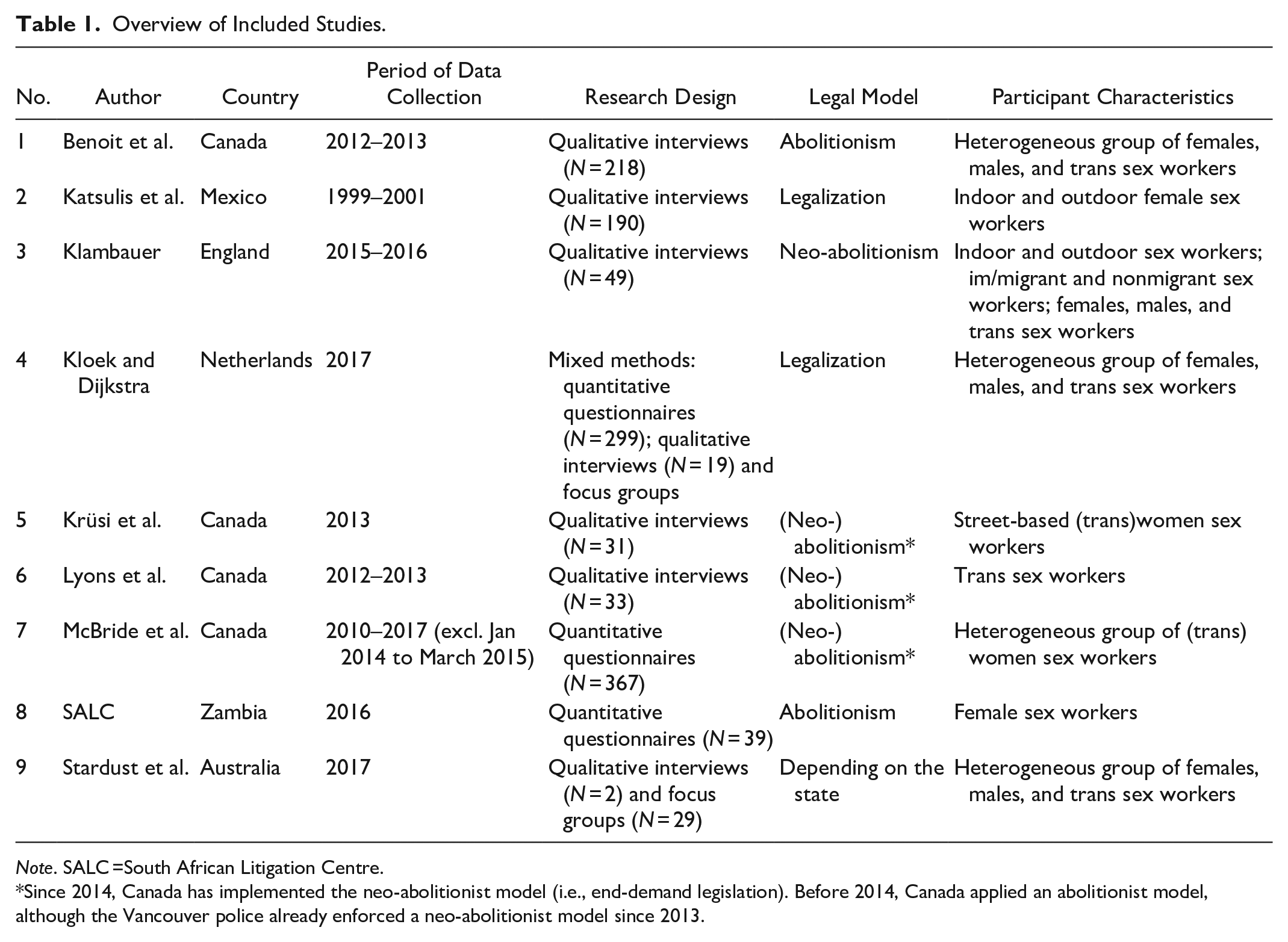
Note. SALC =South African Litigation Centre.
Since 2014, Canada has implemented the neo-abolitionist model (i.e., end-demand legislation). Before 2014, Canada applied an abolitionist model, although the Vancouver police already enforced a neo-abolitionist model since 2013.
Main Results of the Included Studies (n = 9).

Note. SALC = South African Litigation Centre.
Results
This systematic review synthesizes the most relevant literature on the motivations of sex workers to not report victimization to the police. The nine included studies vary in terms of country and legal system, type of participants, methods used, and findings.
Study Characteristics
Sample size and characteristics
The sample size of the included studies ranges from 31 to 367 participants, with an average sample of 108.5 participants. The studies varied in terms of the gender of the studied population. Four of the studies researched ciswomen, cismen, and transgender sex workers (Benoit et al., 2016; Klambauer, 2018; Kloek & Dijkstra, 2018; Stardust et al., 2021). Two studies researched ciswomen and transwomen sex workers (Krüsi et al., 2016; McBride et al., 2020). Two studies only researched ciswomen sex workers (Katsulis et al., 2010; South African Litigation Centre, 2016), and the last study exclusively researched transgender sex workers (Lyons et al., 2017). Overall, in all included studies, at least 65% of the participants identified as ciswomen sex workers.
All studies demanded direct physical contact with clients but vary in the type of sex work that is included. Both indoor and outdoor sex workers were included in most studies, except the study of Krüsi et al. (2016), which exclusively researched street-based sex workers.
Research design
The included studies used a variety of research designs. Most of the included studies (n = 6) used a qualitative design with semi-structured in-person interviews and/or focus groups (Benoit et al., 2016; Katsulis et al., 2010; Klambauer, 2018; Krüsi et al., 2016; Lyons et al., 2017; Stardust et al., 2021). Two studies used an exclusively quantitative design with questionnaires (McBride et al., 2020; South African Litigation Centre, 2016). Only one study used a mixed methods design by combining quantitative questionnaires and qualitative in-depth and focus group interviews (Kloek & Dijkstra, 2018).
Country and legal system
Almost half of the selected studies (n = 4) were conducted in Canada (Benoit et al., 2016; Krüsi et al., 2016; Lyons et al., 2017; McBride et al., 2020) where end-demand legislation 3 was implemented in 2014. Before 2014, buying 4 and selling 5 sex in Canada was legal, only organizing 6 sex work was penalized by the law. Two of the selected studies were conducted in Europe, more specifically England (Klambauer, 2018) and the Netherlands (Kloek & Dijkstra, 2018). At the time of the study, selling sex in the United Kingdom was legal (except for Northern Ireland), while buying and organizing sex work was illegal. In the Netherlands, sex work is legalized, whereby specific regulations are applicable, exclusively for sex workers (e.g., working license). One of the studies was conducted in Australia (Stardust et al., 2021), where states and territories apply a wide variety of prostitution laws and regulations. For example, in New South Wales, sex work is fully decriminalized, whereas brothels in South Australia are fully criminalized. One of the included studies was conducted in Mexico where the sex work industry is legalized but subject to several legislative requirements, such as health cards and licenses for sex work establishments (Katsulis et al., 2010). The final study was conducted in Zambia, where buying and selling sex is legal, but the organization of sex work is a crime (South African Litigation Centre, 2016).
Four Fears as a Barrier to Report Victimization
Sex workers’ motivations for not reporting victimization to the police can be divided into four main categories which we defined during the analysis of the nine studies. The main categories are linked to specific fears sex workers experience when considering reporting victimization to police: (i) fear of punishment, (ii) fear of maltreatment, (iii) fear of exposure, and (iv) fear of impunity.
Fear of punishment
Regardless of the prevailing legalities, fear of punishment is one of the most common motivations for not reporting victimization to the police. Sex workers fear that reporting crimes perpetrated against them could result in they themselves being prosecuted, or having to face financial penalties, on account of their own crimes related to their work or for drug use (Benoit et al., 2016; Katsulis et al., 2010; Klambauer, 2018; Lyons et al., 2017). The fear of punishment is also connected to the legal status of the sex worker, inadequate knowledge of the legal system concerning sex work, and/or possible substance abuse. This is especially pertinent for sex workers whose work is illegal, or who are unlicensed, whose fears of prosecution may have greater consequences (Stardust et al., 2021). This is also likely to apply for those with ambiguous immigration status or sex workers who are registered drug users (Katsulis et al., 2010). The discretion of police officers (i.e., the decision whether or not to arrest or fine a sex worker) as well as uncertainty about laws and regulations can cause high levels of insecurity among sex workers (Benoit et al., 2016) and further decreases the likelihood that sex workers would report being the victim of a crime (Kloek & Dijkstra, 2018). In the Netherlands, for example, there are very few licensed workplaces for male and transgender sex workers, which decreases the willingness to report victimization for fear of being charged for working illegally in the industry (Kloek & Dijkstra, 2018).
Klambauer (2018) showed how all migrant sex workers who were not from the European Union, reported high levels of fear about being deported (Klambauer, 2018). Similarly, Stardust et al. (2021) found that migrant sex workers avoided any contact with police, fearing that disclosing their occupation would lead to the police referring them to the immigration authorities. The results of McBride et al. (2020) also clearly show that migrant sex workers were much less likely to report victimization to the police compared to all other participants (12.7% and 38.2%, respectively), despite experiencing a higher risk of work-related violence (Kloek & Dijkstra, 2018).
Fear of maltreatment
Trust in the police among sex workers is very low (Benoit et al., 2016) and is in itself an important factor in the unwillingness to report crimes (McBride et al., 2020). Sex workers do not expect fair treatment by police officers and fear unpredictable and negative outcomes when contacting them (Klambauer, 2018). This fear of maltreatment by police can be categorized as the second main motivation and is strongly linked to the stigma they feel is associated with their occupation (Benoit et al., 2016). It is striking that even in countries where sex work is (partially) legalized, sex workers fear maltreatment at the hands of the police (Katsulis et al., 2010; Kloek & Dijkstra, 2018).
First, sex workers fear that they will not be taken seriously, or helped by police officers, if they were to file a complaint (Benoit et al., 2016; Klambauer, 2018; Kloek & Dijkstra, 2018; Krüsi et al., 2016; South African Litigation Centre, 2016; Stardust et al., 2021). Sex workers are also concerned that police officers would rather believe the statements of clients (or those reported for the crimes) and would therefore be unwilling to help them (Klambauer, 2018). In the studies of Kloek and Dijkstra (2018) and Klambauer (2018), participants even mentioned the refusal of police officers to register a sex workers’ complaint. Participants in the studies of both Lyons et al. (2015) and Stardust et al. (2021) reported that the inaction of police, which they mostly anticipated, reinforced their feelings of being deserving of the violence they encountered. This feeling is strongly linked to the next fear that creates a barrier for sex workers to file a complaint after being the victim of a crime, more specifically, the fear of victim blaming.
The fear of victim blaming was reported by participants in three of the included studies (Krüsi et al., 2016; Lyons et al., 2017; South African Litigation Centre, 2016). As noted above, sex workers often see violence as “part of the job,” a feeling that is likely compounded by a stigmatized and inconsiderate attitude from the police. Stigmatized thinking, such as “sex workers bring that kind of violence on themselves,” “sex workers cannot be raped,” and “it is what they deserve for choosing this occupation,” only contributes to feelings of discrimination and legal alienation. 7
Sex workers in several studies reported that police officers treated them as undeserving of citizenship rights and basic dignity (Benoit et al., 2016; Klambauer, 2018; Krüsi et al., 2016; Stardust et al., 2021). Stigmatizing and discriminatory treatment, and attitudes toward, sex workers by police, such as, for example, the myth that sex workers are “unrapeable” (Stardust et al., 2021, p. 9; Sullivan, 2007) undermine sex workers’ confidence in them, and therefore creates a high threshold for sex workers to report victimization (Benoit et al., 2016; Stardust et al., 2021). As one of the participants in the Benoit et al.’s (2016, p. 465) study expressed: The discredited status afforded to sex workers in the criminal justice system acts as a blue ceiling that stops sex workers from approaching police for help and limits the fair treatment of sex workers who report crimes against them.
A final aspect that conditions the fear of maltreatment was most explicitly reported by the Zambian study, namely the fear of police brutality (South African Litigation Centre, 2016). In this study, 90% of participants reported experiences of violence from police, or other parties, during working hours. Unfortunately, the study is unclear about what the actual prevalence of police violence against sex workers is, as the numbers are conflated with violence from other parties, such as clients; however, the fact that it is highlighted in the study suggests it has some importance. Equally, the study undertaken in Mexico mentions several, mostly outdoor, sex workers who experienced police violence and police corruption. A similar story emerges in Katsulis et al.’s (2010) study of migrant sex workers in Australia who reported police officers demanding free sexual services to avoid any legal consequences, both in respect of sex work and their potentially illegal status (Stardust et al., 2021). This physical, emotional, and sexual victimization of sex workers by police is also confirmed in the study of Dewey and St. Germain (2014, p. 265), where sex workers in Denver, Colorado, notably describe the “unnecessarily rough treatment during arrest.”
Fear of exposure
Sex workers place a high value on their anonymity which serves as a strategy to avoid violence (e.g., stalking and extortion) and stigma from judicial authorities, official institutions, and friends and family. This can be disturbed if a complaint to the police is filed (Stardust et al., 2021) and one’s occupation is revealed to the authorities and possibly to friends and family (Benoit et al., 2016; Klambauer, 2018; Kloek & Dijkstra, 2018; Stardust et al., 2021). In particular, sex workers who do not have a working license find it essential to remain anonymous from judicial authorities and to not risk prosecution, eviction, and/or other legal consequences (Kloek & Dijkstra, 2018).
Previous studies have suggested that experiences with, and fear of, stigma and discrimination as a result of concealing one’s involvement in sex work, constitutes an important threshold against sex workers registering for health care and protective services (McCausland et al., 2022). One can assume that this fear of exposure also serves as a barrier to report victimization to the police.
Fear of impunity
Sex workers’ fear of impunity from offenders after reporting victimization was explicitly mentioned in two studies (Katsulis et al., 2010; South African Litigation Centre, 2016). Other studies made reference to this fear more implicitly, noting how “sex workers doubted whether reporting had made any sense at all” (Kloek & Dijkstra, 2018, p. 44); or “it’s useless.” Some cited participants’ concerns over reporting crimes with the sentiment, “cause nothing’s gonna be done” (Lyons et al., 2017, p. 4) and because, “the law does not deliver justice” (Stardust et al., 2021, p. 10), all of which confirmed the sense of uselessness with which sex workers regarded reporting of victimization, that was experienced as a threshold that sex workers were unable to meet. The evidence strongly suggests that this feeling of impunity is a consequence of institutional discrimination and is confirmed by the low conviction rates for crimes of violence against sex workers. For example, courts have often interpreted the status of sex workers as one that implies consent for any sexual activities at any time, which denies their right to choose, ruling out the possibility of being the victim of an offence. Consequently, violators are not prosecuted (Anderson, 2004), and justice for the victims of violent crime is denied.
This has an important and perverse effect on the risk of violence against sex workers. Namely, those who commit (commonly violent) crimes against sex workers (namely, clients, other third parties, or police) know that sex workers will be reluctant to file a complaint. Such a situation where offenders have the knowledge that they can act with impunity and get away with it, increases the risk of violence against sex workers (Katsulis et al., 2010; Kloek & Dijkstra, 2018; McBride et al., 2020), and also generates a sense of normalization with regard to violence against sex workers (Krüsi et al., 2016; Lyons et al., 2017).
Intersectional and Personal Factors as Additional Barriers
In the study of McBride et al. (2020), 34% of those who participated reported high levels of distrust toward the police, which was noted as an important indicator of whether sex workers reported victimization or not. Similarly, Fey (2019) begins with the hypothesis that sex workers’ willingness to report victimization to the police is strongly correlated to the levels of trust in police. Arguably, the depressed incentive to report crimes is not unrelated to the stigmatized discourses and attitudes of the police experienced by sex workers, and widely documented in the studies considered here.
Policing sex work is two-fold and is marked by an essential contradiction: sex workers are at risk, yet they simultaneously pose a risk to society (Armstrong, 2014). Accordingly, police play a dual role when it comes to policing sex work (Fey, 2019; Klambauer, 2018; Stardust et al., 2021). On the one hand, police are responsible for enforcing sex work regulations and clamping down on crimes that are related to sex work (e.g., pimping, unlicensed sex work, and drug use) (Kloek & Dijkstra, 2018; Stardust et al., 2021), yet on the other, police ought to be the protectors of all citizens, including sex workers. The evident contradictions attached to this duality, causes well-founded insecurity and fear among sex workers.
Studies reflect that distrust toward the police is largely the result of sex workers’ negative experiences or those of fellow sex workers’ (Benoit et al., 2016; Footer et al., 2019; Stardust et al., 2021). According to Benoit et al. (2016), procedural justice is more effective in building sex workers’ confidence in the police than focusing on the specific content of the law; however, levels of police trust toward sex workers were shown to be significantly lower than that they had for the general population in Canada. This is evinced by sex workers who reported a low expectation of receiving fair treatment when they interact with police (Benoit et al., 2016). Positive experiences with the police as a source of help, meaning they experienced fair and equal treatment, was critical to creating relationships of confidence and trust between sex workers and police (Benoit et al., 2016; Klambauer, 2018). Small and friendly reactions and actions from police officers were seen to strengthen trust and legitimacy of police (Tyler, 2011). Confidence in police could, in its turn, increase the willingness to report victimization (Benoit et al., 2016; Klambauer, 2018). Several personal characteristics, such as the type of sex work, gender, substance abuse, migration status, ethnicity, and so on (Benoit et al., 2016; Stardust et al., 2021), can serve to reinforce different levels of stigma associated with sex work, and consequently impact upon their willingness to report victimization to the police.
Being a sex worker
The type of sex work one is engaged in can often determine the levels of violence, trust toward the police, and thresholds that apply when filing a complaint to the police. For example, street-based sex workers are considerably more vulnerable to becoming a victim of violence, in comparison to indoor sex workers (Church et al., 2001; Deering et al., 2014; Kinnell, 2006; Sanders & Campbell, 2007). At the same time, several international studies concluded that street-based sex workers were more willing to contact the police when they were victims of a crime (Brooks-Gordon, 2006; Klambauer, 2018). Klambauer (2018), for example, found that street-based sex workers reported higher levels of trust in police, which arguably explained their increased propensity to report instances of violence. The same conclusion was drawn by Connelly et al. (2018), who suggested that street-based sex workers were more likely to report violence to the UK National Ugly Mugs, 8 compared to sex workers who work for escort agencies or with those who work independently. This overrepresentation might be explained by spatial factors: street-based sex workers are more visible to police and aid organizations, creating more opportunities for street-based sex workers to report victimization (Benoit et al., 2016; Connelly et al., 2018). Similarly, in comparison to sex workers that meet their clients at home, those who work in the Red-Light District are more willing to file a complaint or to approach the police in the Netherlands—the former fearing eviction from their homes if they reported victimization to the police (Kloek & Dijkstra, 2018).
Being an (un)licensed sex worker
In comparison to illegal sex workers, those who work legally in the sex industry experience a more positive relationship with the police (Katsulis et al., 2010). We might reasonably expect that licensed, or legally working sex workers, are not as exposed to identified fears such as fear of punishment and fear of exposure, thus decreasing their threshold of reporting victimization to the police.
Being a male/female/transgender sex worker
One of the Canadian studies mentions the over-policing of female sex workers relative to those who identify as male and/or transgender (Benoit et al., 2016). Other studies, however, reported a higher risk of violence toward, and a greater reluctance to report crimes to the police, from male and transgender sex workers (Kloek & Dijkstra, 2018; Krüsi et al., 2016; Lyons et al., 2017). As alluded to above, there are few licensed workplaces available for male and transgender sex workers in the Netherlands, which constitutes a structural barrier to contacting the police. According to Lyons et al. (2017), transgender sex workers are confronted with multilayered forms of discrimination: stigma and violence as a sex worker, homophobia, and transphobia, which results in a triple layered intersectional level of discrimination. As Lyons et al. (2015, p. 5) state: Lack of police response to violence against trans sex workers is firmly rooted within the context of criminalization, where sex workers are considered criminals, and within the context of transphobia, where trans persons are framed as deviant.
Being a migrant sex worker
Migration status is an important barrier to reporting instances of victimization to the police. Ambiguous residency increases the fear of arrest, deportation, related immigration charges, police brutality, and discrimination (Klambauer, 2018; Krüsi et al., 2016; McBride et al., 2020). According to the study of McBride et al. (2020), only 12.7% of im/migrant sex workers reported victimization to the police, in contrast to 38.2% of all participants. According to Fey (2019), this reluctance of migrant sex workers to contact the police can be explained by shorter term involvements, language barriers, and negative experiences with the police in the country of origin or previous countries of employment.
Being an ethnic minority sex worker
According to the studies of Krüsi et al. (2016) and McBride et al. (2020), indigenous sex workers in Canada have the lowest levels of trust in the police due to racialized policing and negative experiences when filing a complaint or contacting the police in the past. Although this group of sex workers in Canada experiences significantly more violence, their colonial experiences of intergenerational poverty and discrimination have led to a historical reluctance to contact the police and report victimization (Krüsi et al., 2016; McBride et al., 2020).
Being a drug-using sex worker
Sex workers who use drugs or other substances report increased levels of fear when considering whether or not to report victimization (Katsulis et al., 2010; Klambauer, 2018). Although they experience higher levels of violence from clients, their fears correlate most strongly with the desire to avoid prosecution for drug-related offenses.
Normalization of Violence Against Sex Workers
The consequence of the deep-rooted distrust of police, and the reluctance of sex workers to report incidences of victimization, is that violence toward sex workers has become de facto normalized in most societies (Crago et al., 2021; Ślęzak, 2017). Clients and police officers who commit crimes against sex workers do so with impunity, which in turn increases the risk of violence toward sex workers (Bungay & Guta, 2018; Dalla et al., 2003; Katsulis et al., 2010; Lyons et al., 2017; Mahapatra et al., 2014). At the same time, the low prevalence of reporting victimization to the police by sex workers highlights the inaccessibility of the legal system and the inequality in the social distribution of police protection (McBride et al., 2020), which is compounded by intersectional dynamics (i.e., type of sex work, gender, etc.) (Klambauer, 2018). The unwillingness of police to record a sex workers’ statement further increases the feeling of alienation from the criminal justice system and results in legal powerlessness (Benoit et al., 2016; Hertogh, 2014; Klambauer, 2018). As Krüsi et al. (2016, pp. 1142, 1143) report: Participants felt they were denied their citizenship rights for police protection and legal recourse by virtue of their ‘risky’ occupation. This [stigma] increases sex workers’ structural vulnerability to violence as they have to operate outside the societal protections other citizens can take for granted.
Notwithstanding the distribution of inequalities noted above, the unwillingness to contact the police can be seen as an act of self-care by which sex workers seek to avoid additional stigma and discrimination (Stardust et al., 2021). Evidence does suggest, however, that in recent decades, the attitudes of actors in the criminal justice system toward sex workers have been gradually shifting, and police, judges, and juries are beginning to make a distinction between consensual and nonconsensual sexual services provided by sex workers. In that instance, sex workers are being recognized, albeit slowly, as potential victims of rape and assault on an equal footing as with other women in society (Sullivan, 2007).
Discussion
The results of this systematic review have focused exclusively on the barriers which prevent sex workers from reporting victimization to the police. The outcomes, however, prompt the necessary question of remedies and reforms that can have a positive impact on the safety of sex workers worldwide. Based on the findings of this systematic review of the international literature, what needs to change for the willingness of sex workers to report victimization to the police to increase?
What Can Be Done About Laws and Regulations?
One of the most important barriers sex workers face in reporting victimization to the police emerging from the literature is the fear of punishment. Strongly linked to this is the lack of knowledge regarding national laws and local regulations among sex workers (Kloek & Dijkstra, 2018, p. 45), which even if they are intended to increase the willingness of sex workers to report victimization to the police, can have the opposite effect. In Canada, for example, end-demand legislation was implemented in 2014 with the objective of providing greater levels of safety for sex workers (McBride et al., 2020). By criminalizing clients, policymakers intended to increase the willingness to report victimization by recognizing sex workers as victims. However, three studies (Krüsi et al., 2016; Lyons et al., 2017; McBride et al., 2020) found that the end-demand legislation had no positive impact on the confidence of sex workers toward the police, failing to meet its main goal, and push sex workers further into marginalization. As the activities of sex workers must occur in a hidden and covert manner, they have less time to screen their clients, which, therefore, negatively impact their safety and health.
One of the main recommendations from almost all the studies considered here is to decriminalize the sex work industry. When the buying, selling, and organization of consensual sex work is decriminalized, sex workers report more trust toward the police, and feel more secure in filing a complaint against a violent client (Armstrong, 2017; Lutnick & Cohan, 2009), whereas the criminalization of sex workers, and/or clients, further emphasizes the marginalized position of sex workers in society (Benoit et al., 2016). On the available evidence, decriminalization of the sex industry offers a clear remedy to problems such as unclear laws and regulations and discriminatory attitudes toward sex workers in the legal system. Nevertheless, decriminalization is not the holy grail and sex workers are still in the danger zone for stigmatization and discrimination, based on their ethnicity, sexual orientation, drug abuse, and homelessness for example (Lutnick & Cohan, 2009).
What Can Be Done About Police Practices?
It would not be unreasonable to hypothesize that higher levels of trust in the police would be an important factor in encouraging sex workers to report victimization. Underlying their unwillingness to do so is their fear for maltreatment at the hands of the criminal justice system in police. To increase the willingness to report a crime to the police, the necessary conditions for police legitimacy need to increase as well (Benoit et al., 2016; Fey, 2019). Increasing police legitimacy is not solely an individual act, but also requires institutional change (Tyler, 2011). Several actions can be undertaken by individual police officers and the police organization to maximize procedural justice in which training, police leadership, and operational guidelines play an important facilitating role (Tyler, 2011; Tyler et al., 2007).
First, police must improve the quality and transparency of their decision-making processes (Tyler, 2011), which evidence shows results in a greater willingness to report victimization. The specialized Red Light District unit in Geneva, for example, do follow-ups on complaints and explain to sex workers how their complaints are being treated by police (Fey, 2019). By increasing their presence in the neighborhood, avoiding any controlling police strategies (e.g., controlling working licenses), and explicitly cooperating with medical and social outreach organizations, police can increase their legitimacy and decrease the threshold for sex workers to file a complaint (Benoit et al., 2016; Connelly et al., 2018; Fey, 2019).
Second, police should ensure an equal and respectful interaction with all citizens, irrespective of their profession. Small actions, such as the use of language (e.g., “sex workers” instead of “whores” or “girls”), could increase their legitimacy in this group (Fey, 2019). Stardust et al. (2021) also recommended sensitivity training for police officers, mostly provided by sex worker organizations, to change attitudes toward sex workers and avoid the risk of stigmatized and discriminatory treatment when contacting the police. Participants in this study confirmed the importance of such sensitivity training, as well as specialized police units, with whom they felt more comfortable with during interactions (Stardust et al., 2021). This attitude shift can possibly be the biggest challenge. Hence, Stardust et al. (2021, p. 13) propose further legal, cultural, and systemic changes to shift attitudes (from police and the wider society) and guarantee access to civil rights for sex workers.
Conclusion
The decision to report or not report is complex, multilayered, and intersectional, which was aptly described by one of the participants cited in the Stardust et al.’s (2021, p. 11) study as a “sort of cost benefit analysis.” We argue that this can be distilled into the four main fears experienced by sex workers: (i) fear of punishment, (ii) fear of maltreatment, (iii) fear of exposure, and (iv) fear of impunity. Individual factors, such as gender, type of sex work, and legal status, determine which fear will be crucial, or non-existing, in the decision-making process. Trust, or the lack of it, in the police is an important explanatory factor in sex workers’ willingness to report victimization or not. Actions to improve procedural justice, such as ensuring the equal and respectful treatment of sex workers, and a transparent and objective decision-making process, could improve police legitimacy among this group.
Limitations and Implications of This Review
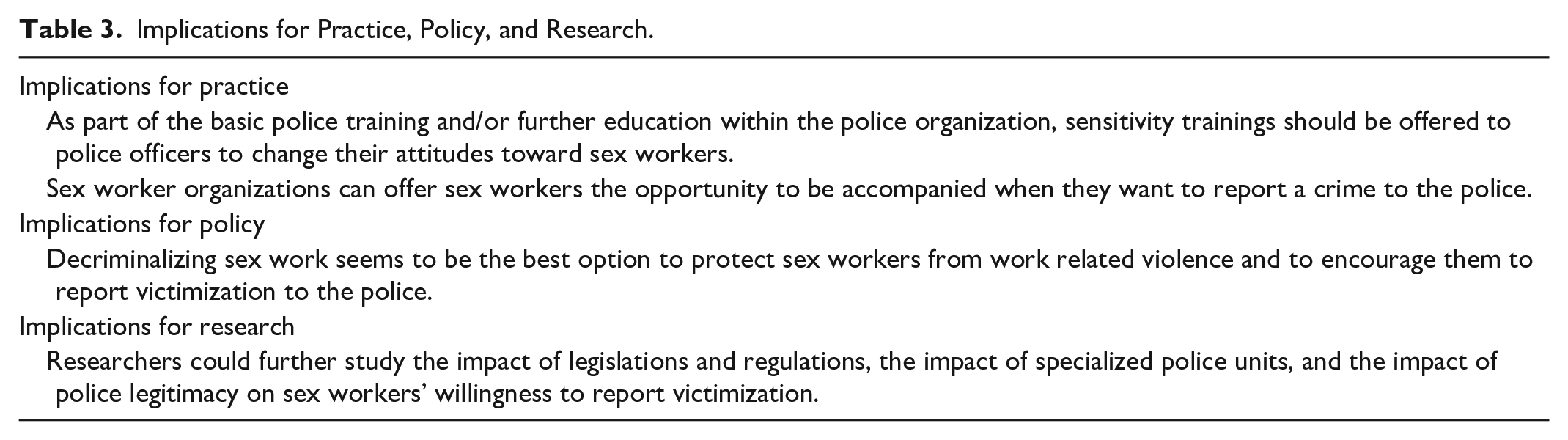
The systematic review presented here has limitations, but these ought to be considered as pointers to further research. Only nine articles met the inclusion criteria for this review, resulting in some blind spots. First, the selected studies were all written in English, which limits the international scope of the review. If replicating this review, the findings are likely to be enhanced by the inclusion of studies from more diverse sources of scholarship. Second, girls and women involved in sex work who did not yet reach the national age of consent as well as victims of human trafficking were not explicitly covered by the research in this review, resulting in a research population of those with greater levels of agency. 9 Third, in all studies, except for the study of Lyons et al. (2017), at least 65% of respondents identified as ciswomen, creating an underrepresentation of cismale and transgender sex workers. Interestingly, these last groups are confronted with multiple stigma: being a sex worker, being trans, and/or homosexual. This suggests an opportunity for further empirical research on the topic to gauge the extent to which these intersectional characteristics condition their experiences. Fourthly, as mentioned above, national legal systems concerning sex work have an impact on the relationship between sex workers and police, and thus, affect the threshold levels of reporting victimization to the police. The relative effect of these laws and regulations cannot be measured in this review but could form the basis of future socio-legal studies of police and sex worker relationships. Finally, it is not always clear which definition of violence and victimization was used in the selected, nor can it be known if certain cultural particularities have some bearing on respondents’ definitions. Consequently, it is possible that not all types of crimes are considered in all the studies. For example, some sex workers did not define condom refusal by a client as work-related violence, whereas other sex workers did. In the study of Kloek and Dijkstra (2018), financial and economic violence was explicitly included, in contrast to all other included studies. However, while some differentials existed, they ought not to be considered strong enough to undermine the broad findings that were reported, as the focus of the review was on the motivations for not contacting the police. Nor does it alter the strong suggestion that changing the attitudes toward sex work, and sex workers, will improve their position in our society, and ensure their civil rights as equal citizens are recognized within different criminal justice systems. The implications of this study for practice, policy, and research are summarized in Table 3.
Implications for Practice, Policy, and Research.
Footnotes
Acknowledgements
I would like to thank Andres Steyls and Silke Van Cutsem for assisting me in collecting the data and Fraser King for proofreading the article.
Declaration of Conflicting Interests
The author(s) declared no potential conflict of interest with respect to the research, authorship, and/or publication of this article.
Funding
The author(s) received no financial support for the research, authorship, and/or publication of this article.
