



Abstract
Climate change and extreme weather events have been shown to increase incidences of gender-based violence (GBV). Numerous organizations have devoted significant time, resources, and effort to the design and implementation of interventions aimed at reducing GBV in Africa. Some interventions effectively reduce violence, but GBV persists and remains pervasive. The United Nations has called for GBV interventions that consider the impact of climate change on violence. This review aims to determine whether public health interventions intended to reduce GBV in Africa take into account the effects of climate change on the region and the population. PubMed, PsychArticles, and CINAHL databases were searched systematically in February 2023 for interventions conducted in Africa published between 2010 and 2023. There were a total of 86 articles in the final review that described 40 distinct interventions. The intervention designs included empowerment and participatory approaches (microfinance, microfinance plus, community education, and community engagement), changing social and cultural norms (community education, community engagement, and media), and school-based programs. None of the 40 interventions mentioned climate, weather, or climate change as a component of the intervention. There are several opportunities to improve existing, successful GBV interventions in order to increase their efficacy. GBV interventions could incorporate economic independence programs that do not rely on agriculture and include climate change education. These findings could facilitate the integration of two previously distinct research disciplines—climate change and GBV prevention—to inform future research and develop more effective and cost-efficient interventions.
Keywords
Introduction
Globally, climate change and extreme weather events have been explored as potential catalysts of violence (Mearns et al., 2012). This is particularly apparent in agrarian-based economies (Wozniacka, 2021). As the variability of weather patterns increases, severe weather events disrupt the agriculture and fishing industries. Those who rely on agricultural work face a multitude of stressors because of climate-change-related severe weather events (Wozniacka, 2021). Following disasters, dwindling financial prospects and the threat of long-term unemployment cause stress and become a contributing factor to the rise in violence (Mearns et al., 2012). Food insecurity due to meager harvests or the loss of livestock during severe weather events causes feelings of insecurity, anxiety, and stress among men who can no longer provide for their families (Cartier, 2021; Gevers et al., 2019). These disruptions increase family stress and diminish food affordability, which could lead to millions of people falling into extreme poverty (D’Alessandro, 2015; Sanz-Barbero et al., 2018; USAID 2020). Moreover, because small-scale subsistence farmers rely solely on their agricultural production to support their families, a natural disaster has a negative impact on their means of subsistence. The disruption and challenge to traditional gender roles and the decline in income for a household give rise to gender-based violence (GBV) (Castañeda Camey et al., 2020).
The purpose of this study is to examine current interventions aimed at reducing GBV and determine whether the effects of climate change are considered through a systematic review of the literature. In the subsequent paragraphs, we expound upon the ramifications of climate change on women, an intersectionality approach to the issues of climate and violence, and United Nations (UN)’s call to empower women in climate change efforts.
Women and children often bear the brunt of climate-change-induced turmoil. Extreme weather patterns can place women and girls in a more vulnerable position and frequently contribute to an increase in violence (Allen et al., 2021; US EPA, 2016). Data illustrate a pattern of increased GBV following extreme weather events like droughts and floods (Allen et al., 2021; CARE International, 2015). In many parts of the world, women and children, typically girls, often perform daily tasks such as collecting water and firewood for the household. When droughts, deforestation, and floods deplete nearby supplies, women and children are forced to walk further to get these necessities (Cwienk, 2020), and walking further distances can increase the likelihood of sexual assault (Birch-Jeffrey, 2019; Gevers et al., 2019). Some studies have found that girls are forced to marry at a young age in exchange for food or livestock when droughts or floods destroy crops (Cwienk, 2020; Pope et al., 2022; UNFPA, 2021b). Transactional sex exchange (jaboya) is a recognized issue in coastal Kenyan regions where women are forced to engage in sex to gain access to fish; declining fish populations have exacerbated this issue (Davis & Silver, 2019).
The significance of considering the intersectionality of climate and GBV cannot be overstated, as it illuminates their intricate and multifaceted nature. The theoretical framework of Crenshaw emphasizes the intersection of systemic inequalities, which creates unique experiences for marginalized groups (Crenshaw, 1991). In this context, marginalized gender identities, socioeconomic status, and geographical location can exacerbate individuals’ vulnerability to climate-induced disasters and GBV. Those who live in impoverished neighborhoods have a higher link with violence than those who reside in affluent communities (Mares et al., 2013). This demonstrates how severe weather and climate change can exacerbate violence in an already vulnerable group due to increased stress. The aftermath of natural disasters can exacerbate existing patterns of violence, including partner violence. The stress, dislocation, and disruption caused by these disasters may contribute to an increase in violence and conflict among damaged communities (Rezaeian, 2013). Inadequate access to resources and support networks during the post-disaster recovery period may also increase the chance of violence (Gearhart et al., 2018). In the African context, where environmental shifts can lead to significant socioeconomic ramifications, it is crucial to consider the interconnectedness of these factors in order to develop comprehensive, culturally attuned, and effective solutions. The combination of marginalized gender identities, socioeconomic status, and geographic location may exacerbate individuals’ vulnerabilities in relation to climate-induced disasters and GBV.
The global hazards posed by climate change and environmental degradation are likely to exacerbate the growing number of complex crises that disproportionately affect women and girls. Though they are among the most vulnerable to its effects, women are frequently excluded from decision-making and, therefore, unable to affect changes that would improve their health, safety, and chances of survival (Castañeda Camey et al., 2020; Elwell and Williams, 2016). In 2022, the UN Secretary General issued a report regarding the need and strategy for achieving gender equity and empowerment in the context of climate change and environmental disaster risk reduction policies and programs (UN Commission on the Status of Women, 2022). In this report, the Secretary General admonished countries for not making significant strides in reducing gender inequities in relation to climate change as the UN had called for in 2016 (UN Commission on the Status of Women, 2022). The report identified several negative effects of climate change experienced by women, including GBV. The report further identified several action items for countries to complete to improve gender equity in the fight against climate change, including economic empowerment of women in sustainable industries, climate change resilience, climate change education, and programs to reduce GBV (UN Commission on the Status of Women, 2022).
Given the strong evidence that climate change and GBV are connected and the push from the UN to address climate change and violence, the authors questioned if and how these two issues are being addressed together. As the effects of climate change intensify, resource scarcity will exacerbate (or render unpredictable) economic duress and increase GBV (UN Commission on the Status of Women, 2022). Therefore, if the design of a GBV intervention considers how climate change may impact the target population, it will likely have the greatest potential impact with the most efficient use of resources.
This review aims to determine whether public health interventions to reduce GBV in Africa take into account the effects of climate change on the region and the population. More than 60% of sub-Saharan Africa’s population are small-scale farmers, and about 23% of the region’s gross domestic product is derived from agriculture (Goedde et al., 2019). Climate change can significantly impact agrarian-based economies in Africa, affecting agricultural productivity and exacerbating existing vulnerabilities. Considering the intersection of GBV and climate change is crucial for developing effective interventions that address the unique challenges faced by women in these contexts. The findings of this systematic review will facilitate the integration of two previously distinct research disciplines—climate change and GBV prevention—to inform future research and develop more effective and cost-efficient interventions.
Methods
Search Protocol and Study Selection
This systematic review conforms to the Preferred Reporting Items for Systematic Reviews and Meta-Analyses 2020 Statement (Page et al., 2020). The following databases were searched for this systematic review: PubMed, PsychArticles, and CINAHL. We were interested in knowing if climate change was a consideration in the design of GBV interventions; thus, we used broad search terms to capture any article about an intervention in any African country focused on GBV.
We used the following inclusion criteria to capture all GBV-focused interventions: Articles had to include a description of an intervention, the intervention had to be based in Africa, and the intervention had to be designed to reduce GBV. Interventions that were not yet implemented or reviewed for efficacy were still included in this review as long as they met the inclusion criteria. The World Health Organization (WHO) Report in 2010 called for GBV prevention research (WHO, 2010); thus, each search included date ranges for articles published between January 1, 2010 and February 12, 2023. In addition, we restricted our review to English-language, peer-reviewed journal articles. Search results were imported into the Covidence systematic review application (Covidence, 2023). Covidence is a web-based collaboration software platform that streamlines the production of systematic literature reviews.
In the initial phase of screening, the authors examined the articles based on their titles and abstracts. At this stage of vetting, the authors employed Covidence’s two-reviewer approval method. Two of the three reviewers had to concur on an article’s inclusion or exclusion for it to be included or excluded from this review. Conflicts that arose between the first and second reviewers were discussed by all three reviewers, and the third reviewer made the final decision regarding inclusion or exclusion. This process helped to assure consistency during article review and selection. Only articles that were clearly outside the scope of this systematic review were excluded during the initial review of titles. To avoid improperly excluding an article, articles were included for the next level of review when uncertainty existed.
We identified 13,039 articles from the 3 databases. After removing 1,774 duplicates, there were 11,264 articles remaining for initial screening. A total of 11,053 articles were excluded after title review, and another 106 were excluded after abstract review because they did not meet the inclusion criteria. Through full text review, another 20 articles were excluded due to the following: (a) the article did describe a GBV intervention (N = 13); (b) the article was not about Africa (N = 1); (c) the intervention in the article aimed to identify victims of GBV in clinical settings or improve clinical treatment rather than prevent GBV (N = 4); and (d) the article was not within scope for multiple of reasons 1–3 (N = 2). After this full-text review, 86 articles remained for final review. The included articles are noted with an asterisk in the list of references. The study selection flow is shown in Figure 1.
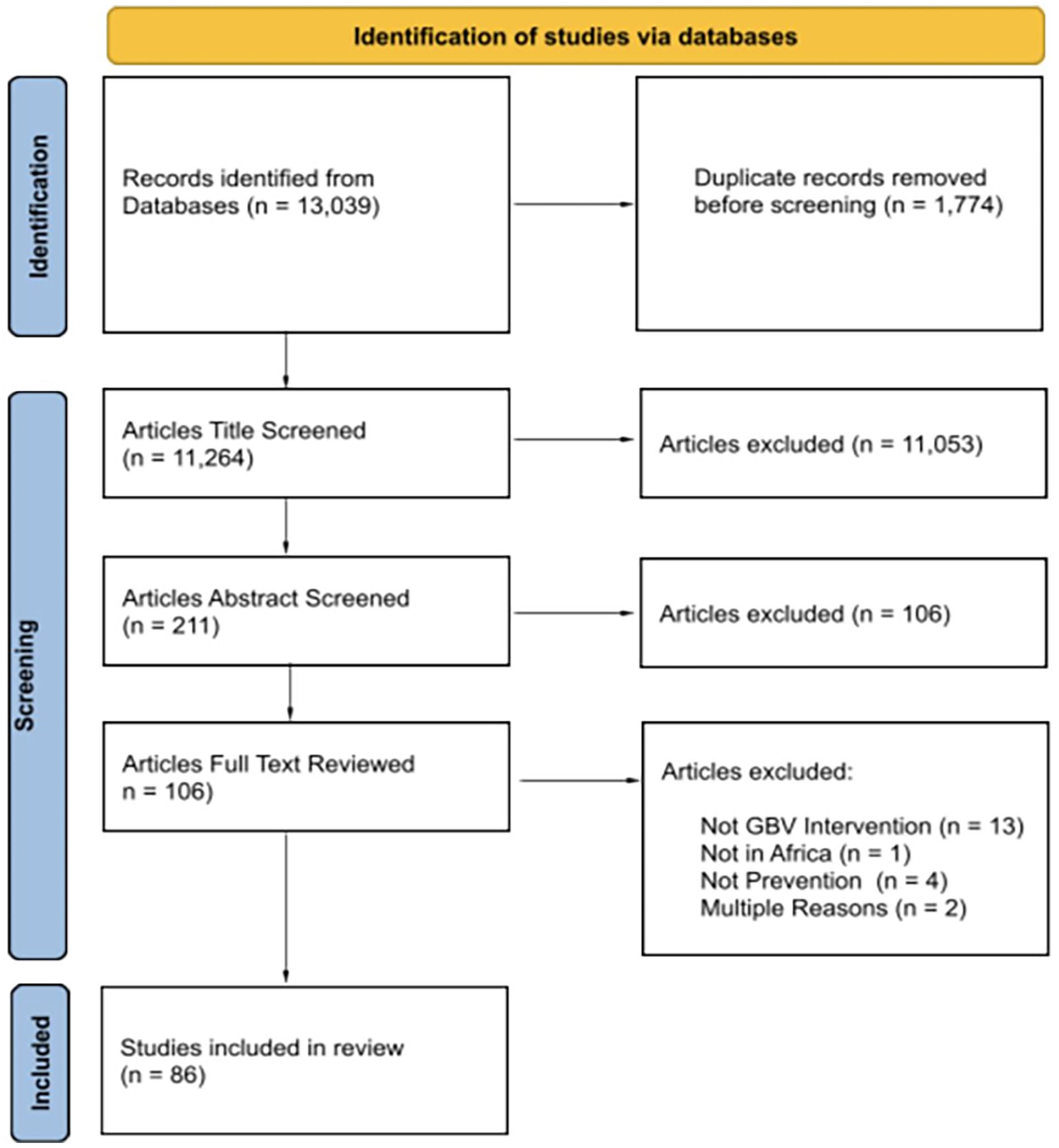
Preferred reporting items for systematic reviews and meta-analyses diagram.
Data Extraction and Analysis
To evaluate the final manuscripts, the authors developed a template for standardizing data collection. One author extracted all pertinent data from each article, including general information (author(s), year of publication, article title, and Covidence database number) and substantive information (summary of intervention, target population, location of intervention, theory of the intervention, number of people participating in intervention, and whether the intervention was successful at reducing GBV if it was implemented). In 2010, the WHO identified several types of GBV interventions that had some evidence of success, including: school-based programs to prevent violence, empowerment and participatory approaches to reduce gender inequality, home visitation programs to prevent GBV, programs to reduce access to alcohol, and changing social and cultural norms related to gender (WHO, 2010). We grouped the interventions by these WHO categories as well as the type of intervention.
Results
The 86 articles assessed 40 distinct interventions. Numerous articles examined the same multiple interventions or variants of one of those interventions. Intervention with Microfinance for AIDS and Gender Equity (IMAGE) intervention (N = 5), Start, Awareness, Support, Action (SASA!) study (N = 7), CETA intervention (N = 6), Indashyikirwa Program (N = 4), CHANGE intervention (N = 5), MAISHA intervention (N = 5), Rural Response System (N = 3), and Stepping Stones and Creating Futures (N = 4) were the interventions most frequently discussed and analyzed.
The interventions were conducted in only a small percentage of African countries: South Africa (N = 6), Rwanda (N = 4), Tanzania (N = 6), Ghana (N = 1), Uganda (N = 5), Somalia (N = 1), South Sudan (N = 2), Ethiopia (N = 3), Democratic Republic of the Congo (N = 4), Mali (N = 1), Kenya (N = 6), Malawi (N = 1), Côte d’Ivoire (N = 2), Nigeria (N = 2), and Liberia (N = 11). Some of the interventions were conducted in multiple countries. The authors only reviewed the portions of the programs conducted in Africa. The interventions targeted a wide range of populations, including women, men, couples, children, families, and entire communities more generally. Some of these interventions had additional aims beyond reducing intimate partner violence (IPV). The authors only reviewed aspects of the intervention related to IPV reduction. The details of the interventions are summarized in Table 1.
Summary of Interventions Identified in Articles.
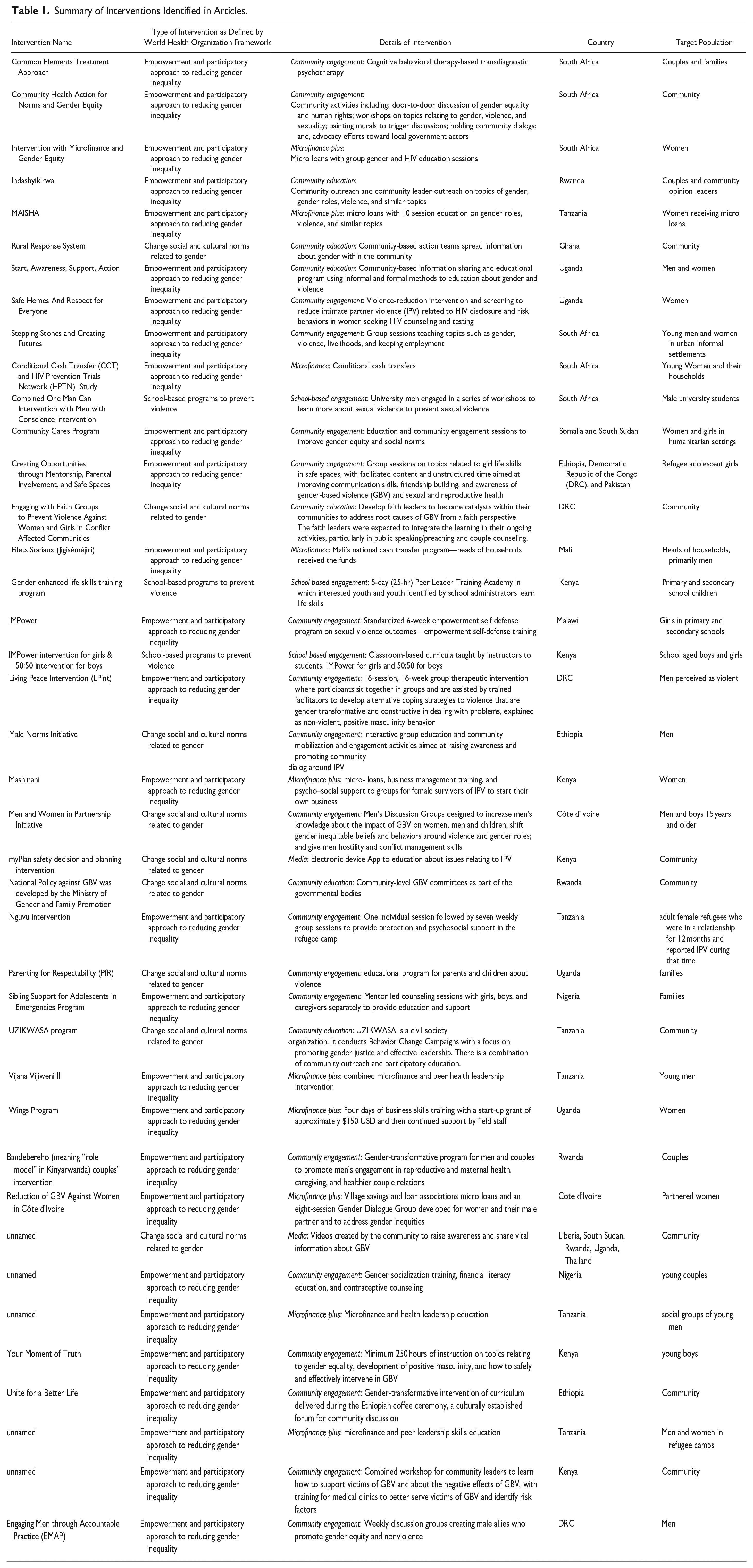
None of the articles indicated that climate change was a factor in any of the interventions investigated or that climate change literacy was a component of any intervention-related education. Three of the WHO-recommended evidence-based strategies to reduce GBV were used in the 40 identified interventions: empowerment and participatory approaches to reduce gender inequality, changing gender-related social and cultural norms that support IPV and sexual violence, and school-based programs to prevent dating violence in secondary schools.
Empowerment and Participatory Approaches to Reduce Gender Inequality
The majority of interventions utilized the empowerment and participatory approaches (N = 28). These interventions fell into four main categories: community engagement (N = 16), microfinance (N = 2), microfinance plus programs (N = 8), and community education (N = 2). Microfinance plus programs combined gender equity education with microloans. For example, the IMAGE program implemented in South Africa is one of the most studied GBV reduction interventions (WHO, 2010). IMAGE targets the poorest women in rural areas and provides them with combined microfinance loans and skills-building sessions on IPV, HIV prevention, gender norms, cultural beliefs, and communication (Hargreaves et al., 2010; Ranganathan et al., 2021; WHO, 2010). IMAGE also seeks to develop broad community engagement among men and boys so that all are educated about issues of gender equity (WHO, 2010). Ultimately, IMAGE aims to improve women’s economic positions, their influence within the household, strengthen relationships, including reducing IPV, and reduce HIV transmission (Hargreaves et al., 2010; Ranganathan et al., 2021; WHO, 2010). A randomized-controlled trial found that IMAGE participants reported experiencing 55% fewer acts of IPV 12–24 months after completing the program compared to a control group (WHO, 2010).
Community engagement interventions included activities such as focus groups teaching about gender equity issues. For example, Stepping Stones is a training package that encourages communication and relationship skills within communities (Gibbs, Washington et al., 2020; WHO, 2010). Training sessions are conducted for single-sex groups of women and men (Gibbs, Washington et al., 2020; WHO, 2010). A randomized-controlled trial in South Africa found that a lower proportion of men who had participated in Stepping Stones committed physical or sexual IPV in the 2 years after they completed the program as compared with men in a control group (WHO, 2010).
SASA! is an “activist kit” aiming to mobilize communities to prevent IPV with a focus on the connection between HIV/AIDS and violence against women (Michaels-Igbokwe et al., 2016; WHO, 2010). The SASA! kit includes communication materials, training materials, and monitoring and assessment tools to support local activism, media, and advocacy activities. The intervention seeks to change gender norms and improve gender equity (Michaels-Igbokwe et al., 2016; WHO, 2010).
Change Social and Cultural Norms Related to Gender that Support IPV and Sexual Violence
The next most common type of intervention was to change social and cultural norms related to gender (N = 9). These interventions included community education (N = 4), community engagement (N = 3), and media (N = 2). These interventions included creating radio programs and videos to raise awareness about GBV that would be shared throughout the target population and providing information to community leaders so that they could include messages about GBV in their communications with communication members (Abeid et al., 2015; Gurman et al., 2014; Ismayilova et al., 2018). For example, one intervention, myPlan, developed a phone app to teach community members about GBV and provide the ability to report unhealthy behaviors in their relationships (Decker et al., 2020).
School-Based Programs to Prevent Dating Violence in Secondary Schools and Colleges
Finally, the last type of intervention utilized was school-based programs to prevent dating violence (N = 3). School-based programs included group learning sessions for adolescents in secondary school to learn how to develop healthy interpersonal relationships (Baiocchi et al., 2017; Decker et al., 2018; Edwards et al., 2022) and group sessions in universities to help young adult men unlearn unhealthy attitudes toward violence, masculinity, and relationships (de Villers et al., 2021). For example, IMPower is a 6-week program designed to provide life skills training to primary and secondary school girls. Lessons include negotiation skills to resolve conflict, skills to identify when a situation may be escalating, and self-defense techniques (Decker et al., 2018).
Discussion
GBV persists as a global health issue due, in part, to the increasingly unpredictable economic effects of climate change, particularly in regions where livelihoods are climate-dependent and natural disasters have a greater impact (Mearns et al., 2012; Wozniacka, 2021). There are substantial public health efforts to reduce GBV—in this literature review, we identified 40 unique interventions aimed at reducing GBV in Africa. The findings underscore the necessity of adopting a comprehensive strategy for interventions addressing GBV in Africa. In this literature review, we identified three key findings: (a) GBV interventions do not consider the impact of climate in their design, (b) only three of five strategies recommended by the WHO are being implemented to reduce GBV, and (c) many interventions identified are easily adaptable to incorporate climate-focused strategies.
Our first key finding found that no interventions aimed at reducing GBV in Africa consider the role of climate or climate change on violence. Climate change organizations and organizations dedicated to eliminating GBV are collaborating toward a common objective. The UN recognizes that addressing climate change and gender inequality are inextricably linked and intends to employ an approach that recognizes the role of gender and empowers women in its efforts to mitigate and adapt to climate change. The UN also acknowledges that climate change has a disproportionate effect on women, with increased economic stress leading to an increase in the incidence of GBV. In 2016, the UN reported a lack of progress in this area, despite having urged organizations working on climate change to resolve gender disparities in their programs. In response, the UN has committed $100 billion to initiatives that promote gender equality in climate change resilience efforts (UN Commission on the Status of Women, 2022). The existing body of evidence establishes a connection between climate change and GBV. Furthermore, the UN has emphasized addressing climate change and violence. It is worth noting, however, that interventions targeting GBV have yet to incorporate an explicit consideration of the ramifications of climate change. As the impacts of climate change become more severe, the limited availability of resources will further contribute to economic stress and perhaps escalate GBV (UN Commission on the Status of Women, 2022). Understanding the potential link between climate change and GBV is crucial for developing effective intervention strategies. By acknowledging the interplay between these two issues, policymakers and practitioners can better address the underlying causes of GBV and allocate resources accordingly. Additionally, incorporating climate change considerations into GBV interventions can help foster resilience within communities and mitigate the exacerbation of violence in times of environmental crisis.
In 2010, the WHO identified that there was little evidence on effective interventions to reduce GBV (WHO, 2010). In a report that year, the WHO issued a call to action for increased research on GBV prevention. The WHO recommended types of interventions that had some evidence of success and provided a framework for developing future interventions with monitoring and evaluation programs (WHO, 2010). These interventions include: school-based programs to prevent dating violence, empowerment and participatory approaches to reduce gender inequality, home visitation programs to prevent GBV, programs to reduce access to alcohol, and changing social and cultural norms related to gender that support GBV and sexual violence (WHO, 2010). The second key finding of this review identified that only three of these five recommended strategies are being implemented. The vast majority utilized empowerment and participatory approaches (N = 28) followed by changing social and cultural norms related to gender (N = 9) and school-based programs to prevent dating violence (N = 3). This identifies a gap in strategies as well as additional opportunities for GBV prevention. Organizations that work in GBV prevention may consider utilizing additional strategies recommended by the WHO including home visitation programs to prevent GBV and programs to reduce access to alcohol. These are two strategies with evidence of success (WHO, 2010) that are not currently used in GBV prevention work.
The WHO recommends that organizations continuously evaluate and update their GBV interventions based on current conditions within the target population and geographic location (WHO, 2010). Education about and consideration of climate change align with the WHO’s recommendations, but organizations currently lack the necessary information and knowledge to incorporate these additions into their interventions.
The third key finding was that many interventions could be modified without much effort to include climate-specific measures. Many of the interventions promoted economic independence (N = 10). When financial interventions are agricultural-based, a severe weather event can destroy the means of subsistence. Thus, they may need additional funds from the intervention’s sponsor to avoid falling back into the same or worse position as before the intervention was implemented. Africa, a region prone to climate change’s negative impacts, has a low climate change literacy rate, with only 6 out of 10 people aware of the issue (Alenda-Demoutiez, 2022; Selormey et al., 2019; Simpson et al., 2021). The majority of the population believes that weather events, such as droughts and floods, have worsened over the past decade for agricultural commodities. Despite this view, climate-change-aware individuals do not necessarily believe that these increasingly severe weather events are related to climate change (Alenda-Demoutiez, 2022; Selormey et al., 2019). This analysis focuses on two suggestions for moving forward. First, economic-based GBV interventions that target agricultural activities should incorporate economic independence programs that do not rely on agriculture during extreme weather events. Second, GBV prevention strategies should incorporate climate change education into their interventions. This integration would not only enhance the understanding of the impacts of climate change on vulnerable communities but also empower individuals to take action toward mitigating its effects. Incorporating the impact of climate change on the target population and location can improve the effectiveness of GBV interventions by assisting individuals in building climate resilience, preventing families from falling back into poverty, and reducing the stress that often contributes to an increase in GBV.
Conclusion
This systematic review has some limitations, which should be considered when interpreting the results. First, only English-language articles were included in the review, and thus, we are missing interventions that may have been published in non-English journals. Moreover, many interventions may exist that have not been published in peer-reviewed journals and, therefore, were not included in this systematic review. Second, the scope of this work was to conduct a descriptive analysis of intervention strategies, and thus, we did not evaluate the methodology or effectiveness of each intervention. Future research could evaluate the effectiveness of individual GBV interventions.
The findings from this study underscore the necessity of adopting a comprehensive strategy for interventions addressing GBV in Africa. GBV is produced by sociocultural vulnerabilities, and one of the things that trigger those vulnerabilities is climate change. The concept of intersectionality, upon which this assessment is based, is worth exploring in future research. This approach should duly consider the impact of climate change on the occurrence and perpetration of violent acts. Integrating climate-focused tactics into pre-existing interventions makes it possible to tackle the root causes of GBV more comprehensively and develop more effective interventions. Moreover, it is imperative to conduct additional studies to understand the potential ramifications of climate change on GBV rates and create specific solutions that effectively tackle this pressing concern.
Footnotes
Declaration of Conflicting Interests
The author(s) declared no potential conflicts of interest with respect to the research, authorship, and/or publication of this article.
Funding
The author(s) received no financial support for the research, authorship, and/or publication of this article.
