



Abstract
Young adulthood is a period of pronounced weight gain, though few weight management interventions exist for this population. This qualitative study explored how young adult women feel about their weight, what kinds of weight-related advice they have received, and concerns about future weight gain to inform the adaptation of a weight gain prevention intervention. Forty women completed semistructured, in-depth interviews, which were digitally recorded, transcribed verbatim, coded, and analyzed using thematic analysis. Participants were women aged 20 to 29 years, primarily overweight (12.5%) or obese (55.0%), and African American (65.0%). Participants expressed dissatisfaction with their current weight and reported receiving advice to lose weight from multiple sources. Direct, health-focused advice from health care professionals tended to be received more positively than indirect, appearance-focused advice from family members and romantic partners. Participants expressed concern about future weight gain, either as a result of a family history of obesity or chronic disease, pregnancy, and child-rearing, or unhealthy lifestyle patterns. Future weight gain was anticipated to impact chronic disease risk, changes in physical appearance, and interference with daily activities. Results suggest that young adult women may be receptive to participating in weight management interventions and that health care systems may be strategic implementation partners.
Introduction
Over one third of adults in the United States are obese, which increases their risk of chronic disease (Guh et al., 2009; Ogden, Carroll, Kit, & Flegal, 2014). Adults in the United States typically gain weight over time, and the transition from adolescence to young adulthood is marked by changes in diet (Larson et al., 2008; Larson, Neumark-Sztainer, Hannan, & Story, 2007), physical activity (Nelson, Neumark-Stzainer, Hannan, Sirard, & Story, 2006), and weight gain (Burke et al., 1996; Gordon-Larsen, Adair, Nelson, & Popkin, 2004; Lewis et al., 2000; Mokdad et al., 1999; Mozaffarian, Hao, Rimm, Willett, & Hu, 2011). For example, results from the Add Health prospective cohort study documented a 5-year obesity incidence of 12.7% among adolescents transitioning to adulthood (Gordon-Larsen et al., 2004). Given the challenges associated with losing weight and sustaining weight loss (Franz et al., 2007), slowing or halting the progression of excessive weight gain over the life course may be an important strategy for obesity control efforts in the United States.
Young adulthood has been defined in various ways in the research literature, including using broad age criteria (e.g., ages 18-34 years; Nelson, Story, Larson, Neumark-Sztainer, & Lytle, 2008), more narrow age criteria (e.g., ages 20-29 years; Lewis et al., 2000), or as composed of distinct phases (e.g., ages 18-25 years as emerging adulthood and ages 26-35 years as late young adulthood; Arnett, 2000). This period of life is marked by a host of life transitions, such as living independently from the childhood home, entering the workforce, and having and raising children (Arnett, 2000; Nelson et al., 2008). These transitions may result in changes to young adults’ social, economic, and physical environments, which in turn, may influence their ability to maintain a healthy weight over time. The young adult years may also be a particularly important period for establishing health-promoting lifestyle patterns that protect against excessive weight gain (Nelson et al., 2008). Although developing weight gain prevention interventions targeting the young adult age-group is an important component of obesity prevention and control efforts in the United States, few such interventions have been developed for young adults; most of those that do exist were developed for college and university student populations residing in dormitories (Laska, Pelletier, Larson, & Story, 2012; Lombard, Deeks, & Teede, 2009).
This formative research study sought to qualitatively assess young adult women’s perceptions and experiences regarding their weight to inform the feasibility of adapting the Healthy Homes/Healthy Families (HHHF) intervention for this population. HHHF is a research-tested, theory-informed weight gain prevention intervention originally designed for women aged 35 to 65 years that uses behavioral contracting, goal setting, and coaching strategies to make the home environment more supportive of healthy eating and physical activity (Kegler et al., 2016). This approach is consistent with social ecological models of health promotion, which identify contextual influences, such as characteristics of home environments, as important determinants of health behavior (McLeroy, Bibeau, Steckler, & Glanz, 1988).
Current frameworks and models recommend that the intervention adaptation process begin with an initial assessment phase (McKleroy et al., 2006; Wingood & DiClemente, 2008), in which formative data are collected to determine the extent to which an intervention is compatible with and responsive to the needs identified by the priority population. Qualitative methods, including elicitation interviews and focus groups, are ideal methods for this phase, as they can provide insight into the lived experiences of the priority population (Wingood & DiClemente, 2008). In this study, we sought to answer the following research questions: (1) How do young adult women feel about their weight? (2) From whom have they received advice to lose weight and what have their reactions been to this advice? and (3) To what extent are young adult women concerned about future weight gain and for what reasons?
Method
Participants and Recruitment
This formative research study was conceptualized by the Emory Prevention Research Center (EPRC) and its Community Advisory Board (CAB). A purposive sample of participants was recruited from two peri-urban cities in the southwest region of the state of Georgia. According to Census data, 11.1% of the population in these cities were women aged 20 to 29 years in 2013, approximately 35.0% of whom were White and 61.0% of whom were Black (U.S. Census Bureau, 2013). Recruitment methods included in-person outreach and posting flyers at community locations, such as worksites, public housing developments, community health centers, and technical schools. Eligible participants were young adult women aged 20 to 29 years who were not residing in a dormitory setting. Women residing in dormitories were excluded as they have limited control over modifying their home environments, which is the focus of the HHHF intervention.
Interview Procedures
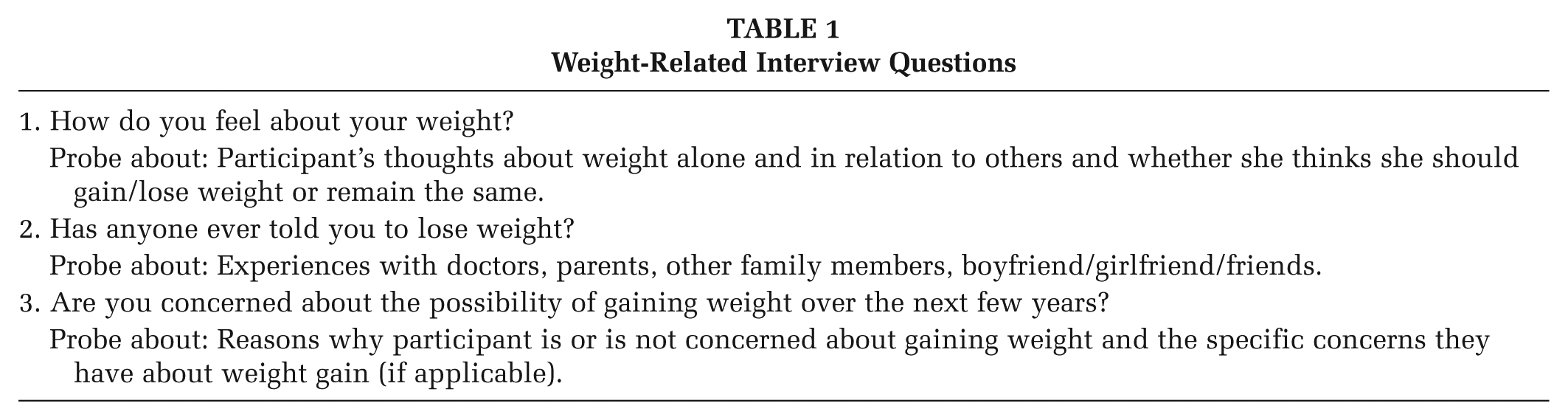
The interviewer for this study was an African American young adult woman who served as a health coach for the HHHF intervention trial. The interviewer received training on the study protocol and interview guides and completed practice interviews prior to contacting participants. The interviewer conducted hour-long semistructured in-person interviews with 40 young adult women. The interview guide contained both qualitative and quantitative questions about participants’ home food and physical activity environments; their dietary, physical activity, and weight monitoring behaviors; and their weight-related perceptions and experiences. Questions about weight-related perceptions and experiences are reported in Table 1. At the end of each interview, participants provided demographic information and self-reported height and weight, which was used to calculate body mass index (BMI) and classify each woman as normal weight (BMI 18.5-24.9 kg/m2), overweight (BMI 25.0-29.9 kg/m2), or obese (BMI ≥30.0 kg/m2). Participants received a $35 gift card as an incentive. The Emory University institutional review board approved all study procedures.
Weight-Related Interview Questions
Analysis
All interviews were digitally recorded, transcribed verbatim by a professional transcriptionist external to the project team, and analyzed using NVivo software (QSR International, Melbourne, Australia). Two members of the research team (IGR and MCK) developed an initial codebook of deductive codes based on the interview guide. They then independently read three transcripts, applied the initial codes, noted emergent themes that were later added to the codebook as inductive codes, and met to discuss their results and resolve coding discrepancies. Once the codebook was finalized, a team of coders (IGR, two members of the EPRC’s CAB, and four graduate research assistants) independently double-coded each transcript for reliability and then met to reconcile coding discrepancies (Hennink, Hutter, & Bailey, 2011). One member of the research team (RCW) queried the final dataset to pull code reports relevant to this analysis. The analyst read the code reports, wrote memos about themes related to each code, and grouped themes according to each research question. Quantitative data were analyzed using SAS Version 9.4 (SAS Institute, Cary, NC).
Results
Demographics
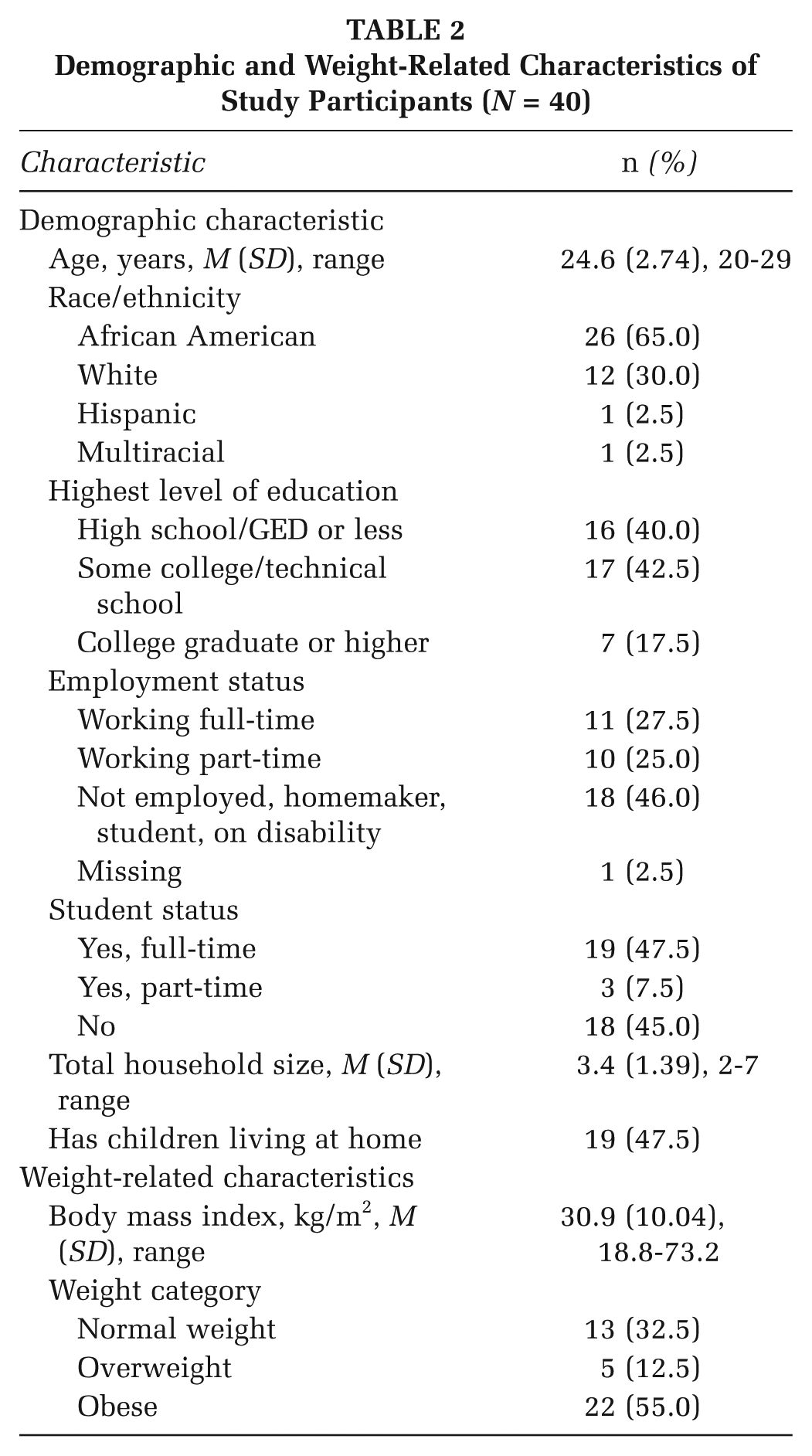
Participants ranged in age from 20 to 29 years (M = 24.6 years, SD = 2.74; Table 2). Most participants were African American (65.0%). Educational attainment varied widely, with 40.0% of respondents reporting a high school education or less, 42.5% reporting some college, and 17.5% reporting that they held a college, postgraduate, or professional degree. Most reported full (27.5%) or part-time employment (25.0%) and full (47.5%) or part-time (7.5%) student status. Over a quarter of participants (n = 11, 28.2%) were both students and working full- or part-time (not shown). Total household size ranged from 2 to 7 people (M = 3.4, SD = 1.39). Nineteen women (47.5%) had a child living at home, and five (12.5%) lived alone with their children (not shown). BMI ranged from 18.8 to 73.2 kg/m2, with a mean BMI of 30.9 kg/m2 (SD = 10.04). The majority of participants were either overweight (12.5%) or obese (55.0%).
Demographic and Weight-Related Characteristics of Study Participants (N = 40)
Feelings About Weight
Though some women expressed neutral or positive feelings, including being happy or content with their weight, most women reported that they wanted to lose weight or that they had negative or ambivalent feelings about their weight (Table 3). Negative feelings reported by participants ranged from dissatisfaction with or disbelief of their current weight to stronger negative feelings, such as reporting that they hate their weight or are upset or depressed by it. As one woman put it, “I just want to get to a lower number and like when I look at myself, I can’t be that much, you know, I can’t. It’s hard to believe that I weigh as much.”
Qualitative Themes Regarding Young Adult Women’s Weight-Related Perceptions and Experiences
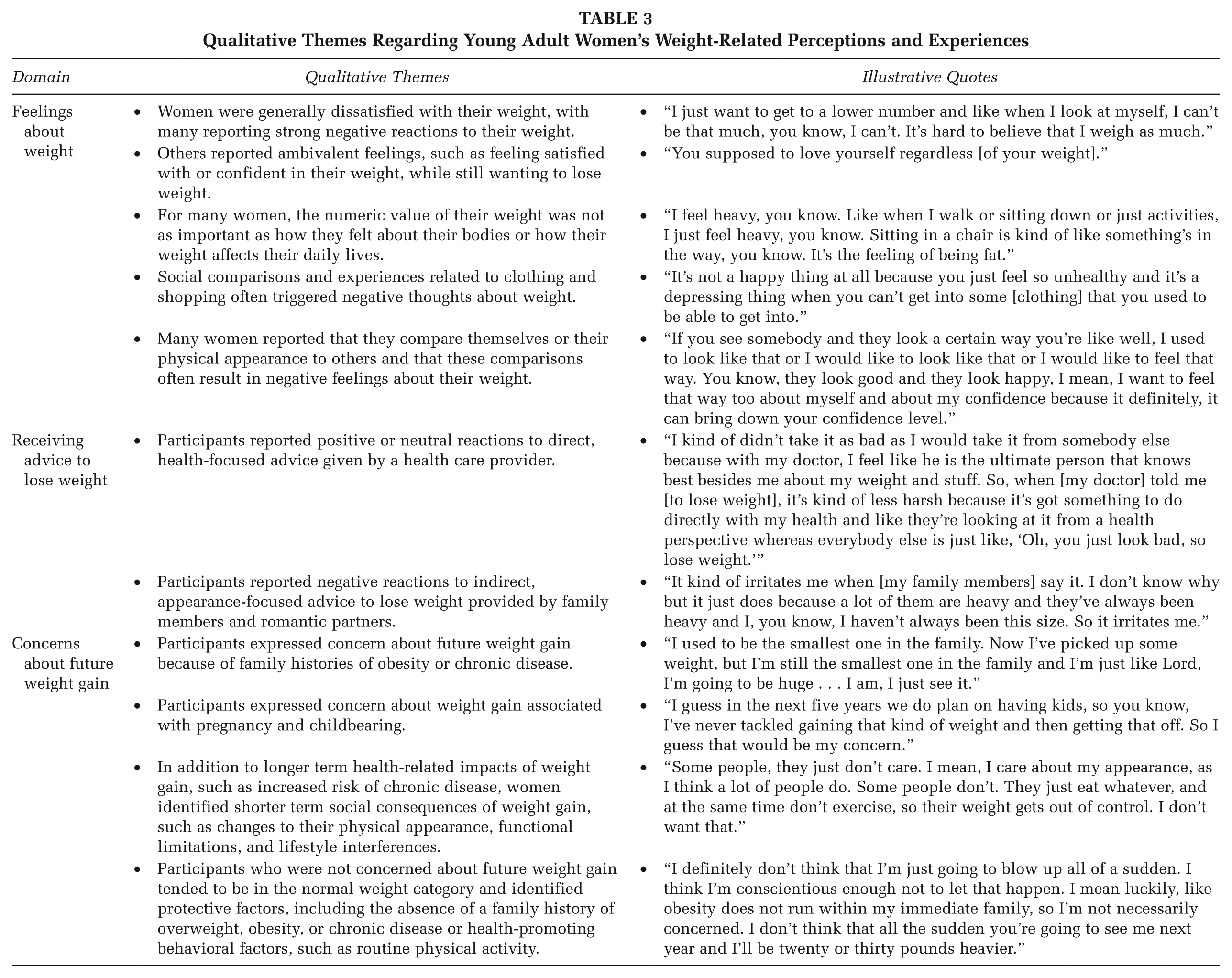
Ambivalent feelings about weight were predominantly reported by overweight and obese African American women and included feeling satisfied with their weight while still wanting to lose weight; feeling alright about their weight on some days, but not on others; or stressing the need to feel confident in oneself, despite wanting to lose weight. One participant illustrated these complex feelings about her weight by stating that she was confident in her weight, even though she thought she needed to lose more weight because, in her words, “You supposed to love yourself regardless.”
For many women, the numeric value of their weight was not as important as how they felt about their bodies and how their weight affected their daily lives. As one woman said, I feel heavy, you know. Like when I walk or sitting down or just activities, I just feel heavy, you know. Sitting in a chair is kind of like something’s in the way, you know. It’s the feeling of being fat.
While some women reported that they think about their weight all the time, others reported specific triggers that cause them to think about their weight. One commonly reported trigger was related to clothing fit and experiences while shopping for clothes. One woman said, I don’t do that much shopping any more. I used to love to go shopping . . . [but] I don’t want to buy too many clothes at one size again. . . . Things didn’t look as good as they used to look, so I just kind of gave up on it.
Many women reported that they compare themselves or their physical appearance to others and that these comparisons often result in negative feelings about their weight. As one woman put it, If you see somebody and they look a certain way you’re like well, I used to look like that or I would like to look like that or I would like to feel that way. You know, they look good and they look happy, I mean, I want to feel that way too about myself and about my confidence because it definitely, it can bring down your confidence level.
These comparisons to others often were related to fashion and clothing: Like, during the summertime, I’ll wear certain stuff and I’m like, OK, I’m fine with it, like my stomach is not big, but it’s not where I want it to be and then I’ll see somebody else and I’m like, oh my gosh, she looks amazing in that, I could not ever look like that.
Receiving Advice to Lose Weight
Most of the women in the sample reported that they had received advice to lose weight from health care providers or other members of their social networks. In addition to health care providers, participants reported receiving advice to lose weight from romantic partners and family members (e.g., parents, grandparents, cousins, siblings, and children). A small number of women reported receiving advice from friends, or “everyone.”
Participants reported that heath care providers gave direct advice to lose weight that was framed in terms of health-related concerns (e.g., the importance of maintaining a healthy weight during pregnancy, reducing existing pain, chronic disease prevention). Generally, women reported positive or neutral reactions to this advice, including being receptive to it, agreeing with it, or acting on it. As one woman put it, I kind of didn’t take it as bad as I would take it from somebody else because with my doctor, I feel like he is the ultimate person that knows best besides me about my weight and stuff. So, when [my doctor] told me [to lose weight], it’s kind of less harsh because it’s got something to do directly with my health and like they’re looking at it from a health perspective whereas everybody else is just like, “Oh, you just look bad, so lose weight.”
Some women who received advice from romantic partners or family members reported that advice was given in a direct manner, framed in terms of health-related concerns. Others reported that romantic partners or family members commented on their physical appearance, pointed out specific areas of their bodies where they had gained weight, made comments about how they are fat, chubby, or “getting big” or asked if they are pregnant. Many women reported negative reactions to these comments, including crying, having hurt feelings, irritation, anger, or ignoring or dismissing the comments. As one woman put it, It kind of irritates me when [my family members] say it. I don’t know why but it just does because a lot of them are heavy and they’ve always been heavy and I, you know, I haven’t always been this size. So it irritates me.
Concerns About Future Weight Gain
The majority of participants reported that they were concerned about the possibility of gaining weight over the next few years. Women provided a variety of reasons for why they thought they would gain weight over time, including family histories of obesity or chronic disease, concerns related to pregnancy and childbearing, unhealthy diets, sedentary lifestyles, and slowing metabolism as the body ages. Regarding family history, one woman said, I used to be the smallest one in the family. Now I’ve picked up some weight, but I’m still the smallest one in the family and I’m just like Lord, I’m going to be huge . . . I am, I just see it.
Weight-related challenges associated with pregnancy and child-rearing also emerged as an important theme. One woman reflected on prior experiences by saying, Before I had kids, [when] I was in high school, we were actually working out at my high school gym. And so I was losing weight, and you know, everything was ok. But it’s like after I had the kids, it’s like I stopped doing everything.
Regarding future challenges associated with pregnancy, one woman said, “I guess in the next five years we do plan on having kids, so you know, I’ve never tackled gaining that kind of weight and then getting that off. So I guess that would be my concern.”
Commonly cited concerns related to future weight gain focused on health status, particularly increased risk of developing chronic diseases (e.g., heart disease, diabetes) and associated risk factors (e.g., high cholesterol and blood pressure), problems with joint health, and premature death. Others discussed concerns about their physical appearance and not wanting to “let themselves go” as they aged. As one woman put it, Some people, they just don’t care. I mean, I care about my appearance, as I think a lot of people do. Some people don’t. They just eat whatever, and at the same time don’t exercise, so their weight gets out of control. I don’t want that.
Others talked about how weight gain would interfere with their lifestyle, including limiting their energy or ability to engage in activities that they enjoy.
Some participants did not express concern about the possibility of gaining weight over the next few years. These women tended to be in the normal weight category and identified protective factors that they anticipated would guard against future weight gain. For example, some of these participants identified an absence of a family history of overweight, obesity, or chronic disease as a protective factor. As one woman said, I definitely don’t think that I’m just going to blow up all of a sudden. I think I’m conscientious enough not to let that happen. I mean luckily, like obesity does not run within my immediate family, so I’m not necessarily concerned. I don’t think that all the sudden you’re going to see me next year and I’ll be twenty or thirty pounds heavier.
Other women cited that their current healthy behaviors, especially routine physical activity, would prevent future weight gain.
Discussion and Conclusions
The purpose of this qualitative research study was to collect formative data to inform the adaptation of HHHF, a research-tested, theory-informed weight gain prevention intervention, for young adult women. Consistent with existing models of intervention adaptation, the objective of this study was to conduct an initial assessment of the extent to which the HHHF intervention aligns with the priorities and concerns of the priority population (McKleroy et al., 2006; Wingood & DiClemente, 2008). Results indicate that young adult women are generally concerned about their weight, have received advice to lose weight from their health care providers and various members of their social networks with varying responses, and that they are concerned about future weight gain for a variety of reasons. These results provide useful preliminary data regarding the feasibility of adapting HHHF and other weight management interventions for this population, few of which currently exist for the young adult population (Laska et al., 2012; Lombard et al., 2009).
An important finding from this study is that young adult women reported dissatisfaction with their weight and concern about future weight gain. These findings mirror those from longitudinal cohort studies, which have documented increasing body dissatisfaction among adolescents transitioning to young adulthood (Bucchianeri, Arikian, Hannan, Eisenberg, & Neumark-Sztainer, 2013), and from prior qualitative work with women of older age-groups (Baturka, Hornsby, & Schorling, 2000; Befort, Thomas, Daley, Rhode, & Ahluwalia, 2008; Blixen, Singh, & Thacker, 2006; Bove & Olson, 2006; Davis, Clark, Carrese, Gary, & Cooper, 2005). Notably, both White and African American women in this study expressed dissatisfaction with their weight, which adds to the growing body of research challenging prevailing notions that African American women report higher satisfaction with their body, regardless of their weight status (Grabe & Hyde, 2006). These findings indicate that HHHF aligns with existing concerns among young adult women and suggests that adapting the intervention for this population may be feasible. However, more research is needed to identify appropriate recruitment mechanisms given the challenges of recruiting and retaining young adults in weight management interventions (Gokee-LaRose et al., 2009).
Similar to results from prior qualitative studies, young adult women reported that they were concerned about the longer term health-related consequences associated with weight gain, particularly increased chronic disease risk (Befort et al., 2008; Malpede et al., 2012). However, participants in this study also reported that they were concerned about shorter term social consequences of weight gain as well. For example, young adult women reported that comparing their bodies to others and that experiences related to clothing fit and shopping were sources of negative feelings about their weight. Participants in this study also described that the numeric value of their weight was not as important as how they felt about their bodies and how their weight affects their daily lives. Similar concerns have been reported in some (Malpede et al., 2012), but not all (Baturka et al., 2000; Befort et al., 2008; Blixen et al., 2006; Bove & Olson, 2006; Davis et al., 2005) prior qualitative work with adult women, possibly suggesting that these shorter term social concerns are more salient among a young adult population. Documenting young adult women’s specific concerns about their weight could be used to tailor recruitment messages to the concerns of this population, for example, by highlighting the immediate shorter term social benefits of weight management in addition to traditional messages emphasizing longer term health-related benefits of healthy weight management.
Young adult women in this study reported receiving advice to lose weight from their health care providers and from members of their social networks, but their responses to such advice varied according to who provided it. Participants described positive or receptive reactions to direct weight loss advice from their health care providers, which suggests that health care systems may be strategic partners for recruiting women into weight management interventions. These results suggest that the recruitment methods used in the HHHF intervention trial may be appropriate for a young adult population. In the original intervention trial, primary care providers at a network of Federally Qualified Health Centers in southwest Georgia referred overweight and obese women aged 35 to 65 years to the program (Kegler et al., 2016). Given that young adult women in this study identified pregnancy and child-rearing as particularly challenging times for healthy weight maintenance, prenatal and pediatric health care providers might be another appropriate clinical partner for recruiting a young adult population (Befort et al., 2008; Phelan, 2010).
In contrast, young women in this study reported negative or unreceptive reactions to indirect, appearance-focused comments about weight from family members or romantic partners, which may indicate limited social support for weight loss within their social networks. Many participants in this study were raising children without a spouse or partner living in the home, which may further limit their social support. Prior research has shown that increased social support is associated with maintaining weight loss over time and that support from family members may play an important role in weight-focused interventions (Elfhag & Rössner, 2005; McLean, Griffin, Toney, & Hardeman, 2003). These results suggest that additional research is needed to explore how young adult women’s social environments support or impede their ability to maintain a healthy weight and suggest that HHHF could be adapted to include intervention components focused on building social support within participants’ social networks.
This study used qualitative research methods to document weight-related perceptions and experiences of young adult women living in periurban southwest Georgia for the purpose of adapting an evidence-based weight gain prevention intervention for a young adult population in this geographic area. These results are neither intended to represent all young adult women’s perceptions and experiences nor intended to generalize to other age-groups or to men. Limitations of this study include that one interviewer conducted all the interviews, which prevented matching the interviewer to the full sample on relevant demographic and weight-related characteristics. Additionally, we intentionally phrased some of the interview guide questions as closed-ended to avoid making assumptions about women’s weight-related perceptions and experiences, and followed these questions with open-ended probes to draw out participant responses. The sample was also not balanced with respect to both race and weight status, which limited our ability to identify thematic differences between groups. Although we assessed parental status of participants, we did not assess current pregnancy status, which would have helped contextualize findings regarding concerns about future weight gain.
Despite these limitations, the results from this formative study suggest that young adult women may be a meaningful population for future adaptations of the HHHF weight gain prevention intervention and that young adult women may be receptive to participating. These results also suggest that physician referral, the recruitment mechanism used in the prior intervention trial, may be a viable option for young adult women as well. Future steps in the adaptation process, as specified by the ADAPT-ITT model (Wingood & DiClemente, 2008), will include pretesting the HHHF intervention among young adult women to elicit their reactions to the intervention and modifying the individual intervention components according to their feedback. Results from this and future research will be used to adapt the HHHF intervention and contribute to obesity prevention and control efforts among young adults in the United States.
Footnotes
Acknowledgements
We acknowledge with gratitude Tarccara Hodge, who conducted the in-depth interviews discussed in this article. We also wish to acknowledge the members of the Emory Prevention Research Center Community Advisory Board, the staff and graduate research assistants who coordinated this study, and the young adult women who participated in this study.
Funding for this research was provided by Centers for Disease Control and Prevention (CDC) and the National Cancer Institute (NCI; Award No. 5U48DP001909).
The contents of this article are solely the responsibility of the authors and do not necessarily represent the official views of the CDC or NCI.