



Abstract
Individuals born between 1945 and 1965 (“baby boomers”) account for an estimated three quarters of all hepatitis C (HCV) infections in the United States. This article describes the evaluation of Test4HepC, a program that uses social media and a website to promote HCV testing to baby boomers in Los Angeles County, California. The first 16 months of Test4HepC were evaluated using an online survey (n = 302), qualitative interviews (n = 20), website and social media analytics, and records of free testing offered though the program. Test4HepC.org had 6,919 visitors; 48 individuals used the free testing offered. Within 1 month of visiting the website, 24.5% (74) of survey participants tested for HCV, 67.6% (50) received a negative HCV antibody test result, 2.7% (2) received a positive HCV antibody test result, and 25.7% (19) had not received their results as of taking the survey. Most of those not tested (60.5%) reported intention to test. In multivariable analysis, male sex and high perceived usefulness of the program website were associated with HCV testing. Qualitative interviews suggested that Test4HepC increased baby boomers’ HCV risk perception and encouraged testing. Social media is a promising strategy for promoting HCV testing to baby boomers. Expanding Test4HepC to other areas and prioritizing the highest risk baby boomers could enable many people with HCV to benefit from new treatments.
Background
An estimated 3.4 to 6 million people in the United States are living with chronic hepatitis C (HCV) infection (Chak, Talal, Sherman, Schiff, & Saab, 2011; Edlin, Eckhardt, Shu, Holmberg, & Swan, 2015). HCV is a viral infection that attacks the liver and is primarily transmitted via blood (MacDonald, Crofts, & Kaldor, 1996). Primary risk factors include injection drug use, receiving an organ transplant or blood transfusion before 1992, having certain medical conditions, and exposures in health care settings (Smith et al., 2012). Between 75% and 85% of those with HCV will develop a chronic infection (Liang, Rehermann, Seeff, & Hoofnagle, 2000; Thomas & Seeff, 2005), which can result in liver disease (Westbrook & Dusheiko, 2014) and is the leading cause of liver cancer (El-Serag, 2012). HCV-associated liver failure is the most common reason for liver transplantation (Berg et al., 2009), and approximately 19,370 people died in 2013 from HCV (Ly, Hughes, Jiles, & Holmberg, 2016). Pharmaceutical advances have resulted in several highly effective HCV medications with cure rates ranging from 70% to 100% (American Association for the Study of Liver Diseases & Infectious Diseases Society of America, 2016).
Those born between 1945 and 1965 (“baby boomers”) account for approximately three quarters of people infected with HCV (Smith, Patel, Beckett, & Jewett, 2011) and HCV-associated mortality (Moorman et al., 2013). A study using National Health and Nutrition Examination Survey data from 1999-2008 found a 3.2% HCV prevalence rate among baby boomers (Smith et al., 2014). Individuals with a history of injection drug use or blood transfusion accounted for 52% of HCV-positive baby boomers, yet 48% reported no known exposure risks (Smith et al., 2014). Other factors associated with HCV among baby boomers include being male, non-Hispanic Black, homeless, and of low socioeconomic status (Aisyah et al., 2017; Armstrong et al., 2006; Chak et al., 2011). Furthermore, several studies of baby boomers have found low HCV knowledge (Norton et al., 2014; Rashrash, Maneno, Wutoh, Ettienne, & Daftary, 2016), low risk perception (Allison, Chiang, Rubin, Oshva, & Carmody, 2016; Grannan, 2017), and low testing for HCV (American Gastroenterology Association, 2012; Grannan, 2017).
Given that nearly half of HCV-positive baby boomers have no known risk exposure and may not be identified through risk-based screening, testing for HCV infection on the basis of birth cohort presents an opportunity to identify a significant number of cases (Smith et al., 2012). Currently, the Centers for Disease Control and Prevention (CDC; Smith et al., 2012), the American Association for the Study of Liver Diseases/Infectious Diseases Society of America (Chung et al., 2015), and the U.S. Preventive Services Task Force (Moyer, 2013) recommend at least one-time HCV antibody testing for all baby boomers, confirmatory testing for anyone testing antibody positive, and appropriate treatment for those with active HCV. Despite these recommendations, an estimated 43% to 85% of people with HCV are unaware of their infection and therefore unable to benefit from treatment (Smith et al., 2012; Southern et al., 2011; Spradling et al., 2012). Multiple screening tactics have been employed to reach undiagnosed baby boomers, including hospital-based interventions, community-based programs, educational efforts, and adding HCV screening onto routine medical procedures (Thuluvath, Feldman, Horowitz, & Lowe, 2016; Torres & Harrison, 2013; Turner et al., 2015). However, additional innovative strategies are needed to identify the millions of adults with HCV so that they can avoid the potentially dire outcomes associated with untreated infection.
Utilizing social media for health promotion for older adults is one promising strategy. A 2016 national study found that 72% of online adults aged 50 to 64 years and 62% of online adults 65 years and older use Facebook and that both age-groups use Facebook far more than other social media platforms (Greenwood, Perrin, & Duggan, 2016). A 2015 study using a random sample of baby boomers and older adults revealed that 34% used social media such as Facebook and Twitter to find or share health information (Tennant et al., 2015). Social media can be a cost-effective way to deliver health promotion messaging and has demonstrated potential for behavior change (Korda & Itani, 2013), including promotion of HIV testing (Muessig, Nekkanti, Bauermeister, Bull, & Hightow-Weidman, 2015; Tso, Tang, Li, Yan, & Tucker, 2016). Thus, social media may provide an opportunity to reach baby boomers who need HCV screening. In 2012, the CDC launched the “Know More Hepatitis” campaign to encourage baby boomers to test (Jorgensen, Carnes, & Downs, 2016). Program components included ads on social media but did not provide testing resources; HCV testing outcomes for this program have not been published (Jorgensen et al., 2016).
We developed Test4HepC to increase HCV testing among baby boomers in Los Angeles County. Launched in October 2015, the program uses Facebook ads and a Facebook page to educate baby boomers about the risks of HCV and the need to get tested. The Facebook page and ads link to a program website (Test4HepC.org) with additional information and various testing resources, including free testing at local laboratories paid for by the program. We evaluated the first 16 months of Test4HepC using a mixed methodology. Evaluation data sources included (1) website and Facebook analytics, (2) free laboratory testing usage data provided by the participating laboratories, (3) an online survey of Test4HepC users, and (4) qualitative interviews of Test4HepC users. The program and study protocol were reviewed and approved by the institutional review board at the University of California, Los Angeles.
Method
Program Development and Components
A website design firm and graphic designer were hired to produce a program website and ad images. Website and ad text were created by the program team. We conducted an online survey of U.S. baby boomers (n = 50) to test and refine initial website and ad designs. Facebook allows targeting of ads to certain demographic characteristics. We targeted ads specifically to baby boomers living in Los Angeles County, which linked them directly to the program website (Figure 1). In addition, we created a Test4HepC Facebook page, where we posted information about HCV; engaged in dialogue with users who left comments; and linked users to the program website.

Test4HepC Website Homepage
Both the Facebook ads and the Facebook page content were informed by theories that explain why individuals take actions related to their health, including the health belief model (Rosenstock, Strecher, & Becker, 1988) and the theory of reasoned action (Ajzen & Fishbein, 1980). This content was intended to increase baby boomers’ HCV risk perception, increase perceived severity of HCV, inform them of the need to be tested, and reduce barriers to testing by emphasizing that HCV can be cured and that free local testing is available. The content was also meant to increase their intention to test and lead to actual testing. Twenty-five Facebook ads and paid posts were run in several waves over 16 months, with images and messaging iteratively adapted to improve the click-through rate (Figure 2). Facebook ads and the Facebook page were the only methods used to promote the program.

Test4HepC Facebook Ad
Information on the Test4HepC.org homepage was designed to further increase baby boomers’ risk perception for HCV and lower barriers to testing. Test4HepC.org includes a prominent testing site locator where users enter their zip code to find free or low-cost testing locations. This locator promotes various ways to test, including the user’s own health provider, low-cost community testing resources, a commercial home collection test, and free testing at commercial laboratories. To use the program’s free HCV testing, users register on Test4HepC.org, print out a lab requisition form, and visit one of more than 70 participating laboratories in Los Angeles County. Test4HepC staff followed up with all the participants by telephone to deliver results and provide referral to confirmatory testing for those testing HCV antibody positive. We also created two website sections: “Hepatitis C Facts” and “Get Tested,” with detailed information adapted from CDC (2018) about HCV transmission, risk factors, testing, and treatment.
Online Survey
Test4HepC.org users interested in participating in the online evaluation survey clicked on a study sign-up button on the homepage. To register for the study, potential participants had to answer three questions indicating that they (1) were born between 1945 and 1965, (2) lived in Los Angeles County, and (3) had never tested for HCV or tested in the past but with an unknown result. Individuals meeting the inclusion criteria completed an online consent form and finished the registration process by providing their e-mail address. Study registrants were sent a link to the online survey 1 month later to allow sufficient time to get tested, if they desired.
A 38-item survey instrument measured use of and response to the website, HCV testing behavior, social media use, and demographics. Data were collected in multiple waves corresponding to periods of Facebook advertising from February 2016 to January 2017. Participants were paid $50 for completing the survey.
We employed multiple strategies to mitigate the potential for fraudulent responses to the online survey (Teitcher et al., 2015). These included restricting IP addresses to those from California, eliminating surveys from duplicate IP addresses, mailing the incentive only to a Los Angeles County address, and allowing only one survey per household. Furthermore, each registered participant was sent a unique survey link that could be used just once. Respondents were eliminated from the analytic sample for having an e-mail address that was a duplicate.
Bivariate analysis using chi-square and exact tests was conducted to assess associations between key factors and HCV testing and intention to test. A multivariable logistic regression model was developed to identify factors associated with testing for HCV (main outcome variable); adjusted odds ratios (AORs) alongside 95% confidence intervals (CI) were computed to measure these factors’ magnitude of effect on the outcome variable. We analyzed all data with SAS version 9.4 (SAS Inc., Cary, NC).
Qualitative Interviews
At the end of the online survey, participants were given the opportunity to participate in a telephone interview for an additional $100 incentive. Participants who agreed to participate were e-mailed to set up the interview. Consent was collected verbally over the telephone before starting the interview.
The semistructured interview guide assessed acceptability and usability of Test4HepC.org, website information retention, HCV testing behavior, and response to potential program enhancements. During the interview, participants were read six facts from the website and asked whether this information would motivate them to get tested. Participants were also e-mailed four program Facebook ads and asked for feedback during the interview.
Interviews were conducted by one study team member from September 2016 to December 2016. They were audio-recorded, transcribed verbatim, and checked for accuracy. The interviewer and another research team member created a codebook based on the interview guide and participant responses. One team member coded the interviews using qualitative analysis software (dedoose: SocioCultural Research Consultants, LLC, 2016) to uncover themes. Coded interviews were reviewed throughout the data analysis by the second research team member to ensure agreement with the codes, and any discrepancies were discussed and resolved.
Results
Website and Facebook Analytics
From October 2015 through January 2017, the Test4HepC Facebook page had 49 followers. Facebook ads reached 204,657 individuals and resulted in 8,547 clicks to the website with an average click through rate of 1.4%. There were 6,919 unique Test4HepC website users. Of these, 2,020 (29.2%) used the testing site locator. Less than 1.5% of visitors clicked to either “Hepatitis C Facts” or “Get Tested” pages.
Laboratory Testing
Forty-eight people accessed free laboratory testing, and one of these results was positive for HCV antibodies (see Online Survey section for use of other testing options).
Online Survey
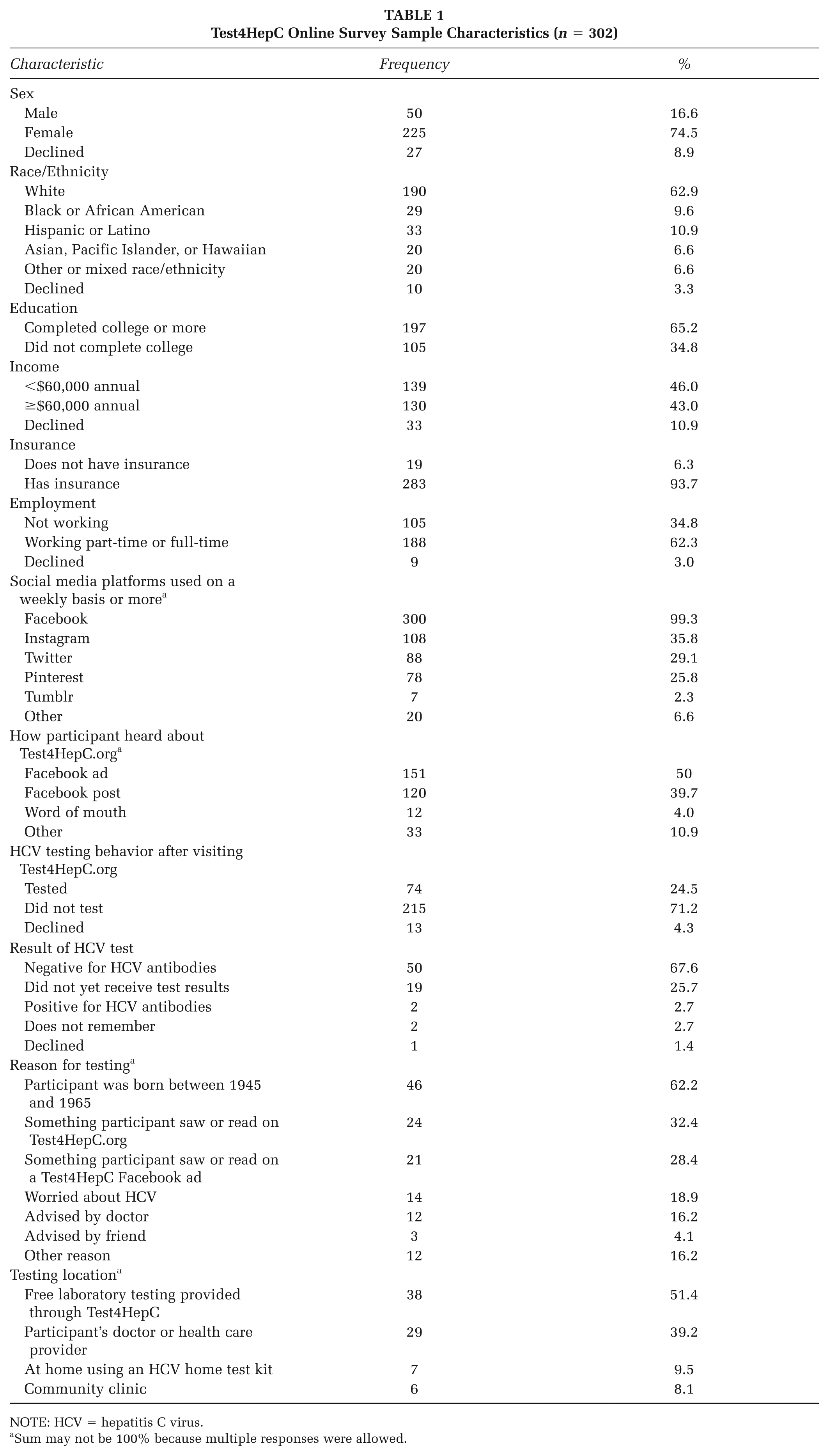
There were 319 complete online survey responses. Seventeen responses were eliminated for having a duplicate e-mail address, leaving an analytic sample of 302. Most participants identified as White and female (Table 1); participant age ranged from 51 to 71 years (mean = 58.2). Most participants found Test4HepC.org to be very useful (60.3%) or somewhat useful (22.8%); 70.5% of survey participants used the testing site locator.
Test4HepC Online Survey Sample Characteristics (n = 302)
NOTE: HCV = hepatitis C virus.
Sum may not be 100% because multiple responses were allowed.
Self-Reported HCV Testing, Test Results, and Reasons for Testing
Seventy-four survey participants (24.5%) tested for HCV after using the website; two participants reported testing positive for HCV antibodies (2.7%), while the rest tested negative (67.6%), did not remember (2.7%), or had not yet received their results (25.7%). The most common reason given for testing was being a baby boomer (62.2%), followed by information read on Test4HepC.org (32.4%) and seeing a Test4HepC Facebook ad (28.4%). More than half of the survey participants who tested (51.4%) used the free laboratory testing provided by the program.
Correlates of HCV Testing
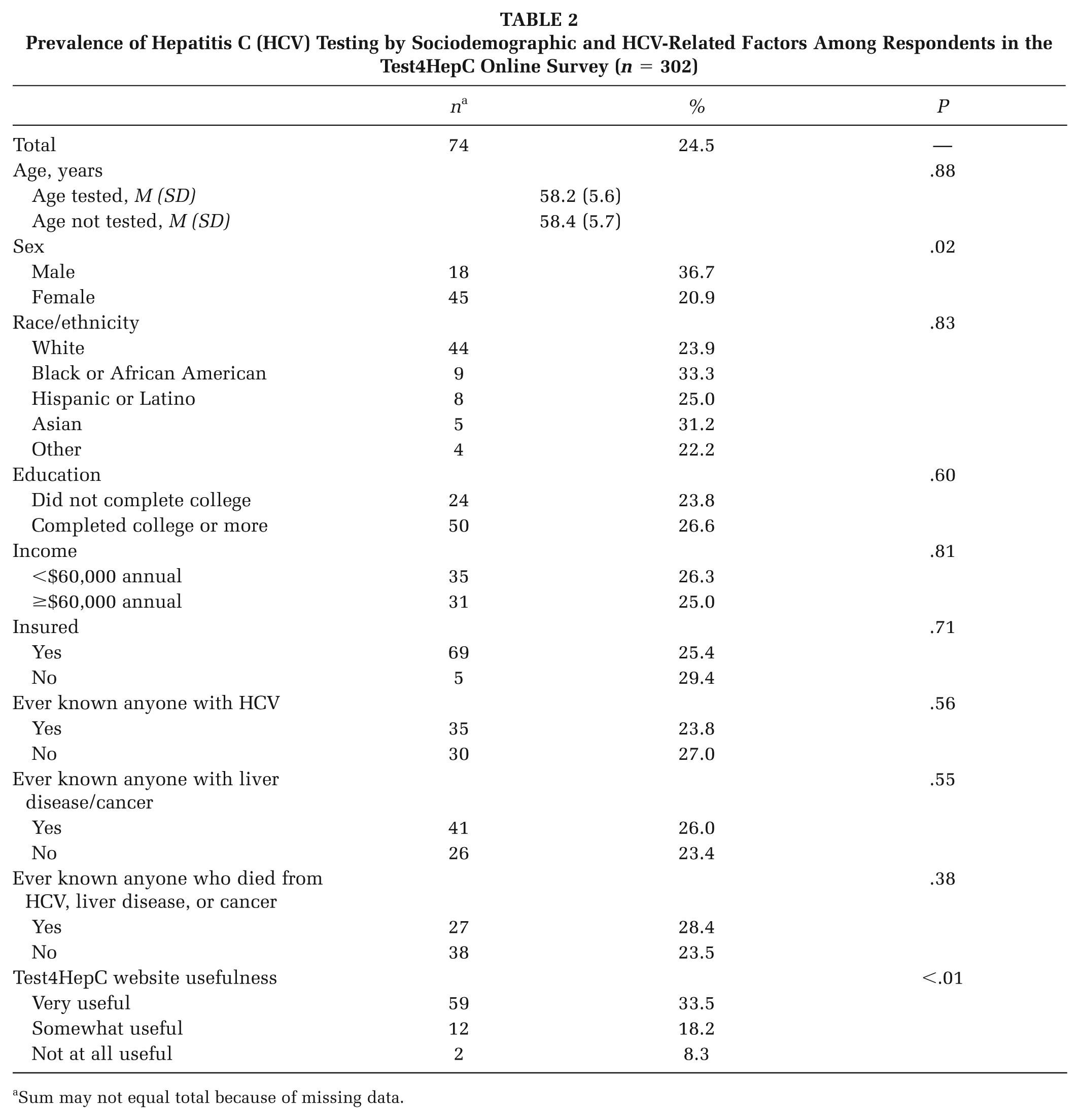
The prevalence of HCV testing was higher among men compared with women (36.7% vs. 20.9%; p = .02; Table 2). No other differences were noted in testing prevalence by demographic characteristics. Among those testing, significantly more participants found Test4HepC.org to be very useful (33.5%) compared with somewhat useful (18.2%) or not at all useful (8.3%; p < .01). In multivariable analyses, after adjusting for gender and race/ethnicity, perceived usefulness of Test4HepC.org was independently associated with HCV testing. Those who said that the website was very useful had a threefold increased odds of testing compared with those who said the website was somewhat or not useful at all (AOR = 2.9; 95% CI = [1.4, 6.2]). Furthermore, males had more than twice the odds of testing compared with females (AOR = 2.5; 95% CI = [1.2, 5.5]).
Prevalence of Hepatitis C (HCV) Testing by Sociodemographic and HCV-Related Factors Among Respondents in the Test4HepC Online Survey (n = 302)
Sum may not equal total because of missing data.
Reasons for Not Testing and Intention to Test
Of those not testing (n = 215), the most common reasons were a lack of time or opportunity to test (58.2%) and a lack of perceived risk for HCV (44.2%). However, 130 participants (60.5% of those not testing) planned to test in the future; most within the next 3 months (66.2%). Our analysis found no differences in intention to test by demographics or other factors.
Qualitative Interviews
Twenty individuals participated in a telephone interview. The participants were 75% female and 25% male. The racial/ethnic composition of the sample was 50% White, 20% Latina/o, 15% African American, and 15% Asian. All the 20 participants reported being “very active” on Facebook. Nineteen participants felt that Facebook is a good tool for promoting HCV testing to baby boomers. One participant said, “I think it’s a very good strategy. A lot of people are on Facebook, not just young people anymore.”
Ad Content
Most participants preferred Facebook ads with more information about HCV risk for baby boomers, availability of free and low-cost testing, and the identity of the program sponsor. Respondents overwhelmingly preferred an ad image depicting a grid of diverse baby boomers (Figure 2) because it communicated that all baby boomers were potentially at risk. One participant felt that this image conveyed, “It doesn’t matter if I’m male, female, Black, White, Asian, Hispanic, or otherwise; people of my age need to get tested.”
Website Response
Twelve participants had relatively poor recall of the website content. Of the eight who remembered exploring the site, most reported that it was informative, easy to use, and visually pleasing. For example, one participant said it was “Very straightforward, easy to navigate. . . . I went through the whole site in a short amount of time and I got a lot of information that I was unaware of.”
HCV Knowledge, Risk Perception, and Intention to Test
HCV knowledge before visiting the website was generally low. Six participants said the website should have included more information about HCV transmission and why baby boomers are particularly at risk. Only three participants reported any prior concern for HCV, and just two participants had considered testing before visiting the website. However, half of the respondents reported increased risk perception after visiting the website. One participant discussed never considering testing in the past: “But yes, after I went to your website, I did.”
HCV Facts on the Website
Of the facts presented, that HCV causes liver cancer and is the most common reason for liver transplants and that people can have HCV and not be aware were considered the most motivational to get tested. One participant stated, “It’s frankly, scary. I do know someone who died of liver cancer so that’s motivational.” Another participant explained, “You could have something without knowing it . . . it’s all about if you find out you have it before it gets really bad.” Some participants felt the fact that hepatitis can be cured was a strong motivation to test. One participant said, “You don’t need to be afraid to get tested, because it’s curable.”
Testing Behavior and Resource Use
Seventeen interview participants used the testing site locator on the website, and 16 reported that it was simple to use. One described, “That was very easy to use. I mean, just put your zip code in there, and it gives you so many choices of places to go—community clinics and laboratories—. . . . So, it was very encouraging to go get tested.” After visiting the website, 11 participants tested for HCV. Eight of them used the free laboratory testing provided through Test4HepC. Of the 9 participants who did not test, 8 planned to test in the future or to discuss testing with their health care provider.
Program Enhancements
Participants had generally positive reactions when presented with potential program improvements. About half felt adding a video with a doctor discussing HCV would be beneficial, and nearly all participants liked the idea of adding videos of people with HCV talking about their experience finding out that they were infected and getting treatment. Several felt such a video would increase baby boomers’ perceived risk for HCV, by showing that any baby boomer could be infected. One participant suggested that the video subject should say, “I found out I have hep C and I’ve never had a blood transfusion. I’ve never injected drugs. I honestly don’t know how I got this, but you know, now I have it. I took treatment and I’m cured.” Adding a free HCV home collection kit was also very well received.
Discussion
Millions of baby boomers in the United States currently live with undiagnosed HCV (Smith et al., 2012, 2014; Spradling et al., 2012). Given the recent availability of highly effective treatments, innovative HCV testing programs are urgently needed. Social media holds promise because it can be used to very specifically reach a priority population segment efficiently and cost-effectively (Korda & Itani, 2013; Tso et al., 2016). While no evaluations of programs using social media to promote HCV testing have been published to date, programs have successfully used social media to promote testing for other conditions, including HIV (Muessig et al., 2015; Tso et al., 2016; Young et al., 2013).
Our mixed-methods evaluation of Test4HepC demonstrated the potential for using social media to promote HCV testing to baby boomers. One quarter of online survey participants reported testing within approximately 1 month of using the website, and most who had not yet tested planned to do so. This rate of testing compares favorably with a program that used social media to promote HIV testing (Young et al., 2013) and is especially considerable in light of evidence that HCV testing is not normalized among baby boomers (American Gastroenterology Association, 2012; Grannan, 2017). Furthermore, the positivity rate among baby boomers who reported testing in our survey, 2.7%, was only slightly lower than the 3.2% of baby boomers estimated to have HCV (Smith et al., 2014). In addition, 29.2% of all Test4HepC website visitors used the testing site locator (n = 2,020), indicating relatively high interest in HCV testing among program users.
Similar to other studies (American Gastroenterology Association, 2012; Grannan, 2017; Rashrash et al., 2016), baby boomers in our interviews expressed low risk perception for HCV and low levels of testing before exposure to the program. The information on Test4HepC.org increased interview participants’ risk perception for HCV, actual testing behavior, and intention to test if not tested. Similarly, the online survey results indicated that the website and the Facebook ads and posts increased risk perception for HCV and that this led to actual testing. Nearly one third of survey participants who tested said it was because of something they read on the website, and 28.4% said it was because of something they read in a Test4HepC Facebook ad.
The evaluation also provided useful information about which elements of the program worked best. For instance, we found having multiple testing options was beneficial. While most participants used the free laboratory testing (51%), many went to their own provider (39%), and approximately 10% used a home collection kit or a community clinic. Interview participants gave very positive feedback on both the testing site locator and the free laboratory testing. The website itself received mostly positive feedback in both the interviews and the survey. In multivariable analysis, those who felt the website was very useful were three times as likely to get tested.
The evaluation also provided feasible ways to improve Test4HepC. The survey showed that the main reasons for not testing were a lack of time or opportunity and low perceived risk. In the interviews, participants were enthusiastic about the free laboratory testing and even more so about a possible free home collection test. Promoting these could increase testing by making it easier and more convenient. Free home collection tests for HIV and sexually transmitted infections have been shown to be well utilized by various high-risk populations (Rotblatt, Montoya, Plant, Guerry, & Kerndt, 2013; Young et al., 2013). Some interview participants felt that the website did not adequately explain why baby boomers are at risk for HCV. More detailed information about risk was included in the “Hepatitis C Facts” section; however, website statistics showed that few people visited these pages. One way to increase testing could be to better explain on the homepage or in the Facebook ads why baby boomers are at risk for HCV. Interview participants said adding videos of baby boomers discussing personal experiences with HCV would also increase risk perceptions. Future studies could also focus on other ways to increase baby boomers’ perceived susceptibility for HCV.
Several limitations may have affected this study. We used convenience samples, and participants self-selected into the study; therefore, these data may not be representative of all baby boomers in Los Angeles County. The program was only available in English, which could further limit generalizability. In addition, survey and interview data may have been limited by our participants’ abilities to remember specific ad and website visuals and content, as both occurred at least 1 month after they visited the website and registered for the study. For the interviews, however, the participants were presented with Facebook ads and HCV facts from the website during the interview to help overcome this possible limitation. Survey and interview data were self-reported. However, laboratory-verified testing behavior and results were available for the 48 participants who used the program’s free testing service. One issue with online surveys is the potential for fraudulent participants, but we took several steps to ensure the validity of responses. Another limitation is that the sample skewed toward White women, who have a lower risk for HCV than other demographics. While many survey participants reported getting tested because of something they read on a Test4HepC ad or the website, it is possible that they were also influenced by a concurrent campaign such as “Know More Hepatitis” (Jorgensen et al., 2016) or commercial ads for HCV treatments. Finally, while website users were recruited only through Facebook ads and posts, which were targeted to baby boomers in Los Angeles County, we have little other information about users who accessed the website.
Conclusion
Our study demonstrated that social media is a promising strategy for promoting HCV testing to baby boomers. Nearly 25% of the online study sample tested for HCV within 1 month of clicking on a Facebook ad or post and going to Test4HepC.org, and most who did not test intended to test in the future. We plan to make further refinements to the program based on the evaluation results and then expand the program to other geographic areas, prioritizing segments of baby boomers at highest risk for HCV.
Footnotes
Authors’ Note:
We thank our study participants and program staff, Kristie Gordon, Mariana Castrejon, Mable Kimble, and Dvora Joseph Davey, as well as Debra Callabresi at N-tonic for creating and maintaining the Test4HepC website. Funding for this investigator-sponsored study was provided by Gilead Sciences (Grant No. IN-US-337-1780).
