




Abstract
Background. Almost 2,000 campuses have adopted tobacco-free (TF) policies across the United States. However, there is not a systematic process to help campuses implement successful policies. Readiness assessments can help provide assistance as campuses work to implement successful policies. Purpose. We assessed readiness for TF policies among campuses of a statewide university system and determined factors associated with readiness. Participants. Stakeholders from 23 campuses without 100% TF policies were invited to participate in an online survey. Method. System administrators provided contacts for five to eight stakeholders per campus. Included in the analysis were 10 of 23 campuses (43.5%) with at least three stakeholders completing the survey. Results. Of the 10 campuses, one was in Preplanning, five were in Preparation, and four were in the Initiation stage of readiness. Political Climate was the highest scored dimension on seven campuses (0.74–1.0); Resources was the lowest on eight campuses (0.0–0.67). Campus size and county rurality were each associated with one dimension score. Conclusions. Despite being part of a statewide university system, campuses are in varying stages of readiness for TF policies. Stage-based strategies to advance TF campus policies must be implemented to set campuses up for successful policies.
Tobacco use on college campuses remains a concern, with approximately one in five college students reporting tobacco use (American College Health Association [ACHA], 2018). Use of emerging tobacco products such as hookah and e-cigarettes, as well as polytobacco use among college students, is on the rise (ACHA, 2018; Butler et al., 2016). Consequently, there is a need to target prevention and tobacco control strategies on college campuses. The ACHA (2009) has reinforced the need to implement tobacco-free (TF) campus policies as a strategy to reduce tobacco use and initiation on college campuses. As of January 2, 2019, there were 2,342 smoke-free campuses (prohibiting all smoked tobacco products, inside and out, on campus property), including 1,975 with comprehensive TF policies (all tobacco products, including e-cigarettes, inside and out, on campus property; American Nonsmokers’ Rights Foundation, 2019). Although research continues to emerge on the benefits of campus policies, implementing TF policies decreases tobacco use, increases quit attempts, and decreases exposure to secondhand smoke (Fallin et al., 2015). However, there is a critical need for research on how best to advance TF campus policies.
The majority of campuses with TF policies adopt them at the institutional (i.e., campus) level. However, a few states have initiated statewide mandates (American Nonsmokers’ Rights Foundation, 2019) or provided resources to encourage diffusion of policies across the state (Lee et al., 2010). As Lee et al. (2010) report, even when resources and support are provided, time to policy implementation and campus-specific strategies and barriers vary. Given the varied approaches campuses take to adopt TF policies, there is a need to understand campus readiness to adopt these policies as well as the institutional and community factors influencing campus readiness to adopt them.
The community readiness model (CRM) posits that communities advance through a series of stages to develop, implement, and evaluate effective programs (Edwards et al., 2000). The model has been adapted, tested, and found to be effective in understanding community readiness for smoke-free policies (Hahn et al., 2014; York et al., 2008; York & Hahn, 2007). Communities that received tailored interventions were more likely to adopt community smoke-free policies (Hahn et al., 2014), reinforcing support for the CRM to aid policy development and implementation. More recently, the CRM has been used to understand factors related to adoption of voluntary smoke-free and TF campus policies (Ickes et al., 2018). An understanding of campus readiness to adopt TF policies can guide the use of stage-based, tailored interventions to assist college campuses to adopt these policies. Less is known regarding how to approach campuses that are part of a statewide system. Thus, the purpose of this study was to (1) assess readiness to adopt TF policies among campuses that are part of a large statewide university system and (2) determine campus- and county-level characteristics associated with readiness scores.
Method
Study Design and Sample
The study incorporated a descriptive nonexperimental, cross-sectional design, recruiting stakeholders from 23 campuses without 100% TF policies in a statewide university system (which includes a total of 64 campuses) to determine readiness to implement such policies. Five to eight campus stakeholders from each college/university without a 100% TF policy who had knowledge about their campus and involvement in health and wellness and/or policy development were invited to participate. These included university administrators; representatives from staff, faculty, student organizations; and health/wellness departments. Snowball sampling was used to invite additional participants who would be knowledgeable in campus policy and campus climate. Of the 100 stakeholder contacts provided by administrative personnel within the statewide system (e.g., Director of Policy and Planning), 43 completed the survey. Due to the nature of snowball sampling, overall stakeholder response rate could not be determined. Included in the analysis were 10 of 23 campuses (43.5%) with at least three stakeholders completing the survey. Approval was obtained from the institutional review board of the authors’ institution, which received approval as the institutional review board on record through the statewide campus administration participating in this study.
Measures
The Campus Assessment of Readiness to End Smoking (CARES) was previously pilot tested with campuses in Kentucky (Ickes et al., 2018) and was adapted from the Community Readiness Survey–Short Form, a validated instrument developed to assess community readiness for TF policy (Fallin et al., 2012). Based on the CRM, survey items span six dimensions of campus readiness: Knowledge (i.e., activities and approaches to educate the campus community about the negative effects of secondhand smoke exposure; 2 items), Resources (i.e., people, money, time, equipment, and space dedicated to smoke-free or TF policy development; 20 items), Existing Policy (i.e., the voluntary rules currently existing on the campus: 2 items), Campus Climate (i.e., the campus community’s norms that influence smoke-free or TF policy development: 15 items), Leadership (i.e., the support of appointed leaders and influential campus members: 3 items), and Political Climate (i.e., influence of the political process and politics on smoke-free and TF policy development considering the position of political influencers such as Board of Trustees: 1 item). More detail about the CARES measure and the dimensions is given elsewhere (Ickes et al., 2018).
Scores from the six dimensions were summed to determine overall stage of readiness: Unawareness (0–1.0): issue not recognized as a problem; Vague Unawareness (1.1–2.0): some believe there is a problem but have little to no motivation to change; Preplanning (2.1–3.0): clear recognition that action is needed; Preparation (3.1–4.0): active planning is done with a focus on details; Initiation (4.1–5.0): policies are adopted and viewed as valuable; and Endorsement (5.1–6.0): policies are implemented; decision makers support expanding or improving efforts.
General demographic items assessed campus stakeholders’ position title, length at current position, type of institution, county and state, geographic location, and how long the current campus president/chancellor had been in office. In addition, stakeholders were asked if their campus was currently advocating for/working toward a 100% smoke-free or TF policy (yes/no for each) and how satisfied they were with the current tobacco policy (1 = extremely unsatisfied to 10 = extremely satisfied). Campus size (in acres), student demographic info, and type of campus was retrieved from each campus website and rural urban continuum codes were determined based on the campus’ county location (U.S. Department of Agriculture, 2016). Rurality was measured using the rural urban continuum code (1–9), with higher scores representing less dense population and greater distance from metro area (i.e., more rural).
Procedures
Administrative personnel within the statewide system shared the contact information of campus stakeholders at each college/university without a current 100% TF policy who had knowledge about their campus and involvement in health and wellness and/or policy development. Our team sent an email invitation to the identified stakeholders in December 2016. All stakeholders were sent a link to the online CARES survey through Qualtrics, a secure survey database (Qualtrics, 2013). Follow-up email reminders were sent to noncompleters 1 week and 2 weeks after the initial email. Due to the timing of the survey being near the holidays and semester break, an additional reminder was sent in January 2017 and the survey was kept open through February 2017.
Data Analysis
Similar to previous dimension scoring, responses to items within each CARES dimension were averaged across survey respondents on each campus (Ickes et al., 2018). For items with binary response options, responses were summarized as the proportion of respondents answering positively (e.g., “yes” or “agree”). For Likert-type items, a mean score ranging from 1 to 5 was calculated; these items were then divided by the maximum response to yield an item score between 0 and 1. Once all items were appropriately scaled, items making up each dimension were averaged to create the dimension score (potential range 0–1). This was done to assure that all dimensions would have equal influence in determining the overall readiness score (Fallin et al., 2012). Finally, all six dimension scores were summed to create the overall readiness score, ensuring all dimensions contributed equal weight. Cronbach’s alpha for the overall readiness score was .61. Descriptive analysis, including means and standard deviations, frequency distributions, or medians (interquartile ranges), was used to summarize campus readiness scores and campus and stakeholder characteristics. Spearman’s rho correlation coefficient examined associations among campus characteristics and dimension and readiness scores. Data analyses were conducted with SAS Version 9.4. An alpha level of .05 was used for all analyses.
Results
Campus Characteristics
Of the 10 campuses, enrollment ranged from 2,300 to almost 17,000, with an average enrollment of 5,800. Nine campuses reported the majority of students as White, non-Hispanic, ranging from 57% to 69%. Five campuses were classified as “technology” colleges, four “university” colleges, and one “university center and doctoral degree granting.” Campus size ranged from 220 to 930 acres. Four campuses were classified as counties in metro areas of 1 million population or more, three counties in metro areas of fewer than 250,000 population, and three were considered nonmetro counties.
Stakeholder Characteristics
Stakeholders from the 10 campuses represented the following sectors: health and wellness, counseling, and health services (n = 13); human resources/administration (n = 8); student affairs (n = 4); environmental health and safety/operations (n = 4); student representatives (n = 2); faculty (n = 1); and union president/representative (n = 1). Median years working at the campus was eight (interquartile range 3–15). The majority of stakeholders indicated their campus was working toward 100% TF (55.3%) or 100% smoke-free (10.5%) campus policies, and 43% indicated having a “champion” who was willing to take the lead and keep momentum going for TF policy efforts. About one third of the stakeholders, or 34.2% (n = 13), reported their campus was not working toward a policy.
Overall Campus Readiness and Dimension Scores
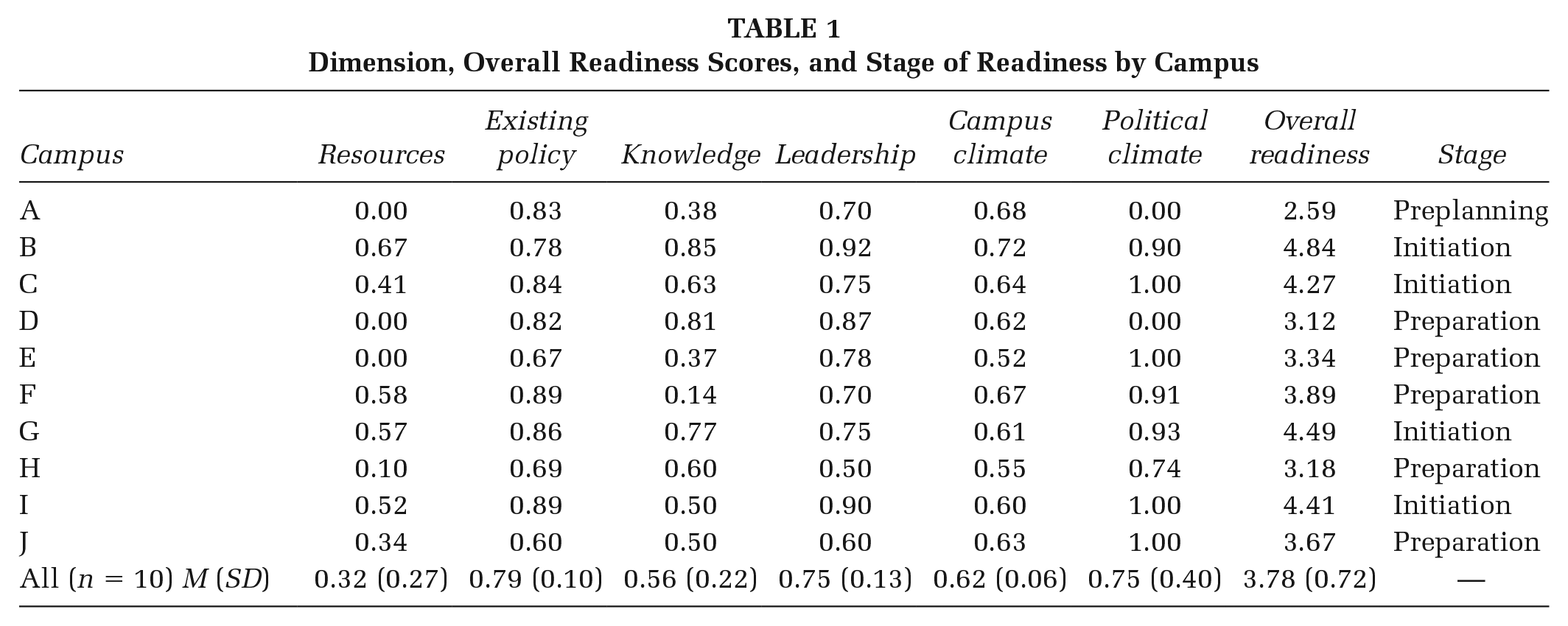
The dimension scores for each of the 10 campuses (A–J) are summarized in Table 1. Political Climate emerged as the highest scoring dimension across seven campuses, with scores ranging from 0.74 to 1.00. However, the Political Climate dimension revealed the greatest variability across campuses, with scores ranging from 0.00 to 1.00. The Resources dimension ranked as the lowest for eight of the 10 campuses (M = 0.32; SD = 0.27), with scores ranging from 0.00 to 0.67. Overall readiness scores ranged from 2.59 to 4.84 (M = 3.78; SD = 0.72). One campus was in the Preplanning stage, five were in Preparation, and four were in Initiation.
Dimension, Overall Readiness Scores, and Stage of Readiness by Campus
Association of Campus Characteristics With Dimension and Readiness Scores
Campus size (i.e., acreage) and rurality of the county of location were significantly associated with at least one dimension score (see Table 2). Larger campus size was associated with higher Knowledge dimension scores (ρ = .82; p = .004). The more rural the county where the university was located, the lower the Political Climate dimension score (ρ = −.82; p = .004). Enrollment and percentage of the student body who identified as White were not associated with any of the dimension scores or overall campus readiness for TF policy.
Correlations Between Campus Characteristics and Readiness Dimension and Overall Readiness Scores

Note. Cells contain Spearman’s rho correlation coefficients and p values. Value range from −1 to +1, with higher absolute values corresponding to a stronger (positive or negative) association between variables. Bold denotes p < .05.
Discussion
Campuses that are part of a large statewide system reported various stages of readiness to implement 100% comprehensive TF policies. One participating campus was in the Preplanning stage, five were in Preparation, and four were in Initiation. These varied stages are consistent with previous research on campuses (Ickes et al., 2018) and communities adopting smoke-free policies (Hahn et al., 2014). The continuum of stages across these campuses reinforces the underpinnings of the CRM, which emphasizes the importance of readiness to develop, implement, and evaluate effective programs/policies (York & Hahn, 2007). Although all campuses in this statewide system had been encouraged to adopt 100% TF policies (SUNY, n.d.), it is clear that each campus must be considered individually to change campus culture for successful policy adoption. There is promise, however, that the majority of the campuses were in the later stages of readiness and working toward policy adoption. It is important to point out that while 100% TF policies prohibit use of all tobacco products, including e-cigarettes, there may be varying perceptions if these products should be included in comprehensive campus policies. Future research should further explore whether or not including e-cigarettes affects campus readiness for policy adoption.
Emerging Dimension Scores
Political Climate emerged as the highest scoring dimension on seven of the 10 campuses. These findings are similar to previous research on college campuses in Kentucky (Ickes et al., 2018). This dimension primarily relates to the influence of the political process and politics on campus TF development. However, these campuses are in a state with strong tobacco control policies (New York State Department of Health, 2018), which may positively influence stakeholders’ responses to political climate items. Interestingly, the Political Climate dimension also revealed the greatest variability across campuses, with the lowest and highest possible dimension scores. Previous research with rural communities suggested there may be a disconnect in perception of political climate by those completing the readiness survey and actual support or opposition as reported by elected officials (York et al., 2008). Collecting data from multiple sources, including key campus decision makers, may offer a clearer picture of actual support for TF policies. Information elicited from such research may help campus advocates frame the issue to best suit the interests of decision makers on each campus.
The Resources dimension ranked as the lowest for eight of the 10 campuses. Resources are the people, money, time, equipment, and space dedicated to TF policy development. While the statewide system supports TF policy implementation and has brought in national experts to conduct campus visits and present evidence-based strategies for policy implementation (SUNY, n.d.), campuses may not have the day-to-day resources needed to work on policy adoption. Campuses often cite funding, time, and dedicated personnel as barriers to TF policy implementation (Harbison & Whitman, 2008). Just over half of the participating stakeholders indicated their campus had a current group, coalition, or task force working on TF policy efforts, and 43% indicated their campus had a “champion,” or someone who was willing to take the lead and keep momentum going for TF policy efforts. Community readiness for policy change (e.g., substance abuse) may be linked to the presence of a community coalition (Feinberg et al., 2004). These findings reinforce the need for strong and comprehensive campus coalitions, as reaffirmed by the ACHA (2009), to help with successful policy adoption efforts. More recently, several national organizations such as “American Cancer Society Tobacco-Free Generation Campus Initiative” (American Cancer Society, n.d.) and “Truth Initiative Tobacco-Free College Program” (Truth Initiative, n.d.) have offered funding for campuses working toward TF policies. Give this is a common barrier to implementation, these grants may help facilitate campus readiness for successful policy adoption. Further research is needed to investigate the role of resources on campus readiness for TF policy.
Campus Characteristics Influencing Readiness
Campus size (i.e., acreage) and rurality of the county of location were significantly associated with at least one dimension score. Larger campus size was associated with higher Knowledge dimension scores. Previous research with smoke-free communities found that town size was an important predictor of readiness and strength of tobacco control; smaller towns were less ready to adopt policies (York et al., 2008). Larger campuses may have more resources, in general, so this may have contributed to higher Knowledge scores. Further research is needed to assess the availability and contributions of campus professionals such as health educators, tobacco treatment specialists, health communication partners, and others who could educate the campus about the health effects of tobacco use across small and large campuses. Smaller campuses may benefit from community and other campus collaborations. Given the campuses included in this study are part of a statewide system, there is potential to create networks for those working on TF policies so campuses can build on what others are doing and maximize the opportunities to share information on the harms of tobacco use and secondhand smoke and on the benefits of TF policies. Coordinated efforts may help contribute to policy adoption, but future research is needed to determine the most effective strategies.
The more rural the county where the university was located the lower the Political Climate dimension score. In general, those in rural communities are more likely to use tobacco and have weaker tobacco control efforts (McMillen et al., 2002). Stakeholders from campuses in rural communities may have been affected by these community factors. Campuses located in more rural areas may need targeted training and support to work with campus stakeholders and decision makers to overcome these barriers. In general, rural tobacco control has unique challenges, often with unique solutions. Considering that TF campus policies decrease tobacco use and encourage quitting (Fallin et al., 2015; Hahn et al., 2012), TF campus policy adoption in rural communities may promote health behaviors and a healthier environment. Future research is needed to determine factors that support and inhibit TF campus policy adoption across varying campuses, including those that are in rural and urban settings.
Application of the Readiness Model
Each participating campus received a user-friendly report that highlighted areas of strength and on which dimensions they scored the lowest. The dimension and overall readiness scores can be an important first step in moving campus policy forward (York et al., 2008). In addition, stage-based strategies were shared with these campuses in an effort to build readiness for TF policies. As an example, campuses that scored lower on the Resources dimension, one strategy shared was to engage campus partners (e.g., health organizations, hospitals, student organizations, staff senate, faculty senate, athletics) in forming or extending existing coalition. For campuses in the preparation stage of readiness, to encourage campuses to translate and disseminate knowledge, stage-based suggestions were to conduct campus-wide surveys to obtain information about campus attitudes and beliefs (students, faculty, staff, etc.) and to present in-depth local and campus statistics to campus community via media.
It would be ideal for campuses to complete the readiness assessment (i.e., CARES) annually to assess improvements across dimensions and overall readiness. There also is evidence that readiness for community-based initiatives is essential for sustainability. Thus, understanding campus readiness for TF policy is a way to promote sustainability. This is a critical element of college health promotion as financial constraints and other barriers can derail policy development, especially on college campuses with competing demands.
Limitations
While an understanding of campus readiness to adopt TF policies is novel and will ultimately guide the development and testing of stage-based, tailored interventions to assist campuses in their TF policy campaigns, it is important to note several study limitations. Only 10 of the campuses had enough stakeholders to complete the survey despite the ease of an online survey. Campuses not discussing TF policies may have been less likely to participate in the readiness survey. Campus stakeholders may not have known how to respond to some of the dimension-specific items especially if there is no active policy campaign or no existing group working on these efforts. Response bias is another potential limitation. The majority of stakeholders were health- and wellness-based and may have more of a vested interest in TF policy adoption. Similarly, campus stakeholders may not have been representative of the campus and/or they may have unintentionally responded from their own personal viewpoint versus representing the campus. The small sample size may appear to be a limitation of this study. However, diverse campus stakeholders were represented, and it is important to note that the aim of this study is not to generalize these findings to other campuses but rather to determine campus readiness, understand challenges, and build on strengths to promote adoption of TF policies. Campus-wide surveys could complement this process in the future.
Conclusions
Even campuses in the same statewide system are at varying stages of adopting TF policies and exhibit unique challenges and strengths. Using the CRM and the CARES measure developed specifically for campuses can provide campuses with a way to assess campus readiness and identify strategies to promote adoption of TF campus policies. Additional research is needed to assess the association between readiness scores, TF policy adoption, and policy effectiveness, and to test stage-based tailored interventions to promote TF campus policies. Systematic evaluation efforts of campus policy adoption and implementation are needed.
Footnotes
Authors’ Note:
The authors would like to thank Heather Eichin who communicated with SUNY administration and personnel and who led the SUNY tobacco-free movement. In addition, we are most appreciative of the campus stakeholders who participated in the readiness assessment. This work was supported by a contract with SUNY Research Foundation.
