



Abstract
Obesity prevalence is higher among rural populations than urban, which may be related to differences in environments. Rural counties face barriers to accessing healthy foods and physical activity opportunities including isolation, transportation distances, and lack of facilities. As part of the Centers for Disease Control and Prevention Division of Nutrition, Physical Activity, and Obesity High Obesity Program, community-based wellness coalitions were established in six South Dakota counties with adult obesity prevalence >40%. The community coalitions were charged with improving access to healthy foods and safe and accessible places to participate in physical activity within their rural, underserved communities. Coalitions were created and members were recruited by Cooperative Extension staff who had existing relationships with key stakeholders within the community. Within these coalitions, champions were identified to provide leadership and ensure project implementation. Ongoing support and technical assistance were provided to the community coalitions by Cooperative Extension staff as they completed a community needs assessment, disseminated results of the needs assessment with the community, created action plans based on needs assessment data, implemented evidence-based interventions to support nutrition and physical activity policy, system and environmental changes, and assessed impact within their community. Overall, the purpose of this article is to share the project methodology, which capitalized on using Cooperative Extension, to build capacity to improve the nutrition and physical activity environment in rural, unserved communities. Sustainability of this work, along with lessons learned, is also discussed.
Keywords
National data indicate that 42% of adults in the United States have obesity (Hales et al., 2017). There is a disparity in obesity prevalence between rural and urban populations, with both adults (Hales et al., 2018; Lundeen et al., 2018; Wen et al., 2018) and children (Johnson & Johnson, 2015) experiencing significantly more obesity in rural areas than urban. Adults living in rural areas tend to have less access to healthier food retailers compared with those living in urban areas (Grimm et al., 2013). In addition, adults living in non-metropolitan areas are less likely to meet physical activity guidelines compared with their metropolitan counterparts (Whitfield et al., 2019). Social determinants of health (United States Department of Health and Human Services, n.d.) contribute to the barriers rural counties face in accessing healthy foods and physical activity opportunities and include factors such as isolation, transportation distances, and lack of facilities (Gilbert et al., 2019; Jilcott Pitts et al., 2015; Lenardson et al., 2015; Seguin et al., 2014).
Grounded in the Social Ecological Model first described by Bronfenbrenner as Ecological Systems Theory (Bronfenbrenner, 1977) and later applied to health promotion (Golden et al., 2015; L. W. Green et al., 1996), leading U.S. public health organizations support the use of policy, systems, and environmental (PSE) strategies for obesity prevention (Honeycutt et al., 2019). The Social Ecological Model highlights the complex interplay between individual, community, and societal factors that affect physical activity and nutrition behaviors and supports the creation of structure that makes healthy choices easier. While individual level prevention efforts have been shown to be minimally effective, costly, and difficult to sustain (Brownson et al., 2006), there is ever growing evidence that society, the environment, and policy have the potential to affect health behaviors (Heath et al., 2012; Hoelscher et al., 2013; Honeycutt et al., 2019; Institute of Medicine, 2011; Leeman et al., 2015). Researchers and practitioners in the fields of physical activity and nutrition have applied the Social Ecological Model and stress the importance of multiple levels of influence (Sallis et al., 2006; Story & Duffy, 2020) to support health behavior change.
In 2014, the Centers for Disease Control and Prevention (CDC) Division of Nutrition, Physical Activity, and Obesity launched the High Obesity Program (https://www.cdc.gov/nccdphp/dnpao/state-local-programs/hop-1809/high-obesity-program-1809.html; HOP), which provided funding to land-grant institutions to work in partnership with Cooperative Extension services (Extension) to improve the physical activity and nutrition environment through PSE strategies and reduce obesity in counties with adult obesity prevalence >40% (Murriel et al., 2020). The overarching goal of the South Dakota HOP was to utilize community-based wellness coalitions, led by a community champion and supported by Extension staff, to improve the nutrition and physical activity environment and reduce obesity in one community in each of SD’s six high-obesity counties. The specific project outcomes were to: (a) increase knowledge of healthy behaviors associated with eating, physical activity, and screen time among children, youth, and families; (b) increase the number of existing community coalitions that support implementation of evidence or practice-based strategies to improve healthy behaviors; and (c) increase the number of community-wide practices that promote access to and improve behaviors associated with healthy foods and beverages, physical activity, and reduced screen time. The component model of infrastructure (CMI) was used as a framework to guide the implementation of PSE strategies within each community (Lavinghouze et al., 2014). The CMI includes five core components (multilevel leadership, managed resources, engaged data, responsive plans and planning, and networked partnerships) and three supporting components (strategic understanding, operations, and contextual influences).
Community-led obesity prevention efforts that include education and PSE strategies have been shown to improve obesity-related behaviors (Compernolle et al., 2014). Community coalitions have been shown to play a pivotal role creating PSE changes within communities, especially in communities with low resources and higher percentages of racial and ethnic minorities (Agner et al., 2020). However, the development of community coalitions and initiation and implementation of PSE strategies can be challenging in rural areas due to difficulty creating community buy in, lack of education/familiarity with PSE strategies, the need for relationship building (Haynes-Maslow et al., 2018) limited human capital, population size, culture, leadership, and lack of examples of how to facilitate this work in rural areas (Agner et al., 2020; Barnidge et al., 2013). Previous studies have used community champions (Agner et al., 2020) or Extension (Holston et al., 2020) to support communities in PSE change, but not both. A multilevel leadership model that utilizes community champions and extension working in collaboration may provide the structure, skills, and resources to better support rural communities in PSE change.
There is a need for resources that share innovative methodologies and the associated strengths and limitations to assist practitioners and researchers in the facilitation of PSE work in rural areas. Given the overall goal of the South Dakota HOP project, along with the noted challenges in carrying out this type of work in rural areas, the purpose of this article is to provide an overview of the methodology used meet our project objectives as an example of community-based PSE work in rural areas that uses the CMI to link infrastructure to capacity, measure success, and increase sustainability.
Methodological approach
One community within each of the six high obesity SD counties (with obesity prevalence ≥40%) was selected because of county size or the volume of services currently being provided by Extension. To facilitate PSE change, community champions were identified, wellness coalitions were created, community needs assessments were completed, needs assessment results were discussed with the community and used to prioritize needs, action plans were created, interventions implemented, and assessments were completed to evaluate impact within each rural community. Details of each component of the methodological approach are provided below. The implementation timeline and activities within each community varied based on the needs and action plans identified within each community wellness coalition. The project funding period was 2014–2018.
Coalition Creation, Wellness Champion Leadership, and Extension Support
Extension 1 staff, with the assistance of their project team, engaged and supported each community in creating a wellness coalition. Wellness coalitions were created to help communities focus on their ability to provide environments that support healthy eating and physical activity, to include broader strategies such as changing policies and environmental factors that may impede or facilitate the choices of individuals, and to augment traditional approaches of changing individual behaviors. Extension staff were well-poised to help establish and facilitate wellness coalitions because of their familiarity and existing relationships with the key stakeholders in the community, strong communication and partnership-building skills, and resource-building experiences. To facilitate wellness coalition creation and assist with health improvement planning, Extension staff attended a 2-day training hosted by the SD Department of Health that shared content from the South Dakota Good & Healthy Community Health Needs Assessment and Improvement Planning Toolkit (https://healthysd.gov/the-south-dakota-good-healthy-community-health-needs-assessment-and-improvement-planning-toolkit/) (Melstad & Oster, 2013). The training included an overview of the cooperative agreement objectives, and content on wellness coalition development, community health needs assessments, the relationship between a community and a wellness coalition, wellness coalition facilitation techniques/strategies, and nutrition and physical activity PSE change success stories. Coalitions are an example of networked partnerships, one of the five core components outlined in the CMI infrastructure model. Coalition members can also serve as leaders representing multi-level leadership, another core component of the CMI model.
Extension staff recruited key community stakeholders to participate in the community wellness coalition. Extension staff were knowledgeable of key community stakeholders as they are established in the community and provide outreach on a regular basis, making them a natural fit for coalition building. An effort was made to include stakeholders representing park and recreation, city planning, health systems, schools, after school programs, gyms, food retailers, and food banks. Once a base group was established, the coalitions raised awareness about the objective of the coalition. Within the first 6 months of establishment, one individual from each community coalition was recruited to serve in a leadership role on the coalition as a Community Champion. Champions were selected based on their knowledge of and connections within the community and ability to dedicate time to the leadership of the coalition. The Community Champion was responsible for ensuring the implementation of coalition activities and achievement of outcomes with support and technical assistance from Extension staff. Financial compensation was provided on a quarterly basis following the completion of a report and satisfactory job performance. Community Champion positions were renewed at the beginning of each year. Community champions and Extension staff were integral to creating a structure of multi-level leadership, consistent with the CMI (Lavinghouze et al., 2014). This structure helped to provide managed resources and facilitate networked partnerships across multiple types of organizations and content groups working toward interconnected public health goals.
Community Needs Assessment
To initiate the engaged data core component of the CMI, the wellness coalitions, with assistance from Extension, conducted a community needs assessment that utilized the following tools to assess the nutrition and physical activity environment:
Healthy Eating Active Living: Mapping Attributes Using Participatory Photographic Surveys
Healthy Eating Active Living: Mapping Attributes Using Participatory Photographic Surveys(HEAL MAPPS) (https://extension.oregonstate.edu/heal-mapps) is a participatory action research methodology that involves residents in photomapping locations and communicating experiences of their rural community they perceive to be obesity preventing or promoting and discussing potential solutions (John et al., 2016). Extension staff attended HEALMAPPS training conducted by staff from Oregon State University. Extension staff then led community members through the HEAL MAPPS process, which included having community members’ photograph and map their direct experience with the food and physical activity environment within their individual communities. Representative photos were selected and presented to each community at a community-wide event in which members of the community were invited to share a community meal and engage in conversation around the photos. Extension staff facilitated the community conversation with support from the community wellness. The narrative of the community conversation was transcribed verbatim and used as a source of data for the community.
Rural Active Living Assessment and Rural Activity Living Perceived Environment Support Scale
The Rural Active Living Assessment (RALA) was used by the community wellness coalitions to assess the physical environmental features and amenities, town characteristics, community programs, and policies that affect physical activity within their rural communities (Yousefian et al., 2010). The Rural Activity Living Perceived Environment Support Scale (RALPESS) was completed by community members attending the community conversation to understand the perception of the physical activity environment by community residents (Umstattd et al., 2012).
Nutrition Environment Measures Survey
The Nutrition Environment Measures Survey (NEMS) (https://nems-upenn.org/) was completed by Extension staff to assess the community and consumer nutrition environment in rural grocery and convenience stores (S. H. Green & Glanz, 2015). A traditional foods section was developed by the project team and added to the assessment to capture the availability of traditional foods just within tribal communities.
Discussing Results and Prioritizing Needs
HEAL MAPPS data were analyzed and provided to the communities within an HEAL MAPPS Community Report to continue the process of engaging community members with the data to promote action toward public health goals. The report covered: relevance for the community, current public health efforts, methods, and preliminary results, community readiness, summary that included supports and barriers identified during the community conversation regarding physical activity and nutrition, and resident-informed recommendations for community change. Data from the RALA, RALPESS, and NEMS assessments were analyzed and presented to communities in an infographic format. The community report and community infographics were made available to wellness coalitions who then shared with community members and partners through a variety of methods such as presentations at community events and social media. Wellness coalitions utilized the information to assist in the creation of an action plan that would meet community needs and the interests and priorities of community members and facilitate action.
Action Planning with an Intervention Menu
The project team created a “menu” of evidence-based and/or evidence-informed interventions that were organized into two major strategies: (a) increase consumption of healthy food and beverages as recommended by the Dietary Guidelines for Americans and (b) increase opportunities for physical activity. The wellness coalitions were charged with selecting, implementing, and sustaining at least one intervention menu item from each strategy to implement in Years 2–4 and were encouraged to make their selections based on needs that were identified through the needs assessment. Menu items utilizing direct education are shown in Table 1, while items utilizing policy/systems/environment strategies are shown in Table 2. The Menu was developed with existing Extension-based services, programming, and policy/systems/environment strategies to support healthy nutrition and physical activity behaviors. This component of our methodology aligns with the responsive plans and planning core component of the CMI. The menu allowed for communities to select interventions to meet the needs identified through the needs assessment, while also ensuring interventions were evidence based and/or evidence informed, and were feasible and sustainable via support from existing partnerships. In addition to selecting menu interventions, all wellness coalitions were asked to create a Food and Demonstration Garden, which combined both direct education and policy/systems/environment strategies aimed to improve overall local access and utilization of produce by community members. Seasonal garden coordinators were hired to assist communities with gardening efforts, which included planning, planting, maintaining, and harvesting community gardens and teaching youth and adults gardening skills. Garden training and compensation was provided.
Menu of Interventions and Supports Provided to Wellness Coalitions That Utilize Direct Education Approaches
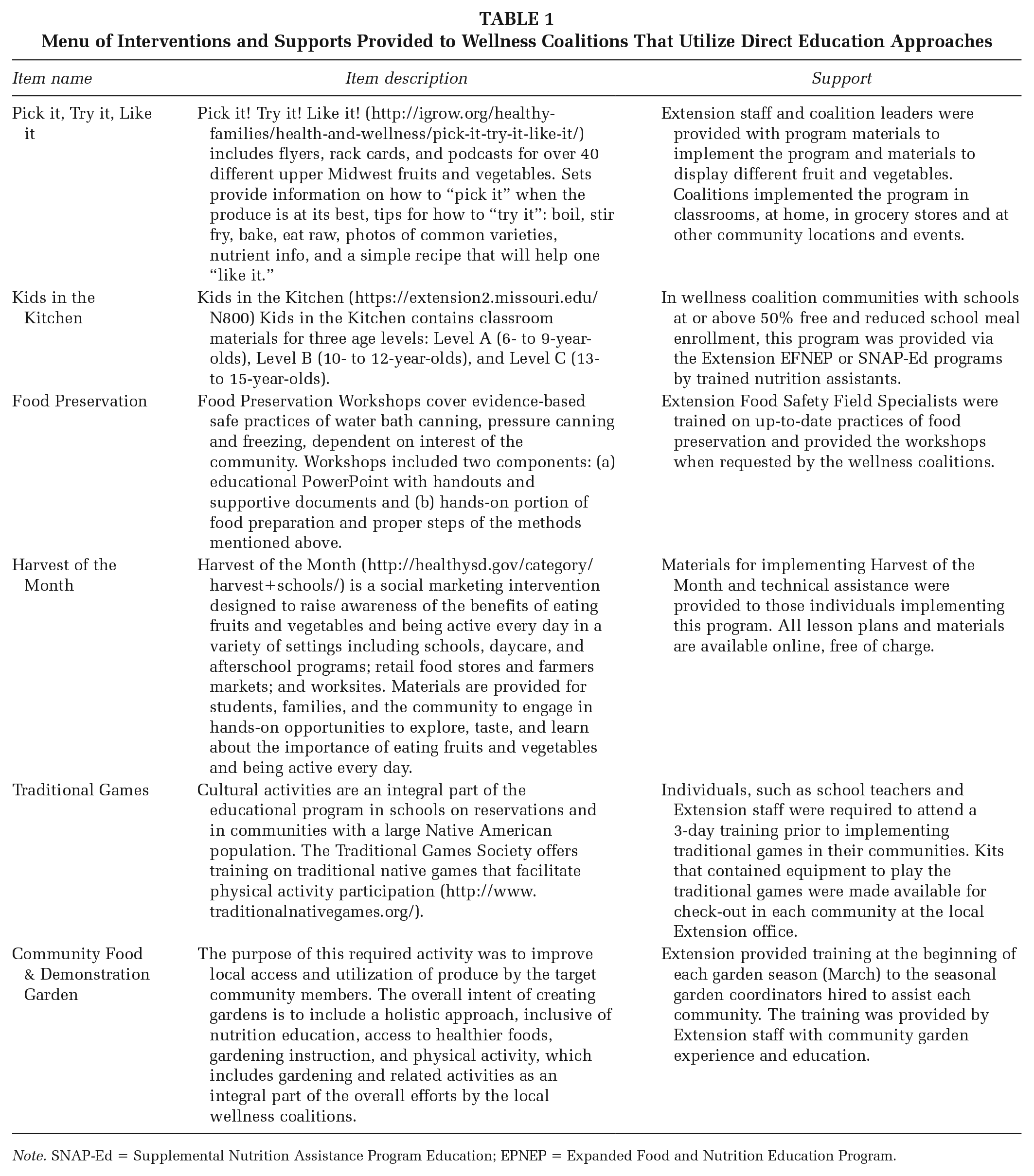
Note. SNAP-Ed = Supplemental Nutrition Assistance Program Education; EPNEP = Expanded Food and Nutrition Education Program.
Menu of Interventions and Supports for Wellness Coalitions That Utilize Policy, Systems, and Environment Approaches

Note. CDC = Centers for Disease Control and Prevention; SDSU = South Dakota State University.
Implementation
The wellness coalitions supported implementation of menu interventions using the tactics outlined below:
Regular Wellness Coalition Meetings
Each coalition had an Extension staff member that served as a lead facilitator, who along with the Community Champion, helped to ensure that activities kept moving forward. The coalitions met monthly, with some meeting more frequently depending on the project they were working on; meetings were scheduled by the Extension staff member with email reminders and communication in-between meetings.
Weekly Extension Staff (Facilitator) Meetings
Extension staff met with their supervisor weekly to discuss weekly tasks, receive evaluation updates, and network around successes and barriers experienced by the coalitions. These meetings addressed or mediated any problems, provided a course correction as quickly as possible, and offered an opportunity for reflection and affirmation of the work being done with the other coalitions.
Community Action Plan and Budget Justification
Extension staff were trained on utilization of the Community Action Plan (CAP) and Budget Justification form. These tools were used to coach wellness coalitions in planning for chosen interventions. A CAP template was created for each strategy and individual items (e.g., Harvest of the Month, Pop Up Play) as outlined in Table 1, and included the following sections: objectives, sector, planned action (activity, description, due date, and lead person), and funding requested and/or secured. The Budget Justification template included the following sections: item request, level of priority, quantity needed, justification for purchasing the item, cost per item, and total cost. Both the CAP and Budget Justification were created with simplicity in mind, with the CAP being two pages and the Budget Justification one page, and prior to submission must be signed by a coalition representative. Once completed, the CAP and Budget were submitted to the project leadership team, who provided guidance on strengths and weaknesses of the plans and worked with the Extension staff member on final approval, with a goal of a 2-week turnaround.
Evaluation
The overall evaluation plan tracked menu item implementation efforts and provided feedback necessary to adjust the work plan. The plan assured that activities yielded the intended short-term outcomes of developing community-level health-promoting coalitions, increasing community-wide health-promoting practices, and improving community member knowledge about health-promoting behaviors in nutrition and physical activity. Evaluation efforts were grounded in utilization-focused evaluation (Patton, 2012), comprised of both process and outcome evaluation, with a focus on tracking activities that contributed to the short-term outcomes, and identified best practices for dissemination and application in other settings.
HEAL MAPPS, RALA, RALPESS, and NEMS assessments were completed at baseline and Year 4 to allow for assessment of change in the environment after wellness coalition establishment and community interventions. To measure partnership engagement, program administration, and communication, the project utilized wellness coalition meeting minutes, Coalition Effectiveness Inventory, and the community champion survey. The data were utilized to determine coalition development for each community and across communities. These tools assessed the perceptions of collaborative activities, group decision-making processes, satisfaction with coalition participation, and impact on the community.
Direct education efforts were tracked utilizing the Program Evaluation and Reporting System (PEARS). PEARS is a web-based data management system built to help Extension administrators manage program data and demonstrate impact. Each Extension staff member entered their progress into PEARS to track the extent of their efforts.
Discussion
This article provides an overview of an innovative methodology used to facilitate community-based PSE work in rural areas. The infrastructure created to support community-led PSE change strategies was based on the CMI (Lavinghouze et al., 2014). A multilevel leadership structure was used to facilitate PSE change within rural communities by developing community coalitions and providing leadership and technical support through community champions and Extension, respectively. In addition, assessment tools were selected with attention to the rural nature of the community and presentation of data and evidence-based PSE strategies back to key stakeholders was a focus of the structure to support engaged data, and responsive planning.
Previous studies using wellness coalitions to promote PSE change in rural communities have used community champions (Agner et al., 2020) or Extension (Holston et al., 2020) to provide support, but not both. A novel component of the present methodology was the multilevel support, wide array of skills and strengths, and expanded network of resources available to the community coalition that came from having leadership from a community champion and Extension staff working collaboratively. Extension staff are commonly charged with building capacity within communities, making them an ideal partner. In addition, having a community member serve in the community champion role brought internal knowledge of the community, its history, and culture. The combination of leadership from community champions and Extension allowed coalitions to extend their knowledge of available resources from those within the community to Extension resources and partnerships across the state. Furthermore, with Extension staff located in communities across the state working on like initiatives, it created a network of communities that were working toward common goals and could share successes, barriers, strategies, and resources. For example, SNAP-Ed (https://snaped.fns.usda.gov/) funding was integrated into this project from the start (due to knowledge of cross-cutting objectives), allowing for expansion of project reach to a greater number of underserved communities across the state, and for sustainability of activities once CDC funding was extinguished, which would not have been possible without Extension.
Land-grant institutions were established with a tripartite mission: education, research, and community outreach through Extension. The U.S. Department of Agriculture’s 2014 report, Cooperative Extension’s National Framework for Health and Wellness (U.S. Department of Agriculture and National Institute of Food and Agriculture [USDA & NIFA], 2014) encouraged Extension to move beyond community outreach through direct education efforts and increase their focus on facilitating PSE changes within communities. With this evolution in Extension, the Division of Nutrition, Physical Activity, and Obesity saw Extension as an innovative, non-traditional public health partner that could implement evidence-based obesity prevention strategies with a focus on PSE approaches (USDA & NIFA, 2014). The structure of wellness coalitions led by community champions and supported by Extension staff aligns with the CMI core components of multilevel leadership, networked partnerships, and managed resources (Lavinghouze et al., 2014). The idea was to create a community-led structure but provide additional support and technical assistance in the form of resource networks at the national state and local levels, trainings, knowledge of funding opportunities, and social capital from Extension staff. The multilevel partnerships between the community coalition, community champion, and Extension built capacity to make PSE changes and promoted sustainability beyond the funding period.
Another notable component of the present methodology was the attention to rural-specific assessment tools, presentation of the data back to the community in easily interpreted formats, and providing applied, evidence-based PSE strategies in a menu format for community selection to facilitate engaged data and responsive planning. Most research on PSE change has focused on non-rural settings and thus, there are limited nutrition and physical activity environment assessment tools specific to rural areas (Frost et al., 2010). To capture the strengths and weaknesses of the physical activity environment in rural areas, it is critical that tools specific to rural areas are used. In addition to using rural-specific tools when available, the assessment tools selected engaged the community in the process of assessing the nutrition and physical activity environment to allow for their perceptions to be captured. Data were presented back to the community and the community coalition in an easy-to-understand format with photos that initiated a community conversation on strengths and weaknesses of the food and physical activity environment within their communities and infographics that shared the strengths and opportunities for improvement. Extension staff then presented community coalitions with a menu of evidence-based PSE approaches that were presented in a way that facilitated matching PSE approaches to prioritized needs. This structure allowed the community to be engaged in the data and create an action plan that met the needs and priories of the community, while ensuring the plan utilized evidence-based PSE strategies. These elements of the methodology align with the engaged data and responsive plans and planning components of the CMI and allowed for a great balance of community ownership and informed, feasible, and sustainable solutions.
Building active, sustainable community wellness coalitions takes time, dedication, and multiple levels of support. One limitation to the structure used in this methodology was the time required to build coalitions, get a wide variety of key stakeholders involved, and establish community champion leadership. The coalitions were not fully formed until Year 2 of the project, and membership continued to ebb and flow depending on a variety of factors such as personal interest in the intervention project the coalition was actively working on and turn over in staffing by external partners. Limited turnover of community champions occurred, but it took 1 year to find and engage individuals to serve in the community champion role within all communities. Weekly staff meetings to facilitate communication among members of the project team were implemented as a strategy to help the Extension staff who were facilitating the wellness coalitions have an outline to plan for and overcome challenges related to coalition efforts. Throughout this project, the support provided to community wellness coalitions from Extension staff proved to be critical to keeping wellness coalitions moving forward through capacity building, knowledge of potential resources and mutually beneficial partnerships, and ability to stand in and transition new leadership at times of turnover and change.
Implications for practice and research
Community champions and Extension have independently been shown to be effective forms of rural community wellness coalition leadership (Agner et al., 2020; Holston et al., 2020). Community champions have knowledge of their communities, and Extension is charged with community outreach and is a natural partner for nutrition and physical activity-focused PSE work. Because both have unique strengths, connections, and knowledge, bringing them together can amplify and enhance work being done in rural communities. This article presents a model for multilevel leadership of community wellness coalitions using community champions and Extension. The strengths of community champions and Extension were complementary and provided access to both internal and external community resources, contributing to overall sustainability of the coalition and its work. Community leadership by the community champion was enhanced with an extra layer of support and technical assistance from Extension and its statewide network of resources. In addition to presenting a model for leadership, this article highlights an innovative format to guide community-led PSE work, which includes involving community members in data collection and using a menu of PSE strategies to guide coalition activities. This format allows communities to be engaged with data and facilitate the direction of work based on their needs, while limiting activities to only evidence-based PSE strategies as solutions, ultimately nudging communities to move past direct education to engage in PSE strategies. Furthermore, working from an established intervention menu allows for selection of PSE strategies that already have momentum and support through partnering organizations and stakeholders, such as Extension, that can support the implementation and sustainability of activities. The CMI was an ideal model for this work as the partnership between community champions and Extension provided a structure of multilevel leadership, managed resources, and networked partnerships and this structure facilitated action and oversight of engaged data and responsive plans and planning, checking the box on all CMI core components.
Ultimately, the framework provided in this article outlines how to bring rural communities and Extension together to implement community-based interventions that are supported by community members, evidence-based and impactful, with a focus on long-term sustainability. To further support the use of community champions and Extension in the leadership of community wellness coalitions, future research should work to quantify the impact of multilevel leadership from community champions and Extension on policy change and sustainability of community coalitions in PSE work.
Footnotes
Authors’ Note:
This project was funded by the Centers for Disease Control and Prevention High Obesity Program cooperative agreement number 6NU58DP005477-03-03 (DP18-1809), and USDA’s Food and Nutrition Services Supplemental Nutrition Assistance Program Education (SNAP-Ed) funding from the South Dakota Department of Social Services, Office of Economic Assistance. The funders had no role in the design of the study; in the collection, analyses, or interpretation of data; in the writing of the manuscript, or in the decision to publish the results. Dr. Stluka contributed to this article in her personal capacity. The views expressed are her own and do not necessarily represent the views of the National Institute of Food & Agriculture or the United States Government. The other authors declare no conflicts of interest.
Supplement Note:
This article is part of the Health Promotion Practice supplement, “Public Health Practice in the Field.” The purpose of the supplement is to showcase innovative, communitycentered, public health actions of SPAN, REACH, and HOP programs to advance nutrition and physical activity among priority populations in various settings. The Society for Public Health Education is grateful to the Centers for Disease Control and Prevention, Division of Nutrition, Physical Activity, and Obesity for providing support for the issue. The entire supplement issue is available open access at  .
.