



Abstract
Augmentative and alternative communication based interventions support individuals with complex communication needs in becoming effective and efficient communicators. However, there is often a disconnect between language models, communication opportunities, and desired intervention outcomes in the intervention process. This article outlines a service delivery model that unites these elements of intervention. The social theory of language acquisition provides the foundation of this immersion model, while adaptations of indirect language stimulation strategies create the support system necessary to develop an independent and functional communicator. The model described in this article may be replicated or modified to meet the needs of individuals in any classroom or intervention setting.
The core intent of pairing individuals with complex communication needs (CCN) with an augmentative and/or alternative form of communication (AAC) is to provide them means to communicate and actively participate in life’s events (American Speech-Language Hearing Association [ASHA], 2004). Language is the vehicle for conveying the essence of these events. For typically developing children, the acquisition of language is a rapid and seemingly effortless and organic process, which occurs naturally by being immersed in the language one is learning (Langdon, 2008). “Children learn to comprehend and produce words that are frequently spoken to them” (Harris & Reichle, 2004, p. 155) and a word is only considered a part of a child’s repertoire after they have used it in meaningful contexts multiple times (Gray, 2003; Pence & Justice, 2008). However for children learning to use AAC as a means of communication, there is a separation between the expectations of learning their AAC language, that is, the language represented on their device, and the presented learning opportunities, or the experiences that encourage the use of language.
Often, familiar and unfamiliar communication partners use an oral language system with an individual learning an AAC-based language. In a sense, this dichotomy requires the AAC user to “code switch” between a verbally symbolic language system and a visually symbolic language system. Since the AAC learner does not possess a solid language foundation in either system, there is often a breakdown in his or her understanding and use of symbolic communication. These breakdowns lead to negative responses in the AAC learner, such as frustration and passivity, which may impact his or her learning.
AAC intervention is a venue to connect language exposure, communication opportunities, and desire intervention outcomes. The intervention model described in this article aims to provide intense language intervention services for children with CCN by creating an immersive language-rich environment based on the child’s AAC language system. As a component of each students’ extended school year (ESY) program, services provided beyond the regular school to students who might otherwise display an irrecoverable regression in skills as a result of an extended break (e.g., summer vacation; Individuals With Disabilities Education Improvement Act [IDEA], 2004), this alternative service delivery model provides an intensive AAC-based intervention provided under the roués of “camp.” Striving to emulate a summer camp experience, select students leave their special education classes for 2 weeks to attend camp. Campers are encouraged and supported in using their communication aids to participate in various camp-themed activities including nature hikes, scavenger hunts, and arts and crafts. Each camper is paired with a graduate student clinician who serves as the camper’s personal communication guide. The student clinician aims to escort the child with CCN toward the use and understanding of symbolic language; therefore, we like to refer to the child’s trained partner as his or her communication guide.
The purpose of this article is to delineate and describe this alternative service delivery model for children with CCN. This article will discuss the planning and implementation of phases of the intervention process that must occur in order for successful implementation of this immersive service delivery model to occur. Preliminary investigations have shown that this approach is effective in increasing symbol use (e.g., use of symbols, number of symbols per message, range of communicative functions) in children with CCN (Dodd & Hagge, 2013; Dodd, Jekerle, & Marsden, 2011). The intervention process described in this article may be replicated or modified to meet the needs of individuals with CCN in any classroom or intervention setting.
AAC Intervention
Adopting Schlosser, Koul, and Costello’s (2007) adaptation of Garlund and Björck-Ǻkesson’s definition of intervention, we recognize intervention as a series of intentional steps taken toward an identified goal. These intentional steps, referred to as phases, include activities related to assessment, intervention planning, and ultimately implementation of the intervention itself. Intervention, particularly as it relates to AAC, must be viewed as a dynamic process—constantly changing in response to the child’s reaction to the intervention and the child’s changing communication needs. While this article will focus on the planning and implementation phases of the intervention process, Table 1 provides an overview of the different components at each phase of the intervention process (Schlosser et al., 2007). The subsequent sections will provide a detailed description of each component of the intervention planning and intervention implementation phases.
Phases of the AAC Intervention Process.
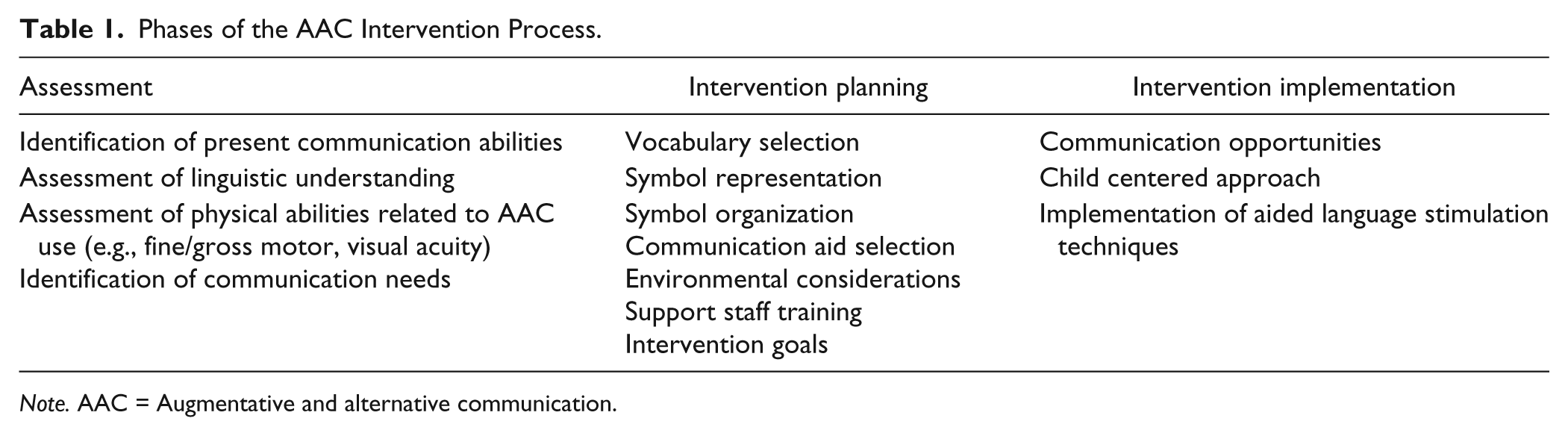
Note. AAC = Augmentative and alternative communication.
Intervention Planning Phase
The intervention planning phase is a critical period when deliberate consideration is given to decisions regarding the initial set of vocabulary and how that vocabulary will be represented and organized. It is during this phase when key stakeholders are trained about the philosophical foundation of the intervention approach and how to implement the intervention techniques and strategies. Intervention is customized based on the needs of the AAC user and begins with the identification of intended intervention outcomes. The following are examples of goals that would be characteristics of a child who would benefit from this type of intervention model:
After attending AAC Camp the AAC user will . . .
Increase understanding of symbols
Increase the total number of symbols used for communication
Increase the number of symbols sequenced to create messages
Expand the purposes for which they communicate (e.g., communicative functions)
Increase frequency of initiations.
Vocabulary selection is guided by two main purposes: the need to convey essential messages and the eventual development of language skills (Beukelman & Mirenda, 2013). Words and phrases to convey essential messages are generally categorized according to specific environments (e.g., playground) or activities (e.g., circle time, arts, and snack). Utilizing an environmental approach, coverage vocabulary is selected to allow the AAC user to communicate basic wants and needs in specific communication environments (i.e., playground, circle time) and consists predominately of fringe vocabulary. Fringe vocabulary, also referred to as content or extended vocabulary, includes context-specific words (e.g., snack-cookies, chips, juice, versus playground-slide, ball, swing), which are unique to an individual’s interests and are directly influenced by the immediate environment and activity (Beukelman & Mirenda, 2013). A communication aid based primarily on fringe vocabulary leads the child toward using their aid primarily for the pragmatic function of requesting often restricting its use for other communicative purposes (e.g., commenting, sharing).
Taking a developmental perspective to vocabulary selection, we reflect on the fact that young children in the thralls of acquiring language use predominately core vocabulary (Banajee, DiCarlo, & Stricklin, 2003; Rescorla, Alley, & Christine, 2001). Core vocabulary terms are words that can be used universally across environments and activities to convey an array of communicative functions (Beukelman & Mirenda, 2013). Taking a developmental approach to vocabulary selection will provide the child with the means to communicate for purposes that extend beyond requesting. The initial vocabulary set of an emergent AAC user should consist predominately of core vocabulary to provide the child with a means to create novel sentence patterns and communicate for a variety of pragmatic functions (e.g., requesting, recurrence, negation, sharing). A well-chosen set of core vocabulary terms can easily be combined to serve a variety of communicative functions while fringe vocabulary may impose unexpected restrictions.
Symbol representation
Once a vocabulary set has been carefully chosen, the symbol representation must be decided on (e.g., PCS™, real photos) and organized on the child’s communication aid. To foster the child’s acquisition of language, it is helpful to choose symbols that are consistent throughout the child’s environment. It can be confusing to the child to have one set of symbols on his or her communication aid (e.g., SymbolStix®) and a different set of symbols used within the classroom (e.g., PCS™). Furthermore, when choosing a representing icon, it is important to consider its application. Choosing an icon with a general or universal representation (e.g., “turn” represented with an icon of an arrow) enables the child to consider its use for a variety of functions rather than one specific to its iconicity (e.g., “turn” represented with an icon of turning a page of a book; Beukelman & Mirenda, 2013). To promote the flexible use of core vocabulary to create novel messages, it is important that each word be individually represented. As the child’s communication abilities develop, his or her system will enable them to create more novel and complex messages.
Communication aid selection
The focus of intervention is not on teaching vocabulary but rather teaching children how to use language, in this case picture symbols, for a broadening range of functions. Although not necessary, exploring the use of speech-generating devices is strongly encouraged. Many of the children who benefit from this type of intervention tend to exhibit a low initiation rate. When using a non-voice generating system (e.g., communication board or book), communication attempts can be easily missed. Failing to respond to a communication attempt is a missed opportunity to reinforce the child’s bid for interaction and may decrease the likelihood of future initiation attempts or delay the occurrence of the next.
Environmental considerations
Another aspect of the intervention planning phase involves creating a linguistically rich environment by providing multiple opportunities for the child to experience his or her AAC language throughout the day. This may be done by incorporating picture schedules, choice boards, adapted stories (Dodd, 2011), and the use of modeling boards. Adapting stories is one way to increase the child’s language exposure opportunities. In this technique, written story text is supplemented with iconic symbols consistent with the child’s AAC language and development level. This gives the child an exposure to his or her AAC language within shared reading activities. Modeling boards are low-tech communication boards which are readily available to augment oral language models provided throughout the day. Routine exposure to the child’s AAC language is essential for creating an immersive environment.
Training
The last step of the intervention planning phase involves training key participants. Inform communication guides about the premise behind teaching core vocabulary versus fringe vocabulary. Teach communication guides how to apply familiar language stimulation techniques (e.g., self-talk, modeling) through the use of aided language stimulation (ALgS) and augmented input techniques.
Intervention Implementation Phase
The primary objective of AAC intervention is to optimize an individual’s skills in accessing and using his or her AAC aid (Binger, Berens, Kent-Walsh, & Taylor, 2008). Guiding the child in accessing his or her communicative aid and empowering them to create novel messages for a variety of functions leads the child toward independent, participatory communication. This may be accomplished by immersing the child in an environment rich in AAC language while simultaneously creating opportunities for them to use his or her communication aid.
A child-centered approach to AAC intervention creates and scaffolds natural opportunities utilizing the child’s communication aid (Paul & Norbury, 2012). Following the child’s lead enables the communication guide to contingently respond to all of the child’s communicative attempts. This demonstrates to the child that his or her language has meaning while providing AAC language models.
Too often communication partners respond to a child’s attempts with verbal language alone, which creates a disconnect between the language being acquired and the language being modeled. To connect the child’s exposure to language and the language being acquired, oral speech is coupled with the language represented on the communication aid—a technique known as ALgS (Beukelman & Mirenda, 2013; Cafiero, 1998; Goossens’, 1989). This technique provides a model of language for the child to internalize while showcasing AAC as a viable form of communication (Binger et al., 2008; Paul & Norbury, 2012). ALgS has been shown to increase a child’s understanding of symbols and increase syntactic performance (Bruno & Trembath, 2006; Dada & Alant, 2009; Harris & Reichle, 2004).To be effective, Goossens’, Jennins, and Kinahan recommend that ALgS be applied to 70% of interaction opportunities (as cited in Dada & Alant, 2009). Such inundation of ALgS is validated when we consider that typically developing children observe and listen to language for one to two years before producing verbal language.
Indirect language stimulating techniques such as self-talk, parallel talk, modeling, and expansion provide the communication guide various methods to expose the child with CCN to AAC language that is meaningful to his or her experience. These strategies in language intervention may easily be translated to AAC intervention (see Table 2).
Language Stimulation Techniques Translated to AAC Intervention.
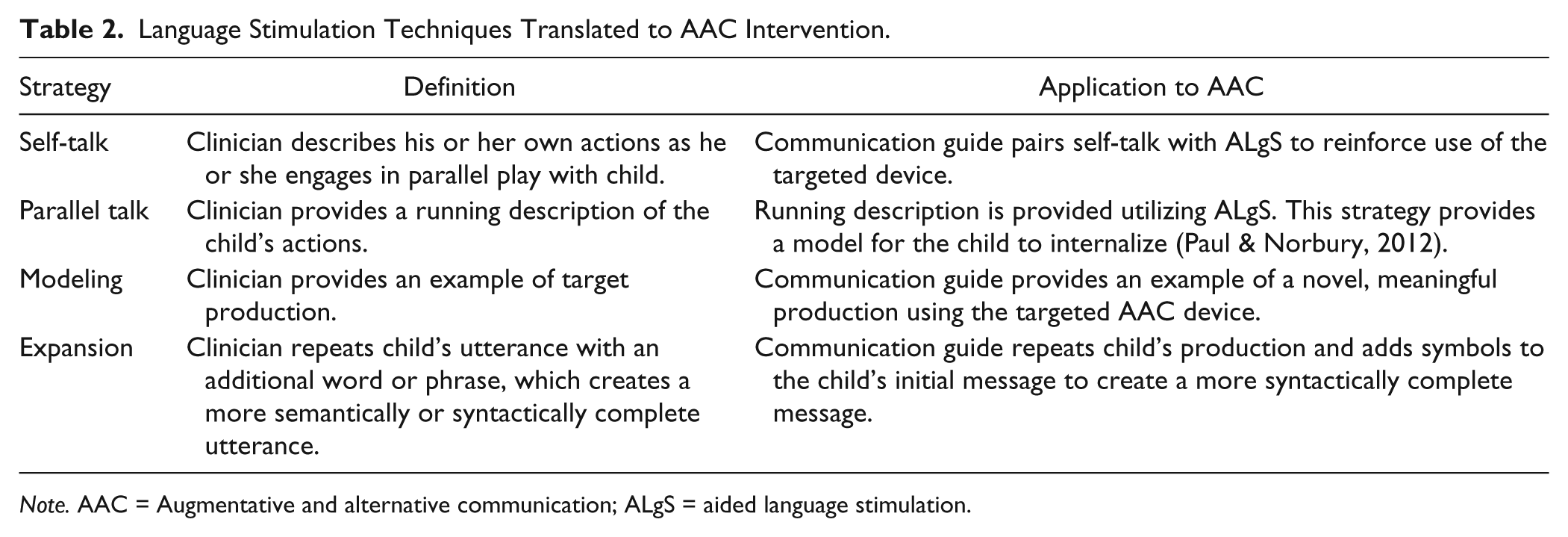
Note. AAC = Augmentative and alternative communication; ALgS = aided language stimulation.
Another strategy vital to the process is the expectant delay. Expectant delays provide the child ample time to process and respond to a communication guide’s bid for interaction (Binger et al., 2008). This can be a difficult technique to practice since most individuals have an innate desire to keep a conversation going at a typical rate; however, this is an important technique in working with the CCN population due to their specific language deficits and the time required to program AAC. Expectant delays combined with the listed intervention strategies provide children with CCN-appropriate models of language as well as the opportunity to participate in communication with their AAC aid.
Clinical Implications
Consistent with the Children and Youth version of the International Classification of Functioning, Disability, and Health framework (World Health Organization, 2007), the intervention program discussed in this article is designed to facilitate an individual’s participation by guiding that person to acquire skills and strategies in using his or her AAC aid effectively (ASHA, 2004). This is accomplished by utilizing natural interactions and experiences and immersing the child in his or her AAC language. The outlined program enhances successful communication and minimizes social barriers (e.g., language gap) by providing training and support to communication partners and guides. We encourage individuals to collaborate and to adapt the strategies discussed in this article when developing an intervention program that meets the needs of individuals with CCN.
It is recommended that classroom instruction include the child’s targeted AAC language to promote the child’s understanding of the symbol and the referent. Many children with CCN are visual learners living in an auditory world, so it is imperative that we enhance their learning potential by capitalizing on their strength (Beukelman & Mirenda, 2013). Beyond classroom instruction, one on one interaction with the child should utilize ALgS to promote the use of the communication aid and its language. The communication guide should sit next to the child to facilitate modeling and always focus on the communication rather than the AAC aid (Cumley & Wirkus-Pallaske, 2007). The communication team may determine other methods in how to immerse individuals with CNN in their targeted language to promote acquisition.
Considerations outlined in this article infer the need of a mature adult: student ratio, which may be done by enlisting paraprofessionals (e.g., speech-language pathology assistants [SLPAs], student teachers). These paraprofessionals should be trained by the communication team in the strategies outlined and discussed in this article. Above all, to create a successful experience everyone must commit to an immersive program, which requires professionals and paraprofessionals to challenge themselves. Constant evaluation and adaptation regarding how we are guiding communication within this population, which is often viewed as difficult to teach, must occur to best serve them.
Footnotes
Declaration of Conflicting Interests
The authors declared no potential conflicts of interest with respect to the research, authorship, and/or publication of this article.
Funding
The authors received no financial support for the research, authorship, and/or publication of this article.