



Abstract
Siblings play an important role in the lives of children with disabilities, especially those with complex communication needs (CCN). However, children with CCN require support to learn social and communication skills. Like other communication partners, typically developing (TD) siblings may struggle to understand how to best interact with a child with CCN and may benefit from training to learn communication strategies. This pilot study evaluated a newly created sibling communication partner training program to help TD siblings learn the strategy Plan, Talk, Wait, and Respond to support the communication of their siblings with CCN. A single-subject multiple probe design was used with three TD siblings and their siblings with CCN. Although results varied for sibling pairs, an increase in communication supports from TD siblings and communication gains for children with CCN were noted with all sibling pairs. Limitations, adjustments to the training, and future research directions are discussed.
More than half of the children who receive special education services in early childhood have speech and language delays (Hebbler et al., 2007). Many of these children have significant delays called complex communication needs (CCN), which includes a lack of speech production, and impacts communication and social development (Raghavendra, Virgo, Olsson, Connell, & Lane, 2011). Children with CCN require specialized supports from communication partners (e.g., siblings, parents, teachers) to learn communication skills (Kent-Walsh & McNaughton, 2005). Unfortunately, communication partners often hinder communicative development by asking closed questions, dominating communicative interactions, and providing few opportunities, which leads to limited communication by the child with CCN (Kent-Walsh & McNaughton, 2005). However, communication partner training can improve communication partner supports from individuals such as parents and peers (Kent-Walsh, Murza, Malani, & Binger, 2015), and also improve communication by individuals with CCN (Douglas, Light, & McNaughton, 2013).
Although all individuals in a child’s social environment are important, the sibling relationship is especially crucial (Shivers & Plavnick, 2015). Siblings frequently play together and spend more time together in childhood than other individuals (Kim & Horn, 2010). Sibling relationships are also the longest lasting relationships in life (Shivers & Plavnick, 2015). However, for children with CCN, sibling interactions may be challenging due to communication difficulties, which can make typically developing (TD) siblings feel incompetent (Kim & Horn, 2010). Sibling interventions can boost TD sibling confidence, increase skill acquisition for both siblings, and positively impact sibling relationships (Shivers & Plavnick, 2015).
Despite evidence suggesting that siblings are ideal communication partners, sibling research is still limited (Shivers & Plavnick, 2015). However, sibling training has been shown to positively impact the communication of children with autism spectrum disorder (ASD) and the communication supports by their TD siblings (Oppenheim-Leaf, Leaf, Dozier, Sheldon, & Sherman, 2012). TD siblings have also been successfully taught to support play behaviors (Celiberti & Harris, 1993), and social skills (Tsao & Odom, 2006). Research indicates that sibling interventions are effective for children with ASD and other developmental delays (e.g., Down syndrome, William’s syndrome, cognitive delays; Kim & Horn, 2010), and there is a growing body of research indicating that communication partner training is effective for peers of children with CCN (Kent-Walsh et al., 2015). However, limited research exists evaluating interventions targeted to siblings of children with CCN (Kent-Walsh et al., 2015).
Research indicates that communication partner training and sibling interventions should include several components to support communication partner skills and increase communication by siblings with CCN. First, training programs with instructional foundations that include strategy instruction and a mnemonic, as suggested by Kent-Walsh and McNaughton (2005), have been shown to be most beneficial (Kent-Walsh et al., 2015). In addition, sibling interventions should focus around naturally occurring activities, such as play (Ferraioli, Hansford, & Harris, 2012). Interventions should also include content to help siblings provide supportive interactions where choices, questions, and comments occur frequently, where sufficient wait time is provided for the child with CCN, and where siblings respond to communication by the child with CCN (Douglas et al., 2013; Douglas, Nordquist, & Kammes, 2016). Interactions where these strategies are present have been shown to increase the frequency of communication for children with CCN (Douglas et al., 2013; Douglas et al., 2016).
Research Questions
A pilot study was conducted to evaluate a sibling communication training program. We sought to answer the primary research question:
Two secondary questions were also posed:
Method
Research Design
A single-subject multiple probe design (Gast & Ledford, 2014) was used in this study with three sibling pairs (i.e., one TD sibling and one child with CCN in each pair). The primary dependent variable was frequency of TD sibling talk. Secondary variables included the frequency of communication by the child with CCN, and the frequency/percentage of responses by the TD sibling to the communication of the child with CCN.
Instrumentation
Prior to the start of the study, three instruments were used to gain information about the communication of the child with CCN and the relationship of sibling pairs. The Behavior Indication Assessment Scale (BIAS; Sigafoos, Arthur-Kelly, & Butterfield, 2006) was used to gather information from parents about the communication skills of children with CCN, including the ways the child gained attention, requested, and protested. The Sibling Relationship Questionnaire (SRQ; Furman & Buhrmester, 1985) and questions on the demographic form were used to gather information about sibling relationships. The SRQ was completed by TD siblings and parents and provided a rating for warmth/closeness between siblings, status/power, and conflict/rivalry on a Likert-type scale ranging from 1 (i.e., infrequent occurrence) to 5 (i.e., frequent occurrence). Parents also answered questions on the demographic form about the TD sibling’s role in caring for the child with CCN (e.g., “How often is your older child involved in the care of their younger sibling?”).
Setting and Participants
This study was conducted in the homes of participants in the Midwestern United States. Parents were present at each session but did not engage in interactions. TD siblings selected all activities using materials available in the home. Participants were recruited for the study through a parent listserv and flyers sent home to families in local schools and preschools. Interested parents contacted the first author and were screened for eligibility (i.e., a TD child aged between 7 and 15 years paired with their sibling who has a communication disability that requires the use of alternative communication such as sign, gestures, computer systems, picture symbols). In instances where more than one TD sibling met eligibility requirements, the parent was instructed to select the sibling who played most frequently with the child with CCN. Eligible participants were then visited in their home by the first author to provide further detail, complete enrollment forms (e.g., informed consent, demographic forms), and provide detail about the communication of the child with CCN (i.e., BIAS) and sibling relationship (i.e., SRQ, demographic questions).
Sibling Pair 1
Aria was 14;11 (years;months) and in ninth grade at the start of the study. She identified herself as White and did not have any disabilities. She lived with her parents and five siblings including two foster siblings, one who was in the process of being adopted by the family. Brandon, 3;3, was a soon to be adopted sibling, who was identified as White by his foster mother. His foster mother reported that he had a speech and motor delay and an emotional disability. Brandon attended head start and received speech therapy and behavioral counseling and was being evaluated for occupational therapy and physical therapy. Based on information from the BIAS, Brandon could communicate verbally, but was difficult to understand and often used nonverbal means to support speech. To gain and maintain attention, Brandon frequently used eye gaze, touch, vocalizations, guided his partner, and demonstrated aggression. To request items or activities, Brandon often used eye gaze, touch, vocalizations, gestures, or guided a partner to what he wanted. When rejecting or protesting an item or activity, Brandon often used eye gaze, facial expressions, body movements, or walked away from the item or activity.
Aria and Brandon had a positive sibling relationship according to SRQ results. They demonstrated moderate levels of warmth, closeness, and rivalry. SRQ results were similar for Aria and her mom in all but two areas. Specifically, Aria reported more sibling conflict (i.e., moderate to high levels), and indicated that Brandon held more power. Aria’s mom reported that she played an important role in Brandon’s life, and was often involved in his care (i.e., bathed, dressed, fed, and babysat). However, Aria’s mom noted limited reliance to help with treatments related to Brandon’s diagnosis. Aria’s mom felt training would help support their interactions.
Sibling Pair 2
Conner was 8;4 and in third grade at the start of the study. His mother identified him as biracial (i.e., African/Caucasian), and he did not have any disabilities. He lived with both parents and his younger brother. Daniel was 6;3 at the start of the study and attended a multiage special education elementary class. He was identified by his mother as biracial (i.e., African/Caucasian) and had Down syndrome. His mother reported that he received special education services at school including speech, physical, and occupational therapy. Based on information from the BIAS, Daniel communicated verbally, but was very difficult to understand due to speech challenges. He communicated using nonverbal means more often than speech. To gain and maintain attention, Daniel used facial expressions, gestures, and eye gaze. Daniel requested items or activities through facial expressions, pictures, gestures, sign language, and vocalizations. When rejecting or protesting, Daniel said “no,” used eye gaze, facial expressions, body movements, and occasionally sign language.
Conner and Daniel had a positive, warm sibling relationship according to SRQ results. They had moderate levels of warmth and closeness, moderate levels of rivalry, and moderate to low levels of conflict. Power was rated as nearly equal between the two siblings with Conner holding slightly more power than Daniel. Conner and his mom provided similar results on the SRQ in all areas. Conner’s mom indicated that Conner played an important role in Daniel’s life, served as his primary playmate, redirected inappropriate behavior, and helped keep him safe in the home. However, she indicated that Conner was rarely involved in Daniel’s care or treatments related to his diagnosis. Conner’s mom was unsure what benefits would come from the training.
Sibling Pair 3
Eliza was 8;1 and in second grade at the start of the study. She did not have any disabilities and her mother identified her as Hispanic. She lived with both parents and a younger brother. Finn was 5;3 at the start of the study and attended kindergarten. Finn’s mom identified him as Hispanic. Finn had a diagnosis of Noonan Syndrome, which is characterized by developmental delays, hypotonia, and vision problems (corrected with glasses he wore throughout the study). His mother reported that he received special education services at school including speech, occupational, and physical therapy. He also received private speech services. Based on the BIAS, Finn communicated verbally, but was very difficult to understand. He often used nonverbal communication to support or replace speech and used sign, vocalizations, and gestures to gain or maintain attention. Finn often requested items or activities by gesturing and signing. When rejecting or protesting, Finn used sign and speech, and sometimes yelled.
Eliza and Finn had a warm, positive sibling relationship according to SRQ results. They had moderate to high levels of warmth and closeness, low levels of rivalry, and low levels of conflict. Results were similar for Eliza and her mom in all areas except relative power/status. Eliza indicated that Finn held more power, and mom indicated Eliza held more power. Eliza’s mom noted that she played an important role in Finn’s life, served as Finn’s primary playmate, and was his best friend. Eliza’s mom depended heavily on Eliza to support Finn’s treatments.
Procedures
This study was conducted in three phases: baseline, training, and maintenance. All sibling pairs participated in each phase of the study. Generalization sessions were conducted during each phase to measure the use of the strategy during art/music activities.
Baseline
During baseline sessions, siblings were videotaped during play interactions in the home. At the start of each session, they were instructed to “play as you normally play.” Sessions were approximately 15 min, and videos were standardized to 10 min in length (i.e., the first minute was removed, and the following 10 min were retained and coded).
Training
The training phase of the study included two parts: live training sessions, and practice play/generalization sessions. Training was conducted by the first author and included instructional components outlined by Kent-Walsh and McNaughton (2005).
Training sessions
Training sessions followed the instructional components of Kent-Walsh and McNaughton (2005). First, a pretest and commitment to the instructional program was obtained. Training then took place during two live sessions with the first author. The first session took approximately 45 min and provided TD siblings with a description of the strategy steps, visual text on a PowerPoint, video demonstration, and a handout of the training content. Verbal practice, questions, and application activities were included for each strategy step. The second session of training took approximately 30 min and included a quiz of the strategy steps, role-play of the strategy during a play activity with the trainer, and a practice play session with feedback with their sibling with CCN. Role-play and training phase sessions included the completion of a self-reflection form with the trainer to evaluate use of the strategy, strengths, and areas of improvement. The self-reflection form included two open-ended questions and a Likert-type scale adapted for children with five facial expressions (i.e., a large smile at one end of the scale with varying expressions in between and large frown at the other end of the scale). The sessions were scheduled according to participant availability and were 2 days apart for Aria, 5 days apart for Conner, and 1 day apart for Eliza.
Instructional strategy
During live training sessions, TD siblings were taught the strategy Plan, Talk, Wait, and Respond. The strategy was adapted from communication partner training programs for paraeducators (Douglas et al., 2013) and parents (Douglas et al., 2016). The first step, Plan, taught siblings to pick a fun activity that both siblings enjoy, that both siblings can do, and that allows for lots of communication. During this step, the sibling learned about the ways children communicate including speech, gestures/facial expressions, sign language, objects, pictures, and computerized systems. Photographic illustrations were provided to demonstrate choice making with objects, sign language, facial expressions, photo and line drawn picture symbols, and computerized visual scene/grid displays. The second step, Talk, encouraged the sibling to provide choices, ask questions, and comment about the activity. The third step, Wait, taught the sibling to wait for at least 5 s each time they talked to give their sibling the chance to communicate. They were also instructed to talk again if their sibling did not communicate after 5 s of wait time. The final step, Respond, encouraged siblings to reply each time their sibling communicated, even if the communication was unclear. After they responded to their sibling, they were instructed to begin the strategy again (i.e., talk, wait, and respond).
Training fidelity
To ensure consistency of the training, training fidelity checks were conducted for each training session. The training fidelity checklist allowed the coder to indicate the absence or presence of specific areas of content and instructional activities within each training session. Fidelity was calculated by taking the number of correctly implemented instructional steps divided by the total number of instructional steps for the training session. Training fidelity averaged 99.7% (Session 1 = 99%, range = 98%–100%; Session 2 = 100%).
Training play/generalization sessions
Following the completion of the two live training sessions, siblings participated in a minimum of four practice play sessions and one generalization session during the training phase of the study (see Kratochwill et al., 2010). Practice sessions occurred 1 to 2 times per week, depending on family availability. The same standardization procedure from baseline was used for videos, but the prompt at the beginning of the session asked the sibling to play using the strategy they had learned. At the end of each training play/generalization session, the TD sibling completed a self-reflection of their strategy use, identical to the self-reflection used during the live training sessions. In training, booster sessions were provided when low levels of performance were noted for TD sibling talk (e.g., overlap with baseline data, drop when data were previously higher). Booster sessions included a brief review of the strategy steps with the TD sibling before the training session began. Booster sessions were provided for Conner (i.e., Play Session 5) and Eliza (i.e., Play Sessions 4 and 6).
Maintenance
The maintenance phase of the study included follow-up sessions 2, 4, 6, 8, and 10 weeks after the training phase ended. Maintenance sessions were conducted using the same procedures as baseline and training, but no prompt was provided.
Measures
Three dependent variables were measured in the study. Behavioral definitions were adapted from previous research studies (Douglas et al., 2016). The primary dependent variable was TD sibling talk, defined as any question, comment, or choice the TD sibling provided to the child with CCN with 5 s of wait time or a response from the child with CCN before 5 s elapsed. Secondary dependent variables included communication turns by the child with CCN, defined as any communication from the child with CCN using speech or augmentative and alternative communication (AAC; e.g., sign language, gestures, objects) to their TD sibling, and responses by TD siblings to communication turns from children with CCN, defined as a verbal acknowledgment of communication or nonverbal fulfillment (e.g., the child asks for a toy and the sibling provides it).
Data were collected via video recording in the homes of the siblings using materials available in the home during play and generalization sessions. Videos were approximately 15 min in length and were standardized to 10 min (i.e., the first minute was removed to account for reactivity with the following 10 min retained and coded and remaining video discarded). If either child left the room during the interaction, the video was paused and restarted when both children were present. Reliability was measured to ensure data collection procedures were followed during each phase of the study. Research assistants completed a checklist to determine the percentage of steps that were followed in the research protocol (e.g., sibling pair captured on video, appropriate prompt). Procedural reliability was 99% for Sibling Pair 1 (range = 89%–100%), 99% for Sibling Pair 2 (range = 89%–100%), and 99% for Sibling Pair 3 (range = 89%–100%).
Coding
Data were analyzed using Datavyu software (Datavyu Team, 2014). Research assistants coded videos using behavioral definitions for each dependent variable (i.e., TD sibling talk, communication by the child with CCN, TD sibling responses to communication of child with CCN). Before video coding, research assistants were trained until at least 90% agreement was reached for all dependent variables. Reliability was measured for 22% of the play sessions (i.e., 25% baseline, 21% training, 20% maintenance) using randomly selected videos. Reliability was calculated by taking the number of agreements for each behavior divided by the number of agreements plus the number of disagreements and multiplying by 100 to determine the percentage of agreement. Coding disagreements were discussed until agreement was reached. Reliability for TD sibling talk had a mean of 96% (Sibling Pair 1 = 99%; Sibling Pair 2 = 93%; Sibling Pair 3 = 97%) with a range of 84% to 100% (Sibling Pair 1 = 97%–100%; Sibling Pair 2 = 84%–98%; Sibling Pair 3 = 94%–100%). Mean reliability for communication by the sibling with CCN was 97% (Sibling Pair 1 = 97%; Sibling Pair 2 = 95%; Sibling Pair 3 = 98%) with a range of 90% to 100% (Sibling Pair 1 = 93%–98%; Sibling Pair 2 = 90%–100%; Sibling Pair 3 = 92%–100%). Coding reliability for responses from TD siblings was 93% (Sibling Pair 1 = 95%; Sibling Pair 2 = 87%; Sibling Pair 3 = 98%) and ranged from 50% to 100% (Sibling Pair 1 = 97%–100%; Sibling Pair 2 = 50%–100%; Sibling Pair 3 = 94%–100%).
Data analysis
Data were graphed and visually analyzed for level, trend, variability, immediacy of effect, and overlap (Kratochwill et al., 2010) with decisions made based on the primary dependent variable. Data were also analyzed using nonoverlap of all pairs (NAP), an effect size measure for single-subject designs (Parker & Vannest, 2009). Using NAP, effect sizes of 1 to 0.93 are strong, 0.92 to 0.66 are medium, and 0.65 to 0 are considered weak (Parker & Vannest, 2009).
Social validity
Social validity measures were taken during the study from TD siblings and their parents. At the end of training, parents and TD siblings completed a training evaluation to understand the perceived benefits and suggested improvements for the training.
Results
Results from the study indicate that siblings with and without disabilities made communicative gains as a result of the training (see Figure 1). Results varied for sibling pairs.
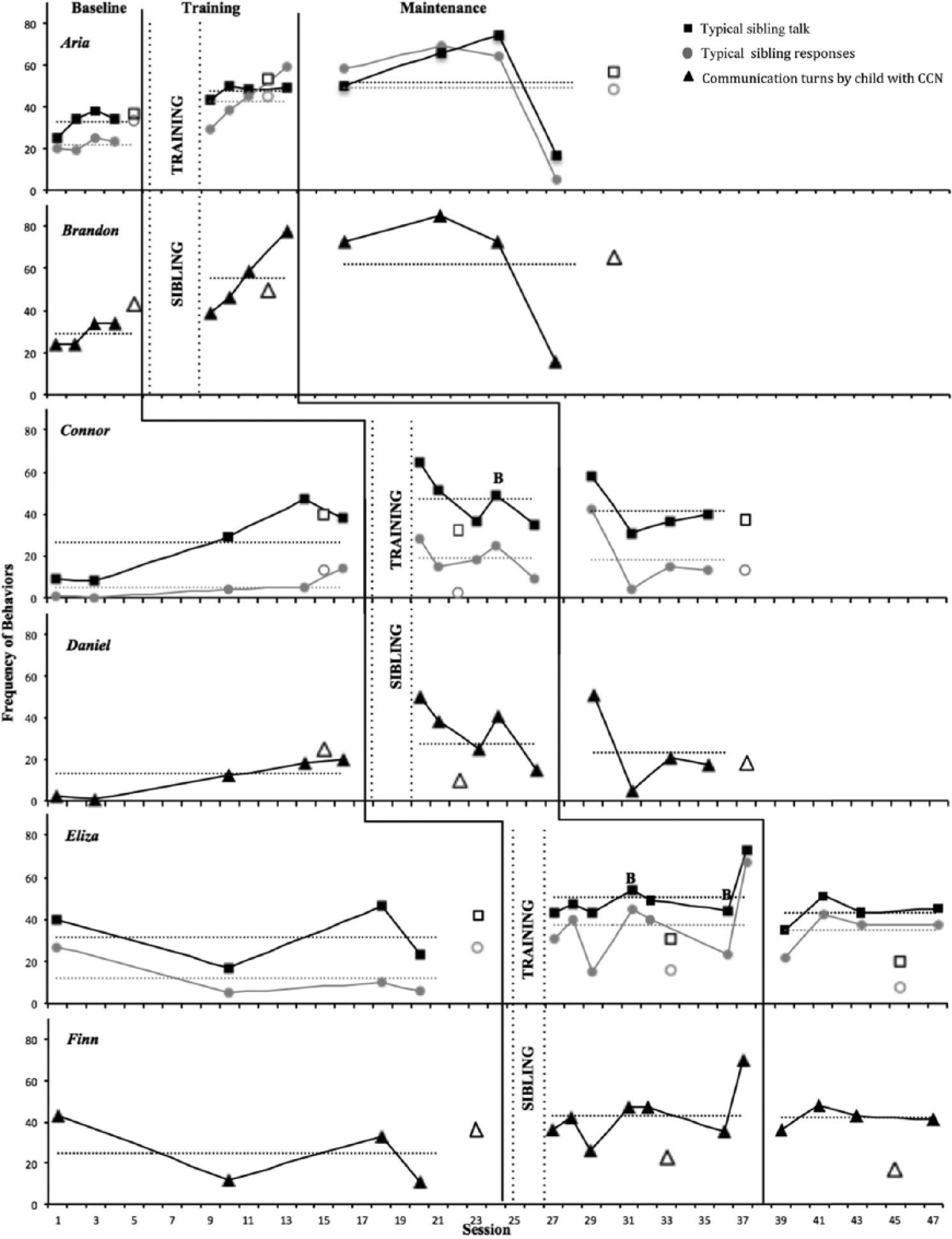
Frequency of sibling communication behaviors during 10-min interactions.
TD Sibling Talk
Sibling Pair 1
In baseline, Aria had a mean of 33 instances of talking to Brandon (range = 25–38) with limited variability and an ascending trend due to low points at the beginning of baseline with data leveling for remaining baseline sessions. During training, Aria had a mean of 48 instances of talking to Brandon (range = 43–50) with a slight ascending trend. Data were stable during training with no overlap to baseline, and an intervention effect was noted. When comparing baseline with training, NAP was 1 indicating a strong intervention effect. However, due to the low initial baseline point, it is unclear whether improvements were a continuation of the baseline trend. During maintenance, Aria had a mean of 52 instances of talking to Brandon (range = 17–74). In maintenance, data continued to increase, until the fourth maintenance session where Aria’s talk declined significantly. Higher levels were noted in the following generalization session.
Sibling Pair 2
In baseline, Conner had a mean of 26 instances of talking to Daniel (range = 8–47) with an ascending trend in baseline that leveled out at the end of baseline. In training, Conner had a mean of 47 instances of talking to Daniel (range = 39–59). In training, an immediate effect was noted, but this effect diminished later in the training phase, so a booster session was conducted. This appeared to improve talking by Conner, but this effect did not remain in the next session. Although overlap existed between baseline and training, NAP was 0.84 indicating medium intervention effects when considering overlap. During maintenance, the mean dropped to 41 instances of talking to Daniel (range = 31–58). Intervention effects did not maintain well for Conner, and given the ascending trend during baseline, intervention effect is not clear.
Sibling Pair 3
During baseline, Eliza had a mean of 32 instances of talking to Finn (range = 17–46) with some variability. In training, Eliza had a mean of 50 instances of talking to Finn (range = 43–73) with continued variability and no immediate intervention effect noted. Due to low performance at the beginning and middle of the training phase, Eliza had a booster session at the fourth and sixth training play session after which she appeared to make an improvement in performance, with an upward trend noted in training. Overlap from baseline to training resulted in a NAP of 0.89 (i.e., medium effects). In maintenance, the mean dropped to 44 (range = 35–51).
Communication by the Child With CCN
Sibling Pair 1
In baseline, Brandon had a mean of 29 instances of communication (range = 24–34) with some variability and an ascending trend due to low initial baseline points. In training, his mean rose to 56 (range = 39–78) with a delay in intervention effect. An ascending trend continued in training, but at a slightly faster rate than baseline. By the end of training, Brandon’s communication surpassed Aria’s talking, indicating that he initiated communication. When comparing overlap from baseline to training, NAP was 1 (i.e., strong treatment effects). In maintenance, skills continued to improve with an average of 62 instances of communication (range = 16–85). However, as mentioned previously, a drop in performance was noted in one maintenance session, with a return to previous levels during the generalization probe.
Sibling Pair 2
Daniel had a mean of 13 instances of communication (range = 1–20) in baseline with an ascending trend that stabilized at the end of baseline. During training, data were variable with a mean of 28 instances of communication (range = 15–50) and a downward trend. When comparing overlap from baseline to training, NAP was 0.92 indicating medium treatment effects. In maintenance, communication for Daniel dropped to a mean of 24 (range = 5–51) with a descending trend and continued variability.
Sibling Pair 3
Finn had a mean of 25 instances of communication (range = 11–43) in baseline with variability and a slight descending trend. In training, data remained variable with a mean of 43 instances of communication (range = 26–70) and an ascending trend that mirrored Eliza’s talk data. When comparing overlap from baseline to training, NAP was 0.82 indicating medium effects. In maintenance, Finn’s communication was a mean of 42 (range = 36–48).
TD Sibling Responsiveness
Within the study, a response could only occur after communication from the sibling with CCN. As a result, responses mirrored communication turns for siblings with CCN.
Sibling Pair 1
During baseline, Aria had a mean of 22 responses to Brandon’s communication (range = 19–25) with an ascending trend and an average response percentage of 76% (range = 68%–83%). In training, the ascending trend continued, but appeared to improve at a faster rate. The mean in training for responses was 43 (range = 29–59) with an average response percentage of 77% (range = 74%–83%). When comparing frequency overlap from baseline to maintenance, NAP was 1 indicating strong effects. In maintenance, a mean of 49 responses to Brandon’s communication was observed (range = 5–69) with variability in the data due to a low point for the fourth maintenance session. Mean response percentage dropped in maintenance to 70% (range = 31–88). Frequency of responses closely mirrored Brandon’s communication.
Sibling Pair 2
In baseline, Conner had a mean of five responses to Daniel’s communication (range = 0–14) with an ascending trend that mirrored Daniel’s communication and a mean response percentage of 36% (range = 0%–70%). In training, data were variable with a rise in mean response to 19 (range = 9–28) and mean response percentage to 58% (range = 39%–72%). When comparing overlap from baseline to maintenance (frequency count), NAP was 0.96 indicating strong intervention effects. In maintenance, a mean of 19 responses (range = 4–42) was seen with a mean response percentage of 77% (range = 71%–82%). The response percentage for Conner’s responses steadily increased with data directly mirroring Daniel’s communication.
Sibling Pair 3
In baseline, Eliza had a mean of 12 responses to Finn’s communication (range = 5–27) with a mean percentage of 48% (range = 30%–63%). In training, the mean number of responses rose to 37 (range = 15–67) with a mean percentage of 83% (range = 58%–96%). When comparing overlap from baseline to maintenance, NAP was 0.92 indicating medium intervention effects. In maintenance, responses dropped to a mean of 35 (range = 22–42) with a mean response percentage of 81% (range = 61%–90%). Responses for Eliza mirrored Finn’s communication.
Generalization
One generalization probe was conducted during baseline, training, and maintenance phases of the study for each sibling pair. The TD sibling was instructed to select an art or music activity. Results for generalization were mixed (see Figure 1).
Sibling Pair 1
Aria selected art activities for each generalization session (e.g., play doh, coloring). Frequency of TD sibling talk by Aria was 37 at baseline, rose to 53 during training, and continued to rise to 57 during maintenance. Frequency of communication turns taken by Brandon was 43 at baseline, 50 at training, and rose to 65 in maintenance. Frequency of Aria’s responsiveness to Brandon’s communication was 33 at baseline, 45 at training, and rose to 48 during maintenance. When considering responsiveness percentages, baseline was 77%, training rose to 90%, but dropped to 74% in maintenance. Overall, the frequency of talk by Aria, and the number of communication turns taken by Brandon appeared to generalize in this study.
Sibling Pair 2
Conner selected music, dancing, and painting activities during generalization sessions. Frequency of TD sibling talk by Conner was 40 at baseline, 32 during training, and 37 during maintenance. Frequency of communication turns taken by Daniel was 25 at baseline, 10 at training, and 18 in maintenance. Conner’s response frequency was 13 at baseline, two at training, and 13 during maintenance. Response percentages were 52% for baseline, 20% in training, and 72% in maintenance. Training did not generalize for Conner and Daniel.
Sibling Pair 3
Eliza selected painting, fossil digging, and art activities during generalization sessions. Frequency of TD sibling talk by Eliza was 42 at baseline, 31 during training, and 20 during maintenance. Frequency of communication turns by Finn was 36 at baseline, 23 in training, and 17 in maintenance. Frequency of Eliza’s responses to Finn was 27 at baseline, 16 at training, and eight during maintenance with response percentages of 75% at baseline, 70% during training, and 47% in maintenance. Training did not generalize for Eliza and Finn.
Activity Descriptions
Each sibling pair participated in activities that were selected by the TD sibling. In baseline, Aria and Brandon played with play doh, cars, stuffed animals, and colored. Conner and Daniel played with balls, built a fort, listened to music, and gave piggy back rides. Eliza and Finn played with legos, cars, painted, and pretended to be pirates. In training sessions, Aria and Brandon played with blocks, play doh, and colored. Conner and Daniel played with cars, balls, built a fort, danced, and had a sword fight. Eliza and Finn played Pokémon, Hungry Hungry Hippos, transformers, video games, school, did puzzles, colored, and dug for fossils. In maintenance, Aria and Brandon played with cars, blocks, balls, and play doh. Conner and Daniel played with balls, stuffed animals, built a fort, and painted. Eliza and Finn played with balls, played school, made pictures with shapes, danced, and colored on a chalkboard.
Sibling Training
Training was provided during two live sessions conducted by the first author. The pace for each session was adjusted to match participant needs. Session 1 was completed in an average of 49 min (range = 37–57 min). Session 2 was completed in an average of 31 min (range = 21–36 min). Total training time for participants took an average of 1 hr 20 min (range = 59 min–1 hr 33 min). Younger participants took longer to complete training than older participants.
Training evaluation
At the end of the training phase of the study, TD siblings and their parents completed a training evaluation as a measure of social validity.
Sibling training evaluation
When siblings were asked about the benefits of the training, Aria noted that she liked the one-on-one nature of the training and the use of the computer (e.g., PowerPoint, videos). Eliza also liked the videos that were part of training. Conner noted that training helped him play better with Daniel. Aria, Conner, and Eliza did not have any suggested changes to the training, and all said they would recommend the training to other children who have siblings with CCN. Aria said the training helps “siblings come closer together.” When asked whether they noticed any changes in the communication of their sibling with CCN, Aria and Conner both indicated they saw improvements. Aria stated that Brandon “uses more words.” Eliza stated that she did not notice any changes in Finn’s communication. When asked whether they had any other comments, Conner said “I liked how [the training] didn’t just help [Daniel], but it also helped me with communicating with [Daniel] . . . I am so thankful.”
Parent training evaluation
When parents were asked about the benefits of the training, Aria’s mom noted benefits to Brandon’s communication and increased play between the siblings. Conner’s dad said the training helped Conner think more critically about his interactions with Daniel. Eliza’s mom stated that Eliza “has gotten even better at explaining things to her brother, as well as better at waiting for his response . . . [the training] also helped her think about how she communicated.” When asked whether they had any suggested changes to the training, parents indicated they had no suggestions. Eliza’s mom stated that the training was easy for her child to understand and implement. When parents were asked whether they noticed any changes in the communication of their child with CCN, they all indicated improvements. For example, Aria’s mom said that Brandon listens to Aria more. All the parents stated they would recommend the training to other families. Conner’s dad indicated that the training “help[ed] strengthen the bond between siblings and improve[d] communication.” When asked whether they had any other comments, Eliza’s mom said, “As a family, we appreciate any tools to help us communicate.”
Self-reflections
After the second live training session and each training practice session, TD siblings completed self-reflections of strategy use.
Aria
During the live training session, Aria rated herself highly in all categories. Aria continued to provide high ratings in talking, waiting, and responding in practice sessions. She provided moderate ratings for the first practice session in the training phase of the study, but high ratings for the live training session and Practice Sessions 2 to 4. At Practice Session 5, she rated herself highly for planning and talking, waiting, and responding. Aria frequently noted strengths in talking and responding, but a need to include more choices, wait longer, and plan better.
Conner
During the live training play session, Conner provided high ratings in all areas of the strategy, but indicated in the future he would change the activity if Daniel did not like it. During the practice sessions, Conner consistently rated himself high in all categories with the exception of the first session where he rated himself neutral at planning. He often noted what went well with Daniel (e.g., “When he finally played with me”; “When I found a way to have fun with him”), and indicated that in the future he would “plan earlier,” make sure the TV was off, and “pick his favorite games” or change activities if Daniel was not having fun.
Eliza
During the live training session, Eliza rated herself consistently high for all areas except waiting. During the practice sessions, Eliza rated herself lowest during the first three practice sessions with a frowning face for Sessions 1 and 2 in the area of responding and neutral ratings for at least one other area of the strategy. By Session 4, she consistently rated herself highly. She provided perfect ratings in all categories during the generalization and final two play sessions. She had difficulty reflecting on what went well during sessions and often indicated she would “respond and talk more,” or “plan better” in future sessions.
Questions to the researcher
After each practice session during training, TD siblings were asked whether they had questions, and answers were provided by the researcher. Despite being prompted, Aria and Conner had no questions after any training session. Eliza had questions after the second training session where she asked whether she did a good job asking Finn questions. After the fourth practice session, Eliza stated she was happy to learn the strategy because she was jealous when just her parents participated in previous interventions.
Discussion
Siblings are crucial communication partners and should be involved in interventions to increase the communication of children with CCN (Shivers & Plavnick, 2015). Findings from this study show that the Plan, Talk, Wait, and Respond training can increase the frequency of sibling communication supports and communication for children with CCN. Specifically, we saw mean level changes for TD sibling talk and frequency of responses. We also noted percentage frequency improvements for Conner and Eliza’s responsiveness. These improvements resulted in higher communication levels for siblings with CCN, but because of increasing trends in baseline and variability for some sibling pairs, a functional relationship between the intervention and behavior changes for siblings and children with CCN is not clear. The findings from this study add to the research on communication partner interventions for parents (Rosa-Lugo & Kent-Walsh, 2008) and paraeducators (Douglas et al., 2013). However, it is evident that siblings did not perform as well when compared with adult participants. Therefore, limitations, suggested adaptations to training, and future research directions will be discussed.
Limitations
Several limitations are noted in this study. First, the study included only three sibling pairs. Given the small number of participants, generalization to other groups is limited without further research to support the effectiveness of this intervention. In addition, after analysis of results, it became clear that the intervention was most effective for the oldest TD sibling. Aria showed the clearest improvement in the study, including generalization to other activities, whereas Conner and Eliza’s performance included more variability and limited gains. Eliza, the youngest participant, also struggled with self-reflection. In addition, all TD siblings showed limited maintenance of skills. Although this is not unique in the literature (see Douglas et al., 2013), future changes to the training might work to improve maintenance of skills. In addition, given the ascending trend for some participants due to low initial baseline points, it is unclear whether the effects seen after training are related to the intervention or a continuation of baseline trend. It should be noted that Sibling Pairs 1 and 2 had never participated in a research project before. Both sibling pairs appeared timid in the first sessions and started with very low baseline points that leveled out after several sessions. Therefore, the trend in baseline may be misleading for these sibling pairs as the sessions may not be representative of typical play because of reactivity to video recording and observation. Sibling Pair 3 did not show the same pattern, but the family had participated in past research projects that included video data collection in the home.
Limitations also occurred in ways that could not be controlled or predicted. For example, Sibling Pair 1 had a low maintenance session potentially due to family environmental factors. During this session, mom indicated that the family had just received two emergency foster children, and neither sibling was responding well to the change, which corresponds directly with the decline seen during the fourth maintenance session. By the next session, family challenges were resolved, and data returned to comparable levels. Sibling Pair 2 also showed some challenges that were not identified before the start of the study despite screening attempts. Specifically, during sessions, Daniel engaged in self-stimulating behaviors and showed a preference toward solitary play. Therefore, adjustments to the intervention may be required for siblings who are not socially motivated.
Adjustments to Training and Future Research Directions
Given the challenges noted with the youngest participants in the study, future adjustments to training and research evaluating a revised training would be beneficial. First, training adjustments could be made to reduce cognitive load for participants. The training in this pilot study was broken into two sessions ranging from 21 to 57 min in length, but the overall session length may have been too much for the youngest participants. Future research could examine structural changes to the intervention (e.g., shorter sessions, clear mastery of each step of the strategy with their sibling before moving on to the next step of training). Additional instructional scaffolds, such as video models of the strategy during play and generalization activities, could also be added to illustrate strategy steps, support skill acquisition, and strategy generalization to other activities. Given the limitations for some participants, and lack of questions asked by TD siblings, future training could also incorporate coaching and positive feedback throughout the training phase of the study to better support learners and produce higher intervention effects. TD siblings within the study also appeared to struggle with activity selection and keeping the attention of their siblings with CCN; therefore, future training and coaching could emphasize the benefits of providing choice throughout an activity and could add a preference assessment to assist TD siblings in choosing motivating activities. Future research should also help identify the optimal schedule and number of practice play and training sessions, implementation of the strategy outside of scheduled play sessions, and implementation of training by naturally occurring individuals in the children’s lives such as early interventionists who are already providing services in the home or parents who have received prior training. Finally, in future research, it might be interesting to explore the use of the SRQ in selecting sibling pairs for the sibling communication training, and collect assessment information about child language skills and intervention needs.
Summary
In summary, this pilot study provides initial support for the benefits of sibling communication partner training. However, given the small number of participants, study limitations, and lack of clear effects for some participants, continued research evaluating the training is needed.
Footnotes
Declaration of Conflicting Interests
The author(s) declared no potential conflicts of interest with respect to the research, authorship, and/or publication of this article.
Funding
The author(s) received no financial support for the research, authorship, and/or publication of this article.