



Abstract
This study quantified the orthographic knowledge (i.e., knowledge of spelling conventions) of school speech-language pathologists (SLPs). On average, SLPs (N = 48) answered 65% of the questions correctly on a measure of orthographic knowledge. SLPs need better preparation in written language structure to support reading acquisition in children with language disorders.
Early language deficits place children at elevated risk for reading disabilities (Catts et al., 2001; Vellutino et al., 2004). Few speech-language pathologists (SLPs), however, incorporate activities that support reading acquisition into speech-language intervention (American Speech-Language-Hearing Association, 2018; Tambyraja et al., 2014). Limited data exist about SLPs’ knowledge for supporting reading acquisition, and most available reports are of subjective, self-reported data (e.g., Blood et al., 2010; Davis & Murza, 2018). SLPs report a general lack of preparation for preventing, identifying, and remediating reading disabilities (Blood et al., 2010). Effective prevention and remediation of reading disabilities requires metalinguistic knowledge across multiple domains (Moats, 2009). The metalinguistic domain of interest for this report is orthographic knowledge, or knowledge of the spelling system. The purpose of this study was to objectively quantify SLPs’ orthographic knowledge. We answered the research question:
Method
The Institutional Review Board at Vanderbilt University approved the methods for this study.
Participants
Participants were school SLPs from 28 school districts in two states (N = 48; one male). They were recruited via email from school districts that agreed to participate in the study and from the Child Language and Literacy Lab email distribution list, which reaches approximately 1,200 educators. Participants had a mean of 11.94 years of experience working with children in any setting (SD = 7.72). The majority (94%) reported having earned a master’s degree; the remaining 6% reported having earned an advanced professional degree (e.g., PhD). Most (85%) reported that they hold the Certificate of Clinical Competence in Speech-Language Pathology from the American Speech-Language-Hearing Association.
Materials
An experimental measure of orthographic knowledge was developed for this study and administered as an online survey using the Research Electronic Data Capture Tool (Harris et al., 2009). Participants were instructed to select (a) all words that contain consonant digraphs from a list of 10, (b) all words that contain vowel teams from a list of nine, and (c) the best answer for each of five multiple-choice questions. The multiple-choice questions asked them to indicate the set of words, from a choice of four sets, that represented a given spelling pattern (e.g., “Which of the following sets of words contains four words that follow the ‘drop the silent e’ phonics generalization?” see Tables 1 and 2). Definitions were not provided for terms; the measure thus indirectly assessed the extent to which SLPs share instructional terminology with other educators (e.g., teachers). Participants received 1 point for (a) every word correctly selected in the word lists, (b) every word correctly left unselected in the word lists, and (c) every multiple-choice question answered correctly, for a maximum of 24 points. Participants’ responses were scored automatically as correct or incorrect using Excel. Total percent correct was calculated by dividing each participant’s total number of points by 24 and multiplying by 100.
Percentage of the Participant Sample Who Selected Each Word on Multi-Select Questions.
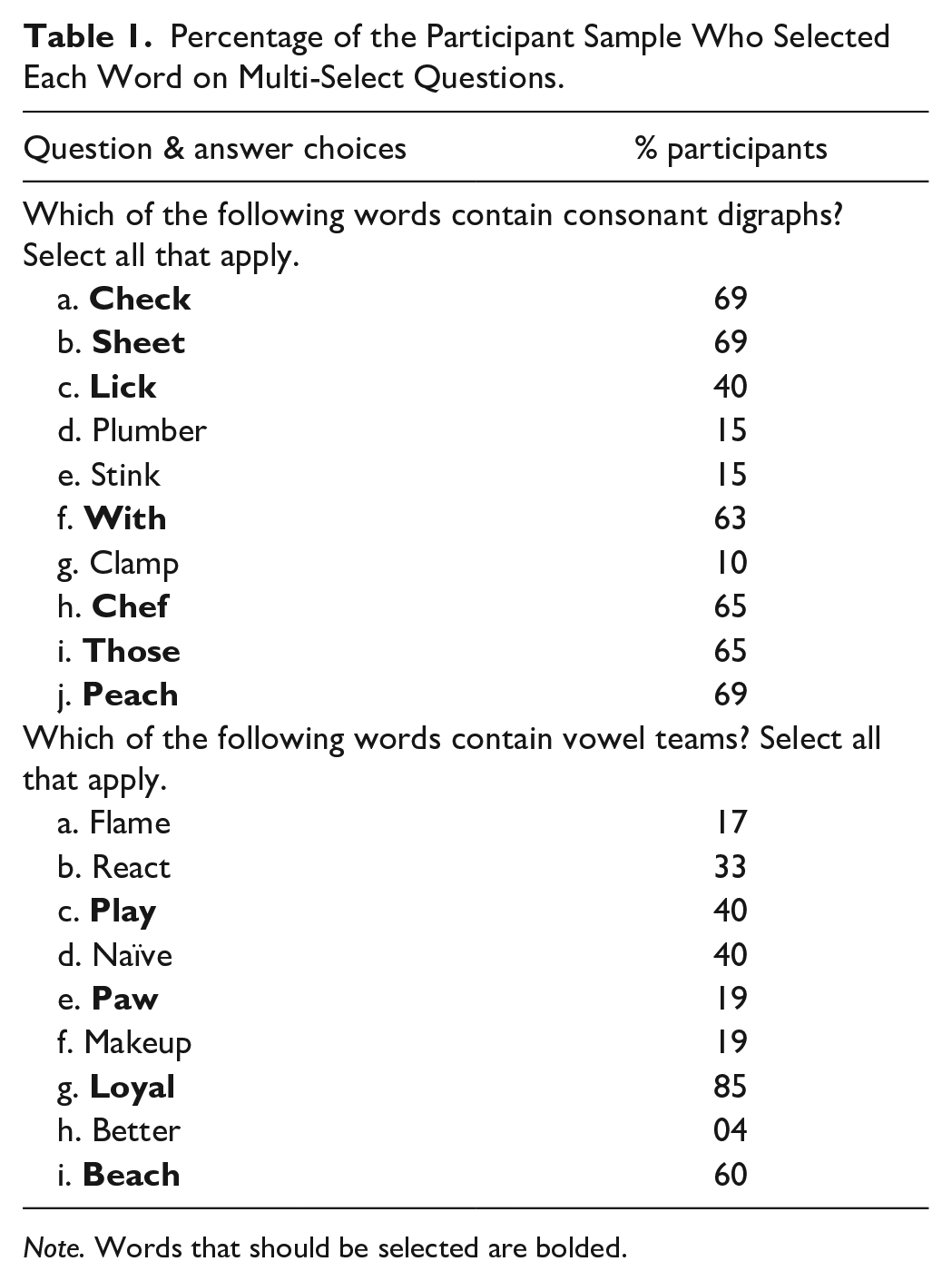
Note. Words that should be selected are bolded.
Percentage of the Participants Who Correctly Answered Multiple-Choice Questions.
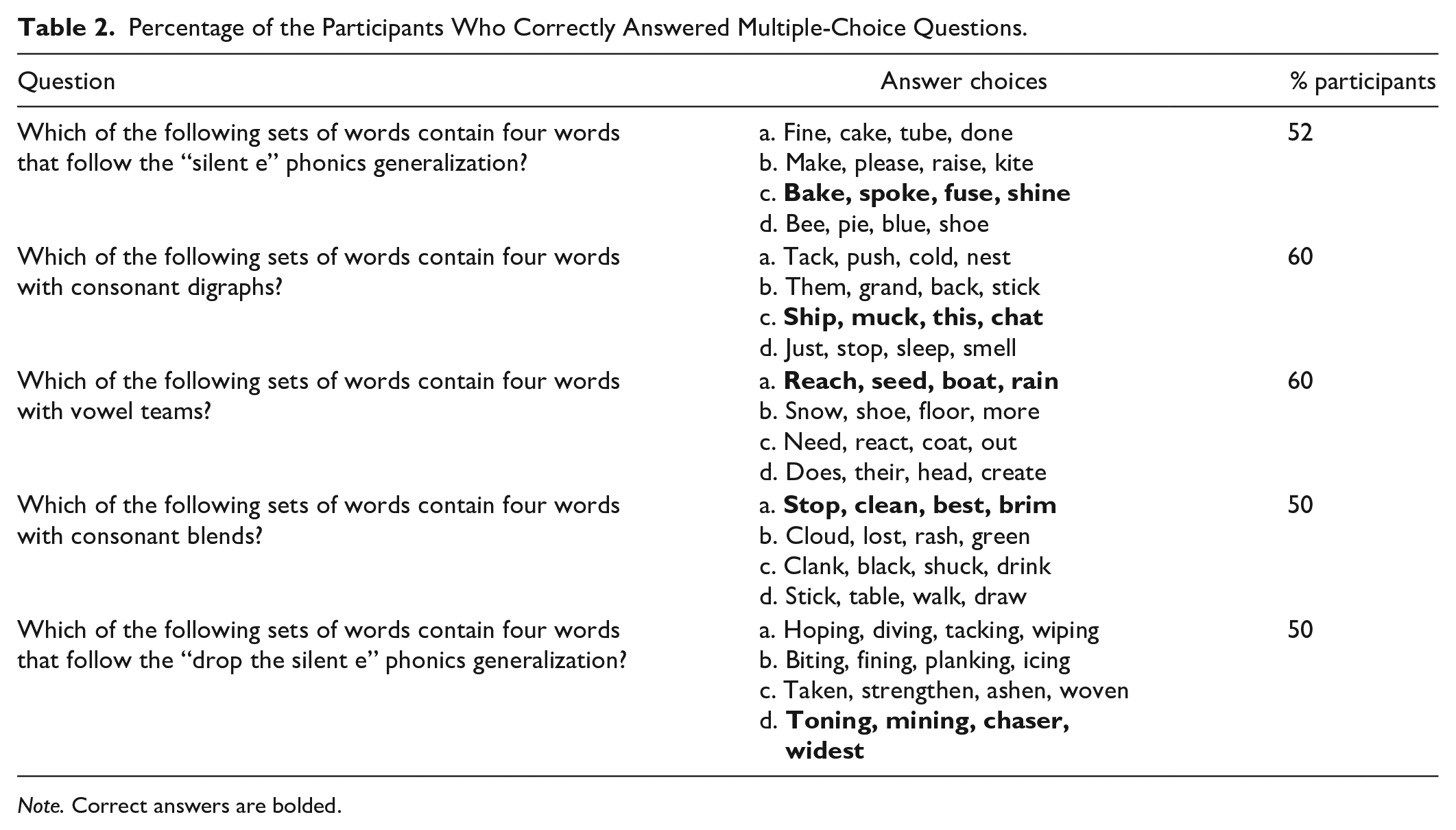
Note. Correct answers are bolded.
Procedure
Participants accessed the study measures using a link in the invitation email and completed the orthographic knowledge measure along with a demographic questionnaire and other measures of metalinguistic knowledge (e.g., phonological awareness, morphological knowledge) not reported here (Krimm, 2019).
Results
Figure 1 shows the distribution of the total percentage correct in the participant sample. Mean percentage correct was 65% (SD = 22%) and median percentage correct was 71%.
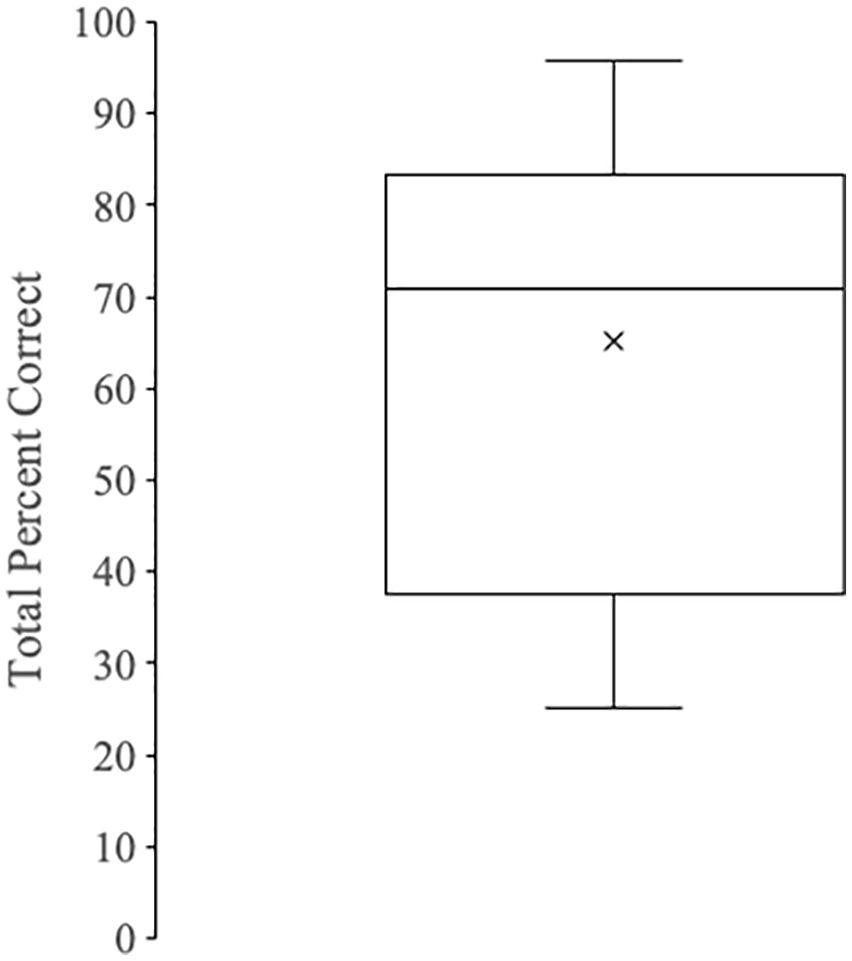
Distribution of total percentage correct on the orthographic knowledge measure across participants.
Table 1 displays the percentage of the participant sample that selected each word in the consonant digraph and vowel team word lists. Table 2 displays the percentage of the participant sample that correctly answered each multiple-choice question.
Discussion
On average, the school SLPs in this study answered about two thirds of the orthographic knowledge items correctly. These findings confirm SLPs’ self-reported concerns about their preparation for supporting reading acquisition (e.g., Blood et al., 2010). Although school SLPs typically are not the primary educator responsible for teaching orthographic conventions, they need enough orthographic knowledge to collaborate with and to support the efforts of the classroom teacher(s) and/or special education teacher(s) with whom they work.
Future Directions
In future work, we plan to examine the individual differences that contribute to variation in orthographic knowledge among school SLPs. Based on the current literature, we expect that most SLPs who have strong orthographic knowledge have received additional training in structured literacy intervention. In addition, we plan to clarify whether SLPs perform better on the orthographic knowledge measure when given definitions of terms as part of the task instructions. It is possible that SLPs who do not necessarily know the term “vowel team,” for example, could use their knowledge of phonology to identify vowel teams if given a definition. Shared terminology is critical for interdisciplinary team functioning (Postrel, 2002); a lack of familiarity with instructional terminology, however, presents a different challenge than a more general lack of orthographic knowledge.
Conclusion
This study adds to the extant knowledge base by objectively characterizing orthographic knowledge in SLPs. Our findings are consistent with SLPs’ self-reported lack of adequate preparation for engaging in evidence-based literacy instruction (e.g., Blood et al., 2010). Given that children with language disorders are at high risk for co-occurring literacy disorders (e.g., Catts et al., 2002), SLP pre-professional preparation programs should consider how to prepare SLPs to support written language acquisition. We recommend Speech to Print: Language Essentials for Teachers (Moats, 2020) as a basis for such preparation, as it is a text designed for this purpose.
Footnotes
Declaration of Conflicting Interests
The author(s) declared no potential conflicts of interest with respect to the research, authorship, and/or publication of this article.
Funding
The author(s) received no financial support for the research, authorship, and/or publication of this article.
