




Abstract
Punitive policy designs diminish felons as citizens. Scholars know much about the designs’ influence on felons’ political and civil rights. They know little of how policy influences felons’ social rights. Examining the discretion of states to retain or reform federal bans on drug felons receiving cash and food assistance between 1997 and 2004, we explain the choices states make about extending social rights to “deviants.” We draw from theories of neoinstitutional organization, group threat, and political incorporation. Multivariate analysis suggest that the severity of states’ penal regimes and the degree to which felons and poor people threaten social order have the greatest influence on states’ responses to the federal sanctions on drug felons. Our study informs understandings of why some states take a “punitive turn” while other states may counter convention, exercising discretion to reduce rather than increase their punitiveness toward felons specifically and lawbreaking generally.
Democratic politics shape the scale and character of punishment in America. Choices made in legislatures, bureaucracies, and voting booths, across all levels of government, determine the forms and lengths of punishment of citizens who offend laws. Prominent examinations of the punishment of lawbreakers in the United States address political factors for the growth of the “carceral state” (Gottschalk, 2006; Murakawa, 2008; Simon, 2007; Smith, 2004; Weaver, 2007; Yates & Fording, 2005); cultural determinants of the severity of punishment (Garland, 2001; Smith, 2008; Whitman, 2003); structural biases inherent in penal policymaking (Fairchild, 1981; Miller, 2008); and the democratic decisions and consequences of punishment, especially the adoption of laws and rules that undermine the citizenship of the punished and diminish their status as full citizens (Manza & Uggen, 2006; Weaver & Lerman, 2010). For felons, in particular, the politics of punishment tends to reduce the triumvirate of political, civil, and social rights associated with citizenship 1 and narrows the benefits, obligations, and expectations for people convicted of felonies even after they complete their sentences and make restitution (Manza & Uggen, 2006; Mauer & Chesney-Lind, 2002; Mele & Miller, 2005). Such collateral consequences of criminal convictions deliberately exclude felons from polities, communities, and economies. In this article, we examine why American states retain or reform such punitive policy designs (Donovan, 2001; Schneider & Ingram, 1997), focusing on designs that diminish the social rights of felons.
Political scientists have ignored the democratic decisions to curtail the social rights of felons. Such decisions restrict the ability of felons to access social entitlements and means-tested benefits ranging from higher education grants to occupational licenses and foster their economic insecurity. Instead, scholars have focused on the removal and restoration of felons’ political rights such as the right to vote (Ewald, 2009; Hull, 2006; Manza & Uggen, 2006; Preuhs, 2001) and infringement and expansion of their civil rights like the right to free speech (Manza, Brooks, & Uggen, 2004). Breaking with convention, we examine the politics of removing felons’, particularly drug felons’, access to social entitlements and means-tested benefits that influence economic security. Drug offenses for possession and trafficking constitute the largest proportion of felony sentences handed down by courts across the United States (Bureau of Justice Statistics, 2009). Annually courts sentence approximately 380,000 individuals for drug felonies. Although there is an absence of data on the socioeconomic status of individuals sentenced for drug felonies, a felony drug conviction is consequential for access to social entitlements and means-tested benefits. (Rubinstein, & Mukamal, 2002).
Since the 1996 enactment of the Personal Responsibility and Work Opportunity Reconciliation Act (PRWORA), federal law prohibits impoverished citizens with felony drug convictions from receiving Temporary Assistance to Needy Families (TANF) and Supplemental Nutritional Assistance (née Food Stamps). 2 The federal law, however, grants states discretion to reform the federal restrictions within their borders through modification or abolition of the federal law. Why do some states choose to reform the federal bans, signaling their support for a restorative turn in American punishment regarding the social rights of (drug) felons?
We use an original state-level data set on the retention and reform of the federal bans on social assistance—cash and food benefits—for drug felons between 1997 and 2004 to identify factors that may influence state variation in retention and reform of the federal bans. We employ event history analysis to test a set of propositions we deduced from the literatures on neoinstitutional organization theory (DiMaggio & Powell, 1983), social psychology and group threat (Blumer 1958), and minority political incorporation (Matsubayashi & Rocha, in press; Preuhs 2006). Specifically, we explore whether cultural expectations of retributive punishment, preservation of group position and social order, and the presence of minorities and women in state legislative leadership positions may influence the choices of states to retain or restore the benefits of social rights to drug felons.
The results of our analysis suggest that the severity of states’ penal regimes (i.e., their cultural expectations of retributive punishment) and the degree to which states perceive felons and low-income people as threats to social order and group position may have the greatest influence on states’ choices regarding the federal sanctions. Surprisingly, the political incorporation of Blacks and women in state legislatures, along with some traditional political predictors of social welfare access and generosity, failed to yield statistically significant effects, holding other factors constant. Nonetheless, the results suggest why states may counter convention, exercising their discretion to reduce rather than increase their punitiveness toward felons specifically and lawbreaking generally (Barker, 2009; Brown, 2007; Kutateladze, 2009). The study contributes to the emerging understanding of how politics shapes the decision of some states to maintain a more “punitive turn” (Barker, 2009; Garland, 2001) while others move in a less punitive direction.
Sanctioning the Right to Assistance by “Deviants”: Drug Felons and Social Benefits
Generally, people convicted of felonies have a negative social construction as undeserving or scorned citizens, resulting from their master status as a criminal. They also have a low degree of political resources—human, economic, and social capital—to influence positive governmental and nongovernmental action, as well as civic regard, on their behalf. The intersection of the dimensions of social construction and political resources places felons in a “deviant” category of polity membership (Schneider & Ingram, 1997). Their membership in it allows other categories of polity members to put them on the lower end of group position, controlling and coercing felons without much opposition. Law-abiding citizens may use the group position of lawbreakers to exercise prejudice against them, upholding their moral superiority over lawbreakers, treating them as essentially corrupt, while sidelining their claims as polity members, and preventing their encroachment on and spoiling of moral, social, and political orders (Blumer, 1958). Consequently, as Smith (2008) observes, “the intersection of two structural dimensions (societal differentiation and the concentration of political power) determine the severity and form of penal practice” (p. 17). This intersection influences punitive policy designs for felons.
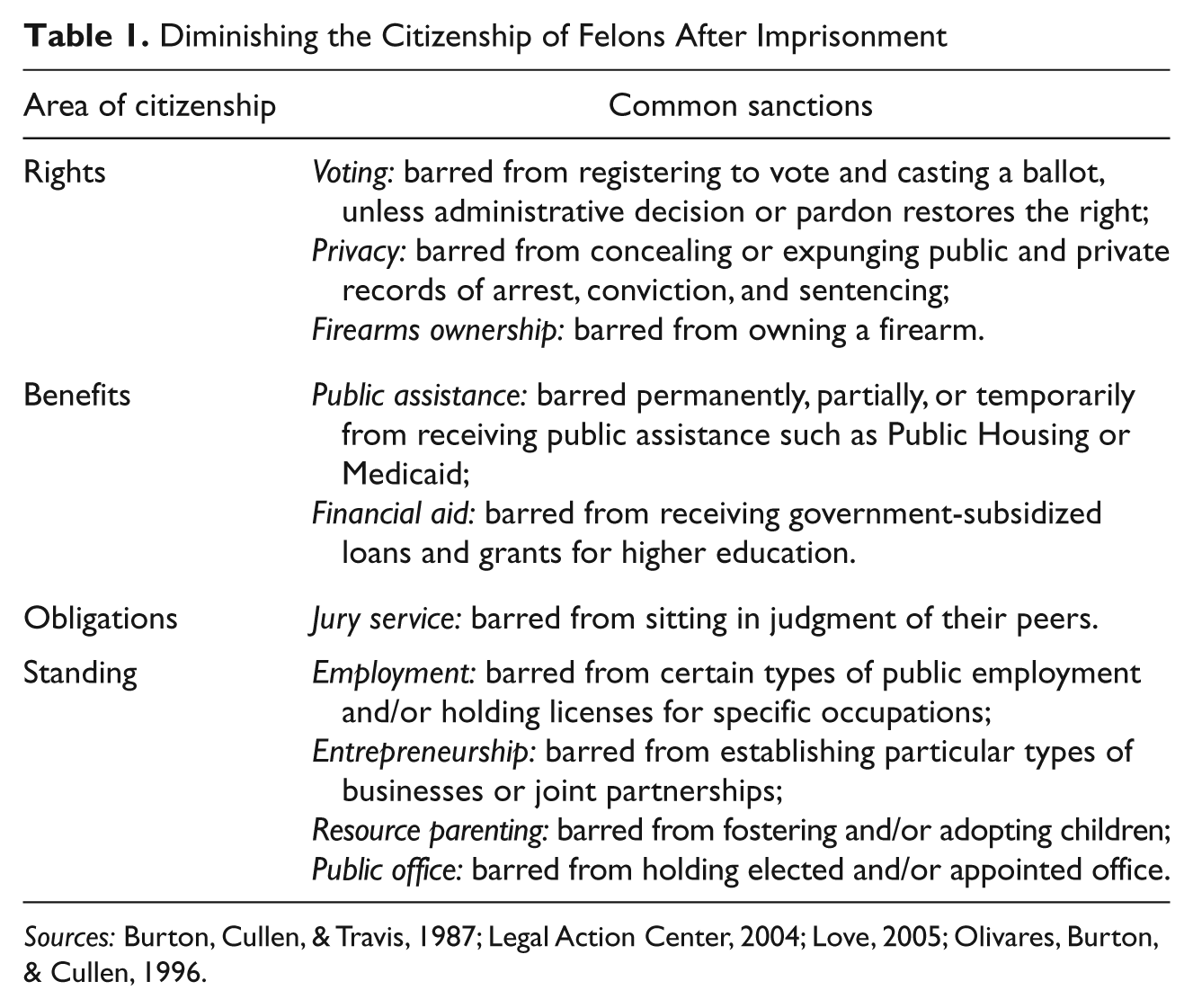
Punitive policy designs are the sets of institutions (i.e., the formal and informal rules) that deliberately bound benefits and bestow burdens on a target group deemed inferior in relation to others because their presence and/or behaviors offend norms, morals, and laws (Donovan, 2001). Punitive policy designs determine who gets the costs and penalties of distributive politics. In the case of felons, their low group position often yields punitive policy designs that rely on what Matthews (2009) describes as “a disproportionate use of sanctions and consequently a deviation from the principle of proportionality” (p. 179). Typically, the sanctions diminish rights, obligations, and benefits for felons and deny them the entitlements and benefits of citizenship after they complete court-ordered sentences and meet obligations such as compensation of their victims (Mauer & Chesny-Lind, 2002). Post-prison sanctions diminish the rights of citizens with felony convictions, often hindering voting, privacy, and employment (see Table 1).
Diminishing the Citizenship of Felons After Imprisonment
At a minimum, polities use punitive policy designs to coerce felons to act rationally and engage in behaviors that prevent what Boonin (2008) describes as “authorized intentional reprobative harm” (p. 26). Like all manifestations of group position based on prejudice by dominant groups, however, the sanctions allow nonfelons to retain, even strengthen, a feeling of what Blumer (1958) refers to as a “sense of proprietary claim [over] many important areas of life” (p. 4). Therefore, aside from punishment, polities employ punitive policy designs to reduce the presence and regulate the behavior of felons in civic and commercial forums and to marginalize their claims for equal treatment rooted in American citizenship. Recent punitive policy designs of this order include the federal sanctions on drug felons that restrict their access to governmental cash and food assistance.
During the 1996 Congressional debates to reform welfare, conservative policy entrepreneurs linked the negative social construction of welfare recipients as frauds, cheats, and abusers of the welfare system (Hancock, 2004) to the concern that drug use increased welfare dependency. Moreover, they tied both points to evidence that, one, cash assistance and food stamps recipients had the highest rates of drug use and addiction among recipients of key social welfare programs targeting low-income people (Schmidt, Weisner, & Wiley, 1998) and, two, in the case of some Food Stamps recipients, benefits were being traded or sold for drugs by people convicted of drug felonies. 3 The conservative policy entrepreneurs, especially U.S. Senator Phil Gramm, a Republican from Texas, used the constructions and evidence to advocate for reduced access to social benefits by citizens. Gramm called for a redesign of welfare to assist poor people who play by the rules, not only the rules of welfare but also those of the criminal justice system. Gramm sponsored an amendment to PRWORA that provided for the lifelong exclusion of low-income drug felons (i.e., people convicted in federal and state courts for felony possession, use, and distribution of controlled substances) from receiving cash assistance through the new TANF program and food assistance via the Food Stamps program. 4
Adopted and enacted, the Gramm Amendment prohibited government support for low-income drug felons after their imprisonment and ended public assistance to a segment of poor people who would be entitled to it were it not for their drug felony convictions. This made the Gramm Amendment a hybrid policy that overlapped the social welfare and criminal corrections domains. It also made the amendment more severe as a punitive policy design for drug felons than any design the federal government enacted during the height of the drug epidemic in the 1980s (Donovan, 2001). 5 Yet the Gramm Amendment followed a pattern common to distributive politics involving “deviants” in the United States (Nicholson-Crotty & Meier, 2005): There was “a readily identifiable and socially marginal group” burdened by “value-laden” perceptions (drug felons on the public dole); there was “a moral entrepreneur” (Senator Gramm) who raised public awareness about the illegal and unworthy behavior of the group; and there was “sufficient political profit to entice a policy champion to place the issue on the political agenda and to work to secure passage of targeted legislation” (p. 241).
However, the Gramm Amendment and its implementation remained consistent with the devolutionary scheme of PRWORA: States could take affirmative steps to reform the federal ban within their borders (U.S. Governmental Accountability Office, 2005). Many states like California, Georgia, and Ohio retained and enforced the federal bans. From 1997 through 2002, according to one estimate, states removed at least 92,000 adults with felony drug convictions from the welfare rolls (Gustafson, 2009, p. 27). Some states chose to reform the bans by modifying them. For instance, some reduced the durations of ineligibility or permitted drug felons (or particular classes of them) to receive assistance if they met conditions (e.g., enrollment in substance abuse treatment programs or passing periodic drug screenings). Other states opted out of the federal bans, operating welfare and food assistance programs that were open to all eligible drug felons.
To Retain or Reform Punitiveness: Explaining the Choices of the States
The criminal corrections and social welfare systems are “federalized,” actively considered and influenced across all levels of the federalist system (Miller, 2008). Yet they are systems that we generally perceive as operating independently of each other. The federal restrictions against drug felons receiving cash and food assistance and the choices of states to retain and enforce them, however, illustrate a contemporary convergence of the corrections and welfare domains. This is not surprising. Coupled with the “punitive turn in contemporary penalty” in the United States (Garland, 2001, p. 142) has been a punitive redirection of social welfare programs (Soss, Fording, & Scram, 2011). It is a redirection that reestablishes social welfare as a “gratuity” (Reich, 1965, p. 1245) and restores and expands paternalistic social control of poor citizens (Mead, 1997; Soss et al., 2011). Consequently, formerly distinct agencies of social welfare and criminal corrections collaborate to control the political, economic, and social behaviors of low-income people and to inform their attitudes in ways that further signal and circumscribe their marginalized status (Wacquant, 2009). This is not to claim complete convergence of the two systems. In some instances, the social welfare and criminal corrections arenas maintain “overlapping goals and attitudes towards the poor, but also collaborative practices and shared information systems” that they jointly use to punish and regulate their target populations (Gustafson, 2009, p. 5; Hayney, 2004; Wacquant, 2009). 6 At times, as Beckett and Western (2001, p. 44) conclude, “penal and social welfare institutions comprise a single policy regime aimed at the problems associated with deviance and marginality.” As such, their philosophies and practices may appear similar as they work together to deal with a shared problem or target population. Therefore, the two arenas may not be as distinct as political scientists, policy scholars, and conventional wisdom suggest.
Institutional isomorphism describes policy convergence (and enforcement) between two or more systems, domains, or organizations (DiMaggio & Powell, 1983). Convergence of the purposes, policies, and practices of social welfare and criminal corrections spheres, we argue, is a consequence of “coercive isomorphism” (DiMaggio & Powell, 1983). Typically, according to DiMaggio & Powell (1983), coercive isomorphism results from “formal and informal pressures exerted on organizations by other organizations upon which they are dependent” (p. 150). Formal pressure on the states from the federal government to retain its bans against drug felons receiving cash and food assistance, however, is absent. The Gramm Amendment does not coerce states to comply with the idea that correctional control should overlap with social welfare and vice versa. Instead, the amendment grants states discretion, empowering them to act in ways that befit their polities and cohere with their politics. In the absence of explicit pressure from the federal government, we posit that retention and enforcement of the bans were the products of “cultural expectations in the society [or state]” (DiMaggio & Powell, 1983, p. 150).
The 1990s were years that Tonry (2007) characterizes as having “greater intolerance of deviance and deviants, and greater support for harsher policies and severer punishments” (p. 7). Claiming strong public support, political elites in some states designed policies that manifested cultural expectations that states should not only punish to deter crime and exact retribution but to degrade the status of offenders (Whitman, 2003). Some degradations were frivolous (e.g., making male inmates wear pink undergarments, requiring drunk drivers to carry licenses or obtain license plates that bear a mark signifying their offenses, or reinstating the wearing of prison stripes). Degradations like shackling female prisoners during childbirth, turning off air conditioning in prisons during the summer, disregarding proportionality in sentencing (e.g., the adoption of “Three Strikes and you’re out” laws), and putting juvenile offenders in prison “boot camps” were serious. Policymakers justified their democratic choices to degrade offenders on the grounds that it was acceptable and prudent for them to suffer for their crimes (Clear, 1994). The penal imaginations that produced harsher policies assumed that punishment was impossible without degradation (Braithwaite, 1989; Whitman, 2003). This was as true of the punishment of offenders by criminal corrections agencies as it was the sanctioning of clients by social welfare agencies (Soss et al., 2011).
Penal regimes, the dominant consensus on the causes and consequences of crime, dominant understandings of what constitutes just acts, the set of explanations for punishment, and the collections of punishment, may influence the variation in punitiveness as a cultural expectation (Barker, 2009). Generally, scholars of punishment categorize penal regimes by their character of and “commitment to including or excluding marginal groups” (Beckett & Western, 2001, p. 44). Rehabilitative/inclusive regimes restore offenders to their full status as citizens vis-à-vis rights, obligations, and expectations, or at least work to positively reintegrate them into society, after imprisonment. Beckett & Western (2001; also Koster, Van Der Waal, Achterberg, & Houtman, 2008) suggest that retributive/exclusive regimes “emphasize the undeserving and unreformable nature of deviants, tend to stigmatize and separate the socially marginal, and are hence more likely to feature less generous welfare benefits and more punitive anti-crime policies” (p. 44). Hence, retributive/exclusive regimes should be more likely than rehabilitative/inclusive regimes to favor an expanded scope of corrections into other spheres such as social welfare, especially when coupled with cultural expectations that social welfare should be “directive, supervisory and punitive” (Schram, Fording, & Soss, 2008, p. 18). In sum, penal regime type should influence the choices of states to retain the federal bans against drug felons receiving cash and supplemental food assistance, in essence adopting them as their own laws.
Hypothesis 1: States with more retributive/exclusive penal regimes will be more likely to retain and enforce the federal drug felony bans on TANF and Food Stamps.
Societies often perceive felons as perpetual norm breakers, potential sources of social disruption, and ultimately threats to the social order because of their criminal offending and likelihood of recidivism. Accordingly, policy choices about distributing benefits to low-income felons, perhaps the most marginalized of the poor, can be viewed as choices about the maintenance of social order, the retention of group positions, and the allocation of scarce resources. Since punitive policy designs manifest group prejudices and biases, political elites should retain and enforce regulations that marginalize threats to order and preserve social position and benefits for their groups (Blumer, 1958; Giles & Evans, 1986; King & Wheelock, 2007; Piven & Cloward, 1971; Soss, Schram, Vartanian, & O’Brien, 2001). As Blumer (1958) observes, “acts or suggested acts that are interpreted as an attack on the natural superiority of the dominant group, or an intrusion into their sphere of group exclusiveness, or an encroachment on their proprietary claims” should evoke controlling and punitive responses from dominant groups (p. 4). In turn, dominant groups may respond by reducing the access to and generosity of their assistance and increasing the sanctions against threatening groups (Fellowes & Rowe, 2004; Soss et al., 2001), placing them in precarious positions to influence their political, economic, and civic behavior (Piven & Cloward, 1971).
While reducing access and generosity to social resources, political elites may expand correctional control to regulate the behavior of low-income groups as economic, social, and political claim-makers. This yields the welfare-imprisonment tradeoff, the inverse relationship between social welfare spending and incarceration rates in the American states and many democratic nations (Beckett & Western, 2001; Downes & Hansen, 2006; Soss et al., 2011; Sutton, 2000). As the threat felons pose as potential claims-makers increases, states should narrow access to redistributive programs and other benefits of citizenship for felons. Thus states that rely more heavily on corrections as social control of felons should be more likely to restrict their access to public benefits.
Hypothesis 2: States with larger correctional control populations, especially states with higher rates of incarceration, will be less likely to reform the federal bans on drug felons receiving TANF and Food Stamps.
The politics of means-tested social welfare programs (e.g., the defunct Aid to Families with Dependent Children that TANF replaced), rather than social insurance programs (e.g., Social Security Disability Income), often reflect the politics of racial resentment (Gilens, 1999). Generally, as the minority composition of means-tested social welfare caseloads increases, the social welfare systems of states become more punitive, characterized by the adoption and enforcement of stricter rules and sanctions that reduce welfare eligibility, participation, and benefit levels (Fellowes & Rowe, 2004; Soss et al., 2001). Likewise, studies tie racial sentiments to punitive attitudes toward criminals (Bobo & Johnson, 2004; Hurwitz & Peffley, 1997; Unnever & Cullen, 2010). Given that racial stereotypes are tied to perceptions of who is more likely to receive social welfare assistance, to engage in criminal activity, and to be worthy of social support, we expect that race influences states’ choices to retain and enforce the federal bans against drug felons benefiting from social welfare.
Hypothesis 3: States where minorities, namely, African Americans and Latinos, comprise a larger percentage of TANF and Food Stamps caseloads will be less likely to reform the federal bans against drug felons receiving TANF and Food Stamps.
A routine expectation is that the racial composition of political institutions, particularly state legislatures, influences social welfare policy (Matsubayashi & Rocha, in press). While the expectations have empirically proven difficult to realize, strong arguments buttress the expectation that the political incorporation of Blacks influences state variation in the retention of the federal bans against drug felons receiving cash and food assistance. One, Black state legislators are more active than White state legislators in welfare policymaking and Black legislators are more strident advocates than their White peers for broadening access to social assistance for all in need (Bratton & Haynie, 1999). This may be because their Black constituents, who tend to comprise a majority of their districts, are more likely than other groups to need social assistance. 7 Two, Black legislators may be less likely than others to see drug felons as undeserving of assistance. For instance, the National Black Caucus of State Legislators (2004) ratified a resolution from its members proclaiming “that nonviolent substance abusers are not menaces to our communities but rather a troubled yet integral part of our community who need to be reclaimed.” Also, given the racial dynamics of welfare caseloads and felony drug convictions, Black legislators may focus on the disparate effect of the Gramm Amendment on Black communities (Chin, 2002). Three, with the exception of gun-related crimes (Payne, Gainey, Triplett, & Danner, 2004), Blacks generally hold less punitive attitudes than Whites in terms of sanctioning people convicted of crimes (Bobo & Johnson, 2004; Unnever & Cullen, 2007), which stems from real and perceived racial inequities in arrests, convictions, and sentencing (Johnson, 2008). Hence, as Barker (2009, p. 18) posits more generally about punishment among the states, the political incorporation of Blacks in state legislatures may moderate punitiveness.
Hypothesis 4a: States with greater degrees of political incorporation by Blacks in state legislatures will be more likely to reform the federal bans on drug felons receiving TANF and Food Stamps.
Gender diversity within state legislatures should also influence the use of state discretion regarding access to TANF and Food Stamps by drug felons. Welfare policy is a “distinctive policymaking focus” for women in state legislatures (Bratton & Haynie, 1999, p. 670; Reingold & Smith, in press) and female legislators maintain more liberal welfare policy preferences than male legislators, especially in relation to the key elements of PRWORA (Poggione, 2004). Moreover, it is plausible that women legislators will associate the federal bans on public assistance with women’s interests. This is because women are more likely to live below the poverty threshold and to head single-parent families, comprise the greatest proportions of TANF and Food Stamps caseloads, and constitute one of the fastest growing segments of those under correctional control stemming from felony drug charges and crimes associated with drug abuse such as larceny (Greenfield & Snell, 1999). Plus, women typically express less support than men for punitive criminal policymaking (Soss, Langbein, & Metelko, 2003; Unnever & Cullen, 2007).
Hypothesis 4b: States with greater degrees of political incorporation by women in state legislatures will be more likely to reform the federal bans on drug felons receiving TANF and Food Stamps.
Data, Models, and Measures
Generally, an absence of data sets for analysis hampers the study of punitive policy designs that limit the social rights of felons. We overcome this challenge with an original data set. It draws on published records from governmental and nongovernmental sources, including the U.S. Government Accountability Office, U.S. Bureau of Justice Statistics, Joint Center for Political and Economic Studies, Center for American Women and Politics, University of Kentucky’s Center for Poverty Research, and others (see supplemental materials at http://papers.ssrn.com/sol3/papers.cfm?abstract_id=1959458). It includes all 50 states for the years 1997 through 2004. States did not begin to make policy decisions in relation to the Gramm Amendment until 1997 and 2004 is the most recent year for which there is accurate and independently verifiable data on the retention and reform of the federal bans against drug felons accessing cash and food assistance across the states (U.S. General Accountability Office, 2005).
Dependent Variables
Passage of PWRORA presented the states with a broad choice regarding the federal drug felony bans for TANF and Food Stamps—retain or reform one or both bans on drug felons accessing the social welfare benefits. Given that our study is inherently about policy adoption and the states had discrete choices, we employ event history analysis (EHA). We treat reform (i.e., modifications that broaden access to the means-tested social welfare benefit of cash assistance and to the social welfare entitlement food assistance) as a singular event rather than a repeatable event or multiple events. We employ two dependent variables that measure states’ broad responses to the federal drug felony bans in relation to TANF and/or Food Stamps. For each year, we record a value of 0 if a state retained the federal ban on drug felons’ access to the means-tested benefit of TANF and 1 if a state reformed the ban. Likewise, we record a value of 0 if a state retained the federal ban on drug felons’ access to the entitlement of Food Stamps and 1 if a state reformed the ban. The number of observations in our data set is 223 for the TANF ban and 228 for the Food Stamps ban. 8 We use Cox proportional hazards models to estimate the effects of the covariates on the likelihood of states reforming the federal drug felony bans. 9
Note, however, that reform includes opting out of one or both bans or modifying one or both. Theoretically, the factors that drive the decision of a state to opt out of the federal bans should be the same ones that push states to modify the bans. Still, one may want to disaggregate modification from opting out as they are different actions. Of the states reforming the federal bans between 1997 and 2004, few opted out (U.S. General Accountability Office, 2005). Instead, a majority of reformers modified the bans by restoring eligibility to drug felons. 10 We combine the decision to opt out with the decision to modify, focusing on the general choice of reforming versus retaining the bans. This is because of the small number of reformers that opted out. We recognize that this yields “only the simplest of theoretical event models” (Jones & Bratton 2005, p. 428), but our choice seems appropriate since (a) theoretically, we expect the causes of opting out to be identical to those for modification and (b) the limited number of states that opted out entirely makes alternative estimation techniques tenuous.
Recall that our study seeks to determine why some states retain punitive policy designs that diminish the social rights of felons while others reform them to expand social rights for felons. The degrees to which states reduce their punitiveness toward felons are important. But it is not central to the current study. Since we are interested in the mutually exclusive choice of retaining or reforming the federal bans and we can create discrete indicators that measure that choice, a standard Cox proportional hazards model seems adequate. 11 Nevertheless, as a robustness check, we ran a separate set of models with our data where we employed competing risks estimation. Following Jones and Bratton (2005; also Boehmke, 2009; Box-Steffensmeier & Jones, 2004), we consider each state to be at “risk of experiencing one of m distinct events whose risks are related” (p. 434). We treated modification and opting out of the federal bans as separate outcomes, not a single indicator. The results of the competing risks models (available from the authors) were similar to those generated by the standard Cox proportional hazards models. In this article, we present the results of our simpler Cox proportional hazard models.
Independent Variables 12
Our central argument is that states diminish the social rights of felons to access entitlements and benefits of citizenship because their penal regimes are retributive and exclusive. Specifically, we posit that states with retributive/exclusive penal regimes are less likely than other states to repeal the bans on allowing drug felons to receive social welfare through the TANF and Food Stamps programs because their cultural expectations of how best to punish felons obligate the states to disregard the social rights claims of felons. The development of such penal regimes may stem from state “cultures of inequality” that accept and foster social and economic inequality among their citizens (Crutchfield & Pettinicchio, 2009). Polities with cultures of inequality, for instance, are more likely than those with cultures of equality to adopt public policies that exacerbate socioeconomic cleavages between the “deserving” and “undeserving” poor, emphasizing social support for the former and self-sufficiency for the latter.
Extant research theorizes about the development and outcomes of penal regimes (and cultures of inequality) but it does not offer guidance for identifying key attributes that distinguish retributive/exclusive penal regimes from restorative/inclusive regimes. It does suggest, however, that state penal regimes vary in the degree to which they “emphasize the undeserving and unreformable nature of deviants” and “stigmatize and separate the socially marginal” (Beckett & Western, 2001, p. 44). In the absence of empirical markers that distinguish between penal regimes that are retributive/exclusive and those that are restorative/inclusive, we use a measure of the degree to which states reduce the personal autonomy, obligations, and duties of felons vis-à-vis nonfelons in private and public spheres.
We employ an additive Collateral Consequences Scale to distinguish between retributive/exclusive penal regimes and restorative/inclusive regimes. For each state, the scale counts the number of areas where statutes directly regulate the private autonomy and public behavior of all felons, treating persons with felony convictions as a stigmatized class deserving differential treatment from persons without felony convictions in terms of political participation, family formation, and employment. We created the measure of penal regime type from published reports on state statutes that regulate the autonomy and behavior of felons after imprisonment in the private and public domains of parenting adoptive and foster children, pursuing divorce, voting in elections, serving on juries, holding public office, securing public employment, owning firearms, and requiring criminal registration.
Aggregate data on the regulation of felons in private and public matters is available for 1996 and 2002 (Buckler & Travis 2003; Olivares, Burton, & Cullen, 1996). We substitute the 1996 values for the years 1997 through 2001 and the 2002 values for the years 2003 through 2004. Scores on the scale range from 0 to 8 where higher values correspond with more retributive/exclusive penal regimes and lower values correspond with more restorative/inclusive penal regimes. We know of no better measure that approximates the concept of penal regime type, emphasizing its exclusive/inclusive characteristic. Nonetheless, we acknowledge that we rely on a proximate measure of penal regime.
We measure group threat in three ways. Our first measure of group threat is the incarceration rate per 1,000 residents for the states. It taps the degree to which states have punitive criminal corrections systems. 13 The Cox model used in the analysis relies on the proportional hazards (PH) assumption, which means that the covariates’ effects on the dependent variable should not vary significantly with respect to time (Box-Steffensmeier & Jones, 2004; Box-Steffensmeier & Zorn, 2001). Diagnostic tests revealed that the incarceration rate variable violated the PH assumption in one of the models. Therefore, we include an interaction of the incarceration rate with the log of time to correct for the nonconstant effect that the incarceration rate had over the course of the study period. We use the log of time rather than simply time. This is because, as Figure 1 illustrates, a significant proportion of states that reformed the drug felony bans did it in the early years of the implementation of welfare reform, which was true of other state innovations in welfare reform (Soss, Condon, Holleque, & Wichowsky, 2006). Given this temporal process, we surmise that incarceration rates likely had the most pronounced effect on reforming the drug felony bans in the years immediately after the enactment of PWRORA. Therefore, it is appropriate to use a log function of time.

Retention of punitive policy designs across the states: TANF and Food Stamps
Our second measure of group threat captures social welfare demand by low-income groups. We measure TANF Demand as the total number of TANF recipients in a state divided by the overall population times 100 and Food Stamps Demand as the number of Food Stamp recipients divided by the population times 100. Our third measure of group threat captures the potential racial dynamics of low-income welfare demands. We include the percentage of TANF recipients who are minorities and the percentage of Food Stamp recipients who are minorities. Blacks and Latinos are included in both measures. States may be responsive to minority group needs when the percentage of TANF or Food Stamps recipients who are minorities is on the small to medium side. As the proportion of minorities among TANF or Food Stamps recipients increases, however, states may respond to this increasing group threat by placing more restrictions on access to benefits. We therefore posit a step effect. Consequently, we include a threshold variable, calculated by multiplying the percentage of TANF or Food Stamps recipients who are minorities by 0 if minorities make up less than or equal to 25% of recipients and 1 if they make up greater than 25% of recipients. 14
To measure the political incorporation of Blacks and women, we collected data on all Black and female state legislators by state in 1997, 2001, and 2005. We identified the leadership positions, if any, that they held, aggregated the data to the state level, and calculated factor scores for Black political incorporation and female political incorporation in state legislatures. Guided by Preuhs (2006), the scores include three components: descriptive representation (i.e., the percentage of legislative seats held by group members), group institutional incorporation (i.e., the average proportion of weighted leadership positions across the two chambers that are occupied by group members), and the percentage of social services committees (e.g., health and human services) chaired by group members. 15
Potential Confounding Factors
The ideological composition of state governments could influence whether drug felons have access to public assistance and the breadth of their access. Conservative governments are negatively correlated with social welfare access and generosity and positively correlated with higher incarceration rates (Beckett & Western, 2001; Fellowes & Rowe, 2004; Soss et al., 2001; Sutton, 2000, 2004; Yates & Fording, 2005). If political elites have more conservative policy attitudes, a state should be more punitive and limit access to social welfare benefits by drug felons. Government ideology measures the collective policy attitudes of state political elites, based on gubernatorial and legislative partisanship, congressional election outcomes, and the interest group ratings of Congressional representatives (Berry et al., 1998). Higher values correspond with greater policy liberalism among political elites.
Furthermore, electoral politics could influence the punitiveness of states toward felons (Stucky, Heimer, & Lang, 2005). Conversely, crime rates can influence elections at the state level. Gubernatorial incumbents, for example, receive fewer votes when crime rates increase (Cummins, 2009). Also, given that the two dominant political parties will campaign on and “govern through crime” (Simon, 2007), taking hard stances on criminal punishment to make claims about their ability to protect the public and to solicit votes (Murakawa, 2008; Weaver, 2007), increased electoral competition should affect state punitiveness. We predict that when interparty competition is more intense, states will be more likely to retain the federal bans. 16 We measure interparty competition as the percentage of state legislative seats held by Democrats minus the percentage of seats held by Republicans, with higher values equaling less competition between the two major parties.
Additionally, since low-income individuals, families, and communities are affected by reduced access to TANF and Food Stamps, states where lower income adults participate in elections at higher rates should receive greater policy responsiveness. According to this logic, states where the class bias in voting is smaller should reform the federal bans. We measure class bias in turnout as the percentage of higher income adults that voted in the presidential or midterm elections between 1996 and 2004, divided by the percentage of lower income adults that voted. 17 Higher values indicate a greater degree of class bias in voting.
State economic conditions influence the degree of TANF generosity (Fellowes & Rowe, 2004) as well as incarceration rates (Wacquant, 2009). States with worse economic conditions may be less likely to reform the TANF ban simply because they cannot afford to extend welfare benefits. The federal government fully funds the benefits distributed through the Food Stamps program and states share the administrative expenses. Given that states must cover a portion of the administrative costs of operating the Food Stamps programs, economic conditions may influence the behavior of states regarding the Food Stamps ban. We measure state economic conditions by the Gross State Product per capita (in 1,000s). Finally, states with higher crime rates may be more punitive toward felons, making them more likely to retain the federal bans. We include the rate of violent crime rate to control for this possibility.
A concern may be that the potential confounders that we control for predict both our Collateral Consequences Scale and dependent variables. That is, factors predicting whether a state retains the federal bans on TANF and Food Stamps may contribute to its decision to adopt and enforce a certain number of statutes that regulate the private autonomy and public behavior of felons. One could imagine, for example, that Black legislative incorporation in a statehouse would reduce the likelihood of both the drug felony bans and the implementation of a large number of post-prison regulations of felons in a state. However, the dynamics of states that lead them to impose harsh penalties on all felons should not necessarily influence states to treat particular sets of felons harshly. The politics of adopting diffuse penalties that cover all felons versus particular penalties that cover some felons differ, for instance, in terms of historical moments, issue framing, and interest group mobilization (Buckler & Travis, 2003). Moreover, historical evidence suggests that the political, social, and cultural justifications for the adoption of specific types of collateral consequences differ (Buckler & Travis, 2003). For instance, states may justify some civil penalties on the grounds of protecting life and property (e.g., bans on weapons possession by felons or requiring sex offenders to register their residences), while employing for other penalties justifications of the preservation of public confidence in electoral and other democratic institutions (e.g., bans against felons voting or serving on juries) or facilitating transfers of real property (e.g., declaring the civil death of those serving life in prison or allowing imprisonment as grounds for divorce).
Controlling for plausible and relevant confounders (e.g., Black legislative incorporation) improves our ability to make sound interpretations about the empirical results and the possible effect of penal regime type on the likelihood of states retaining or reforming the drug felony bans. However, in the absence of an experimental design, we moderate our causal claims regarding the choices of states regarding the social rights of felons. We use our measure of penal regime type with caution and temper our conclusions that we draw from our observational data.
Results
Many states have moved toward restoring the social rights of drug felons within their borders. Figure 1 shows the distribution of states retaining the federal bans over time. One year after the enactment of PRWORA, a majority of the states retained the federal ban on distributing public benefits to drug felons through TANF and SNAP (U.S. Government Accountability Office, 2005). Specifically, 30 states retained the TANF ban and 29 retained the Food Stamps ban. From 1997 through 2004, however, the number of states retaining the bans decreased. By the end of 2004, the number of states retaining the federal ban on drug felons receiving cash assistance under TANF totaled 19 and the number keeping their federally supported Food Stamps programs closed to drug felons was 17. This confirms the findings of others that states need not remain punitive toward felons (Barker, 2009; Kutateladze, 2009).
The coefficient estimates of our two models are shown in Table 2. Each identifies the factors associated with the states’ progressive turn to reform the federal drug felony bans on social welfare assistance. The coefficient estimates in Table 2 are presented in terms of hazard rates. Positive coefficients indicate a decrease in the time until reform of the drug felony bans by a state, while negative coefficients indicate an increase in the time for a state to do it.
Correlates of Reform by the States

Note: Standard errors in parentheses.
p < .05.
Model 1 estimates the effects of the independent variables on the time until a state reforms the federal TANF ban against drug felons receiving cash assistance. In line with Hypothesis 1 and our prediction about the influence of penal regime type, the results suggest that the time until reform of the TANF ban is longer for states with more retributive/exclusive penal regimes, as measured by the number of areas where state statutes regulate the private autonomy and public behavior of felons. As we noted, our scale is a proximate measure of penal regime type. In the absence of another measure of the placement of states on the penal regime continuum between retributive/exclusive and restorative/inclusive and since we control for plausible and relevant confounders, we cautiously conclude from our analysis that the retributive/exclusion nature of a state’s penal regime affects its decision to retain the TANF ban. Graphs of the hazard function for several of the key independent variables are presented in Figures 2 and 3. In each graph, we vary the independent variable in question from its 25th percentile to its 75th percentile value in the data, holding all other independent variables constant. As Figures 2a and 3a show, our results suggest that states that have more inclusive penal regimes, regulating felons in only three of the eight areas, are 3.82 times more likely to reform the federal TANF ban than states that have more exclusive penal regimes and regulate felons in six areas. 18

Estimated time until states reform the TANF ban by the number of collateral consequences, incarceration rate, and percentage of recipients who are minorities

Estimated time until states reform the TANF ban by number of collateral consequences and the percentage of recipients who are minorities
The results of Model 1 also suggest that the size of the imprisoned population per capita influences the likelihood of states restoring social rights to drug felons, which supports Hypothesis 2. The coefficient on the incarceration rate (interacted with the log of time) variable is negative and significant. 19 As the degree of group threat increases, measured by the rate of people incarcerated in a state, the likelihood of a state retaining the TANF ban increased between 1997 and 2004. Figure 2b illustrates how the duration of time before a state modifies the TANF ban is longer in states with higher incarceration rates. The dashed line in the graph illustrates that the likelihood of reform is extremely low in states with relatively high incarceration rates. The solid line shows that the likelihood of reform is much higher in states with lower incarceration rates, across all years in our data set.
The results of Model 1 also show that the percentage of minority TANF recipients may have a nonmonotonic effect on the retention of the federal TANF ban by states. The coefficient on the percentage of TANF recipients that is minority is positive and significant, while the coefficient on the threshold term is negative and highly significant. Increasing the percentage of minority recipients shortens the time until states reform the federal ban up to a certain point, whereupon the effect of additional minority recipients has the opposite effect. This is indicative of a threshold effect—as the size of the proportion of minorities receiving TANF benefits becomes more pronounced in a state, the state responds by retaining the federal TANF ban. For states where minorities make up small to medium percentages of TANF cases, however, the results suggest that states will be quicker to relax the federal restriction as the percentage of minority recipients increases. This finding contradicts the direct and strong relationship routinely observed between the proportion of minorities and welfare restrictions (Fellowes & Rowe, 2004; Soss et al., 2001).
Figure 2c illustrates that states where minorities make up larger percentages of welfare recipients are more likely to reform the TANF ban than those states where minorities make up smaller percentages of recipients. The solid line demonstrates the likelihood of a state reforming the ban when the percentage of minority recipients is 15.7 (the 25th percentile value in the data). The dashed line shows the likelihood of a state reforming the ban when the percentage of minority recipients is 70.8 (the 75th percentile value). Figure 3b graphs the percentage of minority recipients of TANF during the early years of the study period. In both graphs, the dashed line is above the solid line, indicating that the likelihood of reforming the TANF ban increased as minorities comprised a larger percentage of welfare recipients. Yet the negative sign on the threshold term of this variable suggests a step effect. It is important to note, however, the step effect of the percentage of TANF recipients who are minorities does not yield a pronounced substantive effect in Figures 2c and 3b.
Additionally, there is no evidence from Model 1 that the political incorporation of Blacks and women in state legislatures influenced the reform of the TANF ban across the states. Neither measure produces a statistically significant effect. Despite the null results, we urge caution in interpreting these results to mean that Black and female legislators lack any influence on the reform of the federal bans by the states. Given that the incorporation of Blacks and women legislators is modest in most state-years, the findings may mask their efforts to reform the TANF ban. Media accounts suggest that Black and women state legislators tended to introduce bills to amend or abolish the federal bans at the state level, held or participated more in committee hearings on the matter, and pursued other avenues for broadening access to TANF by drug felons such as lobbying Congress and the U.S. Department of Health and Human Services through their national identity caucuses such as the National Black Caucus of State Legislators and the Women’s Legislative Network of the National Conference of State Legislators (e.g., National Caucus of Black State Legislators, 2004). Unfortunately, our independent variables do not capture these activities and their effects on the choice by states to retain or reform the punitive policy toward drug felons. Moreover, as Matsubayashi and Rocha (in press, p. 3) observe in their study of the effects of racial diversity on welfare spending and benefit levels, an observed null relationship between Black political incorporation and welfare access and generosity “is likely to be a product of nonminority representatives choosing to oppose minority-interest legislation more strongly.”
Lastly, the demand for welfare benefits, along with the set of control variables measuring government ideology, class bias in turnout, interparty competition, GSP per capita, 20 and the violent crime rate do not appear to influence whether states retain or reform the TANF ban. While the finding that the demand for welfare benefits does not influence the choice states make about the federal TANF bans is curious, perhaps more intriguing are the findings that neither the traditional measures of state-level politics associated with welfare reform nor economic conditions seem to affect decisions concerning the federal TANF ban.
Model 2 estimates the effects of the independent variables on the time until a state reforms the federal ban on drug felons receiving food assistance under the Food Stamps program. Generally, the results are consistent with those of Model 1. The time until states reform the Food Stamps ban increases in states with more retributive/exclusive penal regimes, as measured with the Collateral Consequences Scale. Figure 4a graphs this effect. States that regulate the civic and political behavior of felons in six of the eight areas are 4.62 times more likely to restrict the social right of drug felons to receive Food Stamps ban than states regulating three areas of felon’s lives. Also, the rate at which states incarcerate is a significant predictor of whether states retain the federal Food Stamps ban. 21 Figure 4b provides some evidence that states with higher incarceration rates are more likely to maintain the ban within their borders. Specifically, states where the incarceration rate per capita is 3.1 are 2.3 times more likely to reform the Food Stamps ban than states with an incarceration rate of 5.4. This result lends further support for Hypothesis 2. Additionally, and unexpectedly, neither the percentage of minorities among Food Stamps recipients nor the variable measuring the predicted threshold effect are statistically significant in Model 2, despite their coefficients being in the direction we expected. Perhaps states respond to minority needs up to a point, whereupon group threat prompts a reduction in Food Stamp generosity.
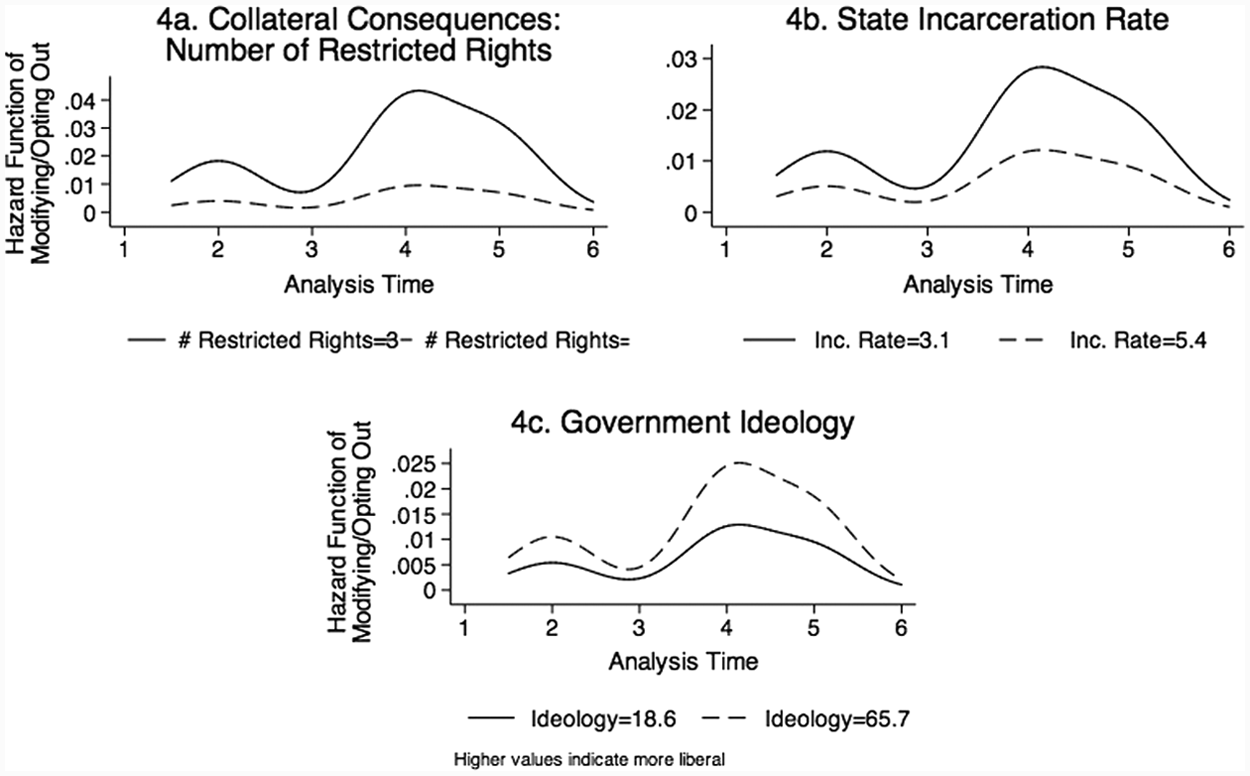
Estimated time until states reform the Food Stamps ban by the number of collateral consequences, incarceration rate, and government ideology
Although our measure of government ideology is below the standard level of statistical significance (p < .105), it suggests that states where political elites are more liberal have a greater likelihood of reforming the federal ban on drug felons receiving Food Stamps, as predicted. Figure 4c graphs this relationship, showing that states where the government ideology variable is at its 75th percentile value in the data (i.e., at 65.7) are 1.96 times more likely to reform the Food Stamps ban than states where government ideology is at its 25th percentile value (i.e., at 18.6). Finally, all remaining control variables failed to achieve statistical significance in Model 2, which is consistent with Model 1.
Discussion and Conclusion
Democratic institutions at the federal and state levels punish felons through punitive policy designs that diminish their status as citizens. Prior to our study, political scientists and others interested in punitive policy designs for felons examined the removal and restoration of political rights such as the franchise and civil rights like free speech, but they overlooked the removal and restoration of felons’ social rights such as access to public benefits. The Gramm Amendment of PRWORA, however, demonstrates how the intersection of the low public regard for felons and their limited political resources enables policymakers to adopt punitive policy designs that influence the set of social rights that felons possess.
Since the enactment of PRWORA, most states have restored the social welfare entitlements and benefits of Food Stamps and TANF to impoverished citizens with drug felonies. The trend is surprising. The consensus among penologists is that the United States became more punitive toward lawbreakers during that period (Garland, 2001; Tonry, 2007; Whitman, 2003). Why did some states reform the punitive policy designs of the federal government while others retained them? We predicted that the variation among the states regarding their retention or reform of the federal bans was a function of political factors, namely, cultural expectations of punitiveness, women’s and Black’s political incorporation in state legislatures, and the perceived threat that felons pose to social order. Using a measure of state penal regime type, we found evidence that the degree to which states regulate the private autonomy and public behavior of felons influences whether states maintain restrictions on access to social welfare entitlements and benefits by drug felons. We also found evidence that the degree to which felons may threaten the social order of polities, measured by incarceration rates, affects the retention of restrictions on social welfare access by drug felons.
However, the degree of racial and gender incorporation in legislatures does not appear to influence states’ choices to retain the federal sanctions on the social rights of drug felons. That result contradicts our theoretical expectations. But it coheres with extant research that finds the racial and gender compositions of state legislatures are poor predictors of social welfare policies (Matsubayashi & Rocha, in press). Additionally, and perhaps more curious, traditional political factors, such as ideology and interparty competition, do not appear to affect states’ decisions about the social rights of drug felons. Still, this puzzle is one that remains central to the study of social welfare policy adoption and innovation by the states, which tends to yield mixed and contradictory results on the effects of political factors (Lieberman & Shaw, 2000; Karch, 2006; Soss et al., 2001). Under what conditions and how can the political incorporation of racial minorities and women make a positive difference for drug felons or any other felons?
Our study sought to determine the factors associated with the states sanctioning felons in terms of their social rights, using the discretion granted to them by the federal government to retain or reform bans on drug felons receiving cash and food assistance. In doing so, we intended to broaden and deepen the political analysis of “deviant” citizens in American democracy as well as to extend the research on the dynamism of the politics of punishment at the state level (Barker, 2009; Kutateladze, 2009). Our study is far from the final word regarding either the determinants of states adopting punitive policy designs for felons or the place of deviants in American democracy. There is much more to learn.
Our research suggests that the development and mutability of penal regimes among the states is worthy of future investigation (Barker, 2009) and the development of alternative measures of penal regime types is necessary. We imagine scholars exploring the influence of state political cultures on penal regime formation. This would be especially interesting given that contemporary economic conditions and the fiscal crisis of corrections in some states like California may transform policy debates about whether penal regimes should remain retributive and exclusive. Additionally, there is room for more analysis of how, why, and when governments alter the social, political, and civil rights of convicted lawbreakers. For instance, in recent years, representatives have introduced bills in Congress to abolish the Gramm Amendment, or at least weaken it. 22 Thus far, the bills have failed to advance through the legislative process, even in a time when more corrections administrators, criminologists, and public safety interest groups are united in their call for government at all levels to “get smart on crime,” not just tough on it. Given the restorative turn we observed among the states regarding the TANF and Food Stamps bans, is there something politically different about the states as penal policy venues that may make it easier for reform to occur at that level than at the federal one? Moreover, how do public attitudes influence the decisions of states when it comes to adopting and reforming punitive policy designs for felons?
Furthermore, we support future research on the political process of punitive policy designs for felons, as well as other political deviants, emphasizing the roles of policy entrepreneurs and moral panics and exploring how political opportunities shape the likelihood of countermobilization by deviants and their allies (Nicholson-Crotty & Meier, 2005). Also, future research should attempt to combine quantitative and qualitative methods to better evaluate the influence of politics on punitive policy designs. This makes sense given the dynamic nature of penal policymaking (Gottschalk, 2006; Miller, 2008; Weaver, 2007) and the potential of mixed-methods of inquiry to identify the causal mechanisms that drive government decisions.
Ultimately, political science should broaden its empirical consideration of distributive politics to focus more on the allocation of negative goods such as burdens, penalties, and sanctions (Soss et al., 2011) and the group most likely to receive them, namely “deviants” (Schneider & Ingram, 1997). In particular, the study of punishing citizens, especially beyond their “time served,” should become more central to political science. Much is justly made of the mass incarceration of adults (and juveniles) in the United States. But the number of citizens remaining under correctional control after imprisonment, especially through the use of punitive policy designs, is also unlike anything the nation (or the world) has ever witnessed. The increased political study of punishment during and after the “payment of one’s debt” may improve American democracy for all citizens, both law-abiders and lawbreakers.
Footnotes
Acknowledgements
The authors thank Vignesh Narayanaswamy, Ashley Moraguez, and Ly Ngoc Le for their research assistance and Thomas Walker, Micheal Giles, Beth Reingold, Drew Linzer, Michael Kang, Kay Levine, Vesla Weaver, and Jacob Brown, and the three anonymous reviewers for their comments on drafts of this article.
Previous versions of this research were presented at the 2009 American Political Science Association annual meeting and 2010 Faculty Colloquia at the School of Law at Emory University.
The authors declared no potential conflicts of interest with respect to the research, authorship, and/or publication of this article.
The authors received no financial support for the research, authorship, and/or publication of this article.