




Abstract
Advocates of term limits argued that term limits would help reduce out-of-control government spending by removing veteran legislators who became acclimated to the prospending environment in our nation’s capitals. However, previous research shows that term limits may increase spending, which could jeopardize state fiscal health. The primary purpose of this article is to examine whether states with term limits encounter more fiscal problems than non-term-limited states. I suggest that the short-term fiscal outlooks and loss of experienced legislators produced by term-limit turnover lead to poor fiscal conditions. Myopic legislators may avoid tough fiscal decisions, while inexperienced legislators may be ill-equipped to develop sound fiscal policy. Analysis of budget data on U.S. states from 1983 to 2008 reveals that legislative turnover decreases budget balances. Results further show that these effects do not appear in the upper chamber, perhaps because state senates have more experienced legislators than the lower chamber.
Advocates of term limits argued that term limitations would help reduce “out-of-control” government spending (Herron & Shotts, 2006; Will, 1992). 1 This argument was based on the idea that a “culture of spending” presumably engulfed our nation’s capital since veteran legislators were more likely to support higher spending than their junior counterparts (Payne, 1991; Reed, Schansberg, Wilbanks, & Zhu, 1998). Because term limits would expel long-serving legislators who had become acclimated to the culture of spending, advocates argued that these spendthrift representatives would be replaced by more fiscally conservative members. However, Erler’s (2007) study shows that term limits may not help rein in government spending the way advocates anticipated and that more severe limits result in an even higher level of spending. Since higher spending levels can jeopardize fiscal balance without commensurate levels of revenue, these findings raise the question as to whether states with term limits are more likely to encounter budget problems.
While research does not support the notion that legislative term limits restrain government spending, there is evidence that, on average, states with legislative term limits have higher turnover than their their non-term-limited counterparts (Moncrief, Niemi, & Powell, 2004). Although several factors have contributed to the level of legislative turnover, both before and after adoption of term limits, “the most important factor now is the presence of term limits” (Moncrief et al., 2004, p. 377). Proponents of term limits believed that this turnover would lead to fresh ideas in legislative bodies, but numerous studies point to the substantial reduction in legislative experience and policy expertise produced by that turnover (Berman, 2004; Cain & Kousser, 2004; Cain & Levin, 1999; Little & Farmer, 2007; Moncrief, Powell, & Storey, 2007; Mooney, 2009; Sarbaugh-Thompson et al., 2004). Along with shorter fiscal outlooks, the loss of experience and expertise is likely to detract from sound budgetary policy. Instead, inexperienced legislators are less likely to ferret out deleterious tax and spending ideas, resist the potential negative influence of lobbyists, and negotiate compromises that place the state on solid fiscal ground.
For these reasons, I examine whether states with term limits are more likely to encounter poor fiscal conditions than non-term-limited states. Although previous research has identified several factors that contribute to budget problems (Bohn & Inman, 1996; Rose, 2006), such as economic conditions, only two studies have investigated the impact of legislative term limits on state fiscal conditions and these have focused on state spending. However, higher state spending is not necessarily a problem if revenue keeps pace and balance is maintained. As such, I systematically analyze whether legislative term limits, and the turnover produced by them, affect overall state balance levels using budget data from 1983 to 2008.
This study contributes to our understanding of state politics and budgeting in at least two ways. First, there is rising concern about the solvency of state budgets over the long term. This study sheds light on whether term-limited states are less likely to avoid these future fiscal problems. Second, some states adopted term-limit provisions that are particularly strict and may lead to more frequent turnover, while other states adopted looser policies that may mitigate the impact of legislative turnover. This research helps reveal whether more severe limits further hinder the effectiveness of policy makers.
The Fiscal Impact of Term Limits
A handful of studies have looked at the effects of term limits, either legislative or gubernatorial, on state spending and taxing patterns (Bails & Tieslau, 2000; Besley & Case, 1995, 2003; Erler, 2007; Johnson & Crain, 2004). In an update of earlier research by Besley and Case (1995, 2003) on gubernatorial term limits, Alt, Bueno de Mesquita, and Rose (2011) conclude that taxes and spending are higher when governors are subject to term limits and these effects are exacerbated for executives subject to a limitation of one term versus two. Johnson and Crain (2004) found similar results in their investigation of executive term limits in democratic countries.
For legislative term limits, previous scholarship is contradictory on the direction of term limits’ effects on state spending. Bails and Tieslau (2000) show that the presence of term limits decreases state spending, while more recent work by Erler (2007) suggests the opposite. Similar to research on executive term limits, Erler (2007) finds that spending is even higher in states with stricter limits. While previous research does not indicate whether term limits lead to fiscal distress, since the balance of taxes and spending is not considered, this work does demonstrate that fiscal outcomes are different for institutions with and without term limits.
Previous research thus raises the question as to what factor is primarily responsible for these differing outcomes. One fairly obvious effect of legislative term limits is its impact on turnover; after all, this is the primary purpose of term limitations (Moncrief et al., 2007). Therefore, I suggest that the potential for poor fiscal conditions may arise from higher turnover and its byproducts. Although reformers thought this turnover would produce many positive benefits, it may leave legislative institutions more ill-equipped to effectively manage their budget situation. The two main byproducts of turnover that apply here are (a) shortened fiscal outlooks and (b) the loss of experience and policy expertise. I address each in turn.
First, legislators who are subject to term limits can no longer anticipate a long career in that same office as their non-term-limited counterparts can in other states. Therefore, their political and fiscal outlook may be shortened to accommodate the briefer stints in office imposed by term limits. Moreover, legislators in term-limited states may leave office prior to terming out (Francis & Kenney, 2000; Lazarus, 2006; Sarbaugh-Thompson et al., 2004), further reducing their political outlook. As a consequence, their goals in office become short term and they may be less invested in the state’s condition beyond their tenure. In states with consecutive term limits, termed out members can sit out a designated period of time and run for that office again, mitigating the impact on their political outlook. However, in states with strict limits (i.e., 6 years in the house and 8 in the senate) the short-term effects may be amplified.
In terms of the fiscal impact of shorter outlooks, term-limited legislators may be less likely to tackle long-term concerns about a state’s fiscal solvency. Based on his study of term limits in Arizona, Berman (2004) concluded that “term limits, interviewees felt, encourages legislators to concentrate on ‘littler’ issues and short term problems for which there is an immediate payoff and to ignore the long term consequences of their decisions” (p. 14). This suggests that term-limited legislators may be eager to support popular tax decreases or spending increases that may boost their individual recognition in the short term, but severely impact state finances 2 or 3 years down the line. This is particularly the case with pilot programs that require several years of design and implementation, but which might not be fully implemented until after legislators have departed for another elective office or been termed out. Therefore, legislative myopia may encourage these types of actions, but short tenures may help legislators avoid the future fiscal fallout.
Second, the experience and policy expertise vacuum created by turnover affects many of the ordinary processes that occur in state legislatures, involving both rank-and-file members and legislative leaders. At the committee level, the experience deficit can influence the quality of policy development and review (Cain & Kousser, 2004). Term limits negates the seniority system present in many state legislatures that rewards length of service and the development of policy expertise. Once long-serving chairs or members are expelled from office, they are replaced by new members unfamiliar with budget issues the committee may have been grappling with for years and are less likely to fully understand the consequences of their decisions. Members without relevant policy expertise can no longer turn to the experts on the committee for voting cues. Therefore, without the careful scrutiny of committee members with considerable policy expertise, fiscal policies that may hurt the state’s financial integrity may remain alive and perhaps be adopted.
Legislative leaders who are forced from office by term limits are likely to be replaced by leaders with less legislative experience overall and less experience as leaders. Little and Farmer (2007) show that post-term-limit leaders in term-limited states have 2.4 years of experience as leaders, compared to slightly more than 6 years of leadership experience prior to the implementation of term limits. With regard to leaders’ overall legislative experience after term limits, Little and Farmer (2007) demonstrate that leaders have 4.2 years of experience compared with 13.3 for leaders in non-term-limited states. This means that leaders may have little experience negotiating complicated fiscal issues with opposition party leaders and with the governor. Proposals to address specific budget problems may be offered by the governor or another party leader during negotiations, but new legislative leaders may not recognize the merits or long-term impact of the proposal. In term-limited states, leaders are also likely to have weaker relationships with their colleagues and be less familiar with what their rank-and-file members are willing to support. For rank-and-file members, they may be less willing to go along with negotiated compromises because their leaders are less able to impose party discipline (Little & Farmer, 2007). Members who will be termed out soon may not be willing to support budgets that are politically unpopular in the short term, even if they strengthen budget health over the long term.
Additionally, institutional memory significantly declines with the loss of both experienced leaders and rank-and-file members. This is important because experienced legislators have a better idea of what has and has not worked in the past. In discussions at the committee or leadership level, veteran legislators may quickly dispense with ineffective solutions or ones that are not politically feasible, whereas neophyte legislators may not realize the downside to a given solution.
A larger number of inexperienced legislators may also increase the dependency of legislators on lobbyists and interest groups. Once fiscal expert colleagues have been termed out, inexperienced legislators may seek information and expertise from lobbyists to make sense of complicated fiscal matters (Cain & Levin, 1999; Capell, 1996; Corwin, 1991; Mooney, 2007). Although the evidence is mixed as to whether interest groups have increased their influence in term-limited states, case studies and some empirical studies show that interest groups play a more prominent role in the policy process, especially in particular states (Berman, 2004; Cain & Kousser, 2004; Mooney, 2007). This increased dependence on lobbyists and interest groups could translate into the development of poorer fiscal policy; legislators may support irresponsible budget actions that reflect the goals of self-serving interest groups, who are not necessarily concerned about the state’s budget condition. Thus, legislators may resist eliminating tax breaks and funding support that favor an industry represented by a particular interest group. In addition, the number of lobbyists has grown in term-limited states compared to non-term-limited states (Mooney, 2007). This likely results in more requests and pressure to protect and expand tax breaks and program funding and to maintain the status quo in states afflicted with precarious financial situations.
For the reasons outlined above, term-limited states should be more likely to encounter poor fiscal conditions than non-term-limited states.
While I expect that term limits affect the entire legislature in a state that has adopted and implemented them, the fiscal effects may be mitigated in the upper chamber of state legislatures. The political outlook for members of the state senate is likely to be slightly longer because most states have 4-year terms in their upper chamber compared to mainly 2-year terms in the lower chamber. 2 State senators should thus be more concerned about fiscal conditions beyond the immediate short-term horizons of lower chamber members.
The drain of experience and expertise produced by higher levels of turnover should also be less severe in upper chambers. Previous studies indicate that house members subject to term limits fairly frequently seek to jump to the state senate and are relatively successful (Francis & Kenney, 2000; Moncrief et al., 2004, 2007). For example, a 2002 survey of legislators’ future plans indicated that more than 50% of lower chamber members in states where term limits had been implemented anticipated running for the other chamber (Moncrief et al., 2007). In non-term-limited states, only 23% of lower chamber members planned to run for the state senate. In another study, Moncrief et al. (2004) found that 25% of state senators in term-limited states had previously served in the lower chamber. They found very few instances of state senators moving to the lower house.
The practical effect of this movement from the lower to the upper chamber means that experience and expertise is likely to be stronger in the upper chamber. Members who have moved up from the lower chamber bring their experience and policy expertise with them, perhaps even as leaders, which should somewhat offset the loss of experience from other state senators who are termed out. This experience may allow them to forge better fiscal policy than their lower chamber colleagues. Furthermore, their stronger experience may allow them to navigate the flow of information coming from lobbyists and interest groups seeking policy decisions beneficial to their members, but that would also weaken the state’s financial condition. As Cain, Kurtz, and Niemi (2007) conclude in their comprehensive look at term limits,
The Senate has become the more experienced house, with members of the House moving to the Senate when their terms expire. So one reason the lack of experience has not been as debilitating as some expected is that the bicameral structure provides offsetting experience in Senates. (p. 192)
Based on these reasons, term limits in upper chambers should have weaker effects on fiscal conditions compared to those of the lower chamber.
An alternative explanation of how term-limited states may encounter more budget problems centers around legislative pork and distributive politics. Distributive theory argues that legislators seek pork barrel projects for their districts to gain more electoral support (Alvarez & Saving, 1997; Herron & Shotts, 2006; Kiewiet & McCubbins, 1985). Distributive politics may be more prevalent in term-limited states because these legislators could make extra efforts to secure pork to pad their resume in the hope of gaining electoral support for another office once they are termed out. This additional pork barrel spending could contribute to poor fiscal conditions. However, for two reasons, pork barrel spending is unlikely to be a significant contributor to budget imbalances in term-limited states. First, research indicates that term-limited members spend far less time securing funding and projects for their districts than non-term-limited members and that the amount of time spent declines further as members reach the end of their term-limit clock (Powell, Niemi, & Smith, 2007). Second, the amount of spending represented by pork barrel politics is likely a very small percentage of overall state budgets and unlikely to threaten budget balances. 3
Research Design and Data
To estimate the impact of term limits on state fiscal conditions, I employ annual budget data on state general fund accounts from 1983 to 2008. This time period was chosen because it provides an ample period both before and after the implementation of term limits in most term-limited states and in the states without term limits. 4 The time span also encompasses several economic recessions and periods of economic expansion, which, along with several control variables, helps control for the confounding effects of the economy on state budget conditions. With the exception of Nebraska, all U.S. states with and without term limits are included in the analysis. 5 Nebraska was excluded because of its nonpartisan legislature, which does not allow the models to account for partisan influences on budget conditions.
One major advantage of this research design is that it is a natural experiment, with a treatment group—term-limited states—and a control group—non-term-limited states, both with multiple observations before and after the intervention of term limits (Mooney, 2009). In this case, the treatment group actually has two comparable control groups—states with term limits before implementation and states without term limits. It represents a stronger design than a natural experiment that only has one observation or a few before and after the treatment, where spurious relationships are possible with limited observations. In addition, as Sekhon and Titiunik (2012) note, the internal validity of a natural experiment may be threatened if the assumption that the treatment group was assigned as if by random selection cannot be verified. However, by finding no significant differences between term-limited states (treatment group) and non-term-limited states (control group) on 14 characteristics commonly used by state politics scholars, Mooney (2009) provides evidence to validate the assumption of as if random assignment. Moreover, a difference of means test on legislative turnover between term-limited and non-term-limited states in 1988 is not significant, indicating that these two groups of states were similar on the key variable of turnover prior to adoption of term limits. 6 With these considerations in mind, we can have more confidence in the interpretation of the results.
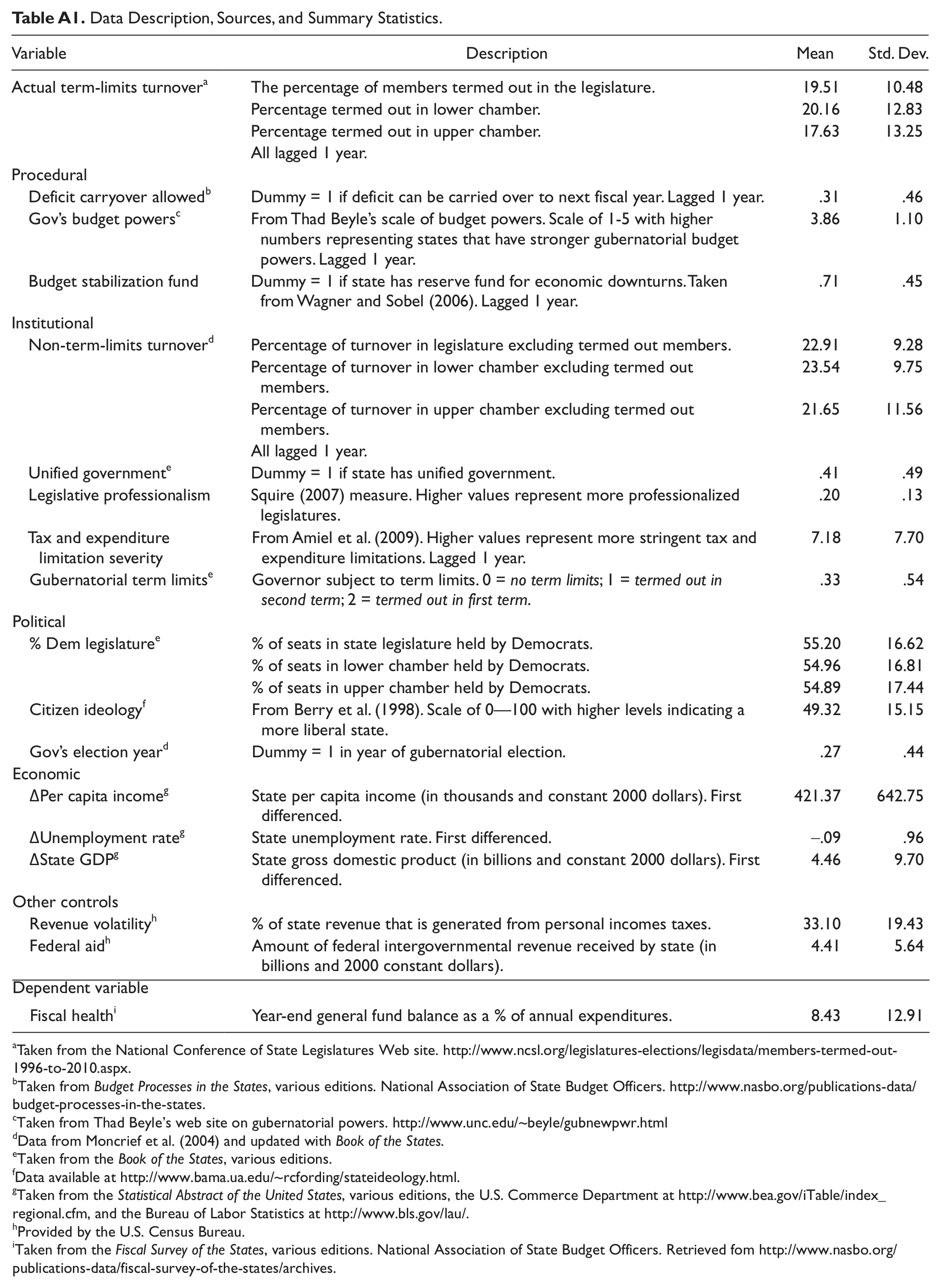
The budget data for this study are taken from the Fiscal Survey of the States. The dependent variable is Fiscal Health and represents the total ending balance as a percentage of state expenditures. This is a common way of measuring a state’s budget condition (National Association of State Budget Officers (NASBO), 2010; National Conference of State Legislatures, 2010). The budget data are from the general fund because this is the states’ main account that legislators and governors normally seek to balance each budget cycle (Bohn & Inman, 1996). Additionally, balanced budget rules usually apply to general fund accounts (Hou & Smith, 2010; National Conference of State Legislatures, 2010). The inclusion of either federal or local funding and expenditures would make it more difficult to discern the true condition of state finances. Furthermore, there are restrictions on the use of federal and local intergovernmental funds for the purpose of replacing state funding so states usually cannot simply fill their budget holes with other intergovernmental revenue streams. 7 All variable descriptions and summary statistics are presented in the Appendix.
Independent variables
In previous studies, a common way of measuring term limits has been to employ a dummy variable, but this masks the substantial variation in the severity of term-limit provisions (Erler, 2007; Moncrief et al., 2004; Sarbaugh-Thompson, 2010). Since it was anticipated that the main effect of term limits would be to increase legislative turnover, several studies attempted to estimate the predicted level of turnover in each term-limited state based on previous turnover and the strictness of the term limits law (Francis & Kenney, 2000; Moncrief, Thompson, Haddon, & Hoyer, 1992; Opheim, 1994). Following this latter camp, I use the percentage of members termed out in each chamber and overall to capture Actual Term Limits Turnover. 8 This is one of the first studies to employ actual turnover produced by term limits and should indicate whether the short term perspectives and loss of experience that accompany higher turnover contribute to shakier state fiscal conditions. 9
The other independent variables serve as control variables. The variables are grouped into five different categories of variables: (a) procedural; (b) institutional; (c) political; (d) economic; and (e) other controls. The procedural variables attempt to account for the various budget processes in the states and their efforts to rein in government spending (Bohn & Inman 1996). The first procedural variable addresses those states that have adopted balanced budget requirements to avoid fiscal pitfalls (Briffault, 1996; Poterba, 1996). Research generally shows that balanced budget rules work, especially with unified government (Alt & Lowry, 1994; Bohn & Inman, 1996). To capture the most stringent requirement, I coded states that allow deficits to be carried into the next fiscal year with a 1 and 0 if they do not allow it. 10 I expect the variable Deficit Carryover Allowed to worsen budget conditions. Another procedural variable measures the Governor’s Budget Powers on a scale of 1 to 5, where higher levels represent more powerful governors. I anticipate that states with stronger gubernatorial powers should be able to manage their finances better because decisions can be made more unilaterally (Goodman, 2007). One last procedural variable addresses whether a state has adopted a Budget Stabilization Fund (BSF; 1 = BSF adopted; 0 = otherwise). Since research shows that states can manage economic downturns better with a BSF (Douglas & Gaddie, 2002; Hou, 2004; Joyce, 2001; Rose, 2008), it should improve state fiscal conditions.
Five institutional variables are also inserted into the models to capture Non-Term-Limits Turnover, Unified Government, Legislative Professionalism, Tax and Expenditure Limitation (TEL) Severity, and Gubernatorial Term Limits. To further isolate the effects of turnover solely attributed to term limits, the models contain a variable that captures regular turnover in pre-term-limit states, states without term limits, and turnover in term-limited states attributed to non-term-limits factors, such as normal attrition. Similar to term-limits turnover, I expect that this turnover will reduce state budget health. Several previous studies highlight the importance of unified government in dealing with budget deficits (Alt & Lowry, 1994; Poterba, 1994). I account for its effects with a dummy variable and anticipate that it will improve fiscal health and avoid budget problems. For Legislative Professionalism, I use Squire’s (2007) measure of professional legislatures, which compares the level of professionalism in each state to that of Congress. Higher values represent more professionalized legislatures. The scholarship on the impact of professionalism remains mixed, which does not suggest a strong directional effect of professionalism on fiscal conditions. Several studies show that professionalism is associated with the shirking of district and state interests (Luttbeg, 1992; Opheim, 1994; Weber, 1999), which may mean legislators turn more to interest groups for their voting cues, while other researchers conclude that professionalism increases responsiveness to public opinion (Maestas, 2000). Given the lack of theoretical clarity, I remain agnostic on its effect here.
Many states have adopted tax and expenditure limitation (TEL) laws that seek to restrict the growth in government spending. Research on their containment of spending is somewhat mixed (Kousser, McCubbins, & Moule, 2008; New, 2010), but recent evidence shows that the severity of the limitation may be important in its effectiveness (Kioko, 2011). I use a scale measure developed by Amiel, Deller, and Stallmann (2009) that captures the severity of different TELs based on their growth factors, exemptions, and other criteria. Stronger TEL Severity should contribute to more sound financial management. The last institutional variable, Gubernatorial Term Limits, accounts for whether a governor is a lame duck because of term limits. Since previous research suggests that term-limited governors may spend more than non-term-limited governors, and for similar reasons outlined for legislative term limits, these may threaten fiscal conditions (Alt et al., 2011; Besley & Case, 2003).
Three political variables address the predisposition toward higher spending of legislators and citizens, and potential political business cycle effects. Since Democrats are normally associated with higher levels of spending (see, for example, Barrilleaux, Holbrook, & Langer, 2002, or Garand, 1985) and elected officials are often reluctant to raise taxes to support higher levels of spending, I include a variable, Percentage Democratic Legislature measuring the percentage of Democrats in the state legislature. This should hurt state finances. Likewise a more liberal state should also make it harder to balance revenues and expenditures. I employ Berry, Ringquist, Fording, and Hanson’s (1998) measure of Citizen Ideology for such effects. This variable is scaled 0 to 100 where higher values represent a more liberal state. There is also a possibility that governors will manipulate fiscal conditions in their election years to generate more voter support, a prospect arising out of the political business cycle literature (Rose, 2006). As such, I expect that a dummy variable for Governor’s Election Year (1 = election year; 0 = otherwise) will decrease fiscal health because additional spending can placate constituent demands for capital projects or program expansions and curry favor with the electorate.
The economic situation is a common explanation for state fiscal problems (Rose, 2008). Obviously, when there are downturns in the economy, state budgets are going to suffer. The models account for state Per Capita Income, Unemployment Rate, and State Gross Domestic Product (GDP). Increases in per capita income and state GDP should help the budget situation, while higher unemployment rates should hurt it.
The last set of variables attempt to control for potential influences on the budget that do not fit well in the other categories. Since the stability of revenue sources may impact a state’s ability to balance its budget, I incorporate a variable for the percentage of state revenue that is derived from personal incomes taxes. This source tends to be the most volatile because it responds more strongly to economic growth (Fox & Luna, 2005). Therefore, increases in this Revenue Volatility variable should lead to poor budget conditions. Lastly, despite general restrictions on the use of federal funding, states do receive federal aid for certain programs such as Medicaid and K-12 education, which help offset state support for these programs. In addition, during economic downturns, the federal government has provided states with fiscal assistance to offset declining state revenue, as it did during the 2008 recession. The Federal Aid variable accounts for this assistance and should help states maintain healthier balances.
The empirical models in Table 1 are estimated using a Prais-Winsten procedure with panel-corrected standard errors and include a lagged dependent variable to eliminate serial correlation (Beck & Katz, 1995, 1996). Lagrange multiplier tests revealed no residual serial correlation. Year fixed effects are included in the models to account for annual trends that may commonly influence states, such as national economic trends. State fixed effects are also included to control for factors that may help some states maintain higher (or lower) balances than others that are not captured by the other control variables. For example, some resource-rich states like Alaska and Wyoming carry unusually large balances at times because of revenue generated from these resource industries. Fixed effects help capture these idiosyncratic factors in all states. I estimated three main models, one for each chamber and one for the overall legislature, and conducted additional robustness tests not shown in Table 1.
The Impact of Legislative Term Limits on State Fiscal Health, 1983-2008.
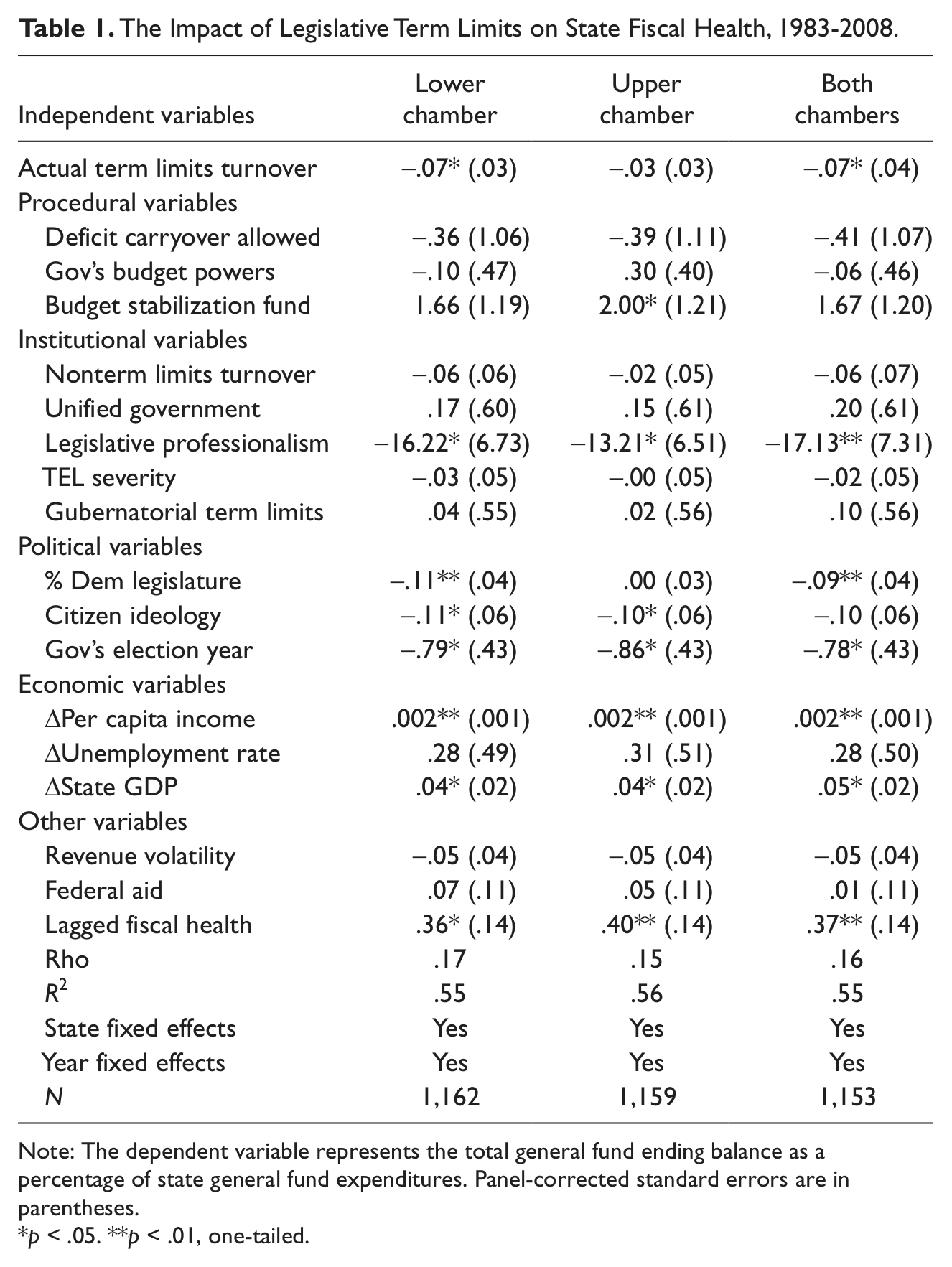
Note: The dependent variable represents the total general fund ending balance as a percentage of state general fund expenditures. Panel-corrected standard errors are in parentheses.
p < .05. **p < .01, one-tailed.
Data Analysis and Results
Table 1 presents the results for three models that estimate the impact of term limits on Fiscal Health. Each of the models account for more than 50% of the variance in state Fiscal Health. In the Lower Chamber model, Actual Term-Limits Turnover is significant and pointed in the expected negative direction. 11 Regarding the magnitude of effect, the average percentage of turnover produced by term limits in the lower chamber, 20.16%, results in a decrease in fiscal health of 1.41%. To put this in perspective, a balance of 5% or more is normally considered a prudent reserve level (Joyce, 2001; Poterba, 1994). A decrease of 1.41% represents nearly a third of that standard. In states where turnover exceeds the mean, the budget impact could be more severe. For example, in Colorado in 1999, lower house turnover was 28%, which may have accounted for a nearly 2% drop in the state’s reserve level. Based on these results, it appears that term limits lead to a deterioration of fiscal conditions and these states may have more trouble maintaining a healthy balance. 12
Turning our attention to the control variables in the first column in Table 1, seven are significant and, with the exception of the coefficient for legislative professionalism, all coefficients have the anticipated signs. Budget stabilization funds and positive economic conditions boost budget balances as we might expect. Legislative professionalism, a higher percentage of Democratic legislators, a more liberal state, and governor’s election year all worsen budget conditions. 13 The finding for legislative professionalism is somewhat unexpected although previous literature on professionalism is not clear on how it would impact state finances. It appears that the advantages of professionalism, such as more staff and a higher salary, may insulate representatives from public pressure to maintain a sound budget. Longer sessions also may provide legislators with more time to develop and adopt spending programs that lower balance sheets.
Column 2 in Table 1 presents the results for the upper chamber model, where only actual turnover in the senate is inserted in the model. 14 This allows us to determine whether the impact of term limits is mitigated in the upper chamber compared with the lower. Although the coefficient for Actual Term-Limits Turnover is negative, it is no longer significant at conventional levels. It appears that slightly longer time horizons and more experienced members in the state senate may offset the negative effects of term limits when compared with the lower chamber. 15 These results also serve to validate the theory underlying the impact of term limits since the main byproducts produced by turnover—shorter fiscal outlooks and loss of experienced members—are not as pronounced in the upper house as they are in the lower.
The final model in Table 1 uses overall turnover from term limits implemented in both chambers. The variable of interest is once again significant and has the same negative impact on fiscal conditions as in the lower chamber. The size of the coefficient in the final model is slightly smaller (–.069) than it is in the lower chamber model (–.074), presumably because the upper chamber is likely offsetting the negative effects of the lower. 16 The fact that it is only slightly smaller is a reminder of the bicameral nature of the budgetary process. Less experienced members in the lower chamber seem to pull state budgets in a downward direction.
In terms of the magnitude of these overall effects, a few examples can illustrate the impact of turnover. In 1997, California implemented for the first time one of the nation’s strictest term-limits law: lower house members were banned for life after 6 years, while upper house members were banned for life after 8 years. About 29% of the state’s legislators were termed out of office. According to the model estimates, this translates into a reduction of 2% in the state’s fiscal health. Although the state’s budget was healthy in the late 1990s, it became mired in budget problems throughout much of the decade in the 2000s. While other factors were certainly at play, it seems likely that turnover generated by term limits contributed to these ongoing imbalances.
In 2001, Ohio implemented a more moderate term-limits law: members in each chamber were termed out after 8 years, but were not banned for life. As a result, close to 39% of the legislature’s members were ousted from office. This level of turnover leads to a decrease of 2.73% in Ohio’s budget reserves, more than half of the 5% threshold commonly cited as a prudent level. While California’s problems were more severe, Ohio’s budget also remained on shaky financial ground for a good portion of the 2000s. The model results suggest that term limits may have played a role in this fiscal stress as well.
Discussion and Conclusion
The overriding goal of this project was to examine whether states with legislative term limits have worse fiscal conditions than non-term-limited states. The findings here indicate that term-limited states have more precarious budget conditions than those without term limits. Specifically, as the turnover produced by term limits increases, state general fund balances decline, leaving these states more vulnerable to economic downturns and other budget shocks.
Presumably, the loss of experienced legislators and shortened fiscal outlooks lead to budget decisions that place these states on shakier financial ground. Newer members have less experience and expertise to work out viable solutions to fiscal problems. Their knowledge of revenue sources and the myriad programs supported by the budget is likely much less than their non-term-limited predecessors and counterparts in other states (Kousser & Straayer 2007). Rather than tackle issues that plague the state’s long-term financial situation, the emphasis shifts to finding options to get through the next budget year (or even current year) and to just passing a budget, even if it does not address long-term issues. With shorter stints in office, legislators may become more myopic in their outlook, perhaps realizing that supporting tough fiscal decisions that address long-term concerns may jeopardize their more immediate political goals. Temporary solutions and get-out-of-town budgets not only become more expedient but also deteriorate the state’s ability to maintain fiscal balance.
Less experience and expertise on fiscal matters may also make term-limited legislators particularly vulnerable to the self-serving information flowing from lobbyists and interest groups, who are probably not concerned with the overall condition of state finances. Instead, these interest groups likely seek to protect their favored tax or program status, which pulls expenditures in one direction and revenues in the opposite.
This explanation for the impact of term limits becomes more plausible when we consider the evidence that turnover in the state senate, by itself, has no impact on fiscal health. This null effect likely occurs because the turnover impact is somewhat blunted in term-limited upper chambers. The fiscal outlook of legislators may be slightly longer, legislators may have more experience, and they may be less susceptible to the detrimental influence of lobbyists seeking budget favors.
Legislative turnover also occurs in states without term limits, but the results showed that this type of turnover does not yield the same effects as that of turnover related to term limits. This is likely the case for several reasons. First, with the possibility of longer potential careers in the state legislature, members in non-term-limited states may assume a longer term perspective on their budgetary decisions. Second, while newer members in both term-limited and non-term-limited states lack experience and policy expertise, the reservoir of experience and expertise is likely to deplete more rapidly in term-limited legislatures. Each successive election removes more legislators from office in term-limited states, leaving their chambers with fewer and fewer long-serving members. In non-term-limited states, veteran lawmakers are more likely to assume leadership roles, while newer members can still lean on veterans for fiscal advice. Both of these situations may help these states avoid financial strain. Lastly, some portion of the regular turnover in non-term-limited states is likely rooted in different reasons than that in term-limited states. For instance, when legislators leave office in states without term limits, they are more likely to retire or return to a nonpolitical career than states that have implemented term limits (Moncrief et al. 2007, p. 33). These different motivations for leaving office may lead to fiscal decisions that strengthen state finances prior to their departure.
One limitation of this study is that it did not explore the potential anticipation effects of term-limit turnover on fiscal conditions. That is, legislators who are eventually termed out may leave office prior to their forced exit (Francis & Kenney, 2000; Lazarus, 2006; Sarbaugh-Thompson et al., 2004), but contribute to weaker reserve levels before that early departure. In their study of legislative turnover, Moncrief et al. (2004) found some anticipation effects after adoption of term limits, but, by far, the largest effects occurred from implementation, which is the focus of this study. There are likely some negative fiscal effects from this early exit turnover, but it is hard to attribute these departures solely to term limits as we can with the implementation effects. Further research may shed light on the extent to which anticipation effects play a role in fiscal decision making. One avenue might be to explore the voting patterns of term-limited legislators to see if they vote differently on fiscal matters based on the number of terms they have remaining before they are termed out. This avenue and others should help further confirm and illuminate the relationship between term limits and state fiscal conditions.
Footnotes
Appendix
Data Description, Sources, and Summary Statistics.
| Variable | Description | Mean | Std. Dev. |
|---|---|---|---|
| Actual term-limits turnover a | The percentage of members termed out in the legislature. | 19.51 | 10.48 |
| Percentage termed out in lower chamber. | 20.16 | 12.83 | |
| Percentage termed out in upper chamber. | 17.63 | 13.25 | |
| All lagged 1 year. | |||
| Procedural | |||
| Deficit carryover allowed b | Dummy = 1 if deficit can be carried over to next fiscal year. Lagged 1 year. | .31 | .46 |
| Gov’s budget powers c | From Thad Beyle’s scale of budget powers. Scale of 1-5 with higher numbers representing states that have stronger gubernatorial budget powers. Lagged 1 year. | 3.86 | 1.10 |
| Budget stabilization fund | Dummy = 1 if state has reserve fund for economic downturns. Taken from Wagner and Sobel (2006). Lagged 1 year. | .71 | .45 |
| Institutional | |||
| Non-term-limits turnover d | Percentage of turnover in legislature excluding termed out members. | 22.91 | 9.28 |
| Percentage of turnover in lower chamber excluding termed out members. | 23.54 | 9.75 | |
| Percentage of turnover in upper chamber excluding termed out members. | 21.65 | 11.56 | |
| All lagged 1 year. | |||
| Unified government e | Dummy = 1 if state has unified government. | .41 | .49 |
| Legislative professionalism | Squire (2007) measure. Higher values represent more professionalized legislatures. | .20 | .13 |
| Tax and expenditure limitation severity | From Amiel et al. (2009). Higher values represent more stringent tax and expenditure limitations. Lagged 1 year. | 7.18 | 7.70 |
| Gubernatorial term limits e | Governor subject to term limits. 0 = no term limits; 1 = termed out in second term; 2 = termed out in first term. | .33 | .54 |
| Political | |||
| % Dem legislature e | % of seats in state legislature held by Democrats. | 55.20 | 16.62 |
| % of seats in lower chamber held by Democrats. | 54.96 | 16.81 | |
| % of seats in upper chamber held by Democrats. | 54.89 | 17.44 | |
| Citizen ideology f | From Berry et al. (1998). Scale of 0—100 with higher levels indicating a more liberal state. | 49.32 | 15.15 |
| Gov’s election year d | Dummy = 1 in year of gubernatorial election. | .27 | .44 |
| Economic | |||
| ΔPer capita income g | State per capita income (in thousands and constant 2000 dollars). First differenced. | 421.37 | 642.75 |
| ΔUnemployment rate g | State unemployment rate. First differenced. | −.09 | .96 |
| ΔState GDP g | State gross domestic product (in billions and constant 2000 dollars). First differenced. | 4.46 | 9.70 |
| Other controls | |||
| Revenue volatility h | % of state revenue that is generated from personal incomes taxes. | 33.10 | 19.43 |
| Federal aid h | Amount of federal intergovernmental revenue received by state (in billions and 2000 constant dollars). | 4.41 | 5.64 |
| Dependent variable | |||
| Fiscal health i | Year-end general fund balance as a % of annual expenditures. | 8.43 | 12.91 |
Taken from the National Conference of State Legislatures Web site. http://www.ncsl.org/legislatures-elections/legisdata/members-termed-out-1996-to-2010.aspx.
Taken from Budget Processes in the States, various editions. National Association of State Budget Officers. http://www.nasbo.org/publications-data/budget-processes-in-the-states.
Taken from Thad Beyle’s web site on gubernatorial powers. http://www.unc.edu/~beyle/gubnewpwr.html
Data from Moncrief et al. (2004) and updated with Book of the States.
Taken from the Book of the States, various editions.
Data available at http://www.bama.ua.edu/~rcfording/stateideology.html.
Taken from the Statistical Abstract of the United States, various editions, the U.S. Commerce Department at http://www.bea.gov/iTable/index_regional.cfm, and the Bureau of Labor Statistics at http://www.bls.gov/lau/.
Provided by the U.S. Census Bureau.
Taken from the Fiscal Survey of the States, various editions. National Association of State Budget Officers. Retrieved fom http://www.nasbo.org/publications-data/fiscal-survey-of-the-states/archives.
Acknowledgements
I want to thank Thomas Holyoke for helpful comments on several previous drafts and Zethyn Ruby and Ashlin Mattos for their research assistance. I also would like to thank Gary Moncrief for providing his data on legislative turnover. Data, coding, and alternative model estimates are available from the author.
Author’s Note
A previous version of this article was presented at the 2008 Western Political Science Association Annual Conference, San Diego, California.
Declaration of Conflicting Interests
The authors declared no potential conflicts of interest with respect to the research, authorship, and/or publication of this article.
Funding
The authors disclosed receipt of the following financial support for the research, authorship, and/or publication of this article: This project received support from the College of Social Sciences and the Provost Research Award at California State University, Fresno.