



Abstract
What determines state success when petitioning the U.S. Supreme Court for review? We suggest that states can improve the likelihood of securing Supreme Court review by coordinating litigation efforts. This coordination occurs in two ways. First, some states coordinate their appellate litigation efforts internally through the creation of state solicitors general offices. Second, external coordination occurs when states join amicus briefs at the agenda setting stage urging the Supreme Court to grant review in state-filed cases. Using new data on all state-filed certiorari petitions from the 2001-2009 terms, we find that internal and external coordination is associated with an increased likelihood of the Supreme Court granting review in state-filed cases.
Introduction
In Bridge v. Alliant Energy Co. (2004), the U. S. Supreme Court denied Wisconsin’s petition to review a lower court judgment invalidating a Wisconsin law requiring public utility holding companies to be incorporated within the state under the Dormant Commerce Clause. A few months after denying Wisconsin’s petition, however, the Court granted Michigan’s petition in Granholm v. Heald (2004) requesting review of a lower court judgment invalidating a Michigan law restricting the ability of out-of-state wineries to directly ship alcohol to Michigan residents under the Dormant Commerce Clause. Why was Michigan, but not Wisconsin, successful in securing Supreme Court review of its voided policy?
Explaining the Supreme Court’s certiorari (cert) decision in any particular case can be a difficult task, but “the criteria for certworthiness are not quite as mysterious, serendipitous, or dependent on one’s olfactory skills” as one might expect given the small percentage of petitions that are granted by the Court each term (Perry, 1991, p. 216). Indeed, there is already an impressive literature unraveling the determinants of the Court’s agenda setting decisions (e.g., Black & Owens, 2012a; Caldeira & Wright, 1988; Caldeira, Wright, & Zorn, 1999; Cameron, Segal, & Songer, 2000; Owens, 2010; Perry, 1991; Provine, 1980). Our contribution is to explain why some state-filed petitions, which already enjoy an advantaged status relative to the typical petition (Black & Boyd 2012), may be viewed more favorably than others.
We contend that states improve the likelihood of securing Supreme Court review of their voided policies under federal law by coordinating litigation efforts. This coordination occurs in two ways. First, some states coordinate their appellate litigation efforts internally through the creation and maintenance of state solicitors general offices (Layton, 2001; Miller, 2010). Like their federal counterparts, state solicitors tend to be highly qualified attorneys, and the opportunity to specialize in appellate litigation should be expected to improve screening decisions and the quality of legal arguments presented to the Court. Second, external coordination occurs when states file an amicus curiae brief at the cert stage urging the Court to review a state-filed petition. This external coordination is important for signaling to the Court that a particular state-filed case has far-reaching policy consequences.
With respect to the Supreme Court’s cert decisions in Granholm and Alliant Energy, we contend that Michigan enjoyed two advantages over Wisconsin: guidance from a state solicitor general specializing in appellate litigation and the aid of a state-filed amicus brief urging review. In recent terms, the Court has decided important state-filed cases in areas such as health care (Florida v. Health and Human Services) and federalism/immigration (Arizona v. United States). But the Court has also refused to decide state-filed cases involving issues such as abortion (Wasden v. Planned Parenthood) and elections (Dimick v. Republican Party). The Court’s largely discretionary, small, and shrinking docket (Owens & Simon, 2012) ensures that important cases are regularly denied review. But considering the policy and federalism implications of state and lower federal courts voiding state laws and procedures under federal law, it is important to understand why some state petitions for Supreme Court review enjoy advantages over others. To examine state success at the agenda setting stage, we utilize new data on all state-filed cert petitions considered by the Court during its 2001-2009 terms. Aside from the well-known predictors of success at the agenda setting stage, we find that internal and external coordination can benefit states attempting to secure review from the Supreme Court.
Coordinating State Litigation Before the Supreme Court
States enjoy a litigant status second only to the federal government among repeat players before the Supreme Court (Black & Boyd, 2012). Considering the vast array of public policies produced by the states and important issues of federalism at stake when these policies are challenged under federal law, it is hardly surprising that the Court resolves many disputes involving the states (Collins, 2007; Epstein & O’Connor, 1988; Kearney & Sheehan, 1992; Waltenburg & Swinford, 1999). But like other litigants, states must overcome a high hurdle when petitioning the Supreme Court for review given its largely discretionary, small, and shrinking docket. States certainly enjoy more success than the typical litigant at the agenda setting stage (see Perry, 1991), but we contend that the likelihood of state success when petitioning the Supreme Court for review will vary according to the extent to which appellate litigation efforts are coordinated. Some states coordinate their appellate litigation efforts internally by appointing state solicitors general to specialize in appellate litigation. Furthermore, external coordination occurs when states file an amicus brief at the cert stage urging the Court to review a state-filed petition.
State Solicitors General
Notwithstanding their status as repeat players and relatively resource-rich litigants, Supreme Court justices have not historically considered state attorneys first-rate advocates. As the Burger Court took an increased interest in federalism, there was mounting frustration among the justices concerning the poor quality of representation in cases involving the states. Justice Powell, for example, expressed “disappointment” in the advocates representing the states and suggested that they were responsible for “some of weakest briefs and arguments” he had encountered (quoted in Baker & Asperger, 1982, p. 368). Similarly, Chief Justice Burger (1984, p. 525) wrote that “state and local governments [had] not provided experienced and qualified personnel skilled in arguing cases before the Supreme Court,” and that “many who represent the states and local communities in the Supreme Court of the United States fail to appreciate fully the critical importance of well-organized and carefully researched briefs.” In 1974, Chief Justice Burger also sent a memorandum to the conference suggesting that a case be set for reargument with the goal of appointing amicus curiae for California in order to “begin our drive to force the States to abandon their on-the-job training of their lawyers in this Court.” 1
With frustration mounting and growing concern about a lack of coordination among the states in pursuing common policy objectives, the National Association of Attorneys General (NAAG) established the Supreme Court Clearinghouse Project in 1982 “in an effort to improve the quality and effectiveness of state litigation before the High Court” (Clayton, 1994, p. 542). The Clearinghouse Project assists state attorneys with preparations for dealing with the Supreme Court, holding moot courts to simulate oral arguments and providing feedback for written documents such as briefs. Furthermore, state attorneys general offices underwent a period of institutionalization throughout the 1970s and 1980s (Clayton, 1994; Waltenburg & Swinford, 1999). As a result of this coordination and institutionalization, state attorneys general offices were better equipped to shed their reputation for substandard performance before the Supreme Court.
Recently, some states have innovated further by appointing state solicitors general to improve their appellate litigation performance. Early adopters appointed their state solicitors general prior to 1995, with a subsequent increase in adoption through the late 1990s and 2000s (Miller, 2010). Although some features of institutional design and organization differ, state solicitors offices are typically created to mirror the federal model (Layton, 2001). For example, the Office of the Solicitor General in Texas “supervises all appellate litigation” and “is expressly modeled after the Office of the Solicitor General at the U.S. Department of Justice.” 2 And like their federal counterparts, “[m]ost state solicitors have a background that suggests that they are or will become elite members of the legal profession” (Miller, 2010, p. 239).
Our own analysis reveals that state solicitors general have impressive backgrounds and prior experience with federal appellate courts as a group, particularly when compared to attorneys general in states that do not have solicitors. About 52% of the current solicitors general attended top-20 law schools (according to the U.S. News and World Report rankings) compared to 24% of the attorneys general in states without solicitors general. Moreover, many state solicitors have experience with federal appellate courts. About 39% of the solicitors general served as clerks to circuit courts of appeals judges, while none of the attorneys general in states without solicitors served as federal appellate clerks. Moreover, 18% of the solicitors served as clerks to United States Supreme Court justices, while none of the attorneys general in states without solicitors have this experience. These data support claims that state solicitors are well qualified as a group and are more likely to have worked in federal courts, including the Supreme Court, gaining valuable experience with framing federal questions and evaluating appellate briefs.
Aside from their impressive backgrounds, state solicitors general develop important expertise in handling appellate litigation. This expertise can benefit a state when petitioning the Supreme Court for review in two ways. As with the United States Solicitor General (Pacelle, 2003, p. 21), state solicitors are experts at screening cases for review and they take this role seriously, recognizing the value in developing long-term relationships with the Supreme Court. As one former state solicitor noted, states with solicitors “have hopefully . . . built up a reputation over the years of knowing when to ask [the Supreme Court to grant review] and when not to ask” (Cole, 2010, pp. 708-709). Another former state solicitor expressed concern about being viewed as a political entity, noting that the “office has a higher duty to the state, its [citizens], and agencies to not merely advance a political, agenda-driven position” (Nordby, 2009, p. 219).
State solicitors also have an expert ability to craft convincing appellate documents and arguments. 3 Just as the United States Solicitor General is successful at the cert stage in large part as a result of “know[ing] all the catchwords . . . and . . . how to write them in a brief” (Perry, 1991, p. 132), state solicitors are experts at framing questions and cert briefs in a way that improves their chances of securing review (see Schweitzer, 2010). In addition to framing questions and drafting compelling cert briefs, state solicitors are more adept at crafting persuasive legal arguments. The United States Solicitor General’s advantage before the Court has been attributed in part to the office’s litigation expertise, an attribute that is not limited to the federal office (McGuire, 1998). By all accounts, state solicitors general acquire similar expertise (see Ho, 2010; Layton, 2001; Miller, 2010). As a result of these advantages, we expect that the Supreme Court will be more likely to grant a particular state-filed petition if it is filed by a state with a solicitor general.
State Solicitor General Hypothesis: The Supreme Court will be more likely to grant a state’s cert petition when that state has a solicitor general.
State Amicus Activity
States are among the more active amicus brief participants before the Supreme Court. Aided in part by the NAAG (see Clayton & McGuire, 2001), states regularly file amicus briefs at both the agenda setting and merits stages (Caldeira & Wright, 1990; Collins, 2008; Morris, 1987; Perry, 1991; Waltenburg & Swinford, 1999). At the merits stage, there is evidence that state-filed amicus briefs are associated with pro-state decisions in federalism cases (Nicholson-Crotty, 2007). But is a state-filed amicus brief associated with an increase in the likelihood that the Supreme Court will grant cert in a state-filed case? It is well established that the presence of an amicus brief at the agenda setting stage, regardless of who files it, increases the likelihood of review (Black & Owens, 2012a; Caldeira & Wright, 1988; Caldeira et al., 1999). Is the presence of a state-filed brief in a state-filed case particularly meaningful? There is good reason to suspect that the answer is yes.
Amicus briefs serve an important informational role for the justices (Collins, 2008). As Caldeira & Wright (1988, p. 1,112) explained, “amicus curiae participation by organized interests provides information, or signals—otherwise largely unavailable—about the political, social, and economic significance of cases on the Supreme Court’s paid docket.” And just as the Supreme Court looks to amicus briefs filed by the United States for information about the potential impact of a case at the federal level (Thompson & Wachtell, 2009), states may be considered particularly credible sources for explaining why a particular case is likely to have far-reaching consequences for their interests. Although the petitioning state can make this claim in its cert petition, the presence of a state-filed amicus brief will be a more credible signal that the case impacts not only the filing state’s interests, but those of other states as well.
State-filed amicus briefs in support of granting cert at the agenda setting stage are particularly adept at highlighting how underlying disputes impact states’ interests. Their pleas for review often emphasize how granting a particular case will reduce uncertainty and better allow the states to address important policy issues. For example, a state-filed amicus brief to support Supreme Court review in Washington State Department of Social and Health Services v. Keffeler (2002) noted that the states were “uncertain about their conduct going forward” and concerned that the lower court decision in question “would require dismantling large components of States’ children’s service programs…” 4 Similarly, a state-filed brief in Wilkins v. Cuno (2005) urged the Supreme Court to review a lower court decision that “undermine[d] every State’s ability to encourage investment in depressed areas, and to compete with other States and with foreign nations for economic investment.” 5
Furthermore, the Supreme Court appears to take state-filed amicus briefs seriously. According to one scholar who surveyed former Supreme Court clerks about the influence of amicus briefs, state filings were second only to those by the United States Solicitor General in terms of “being important enough to always warrant close consideration” (Lynch, 2004, p. 47). As one clerk noted, “there is an institutional interest in taking state concerns seriously because of federalism concerns” (Lynch, 2004, p. 47). Moreover, Supreme Court clerks regularly mention state briefs in their pool memoranda, suggesting that they are useful to clerks making cert recommendations and to justices making final decisions. In California v. ARC America Corp. (1989), for example, the Court was asked to overturn a circuit court decision invalidating a state antitrust law on preemption grounds. The pool memo summarized an argument by appellants and state amici on the broad policy consequences of the decision for the states, noting that the “decision will seriously reduce the incentive of state attorneys general to pursue antitrust claims. Because these attorneys general are increasingly leading the way in antitrust litigation . . . reducing their incentive to pursue such claims will reduce the enforcement of the antitrust laws generally to the detriment of all victims and the benefit of all violators.” 6
State-Filed Amicus Brief Hypothesis (1): The Supreme Court will be more likely to grant a state’s cert petition when the petition is accompanied by a state-filed amicus brief supporting review.
In addition to the decision to file, there is the question of how many states urge the Supreme Court to grant review. According to the NAAG, it is highly unusual for more than one state to file an amicus brief at the cert stage. 7 State coordination in the filing of amicus briefs is common (Morris, 1987), however, and state-filed briefs at the agenda setting stage are regularly joined by multiple states. During the 2001-2009 terms, state-sponsored amicus briefs urging review in state-filed cases were joined by an average of about 18 states, and only 5 of the 88 briefs filed were signed by a single state. There is evidence that justices sometimes pay attention to the number of states signing on to amicus briefs at the merits stage (Solimine, 2012), and the number of state signatories on amicus briefs at the merits stage is positively associated with pro-state outcomes in federalism cases (Nicholson-Crotty, 2007). Thus, it is reasonable to expect that the number of states urging review is positively associated with the Court’s decision to grant review.
State-Filed Amicus Brief Hypothesis (2): The Supreme Court will be more likely to grant a state’s cert petition as the number of states urging review increases.
Data and Measurement
To test our theory that coordinating litigation efforts increases the likelihood of the Supreme Court granting review in state-filed petitions, we utilize new data on all state-filed cert petitions reviewed by the Court during its 2001-2009 terms. 8 The Court reviewed 598 state-filed petitions during the sample period—an average of about 66 petitions per term. Overall, the states enjoyed remarkable success obtaining review, with 21.9% of their petitions being granted compared to a 4.2% success rate for all paid petitions during the sample period. 9
The dependent variable is an indicator scored 1 for those state-filed cert petitions granted review by the Supreme Court and 0 otherwise. The key explanatory variables are whether the petitioning state has a solicitor general, whether a state-filed amicus brief accompanied the petition, and the number of states urging review. Using information provided by Miller (2010), Solicitor General is an indicator variable scored 1 if the petitioning state had a solicitor general and 0 otherwise. Using data provided by the NAAG, State Amicus is an indicator variable scored 1 if a state-filed amicus brief accompanied the cert petition and 0 otherwise. According to the NAAG, it is rare for more than one state-filed amicus brief to be filed supporting cert, or for a state-filed amicus brief to be filed in opposition to cert, in a state-filed case. During the sample period there were no instances of more than one state-filed amicus brief being filed urging review, and there were no instances of a state-filed brief being filed in opposition to review of a state-filed petition. Total States scores the number of states urging the Supreme Court to grant review, taking a value of 0 if no brief was filed in support of a petition. Because the State Amicus and Total States variables are highly correlated (r = .83), we estimate separate models for each measure.
Using the agenda setting literature as our guide, we control for a variety of alternative explanations that account for the Supreme Court’s agenda setting decisions. Having already noted the influence of amici at the cert stage, we include several variables that account for nonstate amicus activity, including briefs in opposition to cert, which have been shown to increase the probability of review (Caldeira & Wright, 1988). For briefs supporting review, we code indicator variables for One Support Brief and Two Or More Support Briefs, leaving 0 support briefs as the excluded category; we follow the same strategy for opposition briefs, with indicator variables for One Opposition Brief and Two Or More Opposition Briefs, leaving 0 opposition briefs as the excluded category.
We account for the federal government’s participation with U.S. Opposition, which is an indicator variable scored 1 if the federal government is the respondent in a case or files a brief in opposition to granting cert and 0 otherwise. We cannot include a U.S. Support variable because the U.S. did not serve as copetitioner in any case in our sample, and although the U.S. filed briefs urging review in two cases, both petitions were granted, which means that we cannot account for this activity in our models. 10 We also account for several case-level factors. Lower Unconstitutional is scored 1 if the lower court invalidated a law on constitutional grounds in the case and 0 otherwise. Lower Conflict takes a value of 1 if the lower court indicated the existence of a circuit split or another type of conflict noted in Supreme Court Rule 10 and 0 otherwise. 11 Lower Dissent takes a value of 1 if the lower court opinion included a dissent and 0 otherwise. Lower Reversal is scored 1 if the last court to review the case reversed a previous court’s judgment and 0 otherwise. As a measure of legal importance, Lower Unpublished is scored 1 if the lower court opinion was not published and 0 otherwise. State Court Decision is coded 1 if the appeal is coming from a state court and 0 if it comes from a federal court. We include this variable because the Supreme Court may be less likely to review state court decisions due to the adequate and independent state grounds doctrine or other federalism concerns. If states base their amici activity in part on their expectation concerning the likelihood of review in these cases, the exclusion of this variable could bias the results.
We also include several variables to account for the political dynamics of agenda setting decisions. First, we include Lower Liberal scored 1 if the lower court judgment is liberal (0 otherwise) and interact that variable with a measure Court Conservatism based on Martin and Quinn (2002) estimates of the median justice’s ideology; we expect that the Court will be more likely to grant petitions appealing liberal lower court judgments as it becomes more conservative. 12 Next, we interact Lower Liberal with a measure of State Government Conservatism based on NOMINATE scores (Berry et al. 1998, 2010); given that the Court was relatively conservative during this period, we expect that liberal lower court judgments will be more likely to be granted as petitioning state conservatism increases. Finally, we control for the ideological distance between the petitioning state and the Supreme Court. Although we are not aware of any existing measure that places these actors in the same ideological space, we accomplish this by using Judicial Common Space scores (Epstein, Martin, Segal, & Westerland, 2007) to capture the Court’s ideology and each state’s U.S. House delegation’s average Common Space score (Poole, 1998). 13 Petitioning State-Court Divergence scores the absolute value of the difference between these ideal point estimates.
Estimation and Results
Table 1 displays results from logistic regressions explaining the Supreme Court’s agenda setting decisions in state-filed cases during the 2001-2009 terms. We include fixed effects for term, issue area, and natural court. 14 Standard errors are clustered by term. 15 The analysis excludes petitions that were granted, vacated, and remanded (GVR), along with cases for which information on some of the independent variables were not available. 16 Model 1 includes the State Amicus Brief indicator whereas Model 2 includes the Total States measure. Overall, the models fit the data well and are consistent across specifications. Unless otherwise noted, we discuss results from Model 1. The area under the ROC curve, which conveys the proportion of correct classifications from random draws of 0,1 pairs on the dependent variable, is .78. Moreover, Model 1 correctly predicts 78.7% of the decisions for a reduction in error of 11.2% over simply guessing that the Supreme Court would deny any particular cert petition.
The Determinants of the Supreme Court’s Agenda Setting Decisions in State-Filed Cases.
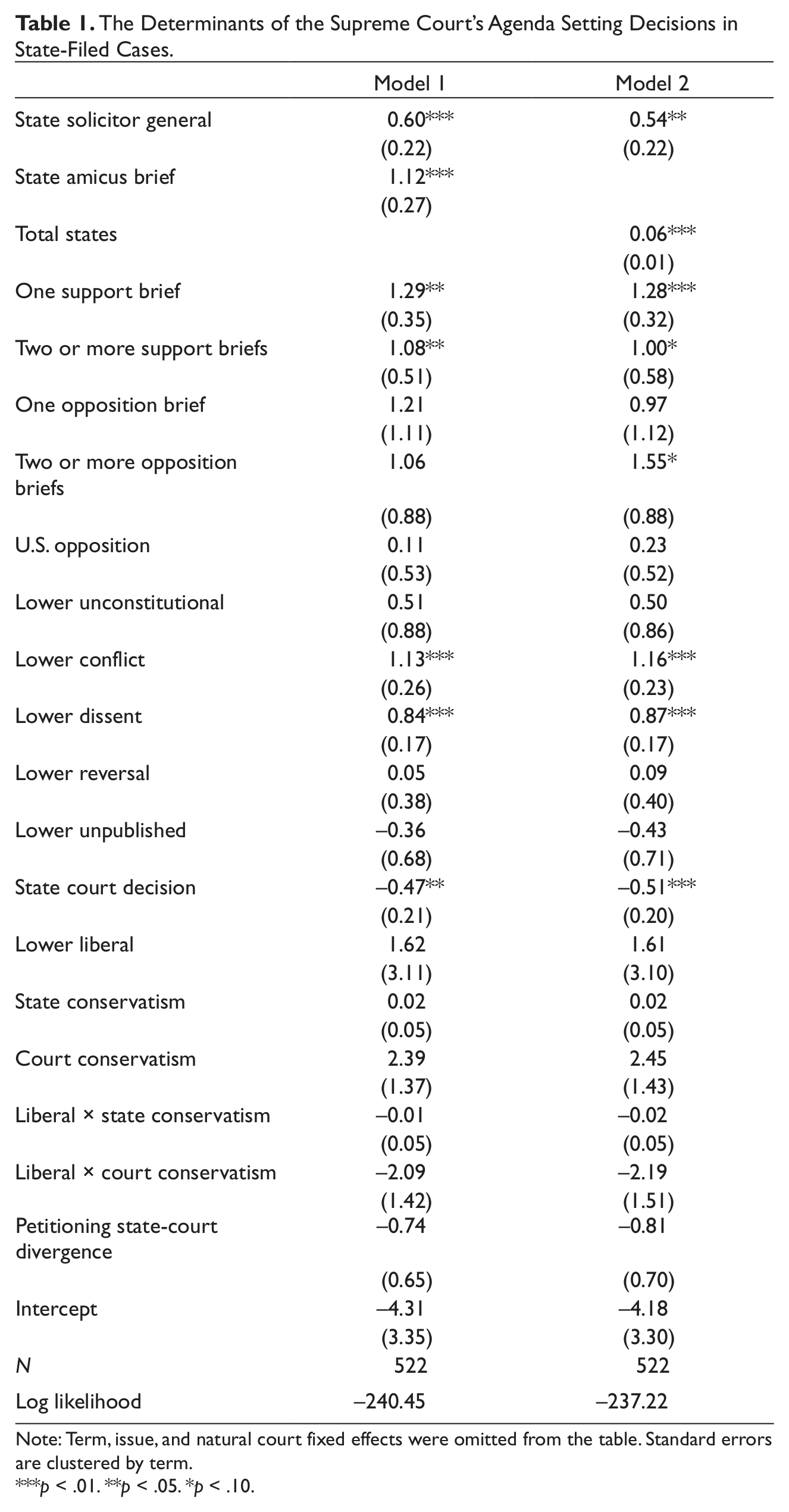
Note: Term, issue, and natural court fixed effects were omitted from the table. Standard errors are clustered by term.
p < .01. **p < .05. *p < .10.
Many of the control variables perform as expected. To facilitate comparisons to the substantive effects of our theoretically relevant explanatory variables, we calculate predicted probabilities for the control variables holding continuous variables at their means and binary variables at their modes with the exception of State Solicitor General, which we set to 0. 17 Consistent with the extensive existing literature on the Supreme Court’s agenda setting decisions, we find that amicus briefs filed by nonstate actors urging review are positively associated with an increase in the probability of the Court granting cert. A petition that is not accompanied by an amicus brief urging review has a .10 [.04, .15] probability of being granted, while the presence of one brief improves that probability to .29 [.10, .47], an increase of .19 [.03, .34]. 18 The presence of two or more briefs improves the probability of review (compared to zero briefs) from .10 [.04, .15] to .24 [.05, .44], but the change in probabilities of .14 [–.04, .33] is not statistically significant at the .05 level.
Absent conflict in the lower courts, there is a .10 [.04, .15] probability of a petition being granted; the presence of conflict increases the probability of review to .25 [.15, .36], an increase of .15 [.07, .24]. 19 A dissent, meanwhile, increases the probability of review from .10 [.04, .15] to .20 [.10, .31], a change of .10 [.04, .17]. State court decisions are less likely to be reviewed, with the probability of a grant decreasing from .10 [.04, .15] to .06 [.04, .09] in Model 1, but the change of –.04 [–.07, .01] is not significant at the .05 level. The only substantive difference across models is that the estimated coefficient for Two Or More Opposition Briefs is positive and statistically distinguishable from 0 in Model 2, but not Model 1. Substantively, the probability of a grant in Model 2 increases from .11 [.05, .16] to .36 [–.03, .74] when there are two or more opposition briefs filed, but the change of .25 [–.13, .63] is not significant at the .05 level. The remaining independent variables were not associated with agenda setting outcomes in state-filed cases.
Turning to our theoretical expectations, there is a strong relationship between coordinating litigation efforts and the probability of a state securing review from the Supreme Court. Having a state solicitor general is positively associated with the Supreme Court granting review in a state-filed case as expected. 20 Substantively, holding continuous variables at their means and binary variables at their modes, the probability of the Court granting review increases from .10 [.04, .15] for states without a solicitor general to .17 [.08, .25] for states with a solicitor general, an increase of .07 [.01, .12]. In terms of improving the probability of a state securing review by the Supreme Court, having a solicitor general has a similar impact as the lower court decision containing a dissent—a factor that has long been shown to be of special importance in the Supreme Court’s agenda setting decisions (Tannenhaus, Schick, Muraskin, & Rosen, 1963). Another way to think about the substantive impact is to consider that out of every 66 state-filed cert petitions (the average per term over the sample period), states with solicitors general will secure review in 4 to 5 additional cases. Considering the relatively high success rate enjoyed by states on the merits, this advantage is likely to have important policy consequences.
The presence of a State Amicus Brief also improves the likelihood of the Supreme Court granting cert. Substantively, the probability of review increases from .10 [.04, .15] to .25 [.09, .42] with the addition of a state-filed amicus brief, an increase of .15 [.03, .28]. This is nearly identical to the impact of having conflict in the lower courts, which is thought to be the most important factor in the decision to grant cert (Perry, 1991). Moreover, although the probability of a grant is similar given the presence of a nonstate or state-filed brief supporting review, there is a substantial difference in the probability of review when a petition is accompanied by both a state-filed and nonstate brief compared to two nonstate briefs. As noted above, the change in the probability of review given the presence of two nonstate briefs urging review is actually negative, although not statistically distinguishable from zero. But the probability of review increases from .10 [.04, .15] with no briefs urging review to .55 [.30, .80] with one nonstate and one state-filed brief urging review, an increase of .45 [.24, .67]. This suggests that the presence of a state-filed brief is meaningfully associated with an increase in the probability of the Court granting review beyond what would be expected from the presence of amici more generally.
Our alternative measure of influence—the total number of states urging review (Total States)—is also positively associated with the likelihood of the Court granting cert. The probability of a grant is .11 [.05, .16] when no states urge the Court to grant review, increasing to .37 [.15, .59] when half the states urge review, an increase of .26 [.08, .44]. This suggests that state coordination may influence the Court not only through filing a brief, but also by maximizing the number of states urging review.
All things considered, state coordination efforts have a substantial effect on the likelihood of the Supreme Court granting cert in state-filed cases. Petitions filed by states with solicitors general or accompanied by state-filed amicus briefs were about four times more likely to be granted than the typical paid petition over the sample period. It is important to note, however, that these data encompass only terms from the Rehnquist and Roberts Courts, which have been relatively pro-state. The extent to which these findings will hold for future courts may depend in part on the inclinations of those courts toward federalism claims and the value of monitoring state and lower federal court decisions voiding state policies. At the same time, states may invest in specialized appellate groups headed by solicitors general and those that have already created these positions may continue to add experience and skill in their handling of federal cases. We might also observe more amicus brief activity by states at the cert stage in future terms as states continue to develop institutionalized federal appellate practices and reap the benefits of coordination. Although state investment in appellate litigation is unlikely to ever match the federal government’s, the reforms and cooperative strategies adopted by states are likely to render them skillful repeat players in Supreme Court litigation.
Conclusion
States enjoy an important advantage relative to the typical litigant at the agenda setting stage before the Supreme Court (Black & Boyd, 2012). However, states can take efforts to distinguish their petitions from other state-filed petitions. In particular, we find that states improve the probability of securing Supreme Court review by coordinating their appellate litigation efforts internally through the creation and maintenance of state solicitors general offices, and externally by joining amicus briefs at the cert stage to signal to the Court that particular state-filed cases have far-reaching policy consequences.
These results offer contributions to the study of Supreme Court agenda setting and state institutional development. Although there is an extensive literature devoted to the United States Solicitor General (e.g., Bailey, Kamoie, & Maltzman, 2005; Black & Owens, 2012b; Pacelle, 2003; Wohlfarth, 2009), relatively little is known about state solicitors and even less about how these state institutions influence decision making at the federal level. Future work would benefit from exploring whether state solicitors are influential at the merits stage and whether any advantage extends to proceedings before other federal courts. Moreover, this project contributes to our developing understanding of the relationship between state-filed amicus briefs and Supreme Court decision making (Clayton & McGuire, 2001; Collins, 2008; Morris, 1987; Nicholson-Crotty, 2007; Provost, 2011; Waltenburg & Swinford, 1999). Although much of this research examines the impact of state briefs at the merits stage, their agenda setting stage filings also appear to be influential as signals concerning case impact.
As the Supreme Court continues to develop its interest in federalism, and states continue to pursue policy goals that implicate federal law, it will become increasingly important to understand how states and the Supreme Court interact. Supreme Court scholars will continue to be interested in the institution’s agenda setting and merits decisions involving the states and federalism issues, but those interested in state politics and political institutions more generally should also take notice as the states continue to innovate and coordinate their handling of litigation at the federal level. Moreover, the political science literature on judicial federalism is in its infancy, with scholars just now beginning to empirically address important issues such as state court responses to the Supreme Court (Comparato & McClurg, 2007; Hoekstra, 2005; Howard, Graves, & Flowers, 2006). We hope that future research will continue to explore the multifaceted and interesting interplay between the states and federal courts.
Footnotes
Authors’ Note
The author(s) would like to thank Dan Schweitzer, Judge Scott Makar, Brian Gaines, and the anonymous reviewers for helpful feedback.
Declaration of Conflicting Interests
The author(s) declared no potential conflicts of interest with respect to the research, authorship, and/or publication of this article.
Funding
The author(s) received no financial support for the research, authorship, and/or publication of this article.