



Abstract
Regulation of the environment is often characterized as a polarizing issue that pits public health against economic growth. Although researchers have examined the decisions of federal district court judges in environmental civil penalty cases and examined the decision making of administrative law judges (ALJ), there has been no research which has examined factors that influence ALJ decision making in environmental civil penalty cases at the Environmental Protection Agency (EPA). I theorize that ALJ decisions, like federal district court judge decisions, are a function of personal policy preferences, hierarchical controls by higher courts, separation of powers influences, and case and defendant characteristics. Results demonstrate that the size of civil penalties issued by ALJs at the EPA is influenced by personal policy preferences, political constraints via Congress, hierarchical control by the Environmental Appeals Board (EAB) and the Supreme Court, litigant characteristics, and case characteristics. Overall, EPA ALJs seem to put more emphasis on their role as judge than their role as bureaucrat. The influence of attitudes raises normative concerns regarding the level of independence that is provided to ALJs as the weighing of public health versus economic growth seems to be based in personal policy preferences rather than technical expertise.
Keywords
Introduction
Since the creation of the Environmental Protection Agency (EPA) by President Richard Nixon in 1970, the EPA has been the source of much debate, controversy, and research. Regulation of the environment is a politically polarizing issue that receives considerable public attention and pits public health against economic growth. The attention received by the EPA is not surprising as a 2007 (February 6th) Harris Poll demonstrates that 87% of Americans report that they understand the purpose of the EPA (Taylor, 2007). It is perhaps this level of understanding that has led to a greater focus on the EPA than other federal regulatory agencies in presidential campaigns and an increased salience of the EPA in political science research.
While research on the EPA has been varied and crossed into multiple disciplines, one aspect of EPA decision making that has been largely ignored in the literature is the adjudicatory function of the EPA. When a regulated party violates environmental regulations, it is the responsibility of agency attorneys to assess a civil penalty against the violator. Violators then reserve the right to request an adjudicatory hearing to challenge the determination of liability and/or the penalty before an administrative law judge (ALJ). In determining whether civil penalties should be imposed, and if so, how much, ALJs find themselves in the direct position of having to consider the balance between public health and economic growth. Higher penalties would signal an increased emphasis on public health while limiting economic growth. Lower penalties, conversely, would increase emphasis on economic growth and decreased emphasis on public health.
Taratoot and Howard (2011) examined the role of the ALJ at the National Labor Relations Board (NLRB) and found that ALJs at the NLRB exhibited behaviors in their decision making that were exemplary of both bureaucrats and judges. The ALJ’s role as a bureaucrat raises normative concerns regarding control over the bureaucracy; the ALJ’s role as judge demonstrates a need for independence from political interference to satisfy the terms of the Due Process Clause of the 5th Amendment (see Gibson v. Berryhill [1973]). At the same time, research by Ringquist and Emmert (1999) examined the issuance of civil penalties by federal district court judges in environmental protection cases. This research demonstrated that “penalty severity in environmental cases is affected by case and defendant characteristics, judicial policy preferences, the surrounding political context, and federal institutional actors” (Ringquist & Emmert, 1999, p. 1).
So while there has been research investigating the decision making of ALJs, and there has been research examining the decision making of federal district court judges in environmental cases, there has been no research that specifically examines the decision making of ALJs in environmental cases. This research seeks to fill this gap in the literature by integrating these two lines of research.
The integration of these two lines of research is not difficult. Taratoot and Howard (2011) found that the position of ALJ was comparable to that of a federal district court judges. Because of the similarities to district court judges, I assume that the same factors that influenced the decision making of federal district court judges in environmental cases (Ringquist & Emmert, 1999) should influence the decisions of ALJs in cases of the same type. Thus, I theorize that EPA ALJ decisions should be affected by personal policy preferences, hierarchical controls by higher courts, separation of powers influences, and case and defendant characteristics. To test this theory, I investigate the decision making of ALJs in civil penalty cases at the EPA, an independent agency, for the time period between 1992 and 2008.
Results demonstrate that the size of civil penalties issued by ALJs at the EPA is influenced by personal policy preferences, political constraints via Congress, hierarchical control by the Environmental Appeals Board (EAB) and the Supreme Court, litigant characteristics, and case characteristics. Thus, the research here confirms that ALJs are comparable to federal district court judges. ALJs at the EPA, like their NLRB and federal trial judge counterparts, are influenced by attitudinal considerations in their decision making. Thus, mounting evidence suggests that the attitudinal model espoused in judicial research transcends bounds into the bureaucracy and adjudicatory decision making by demonstrating that even Article I judges, who are selected through merit hiring and subject to political and bureaucratic oversight, are influenced by personal policy preferences. Second, results provide initial evidence that structural and procedural differences between agencies can affect the factors that influence ALJ decision making, thus contributing to the literature on structure and process.
ALJs and the EPA
ALJs
The federal government employs nearly 1,800 ALJs across 24 different agencies, the majority of which are housed at the Social Security Administration (FedScope, 2012). The primary function of the ALJ is to serve as an impartial decision maker in both formal and informal adjudication across a variety of cases before administrative agencies. ALJs administer oaths, issue subpoenas, determine the admissibility of evidence, make findings of fact, develop a record of evidence, and issue a decision termed an “initial decision.” The position of the ALJ is one that possesses characteristics that are indicative of bureaucrats and federal judges.
Like other federal merit employees, ALJs are hired through the Office of Personnel Management (OPM) through competitive examinations and merit-based qualifications. The OPM administers a special examination for ALJs that ensures that potential applicants possess the necessary level of legal expertise to perform duties of the position. Unlike other bureaucrats, however, the position of the ALJ has a great deal of independence from the hiring agency. As Ruhlen (1982) points out, determinations of ALJ pay, promotions, demotions, and efficiency ratings are handled by the OPM rather than the hiring agency. “This insulates the ALJ and ensures that members of the agency cannot influence the decision of ALJs through threats of demotions or pay cuts” (Taratoot & Howard, 2011, p. 835). Thus, although the selection process is different from Article III judges, the level of independence mirrors that of Article III judges.
Like federal district court judges, it is also difficult to remove ALJs from their position for politically motivated reasons. This essentially gives ALJs life tenure as they can only be removed for “good cause” after having been given a hearing before the Merit Systems Protection Board. In this regard, ALJs exhibit many of the same characteristics as federal district court judges and these characteristics allow ALJs the independence necessary to insert their own policy preferences into their decision making.
EPA Enforcement Process
The enforcement process at the EPA begins when EPA attorneys file a complaint with the Regional Hearing Clerk in one of the EPA’s 10 regional offices. After the complaint is filed, the EPA will serve the complaints and give notice to the respondents who then have 30 days to file an answer with the Regional Hearing Clerk. If the respondent denies any claims, the complaint is then forwarded to the Office of Administrative Law Judges (OALJ) in Washington, DC, which houses four ALJs. If the respondent fails to respond to the complaint within 30 days, an ALJ will issue a default order which assumes guilt on the part of the respondent and typically adopts the penalty sought by the EPA.
The case is then assigned to an ALJ who then presides over the case in a manner that is similar to a federal nonjury civil trial. EPA ALJs handle all cases that fall under 40 C.F.R. 22 (2011) with the exception of permit cases (handled by Regional Administrators) and a limited subset of cases which are handled by Regional Judicial Officers. 1 After the trial, the ALJ will issue an initial decision in the case, which becomes the final order of the agency after 45 days, unless parties appeal the case to the EAB within 30 days.
Prior to the creation of the EAB in 1992, cases were heard upon appeal by the Chief Judicial Officer of the EPA. 2 The creation of the Board would make the EAB the final authority for all adjudicatory matters for the EPA. 3 Although it originally consisted of three Environmental Appeals Judges (EAJs), the EAB was expanded to four judges in 1999. EAJs are career Senior Executive Service employees that are appointed by the Administrator and do not serve under a fixed term appointment. This system differentiates the EPA’s adjudication process from other federal agencies where the final arbiters are typically the political appointees of the agency (e.g., the Federal Communications Commission, NLRB, and the Securities and Exchange Commission) and serve shorter terms. In this regard, the reviewing body over ALJ initial decisions at the EPA has a much more permanent makeup than in other agencies. 4 EAB decisions are issued by majority vote by three-judge panels and act as the final administrative decision of the agency.
EAB final orders mark the point at which all administrative remedies have been exhausted under the requirements of the Administrative Procedure Act (5 U.S.C. § 704). Thus, appeals of EAB decisions are reviewable by the federal Circuit Courts of Appeals. 5
ALJ Decision Making
Taratoot and Howard (2011) demonstrated that ALJs are comparable to federal district court judges. In this regard, it is logical to look to the literature on the decision making of federal district court judges to develop a theory of ALJ decision making at the EPA. The work of Ringquist and Emmert (1999) is instructive as their research directly examines the decision making of federal district court judges in environmental civil penalty cases. Ringquist and Emmert (1999) identify several broad categories of relevant influences over ALJs, including attitudinal considerations, the political environment, hierarchical constraints, respondent characteristics, and case characteristics. Thus, my theory of ALJ decision making at the EPA seeks to incorporate these influences.
Attitudinal Considerations
Political scientists have demonstrated that the personal policy preferences of judges are an important determining factor in predicting case outcomes at the Supreme Court (Segal & Spaeth, 1993, 2002), the federal Circuit Courts of Appeals (Songer & Haire, 1992; Songer, Segal, & Cameron, 1994; Humphries & Songer, 1999) and the district court level (Carp & Rowland, 1983; Rowland, Songer, & Carp, 1988). Evidence of attitudinal considerations in ALJ decision making has also been demonstrated by Taratoot and Howard (2011). One key ingredient necessary for judicial decision making to be impacted by ideological considerations is the presence of judicial independence. In fact, variations in the level of judicial independence within the judicial hierarchy help to explain variations in the overall impact of attitudinal considerations.
The above discussion on the position of the ALJ demonstrates that ALJs possess a significant level of independence from the hiring the agency. However, because ALJs also act as a class of bureaucrat, there may be statutory constraints that limit the discretion of the ALJ when issuing civil penalties. The language of 40 CFR 22.27 demonstrates the considerable amount of discretion that ALJs are afforded at the EPA: The Presiding Officer shall determine the amount of the recommended civil penalty based on the evidence in the record and in accordance with any penalty criteria set forth in the Act. The Presiding Officer shall consider any civil penalty guidelines issued under the Act. The Presiding Officer shall explain in detail in the initial decision how the penalty to be assessed corresponds to any penalty criteria set forth in the Act. If the Presiding Officer decides to assess a penalty different in amount from the penalty proposed by complainant, the Presiding Officer shall set forth in the initial decision the specific reasons for the increase or decrease.
The vague nature of the language clearly provides ALJs with a level of discretion, combined with the necessary independence, which would allow for the injection of personal policy preferences into the determination of civil penalties.
Political Constraints
Although research has demonstrated the similarities between federal district court judges and ALJs, ALJs still possess characteristics of bureaucrats (Taratoot & Howard, 2011). In this regard, it is reasonable to expect that ALJ decision making may be constrained by the ideological preferences of political actors. Research has demonstrated that the bureaucracy is subject to significant control by Congress (Calvert, McCubbins & Weingast, 1989; Calvert, Moran, & Weingast, 1987; McCubbins & Schwartz, 1984) and the president (Moe, 1982, 1985; Wood & Waterman, 1991, 1994). Ringquist and Emmert (1999) even point out that federal district court judges are subject to potential influence by political institutions.
Although Taratoot and Howard (2011) did not find presidential influence to be a determining factor in NLRB ALJ decision making, it might be more reasonable to expect presidential influence over EPA ALJ decision making. As an independent regulatory board, presidential influence over political appointees is limited by the fact that appointees serve fixed terms and do not serve at the pleasure of the president. This provides political appointees at independent regulatory agencies increased insulation from the president with an eye toward increased responsiveness to Congress. The Administrator of the EPA, on the other hand, as the head of an independent agency, is subject to the potential removal from office by the president. This may allow for increased influence by the president over the agency’s functions via overhead democracy. In fact, research by (Wood & Waterman, 1991, 1994; Ringquist, 1995) demonstrates that EPA enforcement is responsive to presidential preferences and changes in leadership at the EPA. ALJs at the EPA may then be responsive to changes in presidential ideology via overhead democracy.
Research by Taratoot and Howard (2011) also demonstrates that ALJs are responsive to congressional preferences. The authors theorize that ALJs are motivated to respond to congressional preferences due to the fact that ALJs seek to realize their professional interests, including improved working conditions, via lobbying of Congress through their professional organization. Additionally, because ALJs are affected by budgetary decisions made by Congress that impact the agency, there is an additional motivation for ALJs to consider congressional preferences. Because research demonstrates that congressional committees act as gatekeepers (Moe, 1985; Shipan, 2004) for these kinds of budgetary decisions, I consider the preferences of the committees in each chamber that have oversight responsibility over the EPA.
Hierarchical Constraints
The above discussion on the processing of civil penalty cases at the EPA demonstrates that like federal district court judges, ALJs find themselves at the bottom of a judicial hierarchy. ALJ initial decisions are subject to direct review by the EAB and subsequent to potential review by the federal appellate courts and the Supreme Court of the United States when their initial decisions are affirmed by the EAB. This institutional characteristic acts as a restraint on the ability of a trial judge to insert their own policy preferences into their decision making (Rowland & Carp, 1996) and thus poses as a potential constraint on ALJ decision making as Klein (2002) and Klein and Hume (2003) demonstrates that judges do fear reversal by higher courts when making decisions. Additionally, Baum (2006) demonstrates that judges consider their audiences (in this case the EAB) when making and writing judicial decisions.
In this regard, the ALJ, as both bureaucrat and judge, is placed in a principal-agent relationship with these reviewing bodies. Research from Moe (1985) demonstrates that courts can have a significant influence over bureaucratic decision making. At the same time, Songer et al. (1994) and Songer (1987) demonstrate Supreme Court influence over lower court decision making. Taratoot and Howard (2011) also demonstrated that ALJs at the NLRB considered the preferences of the D.C. Circuit Court when issuing initial decisions in unfair labor practice cases, but were not influenced by the Supreme Court and other the other Circuit Courts of Appeals. Nevertheless, I consider the potential influence of these bodies over ALJ decision making at the EPA as these influences have traditionally been present for bureaucrats and federal district court judges.
I also theorize that the policy preferences of the EAB will have an impact over EPA ALJ decision making. As discussed above, the EAB represents a more permanent and legalistic body when compared to bodies with final decision making authority at others agencies whose membership is comprised of political appointees. Because EAJs are not political appointees, but rather are merit-based judicial appointees this has a twofold effect. First, the lack of politicization of appointments (i.e., appointments are not based in partisanship) should reduce the appearance of the influence of ideological considerations and political influences in EAJ decision making. Second, the ALJs should regard EAJs as part of their judicial brethren seeing as how there is a great deal of similarity between the positions. The net effect is that EPA ALJs should consider the policy preferences of the EAB when issuing initial decisions in civil penalty cases.
To summarize, ALJs at the EPA should consider the policy preferences of these potential reviewing bodies ex ante when issuing initial decisions. Accordingly, a model of EPA ALJ decision making must consider the impact of hierarchical constraints over ALJ decision making in civil penalty cases, including potential influence from the EAB, the Circuit Courts of Appeals, and specifically, the D.C. Circuit Court of Appeals, and the Supreme Court of the United States.
Case Characteristics
Trial court judges typically face overcrowded dockets (Green, 1965) and as a result look for cues in the characteristics of cases to assist with case disposition. Scholars emphasize the importance of a consideration of case characteristics in the decision making of federal district court judges (Carp & Rowland, 1983), particularly in environmental penalty cases (Ringquist & Emmert, 1999). Because trial judges are fact finders, case characteristics should not be confused with fact patterns as the trial judge’s (ALJs) job is to generate a record of the facts; a record that does not exist until after the decision of the ALJ. For example, Ringquist and Emmert (1999) considered the statute in question and the number of alleged violations as case characteristics. Thus, a model of ALJ decision making in civil penalty cases at the EPA must consider the influence of case characteristics on the issuance of civil penalties.
Respondent Characteristics
Variation in the characteristics of respondents is another potential influence that may impact the assessment of civil penalties by ALJs at the EPA. These characteristics can be thought as two broad categories. The first category represents characteristics that are considered due to statutory requirements. The second category seeks to capture the potential economic stratification among respondents.
ALJs at the EPA issue civil penalties across multiple policies for which the EPA is responsible for enforcing. The vast majority of these policies include provisions that consider whether a violator has a history of prior violations. For example, the Toxic Substances Control Act (15 U.S.C. § 2615) states, “In determining the amount of a civil penalty, the Administrator [ALJ] shall take into account . . . any history of prior such violations.” In this regard, unlike what we would normally expect with “repeat players,” we should expect that repeat offenders should be issued higher civil penalties than first time violators, all else being equal. As a result, I consider the impact of this important respondent characteristic over ALJ decision making.
Next, Galanter (1974) points to the advantages of litigants with greater financial resources possess in the judicial system. Those with more resources can afford better legal representation, are often repeat players, have resources to allow for lengthy litigation and appeals, and thus can perform better in litigation (Songer & Sheehan, 1992). However, as Ringquist and Emmert (1999) point out, “EPA officials are charged with setting penalties so that the fine exceeds the profit accruing to the company through noncompliance” (p. 18). This means that, under environmental statutes, companies with more resources should actually be assessed harsher penalties than companies with fewer resources making them likely to receive larger civil penalties. This runs counter to normal expectations under Galanter’s (1974) theory. To compensate for those litigants that have more resources, I consider how the profitability of the respondent impacts the ALJ’s decision.
As a special class of litigant, governmental entities have been shown to possess an advantage in litigation (Farole, 1999; Kritzer, 2003; Sheehan, 1992; Songer & Sheehan, 1992, Songer, Sheehan, & Haire, 1999, 2000; Wheeler, Cartwright, Kagan, & Friedman, 1987). Thus, I consider whether the respondent is a governmental entity and expect that governmental entities should receive lower penalties than other respondents.
Primary Hypotheses
Based on the previous discussion, I draw the following hypotheses:
Hypothesis 1 (H1): Attitudes: Because Democrats tend to favor increased environmental regulation, while Republicans tend to favor a laissez-faire approach to environmental regulation, Democratic ALJs will issue higher civil penalties than Republican ALJs.
Hypothesis 2 (H2): Political constraints: As presidential ideology moves in a conservative direction, the size of civil penalties issued by ALJs should decrease in size. As presidential ideology movies in a liberal direction, the size of civil penalties issued by ALJs should increase in size.
Hypothesis 3 (H3): Political constraints: As the ideology of the House or Senate committee moves in a conservative direction, the size of civil penalties issued by ALJs should decrease in size. As the ideology of the House or Senate committee movies in a liberal direction, the size of civil penalties issued by ALJs should increase in size.
Hypothesis 4 (H4): Hierarchical constraints: As the ideology of the EAB moves in a conservative direction, the size of civil penalties issued by ALJs should decrease in size. As the ideology of the EAB moves in a liberal direction, the size of civil penalties issued by ALJS should increase in size.
Hypothesis 5 (H5): Hierarchical constraints: As the ideology of the relevant federal Circuit Court of Appeals, based on the location of the trial, moves in a conservative direction, the size of civil penalties issued by ALJs should decrease in size. As the ideology of the relevant federal Circuit Court of Appeals moves in a liberal direction, the size of civil penalties issued by ALJS should increase in size.
Hypothesis 6 (H6): Hierarchical constraints: As the ideology of the United States Supreme Court moves in a conservative direction, the size of civil penalties issued by ALJs should decrease in size. As the ideology of the Supreme Court of the United States moves in a liberal direction, the size of civil penalties issued by ALJS should increase in size.
Data and Variables
Data were collected via the EPA website (http://www.epa.gov/oalj/orders.htm). Between 1992 and 2008, there were 238 initial decisions, including default decisions, by ALJs at the EPA. 6 The dependent variable for analysis was the size of the civil penalty, in dollars, issued by the ALJ against the respondent. In all cases coming before the ALJ an initial penalty is proposed by EPA attorneys. In the data, the minimum penalty proposed was in the amount of US$800 and the maximum penalty proposed was in the amount of US$3,362,149 allowing for a great deal of variation. Two coders divided the data and coded separate portions. 7 To ensure intercoder reliability, each coder first coded a sample of 30 cases. For the dependent variable, coders were able to achieve an agreement rate of 96.67% with a strong kappa statistic (.964, p < .001). This ensures that coder bias is not evident and that coding was done based on strict coding rules. The agreement rates that were able to be achieved, the kappa statistics, and statistical significance for independent variables in which data were divided between coders are reported in Table 1.
Intercoder Agreement Rates for Independent Variables.
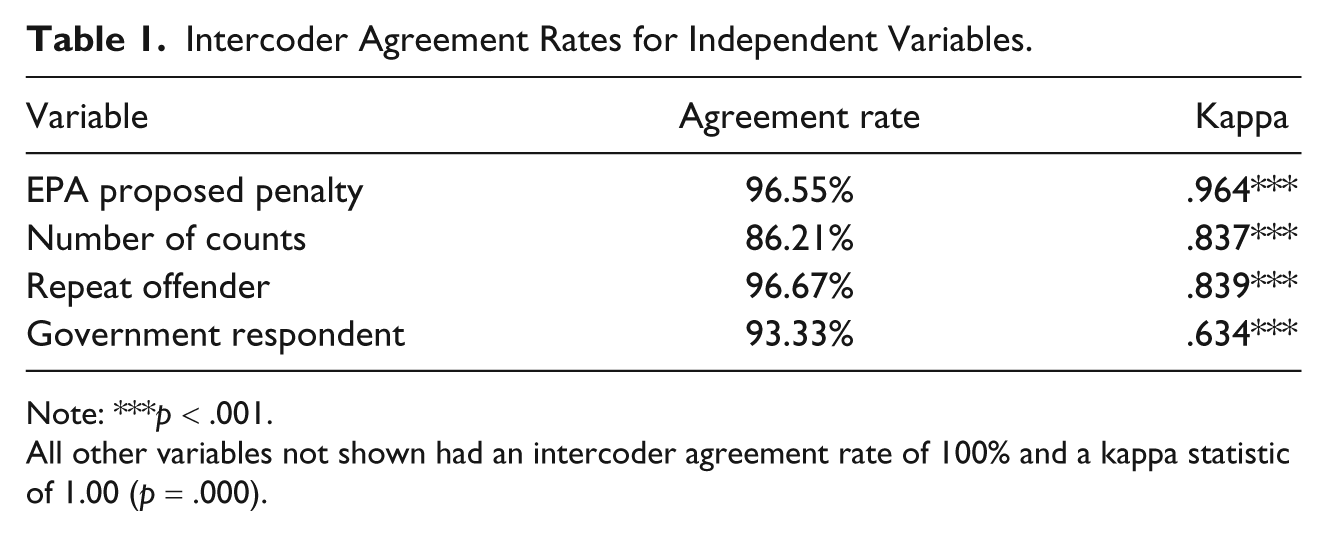
Note: ***p < .001.
All other variables not shown had an intercoder agreement rate of 100% and a kappa statistic of 1.00 (p = .000).
To measure political attitudes of the ALJs at the EPA, I used the partisan identification of the administration law judge as identified through Federal Elections Commission donation disclosure statements along with voter registration information. 8 Goldman and Slotnick (1997, 1999, 2001, 2003, 2005) used this same method to identify the partisan affiliation of Article III judges. In total, there were 16 ALJs who decided cases between 1992 and 2008. Of the 16 ALJs, 10 were Democrats (62.5%), 5 were independents (31.25%), and 1 was a Republican (6.25%). As was the case with ALJs at the NLRB (Taratoot & Howard, 2011), we can see that the vast majority of ALJs working at the EPA are Democrats. The dominance of Democrats at the EPA may be reflective of the liberal climate that pervades at the EPA since it was created during a strong liberal climate in 1970. For analysis, Democrats were scored 1 and 0 otherwise; Independent judges were scored 1 and 0 otherwise, leaving Republicans as the baseline category. Descriptive statistics demonstrate that the vast majority of cases at the EPA were decided by Democratic ALJs (69.9%), while only 14.8% of cases were decided by Republicans. 9
To provide an initial test of the relationship between partisanship and the size of the civil penalty issued by ALJs, I calculated the average size of civil penalties issued by ALJs by partisanship. The average penalty issued by Democrats (US$61,355.35) is 1.8 times higher than the average penalty issued by independents (US$34,051.37) and 2.39 times higher than Republicans (US$25,640.03). 10 While this provides initial evidence of the relationship between ALJ policy preferences and case outcomes, it is important to turn to multivariate analysis to provide a more detailed examination of the relationship between personal policy preferences and case outcomes.
Political Constraints
I suggested that EPA ALJs were influenced by separation of powers influences in their decision making. To measure congressional influence over the bureaucracy, I include Poole and Rosenthal’s (1991) common space score of the median member of the oversight committees in the House of Representatives and the Senate as these committees act as a gatekeeper for legislation that can impact the agency. 11 Common space scores for the sitting president at the time of the decision by the ALJ are also included in the model. For the time period of study, common space scores are included for Presidents George H.W. Bush, William Clinton, and George W. Bush.
Hierarchical and Trial Court Constraints
Because ALJ decisions can be appealed to the EAB, EPA ALJs may consider, ex ante, the preferences of the EAB when making decisions in civil penalty cases. 12 To measure the political preferences of the EAB, I identified the partisan affiliation each of the members of the EAB. 13 During the time period of study, there were 7 Democrats, 1 Republican, and 1 Independent that served on the EAB. To construct an overall measure of the ideological preferences of the EAB, I total the number of Democrats sitting on the EAB at the time of the ALJs decision. Thus, the variable measuring the ideological preferences of the EAB is an ordinal measure that can range from 0 to 4, where scores closer to 0 represent more conservative Boards and scores closer to 4 represent more liberal Boards. 14
To measure the influence of higher courts over ALJ decision making, I include several measures of higher court ideology into the final model. First, I include the Giles, Hettinger, and Pepper (2001, 2002) scores for the median member of the relevant circuit court based on the geographical location of the ALJ hearing. Because a large portion of federal cases are appealed from federal agencies to the D.C. Circuit Court of Appeals, I include a separate variable, also based on Giles, Hettinger, and Pepper scores, to determine if ALJs are responsive, ex ante, to the policy preferences of the D.C. Circuit Court of Appeals.
To measure the ideological preferences of the United States Supreme Court, I include the common space score (Epstein, Martin, Segal, & Westerland, 2007) of the median member of the Court at the time of the ALJ decision.
Respondent Characteristics
To account for how respondent characteristics may impact ALJ decision making in civil penalty cases at the EPA, I include two measures in the final model. First, because the EPA institutes higher civil penalties on those who profit more from violating environmental standards, those with greater financial resources are likely to suffer harsher penalties. Thus, I include a variable that measures whether the respondent involved in the case is a Fortune 500 company. This variable is simply coded as “1” when the company was on the Fortune 500 list during the year of the trial and “0” otherwise. Fortune 500 companies should receive higher penalties than other respondents as a result of the greater profitability from violations.
Because government actors have been shown to be a special class of litigant this may result in lower penalties than other respondents, I include a dichotomous measure that is coded “1” when the respondent is a government actor and “0” otherwise.
Next, about 18.61% of cases in the data set involved cases with multiple respondents. I assume that cases involving multiple respondents will result in higher total penalties issued because it allows for the possibility that each charge will result in double, triple, or quadruple the amount depending upon the number of respondents. To account for this, I include a simple count measure of the number of respondents listed in the case.
One final respondent characteristic that may impact the size of the civil penalty is whether the respondent is a repeat offender. When calculating the size of civil penalties, ALJs may increase the size of the civil penalty in cases where the respondent has a history of prior violations of the same act. For example, the Safe Drinking Water Act (42 U.S.C. § 300h-2) states, “In assessing any civil penalty under this subsection, the Administrator shall take into account appropriate factors, including . . . any history of such violations.” As a result, we should expect that respondents with a prior history will be assessed higher penalties than respondents with no prior history. Respondents with a prior history are scored “1” and “0” otherwise.
Case Characteristics
Because case characteristics have been shown to have an impact over judicial decision making, I include several measures to capture their effects. First, I include several dummy variables to capture the potential effect of variation of penalties across policy categories. The policies for which the EPA is responsible for enforcing have variation in their statutory maximums. For example, the Federal Insecticide, Fungicide, and Rodenticide Act (FIFRA) only allows for a statutory maximum of US$5,000 per offense, while the Toxic Substances Control Act (TSCA) allows for a statutory maximum of US$25,000 per offense. Even in situations where policies allow for identical statutory maximums, I still seek to control for potential variations across statutes. Dummy variables are included for the Clean Water Act (CWA), the Comprehensive Environmental Response, Compensation, and Liability Act (CERCLA), the Emergency Planning and Community Right-to-Know Act (EPCRA), FIFRA, the Resource Conservation and Recovery Act (RCRA), the Safe Drinking Water Act (SDWA), and the TSCA. In addition, some cases involved charges against respondents alleged to be in violation of multiple acts. To account for this circumstance, an additional dummy variable was included when cases involved alleged violation of more than one statute. We should expect higher penalties in instances where a respondent violates multiple acts. The Clean Air Act was left as the baseline category.
An additional factor that may affect variations in penalty size is the number of violations committed by the respondent (Ringquist & Emmert, 1999). Because EPA penalties are calculated on a per violation basis, it is natural to assume that the more violations a respondent is charged with, the larger the expected size of the civil penalty. To capture this potential effect, I include the number of counts included in the complaint filed by the EPA against the respondents.
Next, the size of the civil penalty assessed by the ALJ is going to be conditioned upon the penalty proposed by the EPA in the complaint. Although 42 CFR 22.27 allows for a great deal of discretion for ALJS in the calculation of civil penalties, it is reasonable to assume that ALJs will not dramatically increase the amount of the final penalty over the amount of the proposed penalty. 15 Because the proposed EPA penalty provides an initial baseline upon which the ALJ can base the final assessed penalty, I include the whole dollar amount proposed by the EPA in its complaint as an independent variable.
Default decisions result in the respondent being held liable for all violations and the ALJ typically accepts the penalty proposed by the EPA. As a result, cases that are decided as default decisions should result in higher penalties than other cases. I include a dummy variable that is scored as “1” when the case is a default decision and “0” otherwise.
Regional Controls
Because the EPA operates under a regional framework, we still might expect regional differences between proposed penalties, the number of charges sought, and activism by the EPA. To compensate for potential regional differences, I include dummy variables for each region of the EPA. Each case is simply scored “1” when a case occurs in that particular region and “0” otherwise. Because Region 3 serves Washington, DC, I leave this as the baseline category.
Control Variables
There is a potential that the size of penalties may simply be a function of a lapse in time. Inflation and other factors may affect the size of civil penalties over time. Although the EPA institutes changes to penalty structures according to inflation rates, it is necessary to ensure that penalty size is not simply varying as a result of a lapse in time. To adjust for potential temporal differences in penalty size, a simple count variable is included in the model. The count is coded as “1” for the first year of data and increases by one for every subsequent year. 16
Model, Results, and Discussion
Because the dependent variable is a continuous variable, I estimate results using ordinary least squares regression. 17 Ordinary least squares regression results are presented in two columns of Table 2. For ease of interpretation, coefficients and standards errors have been rescaled by dividing by 1,000 but interpretations of coefficients will be in thousands of dollars. The final data set included one case where the final penalty was an extreme outlier (US$1,250,000) relative to other observations. To ensure that results are not driven by this single observation, I present the results for two models in Table 2. The second column of Table 2 presents the results for the model where the extreme value was dropped from the final analysis. The third column of Table 2 presents the results where the extreme value was included for the sake of comparison. Because the models are substantively similar, I will discuss the results presented for Model 1, but I will note any differences. Overall, the model demonstrates good overall fit as the R2 (.668) shows that the models explains more than two thirds of the variance in the dependent variable. In civil penalty cases, EPA ALJs are influenced by their political attitudes, maintain partial, but not total, independence from political constraints, are subject to hierarchical constraints from the EAB and the Supreme Court, and, to a limited degree, respondent and case characteristics.
Ordinary Least Squares Determinants of the Size of the Civil Penalty in ALJ Initial Decisions in Civil Penalty Cases at the Environmental Protection Agency.
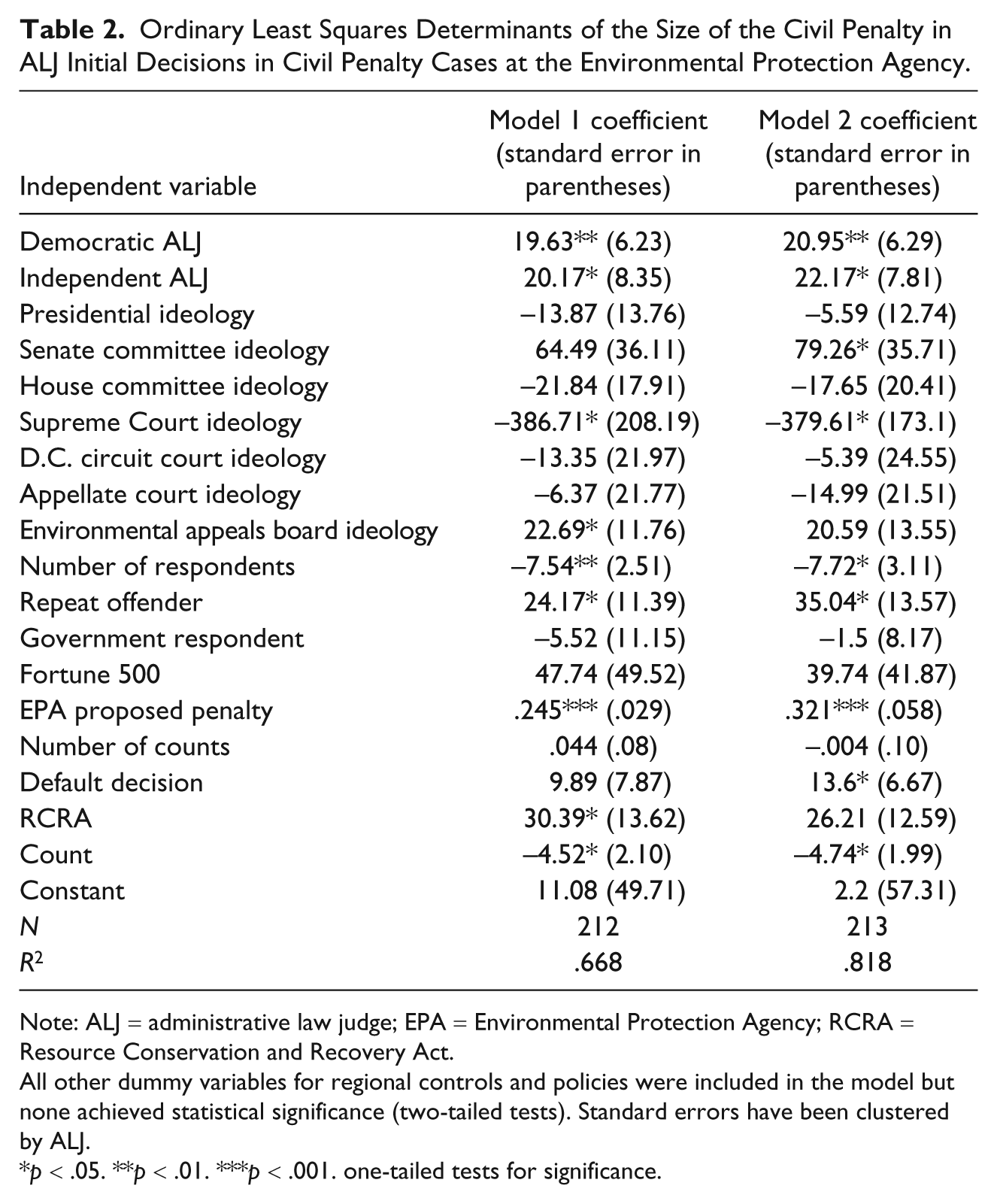
Note: ALJ = administrative law judge; EPA = Environmental Protection Agency; RCRA = Resource Conservation and Recovery Act.
All other dummy variables for regional controls and policies were included in the model but none achieved statistical significance (two-tailed tests). Standard errors have been clustered by ALJ.
p < .05. **p < .01. ***p < .001. one-tailed tests for significance.
First, having a Democratic ALJ will result in civil penalties that are US$19,629 higher than when cases are decided by a Republican ALJ (p < .01), even controlling for other factors. The differential in the size of penalties between Republican and Democratic ALJs is not inconsequential as a nearly US$20,000 difference in penalty outcomes, simply based on the party of the presiding ALJ, is a substantial sum of money. Thus, my expectations with regard to the impact of political attitudes on decision making are met. 18 These results bolster the findings of Taratoot and Howard (2011), who found that ALJs at the NLRB were also influenced by attitudinal considerations in their decision making. This provides mounting evidence that, like other federal judges, ALJs are influenced by personal policy preferences. 19
I theorized that because ALJs have a dual role as bureaucrat and judge, that ALJs should be responsive to the political environment. Although the results demonstrate that the House Committee and the president do not act as constraints over the decision making of EPA ALJs, the results do show a statistically significant (p < .05) influence of the ideological preferences of the Senate Committee over ALJ decision making in Model 2. 20 Curiously, however, the coefficient moves in an unexpected direction. Results show that a one standard deviation (.170) increase in the ideology of the Senate Committee, a move in a conservative direction, will result in an increase in the civil penalty by about US$13,474. This does not match theoretical expectations as we would expect a more conservative comittee to result in lower penalties. Ringquist (1995) found that congressional influences did have an impact on EPA enforcement activities. It could be that ALJs seek to compensate for a reduction in enforcement by issuing higher penalties in civil penalty cases. This would coincide with Ringquist’s (1995) finding that although congressional influence affected enforcement activities, it not as effective in influencing agency values.
ALJ responsiveness to EAB preferences meets theoretical expectations as ALJs at the EPA do consider the policy preferences of the EAB. For each additional Democratic Environmental Appeals Judge on the Board, the size of the civil penalty will increase by US$22,436. This demonstrates an increased level of responsiveness to the immediate reviewing body relative to the findings of Taratoot and Howard (2011) at the NLRB. Given the judicial nature of the EAB, and the lack of emphasis on partisan appointments, this responsiveness is not surprising. 21
Results also show that EPA ALJs are constrained by hierarchical controls to a limited degree. Although Taratoot and Howard (2011) found that NLRB ALJs were influenced, ex ante, by the ideological preferences of the D.C. Circuit Court of Appeals, the federal Circuit Courts of Appeals demonstrate no ex ante influence over the decision making of EPA ALJs in civil penalty cases. The Supreme Court, on the other hand, does show to be a statistically significant (p < .05) constraint over EPA ALJ decision making. A one standard deviation increase (.062) in the ideology of the Supreme Court results in a decrease in the size of the civil penalty by about US$23,976. This finding is a departure from the findings of Taratoot and Howard (2011) who found no ex ante influence from the Supreme Court over ALJ decision making.
The fact that EPA ALJs are responsive to changes in the policy preferences of the Supreme Court, but not changes in the ideology of the U.S. Circuit Courts of Appeals initially seems counterintuitive. With only two cases involving the EPA decided by the Supreme Court during the time period of study, 22 it is surprising that ALJs would be more responsive to the preferences of the Supreme Court than the preferences of the U.S. Circuit Courts of Appeals given that a larger proportion of cases are likely to be heard at the appellate court level. The explanation may lie in the structure of the OALJ at the EPA. At the NLRB, ALJs were organized into a regional framework. Howard and Nixon (2002, 2003) demonstrated that a regional framework made the Internal Revenue Service more responsiveness to the circuit court with geographical jurisdiction. Thus, although the EPA typically handles enforcement in a regional framework (see Landy, Roberts, & Thomas, 1994; Mintz, 1995; Whitford, 2005, 2007), the absence of a regional framework for the OALJ could decrease ALJ focus on differences between circuits, as expressed by the ideology of the circuit courts, and increase focus on broad-based environmental law that has national, rather than regional, application.
In fact, Wohlfarth (2010) demonstrates that while EAB decisions are influenced by both the political preferences of the Circuit Courts of Appeals and the Supreme Court, Supreme Court preferences have a stronger influence over EAB decisions. Wohlfarth also finds that when the Supreme Court and the Circuit Courts are ideologically opposed to one another, the EAB tends to more closely follow the preferences of the Supreme Court. Because results show that ALJs are influenced by the preferences of the EAB, and the EAB is most heavily influenced by the Supreme Court, ALJs engage in forward-thinking strategic behavior by considering, ex ante, the preferences of the Supreme Court.
EPA ALJs also seem to take cues from respondent characteristics, although variables for Fortune 500 companies and government respondents fail to achieve statistical significance. 23 The size of civil penalties issued by ALJs is influenced by the number of respondents and whether the respondent is a repeat offender. Each additional respondent actually results in decrease in the size of the final penalty by about US$7,538 and the presence of a repeat offender will result in civil penalties that are US$24,170 higher than cases where the respondent is not a repeat offender.
Finally, the coefficient for the size of the penalty proposed by the EPA shows that the proposed penalties account for roughly 25 cents of every dollar of the final penalty. Thus, the proposed penalty does provide a baseline upon which the ALJ bases the final penalty.
Conclusion
ALJs at the EPA are charged with the duty of determining the amount of civil penalties when parties violate policies for which the EPA is responsible for enforcing. These determinations represent important policy choices between economic growth and public health that have a direct impact on parties charged by the agency and indirect impact on the economy. Like their counterparts at the NLRB, EPA ALJs were shown to be functionally similar to federal district court judges as they were influenced by personal policy preferences, hierarchical control via the EAB and the Supreme Court, litigant characteristics, and case characteristics. These factors were the same factors shown to influence the decision making of federal district court judges in environmental cases (Ringquist & Emmert, 1999). Results also demonstrated that ALJs at the EPA exhibited fewer characteristics that would be indicative of bureaucrats than ALJs at the NLRB.
The influence of political attitudes over the size of the civil penalties issued by ALJs at the EPA provides further support to the attitudinal model and reconfirms the findings of Taratoot and Howard (2011). ALJs, like Article III judges, have the necessary amount of discretion and independence by which to insert their policy preferences into their decision making. This means that to a certain degree, the balance between economic growth and public health is predicated on who decides a civil penalty case. The influence of attitudes in ALJ decision making is particularly compelling given that ALJs, as Article I judges, are hired through merit selection rather than the highly politicized process that surrounds Article III judges. One might suspect that this would have depoliticized decision making, but this clearly isn’t the case. It also particularly compelling given that, as bureaucrats, ALJs, unlike Article III judges, are subject to political and bureaucratic oversight. This speaks to the pervasiveness and inevitability of the influence of attitudes in judicial decision making even in a bureaucratic context.
This raises normative concerns over the independence of ALJs that parallels the concerns that scholars have debated with regards to the federal judiciary. If the purpose of providing increased independence to ALJs is to insulate them from political and partisan pressure that may come from the hiring agency, and this insulation merely provides the basis for the ALJ to insert his or her own political preferences, then politicians may reconsider the level of independence that is provided to ALJs when they design federal agencies. It may also raise the stakes for politicians to consider ways of influencing who sits as an ALJ. When one considers the vast array of policy decisions that ALJs make across federal agencies, this may become a new battleground for the president and Congress.
EPA ALJs demonstrated a decreased emphasis on their role as bureaucrats. Not only did presidential and House preferences not play a role in ALJ decision making at the EPA, but EPA ALJs actually seemed to compensate for ideologically opposed policy preferences in the Senate through the issuance of civil penalties. Like other EPA employees, ALJs resisted efforts by Congress to change the values of the agency. When combined with the fact that EPA ALJs were responsive to the ideological preferences of the EAB and the Supreme Court, I surmise that EPA ALJs place more emphasis on their role as judge and less emphasis on their role as bureaucrat. This represents a departure from the findings of Taratoot and Howard (2011) who found that ALJs at the NLRB exhibited characteristics of both bureaucrats and judges.
The responsiveness of EPA ALJs to the Supreme Court and lack of responsiveness to the Courts of Appeals was attributed to the absence of a regional structure for the OALJ at the EPA and strategic anticipation by the ALJ. Because ALJs anticipate the influence the Supreme Court has over EAB decisions, they incorporate this influence into their own decision making. In addition, by having a reviewing body where members are appointed as merit employees, rather than partisan appointees, EPA ALJs exhibited responsiveness to the immediate reviewing body that was not seen at the NLRB. These results provide initial evidence that differences in structure and process have an impact over how ALJs perceive their roles in federal agencies.
Future research should examine ALJs in other agencies to determine if the principles articulated here are applicable in other settings. In doing so, researchers should pay careful attention to how structural and procedural differences may impact ALJ decision making. With no shortage of agencies employing ALJs, this remains a budding area of research for scholars.
Footnotes
Acknowledgements
I want to thank Andrew Ley, Renato Corbetta, and Sunjoo Kwak for their helpful advice and suggestions on previous versions of this work. I also thank my research assistant Margeaux Green for her assistance on this project and the helpful comments of the reviewers.
Declaration of Conflicting Interests
The author declared no potential conflicts of interest with respect to the research, authorship, and/or publication of this article.
Funding
The author received no financial support for the research, authorship, and/or publication of this article.