



Abstract
Recent debate on the use of unilateral presidential directives suggests that a president’s ability to shape and act without the consent of Congress is largely unchecked by traditional institutional arrangements while other research shows that presidents are more likely to be restrained by Congress. This article contributes to this debate by examining the source of authority used in unilateral orders. Using a new database of unilateral orders and a new theory, we reexamine when presidents use unilateral orders. We find that orders that invoke Congressionally based sources of authority are used when Congress is stronger while those that are presidency-based are used when Congress is weaker. These findings allow us to be more precise about how presidential unilateral strategy is shaped by institutional forces.
BY VIRTUE of the authority vested in me by the Constitution and Statutes, and in order to effectuate the purposes of the Reorganization Act of 1939, Public No. 19, Seventy-sixth Congress, approved April 3, 1939, and of Reorganization Plans Nos. I and II submitted to the Congress by the President and made effective as of July 1, 1939, by Public Resolution No. 2, Seventy-sixth Congress, approved June 7, 1939 by organizing the Executive Office of the President with functions and duties so prescribed and responsibilities so fixed that the President will have adequate machinery for the administrative management of the Executive Branch of the Government, it is hereby ordered as follows. Executive Order No. 8248 (1939) As President of the United States of America, I direct each Executive Agency to adopt procedures to improve existing and future regulations. Executive Order No. 12044 (1978)
The two executive orders above illustrate the importance of unilateral power. The first order by Franklin D. Roosevelt created the Executive Office of the President to help the president control administration. The second order by Jimmy Carter instituted new rules for agencies proposing new regulation with “an annual affect of $100 million or more” (EO 12,044), thus shifting the “terms of debate from inflationary impact to whether a proposed regulation was worth its cost” (Dodds, 2013). Each order brought about vast changes in the administration of the law, each order increased the president’s power in terms of control the regulatory apparatus (Mayer, 2001; Milkis, 1993), and each order was done by the stroke of pen. But, as the text above reveals, there is an important difference between the two. Franklin Roosevelt’s order explicitly relied on statutory authority, but Carter’s did not. The difference between the two orders is important and, we believe, can add to what we know about unilateral power.
The scholarship on unilateral power has done much to change the way we think about presidential power. Most immediately, it has challenged Richard Neustadt’s argument that presidential power is primarily informal by focusing on the ways that presidents can make policy with formal powers. By acting first and alone, the unilateral president is distinct from Neustadt’s (1960/1990) bargaining president, but it is still true that presidents use unilateral power differently according to different political contexts. Studies of unilateral power have shown that the use of unilateral power varies according the president’s term in office (Mayer, 2001), the strength of the Congress (Howell, 2003), divided government (Fine & Warber, 2012), ideological divergence (Deering & Maltzman, 1999), and foreign events (Young, 2013). The scholarship has demonstrated that presidents have important formal powers, but it has also demonstrated that presidents must “think politically” when they use them.
We argue that part of this political calculation is the way the president treats the source of authority he uses as the basis for justifying unilateral activity. When a president reaches for a unilateral tool, that president must decide whether to cast that action as unilateral or shared with Congress. As scholars of executive prerogative have long argued (Mansfield, 1989; Pious, 2012; Schlesinger, 1973; Wilmerding, 1952), the justification for the president’s order has implications for the durability of the president’s actions and constitutional practice (Sollenberger & Rozell, 2012). Indeed, presidents know that their orders will be part of the public record and eventually be scrutinized by citizens, political officials and the courts. This is particularly true of orders that give rise to legal controversies: Because there are winners and losers—individuals who will be arrested, lose land, be deported, or be denied access to courts—presidents are certain that the legal and political basis of their orders will be examined and contested. The decision to go first and alone, and then resolutely appear to be acting first and alone, is not a trivial one.
Our aim in this article is to build on the scholarly understanding of unilateral power by examining whether and when presidents appeal to congressional authority when they act first and alone. Using a new database of more than 5,000 unilateral orders (presidential proclamations and executive orders), we examine the source of the authority invoked by presidents and the conditions under which presidents issue unilateral orders. Even though we would expect that presidents would cite congressional authority all the time, we find that that they do not. To explain this fact, we develop a theory and expectations concerning the strategic choices president face when describing unilateral action. We explain the new data in depth and test these data with several multivariate count models. These findings expand our understanding of the use of unilateral powers within the context of the separation of powers.
Unilateral Power and Congress
The new attention to unilateral power has revived a longstanding debate in the study of presidential power. On one hand, Richard Neustadt (1960/1990) argued that presidents have limited power and are “dependent on consent from other sharers” in government, especially Congress (p. x). Because the president “needs them,” he must “bargain” with them, “buttressing his share with his resources in their eyes of personal reputation and of public standing” (Neustadt, 1960/1990, p. x). For Neustadt, presidential power was the power to persuade, and presidents do not “obtain results by giving orders” since having formal power is no guarantee of success (p. 11). He described unilateral use of power as a “painful last resort” to be used expediently only after bargaining has failed (p. 24). On the other hand, recent interpretations of presidential use of power suggest that presidents are strategic actors who issue unilateral orders to bypass Congress (Martin, 1999; Morgan, 1970; Nathan, 1983; Neighbors, 1964; Peterson, 1990). Challenging Neustadt’s conceptualization of presidential power, several scholars confront Neustadt’s view of a “weak” president by emphasizing the formal powers presidents exercise when engaging in unilateral action (Howell, 2003; Mayer, 2009a; Waterman, 2009). Unilateral orders allow presidents to act alone in an “efficient and alternative manner” compared with the legislative process (Deering & Maltzman, 1999; Krause & Cohen, 1997, p. 462). The institutional dynamic between Congress and the president encourages the president to pursue a unilateral strategy up to a point where Congress resists (Howell, 2005; Mayer, 2001; Sala, 1998). This scholarship has found that presidential use of unilateral actions is strategically useful for presidents with the separation of powers (Howell, 2003, 2005; Krutz & Peake, 2009; Mayer, 2001; Moe & Howell, 1999a).
There is still much that needs to be explained with respect to how presidents understand unilateral power. Rudalevige (2009), for example, argues that unilateral orders can be better understood within a Neustadtian framework, because most orders are the subject of bargaining within the executive branch. Rudalevige’s point raises a question about the bargaining with respect to Congress, because it is still unclear whether and how presidents consider Congress when they act first and alone. The problem is that there has been diversity in the theoretical explanations and findings with respect to Congress and divided government. One theory (and indeed the conventional wisdom) is that presidents rely on unilateral power to get around congressional opposition and therefore should be more likely to issue orders when government is divided (Mayer, 2001) or when the ideological distance between Congress and the president is greater (Deering & Maltzman, 1999). The logic here is that presidents “go unilateral” to circumvent the other party when that party controls at least one chamber of Congress. The difficulty this explanation faces, however, is that the findings do not consistently support it. Instead, study after study has found that divided government either has no effect on the issuing of unilateral orders or that it has a negative effect (Fine & Warber, 2012; Mayer, 2001; Mayer, 2009a;). Mayer (2009b) recently concluded, “We do not yet fully understand the dynamics of how presidents take Congress into account when they resort to unilateral action” (p. 168).
As a result of these counterintuitive findings, scholars have developed new theories. In a sustained series of studies, William Howell has offered the most developed theory to explain unilateral action. For Howell, the key question is whether the governing coalition in Congress can make policy, not whether that coalition is of the same party of the president. Consequently, for Howell, the size and unity of the majority party in Congress is the key variable (Howell, 2003). Howell’s work is representative of the unilateral presidency scholarship in that what is being examined in the conditions underlying the issuing of an order. His theory (and expectations) goes considerable distance in explaining the lack of finding with respect to divided government, but it does not provide all that there is to know about the decision by a president to issue the order and how to do it. Fine and Warber (2012), for example, build on Deering and Maltzman (1999) and find a variation in the types of orders based on the ideological divisions between the Congress and the president.
We propose a different line of inquiry for understanding the decision-making process of presidents. Instead of demonstrating that the president is either a clerk or a commander, unilateral power should instead reveal that most presidents are some version of both. The trick is to determine when, how, and why presidents leave the one to become the other. A starting place is the president’s understanding of his authority to act. Going all the way back to the first presidency, authority for unilateral power has been contested on some occasions and delegated on others. George Washington’s 1793 proclamation of neutrality stands out as perhaps the most controversial, as that order precipitated a serious debate about the scope of executive power between the two principal authors of the Federalist Papers, James Madison and Alexander Hamilton. But as Bailey and Rottinghaus (2013) show, that unilateral action in 1793 needs to be understood as part of process of negotiation between the president and the Congress about the procedures for warning citizens to abide by the law, a process that quickly resulted in Congress’s requiring the president to issue a proclamation before he mobilized U.S. troops to aid law enforcement. Similarly, in 20th century practice, most unilateral orders are not wholly unilateral; instead, the president draws on a delegated source of authority to justify his “unilateral” actions. Indeed, Warber (2006) demonstrates that presidents justify their actions with various sources of authority. Furthermore, unilateral actions are subject to posthumous review by the other two branches, and some orders are subject to prior policy restraint since Congress initially limits the policy action that presidents can undertake (Shull, 1997, p. 98).
The Source of Authority and Justification of Action
Although scholars who study the unilateral presidency have generally not considered citation patterns (see Warber, 2006, for an exception), other scholars of presidential power have long examined how presidents ground their use of executive power. This is particularly true of scholars in the “public law” approach to the presidency as well as of those who study the normative and interpretative explications of executive prerogative. Within the public law approach, Fisher (2003) has documented the importance of FDR’s appeal to “the law of war” rather than “Articles of War” in his proclamation limiting the access to courts for the Nazi sabaoteurs. Likewise, Sollenberger and Rozell (2012) trace how the expansion of the use of presidentially appointed “czars” goes back to Woodrow Wilson’s expansive reading of the Overman Act, a reading that allowed Wilson to create what Sollenberger and Rozell regard to be the constitutionally suspect practice of appointing czars outside the Senate confirmation process. Similarly, within the scholarship on the prerogative power, there has been continued interest in the way presidents justify prerogative (Langston & Lind, 1991; Mansfield, 1989; Pious, 2012; Schlesinger, 1973; Wilmerding, 1952) and scholars continue to distinguish Hamiltonian, Jeffersonian, and Lincolnian approaches to presidential strategy with respect to defending prerogative (Arnhart, 1979; Bailey, 2004; Fatovic, 2004; Kleinerman, 2005; Schmitt, 1987; Thomas, 2000). As Mayer (2009b) notes, both the literature in the empirical study of unilateral power and the literature with respect to constitutional authority would benefit from consideration of the other.
To be sure, what a president says about source of authority does not reveal in any precise way whether the president is acting as an agent of Congress or is acting on his own. It is possible that a president would invoke a statute incorrectly, when he need not, or for his own ends. Bill Clinton, for example, appealed to statutory authority when he issued an executive order changing labor law against the wishes of the Republican majority in Congress (Mayer, 2001, p. 8). With similar examples, Mayer (2009a) shows that “broad grants [of authority], ambiguity and the potential for swift action are a compelling combination” (p. 432). It is also possible that a president would choose to invoke only presidential authority when in fact he is relying on what Congress understands to be delegated authority. Andrew Jackson, for example, relied on his own executive authority when issuing the Nullification Proclamation instead of citing 1807 Insurrection Act as he and other presidents had done in other instances of domestic resistance (Bailey & Rottinghaus, 2013; Vladeck, 2004). Even though we cannot investigate every order with this level of specificity, we can take a first step by determining if citations by presidents vary according to the political environment.
We expect that presidents will generally cite Congress because it is less risky. We live under the rule of law, and a president, like any executive, knows that he cannot go unilateral all the time. This expectation is supported by no less than Robert Jackson’s famous “practical grouping” of presidential power in Youngstown Sheet and Tube Co. et. al. v. Sawyer, 343 U.S. 579 (1952). When the president acts under authority delegated by Congress, in addition to his constitutional authority, presidential power is at its maximum and most safe from judicial oversight. This is confirmed by recent scholarship, which has shown that even during wartime the Supreme Court usually casts itself as an auditor of process, checking to see whether Congress has delegated authority to the president, rather than as an umpire of zero sum contests between executive power and individual rights (Issacharoff & Pildes, 2005).
This expectation is also supported by practical politics. The charge that “the president is acting unilaterally again” offers a convenient critique for opponents, allowing them to criticize the method without having to win on the merits of the policy. Thus FDR’s appeal to specific statute in the order referenced at the start of this article reflected caution on the part of the president: The executive reorganization plan had become entangled with the courtpacking scheme and, in the eyes of FDR’s opponents, had become emblematic of FDR’s overuse of unilateral power. A more recent example is the common critique of Vice-President Richard Cheney’s approach to executive power. According to Jack Goldsmith (2007), the former head of the Office of Legal Counsel, Cheney consistently advised George W. Bush to avoid reliance on Congress completely, and, in Goldsmith’s opinion, this strategy ultimately backfired. Had President Bush cultivated congressional support, the argument goes, he would have been more successful in building the muscular executive Cheney wanted because Congressional backing is less circumspect than relying solely on executive power. Goldsmith’s conclusion is important because it shows that the decision to go alone is a matter of both persuasion and command.
This expectation would be the end of the story if it were not the fact that presidents, as the example of Carter’s executive order above illustrates, do not always cite congressional authority. Why? There are several potential reasons why a president might choose to go alone in this way. Some are practical. There might not be a law to cite such that sufficient legal authority is provided, or finding the right law could take time (and perhaps even deliberation with the legislative branch) and the president may wish to move quickly. But there are also strategic considerations. Presidents might lack the ability or desire to bargain, or to appear to bargain, with Congress. One documented reason for this is that in some cases, when presidents believe their own legal authority is clear, they wish to protect the historical prerogatives of the executive branch (Mayer, 2001). Accordingly, presidents might not want to rely on Congressional authority when they think they can or should go alone. From the perspective of the retention of executive power, a simple gesture now might become a binding precedent in the future.
But these instances should be rare. Presidents should issue orders based on their own authority only under conditions in which they consider themselves most free. These conditions can include policy areas that grow out of constitutional authority, such as control over foreign policy or, as in the case of Carter, control of the executive branch. These conditions can also be political, such as when the president’s party controls both chambers of Congress. These conditions can also be related to external crisis, such as wartime, when presidents enjoy typically enjoy maximum latitude. But these conditions are not normal, and we expect that presidents will typically be cautious and cite congressional authority. This expectation, then, runs counter to the common strategic understanding of unilateral power and corresponds with the findings with respect to divided government. In a system of separation of powers, presidents should be risk adverse in using unilateral power and should therefore seek to increase the sources of authority for their action.
Expectations of Unilateral Presidential Strategy
We should see variation in the president’s citation of authority, and this variation should correspond to the president’s understanding of his freedom to act unilaterally. We expect that presidents will appear to cooperate (cite statute) under conditions different than those when they appear to go it alone (rely on presidential authority). Given our theory above and prior findings associated with the unilateral presidency, in this section, we identify when presidents are likely to cite each type of authority in an order. 1 In general, presidents will evoke the authority of Congress in an order (such as by citing a statute) when they consider themselves less free to act because of fear of being challenged or overturned. This should be the norm. However, when presidents feel like they are freer to act, such as when they have greater political power relative to Congress or when dealing with a policy over which presidents traditionally retain control, they should be more likely to cite their own executive authority either alone or in combination with statutory authority.
First, we expect that presidents will refrain from relying on their own authority during times of divided government. The presence of divided government creates a unique situation for presidents, which is distinct from the “strength” of Congress (Fine & Warber, 2012). In instances of divided government, Congress has an easier time overruling the executive and serving as a preemptive restrictive political agent. Presidents are more likely to be aware of the institutional limits faced by the lawmaking branches (see Howell, 2003). Thus, presidents should issue fewer orders in general, and even fewer orders relying on their own authority. This expectation runs counter to the conventional wisdom but accords with findings by prior scholarship. This work has found that divided government results in fewer significant executive orders, or put another way, presidents issue more orders in unified government. Mayer and Price (2002) find the same thing for important orders, although Marshall and Pacelle (2005) only find an effect for foreign policy executive orders (see also Krutz & Peake, 2009).
Second, applying this logic to Howell’s work, we expect that presidents should be more likely to issue unilateral orders citing Congress when the majority party in Congress has large and cohesive majorities. Presidents are cognizant of Congressional political power and cast their justification for unilateral action in ways that will lessen the likelihood that Congress will object. Under these conditions, it is more likely that presidents will consider the political strength of Congress (Howell & Kriner, 2008), and, we expect, likely that presidents will be cautious, casting unilateral action as delegated by Congress. Put another way, we suggest that the president will appeal to Congress (statute) when Congress’ ability to make law is heightened such as when there are more members of the majority party and they are more unified. The logic underlying this argument is simple: When presidents are concerned about possible limitations presented by Congress, presidents will be more likely to cast their actions as consistent with Congressional authority (see Gomez & Shull, 1995). Specifically, the larger the size of the majority party in Congress and the larger and more unified the majority party, the more likely the president is to issue orders based on statute. On the other hand, presidents should rely on their own authority to act when they have more freedom to act without presumed Congressional authorization. That is, presidents are more to likely to rely on their own authority when the majority party is smaller and fragmented (Howell, 2003). Indeed, as Howell and Kriner (2008) these circumstances are ripe for executive action,
because presidents can issue executive orders in lieu of laws and executive agreements in lieu of treaties, they are able to institute policies that materially alter the doing of government. Rather than working at the fringes of the policymaking process, or instituting policies preferred by supermajorities within Congress, presidents use their unilateral powers to considerable and independent effect. (p. 107)
Third, presidents should rely on their own authority only during conditions that favor the president. The most obvious among these is wartime. War presents the president with all sorts of advantages. Among these is more attention to foreign policy and scholars have long documented presidential success in the foreign policy arena relative to domestic politics (Canes-Wrone, Howell, & Lewis, 2008; Wildavsky, 1966). Howell, Jackman, and Rogowski (2013) find that war helps the president achieve policy victories that would not have happened during peacetime, but they also find that this is not true of all wars. Another condition that favors presidential unilateral action is unified government. Because the president is less likely to face criticism and oversight from fellow partisans, the president is likely to be less cautious in framing unilateral power. Because presidents should be freer to rely on their own authority in policy areas traditionally under the control of the president, we expect presidents to cite their own authority more frequently when they issue orders relating to control or organization over the executive branch.
Finally, unilateral orders that cite “both” types of authority (presidential/Constitutional and statute) should represent a middle ground. The inclusion of presidential authority has the benefit of carving out and preserving a presidential claim on the policy area in question, but it adds some uncertainty because it invites scrutiny. Accordingly, presidents should rely on both sources of authority in conditions in which presidents are less cautious, but not to the extent of those conditions when they act alone. Because this is, in effect, a middle position, we expect the findings to be neither wholly like the statute based orders nor the president based orders. The example from Franklin Roosevelt that begins the article is a good example of a president relying on both sources of authority, acting as neither wholly commander nor wholly clerk.
Data and Method
Executive orders and proclamations are the two most prominent unilateral orders where a president may invoke multiple sources of authority to justify a specific action. Although proclamations remain understudied in the unilateral presidency literature, they remain an important unilateral tool. Although proclamations are often ceremonial, presidents frequently issue proclamations treating policy. These carry the same force of law as executive orders—the difference between the two is that executive orders are aimed at those inside government while proclamations are aimed at those outside government (Cooper, 1986). We coded every presidential proclamation issued from the 75th to the 110th Congress. Because there was no complete list of presidential proclamations, several sources had to be searched to generate this complete record of all proclamations: the Codification of Presidential Proclamations Disposition Tables, the United States Statues at Large, the United States Federal Code, the CIS Information to Presidential Executive Orders and Proclamations, the United States Federal Register, the Public Papers of the Presidents, and the White House website of President Bush (43). 2 We include only policy-based proclamations that we define as any proclamation directly affecting government process, structure or actions, including both international and domestic affairs. This search process yielded 1,408 policy-based proclamations from 1935 to 2009. A full list of the annual counts for each category is available in Online Appendix Table 1 in the supplemental information document uploaded to the APR website.
We also coded the source of authority for executive orders from the 75th Congress to the 108th Congress (1935-2005). These data were assembled from the American Presidency Project, and data from King and Ragsdale (1988) and Warber (2006). We examine executive orders from 1936 to 2004. This largely comports with the time frame other scholars have examined for executive orders over time (Howell, 2003; Krause & Cohen, 2000; Mayer, 1999; Mayer & Price, 2002; Warber, 2006), making our study more directly comparable with previous work. 3 The executive orders from this period yielded 3,493 executive orders. A full list of the annual counts for each category is available in Online Appendix Table 2 in the supplemental information document uploaded to the APR website.
Given our interest in the shared nature of unilateral power, we coded the source of the authority that presidents used to justify the action taken for each proclamation and executive order. 4 We examined the enabling clause of each order to decipher the source of authority cited for the action taken (unless other parts of the text were relevant to this end). We then coded each policy-based proclamation and executive order as to whether its text mentioned Congress (resolution, joint resolution or statute) or a presidential-based power (Article II of the Constitution, “executive authority”). 5 Orders that invoked both sources of authority (“joint authority”) were also recorded but were counted as Congress-based justifications for purposes of analysis.
To extend our analysis to examine whether significant statute and nonstatute orders are statistically unique, we undertook an analysis to test this question. A search was made from 1936 to 1996 to (a) match the proclamations data to Mayer and Howell’s span of executive order data and (b) allow for the 15-year “significant” cut off as identified by Howell (2003). Two resources were searched to identify significant proclamations: mentions in Congress (by searching the Congressional Record) and mentions in a Supreme Court case. First, the Congressional Record index was used to identify references to each proclamation. This was generally sufficient to match to a specific proclamation, but if it was not, the specific page in the CR was searched to more clearly identify the specific proclamation. Second, a search of the term proclamation in Lexis-Nexis searched all Supreme Court cases. There were 791 hits total, but we focused only on those in our time frame. The columns in Table 6 sum (a) the total number of significant proclamations by this definition, (b) the total number of statute-based significant proclamations, and (c) the total number of non–statute-based significant proclamations.
Because we are interested in the presidents’ understanding of his freedom to act vis a vis Congress, we follow models similar to those used by Howell (2003) and Mayer (1999), we focus on three variables that capture the relative “strength” of Congress: the average size of the majority party, the size and unity of the majority party and divided government. 6 First, we use a variable for the size of the majority (“Majority Size”) by averaging the size of the majority in each house for each Congressional session. Second, we calculate a ratio of the average size of the majority party (across both houses) multiplied by the unity of the majority party divided by the average size of the minority party multiplied by the unity of that party (“Size/Unity Ratio”). 7 This variable is conceptually similar to Howell’s utilization of the LPPC scores from Cooper, Brady, and Hurley (1977) in that it captures moments where the majority party is large, unified and “faces minimal opposition from the minority party” (p. 86). Third, we include a dichotomous measure of divided government, where any divided government (in either or both chambers) is treated as divided government (“Divided”).
Finally, we include four control dummy variables to control for the times where presidents are likely to issue unilateral orders (Howell, 2003; Mayer, 1999). First, we include a dummy variable for moments where a president of a new party enters office (“New President”), starting with the first Congress over which they govern (coded “1” if yes and “0” if no). Second, if the United States is involved in an armed conflict, we include a dichotomous indicator for war (“War”). The war variable was coded “1” for the following conflicts: World War II (1941-1945), Korean War (1950-1953), Vietnam War (1964-1973), Persian Gulf War (1991-1992), Afghanistan War (2001-2009), and Iraq War (2003-2009). Third, if the year is the second half of the president’s term (“Second Half”), the variable was coded “1.” Fourth, if the year is in the president’s second term (“Second Term”), the variable was coded “1.”
Because we are interested in the frequency of an event, we employ several event count models. Count models take as the dependent variable the number of discrete times an event occurred (e.g., the number of times a particular kind of order was issued in a Congressional session and under what authority) with the assumption that the process generating the event is independent of time (t). This is appropriate for all of our series since the counts take a non-negative integer value (Cameron & Trivedi, 1998). Linear regression models may result in inefficient and biased estimates for the count of events and it is “much safer to use models specifically designed for count outcomes” (Long & Freese, 2006, p. 349). For the count models described below, we aggregate these into Congressional terms, from the 75th Congress to the 110th Congress. This allows our count model to comport with other models so the findings can be comparable (Deering & Maltzman, 1999; Fine & Warber, 2012; Howell, 2003; Mayer & Price, 2002). The trends in the data do not display any autoregressive elements. 8 For example, the individual time-structured series for each ACF (Online Appendix Figures 1 and 2) reveal relatively low counts and no internal time dynamics, making a Poisson or negative binomial model appropriate in these series. 9 A Poisson model models the probability of observing any observed count using the Poisson distribution (such as the nonstatute proclamations or the Commander-in-Chief executive order series). The Poisson model is specified:

where each observation has a value of u and the observed count for observation i is drawn from a Poisson distribution with mean ui (Long & Freese, 2006) and n is the total number of independent variables. A negative binomial model (which accounts for observed heterogeneity, or “overdispersion”) is modeled for any series where tests of the log likelihood ratio = α reveal positive and significant tests for overdispersion (such as statute-base proclamation or executive order series). Because “overdispersion” can artificially deflate standard errors, tests for such “overdispersion” are utilized to determine the appropriate model (tests use a log likelihood-ratio test that α = 0). The negative binominal is specified:

where n is the total number of independent variables. This captures the rate of overdispersion, where the variance is larger than the mean. The estimated results will be interpreted with respect to the percent change in E(y | x).
Unilateral Powers and Source of Authority
Figure 1 presents a graph of the collected orders by Congress separated by the source of authority they cite. What is most noticeable is that presidents cite Congress as the justification in the vast majority of unilateral orders. Of the 1,390 policy proclamations from the 75th Congress to the 110th Congress, nearly 98% cite a law passed by Congress (the 1,356 Congress-based orders include any order that references Congress). The same is true of executive orders. Figure 1 shows that in 2,083 of the total 3,493 executive orders, or 60% of the time from the 75th to the 108th Congress, presidents justify an executive order under the auspices of Congressional jurisdiction rather than their own authority. The ratio of statute to nonstatute is higher for proclamations, but both sets of orders reveal similar trends of the dominance of statutory-based orders. In practice, it seems, presidents prefer not to act wholly alone.
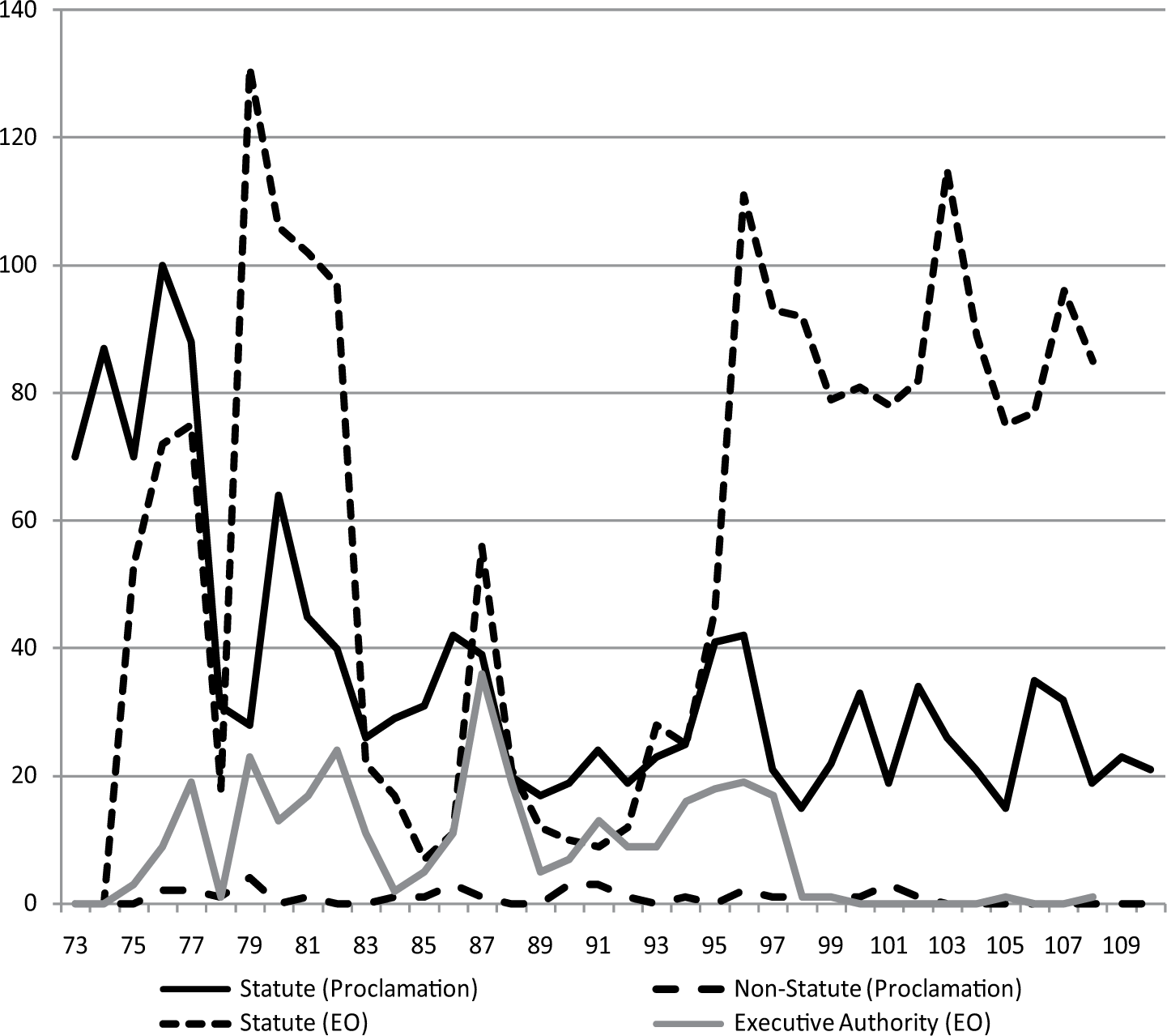
Source of authority by Congress.
What is also prevalent in Figure 1 is the degree of fluctuation in terms of what presidents cite in each order with respect to the source of authority. The expectations described above tend to fit the data well. For instance, the largest increase in statute-based executive orders comes during the 78th to 83rd Congresses (1943-1954), relative to the period following it, where the Democratic Party has large and cohesive majorities. Statute-based proclamations are also more frequent before the 83rd Congress, especially during the 73rd to 78th Congresses (1933-1944), than afterwards. In another example, Congressional majorities are less large and cohesive in the 88th to 94th Congresses (1963-1976), and Figure 1 reflects that presidents issue fewer statue-based orders during this period. On the other hand, there is a small rise during this period in executive orders relying on executive or Constitutional authority.
Testing the Theory
To briefly restate our expectations, we argue that presidents will evoke congressional authority or their own authority according to different political conditions. Specifically, presidents should act “alone” more frequently when they perceive that political conditions provide them the most latitude. That is, presidents will rely on presidential authority when the majority party in Congress is smaller and when the majority party is smaller and fragmented (in relation to the other party). On the other hand, presidents should issue more orders that evoke Congress when presidents are cognizant of potential Congressional political strength and when Congress is more able to make policy. 10 Specifically, presidents will cite Congressional-based authority when Congress has larger majorities or when the majority party is larger and more unified. Presidents should be less likely to issue unilateral orders when government is divided. The key independent variables capturing the relative strength of the institutional balance are the average majority party size, the size and unity ratio, and divided government. The key variable to capture policy issues is when the country is engaged in conflict (war) and when the president is issuing orders that relate to the organization of the executive branch.
The data from Table 1 demonstrate, as expected, variation in how and when presidents cite either statute or non-statute sources of authority for proclamations. The table divides the variables into separate models. For the size and unity ratio, while there is no effect for all proclamations or for statute-based proclamations, presidents are significantly less likely to issue a non-statute proclamation when Congress is stronger (the size/unity ratio is larger; −2.3%). This corresponds to expectations. The second set of models in Table 1 examines the average size of the majority party. Again we see variation in how presidents justify their orders. Presidents issue more orders that cite statute when the majority size is larger (0.72%) but fewer citing their own authority when average majority size is larger (−0.06%). However, in each case the effect is substantively small. 11 Yet, that we find consistent positive relations between the capacity of the majority party to legislate and presidential reliance on Congress suggests that presidents are thinking about Congress as they issue unilateral orders. In the same way, that presidents are less likely to act on their own authority when majority size is higher speaks to the constraining role of Congress when it has relatively more ability to make law or to challenge presidential unilateral action. 12
Count Models for Proclamations Source of Authority.
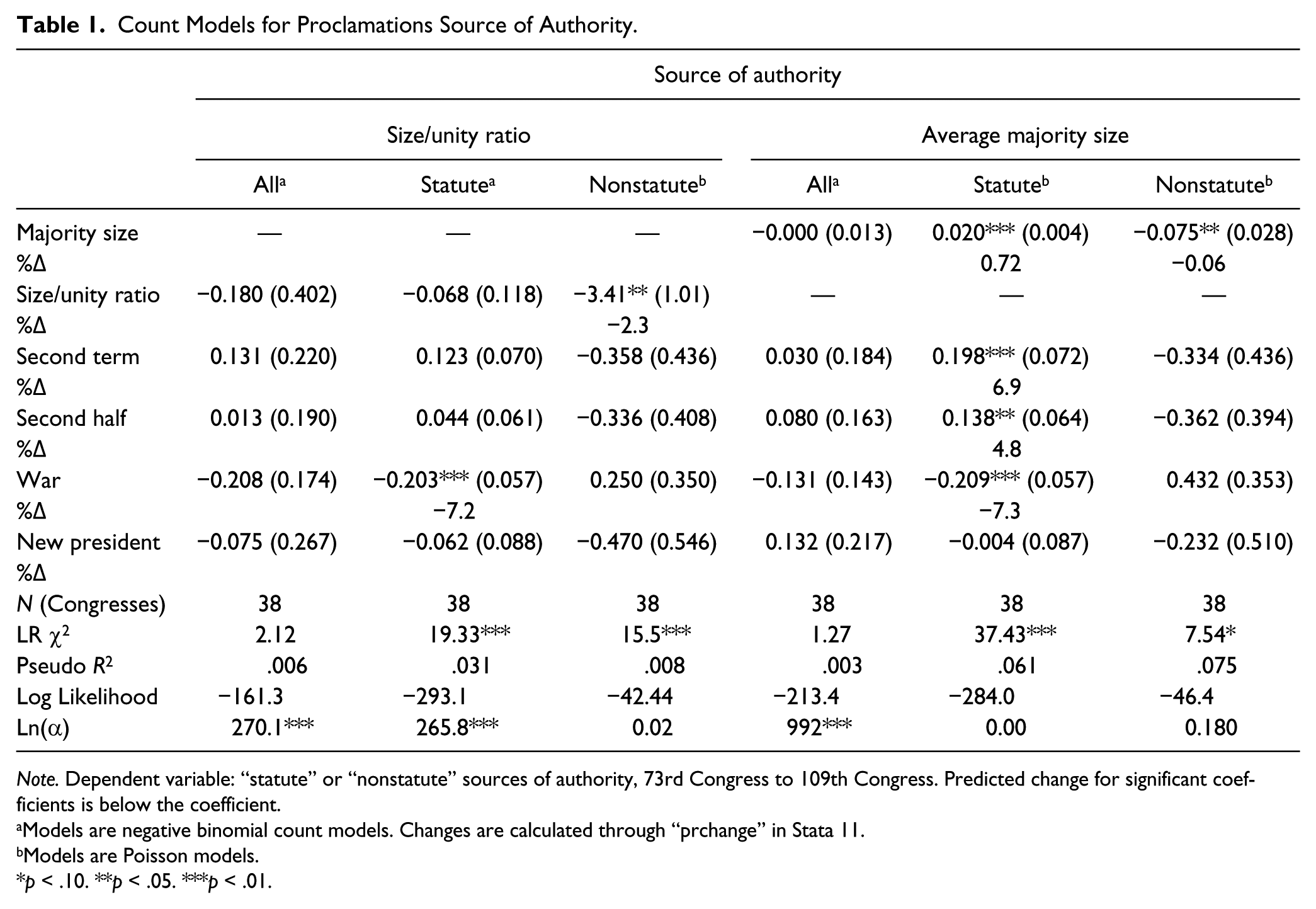
Note. Dependent variable: “statute” or “nonstatute” sources of authority, 73rd Congress to 109th Congress. Predicted change for significant coefficients is below the coefficient.
Models are negative binomial count models. Changes are calculated through “prchange” in Stata 11.
Models are Poisson models.
p < .10. **p < .05. ***p < .01.
Table 2 segments the source of authority for executive orders into those based on Congressional statute, “presidential” authority or the “Commander-in-Chief” clause of the Constitution. 13 Here, we specifically examine the average size of the majority party as the key independent variable. Once we divide executive orders into specific sources of authority, we see again that not all unilateral activity is equal. Presidents issue fewer executive orders based on presidential authority when Congress is stronger (the size/unity ratio is larger; −0.56%). This corresponds to expectations concerning the balance of institutional power. Namely, presidents are less likely to rely on their own authority when Congress is relatively stronger. Despite the amount of formal authority they might have under law or the Constitution, presidents are still cognizant of potential congressional reaction.
Count Models for Executive Orders and Source of Authority.

Note. Dependent variable: count of executive orders for each category. Data are 75th Congress to 108th Congress. See text for details.
Models are negative binomial count models. Predicted change for significant coefficients is below the coefficient. Changes are calculated through “prchange” in Stata 11.
Models are Poisson models.
p < .10. **p < .05. ***p < .01.
Table 3, which includes the “size/unity” scores as an alternative measure of the relationship between the president and Congress, shows again that presidents choose to cite Congress or their own authority according to different circumstances. Presidents issue more orders under statutory authority when the size/unity of the majority party is larger relative to the minority party’s size and unity (70%). This suggests that presidents are more likely to appeal to Congress when Congressional majorities have a more influential say in the policy making process. Yet, as expected, presidents cite the “Commander-in-Chief” clause or general presidential authority under different conditions. Specifically, for the size/unity ratio, the results for both presidential citations (−11.8%) and Commander-in-Chief citations (−6.1%) are negative and statistically significant. In sum, presidents issue fewer presidency-based orders when the majority in Congress is strong and unified.
Count Models for Executive Orders and Source of Authority.

Note. Dependent variable: count of executive orders for each category. Data are 75th Congress to 108th Congress
Models are negative binomial count models. Predicted change for significant coefficients is below the coefficient. Changes are calculated through “prchange” in Stata 11.
Models are Poisson models.
p < .10. **p < .05. ***p < .01.
Yet, when presidents perceive a greater authority or more freedom to act within the system, they are more likely to cite their own authority in general. For example, in Table 4 which truncates the models to only orders that involve organizing or reorganizing the executive branch, presidents are more likely to issue orders based on their own authority (executive) in their second terms, second halves of terms, during war and when new to office. 14 Divided government is negative, as predicted, demonstrating some resistance in general to citing their own authority. What is telling is that presidents cite statue in executive organizational orders under different conditions. In column 2 in Table 4, which examines only cases where presidents cite statute as a justification for their order, few of the variables are statistically significant, even divided government which would otherwise be predicted to be positive. Even the condition for war barely reaches statistical significance. In general, presidents are more likely to rely on their own authority when conditions favor presidential action.
Individual Level Models With Executive Organizational Orders Only.
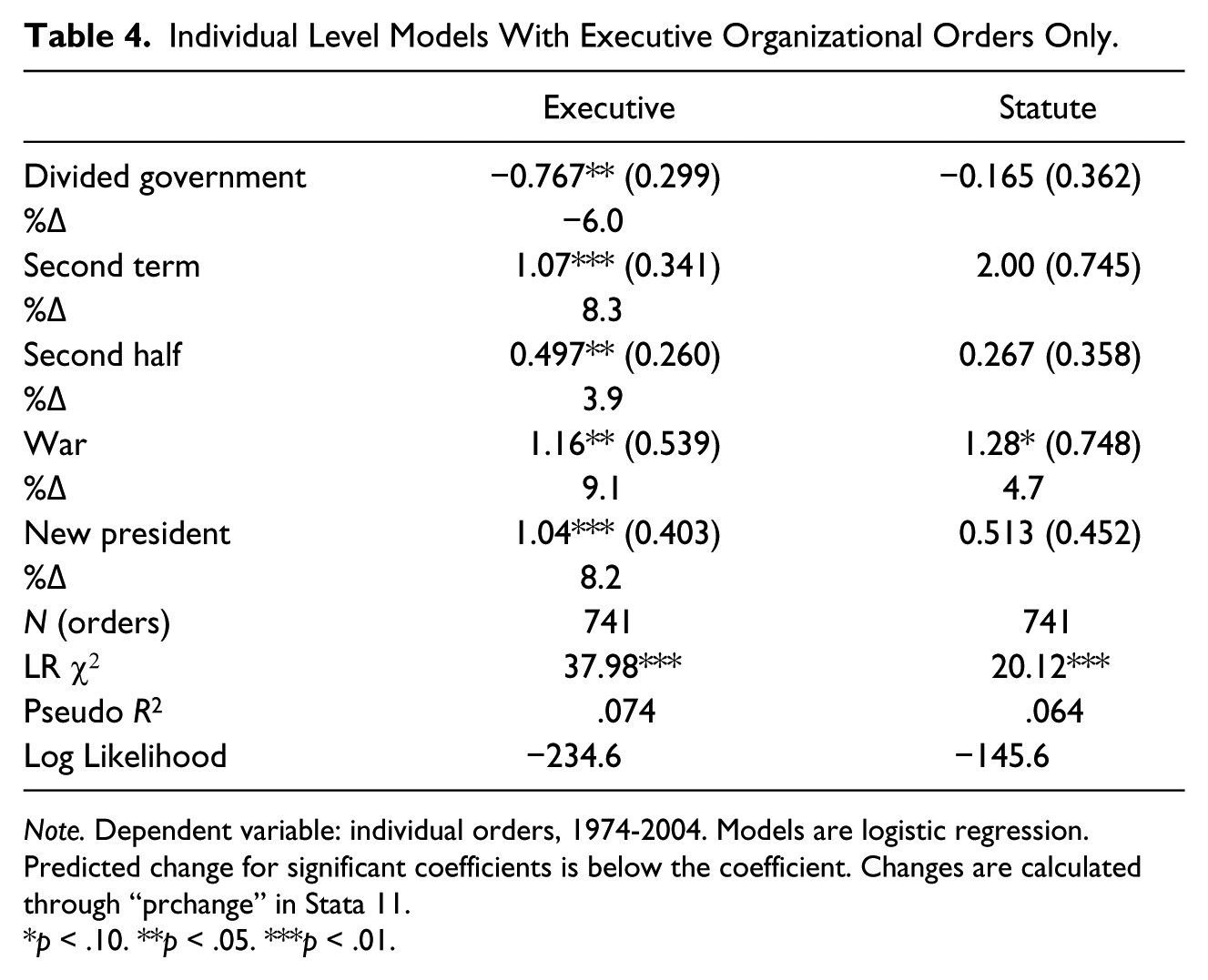
Note. Dependent variable: individual orders, 1974-2004. Models are logistic regression. Predicted change for significant coefficients is below the coefficient. Changes are calculated through “prchange” in Stata 11.
p < .10. **p < .05. ***p < .01.
Table 5 recreates the same models from Tables 1 to 3 using divided government as the indicator of interbranch friction. For both proclamations and executive orders, presidents are likely to issue fewer orders of every type (all, statute-based and non-statute-based) under divided government, as predicted. As argued above, divided government is a unique political circumstance where presidents are less likely to challenge Congress under any circumstances. This argument extends to times where the United States is engaged in foreign conflict, although the effect is only statistically significant for the issuance of statute-based orders. An exception to this is that presidents are more likely to issue orders referencing his Commander-in-Chief authority when the country is at war. This latter effect is the same as found in Table 3. Divided government clearly functions differently as a political strategy than does the size of the majority party or the unity of the parties. Howell (2003) explains that unilateral powers are used less in divided government because Congress constrains the use of such powers. Yet, as we have seen, constraint can be loose or tight. Mayer (1999), for example, allows that unilateral powers are still a negotiation. That we find variation in the negative findings between divided government and a larger majority in Congress suggests that divided government is a unique structural limitation.
Count Models for Divided Government.
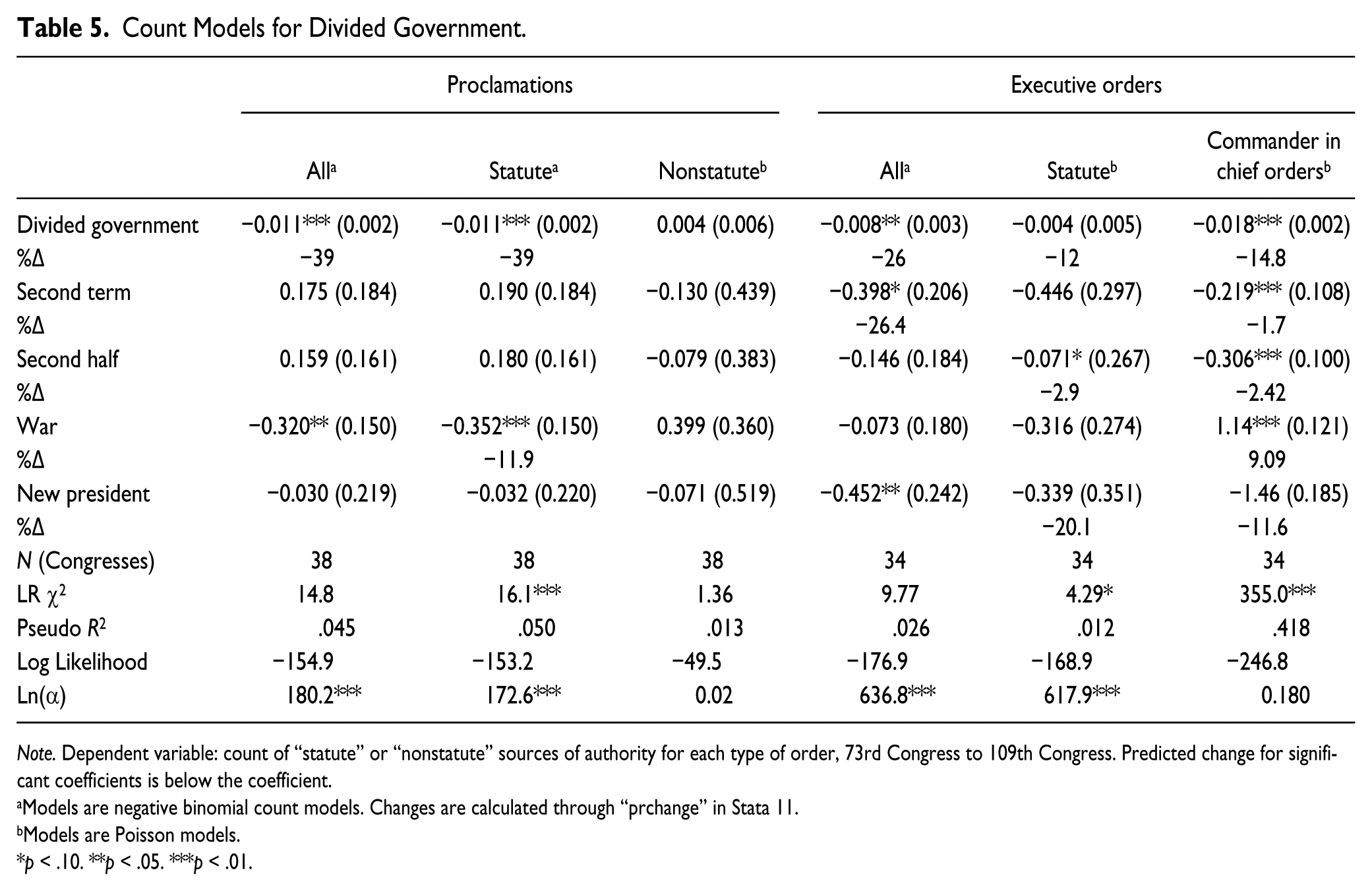
Note. Dependent variable: count of “statute” or “nonstatute” sources of authority for each type of order, 73rd Congress to 109th Congress. Predicted change for significant coefficients is below the coefficient.
Models are negative binomial count models. Changes are calculated through “prchange” in Stata 11.
Models are Poisson models.
p < .10. **p < .05. ***p < .01.
Another way to examine how presidents change their strategy in citation patterns for executive orders is when they cite both statutory sources and presidential sources. As suggested in earlier sections, when presidents cite both sources of authority (statute and nonstatute), they are making a claim of executive authority and therefore taking on more risk than they would be in citing Congress alone but not as much as when citing only presidential authority. Table 6 displays models for the issuance of orders that cite both statute and nonstatute sources of authority using the individual order as the unit of analysis. As expected, the indicators of divided government and larger majority size are all negative for each model, with between a one and two percent reduction of the likelihood of issuing an order when Congress is stronger. However, the president’s temporal and issue positions are generally positive and statistically significant. For each model specification, presidents are more likely to issue orders citing both types of authority when in their second terms, the second half of their terms or when new to office. Likewise, periods of war are strong positive predictors of the likelihood of issuing an order citing both types of authority. This corresponds to what Young (2013) found as well. Because we suggest that when citing both types of authority presidents are breaking the usual pattern of only citing Congress, that they do so in conditions where they feel more institutionally free to do so conforms to expectations.
Individual Level Models for “Both” Sources of Authority.
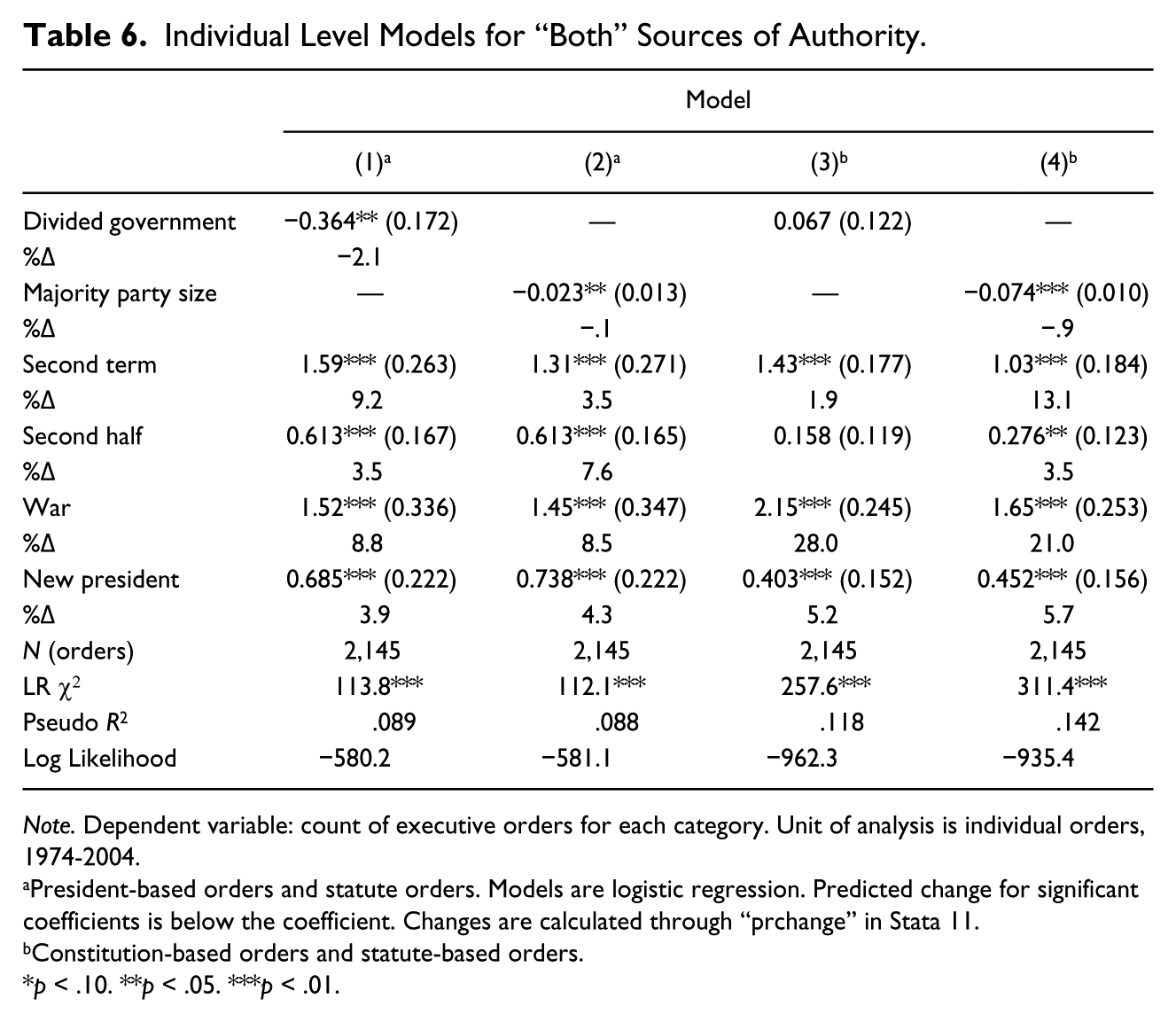
Note. Dependent variable: count of executive orders for each category. Unit of analysis is individual orders, 1974-2004.
President-based orders and statute orders. Models are logistic regression. Predicted change for significant coefficients is below the coefficient. Changes are calculated through “prchange” in Stata 11.
Constitution-based orders and statute-based orders.
p < .10. **p < .05. ***p < .01.
Although we argue that examining all orders tells us a great deal about the relationship between the president and Congress with respect to the unilateral versus shared power arrangement, scholars have also convincingly argued that “significant” executive orders are the most appropriate indicator of when we are likely to see major policy change. For instance, Howell (2003) notes that
if we are to understand how presidents have used their unilateral powers to change policy, rather than tend to their administrative duties, then we must work through these issues and find a meaningful way of distinguishing important orders from trivial orders. (p. 79)
Likewise, Mayer (2001) notes that examining significant policy making through unilateral orders permits “distinctions between, for example, an order exempting an individual from mandatory retirement from one that imposed a loyalty program on federal employees” (p. 83). Mayer uses a combination of press attention, congressional notice, presidential emphasis, litigation, creation of institutions with substantive policy responsibility, or a subjective judgment from a secondary literature review. He uses orders from 1949 to 1999, and we use the same time frame in the models in Table 5.
In our analysis, we focus on executive orders since the number of significant proclamations by this standard is very small and therefore methodologically difficult to model (see Online Appendix Table 5). Table 7 displays the results of the model for significant executive orders as stratified by the source of authority cited. The results generally mirror the findings from Tables 3 and 4. Divided government has a negative effect on the count of president-based executive orders. However, the larger the majority size, the president issues more executive orders contradicting expectations which suggested that presidents would defer to Congress in these instances. The coefficient for statute-based orders is positive for the size of the majority (as is the effect for statute-based orders under divided government) but the effect is not statistically significant. Given the small number of cases over the time period (once divided by type of justification), only a few of the results reach statistical significance. There are positive coefficients for size/unity ratio and majority size for presidency-based significant executive orders, but the effect is small. Thus, the directions of the coefficients tend to point in the direction that somewhat comports with our expectations.
Count Models for Significant Executive Orders.
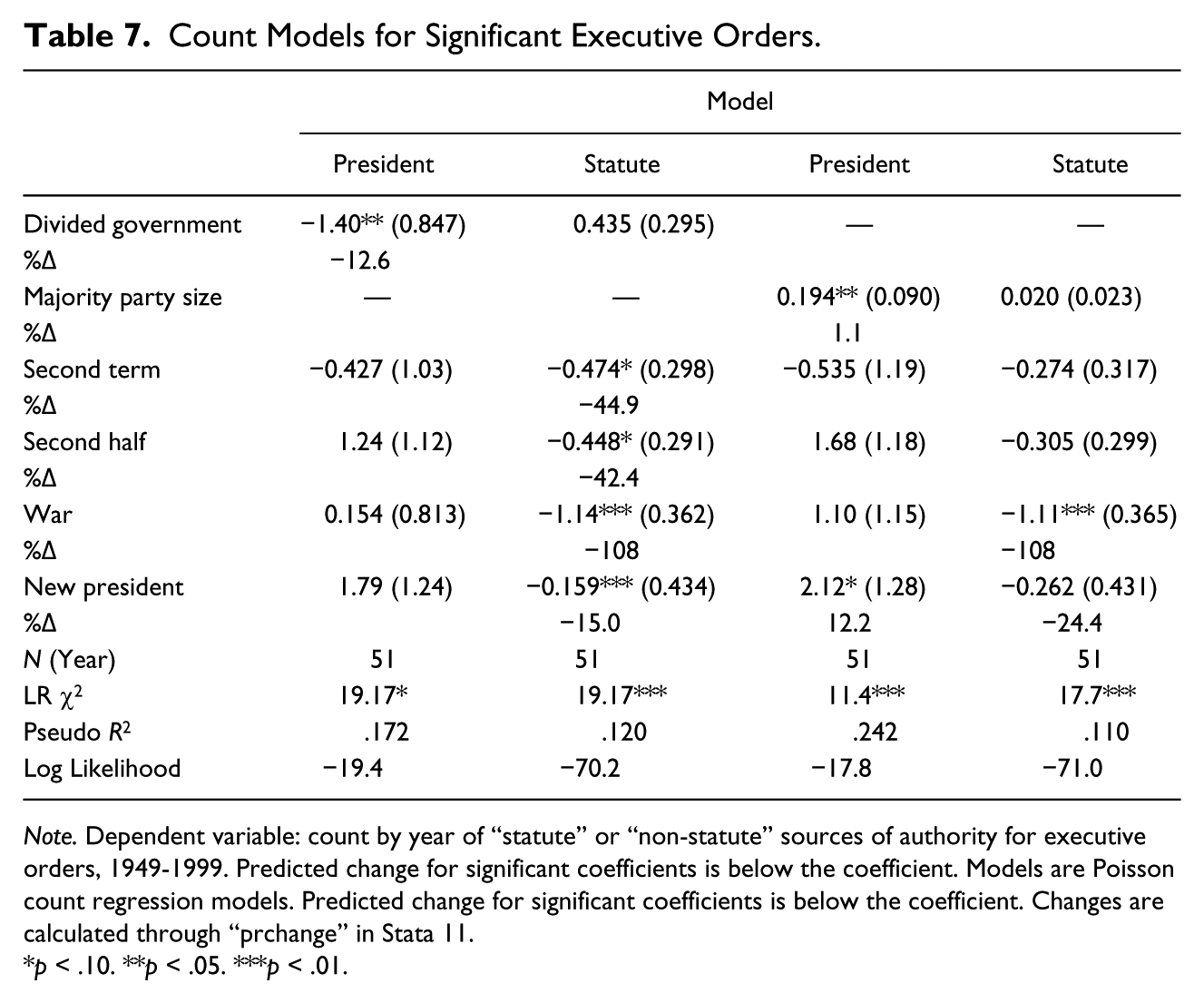
Note. Dependent variable: count by year of “statute” or “non-statute” sources of authority for executive orders, 1949-1999. Predicted change for significant coefficients is below the coefficient. Models are Poisson count regression models. Predicted change for significant coefficients is below the coefficient. Changes are calculated through “prchange” in Stata 11.
p < .10. **p < .05. ***p < .01.
Discussion
This article builds on our theoretical and empirical understanding of the use of unilateral powers. First, empirically, we introduce and analyze a new set of data on presidential proclamations and executive orders. Second, theoretically, we offer a way for scholars to be more precise about analyzing the way presidents exercise unilateral power. Given the complexity in the relationship between presidents and Congress, and given that most orders are based on some prior negotiation between Congress and the president, this emphasis on source of authority offers another step for scholars to continue to understand the place of unilateral power within a system that requires separated but shared powers. Most of the time presidents cite congressional authority to justify unilateral actions, but our analysis revealed not only do they choose to go and remain alone in some instances but also that there is variance according to the size and unity of the majority party in Congress. Understanding these patterns allows us to more concretely place the president’s actions as part of or distinct from the bargaining process and within the modern scope of the separation of powers.
We find mixed but largely supportive evidence for our expectations of how presidents use unilateral orders with respect to Congress. For both sets of orders, a simple distinction divided by source of authority demonstrates that presidents most often rely on Congress for their source of authority when issuing unilateral orders. This simple bivariate finding supports our theoretical assertions about the unique conditions under which presidents will issue a unilateral order given the differing sources of authority presidents may use to justify their actions. For presidential proclamations, presidents issue fewer nonstatutory (presidential-based) proclamations when Congress is stronger but more statute-based proclamations when Congress is stronger. For executive orders, the trends also largely split in predicted ways; presidents are more likely to issue statutory-based orders when presidents and confront large lawmaking majorities, but when presidents face a weaker Congress they invoke their own authority or Constitutional authority. This supports part of Howell’s (2003) theory that presidents issue fewer orders but challenges his theory with respect to when presidents will pursue their own independent sources of power. However, these results challenge the notion that presidents are purely reactionary to Congress—these findings demonstrate that presidents, when they believe their authority to be more robust, are likely to act on their own authority.
Conclusion
As these findings imply, unilateral power is as complex as executive power itself. Unilateral orders are not uniformly used for one selective purpose or the other, nor are all orders subject to the same type of political events. Instead, presidents change the way they cast their orders according to their shifting assessment of how free they are to act first and alone. These concerns are not strictly political in origin, for they also include a meaningful combination of the institutional conditions presidents face and the authority with which they have to act (see Mayer, 2009a). The specific justification of unilateral orders is important not only for tracing the constitutional authority (or lack thereof) for executive power, for it is also related to the president’s political situation. This realization helps to sort out the competing explanations (and findings) about when presidents issue unilateral orders, and, as a result, contributes to the debate about whether presidents function as powerful independent political actors or dependent executive clerks.
From this perspective, we make two primary contributions. First, we suggest that presidents change their description of source of authority and according to the political and policy environment. We find this is true for both proclamations and executive orders. When presidents feel freer to act, such as when reorganizing the executive branch or during war, they are more likely to rely on their own authority. However, when they are politically or institutionally constrained, they should be less likely to act on their own and more likely to cite statute. This finding bridges the study of unilateral politics (Mayer, 2009a) by showing that presidents think politically and institutionally, even when they issue unilateral orders. Second, these findings suggest a middle ground between Neustadt’s version of interbranch bargaining on one hand and studies of unilateral action on the other. The resolution we propose is really a compromise between these two positions, with presidents strategically altering their behavior in light of institutional and political limitations and based on their sense of executive propriety.
These contributions let us rethink our assumptions about the nature of presidential unilateral orders. To be sure, this is only a step in approaching unilateral orders from a different vantage point, but it tells us something about the way presidents understand their own power. At a maximum, they suggest the unilateral power is not precisely unilateral and is instead shared. At a minimum, these findings reveal that, in addition to being strategic about their use of power, presidents are strategic in the way they cast their power. This latter point is a necessary first step to understanding the extent to which presidents and Congress work together by way of unilateral power.
Footnotes
Acknowledgements
The authors thank the National Science Foundation for generous funding.
Authors’ Note
Bailey and Rottinghaus are codirectors of the Presidential Proclamations Project.
Declaration of Conflicting Interests
The author(s) declared no potential conflicts of interest with respect to the research, authorship, and/or publication of this article.
Funding
The author(s) disclosed receipt of the following financial support for the research, authorship, and/or publication of this article: Research for the article was made possible by a grant from the National Science Foundation, SES 1237627.
Notes
Author Biographies
References
Supplementary Material
Please find the following supplemental material available below.
For Open Access articles published under a Creative Commons License, all supplemental material carries the same license as the article it is associated with.
For non-Open Access articles published, all supplemental material carries a non-exclusive license, and permission requests for re-use of supplemental material or any part of supplemental material shall be sent directly to the copyright owner as specified in the copyright notice associated with the article.
