




Abstract
A whole array of studies has shown that the physical appearance of candidates running for elective office matters. However, it is unclear whether attractiveness or perceived competence is the source of such electoral advantage. In addition, the gender of candidates might interact with perceptions of physical appearance. With the help of Canadian student coders and through the use of a web-based survey, we measure the threefold link between physical attractiveness, perceived competence, and gender for all races in the 2008 U.S. House of Representatives elections. We find that both the attractiveness and perceived competence of candidates matter for candidates’ electoral successes; the former having an important effect in intra-gender races and the latter in inter-gender races.
Introduction
Physical appearance matters in social settings. Physically attractive individuals possess more desirable personality traits and obtain various advantages in society (cf. Brewer & Archer, 2007). To highlight this point, Hamermesh and Biddle (1994) argue that individuals in the workforce rated as being of “above average attractiveness” receive a pay premium of approximately 5% compared with their less attractive counterparts, who could be penalized in pay by up to 9%. But how pervasive is this “beauty premium” in politics? Does it extend to the political sphere, for example, by contributing to the electoral success or demise of political candidates? To investigate this question, we present an aggregate analysis of the relationship between physical appearance and electoral success in the 2008 elections to the U.S. House of Representatives.
The starting point of our analysis is the assumption that the idea of physical appearance includes at least two dimensions that are not necessarily interconnected: perceived attractiveness and perceived competence. Appearance-driven attractiveness is based primarily on facial symmetry (cf. Rhodes, Proffitt, Grady, & Sumich, 1998; Thornhill & Gangestad, 1993), while appearance-driven assessments of social characteristics of individuals—for example, competence—are based on other factors (cf. Todorov, Said, Engell, & Oosterhof, 2008). While objectively different, we suggest that both of these dimensions may have an influence on the ability of candidates to win elections. Analyzing these two separate components of physical appearance at the aggregate level and controlling for incumbency, the political experience of candidates, and the underlying partisanship of congressional districts, we find that both the physical attractiveness and the perceived competence of candidates have a considerable impact on their electoral success. More precisely, our results indicate that physical attractiveness plays a determinant role when both candidates running for office are of the same gender (i.e., intra-gender races), while in inter-gender races (i.e., when males and females run against one another) it is the perception of competence that impacts electoral success.
Physical Appearance and Electoral Success
The United States are a perfect case to study the possible impact between physical appearance and candidate success (e.g., John & Shephard, 2011). In the United States, the high frequency of elections tends to increase voter fatigue and makes it less likely that many voters will spend a considerable amount of time and effort to gather information about candidates (cf. Crewe, 1981; Norris, 2004; Olivola & Todorov, 2010; Schattschneider, 1975). In a country where the inexorable organizational decay of political parties (Wattenberg, 1991, 1998) has given rise to a state of systemic partisan dealignment (Ladd, 1981), where voters are not “locked into party commitments” (Silbey, 1991, p. 18), and parties have largely stopped working as heuristic devices, quick assessments made by voters based on physical appearance may become important.
This might apply even more so if we consider that Americans, as a population, have limited political knowledge. For instance, a 1986 ABC-Washington Post poll indicated that a majority of Americans could not recall the name of the leader of the Soviet Union at the time (i.e., Mikhail Gorbachev). More recently, Luskin and Bullock (2011) report that approximately 50% of the U.S. population does not know the length of a Senate term and around 40% cannot correctly recall the nominating procedure for Supreme Court justices. Consequently, judging candidates based on their physical appearance may be a rational cognitive shortcut for many voters in the United States. Therefore, we assume physical appearance to serve as a heuristic device for voters when evaluating a candidate, similar to ideology, religion, or race (Leigh & Susilo, 2009).
A growing U.S.-focused and international literature (e.g., Little et al., 2007; Todorov et al., 2005) supports the assumption that candidates’ physical appearance impacts the vote choices of individuals. For example, Lawson et al. (2010) indicate that physical appearance plays a greater role in races where no incumbent candidate runs, supporting the notion that voters will place a greater emphasis on appearance when little is known about the candidates in question. By focusing on various elections in Ireland, Buckley, Collins, and Reidy (2007) use candidates’ photographs to replicate actual election results. By just looking at the candidates’ pictures, without knowing any other details about the candidates, respondents have predicted the election outcome with 80% accuracy. Very similarly, Lawson et al. discover that, even cross-culturally, voters agree to a surprising extent with regard to which candidates appear more suitable for office, with American and Indian subjects accurately predicting 68% of races in Mexico and Brazil.
The existing literature particularly supports the notion that voters’ judgment of physical appearance applies to the attractiveness dimension (e.g., John & Shephard, 2011). Among social psychologists, the idea that attractiveness carries positive connotations beyond beauty per se is summarized in the axiom “what is beautiful is good” (Dion, Berscheid, & Walster, 1972, p. 285). To support this notion, Winkielman, Halberstadt, Fazendeiro, and Catty (2006) affirm that simply viewing something deemed attractive causes an instant and involuntary physical reaction on the beholder, measured as enhanced activity over the cheek region, a known psychophysiological response that indicates positive affect. This instant assessment of attractiveness, in turn, allows the beholder to form inferences about other characteristics. According to Eagly, Ashmore, Makhijani, and Longo (1991), “Good looks induce strong inferences about social competence and weaker inferences about potency, adjustment, and intellectual competence, but have little impact on beliefs about integrity and concern for others” (p. 124). As early as the mid-1970s, Efran and Patterson (1974) compare attractive with unattractive candidates for the 1972 Canadian Parliamentary election and find a sizable impact of physical beauty on candidates’ vote-shares. More precisely, the two researchers argue that candidates rated as attractive obtained on average 32% of the vote in their ridings, whereas candidates deemed unattractive won an average of only 11%. In addition, Efran and Patterson report that only 1 out of 15 unattractive candidates won their riding, compared with 7 out of 15 attractive ones.
By and large, subsequent studies confirm Efran and Patterson’s (1974) results. For example, focusing on the Finnish Parliamentary and municipal elections, Berggren, Jordahl, and Poutvaara (2007) show that a one standard deviation increase in the attractiveness rating of contenders coincides with increases of 20.3% and 16.6% of the share of the vote they obtain in parliamentary and municipal elections, respectively. Similarly, -King and Leigh (2009) report a strong positive relationship between ratings of physical attractiveness and candidates’ share of the vote in the 2004 election of the Australian House of Representatives. Adding some nuance to the analysis, Rosar, Klein, and Beckers (2008) indicate that the extent of the influence of candidates’ perceived attractiveness increases when the average attractiveness of candidates in a given constituency is low. In other words, attractive candidates tend to win more votes when they are paired against unattractive competitors. Studying elections to Community Partnership Boards in the United Kingdom, Banducci, Thrasher, Rallings, and Karp (2003) and Banducci, Karp, Thrasher, and Rallings (2008) come to similar conclusions. In their two studies, they find that not only are attractive candidates significantly more likely to win but also that moving from the lowest attractiveness score to the highest increases a candidate’s chances of winning by 70%. More indirectly, Lenz and Lawson (2011) add that attractive candidates enjoy an electoral advantage, which increases with enlarged television exposure by candidates and low levels of information by voters.
While the evidence is rather conclusive that attractiveness matters for the electoral success of contenders, there is a second dimension—perceived competence—which might influence candidates’ vote-shares (Berggren, Jordahl, & Poutvaara, 2010). Despite the fact that this second dimension has not received as much attention as physical attractiveness, there are nevertheless a handful of studies that argue that looking competent is another asset for electoral success (Todorov et al., 2005). As early as the 1990s, Lewis and Bierly (1990), as well as Rosenberg, Kahn, and Tran (1991), report that competence ratings have an additional significant effect on evaluations of political demeanor. More recently, three analyses with a U.S. focus confirm that perceived competence matters. The first of these studies by Todorov et al. (2005) shows that U.S. Congressional candidates who were perceived to be more competent by respondents actually won in 76.6% of Senate races and 66.8% of House races in 2004. Todorov et al. (2005) add that research subjects were correctly able to predict the outcome of 67.6% of actual Senate races when exposed to the candidates’ photographs for only 1 second and asked to make competence judgments.
Based on a simulated election study, Chiao, Bowman, and Gill (2008) also claim that perceived competence is a significant predictor of voting preferences across all voters and candidates. Switching to empirical data, their study finds that in the 2006 elections to the U.S. House of Representatives, competence was a significant indicator for male candidates, but not for female ones. Finally, leading up to the 2008 U.S. Presidential elections, Armstrong, Green, Jones, and Wright (2010) argue that the candidates with the highest ratings for competence were also those who won the highest share of the vote for their party nominations in state primaries and caucuses. With regard to the presidential election in 2008, Armstrong et al. (2010) add that, in the months before the election, Barack Obama had a higher average competency rating than John McCain (6.8 out of 10 vs. 6.2 out of 10, respectively), a factor that most likely contributed to President Obama’s victory.
Even though the current literature provides some solid evidence that both attractiveness and competence matter, and despite the fact that some studies (e.g., Banducci et al., 2008; Berggren et al., 2010; John & Shephard, 2011; Mattes et al., 2010) pit them against each other, there is no clear answer within the existing literature on how exactly these two dimensions of physical appearance translate into any electoral advantage. It is also not clear if the gender of the candidate intervenes with any of these two dimensions of physical appearance. Pertaining to the latter point, some of the existing studies suggest that attractiveness impacts male and female candidates in different ways, often to the detriment of the latter. For example, C. K. Sigelman, Sigelman, Thomas, and Ribich (1986) find that attractive men are regarded as being more masculine and attractive women as more feminine. The authors add that these perceptions of masculinity and femininity are the strongest predictors of a candidate’s appeal. Moreover, Carlson and Boring (1981) argue that, regardless of gender, winning candidates are seen as being more masculine than losing candidates. Consequently, the two scholars conclude that an attractive female candidate perceived as being more feminine may be at a disadvantage, if winners are selected on the basis of possessing masculine characteristics.
More broadly, various studies (Bowman, 1984; King & Leigh, 2009; Rosenberg et al., 1991; C. K. Sigelman et al., 1986) suggest indeed that more attractive women tend to be penalized at the ballot box, while attractive men tend to be rewarded. These analyses generally find a strong positive correlation between physical attractiveness and electability for male candidates, and a strong negative correlation for female candidates. However, these findings are not uncontested. Sigelman, Sigelman, and Fowler (1987) report that attractiveness does impact female candidates’ perceived femininity, which enhances their perception as pleasant people, thereby increasing their electability. Very similarly, Berggren et al. (2007), as well as Chiao et al. (2008), claim that attractive women may be rewarded for their beauty and tend to fare better in elections than attractive men. A third array of analyses (e.g., Bowman, 1984) obtains contrasting results on the subject while analyzing different types of electoral races. Bowman (1984) finds that beauty appears to be an asset for men, regardless of the type of race, as attractive men are consistently rewarded with votes across the board. However, this tendency is different for attractive women, who perform better in congressional elections, worse in state legislative elections.
In sum, the literature suggests that both dimensions of physical appearance, attractiveness and competence, have an influence on the electoral success of candidates. Building on this logic, we examine these two dimensions simultaneously at the aggregate level. In more detail, we want to decipher whether physical attractiveness or competence has a stronger aggregate impact on the electoral fortunes of candidates. In addition, we aim to decode the precise effect of gender. Does gender impact voter perceptions of both attractiveness and competence? If so, do these different perceptions have an impact on candidates’ vote-shares? To answer these questions, we take into account some important discoveries made by evolutionary psychologists, who argue that the physical attractiveness of males and females are evaluated according to fundamentally different logics (Barber, 1995; Buss, 1994; Cunningham, 1986; Hassebrauck, 1998). Female beauty seems to be a function of youthfulness, sexual maturity, and the ability to reproduce. Male beauty, in contrast, appears to be a function of dominance and the capability to provide for the offspring. Given that people appear to evaluate the physical appearance of males and females according to two very different logics, it seems difficult to assess and compare the beauty of a male with that of a female. Therefore, we split the elections into intra-gender (i.e., races where males run against males and females run against females) and inter-gender races (i.e., all races where a male and a female run against each other), and evaluate which of the two concepts—perceived competence and perceived attractiveness—plays a larger role in each of these two types of races.
Research Design
Judging the impact of both perceived competence and perceived attractiveness on candidates’ electoral fortunes is a difficult endeavor. Probably the largest problem when dealing with perceptions concerns the bias of individuals. When asked to rank the attractiveness or competence of a candidate for public office, individuals may recognize the candidates and let—intentionally or subconsciously—their own political beliefs and personal opinions influence their perceptions. For example, a very committed Republican supporter may, in fact, end up perceiving Democratic candidates as less attractive and less competent than they objectively appear, given their political affiliation. Vice versa, individuals strongly affiliated with the Democratic Party may inadvertently perceive the candidate of the other party as less attractive and less competent.
Aware of the problem that, if asked to rank the competence or appearance of a candidate, individuals might conflate both perceived beauty and competence with other features of the contender, some existing studies have attempted to avoid possible biases in creative ways. For example, Little et al. (2007) show only the shape of contenders’ face instead of the actual face. Others, such as Rosenberg et al. (1991), manipulate images using makeup artists to make it impossible for voters to recognize the actual candidate (for this technique, see also Armstrong et al., 2010; Lewis & Bierly, 1990; Todorov et al., 2005). A third group yet use foreign subjects in an attempt to eliminate bias (e.g., Antonakis & Dalgas, 2009; Lawson et al., 2010).
In an attempt to eliminate as much political bias toward candidates as possible, we engaged in an equally creative research design. More precisely, we devised a two-stage process to collect data on the perceived attractiveness and competence of political candidates, utilizing two entirely distinct groups of individuals. 1 First, we designed a simple survey comprising only the facial picture of all major-party candidates running in the 2008 U.S. House of Representatives elections. We then asked a total of 160 fourth-year undergraduate students at the University of Ottawa, in Canada, to rank these candidates on a scale from 0 to 10 on attractiveness and competence. While we recognize that there is no assurance that all students did not recognize all candidates, we strongly believe that the vast majority of students were not able to recognize the candidates. This tendency applies even more so, if we consider that House members and candidates generally do not attract much international attention. Even for those few students who may have recognized prominent political leaders, such as Nancy Pelosi or John Boehner, we assume that they do not have extremely strong opinions about these candidates, because Canadian citizens are not directly affected by their domestic battles.
The Canadian students were recruited from a variety of political science and non-political science courses. Each student ranked approximately 40 to 50 candidates on one dimension (i.e., either attractiveness or competence, but never ranked them together). The only data given to the students were the faces of each candidate printed in color and the information that the individuals, whose face they were exposed to, were candidates for American elections. We also told the students who provided the attractiveness rankings that we were not interested on whether or not they were sexually attracted to the individuals, but we were looking for an objective assessment of the attractiveness of candidates, regardless of their personal sexual preferences. In total, each candidate was ranked on physical appearance and competence five times by five different students.
Second, we utilized the same photos to design a web-based survey and collected data through Mechanical Turk, a website that allows users to hire anonymous individuals all over the world to perform simple tasks on the web. In more detail, we set up two web-based surveys: one dedicated to assemble data on attractiveness, the other on perceptions of competence. We then requested that each photo in each survey be ranked on a 0 to 10 scale by five different individuals, allowing only people outside of the United States to participate. The instructions of the attractiveness survey included the same warning provided to the Canadian students on the fact that we were not interested in their sexual preferences. Moreover, the instructions for both surveys specified that the individuals in the photos were running in an election. Analogous to our student coders, all respondents of the Mechanical Turk survey were required to disclose their own gender and age.
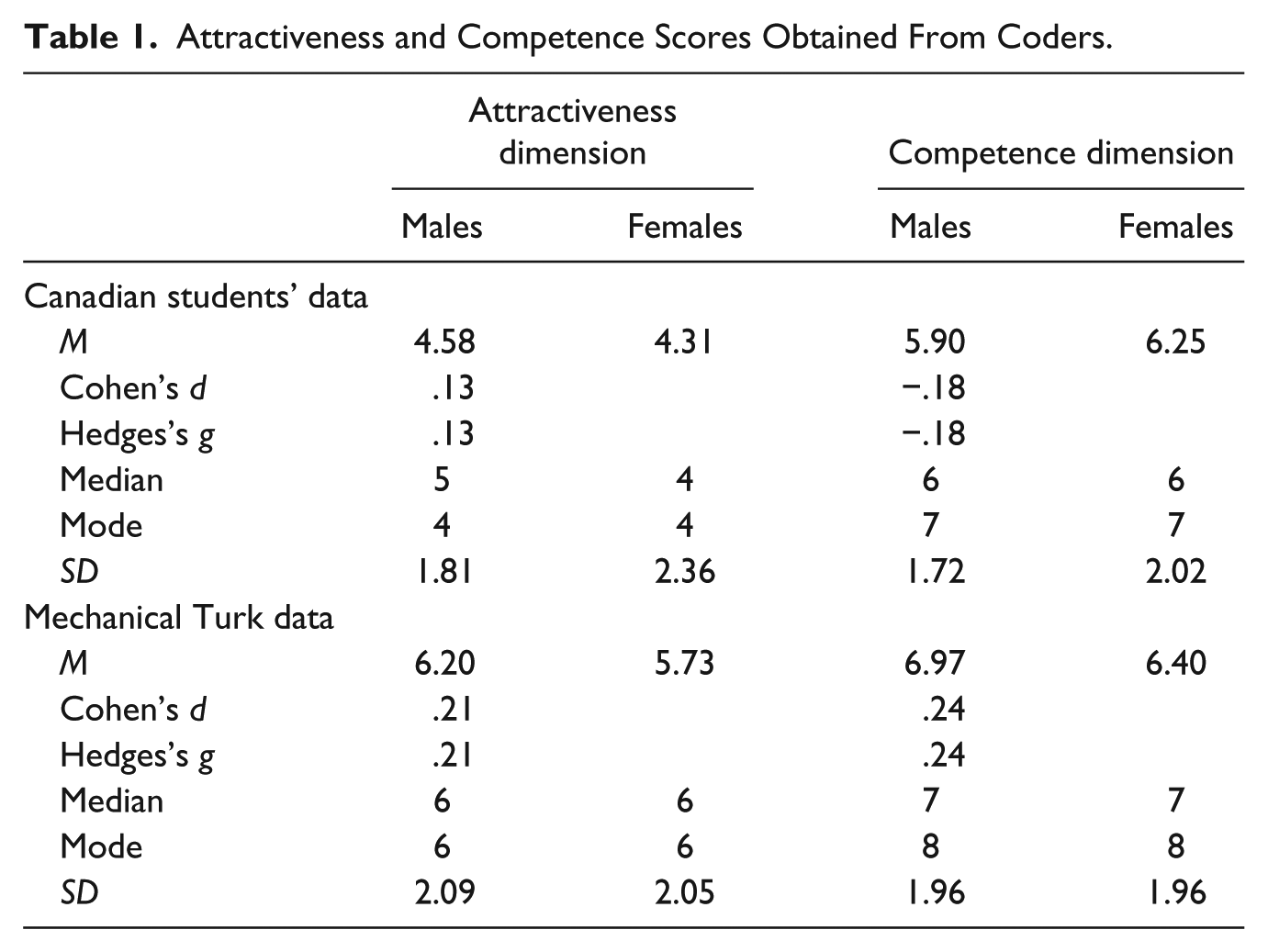
There are two issues that may potentially arise while collecting data as described above. The first concerns the age of respondents. College students tend to be young and belong to a fairly homogeneous age group. Administering the survey to fourth-year undergraduate students placed almost all of our respondents in their early 20s. Our Mechanical Turk coders made up a much more heterogeneous age sample, with the average age of coders being 33.68 years for the attractiveness dimension and 36.34 years for the competence dimension. Considering both groups, the youngest coder was 20 years old, whereas the oldest was 85. Table 1 shows some descriptive data on the coding of both data-pools divided by the gender of the coder. The data highlight that there is not much cross-gender difference in the mean, median, and mode obtained in both dimensions by either pool of coders. This assessment is confirmed through the calculation of two measures of effect size, Cohen’s d (cf. Cohen, 1988) and Hedges’s g (cf. Hedges, 1981), which confirm that, within both data-pools, the cross-gender differences across the mean scores obtained for both dimensions of physical appearance are very small.
Attractiveness and Competence Scores Obtained From Coders.
We averaged the ratings for both dimensions to calculate our main variables of interest—perceived attractiveness and perceived competence. For both dimensions, we calculated the mean score for both the loser and the winner of an election, keeping the data obtained from the Canadian students separated from the data collected through Mechanical Turk. This gave us a total of four variables for each data-pool: attractiveness of the winner, attractiveness of the loser, competence of the winner, and competence of the loser; each possibly ranging from 0 to 10. These four variables have the caveat that they represent an absolute judgment on the physical appearance of each candidate—winner or loser—considered individually. However, absolute perceived beauty and competence rankings might not reflect how voters actually judge candidates. We deem it more likely that voters evaluate the physical appearance and perceived competence of candidates in relation to whoever runs against them. In other words, a score of “5” on any of the two dimensions may give a larger advantage to an individual running against a candidate with a score of “0” than a score of “10” for someone running against a candidate with a score of “9.” Consequently, we transformed our four scores into additional variables, labeled Attractiveness Differential and Competence Differential, by subtracting the score on each dimension obtained by candidates who lost the race from the scores obtained by winning candidates. The Attractiveness Differential and Competence Differential then serve as our main independent variables.
While both main independent variables measure appearance-driven impressions, they seem to be rather different. Statistically, as we explain in detail below, the two sets of variables are not strongly correlated. Theoretically, there is no reason to believe that individuals tend to mix the two concepts. In fact, several studies (e.g., Rhodes et al., 1998; Thornhill & Gangestad, 1993) have shown that physical attractiveness tends to be determined through assessments of facial symmetry. In contrast, appearance-driven trait evaluations on social dimensions—which include our competence evaluation—are driven by judgments based on valence/trustworthiness and power/dominance that are distinct from the concept of attractiveness.
We examined the influence of both dimensions of physical appearance on the dependent variable, which is the share of the total vote obtained by the candidate who won that specific race (labeled Overall Vote-Share of the Winner). To do so, we combined the data obtained through the surveys with data from the official electoral returns of the 2008 House elections by adding other relevant variables to our data set. First, we included a control variable for incumbency, as there is an abundance of literature highlighting that incumbents tend to obtain higher vote-shares than their non-incumbent counterparts (cf. Abramowitz, 1991; Cox & Katz, 1996; Erikson, 1971; Gelman & King, 1990; Mayhew, 1974; Praino & Stockemer, 2012a, 2012b). Labeled Incumbent Winner, this first control variable is a dummy variable coded 1 for all races featuring the victory of an incumbent candidate, 0 otherwise. It captures the advantage in terms of electoral margins that successful incumbent candidates usually enjoy at the ballot box.
Second, partisanship at the congressional district level is known to play an important role in determining the share of the vote candidates receive: Predominantly Republican districts and predominantly Democratic districts may secure higher shares of the vote for the candidates of their favorite political party (cf. Ansolabehere, Snyder, & Stewart, 2001; Erikson & Wright, 1997; Praino, Stockemer, & Moscardelli, 2013; Schwarz & Fenmore, 1977). We operationalize Partisanship by the 2008 overall share of the two-party vote in each congressional district of the presidential candidate of the party of the member of the House who won the election. Congressional districts that elected a Democratic member of the House have been assigned the percentage of the vote obtained in the district by Barack Obama. Congressional districts that elected a Republican member of the House have been assigned the percentage of the vote obtained in the district by John McCain. This second control variable captures not only the underlying partisanship of each district but also accounts for election-specific presidential coattails and partisan (dis)advantages of various kinds (Ansolabehere et al., 2001).
Third, the quality of opponents in any race, expressed as previous political and electoral experience, may play an essential role in determining the share of the vote candidates receive in elections. Hence, we included in our data set a measure of the previous political experience of opponents based on the so-called “challenger scores” compiled and updated by Jacobson (1989) and widely utilized throughout the existing literature (cf. Goodliffe, 2001; Green & Krasno, 1988; Squire, 1995). This Experience of Opponent variable is ordinal 2 : coded 1 for opponents who never held elective office in the past, 2 for opponents who had held an elective office before running for the House in 2008, 3 for opponents who in the past were state legislators, and 4 for opponents who previously were members of the U.S. House of Representatives.
Method
We include in our analysis 330 out of the 435 individual electoral races contested for seats at the U.S. House of Representatives in 2008. 3 To determine the impact of both perceived competence and perceived attractiveness on the electoral fortune of candidates, we engage in a four-step process. First, we run a correlation analysis between the Attractiveness Differential and the Competence Differential to determine if, and to what degree, these two concepts are related. Within the Canadian students, while statistically significant, the Pearson correlation coefficient is substantially rather weak (r = .35). Within the Mechanical Turk respondents, the coefficient is even weaker and not statistically significant (r = −.07). This implies that, in agreement with the theoretical remarks explained above, the two concepts are quite distinct and individuals judge perceived competence and perceived appearance rather differently.
Second, we present some descriptive statistics on the average vote-share of candidates across all races based on the scores of candidates’ attractiveness and competence differentials. In more detail, we compare the average vote-share of candidates deemed less attractive or less competent than their opponents with the vote-share of candidates deemed more attractive or more competent than their opponents. Third, we test the influence of both indicators in a multivariate framework. More precisely, we specify some regression models that simultaneously capture the influence of perceived physical attractiveness and perceived competence on the percentage of the winner’s vote across our 330 electoral races. In detail, we run three sets of separate models for each of our two data-pools. First, we run the model including all races. Second, we run the same model including only intra-gender races; in other words, only those races where candidates face opponents of their own gender (i.e., males running against males and females running against females). Finally, we run the model including only inter-gender races or races where candidates face an opponent of the opposite gender. All three regression models are run as ordinary least squares (OLS) models with robust standard errors (White, 1980) and are formally specified as follows:
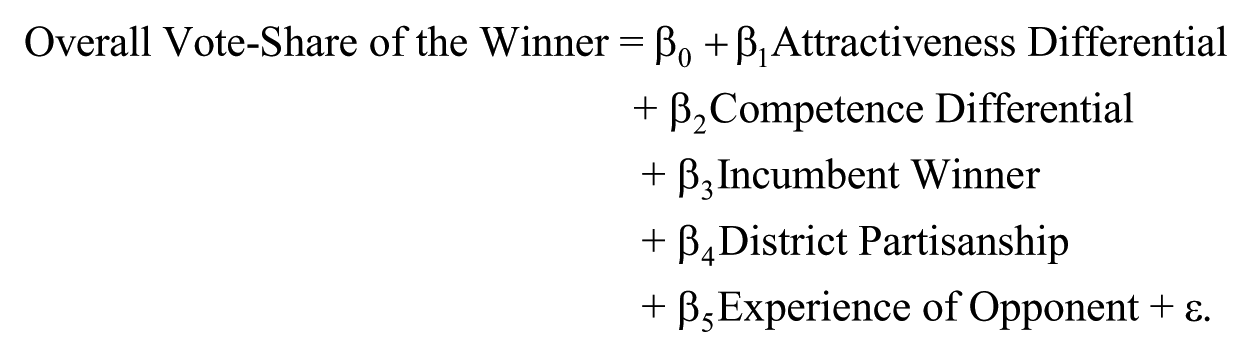
Fourth, and in conclusion, we perform a coefficient-by-coefficient cross-model comparison between the results obtained utilizing the Canadian students’ data and the results of the models estimated with the Mechanical Turk data. Even though the results of the two sets of models are very similar and provide empirical evidence in support of the same identical process, this final step is necessary to formally determine the consistency across results gathered utilizing two entirely separate data-pools, adding strength and certainty to our conclusions.
Results
Our descriptive statistics indicate some differences in the overall vote-share of winning candidates between less attractive/less competent looking candidates and more attractive/more competent looking candidates. Table 2 highlights that, for both dimensions, candidates who are perceived as either more attractive or more competent than their opponents can count, on average, to gain a higher percentage of the total vote. The difference in the vote is 2 percentage points for the perceived attractive dimension and slightly over 1 percentage point for the competence dimension. A simple one-sample t test, however, reveals that while the difference in vote-share across the attractiveness dimension is statistically significant, the difference across the competence dimension is not. Comparing the results obtained utilizing the Canadian students’ data and the Mechanical Turk data, we find consistent results across the two disparate data-pools. The results are statistically identical, regardless of which data-pool we use. In other words, this brief descriptive analysis seems to suggest that only the perceived attractiveness of candidates has an impact on the overall vote-share of candidates.
Descriptive Statistics.

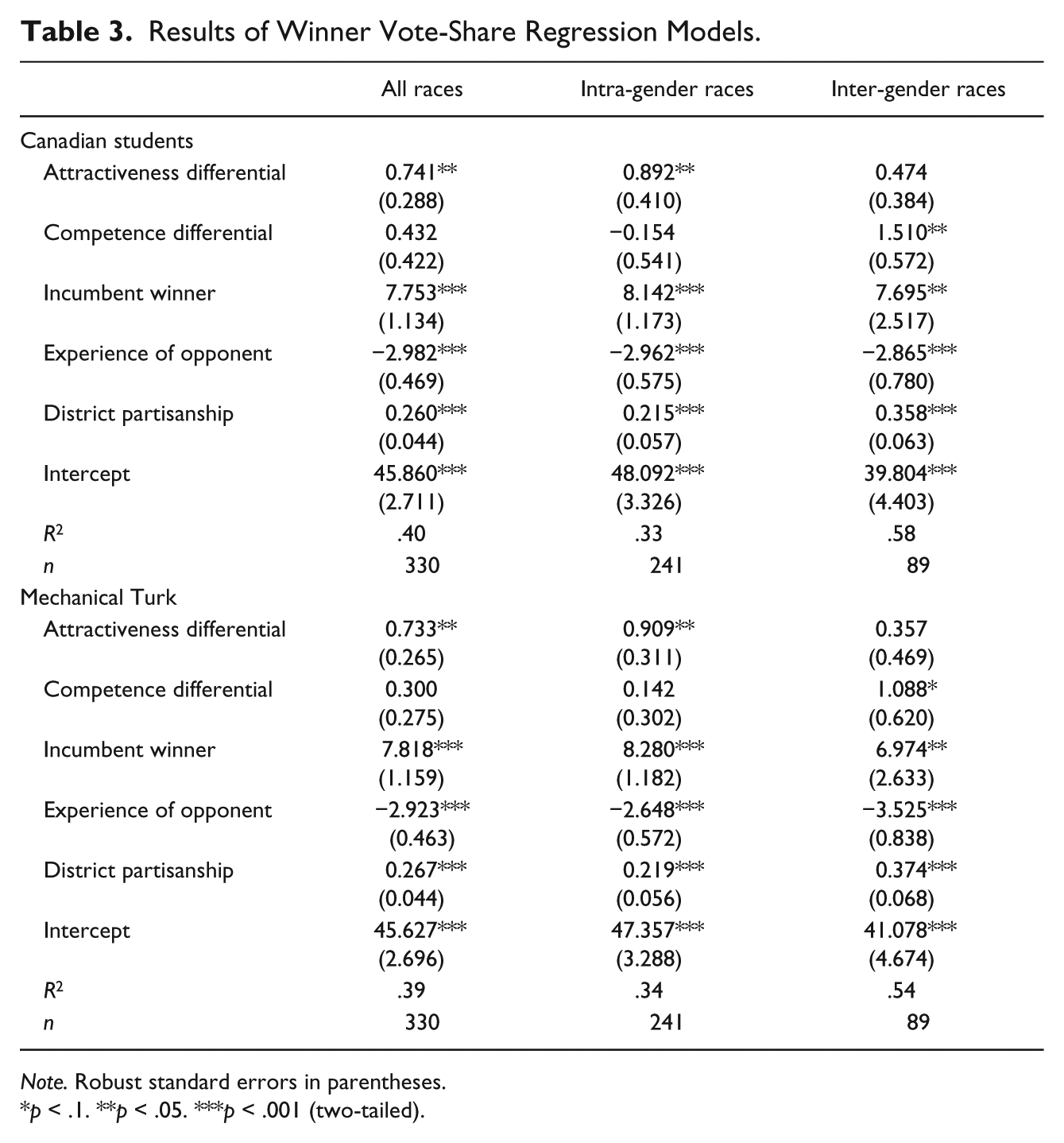
The regression models support the descriptive statistics. Table 3 gathers the results of two sets of three models. The first set of models utilizes data from the Canadian students, whereas the second one uses the data gathered through Mechanical Turk. Both groups of models yield highly similar results for what concerns both the magnitude of all coefficients and their statistical significance. Considering all races included in our analysis, there is a clear, strong, and statistically significant relationship between the Attractiveness Differential and the vote-share obtained by successful candidates. More in detail, for each point within the 0 to 10 Attractiveness Differential scale, candidates tend to receive on average almost an extra percentage point of the overall total vote-share—more precisely, 0.74 points according to the Canadian students’ model and 0.73 points according to the Mechanical Turk model. In other words, an extremely attractive candidate running against an extremely unattractive candidate can expect to obtain an electoral “beauty premium” of more than 7% of the total vote. This number alone would be enough to decide most marginal races in a two-party system.
Results of Winner Vote-Share Regression Models.
Note. Robust standard errors in parentheses.
p < .1. **p < .05. ***p < .001 (two-tailed).
When only intra-gender races are taken into account, the importance of physical attractiveness is confirmed. Both intra-gender models predict that the Attractiveness Differential has a much stronger effect in races where males and females run against individuals of their own gender than when all races are considered together. In fact, the models predict that more attractive candidates can enjoy a “beauty premium” of almost 10 percentage points—8.92 points according to the Canadian Student’s model and 9.09 points according to the Mechanical Turk model, precisely.
Conversely, when only inter-gender races are taken into account, the models predict no impact whatsoever of the Attractiveness Differential. Interestingly enough, in these races the Competence Differential, which presented small and statistically non-significant coefficients in the previous two sets of models, seems to play an extremely important role. According to the Canadian students’ model, successful candidates that appear more competent than their opponents enjoy an electoral advantage of up to 15.10 percentage points, while the Mechanical Turk model 4 predicts an advantage of up to 10.88 points. All control variables across all six models perform as expected: The victory of incumbents in electoral races is generally associated with higher vote-shares; the more political experience an opponent has, the smaller the vote-share of successful candidates tends to be; the higher the level of partisanship within districts, the higher the vote-share of successful candidates tends to become.
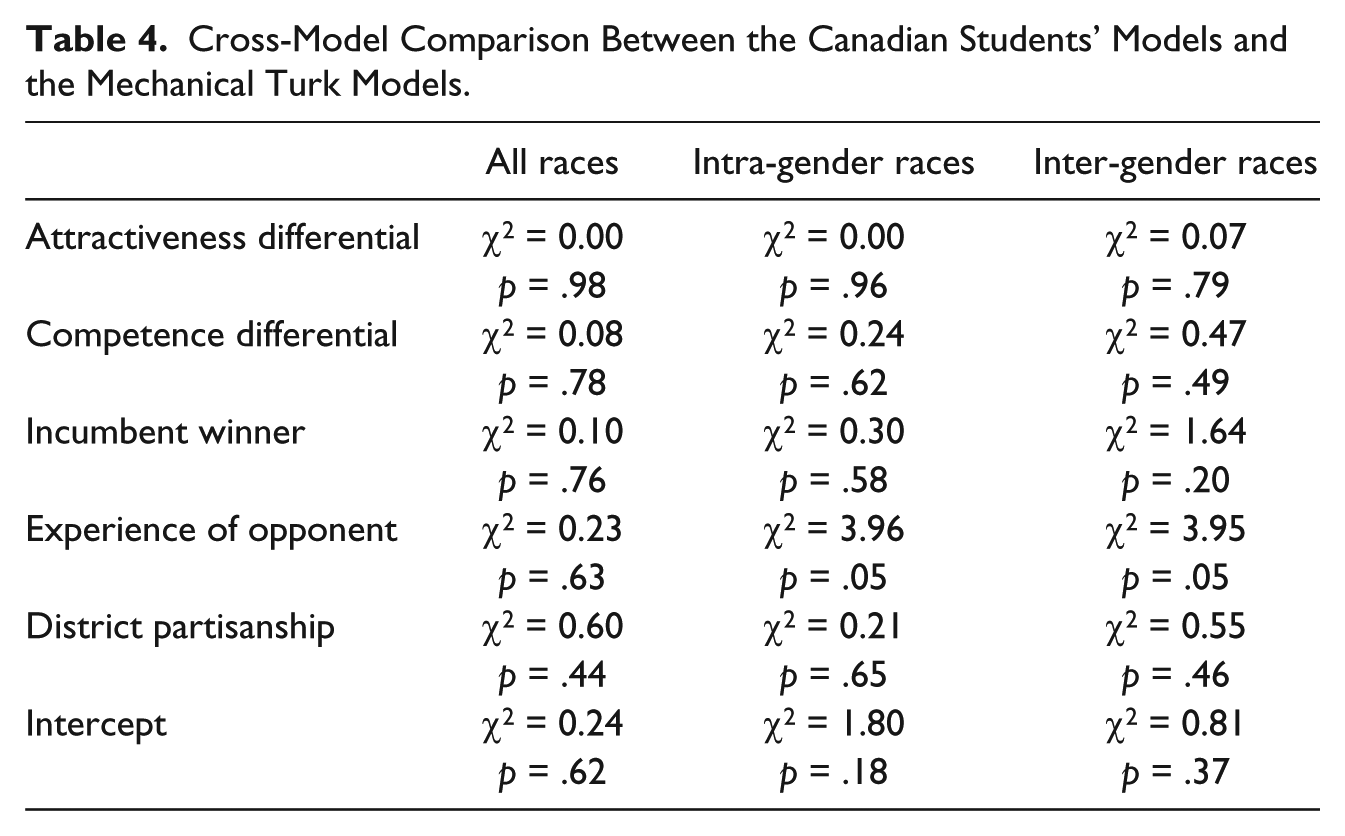
Table 4 gathers the results of a cross-model comparison between the model estimated utilizing the Canadian student’s data and the model estimated with the Mechanical Turk data. The comparison is performed coefficient by coefficient utilizing a simple seemingly unrelated estimation test. The results highlight that all three sets of models yield virtually identical results that, statistically, are not significantly different across the two distinct data-pools. In other words, regardless of which data-pool is taken into account, not only the Attractiveness Differential and the Competence Differential but also all control variables have an identical impact on the vote-share of successful candidates.
Cross-Model Comparison Between the Canadian Students’ Models and the Mechanical Turk Models.
Our analysis adds an important chapter to the literature on physical appearance and candidates’ success in elections. While, generally speaking, physical beauty is gauged in the eye of the beholder (Eagly et al., 1991), our study nevertheless puts forward the idea that, at the aggregate level, voters judge candidates on two dimensions of physical appearance, physical attractiveness and perceived competence. Physical attractiveness seems to strongly matter in intra-gender races, whereas perceived competence appears to play a role in inter-gender races.
Conclusion
Using the 2008 elections to the U.S. House of Representatives as a case, this article argues that two dimensions of physical appearance—perceived attractiveness and perceived competence—have an important impact on candidates’ electoral success at the aggregate level. By estimating different models for all races, intra-gender races, and inter-gender races, we have demonstrated that the attractiveness dimension of physical appearance only plays a role in intra-gender races, while the competence dimension matters merely in inter-gender races. In agreement with the evolutionary psychology literature (cf. Barber, 1995; Buss, 1994; Cunningham, 1986; Hassebrauck, 1998), we believe and empirically highlight that gender is a confounding factor when evaluating candidates’ perceived attractiveness and competence: Between two men or two women, it is fairly easy to determine with a glance who is more attractive than the other; when comparing a man with a woman, however, such assessment becomes much trickier, even at times simply impossible.
Based on our results, it seems likely that voters tend to be easily influenced by good-looking candidates when it is easy for them to choose which candidate looks best. When such assessment becomes more complicated, voters end up choosing the second easiest path, that is, they determine who appears to be more competent. In other words, voting for the most attractive candidate can only be an “easy way out” strategy for uninformed voters unable or unwilling to gather further information on candidates if the candidates differ substantially in attractiveness (in that voter’s eyes). In the case of inter-gender races, when assessing attractiveness becomes more complicated, the easiest move is to infer, based on physical appearance (cf. Eagly et al., 1991; Winkielman et al., 2006), which candidate seems to be more competent.
Despite our and other studies, research on the impact of physical appearance on candidates’ vote prospects is still in its infancy and much more work needs to be done. For example, psychologists believe that human beings use a two-step process to judge other human beings. The first step, labeled “System 1 processing,” allows individuals to form initial impressions of other individuals based on physical appearance that are instantaneous and automatic (Winston, Strange, O’Doherty, & Dolan, 2002). The second step, called “System 2 processing,” is a more deliberate step, which occurs when individuals make a conscious decision to engage with other individuals to acquire additional information about their counterparts. The more individuals engage in System 2 processing, the less physical appearance should count in their value judgment of others (Willis & Todorov, 2006). Future studies should tackle the following questions: Do appearance-driven attractiveness and competence both fall within System 1 processing? Do individuals tend to behave differently when they have additional information about the competence, professional experience, and political experience of the candidate, or do appearance-driven impressions still play an important role?
In addition, it seems likely that perceived attractiveness and competence play a larger role in second-order elections (e.g., local or regional contests), where the candidates are less known and voters tend to want to dedicate little time to get to know the contenders. Finally, it would be interesting to know which of the two sexes, men or women, is more likely to resort to physical appearance as an information shortcut before casting their ballots. While these questions have remained unanswered by our study, we very much hope that future research will exhaustively address them.
Footnotes
Appendix
Declaration of Conflicting Interests
The author(s) declared no potential conflicts of interest with respect to the research, authorship, and/or publication of this article.
Funding
The author(s) received no financial support for the research, authorship, and/or publication of this article.