



Abstract
Using original survey data from the Cooperative Congressional Election Survey (CCES), we examine variation in racial and ethnic group and partisan attitudes toward legislators and representation. Respondents were asked about their views on descriptive representation, its importance for their own elected official, and whether it was important to have more descriptive representatives in general. Using respondents’ personal characteristics such as education, partisanship, race, ethnicity, income, and race and ethnicity of their House of Representatives member, we analyze the impact of these variables on attitudes toward representation. We find that Latino and Black respondents place a high level of importance on having descriptive representatives in their own districts in addition to articulating a high degree of importance to having more representatives from their respective group. However, Latino Republicans place less importance on descriptive representation overall than Latino non-Republican respondents. Non-Latino Republicans also place importance on more legislators of their same race or ethnicity. The findings have implications for democratic governance as the demographics of the United States rapidly changes.
Introduction
Political scientists have thought about representation in a variety of ways. Descriptive representation occurs when a member of a legislature shares the same race, ethnicity, or gender as an individual whereas substantive representation refers to the actions of the legislator on behalf of constituents (Mansbridge, 1999; Pitkin, 1967). The purpose of a representative is to act as a liaison between individuals and institutions within government. Members must navigate the legislative process while advocating on their constituents’ behalf in addition to cultivating constituencies that will support them in re-election (Fenno, 1978; Mayhew, 1974). This article embraces the role of the representative to explicitly examine minority group attitudes toward representation and how they may differ from the White majority population. This angle of representation is important given the history of discrimination, exclusion, and under-representation of minorities in the political process. In the 113th Congress, 67% of the total number of voting members in the House and Senate are White men, whereas only 8% are African American and 6% are Latino. Compared with their national populations of 37%, 12%, and 16%, respectively, White men appear to be vastly overrepresented in Congress, while racial and ethnic minorities are considerably under-represented.
The subject of this article is especially pressing given the Supreme Court’s ruling in Shelby County v. Holder in June 2013 narrowly holding that Section 4(b) of the Voting Rights Act is unconstitutional. Section 4(b) prescribes a formula used to determine which jurisdictions are covered under Section 5 of the Act. While the Court did not explicitly strike down Section 5 and its preclearance requirement by the Justice Department or the DC Circuit Court of Appeals, there can be no Section 5 without Section 4(b). Congress must rewrite the coverage formula in compliance with Shelby for preclearance to return to the states with a prior history of disenfranchisement. This ruling has alarmed voting rights activists who have been successful in litigating illegal redistricting plans in many Southern states that violated the rights of minority voters. Given that many minority officeholders gained office in the redistricting rounds following the enactment of the Voting Rights Act often via majority–minority districts, this article gives us a strong sense of how people feel about these minority officeholders and the value of having representatives who look like them.
This research seeks to understand how constituents assess the amount and importance of descriptive representation. An investigation of public attitudes toward their representatives and their respective behavior, as we explain here, enhances our understanding of the impact of representation on feelings of inequality and political efficacy among minority groups as well as perceptions of group identity and commonality in interests. These questions are all the more important as the number of minority legislators increases in ways that were once unimaginable. Because of the Voting Rights Act and its subsequent reauthorizations, more minorities have been able to win elections in legislative districts across the United States, and how constituents assess the importance of minority group representation matters in important ways.
Our study expands on the scholarship that explores minority group representation by directly examining attitudes toward representation. The literature has demonstrated that the benefits of descriptive representation are extensive, including increased trust in Members of Congress (MCs) by constituents (Pantoja & Segura, 2003; Tate, 2003), higher likelihood to participate in voting by constituents (Barreto, Segura, & Woods, 2004), and increased legislative responsiveness of legislators (Haynie, 2003). Little is known, however, about the extent to which Latinos or African Americans care about representation, whether descriptive representation is important to them, or what types of behaviors matter to constituents (for notable exceptions, see Gay, 2002; Schildkraut, 2013; Tate, 2003; Wallace, 2014). From a theoretical standpoint, it is important to examine both Black and Latino attitudes for several reasons. We include White respondents so that we can compare Whites as the majority group with the two largest racial and ethnic groups: African Americans and Latinos. Attitudes of the majority group may substantially differ from the minority groups; thus, it is critical to understand areas of overlap and areas of divergence. Our research follows from earlier work investigating descriptive representation and minority group interests by asking three primary research questions:
Do attitudes toward representation vary across racial and ethnic groups?
How does the race or ethnicity of legislators affect attitudes toward legislators and representation?
How does party mediate the effects of race and ethnicity on attitudes about representation?
Theory and Hypotheses
Scholars have examined representation by dividing the concept into three categories. Descriptive representation occurs when someone who shares the same race, ethnicity, or gender represents constituents. Substantive representation occurs when constituents’ policy preferences are represented, regardless of race, ethnicity, or gender. Symbolic representation occurs when someone of the same race, ethnicity, or gender is the representative, but without the substantive component (Pitkin, 1967). Existing research on race and representation largely finds that representatives who share racial and ethnic traits offer greater substantive representation to members of the same group (Canon, 1999; Hero & Tolbert, 1995; Mansbridge, 1999). However, it remains unclear whether constituents are more favorable because the representative is of the same race or ethnic group, or because the representative appears to be more effectively representing their interests. In particular, it is difficult to determine the degree to which members of racial and ethnic minority groups prioritize descriptive representation as opposed to substantive representation absent quality survey research.
Considerable debate exists in the literature over the value of descriptive representation—that people are best served by legislators who share similar attributes to them, such as race, ethnicity, or gender (Dovi, 2002; Mansbridge, 1999). Pitkin (1967) raised questions of whether this type of representation leads to better outcomes for members of minority groups. In essence, how important is descriptive representation to people? We do not yet fully know the answers to these questions across a broad range of racial and ethnic groups, and this article is among the first to systematically assess these questions.
On the other hand, the actual mechanisms whereby co-ethnic representatives behave differently remain largely undetermined, but include shared group consciousness, linked fate, and electoral incentives (Casellas, 2010; Gamble, 2007; Minta, 2011). This is partially due to the dearth of research on the attitudes of minority constituents toward both descriptive and substantive representation. Examining the preferences of individuals has the potential, in turn, to provide a micro-level approach for understanding the motives and behavior of legislators. Several studies using survey data argue that having ethnic or racial representatives from one’s own group generates a number of tangible benefits for constituents, such as greater feelings of self-efficacy and trust in government (Pantoja & Segura, 2003; Sanchez & Morin, 2011), as well as higher rates of political participation (Barreto, 2007; Gay, 2002). Relying on aggregate district-level data, Tate (2003) similarly finds that Black constituents tend to evaluate Black representatives more positively than White representatives.
We analyze both Latino and Black attitudes toward representation for several reasons. It is particularly important to include both African Americans and Latinos because of the historical landscape of disenfranchisement and under-representation of minority groups in the United States. Even with the protections of the Voting Rights Act and its subsequent amendments, African Americans and Latinos remain significantly under-represented in the U.S. Congress. For example, as of the 2010 Census, Latinos now comprise 16% of the national population and approximately 50.5 million people; however, there are only 24 Latino MCs in the House of Representatives as of 2012. As a proportion of the House, Latino MCs constitute 6% of the total number of seats and would need to increase to 70 Latino MCs to reach parity with their national population. The scholarly literature has devoted considerable attention to Black representation and increasingly Latino representation as well (Casellas, 2010; Lublin, 1997; Swain, 1993).
In addition, given some potential overlap in group interests between African Americans and Latinos, we believe it is critical to assess the issues and areas in which the groups view issues similarly. Finally, for a significant portion of the history of the United States, African Americans were the largest racial or ethnic minority group; however, Latinos now occupy this position. Latinos are a rapidly growing minority group and are increasingly getting elected to legislative bodies. For all of these reasons, we study White, Latino, and African American attitudes toward representation.
We hypothesize that minority respondents value descriptive representation at greater levels than non-minority respondents, all else equal. Because of the history of discrimination against African Americans and Latinos, these two groups will place particular value on the presence of co-ethnic representatives (Gay, 2002). The key mechanism for this value is trust. Minorities will place greater degrees of trust in co-ethnic representatives, and will thus value descriptive representation more than non-minorities (Tate, 2003). Why might this be? As previous research has shown, African Americans in particular have developed a sense of linked fate, largely because of the external threat of racism and discrimination from society as a whole (Dawson, 1994). For Latinos, the literature on ethnic group consciousness is less developed, but thus far studies have demonstrated that Latino constituents also possess a group consciousness in certain ways distinct from African American linked fate (Casellas, 2010; Sanchez, 2006). The process of earning the trust of constituents is more difficult for White representatives representing minority communities because of this history (Walton & Smith, 2011). This is not to say that some White representatives have not earned this trust, nor are incapable of representing minorities (Canon, 1999). We should also not assume that co-ethnic voters will choose unqualified candidates solely on the basis of their shared demographics. Manzano and Sanchez (2010), for example, find that Latino voters are sophisticated and care about candidate quality, and Dovi (2002) makes the case that not just any minority will do.
In addition, the ability to speak the same language yields increases in levels of comfort with co-ethnic representatives. Preferences for co-ethnic representation can also be contingent on acculturation levels and levels of linked fate (Schildkraut, 2013), as well as experiences with discrimination and strength of Latino identity (Wallace, 2014). Moreover, Latinos and African Americans may also be more inclined to support representatives of their group because they observe members of that group acting on the basis of the group above and beyond district context. For example, Minta (2011) argues that minorities might see MCs engaging in “strategic group uplift” by representing them above and beyond their own districts. Similarly, Mansbridge (2003) proposes the notion of surrogate representation where members may serve group interests or policy interests beyond the geographical confines of their district. Rep. Luis Gutierrez (D-IL) exhibits this through his efforts on immigration reform and Rep. John Conyers (D-MI) on behalf of Black farmers even though his district in Detroit has no farming economy. While the electoral connection is no doubt present for minority legislators, scholarly evidence also suggests that such legislators also behave in ways that enhance collective representation of their ethnic or racial group (e.g., Casellas, 2010; Grose, 2011; Minta, 2011; Tate, 2003). Minorities sense this and are therefore more likely to feel a need for more representatives to maximize effective representation. Our first hypothesis is as follows:
As Bobo and Gilliam (1990) have argued, the presence of minority officeholders can also empower minorities such that participation increases when minorities see other minorities in positions of power. Bowler and Segura (2012) note, “The claim that co-ethnic representation results in empowerment to a community is still uncertain” (p. 180). However, while we do not directly test empowerment in this article, it may play a role in minority group members’ desire to have more representatives like them.
In particular, our inclusion of data on respondents’ legislators’ racial and ethnic characteristics is critical because the literature demonstrates that we might expect differences in perceptions of representation based on the race or ethnicity of the legislator (Tate, 2003). People living in such districts might have different views of descriptive representation than others. We expect that minority group members will have greater degrees of trust in descriptive representatives and feelings of empowerment from electing co-ethnic candidates (Sanchez & Morin, 2011). Barreto et al. (2004) have demonstrated the importance of district context in influencing political behavior of Latino respondents; thus, the context may also influence political attitudes toward representation. How people of different races and ethnicities view representation matters in a democracy. Members of racial and ethnic minorities might have different opinions of representation based not only on their representatives, but also on their perceptions of the overall conditions of their group. Our second hypothesis is as follows:
Partisanship is also an important consideration for views on descriptive representation. Scholars have demonstrated the fortitude of the effect of political party on determining vote choice and influencing political attitudes (Campbell, Converse, Miller, & Stokes, 1960; Miller & Shanks, 1996). In this sense, political party is a strong feature of identity and we should expect it would influence attitudes on representation. However, the race and ethnicity of individuals can also be a salient and even dominant political identity (Barreto, 2010; Dawson, 1994; McConnaughy, White, Leal, & Casellas, 2010). For people who are members of a racial or ethnic minority group, which political identity is the most important and how do these overlapping identities complicate their political attitudes toward representation?
Most Latinos, with the exception of Cubans, have been supporters of the Democratic Party (Alvarez & García Bedolla, 2003) and the split across political party identification among Latinos has typically been 2-to-1 in favor of the Democratic Party. Notwithstanding recent efforts to appeal to the Latino vote by some Republicans, such as George W. Bush, President Obama won 67% of the Latino vote in the 2008 election against John McCain, and an even larger 71% of the Latino vote in the 2012 election against Mitt Romney. Some Republicans, however, have thought that Latinos were Republicans and didn’t know it yet, in the words of Ronald Reagan. That is, their patriotic views on the military and social conservatism made them natural Republicans, although de la Garza and Cortina (2007) dispute this contention. In recent years, some Republicans, especially in California in the mid-1990s, advocated tough immigration measures, which were seen in the eyes of many Latinos as overly harsh. This has affected the party brand image, such that since 1999, according to the Pew Hispanic Center, only about 25% of Latinos identify as Republican.
This analysis examines how cross-cutting cleavages of race and ethnicity and political party influence attitudes toward representation. In contrast to Latinos, African Americans have consistently identified with the Democratic Party (Walton & Smith, 2011), thus making it difficult in this analysis to examine Black Republicans. However, the same is not true for Latino Republicans.
We theorize that Latino Republicans are less likely to be invested in Latino descriptive representation because most Latino elected officials are Democrats. Given the divergence in political views of Democrat and Republican representatives, Latino Republicans may feel they get better substantive representation from Republican legislators even if they do not share the same race or ethnicity as the representative. Especially under these circumstances, because policy preferences matter more than co-ethnic identity, partisanship may trump ethnicity (Michelson, 2005).
Data
To examine racial and ethnic group attitudes toward representation and legislators, we fielded a survey instrument on the Cooperative Congressional Election Survey (CCES). The CCES is conducted every 2 years and 2012 was the most recent presidential election. CCES uses the survey research firm, YouGov/Polimetrix, to field both the common content and individual teams modules of 1,000 adult respondents. Our module was in the field in the 2 weeks after the November 6, 2012, election. It was conducted over the Internet and uses a matched random sample. This involves collecting a random sample drawn from the target population and then identifying one or more members from the opt-in panel that are matched to a member of the target population, to created the matched sample (Ansolabehere & Schaffner, 2012).
A report by the American Association of Public Opinion Research (AAPOR) in 2010 evaluated online panels by examining prior studies. The report expressed some caution about the use of opt-in panels; however, it conceded that very little research has directly compared the modes. Subsequently, Ansolabehere and Schaffner (2014) sought to directly compare survey modes as well as offer critiques of the report. They argued that the AAPOR report relied on studies prior to the rise of cellular phones and the widespread use of the Internet in addition to relying on only a few studies within their report that directly compared modes. In Ansolabehere and Schaffner’s study, they directly compare opt-in Internet, telephone, and mail survey modes using identical survey questionnaires by fielding a new study in 2010 designed with this purpose in mind. Their results indicate that the three modes produced very similar results. One exception is the level of political information respondents in opt-in models demonstrate; however, they indicate this is due to the sample frame being an Internet population, not the opt-in nature of the survey per se. What is key about their study and our analysis is that the opt-in sample they use utilizes the same research firm YouGov/Polimetrix and thus the same sampling technique (matched random sampling) as in our data.
Compared with other instruments such as the American National Election Survey (ANES) and the National Election Study (NES), the CCES appears to over-represent the number of voters and highly educated respondents (Bafumi & Herron, 2010). In our analysis, the sample is comprised of mostly registered voters with 92.5% of respondents indicating they are registered. However, when comparing the CCES with other commonly used instruments in an analysis of vote choice and political preferences, Jacobson (2007) finds no significant differences in outcomes between the samples. In our analysis, the over-representation of voters in the sample does not pose a significant theoretical problem as the focus of our study is on representation and attitudes toward elected officials. In fact, it may be the case that having a voter heavy or higher than average educated sample may result in under-estimating the salience of race and ethnicity on attitudes toward representation because higher educated respondents and voters may be more likely to value substantive representation over descriptive representation. In other words, they may be more likely to have political information about how legislators behave, and not place as much value on sharing the same race or ethnicity as the legislator compared with how the member might actually behave.
In our module, respondents were given the choice to conduct the survey instrument in Spanish or in English. It contained six substantive questions on representation to assess feelings of desire and satisfaction with current levels for descriptive and substantive representation, perceptions of interests of racial and ethnic groups, desire to live in districts with people of the same race or ethnicity, and willingness to contact their representative. The broader module sought to understand constituent views of representation across a host of issues including relevant public policies, race and ethnicity, legislative behavior, and trust in government. The survey also collected additional items for each respondent including partisan affiliation, income, education, geographical location, federal elected legislative representatives, and race and ethnicity, as well as various common content questions asked of all respondents on the CCES.
This article focuses on two survey items designed to assess whether descriptive representation is important to respondents in their own district, and whether they perceive a need for more descriptive representation in general. In this study, we are particularly focused on how these attitudes vary across racial and ethnic groups, the extent to which the race or ethnicity of the legislator affects respondents’ views, and the role of partisanship in mediating any racial or ethnic effects on views. The specific wording of the two questions and answer choices in this article are as follows:
How important is it to you that your elected representative is of the same race or ethnicity as you? (Very Important/Somewhat Important/Not Important At All/Don’t Know)
How important is it that more legislators of your race or ethnicity are elected to the state legislature or Congress? (Very Important/Somewhat Important/Not Important At All/Don’t Know)
The sample 2 contained 694 Whites, 117 African Americans, and 153 Latinos. 3 Given the small number of respondents in racial and ethnic groups who are not White, Latino, or Black, we focus our analysis on these three groups. 4 One potential critique of our data concerns the sample size of the racial and ethnic minority groups. While we concede that the sample size is too small to examine some complexities of in-group variation, we are able to identify meaningful differences across racial and ethnic groups in addition to examining the intersection of partisanship and being Latino. Our statistical models reveal significant differences across racial and ethnic groups and the standard errors in relation to the coefficients are not large. Rather than introduce bias in favor of our theoretical expectations, the small sample size actually makes it more difficult to produce statistically significant findings. Moreover, studies utilizing the CCES individual modules and other survey instruments with comparable sample sizes of racial and ethnic minority groups have also been able to make similar distinctions in their analyses (McClain et al., 2006; Rocha, Tolbert, Bowen, & Clark, 2010).
Models
We conducted ordered logistic regression 5 due to the ordinal nature of the dependent variables (Long, 1997). The first dependent variable concerns personal attitudes toward descriptive representation and whether it is important in the respondent’s own district. The variable is called “Descriptive Representation Own Elected Official.” Models 1 and 2 show the results of the ordered logistic regressions on this dependent variable. The only difference between the two models is the inclusion of an interaction term in Model 2 for Latino × Republicans. The second dependent variable we call “More General Descriptive Representation.” Again, Models 3 and 4 are identical with the exception of the inclusion of the Latino × Republican interaction term in Model 4. In all models, we include the same set of background covariates. 6
The first set of covariates concern specific individual attributes of respondents. To examine racial and ethnic group differences, we include a dummy variable to indicate whether a respondent is Black or Latino. To explore gender differences, we also include a dummy variable for whether a respondent is female. To explore differences by age, the models use a continuous measure of age. To assess the potential influence of party, we created a dummy variable for party. We were particularly interested in whether Republican respondents would differ from Democratic respondents. The interaction term for Latino Republicans examines whether they are a substantively different group. Due to potential conditional relationships between party and race and ethnicity, such as Latinos who identify as Republican, this variable is critical to the analysis. It was created using a 7-point party ID scale and included respondents who selected a Republican identification. To explore differences in respondents of varying educational levels we also include an education variable. Education is on a 6-point scale from 0 to 5 (no high school, high school graduate, some college, two-year degree, four-year degree, post-graduate education). 0 represents no high school and 5 represents post-graduate education. To examine the role of socioeconomic factors, we also include a variable on the reported income of the respondent’s household.
To contextualize the attitudes of respondents and legislative context, we supplemented the survey data set with the collection of data regarding racial and ethnic characteristics of the respondent’s legislator. We include a dummy variable for whether their U.S. House member (MC) is Latino. We also include a dummy variable for whether the MC is Black. Table 1 below displays the descriptive statistics for our covariates. Latino, Black, Female, Republican, Latino MC, and Black MC are dichotomous. Income and Education are both categorical variables and Age is continuous. 7 We now turn to the analysis of the results and discussion of the implications of the findings.
Descriptive Statistics Independent Variables.
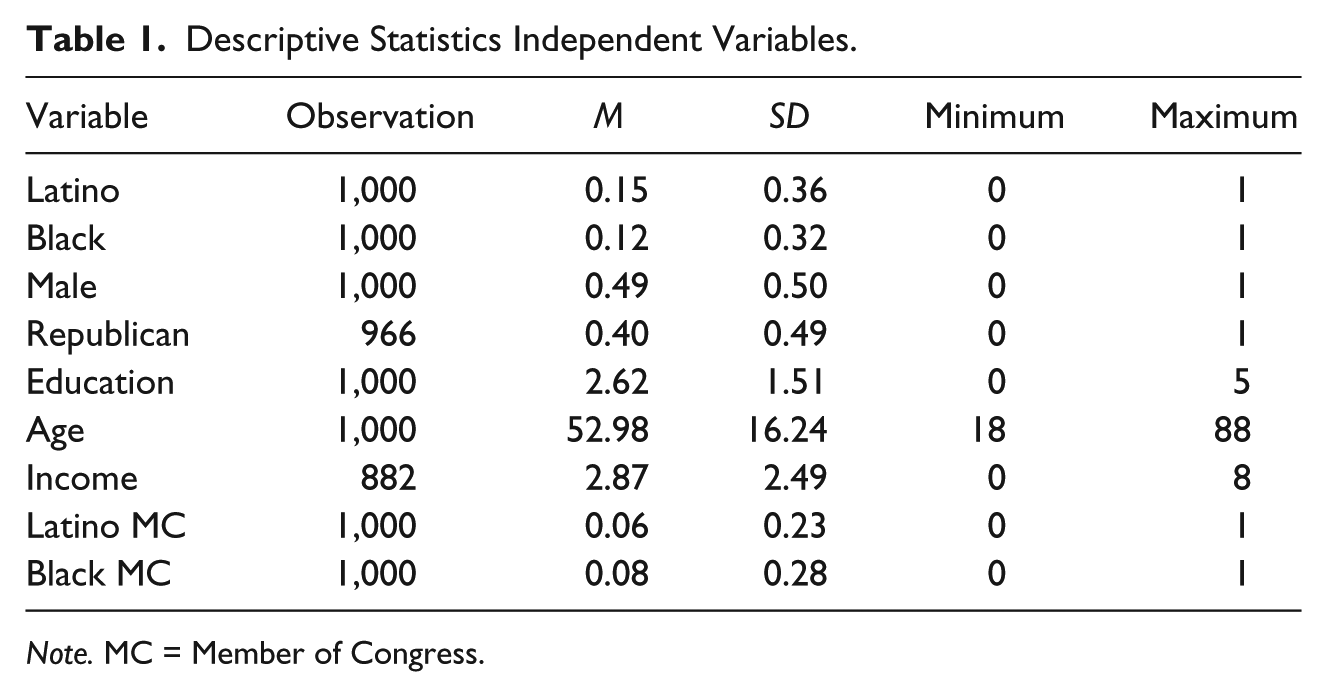
Note. MC = Member of Congress.
Results and Discussion
The statistical results provide strong evidence for the role of race, ethnicity, and party on attitudes toward descriptive representation. Before examining the results of the statistical models, it is useful to turn to a brief examination of various cross tabulations to examine differences in attitudes. For example, when examining the question regarding support for a greater number of legislators from the same race or ethnicity of the respondents, Blacks and Latinos find it very important while a very small fraction of White respondents feel the same need. 8 Table 2 below indicates the breakdown of respondent answers by racial and ethnic group. When examining respondents who feel it is important to some degree, only 16% of Whites feel it is important compared with 53% of Latinos and 64% of Black respondents. These data reveal a significant difference in racial and ethnic group attitudes toward the importance placed on more descriptive representatives. Two possible interpretations of the results are that Whites either do not value descriptive representation, or largely feel they already have enough, while Latino and Black respondents may feel a strong need for more representation.
Support for More Legislators of Same Racial/Ethnic Group.

One noteworthy difference is the disjuncture between respondents’ support for more representatives of their racial and ethnic groups overall, and respondents’ answers when asked directly about the importance of the race/ethnicity of their own representative. The results for the latter question are below in Table 3. Across all three racial and ethnic groups, a sizable majority of people indicate that it is not important at all. While there are still differences across racial and ethnic groups, it is remarkable that so few respondents from racial and ethnic minority groups find it very important. The results to this question are surprising given the results in Table 2, which indicated strong support for more descriptive representatives in general.
Support for Own Legislator to be of Same Racial/Ethnic Group.
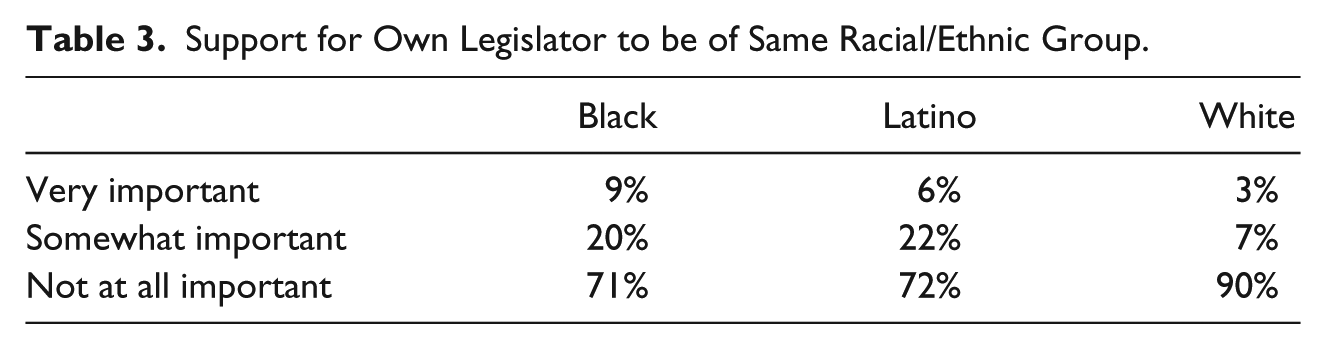
One potential explanation for the results in Table 3 is that members of minority groups do not necessarily believe that more descriptive representation would lead to more substantive representation in line with Swain (1993). Recall that Swain makes the argument that substantive representation is what really matters, and often White Democrats will represent Blacks just as well. For Latinos, voter attitudes about descriptive representation are conditioned on national origin (Sanchez & Morin, 2011). For example, Mexican Americans might value Mexican American legislators over Puerto Rican legislators. However, another possible explanation is that in the aggregate, racial and ethnic respondents are aware that there are few racial and ethnic minorities in legislatures, and thus believe that it is important for their numbers to grow overall. It may also be the case that individuals doubt the benefit of simply having their own elected officials as descriptive representatives rather than a sizeable group that may be able to wield more political influence. Inclusion of secondary data in the statistical models on district demographics, such as the racial and ethnic background of representatives and individual respondent characteristics, will help shed light on the factors that influence attitudes.
The results of the ordered logistic analyses for both dependent variables are presented in Table 4 below. There are two dependent variables and two models for each variable. One dependent variable measures the importance one places on one’s own elected official being of the same race or ethnicity and the second dependent variable measures support for more descriptive representatives in general. The only difference between the models is the second model for each variable (Models 2 and 4) that include an interaction term to examine the role of Latino Republicans.
Attitudes Toward Descriptive Representation.
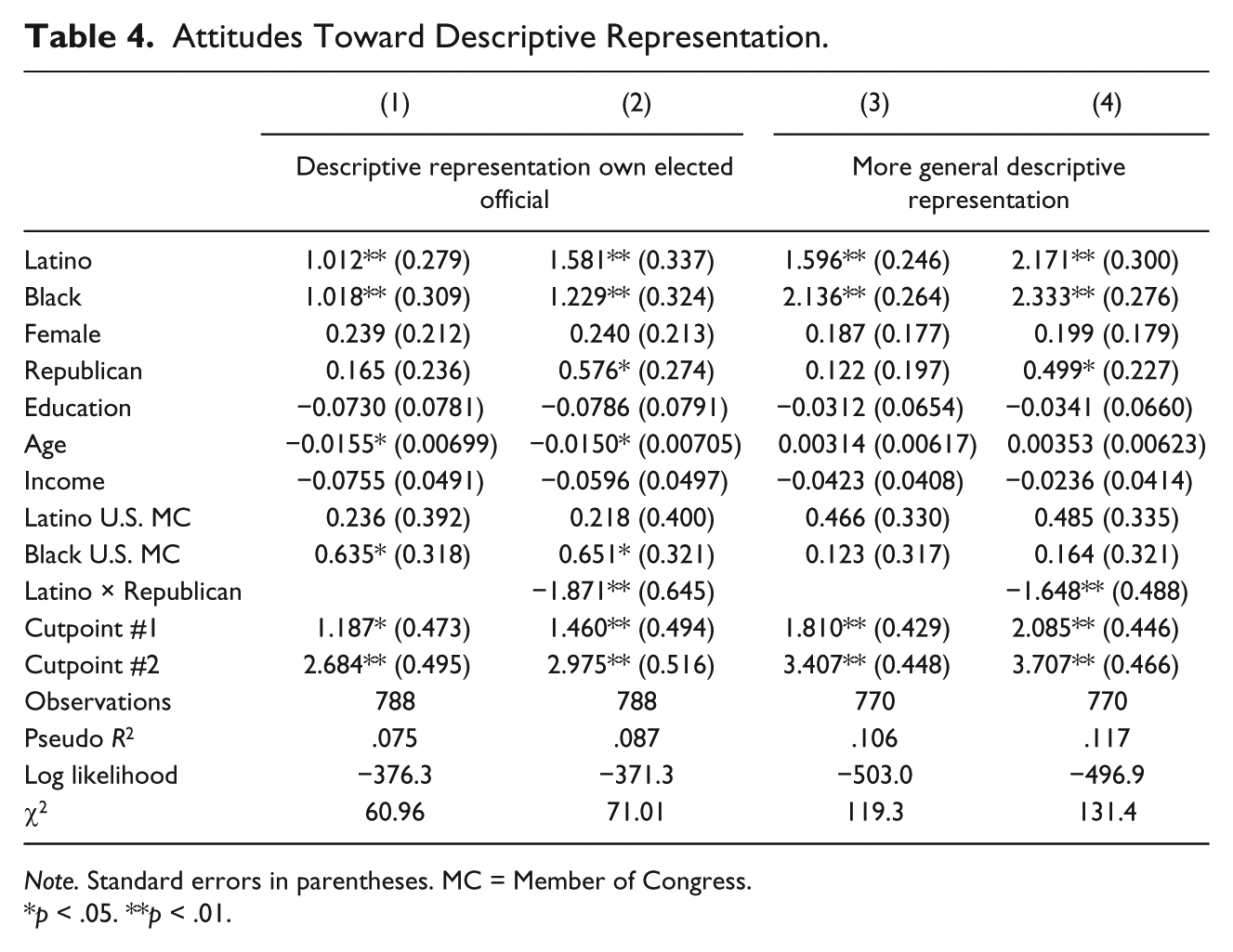
Note. Standard errors in parentheses. MC = Member of Congress.
p < .05. **p < .01.
Race and Ethnicity of Respondents
As we hypothesized in H1, Blacks and Latinos place greater importance on ensuring that the elected officials they elect are of the same race or ethnicity, which is demonstrated in the results from Models 1 and 2. The coefficients for Black and Latino are significant with a p value of .01. Similarly, respondents who have a Black representative are also more likely to value descriptive representation. This is true even controlling for partisanship and a host of other control variables that often diminish the role of race and ethnicity of respondents. These findings suggest that Blacks and Latinos place value on representatives who look like them. 9 This is important because they may perceive a lack of representation by the current political arrangements, and believe that more elected officials of their same race or ethnicity would yield greater degrees of substantive representation.
Our second dependent variable of interest asks how important it is that more legislators of the same race or ethnicity as the respondent are elected to legislatures and Congress. This question is different from the previous one in that it tries to ascertain how important it is to individuals that more descriptive representatives are elected. Do Latinos and Blacks feel that it is important to see greater numbers of legislators from their own group? Our results in Models 3 and 4 provide strong support that the race and ethnicity of the respondent is significant. Blacks and Latinos indicate strong support for more members of their race and ethnicity within legislatures. Both variables are significant across the two models with p values at the .01 level. Similar to the previous set of models, it is critical to recognize that this effect holds in Models 3 and 4 despite controlling for partisanship, gender, income, and many other background variables. One explanation for this result is that the total number of Latino and Black elected officials at the national level is low and people may recognize the numbers are still small.
Latino Republicans
In part, this article seeks to examine the intersection of ethnicity and partisanship. This is particularly important because in recent years, more Latino Republicans have been elected to state legislatures and Congress. While these Latino Republicans were elected with the support of conservative Whites and a smaller proportion of Latinos, it is nevertheless important for the study of descriptive representation. Will the likes of Ted Cruz and Marco Rubio in positions of power lead to more support of descriptive representation among Latino Republicans? Do Latino Republicans care if their legislators are Latinos? In Model 2, which includes an interaction term for Latino Republicans, the variable is significant at the .05 significance level. However, unlike the results for Latino in Models 1 and 2, the direction of the coefficient for Latino Republican is in the opposite direction. In other words, Latino Republicans are less likely to believe descriptive representation is important. This finding suggests that partisanship is a stronger political identity than ethnicity alone for Latino Republicans. Latino Republicans may be satisfied with their representatives who are often White and Republican because of their shared partisanship. This finding should be investigated in future studies given the changing demographics of the electorate as well as the growth of Latino Republicans in legislatures.
The results from our second dependent variable in Model 4 (support for more descriptive representation) reinforce our findings on the intersection of ethnicity and partisanship observed in Model 2. Model 4 examines whether Latino Republicans place importance on more Latinos in legislatures with the inclusion of an interaction term for Latino Republicans. The results for this question are quite remarkable and warrant additional consideration. Latino Republicans are actually less likely to feel that it is important that more Latinos are elected to legislatures. This result is significant at the .01 level and negative. This finding suggests that Latino Republicans are quite distinct from their Latino Democratic counterparts. Latino Republicans may assume that more Latinos in legislatures might mean more Democrats, as most Latinos in legislatures are Democrats. They value substantive representation over descriptive representation because their White representatives are more supportive of their partisan interests. This may change over time as more Latino Republicans make their way to elective offices; however, in the 2012 elections, several Latino Republican MCs lost their seats.
Republicans
Another key variable of interest in this study is the role of partisanship, in particular its effects when it is disentangled from race or ethnicity. In Model 2, which includes the Latino Republican interaction term, Republican is also significant and in a positive direction indicating that non-Latino Republicans also place importance on having descriptive representatives in their own districts. This essentially means White Republicans as there are only six Black Republican respondents in the sample. Similar to Model 2, Model 4 shows that Republicans also feel that it is important that more legislators of their race or ethnicity are elected to legislatures. This finding is also significant at the .05 level. The findings taken together are suggestive of something not typically discussed in the literature. The results suggest that White Republicans feel that it is very important to have representatives from their own racial and group and have more legislators like them elected to legislative institutions.
While White Republicans are hardly under-represented in Washington, it makes sense that such voters would want more representation of their interests rather than less. As noted with the personal need for more descriptive representation, perhaps White Republicans are more racially conscious given the increasing diversity of their surroundings, especially in the South, although see Hero (2000) for a view of how the interaction of White ethnics, minorities, and Anglos have distinct effects on state policies. The growth of minorities in their communities and legislatures might be seen as off-putting to White Republicans for a host of different reasons. In addition, White Republicans may also have a heightened sense of racial identity, especially in areas with growing numbers of minorities. For example, Giles and Hertz (1994) found that White attitudes about Blacks and partisanship were conditioned by surrounding context. White Republicans may therefore perceive racial threat especially from the growing Latino population and fear that their political power is diminishing. While scholars typically discuss descriptive representation in terms of racial and ethnic groups that have been marginalized and under-represented, these findings indicate that White respondents are also capable of valuing descriptive representation for their group and themselves.
Race or Ethnicity of Legislator
In H2, regarding the role of minority MCs, we expected the race or ethnicity of the legislator to play a significant role in influencing attitudes. The results of the statistical analysis do not indicate consistent effects of either Latino MC or Black MC across the models. 10 Latino MC is not significant in any of the models. Black MC is significant and the .05 level in Models 1 and 2 assessing support for descriptive representation of one’s own elected officials, but not in Models 3 and 4 assessing support for more descriptive representatives. Looking at the raw survey data, people living in districts with Black MCs are more likely to express a personal desire for more descriptive representation, yet this variable was not statistically significant in the models analyzing the importance for more descriptive representation in general (Models 3 and 4). This finding might be attributed to the fact that African Americans living in majority Black districts with Black representatives are very satisfied with the representation they are receiving from their Black MCs, but do not sense a need for more descriptive representation in general because they are already content. In short, people living in districts with Black MCs are more likely to place importance on descriptive representation for their own elected officials. One possible explanation for the differential results for Black MCs is that Blacks in these districts may have a higher level of linked fate and may place a higher level of importance on their own representative being of the same racial group as a result.
The non-findings for Latino MC may indicate that Latino MCs have less visibility to respondents and thus consequently less effect on their attitudes toward representation. Black constituents may be able to point to relatively famous Black elected officials who have served in office for many years, such as Maxine Waters (D-California) or John Conyers (D-Michigan). The same cannot be said for Latino MCs due to their shorter tenure and population within Congress. This may help explain some of the differences in these findings between the effects of Black MC and Latino MC.
Turning toward covariates other than the race of the ethnicity of the respondent and party, many of the variables in the models do not have a significant effect on the attitudes toward representation. We do not find significant effects for education or gender in any of the models, nor do we find consistent effects for income or age. The findings of the statistical analyses indicate the strong role of race and ethnicity in attitudes on representation in addition to the role of party under certain conditions.
Substantive Effects
Using Clarify, 11 we estimate the substantive effects of the explanatory variables on the two dependent variables of interest. We do this because of the inherent difficulties in interpreting coefficients in ordered logit models. We now turn to a discussion of the substantive effects displayed in Figures 1 and 2 and Table 5. The values report the difference in probability a respondent will answer the highest value on a survey item if the value of a given variable is changed from its minimum to its maximum, while holding all other variables constant. For continuous variables, the estimate shows the first difference as a result of moving from the minimum to maximum values for each variable. For dichotomous variables, the first difference represents a change from 0 to 1. Ninety-five percent confidence intervals are indicated by the lines in the figures and in brackets.
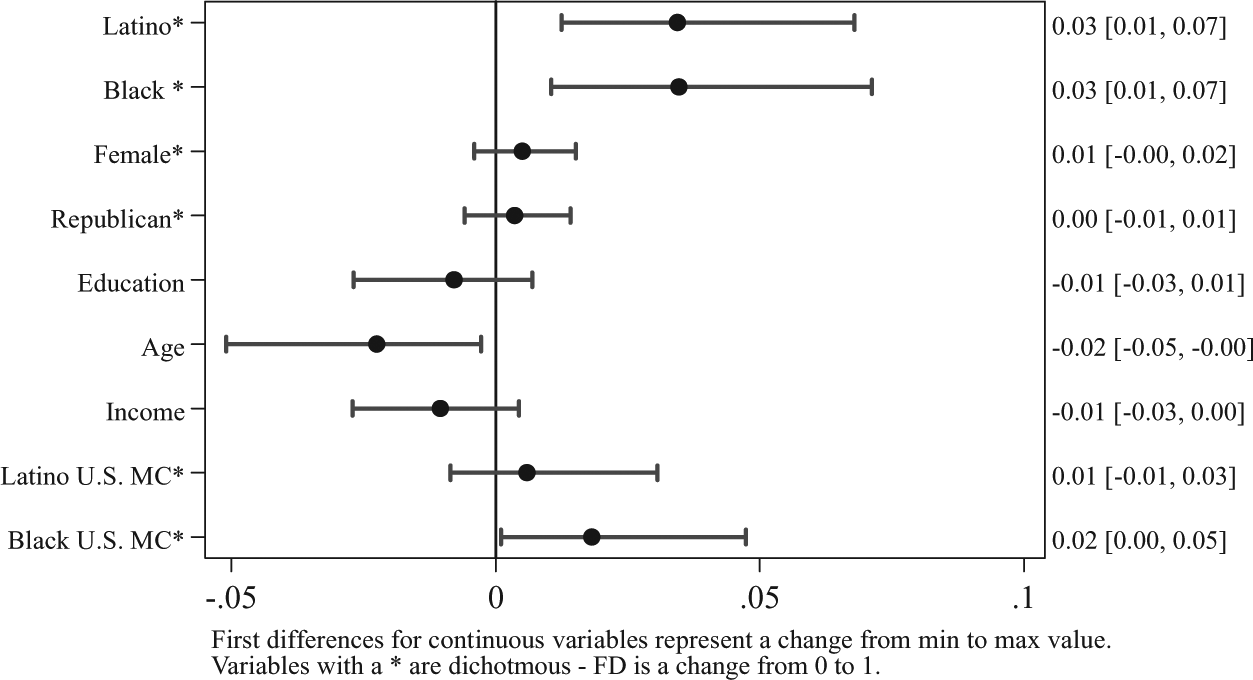
Substantive effects for descriptive representation own elected official for “very important” answer choice.

Substantive effects for more descriptive representation for very important answer choice.
Impact of Race and Partisanship on Probability Believe Descriptive Representation Is Very Important.
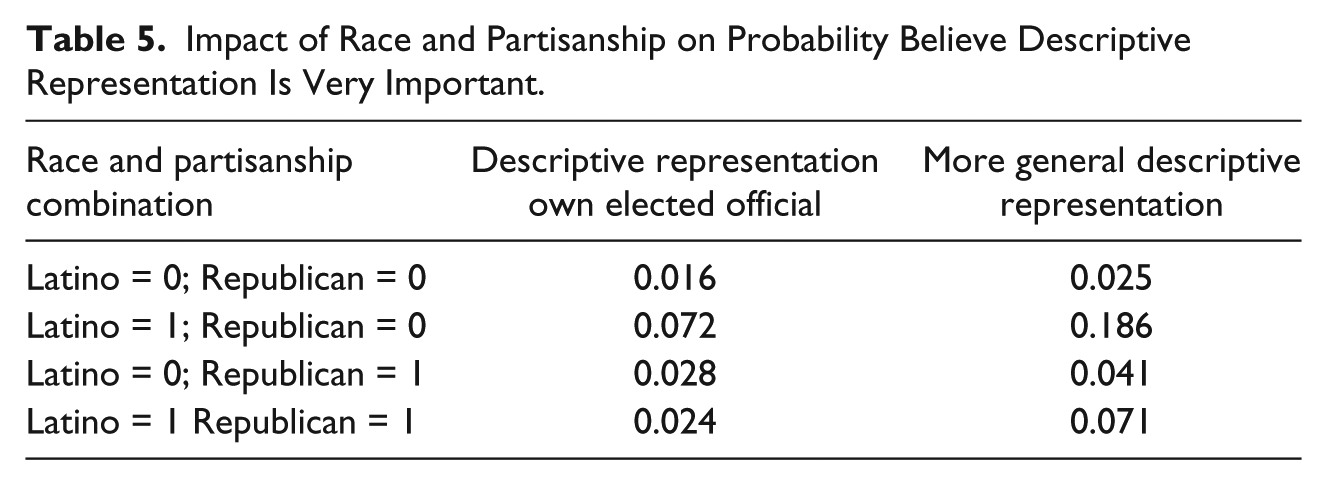
Figure 1 depicts the results for answering very important for the first dependent variable: importance of descriptive representation of own elected official. Here we see that for Blacks and Latinos, the probability of answering very important results in a 3-point increase. These may not appear significant, but when compared with the baseline, such groups are significantly more likely to say that having legislators from their own group is very important to them.
The substantive effects of the explanatory variables on desire for more descriptive representatives in general are displayed in Figure 2. The results are similar in direction to Figure 1 in many ways. However, the size of the effects of race and ethnicity variables is considerably larger. Latinos are 11 percentage points more likely to answer very important to this question, and an even stronger effect of an increase 18 percentage points for Blacks. These results show that the two largest minority groups are strong supporters of increased descriptive representation in legislatures even controlling for other socioeconomic characteristics. No other variable has such an impact either in the negative or positive direction than race or ethnicity.
Table 5 takes a closer look at the interaction term of Latino Republican to examine how party and race and ethnicity affect the probability of answering very important for the two dependent variables of interest. The first column lists whether the respondent was Latino or non-Latino and Republican or non-Republican. 12 The coding for these two dichotomous variables was Latino = 1 if the respondent is Latino; 0 otherwise. Republican = 1 if the respondent is Republican; 0 otherwise. Non-Latino Democrats are 1.6% and 2.5% more likely to respond very important for the two dependent variables. Latino Democrats, on the other hand, are 7.2% more likely to say that it is very important that their representative is Latino, and 18.6% more likely to say that it is very important that more Latinos are elected to legislatures. This demonstrates a strong effect of ethnicity when holding party constant.
When comparing Republican respondents, there is little difference between Latinos and non-Latinos on the first question concerning overall importance of descriptive representation with 2.8% versus 2.4% effect on answer choice. Non-Latino Republicans are 4.1% more likely to value more descriptive representation which is a larger effect than Non-Latino Democrats. This finding resonates with the discussion above regarding how White Republicans value more representatives of their same race in legislatures and Congress. When comparing Latino and non-Latino Republicans on the second dependent variable of need for more descriptive representatives in general, the effect of Latino Republican is almost twice the size of non-Latino Republicans with 7.1% compared with 4.1%. These results, while not as strong in intensity as the results for Black and Latino non-Republican respondents, still demonstrate the powerful role of ethnicity. For Latino Republicans, partisanship mediates their support for descriptive representation; however, ethnicity clearly still plays a role in increasing their support.
Conclusion
Scholars have not fully investigated minority groups’ attitudes toward legislators. This research augments our understanding of minority group attitudes and evaluations of legislators by examining Black, White, and Latino attitudes in the same analysis. Very little scholarly work has attempted to ascertain how minority group members feel about descriptive representation compared with Whites. By focusing on individual attitudes, this article builds on existing scholarly research examining the costs and benefits of representatives possessing different demographic traits. We hypothesized that minority respondents value descriptive representation in unique ways because of a history of exclusion and discrimination. This expectation is based on a body of research showing the role of linked fate in political consciousness and the importance of trust that flows from co-ethnic shared experiences. This study has confirmed our theoretical expectation that Latinos and Blacks do care about having representatives of their race or ethnicity and want more members from their own group. However, we also find that Whites place value on descriptive representation. White Republicans are slightly more likely to desire more legislative members of their own race compared with White Democrats. Somewhat surprisingly, Republicans overall express a personal desire for descriptive representation and feel they need more of it.
For Latinos, being Republican reduces support for descriptive representation overall and the need for more representatives, although Latino Republicans generally want more of their own in legislatures. Other studies have shown that Black Republicans are also less supportive of descriptive representation, possibly for similar reasons—that more Black representation implies more Democratic representation. For Latinos, demographic changes have led to greater spatial dispersion across congressional districts, and it will become critical to understand both their engagement with representatives and evaluation of MCs. In addition, the rise of more Latino elected officials who are Republican may ultimately change the views of Latino Republicans toward descriptive representation.
Attitudes about descriptive representation are strongly influenced by race and ethnicity, even when controlling for other socioeconomic variables, including partisanship. Latinos and Blacks feel strongly that descriptive representation is important and that more co-ethnic legislators are important. Our research demonstrates the effect of being Latino or Black is stronger on support for having more general descriptive representatives than one’s own elected officials. This could be in part explained by recognition that a critical mass of descriptive representatives is necessary to wield political influence and translate descriptive representation into substantive representation. Up until now, very little research has explored how Whites feel about descriptive representation. Our analysis sheds light on this unexplored area by finding that White Republicans value descriptive representation and want to see more of their own in legislative positions. This finding should be explored in further research, as most of the research on descriptive representation and its importance focuses exclusively on minorities.
This research also has important implications given the Supreme Court’s ruling in Shelby County v. Holder in 2013. After 1990, numerous majority−minority districts were created by state legislatures especially in the South. This led to a growth in the number of African American and Latino MCs in the 1990s and 2000s. Now that states will not be subject to preclearance, the implications for minority representation are in question. Whether Congress decides to revisit Section 4(b) remains unclear, but the future of preclearance is at stake, given that Section 5 relies on formulas established by Section 4(b). Even the Court admitted that the Voting Rights Act had been successful in one of its goals of making it easier for minorities to elect their candidates of choice often via majority–minority districts. We know that minorities value descriptive representation at levels exceeding that of Whites; however, the elimination of preclearance might jeopardize the ability of minorities to elect candidates of choice in areas with a history of racial discrimination. If this happens, then more people of color might feel even more unrepresented by their representatives, posing additional challenges for representative democracy.
Footnotes
Acknowledgements
The authors would like to thank the editor, anonymous reviewers, Christian Grose, Monika McDermott, Chris Stout, and Geoff Wallace for their helpful comments and suggestions. The authors thank all participants for their feedback.
Authors’ Note
Earlier versions of this article were presented at the 2013 Annual Meetings of the American Political Science Association, Western Political Science Association, Midwest Political Science Association, Southern Political Science Association, and the University of Houston Department of Political Science.
Declaration of Conflicting Interests
The author(s) declared no potential conflicts of interest with respect to the research, authorship, and/or publication of this article.
Funding
The author(s) disclosed receipt of the following financial support for the research, authorship, and/or publication of this article: This project received financial support from the Irma Rangel Public Policy Institute at the University of Texas at Austin.