




Abstract
Many observers are concerned that campaign contributions could affect the decisions of elected judges. However, the empirical correlation between contributions and judicial decisions is consistent with two different explanations of judicial behavior: (a) money influences judges or (b) contributors choose to support candidates with a similar philosophical or legal perspective. In this article, we take advantage of North Carolina’s shift to a voluntary public finance system for state Supreme Court candidates to obtain more credible estimates of the contributions–behavior relationship. Applying a difference-in-differences research design, we provide evidence that justices who opted into public financing became relatively less favorable toward attorney donors. We also find partial support for our hypothesis that participating justices became more moderate in their voting patterns. Taken together, these findings suggest that public financing reduced responsiveness to donors among participating justices.
Introduction
Do campaign contributions affect the decisions of elected officials? If donors receive favored treatment as some have alleged, it represents a distortion of the democratic system and undermines the legitimacy of existing campaign finance regulations. The possibility of contributor influence is especially troubling for elected judges, who have a professional responsibility to serve as dispassionate arbiters of the law but face conflicts of interest when attorney contributors represent clients in cases before them. Members of the bar frequently have business before state courts and contribute a significant proportion of the money raised in judicial elections. As a result, observers worry that justices may be biased, either consciously or unconsciously, in favor of attorneys who supported their election bids in the past. This concern is so pronounced that the Supreme Court cited it in a 2015 decision (Williams-Yulee v. Florida Bar) as among the chief reasons for finding the states have a compelling interest in restricting the fundraising of candidates for judicial office: “Potential litigants then fear that ‘the integrity of the judicial system has been compromised, forcing them to search for an attorney in part based upon the criteria of which attorneys have made the obligatory contributions’” (Simes v. Arkansas Judicial Discipline & Disability Comm’n, 2007).
A related concern is that donors exert undue influence on the judicial philosophies of elected judges. Numerous scholars have argued that the interests of contributors are better represented than the interests of the average citizen in various political institutions (e.g., Bartels, 2008). In particular, activist influence has been linked to growing levels of ideological extremism and polarization (Layman, Carsey, Green, Herrera, & Cooperman, 2010), suggesting that donors in judicial elections may contribute to increased levels of extremism on the bench. 1
These suspicions about the influence of money on judicial behavior have been exacerbated by the marked increase in spending on judicial elections in recent years (Sample, Hall, & Casey, 2010). Fears about the corrupting influence of money have escalated to alarming heights with prominent critics claiming that this trend “threatens to destabilize fair and impartial courts” (Brandenburg, 2012, p. 1). For instance, former Supreme Court Justice Sandra Day O’Connor has written that, if “[l]eft unaddressed, the perception that justice is for sale will undermine the rule of law that the courts are supposed to uphold” (O’Connor, 2010a, p. iii).
Despite growing concerns among policymakers, reformers, legal observers, and even the public, the political science literature has struggled to provide a clear answer about the effect of judicial contributions. Is the recent flood of money into the judicial system corrupting justice? Are judges beholden to their donors? If so, what reforms would ameliorate these problems? With only a few exceptions discussed below, the quantitative political science literature has failed to address these issues effectively.
The problem, of course, is the inherent difficulty of establishing the direction of the contributions–behavior relationship, which hinders research on the effect of campaign contributions on judicial decision making. Although it is possible to demonstrate a correlation between contributions and behavior in nearly any electoral institution, providing credible evidence that such a correlation represents a causal effect is much more difficult. Any such correspondence could be the result of elected officials taking actions that are biased toward contributors or the more prosaic tendency for contributors to support candidates with similar philosophical or ideological perspectives.
These possibilities have dramatically different normative implications for the proper functioning of the judicial system. Observing a correlation between the interests of contributors and the decisions of justices may demonstrate that justices are influenced by contributions. Special treatment of this kind—even if unconscious or subtle—threatens the legitimacy of judicial institutions and undermines the notion that all citizens are equal before the law. Alternatively, contributors may give to candidates whom they anticipate will be favorable to their interests. Candidates for the high court are often well known in the legal community. Contributors may simply forecast candidate’s future behavior in office and choose to support candidates with similar ideological perspectives. In this scenario, a positive correlation between contributions and voting reflects the ability of donors to anticipate judicial decision making.
As a result of these challenges, most scholars of judicial behavior have neglected either the topic or the inferential challenges it presents. Failing to study the effects of judicial contributions is unsatisfying and contributes to the marginalization of the discipline in contemporary debates (Lupia & Aldrich, 2014). However, research that does not address the causal inference issues described above can sometimes be counterproductive. Palmer and Levendis (2008), for instance, used correlational data to “question the voting behavior of Louisiana’s highest court” (p. 1291), an approach that was sharply criticized by fellow scholars (Newman, Speyrer, & Terrell, 2009; Tully & Gay, 2009) and resulted in the Dean of Tulane Law School writing a letter of apology to the court (Finch, 2008).
We seek to resolve this dilemma by eschewing the typical correlational approach in favor of a research design focused on North Carolina’s shift to a voluntary public financing system for judicial candidates, an institutional reform that provides us with the leverage needed to make plausible causal claims about the relationship between campaign contributions and judicial behavior. In so doing, we join a more limited body of scholarship aimed at carefully considering the difficult endogeneity issues surrounding the contributions–behavior relationship. This design requires a careful trade-off. North Carolina is, of course, only one state, and the effects of the reforms can only be estimated among a limited number of judges whose tenure overlapped the reform. These facts limit the generalizability of our study. However, our design allows us to more carefully estimate the effects of clean money reforms and thereby help to disentangle the contributions–behavior relationship. 2
The rest of this article proceeds as follows. We begin by reviewing past research on the relationship between contributions and the behavior of judges and specifying our research hypotheses. Using a unique data set of judicial decisions and attorney contributions, we then apply a difference-in-differences strategy to examine two specific mechanisms by which reform may change the relationship between contributions and judicial decision making. First, we provide evidence that justices who opted into public financing became relatively less favorable toward attorney donors than those who did not. Second, we find partial support for our expectation that judges who opted in would become more ideologically moderate than we would have otherwise expected. In combination, these results suggest that public financing makes participating justices less responsive to the interests of donors, lending support to reformers advocating for public financing in state judicial elections. We conclude by considering the implications and the limitations of our findings.
The Effects of Campaign Finance on State Courts
As the cost of running for state Supreme Court seats has escalated in the past two decades (Bonneau, 2005), concerns have grown about the potential influence of donors on judges who rely on their support to win elections. As misgivings about the integrity of the courts have grown, some states have enacted policies to shield justices from potentially corrupting influences. While some reforms aim to encourage more recusals (Meizlish, 2010), others seek to alter the campaign finance system itself. In particular, reformers have proposed providing public financing for judicial elections, which advocates claim “removes the influence of special interests” (“Editorial: Democracy Undone,” 2013). Following the passage of public financing reforms in North Carolina in 2002, New Mexico, Wisconsin, and West Virginia used the system as a template for their own public funding systems (National Center for State Courts, 2011). The policy has also been considered in several other states including Kentucky, Ohio, Maryland, and Washington (National Center for State Courts, 2011).
The effects of judicial campaign contributions are also a central issue in the larger debate over the merits of judicial elections and have received extensive attention from judges (see, for example, Cobb, 2013; O’Connor, 2010b), commentators (see, for example, “Editorial: Judicial Elections,” 2013), and legal scholars (see, for example, Chemerinsky, 1998; Kang & Shepherd, 2011). Perhaps most notably, the U.S. Supreme Court ruled in Caperton v. A. T. Massey Coal Co. (2009) that “a serious, objective risk of actual bias” required the recusal of a West Virginia state Supreme Court justice from a case involving a company whose CEO had spent more than US$3 million through a nonprofit organization in support of the justice’s candidacy. While Caperton is obviously unusual, fundraising in judicial elections raises concerns for many observers about the rule of law and the legitimacy of the courts. For instance, the American Constitution Society report Justice at Risk concludes that “Until reforms are enacted, powerful interest groups’ influence on judicial outcomes will only intensify” (Shepherd, 2013, p. 15).
Despite this large and growing debate, court scholars have struggled to reach a consensus on the effect (if any) that campaign finance regulations have on judicial decision making. Political scientists and legal scholars have of course spent considerable time and effort investigating the nature of judicial decision making more generally, including the influence of various political institutions. Unlike appointed federal judges, who enjoy life tenure, many state judges are elected and must be reelected to continue to serve. Selection and retention systems have been shown to shape the decisions that judges make (e.g., Brace, Langer, & Hall, 2000; Choi, Gulati, & Posner, 2010). However, while previous research has examined the effects of various institutional arrangements for selecting and retaining judges (e.g., M. G. Hall, 2001), these studies have focused mostly on electoral rules (e.g., party labels) rather than campaign finance regulations. The specific institutional regime we analyze here—voluntary public financing for high court candidates—has received considerably less attention in the empirical literature. 3
Approaches to Understanding the Effect of Judicial Contributions
The most closely related empirical literature to our study examines whether judges are more likely to rule in favor of parties or attorneys who are contributors (e.g., Bonneau & Cann, 2009; Cann, 2007; McCall & McCall, 2007). A related stream of research has focused on the influence of campaign donors on broader voting patterns. Waltenburg and Lopeman (2000), for instance, argue that judges backed by plaintiffs’ attorneys vote more favorably toward plaintiffs in tort cases, while Ware (1999) finds that Alabama Supreme Court justices are more likely to rule in favor of donors’ interests in the area of arbitration law. Similarly, Kang and Shepherd (2011) and Shepherd (2013) found evidence that judges are more likely to vote in favor of business litigants when they receive more donations from business groups.
While such studies are important for establishing empirical regularities, these results can be difficult to interpret. In particular, it remains unclear what effects contributions have on judicial decision making and how they might be altered by public financing. The endogenous nature of campaign contributions makes untangling the contributions–votes relationship very difficult (as many of the empirical works cited above explicitly acknowledge). Observing a correlation between the interests of donors and the decisions of judges is consistent with multiple causal relationships, not all of which impugn the integrity of the judicial system. There are many reasons why we might expect judges to vote more often in favor of lawyers who have made campaign contributions. Most simply, attorneys may support judges whose philosophy is most consistent with their own or the interests of their clients.
In this article, we contribute to a smaller branch of research that seeks to more carefully identify the causal effects of contributions on judges. McCall (2003), for instance, examines whether judges are more likely to vote in favor of parties represented by attorney contributors despite indications that they are not ideologically aligned. Similarly, Cann, Bonneau, and Boyea (2012) use a matched case-control design to compare voting by justices who have similar ideologies but differ in whether they received a contribution from an attorney in a case. Finally, one published study has analyzed the question using an instrumental variables (IV) framework (Cann, 2007). 4 Each of these studies finds evidence that contributions from attorneys increase judicial support for the position they advocate.
While these studies make important contributions, they also rely on identifying assumptions that may be open to question. For instance, the validity of the Cann (2007) model, like all IV models, depends on two untestable assumptions that may be invalid in practice (Sovey & Green, 2010). As an example, consider one of the instruments used in the study: whether cases are argued by a public defender. For that instrument to be valid, we must accept two assumptions. First, the presence of a public defender as an attorney in the case must have no effect on the justice’s voting except through contributions—an implausible assumption given the evidence that indigent defendants often lack effective counsel (e.g., American Bar Association, 2012). Second, there must be no unmeasured variables that affect both the probability of having a public defender and the likelihood of receiving support from a justice. However, many factors that lead parties to be represented by public defenders could also affect later decision making. For example, racial minorities are disproportionately likely to be represented by public defenders (e.g., Marcus, 1994) and may be treated in a biased fashion by judges (e.g., Alesina & Ferrara, n.d.). Similar concerns apply to the matched case-control design in Cann et al. (2012), which assumes that judges are matched on all characteristics related to receiving contributions from an attorney in a case.
Given these concerns, it seems reasonable to use a different approach that relies on different assumptions that could increase our confidence in the validity of prior estimates. In this article, we therefore apply difference-in-differences models to identify the effect of the North Carolina public financing reform on the relationship between contributions and judicial behavior—a context that we argue is especially useful for obtaining a valid causal inference (Section A of the Supporting Information (SI) provides details on the law).
Theory and Hypotheses
We leverage the North Carolina public financing reform to examine two common claims about the effects of campaign contributions on judicial decisions. First, we ask whether public financing reduces the bias that critics allege judges exhibit in favor of parties whose attorneys have contributed to their campaigns. The theory of why campaign contributions could be valuable enough to judges to influence their behavior is relatively straightforward. Elected judges must prioritize reelection above other goals; they cannot satisfy any of their preferences if they are not reelected (Cann, 2007). The campaign activities funded by such contributions are important to reelection and thus significant to elected judges (see, for example, Bonneau & Cann, 2011). 5 In addition, contributors may provide not only direct financial support but also other forms of indirect assistance to judicial campaigns, including advocacy on behalf of the candidate within and outside of the legal community. A contribution may be seen as an indicator of support that is far more valuable than the dollar amount alone suggests. Furthermore, judges may vote in favor of donors to help ensure future contributions, which are most likely to come from past supporters (Min, Miller, & Curry, 2013). Thus, while judges must also safeguard their reputations as unbiased arbiters, their reputational concerns and intent to treat litigants fairly may on occasion be outweighed (perhaps unconsciously) by the desire to please contributors whose support is necessary in modern judicial elections. As one judge summarized these concerns, “A saint would be hard-pressed to disregard the fact that one litigant gave them a huge contribution while the other gave them nothing. Most of our judges are not saints” (quoted in Meizlish, 2010, p. 1881).
Although public funding does not eliminate the role of donors entirely, it greatly reduces the potential influence of an individual donor. Under the public finance system, donors are no longer the financiers of the campaigns, but instead serve as a safeguard against truly unpopular candidates taking advantage of public funding (Kotey, 2005). All donors in the public financing system are small donors—no contributor can give more than US$500. More importantly, candidates only require and are limited to a small number of donors to qualify for public financing, which is allocated to qualifying candidates during each election. 6 Thus, a candidate who receives public funding need only replace a small number of disaffected donors to achieve the threshold for receiving public funds, which should in turn reduce any procontributor bias.
What effects might this shift have? First, public financing might decrease any tendency for officials to offer particularistic benefits to donors (e.g., Snyder, 1992). These benefits are hypothesized not as bribes, but rather as a tendency for officials to consciously or unconsciously favor contributors or be more attentive to them at the margin. For instance, donors may receive increased access to elected officials or exert more effort on their behalf (Austen-Smith, 1995). Similarly, judges who have cultivated contributors may be more aware of or sensitive to their concerns as a result (perhaps inadvertently).
Our study focuses specifically on the effects of public financing on judicial voting in cases involving attorney donors, who are a key source of campaign funds for judicial candidates. During the 2000 to 2009 period, for instance, 29% of total funds contributed in high court elections came from attorneys (Sample et al., 2010). Furthermore, attorneys appear to be a far more important source of funds than litigants themselves. One study of civil, nonfamily law cases in four states found that 94% of contributions to judges from attorneys or litigants came from attorneys (Min, Miller, & Curry, 2013). Our expectation is that the shift to public financing should make justices who opted into the system less likely to favor attorney donors in their votes (relative to nondonors) than those who did not receive public financing.
Second, reform may reduce the polarizing effects of judicial candidates’ reliance on private funding. Past research has shown that campaign contributors are more ideologically extreme than the general public (e.g., Francia, Green, Herrnson, Powell, & Wilcox, 2003) and that the views of donors and other political activists are disproportionately represented by elected officials’ behavior (Bartels, 2008), contributing to polarization (e.g., Layman et al., 2010). If, as some have argued, public financing frees candidates from needing to cater to the concerns of their donors, justices who opt into the public financing system should become more moderate in their voting relative to those who do not participate.
Changes in Voting on Attorney Donor Cases
We first consider whether North Carolina Supreme Court justices who opted into the public financing system changed the way they voted on cases argued by donor attorneys. Before presenting our results, we describe our data and the difference-in-difference-in-differences (DDD) methods we use to identify the effects of participation in the public financing system.
Data
Our unit of analysis here is a vote by a North Carolina Supreme Court justice in a nonunanimous case 7 with a clear outcome 8 that was decided between January 1, 1997 and December 31, 2009 and accompanied by a published opinion. 9 The cases in our data were identified using two different searches via LexisNexis (“dissenting” and “dissent”) and then compared and verified by a research assistant. For each case, we recorded the identities of the parties in the case, the case history, the outcome, the nature of the suit (civil or criminal), and whether a governmental entity was a party to the case. In addition, the reported opinions identified the author of the majority opinion, the author and signers of any separate opinions, and which justices did not participate in the decision (if any). This information was compared against the composition of the Court at the time of the decision to determine the votes of all the relevant justices. 10
For each case, we used state campaign finance records to identify prior contributions made by any attorney representing a party in the case to a voting justice. 11 We looked for contributions from these attorneys 12 over the previous 8 years, which matches the duration of a North Carolina Supreme Court electoral cycle. 13 The contribution data included the donor’s name and profession as well as the date and value of the contribution. For those who listed job titles or professions that suggested they were attorneys, we verified that the person was a practicing attorney in the state using the relevant North Carolina Legal Directory (1997-2009) for that year, which is the official directory of the North Carolina State Bar. Extensive work was undertaken to properly match attorney names across cases and contribution records. Finally, we used news reports and campaign finance records to determine which justices opted into the public financing system.
It is worth emphasizing that a significant proportion of nonunanimous cases heard before the court are (potentially) affected by attorney donations. Of the 125 qualifying cases in our sample, more than one third involved at least one justice who had received a donation from at least one of the attorneys (44 cases, 35.2%) and more than 1 in 10 (17 cases, 13.6%) involved two or more judges, including 1 case in which seven of the nine justices had received contributions from attorneys of one or more of the parties.
In the prereform period (1990-2002), we identified US$955,872 in contributions from attorneys to justices (median: US$250). Corresponding with national trends, the amount of money contributed by attorneys increased dramatically over this period, increasing from approximately US$20,000 in the 1992 to 1993 period to nearly US$440,000 in the 2000 to 2001 period. In the postreform period (2003-2009), we identified contributions from attorneys totaling US$719,629 (median: US$200). These data suggest that the reforms did not dramatically reduce the flow of attorney contributions in general.
Despite this trend, however, the reforms did have a remarkable effect on the amount of money raised by the specific justices who opted into the system when compared with those who did not. Of those who served both before and after the reforms, the two participating justices received roughly US$180,000 (median: US$100) during the postreform period while the four nonparticipating justices received over US$480,000 (median: US$250).
DDD Analysis of Donor Treatment
Although we can establish that judges who opted into the system received considerably less money in the postreform period than their counterparts who chose not to participate, the question we wish to answer is whether the reforms also affected their voting behavior in nonunanimous cases. To do this, we conduct a variant of a difference-in-differences analysis. These models are a common approach to estimating the effects of public policy changes (for recent reviews, see Imbens & Wooldridge, 2009; Lechner, 2011). Under certain assumptions discussed further below, difference-in-differences models can recover the effect of a policy change by comparing the changes in the behavior of those affected by the reform (i.e., those justices who opted into the public financing system) with the changes in the behavior of those not affected by the reforms (i.e., those justices who did not opt into the public financing scheme) over the same time period. If the behavioral changes observed in the time period differ significantly between the two groups, we can attribute this difference-in-differences to the reform itself. Unfortunately, this design requires that we restrict our analysis to the votes cast by the six justices who served both before and after reform, which also ensures that our results are not affected by changes in the composition of the court over time.
In our first analysis, however, the unit of analysis is not the justice but the justice vote. We do not anticipate that the reforms will affect each and every vote cast by the justices who participated in the public financing scheme. Rather, we expect the reform to affect only justice votes in which an attorney in the case previously contributed to the justice in question. We do not expect there to be an effect on justice votes when no attorney on either side has previously contributed to the justice. When only some observations are affected by the reform (e.g., votes on cases involving attorney donors), we can use a DDD model to estimate the treatment effect (Gruber & Poterba, 1994).
To make this DDD approach clear, it is helpful to think through a hypothetical example. Assume that donations come only from plaintiff attorneys and that there is no need for any additional covariates. Further assume that justice behavior is summarized in Table 1, which shows the proportion of the time justices vote in favor of plaintiffs in our hypothetical.
Understanding DDD: Hypothetical Justice Voting Before and After Reform.

Note. Each cell shows the proportion of the time the justices vote in favor of the plaintiff in a hypothetical example. DDD = difference-in-difference-in-differences. Pr(vote plaintiff) = the probability of a justice voting in favor of the plaintiff.
Under these assumptions, the effect of the reform can be calculated as
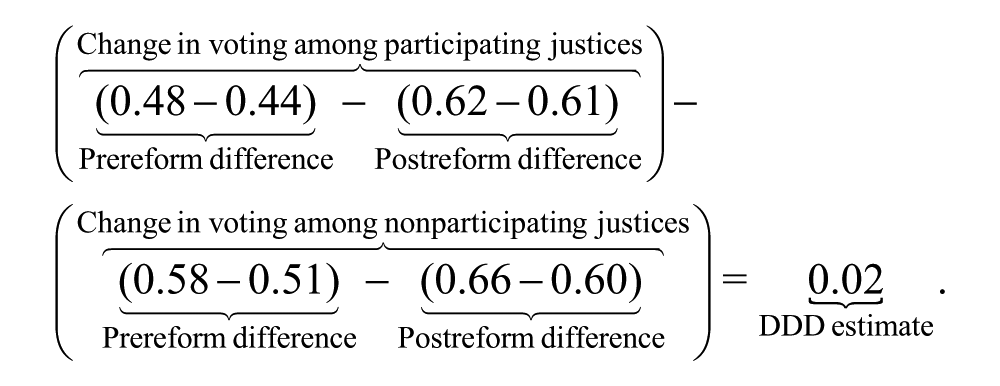
We compare the donor/nondonor difference in voting patterns pre- and postreform between justices who served under private financing and later opted into the public financing system and those who served pre- and postreform but did not receive public financing. 14 If the North Carolina reforms were successful in reducing prodonor favoritism, justices who opted into the public financing system should have voted less frequently in favor of donor attorneys after reform (relative to nondonor cases) than before the reform compared with those justices who did not receive public financing.
We define a donor as an attorney on a case who gave US$100 or more to a justice voting on the case in prior 8 years before the case was heard—the duration of a North Carolina Supreme Court term. Restricting our definition to larger contributions or shorter time periods would mean identifying the effect of contributions based on fewer affected justice votes, which would further limit the generalizability of our results. While US$100 might seem small, very few nonunanimous cases are decided by the North Carolina Supreme Court each year (an average of 10 per year during the 1997-2009 period), reducing incentives for every attorney to contribute. Moreover, even modest financial contributions are an indicator that the attorney in question is a political supporter of the justice more generally. As such, the contributor might also have provided other forms of nonfinancial assistance to the justice’s campaign in the past or could be expected to do so in the future—a relationship that could induce favoritism or disparate treatment. Most importantly, this definition does not affect our results, which we show in SI-D are robust to defining a donor using a higher contribution threshold (US$250) or shorter time period (4 years).
In addition, we define the treatment as taking place after passage of the law in 2002 for those justices who eventually opted into the system. In other words, although justices could not formally opt into the public financing system until January 1 of the year prior to the election in which their seat would be contested, we assume that justices anticipated this process and changed their behavior beginning in the year following the passage of the law (i.e., cases decided in 2003). Thus, the relevant treatment period is defined in our models below as post-2002 rather than the period in which the justice formally entered the public financing system (see SI-A for additional details about the reforms).
Differences between justices
One of the core advantages of the DDD model is that it accounts for time-invariant individual- and group-level confounding factors. To make this point clear, it does not matter if the judges who opted into the system differ in their general voting patterns from the justices who did not opt into the system (e.g., Angrist & Pischke, 2009). Any time-invariant differences between participating and nonparticipating justices are accounted for by the model. Indeed, it is precisely to handle individual-level heterogeneity that DDD models were developed.
In Table 1, for instance, the hypothetical nonparticipating justices are more likely to vote in favor of donor attorneys than participating justices in both the pre- and postreform periods. 15 However, any such time-invariant difference in behavior is irrelevant to the calculation of the treatment effect; each group’s average tendency to favor donor attorneys is “differenced out” in Equation 1 when the postreform difference is subtracted from the prereform difference within each group of justices.
Turning to our real data, one of the justices who opted into the system is a Democrat (Parker) and one is a Republican (Edmunds). However, all of the justices who chose not to participate in the public financing system are Republicans (Lake, Martin, Orr, and Wainwright). Nonetheless, any time-invariant effects of party affiliation do not confound our analysis, which still provides valid estimates of the effect of reform so long as the parallel paths assumption described below holds. A similar response can be made regarding any potential confound associated with time-invariant differences between participating and nonparticipating justices including their differences in their ties to specific law firms or professional organizations, ideological leanings, level of perceived electoral security, or attitudes toward fundraising and donors.
Differences between periods
A further advantage of the DDD model is that it accounts for time-varying confounders that affect all observations. In our toy example, for instance, Table 1 shows that the hypothetical justices in both groups support plaintiffs more often in the postreform period. However, this difference again does not confound the estimated treatment effect because the overall time trend is again “differenced out” in Equation 1 by subtracting the change among nonparticipants from the change among participants.
Thus, the DDD model accounts for any time-specific shocks to justice voting resulting from changes in the overall case mix, composition of the court, or external political factors. For instance, we need not assume that overall composition of the court is comparable before and after the reforms (it is of course possible that the differing composition of the court after reform could change how its members behave relative to the prereform period). Similarly, we do not assume that the types of cases that were appealed to the North Carolina Supreme Court are the same between the pre- and postreform periods. These assumptions are not necessary to support our conclusions.
Time-varying shocks to judges
A third advantage of the DDD approach is that the model controls for time-specific shocks to treated justices that may have affected their overall voting patterns but did not change the difference in how they treat cases argued by donor and nondonor attorneys. In our toy example above, for instance, it is clear that the hypothetical participating justices became much more likely to vote in favor of plaintiffs in the postreform period regardless of their donor status. Again, however, this shock does not confound our estimates because our model focuses on the difference in how often justices voted in favor of plaintiffs with and without donor attorneys; the general postreform shift in voting behavior among participating justices is “differenced out” in Equation 1 by subtracting their probability of voting for nondonor attorneys from their probability of voting for donor attorneys in that period.
In this sense, the DDD model accounts, for instance, for a justice becoming more likely to vote in favor of criminal defendants after the reform. Likewise, the model will account for changes in the role played by a justice in the court after reform (e.g., Justice Parker becoming chief justice) if those changes only affect their overall voting patterns.
Limitations of the DDD model
While the model is robust to the potential confounds discussed above, it relies on three key assumptions. First, we assume that the treatment and control groups would follow parallel paths in the absence of treatment—an unobserved counterfactual. In this case, we assume that justices who opted into public financing would have changed their postreform treatment of donors relative to nondonors identically to those justices who did not.
Second, to make a causal claim, we must assume that selection into treatment is not influenced by temporary, individual-specific shocks that simultaneously affect how justices differentially voted on cases with donor and nondonor attorneys and also whether they opt into the public financing system. Substantively, then, we are making the very plausible assumption that those justices who opted into public financing did not do so as a result of or for reasons related to their prereform behavior in cases involving attorney donors. For instance, we are aware of no evidence suggesting that the participating justices had been differentially criticized for their voting on cases involving donors in the pretreatment period or that they had felt disproportionately pressured to vote in favor of donor attorneys.
Finally, as noted above, the DDD strategy is designed only to estimate the effect of the reforms on justices who opted into the system relative to a counterfactual scenario in which they did not participate—a treatment effect that is often referred to as the average treatment effect on the treated. We cannot estimate the potential effect of the reforms on the justices who did not opt into public financing had they somehow been forced to participate. We return to these points again in the concluding section and in SI-D.
Results
We now compare the voting records of those justices who opted into the public financing system with those untreated justices who did not participate. The data are presented in Table 2 for both groups.
North Carolina Supreme Court Voting Before and After Reform.

Note. Sample includes all votes cast from 1997 to 2009 on nonunanimous cases by North Carolina Supreme Court justices who served prior to and after the passage of the Judicial Campaign Reform Act. Pr(vote plaintiff) = the probability of a justice voting in favor of the plaintiff.
Before reform, justices who later opted into public financing were extremely unlikely to vote for the plaintiff 16 in a case in which a defendant attorney was a donor (0%), somewhat likely to vote for the plaintiff in cases where neither party’s attorneys were donors (48%), and very likely to vote for the plaintiff when a plaintiff’s attorney was a donor (80%). This pattern is consistent with justices favoring donor attorneys. After reform, however, the relationship between contributions and votes diminished.
The change in voting patterns pre- and postreform is very different for justices who did not receive public financing. In particular, the expected relationship between contribution status and contributions is reversed in the prereform period among justices who did not later receive public financing. Before 2003, these justices were more likely to vote for plaintiffs in cases where the defendant attorneys were donors (100%) compared with control cases (56%) and less likely to do so when plaintiff’s attorneys previously contributed (43%). However, this relationship again dissipated in the 2003 to 2009 period.
To maximize the statistical power of our analysis, our attorney contributions variable is coded symmetrically, taking a value of −1 for cases in which one or more defendant attorneys gave US$100 or more to the justice in question, 0 when no attorneys did so (our control cases), and 1 when one or more plaintiff attorneys gave US$100 or more to the justice in question in the previous 8 years. 17
We then test our hypotheses using a least squares DDD model 18 that predicts each justice vote as a function of attorney contribution status, whether the case was decided after reform (i.e., in 2003 or later), whether the justice in question was one of those who opted into the public financing system, and the two- and three-way interactions among those variables. We also include standard control variables that might affect either the tendency of judges to vote in a specific direction or the overall salience of the case—indicators for criminal cases, cases in which the plaintiff or defendant was a government entity, and cases in which one or more amicus briefs were filed. 19 These controls should account for any changes in the pre- and postreform period case mix between donor and nondonor cases.
Substantively, the indicator terms for attorney donors, the postreform period, and participating justices are the needed controls to “difference out” time-invariant differences in proplaintiff voting between cases with and without a donor attorney, time-varying shocks that affect all justices equally, and time-invariant differences between justices in our treatment and control groups. The two-way interactions account for court-wide changes in voting on cases including donors in the postreform period (Donor × Postreform), time-invariant differences in tendencies to vote for donors among justices who opted into public financing (Donor × Participating), and overall changes in postreform voting patterns among justices not specifically related to the presence of attorney donors (Postreform × Participating). Our primary coefficient of interest, however, is the three-way interaction between donor status, the postreform period, and participating justices. This term, which is in essence the estimate shown in Equation 1, is our DDD treatment effect. If our hypothesis is correct, this variable should be negative, indicating that the reforms caused participating justices to be less likely to vote in favor of donor attorneys in the postreform period.
The results of our least squares models are presented in the first column of Table 3. Consistent with our expectations, we find that attorney donors are treated relatively worse by judges who opted into public financing after the passage of reform. The coefficient for the three-way interaction between donor status, the postreform period, and participation in the public financing system is β = −.065, which is reliably distinguishable from zero. This finding indicates that, compared with otherwise identical cases not involving attorney donors, the predicted probability of a vote in favor of an attorney donor decreased by more than 60% relative to justices who did not receive public financing. In other words, the estimated effect of the reforms on participating judges was a 60% reduction in the likelihood they would vote in favor of attorney donors appearing before the court.
OLS Models of North Carolina Supreme Court Voting by Donor Status.
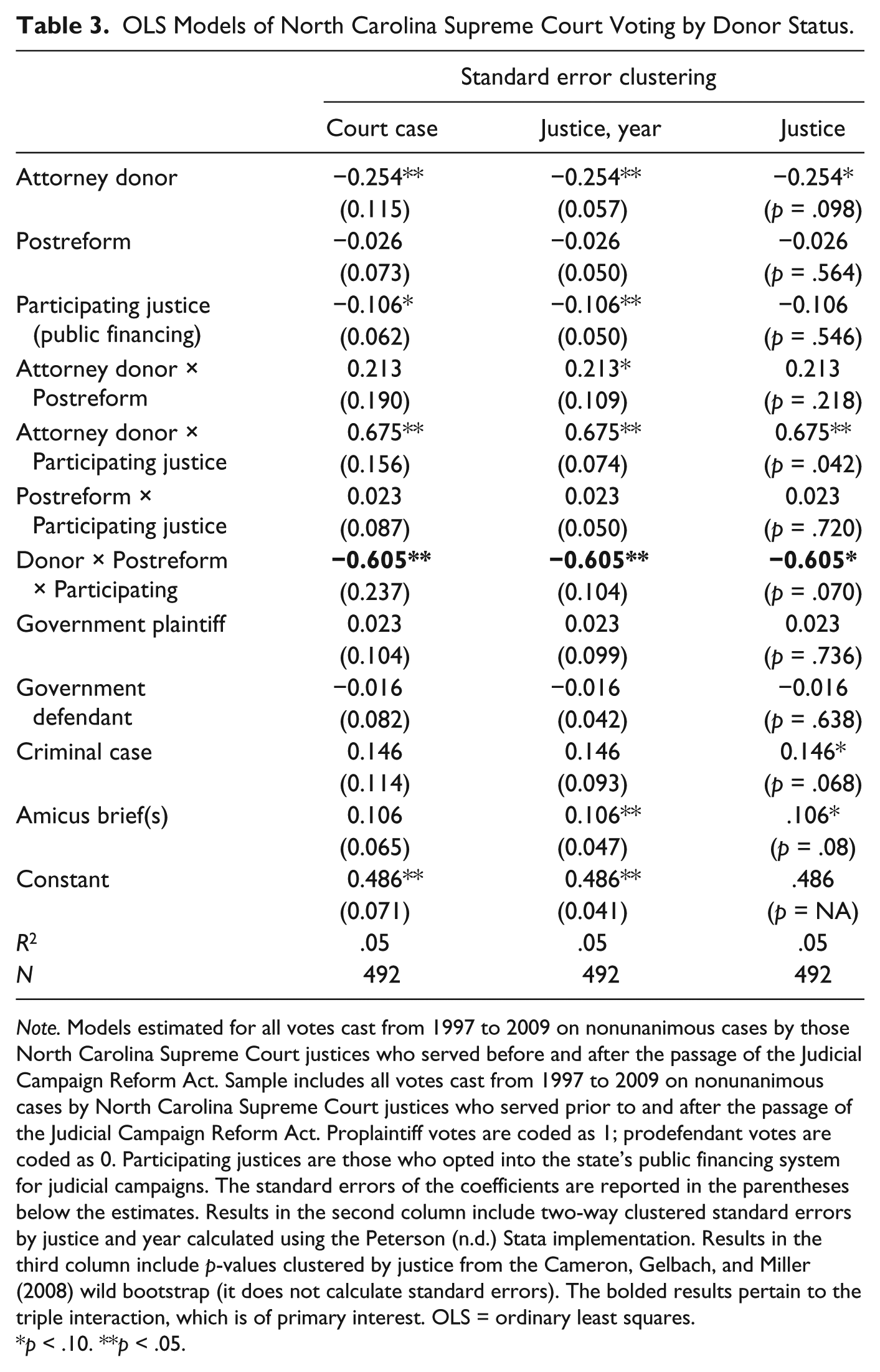
Note. Models estimated for all votes cast from 1997 to 2009 on nonunanimous cases by those North Carolina Supreme Court justices who served before and after the passage of the Judicial Campaign Reform Act. Sample includes all votes cast from 1997 to 2009 on nonunanimous cases by North Carolina Supreme Court justices who served prior to and after the passage of the Judicial Campaign Reform Act. Proplaintiff votes are coded as 1; prodefendant votes are coded as 0. Participating justices are those who opted into the state’s public financing system for judicial campaigns. The standard errors of the coefficients are reported in the parentheses below the estimates. Results in the second column include two-way clustered standard errors by justice and year calculated using the Peterson (n.d.) Stata implementation. Results in the third column include p-values clustered by justice from the Cameron, Gelbach, and Miller (2008) wild bootstrap (it does not calculate standard errors). The bolded results pertain to the triple interaction, which is of primary interest. OLS = ordinary least squares.
p < .10. **p < .05.
However, fully understanding the substantive and statistical importance of a coefficient can be difficult in a model with multiple interactions. To aid interpretation, we therefore summarize the predicted probabilities generated from this model in Figure 1. Specifically, we show the predicted probabilities for a civil case in which government entities are not parties to the case and one or more amicus briefs are filed.
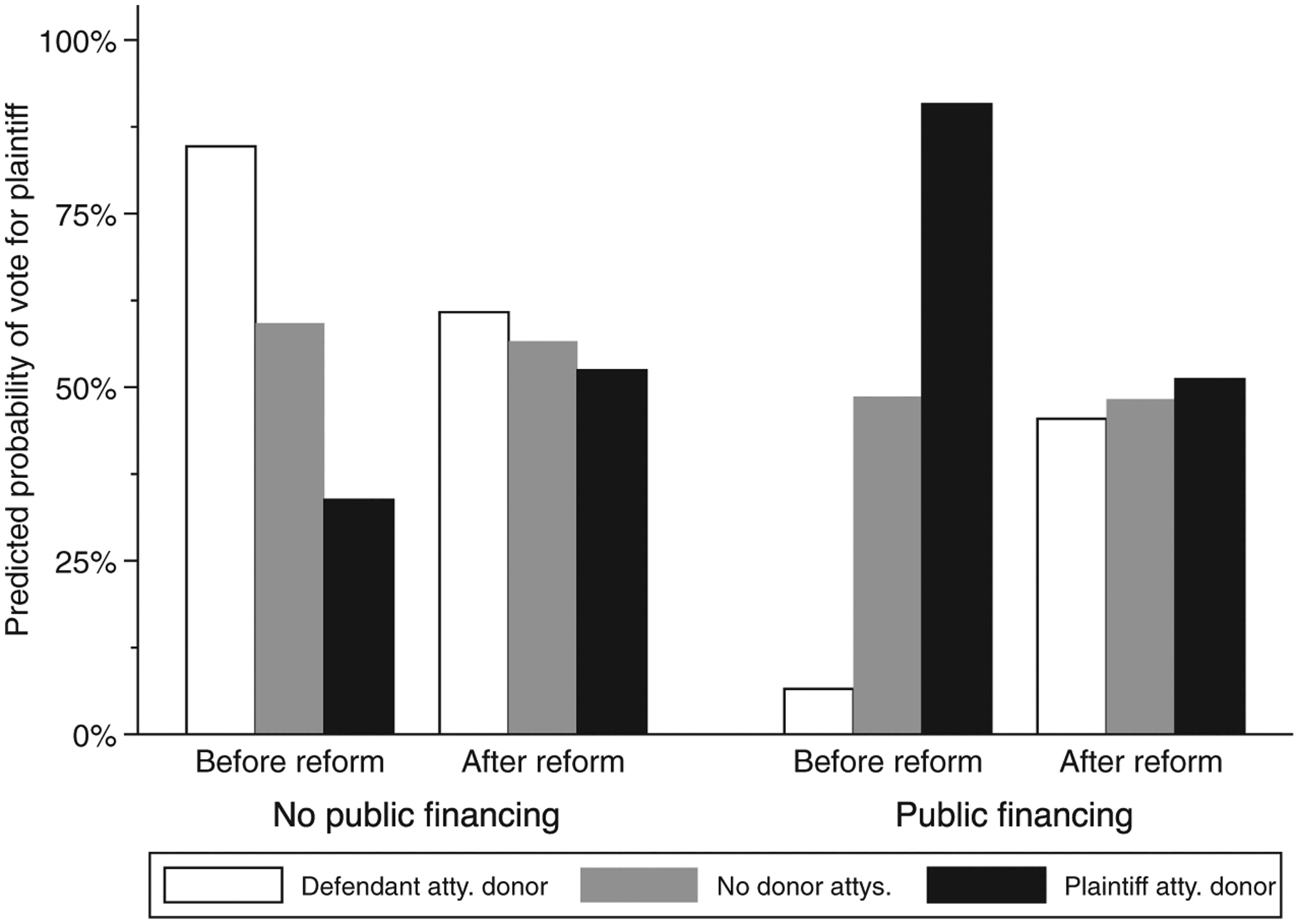
Predicted probabilities of North Carolina Supreme Court justice votes: Civil case.
Again, the results show that voting patterns changed dramatically among justices who opted into public financing after 2002. In particular, their voting records became much less favorable toward attorney donors—a change that was the opposite of the shift observed among justices who did not receive public funding. That is, while judges participating in the public financing system became less likely to vote in favor of donor attorneys in the postreform period, nonparticipating judges became more likely to vote in favor of donor attorneys relative to their behavior in the prereform period.
We estimate several models to ensure that our results are robust to various forms of potential nonindependence among observations. The least squares model in the first column, for instance, clusters the standard errors by case, while the second model includes two-way clustered standard errors by justice and year (Cameron, Gelbach, & Miller, 2011; Thompson, 2011) to account for nonindependence in voting over time by each justice as well as time-level shocks to voting that might have correlated effects across justices. As we have a small number of justices in our sample, the third column includes a model with standard errors clustered by justice estimated using the Cameron, Gelbach, and Miller (2008) wild bootstrap procedure, which has been shown to perform adequately with as few as five clusters. 20 Our DDD result is statistically significant across models.
Finally, these results are robust to numerous plausible perturbations in our assumptions. As we show in SI-D, our results are unchanged if we use 4-year window for previous contributions instead of 8 years or a US$250 contribution threshold for donor status instead of US$100. The results are also consistent if we exclude any or all justices from the control group who retired rather than running for reelection under the new system or if we use robust regression to reduce the influence of potential outliers (see SI-D for further details). Thus, our results are not being driven by the behavior of any one judge in the control group. 21
Changes in Judicial Voting Patterns
A second concern raised in the literature on campaign donors is the polarizing effect of contributions on elected officials. Donors tend to be ideologically extreme relative to the general public. If judges are forced to cater to the interests of donors, their voting behavior may be more extreme than it would be under an alternative financing system. In this section, we therefore estimate the effect of the North Carolina reforms on the ideological extremism of justices who opted into the public financing system relative to those justices who did not.
Difference-in-Differences Analysis of Judicial Ideological Extremism
To test Hypothesis 2, we fit a one-dimensional Bayesian item response model 22 based on votes by justices in our sample in nonunanimous cases before the North Carolina Supreme Court. We generate separate estimates for each justice in the pretreatment (1997-2002) and posttreatment (2003-2009) periods. To avoid strong assumptions, we constrain the estimates for the untreated justices (i.e., justices who did not participate in the public financing system) to be constant across periods, which place the estimates for the two time periods on the same scale. 23
Our focus is the change in the estimated ideal point of the treated (unconstrained) judges who served on the court before and after the reforms. In essence, we place our estimates of the pre- and postreform periods on the same scale by constraining the position of the untreated justices (i.e., justices who did not receive public financing) to be constant across periods. In reality, these justices might also have changed their ideological voting patterns across time periods. Thus, our analysis of the ideological position of the justices is also a difference-in-differences analysis because the effect of the North Carolina reforms on each of the treated justices is estimated relative to ideological positions of the untreated justices, which may also be changing.
Although this approach limits the conclusions we can draw about the absolute positions of the justices, it allows us to estimate the change in the positions of the treated justices relative to the untreated justices. Substantively, we estimate whether the treated justices became more liberal or conservative relative to untreated justices while making minimal assumptions about the positions of justices in the control group. To our knowledge, this analysis represent the first use of an item response framework as part of a difference-in-differences analysis.
As before, this approach accounts for any time-invariant factors affecting justices (e.g., party) as well as any time trends that affect all observations equally (e.g., political trends). We specifically note that it is not necessary that the justices who opted into public financing be identical ideologically with those who did not. However, an important assumption here is that justices do not choose to participate due to a temporary, individual-specific shock—for instance, some shift in ideology that temporarily alienated donors and thereby increased the likelihood that a justice opted into public financing. In addition, we make the same parallel paths assumption described above, meaning that the average postreform change in ideology would have been equivalent between groups in a counterfactual scenario with no public financing.
Results
The coefficient estimates and posterior quantiles for our analysis are summarized in Table 4, where positive values indicate a more conservative justice and negative values indicate a more liberal justice.
Quantiles for Posterior Estimates of Justice Ideal Points (1997-2009).
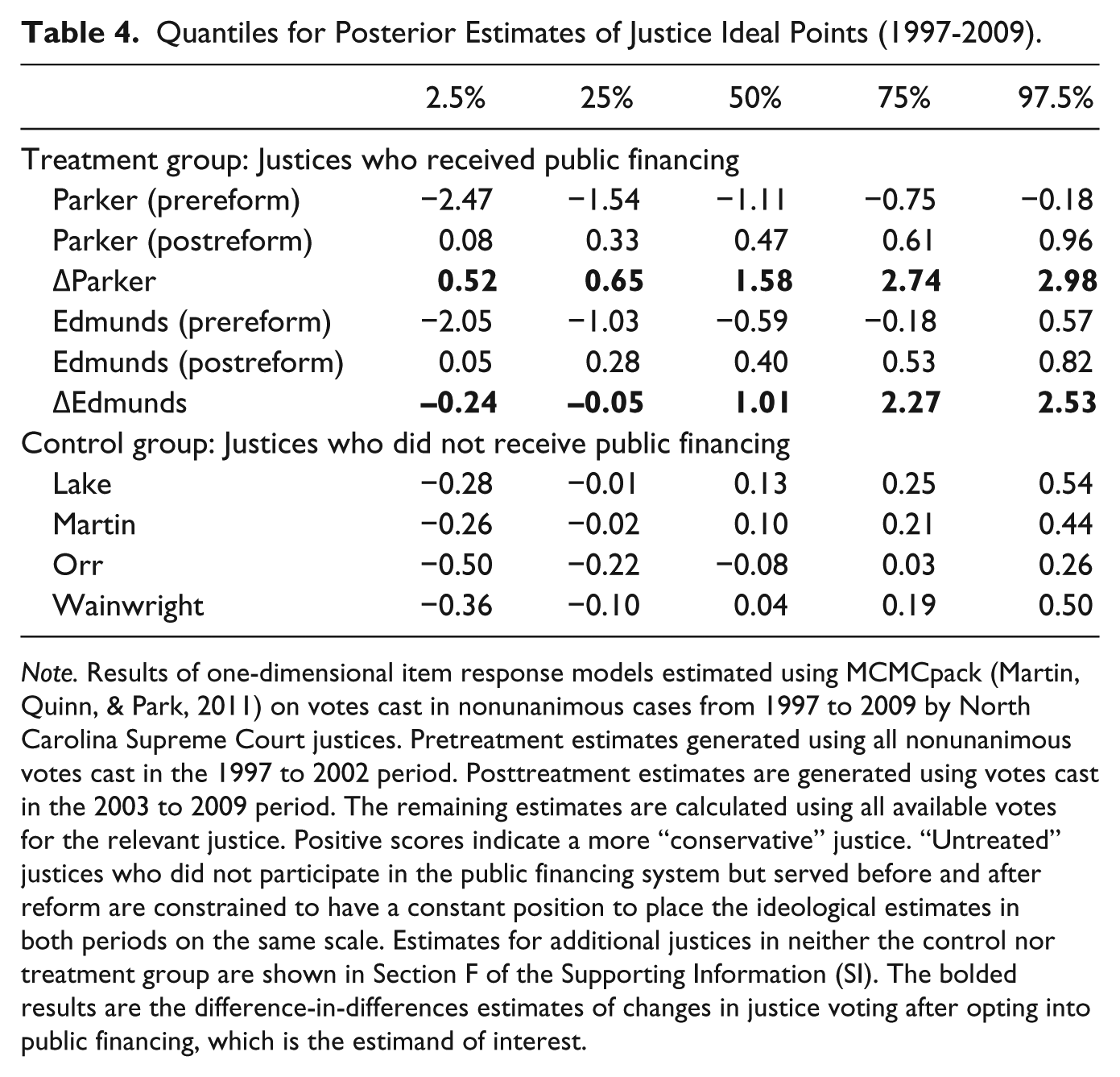
Note. Results of one-dimensional item response models estimated using MCMCpack (Martin, Quinn, & Park, 2011) on votes cast in nonunanimous cases from 1997 to 2009 by North Carolina Supreme Court justices. Pretreatment estimates generated using all nonunanimous votes cast in the 1997 to 2002 period. Posttreatment estimates are generated using votes cast in the 2003 to 2009 period. The remaining estimates are calculated using all available votes for the relevant justice. Positive scores indicate a more “conservative” justice. “Untreated” justices who did not participate in the public financing system but served before and after reform are constrained to have a constant position to place the ideological estimates in both periods on the same scale. Estimates for additional justices in neither the control nor treatment group are shown in Section F of the Supporting Information (SI). The bolded results are the difference-in-differences estimates of changes in justice voting after opting into public financing, which is the estimand of interest.
Two aspects of Table 4 are notable. First, the ordering of the justices on the ideological scale is consistent with expectations. For instance, the model estimates Republican justices to be, on average, more conservative than their Democratic counterparts.
Second, Table 4 shows that Justice Parker, a Democrat, became relatively more moderate in the period after reform, moving away from her party’s ideological base relative to other justices in this time period. To confirm this, we calculate a posterior estimate for the effect of the treatment on Parker, which is defined as
We also calculate a posterior estimate for the effect of the shift to public financing on Justice Edmunds, a Republican, which is defined as
Limitations and Conclusions
We contribute to the growing literature seeking to carefully estimate the causal relationship between donations and judicial behavior by providing the estimates for the effect of public financing on North Carolina’s state supreme court. After reviewing the inherent difficulties of making inferences about the contributions–behavior relationship, we apply a difference-in-differences strategy to a unique data set consisting of judicial votes in nonunanimous cases and campaign contributions from attorneys to justices. Our results provide evidence that justices who opted into the public financing scheme became relatively less favorable toward attorney donors once the reforms came into effect relative to justices who did not participate. We also find partial support for our hypothesis that justices who opted into the system become more ideologically moderate relative to nonparticipating justices in the postreform period. These results, which suggest that donors do in fact have distorting influence on judicial decision making, make a substantial contribution to the literature on the relationship between contributions and judicial behavior.
Before concluding, it is important to discuss the limitations of this study. A chief concern is the relatively small sample size. In particular, our results are based on the six judges whose tenure spanned the implementation of the reforms in North Carolina. As noted in the introduction, the number of justices we consider is a fundamental limitation of the present study. However, it is also important to note some of the strengths of our research design. First, the size of our sample actually biases us against finding significant results by reducing the statistical power of our models. Also, our analyses consider a large number of votes by those justices (492 justice votes on 125 nonunanimous cases with clear outcomes), which increases our statistical power. Although having more nonunanimous votes would obviously be desirable, more than one third of cases in our sample involved at least one justice who had received a donation from an attorney, suggesting that our study examines a widespread and substantively important phenomenon. Finally, while we agree that scholars should be cautious in generalizing from small samples, we note that many previous studies have analyzed courts in one state to test general theories of judicial behavior (e.g., Cann, 2007; McCall, 2003; Traut & Emmert, 1998; see also Nicholson-Crotty & Meier, 2002) and that our sample size is consistent with other studies of the courts (e.g., George & Epstein, 1992; M. G. Hall, 1987; Segal, Timpone, & Howard, 2000) and of specific influences (e.g., contributions) on Congressional behavior (e.g., Bartels, 1991; R. L. Hall & Wayman, 1990; J. R. Wright, 1990). As with these other studies, the results in this article provide specific evidence about a broader problem of general interest. Our results are not definitive but instead seek to contribute to the broader scholarly dialogue surrounding the effects of campaign donations in the judicial system. Our hope is that future studies will subject our findings to additional scrutiny as more observations become available by broadening the set of donors, expanding the data to include the North Carolina Court of Appeals, and evaluating the effects of reforms in other states.
Two other concerns should be considered. First, only cases that were appealed from lower courts are considered by the Supreme Court. If attorneys strategically altered the cases they appeal based on the anticipated effects of contribution status on justice behavior, this anticipatory effect could bias our estimates, though we know of no evidence to support this speculation. Second, some scholars have argued that focusing on nonunanimous cases can be misleading (Brace & Hall, 1990; Tully & Gay, 2009). While we would not claim that unanimous cases are inconsequential, these cases, which make up the vast majority of those heard by the court, do not provide information about the ideological disposition of judges in the item response theory (IRT) framework. Without any variation in behavior between justices, these cases are not informative for our second analysis. In addition, as detailed in SI-B, an analysis of 3 years of decisions data reveals that nonunanimous cases decided by the North Carolina Supreme Court are significantly broader and have a greater impact than unanimous decisions.
Finally, it is important to emphasize that the inferences we draw depend on the assumptions employed in our analysis. We make two key assumptions. We assume that the “treatment”—public financing—affected the justices who eventually participated in the system beginning in 2003. In addition, we assume that no other factor differentially affected the treatment of donors versus nondonors between participating and nonparticipating justices. Under the parallel paths assumption, the change in postreform treatment of attorney donors versus nondonors among participating justices (relative to changes among nonparticipating judges) is attributed to public financing. Similar assumptions are necessary for any change in ideological voting behavior among justices who opted into public financing to be attributed to their participation in the system (see SI-D for additional discussion of potential confounds). While we are aware of no specific reason to believe that these assumptions are not met, it is worth emphasizing that the validity of our results rests on the validity of these untestable assumptions.
Although these limitations are important to note, we believe that our findings make a significant contribution to the ongoing debate over judicial campaign contributions and public financing reforms. West Virginia recently made their judicial public financing program permanent (Smith, 2013) while North Carolina ended theirs (Parker, 2013). Our findings suggest that public financing systems like these may reduce the likelihood that participating justices vote in favor of donor attorneys. These reforms might therefore have a beneficial effect on the proper functioning of state judicial systems as well as public perceptions of their fairness. However, given the importance of ensuring the independence, fairness, and legitimacy of the courts, additional research is clearly warranted to better understand the effect of campaign contributions and public financing on judicial behavior.
Footnotes
Acknowledgements
We are grateful to James Gibson, Chris Bonneau, Andrew Martin, Mark McKenzie, Anne O’Connell, Marit Rehavi, and audiences at the Midwest Political Science Association annual meeting and Political Economy and Public Law Conference for helpful comments. We also thank Tessa Bazier, Brigid Kilcoin, Jake McNichol, Suzanne O’Gawa, Benjamin Prager, Derek Sutton, and Nelson Wong for excellent research assistance.
Declaration of Conflicting Interests
The author(s) declared no potential conflicts of interest with respect to the research, authorship, and/or publication of this article.
Funding
The author(s) received no financial support for the research, authorship, and/or publication of this article.
Notes
Author Biographies
References
Supplementary Material
Please find the following supplemental material available below.
For Open Access articles published under a Creative Commons License, all supplemental material carries the same license as the article it is associated with.
For non-Open Access articles published, all supplemental material carries a non-exclusive license, and permission requests for re-use of supplemental material or any part of supplemental material shall be sent directly to the copyright owner as specified in the copyright notice associated with the article.
