




Abstract
In recent decades, observers of Congress have devoted increasing attention to the phenomenon of the revolving door, whereby members of Congress and staffers go on to careers in lobbying. This practice raises a number of normative concerns that are perhaps most heightened when it comes to the lobbying activities of members of Congress themselves. In this article, I examine the factors determining which former members go through the revolving door, and find that members with central network positions and highly effective legislators are more likely to become lobbyists. I then examine the extent to which members-turned-lobbyists have an impact on bills in Congress. I find evidence that lobbying by former members increases a bill’s probability of progressing and some evidence that highly effective legislators also go on to become more effective lobbyists. Taken together, these findings support conventional wisdom that former members become some of the most influential lobbyists.
In the period from 2011 to 2014, more than 140 former members of the U.S. House lobbied Congress regarding one or more bills under consideration. In light of the challenges (LaPira & Thomas, 2014) of identifying these “revolving door” lobbyists (e.g., due to self-reporting requirements and loopholes in the definition of lobbying activities), the actual number may be significantly higher. On average, those former members lobbied on 14 bills per year, and of the bills signed into law during that period, 19% were lobbied on by at least one former House member. In a Washington environment flooded by hordes of lobbyists, these numbers stand out.
A central question in the literature is whether revolving door lobbyists, including, but not limited to, former members of Congress (hereafter, MCs) themselves, primarily provide access and connections, or whether their main value is in policy and procedural expertise (LaPira & Thomas, 2014). Although this question can mostly be answered only indirectly, a growing consensus suggests the former, which normatively speaking, is the more troubling conclusion, insofar as it permits certain interests in Washington to game the system. At least three recent studies (Blanes i Vidal, Draca, and Fons-Rosen, 2012; Cain & Drutman, 2014; LaPira & Thomas, 2014) have asserted evidence consistent with the primacy of access and connections.
Although ex-staffers can provide access and connections to a certain degree, there can be little doubt that former MCs themselves are in the best position to fill this demand. Only a few recent pieces of research have focused on former member lobbyists in particular. Lazarus, McKay, and Herbel (2016) find that a little more than a quarter of former members become lobbyists, and identify institutional power, seniority, and ideology as key factors in identifying which members will take that path.
However, just because there is a great demand to hire former members for their connections, it does not mean that such members are in great supply. For example, of the 50 most well-connected members 1 of the 108th Congress, 15 are still currently serving in Congress, three died in office or resigned due to failing health, and three were indicted or convicted of crimes. More generally, nearly two thirds of former members return home to their districts from Washington (Leal, 2002), and around 9% literally retire from Congress, meaning they leave the workforce entirely (Herrick & Nixon, 1996). Those who do remain in the workforce may have more lucrative options in their previous profession, or in opportunities such as board directorships (Palmer & Schneer, 2016), although one survey of former members found that only 13% cited career or financial opportunities as a reason for leaving Congress (Herrick & Nixon, 1996).
In this article, I advance a theory identifying two legislative traits that should be especially important in identifying members of Congress who will go through the revolving door: network position and legislative effectiveness. Like the factors identified by Lazarus et al. (2016), these factors should be strong indicators of connections and the potential to influence; however, network position and legislative effectiveness differ in that they represent transferable skills whose benefit in the lobbying area is more direct than correlational.
Second, I move beyond predicting who will become a lobbyist and consider the impact that former members-turned-lobbyists have on the legislative process. Specifically, I examine all bills considered during the 112th and 113th Congresses that were lobbied by at least one revolving door lobbyist (along with a control sample of bills with no such lobbyists). I find evidence that the lobbying efforts of former members are associated with greater odds of advancement, and modest evidence that the impact of such lobbying is conditional on the former member’s legislative effectiveness when they served in Congress.
Legislative Traits and the Revolving Door
Much of the previous research concerning the revolving door either draws no distinction between former members and staffers, or focuses solely on staffers. Within the research focused on staffers, Lazarus and McKay (2012) find that staffers are most likely to become lobbyists if they served in the offices of party leaders and more senior members. Blanes i Vidal et al. (2012) find that ex-staffers benefit (in terms of generated lobbying revenue) when their bosses are in office and are more powerful. Cain and Drutman (2014) find that restrictions imposed by 2007’s Honest Leadership and Open Government Act (HLOGA) legislation have had differential effects on the lobbying careers of “covered” and non-covered staff members.
However, whereas staffers constitute the vast majority of revolving door lobbyists, former MCs might constitute the more interesting subset. From a practical perspective, we might expect former MCs to have an especially outsized level of influence and number of connections, compared with a more modest advantage for staffers. From a normative perspective, any concerns we have about a person using the revolving door to enrich him or herself in a post-congressional career would be far greater with respect to an elected representative than for a staffer who is merely on the public payroll.
While all former MCs are likely to provide a lobbying firm or client with a modicum of expertise and a number of valuable connections, it is implausible that all MCs would be equally valuable in this role. Lazarus et al. (2016) confirm as much in identifying party leaders, members of key committees, and individuals with more seniority as being more likely to become lobbyists.
However, not all of the traits that might be associated with being a more valuable lobbyist are associated with power and experience. After all, positions of institutional leadership and seniority are themselves partially determined by electoral factors such as district safety and fundraising ability (e.g., Heberlig, Hetherington, & Larson, 2006), factors that are unlikely to have much relevance in the lobbying sphere. That said, insofar as political process knowledge and substantive policy knowledge are both key “learnable skills” (Holyoke, Brown, & LaPira, 2015), there should be substantial transferability.
Recent work suggests two important legislative traits that are likely to be transferable to a lobbying position. Network position is one such factor, as scholarship has increasingly emphasized the value in viewing legislatures as networks (e.g., Bratton & Rouse, 2011; Cho & Fowler, 2010; Kirkland, 2011; Ringe et al., 2012). Fowler (2006a) and Ringe and Wilson (2016) argue that measures of network centrality can identify influential members and predict legislative influence and success, a finding that echoes research in other subfields of political science (e.g., Malinick, Tindall, & Diani, 2013; Montgomery, 2016).
The revolving door is a concept that naturally implicates networks, insofar as the presumed benefits of revolving door lobbying relate to the leveraging of relationships developed in Congress. As networks are relevant to the legislative process, it follows that one’s position in those networks could be central to the value of hiring a former legislator as a lobbyist. This leads to the first hypothesis:
The second trait is the concept of legislative effectiveness, which Volden and Wiseman (2014) define as the “proven ability to advance a member’s agenda items through the legislative process and into law.” 2 To the extent that legislative effectiveness constitutes a stable trait from one session to the next (Volden, Wiseman, & Wittmer, 2013), it is intuitive to see why this would be a valuable trait from the perspective of a lobbying firm or client once an MC has left Congress. Although the literature has traditionally drawn distinctions between “policy entrepreneurship” (external to the legislature; for example, Mintrom, 1997) and “legislative entrepreneurship” (by legislators themselves; for example, Wawro, 2000), this distinction may be substantially blurred if former members have the institutional knowledge, connections, and access to advocate for a piece of legislation in much the same way they would were they still sitting MCs. To the extent this is possible, a former member’s effectiveness may be highly transferrable to the lobbying sphere. This leads to the second hypothesis:
Revolvers and Bill Progress
Scant previous research has examined the linkage between the use of revolving door lobbyists and the achievement of specific lobbying goals. Baumgartner, Berry, Hojnacki, Kimball, and Leech (2009), for example, find that having a larger number of revolving door lobbyists is one “resource” associated with being on the winning side. Lazarus and McKay (2012) also find that employing revolving door lobbyists produces an advantage in winning earmarks. For most legislation, however, identifying a linkage between the number of a particular subset of lobbyists and the achievement of specific legislative outcomes poses enormous data challenges.
The presence of revolving door lobbyists, however, may have a more straightforward effect on the consideration of legislation. Revolvers may influence a bill’s position on the legislative agenda or aid in the key elements of legislative entrepreneurship, including information provision and coalition-building, in ways that non-revolver lobbyists cannot. Thus, regardless of which provisions revolvers are lobbying, or which position they take on those provisions, we might expect the presence of revolvers to be associated with greater prospects for the bill’s advancement.
Moreover, if the Network Position and Legislative Effectiveness hypotheses are correct, we might also expect revolvers with different traits to be differently impactful in the legislative process. Revolvers with central network positions will be particularly well-positioned to serve as conduits for information provision and coalition-building, and highly effective former legislators will be able to draw on their proven ability to advance items through the lawmaking process. This suggests the following additional hypothesis:
Which Former MCs Become Revolving Door Lobbyists?
To examine which former MCs become revolving door lobbyists (hereafter, “revolvers” 3 ), I focus on members of the U.S. House who served in Congress between 1973 and 2010 and served at least one term prior to 2005. 4 Because the next section of this article focuses on bills considered in the 112th and 113th Congresses (2011-2014), I also exclude former MCs who held elected or appointed government positions during part or all of the period from 2011 to 2014, as well as those who died prior to the end of 2014. I also exclude three former vice-presidents and former MCs who were convicted of criminal offenses, leaving a total of 641 former MCs in the sample.
To identify those members who have served as lobbyists, I rely on the website of the Center for Responsive Politics (Open Secrets) and note whether each individual is classified as a “lobbyist” or whether they have served in another lobbying-related position. 5 In total, 223 of the former MCs in the dataset (35%) are classified as lobbyists, whereas another 37 (6%) are classified as serving in another lobbying-related position.
To test the Network Position hypothesis, I utilize three measures of network position described in Fowler (2006a). The first two are measures of centrality: closeness centrality “represents the social distance between any pair of individuals in the network” (Fowler, 2006a, p. 465) while eigenvector centrality is based on the idea “the centrality of a given individual is an increasing function of the centralities of all the individuals that support her” (i.e., cosponsor one of her bills; Fowler, 2006a, p. 465). 6
The third measure, connectedness, incorporates two additional pieces of information: the number of cosponsors a bill has and the number of times a dyad of legislators mutually cosponsors bills. Connectedness, then, represents “the inverse of the average of these distances from all other legislators” (Fowler, 2006a, p. 469). Connectedness is correlated with the two measures of centrality (r = .33 and r = .38), but there is also clearly an extent to which it is measuring a different dimension or conception of network position.
To assess the Legislative Effectiveness hypothesis, I utilize Volden and Wiseman’s (2014) legislative effectiveness scores, taking the natural log to account for the extreme positive skew in the scores. I use the average legislative effectiveness score over the former MC’s career, although using the score from the member’s last session of service produces very similar results.
Table 1 provides preliminary evidence of a linkage between these legislator traits and the propensity to become a lobbyist. Individuals in the highest quartile of all four traits are between 12% and 21% more likely to become lobbyists than those in the lowest quartile. The patterns are strongest and most linear for the two centrality measures, while patterns for the connectedness and legislative effectiveness scores are more pronounced at the extremes and more muddled in the middle quartiles.
Percentage of Former MCs Who Became Lobbyists, by Legislator Traits.

Note. MCs = members of Congress.
Next, I perform a series of multivariate analyses to assess whether these patterns hold up after controlling for a variety of demographic and institutional factors. I examine the former MCs’ number of years of service, with the expectation that MCs who served for longer periods will be more likely to become lobbyists (Herrick & Nixon, 1996; Leal, 2002). In contrast, the older the former MCs’ age at retirement (from Congress), the less likely they should be to pursue a subsequent career in lobbying. Given that female members (8% of former MCs in the dataset) and minority members (6%) are substantially underrepresented in Congress, we would not be surprised to find them underrepresented in the lobbying sphere as well. 7
I also control for members’ political party (using the dummy variable, Democrat), whether they served in the Senate subsequent to their service in the House, and their folded ideology score (the first dimension of their DW-Nominate score, folded at 0). Last, I account for positions of institutional power held by members during their service in the House. In particular, I include variables indicating the number of terms they served on the appropriations committee and the number of terms in which they held a leadership position. 8 Descriptive statistics for the above variables can be found in Table 2.
Descriptive Statistics, Legislator Dataset.
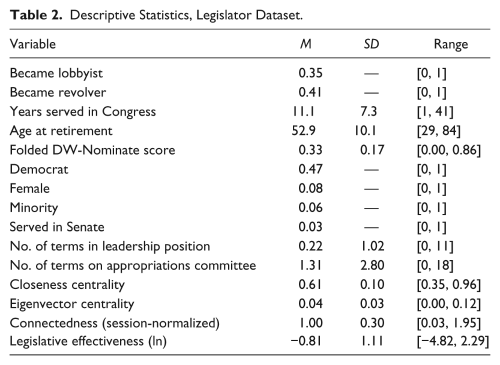
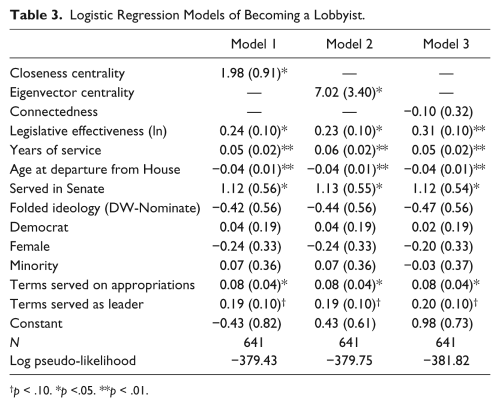
Table 3 presents three logistic regression models that predict the likelihood of becoming a lobbyist based on one’s network position, legislative effectiveness, and the above control variables. As closeness centrality, eigenvector centrality, and connectedness represent similar concepts and are correlated with one another (particularly highly in the case of the first two), I run separate models for each of the three network concepts.
Logistic Regression Models of Becoming a Lobbyist.
p < .10. *p <.05. **p < .01.
Model 1 provides support for both the Network Position hypothesis and the Legislative Effectiveness hypothesis. Closeness centrality and legislative effectiveness both have positive, statistically significant effects on the probability of becoming a lobbyist. The results of Model 2 are similar, with eigenvector centrality also having a statistically significant and positive effect. However, Model 3 fails to show a relationship between connectedness and the probability of becoming a lobbyist. 9 As noted above, this is probably due to the fact that the measures capture different dimensions of network position; the aspect captured by centrality may be more strongly linked to long-term influence in the institution, while connectedness may be more powerful in gauging contemporaneous influence. 10
Table 4 calculates the substantive significance of network centrality and legislative effectiveness by comparing the predicted probability associated with values 1 standard deviation above and below the mean for all three measures. For both measures of centrality, the change in predicted probability is approximately 9%, while for legislative effectiveness, the change in predicted probability ranges from 11% in Model 2 to 15% in Model 3.
Effects of Legislator Traits on Predicted Probability of Becoming a Lobbyist.
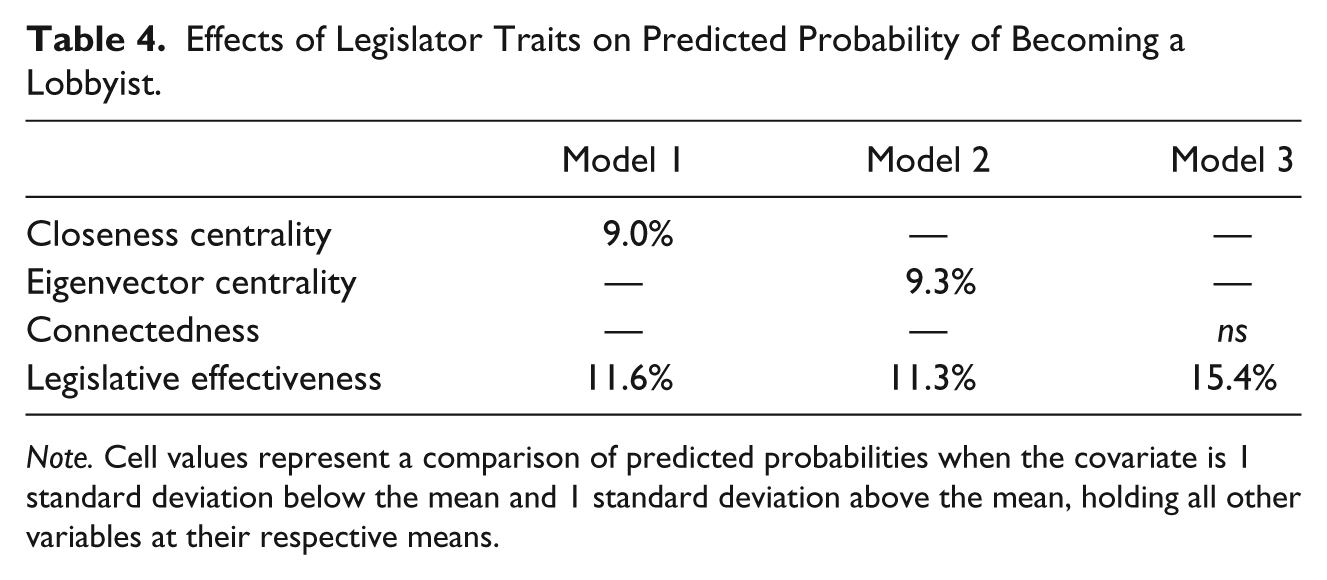
Note. Cell values represent a comparison of predicted probabilities when the covariate is 1 standard deviation below the mean and 1 standard deviation above the mean, holding all other variables at their respective means.
In addition to providing support for the Network Position and Legislative Effectiveness hypotheses, all three models show that the number of years of service, whether one served in the Senate, and a former MC’s number of terms on the Appropriations Committee and in leadership positions are positively associated with becoming a lobbyist. Conversely, individuals who are older when they leave the House are less likely to become lobbyists.
Last, I rerun the models in Table 3 but alter the dependent variable to include non-lobbyist revolvers. The main results are unchanged: closeness centrality and eigenvector centrality have positive and statistically significant effects on the probability of becoming a revolver, connectedness does not predict whether one becomes a revolver, and legislative effectiveness is positive and significant in all three models. The substantive effect sizes are also virtually identical for legislative effectiveness and slightly larger for the centrality measures. 11 The only discernible difference in these models is that the impact of serving in the Senate is almost twice as large, as a number of the individuals who served in both chambers (six) moved on to non-lobbying revolving door positions.
Are Some Former Members More Impactful as Lobbyists?
Next, I examine the extent to which former members-turned-lobbyists influence outcomes on the bills they lobby. It is important to note that these analyses do not purport to measure whether revolvers are more successful in achieving their specific lobbying goals relative to other lobbyists. Without information on the specific provisions being lobbied by individual lobbyists, drawing such inferences would be impossible, and even with such information, drawing direct inferences would be difficult at best. 12 Rather, the goal here is to gauge whether the mere presence of former MCs lobbying on a bill will enhance the bill’s progress toward enactment, regardless of which lobbyists may be advocating for or against which provisions.
I begin by identifying all former MCs who lobbied on at least one bill during the 112th (2011-2012) and 113th Congress (2013-2014). I then compile a list of all bills on which those individuals (95 in the 112th, 88 in the 113th) lobbied, using the lobbying data provided by Open Secrets, and merging this list with data from Congress.gov and from the Congressional Bills Project (Adler & Wilkerson, 2015). To avoid selection bias induced by focusing only on bills lobbied by revolvers, I also take a random sample of 200 bills from each Congress not lobbied by any revolvers. This produces a total of 2,755 bills 13 (1,536 in the 112th and 1,129 in the 113th Congress).
In the analyses that follow, the dependent variables characterize the progress toward enactment that each bill made. Specifically, I consider whether a bill advanced to three separate stages of consideration. The dummy variable reported indicates whether the bill was reported out of committee in (at least) one chamber. The variable passed one chamber indicates that the bill was passed in a single chamber, while passed both chambers indicates that both the House and Senate approved the bill. I do not create a separate variable for bills signed into law, as there were no vetoed bills in the dataset and a negligible number of bills passed both chambers and did not become law (6 out of 119). The results for each of these three dependent variables can be found in Tables 6, 7, and 8, respectively.
For each of the three dependent variables, I begin by estimating the effect of the overall number of revolvers who lobbied on each bill. The models in the first column of each table use this total number of revolvers as a covariate to gauge whether there is prima facie evidence of a linkage between revolver lobbying and bill advancement. Not counting the bills with no revolvers, 14 57% bills were lobbied by exactly one revolver, 93% had five or fewer revolvers, and less than 2% had 10 or more.
To test the Differential Impact hypothesis, I split the pool of lobbyists in half according to each of the three traits in question (closeness centrality, eigenvalue centrality, and legislative effectiveness 15 ). For each bill, I then count the number of lobbyists from each half of the pool, essentially treating individuals from each half of the pool as a separate resource that may predict bill progress. 16 Each of these resources, then, is represented by a separate covariate in the model. For example, the variable high closeness centrality indicates the number of revolvers who lobbied on a bill with high (above the median 17 ) closeness centrality scores, and low closeness centrality indicates the number of revolvers on a bill with below the median closeness centrality scores. 18 As the closeness centrality and eigenvalue centrality scores produce virtually identical results for all models, I present only the closeness centrality scores, in the second column of Tables 6, 7, and 8. I then do the same thing for legislative effectiveness, treating the number of high effectiveness revolvers and the number of low effectiveness revolvers as separate covariates for each bill. The results for models including this pair of covariates can be found in the third column of each table.
I also control for other factors pertaining to the bill’s sponsor and cosponsors and its legislative context. I expect that the sponsor’s ideological extremity, as indicated by the member’s folded DW-Nominate score, will negatively impact the bill’s progress, while the sponsor being a majority party member or a party leader should enhance the bill’s prospects. I also control for the sponsor’s conservatism (measured with an unfolded DW-Nominate score) and whether the sponsor is female.
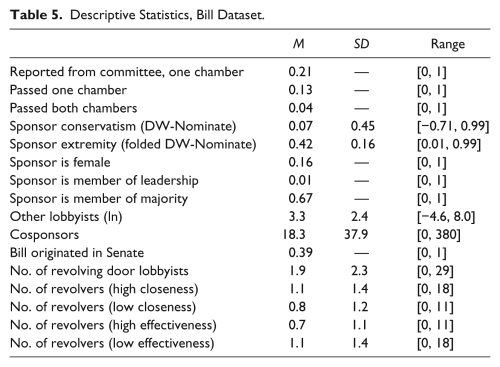
Using additional data from Open Secrets, I also control for the natural log of the number of other lobbyists (i.e., individuals who are not former MCs) who lobbied on the bill. 19 In addition, the variable cosponsors indicates the number of cosponsors the bill has. Some previous research indicates a positive effect of cosponsorship, insofar as cosponsors may be a signal of proposal quality (Woon, 2008), while other research (Wilson & Young, 1997) suggests that the impact may depend on the stage of consideration. Last, the variable Senate indicates whether the bill originated in the Senate (i.e., has an “S.” prefix). Descriptive statistics for all variables in the bill analyses can be found in Table 5.
Descriptive Statistics, Bill Dataset.
The models in Table 6 report the results from logistic regression analyses 20 predicting whether a bill is reported from committee. Model 4a, in the first column of Table 7, indicates a statistically significant, positive relationship between the number of revolvers who lobby on a bill and the bill’s probability of being reported out of committee. This alone, however, does not address the Differential Impact hypothesis, which asserts that some revolvers will have more of an impact on bill progress than others. To do so, I next examine the results in Models 4b and 4c.
The Impact of Revolving Door Lobbyists on Bill Reporting From Committee.

Note. Bold typeface indicates a significant difference of coefficients test between the coefficients for the “high” and “low” category revolvers. AIC = Akaike information criterion.
p < .10. *p < .05. **p < .01.
The Impact of Revolving Door Lobbyists on Bill Passage (One Chamber).
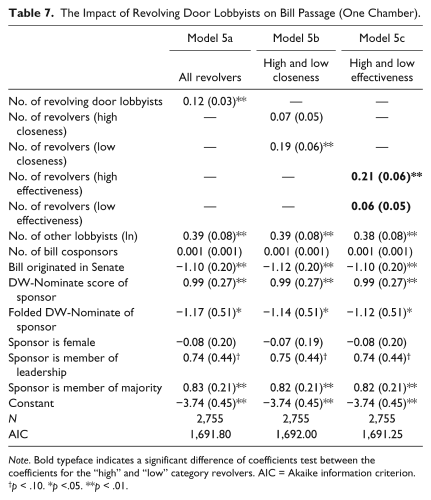
Note. Bold typeface indicates a significant difference of coefficients test between the coefficients for the “high” and “low” category revolvers. AIC = Akaike information criterion.
p < .10. *p <.05. **p < .01.
As can be seen in Model 4b, there is little support for the claim that revolvers who had more central network positions have a bigger impact on bill progress than those who had less central positions. There is no statistically significant difference between the coefficients for high closeness revolvers and low closeness revolvers.
However, Model 4c indicates that there is a statistically significant difference between the coefficients for the variables high effectiveness revolvers and low effectiveness revolvers (difference of coefficients test: χ2 = 21.51, p < .001). In this case, being lobbied by highly effective legislators has a very large effect: each additional revolver is associated with 1.48 times higher odds of the bill being reported from committee. Conversely, lobbying by less effective former MCs has an effect that is nearly 0. Moreover, the Akaike information criterion (AIC) indicates that Model 4c is a significant improvement in model fit relative to Model 4a, demonstrating that the incorporation of information regarding revolver traits does produce a more informative model.
The results with respect to bills being passed in one chamber of Congress, which can be found in Table 7, reveal fairly similar patterns with respect to revolvers. Model 5a once again finds an overall positive effect: the more revolvers lobby a bill, the more likely it is to pass one chamber of Congress. As above, Model 5b again fails to find any distinction between revolvers who had more and less central network positions during their time in Congress; in fact, if anything, the pattern is in the opposite direction from what is expected. (However, the difference in coefficients here is not statistically significant: χ2 = 2.02, p = .15.) Model 5c finds that highly effective legislators are impactful (1.23 times higher odds of passage per revolver), while the impact of less effective legislators is not statistically discernible from 0. The difference between the two effect sizes, however, is only marginally statistically significant in this model (χ2 = 2.80, p = .09), and the AIC improvement relative to Model 5a is very modest, and would not constitute a statistically significant improvement in model fit.
Last, Table 8 gives the results of the three models pertaining to whether a bill was passed through both chambers of Congress. As with the previous two sets of results, Model 6a finds a positive relationship between the number of revolvers and the probability that a bill will pass both chambers. However, there is no difference in the impact of revolvers based on their legislative traits, either by network position (χ2 = 1.62, p = .20), or by legislative effectiveness (χ2 = 0.09, p = .76).
The Impact of Revolving Door Lobbyists on Bill Passage (Both Chambers).

Note. Bold typeface indicates a significant difference of coefficients test between the coefficients for the “high” and “low” category revolvers. AIC = Akaike information criterion.
p < .10. *p < .05. **p < .01.
Among the other covariates in the models, bills sponsored by more conservative members and less ideologically extreme members are more likely to advance through every stage of bill progress. Whether the sponsor is from the majority party predicts bill progress, as does the number of other (non-revolver) lobbyists, but these patterns hold only for the first two stages of progress. 21 Bills originating in the Senate are less likely to progress in all three sets of models, although the effect is of marginal significance in the first and last stages. Last, bills sponsored by leaders are marginally more likely to pass one or two chambers, but no more likely to be reported from committee.
Insofar as only two of the six hypothesized relationships with respect to revolver impact are supported by the data, it is worth considering whether model specification may be influencing the results. In terms of looking at the relationship between the number of revolvers and bill progress, it is conceivable that any observed relationship will be partially endogenous, insofar as strong bills may attract a different caliber of lobbyists (LaPira & Thomas, 2015), rather than the lobbyists enhancing the bill’s advancement prospects.
Although it is possible that the main effect of revolvers (i.e., the coefficients in Models 4a, 5a, and 6a) is partially endogenous, it is unlikely that any such endogeneity would undermine the differences in revolver types uncovered in Models 4c and 5c with respect to legislative effectiveness. It may be the case that lobbying firms deploy revolvers when they are likely to have the biggest impact, but it is unlikely that they will employ multiple “types” of revolvers (e.g., high and low effectiveness lobbyists) and choose which type to deploy based on the legislative context. Thus, any differences observed across the two revolver types should not be affected by any overall endogeneity in the revolvers–bill progress relationship.
Discussion
The evidence presented in this article demonstrates that although all former MCs are valuable in the lobbying sphere for their connections, there may be substantial heterogeneity in that value. In addition to confirming previous work illustrating the predictive value of seniority and institutional positions of power, I also show that members with more central network positions and higher levels of legislative effectiveness are more likely to become lobbyists.
The evidence regarding the transferability of skills through the revolving door, however, is more mixed. The impact of lobbying by highly effective legislators is greater than that of less effective legislators, but only at the first two stages of bill progress. This makes sense to a certain degree as the final stage of bill progress involves steering the bill through the second chamber and having it signed into law. Insofar as most of the lobbyists in this dataset only served in one chamber (and their legislative effectiveness scores are based solely on their time in the House), it makes sense that the benefits of their effectiveness would be limited at this later stage of the process.
Likewise, there is reason not to be surprised that the value of network position does not extend to affecting bill progress. Although one’s network position almost certainly captures some personal traits (e.g., networking skills, personality), network configurations shift over time and sometimes even within legislative sessions (Kirkland & Gross, 2014). The value of a former member’s network position almost certainly decays over time, as the people with whom they served leave the institution. For example, of the 95 former House members who lobbied on at least one bill during the 112th Congress, the average number of current members with whom they served was around 181 (roughly 42% of the size of the House, although this number also includes a handful of House members now in the Senate).
That said, in the actual practice of lobbying, one’s generic network position may matter less than one’s specific position vis-à-vis key actors in the legislative process. Given the increasingly sophisticated and targeted lobbying strategies used by some of Washington’s most successful lobbying shops, it seems certain that such intuitions are paramount both in the hiring of revolvers and the deployment of those lobbyists in the legislative arena.
Footnotes
Acknowledgements
The author thanks Michael Crespin, Kevin Evans, Michael Heaney, Bob Huckfeldt, Hans Noel, Eleanor Neff Powell, Anand Sokhey, Jennifer Victor, and attendees at the 2015 Political Networks Conference for helpful suggestions.
Declaration of Conflicting Interests
The author(s) declared no potential conflicts of interest with respect to the research, authorship, and/or publication of this article.
Funding
The author(s) received no financial support for the research, authorship, and/or publication of this article.