



Abstract
How do legislators respond to electoral competition? We consider this question by looking at the relationship between legislative productivity and the competitiveness of legislators’ primary and general elections. Building on Volden and Wiseman’s preliminary investigation of the electoral connection to legislative productivity, we introduce to that analysis the critical and often-overlooked distinction between primary and general election competitiveness. Employing panel data of U.S. House members spanning three decades (1979-2009), we find significant evidence of a positive relationship between primary vote share and legislative effectiveness, much of which is explained by having primary opposition at all. These results have substantial implications for our understanding of both the electoral connection and legislative behavior.
Congressmen are responsible for their own margins of victory or defeat; and the constraints they face are defined largely in their individual districts. This is a speech I never expected to give.
Introduction
In the 2016 elections, Representative Kevin Brady (R-TX08) came as close to electoral defeat as he ever had. 1 However, the challenge came from inside his own party. Despite two decades of incumbency, a powerful position as chair of the U.S. House Ways and Means Committee, and triple his usual campaign spending, Representative Brady only narrowly defeated the antiestablishment opposition in the Republican primary, garnering just 53.4% of the vote. Fortunately for Brady, his subsequent path to reelection was much easier. His constituency, the Texas Eighth Congressional district, was one of the most conservative in the nation, and he was completely unopposed in the general election. In the adjacent Texas First Congressional District, fellow Republican Representative Louie Gohmert, whose constituency was similarly conservative, also had an easy time in the 2016 general election. He routed the Democratic candidate, Shirley McKellar, by a margin of nearly 50 percentage points. 2 Unlike Brady, however, Gohmert had a largely stress-free experience in the primaries. Although he, too, faced opposition, the challenge was dramatically weaker: He won the Republican nomination for his race with 82% of the vote.
A great deal of the political science scholarship seeking to understand legislator behavior looks first to the electoral connection for explanations (see, for example, Fenno, 1978; Grimmer, 2013; Mayhew, 2004). This is entirely appropriate; elections play a crucial role in mediating the principal–agent relationship between citizen preferences and legislative action. However, many empirical studies employing election results as a metric of district competitiveness only employ vote shares from the general election (see, for example, Dropp & Peskowitz, 2012; Shepsle, Van Houweling, Abrams, & Hanson, 2009; Volden & Wiseman, 2014). Solely by that measure, the electoral conditions facing Representative Brady and Representative Gohmert were effectively equal, but their disparate experiences in the primary election make it clear that such was certainly not the case. Consequently, if we wish to expand our understanding of the electoral connections to legislator behavior, it is critical that we also account for primary competition (for important examples of this, see Boatright, 2013; Brady, Han, & Pope, 2007; Hill, 2015). This article seeks to do so for one of the most important behavioral outcomes in the study of Congress: legislative productivity.
Building on Volden and Wiseman’s (2014) preliminary exploration of the relationship between general election competitiveness and productivity, we introduce the variable of primary election competition and estimate its impact on legislative effectiveness for members of the U.S. House of Representatives over three decades (1979-2009). We find significant evidence of a positive relationship between primary vote share and legislative effectiveness, much of which is explained by having primary opposition at all. These results speak to not only the electoral connection to legislative behavior, but also the interplaying dynamics of two-stage elections in the United States. We discuss the implications of these findings and possible areas of future research.
Theoretical Framework
The study of the effects of congressional electoral competition on various types of legislator behavior dates back over a half century, beginning with MacRae (1952) postulating a causal relationship between competitiveness and representation. The “marginality hypothesis,” as it came to be known, posits that competitive districts make legislators more responsive to constituents’ preferences in an effort to minimize the risk of losing the next election (Fiorina, 1973). There has been significant evidence in favor of the marginality hypothesis in a variety of legislator behaviors. For example, Canes-Wrone, Brady, and Cogan (2002) note that the more that legislators’ roll call votes align with party lines, the lower their subsequent vote share. This incentivizes responsiveness among marginal legislators. Griffin’s (2006) research confirmed this result: Members of the House of Representatives facing additional electoral pressure do tend to be more responsive to constituent preferences in their roll call votes. Beyond roll call voting, Fenno (1978) and, more recently, Grimmer (2013) note that members of Congress consciously develop a “home style”—a strategy for dealing with their constituents to gain their trust—that varies widely by district and elected official. Furthermore, Crisp, Kanthak, and Leijonhufvud (2004) found that legislators’ decisions about which coalitions to form—as measured by bill cosponsorships—were affected by electoral competition. These findings lend credence to the broader notions that legislators alter their behavior in response to the competitiveness of the elections that they face and that they also consider cultivating an image of productivity to be an important part of that response.
In most of the abovementioned work, scholars are testing the relationship between competition and legislator behavior with respect to the competitiveness of the general election constituency. A few other studies focus their attention to the primary electorate, often with mixed results. On one hand, Brady et al. (2007) found that when forced to choose between the two, congressional candidates position themselves closer to the primary electorate. On the other hand, Ansolabehere, Hirano, Hansen, and Snyder (2010) and Boatright (2013) find weak or null ideological responses to primary elections. However, it is possible that the centrifugal influence of primary elections is masked by the centripetal, convergent pressure of general elections. As shown by Hill (2015), the primary and general electorates are significantly divergent in almost every contemporary congressional district, implying that they could be simultaneously pulling candidate behavior in opposite directions. In addition, Boatright (2013) notes that primaries have consequences even without actual challenges if “incumbents believe the rhetoric about primaries and change their behavior in response to the threat of being challenged.” (p. 15).
In each of these cases, legislators consider how best to frame their positions, behavior, and rhetoric to maximize their likelihood of being successful (either in reelection, policymaking, or some other goal). However, legislators have limited time and resources, and must make decisions about how to allocate them (Butler, Karpowitz, & Pope, 2012). Two basic options are available to representatives seeking reelection: legislative production and constituent service (Dropp & Peskowitz, 2012). Legislators are known to build relationships with constituents as a way of garnering votes and developing a particular “home style” (Fenno, 1978). This home style includes a variety of interactions—from answering constituent mail, email, and phone calls to responding to casework and contacting voters through newsletters, advertising, and franked communication. There has been some evidence that legislators believe that constituent service is generally the more efficient option for obtaining additional votes in a competitive election (Butler et al., 2012; Dropp & Peskowitz, 2012).
On the contrary, legislators facing tough competition might intensify their efforts to produce meaningful legislation to impress their district. In other professions, employees facing impending layoffs have an extra incentive to work hard and demonstrate results to their superiors to retain their employment (Lazear, Shaw, & Stanton, 2016). Members of the House of Representative face potential layoffs in the form of elections every 2 years. If the “job” of legislators is to advance a particular policy agenda, then it follows that those who feel most vulnerable to a challenger might give additional effort at proving their competency. We see this often as legislators take great care to advertise the various pieces of legislation that they have sponsored, cosponsored, and successfully moved through the legislative process (Grimmer, 2013). Moreover, some evidence suggests that legislators also simply prefer legislative work over constituency service or other reelection-focused activities such as fundraising or campaigning. 3 Thus, if policy focused work can also increase a legislator’s chances of reelection, this may be a win-win scenario for many legislators.
In this article, we focus specifically on the relationship between electoral marginality and legislative productivity. The principal investigation of this question comes from Volden and Wiseman (2014). However, while they have begun to investigate the relationship between a legislator’s general election outcomes and legislative productivity, no work has studied the relationship between productivity and primary election competition. This is a critical oversight as primary elections are a major concern for legislators of both parties in every district. Many legislators who are extremely safe in their general election are nonetheless vulnerable to a primary challenge (Hirano & Snyder, 2012; Hogan, 2003). And while many legislators go uncontested in the primary election, Burden (2001) observes that “it is potential rather than kinetic energy to which legislators and their challengers are attentive.” Furthermore, since the 1970s, polarization and ideological sorting have drastically reduced competition in congressional races (Abramowitz & Saunders, 2005). As of 2012, at least 60% of congressional districts were dominated by one party, making the outcome of the general election almost a foregone conclusion (Hirano & Snyder, 2012). Thus, only considering the impact of general election competition on legislator behavior ignores a critical source of competition.
This article seeks to fill this gap by bringing together both the general election and primary election constituencies in a study of their relationship with a legislator’s productivity in office. It is also important to consider both of these factors together because the incentives and demands of the general and primary electorate are often in tension with one another. Grimmer (2013) notes that the tension between these two different constituencies affects the way in which legislators communicate with their districts. He finds that legislators in marginal districts are much less likely to articulate policy positions and are more likely to emphasize appropriations they have brought back to the district. This is because “competing for votes among different constituencies makes articulating positions less attractive, because the same position will not build support with the primary and general constituencies” (p. 626).
We suggest that there will be a negative relationship between electoral vulnerability and a legislator’s policy productivity for several reasons. First, the legislative process is long and hard, and moving a bill successfully from policy idea to bill to law is incredibly difficult. The vast majority of legislation dies long before a vote on the floor. And the few bills that pass this hurdle often meet a cold reception in the other chamber or at the president’s desk. Thus, counting on legislative victories as an effective reelection strategy is fraught with danger and may end in frustrating or embarrassing defeat. On the contrary, campaigning, fundraising, and various forms of constituent service are much more within the direct and immediate control of legislators and are significantly more likely to yield a positive outcome. Thus, a legislator may prefer other activities over producing legislation if she is electorally vulnerable. Moreover, moving a policy proposal through the legislative process requires the legislator to build a coalition of support, which inevitably involves compromise and tradeoffs.
Second, a vulnerable member may prefer to avoid this potential conflict altogether rather than have to explain this to a potentially hostile or negative voter. Finally, the policy preferences of the general election and primary election constituencies may be dramatically different (Brady et al., 2007; Hill, 2015). This could be problematic for a legislator who wants to appear productive to these disparate audiences. If legislative productivity is a factor in determining a legislator’s chances of reelection, then productivity aimed at appealing to one constituency may have the opposite effect among the other. Given these various factors, we hypothesize that legislators consciously and systematically respond to competitiveness in general and primary elections by diverting their attention away from legislative productivity toward other activities. However, we hypothesize that as a legislator is more secure, she will devote more time to policy-related activities and legislative productivity.
Data and Measurements
What makes a legislator succeed at lawmaking? The process of lawmaking is a long and difficult one—Legislators must formulate and introduce bills, present and defend them before committees, build effective coalitions, and ultimately garner enough votes to enact the law. Discovering what enables a legislator to succeed at each step of the process is crucial to our understanding of the lawmaking process.
Dependent Variable: Legislative Productivity
The power of Congress is its ability to create and amend laws. Accordingly, we define legislative effectiveness (or productivity—we use the terms interchangeably) as the ability of a legislator to advance bills through the legislative process (Volden & Wiseman, 2014). Though simple, this definition is the result of decades of scholarship on measuring the efficacy of legislators and legislatures. Mayhew (2005) focused primarily on landmark legislation. Howell, Adler, Cameron, and Riemann (2000) find that adding ordinary and minor enactments to landmark legislation as their own separate groups makes for a more accurate measure. Finally, Cox and Terry (2008) were the first to employ panel data in a study of legislative productivity, and they summarize the three ways in which legislative success has typically been measured as (a) bill introduction (e.g., Garand & Burke, 2006; Wawro, 2001), (b) the ability to successfully see those bills through the legislative process (e.g., Matthews, 1960; Moore & Thomas, 1991), and (c) whether or not those bills are eventually passed into law (e.g., Frantzich, 1979).
The Legislative Effectiveness Score (LES) developed by Volden and Wiseman (2014) captures legislator activity in each of those areas and at every step of the process. The LES is calculated based on a legislator’s bills that (a) are introduced, (b) receive action in committee, (c) receive action beyond committee, (d) pass the House, and (e) become a law. Furthermore, because not all bills require equal effort or skill to be advanced in the legislative process, their significance is categorized as substantive and significant, substantive, or commemorative/symbolic, and each is weighted accordingly. 4
Given that the distribution of LES scores is highly right-skewed (see Figure 1), which could introduce bias in our estimations, we also replicate our models using a logged measure of the LES to correct some of the skew (Wooldridge, 2015). As shown in our results, however, we find that the results are qualitatively similar to the models using the unlogged LES.
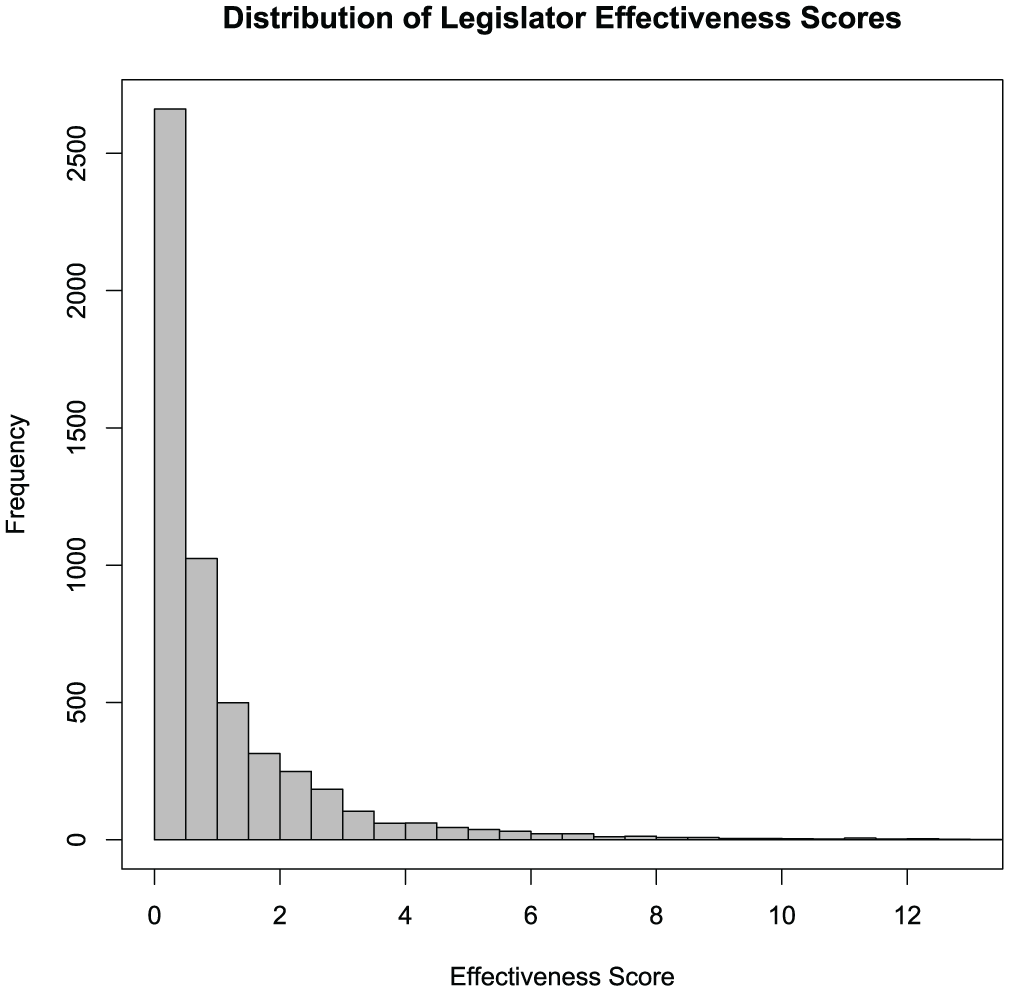
Distribution of legislative effectiveness scores (LES).
Independent Variable: Electoral Competition
Our primary independent variables of interest are vote share measures of general and primary election competitiveness. The connection between a legislator’s vote shares and the underlying competitiveness of the district is complex and imperfect, but it is the closest approximation available (Ansolabehere, Brady, & Fiorina, 1992; Ferejohn, 1977). In studies of Congress, the district’s vote share in the previous congressional election is typically used (Bartels, 1991; Ferejohn, 1977; Kuklinski, 1977; MacRae, 1952), and we follow these previous scholars by also using vote shares from the previous election.
To compare and contrast the effects of primary competition with those of general election competition, we created a new database with both variables. We obtained data on the primary election vote shares of House members from Hirano and Snyder’s (2012) study of primary elections and political accountability. We obtained data on general election competition from Volden, Wiseman, and Wittmer’s (2013) study of legislative productivity. Merging these allows us to produce a data set that includes the primary and general election vote shares, the legislative productivity, and other relevant control variables for each member of the House of Representatives during the 96th to 110th Congresses (1979-2009).
We made two modifications to the data from those sources. First, we drop observations that lacked either primary or general election vote share information or could not be matched between the data sets. Some of these simply had missing data and others were anomalous in other ways—for example, legislator death required a replacement by special election midsession. Second, in some models, we omit multichallenger primary races. This is necessary because vote share is not an equivalent measure of competitiveness in multichallenger races. For example, a legislator who received 51% of the vote in a two-way race was in much more danger of losing the election than a legislator who received 51% of the vote in a five-way race. 5 However, including all of these observations, as shown in the supplemental materials, does not substantively change the results. We also account for this by including the multichallenger races but code the primary election results as the margin between the winner and the second place candidate. In each case, the results are nearly identical.
Finally, we investigate whether or not there is any relationship between primary and general election competitiveness, as collinearity between the two could affect the precision of our models. In Figure 2, we display a scatter plot charting the primary election vote share (on the vertical axis) and the general election vote share (on the horizontal axis) of each observation in our data. Interestingly, although most observations fall in the upper ranges of vote share on both axes, we find a correlation of only .07 between the two measures. Given that this is the case, it is certainly possible for electorally safe legislators (in a general election race, for example) to be quite vulnerable in the primary election (and vice versa).
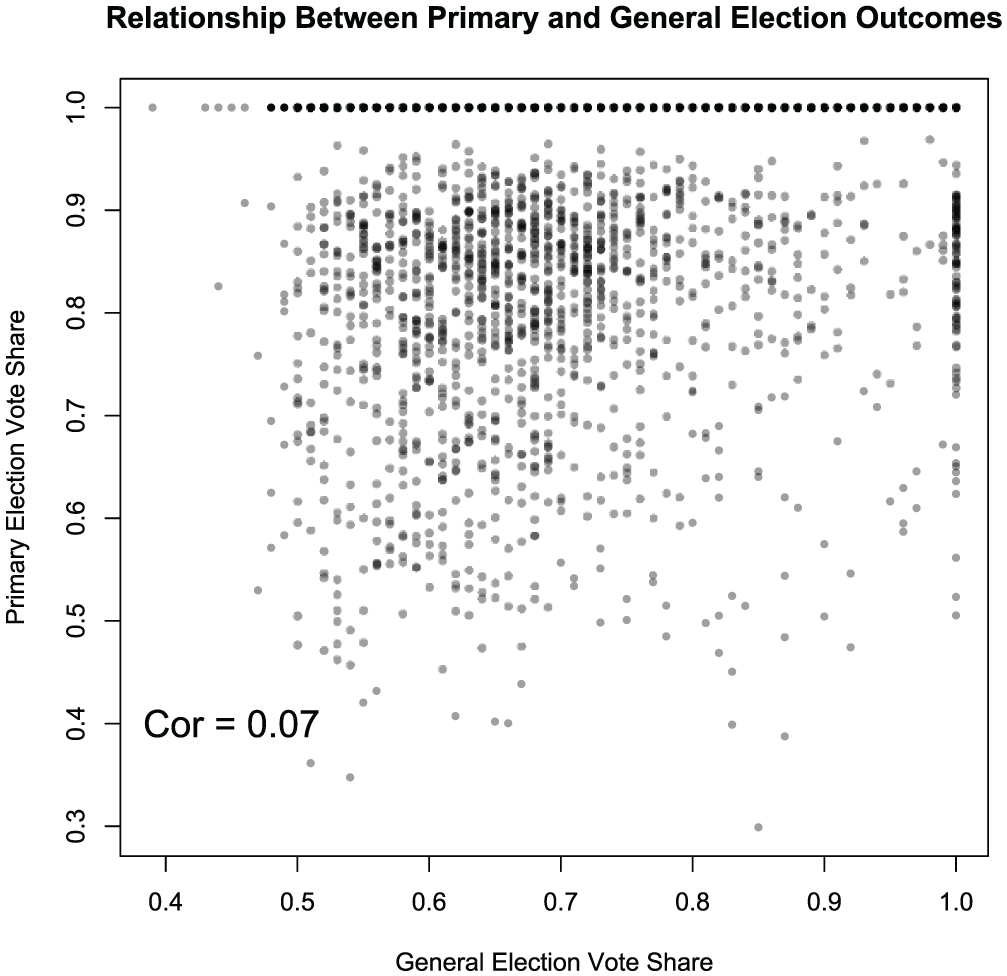
Relationship between legislators’ primary and general election vote shares.
Additional Variables
Of course, electoral competition is not the only factor influencing legislative effectiveness. Institutional and individual-level factors can play a role in determining productivity. For example, Miquel and Snyder (2006) find that individual-level factors, such as candidate tenure and personal lawmaking abilities, can lead to greater legislative productivity, regardless of institutional rules. Similarly, Cox and Terry (2008) find that seniority, being a member of the majority party, and leadership position all boost a legislator’s productivity. Anzia and Berry (2011) even found that legislator gender matters: Congresswomen consistently outperform their male counterparts in legislating. To account for these relationships, we include measures of the individual-level characteristics of seniority, state legislative experience (interacted with the professionalism of that state’s legislature), gender, race, and ideology, and the institutional-level factors of membership in the majority party, positions of power and on key committees, and state delegation size.
The inclusion of these controls also allows us to maintain continuity and comparability to previous scholarship. These are the same control variables as Volden and Wiseman (2014) use in their exploration of the effects of general election competition on productivity. Finally, we also include as a control variable the LES of each member from his or her previous session, which controls for unobservable legislator traits such as personality, ambition, expertise, and “innate ability” (Volden & Wiseman, 2014). The lagged LES also guards against heterogeneity between election results and productivity over time. Together, these controls serve to isolate the effects of electoral competition in both the primary and general elections.
Results
We find in each case that not only is general election competition related to legislative productivity, but also that primary competition is an important predictor of effectiveness as well. Table 1 displays our central findings. As mentioned earlier, we use a linear regression model with the legislator’s effectiveness score (LES) as the dependent variable. The four models presented here are slight variations of each other to test for robustness of our results. Models 2 and 4 differ from Models 1 and 3 only in the inclusion of legislator fixed effects. These models address concerns of omitted variable bias and endogeneity by accounting for any unobserved legislator-constant factors that could affect productivity. The results remain consistent across all four models. The coefficients and significance levels of the general election vote share, lagged LES, and control variables essentially replicate the results found by Volden and Wiseman (2014). Model 6 replicates Model 1, but includes multicandidate races and codes primary election votes as the margin between the winner and the second place candidate. Model 7 also uses this coding scheme but includes legislator fixed effects.
Primary and General Election Vote Shares and Legislative Productivity.

Note. Robust standard errors clustered by member of Congress shown in parentheses. LES = legislative effectiveness score; FE = fixed effects.
Significance codes: *p < .1. **p < .05. ***p < .01, two-tailed tests.
We also observe large and statistically significant effects for our independent variable of interest: a legislator’s vote share in the most recent primary election. In every case, the estimated coefficient is in line with our hypothesis. The positive sign indicates that safer legislators are more productive than their marginal counterparts, whereas legislators who face stronger primary challenges are less likely to focus their attention toward the production of substantial legislation. 6
Model 5 of Table 1 tests for a nonlinear relationship between primary vote shares and productivity. Following Volden and Wiseman’s (2014) model of general election competition, we tested both linear and quadratic measures of primary vote share. Unlike in the model of general election voting, the quadratic measure for primary election vote shares fails to achieve statistical significance and is substantively small. We therefore prefer the linear models (Models 1 to 4) over the quadratic model (Model 5). 7 While we cannot be absolutely sure of why the differences between the primary election and general election exist, we offer one hypothesis here. Figure 3 shows the distribution of primary election votes (right panel) in the data and the distribution of general election results (left panel) in the data set. We see that there are many legislators who win their general election races with far less than a unanimous vote. On the contrary, the vast majority of legislators are winning their primary contests with incredibly large vote shares or are running altogether unopposed. This difference in the distribution and outcomes of these elections may be the reason for the different relationships between a legislator’s effectiveness score and his general election vote share versus his primary election vote share. In other words, whereas it is quite common to be unopposed in the primary election, it is much rarer to not face an opponent in the general election. Those legislators who manage to run unopposed (or win with very wide margins) in the general election may be able to behave differently (i.e., less productive) than in the much more common scenario in which a legislator does not face a primary challenge.
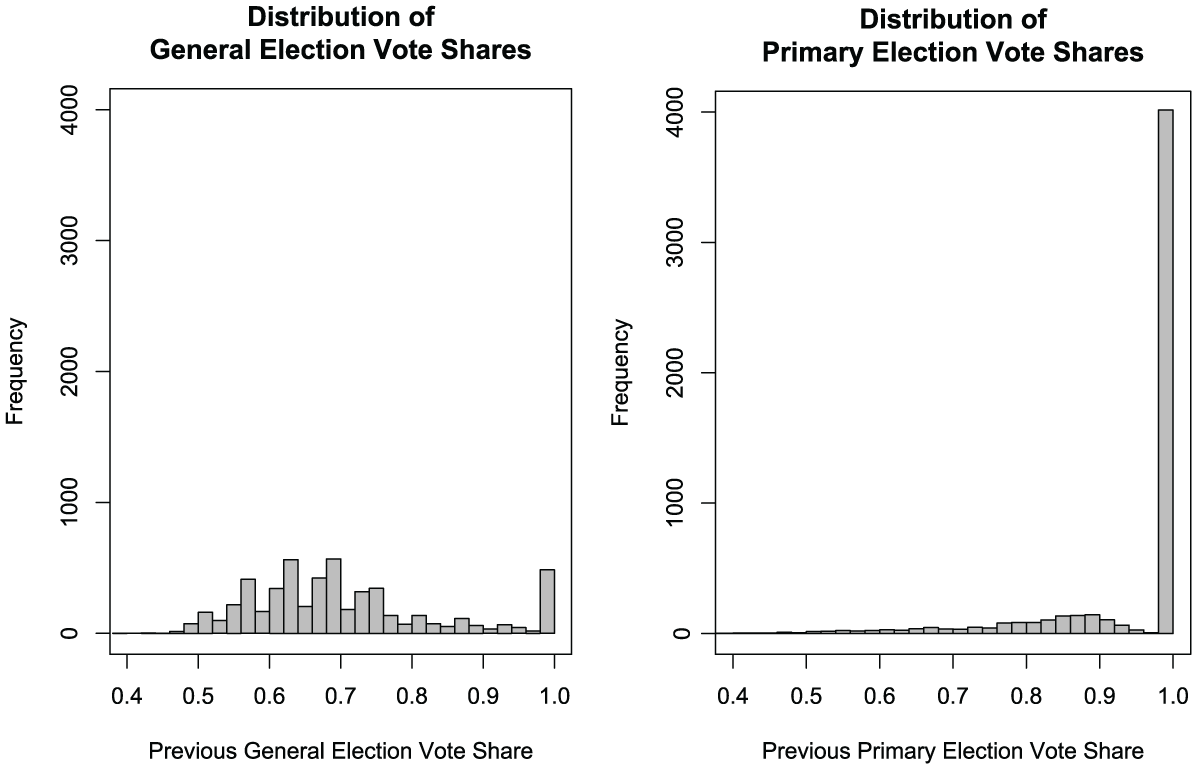
The left panel shows the distribution of general election vote shares among legislators in the data.
The substantive magnitude of the relationship between vote shares and effectiveness, however, is similar across the general and primary election results. Figure 4 shows the predicted effectiveness scores across a range of primary and general election outcomes, holding all other variables at observed values. The left panel shows the relationship between general election vote shares and effectiveness. As in the regression table, and consistent with Volden and Wiseman (2014), we see a nonlinear relationship between the two variables. The right panel shows the relationship between primary election vote shares and effectiveness. Here we see the linear relationship between the two variables as estimated in the regression model. Comparing the two panels side by side, we see that the substantive change in the predicted effectiveness due to primary election competitiveness is as large or larger than the change in effectiveness due to general election vote shares.
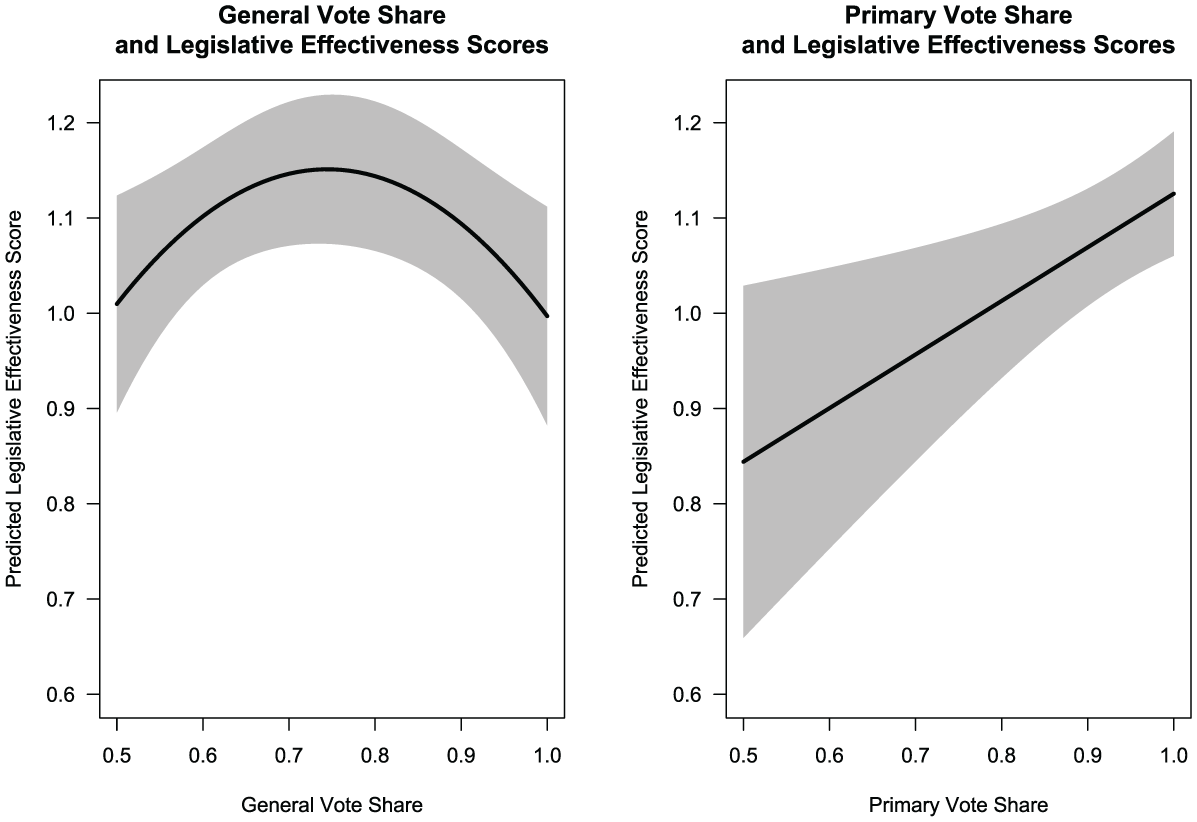
The left panel shows the relationship between general vote shares and a legislator’s effectiveness score.
Comparing the magnitude of primary competition’s effects with other established predictors of legislative effectiveness can also help us better understand its relative impact. For example, the increase in productivity associated with the primary vote share is approximately 20% as large as the predicted increase in legislative effectiveness that comes with being in the majority party. Given the various advantages that come with majority status, we would expect this variable to be very large and significant. Moreover, we find that the impact of primary competition is comparable in magnitude to a member’s seniority, another well-known factor in legislative effectiveness and influence. Seniority augments relationships with other legislators, lawmaking expertise, and opportunities for better leadership and committee positions. A one standard deviation change in seniority (about 3.8 terms in Congress), for example, predicts a 0.29 increase in the productivity score. The magnitude of a one standard deviation in primary competition (about 0.11 change in primary vote shares) is roughly 30% as large as the relationship between productivity and seniority (.06).
It may also be useful to translate the abstract measure of LES into a more concrete measure, such as bill production. The average member of the House produces about 15 bills per session. Consequently, if all members were to receive one standard deviation less of the primary vote share in a given election, we would expect approximately 102 fewer bills to be produced during the subsequent session. This suggests that at least 10 of those bills would have been passed into law.
These results present strong evidence in favor of the primary constituency’s effect on legislators’ behavior in office. Legislators who are safer within their primary constituency, or from primary challenges altogether, are more effective in office. At the same time, legislators who face competitive primary elections (and general elections) tend to be less productive legislators. Although our results cannot speak to the direct mechanism between these two factors, the results are consistent with a number of theories described earlier. Given that legislators face dramatic constraints on their time, avoiding the need to spend time campaigning to the primary constituency may allow legislators more time to produce and advance their legislative agenda through Congress. At the same time, it may also be the case that legislators facing difficult elections want to avoid the possibility of upsetting any potential voters with legislation that runs contrary to their preferences. With a primary and a general constituency that are often in conflict with one another, avoiding legislation altogether to focus on other activities (such as campaigning, or constituent service) may provide a safer alternative.
Additional Empirical Results
In this section, we test a number of additional hypotheses and extensions of the main results shown above in Table 1. We first investigate the various component parts of the LES to see if particular legislative activities are related to electoral safety or vulnerability. The LES score is a composite index of several different activities that are essential to the eventual passage of any given law. These include how frequently the legislator introduces legislation, whether or not that legislation is considered and passes committee markups and hearings, whether the legislation is considered on the floor of the House, and if it passes the House and eventually becomes law. Each of these activities requires a great deal of effort, skill, and strategizing on the part of the sponsoring legislator. Legislators must develop the concept, language, and policy direction of any bill that they introduce. After introduction, successfully navigating the legislative process requires coalition building, persuasion, revision, and anticipating inevitable detractors’ attacks. One possibility is that the relationship observed earlier of electorally safe legislators being more productive could mask differences in how legislators allocate their time. Perhaps electorally vulnerable members seek to merely appear productive by introducing ceremonial or symbolic legislation that is doomed to die in committee, whereas electorally safe members invest more time in the harder and slower process of moving well-crafted bills through the committee, amendment, and floor process.
To test this relationship, we run a number of new regression models. In each case, we retain the same independent variables as were used in Table 1. However, in each model, we change the dependent variable to be a different measure of legislative success. While we include the same controls as in the previous tables, we omit the presentation of the coefficients to conserve space. They are largely consistent with the previous results. Table 2 shows the results of the largest hurdles that any legislator faces in moving a bill toward becoming law. The results show little variation across actions and are universally in line with the previous models that aggregate these actions together into the legislator effectiveness score. In each case, legislators who performed better in the previous primary election, and are thus safer electorally, are more likely to introduce legislation, shepherd that legislation successfully through the committee process, onto the House floor, and on to the president’s desk. In each model, the coefficient on a legislator’s primary election vote share is positive and statistically significant, with the exception of the last step of the process.
Additional Results: Legislative Hurdles.
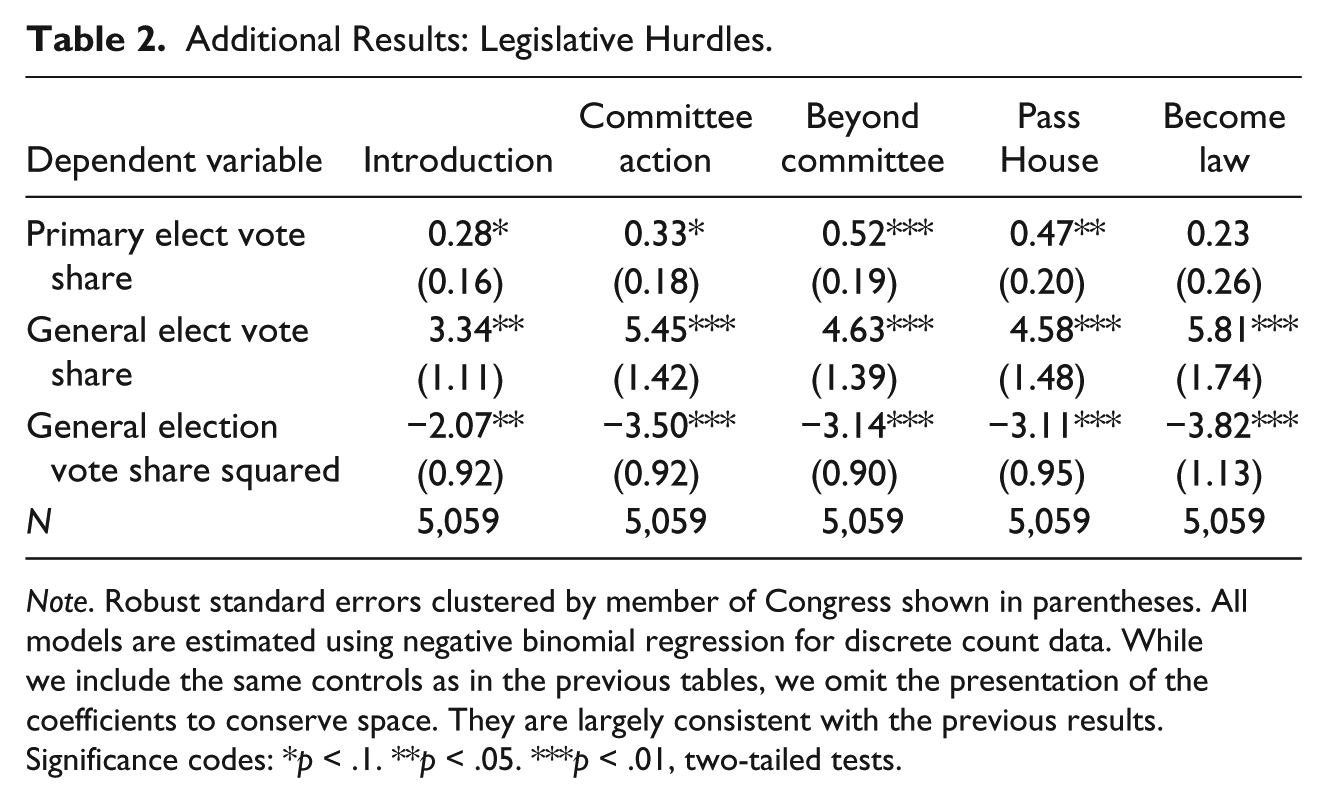
Note. Robust standard errors clustered by member of Congress shown in parentheses. All models are estimated using negative binomial regression for discrete count data. While we include the same controls as in the previous tables, we omit the presentation of the coefficients to conserve space. They are largely consistent with the previous results.
Significance codes: *p < .1. **p < .05. ***p < .01, two-tailed tests.
Table 3 shows the same results but differentiates between substantive and significant, substantive, and commemorative legislation. In this case, primary election vote shares appear to be related to the introduction of substantive and significant legislation and not ceremonial bills. This suggests that perhaps electoral safety affords legislators the time to work on larger, more complex, and comprehensive legislation.
Additional Results: Different Types of Legislation.

Note. Robust standard errors clustered by member of Congress shown in parentheses. All models are estimated using negative binomial regression for discrete count data.
Significance codes: *p < .1. **p < .05. ***p < .01, two-tailed tests.
We also test for whether the primary vote share matters as much as the simple fact of having a primary challenger. Given the skewed distribution of primary election results shown in Figure 3, it may be the case that the mere presence of a challenger is enough to cause a legislator to alter his or her behavior. The first two models of Table 4 substitute a dummy variable of primary opposition in place of the primary vote share. Consistent with our previous findings, the presence of primary competition reduces legislative productivity. The third and fourth models investigate whether or not primary election competitiveness is related to productivity among the set of legislators who faced a primary challenge. To estimate these models, we omit any candidate who ran unopposed. In these models, the estimated coefficients remain in the expected direction but do not attain statistical significance. This finding reinforces the notion that challenger presence plays a significant role in affecting legislative productivity. This suggests that some, but not all, of primary elections’ impact on productivity is driven simply by the presence of a challenger at all. However, we also recognize that whether or not candidates face primary challengers is endogenous to their behavior in office. Thus, it may be more appropriate to consider uncontested and contested races together as uncontested races are in many cases due to candidates who have scared away any potential challengers and would have, in the presence of a primary challenge, won overwhelmingly.
Additional Results: Contested Versus Uncontested Races.
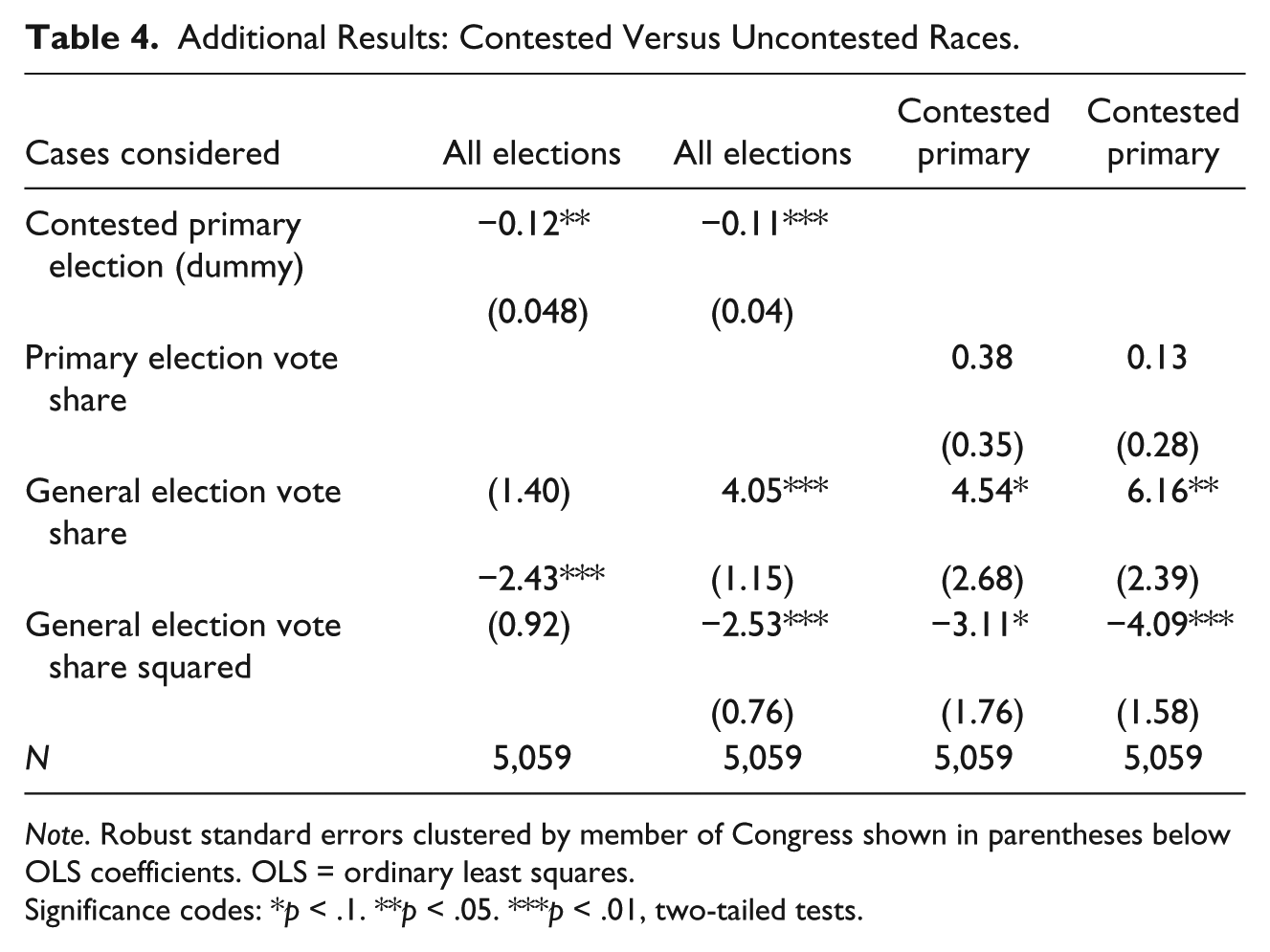
Note. Robust standard errors clustered by member of Congress shown in parentheses below OLS coefficients. OLS = ordinary least squares.
Significance codes: *p < .1. **p < .05. ***p < .01, two-tailed tests.
Having found significant effects for both primary and general election competition, we now examine the possible interplay between these two forms of competition. It may be the case that if legislators are reacting to competition in one election (i.e., the general election), they may struggle to simultaneously respond to the primary constituency (and vice versa). This is especially possible given the fact that preferences between the general electorate and primary electorate are often in tension with one another (Hill, 2015). This could prove problematic to a legislator who wants to appear productive to these two different audiences. For example, a legislator with a conservative primary electorate and a moderate general electorate could alienate the former with a flurry of moderate legislation full of compromises and bipartisan offerings. Similarly, this same legislator could find himself in trouble with the general electorate with efforts to appease a far-right primary electorate with partisan or extreme pieces of legislation. Previous research suggests that this may be the case. Brady et al. (2007) find that increasing vote shares in the general election are correlated with lower vote shares in the primary election stage. If legislative productivity is a factor in determining the vote shares of congressional candidates, then productivity aimed at appealing to one constituency may have the opposite effect among the other. Beyond the inherent tensions that exist between the primary and general electorate, it is also possible that legislators may simply lack the resources to devote their attention to both of these important constituencies. Given the finite amount of time, staff, and money available to legislators, it may be the case that cultivating the favor of both the general election constituency and the primary electorate at the same time may simply require more time and resources than a legislator can allocate.
In Table 5, we investigate this possibility by subsetting our models across one election’s vote share while estimating the effects of the other. For consistency with our previous results, we use the specifications from the first model in Table 1. However, our results persist no matter which model we use. In the supplemental materials, we present the same models using an interaction variable between primary and general election vote share (Table A6). For ease of presentation, we use the subset models; however, the results are consistent across specifications. While we include the same controls as in the previous tables, we omit the presentation of the coefficients to conserve space. They are largely consistent with the previous results.
Additional Results: Safe Versus Competitive Races.
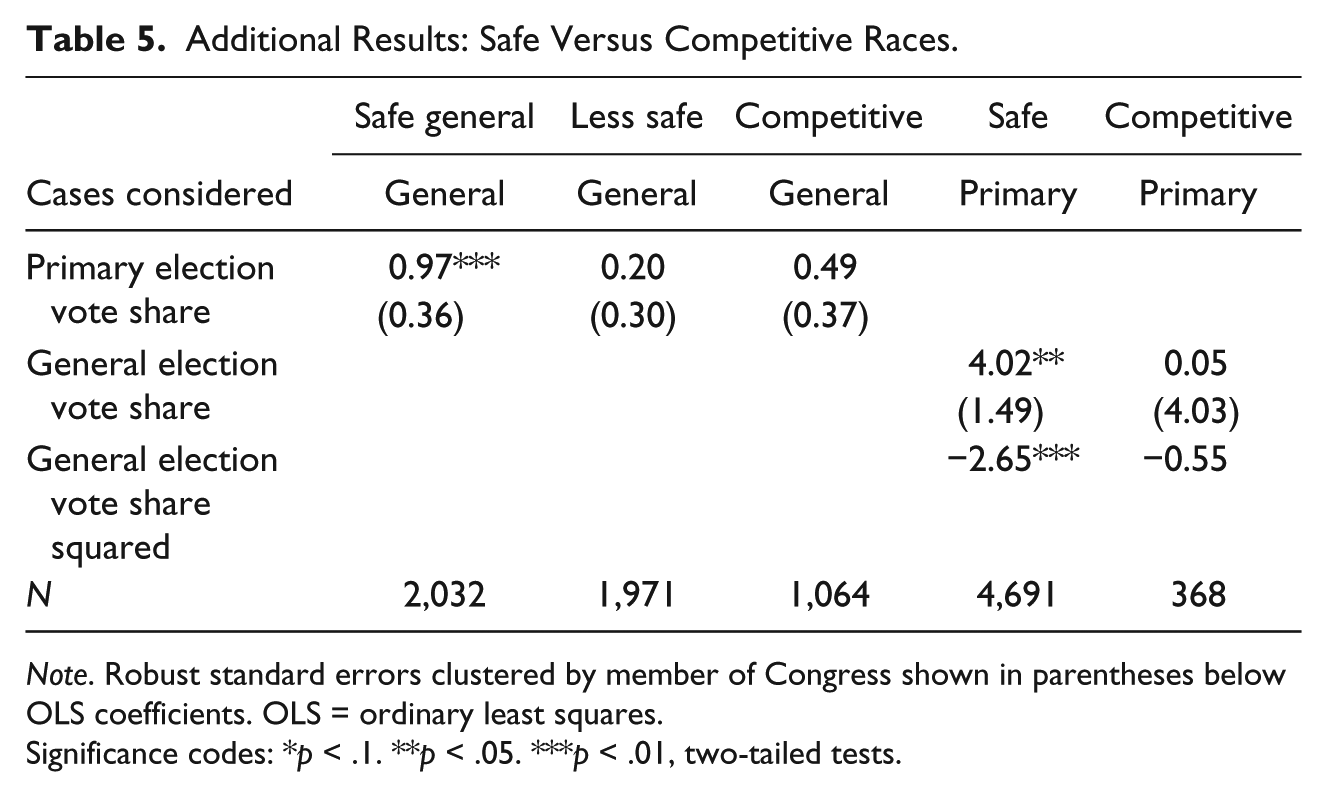
Note. Robust standard errors clustered by member of Congress shown in parentheses below OLS coefficients. OLS = ordinary least squares.
Significance codes: *p < .1. **p < .05. ***p < .01, two-tailed tests.
The first three models of Table 5 subset our data by the level of competition in the general election. The first model includes only the observations from safe general elections (those with a vote share over 0.7), the second those from less safe general elections (those with a vote share between 0.6 and 0.7), and the third includes races from competitive general elections (those with a vote share less than 0.6). Interestingly, we find that in competitive and less safe general elections (Table 5: Models 2 and 3), the coefficient on primary election vote share is substantially smaller and has no statistically significant effect on a legislator’s subsequent effectiveness score. However, when the general election is very safe (Table 5: Model 1), the effect of primary vote share on legislative productivity is more than 60% larger than what we estimate in our main models (Table 1). This suggests that much of our central findings are being driven by the impact of primary vote share when legislators have very safe general elections, which is the plurality of cases in our data (2,023 of the 5,074 observations).
The fourth and fifth models of Table 5 estimate the effect of general election vote share across subsets of primary election competitiveness. The first model includes only the observations from safe primaries (those with a vote share greater than 0.8) and the second model only those from more competitive primaries (those with a vote share less than 0.8). We recognize that 0.8 is far from a truly competitive primary, yet only 7% of legislators won primary contests by a margin of less than .80. Given that many legislators face no primary challenge whatsoever, we use .80 as our threshold for a competitive primary. However, different cut points yield substantively similar results. Here we find the same pattern as when conditioning on the general election outcome. For cases in which the primary election was competitive (Model 5), the general election vote share has no statistically significant impact on legislative productivity. In safe primaries, however, the effect is especially pronounced and even larger in magnitude than observed in our main findings.
Taken together, Table 5 tells an intriguing story about the interaction between general and primary election competition. At least when it comes to legislative productivity, legislators appear to be responsive to only one when they are safe in the other. Although we cannot directly identify the mechanism behind this result, we offer a possible hypothesis for this interesting result. As we have mentioned before, legislators face significant constraints on how to use their time and where to direct their resources. Furthermore, we have noted that in many cases the preferences of the primary and general election constituencies are in conflict. Given this, it may be the case that legislators lack not only the time, but also the policy and campaign resources to attend to both a competitive primary election and a competitive general election with greater legislative productivity. Furthermore, in many cases, this would require policy work that differs substantively across constituencies. In fact, the situations when a legislator has marginal support in either a primary or general election are the cases when we would most expect the legislator to face difficulties in simultaneously positioning himself ideologically in the center of the primary and general electorates.
In the supplemental materials, we also test for the possibility of temporal changes in the relationship between primary election competitiveness and legislative productivity. Although it is possible that there have been changes in this relationship across time, we find little support for this in regression models that interact primary election competitiveness with a linear year variable, with year dummy variables, and when subsetting the data across decades. The relationship appears to be relatively constant across the periods of time we have (1979-2009).
Discussion
In this article, we bring new evidence to bear on one of the most important questions in political science: How do elections affect the behavior of our public officials and, consequently, the policies that they produce? In particular, we have explored the effects of electoral competition not only in general elections, but also in the relatively overlooked primary stage. Although scholars have long recognized the electoral connection between legislators and their general election constituency, we know much less about the interplay between the primary constituency and legislators’ behavior in office. Furthermore, we know even less about how these two constituencies, which are often in conflict with one another, interact to affect the incentives, strategies, and behavior of representatives in office. This novel approach allows us to provide new understanding of the electoral connection to one of the most important behavioral roles of elected officials in Congress: legislative productivity.
Our results elaborate on Volden and Wiseman’s (2014) initial findings that general elections influence legislative effectiveness, but our critical contributions are that primary elections have similarly important impacts on productivity and that the primary and general election constituencies cannot be considered in isolation. Overall, legislators facing less competition are more productive, and the difference in productivity is comparable in magnitude to that caused by other well-known factors influencing effectiveness such as seniority in Congress. These findings suggest that vulnerable legislators, relative to their safer colleagues, are choosing to channel their efforts toward endeavors other than creating and advancing legislation (e.g., constituent services, fundraising, or campaigning, Dropp & Peskowitz, 2012; Grimmer & Powell, 2013).
Moreover, we find an intriguing interplay between the effects of the two stages of congressional elections. At least in terms of productivity, legislators are only responsive to one stage of the election when they are safe in the other. This finding is a compelling reason to revisit a great deal of previous research on electoral connections to legislative behavior, which until this point has largely only accounted for general election conditions. Those that do consider the primary election often do so in isolation. Our results suggest that both should be considered in tandem. While the causal mechanism for this phenomenon merits additional study, our results are consistent with a story of legislators who are limited in their ability to prioritize their responses to a multitude of electoral conditions. A vulnerable legislator in the general election may not be able to also pay attention to the primary election constituency, which may expect completely different behavior, rhetoric, and results from a legislator. Similarly, a vulnerable legislator in a primary election may be expected to deliver policies that stand in direct contrast to what a general election constituency expects and would reward. Thus, there appears to be a difficult interaction between primary and general elections as they influence legislative behavior.
Indeed, our findings here immediately bring to mind other potential avenues for future research. The current literature, for example, lacks analyses of the other ways in which legislators might respond to primary competition: coalition-forming, appropriations, credit-claiming rhetoric, and so forth. In these responses, too, the interaction between primary and general elections could also be studied. The results may very well shed light on one important question raised by our results: Given that legislators facing competitive primaries produce less legislation, to what are they instead directing their attention and efforts to win reelection? In short, we hope this article opens a new and critical discussion on the power of primary elections to affect legislative behavior.
Supplemental Material
Supplemental_appendix_RandR – Supplemental material for Electoral Competition and Legislator Effectiveness
Supplemental material, Supplemental_appendix_RandR for Electoral Competition and Legislator Effectiveness by Michael Barber and Soren Schmidt in American Politics Research
Footnotes
Acknowledgements
We would like to thank Matthew Young for his help with this project. We also thank audiences and discussants at the 2016 State Politics and Policymaking Conference, the 2016 Annual Meeting of the American Political Science Association, the 2017 Annual Meeting of the Southern Political Science Association, and Brigham Young University for helpful feedback and conversations.
Declaration of Conflicting Interests
The author(s) declared no potential conflicts of interest with respect to the research, authorship, and/or publication of this article.
Funding
The author(s) received no financial support for the research, authorship, and/or publication of this article.
Notes
Author Biographies
References
Supplementary Material
Please find the following supplemental material available below.
For Open Access articles published under a Creative Commons License, all supplemental material carries the same license as the article it is associated with.
For non-Open Access articles published, all supplemental material carries a non-exclusive license, and permission requests for re-use of supplemental material or any part of supplemental material shall be sent directly to the copyright owner as specified in the copyright notice associated with the article.
