




Abstract
Laws that restrict and disclose the actions of lobbyists are attempts to protect elected officials from undue influence and preserve public trust in lawmaking processes. Imposing too many campaign finance restrictions and reporting requirements on registered interest groups, however, might discourage them from registering. I use an original data set compiled from several decades of lobbyist lists to determine whether these laws suppress registration rates among interest groups. More limits on campaign finance activities, but not heavier reporting burdens, are shown to be associated with depressed registration of interest groups. As unregistered interests are not subject to these regulations, this presents a paradox of political reform. Reformers can either restrict the campaign finance activities of organized interests or disclose their lobbying activities more fully, but not both. I provide estimated totals of registered interest groups given a set of laws that maximizes compliance.
Introduction
There is increasing concern and evidence that lobbyists and their clients may not be complying fully with lobby registration and transparency laws in the United States (see Thomas & LaPira, 2017). One explanation for such avoidance is that lobbyists can take advantage of loopholes to conceal their activities from the public. With the recent enactment of additional ethics and transparency laws, the imposition of executive orders pertaining to registered lobbyists, and calls to “drain the swamp” in Washington, the effectiveness of lobby regulations is an issue of public concern (see LaPira & Holyoke, 2017).
Are lobby transparency laws effective at getting lobbyists and their clients to register and then report all of their activities? Moreover, do the imposition of other types of laws, such as campaign finance limits, discourage them from registering and reporting? These questions are difficult to answer at the federal level because only one set of laws regulates those lobbyists at any given time, and those laws are relatively new in their adoption. By contrast, the U.S. state governments have adopted a range of laws that restrict and disclose interactions between lobbyists and lawmakers over the past three decades. These laws are relatively comprehensive as by 2007, 47 states were rated by the Center for Public Integrity as having more numerous lobby laws than the federal government (Thomas, Hrebenar, & Nownes, 2008). Given the different experiences of state governments in regulating lobbying activities, researchers can gain insight into the effectiveness of different sets of lobby laws.
In this study, I utilize variation in lobby laws at the U.S. state level to test a theory of compliance. Registration is the first step toward regulating and disclosing the activities of interest groups. The act of registering is a costless task as it usually involves submitting a short form and paying a nominal fee. The criteria that determine who must register, however, differ across states. While more specific sets of criteria should capture more lobbyists and interest groups, the enactment of other kinds of lobby laws that affect only registered persons might dampen this positive effect. If registered lobbyists are subject to campaign finance limits and reporting requirements, then some of them may consider not registering. Hence, registration criteria and these other types of laws should interact to determine how many interest groups register. This would present a paradox of political reform. Nonregistered lobbyists and clients are not subject to special campaign finance limits or reporting requirements. In seeking to protect officials from undue influence and preserve public trust in lawmaking processes, policy makers can either maximize registration rates or regulate the activities of the registered persons, but not both.
Using an original data set spanning all 50 U.S. states and three decades, I find that campaign finance restrictions suppress registration rates for interest groups. These findings have implications for the study of organized interests. Contrary to the results of prior studies, they suggest that lobby laws have some effect on registration rates. Second, numerous giving limits may be counterproductive to the extent that they discourage agents from registering (and also reporting their activities, once they register). As a result, lobby transparency information provided by state authorities is somewhat unreliable for state-level analysis. Third, my model provides a means for estimating more accurately the sizes of interest populations in the American states and other political systems. Based on my findings, I estimate that there might be hundreds of unregistered, shadow groups lobbying in the U.S. states. Ultimately, policy makers must choose between two different types of regulatory regimes for lobbying: a regime in which there is maximum registration but fewer campaign finance limits, or one in which fewer interest groups register but are subject to giving limits and reporting. Given these multiple dimensions of lobby laws, I also suggest a need for further inquiry into the effects of lobby laws on other activities that organized interests might engage in. Such inquiry is timely given recent political developments in the U.S. and political reform efforts abroad.
Lobby Transparency and Interest Populations
Regulations on lobbying are generally intended to prevent forms of corruption and make elected officials more accountable to their constituents (Rosenthal, 2000). Among the most frequent forms of lobby laws are registration and reporting requirements. Once lobbying agents are registered, they are required to file periodic reports disclosing varying degrees of information to the public. A theoretical justification for lobbying regulations can be found in the writings of deliberative democratic theorists (Chari, Hogan, & Murphy, 2010). Transparency undergirds deliberative, democratic institutions. State attempts at regulating lobbying via registers are attempts at protecting public trust in political institutions. They serve the purpose of providing information to the public regarding legislative processes and reinforcing confidence in democratic processes (Ozymy, 2010). Occasional ethics scandals, the resulting media coverage, and electoral consequences highlight the roles of ethics and transparency laws in strengthening connections between voters and elected officials (Goodman, Holp, & Ludwig, 1996).
American state governments were among the earliest democratic regimes in the world to regulate organized interests (Chari et al., 2010; Thomas, 1998). In 1890, Massachusetts became the first state to establish a register of lobbyists (Opheim, 1991). More than half the states introduced lobby registration or additional reporting requirements throughout the 1960s and 1970s (Opheim, 1991). Arkansas and West Virginia were among the very last states to require registration of lobbyists by an entity outside of the legislature itself, both in the late 1980s (Hall, 1989; Thomas, 1998). State legislatures enacted a variety of new restrictions throughout the following decades (Hamm, Weber, & Anderson, 1994; Huckshorn, 1985). Between 1990 and 1995, a number of states dramatically increased regulations as a consequence of salient federal corruption probes (Gray & Lowery, 1998; Newmark, 2005). Both Operation Boptrot in Kentucky and Operation Lost Trust in South Carolina caught numerous lawmakers in the acts of extortion and accepting bribes. A similar probe, Operation Tennessee Waltz, resulted in the arrests of multiple state lawmakers in 2006. In the years following the arrests, these states, along with Arkansas, Arizona, Georgia, Louisiana, South Dakota, Utah, and Vermont, all increased their total lobby laws by more than 300% (Ozymy, 2010; Ozymy, 2013). Due to scandals, at least three state legislatures were called into special sessions and passed new ethics laws in the early 1990s: South Carolina’s in September 1991, Arizona’s in November 1991, and Kentucky’s in February 1993 (Bullock, 1994). Factors other than local scandals may also contribute to the enactment of lobby laws. Moralistic political cultures, legislative professionalism, and term limits are all positively associated with the enactment of additional regulations (Ozymy, 2013). Moreover, the salience of the scandal can affect the robustness (or strictness) of subsequent reform efforts (Crepaz, 2016). Federal scandals have also served as an impetus for state-level reforms, as evidenced by numerous state laws enacted after the Watergate scandal of the 1970s (Ensign, 1997).
With persistent distrust of both lobbyists and special interests among members of the public (see Milbrath, 1963), and occasional political scandals and litigation, the effectiveness of ethics and transparency laws is an issue of public concern. There is existing evidence that lobby laws are either not obeyed or enforced as intended by regulators. Even after the adoption of the federal Lobbying Disclosure Act in 1995, some former legislators do not register as lobbyists but instead claim merely to be consultants hired by reputable lobbying firms. Thousands of individuals may be similar shadow lobbyists in the nation’s capital. After 2009, the imposition of new restrictions on registered lobbyists likely dampened registration rates in subsequent years (LaPira, 2016). However, there is also evidence that new restrictions on former congressional staff acting as lobbyists (so-called “revolvers”) discouraged some from lobbying (Cain & Drutman, 2014) and that lobby laws in the states have helped to make policy outcomes more representative of state-level public opinion (see Flavin, 2015).
Do Lobby Laws Affect Interest Populations?
Throughout a series of publications, Gray and Lowery have developed a theory of interest populations. Populations refers to the number of interest groups actively lobbying within a political system. Gray and Lowery’s Energy–Stability–Area model identifies three factors that influence the size of interest populations. Energy represents the resources needed to sustain lobbying. When there is “something to lobby for,” interest activity will increase (Gray & Lowery, 1996, p. 71). Constituent interest in existing government goods, services, regulations, and other policies all serve as energizing factors that encourage interest activity. The stability (labeled “interest certainty”) of these goods might also spur mobilization (Lowery & Gray, 1995). The most influential determinant of populations, however, is area or the space needed for interest groups to operate. Groups exist where there are constituents to serve. Without these constituents, “lobbyists have insufficient ‘space’ to survive” (Lowery & Gray, 1995, p. 10). While group totals tend to increase with constituents, the increase is curvilinear. To find support for their theory of group populations, Gray and Lowery turned to lobby registration data from the U.S. states.
Comparisons of interest populations across states and time are said not to be affected by different registration requirements or lobby laws (Gray & Lowery, 1996, 1998; Lowery & Gray, 1994, 1997). The finding that lobby laws may behave as constraints on registered interest populations does not call into question the theoretical validity of the Energy–Stability–Area model but suggests that lists of registered agents may not be accurate reflections of the true sizes of interest communities in some states. Indeed, the cause for not comparing totals of political action committees (PACs) has been wide variation in state registration requirements (Lowery & Brasher, 2004). While my findings do not suggest that interest populations (or totals of groups actively lobbying) are affected by lobby laws, they suggest that counts of registered groups are not the most reliable indicators of the sizes of these populations. By extension, my findings suggest that statistical “models of interest community density” might be somewhat “misspecified” (Gray & Lowery, 1998, p. 79).
There are conflicting expectations about how lobby laws may affect totals of registered interest groups. While a number of articles have explored the relationships between lobbyist or client totals and regulation stringency, they offer contradictory conclusions. All examine single-year cross sections of groups and regulations and do not parse out the effects of different types of regulations. Hunter, Wilson, and Brunk (1991) were among the first to test whether stringent (more all-encompassing) lobbying regulations affect registrations. They regressed the total numbers of registered lobbyists per state on binary indicators of frequent legal definitions of “lobbyist,” but failed to find statistically discernible results. Hamm et al. (1994) wrote in response to Lowery and Gray’s (1993) contention that registration criteria have little impact on net registrations. When controlling for state population, the authors found a positive and discernible association between totals of registered groups and the broadness of statutory definitions of lobbying. States with broader sets of definitions were shown to have higher registration rates, thereby indicating that lobbying regulations may stimulate registrations of latent groups. Hamm et al. (1994) then mentioned that group population figures may be unreliable in some states due to poor enforcement of registration procedures.
Other than the effects of registration criteria, it has been suggested that other laws present barriers to lobbying. Brinig, Holcombe, and Schwartzstein (1993, p. 377) utilized an “economic model” to portray lobby regulations as instruments designed to benefit incumbent lawmakers and constrain lobbyists. Using measures of regulations and violation penalties, and examining the ratios of bills introduced to bills passed, the authors suggested that increased regulations generate rents for incumbent lawmakers. They assumed that the introduction of bills is largely a costless endeavor but that the subsequent advocacy for such bills by lobbyists becomes more costly with increased lobby regulation. Such added costs hypothetically force groups to be more selective over which laws to support, thereby providing additional information (as signals) to lawmakers about which interests are most interested in particular laws getting enacted. Lowery and Gray (1997) suggested instead that elected officials are rarely concerned with whether lobbyists abide by statutory regulations and that lawmakers are more concerned with both campaign donations and the influence of groups within their districts. They demonstrated that contrary to the theoretical expectations of Brinig et al. (1993), increased regulations were not correlated with lower numbers of registered groups. In addition, Brasher, Lowery, and Gray (1999) claimed to find no impact of changing lobbying definitions on the totals of registered lobbyists or clients in Florida and Minnesota over two decades.
In light of these studies, the direction of expected effects of lobby definitions and related laws on group totals remains unclear. While it is possible that broader registration criteria increase totals of groups registered, regulations such as campaign finance limits and reporting requirements may also present barriers to groups from registering. It is also possible that these effects cancel each other out so that criteria and other regulations have little impact on total groups registered. Gray and Lowery (1996) suggested that the lack of discernible findings may also be due to lawmakers enacting such laws as merely symbolic acts. As in LaPira (2016), I suggest instead that interest groups consider the potential cost of being registered and likewise determine whether or not they want to be subject to such laws. In the U.S. states, the act of registering as a lobbyist is itself costless. It usually requires submitting a short form and paying a nominal fee to the secretary of state’s office. Lobbyists and clients may instead not register because it is costly to be a registered agent. Registered lobbyists or group leaders may be subject to special restrictions on their political activities or be required to report the details of those activities. These laws can make compliance with registration statutes costly for lobbyists and their clients.
A Theory of Costly Compliance
Formal laws and other political institutions can affect the decisions of firms and individuals by changing the expected costs of particular actions (see North, 1992). Being registered can result in an interest group having to pay at least two costs. These costs come in the forms of campaign finance limits and reporting requirements. When the leaders or representatives of interest groups register, they become subject to giving limits that constrain the actions of registered individuals. Lobbyists in some states are banned from making campaign donations during legislative session or (in other states) at any point. Some states also impose limits on just how much money lobbyists may contribute, and still other states limit the buying of meals or gifts. Each of these bans or limits affects practices that lobbyists rely upon for buying access, building relationships, and achieving influence. The giving of contributions is one of the primary means by which lobbyists achieve influence in legislative deliberations. In examining federal contributions data, Bertrand, Bombardini, and Trebbi (2014) found that lobbyists on the Hill frequently make donations, and that those donations tend to go to politicians working in policy domains relevant to lobbyists’ clients. Importantly, contribution patterns indicated that lobbyists are connected to particular members of Congress, and that lobbyists change the issues they work on whenever their connections in Congress change committee assignments. Whenever a member of Congress transitioned from one committee (policy domain) to another, particular lobbyists and their donations followed. While campaign contributions have not been shown to skew roll-call votes, they have been linked with greater committee participation (Hall & Wayman, 1990) and political access, even under experimental conditions (Chin, Bond, & Geva, 2000). Not being able to give contributions can impede the attempts of registered lobbyists to maintain relationships that lead to access. If a lobbyist can avoid registering and being subject to giving constraints that do not apply to nonlobbyists, then choosing not to register might be in his best interest (see LaPira, 2016). As a result, we should expect numbers of registered interests to be depressed in states with numerous campaign finance and giving limits that apply only to lobbyists.
Being a registered agent can also entail reporting requirements that impose costs on group representatives. These costs come in two forms: inconvenience and public scrutiny. Requirements for keeping records, and regularly submitting detailed expense and compensation reports to state authorities, present inconveniences to group leaders. In some states, group leaders must report their activities frequently and in great detail. Registered lobbyists might also have to report which legislative proposals they have been working on. If the paperwork burden is too much of an inconvenience, then this might discourage group leaders from registering as lobbyists. Moreover, in reporting their activities, interest groups incur the cost of public scrutiny and the exposure of their activities to other, perhaps counteractive groups. If a group leader wishes not to report his political activities, then it might be in his best interest not to register as a lobbyist. If inconvenience and public scrutiny are costly enough for registered interests, then we should also expect to see their totals be depressed in states with frequent or detailed reporting requirements.
Legal Dimensions of Lobbying
While interest group leaders prefer not to bear unnecessary costs that might hinder their lobbying efforts, they must adapt to uncertainty regarding their institutional environments (as in Williamson, 1981). In some U.S. states, potential registrants may be able to avoid registering as lobbyists more easily because of their state’s lack of specific registration criteria. Without such criteria, group leaders in the state have wider latitude for determining whether they can lobby without registering. The absence of concrete or specific registration criteria gives groups leaders more personal discretion over whether to register as lobbyists. The choice of whether to register is a prospective judgment in which group leaders are aware beforehand of the costs of being registered. The content of state lobby laws is available to the public and usually accessible with only a little research on the part of the group leader. Some state agencies take precautions to advertise these laws and publish guides or present tutorials to potential registrants. In influencing the total number of registered interest groups or agents, the number of registration criteria in a state should be expected to interact with the number of ethics and disclosure laws. More numerous criteria should compel greater numbers of latent interests to register, but only in the absence of campaign finance limits or reporting standards that impose costs on registered groups.
I expect that definitions of lobbying, prohibited activities, and levels of reporting stringency have different effects on a group leader’s decision to register as a lobbyist. Definitions of the act of lobbying usually serve the purpose of delineating which lobbyists and clients are required to register. More numerous registration criteria can be expected to correspond with additional registrations by capturing latent interest groups and their representatives. Such definitions establish several dimensions of lobbying activities: venues (i.e., legislatures or executive agencies) and compensation, expenditure, and time standards (i.e., whether lobbyists are paid or spend particular amounts of money or time on lobbying activities). The more definitions that a state adopts, the less discretion group representatives have in choosing whether to register. In other words, there is less room for unregistered lobbyists to hide in states with more comprehensive sets of registration criteria. Groups have maximum discretion over their own registration decisions in states that do not specify exactly which activities require registration. Throughout my sample, for example, the state of South Dakota has maintained a brief set of registration criteria that do not specify whether compensation or expenditure thresholds, or even time spent lobbying, trigger required registration. Such a brief set of lobbying definitions is expected to compel fewer group leaders to register than the more encompassing sets of definitions in most other states.
Whether more registration criteria in a state compel more interest group leaders to register, however, is contingent on the cost of being registered. Campaign finance limits and reporting requirements increase this cost. While more numerous registration criteria are expected to capture more latent groups, this effect is contingent on there being few limits or reporting requirements. Hence, these two types of lobby laws should interact with registration criteria to determine how many interest groups register. My theory implies at least three testable hypotheses: There will be more registered interest groups in states with more registration criteria independent of campaign finance limits and reporting requirements, but limits on giving and reporting burdens should each independently depress this effect. Variations in laws across the U.S. states provide for different regulatory environments in which lobbyists and their clients are faced with different sets of registration criteria and costs. I turn next to the measurement of these concepts.
Data and Hypotheses
Yearly counts of registered interest groups (also known as clients, principals, or employers) within states serve as the response variable in this study. Even though groups must designate representatives (lobbyists) to act on their behalf, I examine group totals because lobbyist totals really capture the “the intensity of organizational effort” that groups expend (Gray & Lowery, 1996). Many registered clients hire multiple lobbyists who may be members of lobbying firms. A group’s decision over whether to hire single-client or multiclient lobbyists, or both, presents a challenge to measuring how many lobbyists fail to register. Totals of registered interest groups provide the “most valid indicator of broadscale political activity” that Gray and Lowery (1996, p. 7) were interested in. As illustrated in the box plot in Figure 1, totals of registered interest groups (or clients of lobbyists) varied by year throughout the 1990s and 2000s. The highest totals ever counted were more than 4,000 groups registered in New York, whose totals consistently were outliers. The lowest count was in Wyoming where 72 groups were registered at the end of 1999 (Newmark, 2008). Figure 1 reports totals only for years in which I have data for all 50 states. In accordance with the hypotheses of Gray and Lowery (1996), states with the largest economies contained the most interest groups.
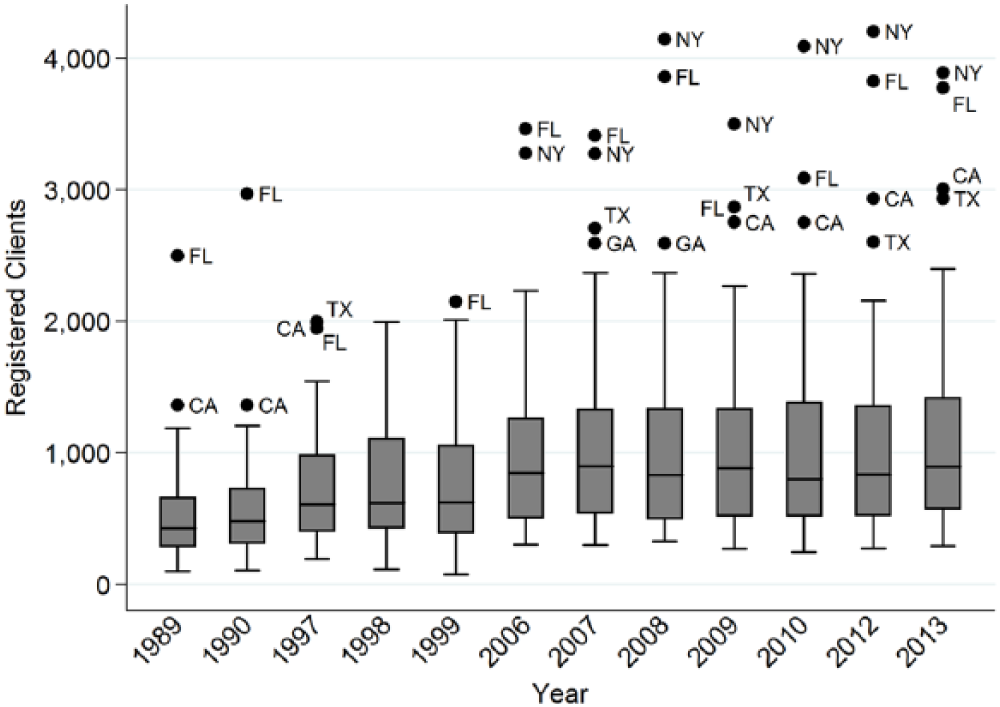
Registered Interests in the U.S. States, 1989-2013.
Explanatory Variables
To gain a sense of how lobby laws have changed over time, I employ a measure of lobby law stringency that spans multiple states and years. Newmark’s (2005) measure assumes values from 0 to 18 depending on the presence or absence of specific lobby laws. In this index, lobby laws come in three categories: definitions of lobbyists, prohibitions on their conduct, and reporting requirements. I utilize the three categories of lobby laws in Newmark’s index as separate explanatory variables. Table 1 lists all 18 laws included in Newmark’s scale. The sources for Newmark’s measurements are annual Blue Books published by the Council on Governmental Ethics Laws and Council of State Governments. Throughout the 1980s and 1990s, the Councils conducted surveys of state ethics agencies to determine which laws were in effect. Newmark’s scale has been used elsewhere to test hypotheses regarding policy representation (e.g., Flavin, 2015). As Newmark’s data covered only the years 1991 to 2003, I extended the index to cover the years 1988 to 2013 using a method described in the appendix.
Newmark’s Measure of Lobby Regulations.
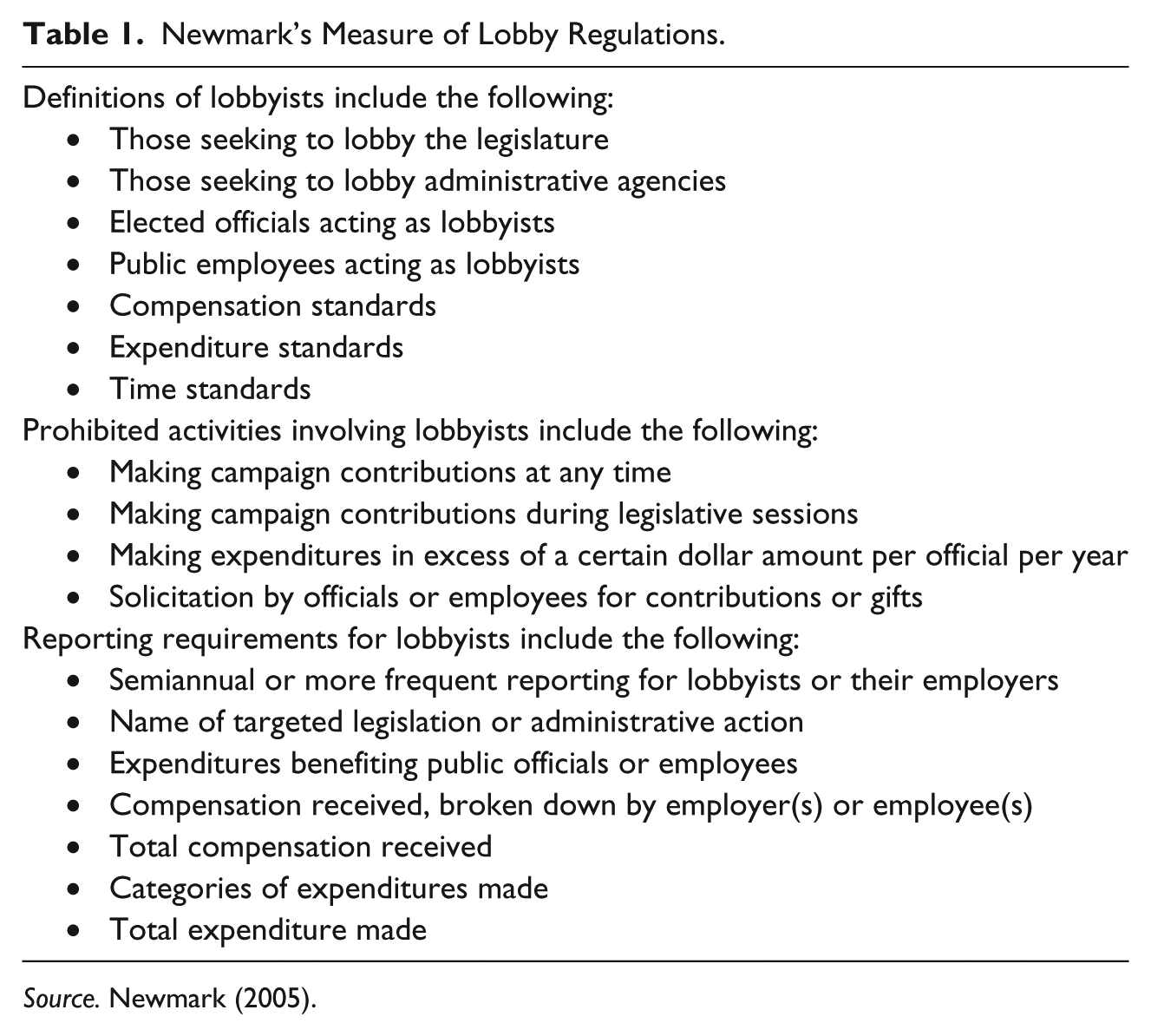
Source. Newmark (2005).
Statutory definitions determine which groups must register. Each definition delineates an additional dimension of the act of lobbying that is expected to compel additional lobbyists and their clients to register (e.g., by lobbying legislators, being paid to lobby, making expenditures). States assigned higher scores on this measure are casting wider nets that should apply to the activities of additional clients. The second component of Newmark’s measure captures legal prohibitions. These include four acts that are limited or banned in particular states. Two of these acts are partially inclusive: Lobbyists are prohibited from making donations during legislative sessions if they are also prohibited from making such donations at any time. In some states, the converse may not be true and lobbyists may freely give when the legislature is not in session. This partial inclusivity does not threaten the ability of the measure to capture the numerosity of prohibitions. Another component of Newmark’s measure captures reporting stringency. The measure reflects the frequency and details of required disclosure reports. Reporting requirements address how much detail lobbyists must disclose about their lobbying activities and clients. As with the prohibitions scale, some components are partially inclusive. The presence of each component adds an additional point to each measure. The sources of my regulation data are described in the appendix.
As described in my theory, I expect that different components of Newmark’s index have countervailing or interactive effects on interest group registrations. More numerous definitions are expected to capture additional groups (via their lobbyists) only in the absence of numerous prohibitions or heavy reporting requirements. With such requirements in place, however, the ability of definitions to capture more groups is moderated or perhaps neutralized. Therefore, I employ interactive terms to capture these moderating effects and expect them both to be negatively associated with totals of registered interest groups (i.e., have negative regression coefficients). Negative interactive coefficients should indicate that prohibitions and reporting requirements have moderating effects on how well more definitions capture more groups (i.e., by decreasing the marginal effect of definitions on registrations).
Confounding Variables
For predicting client totals via regression, I include a control for the size of a state’s gross product or economic output. Interest group registrations tend to be greatest in states with the largest economies. Economic activity is said to be the “fundamental basis of [political] organization” (Schattschneider, 1960; Schlozman, 1984, pp. 1011-1015) and has been shown to be the chief determinant of registration totals (Gray & Lowery, 1996, pp. 85-93). In other words, measures for economic activity have been shown to provide the best proxy for sizes of what Schattschneider (1960) called the “unknown associational universes” of political systems (p. 31). In numerous studies of interest populations, Gray and Lowery (1996, 1998); Lowery and Gray (1993,1994) have controlled for the size of a state’s economy. They discovered that American states with the smallest economies contained a natural threashold of interest groups, and that states with the largest economies tended to house even more groups but at a declining rate. Therefore, I include a control for economy size in polynomial form. As in prior studies of client totals, I expect the first coefficient to be positive and the second negative. This would demonstrate declining marginal increases in group figures within states (i.e., as state economies grow, the growth rate of interest group totals decreases). Economic measures were provided by the Bureau of Economic Analysis in 1997 real U.S. dollars. 1 For ease of interpretation, state economy size was first divided into trillions of dollars. This variable therefore measures how many trillions of U.S. dollars in economic output were produced within a state and year.
Berkman (2001) and Kattelman (2015) have suggested that legislative professionalism might affect the mobilization of interest groups. Berkman proposes that state legislatures with more staff members, greater incomes, and longer sessions can generate legislation more independently of the influence of interests. As interest groups might serve the function of providing needed information to legislators, interest group numbers were supposed and shown to be depressed in states with more professional legislatures with better-informed and better-paid lawmakers. In particular, professionalism served the purpose of decreasing the rate of growth in groups among states with larger economies. Kattelman (2015) approached the relationship between professionalism and groups differently. He suggested that more professionalization of legislatures should result in greater interest mobilization. Such professionalization allows legislatures not only to generate more detailed policies but also to “capitalize on the information supply that groups provide” (Kattelman, 2015, p. 171). Greater session length is said to encourage more contact with constituents and interests, and more staff are said to serve as additional lobbying access points for groups. Although it is also possible that both hypotheses might be correct and therefore nullify any effect of professionalism seen within my data, it is important to hold professionalism constant because it might also lead to more lobby laws (Opheim, 1991; Ozymy, 2013). I include Squire’s (2007) index of legislative professionalism within my models, with 2009 updates provided by Squire. I have no particular expectations for the directionality of professionalism’s effect on groups.
I also attempt to capture circumstances that might encourage interest mobilization by considering the effects of electoral competition and initiatives in my model. There is evidence that electoral competition may stimulate more interest groups to mobilize and register. Competition can be considered a component of Lowery and Gray’s (1995) “interest certainty” term (p. 12). Interest groups may perceive that the likelihood of policy change is higher in states with more evenly divided legislatures or more competitive elections. Such competition therefore energizes more interest groups to mobilize and register, as a way of hedging their bets. Using Ranney (1976) indices averaged over 7 years, Gray and Lowery (1998, 1999) found that less party competition was associated with fewer groups. Party polarization within legislatures does not seem to attenuate this connection (Gray, Cluverius, Harden, Shor, & Lowery, 2015). As in Gray et al. (2015), I employ modified Ranney indices (Klarner, 2010) that accurately reflect party competition within legislatures. Specifically, I include 6-year averages within my models that are folded so that higher values indicate greater one-party dominance. Based on prior findings, this variable should be negatively correlated with registered interests.
Initiatives might also be considered an energizing influence for interest groups. Using a regression specification similar to the one employed here, Boehmke (2005) found that initiative states contained, on average, 28% more interest groups than noninitiative states, ceteris paribus. In particular, citizen interests were more active in states with such direct democracy techniques. To control for the effects of such techniques on registration totals (and estimate better the effects of lobby regulations), my models include a dichotomous indicator for whether a state allowed for direct or indirect initiatives for either statutory or constitutional changes, or popular referenda. Throughout my sample, direct democracy could be found in 26 states. As some initiatives and referenda have historically resulted in greater lobby regulation or transparency, including a variable for initiative status helps to address the possibility of spurious relationships. This variable should be positively associated with registrations. 2
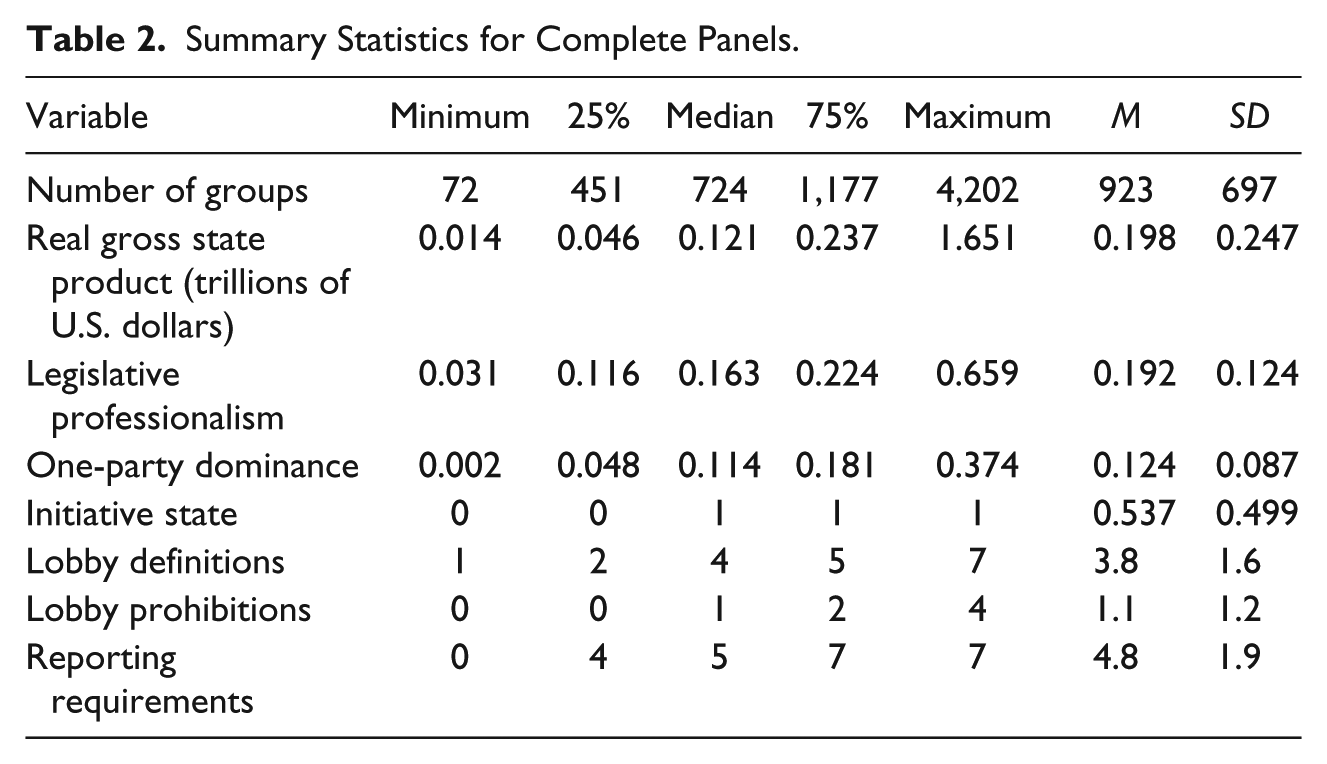
In prior studies of interest populations, other controls have been introduced for theoretical reasons that did not deliver increased explanatory power. Testing a theory introduced by the Virginia school (i.e., public choice) of interest mobilization, Lowery and Gray (1995) found that the size of state government was not discernibly correlated with interest density. The age of a state’s governing institutions was also not a strong predictor of density, as suggested by Olson (1982). As these variables were shown not to be predictors of group registrations, I exclude them from my statistical estimations. In some studies, indicators were used to mark particular outliers (such as Florida in 1990, when a budget battle resulted in more registrations; see Brasher et al., 1999). As the budget battle was ephemeral and Florida’s registration totals have since come to resemble those of states of similar sizes (see Figure 1), I do not include an indicator for this outlier within my models. Table 2 presents descriptive statistics for each of my response and explanatory variables only for observations from year listed in Figure 1.
Summary Statistics for Complete Panels.
Estimation Method and Results
In modeling total registered interest groups, I treat this outcome as a count variable (á la Boehmke, 2005 and Lowry, 2005, among others). For this count variable, I estimated negative binominal regression coefficients to account for overdispersion where the model-conditional variances exceeded model-conditional means (see King, 1988; Long, 1997). I estimated models for both my entire sample of all data available for all years and for a restricted sample of 12 years that includes counts from all 50 states. The first model in Table 3 was estimated using data from all available counts for all states and years, including panel waves for which many states’ totals were unobserved. For the second model, I repeated this procedure but included the variable for party competition. As the Nebraska Unicameral is a nonpartisan chamber, Models 2 and 4 exclude values from that state. The third model estimates the effects of my variables on group totals only for years in which observations from all 50 states were available (the 12 years are listed in Figure 1).
Lobby Laws and Shadow Interests (Count Models).
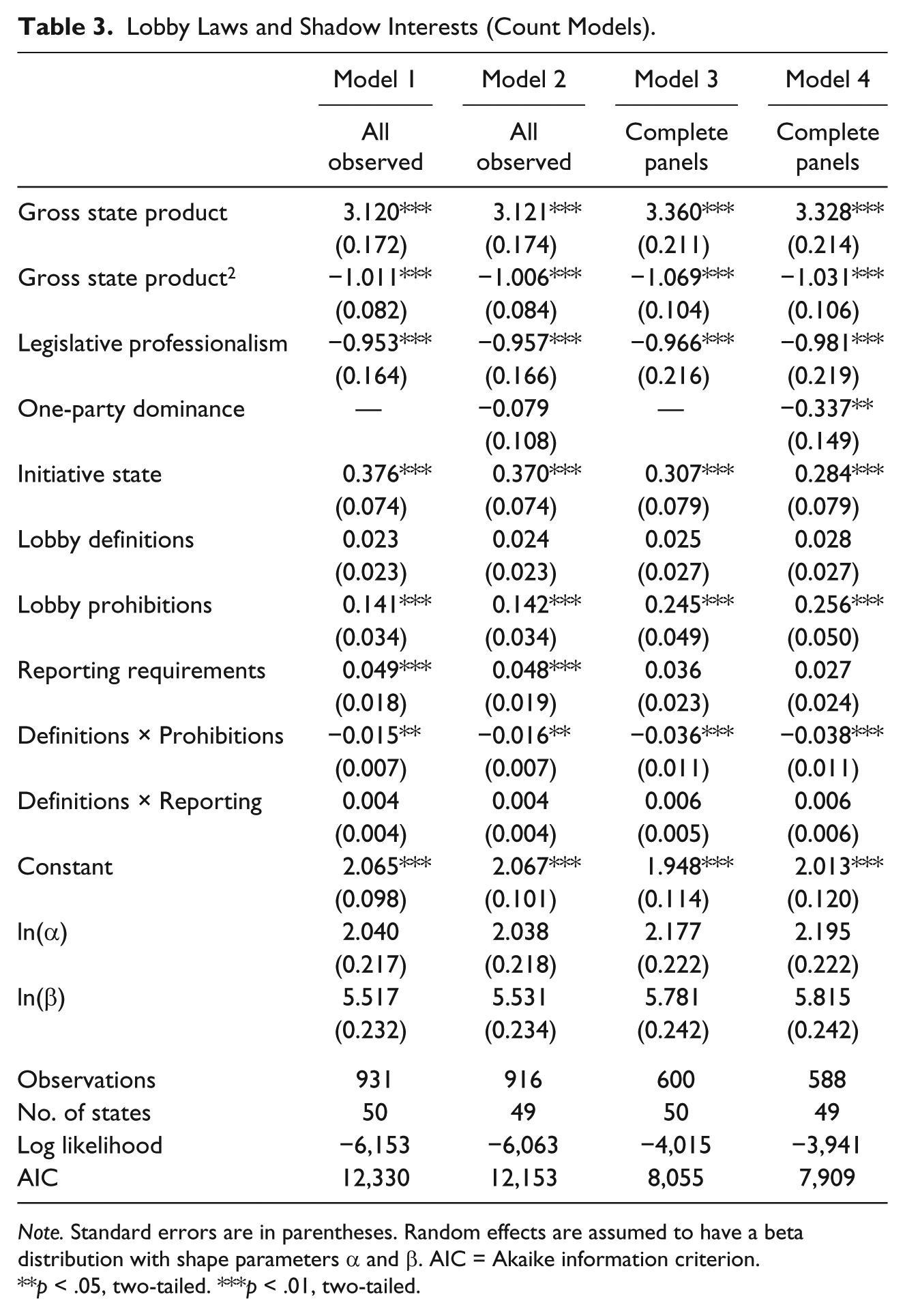
Note. Standard errors are in parentheses. Random effects are assumed to have a beta distribution with shape parameters α and β. AIC = Akaike information criterion.
p < .05, two-tailed. ***p < .01, two-tailed.
As I am working with panel data in which observations are nested within 50 states, the correlation between my observations violates the least squares assumption of independent errors. Each state presents its own “contextual” factors that may influence each of the clusters (by state) of my observations (Steenbergen & Jones, 2002). Due to the structure of my data, state-level random effects are included in my models. The inclusion of state-level fixed effects in a model employing the unconditional negative binomial variance function leads to the incidental parameters problem in which degrees of freedom are insufficient for estimation (see Allison & Waterman, 2002). The use of random effects by state allows my models to utilize variation between states (as opposed only to within states over time). This is preferred because lobby laws and most of my other covariates tend to change slowly within states. I also estimated linear regression models to include state-level fixed effects and isolate the effects of changes in lobby laws over time within states. In Table 4, the linear models include state-level fixed effects to help control for factors specific to each state not included within my data and year-level fixed effects to control for nationwide trends. The inclusion of year-level effects helps to control for recent growth in lobbying activity nationwide, as illustrated by Figure 1 (Drutman, 2015; Gray & Lowery, 2003). As with Table 3, the four models differ by sample size and selection of variables.
Lobby Laws and Shadow Interests (Linear Models).
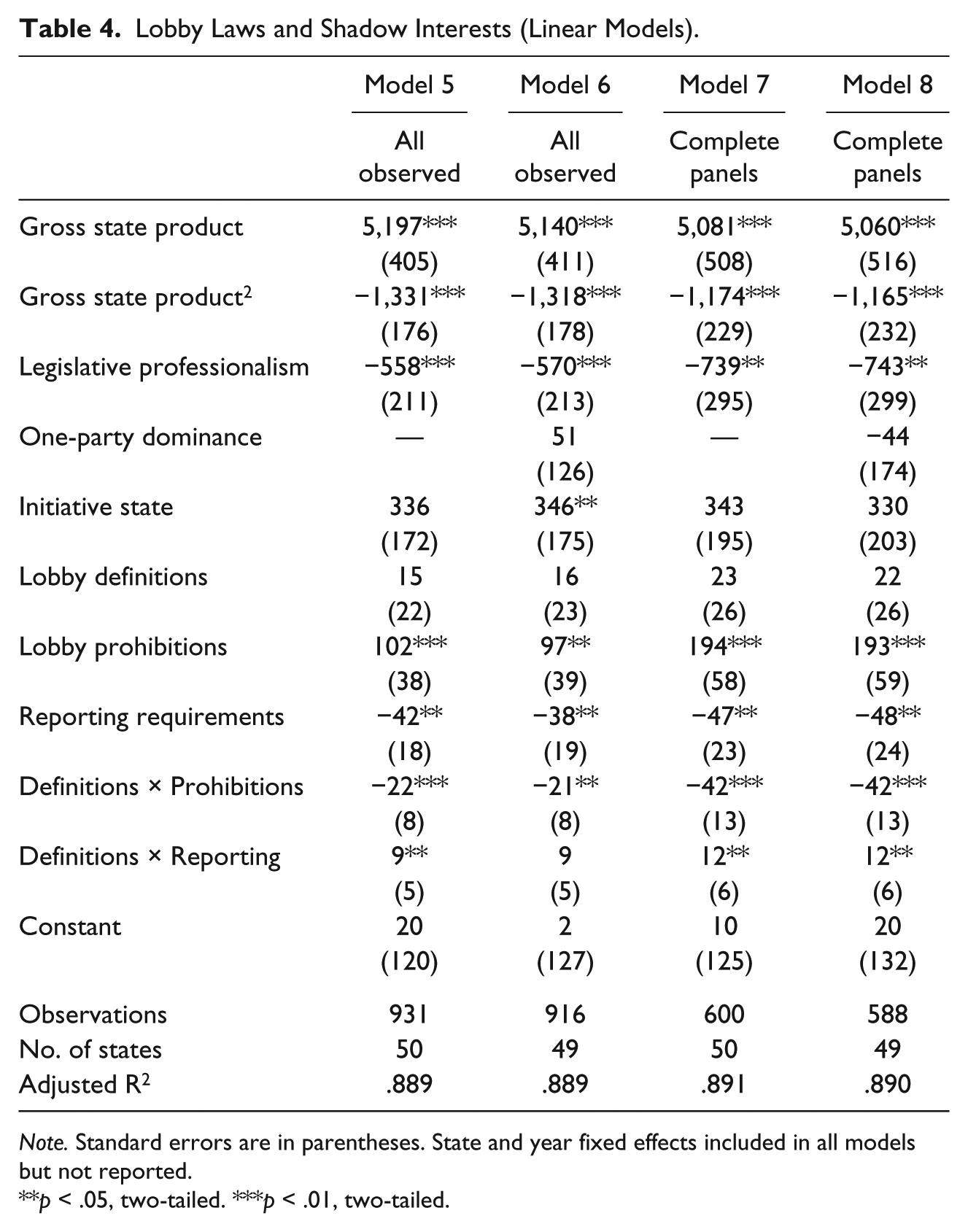
Note. Standard errors are in parentheses. State and year fixed effects included in all models but not reported.
p < .05, two-tailed. ***p < .01, two-tailed.
Tables 3 and 4 present consistent evidence for most of my hypotheses. As expected, the size of a state’s economy is the leading predictor of interest populations in terms of both sheer magnitude and statistical correlation. The relationship between economic output and group totals is not linear as totals increase at a declining marginal rate with economic growth. In terms of legislative professionalism, my results suggest clearly that there are fewer registered interest groups in states with more professionalized legislatures, even after holding constant the effects of economic output. The results might be due to the informational substitution theory of Berkman (2001) or some other process. Contrary to the findings of prior studies, there are not consistent differences in client registration rates according to legislative party dominance. In accordance with the findings of Boehmke (2005), however, states in which initiatives or referenda might occur also have more interest groups on average.
With regard to lobby laws, model results are mixed but conclusively suggest that the number of campaign finance limits in a state affects rates of registration among interest groups. The effects of criteria are contingent on the presence of prohibitions. When interacted with registration criteria, prohibitions suppress the positive effect of more criteria on total registrations. In other words, registration criteria capture fewer interest groups in states with more limits on giving. Figure 2 shows predicted counts of total groups based on two different prohibitions conditions, with 95% confidence intervals. Based on the model predictions, the presence of four prohibitions on political conduct is associated with hundreds of missing interest groups. The predicted counts are based on the coefficients from Model 7 in Table 4. All states within my sample with maximum prohibitions always had between two and six registration criteria. For reporting requirements, my expectations are mostly disconfirmed. Coefficients for this variable, however, often failed to achieve traditional levels of statistical significance.

Predicted clients under two prohibitions conditions.
To illustrate the predictive utility of my models and how prohibitions on campaign donations sometimes result in fewer interest groups registering (thereby resulting in less political transparency), I calculate predicted numbers of registered groups under a hypothetical condition of maximum definitions, zero prohibitions, and maximum reporting. Such predicted totals can be said to be the maximum potential group totals a state could ever register, given the “right” lobby laws. Figure 3 compares the maximum potential clients to the totals of groups that actually registered in each state-year. As with Figure 2, these predictions are based on the results in Model 7. Figure 3 illustrates the depressing effect of campaign finance limits on registration rates among interest groups. The lack of numerous definitions and the presence of multiple ethics prohibitions suppress registration among interest groups. At an aggregated level, 57,815 unique interest groups registered in the U.S. states in 2013 (the latest year for which I have data). By contrast, my model predicts that approximately 72,091 groups might have registered if there had been detailed registration criteria and no campaign finance restrictions or reporting requirements. 3 In some single states and years, the difference amounts to several hundred groups. The biggest differences were found in New York. Whereas 1,365 groups registered there in 1999, the model predicts that 2,670 could have registered. Registration rates have improved since the state enacted the Public Employee Ethics Reform Act in 2007. In a few other states, lobby laws were surprisingly effective at capturing groups. In Washington, where the citizen-initiated Public Disclosure Commission oversees extensive lobby registration and transparency measures, the number of clients who registered consistently approached the maximum potential. Such a set of laws provides promise for reformers.
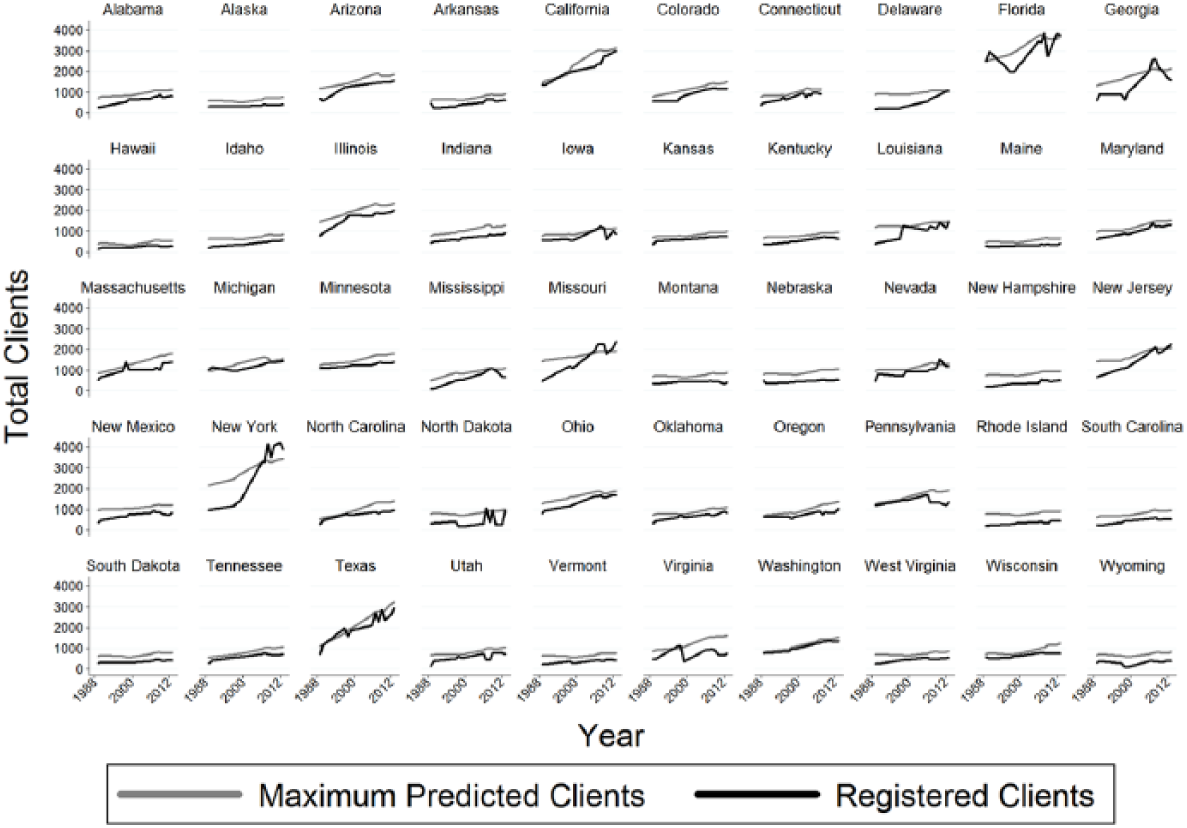
Potential client registrations versus actual registrations.
Discussion and Conclusion
Any analysis of lobby registration data should examine both the scope of criteria and the effects of separate laws that affect registered agents and clients. While prior studies have failed to find discernible relationships between lobby laws and registration rates, none of them examined how registrations change in response to criteria and other laws that impose costs on registered groups. Prior studies employed as explanatory variables either counts of all laws or only registration criteria. I conducted a more thorough examination that parsed apart the separate and interactive effects of changes in criteria, giving limits, and reporting stringency over more than two decades. In doing this, I addressed a long-standing and unresolved debate on the effects of lobby laws on interest registrations. My models advanced our understanding of lobby law compliance also by employing specifications that are more appropriate for analyzing panel data.
My findings provide evidence of a paradox of political reform. Regulating the campaign finance activities of registered lobbyists and interest groups may simply drive more of them to lobby in an unregistered, shadow capacity. As unregistered lobbyists and their clients are not subject to these restrictions, imposing more of them might be counterproductive for both ethics and transparency. Reformers face a trade-off: They can have either more interest groups register and report their activities or attempt to limit their campaign finance activities. Reformers cannot achieve both goals simultaneously. This suggests that group leaders act strategically when it comes to compliance with lobby laws and that ethics reform may come at a cost to transparency. Such findings should be of little surprise given evidence that lobbyists and interest groups modify their tactics in response to restrictions on serving in federal advisory roles (LaPira & Herschel, 2017), the imposition of other types of campaign finance laws (Hogan, 2005), the potential for direct democracy (Boehmke, 2005; Gerber, 1999), and laws that affect the formation of PACs (Gais, 1996). Indeed, lobbyists are among the most experienced, astute, and strategic actors one can find in the everyday practice of American policy making . . . . If there is a class of actors for whom rational choice–even complete information–models should do good explanatory work, lobbyists ought to be it. (Hall & Deardorff, 2006, p. 70)
My findings have implications for reform efforts in both the United States and abroad. The recent enactment of the Honest Leadership and Open Government Act of 2007 and issuing of executive orders related to lobbyists suggest that policy makers are interested in how to control the influence of lobbyists. Analyses of these recent changes suggest that a similar paradox of reform may be playing out in the nation’s capital (see LaPira, 2016; Thomas & LaPira, 2017). As opposed to attempting to regulate the activities of lobbyists directly, however, transparency might be the better approach (see Lane, 1964). As policy makers outside of the United States continue to experiment with various regulations on lobbyists, they can infer lessons from regulations in the states. Not only do the states have more numerous and robust lobby laws than the federal government, their laws are most stringent by international standards (see Chari et al., 2010). Any unintended consequences created by the most detailed lobby laws in the world might persist or even be worsened in nations with less comprehensive regulations.
As for Gray and Lowery’s (1996) Energy–Stability–Area model, it is largely confirmed but made more precise by my findings. Most coefficients within my models support their related hypotheses, but these were intended to serve as statistical controls. Even after adjusting for such factors as economic output, legislative professionalism, party strength, and direct democracy, lobby laws exert discernible influence on the decisions of groups to register. Future studies of interest populations should take these laws into account. The sheer total of registered interests is an insufficient measure for the populations of interest groups who are lobbying members of each state’s legislature. When working with group registration data that span either states or years, researchers should attempt to control for differences in registration compliance. In statistical regression, this can be achieved by including the variables on lobby laws that I constructed (please see the appendix).
As with any study, my findings have limitations. My findings do not speak to how lobby laws may affect the relationship between interest groups and their agents. It remains to be seen, for example, whether more or fewer laws, or even specific types of laws, cause interest groups to hire multiclient lobbyists over in-house agents. My findings also do not explore how lobby laws affect the composition of interest populations. Just as Boehmke (2008) found that direct democracy techniques lead to more citizen interests being registered, it remains to be seen how lobby laws may affect the registration rates of these clients. Finally, the need for more precise measurement of lobby laws remains (see Newmark, 2017). My findings suggest that such laws may serve a variety of functions and outline different dimensions of political mobilization. The variety of policy options designed to restrict and reveal the activities of lobbyists and their clients, however, presents difficulties for those seeking to compare compliance across multiple regimes and years. Nevertheless, this study brings us closer to a fuller understanding of how lobbyists and clients strategically adapt to lobby laws and how lobby laws might be tailored in response.
Footnotes
Appendix
Declaration of Conflicting Interests
The author(s) declared no potential conflicts of interest with respect to the research, authorship, and/or publication of this article.
Funding
The author(s) received no financial support for the research, authorship, and/or publication of this article.