




Abstract
The U.S. Courts of Appeals must ordinarily convene en banc to overturn circuit law. However, roughly half of the circuit courts have adopted an alternative, less costly procedure, the informal en banc, where three-judge panels may overturn precedent with approval of the full circuit. This article leverages variation in adoption and implementation of this institution to analyze the implications of ex post oversight mechanisms for ex ante panel decision making. The evidence suggests that the informal en banc substantially reduces the impact of ideology on panel decision making, providing new evidence that lower court judges strategically alter their behavior in anticipation of potential override by circuit colleagues.
How do informal institutions affect judicial behavior? Traditional analyses of how judges make decisions have often focused on the implications of broad-based structural features, such as the Supreme Court’s power of discretionary review or the hierarchical organization of the federal court system. Increasingly, however, scholars have focused attention on institutions which are, to greater or lesser degrees, less formalized and more bound up in to day-to-day practicalities. Such institutions may provide considerable insight into how judges pursue their goals on an everyday basis. Examples of less formalized institutions whose examination has generated interesting insights are the Rule of Four (Lax, 2003) and opinion assignment on the U.S. Supreme Court (e.g., Maltzman, Spriggs, & Wahlbeck, 2000), as well as the use of visiting judges in the Courts of Appeals (Collins & Martinek, 2011).
In this article, I analyze the political implications of a specific informal institution in the U.S. Courts of Appeals that has largely gone unnoticed by political scientists (though not by legal scholars; see Bennett & Pembroke, 1986; Sloan, 2009): the informal en banc. The informal en banc is a procedure used by roughly half the U.S. Courts of Appeals that allows three-judge panels to alter circuit precedent with the consent of other judges on the circuit. Ordinarily, the Courts of Appeals are bound by “law of the circuit” doctrine, which states that panel decisions constitute binding precedent for the circuit unless explicitly overturned by the full-circuit sitting en banc (or by the Supreme Court). Because en banc review is cumbersome, time-consuming, and increasingly rare, some circuits have adopted the expedient of allowing three-judge panels to propose alterations of precedent, which if approved by the full court in an informal vote take precedence over earlier case law and can overturn circuit doctrine despite the lack of a full en banc rehearing.
Previous research on the formal en banc process has established that it simultaneously serves important political functions in addition to its more basic legalist functions of altering unworkable case law and harmonizing doctrine (George, 1999; Giles, Hettinger, Zorn, & Peppers, 2007; Giles, Walker, & Zorn, 2006). From a political perspective, en banc review provides an important check on the ideological discretion of three-judge panels, allowing circuit majorities to exert principal-agent control over outlier panels. The informal en banc provides an alternative and potentially less costly pathway by which the full circuit might exert principal-agent control over panels. Do circuits with the informal en banc exert better ideological control over panel decision making?
To preview the central results, the evidence presented below suggests that the informal en banc exerts systematic effects on the extent of ideological decision making in the circuits—where this oversight institution is present, the potential threat of its usage appears to impose substantial ideological constraints on ex ante panel decision making. Moreover, this relationship varies quite sensibly with the institution’s implementation: the effect is strongest in circuits with a nonunanimous decision rule for the full circuit’s informal vote, where it is most credibly threatened, and weaker in circuits with a unanimity-rule standard.
The ideological constraint result reported in this article represents an important contribution to our understanding of the role of strategic considerations in the judicial hierarchy. Studies of the formal en banc have noted the potential importance of the ex ante effects of en banc institutions in constraining panels even in the vast majority of cases that go unreviewed (see, for example, Giles et al., 2007, p. 452). That is, there are theoretical reasons to believe that panels preemptively moderate their behavior to avoid potential en banc review, diminishing the role of ideology in judicial decision making. While some scholars have devised clever backdoor tests of such mechanisms (e.g., Giles et al., 2007), the lack of institutional variation across circuits in formal en banc procedures provides no leverage for cleanly pinning down this anticipatory effect. Because circuits vary in their adoption of informal en banc, however, studying this institution makes it much more feasible to directly observe the relationship between panel behavior and institutional structure. Examining the lesser known institution of the informal en banc, therefore, enables a research design that can isolate this effect. As will be seen, the evidence below is consistent with the presence of substantial anticipatory behavior by panels.
A classic debate in the study of judicial politics concerns whether judges act sincerely or strategically. Comparison of circuits with and without the informal en banc reveals key differences in the relationship between outcomes and ideology consistent with strategic effects and highlights the importance of institutions in shaping judges’ strategic environment.
Theoretical Background
The U.S. Courts of Appeals have attracted scholarly interest due to their political importance and problematic nature. Because the modern Supreme Court grants certiorari so rarely, the Courts of Appeals hold de facto final say in tens of thousands of cases. Yet, the randomized three-judge panel system presents inherent problems with respect to legal consistency. While it allows for the efficient disposal of cases, it has the downside that decisions of a circuit’s panels may be inconsistent with one another or may not reflect the preferences of circuit majorities.
Given the latter possibility in particular, scholarly attention has focused on what could broadly be termed oversight mechanisms within the judicial hierarchy and on questions of how three-judge panel decision making is affected by the threat, however, remote, of subsequent review. Within the circuit courts, the primary oversight tool is en banc review, the only formally prescribed method by which a circuit court may alter circuit precedent. As currently codified, Courts of Appeals are encouraged to hear cases en banc sparingly, either to maintain uniformity in their own decisions or to address issues of exceptional importance (F.R.A.P. 35(a)). Empirical research on the en banc process has explored various legal and political dimensions of its operation (see Wasby, 1979, for an overview) and has particularly focused on its role as a tool to discipline out-of-step panels (e.g., Banks, 1997; George, 1999; Giles et al., 2007, Giles et al., 2006).
Much research on the en banc—and on oversight within the circuits more generally—is limited, however, in one important respect. Most research designs in this framework focus on explaining en banc review itself—either predicting which cases will be reviewed (e.g., George, 1999; Giles et al., 2006) or the frequency of en banc activity (e.g., Giles et al., 2007). Such approaches therefore consider only the second stage of a two-stage process wherein three-judge panels initially issue decisions and those cases are later subject to potential review. As such, these designs are not well-equipped to address the important question of to what degree the circuits’ oversight activities affect outcomes in the first stage. Are panel decisions affected or moderated by the threat of en banc review? How large in magnitude are these effects? The en banc process matters because of its potential to influence outcomes well beyond the few cases reheard per circuit year; en banc review is alleged by both scholars and judges to result in better intracircuit consistency (e.g., Giles et al., 2007; Wald, 1999). Yet given how en banc review is typically studied, such impacts are largely left implicit and unexplored.
This limitation is a natural one given the simple fact that the formal en banc process is more-or-less identical across the various Courts of Appeals, 1 and thus, no useful variation can be leveraged to compare first-stage circuit behavior. Some efforts have been made to assess impacts on panel behavior by making use of circuit-level contextual factors. For example, Giles et al. (2007) argue that circuits with higher average tenure should provide better information and clearer expectations for panels, reducing the incidence of out-of-step outcomes and thus the need for rehearing itself. Although a clever approach, this result still draws an inference about panel behavior from data on en banc cases alone and is inherently rather indirect. More recent research has therefore begun to look elsewhere for evidence of anticipatory behavior; Hinkle (2016), for example, finds evidence of anticipatory behavior in citation patterns in search and seizure cases.
Casting a wider net, the general question of how second-stage oversight mechanisms affect panel behavior has also been studied with respect to the other major oversight mechanism relevant to the Courts of Appeals: certiorari review by the Supreme Court. Here as well a major question is whether circuit panels self-restrain at the first stage in anticipation of the possibility of subsequent reversal. Although there are sound theoretical reasons to believe that the Supreme Court may be efficient in reviewing cases optimally to induce compliance (Beim, Hirsch, & Kastellec, 2014; Cameron et al., 2000; Lax, 2003), the empirical picture is much thornier, again due to the fact that the relevant institution simply does not vary across the circuits. Some efforts to directly assess whether panels alter their behavior in anticipation of the Court’s wishes have answered this question firmly in the negative (Bowie & Songer, 2009; Hettinger, Lindquist, & Martinek, 2007; Klein, 2002; Klein & Hume, 2003), while others have found stronger results (Beim, Hirsch, & Kastellec, 2016; Kastellec, 2011; Songer, Segal, & Cameron, 1994; Westerland, Segal, Epstein, Cameron, & Comparato, 2010).
Some have also argued that panel effects in the Courts of Appeals—the empirical observation that panels with, for example, three Democratic appointees tend to be more extreme than those with two Democrats and one Republican—provide evidence of anticipatory behavior through the so-called “whistleblower” effect, where a minority judge on a panel implicitly threatens to write a dissent to signal to the Court that a case should be reviewed (Beim et al., 2014; Cross & Tiller, 1998). The case for this interpretation is bolstered by results showing that panel effects are stronger when potential dissenters are ideologically aligned with the reviewing court (Beim & Kastellec, 2014; Kastellec, 2007). However, it is not easy to tease out the relative importance of strategic anticipation compared with other nonstrategic mechanisms acting in parallel, such as small-group effects and deliberation (Boyd, Epstein, & Martin, 2010; Kastellec, 2013; Sunstein, Schkade, Ellman, & Sawicki, 2006) or collegiality norms (Edwards, 2003; Fischman, 2011).
In short, though many clever research designs have provided some evidence of anticipatory behavior, evaluation of the most important counterfactual—how behavior might vary under different institutional structures—has proven elusive. Given this backdrop, conditions are ripe for an analysis that examines how ex ante panel behavior is affected by variation in the presence or strength of oversight mechanisms. The informal en banc is particularly well suited to making progress on this front. In what follows, I will describe this institution in more detail and highlight one relevant dimension of variation in its usage that is central to the analysis and then explore whether panels on circuits with the informal en banc appear to be more ideologically constrained.
The Informal En Banc
I detour briefly to provide more details about the operation of the informal en banc. The mechanics and origins of this institution have been well-cataloged elsewhere, particularly by Sloan (2009) 2 ; thus, this section is merely intended to summarize the extant factual record and highlight theoretically important details to those who may be unfamiliar with this institution.
The informal en banc empowers regular three-judge panels, during the course of normal circuit business, to perform certain en banc–like functions. A representative description of the informal en banc is found in the D.C. Circuit’s publicly available policy statement regarding the procedure. It notes that in cases that merit revisiting circuit law but that may not warrant the logistical burdens of a full en banc rehearing, “a panel of the court may seek for its proposed decision the endorsement of the en banc court, and announce that endorsement in a footnote to the panel’s opinion.”
The informal en banc allows the court’s regular three-judge panels to circulate a proposed opinion and, subject to a vote by the rest of the circuit’s judges (on which more below), overturn or modify prior case law in the circuit. When precedent is modified in this way, the panel announces the use of the procedure and consent of the full circuit in a footnote to their published opinion. This general procedure—circulation of the proposed opinion to off-panel judges, followed by inclusion of a footnote indicating full-circuit endorsement—represents the practical process in place in all circuits using the informal en banc.
It is important to note what the informal en banc can and cannot do. Ordinarily, three-judge panels are bound by “law of the circuit” doctrine, which states (1) that panel decisions are binding circuit law, and, centrally, (2) only the full-circuit formally sitting en banc has the power to declare a prior precedent overruled. The informal en banc allows this doctrine to be contravened, resulting in alterations to circuit precedent. Accordingly, three-judge panels are endowed with the power to reverse precedents written by prior panels of the circuit. Its scope is limited, though, to the legal rule announced by the prior case; the informal en banc is not an actual rehearing and cannot reverse the actual disposition of an earlier case. While the informal en banc shares these basic features across all circuits that use it, it also varies across them in one extremely important respect. As Sloan (2009) notes in her study, two circuits in particular (the Tenth and D.C.) adopt a fairly stringent unanimity rule for use of the informal en banc. In these circuits, the affirmative consent of all off-panel judges is necessary for use of the procedure. In other circuits, by contrast, the process requires less than complete consensus; the Seventh, for example, explicitly requires only that a majority of the court vote in favor of the panel opinion. Other circuits use a less formalized system that simply requires that there be insufficient objection to the panel decision; on these circuits, informal en bancs sometimes proceed over the objections of a handful of judges so long as there is not a critical mass of disagreement, for example, enough judges to support a formal en banc. Naturally, this distinction is highly consequential regarding the ease and likelihood with which the informal en banc may be deployed—that is, how likely circuit law is to be overturned.
This distinction naturally suggests that circuits be coded differently based on their decision rule; in effect, the informal en banc combined with the voting threshold amounts to two closely related but fundamentally different institutional forms; variation in theoretical expectations across forms is taken up in the next section. I begin by noting my choices regarding the coding of which circuits use the informal en banc and their decision rule. Sloan (2009) notes that this practice was first used in 1966 by the Second Circuit, though they would use it sparingly until accelerating in the late 1970s. The Seventh Circuit was also an early and enthusiastic adopter and is the only circuit to have made the informal en banc an official part of their local rules—they are also by far the most frequent user of the practice (see Kanne, 2008, for an overview by a judge of the Seventh). Sloan notes that a total of nine circuits have used this practice at least once. However, several circuits appear to have flirted with the institution and ultimately rejected it—for example, the Fourth and Sixth have each used the procedure exactly once and never again. As a result, I code a circuit as a user of the informal en banc only if they can be considered a sufficiently regular user of it that panels may reasonably anticipate its potential usage—formally, I use a cutoff of at least 10 observed instances of the procedure’s use, as reported by Sloan.
This eliminates four circuits (of these, the Fifth is the most frequent user with seven instances) and keeps five. Thus, the First, Second, Seventh, Tenth, and D.C. Circuits are coded as regular users of the informal en banc. 3 Of these circuits, following Sloan (p. 756), I code the Tenth and D.C. Circuits as unanimity-rule users and the First, Second, and Seventh as nonunanimous users. 4 Because the informal en banc was in place in all five circuits before the first year contained in the dataset used in the following, circuit codings do not vary over time.
Theory and Hypotheses
The theoretical approach motivating my analysis is very direct and follows from the basic incentives inherent in any act of discretionary oversight. When a court, or any discretionary review body, decides whether to revise a prior decision, it must compare the potential benefits of taking action versus the barriers to entry that make review costly. A panel considering using the informal en banc must consider the benefit of revisiting a given line of precedent, potentially upsetting circuit law, versus any costs associated with their review action.
On the benefits side, in the Courts of Appeals, ex post review can be for ideological purposes, to alter the ideological direction of a given line of precedent. An existing precedent might be ideologically out-of-step with prevailing opinion on a circuit; overturning such a precedent might swing outcomes in a more liberal or conservative direction, particularly if trial judges below faithfully apply current case law (for whatever reason). 5 Prior cases may be only mildly out of step with circuit preferences or may instead be highly ideologically distant. Thus, it is natural to think of given lines of precedent—much like individual cases—as varying in the “urgency” with which a reviewing court might wish to intercede.
The benefits of reviewing a precedent are only one side of the equation: just as important are the costs or frictions involved in reviewing. It is on this dimension that the informal en banc introduces variation. The formal en banc is often regarded as highly costly. Ginsburg and Falk (1991) detail several costs implicit in rehearing. First is the simple matter of fixed costs in time and effort. Scheduling en banc rehearings around the busy schedules of all a circuit’s judges presents logistical barriers and represents time that could instead be spent hearing 4 to 5 panel decisions. Given the caseload pressures faced by the Courts of Appeals, such considerations are quite salient. More subtly, Ginsburg and Falk suggest that frequent rehearings can damage collegial relationships among judges and also “weaken the presumption of finality that otherwise attaches to a panel opinion” (p. 1021). Naturally, this means that a case or precedent must be in especially urgent need of revision for the cost-benefit analysis to favor review; this is reflected in the extreme rarity of full en banc review.
By contrast, the informal en banc is enormously more efficient and allows the benefits of review to be captured at substantially lower cost. By empowering three-judge panels to wield en banc–like powers, the informal en banc allows many of the benefits of review to be pursued during the course of normal circuit business, without the need for actually empaneling the full circuit. Thus, the informal en banc eliminates the (sizable) fixed costs of review, greatly expanding the threshold of precedents that might be considered worthy of revision. That said, the informal en banc does not eliminate other costs such as those bearing on collegiality or finality and thus should still be used somewhat selectively.
The informal en banc also carries with it additional barriers to its use related to coalition building. From the perspective of a three-judge panel considering overturning circuit law via the informal en banc, they must actually bear the costs of drafting an opinion making such alterations and securing the consent of their colleagues. Attempts to use this institution thus carry with them some inherent risk of lost effort and wasted time. It is on this dimension that the nonunanimous versus unanimity-rule distinction has theoretical bite. I assume that panelists will be more likely to engage in such effort when the potential gains from doing so are more likely to be realized, that is, as it grows more likely, their opinion will be adopted by the circuit. Because nonunanimous coalitions are easier to build than unanimous ones, it should be the case that nonunanimous circuits make the most aggressive use of ex post review. These circuits should therefore have the loosest threshold for engaging in review—or, put another way, should use it more often to deal with relatively less urgent or important matters. Unanimity-rule circuits should have an intermediate threshold, and nonadopters the strictest, as they depend solely on the formal en banc. This leads to the expectation that any effects of the informal en banc over and above the formal en banc will generally be stronger on nonunanimous circuits than on unanimity-rule circuits.
Effects on Panel Behavior
Much as with the formal en banc, circuit behavior in the presence of the informal en banc can be thought of as a two-stage process. In the first stage, three-judge panels hear cases and issue legal rules. I assume that the judges authoring those opinions and issuing rules would prefer that those rules persist, so that their policy preferences continue to exert effects on future outcomes. In the second stage, when a similar issue arises in a future case, potential reviewing panels may consider whether to pay the costs necessary to overturn previously issued precedent. Naturally, variation in potential second-stage behavior has ramifications for the behavior of panels in the first stage. As the threshold for ex post review narrows—and review becomes more likely—these anticipatory effects should only increase.
Thus, the informal en banc introduces variation in the likelihood of second-stage review activity that should, if operating as theorized, be discernible in first-stage panel behavior. In what follows, I analyze the effects of variable review thresholds induced by the informal en banc for three-judge panel behavior directly. This has two significant advantages. First, it sidesteps the potential research design challenges of analyzing only the second-stage behavior occurring after the selection of cases for review. For example, if the threat of ex post review causes self-restraint in the first stage, actual uses of the ex post review mechanism should be relatively rare. Thus, any analysis of the second-stage process will likely be plagued with counterintuitive relationships due to selection effects. Focusing on the first stage avoids such issues. Second, it enables a direct test of the effect of institutions of panel behavior writ large, allowing analysis of the counterfactual—how panel self-restraint varies with institutional design.
How, then, should variable review thresholds redound to affect panel behavior? The theoretical basis for anticipating ideological effects on first-stage decision making is ultimately quite direct: I expect panel judges to be sensitive to the probability that future panels will elect to revisit their precedents. This is a direct function of the costs of review: thus, when the costs of policing outlier panels go down, I expect such panels to behave in a more constrained fashion. The argument, in short, is that extreme rules are more vulnerable to potential renegotiation by later panels, causing rational judges to self-restrain and stake out more moderate positions—moreover, this effect should vary as the transaction costs of such future renegotiations increase or decrease.
A more sophisticated formulation of this idea can be derived from the many formal models of judicial hierarchies that contemplate a “zone of acceptability” around a reviewing court’s ideal point within which they will not review (e.g., Beim et al., 2014; Cameron, Segal, & Songer, 2000; Lax, 2003; McNollgast, 1995). Given costly review, reviewing courts will tolerate some degree of noncompliance with their own preferences, as long as violations are not too flagrant—too distant from their own ideal point. Naturally, the size of this zone is inversely related to the costliness of review; as review is cheaper, less severe violations will be policed. Moreover, rational panels should largely self-restrain to this range’s outer boundaries rather than risk review by taking more extreme positions.
As a result, the legal rules issued by panels on circuits with informal en banc practices should be moderated (relative to the circuit median) in comparison to the rules issued by panels on circuits that rely only on the more costly formal en banc. Naturally, it is difficult to measure the content of legal rules directly. As such, I instead examine the ideological direction of judges’ votes. It may initially seem strange to use case outcomes as an indicator of legal—rather than dispositional—constraint, especially given that the informal en banc does not affect case dispositions directly. However, any seeming difficulties here are more apparent than real. Due to the fundamental connection between rules and case outcomes, as explored, for example, in formal models adopting the “case space” framework (cf. Beim et al., 2014; Cameron et al., 2000; Lax, 2007), the content of legal rules directly affects the ideological direction of case outcomes.
Figure 1 provides a visual illustration of this fundamental relationship. For example, a panel establishing a liberal legal precedent will be substantially more likely to apply that rule to some set of case facts to reach a liberal outcome than a panel issuing a moderate or conservative rule. On a largely unconstrained circuit, where liberal panels issue liberal rules and conservative panels issue conservative rules, we should thus expect to see a strong relationship between panel ideology and outcome direction—reflecting the differences in legal rules issued by different panels. On more constrained circuits with smaller zones of acceptability, liberal and conservative panels will issue more moderate rules. This suggests, first, that evidence of rulemaking constraint can be seen by looking at the directionality of case outcomes issued by panels and that such constraints, should they exist, will tend to attenuate the statistical relationship between panel ideology and outcome. 6

Connection between rules and outcomes in case space, illustrated for two hypothetical circuits.
As before, this effect should be stronger for nonunanimous circuits than those with the unanimity rule, giving Hypotheses 1a and 1b. However, because unanimity is such a high standard, particularly with respect to ideological division, it must be noted that any expectations regarding unanimity-rule circuits are highly tentative. On circuits with strong left–right divisions, it may be the case that unanimous consensus is impossible to build on cases that overturn precedent for ideological reasons, eliminating any effect—the zone of acceptability for all judges, rather than just the court’s median, may be too large. Nonetheless, the unanimity informal en banc may exert some modest constraints and thus Hypothesis 1b is worth stating and examining empirically, despite this theoretical uncertainty.
Hypotheses 1a and 1b thus suggest conditional relationships and an interactive specification, reflecting the expectation that institutional variation should affect the magnitude of the relationship between ideology and voting.
Data, Methods, and Results
To analyze these hypotheses, I make use of the Chicago Judges Project dataset originally assembled by Sunstein et al. (2006), as expanded and updated by Epstein, Landes, and Posner (2013). This source contains 13,928 individual judicial votes from nearly 5,000 Courts of Appeals cases from 1995 to 2008 and also includes substantial supplementary information about judicial ideology, panel type, and various other contextual features. Given that both sets of hypotheses make predictions over panel-level behavior, I reshape these data so that the unit of analysis is the panel decision, rather than the individual vote, resulting in 4,658 case-level observations. The dependent variable is whether each panel’s outcome was in a conservative or liberal direction.
This variable is dichotomous, and I adopt a logit specification. In addition, some choices must be made to appropriately deal with the panel structure of the data—simple pooled models would be inappropriate because, for example, errors might be correlated within circuits. In general, there are two major approaches to handling panel data structures. The first is an ex post correction approach where a pooled model is estimated and standard errors adjusted for possible clustering. A second is to model the panel structure explicitly, either with simple fixed or random effects or more nuanced hierarchical modeling techniques (Gelman & Hill, 2007). Due to the relatively small number of groups (12) in the data, I adopt the latter approach and report a random-effects specification in the following. 7
Effects on Ideological Voting by Panels
I now report results for Hypotheses 1a and 1b. Conservative outcomes are coded as 1 and liberal outcomes 0. The ideological preferences of panels are measured using their median Judicial Common Space (JCS) scores—a generalization of Giles, Hettinger, and Peppers (2001) scores, which give liberals relatively negative scores and conservatives positive; this means that the baseline effect of JCS on outcome conservatism is anticipated to be positive.
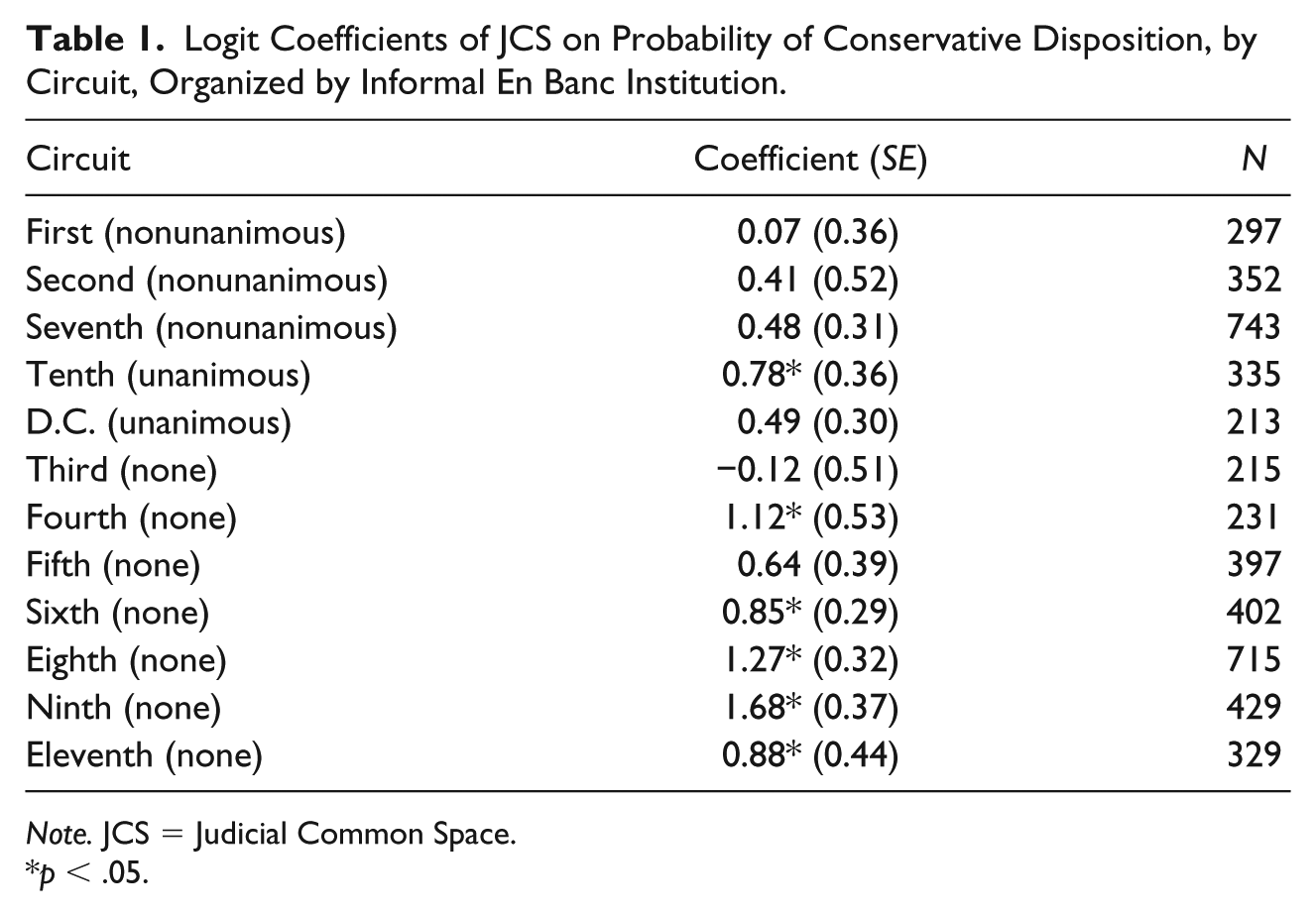
Hypotheses 1a and 1b are both conditional hypotheses, necessitating an interactive specification. Each anticipates that the ideological behavior will be more strongly constrained under the informal en banc than without. Thus, given a baseline relationship between judicial ideology and outcome conservatism, this relationship is expected to be attenuated in circuits with each version of the informal en banc: ideology will predict voting less strongly where judges are more constrained. As can be seen in Table 1, the baseline relationship between panel JCS scores and the probability of a conservative panel vote varies substantially across circuits, with some circuits showing extremely strong ideological effects and others showing weak to nonexistent effects. At a glance, these summary results appear to lend some support to the above expectations. Circuits with the informal en banc show relatively weak relationships between panel ideology and outcome, while those without it—excepting the enormously outlying Third Circuit, which appears to be remarkably nonideological—show on average larger, statistically significant relationships.
Logit Coefficients of JCS on Probability of Conservative Disposition, by Circuit, Organized by Informal En Banc Institution.
Note. JCS = Judicial Common Space.
p < .05.
To provide a more structured test, I model the expectations of Hypotheses 1a and 1b in a model containing multiplicative interaction terms between median JCS scores and dummy variables indicating the presence or absence of each variant of the informal en banc. This model also includes control variables designed to account for other factors that may predict the ideological direction of case outcomes. First and most importantly, this analysis must control for the widely recognized empirical regularity of panel effects. The empirical literature has soundly established that mixed panels containing one out-party member (i.e., two Democrats and one Republican—DDR, or the reverse RRD) behave substantially less ideologically than do unified panels. To account for this, I include a dummy equaling 1 when a panel is mixed, as well as an interaction term between this dummy and the JCS score. This, analogous to the above, allows mixed panels to show an attenuated relationship between ideology and voting, relative to nonmixed panels. Two additional controls are included. First, I include the median-circuit JCS score, to allow for the possibility that conservatism in panel voting is responsive to overall circuit preferences or case law. Second, I include the ideological direction of the District Court decision being reviewed, to account for potential inertia at the appeals stage.
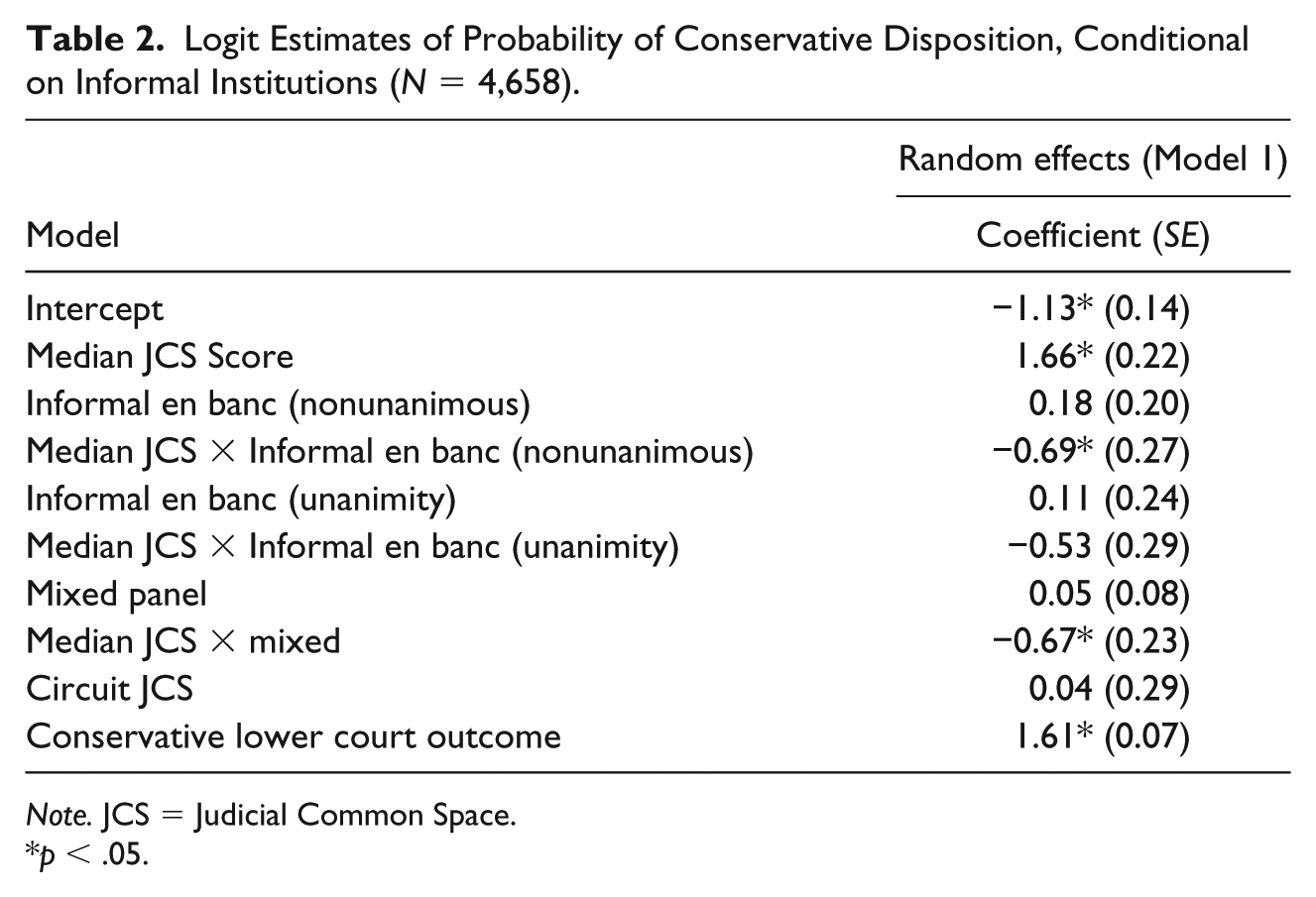
The results are given in Table 2. This set of results strongly supports Hypothesis 1a and somewhat more tentatively supports Hypothesis 1b. To understand these results, first note the baseline coefficient on the uninteracted JCS (judicial ideology) variable: it is positive and statistically significant. Given the specification, this coefficient reflects the relationship between judicial conservatism (more positive JCS median) and outcome conservatism for the omitted category—panels on circuits without either informal en banc that are also unanimous in partisan composition. Of central interest, then, are the coefficients on the two interaction terms between informal en banc rules and ideology. Each is in the predicted direction. Combined with the baseline JCS effect, we can see that the strength of the connection between ideology and conservatism is attenuated for each institution, as expected. For the nonunanimous informal en banc, this effect is strong and statistically significant at the 0.05 level across both models. For the unanimity-rule version, this effect is smaller and, commensurately, significant at 0.10 levels only. These results, including their relative magnitudes, are consistent with expectations.
Logit Estimates of Probability of Conservative Disposition, Conditional on Informal Institutions (N = 4,658).
Note. JCS = Judicial Common Space.
p < .05.
To consider the substantive significance of these coefficients, it is instructive to compare the conditioning effects of the informal en banc to the interaction term between Median JCS and Mixed Panel. The latter is also significant and large, recovering the well-established finding of panel effects. At each extreme of the JCS measure, for example, panels with highly liberal and conservative median judges are predicted to vote conservatively 26% and 71% of the time when unified, respectively, compared to 36% and 64% in the presence of one cross-party judge. 8
Notably, the magnitude of the nonunanimous informal en banc’s interaction coefficient is roughly the same as that of the mixed panel interaction. Unified panels on circuits with no informal en banc vote conservatively at the rates of 26% and 71% just given; similar panels on circuits with the nonunanimous informal en banc vote conservatively at rates of 39% and 67%. The combined effect of the (nonunanimous) informal en banc and the presence of a mixed panel is particularly dramatic: outcome conservatism on mixed panels in such circuits is only weakly related to panel ideology (50% vs. 59% at each extreme of JCS). This effect can be seen visually in Figure 2a, which shows the predicted probability of a conservative case outcome (estimated from Model 1) for circuits with no informal en banc and with the nonunanimous version. For comparison, Figure 2b shows the predicted probabilities conditional on whether the panel consists of same-party judges or instead contains one cross-party judge. As can be seen, the effects of the nonunanimous institution are virtually identical in magnitude to those of panel effects, suggesting substantial ideological restraint.
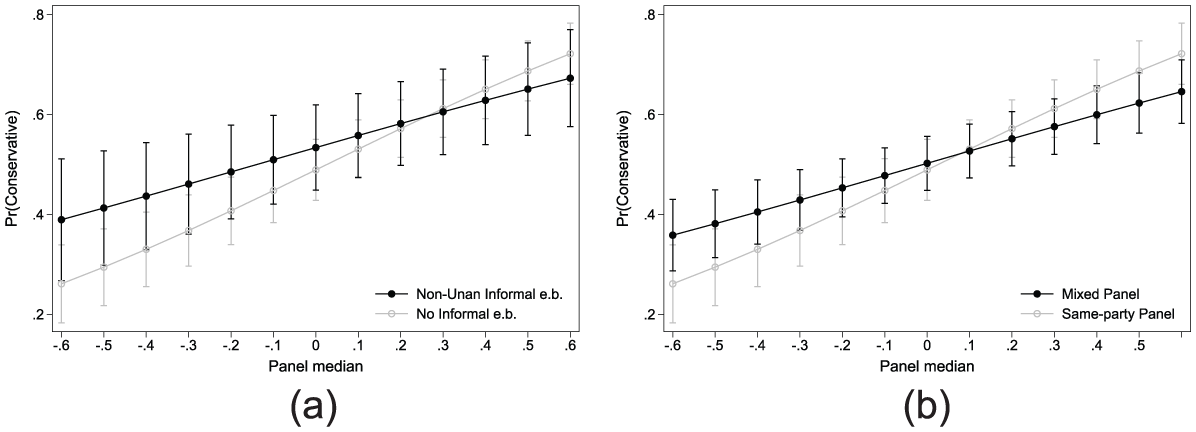
Predicted probabilities and delta method confidence intervals from Model 1, showing the effect of the nonunanimous informal en banc on panel outcomes relative to circuits with neither institution (a), compared with the effect of panel composition (b). (a) Predicted probability of conservative case outcome, by panel median and institution and (b) predicted probability of conservative case outcome, by panel median and panel type.
Naturally, the relevant interaction coefficient in Model 1 indicates that the differences in slopes within each comparison are statistically significant. Moreover, as Figure 3 shows, the marginal effect of the nonunanimous informal en banc is distinguishable for zero for some of the range of ideology and again similar in magnitude to panel effects, though estimated slightly less precisely.
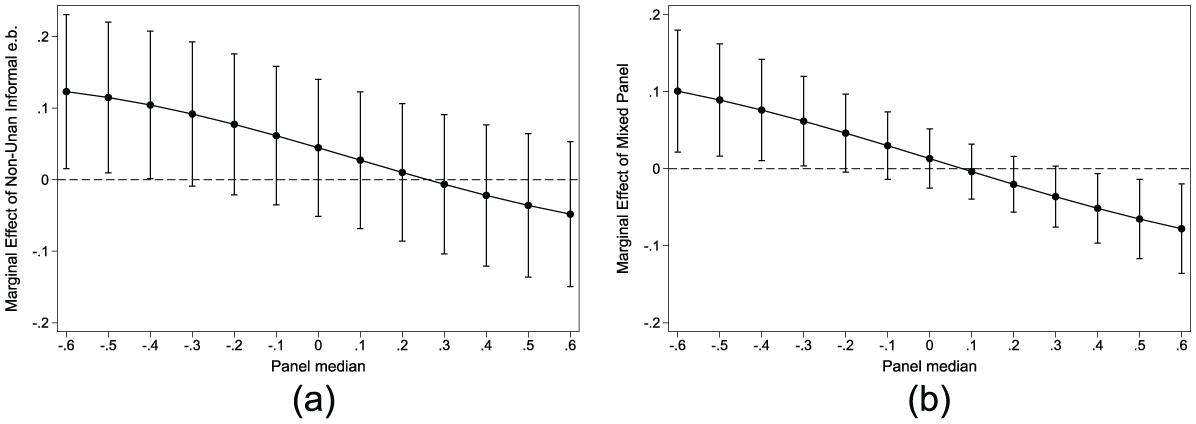
Marginal effects and delta method confidence intervals from Model 1, across the range of panel median, for the nonunanimous informal en banc (a) and mixed panels (b). (a) Marginal effect of nonunanimous informal en banc by panel median and (b) marginal effect of mixed panel by panel median.
This means that the counterfactual of switching a panel from a circuit using only the formal en banc to one that has adopted the nonunanimous informal en banc is to constrain ideological decision making by roughly the same amount as occurs in the counterfactual of switching a panel from DDD to DDR (or RRR to RRD). The unanimity-rule variant, as can be seen from its coefficient, exerts similar but slightly smaller effects. These are substantively meaningful effect sizes, over and above statistical significance, comparable to panel effects in magnitude. As expected, the threat of override of legal precedent by a panel using this highly efficient informal en banc appears to constrain panel behavior considerably more than the similar but less credible (higher cost) threat of the formal en banc.
Threats to Inference
Given the observational nature of this study, it must be acknowledged that the above is not necessarily evidence of a causal linkage between the informal en banc and panel behavior. Simply put, the informal en banc is measured with non–time-varying circuit-level dummy variables that are not randomly assigned, and this inherent constraint of the study severely limits the ability of statistical analysis to establish a clean causal linkage. In this section, I attempt to address and rule out some plausible alternative explanations for these results. However, though this discussion can rule out some confounds, there may remain some unobservable that is linked both to the presence of the institution and the reduced influence of ideology on behavior. Other possibilities along these lines are discussed at the end of this section.
First, are any of the above results due to the influence of a single outlier circuit? To assess this question, I reanalyzed Model 1 with one-by-one exclusion of each circuit. The results are largely robust to this examination. For the nonunanimous version, results are robust to this reanalysis; for example, if the Second is omitted, the interaction term between JCS and the nonunanimous informal en banc remains significant as to the First and Seventh’s behavior. The same is true for removal of the Seventh. The estimated effect upon removal of the First Circuit falls outside conventional significance bounds in the random-effects specification (p = .16), though the estimated beta is still negative and relatively large in magnitude. For the unanimity-rule version, the coefficient after circuit-wise removal is not statistically significant for either circuit, though again still negative and relatively large in size. While this may mitigate against strong claims regarding the unanimity-rule en banc, this circuit-level omission test indicates that no single circuit is responsible for the sizable negative coefficients on the interactions with ideology reported above.
Second, would any arbitrary collection of circuits be likely to show systematic differences if compared to others? Put another way, is variation across the circuits high enough that choosing a subset based on some arbitrary common feature would be likely to generate similar results? To test this possibility, I adopt a randomization test approach (as recommended by Lax & Rader, 2010). I simulated Model 1 1,000 times, in each run generating a single fake “institution” containing 2 to 4 random circuits and including this dummy and its interaction with JCS in the model (in place of the pair of informal en banc measures). I then examined the distribution of coefficients and z-scores. The results of this analysis also cast little doubt on the results above. While statistically significant coefficients are slightly more common than would be expected by chance, 9 the results reported in this article are at the far left tail of the coefficient distribution given by the simulation. That is, the reported interaction term coefficient between JCS and the actual nonunanimous informal en banc is more negative than 96.5% of simulated coefficients. This suggests that this grouping is particularly notable, relative to other arbitrary collections of circuits, in exhibiting a weaker connection between panel ideology and panel outcome.
Third, perhaps the circuits that use the informal en banc are different in some important way from other circuits that are either unrelated to the institution or causally prior to it. One possibility is that these circuits are inherently less ideological: they may be highly unified or on average more moderate. To assess this possibility, I analyzed ideological polarization within the 12 circuits for each circuit year in the sample (1995-2008). Using each circuit judge’s JCS score and circuit membership over time, I constructed a polarization score by taking the standard deviation of JCS scores for all active judges in each circuit year. This analysis shows no evidence that the informal en banc circuits are less conflict-prone in terms of judicial ideology: the mean polarization score for the nonunanimous circuits was 0.39, for unanimity-rule circuits 0.44, and for other circuits 0.35 (higher scores are more polarized). If anything, the circuits using the informal en banc are slightly more ideologically diverse than others—yet, on such circuits, this latent policy disagreement is not translated as strongly into voting behavior.
A final possibility is that some circuits may behave differently owing to longer judicial tenure; as judges serve together longer, they may become more able to anticipate one another’s preferences (Giles et al., 2007), or grow more collegial (Edwards, 2003), reducing dissent or ideological voting. Here again, however, there are no major differences across circuits in the possible conditioning variable: nonunanimous informal en banc circuits have a mean tenure of 10.5 years over the sample period, unanimity-rule 10.4, and the rest 10.7. Differences in judicial tenure patterns are simply not present.
These basic descriptive assessments cannot rule out the possibility that these circuits vary due to some other unobservable factor. Perhaps the most likely suspect is collegiality (Edwards, 2003, for instance, argues that the D.C. Circuit is particularly collegial). The circuits using the informal en banc are somewhat smaller in size (number of seats) than those without, even if excluding the Ninth from the comparison group, and smaller circuits may generally be more collegial. It is possible that collegiality as a latent variable explains both the presence of the informal en banc and reduced ideological voting. However, given that the informal en banc institutions in most circuits that use them date back to the 1960s or 1970s (Sloan, 2009), it is unlikely that the presence of the informal en banc is endogenous to circuits’ collegiality levels during the sample years of 1995-2008. It may instead be the case that a circuit’s collegiality environment is shaped in part by long-standing local rules and norms and that the informal en banc plays a role in shaping circuit judges’ implicit views about panel autonomy.
Discussion
Though the task of assessing the impact of static institutions admittedly precludes completely clean “smoking gun” evidence, taken in total, this analysis provides evidence in favor of the conclusion that the informal en banc influences ideological dimensions of panel decision making. Circuits using this institution appear to exhibit weaker panel effects, such that ideological preferences have less bearing on how they decide cases and, by implication, on the legal rules they favor in doing so. Although the informal en banc procedure is undertaken quite sparingly, the results above are consistent with it exerting ex ante pressure on panel decision making that constrains panels and diminishes the need for actual reversals of precedent.
In contrast to studies of the formal en banc, which due to lack of variation across circuits have sometimes strained to find clear evidence of anticipatory self-restraint by panels, this study does find such evidence. Subject to the research design caveats noted throughout, these results provide a rare glimpse at the counterfactual impact of varying judges’ oversight environment. Strikingly, the effect of “cheaper” ex post oversight is similar in magnitude to effects found in the literature on panel effects. This provides strong evidence of anticipatory behavior and underscores the importance of principal-agent politics in the federal courts. In showing that Courts of Appeals judges appear forward-looking with respect to one form of oversight, it also indirectly bolsters the case that other intrajudicial accountability mechanisms such as the formal en banc and certiorari review work similarly, producing strategic incentives that reduce the impact of personal preference. Such effects may often be invisible to researchers because the relevant institutions do not vary; this does not mean they are absent.
I conclude by noting that legal scholars who have studied the informal en banc (Bennett & Pembroke, 1986; Sloan, 2009) have highlighted important normative concerns raised by the procedure—particularly its “stealth” nature. The above analysis suggests reason for optimism with respect to this institution’s effects on consistency in panel decision making. Effects on ideological consistency are nonetheless only one piece of the puzzle; a full understanding of this institution’s implications must consider the balance between potential legal consistency gains versus costs it may impose in terms of transparency, collegiality, or panel independence.
Footnotes
Acknowledgements
The author wishes to thank Cliff Carrubba, Tom Clark, Micheal Giles, Tom Walker, Steve Wasby, and the anonymous reviewers for helpful comments at various stages of this project.
Declaration of Conflicting Interests
The author(s) declared no potential conflicts of interest with respect to the research, authorship, and/or publication of this article.
Funding
The author(s) received no financial support for the research, authorship, and/or publication of this article.