



Abstract
As the Latino population in the United States grows, it is increasingly important to understand how the unique experience of Latino judges translates into legal decisions. This experience has included, until recently, a bipartisan prioritization to appoint Latinos to the federal judiciary. For the first time, we analyze the judicial decision-making of Latino judges with enough observations to provide robust results. We find that the differences in priorities between the two parties have typically meant more conservative Latino judges on the bench. Using the Carp-Manning U.S. District Court Case Database, we analyze the decisions of Latino judges to determine policy areas where they diverge from their non-Latino counterparts. We find strong evidence that, under certain partisan, ideological, and policy-specific conditions, Latino judges decide differently than non-Latino judges.
Introduction
Throughout the 2016 presidential campaign, Donald Trump rallied his political base by promising to build a wall and restrict immigration. He drew only mild criticism from Republicans, except for comments he made about the presiding judge in the class action lawsuit against his university. Trump drew condemnation for denigrating the decisions of Judge Gonzalo Curiel, by saying, in part, Let me just tell you, I’ve had horrible rulings, I’ve been treated very unfairly by this judge. Now, this judge is of Mexican heritage. (Wolf, 2018)
President Trump’s comments about Judge Curiel were not the only break from established norms in that his administration has reversed a bipartisan trend of increasing diversity on the federal judiciary; in fact, Trump’s nominations at this point are the least racially and ethnically diverse since the Ford administration. 1 Trump’s tenure has seen a decrease of Latinos in the judiciary.
Although it is impossible to empirically assess the impact of Trump’s judicial appointments now, we provide among the first large N empirical studies analyzing the different voting tendencies of Latino judges compared with non-Latinos using data from 1985 to 2012. Due to the lack of available data on Latino judges, scant empirical research has been conducted on how Latino identity affects the judiciary (Haire & Moyer, 2015; Harris & Sen, 2019; Morin, 2014). We empirically examine the extent to which the behavior of Latino judges differs from other judges on the district courts using a large data set of case outcomes.
We consider the following research questions: Do Latino judges decide differently than their non-Latino counterparts? If so, how? Are Latino judges more or less conservative, and in what policy areas? These questions are timely given the growth of the Latino population as well as perceptions that such identities might have important ramifications on case outcomes.
We find strong evidence that Latino judges decide more conservatively than their co-partisans of other races. Trump’s political goal of a more conservative judiciary may be undermined by his selection of primarily White 2 Republican judges; meanwhile, the lack of diversity has brought negative attention from the media (Corriher, 2018; Kapur & Litvan, 2018). We begin by analyzing Latino representation in the federal judiciary and then discuss different concepts of judicial decision-making. We conclude by discussing the importance of our findings considering the growing relevance of the federal courts in American politics.
Background: Latinos on the Federal District Court
The number of Latino 3 federal judges has increased since 1961 when President Kennedy appointed Reynaldo Garza as the first Latino to a U.S. District Court; however, the appointment of Judge Garza was less a push for diversity and more a practical appointment for a largely Latino community. 4 It was not until the Carter administration that the number of Latino district court judges broke into the double digits. Carter’s counsel made it clear that his two goals were high-quality candidates and the representation of historically underrepresented groups (Scherer, 2011). The 14 Latino judges appointed by Carter represented the high point of diversity, until President George W. Bush’s first term, when 18 Latinos were appointed to district courts. Figure 1 illustrates diversity trends over time, where the dashed line represents the total number of Latino judges by the end of each presidential term and the bars represent the number of Latino judges confirmed during each presidential term.

Latino judges on the federal district bench.
Since the Kennedy Administration, every president has increased the number of Latinos on the district courts in their first terms, but that streak will most likely end in 2020 as President Trump’s judicial appointments have been below replacement levels for retiring Latino judges. From 1961 to 2018, Democrats appointed a total of 64 Latino jurists, whereas Republicans appointed 49 Latino jurists. In 2016, Latino judges accounted for 56 of the 677 positions at the district level. They make up 8.3% of the judiciary, as opposed to 18% of the U.S. population (Fjc.gov, 2018; U.S. Census Bureau, 2018). The district courts still lag significantly behind the diversity of the U.S. population.
The structure of the federal judiciary and the appointment process provides an opportunity for political actors to take advantage of lifetime tenure by appointing judges who share their political ideology (Giles, Hettinger, & Peppers, 2001; Pinello, 1999). Once confirmed, judges are free to follow their own course. In the next section, we examine prevailing theories regarding judicial decision-making, specifically how personal characteristics of the judge may affect their rulings.
Models of Judicial Behavior
Despite the tendency for judges and politicians to claim impartiality, there is strong evidence that judges decide cases differently based on ideology (Collins & Moyer, 2008; Kritzer, 1999; Kritzer & Richards, 2005; Pinello, 1999; Segal & Spaeth, 1996, 2002; Zorn & Bowie, 2010). Although the degree to which ideology shapes decision-making on the bench is up for debate, we argue that, consistent with previous research, it does have some influence on judicial decision-making (Ashenfelter, Eisenberg, & Schwab, 1995; Pinello, 1999; Richards & Kritzer, 2002).
In a meta-analysis of 140 scholarly publications on the relationship between ideology of judges and their political party affiliation, Pinello (1999) finds that party and ideology among judges are strongly related. In the attitudinal model of judicial behavior, the ideological views of the judge are linked to the outcome of the decision as justices “decide disputes in light of the facts of the case vis-à-vis the ideological attitudes and values of the justices” (Pinello 1999). The ideology of the judge is an important consideration for predicting their judicial behavior (Brenner & Spaeth, 1988; Harris & Sen, 2019; Pinello 1999; Sheehan, Mishler, & Songer, 1992; Songer, 1982). In the last half century, the politicization of the court has increased as a function of elite mobilization (Scherer, 2005).
Social Background and Personal Attributes in Judicial Decision-Making
In addition to ideology, many of the remaining differences are explained by theories of personal attributes and social background of judges. These theories highlight the context for judicial decision-making based on personal experience (Budziak, 2016; Goldman, 1975; Nagel, 1974; Songer & Johnson, 2007; Tate, 1981; Tate & Sittiwong, 1989; Ulmer, 1973, 1986). 5 Judges’ personal characteristics and varying social experiences also tend to affect their decisions on the bench (Kulik, Perry, & Pepper, 2003; Morin, 2014; Moyer & Haire, 2015; Segal & Spaeth, 2002). These background characteristics are likely to influence the judge’s perspective on case decisions (Goldman, 1975; Nagel, 1974; Songer & Johnson, 2007; Tate, 1981; Tate & Sittiwong, 1989; Ulmer, 1986).
Recent research has highlighted how the race and gender of the judge have an impact on cases which involve plaintiffs of the same race or issues that prime the judge’s identity (Boyd, 2016; Chew & Kelley, 2012; Goelzhauser, 2011). The role of Latinos on the bench has been overlooked as more emphasis has been placed on the Black/White racial divide (Collins & Moyer, 2008; Farhang & Wawro, 2004; Mustard, 2001; Scherer, 2004; Tiede, Carp, & Manning, 2010). Continuing research has highlighted how personal characteristics of judges affect their decisions. (Ashenfelter et al., 1995; Harris & Sen, 2019; Kritzer, 1978; Kulik et al., 2003; Segal & Spaeth, 2002). The relationship between race and judicial decision-making is common in the literature (Badas & Stauffer, 2018; A. Cohen & Yang, 2018; Collins & Moyer, 2008; Grossman, Gazal-Ayal, Pimentel, & Weinstein, 2016; Kastellec, 2013; Mustard, 2001; Scherer, 2004; Scherer & Curry, 2010; Tiede et al., 2010; Walker & Barrow, 1985). The consistent findings have been that non-White judges tend to be more sympathetic to minority defendants, more receptive to discrimination claims and affirmative action, and generally less punitive in their sentencing (Harris & Sen, 2019; Kastellec, 2013; Scherer, 2004). There has been an increased movement to diversify the federal judiciary since the 1980s and this has had an impact on the power dynamics between the president and U.S. senators (Bell, 2002; Binder & Maltzman, 2009; Epstein & Segal, 2005; Steigerwalt, 2010). We now turn to an examination of Latino public opinion and representation in the judiciary.
Latino Political Attitudes and Representation in Government
Although two-thirds of Latinos in the United States are of Mexican origin, Cuban Americans, Puerto Ricans, and other nationalities make up important parts of the Latino community. Latinos are also diverse in terms of race, with a significant presence of Cubans, Puerto Ricans, and Dominicans of African descent. Cuban Americans have historically been concentrated in South Florida and New Jersey, whereas Puerto Ricans have settled in New York City and most recently in Orlando, Florida. With respect to Latino representation, the little work that has been published focuses on city councils, school boards, state legislatures, and Congress (Casellas, 2010; Espino, Leal, & Meier, 2008; Leal, Martinez-Ebers, & Meier 2004; Rouse, 2013; E. R. Wilson, 2018; W. C.Wilson, 2010).
We know very little about the representation of Latinos in the judiciary. Of the three federal branches, the judiciary has pioneered minority rights. 6 Courts have been a source of strength for minority rights, but until recently the decisions were reached by predominantly White male judges. However, as of 2017, the judiciary has become one of the most descriptively representative institutions in the federal government (Herrick, 2016). The federal district court level is of interest as it provides the most decisions by Latino judges due to a larger aggregate number of judges. Because the most commonly considered personal characteristics in the judicial politics literature are race, gender, ideology, and religiosity, we believe that the same mechanisms will work to make Latino identity relevant (Songer & Johnson, 2007). Although Latinos are not a monolithic group, they share commonalities in terms of ethnicity, language, religion, and socioeconomic background. The degree of shared Latino experience varies, and some religious trends are changing (Mohamed, 2017; Wong, 2018).
We hypothesize that Latino judges will hold more conservative views than non-Latino judges. This reflects trends in Latino public opinion and, for Republicans, the necessity to prove conservative bona fides to get appointed. Compared with other non-minority Democrats, Latino views on social issues are decidedly more conservative (Abrajano & Alvarez, 2010; Bolks, Evans, Polinard, & Wrinkle, 2000). For example, Latinos are more likely than Whites to support restrictions on abortion and oppose assisted suicide (Leal, 2007; Pew Research Center, 2018). Although Latino public opinion has traditionally been characterized as socially conservative and fiscally liberal (Abrajano & Alvarez, 2010; Leal, 2007), more recently, younger Latinos have become more socially liberal. As Latinos assimilate, their views coincide with the views of other Americans (Uhlaner & Garcia, 2002). Latinos occupy a middle ground between White and Black Americans on many policy issues. For example, 47% of Latinos favor the death penalty, which is lower than the 59% of Whites that favor the death penalty, but still higher than the 36% support in the Black community (Pew Research Center, 2018).
However, some evidence suggests that strong Latino identity is what contributes to issue preferences on economics as well as immigration and leads Latinos away from Republicans (Cisneros, 2017; Sanchez & Masuoka, 2010). To be sure, most Latinos identify as Democrats, but their attachment to the party is not as strong (Alvarez & Bedolla, 2003). The Pew Hispanic Center reported in 2016 that 24% of Latino respondents identified or leaned Republican, whereas 64% leaned or identified Democratic. Ideology and partisanship are not as strongly correlated for Latinos. Bejarano (2013) shows that more Latinos identify as conservative, especially foreign-born women. Republican Latinos make up a minority but tend to be more strongly loyal to their party (Uhlaner & Garcia, 2002). We therefore believe that Latino Democratic judges will be less liberal than non-Latino Democrats.
We argue that Republican presidents value conservatism and loyalty when deciding to pick Latino judges. Until recently, Republican presidents made efforts to recruit conservative Latinos. By appointing Latinos, Bush signaled his willingness to appeal to Latino voters, although some question his genuineness (Fraga & Leal, 2004). Notwithstanding Trump, if anything it will be the case even more strongly that Republican appointments during his term will be more sensitive to political loyalty. For these reasons, we argue, and our evidence shows that Republican presidents will appoint tried and true conservative Latino judges.
Theoretical Expectations
Latino Democrats are less intensely partisan than Republican Latinos (Abrajano & Alvarez, 2010). It is likely that the selection process operates from two different candidate pools. Democratic presidents have a larger pool who tend to be more moderate than their typical co-partisan; meanwhile, Republican presidents have a smaller, more conservative pool of Latinos to draw from. As a result, we expect to see these partisan trends play out in judicial decisions.
At the district level, judges have an incentive to rule according to legal precedent, because their decisions can be overturned by superior courts. The reversal of a district court decision is not always a stain on the reputation of a judge and there is some evidence that this threat is overblown (Klein & Hume, 2003). Yet, a consistent trend of being overruled may potentially weaken their case for promotion (Badas, 2018). A judge looking for a promotion may attempt to signal political leanings in their decisions with an eye toward future selections (Budziak, 2016; Chemerinsky, 2002).
We argue that the perspective of the judge based on their political views, life experience, and their identity (i.e., race, gender, age, etc.) may affect their decisions (Budziak, 2016). Given the lifetime appointment, it is likely that judges will rule how they wish. We expect to see some of the political preferences of Latinos as a distinct group play out in their decisions. As the tendency is for Latinos—across partisan lines—to be relatively conservative on criminal justice issues and more liberal on issues of economics and fiscal policy, we expect Latino judges will mimic broader trends in their decisions. The confluence of candidate pool, professional and political qualifications for selection, and background identity of Latino judges leads us to our hypotheses:
Data
Using the Carp-Manning U.S. District Court Case Database (hereafter, Carp-Manning Database) allows us to track many district court decisions. This data set covers more than 115,000 cases in the courts and codes for the judges, the subject matter of the case, and whether the decision was considered liberal or conservative. 7 This data set contains numerous variables about the personal attributes of the judge, case content, time period, partisanship, and other associated variables. The Carp-Manning Database uses published decisions and has some potential shortcomings. 8 Although there is reason for caution, recent projects using published decisions for purposes of studying race on judicial decision-making have found that their results do not differ from randomly drawn selections of unpublished cases from other sources (Tiede et al., 2010 see also, Rowland & Carp, 1996).
Method
The focus of this article is on the relationship between race/ethnicity of judges and judicial decisions. We must ensure that the decisions are clear-cut enough to constitute a measurable stand on the case facts. The complexities of muddling through neutral or internally contradictory decisions from judges may provide insights into the decision-making differences between Latino and non-Latino judges, but this type of analysis is not currently possible with the available data. Instead, we use a binary account, which admittedly loses some nuance. As liberal and conservative judges must rule on the facts in the case, even the most ideological will inevitably decide a case in an unexpected manner (Gillman, 2001; Schauer, 1999).
Given the dichotomous nature of the dependent variable, we run a logistic regression model (Dayton, 1992; Menard, 2002). We report predicted probabilities using the mean values for control variables. This specification for generating predicted probabilities will affect the results reported (Hanmer & Kalkan, 2013); however, we have specified the models to illustrate substantive differences among our six different subgroups of analysis. We use non-interactive models but report interactive models and 11 alternative model specifications as robustness checks in Supplemental Appendix. 9 Until the end of the Carter Administration, the number of Latino judges in the district court numbered less than 10 and this necessitates limiting our time frame to 1985-2012. By 1985, there were at least 25 decisions by Latino jurists in each year of analysis. 10
Race, Party, and Control Variables
The key explanations that we believe will lead to differences in decision-making are race and party of the judge. If the characteristics of the judge matter in decision-making, these identity factors should lead judges to make different decisions. To capture these effects, we construct dichotomous variables for different races (our sample size only allows us to analyze Black, White, and Latino judges). Because Latinos as a group are not monolithic, there is the risk that certain subgroups in the population may be driving our results. Although the dataset does not break down Latino judges by national origin, the number of case outcomes in these subgroups is currently too small to make meaningful inferences. 11 We nevertheless capture some of the differences in the Latino experience by controlling for the circuit of appointment and, in our robustness checks, the state-by-state effects, which correspond to settlement patterns based on national origin. 12
Although the courts in question for this project are all under federal control, regional biases do make their way to the court (Pasko, 2002; Rowland & Carp, 1996). Specific circuits are known for producing either liberal or conservative decisions. 13 Furthermore, the circuit in which a judge presides affects the type of cases they will see as judge (Rowland & Carp, 1996). As there is a tendency for case types to drive the liberal/conservative lean of decisions, this distinction is crucial. 14 We include control variables for gender, ideology, the year of appointment to the bench (proxy for age/experience), and the decade when the case was decided. 15 These additional considerations capture the impact of regional biases, the temporal component of social backgrounds, and the impact of gender.
Given the importance of partisanship and ideology in any political account of judicial decision-making, we have included measures to control for these factors. For partisanship, we created a dichotomous variable and removed all others. As ideology and partisanship are not always aligned and the literature suggests that they are less aligned for Latinos, we incorporated the Giles, Hettinger, and Peppers (GHP; Giles et al., 2001) Scores to capture the varying levels of conservatism/liberalism of the judges (Boyd, 2015). GHP Scores are estimates of judicial ideology driven by assumed preferences of political actors rather than actual case outcomes. 16 Ideology and partisanship were correlated, but after extensive testing we determined that the correlation was not problematic for our chosen models. 17 Overall, we find that White partisans tend to be the most moderate among their co-partisans. Figure 2 illustrates the average (GHP) ideological score for judges based on their race and party affiliation, with liberal scores being represented by negative numbers and positive scores representing conservative ideologies.

Ideology of federal district court judges by race and party.
Results and Discussion
Results for all models are reported (as logistic coefficients and odds ratios) in Table 1. Our first logit model covers all the available cases in the data set from 1985 to 2012 regardless of the case type. 18 Figure 3 reports all cases using predicted probabilities of a liberal decision with 95% confidence intervals. In this model, we find strong support for the Conservative Republican Latino Hypothesis and the Moderate Democratic Latino Hypothesis. Although all judges are predicted to rule more often in a conservative direction, the Latino judges are statistically different from their co-partisans. Latino Republican judges are the most conservative in this model. They are predicted to render liberal decisions only 32% of the time. They are significantly more conservative than Black and White Republicans at 37% probability of liberal decisions. Latino Democratic judges are so much more conservative than their co-partisans that they are statistically indistinguishable from Black and White Republicans at around 39%. In other words, Latino judges (regardless of party) are expected to rule conservatively between 61% and 68% of the time; meanwhile, non-Latino Democrats rule conservatively around 52% of the time. If the goal of the Trump administration is to produce a more conservative judiciary, evidence suggests that the absence of Latino appointees to date is counterproductive.
Primary Models of Analysis.
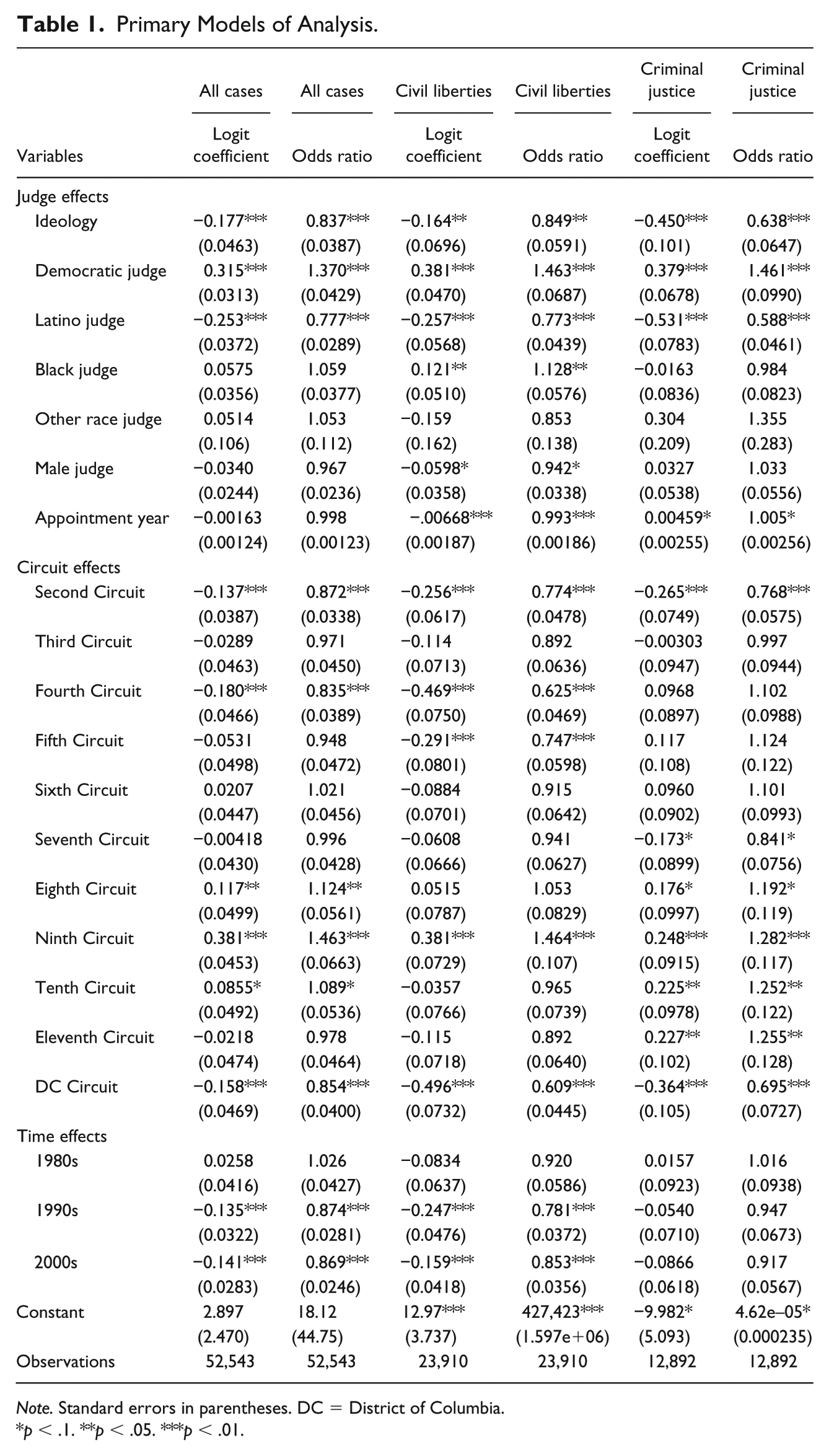
Note. Standard errors in parentheses. DC = District of Columbia.
p < .1. **p < .05. ***p < .01.
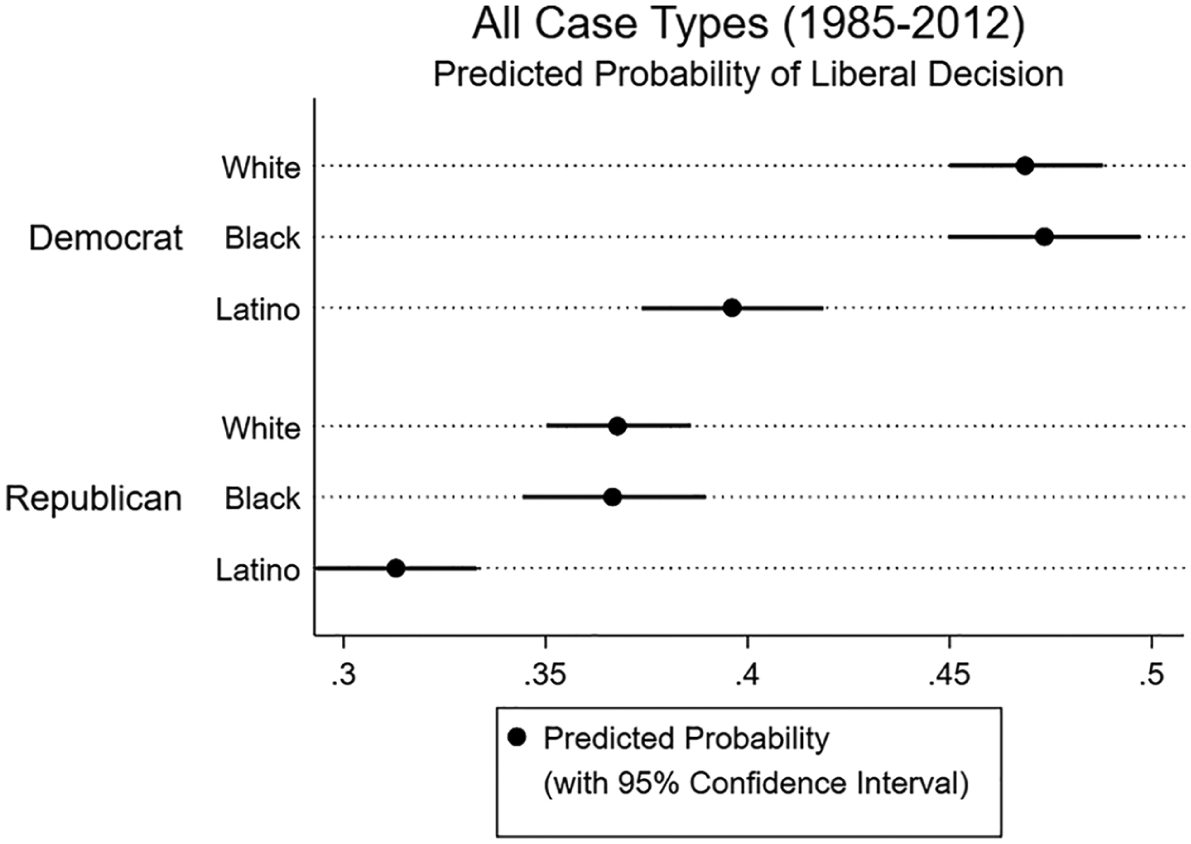
Predicted probabilities of liberal decision—all cases (1985-2012).
This first analysis of Latino identity on the bench requires further examination of the specific nature of the cases. The data set is divided into categories of cases, which we analyze separately. 19 We hypothesize that Latino judges follow the trend of the larger Latino population in terms of social conservatism. In Figure 4, the predicted probabilities resulting from a subset of cases dealing with civil liberties 20 issues support for our Socially Conservative Latino Hypothesis. Democratic Latino judges are significantly more conservative than their co-partisans. Republican Latino judges differ from White Republican judges; however, Latino Republican judges are expected to decide civil liberties cases conservatively around 81% of the time, a rate similar to Black Republicans (77%). Latino Democratic judges differ from their party, who are expected to issue liberal rulings around 28% of the time, whereas Democratic judges on average are expected to rule liberally in these cases around 40% of the time. Latino judges (regardless of party) decide cases more conservatively than their co-partisans.
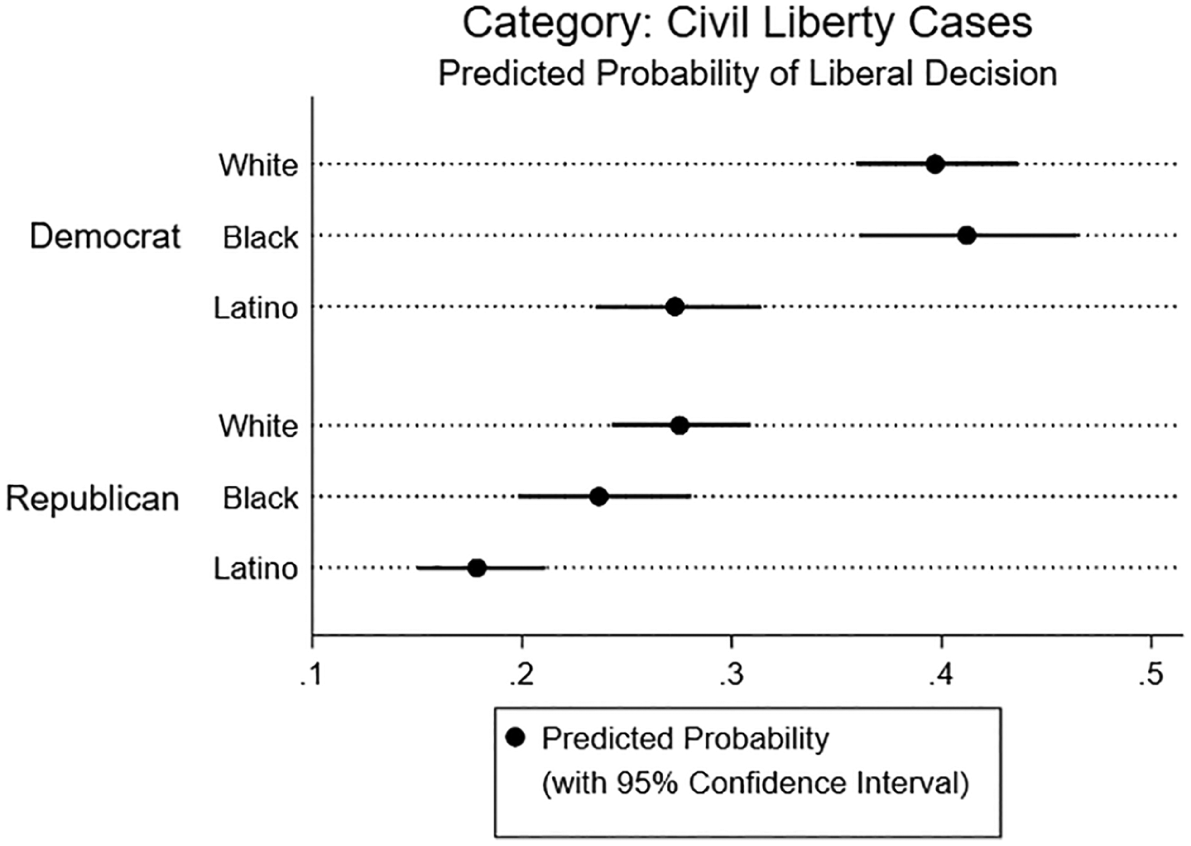
Predicted probabilities of liberal decision—civil liberty cases (1985-2012).
In our final model, we find support for the Socially Conservative Latino Hypothesis in the policy domain of criminal justice. Criminal justice cases at the federal level are more likely to result in conviction, thus more likely to result in conservative decisions. Figure 5 illustrates the conservative rulings of Latino judges. Latino Democrats rule so conservatively that they are almost identical to White Republicans. Both groups are expected to decide conservatively more than 70% of the time. Latino Republicans are the most conservative and are statistically more conservative than White Republicans. Republican Latino judges are expected to issue liberal rulings less than 18% of the time. The overall average predicted probability of a liberal decision is 33%. These types of cases highlight a very conservative tendency among Latino judges that has gone unnoticed in the literature.

Predicted probabilities of liberal decision—criminal justice cases (1985-2012).
Conclusion
This analysis uncovers how the Latino ethnicity of judges may influence decisions on the federal bench. Our results suggest that partisanship and ideology alone do not account for all differences. Republican and Democratic Latino judges tend to issue more conservative opinions than their White and Black counterparts. We find strong support for our Conservative Republican Latino Hypothesis. When examining all cases from 1985 to 2012, Republican Latino judges come to conservative decisions more often than their co-partisans. In our subset analysis, we find mixed support for our hypothesis in criminal justice cases. Notably, Republican Latino judges rule in a more conservative manner than their White co-partisans although not statistically different from their Black co-partisans.
We find our strongest support for the Moderate Democratic Latino Hypothesis. In all cases and in every subset analysis, we find that Democratic Latino judges rule in a moderate manner compared with other Democrats. These Democratic judges behave more like White Republicans than their Democratic co-partisans. This may be the result of an increased priority among Democrats to promote well-qualified candidates from underrepresented groups or the selection pool of Latino candidates who identify with the Democratic Party, but do not hold particularly liberal viewpoints.
Finally, we find mixed support for our Socially Conservative Latino Hypothesis. In our subset analyses of social issues, Democratic Latino judges rule in a conservative fashion more often than their co-partisans; however, Republican Latino judges only come to conservative decisions more than their White co-partisans on issues of criminal justice. The trend of Black and Latino Republican judges producing some of the most conservative predicted outcomes may point to a trend among Republican appointees to value diversity to the extent it does not come at the expense of ideology. In the case of Latino Republicans, this may be the result of a smaller selection pool for Republican politicians.
Although the nation’s Latino population has substantially increased, the appointment of Latinos to the federal bench remains disproportionately low, especially since 2017. Knowing that Latino judges can be appointed without damaging his ideological goals, Trump’s lack of Latino appointments seems ill-advised and exacerbates the current underrepresentation of Latinos in the judiciary. Because federal judges are appointed for life and make decisions that bind future generations, it is important for scholars of American politics to examine the extent to which racial and ethnic identity affect rulings. Scholars should continue to monitor the extent to which the presence of Latinos in the federal judiciary affects the lives of their communities.
Supplemental Material
Appendix_Graphics – Supplemental material for Latino Judges on the Federal District Court: ¿Cómo Deciden?
Supplemental material, Appendix_Graphics for Latino Judges on the Federal District Court: ¿Cómo Deciden? by Scott Hofer and Jason Casellas in American Politics Research
Footnotes
Declaration of Conflicting Interests
The author(s) declared no potential conflicts of interest with respect to the research, authorship, and/or publication of this article.
Funding
The author(s) received no financial support for the research, authorship, and/or publication of this article.

Supplemental Material
Supplemental material for this article is available online.
Notes
Author Biographies
References
Supplementary Material
Please find the following supplemental material available below.
For Open Access articles published under a Creative Commons License, all supplemental material carries the same license as the article it is associated with.
For non-Open Access articles published, all supplemental material carries a non-exclusive license, and permission requests for re-use of supplemental material or any part of supplemental material shall be sent directly to the copyright owner as specified in the copyright notice associated with the article.
