



Abstract
Automatic voter registration (AVR) is a recent innovation in voter registration in the United States, passed by 18 states plus DC in the last 4 years. AVR has generally escaped partisan polarization about election reform, having passed in Republican and Democratic controlled states. Using a survey experiment in the 2018 Cooperative Congressional Election Study, we investigate effects of source cues about support of AVR from different party elites and from election administrators on the public’s expectations about AVR’s impact on turnout, voter fraud, fairness, and election problems. Our experimental results show an asymmetric partisan effect. When AVR is endorsed by Democratic leaders, Republicans (and independents) expect AVR to reduce the fairness and legitimacy of elections, while Democrats are generally resistant to partisan cues.
Keywords
Automatic voter registration (AVR) is the latest significant reform to the electoral process in the United States. AVR shifts the burden of voter registration from the eligible registrant to the state government (Burden & Nieheisel, 2013). While there are variations among states, typically AVR registers all eligible citizens who interact with government agencies, most commonly through the state’s motor vehicles department. The state elections office reviews the registration application, determines a potential registrant’s eligibility, and then accepts or rejects the application.
Despite AVR’s significant change to voter registration, it has not gotten bogged down by the partisan “voting wars” typical of the last two decades of policy debates to change how elections are administered (Hasen, 2013). Oregon was the first state to implement AVR in 2016, and 17 more states and DC have adopted AVR as of June 2019 (National Conference of State Legislatures, 2019). While more Democratically controlled states have passed the reform, there are states of all partisan colorations that now have AVR (seven with divided government, two with Republican control, and 10 with Democratic control).
Public opinion shows bipartisan support for AVR, but with partisan gaps. Roughly two thirds of the American public supports AVR, including four in five Democrats and a bare majority of Republicans (Bialik, 2018; Gallup, 2016; Ingraham, 2018). Referenda to pass AVR in several states provide additional (and legally binding) indications of public support. However, research on public attitudes about AVR is in its infancy. Adona and Gronke (2018) find “the public does not currently express strong support or opposition to AVR” (p14) suggesting that many people may not be familiar with AVR and are answering based on the brief descriptions provided in a survey question.
We leverage this survey result for this research. When the public is willing to make broad judgments, but show low levels of detailed information, source cues from political elites can have a strong influence on expectations about policy outcomes (Mondak, 1993). We developed and implemented a survey experiment to test how source cues shape public expectations about AVR’s impact on the voting process.
AVR as Bipartisan Reform
The promise of improving both “access” and “integrity” is a major reason AVR avoids the partisan “voting wars.” Democrats and liberals see potential to increase access (e.g., Griffin et al. 2017; Weiser, 2016). Republicans and conservatives see potential to increase integrity of elections (e.g., Borchardt, 2019). Another possible explanation why AVR has not gotten bogged down in the polarized “voting wars” debate is that it is seen as a technocratic change to an already settled linkage of voter registration with driver’s license and IDs in the National Voter Registration Act of 1993 (a.k.a. the “Motor Voter” law).
Elite Source Cues About AVR Policy Outcomes
As support for AVR has come from a variety of political elites, examining how partisan cues shape public expectations is an opportunity to gain insights in an area of election reform that has not been uniformly associated with one political party. Our experimental design includes cues indicating support from elites in each party, a cue about bipartisan support for AVR, and a cue about support from election administrators.
We start this project with the not-heroic assumption that partisan cues have large influence on public opinion about policy proposals (Broockman & Butler, 2017; Kam, 2005; Leeper & Slothuus, 2014; Nicholson, 2012; Slothuus & de Vreese, 2010), and especially about voting reforms (Bowler & Donovan, 2018). Partisanship plays a central role in debates about election reform legislation (Bentele & O’Brien, 2013; Biggers & Hanmer, 2015, 2017; Hasen, 2013; Hicks et al., 2016a, 2016b). Support for voter ID, Election Day registration, and convenience voting change when survey experiment participants are presented with information suggesting a strategic partisan electoral advantage or disadvantage (Biggers, 2019; Bowler & Donovan, 2007; Kane, 2017; Wilson & Brewer, 2013). Support also changes when the impacts from election reforms are portrayed in terms of immigration, race, and age (Udani & Kimball, 2018; Wilson & Brewer, 2016).
Our experiment differs from past research in three important ways. First, our experiment is the first to investigate AVR. Second, past experiments focus on support or opposition, and do not measure public perceptions of the expected policy outcome. Third, past studies examine different policy frames rather than partisan source cues. As the general public is unlikely to be informed about a low salience and obscure change to registration procedures, source cues can shape public attitudes toward AVR (Nicholson, 2011).
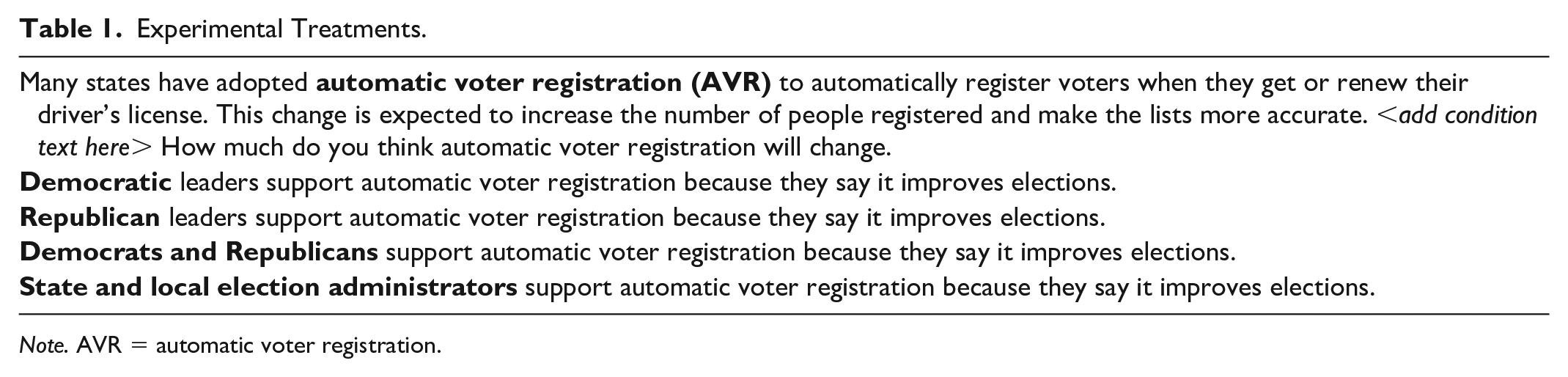
In order to investigate the impact of elite source cues on public views of AVR, we designed a survey experiment using partisan cues (“Democratic leaders,” “Republican leaders”), a bipartisan cue (“Democrats and Republicans”), and a non-partisan cue from policy experts (“state and local election administrators”). The experiment tests three major hypotheses:
Source cues indicating that a policy is supported by co-partisan elites are expected to heighten expectations of normatively positive policy outcomes. It is well established that people use co-partisan elites as a heuristic for determining if a policy will lead to desirable outcomes (e.g., Barber & Pope, 2019). Furthermore, the partisan cues are expected to differ from the bipartisan and election administrator cues (H2).
Cues suggesting that a policy is supported by elites in the other party are expected to heighten expectations of negative policy outcomes. Affective partisanship leads partisans to assume that any policy desired by the opposing party is likely to have negative outcomes (Iyengar et al., 2019). In addition, a substantial number of weak partisan identifiers and independents dislike partisanship (Klar et al., 2018) and therefore may be more likely to expect negative policy outcomes in response to any partisan cue. The combination of agreeing with co-partisan cues and negative partisanship toward opposing party (or any party) cues creates conditional effects by respondent partisanship (H3).
Theoretical expectations about a bipartisan source cue are uncertain. Support from co-partisans should lead to increased expectation of positive policy outcomes, but simultaneous support from opposing partisans could bolster or reduce the co-partisan effect. Bipartisan support could increase expectations of positive policy outcomes if people see this as a signal of agreement about improving the public good. Conversely, negative partisanship reactions to support from the opposing party could undermine the positive impact of co-partisan support.
We extend testing of elite cues beyond partisanship by including “election administrators” as policy experts. The public gives high marks for election administrator job performance (Adona & Gronke, 2018), suggesting that cues from election administrators will lead the public align their expectations about policy outcomes with these policy experts.
We preregistered our intention to look for heterogeneous treatment effects across other respondent characteristics or electoral factors for further insights (see Supplemental Material for details). The heterogeneity analysis is not intended to identify the mechanism(s) for the treatment effect because mediation analysis requires a more extensive research program than our experiment, if it is possible at all (e.g., traits such as partisan affiliation cannot be randomly assigned to respondents, see Bullock et al., 2010). Rather the heterogeneity analysis examines moderation (i.e., differences) of the treatment effect across different subgroups (Fairchild & MacKinnon, 2009). As we do not randomly assign partisan affiliation, these differences are observational—not causal—inferences, but are useful for understanding how variation in response to source cues can shape public opinion about policy debates, confidence in elections, and perceived integrity of the election system.
AVR Policy Outcomes
We examine four policy outcomes that are important to political and legislative debates about election reforms and which are regularly referenced in public debates over changes to election administration. Each measure uses a 5-point scale (see Supplemental Material for full text). Our first measure is “the fairness and legitimacy of elections.” Elections are the primary link between citizens and their representatives in republican democracy. When citizens do not see elections as fair and legitimate, elected officials, government institutions, and policy decisions lose legitimacy as well (Atkeson et al., 2015; Bowler et al., 2015; Norris, 2014). Our second measure is a more concrete approach to whether citizens believe an electoral reform will improve or undermine the conduct of elections, asking respondents directly whether “problems in running elections” would change for better or for worse. Our third measure is whether citizens expect
Research Design
The survey experiment was conducted in the preelection wave of the 2018 Cooperative Congressional Election Study (CCES) in October 2018. Each CCES module is an online survey administered by YouGov to a sample of U.S. adults (N = 1,000). Thus, the experimental population is broad but not representative. YouGov randomly assigned respondents to five experimental conditions: AVR supported by (a) Democrats, (b) Republicans, (c) Democrats and Republicans, (d) election administrators, and (e) a control condition with no elite cue. The random assignment is well balanced on covariates, as expected (see Supplemental Table 1). Following the randomly assigned cue, respondents are asked about the likely change in four policy outcomes.
The base question for the experiment (i.e., control condition) includes a brief description of AVR (full text in Table 1). Including key arguments from both sides of the debate (increase registration and accurate lists) makes this a “hard case” to discern the effects of source cues, because respondents are “pre-treated” by their general knowledge prior to the experiment and by the information in the base question (Bullock, 2011; Slothuus, 2016).
Experimental Treatments.
Note. AVR = automatic voter registration.
We use regression of each outcome measure on a set of indicator variables for the treatment conditions to estimate average treatment effects as change in mean response. We also include covariates to improve the precision of estimates of treatment effects. The experiment is well powered with minimum detectable effects (at power = 0.8) as small as a 6% to 8% difference in the outcome measures (0.24–0.31 units). Our preregistration plan is provided in the Supplemental Material. Replication data is available from Mann et al. (2020).
Results
As specified in our preregistration plan, we test our hypotheses by examining the overall average treatment effect and the average treatment effect by partisanship, for each of four policy outcomes. We plot the average treatment effect as change in the mean response on the 5-point scale. Distribution of the control group responses and full regression results are in the Supplemental Material. The figures display gradient confidence intervals: The full breadth reflects the traditional 95% confidence interval and the gradation of line width and color intensity reflects the probability of the true value of the treatment effect (Fischer, 2018).
Figure 1 shows the change in mean response for each outcome. In the upper left, there are no statistically significant effects on expectations about turnout from any of the four treatments (the pooled probability of a difference is pdiff = .920).
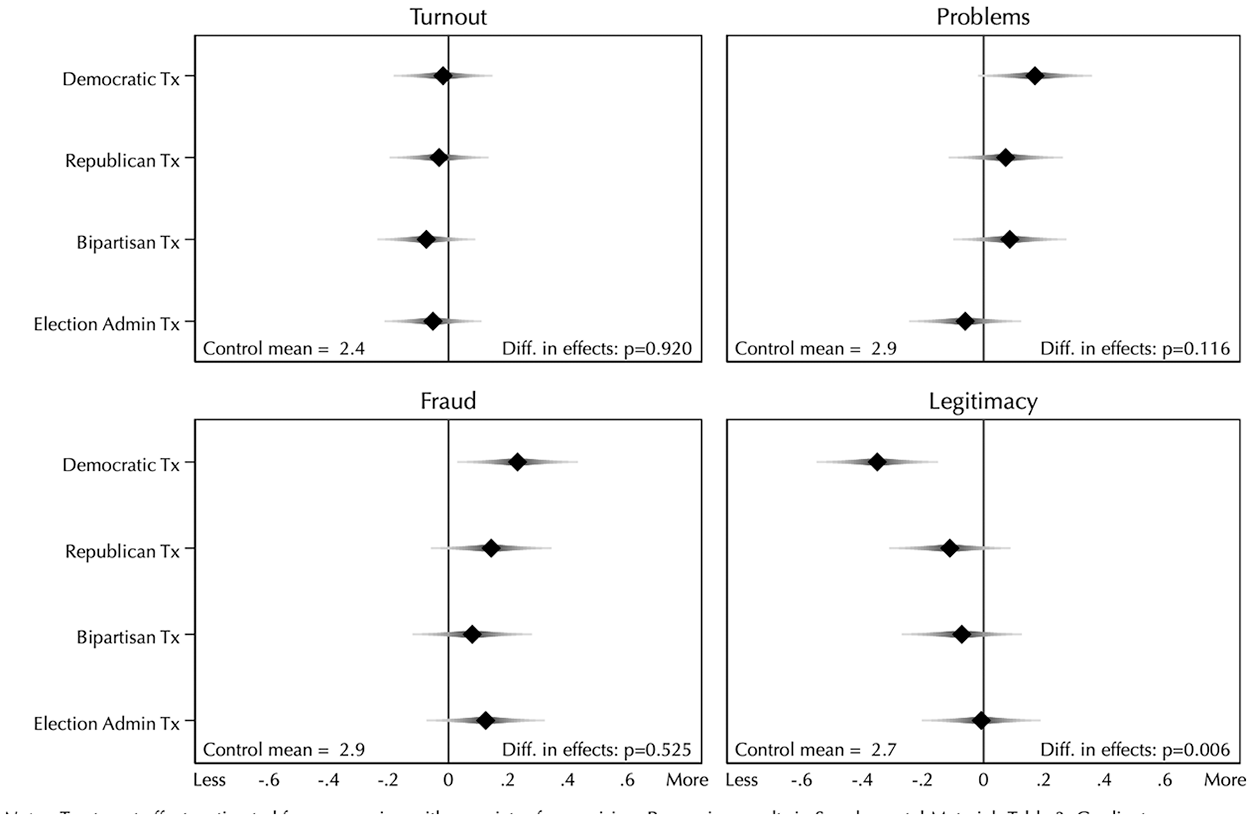
Treatment effects as change in mean response.
In the lower left of Figure 1, all treatments shift respondents toward expecting more voter fraud, although the effect is only statistically significant for the Democratic treatment (Democratic Tx: 0.23 points, p = .025). The increase in expecting fraud is statistically indistinguishable across the four treatments (pooled probability is pdiff = .525).
In the upper right of Figure 1, the three partisan cues increase expectations of problems in running elections, although only the Democratic treatment approaches statistical significance (Democratic Tx: 0.17 points, p = .077). The differences across treatment effects approaches statistical significance (pdiff = .116), largely due to the Election Administrator treatment slightly diminishing expectations of problems.
In lower right of Figure 1, the three partisan treatments cause people to see less fairness and legitimacy with AVR, although only the Democratic cue is statistically significant (Democratic Tx: −0.35 points, p = .001) and the Election Administrator treatment has no effect. The four effects on fairness and legitimacy are significantly different (pdiff = .006).
In summary, our base-level partisan source cues had only modest, and mostly statistically insignificant, impacts on how the likelihood that respondents thought that AVR would impact election administration.
A different picture emerges when we proceed to examine heterogeneous effects by partisanship. Figure 2 reports the change in mean response by respondent partisanship for each outcome. Heterogeneity is assessed between Democratic and Republican respondents as we had no clear priors about independent respondents. The control group mean for each category (listed below each subgraph) falls toward the center of the scale and as expected relative to each other.
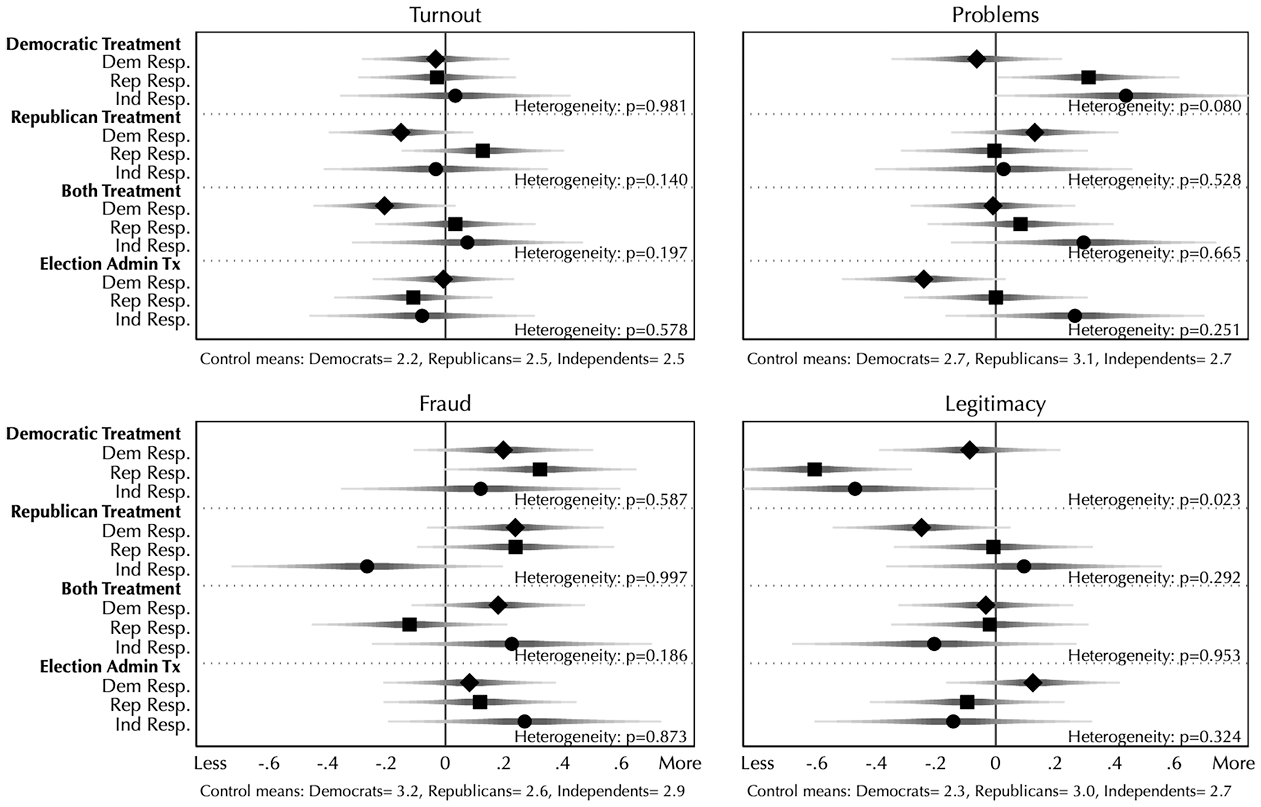
Treatment effects as change in mean response by respondent partisanship.
There is notable partisan asymmetry in the impact of partisan source cues, shown on the right side of Figure 2. In the upper right, Republicans (and independents) expect more problems after hearing about Democratic support for AVR, but there is little impact on Democrats’ expectations (pheterogeneity = 0.080). No heterogeneity appears for the Republican cue or the Bipartisan cue. In the lower right, partisan asymmetry appears again. In the response to the Democratic cue, Republican (and independent) respondents see significantly lower fairness and legitimacy than Democratic respondents (pheterogeneity = 0.023). Partisan heterogeneity appears to be driving the significant negative overall effect of the Democratic cue in Figure 1. The reverse partisan response is faint and not statistically significant for the Republican cue: Democratic respondents appear to see lower fairness and legitimacy while Republican respondents see no increase in fairness and legitimacy (pheterogeneity = 0.292). No heterogeneity appears for the Bipartisan and Election Administrator cues.
In the upper left, there are also hints of partisan asymmetry: Republican respondents may be slightly more inclined to expect increased turnout in response to the co-partisan cue while Democratic respondents may be more inclined to expect decreased turnout when Republicans support AVR, although the differences are not statistically significant (Republican Tx: pheterogeneity = 0.140; Bipartisan Tx: pheterogeneity = 0.197). In the lower left, there is no significant heterogeneity across respondent partisanship for the treatment effect on expectations about fraud. Using respondent ideology rather than partisanship produces similar results (see Supplemental Figure 1).
We found no statistically or substantively significant heterogeneity in treatment effects across other covariates included in our preregistration (analyses available upon request).
Discussion
The results of this experiment provide new insights and raise new questions about how political elite cues shape public opinion about AVR, and perhaps other election reforms. The partisan asymmetry in effects on the fairness and legitimacy of elections and on election problems is striking and largely unexpected. Republican and independent respondents shift toward expecting worsened fairness and legitimacy and worsened election problems when AVR is endorsed by Democrats. However, the reverse response to the Republican cue is faint, if it exists at all. Why this asymmetry occurs is an important theoretical and behavioral puzzle. More research needs to be done to understand if and when Democratic, Republican, and independent affiliators bring to bear different cognitive filters when evaluating and integrating partisan source cues. This asymmetry may also have important implications for the legislative future of AVR.
The absence of any effect on expectations about turnout, a central issue in debates about AVR and other electoral reforms, was unexpected and likely will disappoint many reform advocates. Similarly, there is no difference in the effect of political elite endorsement of AVR on public expectations about increase in voter fraud, although unexpectedly all of the cues appear to similarly increase expectations of fraud rather than the null effect on turnout expectations. Further research is needed to determine whether this is due to firm prior attitudes or lack of belief that turnout and fraud will be influenced by AVR.
The absence of any positive shift in expected outcomes when election administrators support AVR, except possibly a slight reduction in expecting problems in administering elections, and the null-to-negative effects from bipartisan support for AVR are contrary to our hypotheses. We may have misjudged how election administrators are viewed by the public or endorsement by experts may not influence expectations about policy outcomes.
The results of the experiment suggest several directions for future research. Our biggest regret about our experimental design is failing to measure support along with expectations about policy outcomes. In future research, both are important to understanding public attitudes about the electoral system. Future research should explore whether partisan cues about other election reforms produce similar patterns, and which reforms may exacerbate or ameliorate partisan responses to source cues. Online voter registration, for example, is now widespread and seems to have even more bipartisan support than AVR, while political support for same day registration is quite polarized. Extending further, are the effects of elite cues similar for reforms of the mechanics of casting a ballot, such as early in person and mail ballots?
This experiment suggests the dynamics of public expectations about AVR are more complicated than simply being driven by the partisan voting wars, or perhaps that the impact of these wars vary substantially by partisanship within the general public. The asymmetry of effects on expectations about policy outcomes from elite cues is important for understanding public support, incentives for elected policy makers, prospects for adopting AVR in more states, and confidence in the election system.
Supplemental Material
AVR_Experiment_Supplemental_APR_2019_03_28_anon – Supplemental material for Framing Automatic Voter Registration: Partisanship and Public Understanding of Automatic Voter Registration
Supplemental material, AVR_Experiment_Supplemental_APR_2019_03_28_anon for Framing Automatic Voter Registration: Partisanship and Public Understanding of Automatic Voter Registration by Christopher B. Mann, Paul Gronke and Natalie Adona in American Politics Research
Footnotes
Acknowledgements
The authors thank the Democracy Fund for supporting this research. The analysis, interpretation, and especially any errors are the responsibility of the authors. The authors appreciate the research assistance provided by Paul Manson and Sarah Cole and helpful comments from Michael Sances and the participants in the 2019 CCES Conference. This experiment was approved as Exempt by the Institutional Review Board at Reed College. The preanalysis plan was registered with EGAP prior to the research team accessing the survey data. Replication data are available from Dataverse ( ).
).
Declaration of Conflicting Interests
The author(s) declared no potential conflicts of interest with respect to the research, authorship, and/or publication of this article.
Funding
The author(s) disclosed receipt of the following financial support for the research, authorship, and/or publication of this article: The authors thank the Democracy Fund for supporting this research.
Supplemental Material
Supplemental material for this article is available online.
Author Biographies
References
Supplementary Material
Please find the following supplemental material available below.
For Open Access articles published under a Creative Commons License, all supplemental material carries the same license as the article it is associated with.
For non-Open Access articles published, all supplemental material carries a non-exclusive license, and permission requests for re-use of supplemental material or any part of supplemental material shall be sent directly to the copyright owner as specified in the copyright notice associated with the article.
