



Abstract
Research suggests that American partisans are increasingly distinct in their beliefs. These strengthened partisan feelings extend to economic perceptions—as numerous scholars have shown, there is a substantial gap between the proportion of Democrats and the proportion of Republicans that believe the economy is improving. Here, we examine the extent to which these perceptions have polarized over the past two decades and the degree to which they still respond to objective economic indicators. Exploiting a Gallup time-series, we show that the gap in economic perceptions approximately doubled between 1999 and 2020, and that partisan economic perceptions no longer seem to converge during economic crises. We further demonstrate that the economic perceptions of Democrats and Republicans have polarized relative to Independents and that this polarization is not asymmetric in magnitude. Collectively, these results document the extraordinary rise of perceptual polarization and illustrate that neither Democrats nor Republicans are immune to its effects.
Gerber and Green (1999) asserted that partisanship did not appear to significantly impact beliefs about the economy, concluding that “[b]eliefs and evaluations do change by approximately the same degree among those with different political allegiances” (p. 205). Specifically, they point to their own 1997 piece, in which their analyses of survey data showed “Democrats, Republicans and Independents moved together in their evaluation of which party was best able to handle the nation’s economy” (pp. 206–207).
Gerber and Green’s earlier view has since been questioned (including by Gerber himself). In 2002, Larry Bartels made the case to the contrary explicit, arguing that party identification is a “pervasive dynamic force in shaping citizens’ perceptions of and reaction to the political world” (p. 119). Using data that tracked opinions of George H.W. Bush’s handling of the U.S. economy prior to his reelection bid, as well as evaluations of economic phenomena during the Reagan years, he demonstrated that partisans in fact appear to filter information about the economy differently. He concluded that partisan biases in political and economic perceptions played an important role in maintaining and reinforcing sharp differences between Democrats and Republicans.
In the years following Bartels’ article, political scientists have devoted extensive attention to the consequences of partisanship (e.g., Bisgaard, 2015; Iyengar & Westwood, 2014). In particular, they have continued to comment on the distinctive ways in which partisans perceive the economy. As Bartels indicated, partisanship is thought to produce biases in these perceptions; in the last 20 years, a consensus has emerged among scholars that partisans are comparatively more optimistic about the economy when their party controls the executive branch than they are otherwise (Bartels, 2002; Erikson, 2004; Gerber & Huber, 2009). Similarly, research has found that a sudden shift in partisan control of Congress can produce changes in the economic attitudes of partisans (Gerber & Huber, 2010).
To this point, however, academics in the field have focused primarily on demonstrating the existence of partisan differences in economic perceptions. Efforts toward determining how the size of those differences has changed in recent years and uncovering the causes of this perceptual polarization have been more limited. This gap in the literature is puzzling. A surface level glance at partisan economic perceptions suggests that they have grown markedly over the past 20 years, and have become an increasingly salient political phenomenon. As Figure 1a to d indicate, partisan differences in economic perceptions have increased from about 20 percentage-points at the beginning of the Bush II Administration to a maximum of 73 percentage-points during the Trump administration. Moreover, the perceptions of Democrats and Republicans no longer seem to be positively correlated with one another. During the Bush and Obama administrations, the Pearson’s correlation coefficients were 0.41 (p < .001) and 0.44 (p < .001)—during the Trump administration, the coefficient was an insignificant .08.
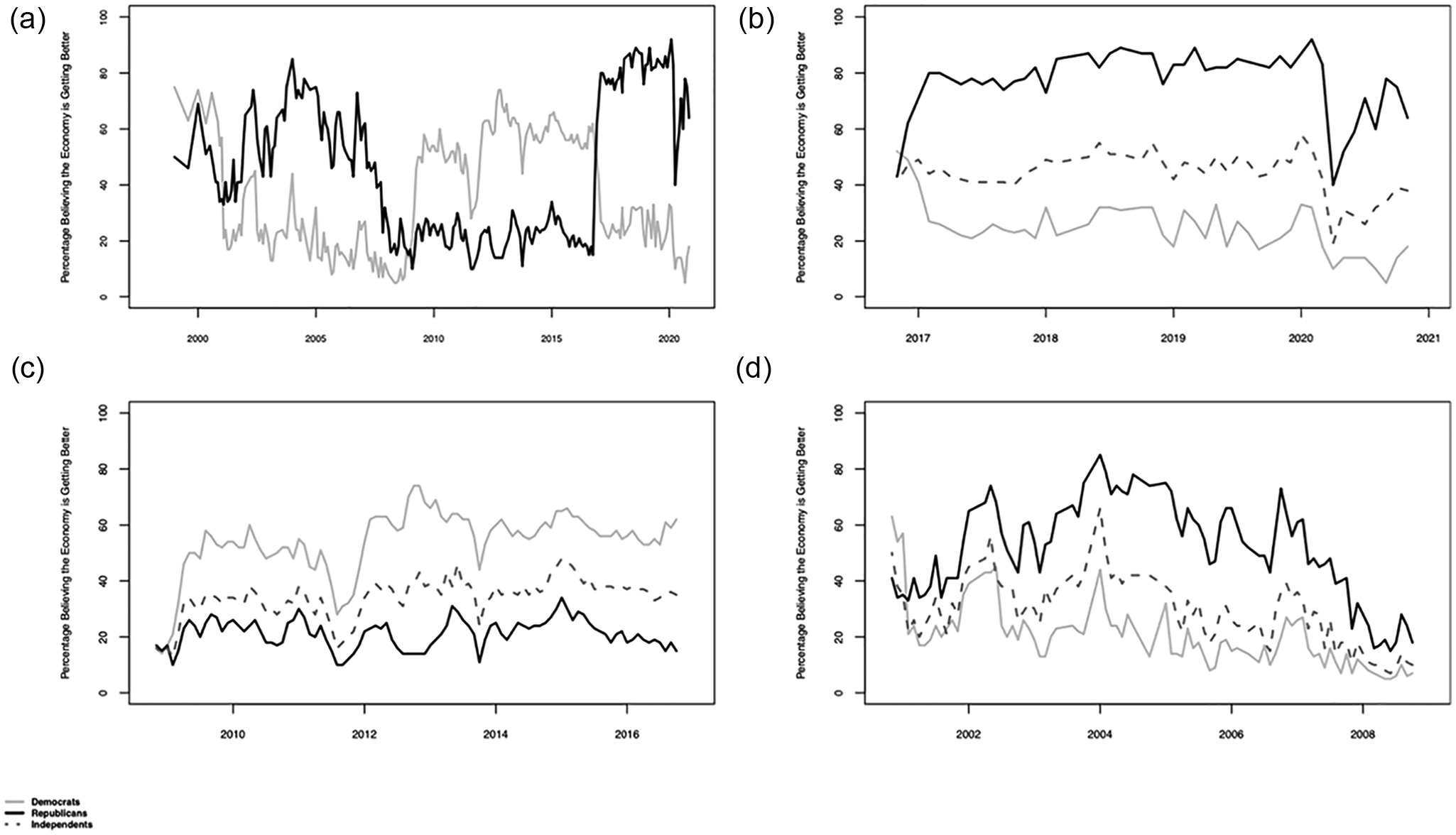
(a) Percentage of Gallup respondents believing the economy is getting better, by partisan identification, (b) percentage of Gallup respondents believing the economy is getting better, by partisan identification (Trump years), (c) percentage of Gallup respondents believing the economy is getting better, by partisan identification (Obama years), and (d) percentage of Gallup respondents believing the economy is getting better, by partisan identification (Bush years).
If confirmed, this growth in partisan differences in perceptions of the economy would indicate the extent to which perceptual polarization has increased in recent years. Exploring how Republicans and Democrats’ economic views have changed relative to Independents could also further the debate on asymmetric polarization by assessing patterns of polarization in a new domain (Mann & Orenstein, 2012; Skocpol & Williamson, 2016; Ura & Ellis, 2012). It may also have implications for economic models of presidential voting (e.g., Fair, 1978) and retrospective voting (e.g., Fiorina, 1981). Accordingly, understanding how perceptual polarization has changed over the last 20 years is our focus in this article.
Pursuant to this agenda, this paper measures the size of partisan differences in economic perceptions over time, and explores whether the growth in those differences is better explained by political or economic variables. To accomplish that goal, we exploit cross-sectional, time-series polling conducted by Gallup between 1999 and 2020. We find that differences in economic perceptions between Democrats and Republicans are primarily attributable to political variables, and that those differences have grown markedly in the past 20 or so years. This polarization extends to economic perceptions during a recession—by comparing the Great Recession of the late 2000s to the COVID-19 induced recession of 2020, we demonstrate that individuals responded in a far more partisan manner to the latter than they did to the former.
We also exploit Independents’ economic perceptions in order to analyze whether one party bears greater responsibility than the other for the growth in the gap between partisan economic perceptions. We find that all partisans’ assessments of the economy have moved away from those of Independents; however, we do not find any evidence that one party is more responsible than the other for the growing partisan divergence in economic perceptions.
In the following section, we review the academic literature on partisan economic biases and articulate our research questions. After doing so, we explain our methods and present our results. Supplemental Material contains methodological details.
Background
Starting approximately with Bartels’ (2002) paper, political scientists have repeatedly observed an association between partisanship and economic perceptions. 1 Survey respondents consistently report positive feelings about the economy when a co-partisan is in the White House, and negative views of the economy when the opposing party controls the presidency (Bartels, 2002; Erikson, 2004; Gerber & Huber, 2009). Gerber and Huber (2010) have also asserted that a similar association exists between partisan control of Congress and economic perceptions. Indeed, the connection between partisanship and economic perceptions is sufficiently strong that it calls into question the extent of the relationship between objective economic measures and economic perceptions.
The reasons for the linkage between partisanship, partisan control of government, and economic perceptions are subject to some debate. However, the research to date suggests that the relationship is a causal one. In their 2010 piece Partisanship, Political Control, and Economic Assessments, Gerber and Huber observed that partisans (Democrats and Republicans) surveyed immediately before and after the 2006 congressional elections changed both their sociotropic (society-wide) and pocketbook (personal) assessments of the economy. After Democrats took control of both Houses of Congress, Democratic (Republican) respondents reported greater optimism (pessimism) about the economy as a whole and about their personal finances. This result indicated that partisanship and partisan control of government had some causal impact on economic views, though it is unclear precisely which mechanism mediates that effect (compare Gerber & Huber, 2009, 2010; Key & Donovan 2016 with Anson, 2017; McGrath, 2017; Prior et al., 2015; Bullock et al., 2015).
We seek to demonstrate that the association between partisanship and economic perceptions has become even stronger over the past 20 years, increasing the gap between Democratic and Republican economic perceptions. Such a hypothesis is consistent with contemporary literature on partisanship and polarization. Scholars generally accept that Democrats (Republicans) have come to hold more consistently liberal (conservative) positions in recent years, even if they cannot agree on whether party sorting or mass polarization is more responsible for this change (Abramowitz, 2011; Fiorina & Abrams, 2011; Fiorina et al., 2011; Jacobson, 2006; Thomsen, 2014). Similarly, levels of affective polarization are extraordinarily high (e.g., Iyengar & Westwood, 2014). Of course, the partisan gap in economic perceptions does not necessarily signify affective polarization (defined as “divergence in affect toward the in and out parties” (Iyengar & Westwood, 2014, p. 1)) or ideological polarization (defined as the divergence in the political positions held by rival partisans). It is instead a measure of perceptual polarization, that is, the divergence in how partisan groups perceive and understand the world. Nevertheless, we anticipate that the various forms of polarization are correlated (Webster & Abramowitz, 2017), and the aforementioned scholarship thus leads us to expect that Democrats and Republicans drifted apart in terms of economic perceptions during the period under study.
Previous research on our subject suggests the same hypothesis. Perhaps most on point is Enns and McAvoy (2011), who studied the speed at which partisans update their economic views to conform to economic reality. That piece, which exploited a wealth of polling data collected between 1985 and 2007, found that partisans updated their economic perceptions more slowly during the George W. Bush administration than they did during previous administrations. This suggests that we should expect to see a substantial increase in the gap in partisan economic perceptions between 1999 and 2020 (the period we study). However, we expect more dramatic results than Enns and McAvoy uncovered. The pair commented in their conclusion “At times, partisan bias and its resulting effect on aggregate opinion appear minimal”; we think that result might be outdated in the current era of hyper-partisanship. After all, it seems reasonable to believe that the patterns of partisan economic perceptions that prevailed pre-2007 may not have survived the election of Presidents Obama and Trump. Stanig (2013) provides additional reason to believe that the partisan gap in economic perceptions has increased post-2007. In the comparative context, he found that partisan economic perceptions tend to be most polarized during periods of economic recovery—the condition of the U.S. during most of the Obama administration. During this same period, some economic indicators (like the stock market) were positive, while others (such as wage growth) were less promising. According to Parker-Stephen (2013), such circumstances often enhance divides in partisan economic perceptions, because ideologues of all stripes can find economic data or news that flatters their political beliefs. Collectively, Stanig and Parker-Stephens’ work suggests that we should observe a particularly sharp divergence in partisan economic perceptions between 2010 and 2019.
Indeed, we think it is an open question as to whether economic realities have any impact on partisan perceptions. As early as 2012, for example, Enns et al. (2012) found that “after controlling for the partisan component of consumer sentiment, objective economic conditions produce no significant short-term effects on approval of the president’s handling of the economy” (p. 304). While evaluations of the president’s economic performance more obviously implicate partisan considerations than the measures of economic perceptions we employ, Enns et al.’s work opens the door to the possibility that partisan economic perceptions are unrelated to the actual economy. In fact, to the degree that partisans primarily arrive at beliefs about the underlying state of the economy by making inferences from their opinions about the president, we would expect economic indicators to have little explanatory power.
We are particularly interested in the degree to which partisan economic perceptions diverge when the economy is under strain. In a 2015 Journal of Politics article, Martin Bisgaard summarized the existing literature, writing “during a severe economic crisis, people seem able to set their party loyalties aside” (p. 849) (see also Parker-Stephen, 2013; Stanig, 2013). Nevertheless, these writings came during a period of prolonged financial recovery (at least in the U.S.). As partisanship intensified during the 2010s, Americans did not have to contend with an unambiguously awful economy. In 2020, however, the COVID-19 pandemic created substantial economic turmoil, leading to the first U.S. recession since 2009. This downturn provides an opportunity to reexamine the conclusions of earlier writings, and to determine if Democrats and Republicans can still agree on when the economy is troubled.
Collectively, the polarization and party sorting literature give us reason to believe that both Democrats and Republicans have developed more partisan economic perceptions in recent years (at least relative to Independents). It is worth noting, though, that a different body of research also suggests that one party has moved further away from a nonpartisan baseline than the other. In the past decade, some political scientists asserted that Republican elites (Mann & Ornstein, 2012) and Republican voters (Skocpol & Williamson, 2016; Ura & Ellis, 2012) have polarized more than their Democratic counterparts (McCarty et al., 2006; Thomsen, 2014). True, this research mostly pertains to ideological polarization (but see Miller & Conover, 2015), and the hypothesis of asymmetric ideological polarization is not universally accepted (e.g., Fiorina, 2013; Galston, 2012). Nevertheless, asymmetric perceptual polarization would be of significant academic and practical interest if it existed, and the concept is sufficiently plausible to merit testing here (see also Enns et al., 2012). In order to do so, we use Independent voters as a neutral baseline. We first show that Independents’ perceptions do not change dramatically with partisan control of the White House or in any systematic direction over time; we then compare the economic perceptions of partisans with those of Independents. 2 If the increase in the gap between Republican perceptions and Independent perceptions is larger than the increase in the gap between Democratic perceptions and Independent perceptions, it would indicate that Republicans have perceptually polarized to a greater extent than Democrats.
Given this scholarly backdrop, we hope to address the following questions in this article:
1) Has the partisan gap in economic perceptions grown during the period under study, controlling for economic variables?
2) Do economic variables still bear some substantive relationship to partisan economic perceptions?
3) Do partisan economic perceptions still converge during recessions?
4) Has the gap in economic perceptions between partisans (Democrats and Republicans) and Independents grown during the period under study, controlling for economic variables?
5) Is the change in the distance between the economic perceptions of partisans and Independents asymmetric?
In the next section, we develop tests to answer these questions.
Methods
During the years under study (1999 to November of 2020), polling organizations used a number of survey questions to measure the economic perceptions of Americans. Among the most prominent is what Gallup dubbed the “Economic Outlook” question, which asked respondents, “Right now, do you think that economic conditions in the country as a whole are getting better or getting worse?” Gallup has been asking the “better or worse” version of the Economic Outlook question in its various surveys since at least 1991, with a brief interruption between 1993 and 1996. Through the Roper Center and Gallup Analytics, we were able to track down Gallup surveys containing the Economic Outlook question for 234 of the 263 months between 1999 and November of 2020. 3
From each of these surveys, we extracted the proportion of Democrats, Republicans, and Independents who answered that the economy was getting “better” at the time the question was asked. These figures served as our primary measure of group economic perceptions. In order to measure the magnitude of the gap in economic perceptions between Democrats and Republicans during a particular month, we took the absolute value of the difference between the proportions of each group that believed the economy was improving (|Democratic Economic Perceptions—Republican Economic Perceptions|). We then estimated regressions using this measure as our dependent variable, using heteroskedasticity and autocorrelation consistent (HAC) standard errors. Our primary explanatory variable was the year number the data was from, with 1999 representing year 1, and 2020 representing year 22. Our expectation was that the absolute value of the difference in economic perceptions between Democrats and Republicans would be directly proportional to the year of the study.
We also kept track of four other variables that might have affected the economic perceptions of partisans. These included:
1) Monthly percentage growth in the Dow Jones Industrial Average.
2) Monthly change in the national unemployment rate (lagged 1 month).
3) Monthly percentage growth in national real personal income (lagged 1 month).
4) The party of the president who won the most recent presidential election. 4
The expected impacts of Dow growth, change in the unemployment rate, and real personal income growth on economic perceptions are fairly obvious; increases in (1) and (3) should improve economic perceptions, as should a decrease in (2). We use all three, however, because some partisans might only be sensitive to some of these measures (e.g., Democrats might respond to unemployment while Republicans react to changes in the stock market). We used the party of the president—defined as the party that won the most recent presidential election—as an explanatory variable because it is possible that absolute partisan differences in economic perceptions might be different under Democratic presidents than under Republican presidents. 5 Moreover, the magnitude of the annual growth in the gap in economic perceptions could depend on the party of the president in office. To account for this possibility, we interact the “Year” variable and what we refer to as the “Dem Victor” variable. 6
This procedure will allow us to assess question (1), but it does not address questions (4) and (5), which ask whether (and how far) the economic perceptions of each individual partisan group have shifted. In order to answer these questions, we needed to create additional dependent variables to facilitate comparison of the economic perceptions of partisans to those of a neutral group.
The neutral group we ultimately settled on was Independents, whose economic perceptions we believed to be, on average, unchanged during the years under study (we verify this assumption in the next section). Using Gallup’s monthly estimate of Independents’ economic perceptions, we constructed two new variables. The first is the absolute value of the difference in the proportions of Democrats and Independents believing the economy to be getting better (|Democratic Economic Perceptions—Independent Economic Perceptions|); the second is the absolute value of the difference in the proportions of Republicans and Independents believing the economy to be getting better (|Republican Economic Perceptions—Independent Economic Perceptions|). By assessing whether the magnitude of those differences has increased over time (controlling for economic and political variables), we could determine if both Democrats and Republicans have adopted more partisan economic perceptions during the last 20 years (assuming that the economic perceptions of Independents did not change substantially in either direction during the period under study). This analysis allowed us to address question (3). Moreover, by observing how far Republicans have moved from Independents as compared to Democrats, we were able to make a preliminary assessment concerning question (4), which anticipates that Republican economic perceptions have polarized more than those of Democrats. 7
That leaves questions (2) and (3). To address (2), we deploy sum-of-squares F-tests, measuring the additional variance explained by adding economic variables to political models of economic perceptions. To answer (3), we compare the degree to which partisan economic perceptions converged during the Great Recession (December 2007–June 2009) and the COVID-19 recession (February 2020–present) using a variety of metrics.
Results
As mentioned above, our models include a variety of variables. Table 1, below, contains summary statistics for the main ones.
Summary Statistics.
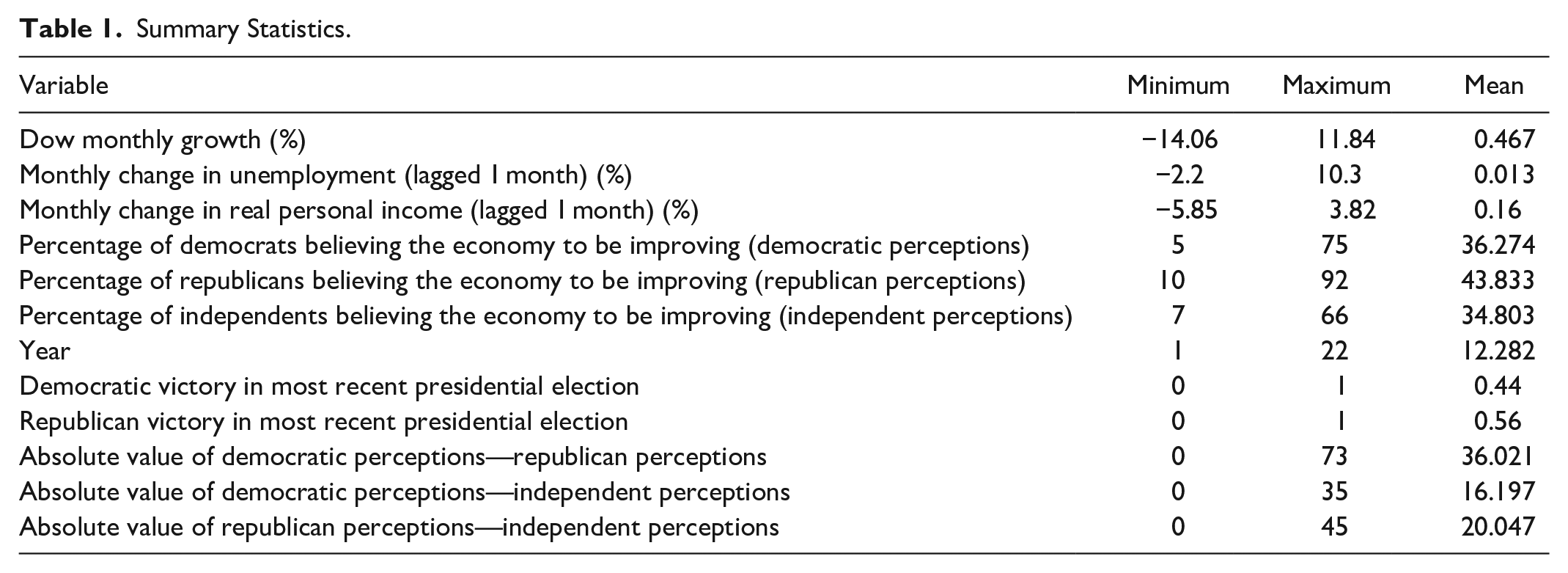
Our data set contains slightly more observations from years under Republican presidents than it does from years under Democratic presidents, so it is no surprise that Republicans were somewhat more optimistic about the economy during the years under study. The mean difference between Democratic perceptions and Republican perceptions was about 36 percentage-points (though as we will see, that average conceals substantial over-time variation). The maximum difference of 73 percentage-points occurred in September of 2020, when 78% of Republicans thought the economy was improving, but only 5% of Democrats felt the same. By contrast, Democrats and Republicans felt exactly the same about the economy in January of 2009, just before Barack Obama took office—at that point, only 17% of both parties thought the economy was improving.
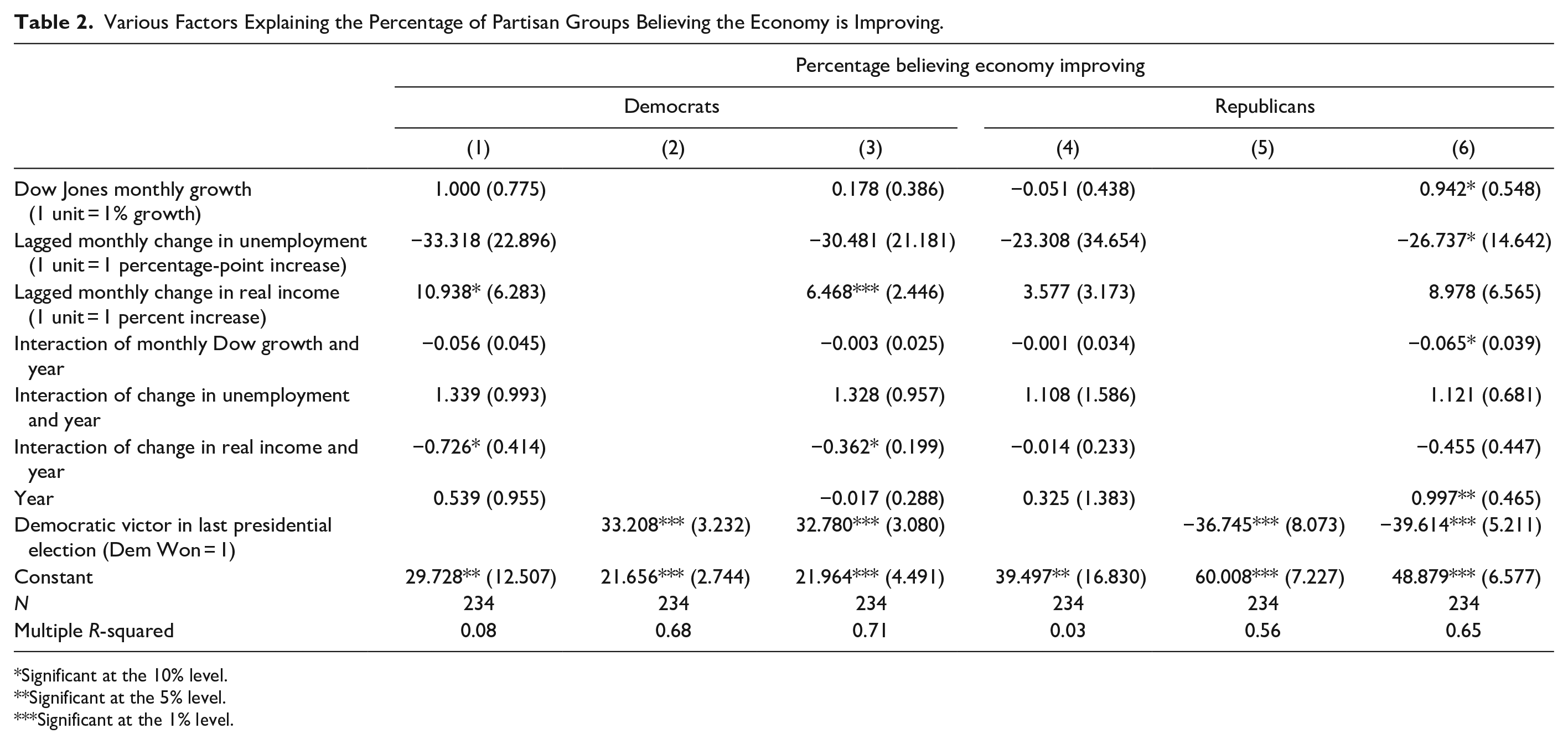
Turning now to our regressions, we begin by establishing that economic perceptions are closely tied to partisan control of the White House and then go on to demonstrate that differences in these perceptions have grown over time. Table 2 confirms the first of these claims; it shows that Republicans tend to view the economy most positively during Republican administrations, and that the same is true of Democrats during Democratic administrations.
Various Factors Explaining the Percentage of Partisan Groups Believing the Economy is Improving.
Significant at the 10% level.
Significant at the 5% level.
Significant at the 1% level.
According to the model estimated in Column 3, the percentage of Democrats that believe the economy is improving is about 33 percentage-points higher when a Democrat is president than when a Republican is (controlling for economic variables). For Republicans the comparable figure is about 40% points. It is thus not surprising that the estimates of partisan economic perceptions that use only political variables are unmistakably more accurate than estimates that use only economic variables. The Multiple R2 values confirm this phenomenon—the party of the president accounts for 68% of the variation in Democratic economic perceptions and 56% of the variation in Republican economic perceptions. By contrast, our economic variables only respectively account for 8% and 3% of the variation in the economic perceptions of Democrats and Republicans. Figure 2a and b demonstrate visually just how much more accurate a purely political model of partisan economic perceptions is than a purely economic model.
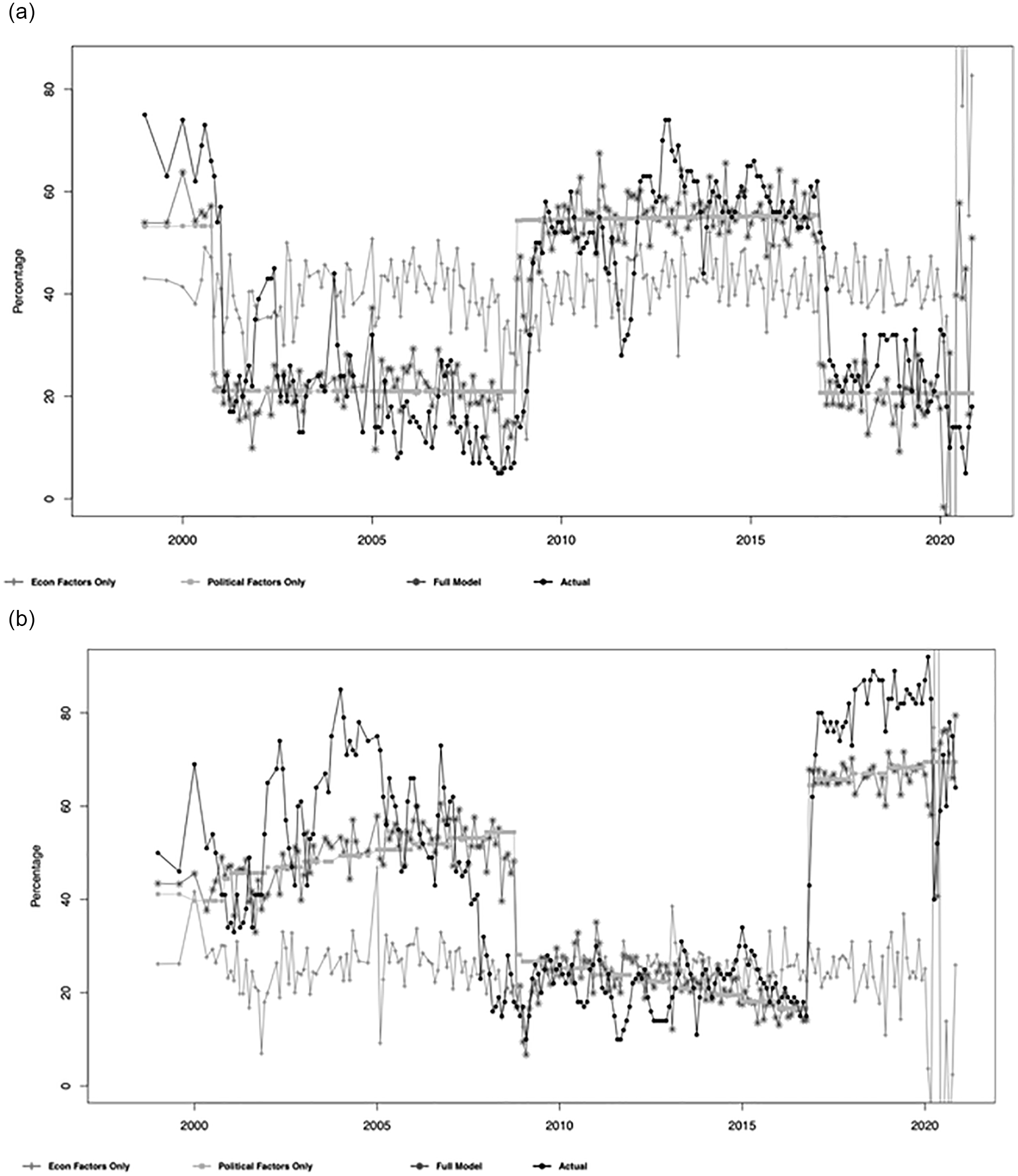
(a) Percentage of democrats believing the economy is getting better and (b) percentage of republicans believing the economy is getting better.
Given the close association between partisan control of the presidency and partisan economic perceptions, it is fair to wonder whether objective economic indicators play any role in determining partisan economic perceptions. However, the results in Table 3 suggest that such indicators still have some influence on how partisans feel about the economy. Table 3 contains the results of using a sum-of-squares F-test to compare the precision of a “political variables-only” model of economic perceptions (columns 2 and 4 of Table 2) with a “political and economic variables” model of economic perceptions (columns 3 and 6 of Table 2). For the sake of accuracy, we use slightly modified versions of the models presented in Table 2, interacting the “Year” variable with “Dem Victor” variable. 8
Comparing “Political Variables Only” Predictive Models to “Political and Economic Variables” Predictive Models.
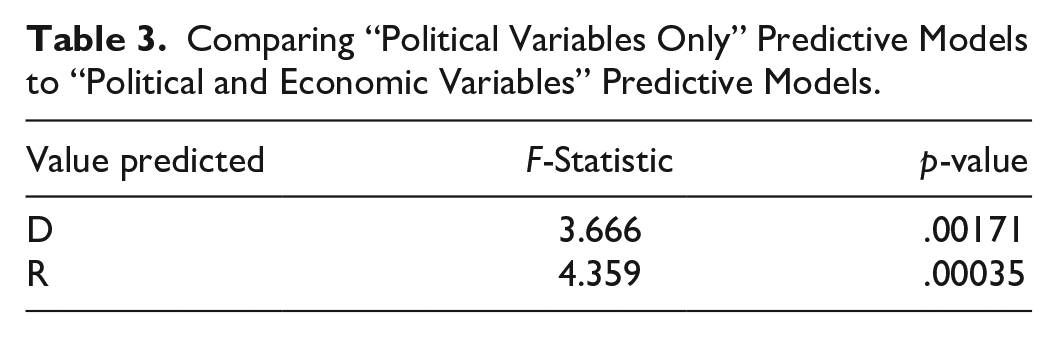
The F-statistics produced by comparing the “political variables-only” models with the “political and economic variables” models are greater than 3.5 for each type of dependent variable, and each F-statistic is significant at the p < .01 level. The implication is that the model using both economic and political variables is a better predictor of economic perceptions than political variables alone; thus, individuals do appear to give some weight to the actual state of the economy in reporting their economic perceptions. Question (2) appears to be answered in the affirmative: economic variables still bear some substantive relationship to partisan economic perceptions.
Interestingly, however, these results do not hold if we omit periods of financial crisis (December 2007–June 2009 and February of 2020 onward). The relevant F-statistics using this modified sample are 1.13 and 1.65, with associated p-values of .35 and .14. The implication of this test is that economic indicators only help to predict economic perceptions when the period under study includes a substantial economic downturn—otherwise, individuals are largely content to rely on their partisan affiliation.
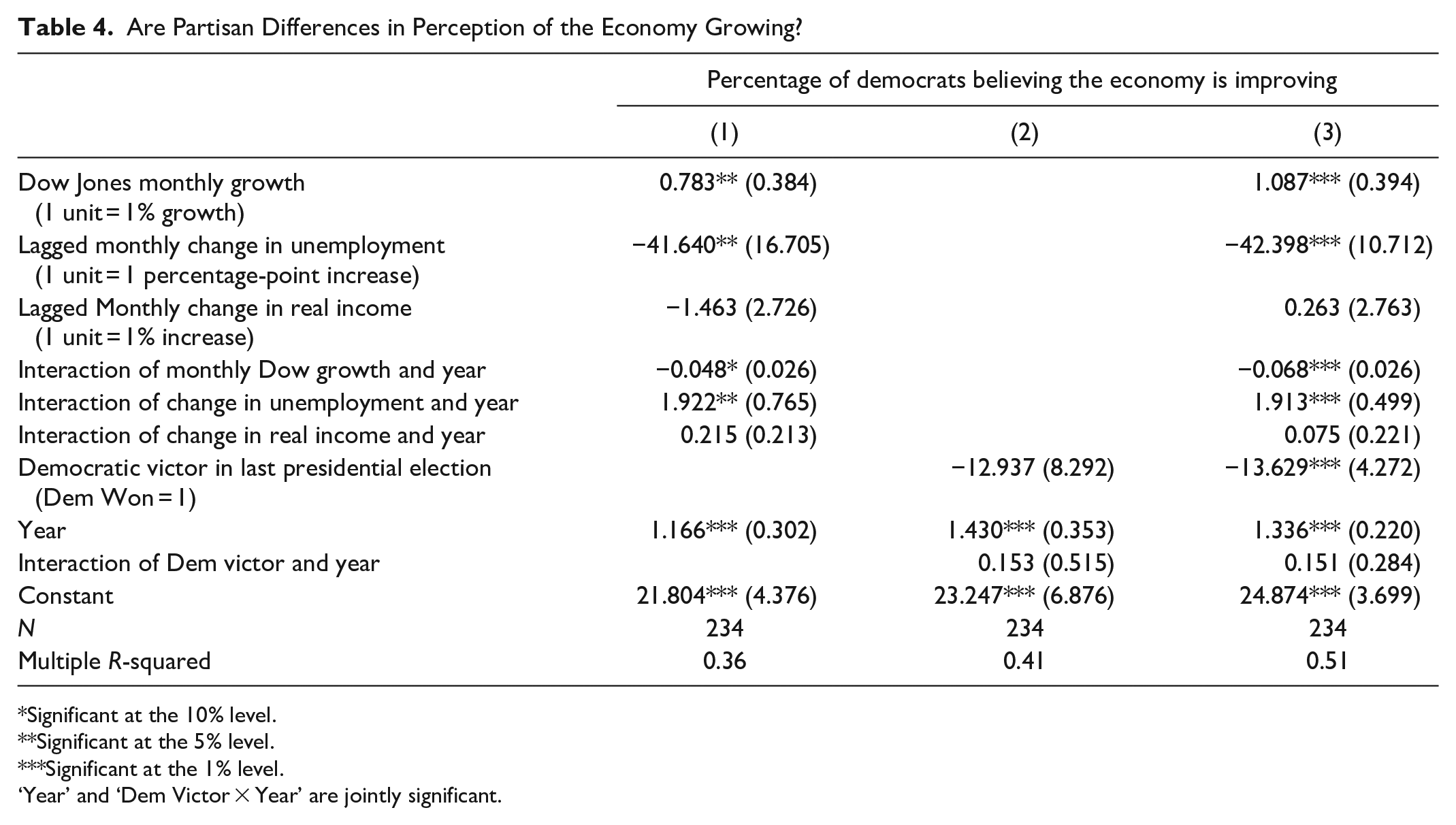
Whatever the role of economic factors in partisan economic perceptions, it is nevertheless clear that political variables are of primary importance. Moreover, it appears the influence of those variables is becoming more pervasive. Table 4 contains the primary test of this claim. It presents the results of regressing |Democratic Economic Perceptions—Republican Economic Perceptions| on various economic and political variables, the salient ones being “Year” and “Year × Dem Victor.” The coefficients in Column 1 are the results of regressing the dependent variable on only the economic variables, while Column 2 regresses the dependent variable on only the political variables. Column 3 contains the complete model, regressing the dependent variable on both economic and political variables.
Are Partisan Differences in Perception of the Economy Growing?
Significant at the 10% level.
Significant at the 5% level.
Significant at the 1% level.
‘Year’ and ‘Dem Victor × Year’ are jointly significant.
As the coefficients in rows (8) and (9) of Column 3 in Table 4 indicate, the value of |D − R| indeed increased between 1999 and 2020, and did so during both Democratic and Republican administrations. According to Table 4, the partisan gap in economic perceptions grew by approximately 1.49 percentage-points during each year of a Democratic administration, and 1.34 percentage-points annually during a Republican administration. 9 The coefficients from which we derived these marginal effects—“Year” and “Dem Victor × Year”—are jointly significant at the p < .001 level (F = 51.951). It is also worth noting that |D − R| appears to be quite sensitive to changes in the unemployment rate—a tenth of a percentage point increase in unemployment decreases the difference between partisan economic perceptions by about 4.2 percentage-points. This statistic is consistent with the common observation that partisan economic perceptions tend to converge during economic downturns. Changes in the stock market appear to have a similar relationship to partisan economic perceptions; a gain of 1% in the Dow Jones Industrial Average is associated with a 1.08 percentage-point increase in |D − R|. The size of this association is impressive, considering that the stock market sometimes fluctuated by as much as 10% in a month during the years under study.
Collectively, these results answer question (1) in the affirmative: the partisan gap in economic perceptions has indeed grown in the last 20 years. Moreover, the magnitude of that change appears to be quite large—when all other variables are set to zero, we would expect the gap to grow by 11.92% points during a two-term Democratic administration, and by 10.72% points during a two-term Republican administration. The gap in economic perceptions at the beginning of George W. Bush’s administration was approximately 20 percentage-points; as such, perceptual polarization (as measured by economic perceptions) has more than doubled in the time since.
Moreover, it appears that the convergence of partisan perceptions that marked previous recessions does not occur to the same extent today. Consider Figure 3a to d, which compare partisan economic perceptions during the Great Recession (December 2007–June 2009) to perceptions during the COVID-19 recession (we have data from March 2020–November 2020). Figure 3a and b depict the percentage of respondents who believed the economy was getting better during each recession; Figure 3c and d contain the percentage of respondents who selected “excellent” or “good” in response to the question “How would you rate economic conditions in this country today—as excellent, good, only fair or poor?”
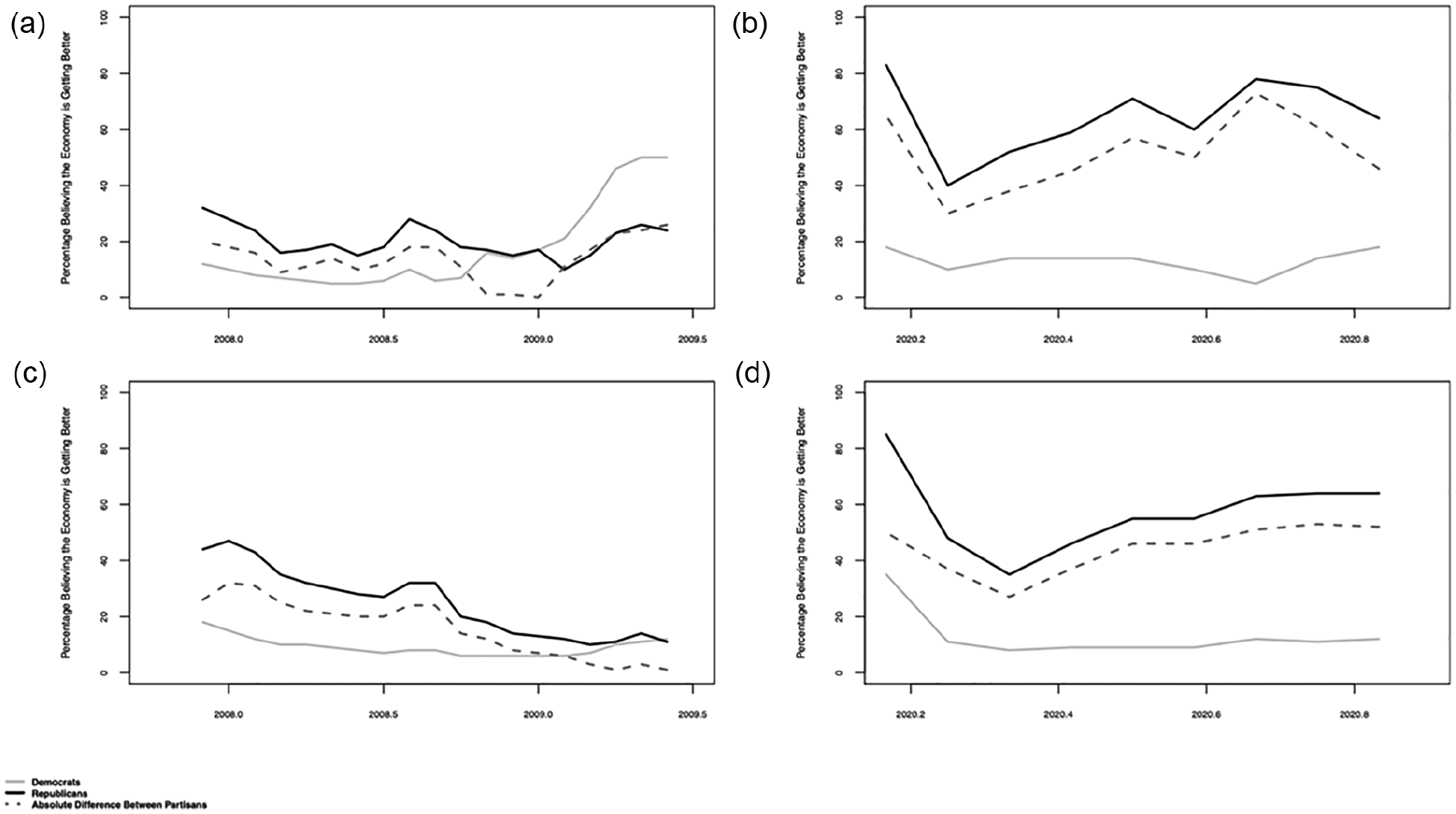
(a) “Economy is getting better” during the great recession, (b) “economy is getting better” during the COVID-19 recession, (c) economic conditions “excellent” or “good” during the great recession, and (d) economic conditions “excellent” or “good” during the COVID-19 recession.
When lined up side-by-side, the differences between the two recessions are striking. For the duration of the Great Recession, the gap between the percentage of Republicans believing the economy was “excellent” or “good” steadily decreased, reaching 1 percentage-point in the final month of the recession. The largest gap between Democrats and Republicans during the entire experience was 26 percentage-points, which is less than the smallest gap between the two parties during the COVID-19 recession (27 points). The same is true when it comes to the percentage of respondents believing that the economy is improving. The maximum gap on that question during the Great Recession was 26 points (in the recession’s first month); the minimum gap during the COVID-19 recession so far has been 30 points.
Two-sample t-tests confirm the changes in the partisan response to recessions. The mean difference between the percentage of Democrats and Republicans believing the economy is improving was 13.7 points during the 2007 to 2009 recession and 51.7 points during the 2020 recession (p < .01). 10 Likewise, the mean difference between the percentages of partisans believing that economic conditions are “excellent” or “good” was 15.8 points during the Great Recession and 44.3 points during the COVID-19 recession (p < .01). 11 Even if we limit our analysis of the Great Recession to months 2 to 10 (the months of the 2020 recession for which we have data), these differences remain significant (p < .001 for both). Collectively, these metrics indicate that even an unambiguous economic collapse is not enough to cause the convergence of partisan economic perceptions.
Table 4 and Figure 3a to d provides strong evidence that partisans disagree more strongly than ever on the state of the economy, and that recession does little to dampen this disagreement. Nevertheless, they do not address the question of which (if either) party’s supporters are more responsible for creating this gap. To address this question, we need to determine how far Democrats and Republicans have moved away from Independents. If Independents did not become systematically more or less optimistic about the economy during the period under study, comparing changes in |D − I| and |R − I| should allow us to assess whether one group of partisans has become more extreme in its economic perceptions than the other.
To establish that Independents are not systematically biased during the period under study, we rerun the analyses from Table 2 (see Supplemental Appendix E for specifics). Unlike partisans, Independents do not seem particularly influenced by the party of the president. Between 1999 and 2020, Independents were an insignificant 0.26 percentage-points less likely to believe the economy was improving when a Democrat had won the most recent presidential election (controlling for economic variables). This shift is negligible compared to the thirty-plus point shifts in partisan economic perceptions that accompany a new party into the White House. Indeed, Independents have fairly stable economic preferences over time; during the period under study, there was no statistically significant annual change in the percentage of Independents who believed the economy was improving. These observations are important, because they validate our assumption that Independents are an approximately neutral barometer against which to compare partisans.
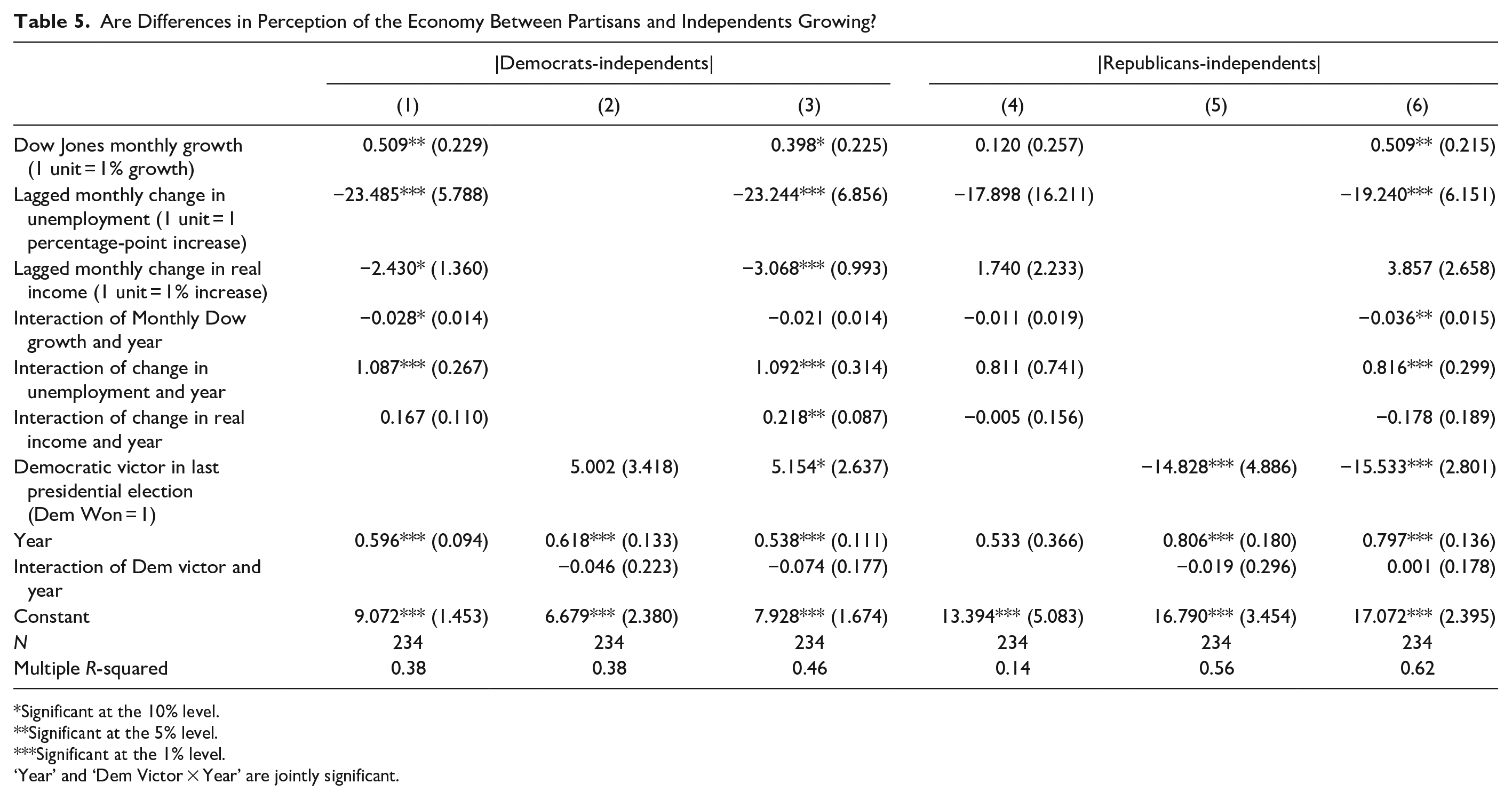
Having established that Independents are a reasonably neutral baseline, we now turn to the analyses. Table 5 contains the results of rerunning the regressions from Table 4, using |D − I| and |R − I|, respectively, as the dependent variables.
Are Differences in Perception of the Economy Between Partisans and Independents Growing?
Significant at the 10% level.
Significant at the 5% level.
Significant at the 1% level.
‘Year’ and ‘Dem Victor × Year’ are jointly significant.
In Table 5, the coefficients of interest are presented in rows 8 and 9 of Columns 3 and 6. Calculating the marginal effects from coefficients in Column 3, it appears that the economic perceptions of Democrats moved approximately 0.46 points away from those of Independents during each year of a Democratic administration, and 0.54 points away during each year of a Republican administration. By contrast, Republicans appeared to move about 0.80 points away from Independents during both Democratic and Republican administrations.
These statistics suggest several conclusions. First, they answer question (3)—the economic perceptions of both Democrats and Republicans moved away from those of Independents at a statistically significant rate (p < .001, F = 19.13 for Democrats; p < .001, F = 32.68 for Republicans). These results indicate that the economic perceptions of both varieties of partisans have become more closely tied to the party of the president over time. Second, the superficially larger coefficients in rows 8 and 9 of Column 6 (as compared to rows 8 and 9 of column 3) suggest that Republicans moved further away from Independents than Democrats did between 1999 and 2017. However, this observation is misleading. Running a pooled regression (modeled by the equation presented in the footnote below), we find that the percentage of Democrats believing the economy to be improving annually shifted approximately 0.72 percentage-points away from the percentage of Independents believing the economy to be improving. 12 Over the same period of time, the economic perceptions of Republicans and Independents grew apart by 0.62 percentage-points each year. 13 The 0.10 gap between these figures does not approach any conventional level of statistical significance (p = .75), preventing us from concluding that Republicans are more responsible than Democrats for the growing partisan gap in economic perceptions or vice versa. Consequently, we find no evidence that the polarization of partisan economic perceptions is systematically asymmetric.
It is worth noting, however, that there do appear to be some asymmetries in the circumstances under which each partisan group moves closer to Independents. For example, in the early part of our dataset, Democrats appear to resemble Independents much more closely in months where unemployment and real income increased—by contrast, only the former was associated with a narrower gap between Republicans and Independents. Likewise, the relationship between Republicans and Independents varied quite a bit more with the party of the president than the relationship between Democrats and Independents. In short, while we do not that find one party moved further away from Independents than the other during the period under study, Table 5 does indicate that the factors that affect the relationship between Democratic perceptions and Independent perceptions are not necessarily the same as the factors that affect the relationship between Republican perceptions and Independent perceptions.
Conclusion
In the previous sections, we developed evidence indicating (1) that the partisan gap in economic perceptions has grown over our time period; (2) that economic variables, while substantially diminished, can still sometimes improve the predictive accuracy of models of economic perceptions; (3) that partisan economic perceptions do not converge during a recession to the same degree that they once did; (4) that partisans have moved away from Independents’ economic perceptions; and, finally, (5) that there is no significant partisan asymmetry in the partisan movement away from Independents. 14 From a theoretical perspective, our results support the consensus that partisanship has become an increasingly salient personal characteristic. If we know an individual’s partisan identification and the party of the president in office, we can more accurately estimate how they feel about the economy than we could two decades ago. This conclusion is consistent with the high levels of affective polarization observed in Iyengar and Westwood (2014). It is also consistent with both the party sorting and mass polarization theories presented by Fiorina, Abramowitz, and others.
Our research does not, however, provide evidence favoring the theory of asymmetric perceptual polarization, at least at the mass level. When compared with Democrats, Republicans do not appear to have moved further away from Independents in terms of economic perceptions; as discussed in the Results section, there is no statistically relevant difference in the extent to which Democratic and Republican economic perceptions have diverged from those of Independents. This conclusion does not necessarily contradict older research finding asymmetric polarization—much of that work took place in the late 2000s and early 2010s, and relative degrees of polarization may have changed in the interim. It does suggest, though, that at least when it comes to survey responses, Republicans are not disproportionately to blame for the vast partisan gap.
One significant theoretical implication of our results has to do with economic models of presidential voting. In recent years, many of these models have proved inaccurate forecasts of the popular vote, calling into question the received wisdom that the economy can determine the outcome of a presidential election to within a few percentage points (Vavreck, 2009, p. 35). In particular, the eponymous Ray Fair model and Douglas Hibbs’ Bread and Peace model have both seen their mean errors more than double over the last three decades (Brady & Parker, 2018, p. 69).
Polarized economic perceptions could be responsible for this decreased accuracy. As our results suggest, there is little consensus about economic conditions when the economy is not in dire straits. Moreover, what agreement there was about the economy during recessions seems to be disappearing by the day. These conclusions are discouraging for models like those of Fair and Hibbs—if objective economic measures are increasingly uncorrelated with individuals’ perceptions of the economy, it stands to reason that they would be of diminished importance in predicting presidential votes.
If the failure of economic models is related to the growing partisan gap in economic perceptions, we might infer several consequences for the conduct of U.S presidential elections. First, if objective factors like economic conditions are becoming less important than partisanship in determining perceptions and attitudes, it seems unlikely that the Democratic and Republican electorates as a whole will deviate from their current habit of casting about 90% of their votes for their own party’s candidate (Brady & Parker, 2018, pp. 71–72; also, see generally Green et al., 2002). Traditional retrospective considerations (Fair, 1978; Fiorina, 1981) will simply reinforce existing partisan proclivities. If so, there would continue to be limited variation in the vote shares received by the two major parties’ candidates, and what variation remains will come from fluctuations in the Independent vote. In such an electoral environment, the preferences of Independents—along with the gap in partisan identification between Democrats and Republicans—will be paramount.
This article does not answer every question about the partisan gap in economic perceptions. We do not know, for example, when the partisan gap in economic perceptions first arose, nor have we determined what forces drive it. These questions deserve further scholarly attention. For now, however, it is enough to conclude that partisanship has increased its grip on the economic perceptions of Americans.
Supplemental Material
sj-pdf-1-apr-10.1177_1532673X211032107 – Supplemental material for Cognitive Political Economy: A Growing Partisan Divide in Economic Perceptions
Supplemental material, sj-pdf-1-apr-10.1177_1532673X211032107 for Cognitive Political Economy: A Growing Partisan Divide in Economic Perceptions by David W. Brady, John A. Ferejohn and Brett Parker in American Politics Research
Footnotes
Declaration of Conflicting Interests
The author(s) declared no potential conflicts of interest with respect to the research, authorship, and/or publication of this article.
Funding
The author(s) received no financial support for the research, authorship, and/or publication of this article.

Supplemental Material
Supplemental material for this article is available online.
Notes
Author Biographies
References
Supplementary Material
Please find the following supplemental material available below.
For Open Access articles published under a Creative Commons License, all supplemental material carries the same license as the article it is associated with.
For non-Open Access articles published, all supplemental material carries a non-exclusive license, and permission requests for re-use of supplemental material or any part of supplemental material shall be sent directly to the copyright owner as specified in the copyright notice associated with the article.
