




Abstract
Critical mass theories predict that women in government will sponsor and vote for more women and feminist bills as their numbers increase. Using Voteview.com data of roll-call votes measuring left–right ideology from 1977 to 2019 this paper shows that ideological divides among women in the U.S. House of Representatives have deepened rather than veered in a liberal direction. Republican women have moved rightward over time and more conservative ones are winning elections. Belonging to a politicized generation, older Silent Generation and Boomer women are more ideologically extreme than younger women. Parties are also elevating their more ideological female members. As their numbers increase, female House members are expected to remain ideologically diverse in a polarized legislative environment. Critical mass theories are deficient in failing to place female political actors in a dynamic workplace.
In this article, we are interested in the political socialization of women in Congress and the way that the institution affects their legislative behavior. Women are socialized to be more caring than men, and this also influences their political behavior, it is argued. Women enter government having a liberal perspective based on gender experiences that pushes them to advocate for women’s issues (Dittmar et al., 2018; Swers, 2002). These two facts, gender socialization and gendered experiences, explain women’s liberal legislative record. However, will each generation of political women enter government with a strong gender identity that promotes liberal politics? It is assumed that women’s political liberalism intensifies as the proportion of women increases in Washington. The logic is taken from Rosabeth Moss Kanter’s (1977) study of women in corporations. When women reach a “critical mass” in government their politics will be visibly more pro-women rights and liberal. Women, already self-conscious of their gender, see each other as potential allies, and strategically group together under a critical mass scenario. Women in larger numbers also become strong enough to influence the legislative culture making it more receptive to women-friendly bills (Childs & Krook, 2008; Dahlerup, 2006).
Scholars argue that there needed to be a critical mass of women for women lawmakers, perhaps around 12–15% of the legislative body, before they are willing to speak out forcefully on women’s rights (Thomas, 1994). Women represented over 12% in 1997 and over 15% of the U.S. House by 2005. In general, however, no threshold number has been established as necessary for women to attain greater substantive representation (Beckwith & Cowell-Meyers, 2007; Grey, 2006).
Evidence for a critical mass theory is mixed. In state governments where the proportion of women are high, women’s issues were most evident (Thomas, 1994). Female judges serving with other female judges in their cities adjudicated in a more liberal direction than men presumably because of their interaction with each other (Collins et al., 2010; see also Scheurer, 2014). However, a study of female judges in Canada found no critical mass effect on their decision-making (Johnson et al., 2011). Other work examining the legislative politics of the New Hampshire state Senate, which in 2009, became the first chamber to have a female majority found that women were no more likely to pursue a women’s agenda with that majority than in other sessions (Schilling & Osborn, 2020). These women legislators were more likely to cosponsor each other’s bills when having a majority, however. Schilling and Osborn argue that political party more than gender shapes the legislative behavior of women even representing the majority. Still MacDonald and O’Brien (2011) find women U.S. House representatives were more likely to sponsor feminist bills when more women were serving.
Childs and Krook (2009) suggest that under a critical mass, women legislators may become less gender-conforming and diversify. Grey (2006) contends that after a substantial rise in female MPs in New Zealand, women politicians were less likely to give speeches presenting themselves as speaking on behalf of women. For Beckwith & Cowell-Meyers (2007) left-wing political parties are important for women to be transformative. In the U.S., increasing numbers of women have coincided with a rise in conservatism when the Republicans won a majority share of seats in the 1994 midterm elections. Both parties since the 1990s have polarized. Women as a group shifted toward the political right with the election of more Republican women (Dodson, 2006). An overtime statistical analysis found support for a women’s agenda is less for Republican women today than during the 1980s and early 1990s (Frederick, 2009). Second, there needs to be a strong women’s movement in place for women’s numbers to be meaningful. Although women protest marched in the aftermath of President Trump’s election in 2017, the U.S. women’s movement is not very strong. Congress notably has been very aggressive in limiting abortion rights. The 1994 Violence Against Woman Act has been left to expire as the two parties cannot reach a compromise.
Critical mass theories assume that women enter government with equally strong gender identities based on their life experiences. However, outside political forces and expanding political opportunities may weaken those identities. Important changes that could affect the legislative behavior of women include new opportunities to advance, the decline of the women’s movement, and the rise of party polarization. Gendered experiences may have changed over time. As women’s numbers have increased, hostility to their presence has diminished. There are more opportunities for women to lead. Even in the corporate world, opportunities for women to advance have improved, making gender consciousness less relevant, and reducing pressures for women to band together. Thus, the relevant force on political behavior is not the number of women in government and the political context but the receptivity of the institution to women. This opening of opportunities has encouraged greater ideological diversity among women. Older women legislators, however, are expected to be more ideological than young women because of the women’s movement. Ambition and formal leadership posts will also undercut solidarity among women.
An analysis of Black Democrats in the U.S. House of Representatives from 1977 to 2010 found that older Blacks, members of the Silent Generation, were more liberal than Baby Boomers and Generation Xers. Older Blacks are more liberal than young ones, it is asserted, because of their idealism rooted in the civil rights era and lower levels of ambition (Tate, 2020). Examining the ideological profile of women in the U.S. House of Representatives from 1977 to 2019, we ask whether a generational divide is also present among women? Older women, like older Blacks, are expected to be more ideological than young women because of having been influenced by the social movements of the 1960s and 1970s. Young women who have more opportunities to advance and may be more centrist in seeking to build a legislative record and run for higher office. Republican women and some Democratic women may also be more conservative today in seeking votes from a conservative, albeit increasingly polarized electorate.
The political discourse has moved from an ideological to a partisan debate. Parties take a greater lead in passing bills in an era of party polarization (Lee, 2016). Party loyalty has become important. Women legislators are under pressure to vote along party lines. The source of ideological polarization among women is believed to be based on the growing importance of political party in government. Unified roll-call voting has grown as both parties have successfully lobbied members to support their agendas. The Women’s Caucus, formed in 1977, like other caucuses, may have less influence as lawmakers strive to win support from their parties for their legislative agendas. Loyal members are expected to lead their parties. The previous generation of women had to counter parties that did not reward women with leadership posts (Gertzog, 1995). All in all, critical mass theories fail to place female political actors in a dynamic workplace. While the aim is to focus on pro-women politics, ideology analyzed here is measured broadly. Ideology is coded as a spatial mapping of left and right House floor votes as calculated by Lewis et al. (2020). Regression models of women’s ideological scores from 1977 to 2019 by political party are developed to determine how unified women are, and whether generational membership and legislative service divide women.
The Role of the Institution and Policy Climate for Women’s Interests in Washington
Women as legislators are more liberal and supportive of women’s issues regardless of party compared to men (Burrell, 1994; Dodson, 2006; Frederick, 2010; Swers, 2002). In terms of their legislative interests, women are more likely to pursue women’s issue agendas than men (Swers, 2002; Thomas, 1994). Figure 1(a) and (b) show the average ideological score over time for women and men in the U.S. House by political party from 1977 to 2019. Women’s scores are consistently more liberal than men’s. Liberal scores are negative while conservative ones are positive. In interviews, congresswomen explain that this emphasis on women’s issues is based on their shared experiences as women. But women are divided ideologically nevertheless, by political party and by political perspectives and constituent needs. Moreover, large political forces also shape their politics and legislative behavior. The second wave of the women’s movement had an important impact on women’s political consciousness. Congresswomen of that era took an oppositional stance to gender inequality and sexism. However, women’s interest group activism in Washington intensified during the 1960s, peaking in the 1970s, only to diminish in the 1990s (Costain, 1994; Goss, 2013). The pressure to represent women in government through liberal politics may be less given this decline of women’s lobbying presence in the federal government. The decline of the women’s movement may have left young Democratic women representatives less committed to feminist agendas than older Democratic women. (a) Ideological Scores for Democratic Men and Women, 94th to 116th Congresses (b) Ideological Scores for Republican Men and Women, 94th–116th Congresses. Source: Voteview data and compiled by authors.
Based on previous research women have often entered politics later in life after fulfilling responsibilities as wives and mothers. There were three waves of women candidates that appeared to have deepened their support for feminist causes. The first wave in the 1970s women were “wives, widows, or, in a few cases, the daughters of male politicians” (Burrell, 1994: 58). The second wave were women who had volunteer experience, while the third wave had women with professional backgrounds comparable to men running for political office. Forty-one percent of congresswomen were lawyers in 1983–1993 compared to 24% in 1941–1964 (Gertzog, 1995: 43). The percentage of congresswomen with prior elective office experience increased as well during this period. With direct life experiences in the workplace, the patriarchal structure was less acceptable to women politicians of the 1970s and 1980s.
During the 1970s, public opinion increasingly favored equal roles for men and women, and there was greater awareness of the problem of gender discrimination. Congresswomen of the 1970s embraced more a feminist agenda where a liberal government transforms society toward greater gender equality. The first set of women in government existed as “tokens.” As tokens, they rarely made meaningful substantive efforts to advance the cause of gender equality. Kirkpatrick’s study of state legislators in 1971 found that women legislators were quite traditional; “[a]lmost all are wives and mothers and, in addition, most concur in the traditional view that these roles have priority at various times over other commitments” (Kirkpatrick, 1974: 219). As the ranks of women legislators began to fill with career women, the policymaking environment in Washington changed as well. Because of the second wave women’s movement, the 1970s was period of major legislative outputs for feminists’ issues.
The late 1970s found that the small number of women legislators still described Congress as a “male” institution, but they reacted against it, chiefly in emphasizing their gender and taking up feminist causes (Gertzog, 1995). In interviews conducted in 1978, most of the congresswomen felt that the male legislators did not treat them equally. While those interviewed disagreed about the extent, there were at times patronizing and condescending comments as well as insults directed at the women by male members (Gertzog, 1995: 68). For example, one female legislator “reported that there was one male colleague who let out a wolf whistle whenever he saw her, adding that it was just ‘a little joke’ between them” (Gertzog, 1995: 69). Congress was also a male institution because its amenities—the bathrooms, the gym, the swimming pool—were not made equally available to women members (Gertzog, 1995: 73). Interviews with members of the House of Representatives in 1993 found that women characterized the House, as, again, a “male” institution where male members continued to make insensitive remarks about gender out of bigotry and ignorance. Notably, male House members had fewer disparaging comments about the women they served with in 1993 than in the 1970s and 1980s. Women members in all three waves of interviews, however, said that they often worked around these sexist remarks. Women of color legislators found not only sexism made their work more difficult but racism as well (Hawkesworth, 2003). Thus, the pro-woman legislative environment continued from the 1970s to the 1990s. Women lawmakers may feel less threatened by traditional, patriarchal political pressures in institutions than in earlier congresses.
There can be generational change. Older women legislators are expected to be more ideological than younger women. Older women legislators come from a generation that participated in the ideological debates of the 1960s and 1970s. Younger women have more electoral and legislative opportunities than older women and may cross party lines to strike deals. Alternatively, senior legislators might be more ideological than those having less seniority. The women’s movement may not have uniformly affected the political consciousness of all women. There was, in fact, a backlash to the movement, with conservative women mounting a campaign against ratification of the Equal Rights Amendment. Older Republican women may continue to have traditional conservative values combined with a commitment to a limited government. Young Republican women may be less conservative on social issues and government spending. Finally, women may feel freer to break apart and dissent on bills given that there are sufficient numbers of women co-sponsors. Democratic men have also liberalized on women’s issues reducing the need to canvass for every woman’s legislative support as males join women in cosponsoring such bills (Frederick, 2009). Contrary to critical mass claims, increasing numbers of women may cause disunity.
Younger women in government may have higher ambitions for political office than older women because opportunities to advance have improved. Political ambition was found to reduce the liberal scores of Black House lawmakers in a study of their ideology from 1977 to 2010 (Tate, 2020). Ambition may be weakest among older people who are not as interested in new political challenges as much as the young. They serve in the U.S. House but may not want to reach for the U.S. Senate or state governor’s office as future goals. Ambition may have also expanded for young women as the glass ceiling has shattered. In 2016, the Democrats nominated a woman, Hillary Clinton, for president. Women were selected to serve as vice president in 1984 by the Democrats and in 2008 by the Republicans. Geraldine Ferraro, the running mate of Walter Mondale in 1984, had served in the U.S. House from 1979 to 1984. U.S. House Representative Tulsi Gabbard (D-HI), after serving three terms, ran for the Democratic presidential nomination in 2020. Republican House member Michele Bachmann (R-MN) ran for president in 2012. Women running for governor today are less uncommon. The Center for American Women and Politics reports that 44 women have served as governor in 30 states.
Periods of heightened public gender consciousness is institutionally important for Congress. A record number of women ran for elective office in 1992, known as the Year of the Woman, motivated by the contested nomination of Clarence Thomas to the Supreme Court. Thomas had been accused of sexual harassment, and the all-male Senate Judiciary Committee had initially ignored the allegation before it became public. The 103rd Congress that included the new freshmen women legislators produced the most legislation pertaining to women, children, and families of any congress (Dodson, 2006; Gertzog, 2004). For example, the 1993 Family Leave Act and the 1994 Violence Against Women Act were adopted during the 103rd Congress. The Family Leave Act had been proposed by Pat Schroeder (D-CO) in 1985. It protects a worker’s job by granting up to 12 weeks of unpaid leave for medical reasons or family-related medical reasons. It had been vetoed twice by the Republican president and signed into law by the new Democratic president in 1993. The 1994 Violence Against Women Act created a federal office on domestic violence and provided grants to create shelters and rape crisis centers in addition to programs to prevent domestic violence. The new law also created a national hotline for victims of domestic violence seeking help and made it easier to convict those stalking individuals across state lines. Women in Congress also sought political unity in abortion rights. During the 103rd Congress, the Congressional Caucus for Women's Issues (CCWI) also abandoned neutrality and declared itself a pro-choice abortion rights organization (Gertzog, 2004).
The Year of the Woman was also very short-lived. In the November 1994 midterm elections, Republicans won a majority of seats in the U.S. House of Representatives. It was a historic election giving the Republicans control of the chamber for the first time in 40 years. Women lost political ground in the Republican takeover of 1995. The women’s issue agenda lost its momentum, as Democratic women legislators reported being fully occupied fighting the Republican Party’s Contract with America agenda. Only two bills pertinent to women became law in the 104th compared to the 30 bills that became law in the 103rd (Gertzog, 2004). The new Republican majority in 1995 changed rules which also led to the defunding of caucuses like CCWI. CCWI struggled to control the policy agenda in the first session of the 104th. Gertzog reports that two-thirds of the Women’s Caucus members failed to show up at its meetings during this time (2004: 86). Dodson (2006) found a divide between newly elected Republican women and returning ones. Freshmen Republican women were markedly more conservative than incumbent Republican women.
The Republican majority in the U.S. House created new motivations for Republican women to move to the political right through party and legislative assignments. Women moved right also to reduce the divide between themselves and Republican men. “Republican congresswomen who joined [the women’s caucus] risked losing leverage with antifeminist Republican men, many of whom were ranking members of committees and gatekeepers to leadership position,” writes Gertzog (2004: 30). In 1995, some Republican women refused to join the Women’s Caucus, while others were members “in name only” (Gertzog, 2004: 13). U.S. House Representative Susan Molinari (R-NY) distanced herself from the CCWI when in 1994 she decided to run for the Republican Party’s fifth highest ranking party leadership position. While the CCWI had become more partisan during the Clinton presidency, Molinari also believed that to be considered a team player she had to “mask” some of her feminist positions (Gertzog, 2004: 41). Some Republican women kept their distance from the CCWI because they wanted closer partisan ties, expressing the sentiment that Republican men were “unsympathetic” to women’s issues (Gertzog, 2004: 84). Republican women make up a smaller share of their party’s coalition in the House than Democratic women in theirs. CCWI Republican leaders are expected to be centrists.
The current Congress may be less gendered than past congresses, and women may have more opportunities to advance. Interview data with congresswomen in 1978 and 1983 indicated that women serving in 1978 were less interested in leadership positions than later women (Gertzog, 1995). Women in the 1970s may have wanted to preserve their political independence. Women also may have been less interested then because they knew leadership positions were generally unavailable to them. In interviews, women members of the U.S. Congress stated that while tensions exist over women striving to exert power in Congress, overt forms of sexism, as when committee chairs openly disapproved of women serving as members on their committees, are gone. Today’s female representatives give examples of how being a woman in a male-dominated institution provided them with more opportunities to have an impact (Dittmar et al., 2018). Some view leadership as a way for more women to get heard in Washington; said one female member of Congress “when women are included in the leadership, then women who are not part of that group are more likely to be heard” (Gertzog, 1995: 127). While Tate (2020) argues that leadership should make Black members more centrist, parties have polarized and are elevating strong ideologues to party posts. Although leaders must compromise and work with the other party across the aisle, they set the policy agenda for the party. The two parties have adopted strategies where they are more ideological. Thus, it may be that ideological women are appointed to party leadership positions, not centrists. Leaders and committee chairs are expected to tow the party line. Parties have begun to appoint loyalists to chairmanships. Republicans in the revolution also deemphasized seniority and elevated ideology as a basis for leadership posts. Other evidence suggests that Republican Party leadership may have made Republican women more conservative. Susan Molinari (R-NY) was pro-choice but voted for the partial birth abortion ban. She claims the vote was in part due to her own older pregnancy but also because of her leadership position—she could not be too far from “the reservation” (Gertzog, 2004: 101). If parties are rewarding ideological extremism, this diminishes opportunities for women across the aisles to work on bipartisan women and feminist bills.
Finally, women may be less impactful as a liberal force in the policymaking process today for reasons other than the institution. First, the women’s movement has changed. As women have won rights and increased their descriptive representation, with some exception, their activism appears to resemble traditional interest group politics. While an exception is the March on Women that took place in 2017 in the aftermath of President Donald Trump’s election and later ones, there remains a struggle to get women’s issues the attention that they once had in the 1970s and in the early 1990s. The Me-Too Movement raised the issue of sexual misconduct in the workplace, and the House passed a resolution that employees must complete a workplace training program. A number of congressmen were accused of sexual harassment in 2015, and most left over the matter. The policymaking environment today may, however, be hostile to women’s legislative initiatives. For example, criticized originally as an intrusion on states’ rights, the 1994 Violence Against Women Act was left to expire. In the Democratic-controlled House, it was renewed, but the more conservative Senate refused to take up the measure because of its new gun ban provision. With the Year of the Woman and the 103rd Congress representing the high point, the women’s political agenda has lost ground.
A second reason is the long campaign against abortion rights in the U.S. The country remains locked in battle over abortion politics with a number of states having moved to impose new restrictions on abortion providers. The issue polarized Congress in the 1980s and the House became the focal point for debates (Ainsworth & Hall, 2011). After a Democratic presidential veto in the 1990s and under a new Republican president, Congress passed the partial-birth abortion ban in 2003. The Supreme Court ruled in a 5 to 4 decision in Gonzales v. Carhart that the federal ban was constitutional in 2007. There was a campaign to defund Planned Parenthood whose clinics counsel on abortion. While both sides have used amendments as leverage in a wide set of policy proposals, anti-abortion legislators have been more effective, keeping abortion funding out of federal programs. The 1995 Republican Revolution is again important. The division between women in Congress became much starker because of abortion politics. Before the 1994 elections, 10 of the 12 Republican congresswomen had been pro-choice, but after the elections, 8 of the 17 were pro-life (Gertzog, 2004: 92). Polls show that despite generational change, national opinion on abortion has remained roughly constant (Wilcox & Carr, 2010). Young voters are not significantly more pro-choice than older ones even as society has liberalized on other social issues such as gay rights and the legalization of marijuana. Alvarez and Brehm (2002) characterize public opinion on abortion policy as ambivalent, reflecting clashing political values that cannot be easily reconciled. This might explain why a counter-movement to the anti-abortion politics in Congress has yet to emerge. Thus, in contrast to critical mass accounts, women’s ideological profiles have changed in response to external conditions and institutional forces. Opportunities to advance have changed the ideological profiles of women. As their numbers grow and the institution becomes less adversarial to women, women are expected to become ideologically diverse. This claim runs counter to critical mass accounts.
Generational Differences in Ideological Scores
Ideological scores are taken from Voteview.com. DW-NOMINATE scores measure the House member’s ideology (Lewis et al., 2020). The scores range from −1.0 (very liberal) to +1.0 (very conservative). They are calculated from floor votes. The data include the 116th to the 94th Congress. The start year is when the Women’s Caucus was formed. By constraining how individual legislators’ positions can change over their careers, these ideological scores are comparable across time. For example, they have been used to analyze political polarization over time (McCarty et al., 2016).
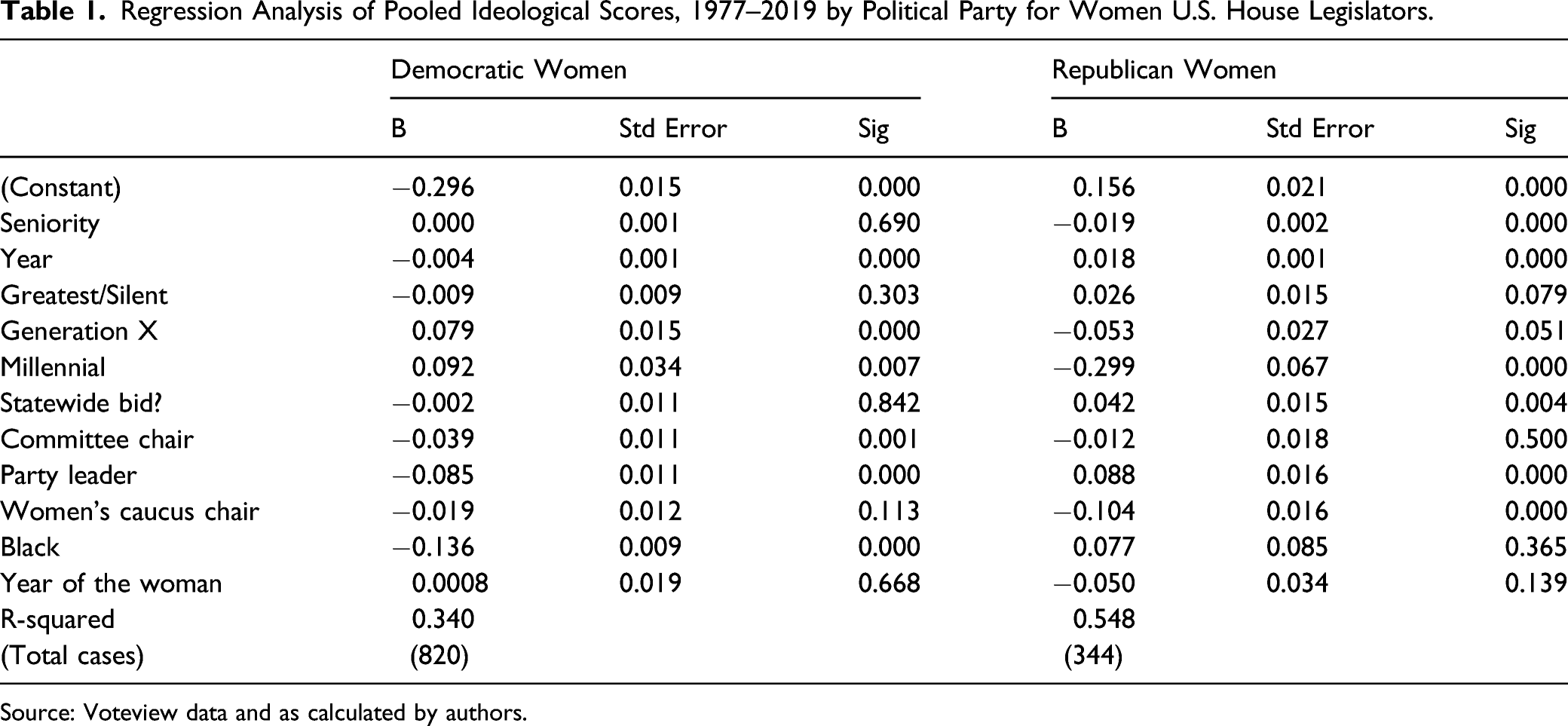
Regression Analysis of Pooled Ideological Scores, 1977–2019 by Political Party for Women U.S. House Legislators.
Source: Voteview data and as calculated by authors.
For Democratic women, the data show a generational divide for pooled congresses controlling for year. Generation Xers and Millennials are more moderate than the older Boomers and members of the Silent/Greatest Generation. In analyses not reported, age had a similar effect, with liberal scores increasing for older women House Democratic legislators. Seniority was added as a control measure, and it has no effect on ideological scores. Democratic women serving longer terms were no different ideologically than Democratic women with shorter terms. In contrast to Republican women, Democratic women are not entering as more extreme than senior Democratic women. Race of the female legislator was also included as a control measure. It was statistically significant indicating that Black women legislators are more liberal on average than White or other race legislators.
Ambition, as estimated by a bid for statewide office, was not statistically related to ideology for Democratic women. Contrary to the hypothesis, Democratic women who ran were no less liberal than those who did not run for governor or U.S. senator. Ambition includes Kirsten Gillibrand, a moderate Democrat, who served in the House for two terms before winning an appointment to the Senate in 2009. Gillibrand ran for the Democratic presidential nomination for 2020. Ambition also includes a list of other candidates who ran for president, including very liberal ones. Liberal Patsy Mink (D-HI), the first woman of color elected to the House, ran for the Democratic presidential nomination in 1972 as did liberal Shirley Chisholm (D-NY). House representative Cynthia McKinney (D-GA) was the Green Party’s presidential candidate in 2008. Ambitious women also ran for the U.S. Senate or governor’s office. Committee chairs and party leaders, however, were more liberal on average than non-leaders for Democratic women. Democratic women tend to be more liberal than Democratic men, and this did not hold Democratic women back from leadership posts. Their elevation might be an additional reason for party polarization. Democratic women’s caucus chairs were no more liberal than rank-and-file Democratic women. Because the 103rd Congress set a record for women-friendly legislation, a dummy variable was added to see if Democratic women’s liberal scores spiked during that Congress. The dummy measure turned out to be statistically insignificant. In analysis not reported here, a dummy variable for 1995 when the Republicans gained a majority was also tested and found to be insignificant.
A generational divide among Republican women is found for all Congresses. Generation X and Millennial Republicans are more moderate than older generation female Republicans. The Millennial statistic is based on one individual. Elise Stefanik (R-NY), the youngest Republican woman ever elected to Congress, represents a strong Republican district where Democrats hope to make inroads. The data confirm other studies reporting that Republican women became more conservative in the mid-1990s. Seniority for Republicans unlike for Democrats is statistically significant. Newly elected female Republicans are more conservative than senior Republican women. And again, these junior Republican women can be considered as also partly behind party polarization in Washington. While it was hypothesized that political ambition would make legislators more moderate, the opposite was true for Republican women. Ambitious Republican women are more conservative than House Republican women lacking ambition. For Republican women, party leaders are significantly more conservative than non-leaders. Republican women who are committee chairs are no more conservative than non-chairs. However, Republican women caucus chairs are significantly more moderate than other Republican women. Given the liberal bent of the nonpartisan Women’s Caucus, this finding might not be surprising.
The results show that leadership does not tamp down one’s ideology. Both parties want to incorporate very strongly liberal or strongly conservative women in leadership. This was not the case for party chairmanships. Since Republican women tend to be more moderate than Republican men, their centrist profile has not hurt them in terms of winning chairmanships. However, the party is elevating more conservative Republican women. It was suggested that Republican House women moved to the right to win leadership positions. For Democrats, left-leaning Democratic women are not punished when seeking to lead, and they may be helping the Democratic House Caucus liberalize as well. The Women’s Caucus has managed its bipartisan profile by picking moderate Republican women to lead its group and combining them with liberal Democratic women as chairs. Overall, women legislators are implicated in the party polarization that is occurring in Washington.
Conclusion
The claim that women are becoming more liberal as their numbers increase found no support in this over-time analysis. Republican women have grown more conservative in time, while younger Democratic women are more centrist than older Democratic women. All in all, despite the commonality of interests based on their gender, women in government might be less unified around liberal political interests with the conservative turn of Republican women and a generational divide among Democratic women. The absence of political pressure on lawmakers from a women’s movement, which Costain (1994) contends began to end in 1980, is an important factor in the ideological profile of women lawmakers. Other external pressures on women lawmakers, notably the Republican takeover and the Year of the Woman, were examined, and they had no effect on women’s ideological scores. Important forces were the role of leadership positions for women lawmakers, especially among the new generation of Democratic and Republican women leaders who are more ideological. The analysis supports the claim that the institution and opportunities within it also shape women’s political behavior.
The research presented here has important implications for what is called the “critical mass” theory. Women, it is argued, achieving greater levels of political representation in government can transform it to be more favorable to the women’s agenda. While women represent more than 20% of the U.S. House of Representatives, given the ideological divide that emerged among women, this claim that government will favor women’s issues more decisively is questionable. The solidarity of women might be rooted in the institution’s hostility to women. Pressure to unite is less as the institution becomes more accepting of women. Furthermore, no longer a class of newcomers, as women achieve a critical mass, women legislators are transformed by their service in government as much as they are elected with the hopes of transforming governing. Women are offered leadership positions, and some enter with sights on higher offices. Government has a moderating impact on outsiders. This was famously argued by Michels (2000 [1911]) who claimed that elected officials took on the organization’s goals and interests in time over their constituents’ concerns and needs. Here, it is argued that new calculations are made by new lawmakers as they enter into an environment that offers them more opportunities to advance and serve their constituents more broadly and more effectively through advancement. Furthermore, in this era of party polarization, Republican women notably entering more ideologically charged. They are rewarded with party leadership posts. Women legislator leaders today are more ideological and are participants in the polarization of the two parties.
Gender is less salient as women are included more as equal participants in the policymaking process. A gender identity is a mixed blessing in the powerful U.S. Senate, it is argued, because women senators do not want to be pigeon-holed as only focused on the women’s agenda (Swers, 2013). Critical mass claims were made at a time when the institution was hostile to the inclusion of women. Today, interviews with women legislators find that they still encounter some sexism but forms less overt than in the past (Gertzog, 1995, 2004). Furthermore, because of the political appeal of social diversity, some argue that there is a greater will to include women in the policymaking process. As an alternative to critical mass theory, political incorporation theories hold that women as newcomers both improve the receptivity of the institution to their demands and also adapt to fit in (Tate, 2020). Younger women in the U.S. House were found to be less ideological and more moderate. Time would expect greater ideological diversity among women and minority lawmakers because of new opportunities to lead and from institutional and electoral pressures. Women House members are still more liberal than men, but the gap between Republican and Democratic women has widened, and young female legislators are less ideological than older ones. Women strive to fit in more than stand out as political actors in government when opportunities to advance improve. Incorporation theory as opposed to critical mass offers a better approach to understanding the legislative behavior of marginalized social groups like women in government.
Footnotes
Declaration of Conflicting Interests
The author(s) declared no potential conflicts of interest with respect to the research, authorship, and/or publication of this article.
Funding
The author(s) received no financial support for the research, authorship, and/or publication of this article.
