




Abstract
Competition is among the few social-scientific concepts clearly associated with the transparency discourse—obvious today when a myriad of public “ratings” and “rankings” evaluate states, universities, and other actors while often claiming to advance the transparency of those actors and their performances. This article deals with this association from a historical-sociological perspective. It argues that public rankings and similar discursive devices not only symbolize competition but also create and reproduce it, creating what is called here, “artificial zero-sum games.” On this basis, it also makes the case that a more sophisticated conceptualization of public forms of competition draws attention to a long-term historical trend, the beginnings of which can be traced to the 19th century. The argument is presented in two steps: In the first part, a sociological model of public forms of competition is proposed that combines classical sociologist Georg Simmel’s concept of “indirect” and “pure” competition (= competition as a struggle for the favor of a third party) with insights from communication theory, market sociology, media, and globalization research. This model implies that public communication processes create competition by imagining an anonymous audience that enables this kind of competition through its very indefiniteness and anonymity. Thus “publicity” or “publicness,” rather than “transparency,” seem to be the more adequate terms to conceptualize these forms of competition. The second part discusses historical-sociological implications of this model, analyzing competition between nation-states (and national collective identities) in the light of recent globalization research, claiming and describing three trends—toward competition for modernity prestige, specific cultural achievement prestige, and attention/legitimacy—since the late-19th century.
Introduction
It is humiliating that at European international congresses on accidents the United States should be singled out as the most belated among the nations in respect to employer liability legislation.
When Theodore Roosevelt addressed the congress in 1908, bemoaning the state of the U.S. social security system (Roosevelt, 1908), he pioneered a perception that we pretty much take for granted today: He saw the United States in a competitive relationship with other countries—not, however, in a “hard” struggle for territories, political influence, or natural or human resources but for some “softer” good, the exact quality of which is not quite as easy to identify. I will try to conceptualize these goods later in this article. For now, suffice it to say that this kind of competitive spirit is rather common today when a myriad of “ratings” and “rankings” is produced on a daily basis, often claiming to advance the “transparency” of these fields, and being accompanied by an intense debate on the advantages and perils of ranking-induced competition especially in fields such as science and education (e.g., Binswanger, 2010; Osterloh, 2010). It is easy to dismiss these rankings and transparency claims as just another fad of neoliberal governance. However, this would be a premature conclusion: It has been with regard to competition that transparency has since long been used as a theoretical concept in the social sciences, influentially so by neoclassical economists who have been arguing since the 19th century that “ideal” markets with “perfect” competition depend on the unrestricted transparency of product qualities and prices for all potential buyers and sellers (e.g., Walras, 1879/1969; cf. Fourcade, 2009; on early modern roots, cf. Agnew, 1986), and it is once again with the belief in the overall social virtues of competition that many of today’s rankings and ratings are justified (while often having rather unintended consequences; Espeland & Sauder, 2007; Heintz, 2008; on the political ambiguities of transparency beyond ranking and competition, cf. Birchall, 2011).
This article approaches the liaison between competition and transparency discourse from a historical-sociological perspective. It makes the case that this liaison is not just a coincidental connection of ideological formations but reflects a long-term trend toward public forms of competition that took off in the late-19th century. It argues, in other words, that the social construction of competition and the transparency discourse are structurally connected on the basis of the “publicity” of the social processes that make certain forms of competition possible—and that this connection is notably older, and possibly more robust, than the more recent “transparency issue.” A heuristic implication of this perspective is to think of “transparency” not so much as a concept of the social-scientific vocabulary but rather as a discourse that should be analyzed in light of the long-term diffusion, differentiation, and globalization of public forms of communication.
To develop this argument, the article starts with a critique of mainstream concepts of competition in the social science literature: These concepts tend to stick to an everyday understanding of competition that takes the production and the scarcity of the contested goods for granted. Consequently, the existing literature has neglected the conceptual problems associated with the social construction of the contested goods, particularly of “soft” goods such as attention, legitimacy, and prestige. For the same reason, the historical relationship between such forms of competition and the transparency or publicity of social processes has remained underinvestigated. To develop a historical-sociological research perspective on these forms, I propose a model of competition that builds on Georg Simmel’s concept of “indirect” and “pure” competition (= competition as a fight for the scarce favor of a third party). Connecting Simmel’s concept with insights from communication theory, market sociology, media, and globalization research, this model points to the constitutive role of public communication processes that construct the favor of an indefinite audience as the basic “good” of public forms of competition. The second section applies this model historically, connecting it to recent globalization research and analyzing the rise of “soft” forms of competition between nation-states and national collective identities since the late-19th century. Here, among other arguments, Theodore Roosevelt’s statement returns and is reconsidered in the light of the proposed model.
Artificial Zero-Sum Games: A Model of Public Forms of Competition
Mainstream Concepts Versus “Indirect” Competition (Georg Simmel)
The social sciences typically rely on everyday concepts of competition, which see competition as a peaceful struggle for scarce goods (e.g., Nader, 1968; Weber, 1921/1980). The empirical application of this view depends on the analyst’s knowledge of—or speculation about—the identity and scarcity of the contested goods. Often, those may appear more or less self-evident: When two states claim sovereignty over the same territory, it seems evident that they compete for this territory because they struggle for an identical good. When two athletes run against each other in a track race, it seems evident that they compete for the victory, because the race can only be won by one of them at the expense of the other.
In other cases, the contested goods are less self-evident. Here, the mainstream concept may invite speculation about “hidden competitive motives” and “latent” forms of competition. For instance, when people engage in a face-to-face conversation, they may be motivated by the intention to surpass the other participants’ wit and to gain the attention and admiration of other participants. In these cases, this intention will rarely be evident simply from observing their behavior. Nevertheless, given the inescapable scarcity of speaking and listening time in social interaction, an observer may be inclined to see latent competitive motives at work, possibly even beyond the participants’ conscious intentions (e.g., Blau, 1964).
On a macro-level, similar arguments are prominently used in Pierre Bourdieu’s field theory. Bourdieu describes societal fields such as politics, economy, science, arts, and so on as “fields of struggle,” where actors fight for different forms of “capital” (e.g., social, cultural, economic, technological, financial), with the types of capital varying with the “illusio” of the field and with the particular types of struggles within the field (e.g., Bourdieu, 1975, 2005). Especially in fields such as science or art, where Bourdieu emphasizes the competition for “symbolic capital” (reputation, prestige), his theory significantly distances itself from the “official” self-descriptions of these fields, where competition usually doesn’t figure prominently (e.g., aesthetics, philosophy of science). Thus Bourdieu, too, makes use of a general concept of competition to discover competition “behind the back” of the actors, that is, irrespective of the subjective view of the inhabitants of the field.
There is much to be said for such a broad, everyday understanding of competition. 1 As these examples show, the mainstream concept can be used to analyze seemingly self-evident and “latent” forms of competition, and it can be applied to a wide variety of cases, ranging from face-to-face situations to macrosocietal field analyses. Figuratively, it may look like this as shown in Figure 1:
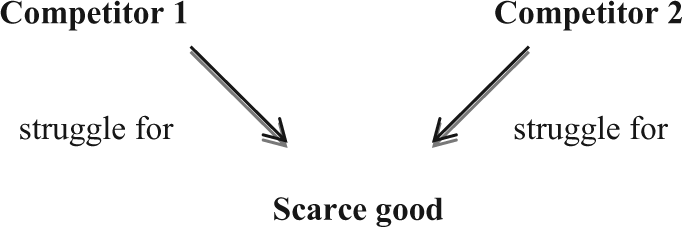
Mainstream concept of competition.
There are, however, aspects and prerequisites of competition that cannot be analyzed quite as productively with this concept. The aforementioned “wit-contest” is a first case in point: Here the competition, if a factor at all, does not lie in some obvious interests but rather in the complex dynamics of the face-to-face interaction, emerging from the attempt to gain the momentous attention or admiration of other people in that very situation. Here, the competing interests and the scarcity of the contested goods are not easy to grasp: Does the participants’ behavior indeed imply competition for the attention and admiration of other participants—as opposed to taking part solely for the sake of enjoyment or making an interesting argument? A similar point can be made against the assumption of “latent” competition on the macrosocietal level, such as Pierre Bourdieu’s field theory mentioned earlier: How can we know that a scientist or artist striving for the recognition of an audience not only tries to contribute to scientific progress but also to outclass his or her colleagues? That competitive motives play a role is easily suspected, and anecdotal evidence among colleagues is easy to find, but it is much harder to prove the actual influence of competitive motives in the production of societal structures. Can the appreciation of others plausibly be understood as a scarce “good,” which can only be achieved at the expense of other participants? How can we distinguish the competitive scenario from the noncompetitive one? And even when it is evident that some participants see themselves as competitors subjectively, does it follow that they also compete socially, that is, that these motives affect the building of societal structures?
As these questions suggest, there are social forms of competition that seem to require a more sophisticated understanding of competition than is offered by the mainstream concept. One could call them “soft” forms, as they don’t require any direct, visible fighting. Classical sociologist Georg Simmel called them “indirect” and “pure competition.” With “indirect” competition, Simmel refers to triadic social constellations where (at least) two parties fight for the favor of (at least) a third party (Simmel, 1903; republished in Simmel, 1908/1992, p. 327). “Indirect” competition is his general concept of competition, which turns into “pure” competition when one “fights with the opponent without turning against him—without touching him, so to speak” (Simmel, 1903, p. 1010), that is, when the competitors focus exclusively on winning the favor of the third party. On the basis of this model, Simmel (1908/1992, p. 334) is able to stress an often-overlooked characteristic of such forms of competition, namely that they depend on the third party’s favor being imagined as scarce. He illustrates this point with a counterexample from religious dogmatic: Christian believers who try to win God’s favor by surpassing others’ “good deed” may be said to participate in some sort of contest or rivalry (“Wettstreit”). However, they don’t actually compete because from a Christian-theological perspective, “there is room for everybody in God’s mansion.” In other words, God’s, the third party, favor is not scarce, and thus not able to produce competition. Figuratively, this model can be represented as shown in Figure 2:
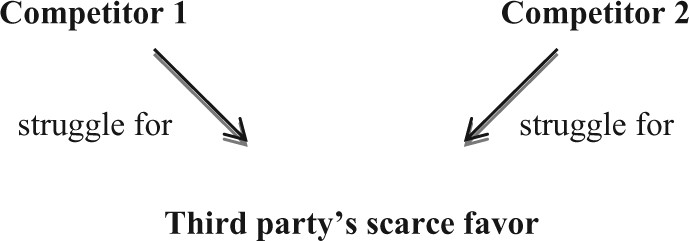
Simmel’s concept of “indirect” competition.
Considering that Simmel developed this concept more than hundred years ago, it is surprising how little conceptual work has since been done on such forms of competition in social theory (for other classical statements, cf. Mannheim, 1929; Wiese, 1929). Since Simmel’s article of 1903, no major “sociology of competition” has been published, and no major historical-sociological studies on historical trajectories of such forms of competition have been written. As mentioned above, there has been no lack of interest in competition as such. Yet, a certain pretheoretical confidence in the recognizability of competing intentions and contested goods seems to have prevented serious thinking about the prerequisites and historical trajectories of these “indirect” forms.
“Indirect,” “soft,” or “pure,” of course, doesn’t mean that such competition can’t be fierce and passionate. It means, however, that the contested goods aren’t as easy to identify as territories, natural resources, or other tangible things, and that it is no longer sufficient to deduce competition from (assumed) competing intentions. Rather, with this model, the challenge is to show how the favor of third parties is constructed and distributed in social practice. It is here that “publicity” and “transparency” enter the conceptual discussion about competition.
Modeling Public Forms of Competition: Competition for an Audience’s Scarce Favor
To develop a historical-sociological research perspective on such forms, I propose a model of competition that builds on Simmel’s concept but adds a sense for the complexities of the social construction of public forms of competition (for details, cf. Werron, 2010b, 2011). Simmel’s concept is helpful because it “socializes” the concept of competition such that direct conflicts of interests become distinguishable from triadic cases where the emergence of competition depends on the attention and appreciation (German: “Gunst”) of others, drawing attention to third parties that produce and distribute their favor between the competitors. It is with regard to these third parties that he can ascribe to competition a specifically “synthetic power,” that is, the power to create a “connex of minds” between the competitors, on one hand, and third parties such as consumers, voters, newspaper readers, and so on, on the other (Simmel, 1908/1992, p. 327). Thus, his concept bears questions such as the following: How and to which effects is the third parties’ favor constructed and made visible in social practice? Which third parties play constitutive roles in the social construction of “indirect” forms of competition, producing, “scarcifying,” and distributing their favor between the competitors? and Do the presence and influence of such third parties change historically?
Simmel himself didn’t ask such questions, as he was interested in competition as an abstract form rather than in specifying the characteristics of certain historical forms of competition. He did, however, point to the important role of modern audiences, particularly in an insightful remark where he describes modern forms of competition as a fight of all for all:
The antagonistic tension against the competitor sharpens the merchant’s sense for the inclinations of the public into an almost clairvoyant instinct for coming changes in taste, in fashion, in interests; but not only the merchant, but also the journalist, artist, bookseller, parliamentarian. Modern competition, which has been called the fight of all against all, is, after all, also the fight of all for all. (Simmel, 1908/1992, p. 328; translation T.W.)
In other parts of his work, Simmel complements this sensitivity for the role of audiences/publics with a perceptive analysis of “the secret,” which he sees as performing a constitutive function in the constitution of human interaction, by allowing to keep information completely for oneself and by sharing information only within certain societal circles (cf. Simmel, 1908/1992, p. 383; Hahn, 1997). Against this backdrop, modern competition as described by Simmel can be seen as a quintessentially public social form. Thus, Simmel can be quoted not only for his ingenious model of “indirect” or “pure” competition but also for having a sense for the constitutive role of audiences, or publics, in modern forms of competition. What Simmel didn’t analyze in any detail, however, is how competitive relationships emerge in cases when the third parties do not or cannot continually interact face-to-face, and when their mutual observation and competitive awareness depend on the availability of modern media technologies. Such mediated forms require a certain mediated publicity of information, which allows the participants to see themselves as competitors/audiences with common knowledge (or common misconceptions) about the field. In an evaluation of market sociology a few years ago, sociologist Ezra Zuckerman raised a similar question, arguing that in the New Economic Sociology, two important aspects of markets are usually left implicit: “the presence of an audience confronting focal actors and the competition among such actors for the favor of this audience. Without an audience, legitimacy loses its value and, indeed, its meaning” (Zuckerman, 1999, p. 1403). To make these aspects explicit, Zuckerman analyzed the categories used by market analysts to classify stock market firms (preferably into “industries”), showing that the selection of categories considerably influences the reaction of the audience and the development of stock market prices (an effect he dubbed “the categorial imperative”; cf. Zuckerman, 1999, 2000).
I propose to generalize and refine this argument by adding three points: First, the idea that the audience’s expectations should be made explicit is useful not only with regard to markets but also with regard to any social constellation where providers of some social “product” (be it stocks, political decisions, newspapers, art works, athletic performances, etc.) try to win the favor of an indefinite, unlimited, and thus basically unknowable, audience. Second, there is a media-sociological basis to this idea that needs to be made more explicit, too: because competition for an audience can’t be based on face-to-face contact alone, it depends on public communication processes that constantly address and create the audience as a “hidden third party” (cf. Werron, 2011). Third, competition for an audience’s favor is also a product of imaginations of the audience that project the audience as a “public” of attentive and critical individuals rather than an unreceptive, undifferentiated “mass” (cf. Tarde, 1901/1969). 2 Precisely because it cannot be directly observed, the very fiction (imagination, assumption) of the audience enables social processes that construct such forms of competition. In this model, the contested goods are “indirect” products of public communication processes (public discourses), that is, of the number, meaning, and influence of public utterances. 3 This model helps to correct the main deficiency of standard concepts of competition in the literature discussed above: their lack of attention for the social processes that account for the visibility of the competitive criteria and the scarcity of the contested “soft” goods. Figuratively, this version of “indirect” competition might look as shown in Figure 3:

Communication theoretical model of public forms of “indirect” competition.
By identifying the discursive logic that makes public forms of competition possible, this model also draws attention to the basic “goods” of public forms of competition: attention, legitimacy, and prestige: 4 Public processes and intermediate third parties (a) produce and “scarcify” attention by noticing the actions and performances of some competitors and ignoring others; they (b) produce and “scarcify” legitimacy by recognizing actors as legitimate participants of their respective fields—for instance, as “sovereign states” or “art works” (e.g., Bauman, 2001)—and by refusing to legitimize others; and they (c) produce and “scarcify” prestige by continually comparing, evaluating, criticizing, ranking, and rating performances, appreciating some actors in the process, and depreciating others. The basic good is attention, because without attention neither legitimacy nor prestige could be produced and distributed. Legitimacy adds a measure of recognition that is not necessarily implied in attention as such, which can also be used for critical and negative purposes. Finally, prestige adds a measure of appreciation that is not necessarily implied in attention or legitimacy as such. For instance, an artist may be recognized as a legitimate creator of art works, but may also be compared with other artists as to who has made the more original contributions to a certain genre or style. A state may be recognized as a legitimate sovereign state, but it may also be observed as having a more or less corrupt bureaucracy, a more or less “developed” economy, and so on compared with other states.
“Artificial zero-sum games” seems to be the best overall expression for such forms of competition: “Zero-sum game” emphasizes that these forms are based on the imagination that some favor given to one actor comes at the expense of others. “Artificial,” however, stresses that the identity and scarcity of the contested goods is not naturally given but depends on the social construction of the favor of an imagined audience. 5
Artificial Zero-Sum Games: General Implications of Competition for an Audience’s Favor
How can these conceptual insights inform the historical-sociological analysis of competition? Before I take a look at a particularly interesting historical case—competition between nation-states and “nations” since the late-19th century—let me stress five more systematical implications, which summarize and integrate a number of observations that have been made largely independently from each other in different strands of the social science literature:
First, intermediaries: The model points to the constitutive role of journalists, international organizations, social scientists, and other third parties who mediate between competitors and audiences by observing and evaluating performances while addressing and imagining an audience. I already quoted Ezra Zuckerman’s work on “market critics” as an example for research on such intermediaries who, competition-wise, play the role of a third party (Zuckerman, 1999; see also Faust & Bahnmüller, 2007). There are related studies on art critics as “gatekeepers” (e.g., Becker, 1982/2008; Greenfeld, 1989), on sports journalists as catalysts of modern sports (e.g., Kaufmann & Patterson, 2005; Werron, 2010a), on university rankings by media organizations (Espeland & Sauder, 2007; Sauder, 2006), on quantitative measures of comparison (Heintz, 2008, 2010), or on international organizations and other “rationalized others” in world politics (Meyer, 1994; Meyer, Boli, Thomas, & Ramirez, 1997). However, still missing are historical-sociological analyses of the influence of such intermediaries on the creation of public forms of competition.
The second theme, homogenization, has been discussed intensely by market sociologists and sociologist of organizational fields: as the aggregate audience (consumers) on markets as such is anonymous and inaccessible, firms tend to imitate the visible strategies of other firms rather than relying on speculations on the audience’s preferences (Leifer & White, 1987: 102; White, 1981). Similarly, as it is uncertain which political strategy actually works, states tend to copy the global models suggested by international organizations to gain the appreciation of these experts and their audiences (Meyer et al., 1997). The aforementioned model of public forms of competition adds a more discourse-analytical explanation to these observations: This constant imitation and copying wouldn’t happen in the same way and degree if the competitors could focus on direct cooperation or conflict and didn’t have to take the indirect competition for the audience’s favor into account. In other words, as a “hidden third party,” the audience introduces a specific uncertainty into the field that encourages competitors to imitate the publicly available models rather than relying on individual beliefs or traditions.
The third implication, temporalization, is closely related to the second but points to somewhat opposite consequences; it could also be termed continual production of minimal differences: Public communication processes create a mirror to which all competitors have to react, assuming that the published performances and opinions are accessible to others in the very moment of publication. This creates a particularly “temporalized” competitive environment (for an analysis of this kind of temporality, cf. Knorr-Cetina & Brügger, 2002), which is caused not only by the accelerated dissemination of information but also by the institutionalized assumption of a common level of information. For this assumption, no final verification or falsification is possible, which provokes constant speculation on the assumed activities of other participants in the field (the temporal consequences of which are discussed by strategic management scholars in terms of “hypercompetition,” for example, Pacheco-de-Almeida, 2010). 6 The primary result seems to be a constant creation of minimal differences, of “unique selling points” and analogous attributes, which are celebrated to be (at least slightly) distinguishable from other competitors in such a highly homogenized competitive environment.
The fourth theme is universalization and globalization: As mentioned above, George Simmel had already described modern “indirect” competition as a “fight of all for all,” that is, as a competition for the favor of a large, unlimited audience. Our model reveals a neglected precondition of this tendency, namely, that public forms of competition are based on the assumption, or fiction, of an indefinite audience, which is reiterated in every single act of communication (cf. Warner, 2002). This assumption has no inherent limits, as it includes whoever may wish to take interest in the communicated information and thus addresses a universal, potentially global audience. Public forms of communication, universalistic criteria of comparison, and universalized fictions of the audience mutually enable each other. On this basis, for instance, the intermediaries mentioned above can continually work on criteria of artistic, scientific, economic, or athletic excellence while addressing an audience of “the arts,” of “a scientific discipline,” “a market,” or “a sport.” This “indefiniteness” or “limitlessness,” of course, doesn’t exclude competition for “localized” audiences. It implies, however, that any such localized competition always has the potential to evolve into, or be an integral part of, a global competitive field (cf. Heintz & Werron, 2011; Werron, 2007). Accordingly, the relationship between processes that construct such forms of competition and the globalization of societal fields is among the major research questions implied by this model. The fifth is “publicity” rather than “transparency”: Finally, the model implies that public communication processes play an ambivalent role in the creation of competition that should caution us against the idea that they also provide any kind of “transparency”: Public communication creates competition by making the performances of competitors visible and by observing, comparing, and evaluating them; they do this, however, by imagining an anonymous audience that enables and influences the competition through its very indefiniteness and anonymity, creating the particular kind of uncertainty that is responsible for the aforementioned dynamics (homogenization, temporalization, universalization, and globalization). Thus “publicity” or “publicness,” rather than “transparency,” seem to be the more adequate terms to analyze these forms of competition in a sociological and historical perspective.
What Do Nation-States Compete for? On the Rise of “Soft” Forms of Global Competition
To develop a general model of public forms of competition, the preceding sections have drawn on a broad range of literature and examples, ranging from markets to politics to arts. The following section will try to give a more concrete idea of the heuristic advantages of this model, using it for a historical-sociological analysis of competition between nation-states (and national collective identities) since the mid- to late-19th century (for a more detailed account, see Werron, 2012). The starting questions might be phrased as follows: What exactly do nation-states compete for? How have competitive relationships between nation-states changed since the late-19th century? How can our model of public forms of competition help to identify and analyze such changes?
Globalization Research and “Universalized Third Parties”
These questions refer us back to the Roosevelt-quote from 1908 mentioned at the beginning of the article. When Roosevelt bemoaned the state of the U.S. social security system in comparison with other states, he gave expression to a then recent trend in world politics, the understanding of which requires an excursus to the results of recent historical globalization studies. In this literature, the late-19th century is increasingly seen as a watershed between earlier globalization periods and our current period (e.g., Geyer & Bright, 1995). At the heart of this diagnosis is research on new transport and media technologies: Since the late-19th century, based on a global telegraph network and a global oligopoly of news agencies, a global media system emerged that dramatically increased the possibilities of mutual observation between states and other agents (Wenzlhuemer, 2010; Winseck & Pike, 2007).
Recent global history literature has emphasized the many new opportunities for “direct” mutual cooperation, imitation, conflict, and competition between nation-states and nationalist movements that developed on the basis of this new communication infrastructure and novel forms of global competition associated with these globalization dynamics. For instance, these studies point to the formation of a confrontation between Western “expansionist nationalism” and anticolonial “counter-nationalism” in the late-19th and early-20th century that was to become an important source of imperial state-building as well as postcolonial national movements in the 20th century (Headrick, 2010; Hill, 2008; Osterhammel, 2009, p. 904; for interesting consequences regarding the theorization of Benedict Anderson’s “nation form,” cf. Goswami, 2002). Accordingly, this literature has spurred an interest in “hard” forms of competition and conflict on a global scale, the most enormous and consequential of which were to come with the First and Second World War (e.g., Joas, 1996), and the so-called Cold War (e.g., Duara, 2011).
These studies fit nicely with historical-sociological ones of recent decades which have shown that competitions for scarce territories and natural and human resources have been an important factor in the formation of the modern nation-state system, for the consolidation of military, bureaucratic, and fiscal capacities of early modern states (cf. Giddens, 1985; Tilly, 1975, 1990) and for the global success of nationalist movements since the 19th century (Wimmer & Feinstein, 2010). In International Relations research (IR), such insights have found an ideal-typical expression in the realist and neorealist tradition, which sees states in continual struggle for survival, territories, and wealth in a largely anarchic international environment (e.g., Waltz, 1979). This research perspective is perfectly compatible with the mainstream concept of competition discussed earlier in the article. For another graphic illustration, see Figure 4:
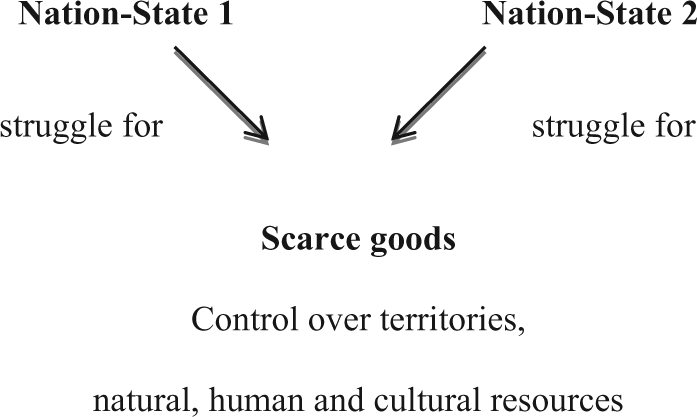
Mainstream concept of “hard” forms of competition.
However, due to its focus on “hard” forms of power competition, this literature has failed to consider a more “indirect” effect of this new global communication infrastructure: It also increased the possibilities of communication about states and national movements, increasing the number of third parties next to/above the state-system such as journalists, international organizations, social scientists, and other experts. The significance of this fact does not only lie in the quantity of these processes and observers alone but also lies in the new quality of these communication processes. One of the most important—and probably the most underrated—qualitative transformation was the combination of real-time media (telegraph network, telephone), news agencies, journals, and newspapers that made the imagination of simultaneous global audiences increasingly plausible. The political press of the late-19th century, for instance, became used to addressing the whole of “humanity” and to reporting and commenting on international proceedings in the name of such a global audience (e.g., in the context of the international peace conferences in Den Hague in 1899 and 1907; cf. Clark, 2007, p. 61). On the basis of such imaginations, it became possible to imagine politicians, firms, scientists, artists, athletes, and others actors as simultaneous participants of global fields, competing for the favor of the same aggregated global audiences (cf. Heintz & Werron, 2011).
In the political field, the most obvious expressions of this trend were the increasing number and different types of international organizations (Intergovernmental Organizations, or IGOs, and International Nongovernmental Organizations, or INGOs, etc.), social scientists (economists, historians, sociologists, etc.), and other experts (journalists, counselors, etc.) that emerged and proliferated since the late-19th century (on international organizations, cf. Boli & Thomas, 1999; Iriye, 2002; on professions, for example, Fourcade, 2006). As these observers work on universalistic criteria and global models and see themselves as representatives of global audiences (which may be a global community of experts or “humanity” in toto), I like to call them “universalized third parties.” 7 Accordingly, the next and last figure (Figure 5) of our model might look as follows:

Communication theoretical model of “indirect” global competition.
Three Historical Trends
On this basis, my historical thesis is that this model reveals the logic and dynamic of three long-term historical trends since the late-19th century that have been largely neglected in the globalization literature: (a) a trend toward competition for modernity prestige; (b) a trend toward competition for specific cultural achievement prestige; and (c) a trend toward competition for attention and legitimacy.
Modernity prestige: “Managerial states.”
The first trend is the one implied in Roosevelt’s address to the congress in 1908 quoted at the beginning. It reflects the rise of universalized third parties such as IGOs, INGOs, and social scientists who observe nation-states as quasi-individual units and compare and evaluate them according to criteria such as economic growth, protection of human rights, level of corruption, protection of the environment, and so on. Under a different name, the rise and increasing influence of these observers have been studied by world polity scholars: John W. Meyer has called them “rationalized others” (cf. Meyer, 1994), stressing that they do not play the role of responsible “actors” but of agents of modernity, who design universalistic norms and models for actions and urge “actors” (individuals, organizations, nation-states) to act in accordance with these “myths of modernity.” Emphasizing the institutionalization of global models, though without talking much about competition, world polity scholars have convincingly shown that the surprising convergence (isomorphy, homogenization) of formal structures in the international system in the 20th century (especially after World War II) cannot be explained without taking the increasing influence of these external observers into account (cf. Meyer, 1980, 2010; Meyer et al., 1997).
However, our model draws attention to another consequence that figures less prominently in world polity research 8 : World polity agents not only produce modernity prestige but also “scarcify” it in such a way that the gains of one country can be perceived as losses of others. When the nongovernmental organization (NGO) “Transparency International” ranks all states on a “global corruption perceptions index,” which is discussed on a yearly basis by newspapers around the world; when UN experts measure states according to indicators such as the “human development index” (HDI) and continually present the results on the Internet; or when social scientists evaluate countries according to the extent of the interconnectedness of their elites (Slaugther, 2009)—then states are not only confronted with global expectations but are also subjected to continual comparisons in which they can continually rise or fall, gaining more or less of the favor of imagined global audiences. To capture such phenomena, it makes indeed an important conceptual difference to speak of “universalized third parties” rather than “rationalized others.”
One of the most influential and typical example for this trend is the competition of “national economies” created by neoclassical economists, political economists, and other economic experts and professions that proliferated since the late-19th century. These observers, with their elaborated statistical concepts and models, not only account for the emergence of the very idea of the economy as an autonomous field and of the idea of more or less self-contained “national economies” in the early- to mid-20th century (Fourcade, 2006, 2009; Mitchell, 1999) but also created a new form of competition between these national economies that is notably different from older understandings of political-economic competition, 9 namely, the idea of competition between “managerial states” (Opello & Rosow, 2004, p. 139) for the political prestige of having a well-organized, growing, “competitive” national economy. The core idea is nicely summarized by a leading political economist: “Although nations may not compete with one another in a narrow economic sense, nations can be said to compete in a broader sense, that is, in their ability to manage their economic affairs effectively” (Gilpin, 2001, p. 182; see also Sinn, 2003; for an interesting debate on national “competitiveness” Dunn, 1994; Krugman, 1994). 10
In short, under the influence of this kind of observers, nation-states compete economically because they compete political-economically, and they compete political-economically because they are continually observed, compared, and evaluated by economists, political economists, and similar “universalized third parties.” It is these forms of competition that connect Roosevelt’s statement from 1908 with today’s ranking and rating industry: Already around 1900, there was constant comparison among nations, especially among bureaucrats in the relevant ministries eager to keep up with the newest social legislation . . . competition among home ministries on social policy was not unlike that waged among war ministries. (Bender, 2006, p. 290)
However, in the 20th century, and especially after World War II, these forms have multiplied, differentiated, and globalized enormously, creating ever-new forms of “artificial zero-sum games” for modernity prestige.
Cultural achievement prestige: Global “banalization” of the national
The creation of competition for modernity prestige by economists and other third parties builds on a particular understanding of the nation-state as a quasi-individual unit (or, to use the felicitous metaphor by Ernest Gellner, of a “marriage” between state and nation; Gellner, 1983). The second trend does not depend on this specific concept of the nation-state. Instead, it draws attention to nonstate actors, nonstate performances, and nonstate products such as artists, television series, touristic attractions, sports clubs, and so on and to global processes comparing and evaluating them according to more specific criteria while addressing and imagining more specific audiences. Some of these actors, actions, and products may look less “rationalized” than states, but they too can be subjected to global comparisons by “universalized third parties,” third parties who may also make use of national symbols and identities.
These phenomena point to the relevance of a “banal,” everyday dimension of nationalism that was first analyzed in Michael Billig’s (1995) book Banal Nationalism and has since become an important topic of nationalism research (for further reception and theorization cf. Brubaker, 2009, p. 28; Hutchinson, 2004, p. 147). Billig’s main intent was to draw attention to the reproduction of national identities in allegedly denationalized Western countries by investigating inconspicuous markers of national differences such as “we” in the daily press. However, this everyday banalization of national symbols and identities is also at work in global fields. Adapting Billig’s concept for globalization research, we may speak of a “global banalization of the national,” which manifests itself in phenomena as diverse as world sport—I will come back to this example below—nation branding (Bolin & Ståhlberg, 2010), presentation and evaluation of touristic attractions (e.g., Fan, 2006), categories of literary critics (Casanova, 2004), national framing of pop-rock music (Regev, 2011), or the “methodological nationalism” of social scientists (Wimmer & Schiller, 2002). 11
Competition, especially for achievement prestige, is a regular characteristic of these processes: Specific forms of public communication and universalized third parties such as art critics, sports journalists, or social scientists address specialized global audiences and compare and evaluate artists, athletes, products, touristic attractions, and so on to produce and “scarcify” achievement prestige in different global fields. The usage of national identities in these processes hasn’t been investigated in much detail yet, but the historical trajectory can be nicely illustrated using the example of modern sports (for two other examples, entertainment cinema and the Eurovision Song Contest, see Reicher, 2011).
Modern sports, characterized by standardized rules, new forms of competition (league systems, world events), and universalistic criteria for excellence first emerge in the late-19th century in largely national or regional frameworks. For instance, professional football first develops as a “national game” in Great Britain (Mason, 1980), baseball as a “national pastime” in the United States (e.g., Goldstein, 1989). However, already in this early and largely localized stage of sports history, universalistic events (world events) and universalistic indicators of achievement (record, statistical measures) evolved, 12 that is, the regional or national formation of modern sports in the late-19th century coincided with the projection of a global horizon of comparisons that established the interpretative framework for the globalization of these sports/disciplines in the 20th century. Here, sports journalists and officials represented the “universalized third parties,” publishing specialized journals and year books, reporting on contests and working on the organization of events (league systems, world events) and the categories/schemes (statistics, records, legends) to evaluate performances on a universalistic basis (for a more detailed account, see Werron, 2010a). When these universalistic sports globalized in the 20th century, they increasingly made use of national identities in an additional way—not only to frame competition (league systems, cup competitions, etc.) but also to compare the performances of representatives of national teams and associations within a global competitive framework, imagining them as sources of identification for national audiences (Dyreson, 2003; Keys, 2006). As a result, already around 1900, the then well-known publicist W.T. Stead could write that “sports which twenty years ago were almost exclusively national have become international, and every year increases the number of events in which the primary interest of sport is reinforced by national rivalry” (Stead, 1901, p. 334). At the same time, global associations (such as the FIFA; Eisenberg, 2006) started to take responsibility for the organization and standardization of competition.
After a few decades, “world sports” had evolved that build the whole spectrum of collective identities into their global frameworks, subordinating them to their universalistic logics of comparison, and enabled by an increasingly sophisticated sports coverage dominated by an “imperative of transparency” (Stauff, 2009) that aims at the evermore refined comparison and evaluation of performances. Accordingly, it has become a typical characteristic of modern sports and global sports events that the audience is imagined in two different but complementary roles: as a universalistic “referee” who is imagined as being primarily interested in excellent performances and as a particularistic “partisan” who identifies with the representatives of “his” nation (Dayan & Katz, 1992, p. 41). 13
This short outline of the history of modern sports illustrates that, although such forms are not directly concerned with competition between states, they are relevant for a historical-sociological perspective on nation-state competition: The very fact that national symbols have become regular features of participation and identification in global fields has probably added significantly to the institutionalization of the idea that the whole world consists, or should consist, of “nations,” and that every collective identity should have its own right of self-expression and self-determination. And again, these forms of competition have emerged and globalized since the late-19th century, creating a broad variety of “games” for cultural achievement prestige. 14
Attention and legitimacy: Fighting for the favor of world public opinion
The last remark—on global sources of national differences—already implied the last historical trend, competition for attention and legitimacy. Today, it can appear obvious that the stability of existing states and the self-determination of aspiring national movements depend less on their military strength than on a struggle for the favor of world public opinion. 15 Today, national movements rely not only on political mobilization and violent and nonviolent resistance but on “public relations” and the help of universalized third parties, including measures such as the staging of media scandals in the Western press, cooperation with NGOs and human rights activists, membership in the “Unrepresented Nations and Peoples organization” (UNPO), and, more recently, even social scientific research on “public accountability” that elaborates general concepts and models to legitimize and delegitimize state behavior (e.g., Held & Koenig-Archibugi, 2005).
This trend, too, starts in the 19th century, when the imagination of a “global public opinion” and the idea of a global audience that is imagined and addressed in everyday political communication inspired the formation of “internationalist” political movements (on historical aspects of the emergence of a world public opinion, cf. Clark, 2007). From then on, legitimacy within the international system was no longer solely a matter of “Great Powers” and their “IR,” but was also increasingly influenced by external observers who may induce states and national movements to fight for the attention and legitimacy granted by these observers. After small successes in the beginning (such as the abolition of the so-called foot binding in China; Keck & Sikkink, 1998, p. 39), an early spectacular consequence of this state-external internationalism was to be observed after World War I when the U.S. President Wilson and socialist leader Lenin rallied for the support of world public opinion by supporting their respective version of the “right of self-determination” (Manela, 2007). Similarly, the fact that formal colonization policies came out of fashion after World War II seems to have been partly a result of competition for legitimacy in the global political field after the diffusion of postcolonial nationalism (Go, 2008).
So far, the literature has mainly focused on the increasing normative pressure exerted by state-external observers, often displaying an optimistic belief in the civilizing effects of this form of global governance (for a good overview, see Price, 2003). However, our model of public forms of competition points to additional competitive aspects of these processes: attention and legitimacy, too, can be scarce goods that are produced and “scarcified” by universalized third parties. How this scarcity can affect the political struggle of independence movements is shown by Clifford Bob (2005) in his book The Marketing of Rebellion: A movements’ chances to gain legitimacy as an internationally accepted conflict party depends on the ability to gain the attention of a global audience as mediated by NGOs and universalistic, Western-style mass media. In this competitive environment, not all seemingly just cases are equally likely to be heard: Not every movement has a Dalai Lama or a similar charismatic leader that guarantees for attractive television interviews; not every movement can easily resort to nonviolent strategies to win the sympathy of human rights activists. 16 To be successful in this competitive environment, a movement not only has to have good arguments but also has to have the personnel, skill, or luck to be noticed and supported by influential universalized third parties 17 —who, again, first emerged in the late-19th century and have increased ever since, creating new forms of competition for attention and legitimacy.
These sketches, of course, were able to give only very cursory impressions of complex and multifaceted processes that could and should be investigated in much more detail, complemented by studies on the “internal” effects of such competitions on local and national levels and on the interplay of hard and soft forms of competition in the international system. In addition, this research perspective is not restricted to the political realm but could be extended to studies on economic markets, art forms, scientific disciplines, and other societal fields, where it, too, would draw attention to public communication processes and “universalized third parties” who create global forms of competition with the help of a global media system since the late-19th century.
Conclusion
Departing from a critique of mainstream concepts of competition in the social sciences, this article presented a communication theoretical model of public forms of competition that builds on classical sociologist Georg Simmel’s concept of “indirect” and “pure” competition (= competition as a struggle for the favor of a third party). The model conceives of such forms as struggles for the scarce favor of an audience that is imagined and addressed in public communication processes, creating competition for the attention, legitimacy, and prestige granted by such audiences. This model helps to generalize and integrate a number of insights into competition that have been made largely isolated from each other in the literature on markets, world polity, and organizational fields: the constitutive role of intermediaries (such as journalists, social scientists, international organizations); homogenizing effects of competitive pressure; a specific temporality and production of minimal differences; and the universalizing and globalizing tendencies of these forms.
The second part applied the model exemplarily to competition between nation-states and national collective identities, connected it to the results of recent globalization research, and identified trends toward competition for modernity prestige, cultural achievement prestige, and attention/legitimacy, each of which illustrated the heuristic advantages of the model by pointing to the rise and influence of universalized third parties (international organizations, social scientists, journalists, etc.) since the late-19th century. In the light of this analysis, Theodore Roosevelt’s word quoted at the beginning of the article was reinterpreted as an early expression of a trend toward global competition for “modernity prestige,” which has culminated in today’s ranking and rating industry.
These arguments also explain why competition has since long been closely connected to the transparency discourse: The rise of public forms of competition depends on visibility qua publicity and, in this sense, on the transparency of the communication processes that make such forms of competition possible. However, considering that public communication processes create competition by imagining an anonymous audience that enables and influences the competition through its very indefiniteness and anonymity, “publicity,” or “publicness,” rather than “transparency,” seem to be the more adequate terms to conceptualize and study these forms of competition. This article has developed a conceptual model to frame and inspire historical-sociological studies on such forms of competition on which empirical research is only at the beginning. For now, it can be concluded that when it comes to competition, the “transparency issue” is structurally embedded in a long-term rise of public forms of competition since the 19th century that can be adequately understood only in a long-term historical perspective.
Footnotes
Declaration of Conflicting Interests
The author(s) declared no potential conflicts of interest with respect to the research, authorship, and/or publication of this article.
Funding
The author(s) received no financial support for the research, authorship, and/or publication of this article.