




Abstract
This article demonstrates the pedagogy and performance of a radical ethical aesthetic. It emerges from a mural-making project that exists in the confluence of critical arts-based research and emancipatory and transformative educational practices. Critical arts-based inquiry is a methodology for ethical research that is futuristic, socially responsible, and useful in addressing social inequities. The critical arts-based research that is demonstrated here was constructed to be deliberately transformative of repressive social structures, and to inspire its participants and its audiences to both, reflection and ethical, political action.
Introduction
This article describes the design and production processes as well as the pedagogical purposes for creating a community-based mural. The At Home At School (AHAS) program is an arts-integrated educational project that enrolls underserved and marginalized K-12 students and university students in after-school and summer learning. Creative arts projects have included choir and dramatic performances in the community, the design and building of a cord-wood outdoor classroom for environmental education, establishing a horticultural exhibit and park in a neglected city lot, producing nature photographs and videography, gallery exhibits of paintings and several portable mural-making projects in our local community. The focus of artworks range from those done in service to the community (e.g., the outdoor classroom) to projects that are directly intended for empowerment and social transformation to improve the lives of the students themselves (e.g., individualized electronic self-portraits and the scripts and performances of the student-named “Not at Risk Theatre Troupe”). Project leadership has come from university students and the AHAS Youth Advisory Board and has included art teachers from local schools who have led particular projects and artists-in-residence. Funding for AHAS comes from a variety of sources, primarily foundations and individuals, and through partnerships with school districts and non-profit organizations. Participating youth learn to be researchers of their own lives and of social justice issues in their community. Participating teachers and teacher candidates research teaching and learning in diverse communities. We are all learners at AHAS.
Murals as Public Pedagogy
Planning, Project Design, and Funding
AHAS students have participated in several mural-making projects in our local community. This history of student participation has shaped the Garden to Table mural project in several ways, most importantly by creating a context in which public art displays are a community expectation for our organization. AHAS exists in collaboration with many community partners, governmental entities, school districts, and non-profit organizations. Urban Abundance was our primary partner in the Garden to Table mural project that is represented in this article, with each of our organizations sharing costs for materials and supplies. Urban Abundance also worked with its partnering growers and local restaurants and catering companies to provide 30 days of healthy, nutritious, locally and organically grown breakfasts, lunches, and snacks for participating students.
Form and Function
The 16-feet by 4-feet Garden to Table mural is designed to be exhibited as one continuous display or it can be disassembled and each of its individual four panels exhibited as independent artworks. Its theme is “Food Justice” and its panels depict the sub-themes that organized our 2013 summer curriculum: (a) Healthy Eating, (b) Community Food Systems, (c) Urban Gardens, and (d) Food Heritage. In addition to the project’s function in teaching a variety of artistic concepts, content about food and nutrition, community, collaboration, and so forth, the completed project is intended as a mobile exhibit and teaching tool to be displayed in urban farmer’s markets, food banks, and schools. It will also be used in educational workshops when displayed at local food banks and it will be used in teacher education workshops. In these workshop models, the mural will present talking points for performance-dialogues with viewing audiences.

Garden to table tetraptych.
Context, AHAS
Beginning in 2002, the AHAS program has operated as an arts-integrated, out-of-school time academic support program for students who are homeless, sheltered, and unsheltered. After the first two years, the population expanded to include students who are immigrants, children of incarcerated parents, students living in foster care, and other preK-12 students who face systemic barriers to educational equity. In 10 years, AHAS after-school and summer programs have enrolled more than 1,200 K-12 students. Nearly half are racial minorities (in a county with a less than 25% minority population), and nearly one fourth are non-native English speakers. AHAS serves three primary functions:
AHAS improves educational possibilities for homeless, high poverty, and immigrant K-16 students and their families through arts-based curriculum and instruction.
AHAS functions as a “lab school” to prepare future teachers and principals to teach in culturally diverse public schools and to transform those schools into models for 21st century education. All pre-service bachelor’s and master’s in elementary teaching and candidates for principal certification have integrated, credited course work that takes place as part of the AHAS program. In addition to teacher education, students from English, Political Science, Human Development, Digital Technology, Public Affairs, and Environmental Science have completed internships and independent study projects with AHAS.
AHAS is a setting for research about teaching and learning.
The title of the AHAS program is a tad unfortunate because it sometimes leaves false impressions that the program has something to do with homeschooling or full-time, separate schools for homeless students. These are not the case. The name is, however, important to the program. The program title was chosen during a group discussion by the first 25 or so students who enrolled. During that conversation, students talked about their experiences of being outsiders in their schools, of being treated differently than their classmates who were not economically poor or homeless, and of the lack of empathy and understanding they sometimes faced over the need for adjustments to be made to homework and some other assignments. The tenor of the discussion became one of advocacy. Students were assured that they had rights to full educational access and that their inferior status in schools was something they might need to resist. Indeed, they (and their families) were encouraged to actively claim their educational rights—to insist on transportation to keep them in their homeschools; to assure proper placements in appropriate grade levels, college-preparatory courses, and special education; as well as access to materials, supplies, and teaching support for their unique learning needs. The conversation took a turn toward how claiming their rights to equal educational opportunity could actually improve their social standing, such that they would feel at home at school. In truth, I cannot recall who first uttered the phrase, but it became something of a refrain; the name was put to a vote and so it has been ever after—At Home At School or AHAS.
The first primary function of AHAS is to advance the educational skills of our K-12 students and their families. Improving individual educational opportunity implies much more than tutoring or “catching-up” with missed work due to transience and absenteeism, important as those educational purposes might be. To that end, we create individualized learning plans for addressing student’s personal learning needs that we include in an electronic portfolio used to facilitate communications among students and their peers, AHAS faculty, tutors, mentors, teachers, and families. The goal of advancing educational opportunity must also be the performance of emancipatory education: so, we teach students how to be advocate for themselves and their community, we teach critical thinking skills, and we use service learning projects such as mural painting as a forum for challenging social determinism. It is our challenge at AHAS to encourage students to write their own futures, to use their critical and creative skills to shape their own lives. Personal reflection and autobiographical narratives are key to the AHAS curriculum. For example, Carmen Vonk (co-author of this article and former AHAS intern) has created individualized, electronic murals with high school students who have been expelled from area schools in which the students tell their life stories in images while they also learn visual editing and other software applications.
In the project described in this article, Carmen and Susan collaborated with about 50 AHAS students on the design of a four panel, From Garden to Table mural. Madeleine Finley drew the design in charcoal on gesso-primed plywood boards and (with Susan) instructed students on the art and mechanics of mural painting while organizing groups of between 3 and 10 late elementary, middle, and high school students as they painted the mural. Several of the participating students had been involved in previous mural painting projects through AHAS.
Teacher Education
We initiated the project with a teacher education component. About 30 university students enrolled in Diversity, Social Contexts, and Arts-Integration courses participated in some phase of the project. In one example of the teacher education curriculum, Amber Heckelman, a doctoral student in environmental science, volunteered her time to share her research that centers on restoring food security and sovereignty in the Philippines. “Essentially, food sovereignty ensures the rights to use and manage lands. Territories, water, seeds, livestock, and biodiversity are in the hands of those who produce food, and not in the hands of the private sector,” says Heckelman. She also led the university students through activities and discussions about food deserts and controversy surrounding genetically modified foods (GMOs). Teacher candidate participants created posters and designed curriculum devoted to these topics for K-12 students.
Carmen Vonk facilitated multiple workshops for educators on the history and pedagogical significance of murals. Her focus was Chicana/o Murals and political resistance, the movement to organize communities, to educate and reunite people with their cultural histories, to reclaim land, and to resist dominant capitalist culture. She explained the importance of iconography to the success of the movement. Her workshops highlighted, among others, the works of Diego Rivera and Judith Baca. In her biography, Baca (n.d.) references her process as being “transformative” wherein she engaged more than 400 youth and provided inspiration for a “new wave of art” and a symbol of inclusiveness and democracy (www.judybaca.com). Carmen encouraged the teacher candidates who participated in the project to follow Baca’s lead in working with youths in creating transformative, political, public art. Carmen consistently integrated her workshops with the Teachers as Cultural Workers (Freire, 1998) text the students had been assigned as a common reading. Says Vonk (2011),
Murals have long been a source of identity for individuals and communities throughout the country. In Toward a People’s Art Cockcroft and her coauthors state that “murals are primarily intended for the community that lives with them, so it is important that the muralists live in or have some strong bond to the community” (Cockcroft, Weber, & Cockcroft, 1998, p. xi). This strong bond provided artists and community members with a basis from which to tell their story since “behind each painted wall lies a story—not just a narrative depicted, but a composite of all the stories, the debates and the ideas that preceded and now underlie the completed images.” (p. xi)
From her emphasis on storied texts and her demonstrations of personal, autobiographical murals, her design for a diversity mural at Washington State University Vancouver (WSUV), and her design for a separate, larger AHAS historical mural, Carmen encouraged the teachers to produce lessons for K-12 students that involved narrating their artworks and storying their examples of artworks for inclusion in the Garden to Table mural.
K-12 Student Education
We began the project with the K-12 population with six, three-hour workshops during Spring-semester AHAS Art Saturdays, on campus at WSUV. During these sessions, we presented curricula to introduce our four themes, as well as the history and educational purposes of murals and other community art forms. Supplementary example lessons included playing non-competitive games such as Rivers, Rails, and Roads in which students assemble an unformed puzzle by connecting transportation systems from a series of photographs and drawings. We included investigations of salmon habitats and collection of indigenous plants that could be eaten, as well as turned into dyes and stains for various student art projects. They visited murals virtually and they learned about the history of murals as educational projects. Several events were held that included field activities and nutritional food educational stations in which the students were the community educators for peers who visited and participated in the events. During summer session, students visited a farmer’s market, planted container gardens, and took field trips to Heritage Farms where they harvested vegetables and prepared their lunches.
Working up the mural included students’ creations of mini-murals, topical posters, and the conceptual beginnings of an art installation for the Respect Park horticulture project that depicted the many fruits and vegetables the students were experiencing. Students composed and produced a radio broadcast on genetically altered foods, food justice, and the politics of health and nutrition. In one fascinating exercise on food heritage, students were asked by a teacher candidate in very broad terms to use a new painting technique to “portray a food that is traditionally eaten in your family. Something that is well-liked and considered special by multiple generations of family members, you, your parents, your grandparents.” Within minutes, she realized that almost all students had produced an artifact on pizza—which then turned into a dialogue on nutrition, advertising, and the proliferation of pizza as a cultural construction of the U.S. diet. Students left the session with an emerging understanding of social construction and the social, economic, and political processes it involves.
Critical Arts-Based Research
By its integration of multiple methodologies used in the arts with the post-modern ethics of participative, action-oriented, and politically situated perspectives for human social inquiry, critical arts-based research has the potential to facilitate critical race, indigenous, queer, feminist, and border theories and research methodologies. As a form of performance pedagogy, arts-based inquiry in this example addresses issues of social inequity. Participants in this work identify and confront systemic oppressions, targets sites of resistance, and map possibilities for transformative praxis.
Critical arts-based research is the dialogical performance of critical theory using art-making as method (with reference to the complete works of Conquergood; see also Kincheloe & McLaren, 2000; Madison, 2005). “Dialogical performances” are the ongoing conversations that occur among communities of individuals—in this instance, marginalized students, teacher candidates and other educators, and researchers/art-teachers/community activists—and the audience(s) to the project. At AHAS, we consider the process of art-making to be at least as important as the product of art-making because it is during the process that we exchange information. The product is only useful as a dialogic performance of research when we make opportunities for opening the dialogue to audiences of the performance, so that the audience members themselves enter the dialogical performance of art.
Marling (1982) discusses matters of popular culture and taste—local and regional—in an examination of art and culture as they played out in the 1930s New Deal post office and courthouse murals that began the “mural renaissance” in the United States. He writes about how interests of the parties to the creation of the murals—the patron, the painter, and the public—overlapped and conflicted. According to Marling, the patron was governmental staff who were “experts in the fine arts” and held among them a collective notion of “good” mural art—“good, that is, for the progress of American art and the improvement of American taste . . . as well as a conduit for transmitting the often inchoate preferences of the public to the painter” (p. 11). The painter, then, was put in a squeeze between the patron and the public, while also exercising his or her own responsibilities and preferences as an artist. Although we appreciated the New Deal contribution of murals to Americana and traditions in mural painting, we certainly did not intentionally emulate any of their patterns of conflict.
Nonetheless, the Garden to Table Mural group had a patron to please—our partner in this project was an organization that touts organic food production, local farms and food purchases (100 miles) and advocates food justice priorities, as well as our own acclamation of social justice issues and interest in advancing the use of murals for the purpose of public education. Together, the patron-partners had determined the themes for the mural, with input from the AHAS Youth Advisory (a committee of middle and high school students). Carmen probably felt the pressure of being in the middle more than the rest of us. Our process had us collecting preferences from our public—children and youths—and Carmen would pull the images children created, lesson plans, and input from the patrons into an electronic design. At one point, real debate ensued over Carmen’s inclusion of ghostly figures of native Americans in the fourth panel, on the theme of “food heritage.” First, the youth participants rejected the notion that the figures represented their heritage or even their lack of claim to the land. For them, the figures didn’t tell the immigration story many of them shared, but that also was very different depending on whether they had immigrated as refugees, undocumented, or by relationships to families in the United States and in countries of origin. For me, as patron, I was concerned that we would be politicizing local tribal conflicts and that we didn’t have sufficient understanding of their issues to make informed choices of how to depict the area’s indigenous peoples. Furthermore, the whole project broke down when both children and youths revolted against the process of creating the design because the photographic method used was “too realistic” and would be difficult to paint. Equally unacceptable to those stakeholders was a design with cartoonesque landscapes and figures. A great deal of effort by Carmen went into her assurances that the design and the actual mural would be remarkably different, and that literal translation was not the goal. Repeatedly, Carmen revised the electronic mural design until it was, finally, acceptable to patrons and public.
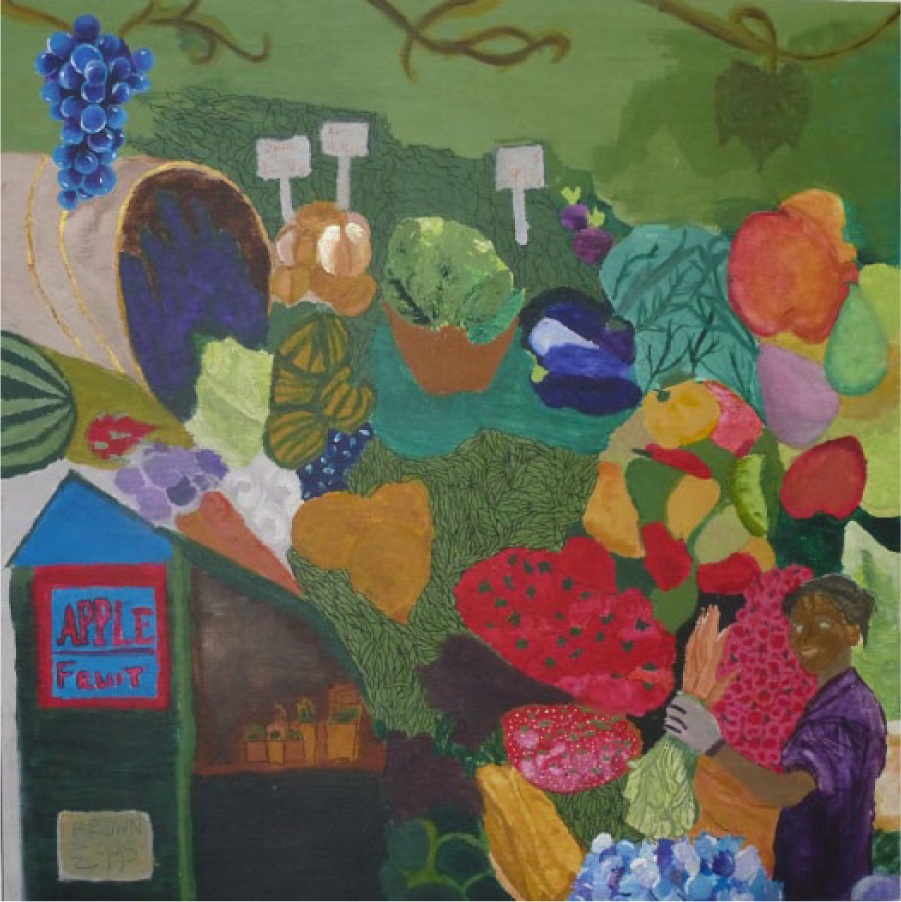
Panel 1: Healthy eating/abundance.
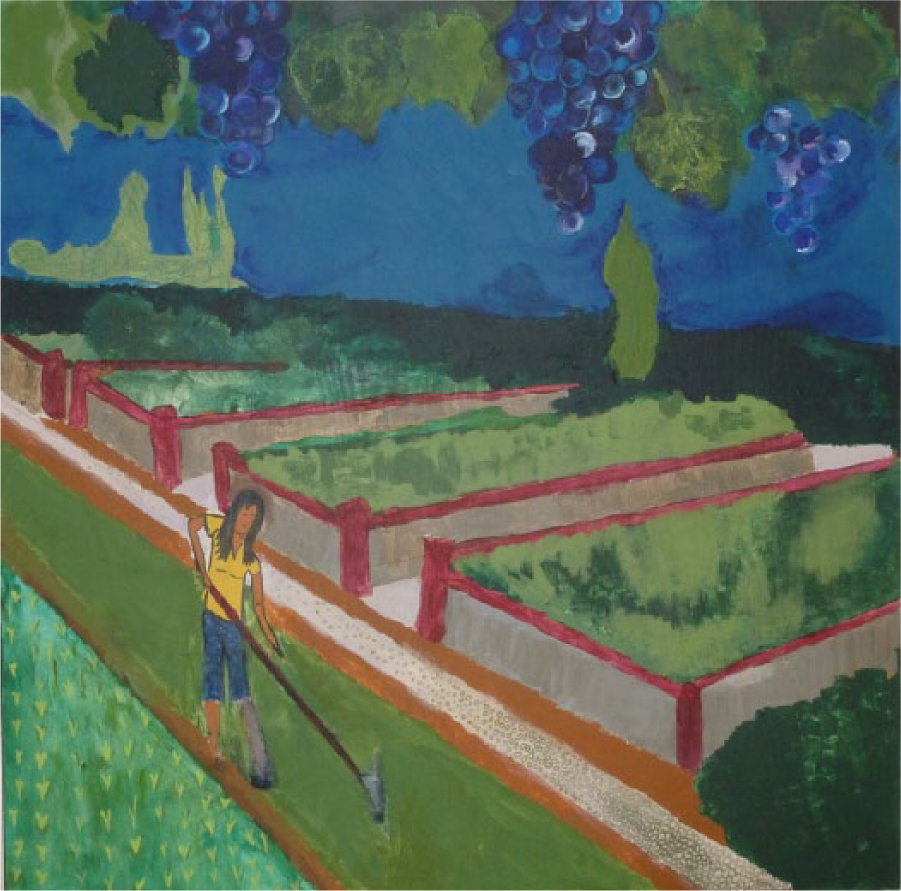
Panel 2: Community food production.
Even so, when Madeleine converted the mural landscape from its electronic vision to actual charcoal on board, she was averse to laying in detail that would render the work of the student artists to “paint by number.” For instance, at her insistence, the entire area of the first panel “abundance” that consists of fruits and vegetables was left open for students to draw in the fruits and vegetables from their original “concept” drawings. Look closely and there’s a very nicely drawn example of “Dragon fruit” in the wide array of items to depict abundance. Susan, acting in the role of patron, objected to Madeleine that Dragon fruit didn’t fit the mural and conflicted with the purpose of promoting foods locally harvested. Madeleine protested—“kid likes Dragon fruit,” she said with a shrug and a nod of her head toward the artist. She started to walk away, but turned back to say, “And besides, the kids who were painting were all from Vietnam and Thailand and even Mexico, where Dragon fruit is local.” Point made.
“In order to keep pace [with] a postcolonial world,” says Conquergood (2002),
Our understanding of local context expands to encompass the historical, dynamic, often traumatic, movements of people, ideas, images, commodities, and capital. It is not easy to sort out the local from the global; transnational circulations of images get reworked on the ground and redeployed for local tactical struggles. (p. 145)
The conflict between patron expectations and public is captured in the depiction of Dragon fruit and compromise was called for; the fruit stayed.
The public, our students, who were also the painters, held an expectation that the concept of painting murals at AHAS included the ethics we have promoted in the program from the beginning—if these paintings were to be consistent with our educational practices, then they were also an opportunity for the “I” story. Here, we were even in conflict thematically, with one of our themes being respect for “local and indigenous” foods and another being “food legacy.” One of the difficulties we know to exist for many immigrants in this area of the Pacific Northwest is the lack of availability of traditional foods and ingredients. In the example of the New Deal murals, sometimes alterations to content were required when iconography depicted ideas and sentiments outside the range of the patron’s purpose—such as one example “under fire for its ‘pessimistic attitude.’”
Still, the notion of place is important to considerations of mural work. Quite a bit has been written about the role of murals in establishing a sense of place for outsider populations. Yet, Lippard (1998) writes “Murals are not often enough considered in the context of their specific urban landscapes.” Regionalism was an important consideration in constructing the New Deal murals. Specifically, the patrons required mural artists to include “factual content derived from the local scene.” Yet, Marling (1982) also notes that history has not recorded any clear mechanisms for the production of New Deal murals “whereby a Section artist was commissioned for service; betook him or herself to Anyplace, USA; mingled with the natives; and painted a mural that local tastemakers deemed satisfactory, abhorrent, or ignorable” (p. 84). Artists were primarily from urban centers like New York and California and regionalism was sometimes achieved by changing details of commissioned art to fit the locale. Marling draws the example of a mural design which showed a cattle train on the plains of the Dakotas, altered into a prairie campfire scene of lumberjacks in Oregon. “Goodbye, bandana. Hello, oilskin” (p. 85). It would have been a violation of the ethics of care for individuals to make any such changes to the AHAS mural to accommodate allegiance to a patron-introduced theme.
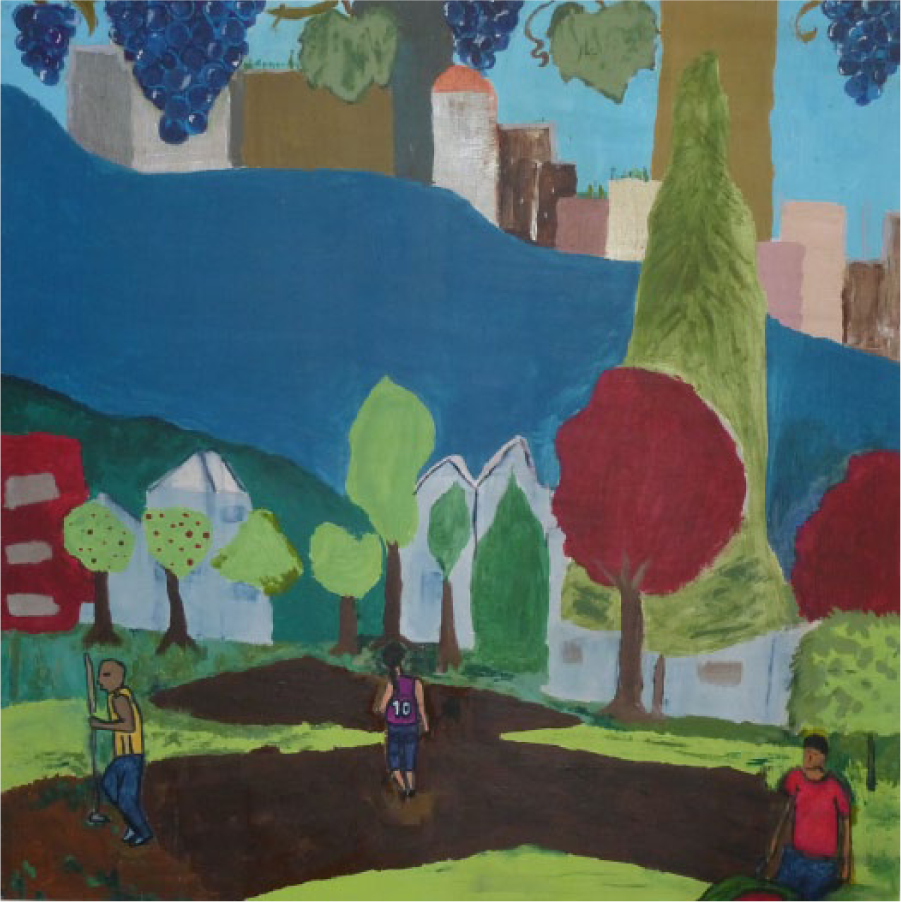
Panel 3: Urban gardens.
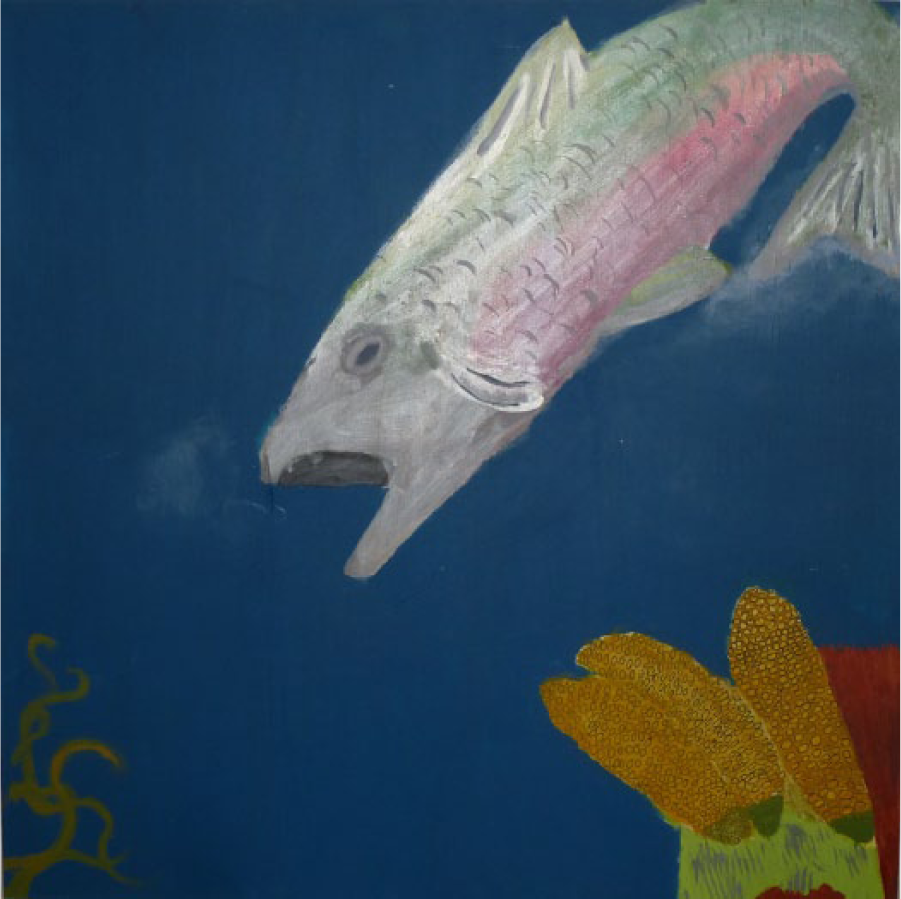
Panel 4: Pacific Northwest food heritage.
Quite a different question of place emerges among people who are placeless but who live in every urban and suburban enclave of America. Children who do not have permanent dwellings but who move as visitors to the homes of friends and relatives, reside in shelters and in dwellings not intended for residences, even living in campgrounds and cars, experience transience more so than the turnover that takes place in the specific boundaries of urban neighborhoods; thus, the notion of mobile murals has resonated with AHAS participants and we have created quite a number of these movable displays over the years.
Again, however, the pedagogical purpose of the AHAS program is to actually lay claim to space; we propose that our marginalized students have every right of full citizenship in their schools as any housed or majority student would have. It is our purpose to assure that our students are not regarded as “transient strangers” in their neighborhood schools. Thus, although flexible as to placement, we also needed these murals to both create and represent an ethical claim to belonging.
The Garden to Table mural represents a pedagogy of hope—it is futuristic, rather than merely historical. In keeping with feminist art and feminist research traditions that are undercurrents in the pedagogical approaches taken at AHAS, it exemplifies empowerment in an artwork that is visionary of what we might become.
AHAS students have a poignant story to tell about their experiences of hunger, food insecurity, and nutritional imbalance. Susan and Madeleine have their stories to tell from years of AHAS participation—the little girl who stuffed her pockets with berries and ruined her clothes; the young boy who licked food off the outside of a garbage can while waiting for breakfast after his family of four parsed out one McDonald’s salad over an entire weekend; the fourth-grade girl who carefully preserved one half of every meal she was given to return to her mother who might otherwise not eat that day; the child who carefully replicated the solar panels we built for a cooking class because her family couldn’t afford to purchase wood for a campfire while they lived in a tent; the conversation Maddie participated in where every student in economic poverty had eaten fast food the previous day. These are not the stories told in the Garden to Table mural. Rather, because of the educational purpose of the mural, the students chose to depict abundance and variety of fruits and vegetables; they wanted to demonstrate their experience of shared, community gardens, and their hope for a future in which urban buildings include “green” rooftops with ample plant life. Their vision of regional food heritage was the one homage to history—but it also underscores wild-caught salmon (as opposed to farm raised) and includes vegetables that are indigenous to the Pacific Northwest and are available in the students’ expanding conceptualization of locally available foods.
Footnotes
Declaration of Conflicting Interests
The author(s) declared no potential conflicts of interest with respect to the research, authorship, and/or publication of this article.
Funding
The author(s) received no financial support for the research, authorship, and/or publication of this article.