



Abstract
This article presents intimate conversations among three colleagues around ethical considerations of ethnographic inter-racial qualitative inquiry. It draws on an ethnographic research project conducted at a high school in rural Idaho, USA. Focusing on the question, “Why are our teachers racist?” the collective worked together to challenge subtle inequity at this particular school. The authors come together in a dialogue to reflect on the role of the researcher within this specific project, but end up illustrating reflexivity, an often hidden aspect of the research process, opening an entangled, unresolved, and yet meaningful set of interpellations around practical methodological concepts.
This article is constituted of a serious email dialogue of three colleagues doing reflexive work on methodological encounters. The conversation springboards from Call-Cummings’ dissertation experience—as we look both backward and forward. Dennis and Martinez were faculty advisors on the project. The conversation around this particular study became an exploration of the entangled methodological concepts of validity, ethics, and participation in the context of a school-based participatory ethnography. Through our email exchange, we engaged in a communicatively structured reflexivity. The dialogue explicitly renders the intra-active nature of reflexivity. While the topic of the conversation revolves around the entanglements and productive tensions of research ethics, participation, ethnography, and validity, the purposes of the article are to illustrate reflexivity, lay bare an often hidden aspect of the research process, and open an entangled, unresolved, and yet meaningful set of interpellations around practical methodological concepts.
The word “reflection” is used throughout the article to suggest both a process and product. There is a tension between the singular version of “reflect” where it seems that separate distinct perspectives are put into conversation with one another and a collective “our,” which emerges as an entanglement of perspectives that are not easily claimed by any one person. The collective “reflection” betrays that already intra- and inter-subjective moment of any individualistic reflection without denying a distinctive movement between the two.
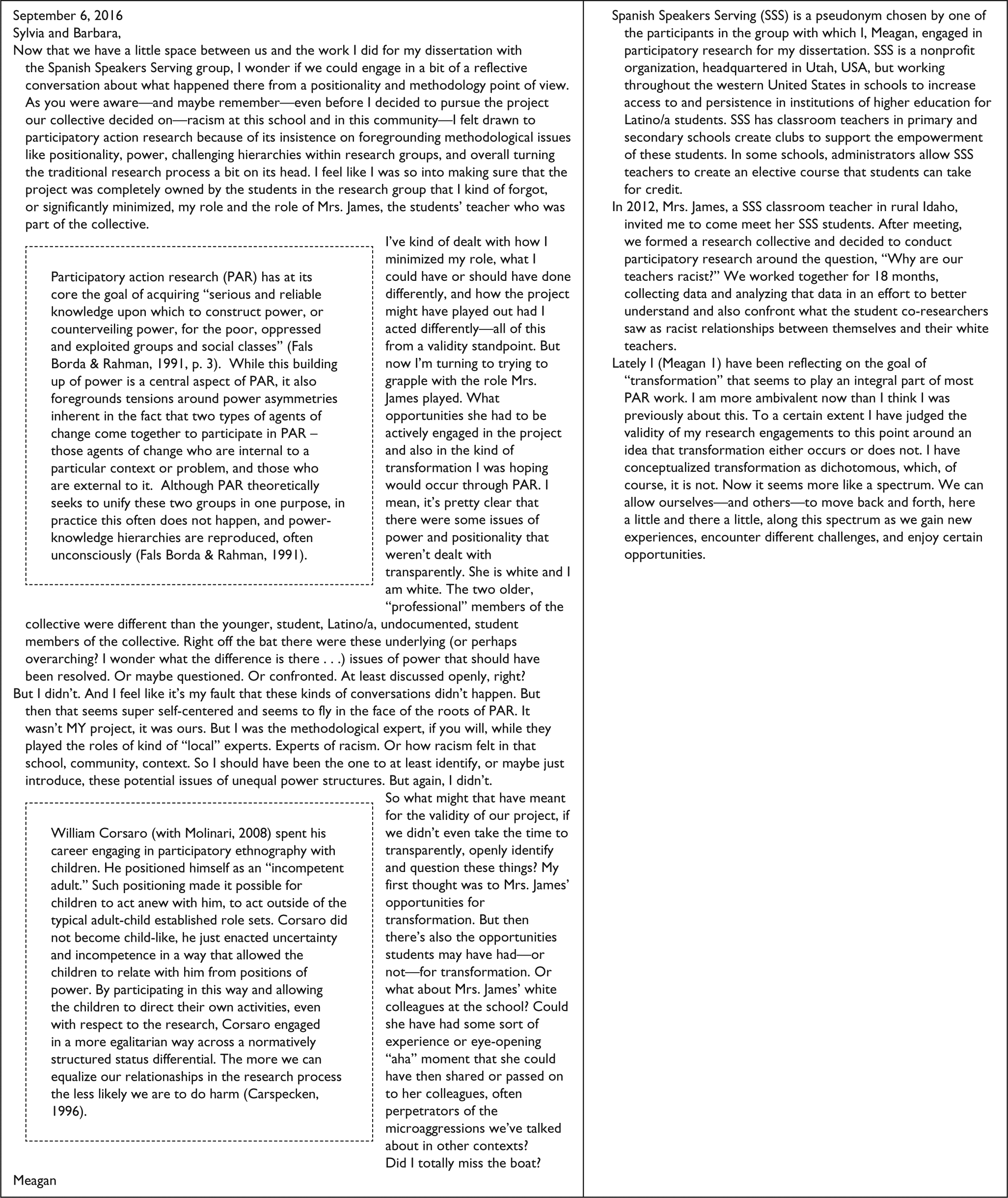
This article’s first author, Call-Cummings, conducted an 18-month, participatory ethnographic study with Latino/a high school students in rural Idaho. The research collective focused on the question “Why are our teachers racist?” Call-Cummings defended her dissertation in 2015 and our email exchange began in 2016. She desired something of the reflecting she had been doing on her own positionality in the study. Our email exchange grew out of that desire. The format of the article is purposefully disjointed to not resolve the tensions of reflection, but rather to engage those tensions. Although we could synthesize the results of that reflection, the messy process would be made invisible if we did so. We expect there is something to be gained from including both.


Conclusion
We came together in this intimate, informal, and vulnerable conversation to explore ethical tensions that seem inherent in participatory and ethnographic qualitative inquiry. Call-Cummings wondered what is the role of the researcher in participatory ethnography? Is it one thing, something that can be defined or made clearer? How can I know that I have “gotten it right?” Do I just have to learn from repeated mistakes and get a little bit closer to some ideal every time I engage in participatory ethnographic inquiry?
In beginning these conversations with Dennis and Martinez, Call-Cummings was in search of answers. Call-Cummings wanted clarity. She wanted to know what was right and what was wrong. And what she should do differently “next time” to be or feel “right” or “ethical.” Yet, in reading through our conversations, we have noticed numerous points at which we end our reflections with ellipses (. . .) or with unanswered questions that seem placed, dropped, seemingly without needing an answer. These moments speak to what became our implicit goal during this process: to lay bare the intra-active nature of reflexivity. These moments of entangled, unresolved, even stilted conversation and questioning lay bare this often hidden aspect of the research process. We offer no simply presented lessons or conclusive statements about what the role of the researcher in fact is. We have created no clean table or linear visual aid that delineates right from wrong. Rather, we have grappled with important and messy questions and argue that the grappling of reflexive practice has allowed us to feel more comfortable in the complexity of our discomfort.
Ultimately, we hope that these unresolved questions and this entangled complexity will ignite useful conversations among others. We think these questions are worthy of continued dialogue that accepts and reflects the messiness of ethical tensions in participatory ethnography. Some of the areas around which we would appreciate more methodological discussion include the following:
How qualitative methodologists conceptualize and present failure and mistakes in academic and scholarly settings and outlets.
How research collectives can collaboratively and explicitly equalize and act outside of taken-for-granted power hierarchies in the researcher–researched relationship.
The ethical role of reflexivity in participatory ethnography.
How ethics is conceptualized and enacted as intra-activity and intra-relational.
These discussions should of course take place at conferences and in journal publications, but we feel strongly that they should also happen in qualitative methodology and other research courses with students. Rather than accepting (and teaching novice researchers) that tensions are unavoidable and, therefore, acceptable, we hope they can be excavated through what we have modeled here as the intra-active process of reflexivity.
Footnotes
Declaration of Conflicting Interests
The author(s) declared no potential conflicts of interest with respect to the research, authorship, and/or publication of this article.
Funding
The author(s) disclosed receipt of the following financial support for the research, authorship, and/or publication of this article: This work was supported by the Indiana University Center for Research on Race and Ethnicity in Society (CRRES) Research Grant and the Indiana University Graduate School Grant-in-Aid of Dissertation Research.
