



Abstract
This article proposes a theoretical model linking the relatively new concept of work engagement to three major domains of employees’ lives—work, personal life, and community—and demonstrates the added value of engagement to each of these domains, above and beyond other well-known concepts in the employee–organization relationship. We propose that promoting work engagement among employees provides organizations with a competitive advantage. Moreover, we maintain that work engagement also creates added value beyond the boundaries of the workplace and has the potential to enrich other major areas in an employee’s life. When compared with similar work-related attitudes such as job involvement and job satisfaction, the work engagement concept also provides added value to organizations, their employees, and their community beyond these similar concepts. This article addresses the paucity of structured literature on the multiple facets and added value of work engagement within organizations and beyond, and presents a comprehensive, holistic model for improving engagement in work that human resource development practitioners can implement.
Keywords
Introduction
The literature on employee–organization relationships contains ever-increasing references to the concept of work engagement (e.g., Bakker, Albrecht, & Leiter, 2011; Eldor & Harpaz, 2016; Macey & Schneider, 2008; Rothbard & Patil, 2010; Shuck & Wollard, 2010), customarily defined as “ . . . a positive, fulfilling work-related state of mind that is characterized by vigor, dedication, and absorption” (Schaufeli, Salanova, Gonzalez-Roma, & Bakker, 2002, p. 74). The growing interest in work engagement in the field of human resource development (HRD) is driven by the hope that improving employees’ engagement in their work could have a significant positive impact on the organization’s results and employees’ performance and learning (Macey & Schneider, 2008; Shuck, Reio, & Rocco, 2011; Shuck & Wollard, 2010).
However, despite the growing recognition of the importance of work engagement in the literature and practices of HRD (e.g., Shuck & Reio, 2011; Shuck, Reio, & Rocco, 2011; Shuck & Wollard, 2010), we still have little knowledge about its added value in promoting the organization’s competitive advantage. This omission is significant, because HRD professionals constantly seek to identify the factors that can improve the performance of organizations (Barney & Wright, 1998). Drawing on Wright’s (2003) argument that the mission of organizations must also include the pursuit of employee happiness, and following Zwetsloot and Pot’s (2004) call that employee well-being is becoming a business value of strategic importance, we propose a comprehensive model for managing work engagement that provides benefits for both the organization and its workers. Although many HRD studies have examined various intriguing organizational aspects of work engagement (e.g., Shuck, Ghosh, Zigarmi, & Nimon, 2013; Shuck, Reio, & Rocco, 2011; Shuck, Rocco, & Albornoz, 2011), there is far less research demonstrating the multi-faceted usefulness of this phenomenon within organizations and in the multiple domains of employees’ lives, both personal and communal. The lack of such information impedes our understanding of the multi-faceted utility of work engagement, making it more difficult for HRD practitioners to determine how to cultivate employee efficacy and effectiveness. Therefore, the goal of this study is to conceptually explore the many facets of the usefulness of work engagement within organizations and beyond, within the specific context of HRD.
To this end, we present a holistic, conceptually grounded approach to the development of a complementary approach to work, life, and community via work engagement. We argue that any organization aiming to increase its competitive advantage must cultivate and foster work engagement among its employees. Moreover, work engagement brings with it added value above and beyond other attitudes involved in the employee–organization relationship. Figure 1 represents the proposed theoretical framework in which we delineate the model. We maintain that the model contributes to the HRD literature by demonstrating why improving employees’ engagement in their work provides organizations and employees with mutual benefits that are desirable in the contemporary challenging reality.
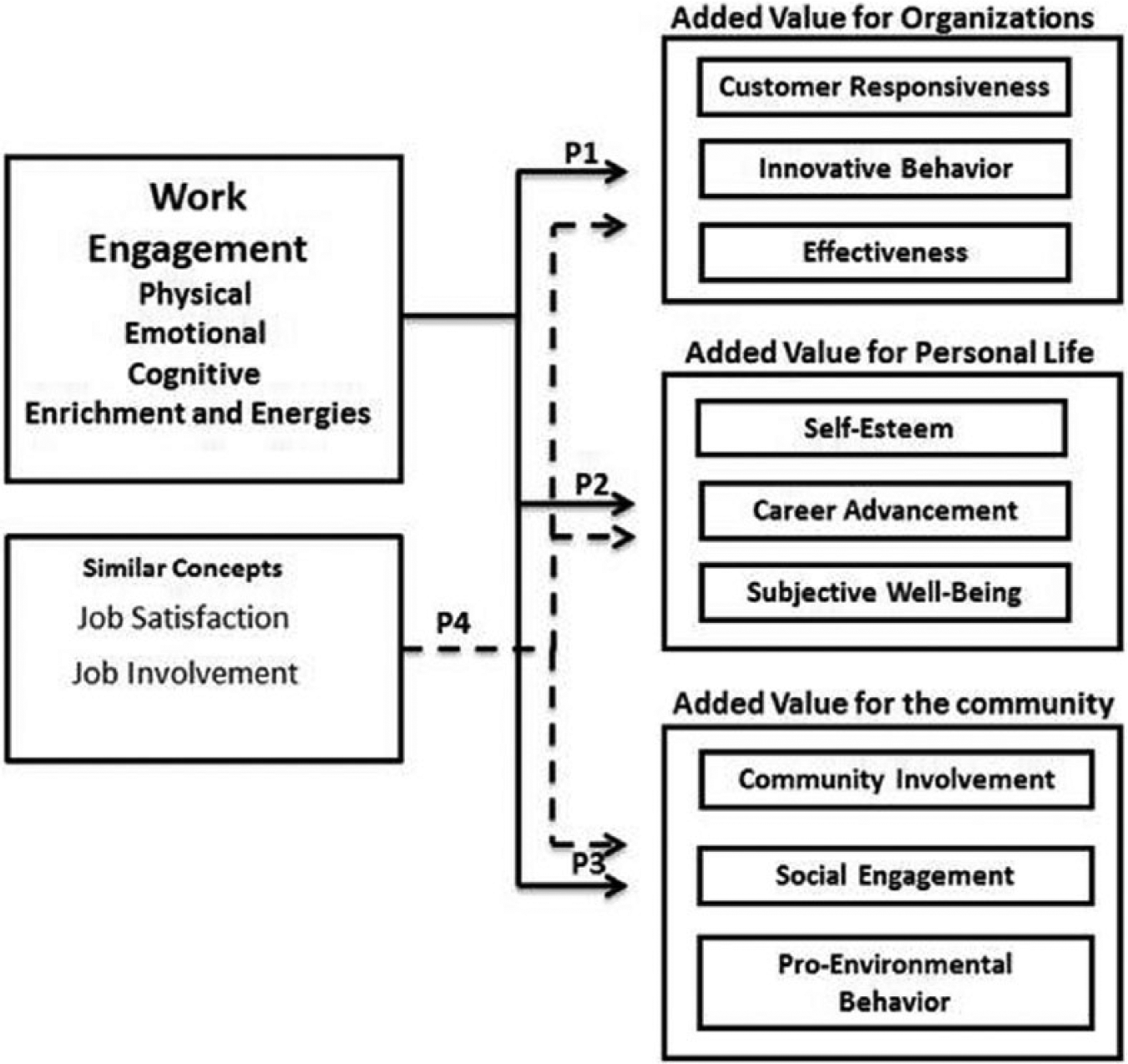
Model of the value add of work engagement.
We begin by providing a broad overview of the current state of work engagement theory and research. Then we discuss the three areas of employees’ lives in which engagement offers added value—work, personal life, and community—in an attempt to formulate a comprehensive theoretical model. We investigate each area (i.e., work, personal life, and community) using existing studies that support our claims and provide the basis for our propositions regarding the enriching potential of work engagement. The article concludes with a discussion including suggestions for managers and HRD professionals.
A Broad Conceptualization of Work Engagement for HRD
Within the fields of HRD and organizational psychology, there is a growing body of research on various perspectives on work engagement (Shuck, 2011). At its core, work engagement refers to involvement, passion, enthusiasm, and energy (Macey & Schneider, 2008). Practitioners often define work engagement in terms of affective commitment, satisfaction, and identification, thereby confusing different constructs by “putting old wine in new bottles” (Schaufeli & Bakker, 2010, p. 12). For example, one of the most widely cited pieces of practitioner literature is the Harter, Schmidt, and Hayes (2002) framework using the Gallup conceptualization of work engagement as an “individual’s involvement and satisfaction with, as well as enthusiasm for, work” (Harter et al., 2002, p. 269). However, from an academic point of view, interest in work engagement can be traced back to Kahn’s (1990) seminal ethnographic work that inspired much of the academic research on work engagement (e.g., May, Gilson, & Harter, 2004; Rich, LePine, & Crawford, 2010; Rothbard, 2001; Shuck, 2011).
Kahn (1990) originally defined work engagement as “the harnessing of organization members’ selves to their work roles, by which they employ and express themselves physically, cognitively, and emotionally during role performance” (p. 694). His formal description views work engagement as a psychological, dynamic, and dialectical relationship, “the simultaneous employment and expression of a person’s preferred self in task behaviors that promote connections to work, personal presence (physical, cognitive, and emotional) and active full performances” (Kahn, 1990, p. 700). The physical aspect of work engagement concerns the physical energies exerted by employees to engage in organizationally valued behaviors at increased levels of effort over extended periods of time. The emotional aspect deals with how employees feel about their work and the emotional energy needed to meet the emotional demands of their roles. Finally, the cognitive aspect of work engagement addresses employee mindfulness, vigilance, and attention to work roles (Kahn, 1990, 1992). Thus, from Kahn’s (1992) perspective, work engagement is best described as a motivational concept reflecting the simultaneous and holistic expression of an employee’s physical, emotional, and cognitive energy in a work role (Shuck & Wollard, 2010).
Inspired by Kahn’s (1990, 1992) seminal theory on psychological engagement, Rothbard (2001) defines work engagement as “one’s psychological presence in or focus on role activities” (p. 656). She suggests that there are two critical components involved in work engagement: attention and absorption. Absorption refers to the intensity of immersion that one experiences at work, being deeply engrossed and not easily distracted; attention refers to the cognitive resources including the concentration and cognitive energy that employees invest in their work (Rothbard, 2001). Rich et al. (2010) have gone beyond this narrow conceptualization of work engagement as a cognitive state and broadened Rothbard’s definition. Their study reverts to the earlier theorizing of Kahn (1990, 1992) and proposes that engagement should be conceptualized and measured so that there are three subcomponents: physical, emotional, and cognitive. Grounded primarily in Kahn’s (1990) seminal study on work engagement, HRD scholars have suggested that work engagement is a three-pronged construct consisting of positive cognitive, emotive, and physical energies and investments (e.g., Shuck, 2011; Shuck & Reio, 2011; Shuck & Wollard, 2010).
A recent conceptual framework by Macey and Schneider (2008) offers a comprehensive taxonomy of work engagement. They describe work engagement as “ . . . a desirable condition, has an organizational purpose, and connotes involvement, commitment, passion, enthusiasm, focused effort and energy, so it has both attitudinal and behavioral components” (p. 4); a “discretionary effort or a specific form of in-role or extra-role effort or behavior” (p. 6); and the desire to go “beyond preserving the status quo, and instead focus on initiating or fostering change in the sense of doing something more and/or different” (p. 24). These scholars propose work engagement to be an aggregate, a multi-dimensional construct that contains three different types of engagement: trait engagement, state engagement, and behavioral engagement. Each of these forms of engagement is based on the previous one, eventually leading to complete engagement. In turn, complete engagement encompasses various conceptualizations such as a proactive personality and positive affect (i.e., trait engagement), job involvement and psychological empowerment (i.e., state engagement), and initiative and proactive behavior (i.e., behavioral engagement).
However, much of the early work engagement research adopted Maslach and Leiter’s (1997) view of work engagement as the opposite pole of the term “burnout.” Indeed, in the Maslach Burnout Inventory (MBI), Maslach and Leiter (1997) define work engagement as the opposite end of a continuum between engagement and burnout, namely, “a persistent positive affective state characterized by high levels of activation and pleasure” (p. 417). They argue that while engagement is characterized by vigor, involvement, and efficacy, burnout is characterized by three parallel yet opposite dimensions: exhaustion (vs. vigor), cynicism (vs. involvement), and ineffectiveness (vs. efficacy). Extending this line of thinking, Schaufeli et al. (2002) define work engagement as a positive, fulfilling, motivational state of mind characterized by vigor, dedication, and absorption (Schaufeli et al., 2002). Vigor refers to high levels of energy and mental resilience at work, willingness to invest effort in one’s work, and persistence in the face of difficulties and challenges (Schaufeli et al., 2002). Dedication means being deeply involved in one’s work and experiencing a sense of significance, enthusiasm, inspiration, pride, and challenge (Schaufeli et al., 2002). The third component, absorption, involves full concentration on one’s work to the point of experiencing time as passing quickly, having difficulty detaching oneself from work (Schaufeli & Bakker, 2004; Schaufeli, Bakker, & Salanova, 2006; Schaufeli et al., 2002).
The root of Schaufeli et al.’s (2002) approach can be traced back to what has come to be known as “positive psychology,” namely, “ . . . a change in the focus of psychology from preoccupation only with repairing the worst things in life to also building positive qualities” (Seligman & Csikszentmihalyi, 2000, p. 5). This change led to a positive shift of perspective in organizational psychology, principally in the study of the characteristics of employee prosperity and well-being (Bakker & Schaufeli, 2008; Luthans & Youssef, 2007). The Schaufeli et al. (2002) conceptualization and operationalization of work engagement using the Utrecht Work Engagement Scale has been the subject of the greatest number of scientific studies (see the meta-analyses of Christian, Garza, & Slaughter, 2011, and Rich et al., 2010, and the overview of Shuck, 2011).
Building on earlier seminal conceptualizations of work engagement (e.g., Kahn, 1990; Macey & Schneider, 2008; Schaufeli et al., 2002), Shuck and Wollard (2010) define engagement for HRD field as “an individual employee’s cognitive, emotional, and behavioral state directed toward desired organizational outcomes” (p. 103). They also suggested that each dimension of work engagement is distinguishable, definable, and derived from one another. To sum, while the literature contains several frameworks for defining work engagement, a consensus seems to be forming that work engagement is an employee–organization relationship that reflects the employees’ simultaneous investment of cognitive, emotional, and physical energies that benefits the organization as well as the employees themselves (e.g., Kahn, 1992; Macey & Schneider, 2008; Rich et al., 2010; Schaufeli et al., 2002; Shuck, 2011; Shuck et al., 2013; Shuck & Wollard, 2010). However, what is still lacking is a clear understanding of what specific added value work engagement brings to the well-being of organizations and their employees.
Enhancing Work Engagement
Consistent with Demerouti, Bakker, Nachreiner, and Schaufeli’s (2001) job demands–resources model, previous studies have consistently shown that job resources facilitate work engagement (Bakker et al., 2011). According to the job demands–resources model (Demerouti et al., 2001), job resources are the aspects of work that are functional in achieving work goals as well as in stimulating personal growth. They play a key role in facilitating work engagement, because they have both extrinsic motivational potential by helping employees achieve their work goals and intrinsic motivational potential by facilitating their personal development (Bakker & Demerouti, 2007; Demerouti et al., 2001). Accordingly, studies have established a positive relationship between various job resources (e.g., learning climate, autonomy, job control, role fit, skills variety, task identity, task significance, autonomy, supervisor support, performance feedback) and work engagement (see Bakker et al., 2011; Bakker & Demerouti, 2007; Bakker, Demerouti, & Verbeke, 2004; Bakker, Hakanen, Demerouti, & Xanthopoulou, 2007; Eldor & Harpaz, 2016; Hakanen, Bakker, & Schaufeli, 2006; Schaufeli & Bakker, 2004; Schaufeli, Bakker, & Van Rhenen, 2009; Shuck & Reio, 2011; Shuck, Reio, & Rocco, 2011; for a meta-analysis, see Crawford, LePine, & Rich, 2010; Halbesleben, 2010).
Similarly, Kahn (1990) finds that the characteristics of tasks are important for the experience of meaningfulness. Building on Hackman and Oldham’s (1980) job characteristics theory, he suggests that meaningfulness, psychological safety, and psychological availability influence employees’ internal work motivations (see May et al., 2004; Rich et al., 2010; Shuck & Reio, 2011). For example, using a sample of 203 employees from a large insurance firm, May et al. (2004) establish that work engagement has a positive relationship with meaningfulness (r = .63), availability (r = .29), and safety (r = .45), and demonstrated that all three of Kahn’s (1990, 1992) conditions are important in the development of work engagement. Kahn argues that work that is challenging, clearly delineated, varied, creative, and autonomous is most likely to be associated with the experience of work engagement. Thus, studies using the job demands–resources model illustrate how various aspects of the organization and characteristics of the job can positively affect work engagement (Shuck, 2011). Such theoretical approaches and empirical findings clearly add to our overall knowledge about work engagement and its potential value to the HRD community.
Work Engagement and Other Similar Concepts in the Employee–Organization Relationship
A particularly intriguing question for HRD scholars and professionals alike is whether work engagement is a distinct concept (e.g., Dalal, Brummel, Wee, & Thomas, 2008; Frese, 2008; Griffin, Parker, & Neal, 2008; Newman & Harrison, 2008; Saks, 2008; Schohat & Vigoda-Gadot, 2010; Shuck et al., 2013; Shuck & Wollard, 2010) or rather a “new blend of old wines” (Newman, Joseph, & Hulin, 2010, p. 45). As Shuck (2011) suggests, an additional important step in understanding the efficacy of work engagement should focus on differentiating the added value that work engagement brings from “other well-researched job attitude and organizational constructs such as job satisfaction, organizational commitment, job involvement, and job affect . . . ” (p. 317). Moreover, given the limits on HRD budgets and the demand of finding the most effective job attitude which cultivates employees’ performance and effectiveness, identifying the specific benefits of work engagement and its added value above other similar job attitudes is imperative for HRD professionals (Shuck, 2011).
To date, work engagement has been empirically distinguished from workaholism and burnout (e.g., Gorgievski & Bakker, 2010; Schaufeli, Taris, & Van Rhenen, 2008), from attitudes such as job satisfaction and organizational commitment (e.g., Christian et al., 2011; Eldor & Harpaz, 2016; Hallberg & Schaufeli, 2006), and from commitment to public service and involvement in public work (Vigoda-Gadot, Eldor, & Schohat, 2013). Work engagement is distinguished from involvement (which reflects only cognitive factors; for an extensive review, see Kanungo, 1982) in that it simultaneously encompasses cognitive, affective, and physical factors (Eldor & Harpaz, 2016; Hallberg & Schaufeli, 2006; Vigoda-Gadot et al., 2013). Work engagement is also distinguished from emotional commitment, defined as being proud of one’s organization and sharing its values (Hallberg & Schaufeli, 2006), in that the latter is merely a single component of work engagement (i.e., state engagement; see Hallberg & Schaufeli, 2006; Macey & Schneider, 2008; Vigoda-Gadot et al., 2013). Finally, work engagement is distinguished from change-oriented organizational citizenship behavior, defined as taking charge of one’s environment and as the employee’s efforts to effect functional changes in the organization (Vigoda-Gadot & Beeri, 2012); the first focuses on intra-role behavior, whereas the latter deals with extra-role behaviors (Vigoda-Gadot & Beeri, 2012).
Recent research provides additional empirical evidence about the distinctiveness and contribution of the work engagement construct (Christian et al., 2011; Rich et al., 2010; Shuck, Reio, & Rocco, 2011). For instance, Christian et al. (2011) demonstrate that engagement “exhibited discriminate validity from, and criterion related validity over, job attitudes” such as job satisfaction and organizational commitment (p. 89). Moreover, Rich et al. (2010) provide empirical findings that engagement predicts work performance outcomes such as job and contextual performance above and beyond other similar job attitudes such as job involvement, job satisfaction, and intrinsic motivation. Similarly, research specifically grounded in the context of HRD has pointed out the utility of work engagement above and beyond other more traditional employee–organization concepts such as job satisfaction and job involvement (Shuck et al., 2013; Shuck, Reio, & Rocco, 2011).
Nevertheless, given the more comprehensive definition of work engagement as having physical, emotional, and cognitive aspects, we maintain that promoting it may offer organizations a competitive advantage as well as benefit their employees’ personal growth and community involvement above and beyond other similar concepts in the employee–organization relationship.
Toward a General Model of the Enrichment-Potential of Engagement Concept
The state of work engagement research indicates a further need for further theoretical development of the concept (Shuck et al., 2013). By employing a holistic model, work engagement forms a multi-faceted contribution: a competitive advantage for organizations, a promoter of employee well-being in the extra work realm of life, and community involvement.
Work Engagement: Creating a Competitive Advantage for Organizations
Organizations today are experiencing constant competition, rapid innovation, and continuous change (Griffin, Neal, & Parker, 2007; Ilgen & Pulakos, 1999). To succeed or even survive, they must gain a competitive advantage (Porter, 1985), meaning, developing organization-specific resources that either cannot be imitated by other firms or, if replicable, can be achieved only at an extremely high price (Barney & Wright, 1998; Porter, 1985). Porter’s (1985) seminal work on the five-forces model indicates that the relationship between the industry’s structure and strategic opportunities and forces can be explained as an environmental analysis. Yet, according to Barney (1995), a complete understanding of the sources of competitive advantage requires analyzing the organization’s internal strengths and weaknesses as well. Barney and Wright (1998) argue that organizations must develop their internal financial, physical, human, and organizational assets to maintain their competitive advantage. These scholars point out that a resource can be considered a potential source of sustainable competitive advantage if it is valuable, relatively rare, and difficult to imitate (Barney & Wright, 1998). Nevertheless, scholars in the field of strategic management have long appreciated the difficulties inherent in identifying specific organizational competitive advantages, because the value of traditional resources such as financial capital, technology, and cost reductions have declined in the face of globalization and rapid competition (Barney, 2001). Nevertheless, according to Barney and Wright (1998), employees can provide a major competitive advantage if they are motivated to use their initiative for the benefit of the organization and if they demonstrate loyalty to the organization. Therefore, highly energetic, dedicated, and knowledgeable employees might be an important source of sustained competitive advantage, because they are valuable, rare, and difficult to replicate (Barney, 2001; Barney & Wright, 1998).
We argue that work engagement promotes this competitive advantage, particularly based on Porter’s (1996) claim that a competitive advantage can be effective only if it is pursued with dedication, thoroughness, and forcefulness. We maintain that the strong sense of dedication and willingness to invest one’s energies physically, emotionally, and cognitively, nurtured among engaged employees, represents a valuable organizational resource for achieving a competitive advantage (Eldor & Harpaz, 2016). Studies in the strategy literature have indeed confirmed that employees who are dedicated to their organizations are more apt to work toward their organizations’ strategic objectives (e.g., Boxall, 1996; Cappelli, 1999; Lopez-Cabrales, Valle, & Herrero, 2006; Pfeffer, 1994), and inspired employees are likely to overcome serious organizational obstacles to doing so (e.g., Pfeffer, 2005; Snell, Youndt, & Wright, 1996). Certainly, such ingredients are among the competitive advantages that rivals would be least able to imitate (Barney, 1991; Lepak & Snell, 2002). Moreover, research has also indicated that motivated employees are better at satisfying customers, thereby minimizing costs while maximizing sales and income (e.g., Barney & Wright, 1998; Gorton & Schmid, 2004; Ulrich, 1994). Thus, we maintain that enhancing the engagement of employees in their work will offer an organization a competitive edge that its rivals may not be able to duplicate.
Indeed, the past decade has witnessed a considerable increase in the published scientific research on the positive effect of work engagement on organizational effectiveness (Albrecht, 2010; Eldor & Harpaz, 2016). Researchers have pointed out the value of effectively engaging employees and established that work engagement constitutes an important variable of interest to organizations, linking it to work performance using resource theories such as Fredrickson’s (2001, 2003) broaden-and-build theory of positive emotions and Hobfoll’s (1989) conservation of resources theory (Bakker et al., 2011). However, studies thus far have mainly focused on the association of work engagement with higher levels of traditional in-role work performance and job attitudes (see Albrecht, 2010; Bakker & Bal, 2010; Bakker, Demerouti, & Brummelhuis, 2012; Demerouti & Bakker, 2006; Demerouti & Cropanzano, 2010; Halbesleben & Wheeler, 2008; Rich et al., 2010; Salanova, Agut, & Peiró, 2005; Shuck, 2013; Xanthopoulou, Bakker, Heuven, Demerouti, & Schaufeli, 2008). Nevertheless, these results look promising when considering the potential role of work engagement in boosting the organization’s competitive advantage by promoting valuable and desirable work performance behaviors. Indeed, Porter (1991) argues that “resources are not valuable in and of themselves, but they are valuable because they allow firms to perform activities . . . business processes are the source of competitive advantage” (p. 108). Drawing on Porter’s (1991) argument, we maintain that work engagement can offer organizations this kind of competitive advantage via contemporary desirable work performance such as customer responsiveness, innovative behavior, and effectiveness.
There are several rationales for positing a positive relationship between work engagement and the improvement of an organization’s competitive advantage. First, employees who score high on the work engagement scale also score high on activation (Langelaan, Bakker, Schaufeli, & Van Doornen, 2006). Therefore, the strong and persistent energy embedded in work engagement may fuel behaviors in which employees take the initiative to achieve organizational success and goals (Frese & Fay, 2001; Grant & Ashford, 2008; Shirom, 2010), craft their own jobs to be responsive (Wrzesniewski & Dutton, 2001), and make their voices heard (LePine & Van Dyne, 2001).
Second, engaged employees experience positive emotions such as joy, interest, contentment, enthusiasm, and inspiration (Bindl & Parker, 2010) which, according to the broaden-and-build theory (Fredrickson, 2001), create enduring psychological and social resources that promote emotional well-being (Fredrickson, 2003; Fredrickson & Branigan, 2005; Fredrickson & Joiner, 2002). For instance, joy expands resources by promoting the urge to be outgoing and more sensitive to opportunities at work (Cropanzano & Wright, 2001). Interest fosters the desire to assimilate new information and experiences (e.g., Fredrickson & Losada, 2005). Previous studies indicate that positive emotions such as inspiration, challenge, and enthusiasm broaden people’s thought–action repertoires and build their resources by expanding their thoughts, ideas, and actions (Fredrickson & Branigan, 2005; Schaufeli, Taris, Le Blanc, Peeters, Bakker, & De Jonge, 2001); increase their openness to new experiences and creative solutions (Cropanzano & Wright, 2001), leading to more outgoing behaviors at work (Cropanzano & Wright, 2001); and promote proactive initiatives (Fritz & Sonnentag, 2009). Thus, engaged employees who experience these positive emotions in their work may be more likely to break their habitual modes of thought and step outside the box.
Finally, engaged employees allocate their attention and energy more effectively than less involved workers (Demerouti & Cropanzano, 2010) and are therefore more focused on achieving the organization’s goals (Macey & Schneider, 2008; Rothbard & Patil, 2010). Indeed, Kahn (1990, 1992) argues that the extent to which work engagement is reflected in attentiveness and connectedness to one’s work may foster a frame of mind in which work performance is perceived to include a wide array of responsive, initiating, and involved behaviors that exceed the traditional border of in-role performance behaviors. Accordingly, we expect the following:
Work Engagement: Creating Added Value for Employees’ Personal Lives
In addition to its proposed benefits for the organization, promoting employees’ engagement in their work may have a positive effect on their efficacy and well-being as well. We maintain that work engagement is a significant attitude that is mutually beneficial for both organizations and employees. Therefore, work engagement also leads to desirable outcomes in their personal lives. The contribution to HRD practitioners can be therefore leveraged from organizational perspective to how prosperity can be simultaneously pursued for organizations and employees as well.
The majority of research on the spillover between work and one’s personal life has mainly focused on negative effects such as conflicts between the demands of one’s job and one’s family (e.g., see a review by Eby, Casper, Lockwood, Bordeaux, & Brinley, 2005) and has been grounded in theories about stress or hypotheses about the scarcity of resources (Edwards & Rothbard, 2000; Grzywacz & Marks, 2000a, 2000b). However, in line with the positive psychology approach (Seligman & Csikszentmihalyi, 2000), recent studies on the interaction between work and personal life have also considered positive spillovers (Bakker & Schaufeli, 2008; Grzywacz & Marks, 2000b; Lazarova, Westman, & Shaffer, 2010), noting “the extent to which experiences in one role improve the quality of life in the other role” (Greenhaus & Powell, 2006, p. 73). According to the Greenhaus and Powell (2006) model, resources such as skills and perspectives, psychological and physical resources, social capital, flexibility, and material resources, and positive affects such as joy, fulfillment, inspiration, and challenge accumulated and derived from one’s work role have a direct, positive impact on the employee’s family life as well.
We propose expanding that model and maintain that work engagement will have a positive effect on other aspects of the employee’s personal life and prosperity such as self-esteem, career satisfaction and advancement, and subjective well-being. Based on the notions of positive spillovers and enrichment, we argue that employees who are engaged in their work will mobilize the resources, skills, and knowledge they have accumulated and use them successfully in their personal lives. Such employees identify strongly with their work and believe that it is meaningful (Albrecht, 2010; Bakker et al., 2011). Therefore, they constantly seek to learn and grow occupationally and personally (Bakker & Leiter, 2010). These unique characteristics help them internalize the skills and knowledge they acquire at work behaviorally, emotionally, and cognitively simultaneously. Therefore, they can utilize these resources in their personal lives more easily and effectively (Greenhaus & Powell, 2006). Moreover, work that involves challenging and meaningful experiences provides the individual with psychological and social capital such as social contacts and self-efficacy (Bakker et al., 2011; Kahn, 1990, 1992; Rothbard, 2001). These multi-dimensional resources lead to the building of a stronger set of personal resources and help individuals achieve their professional goals and personal aspirations such as having satisfying personal and professional lives. Thus, we propose the following:
Work Engagement as Creating Added Value for Employees’ Communal Lives
Work engagement may also be significant in the context of the broader community (Macey & Schneider, 2008; Schaufeli et al., 2001). Just as an organization wants its employees to be engaged, so does a community want its citizens to be engaged and involved. Thus, being engaged is a meaningful value that has significance beyond the boundaries of the workplace.
According to the spillover theory (Wilensky, 1960), perceptions, attitudes, and behaviors in one’s social setting can be manifested in another social setting as a reflection of one’s skills and experience. In other words, work-related activities and participation provide an employee with the skills and desire to participate in other domains of social life (Cohen & Vigoda, 1998; Vigoda-Gadot, Mizrahi, Miller-Mor, & Tevet, 2008). We argue that when employees are engaged with their work and involved in their workplace, these positive feelings and energies are likely to be translated into high-quality performance that will spill over into the community domain. For example, according to Sieber (1974), resources can be transferred from one area of life to another. Thus, the personal contacts, social capital, and knowledge obtained at work can be valuable resources for improving the functioning of the employee’s community (Golembiewski, 1995; Sobel, 1993).
Our spillover argument is also based on Hobfoll’s (1989) conservation of resources theory. This theory is founded on the premise that individuals seek to protect, retain, and accumulate the resources that are desirable and instrumental in attaining higher order goals (Hobfoll, 2001, 2002). Moreover, the conservation of resources theory argues that individuals who already have resources have a better chance of investing them to gain additional resources or achieve higher order goals (Hobfoll, 2002). This phenomenon, dubbed “gain spirals,” is plausible because when initial gains are made, even greater resources become available, providing individuals with a surplus that they can invest (Gorgievski & Hobfoll, 2008; Hobfoll, Johnson, Ennis, & Jackson, 2003).
Based on these sociological and organizational theories, we maintain that there are two reasons for positing a positive spillover of work engagement into the communal domain. First, engagement in the workplace may provide resources to individuals such as social capital, contacts, knowledge, and self-efficacy that can be valuable resources for improving the functioning of the community (Cohen & Vigoda, 1998; Sieber, 1974; Wilensky, 1960). Second, positive feelings and additional psychological assets such as the sense of mission, dedication, optimism, and happiness embedded in work engagement (e.g., Albrecht, 2010; Bakker et al., 2011; Bindl & Parker, 2010) are associated with benevolence, generosity, and increased assistive behavior (George, 1991). Accordingly, we argue that the resources, positive affect, and involvement at work—exemplified by a high degree of work engagement—spill over into and are utilized in the communal domain. The level of involvement displayed by individuals beyond the formal activities required of them is an essential aspect of a flourishing society. Thus, we posit the following:
The Contribution of Work Engagement Over and Above Other Similar Employee–Organization Relationship Concepts
As previously noted, work engagement is defined as the experience of being “fully there” at work and manifesting this involvement physically, emotionally, and cognitively (Kahn, 1990; Schaufeli et al., 2002; Shuck & Wollard, 2010). According to this view, work engagement is the behavioral, affective, and cognitive enrichment of the self, reflected holistically and simultaneously in one’s state of mind (Kahn, 1990). Thus, the concept of engagement provides a more comprehensive explanation for employees’ contributions to and thriving at work above and beyond than other parallel concepts that emphasize relatively narrower aspects of employees’ flourishing (Eldor & Vigoda-Gadot, 2016).
For example, job satisfaction is conceptualized in terms of emotional reactions, inasmuch as they refer to “a pleasurable or positive emotional state resulting from the appraisal of one’s job” (Locke, 1976, p. 1300). The positive feelings associated with a high degree of job satisfaction cause employees to perform in a manner that contributes to their outcomes (Judge, Bono, Thoresen, & Patton, 2001). Another example of parallel concepts in the employee–organization relationship is job involvement, based on a relatively narrow aspect of investment in terms of cognitive energy. Job involvement is defined as a “cognitive or belief state of psychological identification” (Kanungo, 1982, p. 342). Scholars reason that job involvement predicts better performance, because individuals who are deeply involved in their jobs focus their thoughts on work and interpret more situations as opportunities (Kreiner, Hollensbe, & Sheep, 2006). Although studies have demonstrated the contribution of each of these parallel concepts to individuals’ outcomes, they each focus on a narrow area. While these narrower explanations—affective, cognitive, or behavioral—could also account for the added value for the employees and their organizations, they do not account for the simultaneous and holistic behavioral, affective, and cognitive enrichment of the employees embodied in the concept of work engagement (Kahn, 1992; Schaufeli et al., 2002). In contrast, work engagement is reflected in the simultaneous enrichment of employees’ cognitive, emotional, and physical energies, not just in feeling positive emotions or identifying cognitively (Eldor & Vigoda-Gadot, 2016). Accordingly, we argue that work engagement results in added value for both employees and organization above and beyond that offered by other concepts regarding the employee–organization relationship. To advance the theory and practice of the HRD field, we propose the following:
Conclusion
This study focuses on the added value that work engagement provides in promoting an organization’s competitive advantage, improving the employees’ personal lives, and fostering the well-being of the communities in which they live. As a coherent expression of persistence, vigor, dedication, enthusiasm, and alertness at work, engagement offers organizations and their employees added benefits that may not be obtained through other concepts involved in the relationship between them and cannot be readily reproduced by competitors. We believe that engaged individuals may be more satisfied with their jobs and lives because they are participating physically, emotionally, and cognitively in activities that are salient to them and to the people around them. Hence, it behooves HRD practitioners to find ways to improve employees’ engagement in their work. Such employees function effectively, think innovatively, and are more responsive to customers (Grant & Ashford, 2008; Griffin et al., 2007; Pulakos, Arad, Donovan, & Plamondon, 2000). They show more initiative, engage in out-of-the-box-thinking in problem solving, are open to change, and have a desire to share their knowledge with their colleagues (Eldor & Harpaz, 2016; Bakker et al., 2011; Bindl & Parker, 2010; Demerouti & Cropanzano, 2010; Macey & Schneider, 2008; Shuck, 2013). These are precisely the factors that provide an organization with a competitive advantage, one that their competitors will find very difficult to imitate (Barney, 1995; Barney & Wright, 1998).
The growing competitive reality forces organizations to become leaner and do more with less (Parker, Bindl, & Strauss, 2010). Therefore, engaged employees who are willing to take on greater responsibilities are a necessary asset for achieving organizational goals (Eldor & Harpaz, 2016; Parker & Griffin, 2011). Furthermore, the trend toward global organizations and decentralization in the workplace makes it harder for supervisors to oversee employees (Buchner, 2007), particularly in desirable but hard-to-achieve areas such as proactivity and creativity (Parker et al., 2010; Parker & Griffin, 2011). Thus, promoting work engagement may also be an effective approach for HRD practitioners, one that focuses less on performance management and more on performance facilitation. Work engagement can therefore be a HRD strategy for providing organizations with a competitive advantage.
Engagement in work also provides employees with resources and experiences that enrich their own lives—a sense of meaningfulness, challenge, self-esteem, and fulfillment—experiences that could also be associated with a fulfilling career path, increased satisfaction with life, and greater well-being. The literature is replete with discussions about the conflicts between work and family life, including feeling overwhelmed at home (Brotheridge & Lee, 2005), anxiety, tension, and perceived stress (Eby et al., 2005; Franche, Williams, Ibrahim, & Grace, 2006). Research has established the negative impacts of these outcomes on employees’ mental health and personal and family lives (Kafetsios, 2007; Lambert, Pasupuleti, Cluse, Jennings, & Baker, 2006). However, according to our proposed model, the positive aspects of engagement at work could spill over into the employees’ personal lives and the community at large and ameliorating some of these issues. Linking work engagement and personal well-being suggests that positive, challenging, and meaningful work experiences generate a broad spectrum of positive thinking and feelings that lead to the building of personal resources in an upward spiral, thereby helping individuals achieve their personal goals and aspirations (Fredrickson, 2003). Moreover, the presence of energy, positive emotions, and meaningful enrichment embedded in work engagement suggests that engaged individuals may have more personal resources and capital available for reinvestment in their personal life (Albrecht, 2010; Bakker et al., 2011). We therefore believe that engaged individuals may experience a sense of harmony in life and obtain the optimal resources that enable them to meet the long-term demands of their work and non-work roles.
Moreover, in line with recent organizational research suggesting that employee loyalty and retention are particularly high in organizations that have policies about the balance between life and work (Lourel & Guéguen, 2007; Smith & Gardner, 2007), we maintain that cultivating a culture supportive of this goal is a fundamental mission for HRD practitioners. Fostering it will reinforce not only employees’ prosperity and well-being but also the prosperity of the organizations themselves. Moreover, taking a humane approach by incorporating the many facets of work engagement that been shown to have a positive impact on performance (Sambrook, 2012; Swanson & Holton, 2009) may actually have a stronger effect on an organization’s bottom line than the implementation of other initiatives.
Engagement at work may also have the potential of enriching community involvement and other social contexts. That said, we believe that the consequences of having engaged employees may spill over into additional life domains, further reinforcing the importance of having engaged employees. Engaged employees who express positive emotions at work tend to perceive the stimuli around them in a more positive light and may be more generous and giving (Rothbard, 2001; Schaufeli et al., 2001). Moreover, engagement in the workplace may prove beneficial to individuals in areas such as knowledge and self-efficacy—benefits that enhance their functioning in the social domain and can be valuable resources for successful communal functioning (Albrecht, 2010; Bakker et al., 2011). The chaotic nature of modern life forces multiple responsibilities and duties onto employees, often leaving them overwhelmed by the demands of numerous commitments (Rothbard & Patil, 2010). For this reason, we find the potential contribution of work engagement outside the organization to be especially critical and encouraging. Echoing George’s (1989) argument that “not only should we consider how workers feel at work, but also how they feel off the job” (p. 321), organizations can positively affect their employees’ lives outside of work by promoting work engagement. We therefore maintain that the work engagement concept can be a win-win mechanism and a contemporary HRD tool that has the potential of enriching multiple areas of life.
Understanding the added value of work engagement to areas beyond the workplace such as the employees’ communal life and society involvement is important for HRD professionals. As organizations’ boundaries become increasingly blurred, the value of work engagement to HRD professionals may not be limited to the organizational level. The emerging role of HRD practitioners extends beyond this realm to other areas (Sambrook, 2012; Shuck & Rose, 2013; Swanson & Holton, 2009) such as the well-being of employees, communities, society, and even the world at large that simultaneously influence and are influenced by organizations. Thus, HRD practitioners may have an opportunity to expand their already salient impact and role. This emerging role (or even mission) can be regarded through the lens of offering a comprehensive organizational competitive advantage, one that views all the organizational stakeholders as engaged partners who are essential in achieving this goal.
Work engagement appears to be a more effective enrichment mechanism than other, more traditional employee–organization relationship mechanisms such as job satisfaction and job involvement (Eldor & Vigoda-Gadot, 2016). Managers today agree that this relationship has a critical impact on an organization’s competitiveness and effectiveness (Macey & Schneider, 2008). Simply put, organizations today must achieve more with less (Masson, Royal, Agnew, & Fine, 2008), while employees yearn for self-actualization and personal growth (Baruch, 2006; Hall, 2004)—two trends that can either contradict one another or energize each other. With every passing decade, the complexity of the employee–organization relationship grows along with our understanding of its essential role in a flourishing organization. Work engagement has recently been introduced as a potentially optimal means of redefining the employee–organization relationship because it encapsulates the notion of a coherent and simultaneous expression of multiple enrichments (Albrecht, 2010). We argue that emotional, cognitive, or behavioral work experiences may enrich outcomes both at the workplace and beyond, more so than other, narrower mechanisms embodied in parallel concepts. According to our theory-building framework, work engagement offers a competitive advantage for organizations and an added value in general, above and beyond similar concepts. Thus, the recent HRD focus on work engagement is not a case of the old employee–organization relationship concept being repackaged (e.g., Dalal et al., 2008; Griffin et al., 2008; Newman et al., 2010); rather, it reinforces the argument of work engagement leading to a contemporary employee–organization relationship framework (Shuck, 2011; Shuck et al., 2013; Vigoda-Gadot et al., 2013). Moreover, the likelihood that these experiences will provide added value in other realms of life is stronger when these experiences occur simultaneously and in a holistic way as expressed by the concept of work engagement, more so than other parallel concepts.
A Final Note
Briskin (1998) argues that,
to explore the challenge to the human soul in organizations is to build a bridge between the world of personal and subjective individual experience and the world of organizations that demands efficiency . . . we must be willing to shift our viewpoint back and forth between what organizations want of people and what the contradictory nature of human needs, desires, and experience. (p. xii)
Work engagement embraces a combination of individuals’ deeply physical, emotional, and cognitive connectedness with the significant facets of their lives: work, personal life, and community. Thus, by meeting the challenging reality of modern organizational life, work engagement provides the key to the mutual needs of organizations and employees. HRD practitioners must therefore strive to enhance work engagement—for the benefit of the organization and the good of society at large.
Footnotes
Declaration of Conflicting Interests
The author(s) declared no potential conflicts of interest with respect to the research, authorship, and/or publication of this article.
Funding
The author(s) received no financial support for the research, authorship, and/or publication of this article.