



Abstract
Work engagement and organizational commitment are among the most studied topics in a range of fields, including human resource development (HRD) and organization development (OD). The value of such work is evident in the direct influence of work engagement and organizational commitment on employee well-being and organizational performance. However, scholars have divergent perspectives on the relationship between these two concepts. While some studies have examined work engagement as a precursor to organizational commitment, others have investigated work engagement as an outcome of organizational commitment. Despite the contrasting perspectives, little research effort has been made to reconcile these differing views through the synthesis and analysis of the extant literature. Therefore, this study aims to examine the current state of engagement-commitment research and then to suggest HRD implications for research and practice based on a review of selected literature.
Work engagement and organizational commitment have received continuous attention as topics of study in the fields of human resource development (HRD), organization development (OD), management, and psychology (Jeung, 2011; Kim, Kolb, & Kim, 2013; Mercurio, 2015; Meyer & Herscovitch, 2001). Recent studies have supported this emphasis, concluding that both concepts are fundamental to employee well-being and provide competitive advantages to organizations in areas of human performance, such as job performance and turnover intention (Albdour & Altarawneh, 2014; Ibrahim & Falasi, 2014; Kanste, 2011; Kim, Khan, Wood, & Mahmood, 2016; Rivkin, Diestel, & Schmidt, 2016).
In the context of scholarly and practical literature, work engagement refers to “positive, fulfilling, work-related state of mind that is characterized by vigor, dedication, and absorption” (Schaufeli, Salanova, González-Romá, & Bakker, 2002, p. 74). Organizational commitment, on the contrary, is defined as “the relative strength of an individual’s identification with and involvement in a particular organization” (Mowday, Steers, & Porter, 1979, p. 226). As these definitions imply, work engagement focuses on the relationship between employees and the work they perform, whereas organizational commitment emphasizes the relationship between the employee and the organization of which they are a part.
In addition to studies of work engagement and organizational commitment as discrete concepts, research has also addressed the engagement–commitment relationship, empirically investigating construct distinction between work engagement and organizational commitment (e.g., Hallberg & Schaufeli, 2006; Huynh, Metzer, & Winefield, 2012; Kanste, 2011) as well as the engagement–commitment relationship in connection with other relevant research constructs (e.g., Hansen, Byrne, & Kiersch, 2014; Huynh et al., 2012). Especially, in conceptualizing the relationship, some studies have formulated work engagement as a precursor to organizational commitment and examined the impact of work engagement on organizational commitment (e.g., Albrecht, 2012; Hu & Schaufeli, 2011; Karatepe, 2013; Richardsen, Burke, & Martinussen, 2006). Meanwhile, others have framed work engagement as an outcome of organizational commitment and investigated the impact of organizational commitment on work engagement (e.g., Barnes & Collier, 2013; Cantor, Morrow, & Montabon, 2012; Rivkin et al., 2016; Zhang, Ling, Zhang, & Xie, 2015).
Despite the significant dispute over the directionality of the engagement–commitment relationship, little research effort has been made to synthesize examinations of the engagement–commitment relationship in extant empirical literature. A comprehensive investigation of this kind would benefit both researchers and practitioners of holistic HRD. Such data could support HRD practitioners in designing and implementing strategies and policies seeking to enhance work engagement and organizational commitment in employees. Likewise, HRD researchers would gain a vital resource for discussing the contrasting views of the engagement–commitment relationship.
To answer the call, this study aims to (a) search, analyze, and synthesize relevant empirical studies that examine the relationship between work engagement and organizational commitment in organizational contexts, and (b) propose insightful directions for research and practice in the field of HRD. Accordingly, this study is organized into three sections. First, the “Method” section details article selection process along with search criteria used for the literature review. This is followed by a description and synthesis of the findings from the selected literature. The study concludes with a discussion of HRD implications for future research and practice based on a synthesis of the reviewed literature.
Method
This study employed an integrative literature review as its method for its propensity to summarize, examine, and synthesize a current body of literature on a topic (Chermack & Passmore, 2005). This section describes the article search and selection process as well as the data organization and analysis of chosen literature.
Description of Selection Process
Using Torraco’s (2005) framework as a guide, the initial step was to search for articles and to select those most relevant to the study. Recognizing that the importance of implementing a clear and specific method in the literature review, this study made note of the following considerations in the article selection process: (a) where the articles were found (i.e., which database); (b) when the search was conducted; (c) who undertook the search process; (d) how the articles were found; (e) how many articles appeared in the search, against the total number of articles selected; and (f) why the articles were finally chosen (Callahan, 2010; Carasco-Saul, Kim, & Kim, 2015; Kim et al., 2013).
When performing the initial search in April 2016, the researchers used ProQuest (Multiple Databases), which included 47 smaller database subsets (e.g., PsycINFO, PsycARTICLES, and ABI/INFORM Collection), to extract relevant articles. The primary focus of this study, and therefore the search keyword combinations, was on the relationship between work engagement and organizational commitment in an organizational context. The term work engagement is often used interchangeably with similar terms, such as employee engagement, job engagement, role engagement, or personal engagement (Carasco-Saul et al., 2015; Kim et al., 2013; Lee, Kwon, Kim, & Cho, 2016). Thus, to conduct a comprehensive search, all five of the aforementioned terms were used as engagement-related keywords.
For the concept of organizational commitment, studies found in search results on Google Scholar tended to utilize several similar terms, including commitment, affective commitment, and affective organizational commitment. Given that all of these terms contain the common term commitment, the keyword commitment was used for the search. Taken together, the search keywords used for the initial search were combinations of (a) “commitment” with (b) “work engagement,” “employee engagement,” “job engagement,” “role engagement,” or “personal engagement.” For the purpose of this study, the review focused on articles published in peer-reviewed, English-language journals and containing the precise search terms in titles and/or abstracts. Although there was no specific time restriction imposed on results, it is notable that the concept of work engagement was first introduced in the literature in 1990 (Carasco-Saul et al., 2015; Shuck & Wollard, 2010). In addition, we only included articles that provided full texts through the databases to conduct an in-depth review in the second step.
The initial search using the above keywords yielded 61 matching articles on ProQuest (Multiple Databases). Subsequently, a staged review approach was used to examine the 61 articles and to identify relevant articles for the current research purpose. The staged review approach consists of first conducting an initial review of the abstract and then completing an in-depth review of the article (Torraco, 2005). In the in-depth review process, articles were subject to criteria that the study (a) empirically examines the engagement–commitment relationship, (b) has been conducted in an organization setting, and (c) offers relevant and detailed discussions about the engagement–commitment relationship. Reference lists of searched articles were then investigated for any articles that may not have been found by the search in the selected databases. After this secondary search process, three articles that empirically examined the relationship between work engagement and organizational commitment were added. Ultimately, 21 empirical articles found in this process were selected for further review (see Table 1).
Number of Selected Articles by Database.

We used Google Scholar to search for articles that appeared in the reference lists of the searched articles. Excluding duplicated articles, we added three more articles that were not found in the initial search process.
Overview of Work Engagement and Organizational Commitment
Work Engagement
As a concept, work engagement has increasingly gained attention among organizations and researchers (Lee et al., 2016). One reason for this growing interest is that work engagement has been connected to valuable business results across all sizes and types of organizations (Vance, 2006). Numerous empirical studies have shown that employees’ work engagement influenced organizational desired outcomes (e.g., job and financial performance, productivity, innovative work behavior, commitment, turnover intention, and customer satisfaction). Moreover, these results have noticeably piqued the interest of organizations (e.g., Albrecht, 2012; Chughtai, 2013; Harter, Schmidt, & Hayes, 2002; Karatepe, 2013; Rich, Lepine, & Crawford, 2010; Saks, 2006; Zhang et al., 2015).
In defining the concept of engagement, studies have used various terms depending on their perspective, purpose, and context (Carasco-Saul et al., 2015; Kim et al., 2013). Since Kahn (1990) coined the term from a psychological perspective, numerous related terms and definitions have been proposed by scholars and practitioners. Among them, work engagement and employee engagement are considered key terms in the field of HRD (Lee et al., 2016). Work engagement is defined by HRD as “a positive, fulfilling, work-related state of mind” comprised of three subdimensions such as vigor, dedication, and absorption (Schaufeli et al., 2002, p. 74). In contrast, employee engagement is defined as “an individual employee’s cognitive, emotional, and behavioral state directed toward desired organizational outcomes” (Shuck & Wollard, 2010, p. 103). Although the terms tend to be used interchangeably, the term “employee engagement” is used more often in the field of business and “work engagement” in the scholarly literature (Schaufeli & Salanova, 2011). In addition, Saks and Gruman (2014) speculated that the term employee engagement has broader scope than work engagement. That is, employee engagement is an individual’s positive attachment to one’s job, occupation, and organization, while work engagement is an individual’s positive psychological state regarding his or her work.
To examine the concept of engagement empirically, scholars have made an effort to propose several ways of accurately measuring engagement. Among these methods, the Utrecht Work Engagement Scale (UWES) has been considered the most popular (Rich et al., 2010; Saks & Gruman, 2014). The UWES was developed by Schaufeli and his colleagues (2002) for assessing the construct of work engagement with three subdimensions: vigor, dedication, and absorption. The UWES has been globally validated and used in two versions, UWES-17 and UWES-9 (Lee et al., 2016). Despite its popular and wide use, some scholars have argued that the UWES includes redundant elements and measures of job burnout and tends to measure predictors of engagement rather than engagement itself (Lee et al., 2016; Newman & Harrison, 2008; Rich et al., 2010). To address this issue, other measurements have been developed including those by Rich et al. (2010), Soane et al. (2012), and Demerouti and Bakker (2008). Saks (2006) also attempted to conceptualize and measure employee engagement as a two-dimensional construct comprising job engagement and organizational engagement, reflecting Kahn’s (1990) earlier point of view. This measurement consists of six items each for job engagement and organizational engagement. However, as it has not been widely used, its construct validity is limited.
Given that a majority of studies (13 of 21 articles) selected for the literature review used the term “work engagement”, the present study uses the term work engagement, as well. Also, as most studies (15 of 21 articles) measured engagement by using the UWES either fully or partially, this study will consider work engagement to comprise vigor, dedication, and absorption in investigating the relationship between commitment and engagement.
Organizational Commitment
Many previous studies have demonstrated the positive influence that employee commitment has on organizational outcomes, including organizational effectiveness, work engagement, job satisfaction, and turnover intention (Ahmed & Ahmed, 2013; Meyer & Herscovitch, 2001; Plewa & Quester, 2008; Poon, 2013; Zhang et al., 2015). Understandably, organizations have also shown considerable interest in increasing employees’ commitment to the workplace in pursuit of these goals.
To accurately define and measure commitment, extensive research has been conducted within an organizational context (Meyer & Herscovitch, 2001). Over the years, commitment has been conceptualized with diverse terms including organizational commitment (Allen & Meyer, 1990; Meyer & Allen, 1991; Mowday et al., 1979), commitment (Albrecht, 2012; Plewa & Quester, 2008), and commitment in the workplace (Feldman, 2004). Mowday et al. (1979) defined organizational commitment as the strength of identification and involvement of an individual employee in an organization, focusing on the attitudinal perspective of commitment. Meyer and Allen (1991) defined organizational commitment as a psychological state with at least three characteristics including “affective attachment to the organization, perceived costs associated with leaving the organization, and obligation to remain with the organization” (pp. 63-64). Furthermore, Meyer and Herscovitch (2001) synthesized how previous literature had defined commitment and found that the essence of these definitions was “a force that binds an individual to a course of action of relevance to one or more targets” (p. 301) along with the three components of affective, normative, and continuance commitment. However, Mercurio (2015) claimed that the core of organizational commitment is only affective commitment. These variant opinions evince the disagreement that still exists about the concept of organizational commitment (Meyer & Herscovitch, 2001).
To measure the concept of commitment, Mowday et al. (1979) developed a unidimensional instrument, the Organizational Commitment Questionnaire (OCQ), which comprised 15 items. The OCQ was validated by numerous studies (e.g., Barnes & Collier, 2013; Mowday et al., 1979; Richardsen et al., 2006). More recently, however, researchers have increasingly considered commitment to be a multidimensional construct encompassing affective commitment, value commitment, moral commitment, continuance commitment, and/or normative commitment (Allen & Meyer, 1990; Jaros, Jermier, Koehler, & Sincich, 1993; Mayer & Schoorman, 1992; Meyer & Herscovitch, 2001). Consequently, Meyer and Allen’s framework has gained support among the multidimensional measures of commitment (Bergman, 2006). Allen and Meyer (1990) developed a self-reported questionnaire as a three-dimensional measurement consisting of 24 items, with eight items each for affective, normative, and continuance commitment. This measurement has since been implemented by many studies (e.g., Albdour & Altarawneh, 2014; Aydogdu & Asikgil, 2011).
Given that a large majority of studies (17 out of 21) selected for the literature review used either the term “organizational commitment” or “affective [organizational] commitment,” the current study utilizes the term organizational commitment. Also, as many of the studies (10 out of 21) used the measurement developed by Allen and Meyer (1990; Meyer & Allen, 1997) either fully or partially, this study will consider organizational commitment to comprise affective, normative, and continuance commitment in investigating the relationship between commitment and engagement.
Findings on Work Engagement and Organizational Commitment
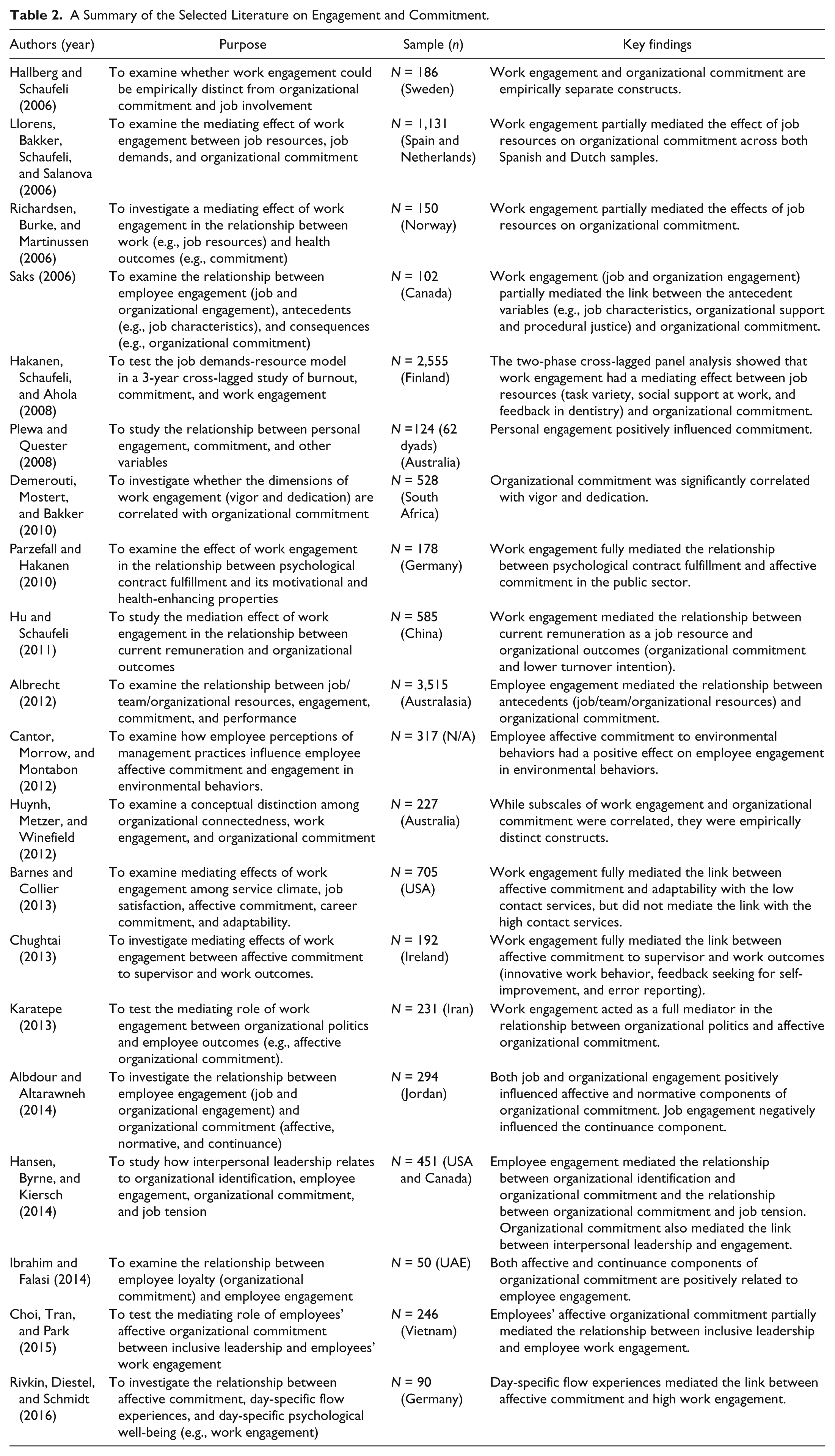
The process of analysis and synthesis was implemented based on the 21 empirical articles that were ultimately selected. As an effort to support a better understanding of the selected literature, a brief summary including authors, purpose, sample data, and key findings from the selected literature is presented in Table 2. These studies are listed in chronological order, beginning in 2006. The following section provides findings from the selected literature on the relationship between work engagement and organizational commitment. As the purpose of the current study mainly focuses on empirical studies on the engagement–commitment relationship, this section consists of two subsections on how the reviewed empirical literature was investigated, in terms of (a) diverse effects examined in the engagement–commitment relationship associated with antecedents and consequent variables and (b) key terms, measures, and methods utilized to conceptualize and analyze the relationship.
A Summary of the Selected Literature on Engagement and Commitment.
Effects in the Engagement–Commitment Relationship
Among 21 reviewed studies, 10 studies focused on examining the effects of engagement on commitment in organizations (i.e., engagement as a predictor of commitment), whereas seven studies primarily focused on investigating the effects of commitment on engagement (i.e., commitment as a predictor of engagement). Another four of the studies examined the bidirectional or distinct relationship between engagement and commitment.
Effects of engagement on commitment
While two studies, Albdour and Altarawneh (2014) and Plewa and Quester (2008), investigated the direct influence of engagement on commitment, a majority of studies (8 out of 10) examined the influences of engagement on commitment in association with antecedent and consequent variables. Most studies focused on job-related resources as relevant input variables. Four of the studies used the job-related resources of social support, performance feedback, autonomy, and task variety to examine the effects of engagement on commitment. Richardsen et al. (2006) revealed that work engagement partially mediated the effects of the job resources of autonomy and social support from supervisors and coworkers on organizational commitment in a sample group of 150 Norwegian employees. Llorens, Bakker, Schaufeli, and Salanova (2006) discovered that work engagement partially mediated the effect of the job resources of social support and performance feedback on organizational commitment across two sample groups (654 Spanish employees and 477 Dutch employees). Using a two-phase cross-lagged panel analysis, Hakanen, Schaufeli, and Ahola (2008) showed that work engagement had a mediating effect between the job resources of task variety, social support at work, and feedback and organizational commitment in the field of dentistry. Albrecht (2012) utilized not only job resources (i.e., career development, autonomy, supervisor support, and role clarity) but also organizational and team resources (i.e., organizational and team culture) as input variables to examine the effects of engagement on commitment. The results of this study showed that engagement played mediating roles in the relationship between antecedent job, team, and organizational resources and organizational commitment among 3,515 employees from a large multinational mining company.
In addition, three studies used antecedent variables pertaining to job resources in that researchers either conceptualized these antecedents as job resources themselves (i.e., current remuneration and psychological contract fulfillment) or subfactors of these antecedents partly overlapped with those of job resources (i.e., job characteristics). In a sample group of 585 workers in China, Hu and Schaufeli (2011) found that work engagement played a partial mediating role in the relationship between current remuneration as a job resource and organizational outcomes, including organizational commitment. Saks (2006) investigated the relationship between employee engagement, organizational support, procedural justice, and organizational commitment, with antecedents including the job characteristics of autonomy, skill variety, feedback, task significance, and task identity in a sample of 102 Canadian employees. The results indicated that work engagement, composed of job and organization engagement, played a partial mediating role between the antecedent variables of job characteristics, organizational support, and procedural justice and organizational commitment. Parzefall and Hakanen (2010) also found that, in a public organization with a sample of 178 German employees, work engagement fully mediated the relationship between psychological contract fulfillment (considered as a job resource) and affective commitment. In addition, turnover intention was used as an outcome variable in the engagement–commitment relationship, revealing that affective commitment had a fully mediating role between work engagement and turnover intention. In another study, Karatepe (2013) posed organizational politics as an antecedent variable and found that work engagement played a fully mediating role in the relationship between organizational politics and affective organizational commitment with 231 hotel employees in Iran.
Two further studies focused on the direct effect of engagement on commitment. The results of one of these studies demonstrated that personal engagement positively influenced commitment in 124 participants from Australian university and industry staff (Plewa & Quester, 2008). In another study of 294 frontline employees from a Jordan banking sector, Albdour and Altarawneh (2014) revealed that job engagement and organizational engagement were positively associated with the affective and normative components of organizational commitment. However, it was also found that job engagement had a negative influence on continuance component of organizational commitment.
Effects of commitment on engagement
Although two studies, Cantor et al. (2012) and Ibrahim and Falasi (2014), primarily examined the direct influence of commitment on engagement, five out of seven studies investigated the influence of commitment on engagement in association with other research variables.
Three out of five studies (Barnes & Collier, 2013; Chughtai, 2013; Zhang et al., 2015) considered diverse consequent variables (i.e., innovative work behavior, feedback seeking for self-improvement, error reporting, turnover intention, and adaptability) as research variables for the effects of commitment on engagement. Chughtai (2013) found that work engagement fully mediated the link between affective commitment to the supervisor and work outcomes such as innovative work behavior, feedback seeking for self-improvement, and error reporting with a sample of 192 research scientists. With a sample of 705 respondents in the United States, Barnes and Collier (2013) also reported that work engagement mediated the link between affective commitment and adaptability in low contact services, whereas there was no mediating effect in the relationship in high contact services. Zhang et al. (2015) also demonstrated that work engagement partially mediated the negative effect of organizational commitment on turnover intention with a sample of 512 building engineers in Taiwan.
In addition, two out of five studies (Choi, Tran, & Park, 2015; Rivkin et al., 2016) utilized either an input variable (i.e., inclusive leadership) or a mediating variable (i.e., day-specific flow experiences) to examine the effect of commitment on engagement. Choi et al. (2015) reported that affective organizational commitment played a partial mediating role between inclusive leadership and work engagement with a sample of 246 employees in Vietnam. A study of Rivkin et al. (2016), with a sample of 90 employees in Germany, revealed that affective commitment positively influenced high work engagement and that day-specific flow experiences mediated between affective commitment and high work engagement.
Two studies focused on the direct effect of commitment on engagement. Ibrahim and Falasi (2014) found out that both affective commitment and continuance commitment had a significant relationship with employee engagement in a sample of 50 government employees in the United Arab Emirates. In addition, a study of Cantor et al. (2012) found a significant, positive impact of employee affective commitment on employee engagement in environmental behaviors in a sample of 317 supply chain management employees.
Bidirectional and distinct relationship between engagement and commitment
The selected literature review included one study that investigated not only the effects of engagement on commitment but also the effects of commitment on engagement (Hansen et al., 2014), and additional three studies examined the construct distinction between engagement and commitment (Demerouti, Mostert, & Bakker, 2010; Hallberg & Schaufeli, 2006; Huynh et al., 2012).
In studying the bidirectional relationship of engagement and commitment, Hansen et al. (2014) aimed to examine the mediating effects of employee engagement on interpersonal leadership, organizational identification, organizational commitment, and job tension. What they found was that employee engagement played a mediating role between organizational identification and organizational commitment. However, the study also tested the relationships between those aforementioned factors by re-specifying organizational commitment as a mediator between interpersonal leadership and employee engagement. Through the exploration, they found that organizational commitment also mediated the link between interpersonal leadership and engagement and that employee engagement had a mediating effect on the relationship between organizational commitment and job tension.
With regard to the construct distinction between engagement and commitment, the results of three remaining studies showed that both the constructs and their subscales were closely related (Demerouti et al., 2010; Hallberg & Schaufeli, 2006; Huynh et al., 2012). However, with a sample of 227 volunteers from emergency service organizations in Australia, Huynh et al. (2012) found that, although the subscales of work engagement and organizational commitment are related, they are empirically distinct constructs. In addition, by examining relationships of these constructs with other constructs such as health complaints (e.g., emotional exhaustion), job factors (e.g., autonomy), and personal factors (e.g., intrinsic motivation) in a sample of 186 Swedish employees, Hallberg and Schaufeli (2006) also concluded that, while work engagement and organizational commitment are closely related, they are empirically separate constructs.
Terms, Measures, and Methods
Terms and measures
In the 21 reviewed articles, diverse terms and instruments were utilized to conceptualize and measure work engagement and organizational commitment. When it comes to engagement, it seems that the terms work engagement and employee engagement as singular concepts are predominantly used in engagement-related studies, and the UWES is primarily used to measure the concept of engagement. Of the various terms for “engagement,” 18 out of 21 studies employed the term either “work engagement” (13) or “employee engagement” (5). Two studies used the term “engagement” alone, and one article utilized the term “personal engagement.”
With regard to measures of engagement, a majority of the studies (17 out of 21) either fully or partially used versions of the UWES (i.e., UWES-17 and UWES-9). Given the global validation of UWES-9 (Schaufeli, Bakker, & Salanova, 2006), most of these studies measured the concept of engagement with the three subdimensions of vigor, dedication, and absorption. However, three studies measured engagement with only vigor and dedication, conceptualizing them as core dimensions of engagement and/or the conceptual opposite to burnout (i.e., Demerouti et al., 2010; Llorens et al., 2006; Parzefall & Hakanen, 2010). In addition, two studies, Albdour and Altarawneh (2014) and Saks (2006) used the term “employee engagement,” conceptualized as a multiple concept consisting of job engagement and organizational engagement, and measured the two levels of engagement with the 12 items of Saks’s (2006) instrument. Two other studies attempted to conceptualize and measure engagement in other ways. One study, Ibrahim and Falasi (2014), measured engagement with the Gallup Workplace Audit (GWA), often used to measure job satisfaction (Harter et al., 2002), and the other study, Cantor et al. (2012), measured engagement in environmental behaviors with three subfactors (i.e., frequency of involvement, innovative environmental behaviors, and promotion of environmental initiatives).
When it comes to commitment, a majority of the studies focused on employees’ affective commitment dimension in conceptualizing and measuring commitment within an organization, and the measure of organizational commitment developed by Allen and Meyer (1990) was primarily utilized to assess the concept of commitment. Concerning terms of commitment, 17 out of the 21 studies used either “organizational commitment” (9) or “affective (organizational) commitment” (8), whereas the four remaining studies employed other terms such as “commitment” (2), “affective supervisory commitment” (1), and “employee loyalty” (1).
A majority of studies (19 out of 21) put the focus of commitment on the relationship between employees and their organization, with the exception two studies which put the focus of commitment on either employees’ relationships with their supervisors (Chughtai, 2013) or employees’ relationships with their environmental behaviors (Cantor et al., 2012). Regarding measures of commitment, 12 out of 21 studies fully or partially used the measure of organizational commitment developed and modified by Allen and Meyer (1990; Meyer & Allen, 1997). Although this measure is comprised of three subdimensions (i.e., affective, normative, and continuance commitment), most studies (10 out of 12) paid attention mainly to the affective dimension of organizational commitment, whereas only two studies either focused on all (Albdour & Altarawneh, 2014) or even two of them (i.e., affective commitment and continuance commitment; Ibrahim & Falasi, 2014). One study (Zhang et al., 2015) used a multidimensional measurement developed by Ling, Zhang, and Fang (2000) with five subdimensions (i.e., affective, normative, ideal, economic, and choice commitment). In addition, six studies measured commitment itself without subdimensions by using diverse instruments including the measure developed by Mowday et al. (1979) (e.g., Barnes & Collier, 2013; Hu & Schaufeli, 2011; Richardsen et al., 2006). Two articles measured organizational commitment using several items without any references (Albrecht, 2012; Cantor et al., 2012).
Methods
All reviewed empirical studies used quantitative approaches and collected data through survey questionnaires with Likert-type scales. Among the statistical methods used to examine diverse relationships (i.e., direct, indirect, and distinct) between research variables, including work engagement and organizational commitment, structural equation modeling (SEM) approaches were used predominantly, and a bootstrapping approach was utilized more to test mediating effects. Specifically, among 21 reviewed articles, a majority of studies (17 out of 21) employed SEM approaches (e.g., Hu & Schaufeli, 2011; Karatepe, 2013; Parzefall & Hakanen, 2010; Plewa & Quester, 2008), whereas four studies utilized multiple regression approaches (e.g., Albdour & Altarawneh, 2014; Ibrahim & Falasi, 2014; Richardsen et al., 2006) to investigate the engagement–commitment relationships. In addition, two studies that employed SEM approaches also used more sophisticated statistical methods such as multilevel analysis by including day-level variables (Level 1) and person-level variables (Level 2) (Rivkin et al., 2016) as well as cross-lagged analysis by a longitudinal research design based on two waves over a 3-year period (Hakanen et al., 2008).
To test indirect relationships (i.e., mediating effects) between work engagement, organizational commitment, and other variables, most studies used one of four approaches: the bias-corrected bootstrapping method (5; e.g., Albrecht, 2012; Barnes & Collier, 2013); a SEM model comparison through a chi-square difference test (4; e.g., Hakanen et al., 2008); the Sobel test (3; e.g., Hansen et al., 2014; Karatepe, 2013); and Baron and Kenny’s mediation test (2; e.g., Richardsen et al., 2006).
Discussion
This section consists of three subsections, beginning with an assessment of strengths and weaknesses of the reviewed studies and, then, offering an analytical synthesis of what the authors investigated through this research. Following the synthesis, this study suggests HRD implications for practice and research agendas based on this literature review.
Assessment of Strengths and Weaknesses of the Reviewed Literature
First, a review of these 21 studies shows that work engagement and organizational commitment are distinct constructs. Researchers conceptualized the engagement–commitment relationship with differing perspectives (i.e., engagement as a precursor to commitment or commitment as a precursor to engagement); however, the results of the reviewed literature demonstrated that both the impact of work engagement on organizational commitment and the impact of organizational commitment on work engagement were statistically significant. These findings offer a firm ground for an empirical understanding of one-directional effects on the engagement–commitment relationship. Although it could be hypothesized that work engagement and organizational commitment might have a reciprocal relationship based on the results, all reviewed studies focused only on examining one-directional effects without considering potential reciprocal effects. Such research efforts could provide more holistic insights to conceptualizing the engagement–commitment relationship in the future.
Second, a majority of reviewed studies (17 out of 21) seemed to utilize the SEM approach as a robust statistical technique to test a research model with hypotheses. SEM can estimate and correct measurement errors of observed variables (e.g., survey items), including latent variables in a research model, and examine various relationships among multiple endogenous and exogenous latent variables simultaneously (Bae, 2014; Kline, 2011; Parzefall & Hakanen, 2010), all definite advantages over the multiple regression approach. In testing mediating effects, the bootstrapping method was more utilized, as it is strongly recommended and considered the most powerful method for measuring specific indirect relationships under most sample conditions without an assumption of a multivariate normal distribution (Preacher & Hayes, 2008). Cross-sectional design has been applied as a primary research design in all but one longitudinal study (Hakanen et al., 2008). However, many researchers also mentioned it as a limitation to generalizing the results of their studies. Without longitudinal research efforts, research findings and their implications on the engagement–commitment relationship would remain limited and inconclusive (Carasco-Saul et al., 2015). As cross-sectional research design does not take into account the factor that work engagement and organizational commitment develop over time (Bergman, 2006), studies need to consider the longitudinal research design, which could provide more in-depth insights regarding the engagement–commitment relationship.
Third, of the three subdimensions of organizational commitment (i.e., affective, normative, and continuance commitment), more than half of studies focused on the affective dimension when conceptualizing and measuring employees’ commitment to an organization, as evidenced throughout this review (e.g., Barnes & Collier, 2013; Choi et al., 2015; Karatepe, 2013; Parzefall & Hakanen, 2010; Rivkin et al., 2016). The predominance of the affective dimension is partly supported by Mercurio’s (2015) claim that the essence of organizational commitment is affective commitment. However, given Meyer and Herscovitch’s (2001) assertion that the core of commitment consists of affective (i.e., desire), normative (i.e., felt obligation), and continuance (i.e., perceived costs) commitment as a binding force to a particular target (e.g., organization), normative and continuance dimensions should not be disregarded if organizational commitment is to be accurately represented and measured. More research efforts to comprehensively conceptualize and measure organizational commitment, using either a second-order hierarchical construct (i.e., organizational commitment) or three distinct constructs (i.e., affective/normative/continuance commitment), for example, need to be considered.
Last, all the reviewed studies were conducted in various contexts, in terms of sample geography and occupation, to provide comprehensive understanding of the relationship between work engagement and organizational commitment. Reviewed studies have been conducted globally in North America (United States and Canada), Europe (e.g., Germany, Netherlands, and Norway), Australia, Oceania, Asia (e.g., Iran, China, and Vietnam), Middle East (Jordan and United Arab Emirates), and Africa (South Africa). Among the diverse occupations encompassed by extant literature are public sector officers, professionals, frontline employees, engineers, and volunteers. Despite substantial global research, considering that each study was investigated separately in a specific context, questions may remain as to whether findings of studies have similar or different implications in other settings. Expanded empirical research to externally validate the study findings across countries and occupations would be a positive contribution to a more holistic understanding of the engagement–commitment relationship.
Synthesis of the Reviewed Literature
Engagement leading to commitment with associated variables
On the influence of employee engagement on commitment to an organization, 11 studies hypothesized and empirically demonstrated that engagement could serve as a precursor to commitment. Employee commitment is one of the work/job outcomes (e.g., Karatepe, 2013; Richardsen et al., 2006) that can be influenced by the motivational process and consequent work engagement (Llorens et al., 2006), resulting from employee well-being (Hu & Schaufeli, 2011). That is, when employees are attached to and engaged in their work, they can become connected to their work and other employees. Ultimately, through this process, employees form an attachment with their organization (Hansen et al., 2014).
Employee engagement could lead directly to enhanced commitment within organizations (Albdour & Altarawneh, 2014; Plewa & Quester, 2008). In addition, the effects of work engagement on employees’ organizational commitment could be supported and facilitated by considering organizational inputs (i.e., antecedent variables) such as job resources (Albrecht, 2012; Llorens et al., 2006; Richardsen et al., 2006), organizational and team resources (i.e., organizational and team culture; Albrecht, 2012), current remuneration (Hu & Schaufeli, 2011), psychological contract fulfillment (Parzefall & Hakanen, 2010), organizational support, job characteristics, organizational procedural justice (Saks, 2006), organizational politics (Karatepe, 2013), and organizational identification (Hansen et al., 2014). Although these antecedents seem different, most are related, fully or partly, to job resources when investigating subfactors. Job resources consist of social support from supervisors and/or coworkers, autonomy, task variety, role clarity, feedback/performance feedback, and career development (Albrecht, 2012; Llorens et al., 2006; Richardsen et al., 2006). Job characteristics consist of autonomy, skill variety, feedback, task significance, and task identity (Saks, 2006). Current remuneration (Hu & Schaufeli, 2011) and psychological contract fulfillment (Parzefall & Hakanen, 2010) are also conceptualized as job resources by researchers.
Antecedents used in examining the effects of engagement on commitment could be reorganized into job resources (social support from supervisors and/or coworkers, autonomy, task variety, role clarity, feedback/performance feedback, career development, current remuneration, and psychological contract fulfillment), organizational and team resources, job characteristics (autonomy, skill variety, feedback, task significance, and task identity), organizational politics, and organizational identification. Furthermore, the effect of employees’ work engagement on their organizational commitment could lead to reducing their turnover intention (Parzefall & Hakanen, 2010).
Taken together, Figure 1 illustrates a framework that encompasses all the discussed influences of engagement on commitment in association with other relevant research constructs.
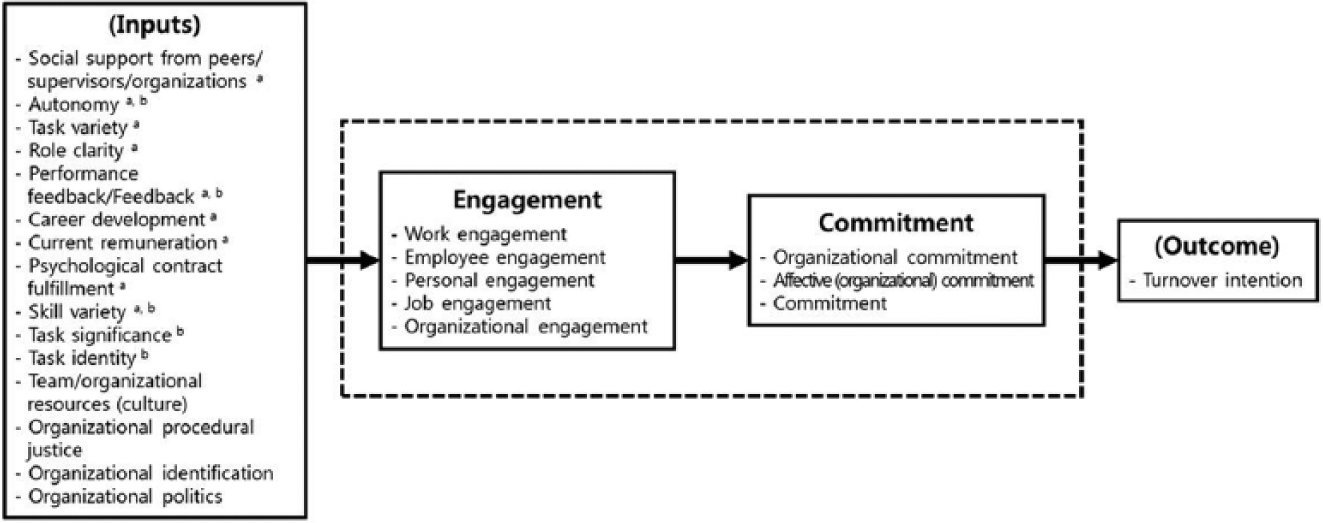
Relationships associated with effects of engagement on commitment.
Commitment leading to engagement with associated variables
Eight studies conceptualized and empirically demonstrated that commitment is a precursor to engagement and that, when employees are involved, attached, and loyal to their organization, they could be engaged in their work or manifest enhanced work engagement (Barnes & Collier, 2013; Ibrahim & Falasi, 2014; Zhang et al., 2015). That is, employee commitment to an organization will occur before their work engagement (Barnes & Collier, 2013), and when employees feel attached to an organization and obliged to repay the organization for this attachment, work engagement results as one way of such repayment (Choi et al., 2015). The implication is that, after employees are attached to their organization, they could become attached to their work as well. Specifically, employee commitment to an organization could also directly and positively influence engagement at work (Ibrahim & Falasi, 2014), and the impact of commitment on engagement could then be mediated by employees’ daily specific flow experiences (Rivkin et al., 2016).
Effects of employees’ organizational commitment on their work engagement could also be supported and facilitated by considering organizational inputs especially associated with leadership, such as inclusive leadership (Choi et al., 2015) and interpersonal leadership (Hansen et al., 2014). The effect of organizational commitment on work engagement could lead to reduced turnover intention (Zhang et al., 2015) and job tension (Hansen et al., 2014) as well as enhanced adaptability (Barnes & Collier, 2013). In addition to employee commitment to the organization, employee commitment to a supervisor could have a positive impact on work engagement, which, in turn, influences their innovative work behavior, feedback seeking for self-improvement, and error reporting in a positive way (Chughtai, 2013). Taken together, Figure 2 illustrates a framework that encompasses all the discussed influences of commitment on engagement in association with other relevant research constructs.
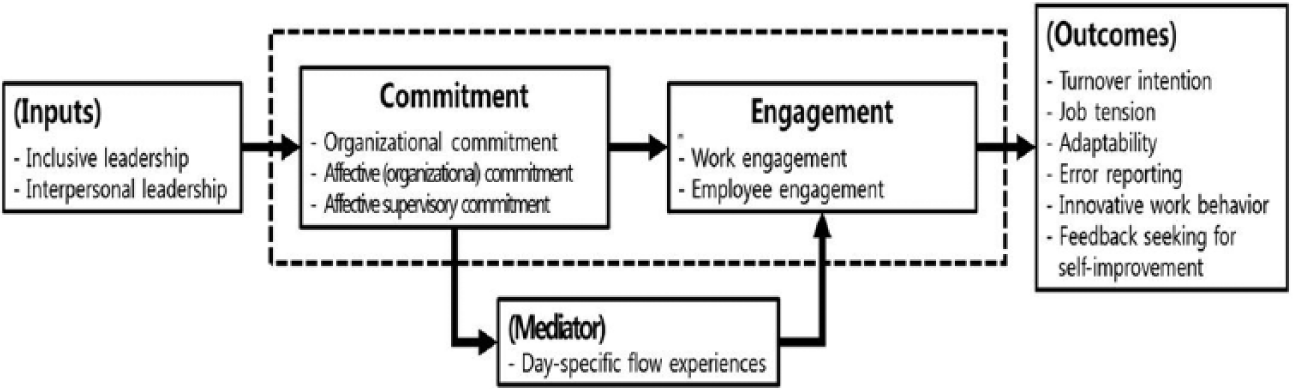
Relationships associated with effects of commitment on engagement.
Implications for HRD Research
This synthesis of extant literature on the relationship between work engagement and organizational commitment suggests several implications for HRD research. More opportunities for empirical research exist to explore the engagement–commitment relationship further as well as to uncover new implications in the field of HRD. First, as an effort to catalyze future research, the current study suggests frameworks in Figures 1 and 2 drawn from the examined empirical studies. However, we cannot postulate that the integrated frameworks are empirically valid, as neither of them have been specified and examined as a whole research model. It is therefore recommended that the suggested frameworks be validated to provide more holistic implications. In addition, as most studies focused on the affective component of organizational commitment (e.g., Choi et al., 2015; Rivkin et al., 2016)—with some emphasizing vigor and dedication as core dimensions of work engagement by excluding absorption (e.g., Parzefall & Hakanen, 2010)—reconceptualizing subdimensions of both constructs or redefining the constructs could be other areas worth examining for future research.
Given that the reviewed studies primarily focused on the one-directional effect of the relationship between work engagement and organizational commitment, future research could expand the current research effort by investigating the reciprocal relationship between engagement and commitment, considering both effects of engagement on commitment and effects of commitment on engagement in research models. Data collection should also be implemented with more than two time frames (e.g., Time 1 and Time 2) to examine the reciprocal relationship effectively, with a recommended longitudinal research design (e.g., years of cross-lagged study; Hakanen et al., 2008). The results of such research could provide the bigger picture of the engagement–commitment relationship.
In addition to quantitative research, future research could consider qualitative approaches to obtain in-depth meanings as well as to offer context and opportunities for expanded dialogues. When qualitative and quantitative studies are combined, elaborating on the meaning of the findings would be beneficial for such dialogues (Kim et al., 2013; Swanson, Watkins, & Marsick, 1997). As the reviewed quantitative studies showed that both the effects of engagement on commitment and the effects of commitment on engagement are statistically significant, future research could employ qualitative approaches to determine (a) how employees define and distinguish work engagement and organizational commitment, (b) upon which construct employees put more value and why, and (c) which construct employees think precedes the other in their organizational context and why. This would enable researchers to elaborate further on the quantitative findings about the engagement–commitment relationship.
Last, as most research variables used in the reviewed studies, including engagement and commitment, are individual-level variables, future research could consider organizational-level variables to comprehend the engagement–commitment relationship and relevant organizational-level antecedents and consequences. By considering two levels of engagement (i.e., job engagement and organizational engagement; Saks, 2006) instead of a singular concept of engagement, future research could employ multilevel research, using engagement as an organizational-level variable (i.e., aggregated variable) and including other organizational-level variables (e.g., actual turnover rates and error reporting rates of organizations). For this purpose, it would be helpful to use more sophisticated statistical methods such as multilevel analysis in SEM or hierarchical linear modeling (HLM).
Implications for HRD Practice
The reviewed empirical literature showed that the effect of work engagement on commitment and the effect of commitment on engagement are both statistically significant. However, which of these constructs precedes the other or whether both constructs are reciprocally related has not yet been made empirically explicit. Therefore, it would be more informative and effective for HRD professionals to utilize both frameworks (i.e., Figures 1 and 2) with a holistic perspective. The findings also indicated that engagement and commitment could be managed and enhanced by organizational efforts (e.g., job resources and inclusive leadership as antecedents) and that such results ultimately could produce desired organizational outcomes (e.g., lower turnover intention and innovative work behavior). Given these conclusions, HRD professionals are advised to pay more attention to diverse antecedent variables, presented in Figures 1 and 2, when designing relevant HR interventions to enhance work engagement and organizational commitment of employees.
From a review of the literature, it appears that most of the antecedent variables associated with the effects of engagement on commitment (see Figure 1) belong to job resources (e.g., role clarity, autonomy, performance feedback, social support, and career development) or job characteristics (e.g., task significance, autonomy, and task identity). Both categories partly overlap in terms of their subfactors and their focus on supporting individual employees’ job/work. Thus, if organizations hope to increase employees’ engagement and commitment on the level of the individual, HRD professionals must pay more regard to several factors. Such factors include what job resources and job characteristics the organization is able to provide and how the organization will adequately deliver these resources and characteristics when creating or modifying HR interventions to enhance employees’ work engagement. For instance, if an organization has a company-wide career development path system, HRD professionals could collaborate with managers and executives to provide individual employees with opportunities for their career development based on annual performance feedback from their managers. HRD professionals could also offer in-house training programs and/or half-day workshops so that supervisors might more effectively clarify subordinate roles and provide social support and autonomy to subordinates using performance feedback meetings.
In addition, some antecedent variables such as inclusive leadership, interpersonal leadership, and team culture focus on team-level interactions with leaders and other employees. To this end, it is critical to consider how to build a supportive team culture through fair interactions with leaders, especially through inclusive and interpersonal leadership. Inclusive leadership refers to leaders’ openness, accessibility, and availability when interacting with their followers (Choi et al., 2015). Interpersonal leadership is comprised of transformational leadership and interactionally fair leadership (Hansen et al., 2014). For HRD professionals in organizations seeking to enhance employee engagement and commitment on the level of team interaction, it is crucial to establish an interactive team climate with a midterm perspective and fair, open, and respectful leaders who frequently interact with followers, sharing information and a common vision.
Some antecedents such as organizational culture, organizational procedural justice, and organizational politics primarily focus on organizational-level culture. Positive organizational culture refers to “a culture of openness, fairness, and support” (Albrecht, 2012, p. 845), and similarly, procedural justice is about fairness of processes and means to allocate resources (Saks, 2006). Conversely, organizational politics refers to “phenomena in which organizational members attempt either directly or indirectly to influence other members by means not sanctioned by formal standard . . . or informal norms” (Karatepe, 2013). Taken together, it would be pivotal to establish an organizational climate with the goals of fair treatment and process and an attitude of openness and support toward employees. If organizations support increasing employees’ engagement and commitment at the level of organizational culture, HRD professionals will need to take a long-term approach to build up a company-wide culture based on openness and fairness. As an initial effort to do that, HRD professionals should define and clarify what their organizational culture means and why a positive organizational culture is important and beneficial to individuals, teams, and the organization as a whole. HRD professionals must also put considerable effort into supporting the development of their designed organizational culture and educating others on this culture using diverse HR interventions (e.g., sharing best practices, on-/off-line messages from CEO/executives, culture-related posters, and promotion material including short video clips). During this process, conveying these messages to more employees and helping them to trust this organizational culture is a vital part of encouraging employees to act as change agents and supporters, reflecting a positive organizational culture in their own work.
Despite such OD efforts, if any forms of organizational politics exist, creating a fair and supportive culture would quickly go down the drain. Hence, HRD professionals should be watchful against any forms of organizational politics and make persistent efforts to diminish the side effects of organizational politics with substantial support from CEO/executives.
Conclusion
This literature review employed the holistic perspective of empirical research on the relationship between work engagement and organizational commitment to examine studies, identify relevant findings, assess strengths and weaknesses, and synthesize findings into meaningful implications for HRD research and practice. Throughout the process, this study identified what we know and what we need to explore further on the topic. The reviewed studies showed that work engagement and organizational commitment are distinct constructs. The studies also showed that the impacts of work engagement on organizational commitment and of organizational commitment on work engagement, associated with other antecedent and consequent variables, were statistically significant. However, as the reviewed studies mainly focused on the one-directional effect of the relationship between work engagement and organizational commitment, the research is still not empirically clear on which construct precedes the other or whether both constructs are reciprocally related in terms of the holistic perspective.
The synthesis of reviewed studies on the relationship between work engagement and organizational commitment yield relevant HRD implications for practice and research. With regard to HRD practice, HRD professionals are encouraged to pay more attention to diverse antecedent variables (e.g., job resources and team/organizational culture, see Figures 1 and 2) when designing and implementing relevant HR interventions. Most antecedents including job resources and job characteristics tended to focus on supporting individual employees’ job/work, whereas some antecedents are related to either team-level interactions (e.g., inclusive and interpersonal leadership) and/or organizational-level culture (e.g., organizational culture, procedural justice, and organizational politics). Future HRD research could empirically validate the frameworks suggested in Figures 1 and 2 and examine the reciprocal relationship between engagement and commitment with a longitudinal research design. In addition to quantitative approaches, future studies could also consider employing qualitative approaches to obtain in-depth meanings and offer greater context on the engagement–commitment relationship. Finally, future studies could further explore to link between engagement and commitment by considering both individual- and organizational-level variables.
Last, the current study only reviewed empirical studies on work engagement–organizational commitment relationship based on the purpose of the study and excluded conceptual literature that might have been useful to the study. Thus, we suggest further exploration on conceptual studies that can help us toward more holistic perspectives about both work engagement and organizational commitment concepts.
Footnotes
Declaration of Conflicting Interests
The author(s) declared no potential conflicts of interest with respect to the research, authorship, and/or publication of this article.
Funding
The author(s) disclosed receipt of the following financial support for the research, authorship, and/or publication of this article: This research was supported by Korea University of Technology and Education.