



Abstract
Employers increasingly attempt to create the right environments where employees experience work–life balance. At the same time, organizations concerned with their organizational-level outcomes encourage improving employee work engagement. The question becomes, how do employee work–life balance and work engagement relate to one another? A similar question concerns human resource development (HRD) practitioners who seek to help both employees with balancing their work and life and employers with their organizational goals. A body of literature has examined the relationship between work–life balance and work engagement, which we review in this article. We identify and synthesize the findings of 37 articles empirically investigating the relationship between work–life balance and work engagement. The findings showed the various antecedents, mediators, and moderators that depict the relationships between work engagement and work–life balance. Furthermore, we provide insight into HRD scholarship regarding how to clarify the direction of causality between two concepts, which has been largely left inconclusive. Finally, our article proposes insightful directions for future research and practice in the field of HRD.
Introduction
Over the past decade, research into the areas of employee work engagement and employee psychological well-being has gained increasing interest in the fields of human resource development (HRD) and organizational behavior (Shuck & Wollard, 2010). Research has shown that work engagement, which is defined as “a positive, fulfilling, work-related state of mind” (Schaufeli et al., 2006, p. 702), has a positive effect on a variety of not only the employee but also organizational outcomes. Job satisfaction, organizational commitment, work performance, financial returns, and customer loyalty (Albdour & Altarawneh, 2014; Bakker et al., 2012; Salanova et al., 2005; Yan et al., 2017) have been reported as the examples of these outcomes. Using a meta-analytic approach, Halbesleben (2010) found that work engagement is positively related to employees’ organizational commitment, performance, and health/well-being while being negatively associated with turnover intention.
Due to the great potential of work engagement that drives organizational prosperity, organizations are concerned with employee work engagement. At the same time, employers increasingly attempt to create the right environments where employees experience work–life balance (WLB). The question becomes, how do employee WLB and work engagement relate to one another? A similar question concerns HRD practitioners who seek to help both employees with balancing their work and life and employers with their organizational goals.
A body of literature has examined the relationship between WLB and work engagement in the literature. Given that both work and family life require a great amount of time, energy, and emotional effort, several work engagement studies have found support for the notion that an individual’s personal life (e.g., nonwork satisfaction and work–nonwork conflict) substantially influences an employee’s engagement, and vice versa (Halbesleben, 2010; Timms et al., 2015). In addition, the literature has shown that work engagement and WLB factors (e.g., work–family imbalance, work–family conflict [WFC], family–work conflict [FWC], work–family enrichment, work–family interference, work–family facilitation, and work–family spillover) have reciprocal relationships, influencing each other (Crutchfield et al., 2013; Ilies et al., 2017; Karatepe & Demir, 2014; Vîrgă et al., 2015). For example, multiple empirical studies (e.g., Parkes & Langford, 2008; Shankar & Bhatnagar, 2010) have found the linkage between work engagement and work–life/family constructs. On the contrary, if employees suffer from a lack of resources (i.e., depletion of role resources; Rothbard, 2001), they are less likely to fulfill their family responsibilities, thus creating work–life conflict (Chernyak-Hai & Tziner, 2016; Mache et al., 2016). As demonstrated in the job demands and resources (JD-R) model (Opie & Henn, 2013), it has been shown that job demands (e.g., WFC or FWC) are antecedents to work engagement.
Based on the strong needs of HRD practitioners and close linkages between work engagement and WLB revealed from previous studies, this study aims to analyze and synthesize relevant empirical studies that examine the relationship between work engagement and WLB. Although there are many review studies of work engagement and those of WLB, to our knowledge, no integrative review has studied the empirical evidence about the relationship between the constructs of work engagement and WLB. Through an integrative synthesis, therefore, we could contribute to the literature by not only documenting the current level of understanding between the two constructs but also by developing a future research agenda for scholars interested in pursuing this area of inquiry.
The current article is organized as follows: the Literature Review section provides an overview of the key concepts—work engagement and WLB. After that, we describe the methodological approach by explaining the article selection process including the search criteria used for the literature review and include a description and synthesis of the findings from the selected articles. This is followed by a section on the theoretical and practical implications of the research. Finally, we note the limitations of the study and areas for future research as well as some final concluding remarks.
Literature Review
In this section, we provide an overview of work engagement and WLB. In particular, we discuss its definitions and the results from empirical studies on this topic. Furthermore, we included a theoretical lens that helps to explain the relationship between work engagement and WLB.
An Overview of Work Engagement
Work engagement is defined as a positive, fulfilling motivational state of work-related well-being (Blanch & Aluja, 2009). Engaged employees identify themselves through their work, and as such have high levels of vigor, dedication, and a deep sense of absorption in their work (Gignac et al., 1996; Klitzman et al., 1990; Timms et al., 2015). Absorption dimension of work engagement, referring to the full concentration on and immersion in work, is often characterized by having time pass quickly or by finding it difficult to detach oneself from one’s work (Mauno et al., 2007; Schaufeli, Martinez, et al., 2002). Recently, some researchers have viewed that experiencing absorption is rather similar to that of flow (González-Roma et al., 2006). Flow relates to the state of mind in which people are intensively involved in a task that nothing else seems to matter; moreover, it is so enjoyable that people will do it purely for the sake doing it (Mauno et al., 2007). Vigor is characterized by high levels of energy, willingness to put effort into the job, and persistence in the face of difficulties (Tims et al., 2012). From an organizational perspective, vigorous employees persist with difficulties and find their job energizing (Bakker & Schaufeli, 2008; Timms et al., 2015). Work engagement’s final component, dedication, is characterized by a strong psychological involvement in one’s work, coupled with a sense of enthusiasm and a feeling that one is challenged by the job (Schaufeli, Salanova, et al., 2002). Work engagement was initially introduced as an antonym of psychological burnout which occurs through a lack of WLB (Maslach et al., 2001). However, others have argued that work engagement and psychological burnout had similar antecedents, albeit with opposing effects (Bakker & Demerouti, 2007; Leiter & Maslach, 2004; Timms et al., 2015).
An Overview of WLB
In recent decades, a great deal of emphasis has been placed on the health and well-being of employees (Peeters & Demerouti, 2014), and as such, WLB is receiving great attention from both researchers and practitioners as a means of nurturing employees’ well-being (Jones et al., 2013; Kinnunen et al., 2014; Wagner et al., 2014).
WLB refers to obtaining a sufficient degree of satisfaction at both home and work (Campbell Clark, 2000). WLB can be achieved through attentive engagement in multiple roles (Marks, 1977; Marks & MacDermid, 1996), in which time allocation and involvement are approximately equal (Kirchmeyer, 2000).
Employees’ work or workplace environments can profoundly influence their nonwork-related life situations, and vice versa, which is often referred to as the “work-to-family interference” or “family-to-work interference” (Mache et al., 2016). The link between these two areas has supported either positive or negative effects on a person’s well-being. According to Kinnunen et al. (2014), over the last two decades, the line between a person’s professional life and nonwork life has become increasingly blurred. This is largely due to changes in family structures, increases in women’s participation in the workforce, and technological changes (e.g., mobile phones and portable computers), which has seen the nature of work evolve with the introduction of remote working practices (Peeters et al., 2005). Given such an environment, employees now place more value on free time or social interaction with friends, family, and their community.
Theoretical Perspectives Explaining the Link Between WLB and Work Engagement
A diverse array of theoretical perspectives have been identified that support the links between work engagement and the work–family interface. A further examination of the literature identified both positive and negative associations between these constructs, the likes of which were respectively examined using accumulation and depletion approaches (Rothbard, 2001). First, accumulation/enrichment of resource perspectives, such as the role enrichment and conservation of resources (COR) theory, were used to explain positive associations between them (e.g., either positive effects of work engagement on WLB or positive effects of WLB on work engagement). The role enrichment perspective (Rothbard, 2001) assumes that positive role-related experiences or emotional responses to one role can increase one’s engagement in other roles. Furthermore, when individuals have positive feelings for one’s work role in the workplace, it can encourage one to perceive WLB aspects positively and vice versa (Marais et al., 2014).
Similarly, the COR theory (Hobfoll, 1989, 1998) assumes that existing resources can bring additional resources, thus individuals with more resources are more capable of initiating proactive behaviors and resolving a problem. Having a good WLB provides oneself with energy, self-efficacy, and a positive attitude, which can intrinsically motivate and energize employees to be engaged in their work (Niessen et al., 2018). It also turns out that work role engagement positively influences work role resource gains, consequently leading to work-to-family enrichment (Z. Chen & Powell, 2012). It can be inferred that work engagement and work–life interface factors can reciprocally strengthen each other based on the COR theory.
On the contrary, research on the negative relationship between work engagement and work–family interface has been rooted in the role strain/loss perspective, which means that multiple demands of work and family are detrimental, thus evoking negative responses to the roles because individuals have limited amounts of time and energy (Greenhaus & Beutell, 1985; Rothbard, 2001). From a strain/loss perspective, people fulfilling dual responsibilities in both work and family (e.g., work–family interferences) face difficulties when transitioning from one role to another due to competition for limited resources, which can lead to disengagement from work (Montgomery et al., 2003). Furthermore, the JD-R model has been predominantly used to examine both the positive and the negative relationships between work engagement and family-related factors. According to the JD-R model, high job resources can increase work engagement, while high job demands can result in burnout (Bakker & Demerouti, 2007; Hakanen & Roodt, 2010). Based on this model, family-related job resources, such as work–family culture and family-supportive supervisor behaviors (FSSBs), can play a pivotal role in enhancing work engagement (Peeters et al., 2009; Qing & Zhou, 2017), whereas a lack of resources and high demands, such as role conflicts (WFC, FWC), role overload, and the emotional demands of family roles, may reduce work engagement and well-being (Opie & Henn, 2013).
Method
An integrative literature review is a distinguishing form of research that creates new knowledge about topics reviewed (Torraco, 2005, 2016). This integrative literature review helps to succinctly summarize, analyze, and synthesize an extant body of literature from a certain genre of scholastic endeavor (Chermack & Passmore, 2005). Furthermore, given that a literature review can provide comprehensive and refreshing perspectives on topics that may include inconsistencies or contradictions in the extant literature, this research adopted a literature review as the primary methodological approach (Torraco, 2005, 2016).
Based on the guidelines of Torraco’s (2005, 2016) integrative literature review, this research begins by searching for and selecting relevant articles in the existing literature. For a systematic and clear literature review, this inquiry is guided by Callahan’s (2010) criteria for conducting a literature review, considering (a) where the articles were discovered (i.e., databases), (b) when the search was implemented, (c) who undertook the search, (d) how the articles were found, (e) how many articles were identified and the final number of articles selected, and (f) why the articles were ultimately chosen (Callahan, 2010; Kim et al., 2013, 2017).
When implementing the initial article search in March 2018, the researchers utilized ProQuest multiple databases, which encompassed 43 subsets of databases (e.g., ABI/INFORM Collection, PsycINFO, PsycARTICLES, and Social Science Premium Collection) to discover relevant articles. With regard to keyword combinations, the primary focus of this study is the relationship between work engagement and WLB within organizations. Given that the term work engagement is used interchangeably with similar terms, such as employee engagement, job engagement, personal engagement, and role engagement (Kim et al., 2013, 2017; Lee et al., 2016), we used the keyword engagement to elicit all available publications that focus on work engagement. When it comes to WLB, a preliminary search via Google Scholar showed that the concepts of work and life balance seem to be examined with substantial analogous concepts, such as work personal life balance, work life imbalance, work family balance, work family imbalance, work family conflict, family work conflict, work family enrichment, work family facilitation, work family interference, and work family spillover. Thus, we included all aforementioned 11 terms to comprehensively discover relevant articles. Taken together, the search keywords used for the initial search were combinations of (a) “engagement” with (b) “work and life balance,” “work personal life balance,” “work life imbalance,” “work family balance,” “work family imbalance,” “work family conflict,” “family work conflict,” “ work family enrichment,” “work family facilitation,” “work family interference,” or “work family spillover.” Also, to ensure that articles examined the identified relationship, only articles in which the search terms appeared either in the titles or abstracts were included. In addition, considering the inconsistent directionality between work engagement and WLB, articles that empirically examined both work engagement and WLB were only included for further analysis. As we focus primarily on the specific relationship between work engagement and WLB, none of qualitative studies was identified. Although a specific time restriction was not imposed on the results, this review focused on peer-reviewed articles and English-language journals, which are fully accessible in databases.
The initial search results using the series of keywords generated 139 articles. Afterwards, a staged review approach was conducted with 139 articles to further identify relevant articles aligned with the purpose of the review. Torraco (2005) stated that the staged review is as follows: (a) perform an initial review by reading abstracts and (b) complete an in-depth review for each article. Using the staged review approach, any articles meeting the selection criteria are included for further review. During the in-depth review process, articles that empirically investigated the relationship between work engagement and WLB in organizational settings were only selected for further consideration. However, for the quality of the review, if an article merely described the relationship without any research model or framework and a method section, it was excluded. Furthermore, we reviewed the references of the selected articles to expand the pool of articles. As a result, we added five articles after duplicate articles were also excluded (e.g., Montgomery et al., 2003; Qing & Zhou, 2017). Throughout these processes, 37 articles were ultimately included for further review.
Findings
The process of analysis and synthesis was implemented based on the 37 articles that were ultimately selected. Of these studies, 16 studies have a WLB to work engagement directional focus, 12 studies have a work engagement to WLB directional focus, while a further nine studies were non-directional in nature (see Table 1). In an effort to provide a more detailed synopsis of the selected literature, the total number of articles has been sorted by the direction and empirical method type. Also, a brief summary, including authors, year, the purpose, theoretical frameworks, the data collection and analysis methods, and key findings, is presented in Supplemental Appendix 1. The included and reviewed studies are listed in chronological order, beginning in 2003.
Number of Selected Articles by Direction.
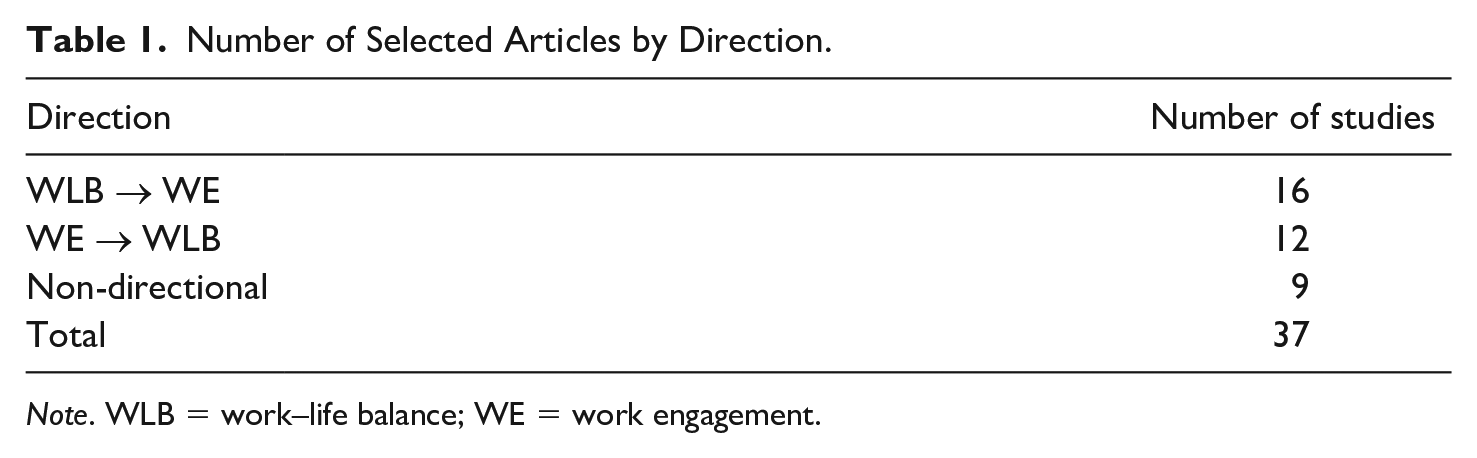
Note. WLB = work–life balance; WE = work engagement.
An overviewed assessment of the studies recorded (see Supplemental Appendix 1) shows that the key theoretical lenses found in our analysis include the COR theory (seven studies), personal engagement theory, broaden-and-build theory, role theory, job characteristics theory, segmentation theory, self-determination theory, spillover theory (two studies), global social support theory, affective events theory, perceived organizational support theory, the role enhancement theory (two studies), role expansionist theory (two studies), attribution theory, and compensation theory, while the following models were also used, including the JD-R model (eight studies), the job demand–control and job demand–control support models, the spillover–crossover model (SCM), work–home resources model, and the effort–reward imbalance model. In terms of design, of the 37 studies, 31 were correlational and seven were longitudinal. In terms of measuring work engagement, 30 of the 37 studies utilized the Utrecht Work Engagement Scale (UWES), while the key measures/variables of WLB included WFC (22 studies), work–family enrichment (nine studies), work–family culture (four studies), WLB (six studies), work–family facilitation (six studies), work–family benefits, work–life imbalance, family satisfaction, work–home interference, and FSSBs.
As the focus of this research is to closely take a look at the relationship between work engagement and WLB in organizations, this section details three key sections: (a) the influence of WLB on work engagement, (b) the influence of work engagement on WLB, and (c) the non-directional influence (e.g., not directly related or reciprocal) relationship between work engagement and WLB.
WLB as the Antecedent of Work Engagement
The literature highlights a range of areas that sought to better understand the WLB as the antecedent of work engagement. Organizational policies, procedures, structures, and systems decide the extent to which employees are satisfied, committed, or engaged in work within their organization. From this analysis, the literature identified a range of factors that have a mediating effect, such as family and work demands, WFC, work–family enrichment, and a supportive work–family culture.
To better understand work–family culture, a key early study by Montgomery et al. (2003) found that work and home demands create additional work pressures and decreased feelings of engagement, while the availability of work and home resources led to greater engagement and reduced burnout in the workplace. Furthermore, Peeters et al. (2009) found that it pays to invest in a supportive work–family culture because such a culture contributes to work engagement and at the same time helps to prevent burnout. A key study to assess the main factors encouraging or preventing work engagement was conducted by Evans and Redfern (2010). Their results highlighted that communication, remuneration, the branch induction process, and WLB play a significant role in helping to enhance work engagement; this finding was echoed by a subsequent Joshi and Sodhi (2011) study, which further analyzed the role of organizational climate in driving work engagement. Their study was particularly influential, as they were able to clearly show that WLB, job content, monetary benefits, and team orientation are important drivers of work engagement for both executives and non-executives.
Moreover, as Itam and Singh (2012) identified in their study of the Indian retail sector in Hyderabad, policies aimed at encouraging corporate training highlighted the positive correlation that exists between work and personal life, stress and training, and work engagement. In addition, Scanlan et al. (2013) found that by implementing policies that help to nurture staff, well-being at work (and especially job satisfaction) was significantly associated with lower turnover intention. Such a finding supports the belief that organizations with flexible or family-friendly policies are better placed to develop a better WLB for their employees, which in turn allows them to better deal with the demands of contemporary households.
In a subsequent study by Timms et al. (2015), the issue of work–family enrichment was examined as a predictor of work engagement. Furthermore, they considered the positive and negative influence of WLB for work performance. Their cross-sectional results showed that experiences of work that contributed to a positive mood (affect) and to a sense of confidence (capital) in family life were associated with all three dimensions of work engagement (i.e., absorption, dedication, and vigor) and with family satisfaction, while their longitudinal analyses demonstrated enduring effects of positive mood, with work–family affect predicting work engagement and family–work affect predicting family satisfaction (Timms et al., 2015).
Another area of importance within the WLB debate is the issue of WFC. To this end, Peeters et al. (2009) examined the mechanism through which work–family culture influences burnout and work engagement. Their study showed that a supportive work–family culture not only enhances work engagement through work–family enrichment but also reduces burnout through the mediation of WFC. Mauno (2010) shed new light on the linkage between work–family culture and well-being (WFC, work engagement, and job exhaustion) by approaching this association through a 2-year longitudinal design. The results showed a strong prospective association between managerial work–family support and work engagement; however, there was only a lagged association between the dimensions of work–family culture (support and barriers) and work engagement. Siu et al. (2010) also demonstrated the influence that FSSBs have on predicting work engagement. Set in a Chinese context, the study showed that FSSBs have a direct, positive, and significant influence on work engagement.
An important contribution was made to the WFC literature by Opie and Henn (2013). Their study helped to reveal that personality (e.g., neuroticism and conscientiousness specifically) plays a vital role in moderating the relationship between WFC and work engagement. Their analysis showed that for those with a high level of conscientiousness, the decrease in work engagement that is associated with increased WFC is more prominent than the corresponding decrease for those with medium or low levels of conscientiousness (Opie & Henn, 2013).
More recently, Li et al. (2014) further extended our understanding about the relationship between work engagement and WFC through moderating the effects of proactive personality. The results from their analysis showed that social support had a positive effect on work engagement, and that WFC had a negative effect on work engagement. In a similar study by Fiksenbaum (2014), an examination of the effects of WFC on an individual’s well-being (i.e., life satisfaction and work engagement) was conducted. The study showed that the availability of work–family benefits promoted a supportive work–family culture, which was inversely related to WFC. Moreover, WFC as a mediator contributed negatively to relationships of work–family culture with both life satisfaction and work engagement (Fiksenbaum, 2014). In addition to this, Chambel et al. (2017) examined the relationship between job characteristics and workplace well-being and the role work-to-life conflict plays in mediating this relationship. Their study further substantiated that in both the part-time and the full-time subsamples, employees’ perceptions of job characteristics are related to their well-being, and the work-to-life conflict partially mediates this relationship. Specifically, they suggested that part-time work is a good solution to prevent the work-to-life conflict and the promotion of well-being at work.
More recently, Vîrgă et al. (2015) examined the interplay that exists between (a) job resources, (b) personal resources (organizational-based self-esteem and self-efficacy) and personality traits (conscientiousness, extraversion, and emotional stability), (c) a specific job demand (work–life imbalance), and (d) work engagement, in a manner that is in line with the alternative JD-R model proposed by Bakker (2011). The results showed that work–life imbalance undermines the positive relationship between self-efficacy and work engagement. Moreover, in a three-way analysis of job resources, personal resources, and job demands interaction, self-efficacy and job resources were found to have had a positive relationship with work engagement when work–life imbalance was low. Chan et al. (2017) found, in their analysis of public and private sector employees in Australia, that self-efficacy was both significantly and negatively related to work and family demands, which in turn were negatively associated with WLB, while a better WLB, in turn, enabled employees to be more engaged in their work.
Finally, Niessen et al. (2018) investigated the issue of preventive coping. From their analysis, they revealed significant indirect effects for emotional exhaustion, work engagement, and relationship satisfaction through WLB. Moreover, for those employees who engaged less in preventive coping, a higher number of business trips were related to a decrease in WLB, which, in turn, was related to more emotional exhaustion, less work engagement, and lower relationship satisfaction. However, for those employees who reported higher preventive coping, opposing indirect effects were found. In this instance, frequent travel was related to an increase in WLB and, in turn, to less emotional exhaustion, more work engagement, and higher relationship satisfaction (Niessen et al., 2018).
Work Engagement as the Antecedent of WLB
The inherent need for organizations to better appreciate the broader canvases of the workers’ lives has been increasingly recognized as being an important determinant for employee health and work performance (Timms et al., 2015). Much research has been conducted on the correlative influences of work engagement and WLB. A key study by Burke et al. (2013) showed that for frontline employees in the hospitality and tourism sector, work engagement was significantly related to job satisfaction and lower levels of WFC and FWC.
Work engagement as the antecedent of WLB is another important area of research, with several studies highlighting the spillover effects that exist away from work. To this end, Halbesleben et al. (2009) investigated the potential influence of work engagement of family life. Their results showed that highly engaged employees have lower levels of work interference with family. Meanwhile, Culbertson et al. (2012) showed, in their research on the relationship between work engagement and work-to-family facilitation, that daily work engagement had a positive effect on family life, with the results moderated by work–family capitalization, or the sharing of positive work experiences at home. More recently, Karatepe and Demir (2014) examined the link between work engagement and work–family facilitation from a hotel industry perspective. Their results were significant as they demonstrated the positive role that core self-evaluations have on work engagement. More specifically, those who are highly engaged at work are more capable of integrating their work (family) and family (work) roles successfully.
Through active work engagement and the adoption of a range of factors, such as flexible work times, workplaces, part-time contracts, and maternal/paternal leave, an employer or an organization is able to provide techniques and policies to foster the WLB of employees. In this regard, Z. Chen and Powell (2012) tested a resource-based model of work-to-family enrichment and conflict. From this analysis, their study made an important contribution to the literature by demonstrating how work engagement can build resource gains and, therefore, suggested it was an antecedent of work–family enrichment. A subsequent study by Marais et al. (2014), in which the relationship between work resources, home resources, work engagement, family engagement, and work–family enrichment was assessed, provided some interesting results. Their analysis showed a positive relationship between work–family enrichment and its antecedents and outcomes. More specifically, it highlighted the mediating relationship between work resources and work engagement, while family–work enrichment helped to mediate the relationship between home resources and family engagement. Similar conclusions were also drawn by Qing and Zhou (2017), in which work engagement was the most proximal predictor of work–family enrichment in a mainland China context.
Another area identified as having a significant bearing on the issue of balancing between work and life is WFC. Within this area of analysis is the issue of spillovers. A key contribution in this area is the SCM, which proposes that work-related strain first spills over to the home domain and then crosses over to the partner through social interaction (Bakker et al., 2012). In this regard, Bakker et al. (2014) found that work engagement was positively related to work–family facilitation, which, in turn, leads to predicted employee’s/partner’s family satisfaction. Chernyak-Hai and Tziner (2016) found that work engagement is statistically and positively associated with burnout and was shown to predict higher experiences of WFC—a finding that was supported by Rantanen et al. (2013), in which over-engagement through high weekly working hours and insufficient personal time were related to harmful levels of WFC. In addition, Y. S. Chen and Huang (2016) examined how a personal engagement may be related with WFC and innovative behavior. Their study showed that charismatic leadership style, colleague support, and self-esteem are key indicators of predicting personal engagement, which, in turn, had a positive relationship with innovative behavior and WFC. More recently, Ilies et al. (2017) found, in their analysis of Chinese banking employees, that daily work engagement experiences related positively, within individuals, to work–family interpersonal capitalization, which, in turn, related positively to daily family satisfaction and to daily work–family balance. They indicated that both the relationship between daily work engagement and work–family interpersonal capitalization and the indirect effects of daily work engagement on the family outcomes were stronger for employees with higher intrinsic motivation than for those with lower intrinsic motivation.
Non-Directional Relationship Between WLB and Work Engagement
The third key area identified within the literature detailed the non-directional relationship that exists between WLB and work engagement. In this context, the term non-directional refers to the findings of the relevant literature not showing any directly related or reciprocal relationship between work engagement and WLB, but examining antecedent factors influencing WLB and/or engagement construct. Ringrose et al. (2009) assessed burnout rates and potential determinants of burnout in a sample of medical residents. The results from their study were non-directional in that WFC, work-related autonomy, and level of work engagement were significantly associated with burnout.
From a gender perspective, Burke et al. (2009) examined work experiences, nonwork satisfactions, and psychological health among Turkish physicians. As part of this, they measured gender differences in levels of work engagement, WFC, and FWC. Their study found that female and male groups were of similar levels for work engagement and FWC; however, in terms of WFC, female physicians reported higher levels of conflict. In addition to this, Geldenhuys and Henn (2017) found, in their study of women in South African workplaces, that a significant relationship exists between life satisfaction, WFC, and work engagement. Moreover, being White showed a significant positive relationship with life satisfaction, WFC, and work engagement.
In other studies that exhibited non-directional findings, Simbula (2010), while using the JD-R model, examined the antecedents of job satisfaction and mental health. In particular, the author examined the effects of WFC (job demand) and co-workers’ support (job resource) by adopting the daily-basis survey to assess day-level exhaustion and work engagement. The results showed that both day-level work engagement and exhaustion mediated the impacts of day-level co-workers’ support on a day-level job satisfaction and day-level mental health (Simbula, 2010).
An examination of the relationship between work engagement and WLB, by Crutchfield et al. (2013), sought to better understand the influence of occupational commitment on agricultural educator retention. Their study showed that a positive relationship exists between occupational commitment and vigor, dedication, and perceptions of WLB. Furthermore, Eek and Axmon (2013) found that workplace factors, such as flexibility and attitude, were positively related with work engagement for working parents and negatively related with WFC and FWC.
Dåderman and Basinska (2016) examined the extent to which perceived job demands (workload and interpersonal conflicts at work) and engagement (vigor) are significantly correlated with turnover intentions in the Polish nursing sector. Furthermore, job demands, engagement (vigor and dedication), and turnover intentions had a strong effect on WFC, while absorption (the third component of engagement) had a strong effect on FWC (Dåderman & Basinska, 2016). This finding implies that work engagement not only predicts WFC, but can also be associated with FWC. More recently, Babic et al. (2017) investigated the directionality of the causal relationships between WFC, work–family enrichment, and two well-being variables (i.e., job strain and job engagement). By incorporating a two-wave cross-lagged design (a 6-month interval), their results demonstrated the reciprocal effects present between WFC-job strain and WFC-job engagement.
In other job resources studies, Mache et al. (2016) investigated the relationship between medical physicians’ JD-R, perceived job stress, WFC, work engagement, and job satisfaction. They found the significant relationships between physicians’ work engagement and their job satisfaction, as well as between job stress and WFC.
Synthesis of the Reviewed Literature
As found in the findings from the 37 publications, it seems that it is premature to conclude that one variable greatly influences over the other. Our findings found that in some 16 studies, WLB has been more frequently explored as an antecedent of work engagement rather than an outcome; however, in some 12 other studies, work engagement was also shown to be a precondition of WLB as well. Thus, it is safe to assume that based on our findings, the two variables have a bidirectional relationship rather than having causality. To demonstrate the causality of work engagement and WLB-related factors, further longitudinal studies should be developed. In addition, further meta-analytic studies should be conducted to more quantitatively and precisely measure the associations.
When it comes to theories that explain the relationship between WLB and work engagement, we found that both the JD-R model and COR theory have been predominantly used to support the direct and/or indirect direction from WLB factors and work engagement, which means WLB is regarded as the critical resource of enhancing work engagement. However, we found that various theoretical frameworks, including SCM, have been used when testing the direction from work engagement to WLB.
Based on key findings of the reviewed studies, we have created Figures 1 and 2, which detail the effect of work engagement on WLB, and vice versa, so as to clearly depict the process or underlying mechanism of the associations. A thorough analysis of the literature provided scope for the development of a detailed understanding of the antecedents (e.g., charismatic leadership, colleagues support, and self-esteem) that encourage first work engagement and then a range of factors that both mediate (e.g., burnout and work–family facilitation/conflict) and moderate (e.g., gender and intrinsic motivation) the effect that work engagement has on WLB (see Figure 1).

The effect of work engagement on work–life balance.

The effect of work–life balance on work engagement.
Alternatively, our empirical analysis of the literature also identified a range of mediating (e.g., family and work demands, supportive work–family culture, and work–family enrichment) and moderating (e.g., preventive coping and work–life imbalance) factors that influenced the effect that WLB and its associated terms have on work engagement and in particular the flow-on effect of employee turnover.
Based on our review and figures, it appears that a variety of antecedents of both work engagement and WLB, including job resources (e.g., colleague support and work–family culture) and personal resources (e.g., self-esteem and self-efficacy), have been studied. Specifically, the most prominent antecedent was the perceived level of support given by colleagues, co-workers, and society, which was then followed by self-efficacy/esteem, as shown in two studies by Chan et al. (2017) and Y. S. Chen and Huang (2016). Three studies (see Y. S. Chen & Huang, 2016; Li et al., 2014; Simbula, 2010) found that social or colleague support is the precondition for either work engagement or WFC. When it comes to the outcomes of both work engagement and WFC, the most frequently studied outcome was satisfaction, including job satisfaction (i.e., Burke et al., 2013; Mache et al., 2016; Simbula, 2010), family satisfaction (i.e., Ilies et al., 2017; Timms et al., 2015), and personal or life satisfaction (i.e., Geldenhuys & Henn, 2017; Scanlan et al., 2013). Seven studies, including those by Burke et al. (2013) and Mache et al. (2016), found a positive association between satisfaction as an outcome variable and work engagement and WFC, while the factors of satisfaction, turnover intention, and intention to stay were also notable outcomes highlighted in three studies by Burke et al. (2013), Dåderman and Basinska (2016), and Scanlan et al. (2013).
However, our study found no marked use of a mediator/moderator among the 37 articles. In addition, studies that have examined either moderators or mediators have focused primarily on exploring underlying mechanisms in which work engagement predicts WLB and their conditional factors than revealing mechanisms and conditions of the other direction (WLB–work engagement relationship). Given the reciprocal association between work engagement and WLB factors, as revealed by Babic et al. (2017), Siu et al. (2010), Timms et al. (2015), more longitudinal investigations should be attempted in order to more clearly identify their associations.
Discussion
We suggest a number of practical and theoretical HRD implications based on the key findings of the empirical literature review.
Theoretical Implications
The most evident implication of our review is that the direction of causality between work engagement and WLB remains inconclusive. As evidenced in our review, a growing body of literature has examined the relationships between two constructs; however, the direction between them has been not clearly articulated. Our findings showed that work engagement is the antecedents of WLB, vice versa. It can be attributed to the lack of theories that explicitly link the two constructs. While the COR theory and JD-R model guided our inquiry, neither of theories paid close attention to the direction or causality between two concepts. Therefore, we urge researchers to further examine the direction between work engagement and WLB and empirically substantiate this link.
Another evident implication of our review is our ability to clearly identify the definitions and validate the concepts through research examining work engagement and WLB. First, work engagement has been conceptualized and viewed from two different perspectives. On one hand, work engagement and burnout are reciprocating components on a single continuum, rather than clearly distinct concepts. However, on the other hand, some scholars (e.g., Schaufeli et al., 2002) argue that work engagement, albeit relevant to burnout, exists as independent. In our review, we established a consensus that work engagement as a distinct concept is associated with WLB. For example, 29 of the 37 studies have used the term “work engagement” as their research construct, instead of employee engagement, job engagement, and (work) role engagement. Furthermore, as was evident in previous arguments (Bakker et al., 2008), the different versions (i.e., short 9-item and original 17-item) of UWES have been utilized in 29 studies to validate the concept of work engagement, in doing so, establishing itself as the predominant scale of measurement.
In addition, some scholars interestingly distinguish the concept of work engagement from burnout, depicting work engagement and its primary relationship with workaholism as a counterconcept of work engagement. Previous studies have shown that burnout is solely related to work engagement; however, we observed that researchers have moved away from simply creating a consensus on the definitions and constructs of work engagement, to seeking the influences and concepts of work engagement in relation to other similar work-related constructs. For instance, Bakker et al. (2014) revealed that although workaholism and work engagement may seem to show similar behaviors, the underlying basis between these two concepts is fundamentally different.
When it comes to WLB, our study unearthed the variability of the concept of WLB, with the literature portraying the term from both positive and negative perspectives, (e.g., work–family culture, enrichment, facilitation, benefits, interpersonal capitalization, and WFC). Among these concepts of WLB, we found that the majority of studies specifically focused on several negative aspects, such as including WFC, FWC, work–family imbalance, and the work engagement of employees. Such a focus may be due to the fact that these negative issues have a greater effect on employees.
For example, disengaged employees influenced by work–life imbalance are more likely to suffer from poor performance and health status when compared with engaged employees, who feel the positive effects on their work and health. Such findings may also be attributable to the fact that since reliable and frequently used measures (such as WFC and FWC) focus on negative perspectives, it may therefore simply mean that more studies are done which examine the failures in WLB in relation to work engagement.
However, several recent studies (Bakker et al., 2014; Chan et al., 2017; Z. Chen & Powell, 2012; Niessen et al., 2018) have sought to examine constructs which emphasize the positive aspects of WLB, including constructs of work–family facilitation and positive work–family spillover. These studies provided evidence-based insight that work engagement is positively associated with above WLB constructs. Although these have expanded the extant literature on WLB and work engagement, the majority of these studies have still paid great attention to the negative correlations that exist between these two factors. Therefore, it is imperative that more is done to explore the positive causality between engaged employees and WLB aspects and how these underlying mechanisms are linked to these two constructs.
Furthermore, it is argued that the concept of work–life/family balance remains ambiguous, therefore lacking an appropriate measure to assess its concept and influences (Kalliath & Brough, 2008). From our analysis, it seems that an agreed-upon definition remains elusive. Although various concepts have been employed to assess the aspects of WLB (e.g., work–family balance, work–family facilitation, work–family enrichment, and work–family benefits) and work–life imbalance (e.g., work–family imbalance, WFC, FWC, and work–family interface), distinctions among WLB and imbalance constructs regarding their conceptualizations have not been identified and the measures of assessing the concepts have varied greatly. Thus, we encourage scholars to clarify the definition of WLB and work–life imbalance, considering whether both constructs lie on opposite sides of a single continuum or are distinctive from each other in terms of their concepts, components, and measures.
Due to a recent shift in workforce interests and the increasing importance of health and well-being concerns, WLB has received more attention than ever before (Kalliath & Brough, 2008). Given that nurturing a safe and healthy work environment is one of the most critical roles for HRD professionals, from both individual and organizational well-being perspectives, HRD scholarship needs to pay close attention to the areas of WLB and work engagement. In order for HRD researchers to exert their influence on not only research but also in practice, it is imperative that more is done to develop clear and well-established definitions of WLB as well as to create a validated measure that captures the exact meaning of WLB.
Practical Implications
As the synthesized relationships between work engagement and WLB suggested reciprocal relations, it is recommended that HRD practitioners better understand the relationship between work engagement and WLB to implement practices that view things from a holistic perspective rather than as two separate entities.
This research helps to establish a clearer understanding of how organizations can support employees’ WLB and work engagement. As supported by our research, by strategically and proactively using WLB supportive policies and systems, employees can bring not only their authentic self to the workplace but also feel valued/engaged while at work, which in turn helps to achieve more desirable individual and organizational outcomes (e.g., a high level of work engagement and productivity). In this sense, HRD professionals and organizations can effectively address retention and engagement issues through the WLB lens. For example, HRD practitioners may find our figures (i.e., the effect of work engagement on WLB, vice versa) useful as a job aid or reference tool to guide the development of supportive work systems and policies. More specifically, when promoting supportive WLB culture and designing WLB policy at the organizational level, HRD professionals may use the figures as a guideline for setting both goals and the qualities required to accomplish a high level of WLB and work engagement.
Furthermore, HRD professionals are able to incorporate various interventions and policies, as evidenced by our findings. For example, organizations can create or designate a family day, in which all employees should finish their work and leave the office by 6 p.m. on that day, to spend quality time with their family on a more regular basis. On the contrary, HRD practitioners can provide family counseling services that help to address any impending issues that employees may face confidentially, such as problems regarding marriage, children, and other relevant family issues (e.g., Peeters et al., 2009). Finally, organizations can offer online courses as well as offline seminars or workshops that can help to develop and maintain self-esteem, provide preventive coping mechanisms for WFC, as well as help to provide the skills required to effectively communicate with their spouse and children (Chan et al., 2017).
Furthermore, both HRD professionals and organizations should be mindful of the need to change and develop their culture, systems, and policies to successfully facilitate higher levels of work engagement and WLB, as they are all inter-related (Rothwell et al., 2010). For example, a family-supportive workplace culture is better nurtured, if the organization changes the performance evaluation system and induces flexible work-hour environments. In other words, through the introduction of flexible working hours and the removal of unnecessary meetings, and minimizing administrative processes, a more conducive level of WLB culture and work engagement can be achieved.
Finally, any efforts made to develop policy initiatives should be done with a long-term perspective in mind. HRD professionals should consider linking these HRD efforts of enhancing the organizational culture of their organization (e.g., supportive work–family culture) with organization development (OD) perspectives. OD interventions represent planned change in an organization through the use of a long-term approach, which cannot be created or changed by some one-off events or within several months (Rothwell et al., 2010). As one of the focal points in OD, organizational culture should be based on the shared beliefs, values, and norms of the employees, reflecting a process of accumulated learning in an organization (Schein, 2010). Given such a framework, HRD professionals need to carefully understand, design, and implement HRD policy provisions in a manner that best reflects organizational culture. In doing so, organizations are able to create an environment that facilitates the desired balance between WLB, work engagement, and the achievement of desired organizational outcomes.
Supplemental Material
Supplemental_HRDR – Supplemental material for The Relationship Between Work Engagement and Work–Life Balance in Organizations: A Review of the Empirical Research
Supplemental material, Supplemental_HRDR for The Relationship Between Work Engagement and Work–Life Balance in Organizations: A Review of the Empirical Research by Jacob Wood, Jihye Oh, Jiwon Park and Woocheol Kim in Human Resource Development Review
Footnotes
Declaration of Conflicting Interests
The author(s) declared no potential conflicts of interest with respect to the research, authorship, and/or publication of this article.
Funding
The author(s) disclosed receipt of the following financial support for the research, authorship, and/or publication of this article: This work was supported by the Ministry of Education of the Republic of Korea and the National Research Foundation of Korea (NRF-2017S1A3A2066878).

Supplemental Material
Supplemental material for this article is available online.
Author Biographies
References
Supplementary Material
Please find the following supplemental material available below.
For Open Access articles published under a Creative Commons License, all supplemental material carries the same license as the article it is associated with.
For non-Open Access articles published, all supplemental material carries a non-exclusive license, and permission requests for re-use of supplemental material or any part of supplemental material shall be sent directly to the copyright owner as specified in the copyright notice associated with the article.
