




Abstract
Role salience is a reflection of the importance and value that people attribute to the roles central to their lives and identities. One pivotal aspect of role salience is individual responsibilities to organizational roles. Role salience has meaningful implications for employees and organizations. Understanding and acknowledging the importance of holistic treatment of role salience has the potential to affect organizational policies, HRD practices, and, ultimately, employee learning and performance. In this study, findings from a systematic review of the role salience literature are reported. Following a search of four Human Resource Development (HRD) journals, the PsycINFO database, and the Academic Search Complete database, 67 articles and papers were identified for inclusion in the literature review. The authors argue that role salience research has implications for HRD professionals; however, role salience has largely been ignored in the HRD literature. The authors speculate on why role salience has not been common in HRD literature and ways in which role salience perspectives and related applications can benefit HRD, organizations, and individuals.
Role salience is a reflection of the importance and value that people place on those roles they determine to be central to their lives and identities. One pivotal aspect of role salience is its influence on how people will fulfill their responsibilities in organizational roles; thus, understanding role salience has meaningful implications for employees and organizations. Because role salience impacts employee behaviors and decisions regarding their role as employee, role salience influences human resource development practices in organizations. Pragmatically, the dynamic mixture of employees and the holistic issues they may face regarding intersections in work–life roles is a necessary consideration for organizations and HRD professionals. Indeed, much of the role salience literature describes the empirical relationships between role salience and HRD-related outcomes. The implementation of policies, shaping of organizational culture, and framing of workplace development may be more effective if HRD professionals integrate role salience considerations. Organizational policies, such as flexible hours, and HRD practices, such as flexible delivery of training through multiple technologies, can be implemented more effectively when role salience–related issues are understood. In addition, HRD researchers may consider issues such as learning transfer and motivation to learn in a different way when role salience considerations are integrated.
The notion of role salience is primarily supported by HRD-related and career development theories. Career development has historically been of interest to the field of HRD and is often considered one of the three main functions of HRD (McLagan, 1989). Since role salience is not a static hierarchy and will likely shift to adjust to an employee’s particular life phase (Super, 1980), role salience is effectively an example of change at the individual level of analysis (Swanson & Holton, 2001). These changes at the individual level inevitably affect how the employee will contribute to the organization and, ultimately, the effectiveness of the organizational system. As HRD is particularly interested in strategically improving learning and performance of people in organizations, in-depth knowledge of how role salience affects the individual employees and collective outcomes of the organizational system will provide meaningful data for effectively initiating and facilitating HRD interventions.
Role Salience Context and Theory
In addition to our work lives, our lives consist of the different roles we play in various settings. In a single day, an adult may engage in the roles of spouse/partner, parent, older adult care provider, employee, and coworker. Over the course of a lifetime, a person is likely to occupy a wide range of roles, some of which will only be appropriate for a given stage of life. In Super’s life span, life-space theory of career development, he posited that people play a variety of roles as they mature. He specified nine major life roles that he believed could be used to describe most people during the course of a lifetime. In approximate chronological order, these roles include child, student, leisurite (a person engaged in leisure-time activities), citizen, worker, spouse, homemaker, parent, and pensioner. Super argued that the sequence and duration of the roles may vary. Nevertheless, with each of the different roles comes a set of expectations (Super, 1980) and responsibilities. Many adults will find that there are some cases when the expectations and responsibilities of their roles are compatible and other times when they have to make decisions to fulfill the expectations and responsibilities of one role in lieu of another.
For instance, an employed parent may need to choose between working longer hours and attending a child’s extracurricular activity on a Wednesday evening. Similarly, a graduate student may need to choose between having an anniversary dinner with his wife/partner and finishing an academic assignment with a looming deadline. Decisions like these are made daily by people who engage in a variety of life roles. When employees in organizations are faced with these types of decisions, there is potential for the incompatible role demands and expectations to affect the employee’s contributions to the organization.
Even as people attempt to meet the demands of their several roles in life, identity theory, as proposed by Stryker (1968), suggests that people organize their multiple role identities into a hierarchical structure of importance. The expectations of the most salient roles will dictate behavioral choices made in a given situation. Essentially, individuals will choose to spend more time in the more important role (Greenhaus & Beutell, 1985) with the purpose of fulfilling the expectations and responsibilities associated with the more salient role.
Role salience defined
In 1982, Donald Super coined the term role salience to represent the notion that all life roles are not necessarily of equal importance to a person. As an outcome of the Work Importance Study (WIS), Super (1982) presented three basic components of role salience: commitment (conative component), participation (behavioral component), and knowledge (cognitive component). As a result, role salience is frequently operationalized in terms of these components. In his seminal work, Super (1982) declared that role salience has been used as “the inclusive term for the attitudinal, cognitive, and behavioral aspects of the relative prominence or importance of any [life] role” (p. 96). Furthermore, Super distinguished role salience from other terms like role involvement and role identity by emphasizing that salience denotes the relative importance or “the degree to which a given role stands out from others played” (p. 97). To illustrate this notion of relative importance, Super used a pie chart. Super’s pie chart, a holistic representation of all of one’s major life roles, does not change in overall size, but the pieces of the pie (life roles) may change in size (relative importance). The size of each pie piece will fluctuate throughout a person’s life span (Super, 1980).
Key hypotheses
Super (1980) recognized three plausible hypotheses regarding the interaction(s) between multiple roles occupied by a person. One hypothesis was the possibility that “playing several differing roles might be associated with greater satisfaction than is playing several similar roles, the balancing of one kind of activity with another (e.g., sedentary with physical) being good mental health” (p. 287). However, Super further noted that little empirical support had been found for this hypothesis as previous studies had determined that in their leisure time men who were most satisfied engaged in nonwork activities that were similar to their work activities.
A second hypothesis regarding the interactions between multiple roles is the notion that as the number of simultaneous roles increases, individuals experience a more rich and satisfying lifestyle, increasing the likelihood of engaging in later roles successfully and with satisfaction. Accordingly, a recent stream of research has emerged in which scholars are investigating constructs such as work–family facilitation, work–family enrichment, and work–family enhancement (e.g., Carlson, Kacmar, Wayne, & Grzywacz, 2006; Greenhaus & Powell, 2006; Wayne, Randel, & Stevens, 2006).
A final hypothesis is the potential that simultaneously engaging in multiple life roles results in role conflict, a condition by which a person’s participation in one role makes participation in another role more difficult. Role conflict between the occupational and familial roles, also known as work-family conflict (Greenhaus & Beutell, 1982), is a common example of role conflict in both scholarly literature and popular press.
In the current review, we identified literature that was largely based on Super’s work, often exploring the aforementioned hypotheses. It is important to note that our review of the literature is specific to role salience as defined by Super (1982). Role salience is often mistaken for, or deemed interchangeable, with other constructs; including role importance, centrality, or involvement. None of these other ideas reflect the relative importance or value of each of a person’s life roles; they merely reflect a person’s choice to participate in the role. Furthermore, Stryker and Serpe (1994) argued that these other “conceptions assume a level of self-awareness that is not inherent in salience” (p. 19). It is possible for a person to be unaware of his or her role salience structures until a role conflict forces him or her to choose between roles. As a consequence, we were diligent to ensure that the studies included in this review were an evaluation of role salience, which by definition focuses on fundamental frictions between life roles and individual behaviors and decisions to establish a hierarchy of roles.
Furthermore, we also chose to include research of role salience rather than focusing exclusively on career salience. Career salience is viewed as “the perceived importance of work in one’s total life” (Greenhaus, 1971, p. 209), rather than the more holistic examination of multiple tensions and opportunities between several roles as described by Super (1980). Limiting our review to only those studies of the salience of one particular role (such as the work/career role) could preclude the HRD-related lessons that may be learned from a more rounded exploration of roles and role-related decision making. Our wider search was designed to provide the more holistic view of the subject.
Problem Statement and Research Questions
Role salience is a predictor of the decisions that people make when the expectations and responsibilities of two or more roles are not compatible (Super, 1980). Indeed, Powell and Greenhaus (2006) found that when a work activity and a family activity were scheduled at the same time, individuals who were high in family role salience were more likely to choose to participate in the family activity than in the work activity. This idea has particular implications for organizations whose employees engage in other roles outside of the workplace. As Nevill and Calvert (1996) noted, this effectively includes all organizations: Salience refers to the relative importance of roles: the values that individuals expect to realize within roles as well as the commitment to, and participation in, various roles. Decisions about workplace advancement and disengagement directly affect family, study, and citizen roles, and vice versa. The salience of roles in an individual’s lifestyle will greatly influence choices about making changes. (p. 400)
These “choices about making changes” make role salience relevant to HRD practice and scholarship. When organizations choose to invest in employees, there is an explicit expectation for the employee to fulfill the expectations and responsibilities associated with the role as an employee of that organization. Since role salience is a determinant in the work-related decisions that employees make (Super, 1980), then an understanding of the role salience construct is necessary for HRD professionals to develop interventions that will truly maximize the potential in employees. If organizations can use role salience measures to predict decisions and actions of their employees, better policies and interventions can be constructed to facilitate the employees’ abilities to fulfill their organizational role. Furthermore, understanding the implications of role salience can better equip HRD professionals for building a career-conducive environment (Gilbreath, 2008) in their organizations.
Although role salience continues to be prevalent in the everyday lives of most adults and has, consequently, been the subject of a respectable amount of academic research, no current systematic review focusing specifically on the implications of role salience in HRD was identified. To our knowledge, the most recent review of the role salience literature was published 16 years ago. In 1996, Niles and Goodnough reviewed role salience literature with the purpose of identifying implications for career counselors. Niles and Goodnough (1996) limited their review of the literature to just those studies that employed two particular scale instruments for measuring role values (The Values Scale; Super & Nevill, 1986a) and life-role salience (The Salience Inventory; Super & Nevill, 1986b) in English-speaking countries. Three primary conclusions were derived from their literature review. First, developmental and cultural contexts affect role salience and values. Niles and Goodnough also identified differences between men and women in the salience of life roles. Finally, they argued the need for career counselors to consider role salience in facilitating the personal development for their clients. Given the overt association between HRD and career development (Egan, Upton, & Lynham, 2006; McDonald & Hite, 2005), we advocate for similar considerations in HRD for the development of employees and organizations.
The current study is more inclusive than Niles and Goodnough’s study. In addition, we focused our efforts on identifying lessons for HRD, a field with several functions in the organization. It appears that the study of role salience is waning, as fewer related studies have been published in most recent years. However, as we watch mothers and fathers flood the workplace, along with the record numbers of dual-income families, there is no shortage of employees who also occupy other life roles that vie for their time and energy. Therefore, we argue that role salience remains relevant and, in fact, its importance may be on the rise though it is an underrepresented concept within the fast growing work-family related literature.
Our contribution is to translate empirical findings regarding role salience into valuable lessons for HRD. We also offer brief summaries of many of the articles that were considered in this review. We hope that this contribution will support specific understanding of the current state of the literature and support extant authors on the topic in a manner that would allow them to further characterize the literature themselves, based on the specificity provided.
In this review, answers to the following questions were sought:
What instruments have been used to measure role salience?
Which roles are most often studied in the literature?
What lessons for HRD can be gleaned from the role salience literature?
We sought answers to these questions by conducting a systematic review of the role salience literature and scouring the identified literature for lessons that we deemed important for HRD practitioners and scholars. Role salience is relevant to the traditional HRD functions of career development, organization development, and training and development (McLagan, 1989) but has been ignored in the HRD literature. We liken this omission to the documented lack of HRD literature devoted to discussions around career development (Egan et al., 2006; McDonald & Hite, 2005; Swanson & Holton, 2001) and work–family issues (Kahnweiler, 2008). As a result of our efforts, we hope that HRD researchers and professionals will increase their consideration of and involvement in issues surrounding role salience.
Identification of Articles
In this review of role salience literature, peer-reviewed journal articles that presented studies based on human subjects research were identified systematically. In an attempt to get a full picture of the history and present work in role salience, a publication date range was not specified. In addition, as a means of gaining greater understanding of how role salience has been conceptualized through measurement instruments, quantitative studies were the focus of this review of literature. For each search conducted, the term role salience was used as the keyword. This keyword was chosen as a starting point so that only those publications that contained this specific phrase would be returned in the search. In addition, using a single keyword improved the likelihood that the publications that were returned in the search were, indeed, referencing the same construct.
Three different searches to identify peer-reviewed journal articles related to role salience were conducted in January 2010. The search included the four journals that are currently published by the Academy of Human Resource Development (AHRD): Advances in Developing Human Resources, Human Resource Development International, Human Resource Development Quarterly, and Human Resource Development Review. Searches for the keyword role salience within these journals resulted in a return of 12 articles. Three of these articles were classified as literature reviews, including a review of career development literature, a review of diversity management literature, and a review of emotional intelligence literature. Six of these articles were conceptual models and theory-related papers. Consequently, only three articles from the AHRD journals met the inclusion criteria for this literature review.
The PsycINFO database (PsycINFO 1872-current [CSA]) was also searched. This database was chosen under the assumption that role salience has been thoroughly explored by researchers as a psychological construct. This database search yielded 145 results. About 35% (51) of the resulting items were classified as dissertations and 10 of them were book chapters and/or essays. There were 84 peer-reviewed journal articles. However, upon closer inspection, two of the articles were duplicated in the database, so there were 82 peer-reviewed journal articles found in the PsycINFO database. Of these 82 articles, 3 of them were qualitative studies, 5 of them were peripherally related literature reviews, and 7 of them were conceptual articles. Ultimately, 67 of the articles that were found in the PsycINFO database search met the inclusion criteria for this literature review.
The third and final search conducted was of the EBSCOhost Academic Search Complete database. This database was chosen with the knowledge that a large number of peer-reviewed journals that represent a wide variety of academic disciplines are indexed there. The search for role salience in this database resulted in 33 articles, all from peer-reviewed journals. However, 23 of the articles were duplicates from the PsycINFO database search. The remaining 10 articles represented quantitative studies of human subjects and, therefore, met the inclusion criteria.
Overall, the three searches resulted in a total of 80 articles for this review of literature. Nine of these 80 articles did not specify a quantitative measure of role salience and did not indicate a specific life role for which salience was assessed. These articles were, consequently, not included in further analysis of the literature.
After collecting the articles to be included in this review, the articles were characterized in terms of whether they addressed the antecedents, methods/measures, or outcomes of role salience. These categories were devised based on the primary contribution of each article to the body of literature. We further divided each of these categories to help us organize the findings in a meaningful manner. Regarding the antecedents of role salience, we devised three subcategories: role salience predictors, cultural differences, and sex–gender differences. The articles assigned to the methods and measures were further characterized into two subcategories: scale validation and longitudinal designs. Finally, the articles that focus on outcomes were divided into four subcategories: psychological outcomes, decision making, career development, and interrole relationships. This method for categorizing the literature facilitated our ability to investigate role salience as a dependent variable and an independent variable.
Limitations of the study
Several limitations should be acknowledged to help frame our treatment of the role salience literature. First, as mentioned previously, we focused exclusively on the term “role salience” in our search for literature. As a consequence, our search results may not have included articles that are peripherally related to role salience. In addition, we purposely excluded related terms that are sometimes thought to be synonymous with role salience. We also focused exclusively on peer-reviewed articles, though it is certainly plausible that there could be additional relevant articles that are practitioner oriented and/or have not the benefit of the peer-review process. Having eliminated conceptual articles from this review, we also acknowledge our limited ability to examine the theoretical contributions from the role salience literature that may shed light on HRD scholarship and practice but have yet to be examined empirically within the refereed journals that comprise our scope of reviewed literature.
Our review of the literature was also limited by the search engines and electronic journal archives that we used to identify the articles. Since we limited our search to four specific journals and two academic databases, our results could only include the articles that were available electronically from these locations. Possibly, there are additional articles that may have been identified if different journals and/or databases were chosen for our search.
Finally, in our summaries of the role salience literature, we were limited by the space allotted by this journal for our article. Therefore, we did not include summaries and specific information for all of the articles that we reviewed. Instead, we chose a subset that we deemed to be most relevant for HRD. Similarly, in our discussion, we do not include every HRD-related contribution from the role salience literature. The space limitations required that we merely offer a sampling in our discussion.
Existing Role Salience Research
Role salience measures
In this body of literature, three instruments were used to measure role salience in more than half of the articles: Greenhaus’ (1971, 1973) Measure of Career-Role Salience, the Salience Inventory (Super & Nevill, 1986b), and the Life Role Salience Scales (Amatea, Cross, Clark, & Bobby, 1986). The remaining studies that did not incorporate one of these three measures usually utilized an original scale of measurement developed specifically for the study at hand.
Greenhaus’ (1971, 1973) 28-item instrument is used to measure 3 dimensions of career salience: relative priority, general attitudes toward work, and career advancement and planning. Whereas this instrument is designed to measure the salience of just one life role (occupational/work), Super and Nevill (1986b) and Amatea et al. (1986) designed instruments to measure the salience of multiple life roles.
The Salience Inventory (Super & Nevill, 1986b) was specifically designed to differentiate the importance of five life roles in relation to each other (Nevill & Calvert, 1996): the occupational role, the familial role, the student role, the leisurite role, and the civic (community member) role. The Salience Inventory is used to assess 3 dimensions of each of these 5 roles for a total of 15 subscales. In accordance with theoretical offerings by Super (1982), the Salience Inventory is used to measure a person’s commitment to, participation in, and values attained in the five roles as listed previously. The commitment subscales are used to measure a person’s emotional attachment to a role and consist of 10 items on a 5-point rating scale. The participation subscales are used to measure a person’s action in the role and also consist of 10 items on a 5-point rating scale. The role values grid is used to measure the extent to which a person views a life role as realizing life values and the relative importance of each of the values in the person’s life space. Each value in the list is represented by one item and items may vary from country to country.
Amatea et al. differentiated their instrument from the Salience Inventory (Super & Nevill, 1986b) by developing specific items that are used to assess the various dimensions of the family role. Whereas Super and Nevill (1986b) measured the salience of a role that they called homemaker, the Life Role Salience Scales (LRSS; Amatea et al., 1986) can be used to assess the marital role, the parental role, and the homecare role. Furthermore, Amatea et al. designed the LRSS with the intentions of developing scales that could be used to measure men and women’s attitudes toward potential work and family lives as well as any current work and family roles.
The LRSS consist of items used to assess four roles—occupational, marital, parental, and homecare—on two different dimensions. The first dimension, reward-value, is used to reflect the extent to which a person agrees that the role “is an important means for self-definition and/or personal satisfaction” (Amatea et al., 1986, p. 832). The second dimension, commitment, is used to reflect a person’s “willingness to commit personal resources to assure success in the role or to develop the role” (Amatea et al., 1986, p. 832). As a result, the LRSS contain eight subscales that are used to measure the following: occupational reward value, occupational commitment, marital reward value, marital commitment, parental reward value, parental commitment, homecare reward value, and homecare commitment. Each of these subscales consists of five items that are measured using a Likert-type attitude scale format.
The LRSS were initially validated by Amatea et al. (1986) using three separate samples: a sample of 434 undergraduate students, a sample of 270 women who were employed as full-time university faculty, and a sample of 150 married couples. Reported psychometric properties of the LRSS are based on the scale used to assess the sample of married couples. This version of the instrument is the basis of the current LRSS. Amatea et al. reported reliability coefficients ranging from .79 to .94 for their scales. Since the initial validation studies, other researchers have produced similar results in their attempts to validate the LRSS in other samples, including nonprofessional working women (Campbell & Campbell, 1995), married couples (McCutcheon, 1998), and a French sample (Lachance & Tétreau, 1999).
Figure 1 is a representation of the various dimensions of life-role salience that are measured by the two instruments that are most commonly used in the role salience literature. The LRSS are used for a subset of dimensions that the Salience Inventory is designed to measure. By considering three additional roles (study, leisure, and community) and an additional dimension for each role (participation), the Salience Inventory is designed to capture 13 dimensions outside of the domain that is covered by the LRSS.

Subscales and overlap of the Life Role Salience Scales and the Salience Inventory
Roles
Although the roles measured in the three instruments previously described were also the most commonly measured roles in the literature that we reviewed, additional roles were assessed using measures that were unique to the articles that used them. These additional roles include breadwinner, religion, ethnicity, gender, and child. Table 1 contains a summary of the various roles that were assessed in this body of literature. The counts of articles that contain measures of each type of life role salience are grouped according to the categorization scheme presented earlier. By far, researchers are most interested in studying the salience of the work role, as 50 of the articles included a measure of work-role salience. Vying for the second place are the composite measures of family-role salience, parent-role salience, homemaker-role salience, and student-role salience. Interestingly, it appears that researchers are slightly less interested in spouse-role salience than the salience of other family roles.
Number of articles in which each type of role salience was assessed

Lessons for HRD
Role salience research has been conducted on an international scale, resulting in a fairly diverse range of study participants. In addition to the United States, researchers have conducted studies in locations such as Canada (Yaremko & Lawson, 2007), England (Noor, 2004), Australia (Ravinder, 1987; Rodd, 1994), Portugal (Duarte, 1995; Ferreira-Marques, 1989), China (Aryee, 1999), Japan (Holloway, Suzuki, Yamamoto, & Mindnich, 2006), Zimbabwe (Mpofu, 2003), and South Africa (Watson & Allan, 1989; Watson & Stead, 1990; Watson, Stead, & De Jager, 1995). The worldwide interest in role salience could potentially be a result of the Work Importance Study (WIS), a project that consisted of psychologists-researchers in 14 countries who were interested in studying the importance of work. Of the 31 articles that reported the ethnic compositions of the study samples, about one-half (15) of these reported using a sample in which 80% or more of the participants were White.
Researchers have been careful to consider samples that were relatively balanced in gender. Of the 62 articles that contained reports of proportions of women and men in the study samples, 50% (31) of the articles were reports of studies in which female proportions were between 40% and 60% of the study sample. In contrast, some researchers chose to focus on role salience in either men or women as appropriate for their theoretical groundwork or research questions. Specifically, in 18 articles, the described sample participants were either 100% male (5) or 100% female (13).
The samples that were studied in this literature included a range of age groups. Researchers focused on children, adolescents, college students, working adults, and retirees. The average age across the 42 articles that reported the age of their samples was 30.7 years, with individual study averages ranging from 12.5 years to 63.0 years. The authors of 12 of the articles reported samples with an average age that was less than 21 years.
Researchers have looked at a number of predictors of role salience. Included among these were demographic data, individual differences, cultural differences, and sex–gender differences. It appears that cultural background (Bochner, 1976; Esdaile, Lokan, & Madill, 1997; Hornowska & Paluchowski, 1994; Watson et al., 1995), age (Chi-Ching, 1995; Richmond, 1985), socioeconomic status (Salami, 2000), and characteristics of a person’s family of origin (Hartung, Lewis, May, & Niles, 2002) affect role salience hierarchies. Although there are some discrepancies in whether gender factors into role salience (for instance, Jackson & Healy, 1996; Matzeder & Krieshok, 1995; Watson & Stead, 1990; Watson et al., 1995), women appear to be more likely to experience dynamic conflict between their roles, especially work and family roles (Marín, Infante, & Rivero, 2002).
As demonstrated in Figure 2, far more research attention has been focused on the outcomes of role salience than the antecedents. Researchers have investigated a variety of psychological outcomes along with some research on how role salience affects decision making, career development, interrole relationships, and a few social outcomes.
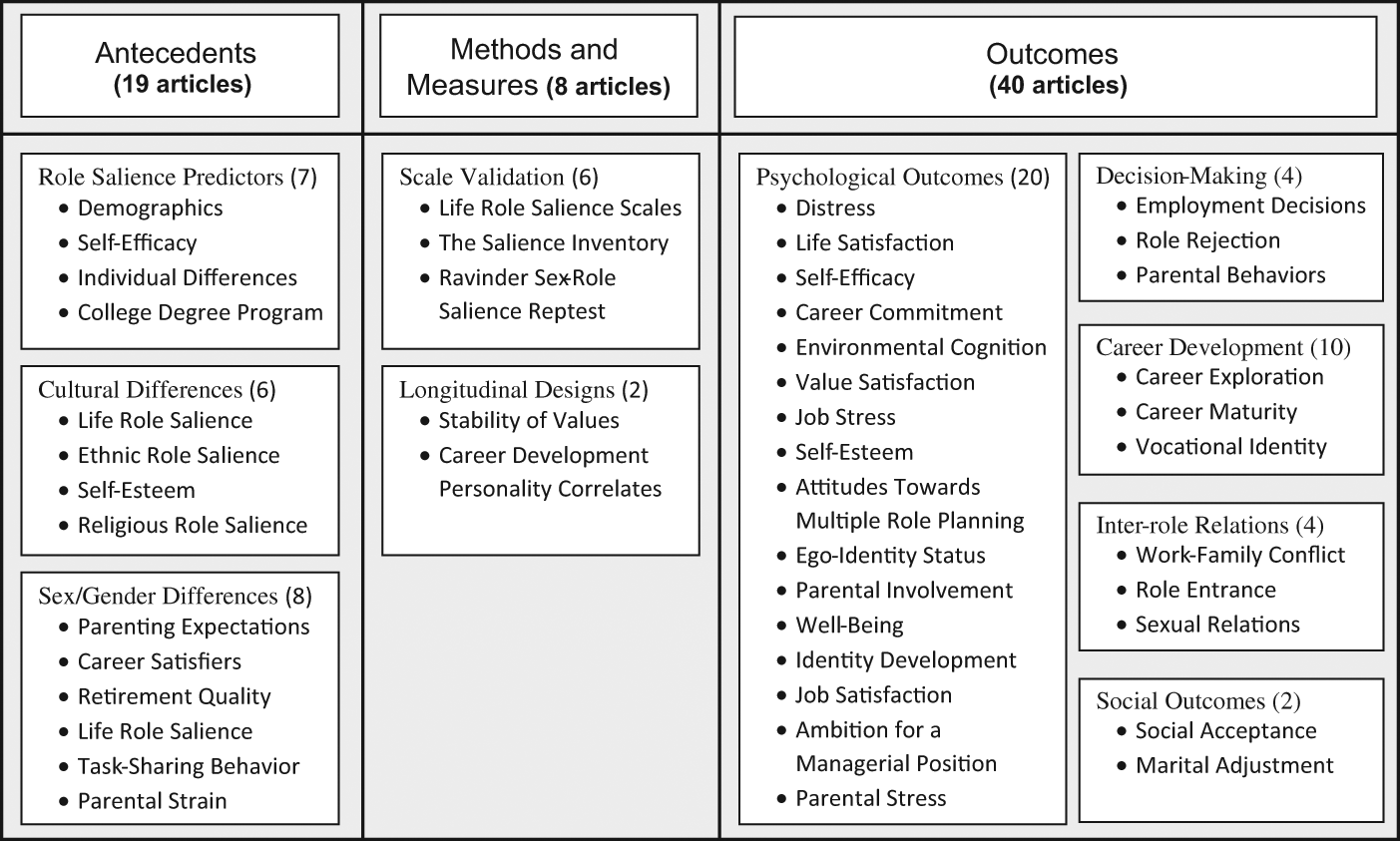
Topics in role salience literature
Several of the psychological outcomes that have been studied have direct implications for HRD. Table 2 contains a list of lessons for HRD that were collected from the role salience literature. We highlight a selection of key insights from extant studies here. For instance, in a sample of 510 teachers and nurses, work-role salience was a predictor of career commitment (Aryee & Tan, 1992), which is positively related to skill development, a foundational HRD function (Swanson & Holton, 2001). In Aryee and Tan’s study, career commitment was also negatively related to career and job withdrawal intentions. Many researchers of job-related phenomenon are interested in predicting job withdrawal intentions as intentions are the most reliable predictor of actually withdrawing from a job. Work-role salience also has the potential to affect retirement quality for men (Quick & Moen, 1998). As a result, knowledge and understanding of role salience may also be helpful in succession planning efforts as role salience could predict when individuals decide to exit roles and enter into new roles (e.g., exit the worker role and enter the pensioner role).
Selected lessons for HRD from the role salience literature

Work-role salience is a positive predictor of job satisfaction (Noor, 2004) and has a direct relationship with ambition for managerial position (Van Vianen, 1999). As management trainee programs continue to gain popularity, it will be important for HRD professionals to recognize and acknowledge role salience as a factor in whether or not employees desire to pursue management positions. Self-efficacy plays a role in the connection between work-role salience and ambition for a managerial position. Furthermore, self-efficacy is also a significant factor in predicting work-role salience for women in traditionally male-dominated occupations (Matzeder & Krieshok, 1995).
Career salience predicts the willingness of women to accept an overseas job assignment. For men, career salience is a predictor of their willingness to follow a partner on an overseas assignment (van der Velde, Bossink, & Jansen, 2005). Similarly, in two-earner families, role salience affects both the husband’s decisions to move locations and jobs and the wife’s decisions to do the same (Bird & Bird, 1985). Such findings could affect the planning and development needs for potential expatriates and repatriates, directly affecting strategic plans in organizations.
It is not surprising that occupancy in a role directly affects the relative importance of that role for a person (McCutcheon, 1998; Reading & Amatea, 1986). For example, mothers in a Japanese sample who were currently seeking employment tended to report lower salience in their maternal role (Holloway et al., 2006). However, employees with disabilities, such as deafness (Cinamon, Most, & Michael, 2008), have reported greater work-role salience while reporting less conflict between their work and family roles than their nondisabled (hearing) counterparts.
High career/work-role salience is associated with more extensive career exploration (Greenhaus & Connolly, 1982; Greenhaus & Sklarew, 1981; Sugalski & Greenhaus, 1986) and attitudes toward career development (Super & Nevill, 1984). As HRD is a field that is devoted to the development of human capital in organizations, the numerous findings (see Table 2) from the role salience literature related to career development and career exploration should be of interest to HRD practitioners who have been charged with the career development components of the HRD functions. These findings related to career development have implications for career counseling, career advancement, and programs to aid career development.
Notably lacking in this body of literature is research regarding relationships between roles. In this review, only four articles were assigned to the interrole relationships category. Two of these articles involved measures of work–family conflict, and the other two were summaries of tensions experienced by women in an occupational/graduate student role and a familial role. Based on the study findings, work-role salience moderates the negative impacts of work-to-family conflict on psychological well-being (Noor, 2004). In a sample of 147 employed women, Noor found that when work salience was higher, work–family conflict had a more negative effect on the women’s well-being. We support the notion that relationships between role salience and work–family conflict are pertinent to HRD due to the implications for employee career paths and development (Slan-Jerusalim & Chen, 2009). Although the primary purpose of this article is not to advocate for the relevance of work–family conflict issues to HRD, we also agree that attention to work–family conflict has been lacking in the HRD literature (Kahnweiler, 2008).
Discussion and Future Research
Role salience has largely been ignored in the HRD journals. Perhaps this oversight in the HRD literature can be explained using one or more of the same explanations that Kahnweiler (2008) offered for why HRD literature has been scant regarding work–life issues. First, Kahnweiler suggested that “work-life is an HRM issue, and HRD is distinct from HRM.” In his third point of argument, he added that “there is abundant research on work-life from disciplines related to HRD, so there is no need for HRD literature to focus on this topic” (p. 78).
As applied to our argument, a similar statement could be made about role salience being a psychological issue or a counseling issue, not an HRD issue, and that plenty of work has been done by the other disciplines. Essentially, role salience has primarily been studied by psychologists who are interested in identifying determinants of role salience and those who are interested in career development patterns and psychological outcomes, including stress, well-being, and satisfaction. Indeed, about one-third of the articles that we reviewed were found in journals with titles containing the word psychology or psychological. An additional 6 articles had been published in journals that contained the word counseling in the journal titles. We argue, however, that this orientation toward psychological outcomes associated with role salience has implications for HRD and, as mentioned earlier, is consistent with common claims that psychology is a foundation of HRD (Egan et al., 2006; Swanson & Holton, 2001). In addition, many of the counseling implications of role salience affect career counseling, which is a practice of career development. Accordingly, nine of the articles that we reviewed had been published in either the Journal of Career Assessment or The Career Development Quarterly. Although research activity around career development in the HRD journals has waned in recent years, there are published arguments detailing reasons and ways that career development research can return to mainstream in HRD (Egan et al., 2006; McDonald & Hite, 2005). Egan et al. argued, “Further connections between [career development] theory and literature in HRD will enhance HRD research and practice. With its rich history and theoretical frameworks, [career development] is important to HRD and deserves more attention in HRD literature” (p. 472). Role salience is explicitly connected to career development, and we argue that role salience will also enhance HRD research and practice.
A second reason that Kahnweiler (2008) believes HRD has been less involved in work–life issues is that “work-life is more about career development than other HRD specialties” (p. 78). He couples this statement with the observation that career development is less of a hot topic than training and development in HRD circles. Although we agree that career development should be more prominent in HRD literature, our argument for increased interest in role salience extends beyond Kahnweiler’s idea on this point. There is a very obvious connection between role salience and career development as indicated by several of the empirical studies in our review (e.g., Sugalski & Greenhaus, 1986). However, due to the systemic relationships between career development and other traditional HRD functions, such as training and development and organization development (McLagan, 1989), we posit that role salience is not only a career development topic but also an idea to be considered in training and development and organization development initiatives.
For instance, in a study of 257 managers, Sugalski and Greenhaus (1986) determined that high work-role salience was associated with extensive participation in career exploration. The career exploration activities in their study involved seeking information about a range of topics, such as current technical skills, high-visibility and low-visibility positions, and who was promoted in the company during the preceding year. Furthermore, they found that career exploration was a significant predictor of career goal selection for the managers who were high in work-role salience. Essentially, those managers who were high in work-role salience were more likely to engage in the career exploration activities and to have identified the job position that they wanted to hold in the upcoming 12- to 18-month period. Sugalski and Greenhaus concluded, “career exploration seems to be triggered by high levels of work role salience” (p. 111).
This conclusion represents obvious implications for career development functions in the organization. We also see implications for organization development in that the high role salience influenced the selection of career goals. Consequently, role salience has the potential to affect organizational structures as employees move through (or out of) the organization, requiring management of those changes. In addition, managers with high role salience who have identified a career goal may also require and seek out training & development opportunities to help them achieve their career goal. This is but one example of how role salience can affect several HRD functions, including career development, organization development, and training and development (McLagan, 1989). With additional research and involvement in role salience, HRD research and practice will likely benefit from additional empirical findings.
Kahnweiler’s fourth, and final, speculation regarding why there is a lack of attention to work–life issues in the HRD literature is that “HRD practitioners may have an interest in work-life, but they are not sure how to get involved, or do not have the skills necessary to be involved” (p. 79). Our hope is that our review of the literature and attempts to glean HRD lessons from the existing role salience literature is a starting point for equipping HRD scholars and practitioners with knowledge of the existing literature that can better position them for considering role salience in future endeavors. Furthermore, Egan et al. (2006) argued, “[career development] has fallen off in importance in HRD because of the failure to ask questions, ascertain outcomes, and make links between HRD- and [career development]-related theories, research, and practice” (p. 469). To combat similar stumbling blocks, we suggest that HRD scholars and practitioners, and managers/supervisors, begin their work by reflecting on the influence of role salience in their own lives (Kahnweiler, 2008) and the impact that it has had on their career decisions, organizational involvement, and contributions.
Implications for HRD Practice
Personal reflections can offer HRD practitioners a more clear understanding of how to effectively support employees in their organization who have a variety of role salience structures. This is especially important when devising systems to motivate and improve individual and collective performance. Since role salience is a reflection of the employee’s value system, role salience should be considered when devising reward systems in the organization to ensure that the organization is offering incentives and rewards that the employees actually value. Role salience offers a reliable glimpse into employee goals and values, and it behooves the HRD practitioner to first examine his or her own role salience structure as a starting point.
Understanding role salience is a powerful resource for HRD practitioners who seek to motivate employees toward learning and performance outcomes. Incentives and rewards that are not deemed valuable by the employees will be ineffective. As a consequence, when role salience is not considered as reward systems are created, the resulting reward system will fail to help the organization meet its objectives. Similarly, as more organizations continue to offer family-friendly practices and policies, the formalization of these practices and policies should be informed by the role salience structures of the employees to maximize the effectiveness of the programs. In outlining the business reasons for considering work- and family-role intersections, Johnson (1995) identified several HRD-related benchmarks, including the following:
Managerial initiatives and organizational development, including audits of company culture and work environment, training for managers on work–family issues, and handbooks for employees and managers on family-supportive policies
Flexible work arrangements, such as part-time work, job sharing, telecommuting, flex time, and compressed work weeks
Work–family stress management, including employee assistance programs, work–family seminars or newsletters, and work–family support groups
We argue that to realize the full effectiveness of popular interventions such as these, HRD practitioners must utilize their skills in implementing successful organizational changes and understand how employees negotiate their life roles. When implementing family-friendly policies and other HRD interventions, to ignore the relative importance of an employee’s life roles is essentially an attempt to remedy an issue without understanding the values of the stakeholders. This situation ultimately results in wasted organizational resources.
Future Research
Reflections on personal experiences and the effectiveness of HRD-related practices and policies can also afford HRD scholars some insights into where they can add value to the discussions of role salience through future research. Future topics in role salience research include the antecedents of role salience, how role salience is manifested, the proximal outcomes of role salience, and the distal outcomes of role salience. Figure 3 is an illustration of the areas of role salience that warrant additional research.
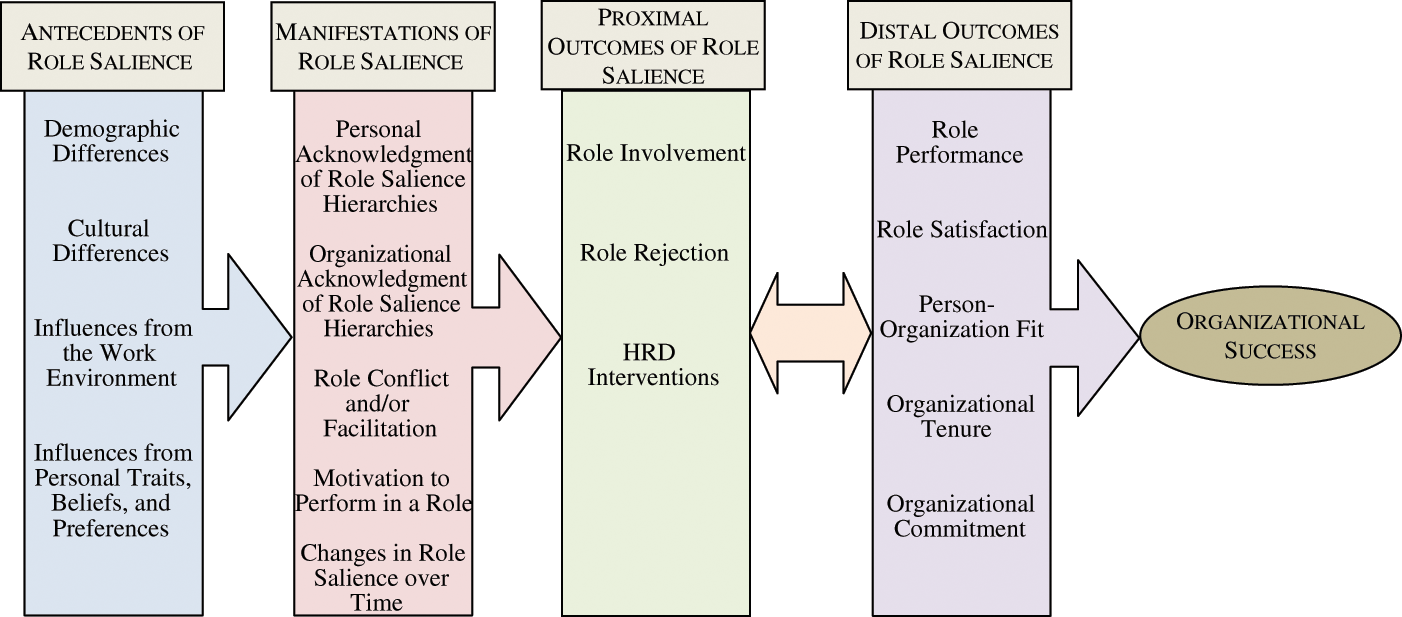
Framework for future research in role salience
For instance, additional research is needed to understand the factors that contribute to role salience. We especially advocate for studying how the work environment and personal traits affect role salience. Having good predictors of role salience, especially those that HRD professionals may be able to affect in the work environment, is important for achieving the desired proximal and distal outcomes of role salience.
In the future, researchers should also build upon the literature presented herein to understand the manifestations of role salience, including how role salience influences interrole relationships and what kinds of decisions people make when multiple role expectations and responsibilities are not compatible. Researchers should also look at any detrimental and/or positive effects of specific roles being highly salient or particular roles that are completely unimportant in relation to a person’s other life roles.
In the life-span, life-space theory, Super (1980) posited that salient roles shift throughout an individual’s life cycle. Indeed, values were found to be more stable over time than salience hierarchies in a longitudinal study of young women who transitioned from high school to postsecondary education or the workforce (Madill et al., 2000). Super suggested that role importance may change temporally (amount of time required by a role or desired to give to the role) or emotional involvement may fluctuate with life stage. Such changes and any underlying patterns have not been sufficiently explored by researchers to date. Chi-Ching (1995) has done some initial work in this area but concluded that more empirical studies are needed around this topic. Understanding how role salience varies as a function of life stage will affect effective career development strategies, as well as organization development interventions across the age demographics in organizations. Additional longitudinal study designs can be used to help fill this void in the literature.
It is also imperative that HRD professionals understand the distal outcomes of role salience, such as job satisfaction. Job satisfaction is a key aspect of the employment experience and often dictates many of the decisions that employees will make regarding their employment. Job satisfaction may also govern an employee’s performance and commitment to the organization. Although Noor (2004) has started some of this work, the pursuit of exploring role salience and job satisfaction could potentially uncover another important predictor of job satisfaction.
Future research efforts should also focus on if and how role salience affects learning and performance in the organization and what steps the organization can take to level any negative effects of role salience on learning and performance. It seems that the probability that an employee will achieve learning and performance goals in the organization in a specified time frame is directly affected by how important achieving those goals is to the employee. Role salience is a good indicator of where learning and performance goals are in an employee’s hierarchy of role importance. If other roles are more important, it seems that the employee will exert less effort to achieving these goals.
Conclusion
The goal of this literature review was to investigate the role salience literature and highlight implications for HRD scholarship and practice. The review revealed several antecedents and outcomes of role salience that can inform effective HRD practice and instigate role salience research from an HRD perspective. We noted particular implications for career development, which systemically affects other functions of HRD, including organization development and training and development (Swanson & Holton, 2001). The lessons learned from existing role salience research serve as convincing examples of the relevance of role salience for HRD.
As career development continues to be redefined in HRD (Hite & McDonald, 2008), the heart of the matter remains that “the constellation of interacting, varying roles constitutes the career” (Super, 1980, p. 284). The study of role salience helps us to understand how a person’s roles interact and vary to dictate the decisions involved in the development of the career. Accordingly, “the new career management model is about helping people become healthy, self-reliant citizens, able to cope with constant change in rapidly changing labour markets and maintain balance between life and work roles” (Cameron, 2009, p. 14).
We hope our present work can help HRD scholars and practitioners to think “bigger” about role salience—in terms of the diversity of situations individuals face in terms of role salience and how that affects their lives, their families, and their career. Just as Egan et al. (2006) argued that “failure to engage more specifically in [career development]-related discussion in general HRD will be a disservice to the field” (p. 444), we believe that failure to address role salience in the HRD literature can have bigger impacts across cultures and nations, including employees in high-tech jobs, less traditional roles, and even in the developing world.
Footnotes
Declaration of Conflicting Interests
The author(s) declared no potential conflicts of interest with respect to the research, authorship, and/or publication of this article.
Funding
The author(s) received no financial support for the research, authorship, and/or publication of this article.