



Abstract
This case study demonstrates the use of a modified evidence-based treatment protocol for “Maya,” a 13-year-old girl who presented with a fear of sleeping alone, Autism Spectrum Disorder (ASD), and separation anxiety disorder (SAD). The treatment, which spanned across 36 sessions, consisted of skills acquisition and exposure, with modifications made to address Maya’s ASD symptoms and cognitive limitations. Modifications for treating comorbid anxiety and ASD are described, including the use of: forced-choice list for emotions and somatic cues of anxiety, concrete props for teaching skills, and a higher level of parent involvement than typical for adolescent clients being treated for anxiety. Based on in-office observations and parental reports of at-home behavior, Maya’s avoidance of sleeping alone decreased over time, and she was able to sleep alone by the end of treatment. This case demonstrates successful treatment of fear of sleeping alone in a child with co-occurring anxiety and ASD.
Keywords
Theoretical and Research Basis for Treatment
Autism spectrum disorder (ASD) is a neurodevelopmental disorder that is characterized by a constellation of symptoms including, but not limited to: a lack of social-emotional reciprocity, difficulties with nonverbal communication, focused interests, repetitive motor movements (e.g., hand flapping, clapping), and rigid patterns of behavior (American Psychiatric Association, 2022). Research indicates that children on the autism spectrum are at an increased risk for co-occurring anxiety (e.g., Van Steensel et al., 2011; Vasa et al., 2020; White, et al., 2009), with prevalence rates ranging from 11% to 84% (White et al., 2009). Children with ASD and comorbid anxiety often demonstrate increased levels of depression and self-injurious behaviors compared to children without co-occurring ASD (Kerns et al., 2015). Furthermore, they are at a higher risk for developing sleep problems (Mazurek & Petroski, 2015), may demonstrate poor social skills (Bellini, 2004), and often have social anxiety and avoidance compared to neurotypical children (Kuusikko, 2008).
Cognitive-behavioral therapy (CBT) for anxiety for children typically includes psychoeducation, somatic management, cognitive restructuring, exposure, and relapse prevention (Albano & Kendall, 2002). The Coping Cat program (Kendall & Hedtke, 2006) is the most well-established protocol for child anxiety, as its efficacy has been demonstrated in several randomized controlled trials (Kendall, 1994; Kendall et al., 1997; Walkup et al., 2008). Coping Cat includes two segments of CBT: skills acquisition and skills practice (exposure), each consisting of approximately eight sessions. Strategies employed during the skills acquisition portion include feelings identification, construction of a hierarchy of feared situations, identification of somatic responses to anxiety, relaxation training, recognition and assessment of self-talk, coping strategies (e.g., coping self-talk), self-evaluation, and self-reward. The acronym “FEAR” summarizes these strategies for the child, and stands for Feeling Frightened? Expecting bad things to happen? Attitudes and Actions that can help, and Results and Rewards. Children can then develop a “FEAR Plan” with their therapist to help them cope in anxiety-provoking situations. The second eight sessions focus mainly on gradual exposure, including both imaginal and in-vivo exposures, to the feared situation.
Core features of ASD may pose as obstacles for engaging in central aspects of CBT for anxiety, such as identifying emotions and self-referential cognitions (e.g., for coping self-talk). Children on the autism spectrum also often display difficulty comprehending and carrying out abstract tasks, and tend to demonstrate challenges with executive functioning such as planning and cognitive flexibility (e.g., Craig, 2016; Minshew et al., 2002). These factors could interfere with their ability to engage in certain exercises such as imaginal exposure, which requires some degree of abstract thinking, or use and generalize skills outside of session. Children with ASD also often demonstrate challenges with social pragmatic skills (e.g., reciprocal communication, speech prosody, and understanding figurative language) and adaptive skills (e.g., daily living skills, self-care, health and safety) (e.g., Kasari, et al., 2012; Tamm et al., 2022) This may require adding an extra component to the treatment plan to improve these skills.
Despite these potential obstacles, several case studies have successfully demonstrated the use of CBT for anxiety in children with ASD (e.g., McNally Keehn et al., 2013; Ozsivadjian & Knott, 2011; Sze & Wood, 2008). Randomized controlled trials (RCTs) have also demonstrated the efficacy of CBT for treating anxiety in children with ASD (e.g., Chalfant et al., 2007; Reaven et al., 2012; Storch et al., 2013; Wood et al., 2009). In these RCTs, researchers modified standard CBT treatment for child anxiety in consideration of the aforementioned characteristics of ASD. The most common modifications included: greater use of visual methods, use of concrete and literal language, use of multiple choice lists, a higher degree of parent involvement, increased repetition of topics, an extended intervention protocol, and greater emphasis on behavioral activities (e.g., exposure and relaxation) as opposed to cognitive activities (e.g., cognitive restructuring).
In one RCT, 45 children (7–11 years old) with co-occurring ASD and anxiety were assigned to a treatment or treatment as usual (TAU) group condition (Storch et al., 2013). The treatment group received 16 sessions of a modular CBT that targeted anxiety and incorporated parent modules, coping skills, and in vivo exposures. The protocol allowed for flexibility to meet needs of children with ASD by using the following modifications: repetition of anxiety modules, implementation of token economy to encourage treatment adherence, social exposure to foster peer relationships, and a communication module focused on adaptive deficits. Results suggested that the individuals with co-occurring anxiety and high functioning ASD receiving the CBT treatment showed superior improvements in anxiety and all other primary outcome measures (e.g., Child Behavior Checklist, Social Responsiveness Scale) compared to the TAU group.
One pilot study evaluated the effectiveness of a modified version of the Coping Cat protocol for children (n = 22) between ages 8–14 with co-occurring anxiety (social anxiety disorder, obsessive compulsive disorder, and/or social phobia) and ASD (McNally Keehn et al., 2013). Participants were randomly assigned to either a 16-week modified version of Coping Cat protocol or a waitlist control condition. Modifications made to Coping Cat included: providing parents with a short review of each session, including skills learned and homework assigned, extended session length to accommodate for the pace of individuals with ASD, increased amount of visual and written materials, use of concrete language, and incorporation of children’s idiosyncratic interests. Results of this study indicated that 58% of children in the CBT condition no longer met criteria for their original primary anxiety diagnosis. This is in contrast to 100% of children in the control condition who retained their primary anxiety diagnosis. These results provide preliminary support that modifying the Coping Cat Program can be effective for treating a variety of anxiety disorders in children with ASD. However, to our knowledge, no treatment studies have specifically targeted the fear of sleeping alone in this population.
Case Introduction
The present case study demonstrates the use of a modified CBT child anxiety protocol to treat Maya, a 13 year-old girl who presented with a fear of sleeping alone with co-occurring ASD and separation anxiety disorder. Her co-occurring conditions warranted an individualized and innovative approach to treatment. Treatment was conducted in a clinical psychology doctoral program’s psychological services center (PSC) by the first author and supervised by the second author, a licensed psychologist. We provide a detailed description of the treatment, modifications made to accommodate Maya’s individual needs, and treatment outcomes.
Presenting Complaints
When ER, the graduate student therapist (GST), began working with Maya, the family’s primary complaint was Maya’s refusal to sleep in her own bed at night. Her parents said they managed this by sleeping in her room or allowing her to sleep in their bed. At times, they would try moving her back to her own bed or leaving her room in middle of the night, but she usually woke up and came to their room soon afterward. When this topic was discussed with Maya present, she displayed symptoms of anxiety and dysregulation (e.g., fast pacing around the room, tears gathering in her eyes, occasional refusal to speak). Her parents reported significant distress and a desire to have her sleep alone in her own bed. Therefore, this became the primary focus of treatment.
Other presenting problems included a high level of dependence in carrying out daily living skills, some continued challenges with social skills after two prior years of therapy, and difficulties with emotion identification and expression. These issues served as secondary treatment targets and were often addressed by providing her parents with guidance, such as how to reinforce practice of daily living skills (e.g., charts for showering on her own) and where to enroll in a social skills group at another treatment site during the year.
History
Maya was White, the youngest of four children, and resided in a middle-class suburb with her parents and a nanny. She had two older sisters and an older brother, who were all living outside of their parents’ home at the time of treatment. One of Maya’s siblings was diagnosed with ASD and lived in a residential facility. Both of Maya’s parents were originally from Israel and identified as Jewish.
As per a psychoeducational evaluation at her school, Maya’s IQ was in the borderline range (Full-Scale IQ = 71). She showed particular deficits in expressive communication and was reportedly underperforming in areas at school such as reading and writing. Maya had an Individualized Education Plan (IEP) and was classified as “other health impaired” by the Committee on Special Education. She was enrolled in special education classes and received occupational therapy.
In terms of medical history, Maya was diagnosed with epilepsy during infancy. Throughout her childhood, she experienced seizures during the period between wakefulness and sleep. The seizures were unpredictable as they occurred some nights but not others, and at times were severe grand mal seizures, requiring hospitalization on three occasions. According to her parents, Maya developed anxiety about future seizures due to these experiences. This anxiety had often been present at bedtime, and Maya’s parents would sometimes stay next to her bed to reduce her anxiety. Maya was prescribed Keppra to manage her seizures and Klonopin for her anxiety symptoms. As per her father’s report, at the beginning of treatment with the GST, Maya had not had a seizure in over a year. However, she continued to experience anxiety during bedtime.
Regarding Maya’s history of psychotherapy, prior to her treatment with ER, she met with two different GSTs during her first 2 years in therapy at the PSC. Therapist turnover was due to the PSC being a training clinic, with a new cohort of GSTs beginning each year. When Maya’s parents first brought her to the PSC, they reported issues related to social anxiety, comfort in social situations, and separation anxiety, including at bedtime. The first GST collaborated with Maya and her parents to determine initial priorities for treatment which included reducing her social anxiety and increasing her social skills. During her first year in therapy, Maya had 58 individual twice-weekly sessions of cognitive-behavioral therapy (CBT). The treatment focused on emotion identification and socials skills training (e.g., initiating conversations). At the same time, Maya participated in a weekly social skills group and demonstrated progress in her social skills and relatedness with others.
During her second year in therapy, Maya had 39 individual weekly sessions of CBT that flexibly followed Kendall’s Coping Cat manual. This treatment focused on emotion identification, anxiety management techniques, social skills training, and exposure to a hierarchy of feared social situations. At the conclusion of the treatment, Maya and the GST made a “commercial,” in which Maya presented the social skills she had learned in therapy (e.g., starting a conversation). According to the GSTs’ reports, over Maya’s first 2 years of therapy she increased her ability to engage in social interactions and decreased her experience of anxiety in social situations. Given these treatment gains, Maya’s parents requested switching the focus of treatment to her fear of sleeping alone.
Assessment
The GST conducted a variety of semi-structured interviews to systematically assess Maya’s diagnoses and functioning. The GST interviewed Maya’s father using the Vineland Adaptive Behavior Scales (Sparrow & Cicchetti, 1989) to assess Maya’s personal and social skills of daily living. Maya received a score of 88 on the Adaptive Behavior Composite, placing her in the adequate range and in the 21st percentile as compared to other individuals her age. However, her remaining scores were as follows: 72 in the Communication domain (moderately low, third percentile), 61 in the Daily Living Skills domain (mild deficit, <1 percentile), 68 in the Socialization domain (low, mild deficit, second percentile), and 67 in the Motor Skills domain (low, mild deficit. first percentile).
Diagnostically, Maya carried a diagnosis of ASD from her prior treatment at the PSC. The current GST confirmed this based on information from semi-structured interviews with her and her parents as well as behavioral observations. Specifically, Maya presented with the following: difficulties with social-emotional reciprocity, challenges engaging in and maintaining verbal interactions, and rigid adherence to rules, such as only speaking to certain people in certain contexts. In addition, Maya occasionally endorsed unusual thought processes (e.g., thoughts about a “private friend” and an alternate world), but this lessened over time.
Maya also met criteria for separation anxiety disorder (SAD) according to her mother’s report on the Anxiety Disorders Interview Schedule—DSM-IV edition, parent version (ADIS-IV-P) (Silverman & Albano, 1997). She exhibited excessive anxiety related to separation and anticipated separation from her caregivers (i.e., mother, father, nanny) at a level that was developmentally inappropriate. Maya reported when she was not with her nanny, she worried something bad had happened to her. In addition to refusing to sleep alone, she had somatic complaints associated with actual or impending separation, including headaches, stomachaches, and nausea. Her attachment to her caregivers and fear of separation from them resulted in a lack of independence and autonomy, and interfered with her familial and social functioning.
Case Conceptualization
Given Maya’s epileptic seizures tended to happen in the evening, the previously neutral stimulus of bedtime likely became associated with the anxiety-provoking stimulus of having a seizure, through classical conditioning. Consequently, being in her own bed reminded Maya of her history of seizures during sleep, which triggered feelings of anxiety and negatively reinforced her avoidance of being alone at bedtime. Furthermore, as a result of her seizures, Maya’s parents did not leave her alone at night which likely maintained her fear of sleeping alone.
Maya’s dysfunctional belief that she was unable to function alone likely resulted in part from developmental delays that made it more difficult for her to carry out some daily activities (e.g., personal hygiene, household chores). In addition, from a cognitive perspective, Maya seemed to have a dysfunctional core belief that she was unable to function independently such as, “I cannot manage daily activities on my own.” Beck (1976) posited that psychological difficulties result from negative automatic thoughts, which are generated by dysfunctional beliefs. This theory relates to Maya’s separation anxiety and dependence on her caregivers, and the related beliefs about her inability to function without them. Additionally, Maya’s parents inadvertently reinforced her dependence and associated beliefs by assisting her with daily tasks, including those she likely could have learned to manage on her own. The cognitive distortions continued to operate despite the fact that Maya’s last seizure was over a year prior to the start of treatment.
Maya’s parents were often unsure of how to treat Maya, as her functioning was superior to that of her oldest sister and yet limited compared to her other two siblings. In addition, Maya was the youngest child in the family, which often caused her parents to have lower expectations for her, provide more assistance with daily living tasks, and grant her certain privileges such as allowing Maya to sleep in their bed. It is likely that her parents positively reinforced Maya’s dependent behaviors. Additionally, Maya likely negatively reinforced her parents’ helping behavior by becoming upset when they tried to increase her sense of independence.
Course of Treatment and Assessment of Progress
Treatment Outline.
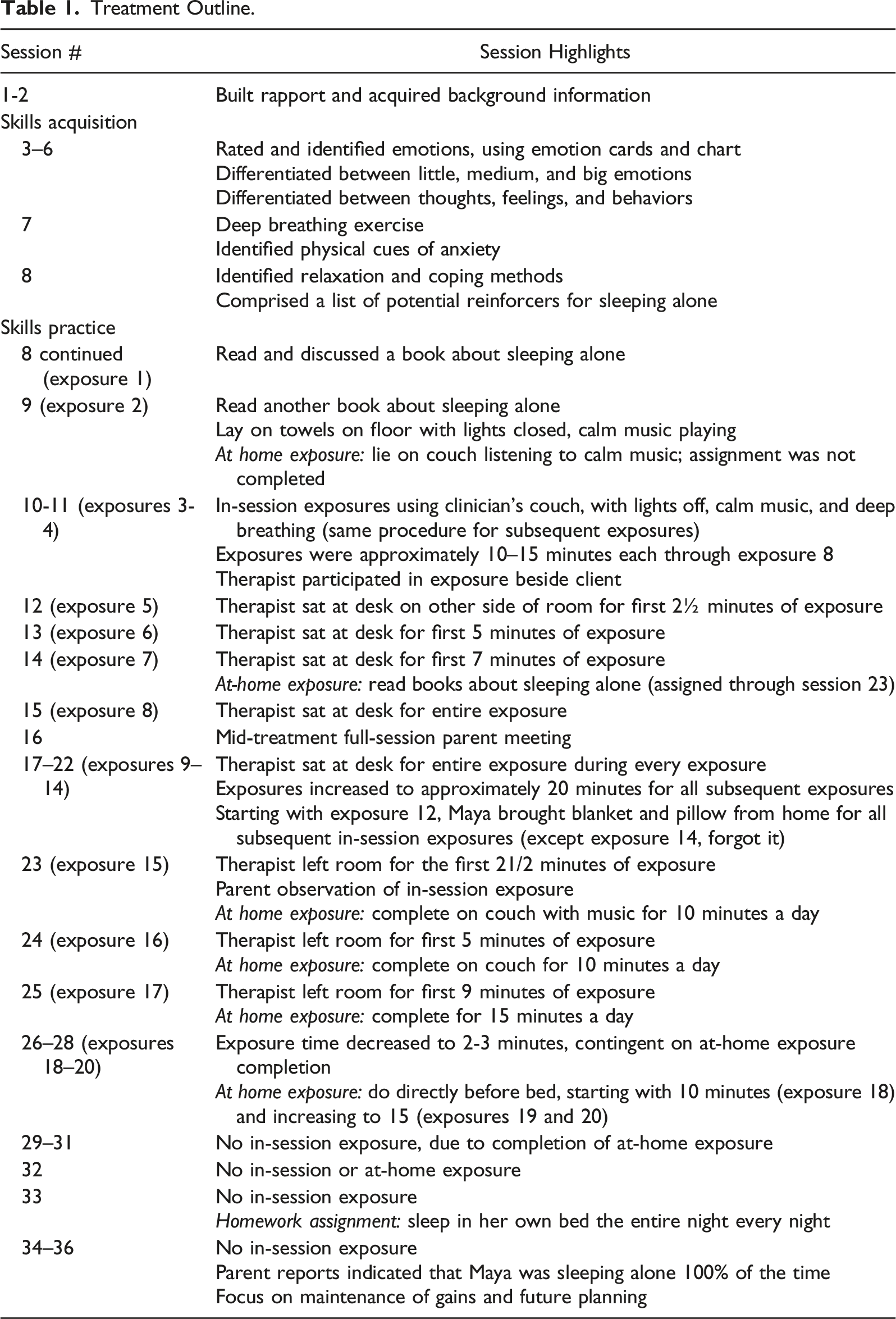
Secondary treatment targets included daily living skills and continued improvement with social skills. Maya’s parents composed a list of daily living skills they wanted Maya to work on. These included eating with a fork, showering independently, eating fruits and vegetables, and not picking at her fingers. Maya and the GST worked together to create charts on which her parents tracked these behaviors daily. At home, behavior charts were completed and brought to sessions to receive a prize. The GST also provided psychoeducation to Maya’s parents on the behavioral management strategies that she was implementing and how they could facilitate the use of behavior charts at home to reinforce Maya’s independent daily living skills at home. In order to improve Maya’s social skills, the GST provided her parents with referrals to social skills groups. Maya attended one of these groups, and the GST maintained close contact with the social skills group leader.
Given Maya’s developmental level, ASD, and cognitive limitations, it was important to flexibly apply the standard Coping Cat protocol to meet her needs. Treatment modifications were implemented based on a literature review of strategies for working with children on the autism spectrum. Given the heterogeneity of ASD symptoms across children, Maya’s treatment was also personalized to address her individual presentation by integrating in her interests (e.g., playing games, propensity for rules). We reviewed the treatment plan with Maya and her parents before beginning and agreed on the course of treatment.
Skills Acquisition
There were a total of six skills acquisition sessions (session 3–8). Maya was taught to identify her emotions, rate them on a SUDs scale, and begin forming connections between emotions and their antecedent events. Emotion cards, an emotion book, a matching game, and emotion charts were used for this purpose. Forced-choice lists were then used in several ways to decrease cognitive demands and help Maya communicate, since she demonstrated difficulty generating responses on her own. This approach aligned with recommendations to use multiple-choice options with children with ASD and anxiety (Reaven et al., 2012). For example, whereas a subjective units of distress scale (SUDs) often includes a large range of points (e.g., 0–10 point scale), Maya was taught to rate her emotions, including fears, on a shorter 4-point scale using words rather than numbers, including: “none,” “a little,” “medium,” and “big.” Emotion charts continued to be used at the start of every session, as a way to check in with Maya on how she was feeling and further build the skill of identifying and rating emotions. She also learned to identify physical cues of anxiety, including shaky legs and head, difficulty speaking, putting her hands on her head, and feeling dizzy, which were also presented as forced-choice lists.
Maya was then taught the relaxation technique of deep breathing. This was modified to be as concrete as possible. Podell et al. (2010) suggested teaching deep breathing to a young child by having them imagine they are smelling roses and then blowing out birthday candles. In Maya’s case, the GST provided actual plastic flowers and candles to teach this skill using hands-on materials. Specifically, the GST modeled this relaxation skill first and then role played this activity with Maya using little, medium, and big plastic flowers and candles. This facilitated learning deep breathing as a way to cope with fear, and allowed her to differentiate between little, medium, and big fears. In addition, cards featuring events or items that she might deem fearful (e.g., going to the dentist) were used to determine how anxious she anticipated feeling and how much of the skill was needed.
Maya and the GST also read a book about a child who struggled with sleeping alone. Although reading the book during session eight was used as a skills acquisition session, it was also viewed as an exposure and is therefore included in the exposure section, below. In addition, a “relaxation binder,” was worked on throughout treatment. An individualized prize box was also created for Maya, which featured some of the rewards she identified for the child in the book. More items were added upon her request throughout treatment. The GST’s use of hands-on activities (e.g., books, games) assisted with Maya’s concrete ways of understanding to enhance engagement and learning (Reaven et al., 2012).
Skills Practice
In-Session Exposures
Due to Maya’s difficulties with communication and abstraction, a fear hierarchy of sleeping alone was constructed with Maya’s father. The GST typically met with him at the beginning of each session to provide him with support and psychoeducation (e.g., rationale and mechanisms of exposure, proper use of praise). In session 8 (exposure session 1), Maya and the GST read a book about a child who struggled with sleeping alone and developed a FEAR plan for the character. She wrote a letter to the child in the book, suggesting possible actions the child could take to stay calm while remaining in his bed alone (e.g., listening to calm music, squeezing a stress ball, drinking warm milk), and a list of possible rewards for sleeping in his own bed. Using a book helped introduce the topic in an indirect way and appeared to increase her willingness to talk about sleeping alone.
In the second exposure session (session 9), another book about a child sleeping alone was read. Then Maya and the GST laid on adjacent towels on the floor with the lights off and calm music playing. A flower and candle were used to engage in deep breathing at the same time, and the GST instructed Maya to imagine she was lying in her own bed.
In the remaining in-session exposures (sessions 10–28), Maya was asked to lie on the couch in the therapist’s office with the lights off, listening to calm music, and engaging in deep breathing. Maya rated her feelings on a 4-point SUDs scale after each exposure (see Figure 1). Common feelings that Maya reported included confused, teary, and calm. In addition, Maya engaged in several behaviors that helped her avoid engaging in the exposures, including sitting, standing, walking over to the therapist, talking, and readjusting her position. These behaviors were systematically tracked beginning with the sixth exposure. In addition, simplified and direct language was used to orient Maya to the in-session exposures (Peterson, 2019). For example, rather than rely on Maya’s memory about how exposures are implemented or assume she understood what was considered appropriate behavior, she and the GST created a list of “rules for exposure” (e.g., remain on the couch and stay silent), which was reviewed prior to each exposure. The therapist’s behavioral observation indicated that Maya liked having the rules, and their formation seemed to increase her compliance. Modified subjective units of distress (SUDS) scale.
As Maya’s avoidance behaviors decreased, indicating increased ability to tolerate exposures, the exposures were made more difficult by extending the time and/or decreasing her proximity to the GST. For example, the GST began by sitting next to Maya on the couch, but soon moved to the other side of the room for increasingly longer periods of time and then started leaving the room for increasingly longer periods of time. Beginning with the 12th exposure session (session 20), Maya brought her blanket and pillow from home and used them during the in-session exposures, in an attempt to simulate part of her sleeping environment at home. When Maya completed an exposure, she was able to receive a prize (e.g., squeeze balls, stamps, kooky pens) from her own personal prize box that included items she specifically requested.
At-Home Exposures
The first at-home exposure was assigned after the second in-session exposure was completed (session 9). The assignment was to listen to calm music while laying on a couch at home, with no specified time. However, this was seemingly too soon for Maya, as she did not complete the assignment and expressed strong opposition to it, according to her father. As a result, at-home exposures were ceased until the seventh in-session exposure (session 14), after which the GST gave Maya the books about sleeping alone to read at home with her parents. This assignment was completed and repeated over the span of several weeks (through session 23) and, according to her parents, sparked productive conversations about the topic of sleeping alone in their home.
The GST also engaged in several between-session phone calls with Maya’s father, which were usually focused on troubleshooting difficulties with the exposures. In addition, a full-session parent meeting was held with Maya’s father midway through the treatment (session 16, after eight in-session exposures) to conduct a brief behavioral analysis of Maya’s functioning at home, provide him with psychoeducation and support, and collaboratively plan future at-home exposures. The GST also spoke to Maya’s mother several times over the phone, and she communicated motivation to help facilitate Maya’s ability to sleep alone. Maya’s father reported that he shared treatment updates and information from sessions with Maya’s mother.
The next at-home exposure was assigned following the 15th in-session exposure (session 23), which lasted 20 minutes and involved the GST walking out of the room for the first two and a half minutes. Maya laid on the couch with her pillow and blanket, with calming music playing during the entire exposure. Maya’s father observed this exposure, and Maya was then instructed to lie on the couch at home and listen to calm music for at least 10 minutes each day in a similar manner, with a parent present if desired. A lower-level exposure (i.e., only 10 minutes with a parent present) was assigned for homework because the GST anticipated that being at home would make the exposure more difficult. As with the in-session exposures, the at-home exposure assignments increased in difficulty over time. The first two at-home exposures were identical. Following mastery of those two exposures, the time was increased to 15 minutes, then reduced to only 10 minutes but performed directly before bed once Maya was ready (e.g., already showered and in pajamas), and then for 15 minutes in the same manner. Charts that described the at-home exposure and required daily parent signatures were provided each week. Maya received a prize every time she brought in a completed chart. In addition, later at-home exposures (sessions 26–31) were rewarded, first with shortened in-session exposures and then with no in-session exposures at all. A considerably longer amount of time was spent on the exposure portion of treatment than in the typical Coping Cat protocol (20 exposure sessions as opposed to eight). This was to ensure that the exposures could be generalized to the home environment, as it is not uncommon for children with ASD to have difficulty with generalizing skills to new settings (Bellini et al., 2007; White et al., 2007).
When no in-session exposure occurred (sessions 29–31), she was able to engage in an activity of her choice with the GST during the session (e.g., word puzzles and games), which provided further reinforcement for the at-home exposure completion. Following this, both in-session and at-home exposures were ceased completely, contingent on her ability to sleep in her bed alone (sessions 33–36).
Assessment of Progress
Given Maya’s difficulty with emotion identification and expressive communication, a stronger emphasis was placed on the GST’s behavioral observations and parents’ reports of progress than on self-reports (McNally Keehn et al., 2013). Progress with in-session exposures was measured using an objective behavior chart that the GST completed during the exposures and a SUDS scale that Maya completed after each exposure. The behavior chart was used to track her avoidance during exposures, and included behaviors such as sitting up, standing up, talking, walking toward the GST, and having physical contact with the GST. Figure 2 displays the frequency of Maya’s avoidance behaviors over time. The avoidance behaviors were recorded from exposure number six (session 13) to exposure number 18 (session 26). As illustrated, Maya’s avoidance behaviors showed a general decreasing pattern over time, with a few spikes that correlated with an increase in difficulty of the exposure (e.g., increased length of time and/or decreased proximity of the therapist). Ultimately, the avoidance behaviors decreased while the exposure difficulty continued to increase. The SUDS scale included a list of basic feelings and required ratings of little, medium, or big. There was no particular pattern of change in Maya’s reported feelings over time; however, her decrease in avoidance behaviors suggest that she was better able to tolerate the exposures over time. Frequency of Maya’s avoidance behaviors: Behaviors observed during in-session exposures 6–18 (sessions 13–26).
Progress with at-home exposures was measured using parent reports and corresponding charts. Maya’s father provided the GST with periodic updates regarding at-home exposures. During the full-session parent meeting (session 16), Maya’s father indicated that he observed a significant improvement in her behavior. Specifically, he reported that Maya had begun allowing herself to fall asleep when he left her room for a short period of time during the night, which she had not been doing previously. He also noted Maya’s increased tolerance and ability to discuss the books about sleeping alone, and related ideas from the books to her own difficulties.
At this point in treatment, Maya frequently stated that she did not want to engage in exposure exercises anymore, both in session and at home. Therefore, starting with exposure 18 (session 26), the in-session exposures began to be faded out contingent on completion of at-home exposures. This functioned as reinforcement for her completion of the at-home exposure and ultimately facilitated her ability to sleep alone, which led to cessation of both in-session and at-home exposures. Due to Maya’s at-home exposure completion, exposures 18–20 (sessions 26–28) were shortened and avoidance behaviors were no longer tracked after exposure 18. In the following three sessions (sessions 29–31), the in-session exposure was ceased completely, contingent on completion of at-home exposure.
During session 31, Maya’s father stated that exposures at home were no longer needed either, as Maya was sleeping in her own bed almost every night. Two sessions later (session 33), Maya was given a homework assignment to sleep in her own bed every night for the entire night. Her parents signed the chart every night for the next 3 weeks, indicating 100% compliance.
Maya also demonstrated progress with secondary treatment targets including daily living skills and social skills. Progress with activities of daily living was measured using parent reports and corresponding charts. Maya’s father reported an increase in her daily living skills. Accompanying charts indicated increased independence with these skills. The charts were faded during the final few sessions, and Maya continued to demonstrate mastery in these skills as reported by her parents. In addition, both the leader of Maya’s social skills group and her parents reported that her social skills were steadily increasing within the group and in other settings, such as school. Overall, both of Maya’s parents reported satisfaction with the treatment at its conclusion, prior to summer break at the PSC.
Complicating Factors
One of the primary difficulties the GST encountered was facilitating parent involvement in Maya’s treatment. Parent involvement was especially important in the treatment because the primary target behavior was one that occurred at home (i.e., sleeping alone). Maya’s father was generally more involved than her mother, as he typically brought Maya to sessions and could touch base with the GST before and after sessions. Having consistency across both parents could have potentially facilitated skills generalization, specifically when Maya was with her mother. Additionally, an increase in her mother’s involvement could have allowed for exposures related to separation anxiety beyond sleeping alone.
Access and Barriers to Care
One barrier to delivering the most effective care to Maya was prohibited by the policies of the PSC. It is possible that conducting some sessions in the family’s home in order to provide in-vivo coaching to Maya and her parents could have strengthened the treatment’s efficacy. However, due to the training clinic’s policy, this was not a possibility.
Follow-Up
When Maya resumed treatment in the PSC in September, follow up with the parents indicated that treatment gains were maintained over the summer when she was not in treatment (i.e., her ability to sleep alone in bed) and they continued to be satisfied with the outcome. Maya’s treatment then shifted to focusing on interpersonal communication challenges, rigid behavior and thinking patterns, as well as her remaining separation anxiety symptoms.
Treatment Implications
This case illustrates a successful modification of CBT for a child with co-occurring ASD and SAD who had a fear of sleeping alone. The treatment of this fear was unique in this case for two reasons. First, Maya’s ASD and cognitive limitations made the treatment more challenging and required adaptations to meet her needs. For example, she had difficulty identifying her thoughts and emotions and comprehending nonverbal cues, a largely visual and rule-based style of learning, and poor social and adaptive skills. Therefore, although treatment followed the general structure of the Coping Cat model (i.e., skills acquisition followed by skills practice), modifications were implemented. Treatment modifications included: utilizing forced-choices lists for emotions and somatic cues of anxiety, incorporating hands-on activities for teaching skills and exposures, concrete means of teaching skills, use of direct and simple language, stronger emphasis on therapist observations and parent reports than child reports, and a relatively longer amount of time spent on the exposures than would typically be expected for treating child anxiety.
A second reason this treatment was particularly unique was that the primary treatment target was an exclusively at-home behavior. Therefore, efforts were made to make the in-session exposures as close to in-vivo as possible. This required the GST to implement treatment, particularly the skills acquisition component, creatively and flexibly to simulate Maya’s home environment and increase the likelihood of skills generalization. At the same time, a relatively high degree of parent involvement was required, as they were ultimately the ones who had to address the behavior in its naturalistic setting.
Despite Maya’s ASD-related difficulties, there were some client characteristics that helped facilitate the treatment. Maya enjoyed school, which resulted in her eagerness to complete homework assignments both for school and therapy. Maya was also pleasant-mannered and got along particularly well with young adults, making rapport with the GST easy to establish and maintain. As Maya became more comfortable as the treatment progressed, she began taking a more active role in sessions and made decisions more easily and independently. Maya also become more comfortable receiving praise, and seemed to be receptive to this type of positive reinforcement. Furthermore, Maya’s preference for rules was used as an asset for the treatment, such as through the creation and use of a list of rules for exposures.
Several limitations of the present case study should be noted. First, although Maya began to sleep in her own bed, the treatment gains were not enough to remove her diagnosis of separation anxiety. Maya continued to be overly dependent on caregivers and have somatic complaints associated with actual or impending separation from them at the conclusion of treatment. In hindsight, using standardized parent report measures to systematically track Maya’s anxiety over time could have helped the GST identify additional separation anxiety symptoms during the course of treatment. These issues became part of her treatment plan the following year. Second, systematic follow-up data on Maya’s ability to sleep alone was not collected over the summer when she was not in treatment; however, when they returned to the PSC in the fall, her parents reported that her treatment gains had been maintained. Third, the PSC did not specialize in ASD evaluation. Although therapists that worked with Maya consulted with ASD experts about her diagnosis, it would have been beneficial to have Maya evaluated by an ASD specialist to provide further treatment recommendations related to her individual presentation of ASD. Finally, it would have likely been helpful to go into Maya’s home directly to provide her parents with live coaching for the in-home exposures. For example, the GST could have coached Maya’s parents on ways to address her avoidant behaviors during exposures and help her use the FEAR plan to navigate the exposures. However, the policies at the doctoral program’s training clinic prevented this possibility.
Recommendations to Clinicians and Students
There are many generalizable elements of Maya’s case that could benefit clinicians and students working with young clients who present with a co-occurring anxiety disorder and ASD. For example, this case highlights the importance of meeting the client at their developmental and cognitive level to increase the likelihood of positive therapeutic change. In this case, the GST was able to assess Maya’s strengths and limitations, and readily integrate them into a sound treatment plan. Given Maya’s limited insight, this assessment was primarily accomplished through the use of parent reports and the GST’s behavioral observations. It is important for clinicians to orient parents of children with ASD to the need for their high level of involvement upfront, especially if treatment targets involve at-home behaviors. For example, this could mean explaining to parents the need to be available to facilitate in vivo exposures several times per week.
This case also highlights the importance of being closely attuned to behavioral principles to maintain engagement in the treatment. For instance, the GST maintained treatment gains via negative reinforcement by fading out in-session exposures to facilitate sleeping alone at home. A strong understanding of what is reinforcing for the client’s behavior is crucial, especially for children with ASD who may have low tolerance to change and display rigid and inflexible thinking styles. Another recommendation for clinicians working with children with ASD is to capitalize on their rule-based learning style by incorporating this structure into the treatment (Peterson, 2019). Setting agendas, maintaining consistency, and having clear expectations or “rules” for what needs to be accomplished (i.e., “rules for exposure”) can facilitate engagement and reduce potential anxiety that could interfere with treatment compliance. In addition, due to difficulties with abstract reasoning commonly seen in those with ASD, it may be useful for clinicians to conduct more in-vivo exposures and fewer imaginal or even simulated exposures so that the new behaviors are learned in their natural environments. Finally, similar to Maya’s improvement in sleeping alone but not other separation anxiety symptoms, exposures that are successful for one target behavior may not generalize to other behaviors. Clinicians may have to build separate exposure hierarchies to address specific target behaviors.
Given the high comorbidity rates for ASD and anxiety disorders, future research is still warranted with this population. Specifically, researchers could systematically assess which treatment modifications (e.g., forced-choice list of emotions, hands-on activities) produce the best outcomes for children with these co-occurring diagnoses. Researchers could also examine if certain modifications are more or less appropriate for different types of child anxiety among those with co-morbid ASD. Finally, researchers could determine if the use of telehealth in treating children with a fear of sleeping alone could be effective compared to simulating a bedroom in a clinic setting. Conducting exposures using a telehealth platform could allow the therapist to work with and coach the child during in vivo exposures in their natural home environment.
Footnotes
Declaration of Conflicting Interests
The author(s) declared no potential conflicts of interest with respect to the research, authorship, and/or publication of this article.
Funding
The author(s) received no financial support for the research, authorship, and/or publication of this article.
