



Abstract
Surface fouling and undesired adhesion are nearly ubiquitous problems in the medical field, complicating everything from surgeries to routine daily care of patients. Recently, the concept of immobilized liquid (IL) interfaces has been gaining attention as a highly versatile new approach to antifouling, with a wide variety of promising applications in medicine. Here, we review the general concepts behind IL layers and discuss the fabrication strategies on medically relevant materials developed so far. We also summarize the most important findings to date on applications of potential interest to the medical community, including the use of these surfaces as anti-thrombogenic and anti-bacterial materials, anti-adhesive textiles, high-performance coatings for optics, and as unique platforms for diagnostics. Although the full potential and pitfalls of IL layers in medicine are just beginning to be explored, we believe that this approach to anti-adhesive surfaces will prove broadly useful for medical applications in the future.
Introduction
Adhesion to medical devices is the initiator of a number of detrimental, often fatal, clinical events such as thrombosis and biofouling. Such adhesion causes further problems ranging from necessitating the administration of systemic anticoagulants, which increase risk of bleeding and drug-related death, 1 to requiring increasingly powerful antibiotics to combat the high number of healthcare-related infections caused by biofilm formation on medical devices. 2 Despite all the attempts made to design surfaces that prevent biological adhesion or mitigate biological processes, current techniques are generally only able to provide solutions that are transient at best. Chemical approaches include hydrophilic coatings that prevent non-specific protein adhesion (e.g. PEG) 3 or minimize van der Waals forces (e.g. Teflon), 4 and materials that present or release biocidal compounds (e.g. antibiotics, silver nanoparticles). 5 These surfaces have shown some success but are vulnerable to degradation, depletion, or desorption of surface molecules over time, and any defects in the surface chemistry can become nucleation sites for adhesion.6,7 Physical tactics often use micro- or nanoscale surface topography to reduce the contact area for organisms and thus their adhesion strength. However, these structures can be damaged, resulting in adhesion sites. Moreover, many film-forming organisms such as bacteria produce a growth-facilitating conditioning layer that can mask underlying surface chemistry. 6
Recently, the concept of immobilized liquid (IL) layers has been proposed as a new approach to the problem of unwanted adhesion. 8 This approach, which leverages the inherent dynamic and self-healing nature of liquids to prevent contaminants from adhering to a substrate, has shown promise toward a variety of industrial applications including anti-icing and marine biofouling.9–11 Increasing realization of the versatility of IL layers also suggests enormous potential in medical applications. In this mini-review, we give an overview of IL layers with the perspective of their eventual application in the medical field. We discuss the overall concept behind this technology, emerging strategies for applying IL layers to a wide variety of materials, and applications of direct relevance to the medical community that have been explored thus far. We also identify the most critical directions in need of development to adapt this new approach in materials science to the clinic, where it can begin to improve patient outcomes and reduce the burden of healthcare costs associated with medical device failure.
Concept
One common method of producing superhydrophobic, liquid-repellent surfaces makes use of hierarchical surface structure to repel liquids via the Cassie–Baxter model (Figure 1(a)). Inspired by the leaves of the Lotus plant,
12
these methods are known to perform well against high-surface-tension liquids such as water under ambient temperature and pressure, but often fail when exposed to complex fluids,
13
high pressure,
14
humidity,
15
or extreme temperatures.
13
This is due to the fact that the air pocket supporting the droplet is inherently compressible, allowing it to be overcome by addition of pressure to the air/droplet interface or by low-surface-tension liquids. Attempts to expand the ability of these surfaces to repel such liquids, including hexane and oils, using re-entrant geometries or fluorinated porous structures have had some success,16,17 however, the question of performance against complex fluids or under high pressure still remains. In addition, the dependence of Lotus-inspired approaches on physical surface characteristics to suspend liquid droplets makes these surfaces susceptible to physical damage, reducing the overall longevity of the design.
14
(a) Schematic of Cassie–Baxter (left) and Wenzel (right) models for wetting. (b) Schematic of a contaminating droplet on an immobilized liquid layer over a structured substrate. (A color version of this figure is available in the online journal.)
Recently, a new approach to fouling-resistant surfaces was proposed: drawing inspiration from the carnivorous Nepenthes pitcher plant, which uses a highly wettable microstructure to force insects to aquaplane into its pitcher-like stomach, 18 Wong et al. 8 were the first to introduce IL layers as a broad solution to this problem with their Slippery Liquid-Infused Porous Surfaces (SLIPS).
The concept of ILs as omniphobic surfaces is based on providing and maintaining a superficially dynamic yet stable and IL layer (Figure 1(b)). The stability of the liquid on the solid can be achieved by designing the system to meet the thermodynamic requirement of

Providing the conditions of chemical affinity and physical entrapment are met, the result is an extremely stable, homogeneous, and highly repellent interface. Flow tests have shown that the liquid over-layer is not stripped at physiological shear rates, 19 and certain IL layers have demonstrated the ability to repel water and liquid hydrocarbons at pressures as high as 676 atm. 8 Additionally, samples with up to 33% mechanical surface damage have been shown to remain slippery, 20 as the liquid-based interface inherently exhibits self-healing characteristics.
Fabrication
For use in medical applications, IL layers should be fabricated (1) using biocompatible materials, (2) on a wide range of scales, and (3) requiring minimal effort and time. They should also be (4) sterilizable and (5) stable in their intended use. To address these issues, multiple fabrication strategies have recently emerged which demonstrate the flexibility inherent in this system.
Liquids
Although a number of different liquids have been used to create IL surfaces, so far only a few have been shown to be biocompatible or have been previously used in other clinical applications. Of these, the medical-grade perfluorocarbons perfluorodecalin and perfluoroperhydrophenanethrene have been used clinically as a blood substitute 21 and vitreonretinal tamponade, 22 respectively. A number of edible oils have also been used as liquid layers, including almond, 23 coconut, olive, and canola. 24 A larger number of studies on ILs have used silicone oil as the infusing liquid, which as a medical-grade product has been used for ocular tamponades 25 and off-label for cosmetic reconstructions. 26 Perfluoropolyethers and perfluorotripentylamines have also been extensively used as ILs due to their repellency of both water- and oil-based compounds,8,9,11,27–33 however, these have not yet been thoroughly evaluated for toxicity.
Plastics
Plastics have most frequently been used to-date as substrates for IL interfaces due to their wide variety of chemical and physical properties and the unique ways in which they can be manipulated. Leslie et al.
27
created a ‘tethered-liquid perfluorocarbon’ (TLP) IL system based on surface fluorosilanization and applied it to a wide range of medically relevant plastics including polyvinyl chloride (e.g. perfusion tubing), polyurethane (e.g. catheters), polycarbonate (e.g. barbed connectors), and polysulfone (e.g. dialysis membranes), among others. Wong et al. used expanded polytetrafluoroethylene (ePTFE) to make their SLIPS with perfluoropolyether liquids.
8
ePTFE is well-known in the medical community as a material used for vascular grafts,
34
hernia grafts,
35
thyroplasty,
36
augmentation of bone growth around implants,
37
and even cosmetic surgery,
38
and when coated with IL layers has been shown to be highly resistant against blood
8
and bacteria.
11
Membranes of ePTFE have further been used to make dynamic slippery/sticky materials through a simple stretch-and-release process (Figure 2).
39
Such an approach may prove useful in applications requiring a switchable surface, such as one in which immediate bacterial resistance is needed, but eventual tissue integration is desired.
Dynamic control of surface slipperiness is achieved by the stretching of a liquid-infused substrate, causing droplet pinning.
39
(A color version of this figure is available in the online journal.)
Infused polymers
Recently, reports of creating ILs by infusing liquid into the molecular structure of a polymer have become more prevalent. Liu et al.
40
used an ultra-thin (∼110 nm) organogel layer coated on copper, iron, silicone, and aluminum surfaces and infused with silicone oil to produce slippery self-cleaning surfaces. Urata et al.
41
designed infused polydimethylsiloxane (PDMS) which could spontaneously release its liquid upon environmental changes such as a temperature decrease to −15℃ or humidity increase to 60% relative humidity. These polymers were prepared as a premixed liquid-polymer system which could make it an easily applicable overcoat for other materials. Other researchers have used widely available PDMS mixtures
42
and commercially available pre-made silicone rubbers
43
to create IL layers simply by soaking them in silicone oil for a matter of hours. Furthermore, these materials can be made self-replenishing through the incorporation of an embedded vascular system (Figure 3(a)), which can be continuously refilled with silicone oil from an outside source (Figure 3(b)). The infusing liquid filling the vascular network can diffuse through the polymer and replenish the surface liquid layer when it becomes depleted.
42
The wide use of PDMS as catheters and tubing in current medical applications, and to a lesser extent silicone oils,26,27 may make the infused polymer approach to IL interfaces both cost-effective and scalable.
(a) Bio-inspired vascular systems can be embedded in a polymer prior to infusion to provide self-replenishment properties. (b) Mechanism of self-replenishment of the slippery over-layer: the infusing liquid diffuses up through the polymer and replenishes the surface liquid layer when it becomes depleted. (A color version of this figure is available in the online journal.)
Alternative methods have been explored to create infused polymers, including the creation of fluoro-organogels which can be infused with perfluorinated lubricants.
28
Supramolecular polymer approaches have been used to create a fibrous polymer for infusion that can be healed upon microwave treatment
44
or which can automatically self-replenish to a 200 nm-thick liquid over-layer from a reservoir of embedded droplets of liquid (Figure 4).
45
While these are powerful demonstrations of the ability of polymer chemistry to create infused materials to exhibit novel properties, further work must be done to either validate the safety of the component chemicals to biological systems or engineer them from currently standard medical materials before they can be used in a medical setting.
Confocal fluorescence images of a supramolecular organogel embedded with silicone oil droplets (green). Visualized in 3D (left) and in horizontal cross-section (right).
45
(A color version of this figure is available in the online journal.)
Metals
Metal substrates are also of interest for immobilizing liquids due to their wide use in applications from scalpel blades to implants. Tesler et al.
29
created IL layers on steel through electrodeposition of nanoporous tungsten oxide, followed by surface fluorination and lubrication to create a perfluoropolyether liquid over-layer (Figure 5(a)). The result (Figure 5 (b) to (d)) was a highly durable system able to withstand impingement of solid particles, UV exposure, and temperatures from –196℃ to 300℃. Studies applying IL layers to titanium,
27
aluminum,
9
and low-alloy steel
46
have also been reported. However, these materials have not yet been thoroughly tested in medical applications and more work is necessary prior to widespread use.
Electrodeposited tungsten oxide films on various steel grades and surface geometries. (a) Preparation procedure on rough steel films deposited on (b) stainless-steel sheet and pipe, (c) surgical-grade steel scalpel blade and syringe needle, (d) naval construction steel plate. Scale bar, 1 cm.
29
(A color version of this figure is available in the online journal.)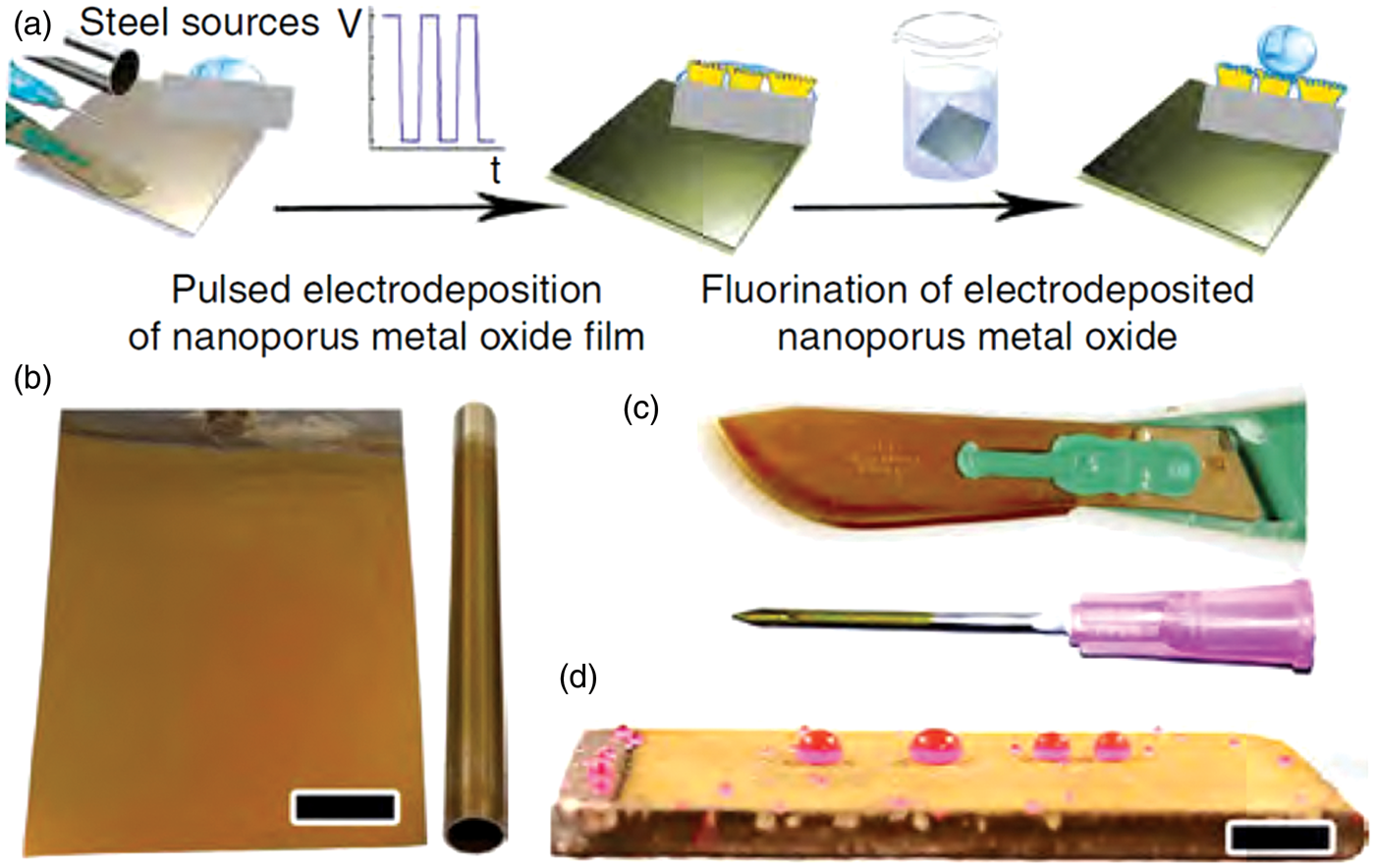
Arbitrarily shaped substrates
Layer-by-layer deposition
47
(LbL) has been demonstrated to be a versatile and robust way to create porous surfaces on objects of arbitrary shape for IL layers. Huang et al.
48
used LbL deposition of two water-soluble weak polyelectrolytes to create substrates for immobilizing liquids on curved glass surfaces. Sunny et al.
30
used 20 nm silica nanoparticles in their LbL deposition (Figure 6) and further demonstrated the mechanical robustness of the resulting layer in a series of tape tests. Other researchers have recently taken the LbL approach in new directions by demonstrating how they can be used to make selectively non-slippery materials by coating only certain areas of the substrate
23
or by making them out of entirely biocompatible and biodegradable materials such as alginate, polyvinylphyrrolidone, and almond oil.
24
Layer-by-layer fabrication of nanoscale, liquid-coated infused silica. (a) (i) Substrate is negatively charged. (ii) Positively charged polyelectrolyte and (iii) negatively charged silica nanoparticles are deposited, creating a thin film (iv) that is (v) calcined and (vi) functionalized with fluorinated silanes, then (vii) coated with a fluorinated lubricant to make it non-adhesive (viii). (b) An LbL coating on the inside of a glass tube repels crude oil compared to an untreated glass tube.
30
(A color version of this figure is available in the online journal.)
Applications
To date, most applications of IL layers have been industrial.8,49 However, strides have been made in applying this technology to preventing adhesion of microorganisms, specifically in marine settings.10,42 As the versatility of this technology becomes increasingly apparent, pursuits in medical applications are beginning to progress as well.
Anti-thrombogenic surfaces
Medical device thrombosis and its consequences remain a ubiquitous problem.50–53 IL layers have been shown in several systems to prevent adhesion of proteins and blood both in vitro and in vivo, which is a promising step toward decreasing the need for systemic anticoagulants. Fluorocarbon-infused wrinkled surfaces showed a 96% reduction in bovine fibrinogen deposition, a significant reduction (P < .001) in platelet adhesion and reduction in whole blood clotting time by up to 95% (correlated to anti-thrombogenicity) compared to controls.
54
The previously mentioned TLP coating has shown great promise in both in vitro and in vivo studies. In addition to macroscopically repelling droplets of blood on tilted surfaces (Figure 7), TLP-coated substrates showed reduced adhesion and polymerization of fibrin compared to controls, as well as suppression of both adhesion and activation of platelets in in vitro thrombogenicity tests. These results were replicated on ethylene oxide-sterilized TLP coatings on medical-grade cardiopulmonary perfusion tubing that were exposed to physiological flow rates. In vivo tests using TLP-coated medical-grade cannulae and the same perfusion tubing in a porcine femoral arteriovenous shunt model showed sustained patency for at least 8 h without the use of anticoagulants, as compared to controls, 80% of which fully occluded in that timeframe.
27
The readiness with which IL layers can be applied to medical tubing and devices lends itself to commercial translation, an essential step toward making this technology accessible to patients.
Tethered liquid perfluorocarbon (TLP) coating on acrylic surface prevents blood adhesion in sliding angle tests (30° tilt), compared to non-coated control. Scale bars, 1 cm.
24
(A color version of this figure is available in the online journal.)
Bacterial anti-adhesive surfaces
In response to the prevalence of nosocomial infections and the rise in multi-drug resistant (MDR) pathogens,
55
IL layers present the possibility to prevent bacterial attachment and biofilm formation without the need for antibiotics.
27
Epstein et al.
11
demonstrated that IL layers on ePTFE reduced biofilm coverage of Staphylococcus aureus by 97.2% and Escherichia coli by 96% after 48 h, as well as Pseudomonas aeruginosa by 99.6% after seven days of growth under gentle flow (10 mL/min). Researchers working on IL layers fabricated using other methods have found similar results with these species both under static27,54 and flow conditions27,43 (Figure 8). However, Li et al.
32
found that not all bacterial strains are equally repelled by lubricant-infused surfaces. In high-nutrient medium, a MDR P. aeruginosa strain isolated from wastewater exhibited up to 12% surface coverage over seven days of incubation, compared to less than 1% coverage for other less virulent strains tested. More work is needed to uncover the reasons for such discrepancies, as well as the mechanics behind bacterial interactions with IL interfaces.
Confocal microscopy of a ∼40um thick P. aeruginosa biofilm (green) on untreated (a,b) and infused (c,d) silicone tubing. (e) Photograph of crystal violet-stained biofilm on a variably infused tube.
40
(A color version of this figure is available in the online journal.)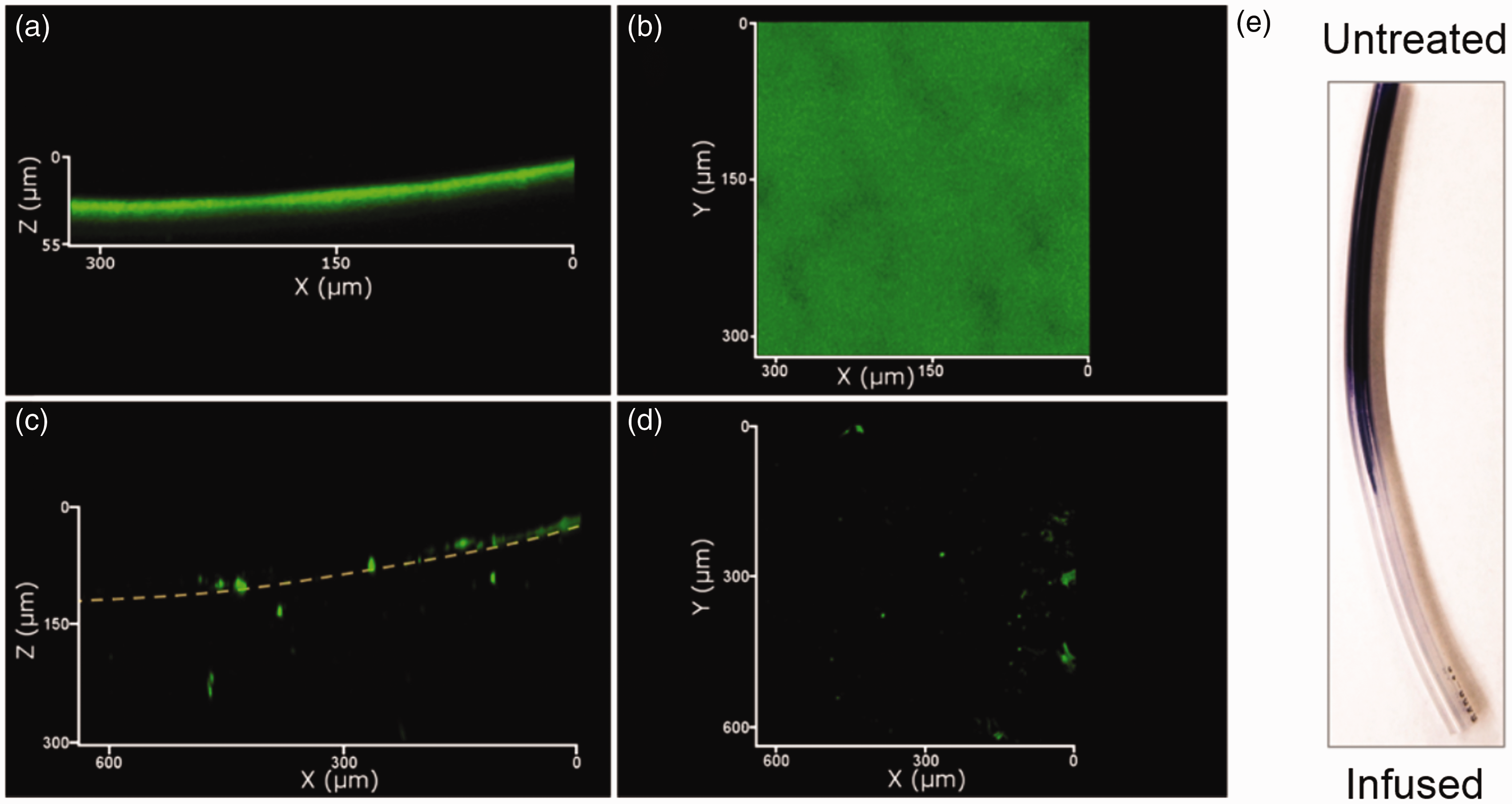
Optics
Another promising direction for IL layers is that of optics, where complications related to staining, coloration, and opacity caused by fouling agents can impair visibility. Zhang et al. 56 developed a method for easily producing large-area (up to 100 cm2) transparent liquid surfaces on glass using breath figure patterns or water droplets sprayed onto surfaces followed by evaporation. Sunny et al. 30 demonstrated that the transparency of their LbL-textured surfaces became even higher than that of bare glass once the IL layer was added, and that it could easily repel protein solutions. Such work opens the door for high-performance coatings of optical devices such as cameras and endoscopes.
Diagnostics
Beyond fouling of medical devices, controlling the adhesion of materials may also be applied to the development of novel diagnostic devices. Boreyko et al. 57 have demonstrated how a phospholipid bilayer can be suspended between two droplets on an IL layer, allowing single-channel gating events across the bilayer to be measured. This is possible due to the fact that droplets on IL surfaces will coalesce orders of magnitude more slowly than on other surfaces due to the presence of an oil layer between them. This concept may prove useful in creating functional droplet networks that can be used for applications such as detecting airborne or exhaled compounds. Other researchers have created patterned IL layers for controlling droplet mobility, 23 have manipulated droplets using ILs impregnated with magnetic nanoparticles, 58 and have transferred magnetically doped droplets between IL layers using magnets. 59 Still others have manipulated droplets using IL layers fabricated on fluorinated paper, 60 which could aid in the development of low-cost, paper-based diagnostics. 61
Textiles
The development of fabrics which will absorb fluids but not stick to wounds or facilitate biofilm growth is highly desired for bandages, dressings, surgical meshes, and sutures. Both cotton and polyester fabrics have been used as IL substrates, created either by depositing a roughening layer of silica microbeads, followed by surface fluorination and lubrication,
31
or by embedding the fabrics in a thin layer of oil-infused PDMS (Figure 9).
62
Both approaches displayed increased liquid repellency as demonstrated by decreased droplet sliding angles. The embedded fabrics further showed retention of these properties in the face of repeated pressurized contact with absorbent cellulose fiber wipes. Testing regarding these infused fabrics’ absorption of fluids remains to be done.
Fabrication of a fabric-supported lubricant-swollen polymeric film resulting in PDMS-sandwiched (s-) fabric with an IL layer.
62
PDMS: polydimethylsiloxane (A color version of this figure is available in the online journal.)
Scaling and corrosion
The accumulation of inorganic solids on surfaces within the body can also cause significant problems. Afflictions such as the calcification of joints and gout are caused by the deposition of calcium pyrophosphate 63 and monosodium urate crystal, 64 respectively, and can cause significant pain and discomfort. Investigations into the ability of IL layers to mitigate mineral fouling have shown an 18-fold decrease in CaSO4 deposition on fluorinated IL surfaces compared to untreated stainless-steel 33 and a 10-fold decrease in CaSO4 scaling on silicone oil-impregnated surfaces. 65 While these studies were focused on addressing scaling problems in industry, this concept may prove useful for medical implants including joint replacements.
Discussion
IL layers have demonstrated promise in a number of medical applications, including those aimed towards anti-thrombosis, anti-biofouling, diagnostics, textiles, and anti-corrosion. Despite this, a great deal of work remains to be done in order to realize the full potential of this technology. Perhaps most importantly, in order for IL layers to become a commercialized technology in the clinic, the substrate and liquid combinations must eventually be validated by regulatory agencies for their intended uses. This may present a challenge for two reasons. First, the thermodynamic requirement for the solid surface and liquid to chemically match may prove difficult depending on the application, such as one in which only the use of a particular solid substrate is acceptable. Second, the liquid layer must be water-immiscible to remain stable against water-based foreign liquids. Such liquids, including the previously mentioned silicone oil and fluorocarbons, while not inherently toxic, may not be appropriate for certain applications due their tendency to form emulsions in the body. 66 Furthermore, depending on the liquid, complications may arise in applications where an immiscible liquid can migrate within the body. 26 However, given the versatility of fabrication methods and materials available for these layers, as well as the great potential benefits of the application of this technology, efforts to overcome issues such as these or find alternatives are likely to prove successful.
As with any emerging area of technology, the hurdles associated with design requirements, testing, and safety must be overcome through rigorous experimentation and documentation. For example, some safety issues raised concerning clinically used perfluorocarbons were found to be a consequence of the emulsifying agent and potentially emulsion size rather than the perfluorocarbons themselves. 21 Nevertheless, safety profiles must be generated for the liquids that can be immobilized, potentially for each application. Additionally, more studies need to be done on the longevity of IL layers, with respect to their stability under flow and ability to survive sterilization processes. Recent testing of perfluorocarbon liquid stability under physiological flow rates in water found that the IL layer remained stable as long as it was not exposed to an air/water interface. 19 This type of interface has been suggested to allow for the energetically favorable wrapping of the air bubble with the lubricant. If this air bubble is in motion, the lubricant may be carried away with the bubble, reducing the volume of lubricant remaining on the surface, and therefore the omniphobicity of the surface. 19 As discussed previously, one method to maintain surface functionality could be through the incorporation of a vascular system within the material, allowing for continual replenishment of the surface layer through diffusion. 42 This would additionally allow for the entire system to be refilled with liquid through a single point. Nevertheless, it will be crucial to obtain further information for more complex fluids and physiological conditions for this work to eventually enable the practical application of IL layers in the medical field.
We expect to see a rise in the investigation and use of IL layers in the medical field in a variety of applications. First and foremost, the ability of this technology to reduce or prevent bacterial adhesion may prove highly useful for reducing infection of grafts and synthetic implants. Second, the ability of these materials to be made optically transparent may be helpful in endoscopy, where their dual slipperiness and transparency can offer physicians and surgeons a heightened advantage in visualization and patient treatment. Finally, designing IL layers to be controllably slippery could aid advancement in fields such as tissue engineering, medical diagnostics, and any areas where the controlled presentation or release of proteins, cells, or biomolecules are desirable. With proper experimentation and development, IL layers have enormous potential to improve current therapies, create new directions in the medical field, and ultimately improve patient care.
Footnotes
Author Contributions
IS and CH designed the manuscript. All authors wrote the manuscript.
Acknowledgements
CH acknowledges funding from a Wyss Technology Development Fellowship. All authors thank Dr. Ida Pavlichenko, Adrian Arias Palomo, and Edythe Johnson for helpful discussions and technical editing.
Declaration of Conflicting Interests
The author(s) declared no potential conflicts of interest with respect to the research, authorship, and/or publication of this article.