



Abstract
In this study I examined archival material relating to music lessons that aired on the Indiana School of the Sky during its inaugural season in the 1947–1948 school year. The Indiana School of the Sky was an educational radio program intended for use in the public schools and produced by Indiana University students and professors, in partnership with the State Department of Education. The purpose of this study was to illuminate details of the Indiana School of the Sky music program during its inaugural season in 1947–1948, such as the staff, repertoire, teaching strategies, and program structure. Of particular interest was Dorothy G. Kelley, who served as supervisor of the Indiana School of the Sky music episodes during its inaugural season, and was the first female to join the faculty of the Music Education Department at Indiana University. A secondary purpose was to examine the intersection of education and technology in the late 1940s through the lens of the Indiana School of the Sky and to afford contemporary music educators the opportunity to reflect on how they use current technologies in their classrooms. This study found that the program employed three main teaching strategies: singalong, call and response, and listening. Indiana University music and music education students performed in many music episodes alongside Kelley, and 34% of compositions that aired during the 1948–1949 school year comprised of music by composers from the United States, or folk music originating in the United States. Other countries represented by either composer or folk tradition included Australia, Austria, Czechoslovakia, England, Finland, France, Germany, Italy, Norway, Mexico, Russia, and Spain.
Keywords
Pioneers of Music Educational Broadcasting
Armstrong Perry, member of the Payne Fund Committee on Educational Radio, wrote in 1929 that “the educational opportunities which are offered to the public by means of radio are most important and far-reaching.” 1
Armstrong Perry, Radio in Education: The Ohio School of the Air, and Other Experiments, 2nd ed. (New York, NY: The Payne Fund, 1929), 30.
Ibid., 47.
Ibid., 50.
Ibid., 49.
Benjamin. H. Darrow, Radio Trailblazing; A Brief History of the Ohio School of the Air and Its Implications for Educational Broadcasting (Columbus, OH: College Book Company), 5.
Cline M. Koon, “The Value of Radio in the Classroom,” in The American School of the Air: Teachers Manual and Classroom Guide, ed. Helen Johnson (New York, NY: Columbia Broadcasting Company, 1934), 10.
Writing in the Music Educators Journal in 1950, Edna Whitsey, an educator who taught radio music classes to first and second graders in the Cleveland public schools between 1934 and 1938, 7
Constance Armfield Sanders, “A History of Radio in Music Education in the United States, with Emphasis on the Activities of Music Educators and on Certain Radio Music Series Designed for Elementary and Secondary Use,” (DME dissertation, University of Cincinnati, 1990), 283.
Edna A. Whitsey, “Radio in Music Education,” Music Educators Journal 37, no. 2 (1950): 26.
The “Listening Lesson,” or music appreciation, lent itself naturally to the radio medium. The Cleveland public schools, perhaps the first public school system to use radio to deliver music education, first broadcast music appreciation lessons between 1925 and 1928. 9
Sanders, “A History of Radio,” 280.
Michael L. Mark and Charles L. Gary, A History of American Music Education, 3rd ed. (Lanham, Maryland: Rowman & Littlefield Education, 2007), 294.
Sondra Wieland Howe, “The NBC Music Appreciation Hour: Radio Broadcasts of Walter Damrosch, 1928-1942,” Journal of Research in Music Education 51, no. 1 (Spring 2003): 64–77.
After a 27-year career in education, first as a teacher and later as a school music supervisor, Frances Elliott Clark accepted the position of Head of the new Educational Department at the Victor Company (later known as RCA Victor Recordings) in 1911. 12
Eugene M. Stoddard, “Frances Elliott Clark: Her Life and Contributions to Music Education” (PhD dissertation, Brigham Young University, 1968): 86.
Stoddard, “Frances Elliott Clark,” 87.
Ibid., 99.
A notable collaboration between Clark’s Educational Department and the music teacher and gifted writer and lecturer Ann Shaw Faulkner Oberndorfer resulted in a course in music history and appreciation for high school students and adults that consisted of a book titled What We Hear in Music. Written by Faulkner, each of the 30 lessons featured a corresponding list of composition titles, composers, performers, and Victor Record Numbers so that learners could listen along with the text. 15
Ibid., 110.
Terese M. Volk, “Anne Shaw Faulkner Oberndorfer (1877-1948): Music Educator for the Homemakers of America,” Journal of Historical Research in Music Education 29, no. 1 (October 2007): 27.
The genesis of Faulkner’s contribution to education by radio may be traced in part to her exposure to the Educational Department at Victor Recordings, as well as the regular preconcert lectures that she gave before Chicago Symphony Orchestra Concerts between 1897 and 1935. 17
Ibid., 27.
Ibid., 35.
Ibid., 36.
Ibid., 36.
Marguerite V. Hood became state supervisor of music in Montana in 1930. Feeling that rural schoolchildren and communities benefited greatly from music education radio programs, Hood promoted programs such as the NBC Music Appreciation Hour, Alice in Orchestralia and the Standard Symphony Hour in her monthly column “The Music Round Table” that appeared in the Montana Educator. 21
Shelly Cooper, “Marguerite V. Hood and Music Education Radio Broadcasts in Rural Montana (1937-39),” Journal of Research in Music Education 53, no. 4 (Winter 2005): 297.
Ibid., 299.
Ibid., 301.
Some programs sought to go beyond music appreciation. For example, the lessons taught by Edna Whitsey and Myrtle Head in the Cleveland public schools in the 1930s, utilized teaching techniques such as “rhythmic activities, stories, dramatizations, and direct rote teaching.” 24
Sanders, “A History of Radio,” 284.
Marie Clark Ostrander, “Music Education by Radio,” Music Educators Journal 25, no. 3 (1938): 28.
The Indiana School of the Sky
Ten years after Hood began her radio broadcasts in Montana, the Indiana School of the Sky (ISS) saw its first season of broadcasting. Through a partnership between the State Department of Education, Indiana University (IU), and donated airtime from local radio stations, radio instruction came to elementary public school classrooms across Indiana for the first time on October 6, 1947. Like the program in California, the ISS required active participation from listeners with singing, review, and in one case even composition, in addition to music appreciation. Intended to provide “stimulating instruction” and to “lighten the labor” of the already busy teacher, 26
Indiana School of the Sky Teachers Manual 1947–1948 (Bloomington, IN: Indiana University Department of Radio and Television Chair’s records, Collection C104, Indiana University Archives), 3.
“Teachers Manual,” 19.
The American School of the Air Teachers Manual and Classroom Guide, 1938-1939 (New York, NY: Columbia Broadcasting Company), 3.
Purpose and Need for Study
I examined a variety of printed and recorded material on the ISS, located in the Indiana University Archives (IU Archives) at the Bloomington campus. I engaged in this inquiry to illuminate details of the program such as the staff, repertoire, and structure of the music programming during the inaugural season of 1947–1948 and paint an intimate picture of individuals involved in the project. A secondary purpose was to examine the intersection of education and technology in the late 1940s through the lens of the ISS.
Telling this story fills a gap in the historical record of educational radio. I could find no information on the ISS outside of the raw material in the IU Archives. This study also brings to light the work of Dorothy G. Kelley (1900–1987), a woman who contributed to music education by radio through her leadership and creativity in the 1947–1948 season of the ISS. Through this research, I aim to add Kelley to the list of other pioneering women in music education such as Frances Elliott Clark, Ann Shaw Faulkner Oberndorfer, and Marguerite V. Hood.
In her 1950 Music Educators Journal article, Whitsey cautioned fellow educators that radios “are tools and devices rather than methods.” 29
Edna A. Whitsey, “Radio in Music Education,” Music Educators Journal 37, no. 2 (1950): 26.
Richard Clark, “Reconsidering Research on Learning from Media,” Review of Educational Research 58, no. 4 (1983): 445.
Research Questions
Questions included the following: What role did Dorothy Kelley, the first female faculty member in the IU Music Education Department, play in the ISS music programs? To what extent were IU students involved in this project? Which composers, performers, musical eras, and genres of music are represented in the ISS music program broadcasts from 1947–1948? What teaching strategies are present in the broadcasts? Did episodes follow a standard format, or did they change over time? And finally, did radio deliver meaningful learning experiences?
Methodology
This project employed immersion and content analysis as the primary research methodologies. 31
Terese M. Volk, “Looking Back in Time: On Being a Music Education Historian.” Journal of Historical Research in Music Education 25, no. 1 (October 2003): 55.
Physical artifacts examined from the Chair’s Records included original publicity pamphlets intended for distribution at teachers’ conferences; newspaper and periodical clippings; the song book compiled by Kelley titled Music in the Air; the Teachers Manual 1947–1948, 32
Digital copies of these artifacts can be found in the Archives Online, Indiana University Department of Radio and Television Chair’s Records, Box 4.
I listened to 29 music program episodes from the 1947–1948 ISS season. These digital files are housed in the Media Collections Online as an additional part of the Indiana School of the Sky Records. Miraculously preserved after being forgotten in a dusty attic in Franklin Hall on the Bloomington campus for as many as 50 years, a maintenance inspector came across a pile of lacquer disks by chance in 2009 and alerted the Media Preservation Initiative at IU. 33
Patrick Feaster, “The School of the Sky Returns,” Media Preservation (Media Preservation Initiative at IU Bloomington, November 26, 2012),
All of the digital sound recordings can be accessed online at this address:
To give the reader a sense of a typical music episode format, I provide the following narrative outlining how episodes generally ran during the 1947–1948 Season. On weekdays from 2:15–2:30
“Teachers Manual,” p. 16, Indiana University Department of Radio and Television Chair’s Records, Box 4.
“Music In Our Country,” 1947, Indiana School of the Sky Records, Collection C643, Indiana University Archives,
Class listening to the Indiana School of the Sky. Courtesy of Indiana University Archives.

The Teachers Manual provided a list of the production staff, the advisory board, a letter from superintendent Ben H. Watt, a letter from director of Educational Radio George C. Johnson, an introduction to each subject, a program schedule for the school year, and a lesson plan to accompany each episode. The brief lesson plans spanned no more than half a page, and included activities for before and after listening, as well as occasional suggestions for additional resources.
I determined the content of the music programs by matching content heard in the digital recordings with the following lists found in the Teachers Manual: the program schedule, suggested recordings, and a composer list. Each time I heard a composition while listening to the music episodes, I categorized it with composer and performer names, whether the content was recorded live in the studio or came from a commercial recording, whether Kelley’s voice was heard, and any identifiable teaching strategies. Three teaching strategies emerged, that I chose to call “singalong,” “call and response,” and “listening.” I cross-referenced compositions with the lessons in the Teachers Manual and classified them by country of origin and genre. Genres that emerged included classical, children’s, Christmas, folk, hymn, and patriotic. Classification of genre was done broadly, so as not to fragment categories into such small slices that they lose their meaning in the final analysis. For example, I categorized All Through the Night, Waltzing Matilda, and Yankee Doodle as “folk,” in spite of origins on three different continents. Music in the Air cited various folk music with more specificity, for example “Traditional American,” “English Ballad,” and “Negro Spiritual,” but because pieces were limited to one or two in each category, I placed them together in the “folk” category for the analysis. I categorized compositions by Sousa as “patriotic,” although scholars might argue that some of Sousa’s output would not fit neatly in that category. Christmas music received its own genre category in order to highlight its prominence in the program. A case could be made for some overlap, for example between “children’s” and “folk,” but I did not count any compositions twice.
A small number of artifacts from the 1947–1948 music programming were ambiguous or missing. For example, performers were not credited on the rare occasion when commercial recordings were used on the air. For example, this occurred with Sousa’s Stars and Stripes Forever (played on November 3, 1947), and with Dukas’ The Sorcerer’s Apprentice (played on February 2, 1948). While students who performed live were named in the ending credits, voice types and instruments were not always identified. I was able to confirm through the Registrar’s Office at IU that many of the performers named in the ending credits earned music education and performance degrees at IU and were students during the 1947–1948 school year.
I chose to limit this study to the inaugural season of 1947–1948 for two reasons: Dorothy Kelley only participated in the 1947–1948 season and I was particularly interested in her work as the first female music educator at IU, and because subsequent years have incomplete artifacts in the IU Archives. For example, material from the 1949–1950 season consists only of incomplete audio recordings; no scripts or teaching manuals survive. I could find no record of music programming between 1951–1952. Music program scripts do exist from 1953–1955, but there are no audio recordings. The ISS persisted until 1964, but after 1955 I could not find any record of music programming. 37
Indiana School of the Sky Records, Collection C643, Indiana University Archives, Bloomington.
Music Episodes, 1947–1948
Dorothy Kelley
Indiana School of the Sky Concert. Courtesy of Indiana University Archives.
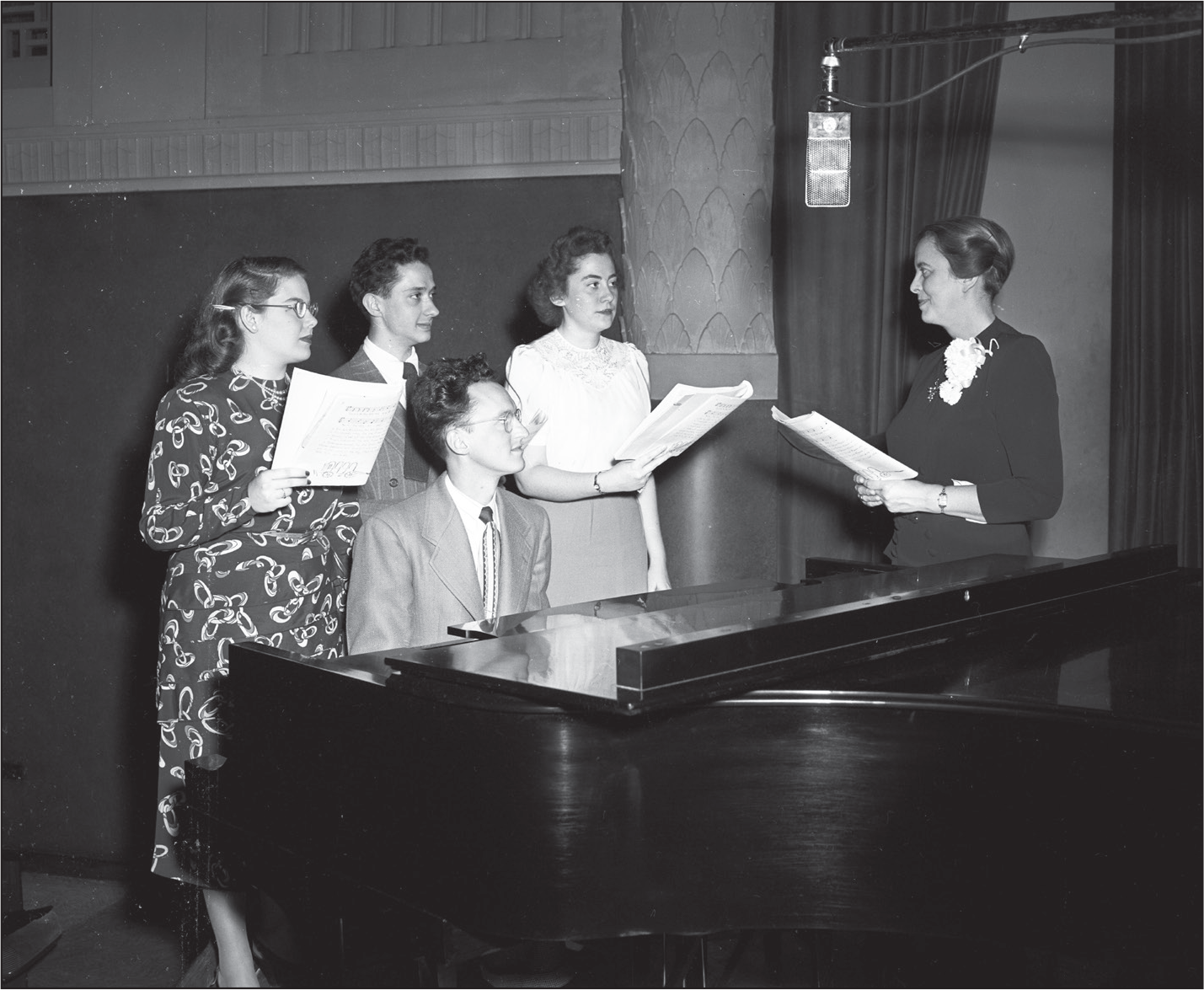
The ISS was produced on the IU campus by the Radio Broadcasting Department at IU, under the leadership of the Director of Educational Radio George C. Johnson. The production staff consisted of nine university professors and employees from across departments, with expertise in each of the various topics. 38
“Teachers Manual,” 2.
1948 Bulletin, Vol. XLVI, No. 17, Indiana University Archives, Bloomington.
“Miss Kelley,” as she is referred to in both the broadcasts and in course listings printed in the IU bulletins, earned a Bachelor of Music in piano at Columbia School of Music in Chicago in 1928, and a Master of Arts in education from New York University in 1936. Her school teaching experience was at rural schools in her home state of Illinois (1918–1920), in Chicago (1921–1922), and as an Assistant Director of Music in Des Moines, Iowa (1931–1934). She held positions prior to her appointment at IU at the Eastman School of Music (1928–1930), and the Milwaukee State Teachers College (1930–1931 and 1934–1946), where she worked with student teachers. Kelley became an Assistant Professor of Music Education at IU in 1946 and was promoted to Associate Professor in 1954. 40
Indiana University News Bureau Form, undated, Dorothy G. Kelley Clipping File, Indiana University Archives, Bloomington.
Press Release, Indiana University New Bureau, August 8, 1969, Dorothy G. Kelley Clipping File, Accession no. 20011031, Indiana University Archives, Bloomington.
A slim clippings file in the IU Archives contains an undated sepia-toned portrait of Dorothy Kelley. She smiles softly, hair pulled back neatly with a necklace of pearls peeking out from around her high collar. This photo made it possible to identify her in a photograph titled simply “School of the Sky Concert” in the Archives Photograph Collection, taken on April 16, 1948 (see Figure 2). Although the “School of the Sky Concert” photo was taken from the side and the headshot from the clippings file is from the front, the curve of her eyebrow and cheek suggest that it is the same individual in both photos. The School of the Sky Concert photo was taken at IU. Kelley is pictured on the right-hand side, and the other four individuals appear to be approximately college aged. They stand around a piano with a microphone hanging above them, ready to lead the radio audience in song.
Student Participation
IU students regularly contributed to the music episode broadcasts through singing and playing their instruments and are heard live on the air in every music episode during 1947–1948. Because of the curriculum’s focus on singing, in most cases they lead the radio audience in learning new pieces or reviewing those learned previously. It appears that students also performed on their instruments, as in the episodes titled “Choirs in the Orchestra,” and in accompanying roles in some of the Christmas episodes. Through their participation, students surely benefited by exposure to repertoire selection, sequencing, and Kelley’s pleasant teaching affect.
The IU Radio Broadcasting Department provided practical training in radio for students, and as of 1948, nine IU students were on staff. Additional hourly student workers were required for the impressive 90 hours of rehearsals that took place each week for the various programs that the Department produced. 42
1948 Bulletin, Vol. XLVI, No. 17, Indiana University Archives, Bloomington, 564.
Participating students’ names were typically announced in the ending credits. While the specific roles of student participants such as voice type or instrument were not usually articulated, occasionally students’ roles were clearly mentioned on the air. “Miss Jean Towers” performed a trombone concertino, Martha Lou Gross performed a work by Edward MacDowell on piano, Nicholas Konichi performed on clarinet with Mary Helen Pease accompanying on piano. Not all names were confirmed as IU students by the Registrar’s Office, possibly because of misspellings or incomplete records. However, many were confirmed. According to the Registrar’s records, Pease received a Bachelor of Music in piano in 1949 and returned to IU to receive a Master of Music Education with high distinction in 1968. Other students who received degrees in music performance included Shirley F. Patrick (BM, 1949) and Pete J. Carr (BM, 1950). Music education majors included James Leroy Roderick (BME, 1949) and Willard Eugene Snap (BME, 1950). All of these students were heard on music episodes of the ISS in 1947 and 1948.
Repertoire and Teaching Strategies
The ISS music program included 95 compositions, both sung live and played from a commercial recording, during the 1948–1949 season. Some compositions appeared more than once, as students reviewed previously learned material across weeks. Music that originated in the United States, either by a composer or folk tradition, made up 34% of material used for both singing and listening activities (see Table 1). Other countries represented by either composer or folk tradition included Australia, Austria, Czechoslovakia, England, Finland, France, Germany, Italy, Norway, Mexico, Russia, and Spain.
Country of Origin of Compositions Represented in the 1947-1948 Indiana School of the Sky Season.
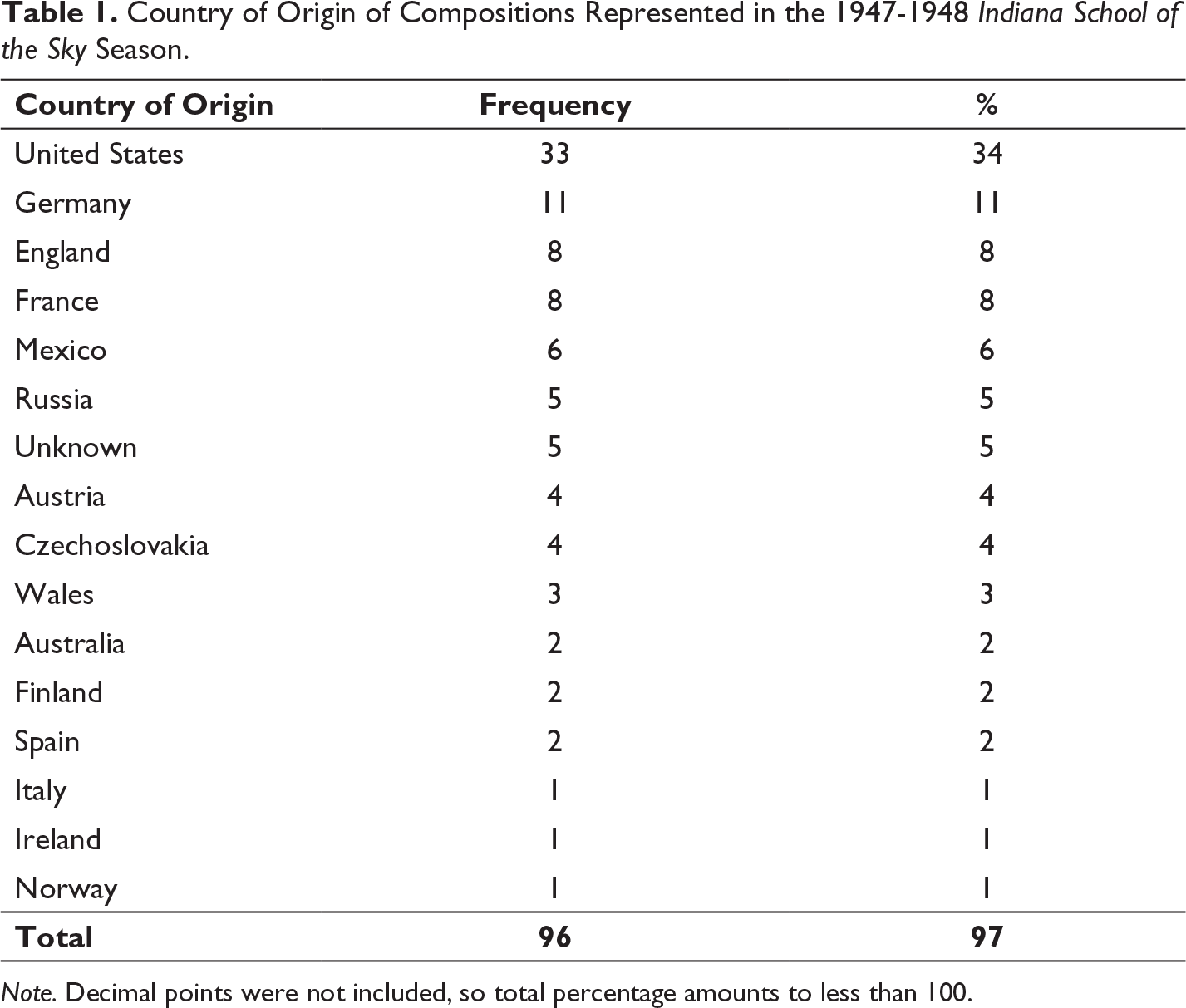
Note. Decimal points were not included, so total percentage amounts to less than 100.
The bulk of the genres represented fell into the folk (39%) and classical (34%) categories (see Table 2). The lessons emphasized singing and active participation from the students, and folk music might have seemed a logical vehicle for this aim because of the comfortable vocal ranges and regular rhythmic patterns. All other genres were less consequential, amounting to between 4 and 9 percent.
Musical Genres Represented in the 1947-1948 Indiana School of the Sky Season.
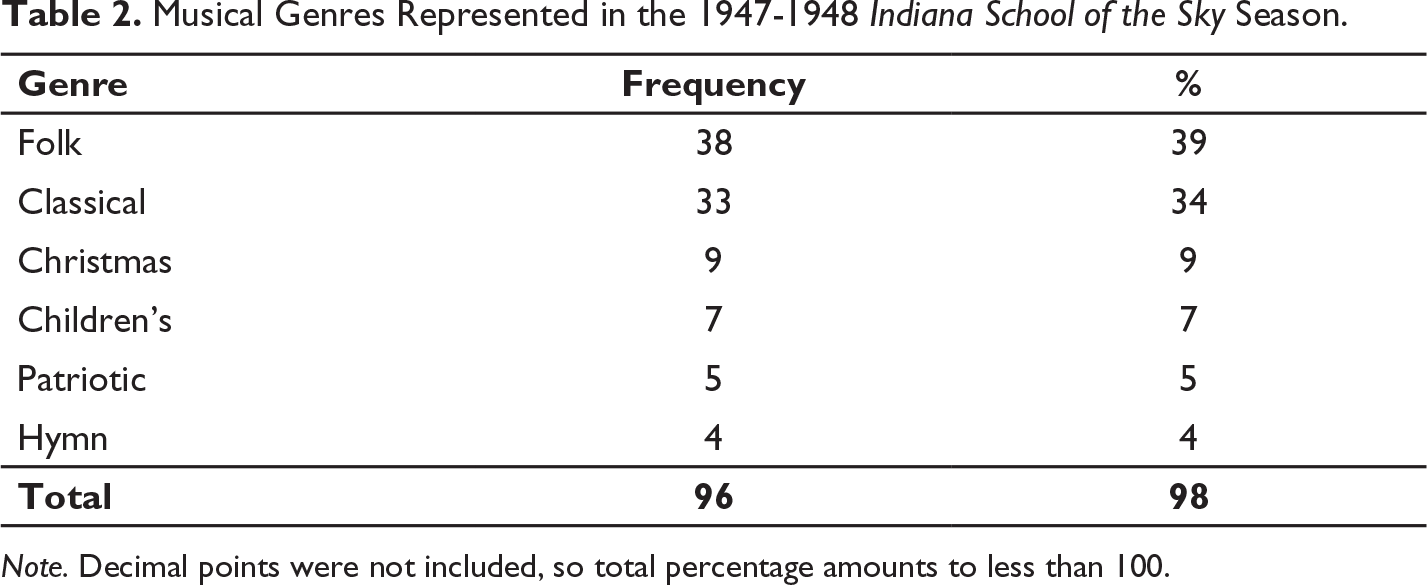
Note. Decimal points were not included, so total percentage amounts to less than 100.
The ISS music programming in 1947–1948 included two types of lessons that Edna Whitsey articulated in 1950. These included “the weekly lesson,” in which students participated in rote song learning and “the listening lesson,” or music appreciation, where students experienced “good and interesting music that is beyond his power to perform…” 43
Whitsey, “Radio in Music Education,” 26.
Episode Format
Most episodes followed a predictable lesson sequence. First, students reviewed previously learned compositions using the “singalong” strategy, then new compositions were introduced using “call and response,” and finally students engaged in some sort of listening or music appreciation activity. 85% of compositions heard on the air were recorded live in the studio at IU, and the episodes that did contain commercially recorded music also featured live music for at least a portion of the 15-minute lesson. Recorded music included classics such as Brahms’ Hungarian Dances, Dukas’ Sorcerer’s Apprentice, Tchaikovsky’s Nutcracker Suite, and Johann Strauss’ Emperor’s Waltz. Recorded music was categorized as “listening” in all cases.
Dorothy Kelley’s voice was most prominent on the air. She led students in song and introduced composers and pieces. Some episodes included mini dramas telling the story of a composer and acted out by IU students. George C. Johnson, the Director of Educational Radio at IU, introduced each lesson and interjected at regular intervals, ushering students from one activity to the next.
There were several episodes that notably broke the standard episode format of review, new repertoire, and music appreciation. These included “Hansel and Gretel” on January 5 and 12, 1948; “Choirs in the Orchestra,” January 19 and 26, 1948; “Making Our Own Music,” February 23, 1948; and “Your Favorite Music,” April 26, 1948.
The “Hansel and Gretel” episodes consisted of an arrangement of Humperdinck’s opera with voices, piano accompaniment, and narration between songs. This was performed live in the studio and consisted completely of “listening.” The “singalong” and “call and response” teaching strategies were completely absent. In this case, the music episodes coordinated with another ISS program. The radio audience heard the story first “The Story Book” program on the previous Friday, January 2, 1948, preparing them for the “Hansel and Gretel” music episode on Monday, January 5. This coordination between the music series and other programs only occurred one other time, when the Social Studies program broadcast “Mexican Neighbors: Western Countries III” on Tuesday, April 6, 1948, a day after “Music of our Latin American Neighbors” aired.
“Choirs in the Orchestra” also abandoned the typical format. This episode included descriptions of orchestral families of instruments with brief sound examples and longer musical demonstrations. Harry Jay Skornia, chairman of the IU Radio Department and a member of the ISS production staff, narrated the bulk of these episodes. Kelley led one song on January 19, but on January 26 her voice was not heard, for the only time during the 1947–1948 Season. Great care was taken in these episodes to announce performers’ names and instruments as they were heard, departing from the usual quick mentions of participating students during the ending credits.
An intriguing alternative-form episode that merits highlighting was titled “Making Our Own Music,” and it aired on February 23, 1948. This episode featured a group of students from the Elm Heights School in Bloomington and culminated in original pieces, composed live on the air, by the Elm Heights children. First, led by Kelley, the children sang favorite songs that they had learned while listening to the ISS in their classroom, such as “Let the Fun Begin” and “Yankee Doodle.” This segued into a discussion about composers and students gave their opinions about “what makes a good song.” These youngsters contributed ideas such as “rhythm and time,” “mood,” “good words to fit with your music,” and “melody.” Kelley asked the students open-ended questions, and the segment had an unscripted feel. After their discussion, Kelley read a poem about a frog that one of the children had written: There was a frog that sat on a log, sat on a log, sat on a log, And there he sat and grew very fat, grew very fat, grew very fat, A little fly came buzzing by, buzzing by, buzzing by, Frog caught the fly as he buzzed by, buzzed by, buzzed by, Frog ate him fast, as he buzzed past, and there he sat and grew very fat, grew very fat, grew very fat.
44
“Making Our Own Music,” 1948, Indiana School of the Sky Records, Collection C643, Indiana University Archives,
Kelley proceeded to lead the children in speaking the poem rhythmically, emphasizing any “important words.” Several children volunteered to sing a tune that they thought went well with the rhythmic verse. It was unclear if the students prepared for this ahead of time, but the results were creative and pleasant to listen to. In spite of the confines of working with the same lyrics and chanting the lyrics in rhythm, the students produced unique renditions: two students sang in a lilting six–eight meter, while another interpreted the lyrics in a march-like four-four. The compositions did carry the influences of past repertoire; with symmetrical phrases and regular rhythms they seemed to mirror the folk music that permeated the series. In “Making Our Own Music,” we saw Kelley creatively set up a unique learning environment over the radio: The Elm Heights students taught children in classrooms across Indiana strategies for music composition. It was an exquisite example of peer modeling.
Students listening from their classrooms were encouraged to experiment with composing and mail their work to the radio program. Kelley selected two of these compositions to feature live on the air: A second-grade class from Jeffersonville wrote “I Will Try to Understand,” and IU students performed it on April 26, 1948. “My Kite,” composed by a sixth grader from Ellettsville, was recorded on Friday, April 23, 1948, in a special concert on the IU campus and attended by students from across the state. These original compositions, prompted by the “Making Your Own Music” episode, was an exception to the program’s typical emphasis on singing and music appreciation, inserting creative music making and personal choice into the curriculum.
Conclusions
In supervising radio music lessons in the 1947–1948 school year, Dorothy Kelley became part of a legacy of female educators using technology as a medium to reach into classrooms where they might not otherwise have the ability to step. The inaugural season of the ISS allowed music education and performance students at IU to work alongside a seasoned music teacher in a unique field experience setting. Kelley innovated beyond simple listening activities, relying heavily on the “singalong” and “call and response” teaching techniques, and even into the realm of peer modeling. In addition to learning new pieces, singing well-loved pieces as a group, and listening to repertoire staples such as The Nutcracker Suite, students had the opportunity to explore composition.
Dorothy Kelley was a member of the music education department at IU for 23 years, but there is no evidence of her continuing with the ISS after the first season. In addition to her teaching duties in the School of Music and the School of Education at IU, the large amount of materials that Kelley was responsible for in the broadcasts must have been akin to a second job. One wonders if Kelley felt that the show brought valuable experiences to the IU students, and worthy lessons to public school students across the state; if she enjoyed the work or found it a cumbersome project pushed onto the newest and only female faculty member; and, if she had a sense if the singalong and call and response teaching strategies were effective over the air.
IU students certainly played a central role in the music programming during 1947–1948, as evidenced in their regular performances on the air. Through their participation, these young men and women not only gained radio and performance experience, but also experienced Kelley’s precise lesson planning and pleasant rapport with the radio audience. This afforded them the opportunity to apprentice with an experienced teacher, while at the same time utilizing exciting technology to deliver instruction. They must have felt as though they were part of the future. Because some of these students were music education majors and others were performance majors, this project provided an opportunity for the two disciplines to intersect. As many performers end up teaching at some point in their careers, though not necessarily in traditional classroom settings, this program could have sparked valuable ideas for how those who considered themselves “performers” might also see themselves as “educators.” The symbiotic relationship of music education and performance is often undervalued, and many conservatory students graduate without exposure to teaching methods. The manner in which the ISS handled its music programming could inspire current programs to create unique opportunities that similarly draw performance and education majors together and foster this symbiotic relationship.
The results of the content analysis suggest that the curriculum for the music lessons aired on the ISS in 1947–1948 was synchronous with larger trends in American music education at the time. A committee appointed by the MENC entitled “American Unity Through Music” advocated for the use of music to uphold American ideals during the tumultuous time around World War II. Suggested repertoire included the obvious classic patriotic pieces, but also folk music from a diverse array of cultural traditions, and music by American composers. 45
Marie McCarthy, ““We Who Have the Destiny of Musical America in Our Hands”: History Speaks to Us through 100 Years of MEJ.” Music Educators Journal 100, no. 29 (May 2013): 31–32.
Howe, “The NBC Music Appreciation Hour,” 69.
“Music in the Air,” 10.
“Music in Lincoln’s Time,” 1948, Indiana School of the Sky Records, Collection C643, Indiana University Archives,
The call and response style of teaching that Kelley employed regularly on the ISS music program is disjointed and awkward for the modern listener. Kelley, or an IU student in the radio studio, would demonstrate a small phrase, and then the small group of IU singers would respond. The call and response did not happen in a rhythmic manner (imagine a teacher chanting “my turn here I go” and “your turn ready go,” to facilitate such a moment), and as a trained musician, I found it difficult to predict the exact moment to begin singing when Kelley gives her directions, “now you, the chord, sing!” Breath and rhythmic sense did not translate well through the airwaves, and the lack of visual cues containing pulse and indicating musical lines makes the task of ensemble even more difficult. The live interaction between teacher and student, an essential element of teaching—breaking down activities further when something is not understood or moving ahead when the students are up to a greater challenge, a gentle push and pull between teacher and pupils—could not happen between Kelley and her radio listeners. Perhaps students during this period, less accustomed to visual stimulation that we receive on a regular basis today, did not experience this as a large problem, or perhaps this teaching strategy exemplified the use of technology for technology’s sake, inhibiting meaningful learning experiences. There is no doubt that technology has the power to bring, in the words of early education radio advocate Benjamin H. Darrow, “a wider, richer world” into the classroom, 49
Darrow, Radio Trailblazing, 5.
The call and response teaching strategy serves as an interesting example of experimenting with a new medium. Further study is needed to determine if other educational audio programs (Victrola or radio) from the 1930s and 1940s employed a similar technique. It is clear, based on the ISS music program recordings from the following season (1948–1949), that this teaching strategy was quickly abandoned: That school year focused on one composer per episode, and consisted largely of musical examples (both in the studio and by commercially-produced recordings) with brief information about composers and pieces.
While the call and response teaching style over the radio leaves much to be desired, the ISS music program in 1947–1948 influenced student learning in at least some meaningful ways, and Kelley experimented with other teaching strategies that appear highly effective. The use of peer modeling in student composition with the children from Elm Heights provides an exemplar case. Based on the evidence provided by student-composed pieces “My Kite” and “I Will Try to Understand,” it is clear that young students in Indiana engaged in composing because of the ISS program. Opportunities for peer modeling in remote and technology-based music lessons could be an avenue of creativity that contemporary music educators might explore.
In the President’s Report, 1947–1948, Herbert George Wells estimated that more than 30,000 school children in 161 towns and rural communities found in the ISS broadcasts “sound instruction in an enjoyable and memorable form.” 50
President’s Report 1947–1948, 1948 IU Bulletin, Indiana University Archives, Bloomington, 114.
Press Release, Indiana University Department of Radio and Television Chair’s records, Collection C104, Indiana University Archives, Bloomington.
Current educational programs delivered by radio and by its newest cousin, the podcast, suggest particular aspects of radio teaching that have best endured. While “weekly lessons” with the active teaching of repertoire requiring immediate listener responses do not seem practical, “listening lessons” or music appreciation programs have withstood the test of time. For example, “Exploring Music with Bill McLoughlin” has aired Monday through Friday on hundreds of radio stations across the country for the past 16 years. 52
“Exploring Music with Bill McLoughlin,” WFMT,
“Sticky Notes, The Classical Music Podcast,”
Footnotes
Author’s Note
This article is dedicated to the memory of Dr Patrice Madura Ward-Steinman. It was she who introduced me to historical research, and her mentorship and goodwill are greatly missed.
Declaration of Conflicting Interests
The author(s) declared no potential conflicts of interest with respect to the research, authorship, and/or publication of this article.
Funding
The author(s) received no financial support for the research, authorship, and/or publication of this article.
