



Abstract
The Swinney Conservatory of Music at Central Methodist University in Fayette, Missouri has a long history with unique beginnings. After the Civil War, Central College (Central Methodist’s original name) grew alongside a “Female Seminary,” Howard-Payne Female College. Through the late 19th and early 20th centuries, the two schools developed their own distinct musical cultures with Howard-Payne faculty developing a music curriculum, and Central students forming their own musical ensembles. When the schools merged in 1923 these two cultures united to create a conservatory of music at a time when many other American conservatories were being established. Just before the merger, Kansas City banker Edward Fletcher Swinney, who had strong family ties to the Fayette area and a history of philanthropy towards causes in Missouri education, donated $35,000 to Howard-Payne College for the construction of the conservatory building that would eventually bear his name. This article focuses on the early history of both Central College and Howard-Payne Female College, the role that music played at both schools (as a curricular and non-curricular activity) and the events leading to the formation of Central College’s music curriculum and construction of the Swinney Conservatory.
Keywords
Musical Traditions at Central College and Howard-Payne Female College (1854–1925): Events Leading to the Founding of the Swinney Conservatory of Music
Music has long been a part of liberal arts training in higher education. Throughout the 19th century, colleges and other institutions developed music schools and curricula to train quality musicians. 1 Beginning in the early 19th century, and blossoming in the years following the Civil War, many states established normal schools to provided teacher training in many disciplines, including music. 2 Private colleges and universities also began including music and music teacher training into their curriculum. One such private college was Howard-Payne Female College in Fayette, Missouri (founded in 1859). Teachers at Howard-Payne had been developing music courses since at least 1889 and music education courses by 1897. In 1923, Howard-Payne merged with its neighbor, Central College (founded in 1854; now Central Methodist University). The colleges’ music departments were formed into the Swinney Conservatory of Music in 1925 and the conservatory building was opened in 1927.
The founding of the Swinney Conservatory is unique, not only because it occurred just as the two colleges merged, but it also signified the coming together of two distinct musical cultures: one that had an established curriculum and the other that had a tradition of student-led ensembles. The story is also important to understand because it intersects two significant trends in American music education: the development of female seminaries in the 19th century, and the founding of American conservatories in the late 19th and early 20th centuries.
In eighteenth-century America, opportunities for women in higher education were sparse due to a perceived notion that women were “incapable of higher learning because of mental and physical inferiority.” 3 While opportunities grew in the 19th century, the main purpose of a “proper education” for women included obtaining knowledge and skills that would help attract and keep a suitable husband, manage a household, and rear children. Through the 19th century, several all-female colleges, often called “seminaries” were established to provide mainly white, middle- and upper-class women this kind of education. While the design of these seminaries mirrored their male counterparts, the subjects women were taught often differed from those in men’s education and included training in social skills, domestic work, and etiquette. 4
Music was also an important part of these seminaries, although it was not always offered as a core academic subject. In society at that time, it was seen that one way in which a woman could help her family was by being able to converse with her husband’s friends and business associates about art and music. Music was also used as a means of providing entertainment in the home (especially in the South), so training in music (mainly voice and piano) became a regular feature of many seminaries. At first, music was seen as an “extra” course, but as more seminaries were established, the subject took on greater importance. By the end of the century, it became a main subject in curricula across the country, including at Howard-Payne Female College. 5
At the same time as female seminaries became popular, there was a growing trend throughout America of individuals and schools establishing music conservatories. Modeled after European conservatories, the aim of American music schools was to train musicians for careers in music performance (mainly in piano, voice, and orchestra). 6 Early American conservatories included the Peabody Institute in Baltimore (1857), Oberlin in Ohio (1865), the New England Conservatory in Boston (1867), and the National Conservatory of Music in New York (1885). 7 While these pre-date the Swinney Conservatory, a curriculum based on a “conservatory-style” of instruction would be developed at Howard-Payne in the late 1800s. The establishment of the Swinney Conservatory in 1925 coincides with the founding of other, now notable conservatories such as the Curtis Institute in Philadelphia (1924) and Julliard in New York (1926, though its predecessor, The Institute of Musical Art began in 1905). 8
This study examines the early histories of both Central College and Howard-Payne Female College as well as the growth of musical cultures on each campus leading up to the formation of the Swinney Conservatory. Primary sources include those of both colleges including course catalogues, school yearbooks (the Central College Ragout, and the Howard-Payne Ditedom), and student newspapers. These were made available by the Smiley Library at Central Methodist University as well as by faculty at the Swinney Conservatory. Secondary sources written by local historians, such as T. Berry Smith, a long-time professor at Central were also consulted. Having so many primary sources dating back to the late 19th century still available is remarkable, but it also comes with some challenges. Some of the early course catalogues and yearbooks, especially those from Howard-Payne could not be located (presumably lost), while others that were available often had important pages (such as a listing of faculty) missing. While the Central Methodist University library has many of these sources on microfilm, the fact that they are not indexed meant that countless hours had to be spent scanning reels of microfilm, searching for any article related to music at both Central and Howard-Payne. This made the research process slow and arduous.
Two Schools in Fayette
To understand the founding of the Swinney Conservatory, one first needs to look at the separate, but connected histories of both Central College and Howard-Payne Female College in the mid-Missouri town of Fayette. Education played an important role in this small community since its founding in 1823. One of the earliest buildings constructed in Fayette was a little red schoolhouse located on top of the hill at the end of Main Street. Archibald Patterson, one of the first schoolmasters, wished to make Fayette an educational center in the new state. In 1838, with Patterson’s leadership, construction began on a building adjacent to the schoolhouse that would better serve the educational needs of the region. 9
It was at this same time that the Missouri Legislature voted to establish a state university. The people of Howard County were interested in having the university located near them and so construction quickly began on the new schoolhouse. 10 However, before construction was complete, citizens of nearby Boone County pledged $117,921 in cash as well as land in the city of Columbia for the new university and won the bid. 11 This setback caused funding to fall through which slowed construction efforts and eventually led to the sale of the property. 12
In September 1844, the unfinished building opened as Howard High School under the leadership of William T. Lucky and Reverend Nathan Scarritt. 13 In December of that year, outstanding debts forced the sale of the property to a local tobacco farmer, Captain William D. Swinney. In 1847, Swinney handed the property over to the Missouri Conference of the Southern Methodist Episcopal Church for “a public institution of learning under the control and government of the Conference.” 14
In the 1850s both the Missouri and St. Louis Conferences of the Southern Methodist Episcopal Church operated several schools throughout the state. In 1852, Reverend Nathan Scarritt proposed that the two conferences work together to create a single Methodist college in Missouri. On April 13, 1853, a committee voted in favor of forming the college with proponents of Fayette convincing the members to establish the new college there over the more heavily populated area of St. Charles. 15 The conferences approved the committee’s recommendation in September 1853 and elected a Board of Curators. The Missouri General Assembly approved the school’s charter in 1855, but the college did not have a name. 16 It’s believed the reason for this was that the founders hoped a benefactor would eventually endow the college, lending his name to the institution. 17 The original charter simply identified the school as “the central college” which evolved into the name Central College. 18
In January 1854, fire destroyed the Howard High School building which created an opportunity for the Board of Curators of Central College.
19
In February 1855, the Board was able to acquire the property for $5000 that (at William Lucky’s insistence) went towards the construction of a new Howard High School.
20
In 1856, with the property purchased, construction on Central College’s first building, known simply as the “Old Building” began (see Figure 1).
21
The first building on Central’s campus known as the “Old Building” (pre-1900). Today the building, now known as Brannock Hall, houses many of the college’s administrative offices. Source: Bulletin of Central College 26, no. 5 (May 1931): 1.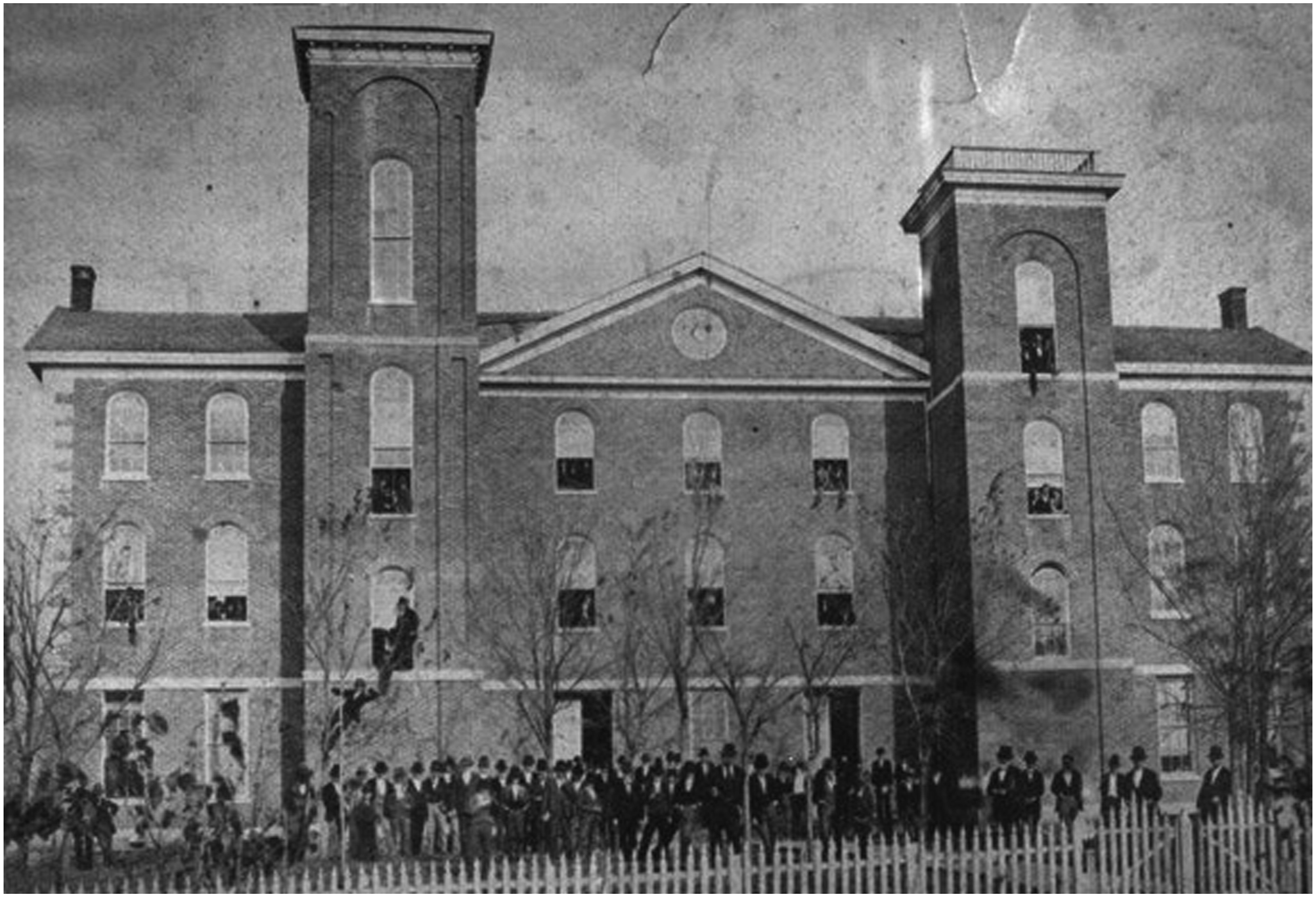
Central College Accidentally Becomes an All-Male School
Central was founded as a co-educational college, but for much of its history before the 1923 merger, it was mistakenly thought of as an all-male school. Howard High School had likewise been founded as a co-educational elementary and preparatory school. This changed in the spring of 1856. According to the official explanation, “in consequence of the large number of students, the Male and Female Departments are now taught in separate buildings.” 22 However, Carr W. Pritchett, an instructor at Howard High School at the time, later explained that “in March 1856 a great scandal arose on account of clandestine meetings of boys and girls at night in the new building.” 23
For the rest of the spring 1856 semester, William Lucky taught the girls in the high school building, while Pritchett taught the boys in the local Masonic Hall. The separation of the sexes continued the following year, and in 1857, the “Male Department” was transferred to Central (which had added preparatory classes). In advertisements leading to the 1857 school year (see Figure 2), Howard High School was now referred to as a “Female Seminary” and changed its curriculum accordingly. Besides traditional coursework, girls could take a variety of extra courses including music (piano, guitar, or melodion) for an extra charge.
24
The school would continue to be restricted to girls, and the curriculum eventually expanded beyond high school. In 1859, William Lucky obtained a charter and renamed the school, Howard Female College.
25
Advertisements in the St. Louis Christian Advocate, September 17, 1857, show the transition of Howard High School to a “Female Seminary” and the inclusion of preparatory courses at Central College.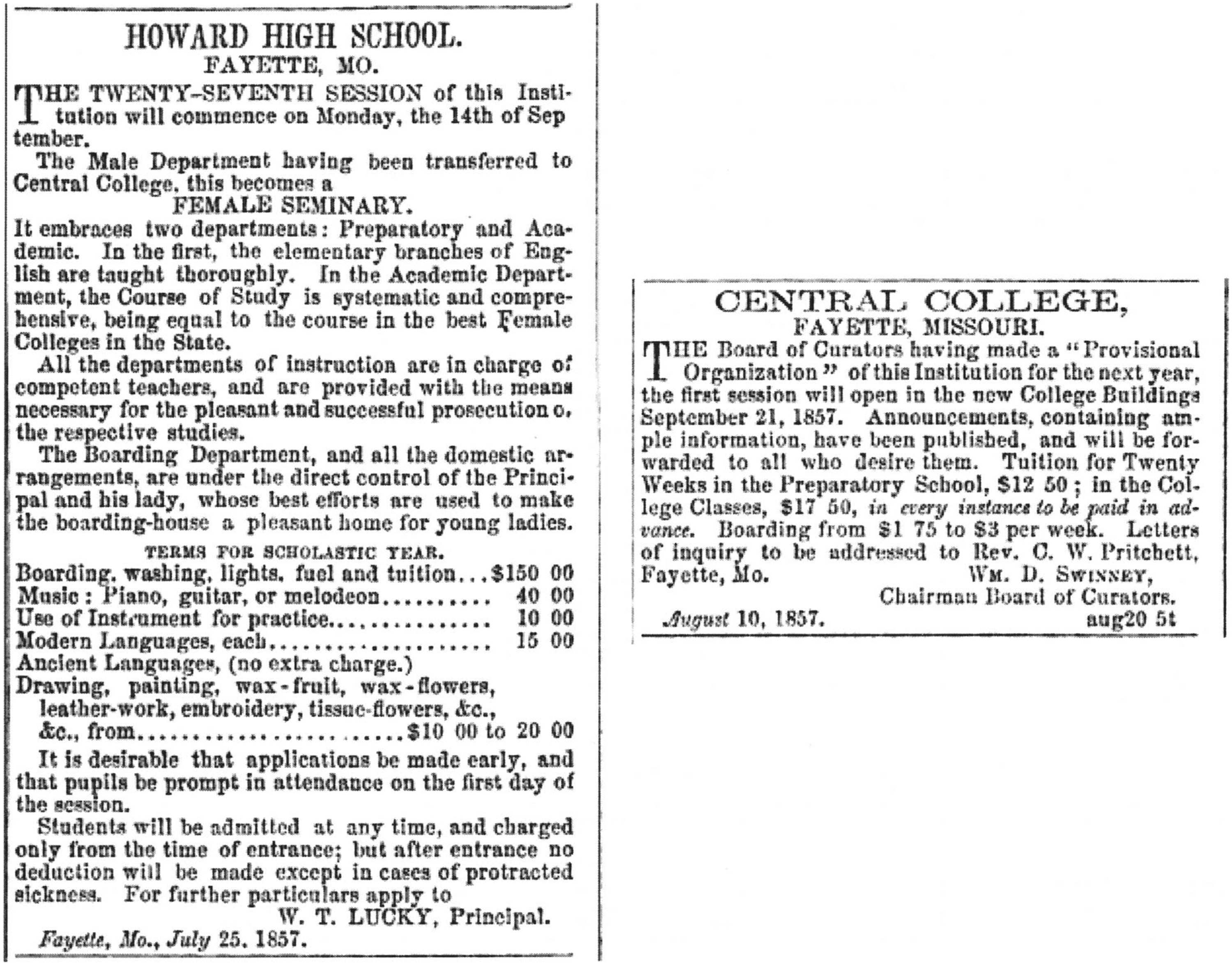
Evidence suggests that Central College’s opening on September 18, 1857, was rushed. The endowment was seen as insufficient, and there was worry that the Old Building would not be completed on time. 26 The first session included an enrollment of 114 students (all male) and three faculty: Reverend Nathan Scarritt (the college’s first president), Carr Pritchett and Eli B. Offutt. 27 It is not clear whether Central had originally intended to offer preparatory courses for boys. The fact that Carr Pritchett is listed on Central’s faculty, coupled with Howard High School’s advertising of a female seminary, and the seemingly rushed nature of Central’s opening, all suggest that the preparatory courses may have been added at the last moment.
The Civil War and its Effect on the Future of Both Schools
With the election of Abraham Lincoln as President of the United States in 1860, tensions in Fayette and the surrounding area grew. Missouri was a state with both strong pro-slavery and anti-slavery factions. In fact, the slavery issue was a contributing factor in the split of the Methodist Episcopal Church in 1844 with members in Missouri joining the Methodist Episcopal Church, South. 28
Howard County at that time had strong ties to the South and slavery. In 1860, twenty-five percent of Howard County residents were transplants from either Kentucky, Tennessee, or Virginia. The area around the Missouri River (which includes much of the western and southern portions of Howard County) was known as “Little Dixie” due to its fertile farmland and culture that was like that of the Upper South. 29 Captain William Swinney himself owned 70 slaves making him the largest slave owner in the county. Support for slavery was so strong in Howard County that in the election of 1860 Abraham Lincoln received only one vote. 30
When the Civil War broke out in April 1861, Central had just graduated its first class consisting of six students. 31 Central’s Board suspended operations that summer but allowed Carr Pritchett and Dr. W. H. Anderson (who had taken over as Central’s President in 1860) use of the Old Building to operate a school, though it was not affiliated with the college. 32
Anderson resigned in 1863, and Pritchett was convinced that he could run the school alone. In September of that year, a band of bushwhackers (marauders with no allegiance to either side of the war who raided the homes of civilians) robbed Pritchett’s house in nearby Glasgow, burned his crops and threatened to hang him, forcing him to abandon his plans. In the summer of 1864, with the Old Building abandoned, Union soldiers occupied it and the nearby courthouse, building fortifications to protect residents from invading guerrillas. 33
When Union soldiers left Fayette in 1865, the Old Building was in shambles.
34
Fayette Methodist Church minister Benjamin F. Johnson helped raise $2000 to restore the building for use as a community school. The St Louis Methodist Conference had no interest in funding the new school, so Reverend H. A. Bourland and Carr Pritchett operated it as a private undertaking under the name of “The Classical Seminary of Central College.” While there is little known about the courses offered at the school, music seemed to be a part of the curriculum when it opened for classes in 1867. Bourland was not checked by the refusal of the support of the St. Louis Conference. “So I gathered some choice spirits,” he wrote later, “Reverend Frank Taylor… James Curd of Palmyra, Mrs. ——— Mitchell [sic)], music teacher, and Miss Walden were my assistants. About 100 pupils were enrolled… and the goodwill of the community secured.”
35
With the war over, leaders of the St. Louis and Missouri Conferences had to decide whether to reopen Central College or close it for good. The Board of Curators had not held a meeting since it suspended operations in 1861 and the college still suffered from a large amount of unpaid debt. 36 This made reopening difficult to imagine.
Proposed solutions to the college’s money problems included moving it to another town, having the St. Louis Conference hand over sole ownership to the Missouri Conference, and selling it outright. In 1867, a proposal was adopted that called for Central to reopen under a new leadership structure in which the Board of Curators was given full operational control independent of the two conferences. 37 On September 22, 1870, Central College formally reopened under the presidency of Dr. John C. Wills. 38
Like Central, Howard Female College had closed during the Civil War. One of the first goals of Central’s new Board of Curators was to purchase Howard’s buildings at “the earliest period possible.” A man named Moses U. Payne purchased the buildings at auction in 1869 promising to donate them to Central.
39
Instead, Payne deeded the property to the Missouri Conference with the stipulation that “said premises be used for female school purposes exclusively, and for the education of females only,” which it did when classes resumed in 1884. In June 1892, the college would honor Payne’s contribution by re-naming the school Howard-Payne College (see Figure 3).
40
Map of Central College, 1912. In it one can see the proximity of Central’s campus to Howard-Payne’s. The “Old Building” is on the far right with Howard-Payne’s campus located just across the street (upper right corner). Source: T. Berry Smith, “The Transformation of the Old Building,” Bulletin of Central College 7, no. 2 (February 1912): 4.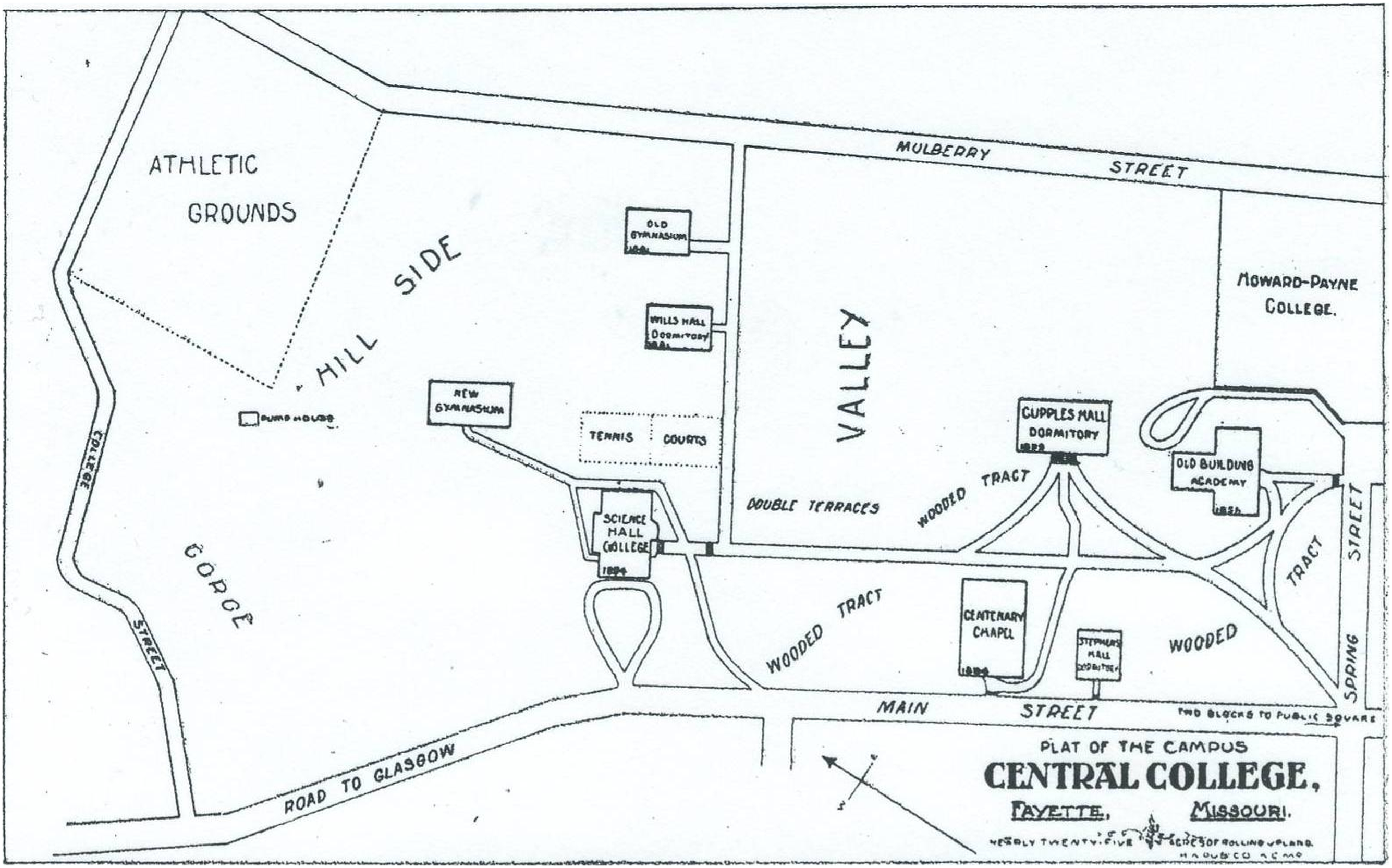
N. Louise Wright and Howard-Payne’s Music Curriculum
Music played a significant role in the social and academic life of both Howard-Payne and Central. The growth of music on each campus, however, began in very different ways with Howard-Payne establishing the first academic music programs led by trained instructors. At the same time, students at Central took it upon themselves to organize their own ensembles, many times independent of faculty.
Music was a part of Howard-Payne’s culture in the years following its reopening. The student newspapers of both schools: the Central Collegian and The Howard-Payne Exponent reported on faculty and student musical performances that were routinely a part of school ceremonies. 41 The earliest evidence of Howard-Payne having an academic music department comes from its 1889–1890 catalogue, which indicates a department consisting of two separate areas: vocal and instrumental (limited to piano). 42 Degrees offered by Howard-Payne at that time were the Mistress of English Literature and Mistress of Arts. A certificate of graduation for students who completed training in the music was also available. 43
In 1889, the instrumental area, led by Lillian B. Flanders, consisted of five grades of study in piano performance using the “New England Conservatory Method.” Each grade of study consisted of practice in scales and etudes along with performing a variety of repertoire deemed appropriate for each student. Study in the fifth grade included a “History of Music” course as well as instruction in the works of “modern” composers such as Liszt and Chopin. 44
The Vocal Department, taught by Pearl Minick, contained four grades of coursework. Along with learning proper breathing technique and basic vocalization exercises, students also learned scales, diction (English, Italian and German) and some music history. By the fourth grade, students were performing opera selections by Mozart, Rossini, and others along with church music repertoire. 45
By 1893, the music faculty and curriculum expanded to accommodate more students. Post-graduate study in piano was introduced as well as sight-singing courses in the vocal curriculum. The music curriculum also included more courses in music analysis and history along with the requirement of recital performance and attendance. 46
In 1897, Grace Louise Ware replaced Lillian Flanders as the head of music. 47 Both the vocal and instrumental (now called the Piano Department) departments began using the terms freshman, sophomore, junior and senior to describe their levels. There was an expansion in the music history, theory, and harmony curricula and elective courses in other subjects such as violin, guitar, mandolin and chorus were offered, at least on a limited basis. 48 Post-graduate work, now aimed at “pupils desiring to teach,” suggests the first attempt at a music education curriculum. 49
Marion Eloise Lasher succeeded Grace Ware sometime between 1899 and 1901. 50 In 1902, there was a restructuring of the college and a changing of the degrees it offered to the Bachelor of Literature, Bachelor of Science, and Bachelor of Arts degrees. There was also a restructuring of the music department with the piano department (directed by Lasher) being separated from the vocal music department (directed by M. Dorothy Martinowski). 51
In 1906, N. Louise (Nannie) Wright (who at the time, was Second Assistant Director of the instrumental music department and instructor of piano) replaced Marion Lasher as director of instrumental music. 52 Wright was born in Fayette in 1879 to Dr. and Mrs. Uriel Sebree Wright. 53 As a child, she proved to be a talented pianist, taking lessons from her mother at the age of five. 54 Her mother passed away when she was just 10 years old, but her keyboard skills at that time were such that she was able to take her mother’s place as organist of the First Baptist Church of Fayette. 55
Wright attended Howard-Payne College where she earned a Mistress in English Literature degree 1898.
56
After graduation, she left Fayette to attend the Columbia School of Music in Chicago, where she studied with Mary Wood Chase.
57
She received her Bachelor of Music degree in theory and composition before returning to teach at Howard-Payne in 1903 (see Figure 4).
58
Nannie Louise Wright when she first joined the Howard-Payne music faculty in 1903 (left) and Wright ca. 1925 when she became the first Dean of the Swinney Conservatory (right). Sources: Catalogue of Howard-Payne College (1903–1904): 5; Central College Ragout (1927): 19.
Under Wright’s leadership, the music department of Howard-Payne flourished. Music history and theory coursework expanded; courses in violin became a part of the curriculum, and in 1915, Howard-Payne offered its first Bachelor of Music degree. 59 Wright continued to lead Howard-Payne’s music department until the school merged with Central and she became the first Dean of the Swinney Conservatory. 60
It was also during Wright’s tenure that the college added another building to its campus. In 1911, Classic Hall, built directly across from the original Howard-Payne building, opened to students. It was said to be the “first building used exclusively for class room purposes among colleges for women in Missouri.” Classic Hall not only had classrooms that housed the Science department and gymnasium, but it also had an auditorium complete with a Steinway grand piano and pipe organ for the many recitals hosted by the music department. 61
While courses offered in the piano and vocal areas remained virtually unchanged, by 1917 additions to the general music curriculum helped create a more robust department. Courses for students wishing to go into ministerial work were now a part of the curriculum as well as additional courses in “Public School Music,” bolstering the music education curriculum. The creation of a subdivision of “Violin, Orchestra and Band” in 1916 helped meet the need for more ensemble work (see Figure 5).
62
The Howard-Payne College Band, 1917–1918 with director A. Delos McCampbell (back row, center). Source: Howard-Payne College Ditedom (1918): 79.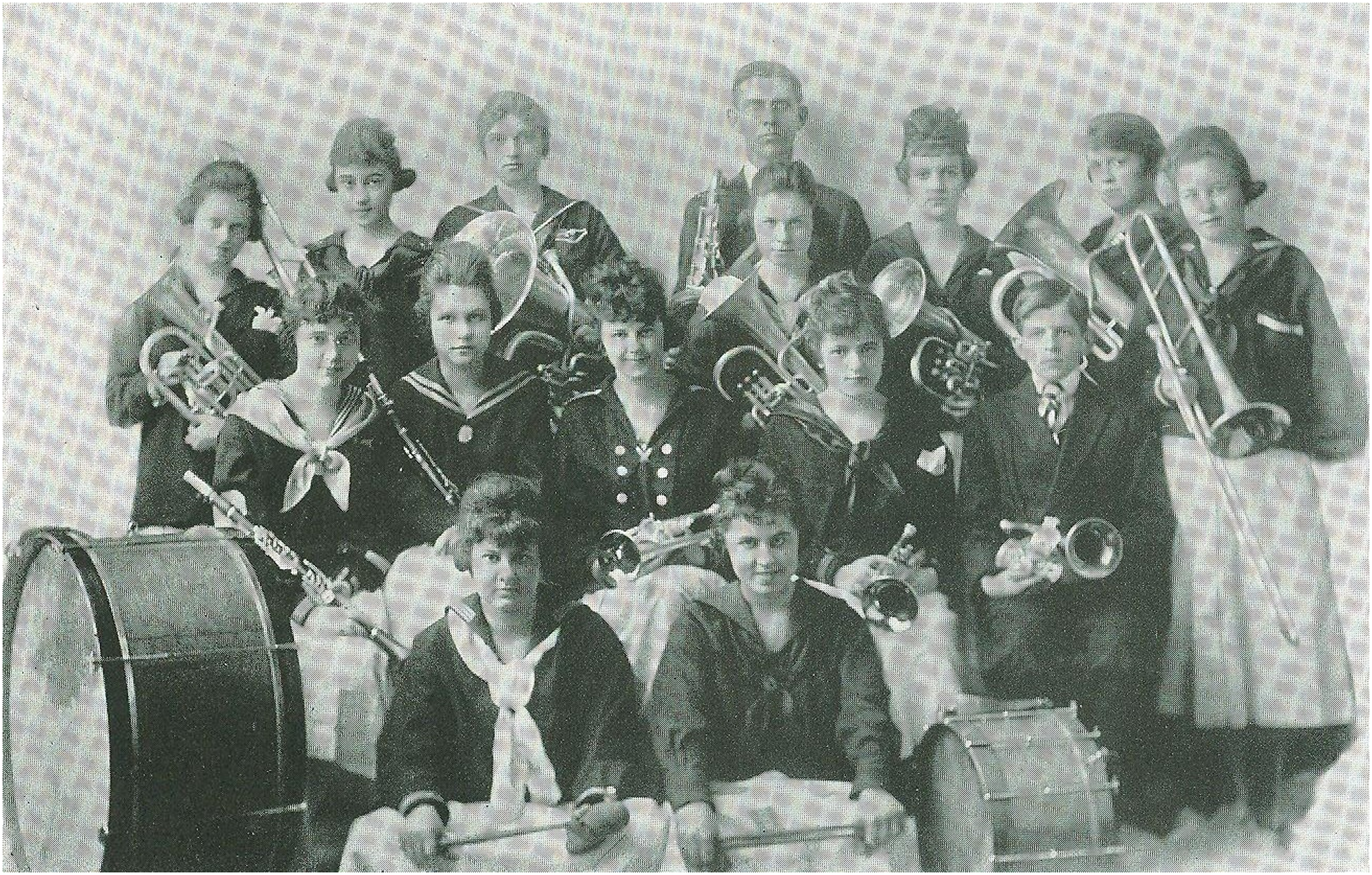
Musical Traditions at Central College
When Central reopened in 1870, extra-curricular activities centered primarily on oratory and debate engaged in by the school’s two literary societies: Phi Alpha and the Aristotelian Society. 63 Evidence shows in early editions of Central’s yearbook, the Ragout, that music proved to be an important activity of both societies. Meetings often included the men singing and a group referred to as the “Quartet” opened the annual speech and oratory contest between the two organizations with a performance. 64
Recitals were also a large part of student life at Central due largely to the music department of Howard-Payne. Central students often attended the student and guest recitals that were a part of Howard-Payne’s curriculum. 65 Acclaimed Russian pianist Josef Lhévinne, who was one of Nannie Wright’s former teachers, gave one of the biggest recitals Fayette had ever witnessed on January 31, 1913. 66
In 1911, at the third annual Valentine Concert, Central premiered its own Glee Club of 12 men directed by faculty member John C. Godbey (see Figure 6). The Central Collegian reported that the group “strengthened the program very materially and made the ‘hit of the evening’ in its first appearance.”
67
Glee Clubs of about a dozen members existed in the 1912 and 1913 Ragouts and although no directors are identified, it is most likely that students oversaw these ensembles.
68
Central’s first Glee Club, 1910–1911. John C. Godbey is in the back row, third from the right. Source: Central College Ragout (1911), n.p.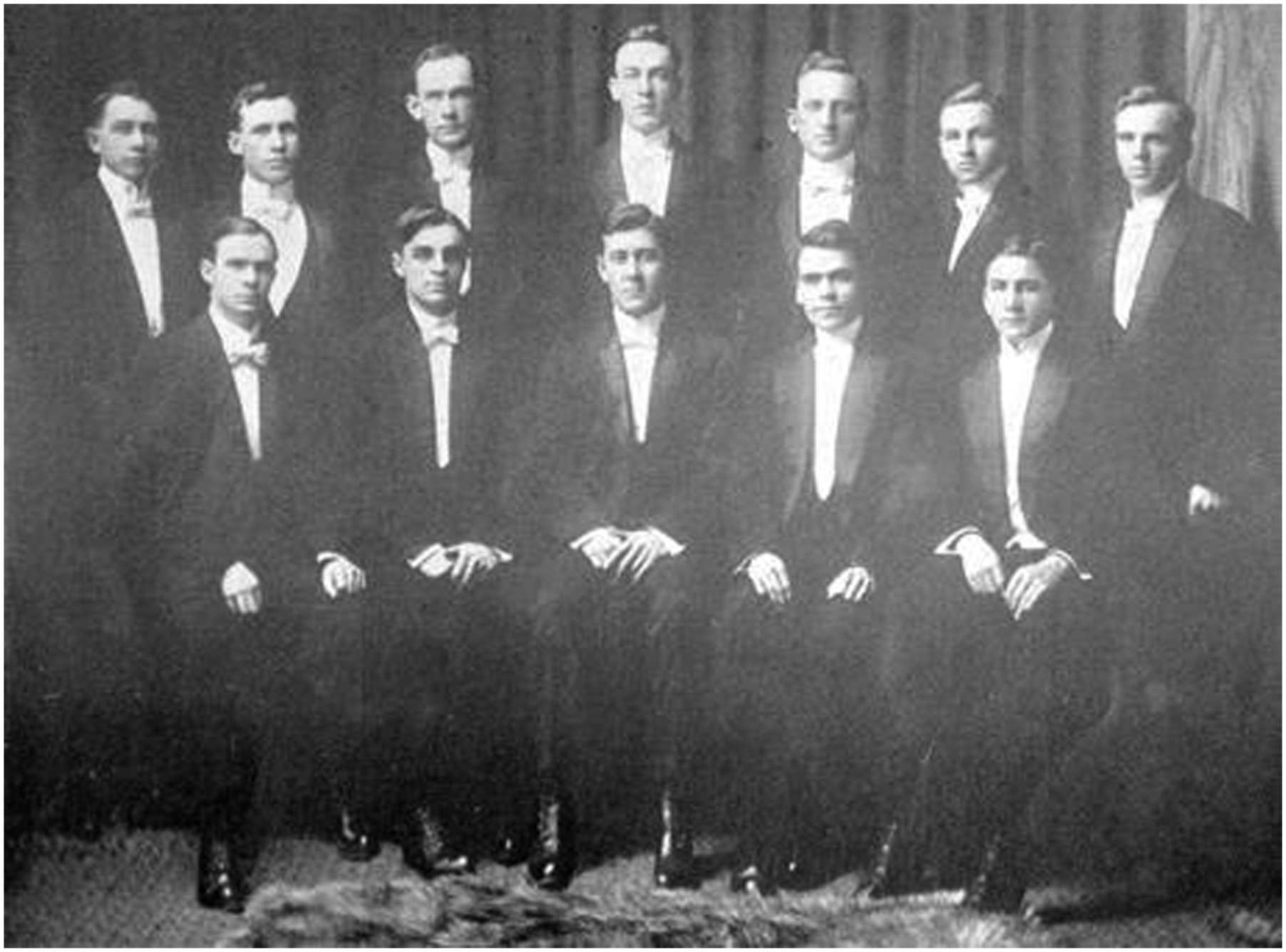
During this time, the Howard-Payne’s Choral Club, which included men (presumably from Central), was also expanding. It is not apparent when the Choral Club was first organized, but by the spring of 1914, it was taking advantage of male singers: Our choral club continues to grow in numbers, in interest, and in power of accomplishment. In order to utilize effectively the large number of masculine voices, and because of the tendency in musical circles this year to review old favorites in light opera, the musical directors selected for the mid-year entertainment the perennially popular “Pirates of Penzance.”
69
There is no evidence of a Glee Club in the 1913 school year and in a September 1914 edition of The Central Collegian announced the organization of a new Glee Club by a Professor Lanius. He stated that the only requirement needed for membership was that “you are able to ‘carry a tune’ and read by position so that you may soon to be carrying a part.” 70 This suggests that Lanius was attempting to regenerate interest in the group.
Central’s distinct musical culture also included instrumental groups, many of whose members were also members of the Aristotelian Literary Society. 71 The Central College Band began in January 1910 after a faculty member proposed the idea in 1908. 72 The credit of creating the band goes to students Robert W. Carroll and Norville W. Brickey, with Carroll (nicknamed “Sousa”) becoming the band’s first—perhaps reluctant—director. 73 Being director of both the band and Aristotelian Orchestra prompted a quote next to his senior picture in the 1911 Ragout, “Some men are born great, others achieve greatness while yet others have music thrust upon them.” 74
Information on the number of members involved in that first band of the spring 1910 semester is unavailable, but the band of the 1910–1911 school year numbered twenty-two. The instrumentation mainly consisted of brass instruments (cornets, and a variety of alto, tenor and bass horns), along with a few clarinets, snare drum, and bass drums (see Figure 7).
75
The Central College Band, 1911. In the center of the front row are the band’s first directors N. W. Brickey (in the drum major hat, holding a mace) and R.W. Carroll (to the right of Brickey holding a cornet). Source: Central College Ragout (1911), n.p.
After Carroll’s graduation, the direction of the band and Aristotelian Orchestra went to Norville W. Brickey. Originally from Festus, Missouri, Brickey learned clarinet at the Western Military School in Alton, Illinois and was a piano graduate of the Beethoven Conservatory in St. Louis before coming to Central. 76 Under Brickey’s direction, the band would experience great success. The number of members in the band under Brickey increased to 30 in 1912 and included R.W. Carroll who returned as a featured clarinet soloist. 77
The Annual Band Tour
One of the traditions of Central Methodist University’s Concert Band is its annual spring band tour. Currently, the band takes a six-day tour during the university’s spring break, playing at high schools and Methodist churches throughout the state of Missouri, generally alternating between the east and west side of the state each year.
Some of the band’s current tour traditions have their roots in its first tour of March 1912. During this tour, the band performed in the eastern Missouri cities of Mexico, Vandalia, Frankford, Monroe City, Shelbina and Clarence, playing for a reported 3000 people during the seven-day tour. 78 The Shelbina Democrat described the band’s March 3, 1912, program at the local Methodist church as consisting of “medleys, popular airs and selections from the operas…, vocal solos and two duets on stringed instruments.” The paper praised Brickey as a “talented conductor” and the band as showing “great skill and learning in music.” 79
Based on the success of the 1912 tour, a second one was taken in the spring of 1913 (this time of the western side of the state) that proved to be even more successful. 80 A letter published in The Central Collegian gives a detailed account of the “Boneheads of Brickey’s Band.” In it, one can see the difficulties of tour travel in the early part of the 20th century which included travel by wagon and waiting for hours in the town of Marshall for a train to take the band to Malta Bend, a mere 10 miles away. The band made stops in the towns of Slater, Marshall, Malta Bend, and Odessa on their way to their final stop, Kansas City. Along the way, an impromptu performance in Oak Grove was quickly organized due to a cancellation in Independence. 81 When they finally made it to Kansas City, a morning concert at Westport High School (attended by 1300 students) turned out to be so popular that the band performed a second concert that afternoon in front of a crowd of 1500. 82
Evidence shows that these students were motivated by the love of performing. They provided for their own instruments and music. Tours were also taken without any funding or supervision of the college. Students stayed in private homes (a practice that still occurs today) and paid for their own travel. 83
In organizations such as this, it’s easy to see how sustainability would become a problem. With the graduation of Brickey in 1913, the band came under the direction of junior L. B. Davis. 84 The band toured in the spring of 1914, making a two-week trip through central and northern Missouri, but this would be the last tour the band would take for over a decade. 85 The 1914 Ragout stated that about 30 musicians made the annual tour, but those numbers included the orchestra and presumably other non-band members. 86 One source claims that the numbers in the 1914 band were “as low as nineteen.” 87
Over the next couple of years, articles published in The Central Collegian attempted to generate interest in the ensemble. 88 In the 1914–1915 school year, there was no band with only 11 students (six of whom only played cornet) showing interest. 89 Enough players were found, however that an orchestra of 10 members could be formed. 90
In 1915, Professor G. B. Lombardo (who would start Howard-Payne’s band and orchestra program the following year) attempted to revive the band. 91 Lombardo was able to form a small orchestra, but he was unable to form band. 92 Students wanted a band, especially to play at athletic contests, but apparent issues of poor equipment, little college support, and lack of players committed to taking the ensemble seriously kept the band silent. 93
World War I and its Impact on Central’s New Music Program
In the spring of 1917, Central announced the establishment of a music department to begin in the upcoming fall semester with the goal being to establish and improve the quality of student ensembles on campus. The only instructor of this new department was A. Delos McCampbell, who had just replaced G.B. Lombardo at Howard-Payne. 94 Things looked promising for the new department with 35 members signed up for the Glee Club and 20 for band and orchestra. 95 Before the program could get off the ground, however, war in Europe would change the focus of instruction at Central.
When the United States declared war on Germany on April 6, 1917, the response from most students at Central was one of patriotism and even anticipation about the reversal of America’s neutrality policy. 96 While both Central and Howard-Payne held commencement exercises, many activities, including those of the literary societies, were either suspended or cancelled. 97 The construction of a new dormitory at Howard-Payne halted due to the rising cost of lumber and the limited number of contractors available due to the war. 98 The students themselves began to prepare for the war and the coming draft. 99
Before the 1916–1917 school year was over, enrollment in colleges throughout the country was declining as men left either for military service or to help on their family farms back home.
100
Central president Paul H. Linn assuaged any fears of school closure by saying that, “the only thing that will keep the college from opening … will be the actual invasion of Fayette by the Germans.” Linn went on to announce an expansion of the curriculum that would include courses in military tactics.
101
In May 1918, the federal government offered interested institutions the opportunity to provide military training to students. The student body as well as the administration expressed interest and by August, Central became one of four colleges in Missouri to establish a Student Army Training Corps (S.A.T.C., see Figure 8).
102
Central College’s S.A.T.C unit, 1918. Source: Central College Ragout (1919): 16.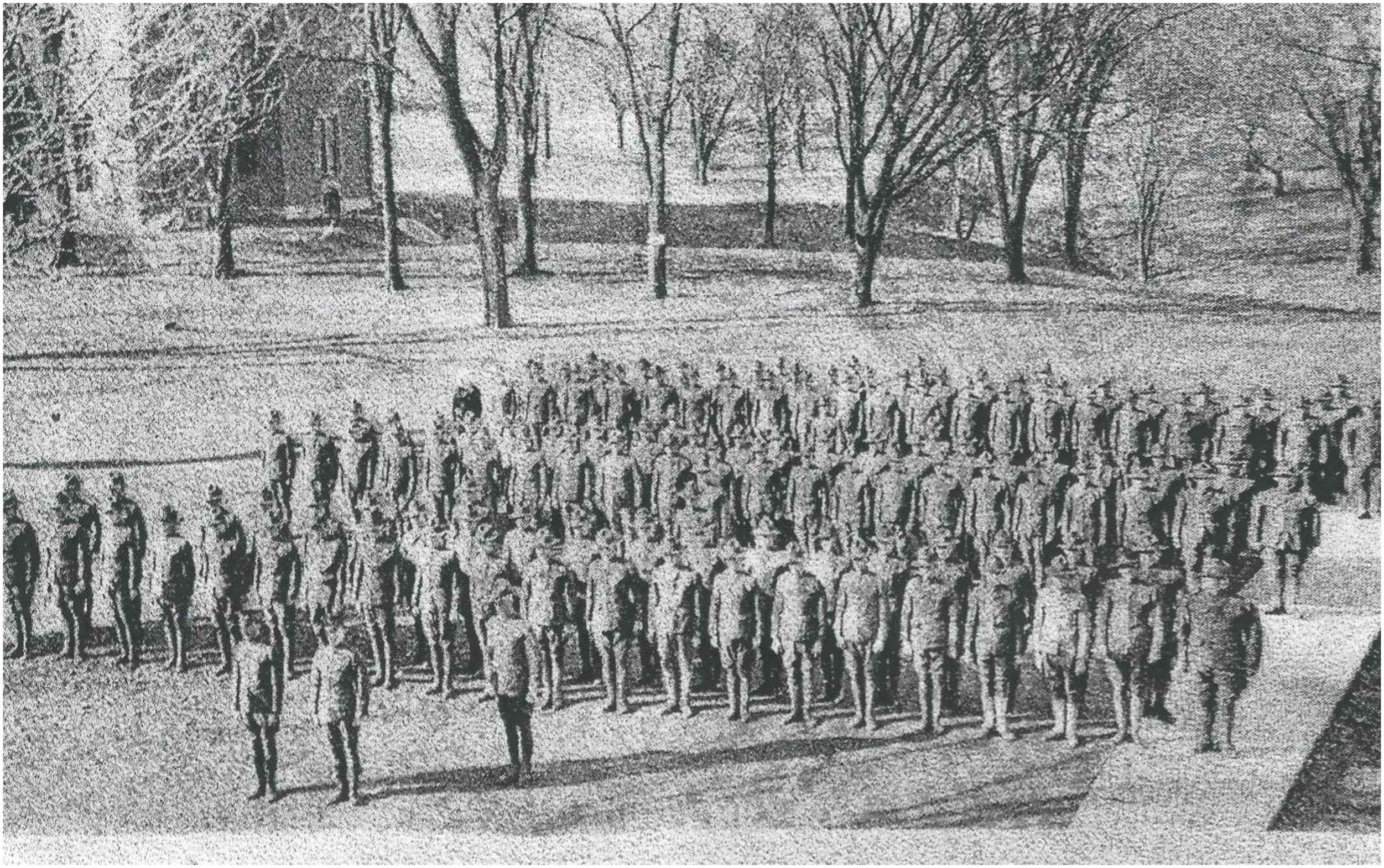
The S.A.T.C. program, however, did not come to full realization. On November 11, 1918, the war in Europe ended with an armistice agreement between the United States and Germany. Central’s military training program lasted exactly 2 months and 10 days with none of the men ever fighting in the war. The end of the war meant that the college and students had to quickly readapt and return to normal operations. The change was so sudden that it was reported that five students traveling to officer training at Camp Grant, Illinois had to turn around mid-trip and go back to Fayette when learning of the armistice. 103 Clothing for the S.A.T.C. men arrived just days before the unit disbanded on December 4, 1918. Many students who had come to Central specifically for its War College left Fayette soon after. 104
Merger of the Two Schools
Central College had to scramble to resume its regular course offerings for the spring of 1919, which included the implementation of its new music curriculum. 105 Courses offered by the music department included private lessons in band and orchestra instruments as well as Glee Club and Chorus. Students wishing to take private instruction in piano or voice could do so at Howard-Payne. 106 This kind of collaboration between the two schools was becoming more common and by the end of World War I, the process of consolidating the two schools was already underway.107
For years, there had been an assumption that Central College was an all-male school, despite its charter as a co-educational institution. The separation of the sexes that had occurred in 1856 due to the “scandal” of boys and girls secretly meeting at night, coupled with the fact that Howard-Payne had become a well-respected women’s college, created the appearance that Central was for men only. Women had been attending Central since at least 1886 on a partial basis (as to not interfere with Howard-Payne) and were fully admitted in 1895. 108
Since the reopening of both schools after the Civil War, the leaders of Central attempted several times to acquire Howard-Payne. 109 After World War I, the push towards consolidation, which started as a more coordinated alliance with Howard-Payne, hastened thanks to Central president Paul H. Linn. Under Linn’s leadership, Central expanded the course offerings available to Howard-Payne students and in 1918, the two schools announced an affiliation deal that would allow students to freely take courses at either school. 110 In 1922, the curators of Howard-Payne finally decided to merge with Central, effective in 1923. President Linn, however, would not see the full fruits of his labor. On February 1, 1924, while attending an educational conference in Memphis, he suffered a stroke and died. 111
With the merger, the music department transferred to Central with N. Louise Wright becoming its first Dean. 112 There was a transitional period where the two colleges kept their respective names with music students being referred to as students of Howard-Payne. 113
The music curriculum centered on a new Bachelor of Music degree with coursework divided into major areas (piano, voice, violin, organ, music theory), applied minors, theory, ensembles, and electives. Just as at Howard-Payne, students attended recitals and concerts as a part of their coursework. Courses in public school music methods were also still available. 114 The Bachelor of Music Education degree would not be added until 1947. 115
A significant change to the curriculum was the addition of performance ensembles, which meant the end of large, student-led ensembles. The first ensemble directors, Keith Anderson (band) and Leslie Putnam (choir) would do much to reorganize their respective groups. 116 Early courses included several large and small vocal and instrumental ensembles including choir and orchestra. Initially, there was not a band course, but one would eventually be included. 117
Edward F. Swinney and the Building of the Conservatory
Under the leadership of President Linn, Central’s endowment rose to $500,000 and the school was finally free of debt.
118
Plans for some of the funds included a capital improvement campaign that would begin with the construction of a new church on campus to replace the old Centenary Chapel.
119
Bishop William F. McMurry, who succeeded Dr. Linn, expanded the campaign.
120
In October 1925, Central’s board approved the opening of a $750,000 endowment for the capital improvement plan to include a gymnasium, swimming pool, a men’s dormitory (later named McMurry Hall), a central heating plant, a religious education building, a chapel, and a conservatory of music.
121
The funding for the new conservatory building, however had been in place well before the merger. In 1922, Kansas City banker Edward Fletcher Swinney (1857–1946, see Figure 9), seeing the needs of a growing Howard-Payne music department, donated $35,000 to the college for the construction of a new music building.
122
Edward F. Swinney, ca. 1925. Source: The Bulletin of Central College 22, no. 4 (April 1927): 2.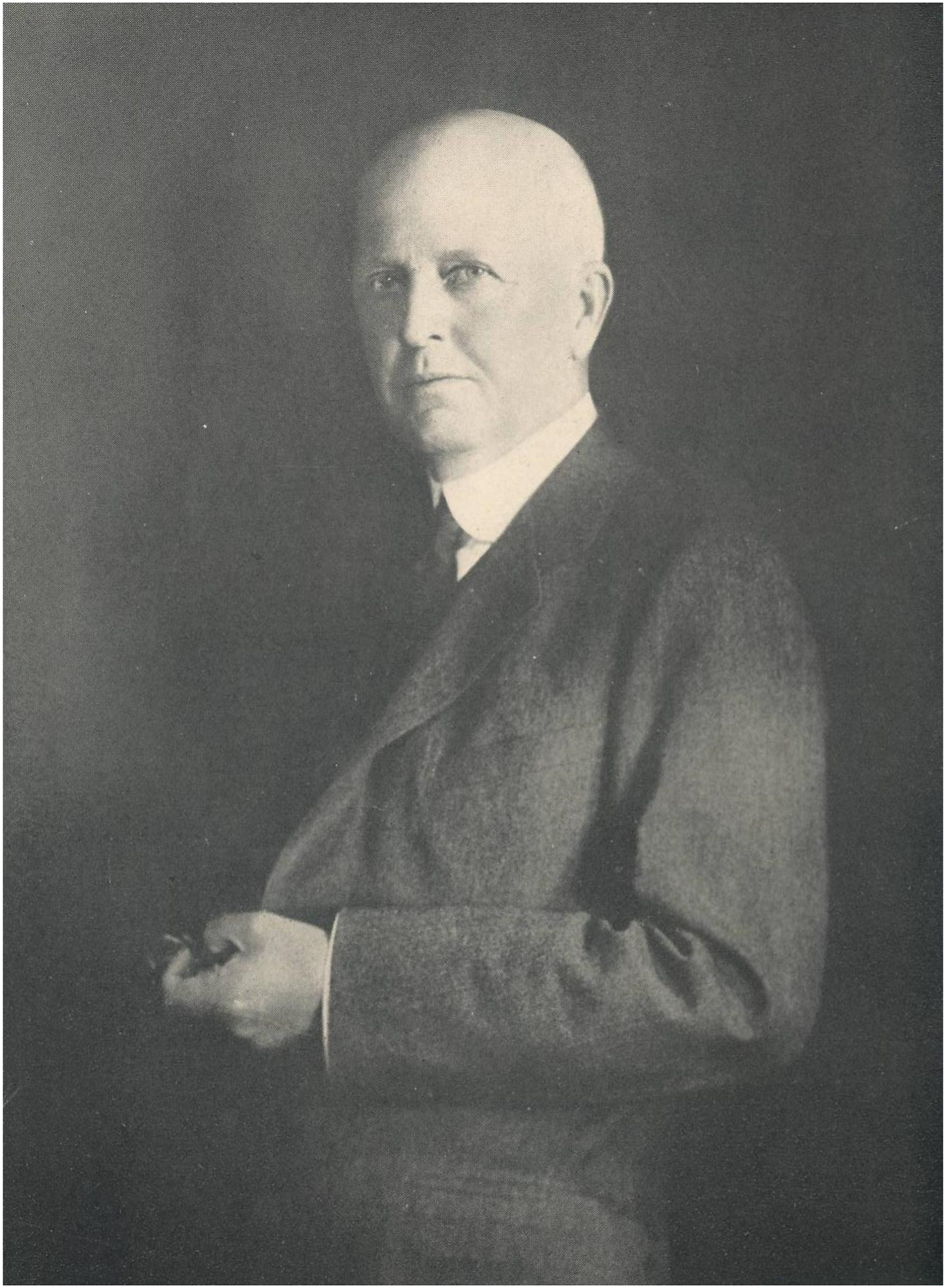
Born in Marysville, Virginia, on August 1, 1857, Swinney was the grandnephew of Captain William D. Swinney, the tobacco farmer who had donated the plot of land on which much of Central’s campus now stands. 123 Edward Swinney, much like his ancestor, grew up in Virginia, moved to Missouri, and became a self-made businessman. He attended the Virginia Polytechnic Institute from 1872 until November 1875. The following spring, he moved with his widowed mother to Fayette, but it’s unclear whether he attended Central College. 124
Upon his arrival in Fayette, Swinney began work at his uncle’s tobacco-curing plant. 125 He then worked as a delivery boy for a grocery store, making deliveries day and night, at the rate of $20 a month while paying out of his own pocket costs of transportation and other job-related expenses. 126 In 1877, he took a job as a clerk in a dry goods store where he worked until 15 August 1878. It was while working these jobs that Swinney decided that he wanted to enter the banking field. 127
In September 1878, Swinney took a job at Davis Bank as a teller, a position he would hold for 4 years. 128 He left Fayette in September 1882 and over the next few years worked at banks in Rich Hill, Missouri and Colorado City, Texas before finally settling in Kansas City, Missouri in 1887. It was in Kansas City where Swinney would make a name for himself at the First National Bank where he started out as a cashier. 129 Swinney worked his way up the bank’s management staff and in 1900, became bank president. In 1927, he was elected chairman of the board and in 1941, he assumed the chairmanship of the bank’s executive committee. 130
The Swinney family had a long history of generosity when it came to education. Not only did Captain W. D. Swinney gift much of the land on which Central now stood, but his son Reverend J. O. Swinney used his inheritance to help found (along with Carr Pritchett) Pritchett College in nearby Glasgow. J.O. Swinney’s granddaughter Bernice Morrison donated money to Pritchett College for the construction of an observatory, which was later moved to Fayette in 1935 and is currently a part of Central’s Campus. 131
Like his ancestors, supporting education was an important aspect of Edward Swinney’s philanthropy. He became treasurer of the Kansas City School Board in 1894 and served for over 30 years. In honor of his service, the district named an elementary school after him in 1914. 132 He would also go on to donate $250,000 to Kansas City University (now the University of Missouri-Kansas City) for the construction of a new gymnasium. 133 In his will, he established the E.F. Swinney Trust at the First National Bank (now a part of Bank of America) “for the furtherance and development of such public charitable and public educational purposes in the State of Missouri.” 134 Swinney’s donation to Howard-Payne in 1922 also had a more direct connection to the music department that helps explain his generosity. His sister, Willie Frances Swinney was the second wife to Uriel Sebree Wright, which made him N. Louise Wright’s step-uncle.
The new conservatory building became part of a three-building complex centered on a new church (later named after Paul H. Linn). The first two buildings constructed were the conservatory (the north arm of the complex) and the religious education building (the south arm—later named the Rice H. Cooper Parish House) for the use of the Fayette Methodist Church, which had donated $50,000 towards its construction. 135
During the planning and construction of the conservatory building, music classes continued in the old Howard-Payne buildings. A history of the college written in 1964 claims that the Hendrix residence (now Givens Hall), which had traditionally been the home of Howard-Payne’s presidents, housed the conservatory. 136 A note in the 1926 issue of The Bulletin of Central College, however states that Classic Hall is where the conservatory’s studios were located. 137 While there is no definitive explanation for this discrepancy, it is reasonable to surmise that Classic Hall, with its larger classroom space, likely held classes while the smaller Hendrix residence served as the conservatory’s administrative offices. With plans for construction underway and temporary space secured, the first official session of the Swinney Conservatory of Music opened on September 25, 1925. 138 The celebration of the Conservatory’s first year included performances by Josef Lhévinne on January 8, 1926, and the St. Louis Symphony Orchestra under conductor Rudolph Ganz on April 9, 1926. 139
Ground was broken on the conservatory and parish house buildings on October 25, 1926, with the goal being completion of the two buildings within six months.
140
The cornerstones of the buildings were laid on January 5, 1927, in a ceremony that included Central’s orchestra and band (see Figure 10).
141
The cornerstone laying ceremony of the Swinney Conservatory, January 5, 1927. Source: Central College Ragout (1927): 82.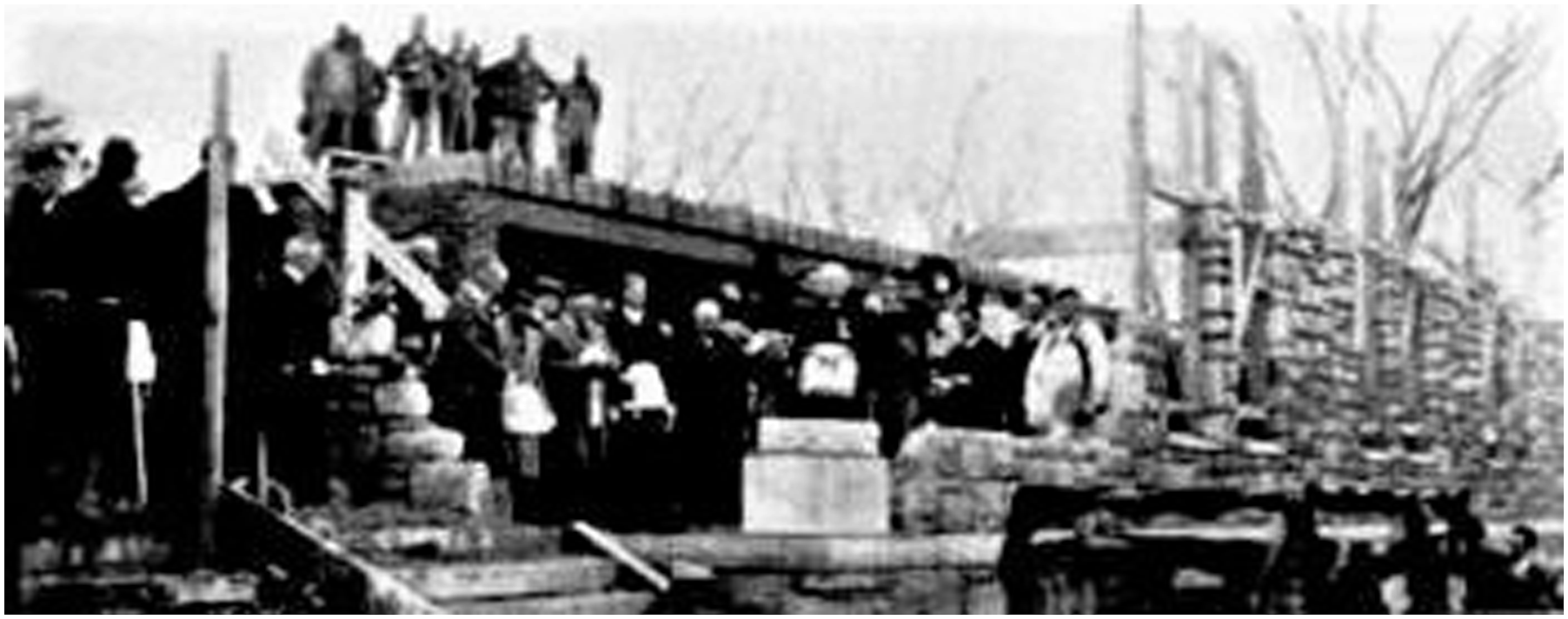
The builders accomplished their goal of completing construction within six months and on June 7, 1927, the Swinney Conservatory of Music building was officially dedicated (see Figure 11).
142
Swinney was honored by faculty and students with a special recital on October 27, 1927, which included N. Louise Wright’s “Negro Suite,” a piece she composed in dedication to Swinney.
143
The Swinney Conservatory of Music shortly after its completion in 1927. The old Centenary Chapel can be seen in the background. As a part of Bishop McMurray’s capital plan, it would soon be torn down and replaced with the Paul H. Linn United Methodist Church. Source: The Bulletin of Central College 22, no. 4 (April 1927): 3.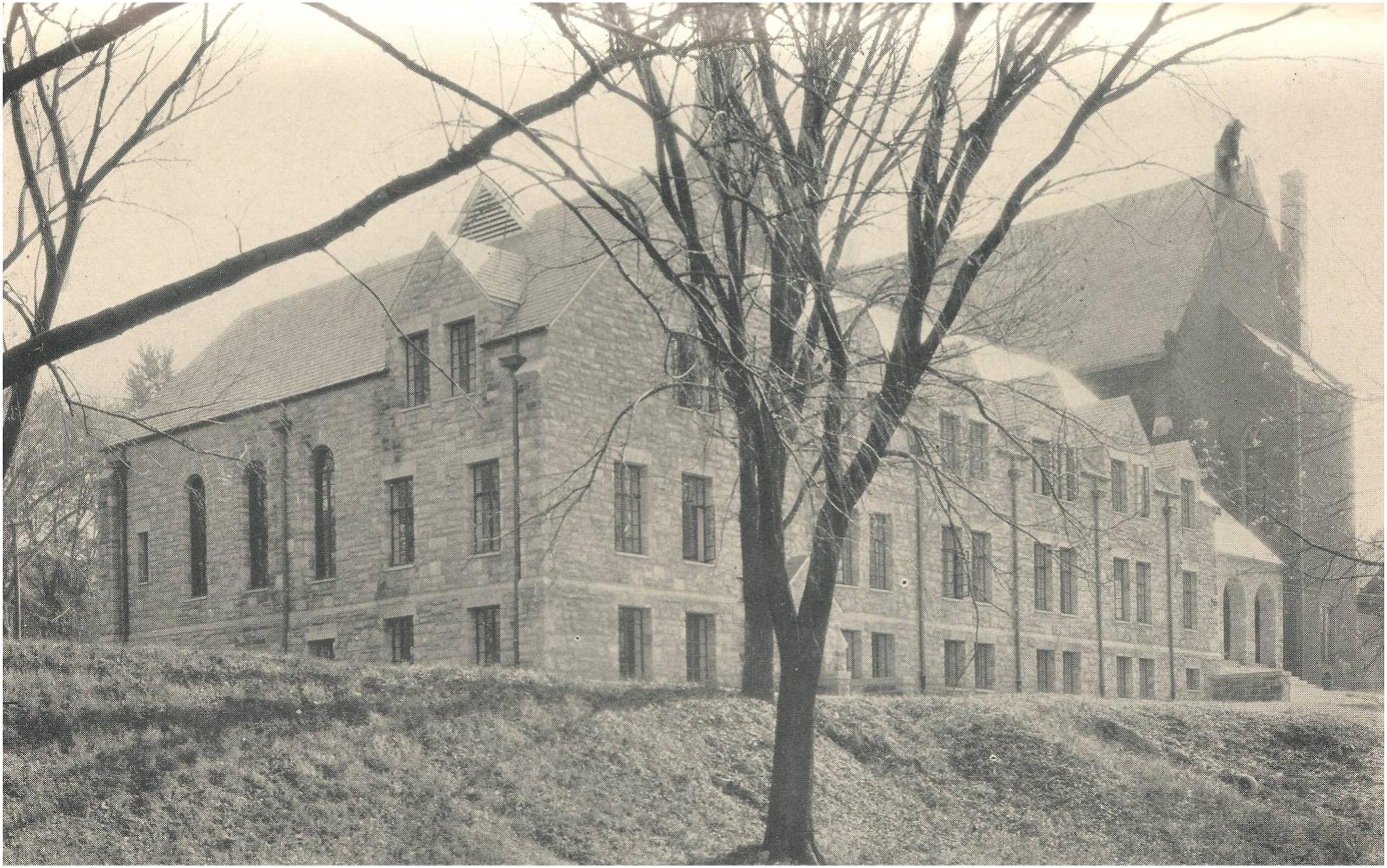
Music was thriving at Central. By 1927, when the conservatory building opened, Central had a growing band, orchestra, two glee clubs and a new club on campus known simply as the B.M. (Better Music) Club. 144 The groundwork for a successful music school had been laid.
Conclusion
The people and events that led to the establishment of the Swinney Conservatory are unique and aspects of the story help add to the understanding of broader historical trends of that era. Howard-Payne’s music curriculum, like many “female seminaries” of its day, evolved to meet the ever-growing needs of young women who were gaining more and more acceptance in higher education. Their culture melded with Central’s tradition of student ensembles during a time in which many other American conservatories were being established. This uniting of cultures helped create a new, more expansive music curriculum that, along with the generosity of its namesake, empowered the conservatory in its early years.
Even though Howard-Payne College is no more, its legacy lives on in the many music students, male and female, who have attended, and continue to study at the Swinney Conservatory. N. Louise Wright and other Howard-Payne music faculty were instrumental in establishing a tradition of excellence that would be carried on by future conservatory leaders such as Luther T. Spayde and Keith House. This tradition of excellence continues to this day, demonstrated by the many prominent music educators in the state of Missouri, as well as some with national and international reputations such as David Holsinger, Joseph A. Labuta, and Claude T. Smith, who the Swinney Conservatory can claim as its own.
Footnotes
Funding
The author(s) received no financial support for the research, authorship, and/or publication of this article.
Declaration of Conflicting Interests
The author(s) declared no potential conflicts of interest with respect to the research, authorship, and/or publication of this article.
