



Abstract
Hispanic college enrollment in 2011 surpassed all other minority groups. However, Hispanic graduation rates continue to lag. This study examines background, academic integration, social integration, perception of prejudice and discrimination factors, and social capital factors, and how these affect Hispanic undergraduate 6-year completion rates at selective colleges. The results demonstrate that social capital during the high school senior year and attending a private or liberal arts college positively affect Hispanic students’ graduation rates.
In 2011, a significant event occurred in minority college student enrollment; for the first time, Hispanic college students enrolled, ages 18 to 24, surpassed all other ethnic minority groups (Fry & Lopez, 2012). Despite this landmark enrollment for Hispanic students, this group’s college graduation rates continue to lag other minority groups. In 2010, the percentage of bachelor’s degrees awarded was 71% non-Hispanic Whites, 10% non-Hispanic Blacks, 7% non-Hispanic Asian/Pacific Islanders, and only 9% Hispanic (Fry & Lopez, 2012).
For the past four decades, college student departure, and more recently degree completion, has been the main topic of research in higher education (Pascarella & Terenzini, 2005). However, there has been a paradigm shift from a short-run perspective of maintaining college student enrollment during the freshman year to a long-run perspective of obtaining a college degree. Even with universities’ and colleges’ rigorous admission policies and an increase in student support services, each year approximately 28% of the freshman class leaves (National Center for Education Statistics [NCES], 2011). The question that remains is, “What factors are unique to Hispanic college students that might affect degree completion?” To answer this question, additional research is needed that builds upon prior college retention and completion theories. The purpose of this study was to add to the current body of knowledge regarding Hispanic undergraduate student degree completion and provide university policy makers guidance in developing programs that will assist minority students in achieving their educational goal of obtaining a bachelor’s degree.
Review of Literature
According to Pascarella and Terenzini (2005), the majority of early college departure studies involved theoretical models by Tinto (1975), Bean (1990), and others were evaluated at schools where minority students were underrepresented. Tinto’s interactionalist theory looked specifically at the student’s experience within the institution and advanced the position that academic and social integration has a positive influence on continued college enrollment (Tinto, 1975, 1993). Later, researchers postulated that the concepts behind academic and social integration were not culturally sensitive to minority students who had strong family and community bonds (Rendon, Jaloma, & Nora, 2004; Tierney, 1999). Building upon the work of Tinto (1975), Bean (1990) developed his Nontraditional Student Attrition model that included social integration variables that could account for the students’ cultural differences (Bean, 1990; Bean & Metzner, 1985; Nora, Cabrera, Hagedorn, & Pascarella, 1996).
Bean Model
Bean questioned whether factors external to the campus environment could affect a student’s decision to remain in college. In addition, he noted that prior research models focused on the traditional student and emphasized the importance of social integration with other members on campus. He questioned the definition of a traditional student and concluded that nontraditional students were any students who are distinguished by a lower level of interaction with peers and faculty as their primary source of socialization on campus (Bean & Metzner, 1985). Bean (1990) contended that social integration for these nontraditional students might not be as important as the family and friends’ social support they receive. Subsequent studies of Bean’s model regarding continual college enrollment were done with primarily “black students, with only a few studies having been done of Hispanic, Asian American or Native American students” (p. 167).
A Titus (2004) study used some of Bean’s Nontraditional Student Attrition model constructs and sampling drawn from the 1996-1998 Beginning Postsecondary Student Survey. However, the focus of this study was the effects of the institutional context on persistence defined as continued enrollment at the same college for 3 years or graduation at the same college. Titus (2004) concluded that most of the components of Bean’s model helped explain college student persistence, and recommended further research to examine the relationship between institutional selectivity and student persistence. Bean and Metzner (2005) recommended that completion theory would benefit from longitudinal research, and “future studies should combine data from a variety of institutions” (p. 35). Other researchers have questioned whether other factors also account for the higher college dropout rate for minority students, such as racism on campus and the students’ responses and resulting stresses (Museus, Nichols, & Lambert, 2008; Reynolds, Sneva, & Beehler, 2010).
Climate of Racism and Prejudice
The concept of a climate of prejudice on campus began with the work of Fleming (1984) in the mid-1980s regarding cognitive growth and college students. Later, other studies examined the effect of alienation and stress on minority students at primarily predominately White institutions (Cabrera, Nora, Terenzini, Pascarella, & Hagedorn, 1999), or with limited minority groups (Hurtado, 1992, 1994). Other researchers reported that a minority student’s perception of the racial climate on campus can affect the academic experience and thereby affect the student’s adaptation to the university (Chang, 2001; Hughes, Anderson, Harms, Perez, & Moore, 1998).
Cabrera and Nora (1994) developed the Perception of Prejudice and Discrimination scale to assess students’ prejudice-discriminatory experiences on campus. This scale’s later studies were done utilizing Bean’s (1985) and Tinto’s (1975) constructs at four institutions, but the only minority represented was Black (Cabrera et al., 1999). Cabrera et al.’s results demonstrated that the climate of discrimination and racism on campus had a small effect on Black students’ decisions to remain in college.
These results were different in a longitudinal study that utilized NCES data to evaluate the relationship between degree completion and the students’ perceived racial climate (Museus et al., 2008). In this study, only Hispanic students demonstrated an indirect effect between a higher level of satisfaction with the campus racial climate and degree completion. The Museus et al. study measured students’ satisfaction with the campus racial climate with a dichotomous variable, compared with Cabrera et al.’s (1999) constructs of prejudice and racism encountered on campus. Researchers have questioned whether family and community support, defined as social capital, could be an important factor (Seidman, 2005).
Social Capital
Earlier college departure studies by Tinto (1975) and others focused on the networking that college students created through close friends on campus, defining this social integration. Extending networks beyond one’s own social group was necessary to make a successful transition to college and resulted in the student being less likely to leave college, according to Tinto (1993). Although this concept appeared to be relevant to nonminority college students, it was criticized for not being culturally sensitive to minority college students. For minority students attending college, maintaining ties to their family and social community was an expectation of their culture. Severing these social ties would cause additional stress to minority college students that would contribute to the departure from college. The researchers reached out to the field of sociology as the focus in college completion studies made a transition to encompass minority students by the inclusion of culturally relevant constructs.
Based on Bourdieu’s (1972) and Coleman’s (1988) theories, the concept of social capital and the resulting on- and off-campus networks are theorized to improve the college student completion rates for minority groups. Coleman, Kilgore, and Hoffer (1982) describe social capital on two levels: the relationship between the student and his or her family, and the relationship between the student’s parents and other adults in the community. Despite social capital’s different conceptualizations, researchers posit that family and community support is a key component in minority groups’ academic success, especially for Hispanic students (Hurtado-Ortiz & Gauvain, 2007; Perez & McDonough, 2008; Perna & Titus, 2005).
Regarding college enrollment and parental involvement, studies have demonstrated a positive relationship for Hispanic students. Social capital, defined by parental and community networks, had a positive effect on Mexican American college degree completion (Hurtado-Ortiz & Gauvain, 2007). A recent study of minority college students utilized Coleman’s definition of social capital as related to institutional agents on campus to provide support to promote persistence (Museus & Neville, 2012). Few studies have taken a multi-institutional analysis of the impact of social capital on Hispanic college student completion. Hispanic college students typically constitute a small percentage of the student body in most colleges. Therefore, it is advantageous to sample multiple institutions to obtain a sufficiently large group of Hispanic college students from which to make inferences regarding factors that promote college completion.
Conceptual Framework
During the past two decades, there have been notable changes in America’s social organization, and these changes are also evident in campus communities (Bowen, Chingos, & McPherson, 2009). There has been a substantial increase in the number of minority and first-generation college students enrolled in colleges across the nation. Although the current Hispanic students come from families with more educated members than documented in the 1970s, they still have parents with the lowest educational attainment levels (Bowen et al., 2009). To provide a new college completion theory paradigm that reflects the current campus environment, a blend of three theories is utilized to provide this study’s conceptual framework: Bean’s (1990) Nontraditional Student Attrition model, Cabrera and Nora’s (1994) Perception of Prejudice and Discrimination, and Coleman’s Social Capital theory (Coleman et al., 1982). Bean’s (1990) model reflects the traditional college completion constructs originating from the work of Tinto (1975), with the inclusion of social integration variables. Cabrera and Nora’s (1994) Perception of Prejudice and Discrimination model examines the ethnic and racial climate on campus. Finally, Coleman’s Social Capital theory (Coleman et al., 1982) explores the concepts of social capital. Each of these three theories includes factors that might be unique to Hispanic college students’ decisions to remain in college and earn a bachelor’s degree. This study utilized exploratory factor analysis (EFA) and logistic regression procedure to answer the following research question:
Method
Population
This study uses public-use data set from the National Longitudinal Survey of Freshmen (NLSF). According to the authors, the NLSF was designed to provide an extensive data set for researchers to test different theoretical models to examine the reasons for minority underachievement in the United States (Massey, Charles, Lundy, & Fisher, 2003). The NLSF comprises data from 150 questions to assess student’s attitudes, aspirations, and motivations at the time of entry into college, and the student’s social, psychological, and academic experiences on campus (Massey et al., 2003). The NLSF is a national sample of first-time, U.S. citizen or resident alien college students at 28 highly selective institutions. As a measure of selectivity, the average freshman Scholastic Assessment Test (SAT) score across these 28 institutions was 1,243, and 71% were in the top 10% of their graduating class (Massey et al., 2003). A second universal measure of the selectivity of a college or a university is their acceptance rate. The acceptance rate is the ratio of the number of accepted students by the number of applicants, expressed as a percentage (Hawkins, 2004). In comparing the NLSF colleges’ and universities’ acceptance rates with other schools in their region, there is a significant difference (see Table 1). The lower acceptance rate for the NLSF colleges and universities is an indication of a more competitive admission screening process. The NLSF study was designed to examine the characteristics of minority students as they entered college and how these shaped their academic progress (Massey et al., 2003). As the institutions in the data set constitute a group of select schools with high admission standards, the findings cannot be extrapolated to the whole of higher education.
Comparison of Admission Rates for NLSF Versus Other Colleges and Universities by Region.
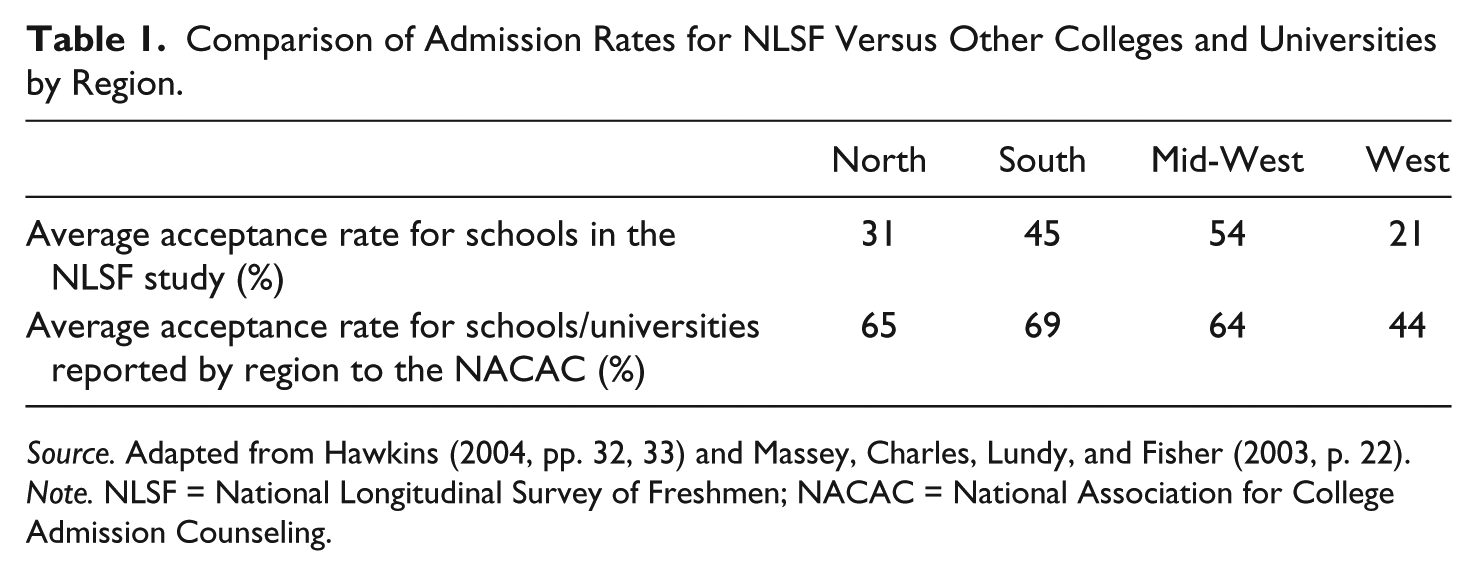
Source. Adapted from Hawkins (2004, pp. 32, 33) and Massey, Charles, Lundy, and Fisher (2003, p. 22).
Note. NLSF = National Longitudinal Survey of Freshmen; NACAC = National Association for College Admission Counseling.
Sample
From each institution, a list of incoming freshmen was obtained to use as a sampling frame. A stratified random sample of minority students from 28 institutions was selected to participate, with an 86% overall response rate to participate in the NLSF data (Massey et al., 2003). This study utilizes the Hispanic student data (n = 916), which comprises students originally included in the NLSF data in the fall semester.
Instrumentation for the NLSF Data Set
Data were collected in a series of waves, at the beginning of the freshman year. Based on the original questionnaire for the NLSF data set, variables were selected and utilized in the analysis of this study. However, factor analysis will be implored to discriminate the underlying factor structure for the NLSF data. Graduation data for the students in the NLSF study were drawn from two sources: office of the registrar for the 28 participating institutions and the National Student Clearinghouse (Massey & Charles, 2009). With an analysis of data from these two sources from 2005 to 2006, the NLSF group was able to collect concrete graduation data for 99% of the students who participated and for Hispanic students, 86% of whom graduated in 6 years. These high graduation rates are expected considering the high academic level of students entering select U.S. institutions (Melguizo, 2010).
Statistical Analysis Overview
To address the research question of the predictive value of variables on college completion rates for Hispanic students at select colleges, a model was constructed to determine statistically significant drivers of college completion rates (see Figure 1). It is hypothesized that several underlying factors that cannot be directly observed (e.g., academic integration, social integration) influence students’ observed questionnaire responses (Table 2). It is possible to estimate the underlying factors with EFA and then use these estimates in logistic regression to determine how the factors affect graduation rates.
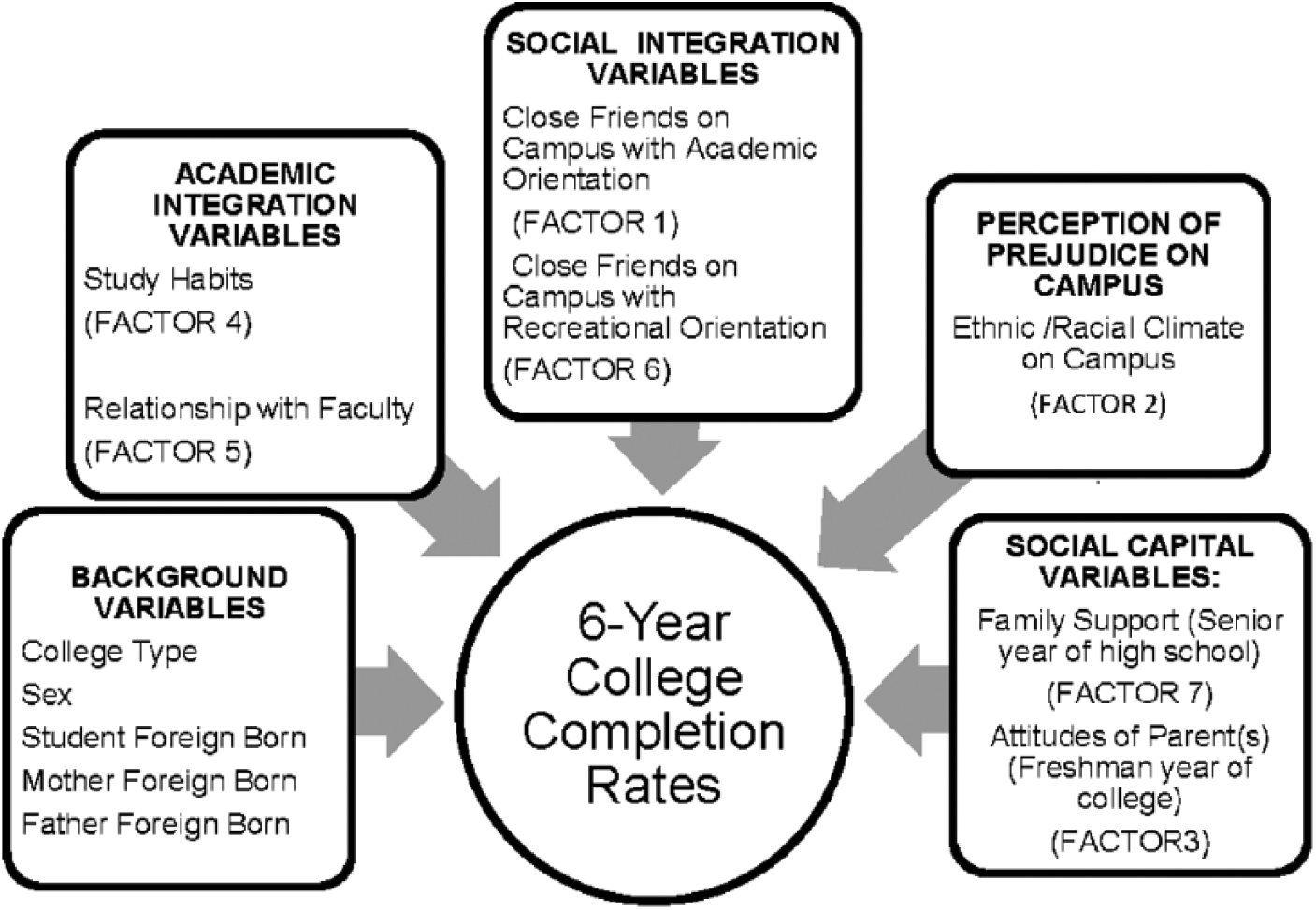
Conceptual model of college student completion.
Survey Items.

Source. Adapted from Massey, Charles, Lundy, and Fisher (2003).
EFA is a statistical method that estimates the few, underlying factors that influence the variables in a particular data set. The results of an EFA show how strongly each of the factors affects, or loads, a given variable. Variables with large positive or negative factor loadings are highly influenced by the factor (positively or negatively, respectively), whereas variables with loadings near 0 are not dependent on the factor. If a candidate factor produces large positive or negative loadings on several variables, it is likely a true underlying factor that drives the behaviors the individual variables measured. However, some care must be taken in examining the results from an EFA. It is up to the researchers to choose how many factors are important and, thus, are included in the model, and if the estimated factors capture behavioral patterns that other studies could reproduce.
Logistic regression is a modeling technique that estimates the relationships between several independent variables (here, factor estimates and background information) and a dichotomous variable (6-year college graduation). The estimates from a logistic regression 6 are in terms of odds, which is simply the probability of an event happening divided by the probability of the event not happening. Thus, the estimates from this analysis are in terms of the odds of 6-year college completion.
Dependent variable
For the research study, the dependent variable is dichotomous for graduation completion at 6 years. A 6-year completion rate was selected as defined by the Student Right to Know (1990) and Campus Security Act: the percentage of full-time, first-time degree-seeking enrolled students who graduate in 6 years, which is 150% of the normal time for completion.
Independent variables
The independent variables for this study can be subdivided into five theoretical groups: background, academic integration, social integration, perception of prejudice and discrimination, and social capital.
Academic integration
For this study, academic integration is divided into two categories: study habits and relationship with faculty. Study habits include six questions that utilize a 10-point Likert-type scale (1 = never to 10 = everyday) to explore the student’s ability to remain focused on his or her studies and not become distracted by his or her environment (Table 2). Relationship with faculty is probed with four questions (Likert-type scale: 1 = never to 10 = everyday) that explore a student’s interaction with faculty.
Social integration
The student’s social integration on campus is determined through inquiry into a student’s campus life: close friends on campus. Sixteen questions survey the support and attitudes of friends on campus, using a Likert-type scale (1 = no importance to 10 = utmost importance).
Perception of prejudice and discrimination
For this study, the concept of perception of prejudice and discrimination was measured using 11 questions that examine the ethnic-racial climate on campus by examining the prejudice of peers, faculty, and staff. These questionnaires are measured on a Likert-type scale from 1 = never to 5 = very often.
Social capital
The concept of social capital is defined as family support during the senior year of high school and freshman year of college. Family support questions utilize a 5-point Likert-type scale (1 = never to 5 = very often) to explore how much the parents and other adults in the family interacted with friends, at 18 years of age, and a 4-point Likert-type scale (1 = strongly agree to 4 = strongly disagree) to find whether the students’ parent(s) knew who their child’s friends were in high school. There are seven questions that use a 10-point Likert-type scale to access the attitudes of a student’s parent(s) during the freshman year of college.
EFA
Utilizing EFA, the factors were initially extracted through a principal factor method, and this was followed by an oblique (promax) rotation. The scree plot of eigenvalues suggested seven meaningful factors; in addition, this finding is supported by using a cutoff of 5% of the variance and an eigenvalue greater than 1, referred to as the Kaiser Criterion (Kaiser, 1960). In interpreting the rotated (promax) factor pattern, a criterion of .40 was utilized to identify whether an item loaded onto a particular factor. Internal consistency among the multi-item summated rating scale is measured by computing the Cronbach’s coefficient alpha (α; Hatcher, 2009). The EFA identified the seven meaningful factors and the coefficient alpha reliability estimates that all exceeded .70, except for Factor 6, for which the alpha score was .68. In Table 3, the specific question items and corresponding factor loadings are presented. Factors with bold and starred loadings are estimated to drive the corresponding questionnaire variables.
The FACTOR Procedure: Factor Loadings.
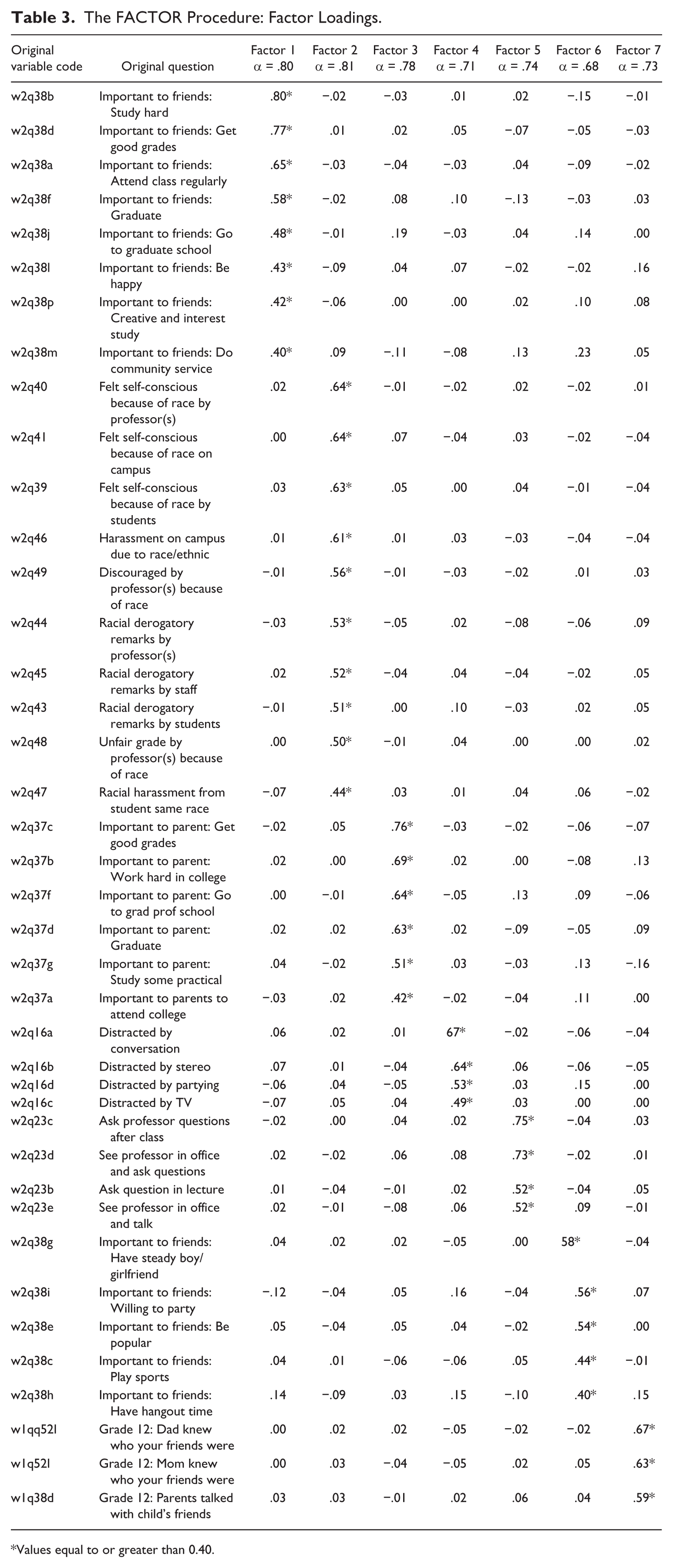
Values equal to or greater than 0.40.
The EFA resulted in two changes in the grouping of the variables. First, for social integration, there was the identification of two distinct subgroups of close friends on campus: friends with an academic or recreational focus. These constructs were supported by a strong factor loading of .40 or greater, and strong internal alpha consistencies of .79 and .68 (see Table 3). These two subgroups are congruent with the conceptualization of the broader classification of close friends on campus. In addition, the concept of perception of prejudice and discrimination after the EFA demonstrated a single construct for 10 of the original 11 questions. This construct was supported by a strong factor loading of .40 or greater and strong internal alpha consistencies of .81.
Results of Logistic Regression Analysis
The seven factors extracted from the EFA, along with some background variables that were not included in the EFA to preserve their interpretation, were used as the independent variables in a logistic regression. The dependent variable is graduation within 6 years, and the estimates are in terms of odds ratios. Listed in Table 4 are the parameter estimates for the logistic regression analysis for the Hispanic college students. It is important to remember that the estimated factors are not directly interpretable; however, higher values for each factor represent a stronger presence of that factor in the Hispanic students’ lives. In this model, the odds ratio associated with each factor measures the increase in odds of graduation for Hispanic students had they observed an increase (of one unit) in their factor score.
Summary of Logistic Regression Analysis for Variables Predicting 6-Year College Completion for Hispanic College Students.
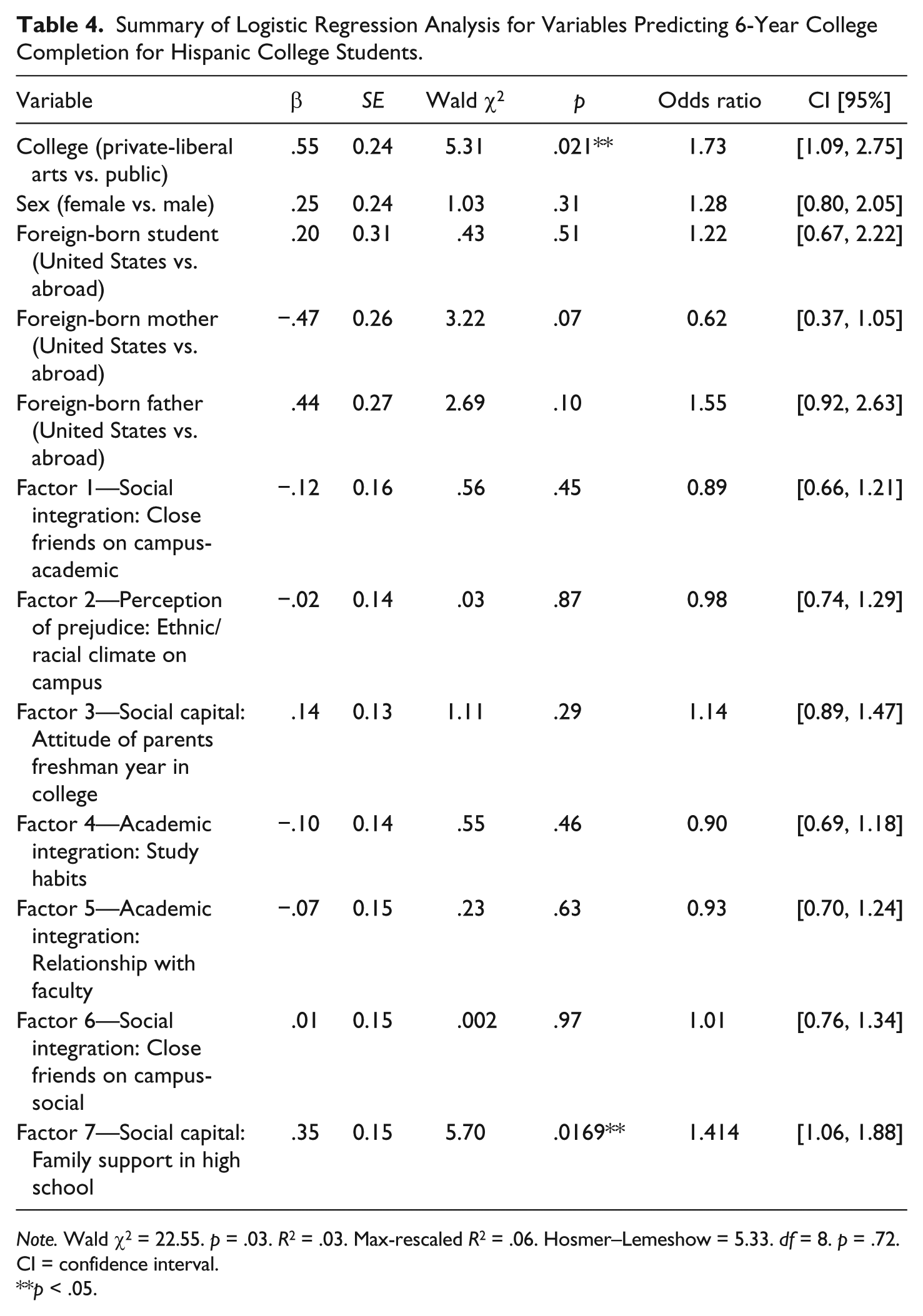
Note. Wald χ2 = 22.55. p = .03. R2 = .03. Max-rescaled R2 = .06. Hosmer–Lemeshow = 5.33. df = 8. p = .72. CI = confidence interval.
p < .05.
From the original 916 Hispanic minority students selected to participate in the study, 205 were deleted from the analysis as a result of missing values (dependent and/or independent variable[s]). Therefore, the number of Hispanic college students included in the logistic regression model was 711 students, 619 graduated colleges in 6 years, and 92 did not graduate by their 6th year. There are two statistically significant (p < .05) independent variables, attending a private-liberal arts college (χ = 5.31, p ≤ .05), and family support during the senior year of high school (Factor 7; χ = 5.70, p ≤ .05).
The first statistically significant independent variable is attending a private-liberal arts college, and the odds ratio for minority students who attended a private-liberal arts college is 1.73, with a 95% confidence interval of [1.09, 2.75]. For the minority college students, the odds of completing a college degree in 6 years are 73% higher when attending a private-liberal arts college versus a public college. This is consistent with Pascarella and Terenzini’s (2005) analysis of past research studies, where they concluded that unadjusted for students’ precollege characteristics, the rate of persistence and degree completion is higher at private colleges.
Similar results were obtained in three recent college completion studies. A Morrison (2012) study examined the graduation rates and institutional characteristics of 428 baccalaureate colleges. In this study’s results, the odds of graduating from a private versus a public college were 8.96 times higher, holding other variables constant. A second study, Melguizo (2008), utilized NCES data with graduation operationalized as obtaining a bachelor’s degree in 8 years. For these students, attending a public institution had a negative impact on degree completion and was statistically significant at p < .01. In a third study, Titus (2006) examined student-level data and examined the impact of institution-level variables on 6-year degree completion for low socioeconomic status students, and attending a private university was statistically significant.
The reason for a higher degree completion rate at private institutions has been a topic of debate. It has been attributed to smaller class sizes, more foundational assets for the students, types of degrees offered, and so on. Pascarella and Terenzini (2005) and others contend that if a student’s precollege characteristics are taken into account, the difference in graduation rates for public versus private colleges is diminished (Bound & Turner, 2010). Astin (2005) contends that graduation rates alone do not take into account the student’s academic preparation. Hence, colleges and universities that serve the less-prepared student, whether minority and/or from a disadvantaged background, are penalized when only evaluating graduation rates. However, it is interesting that for this study, the minority student met the rigorous academic requirements for these select universities, so these students should be academically prepared for college. Therefore, the argument that the public schools are disadvantaged because of the acceptance of less academically prepared students would not apply in this study.
The second significant independent variable is the presence of social capital. The odds ratio for Hispanic students with social capital, specified as family support in high school (Factor 7), 1.414, is with a 95% confidence interval of [1.06, 1.88]. For Hispanic college students, the odd of completing a college degree in 6 years is 41% higher if the student receives family support in high school versus not receiving family support in high school.
The positive effect of social capital during the senior year of high school related to college enrollment and achievement has been explored in other studies. A Klasik (2012) study used a multivariate effects logistic model to examine student characteristics, including social and cultural capital and student enrollment. The author noted that sources of social and cultural capital reduced the race and income disparity and improved the probability of college student enrollment for minority students. Similar results were obtained in another study that examined the influence of social capital on college enrollment and achievement for Hispanic and African American males. Strayhorn (2010) utilized constructs of Coleman’s (1988) theory to operationalize social capital in the form of parents’ expectations for high school and beyond degree completion. Parents’ positive expectations for degree attainment and attending group activities both had positive statistically significant impacts on Hispanic and Black male college students’ grade point average.
Discussion
Although college enrollment rates have increased for Hispanic students, their college completion rates continue to lag behind other minority groups. The purpose of this study was to add to the current body of knowledge regarding Hispanic undergraduate student degree completion and thus provide guidance to university policy makers in developing programs that will assist minority students in achieving their goals of obtaining bachelor’s degrees.
In this study, social capital in the senior year of high school and attending a private research or liberal arts college both had a positive impact on 6-year completion rates among Hispanic college students at selective institutions. These are important pieces to the puzzle of why so many Hispanic college students might leave college without earning a college degree in 6 years. Especially in this study, the Hispanic students were attending academically select colleges and had met the rigorous admission standards for these institutions; therefore, they were academically prepared for college, but some students still failed to obtain a degree. Institutions could implement changes at a secondary and postsecondary level to enhance minority college student enrollment, persistence, and, ultimately, graduation.
Secondary School Initiatives
Families’ support and encouragement for high school students was identified as an important component of social capital in this study. A recent Stanford University study noted that there is a deficit of high-achieving, low-income students applying to select universities because the counselors and parents are not aware of admission and funding opportunities (Hoxby & Avery, 2013). Policy makers and school administrators could explore ways of educating the families of Hispanic high school students regarding the selection of high school courses appropriate for college bound students, and the process for college admission and financial aid counseling. Interestingly, some researchers report that parents of Hispanic students are met with indifference when trying to participate in school activities, but Asian parents do not encounter this resistance (Oseguera, Conchas, & Mosqueda, 2010). School administrators and teachers need to evaluate how they can provide an inclusive environment for families and methods for empowering parents to support the schools and their children in achieving academic excellence, in particular for Hispanic students.
Finally, the message regarding the importance of furthering education needs to be provided early in the secondary school years to all Hispanic students, especially their family and community supporters. Despite an increase in college student enrollment, Hispanic students, unlike their White peers, are more likely to enroll in a 2-year school, attend part-time, and choose a less select university (Fry & Lopez, 2012). Therefore, the information regarding college enrollment and financial aid should be presented to the student and his or her family and community supporters. Providing a college visitation opportunity and written material that is specific to the Hispanic high school student contemplating college enrollment have been found to be effective in promoting college enrollment (Piedra, Schiffner, & Reynaga-Abiko, 2011). Subsequently, a high school student will have access to the information necessary to make a fully informed decision regarding college enrollment. A Hispanic student’s secondary school experience paves the way for a successful transition to college.
Postsecondary School Initiatives
At the postsecondary level, initiatives to improve rates of college enrollment and completion for Hispanic students could integrate the concept of social capital as another tool to promote degree attainment. In this study, the importance of social capital in the senior year of high school was a statistically significant factor for college completion for Hispanic students. Colleges that desire to increase recruitment and degree attainment need to focus on the potential student and his or her family. Recruitment activities that occur on or off campus could be family events directed at providing enrollment and financial information to the entire family (Campos, 2010). Therefore, colleges and universities could facilitate the healthy inclusion of familial social capital by providing guidelines for family members, and include the family in recruitment activities.
Also, information sessions aimed at students’ family and community support systems could provide guidance on how to remain connected to the student in a healthy and supportive fashion through technology. For example, the utilization of social media sites could provide a support system to parents of a new college student, and serve as a source of information concerning events on campus. Policy changes could be implemented to enhance and support social and other forms of capital on campus (Montalvo, 2012; Ovink & Veazey, 2011).
Facilitating the growth of social capital both on and off campus, including among family, peers, and community, to support Hispanic college students might involve changes in current campus policies. One recent change has been the utilization of learning communities on campus to improve the peer climate, creating fictive or surrogate kinships for students removed from their community and family support systems. These on-campus learning communities encourage student involvement with peers and on-campus activities, and have shown an increase in college persistence past the freshman year (Pascarella & Terenzini, 2005). Creating smaller cohesive groups on campus results in similar benefits reported by students attending smaller, private colleges. Some learning communities include faculty interaction in classwork and group activities. Through this collaboration and networking with peers and faculty in a learning community, the student increases his or her social capital on campus (Lin, 2001).
Policy Makers
During the next decade, academic policy makers face a challenge to increase college degree attainment for all students, especially for the Hispanic students on campus. This initiative will take planning and evaluation at all levels of the educational process and will be an ongoing activity. In a global economy, it is imperative that the United States has an educated and diverse workforce to compete on an international level. To meet the challenge to increase college graduation rates, in March 2011, Vice President Biden unveiled a College Completion Toolkit (U.S. Department of Education, 2011). The purpose of the tool kit is to provide governors with innovative strategies for increasing the number of college graduates on a state level. The federal government will support these initiatives through grants and other funding. In particular, several of the strategies for developing an action plan for improving college completion rates are performance-based funding, accelerate learning, ease the transition for transferring colleges, and utilize data to drive decisions. In the past, it has been difficult and costly to collect longitudinal data regarding college student retention and completion. However, Recovery Act funding requires that each state establish a longitudinal data system, and utilize this information to track and improve college completion rates in their states. In addition, potential students and their families will have access to this and other data and can use them to make comparisons among colleges.
However, the changes needed to improve college completion rates cannot occur without adequate funding. Both secondary and postsecondary institutions need adequate funding to develop and implement strategies aimed at improving college completion. In particular, Hispanic students are vulnerable to financial constraints, and lack of adequate funding has a negative impact on enrollment and retention in college (Montalvo, 2012). There must be an infrastructure for adequate financial aid to disadvantaged Hispanic students with a desire to seek a college degree.
Conclusion and Recommendations for Future Research
The topic of college student persistence and retention has been ongoing during the past several decades. However, the changes in diversity among college student populations coupled with low graduate rates for minority students, especially Hispanic students, necessitate the continuation of research and discourse in the arena of college student completion theory. The students in this study attended academically select colleges and universities; however, would the result be similar for Hispanic students at less selective institutions? It is imperative that research continue in the area of minority student college completion to guide policy makers and institutional leaders in promoting academic success for all students but especially the largest minority group, Hispanics. The college graduates of tomorrow will be the United States’ future civic, political, and economic leaders.
Footnotes
Declaration of Conflicting Interests
The author(s) declared no potential conflicts of interest with respect to the research, authorship, and/or publication of this article.
Funding
The author(s) received no financial support for the research, authorship, and/or publication of this article.