



Abstract
Research on social capital in education rarely considers how the resources students can access through their friendships affect educational outcomes later in life. Using the National Longitudinal Study of Adolescent Health, we explore how having resource-rich best friends impacts adolescents’ college completion. We compare the influence of friends’ material and cultural resources and their effects relative to adolescents’ family resources. We find that having a best friend with a college-educated mother significantly increases the likelihood of college completion, though having a best friend whose parents are high income does not. This positive effect of best friends’ cultural resources is not explained fully by school achievement or by the expectations of respondents, best friends, or parents. We conclude that adolescent friendships are an underrecognized source of social capital.
Friends matter. This is particularly true in adolescence, when close peer relationships are a central focus. Yet, while we know that adolescents provide important emotional and behavioral support to their friends (see Giordano, 2003, for a review), less is known about the resources friends share with each other during this life stage. Such resources are the currency that transforms social relationships into social capital: “the aggregate of the actual or potential resources” that individuals can access through their social relationships and use to generate meaningful profits (Bourdieu, 1985, p. 248). We know, for example, that the resources adolescents can access at home—including cultural and material resources—significantly impact their long-term outcomes (Brooks-Gunn & Duncan, 1997; Downey, 1995; Dumais, 2002; Farkas, Grobe, Sheehan, & Shuan, 1990; J. Lee & Bowen, 2006; Teachman, 1987). Yet, less is known about adolescent friendships as a source of social capital—“resources for action” (Coleman, 1988, p. S95) that promote success in school and in life. Nor do we know what effects friends’ resources might have on adolescent outcomes or what mechanisms might generate such effects.
This study uses the National Longitudinal Study of Adolescent Health (Add Health) 1 to examine how access to best friends’ resources matters for adolescents’ subsequent educational attainment. We consider the material resources (household income) and cultural resources (having a mother with a 4-year college degree) 2 that adolescents could access at Wave I of the study, when they were 12 to 17 years of age. We then estimate the relationship between these resources and adolescents’ likelihood of having completed college (bachelor’s degree) by Wave IV, when participants were 24 to 32 years of age. We also investigate the mechanisms by which friends’ resources might impact adolescent outcomes, controlling for adolescents’ family resources and for other factors that could influence friendship formation and college completion. In these analyses, we use fixed effects models to account for clustering at the school level (Allison, 2005; Choi, Raley, Muller, & Riegle-Crumb, 2008; Guo & Zhao, 2000), multiple imputation to deal with missing data (Allison, 2001), and propensity score matching (PSM) to examine the role of friendship selection, though we present the PSM results only in an Appendix in the online version of the journal (Becker & Ichino, 2002; Heckman, Ichimura, Smith, & Todd, 1998; P. Rosenbaum & Rubin, 1983).
We find overall that best friends are an important source of resources in adolescence and that these resources are related to long-term outcomes. Interestingly though, friends’ cultural resources seem to matter more than their material ones. Having a best friend with a college-educated mother is associated with higher rates of college completion, whereas having a best friend with higher income parents is not. Such resource-rich friends, in turn, seem to matter not only through their influence on adolescents’ college expectations, but also through the access they provide to adult, college-educated “role models.” We conclude by discussing the implications of these findings for research on adolescent friendships and social capital and for policy efforts aimed at increasing college attendance and completion.
Social Capital and Student Outcomes
Social capital has long been a popular topic in sociology, particularly in the sociology of education (Coleman, 1988; Dika & Singh, 2002). Since Bourdieu (1985) developed this concept, scholars have explored how social capital impacts students’ educational outcomes. Coleman (1988), for example, argues that social closure (when an adolescent’s parents know their child’s friends’ parents) lowers high school drop-out rates by generating three forms of social capital: obligations and expectations, information channels, and social norms (see also Carbonaro, 1998).
This research, however, neglects the possibility that friends could also be a more direct source of social capital. Despite the key role of friends in adolescence (Giordano, 2003), social capital scholars say little about adolescent friendships as a source of resources, focusing instead on parents’ social relationships (Carbonaro, 1998; Coleman, 1988), parental involvement in children’s schooling (Horvat, Weininger, & Lareau 2003; Lareau & Horvat, 1999; McNeal, 1999; Ream & Palardy, 2008), or adolescents’ relationships with teachers and other institutional agents (Stanton-Salazar, 1997). Research on adolescent friendships, in turn, says little about resources, focusing instead on friendship formation (Doyle & Kao, 2007; Hallinan & Sorensen, 1985; Joyner & Kao, 2000; Kandel, 1978; Moody, 2001; Zeng & Xie, 2008) or on correlations between adolescent and friend behavior (Berndt & Keefe, 1995; Haynie & Osgood, 2006; Kandel, 1978).
When scholars of adolescence do consider the importance of resources, they focus on those adolescents can access at home. We know, for example, that adolescent outcomes—including educational achievement, expectations, and attainment—are strongly correlated with family resources. This is true both for material resources like income and wealth (Brooks-Gunn & Duncan, 1997; Downey, 1995; Teachman, 1987) and for cultural resources (DiMaggio, 1982; Dumais, 2002; Farkas et al., 1990; J. Lee & Bowen 2006), which include knowledge, skills, and strategies for interacting with others in society. While cultural resources are closely associated with families’ educational attainment (Bourdieu, 1977; Calarco, 2011; Lareau, 2003), unlike material resources, they have little intrinsic value. Yet, the knowledge, skills, styles, and strategies of the middle and upper classes are privileged by dominant institutions and thus offer advantages to individuals who activate them in these settings (Lareau & Weininger, 2003).
Existing research, however, has not fully examined friends’ resources or their impact on adolescents’ outcomes. Given the time that adolescents spend with friends (Larson, 1983) and the support they receive from them (Collins & Laursen, 1999; Gibson-Cline, 1996), it seems likely that friends, especially best friends (Urberg, 1992; Urberg, Degirmencioglu, & Pilgrim, 1997), may also provide access to important resources. 3 That being said, we do not know if this is the case. Furthermore, because adolescent friendships exhibit high levels of homophily—the tendency for adolescents to associate and bond with similar individuals (Kandel, 1978; McPherson, Smith-Lovin, & Cook, 2001)—they may provide only redundant resources. Yet, we do not know whether friends’ resources matter regardless of the resources that adolescents can access at home or whether they matter only as a supplement to family resources.
In considering adolescent friendships as a source of social capital, this study explores the relationship between friends’ resources and subsequent college completion. Despite emphasis on “college for all” (Goyette, 2008), research shows that adolescents from more affluent and educated families have higher rates of college attendance and completion (Altbach, Gumport, & Berdahl, 2011; Bowen, Chingos, & McPherson 2009; Dougherty & Kienzl, 2006; Goldrick-Rab, 2006; McDonough, 1997; Sandefur, Meier, & Campbell, 2006; V. E. Lee & Frank, 1990). And yet, while scholars have linked college outcomes to the resources that adolescents can access at home (Charles, Roscigno, & Torres, 2007; Elliot & Beverly, 2011; Perna & Titus, 2005; Sandefur et al., 2006), 4 less is known about how friends and their resources matter in this process (except see Choi et al., 2008; Hallinan & Williams, 1990). This is particularly true given that most studies of adolescent friendships include only one wave of data and thus consider only correlations between adolescent and friend behavior and not how friends’ resources might impact long-term outcomes (see Hallinan & Williams, 1990; Hanushek, Kain, Markman, & Rivkin, 2003).
Relationships and Relative Resources
Despite limited attention to best friends’ resources and adolescents’ college decisions, research on adolescent friendships does shed some light on these issues. We know, for example, that just having a best friend bolsters feelings of school engagement (Vaquera, 2009). We also know that having friends who engage in risky behaviors like alcohol and drug use (Alexander, Piazza, Mekos, & Valente, 2001; Hunter, Vizelberg, & Berenson, 1991; Kramer & Vaquera, 2011; Urberg, 1992; Urberg et al., 1997), sexual activity (Bearman & Bruckner, 1999; Billy & Udry, 1985), and delinquency (Haynie & Osgood, 2006; Jaccard, Blanton, & Dodge, 2005) significantly increases an adolescent’s likelihood of doing the same. Similarly, adolescents with high-achieving, more academically motivated, and better behaved friends tend to do better in school (Davies & Kandel, 1981; Hanushek et al., 2003; V. E. Lee & Smith, 1999; Walker, 2006), take more advanced courses (Crosnoe, Riegle-Crumb, Field, Frank, & Muller, 2008; Riegle-Crumb, Farkas, & Muller, 2006), exhibit fewer behavior problems (Berndt & Keefe, 1995), and have higher college expectations and attendance (Choi et al., 2008; Davies & Kandel, 1981; Fletcher & Tienda, 2009; Hallinan & Williams, 1990; Muller & Ellison, 2001; Pribesh & Downey, 1999). Adolescents whose friends expect to and attend college are also more likely to do so themselves (Campbell & Alexander, 1965; Davies & Kandel, 1981; Hallinan & Williams, 1990). And yet, while these studies clearly show that friends matter for adolescent outcomes, they neither discuss friends’ resources nor control for other attributes of adolescents and their friends that might influence both friendship selection and subsequent outcomes.
That said, there is evidence that friends’ resources may matter for adolescents’ educational outcomes. Studies show that attending schools and enrolling in classes with peers from more privileged families lead to higher academic achievement, expectations, and attainment, regardless of adolescents’ own family backgrounds (Caldas & Bankston, 1997; Choi et al., 2008; Gamoran, 1987; Raudenbush & Bryk, 1986). While focused on classmates, these studies imply that resource-rich friends might also bolster adolescents’ educational outcomes. Similarly, while Hallinan and Williams (1990) do not directly test the impact of friends’ resources on educational outcomes, they do find that friends’ academic achievement and aspirations (both correlated with family resources; Brooks-Gunn & Duncan, 1997; DiMaggio, 1982; Downey, 1995; Dumais, 2002; Farkas et al., 1990; J. Lee & Bowen, 2006; Teachman, 1987) positively impact college-going. Taken together, these studies highlight the potential importance of friends’ resources but do not directly assess these possibilities.
Two older studies examine friends’ cultural resources (though not material ones) and adolescents’ educational aspirations. Using small, nonrepresentative samples, Simpson (1962) and Campbell and Alexander (1965) find that regardless of family background, adolescents who name friends with more educated and higher status (occupation) parents have higher college hopes. While the college-going population has changed substantially since the 1960s (Altbach et al., 2011; Black & Sufi, 2002; McDonough, 1994), Choi and colleagues (2008) also find that adolescents with more friends with college-educated parents are also significantly more likely to enroll in college than are those with fewer such friends. Choi and colleagues, however, do not control for other friend characteristics that might influence both friend selection and college attendance. They also do not consider how a best friend’s resources might matter differently from those of the larger peer group. 5 While scholars debate the relative importance of close friends and peer groups (Bearman & Bruckner, 1999), we focus here on best friends, as evidence suggests that close friends play a particularly important role in shaping adolescent behavior (Alexander et al., 2001; Urberg, 1992).
Unlike Choi and colleagues (2008), we also consider the relative significance of friends’ material resources (e.g., money and the goods, experiences, and opportunities it can buy) and cultural resources (information, skills, styles, strategies, etc.). While material resources may be more easily transferrable, adolescents may have more indirect access to their parents’ material resources than to their cultural ones, which are passed down through processes of socialization (Bourdieu, 1977; Bronfenbrenner, 1958; Lareau, 2003; Maccoby, 1992). As a source of resources, then, adolescent friendships may facilitate greater exchange of cultural resources than material ones. This seems particularly likely given that adolescents spend a great deal of time with their friends (Larson, 1983), rely on them for information and advice (Collins & Laursen, 1999; Gibson-Cline, 1996), and often emulate their behaviors and styles (Bearman & Bruckner, 1999; Giordano, 2003).
Mechanisms for Transfer of Benefits
Coleman’s (1988) social capital theory seems to suggest two mechanisms by which friends’ resources might impact educational attainment. First, best friends’ resources might impact adolescents’ college expectations. More educated and affluent parents are more inclined to expect their children to go to college (Breen & Goldthorpe, 1997). They may also communicate these expectations to their children, who then pass them along to their friends. This transfer of expectations could happen in dinner-table conversations at a friend’s house or even when a friend is invited to “go along for the ride” on college tours. In these situations, affluent and college-educated parents might provide their children’s friends with information about the college process and the benefits of obtaining a college degree, which might in turn influence adolescents’ own college intentions. We test this possibility first by controlling for best friends’ and best friends’ parents’ college expectations at Wave I, as well as respondent’s expectations at Wave I. We then consider the possibility of a more gradual influence, controlling for adolescents’ (and their parents’) college expectations 2 years later (at Wave II), when they are closer to decisions about college.
A second possibility is that best friends’ resources might also matter through a “role model effect.” The role model would be a friend’s parent who, by virtue of their high income and/or educational attainment, has achieved “middle-class success” in American society. By exemplifying the benefits that one can derive from attending college, such parents might inspire not only their own children but also their children’s friends to do the same. In serving as role models, these adults would help to enforce social norms (Coleman, 1988) regarding college attendance and completion. Such a possibility would align with existing research showing that parents, peers, and older siblings influence adolescents’ decision making and outcomes. These role models are often touted as important resources for youth (Brooks-Gunn, Duncan, Klebanov, & Sealand, 1993; Davies & Kandel, 1981). And yet, while programs like “Big Brothers, Big Sisters” operate on the assumption that friends and family members are not the only influential mentors, large-scale, empirical studies rarely examine whether nonfamily adults can also be important models in adolescents’ long-term outcomes. Furthermore, existing research on role models (whether family or nonfamily) tends to examine only the impact of having someone to call a “mentor” and not whether the characteristics of potential role models shape the impact that they have (Greenberger, Chen, & Beam, 1998).
Research on role models also focuses on correlations between adolescents’ behaviors and that of influential others in their lives (regardless of whether adolescents name these individuals as mentors). This research, however, focuses on negative behaviors, showing that adolescents whose friends, parents, and older siblings engage in problem behaviors like drug and alcohol use are more likely to do so themselves (Needle, McCubbin, Reinick, Amnon, & Helen, 1986; see Dornbusch, 1989, for a review). Furthermore, because these studies rely on cross-sectional data, they consider only short-term outcomes and thus cannot say whether correlations between adolescents’ and role models’ behavior are a function of selection (Hallinan & Williams, 1990; Hanushek et al., 2003). Finally, these studies also tend to use adolescents’ reports of others’ behaviors, which may overstate the similarity between the behavior of adolescents and their role models (Hanushek et al., 2003; Kandel, 1996).
In this article, we examine how best friends’ resources shape adolescents’ likelihood of college completion and explore potential mechanisms that explain these relationships. We begin by examining whether friends’ resources matter above and beyond the resources that adolescents can access at home and whether they matter more for some adolescents than for others. It seems possible, for example, that having a best friend with middle-class cultural resources may matter only for adolescents whose own parents cannot provide similar resources. We then consider the mechanisms by which friends’ resources might impact college completion, exploring the importance of both “expectation” and “role model” effects.
Methods
Data Sample
Studying the effects of best friends’ resources (and the mechanisms that produce these effects) is possible using the National Longitudinal Study of Adolescent Health, a nationally representative, multiwave, school-based study of students who were in Grades 7 through 12 at Wave I (1994–1995). 6 The study administrators selected a stratified random sample of high schools (and their feeder middle schools). The administrators then conducted an in-school survey with nearly all of the students (N = 90,118) in these 132 schools. From this larger sample, study administrators selected a subset of students for Wave I in-home interviews (N = 20,745). Wave I interviews were also conducted with the parents of students in the in-home sample. The survey administrators then followed this in-home sample over time. Almost 15,000 of these participants (N = 14,738) were reinterviewed at Wave II, conducted in 1996. Wave IV follow-up interviews were conducted in 2007–2008 (N = 15,701), when the majority of participants were 24 to 32 years old, and included more than 80% of the Wave I in-home respondents. In this study, we use Wave I and II surveys for all independent variables and Wave IV surveys for the dependent variable, examining how the early characteristics of students, their middle or high school best friends, and their parents affect educational outcomes 13 years later. Wave III, not used in these analyses, included a similar number of respondents as Wave II, and the majority of respondents were 18 to 26 years old.
Starting from the in-home, Wave I sample, we apply a series of selection filters. Because we use data from three waves of interviews and include few variables that are not analytic independent variables, we included only students who met the following criteria: participated in Waves I and IV, have no missing data on educational attainment in Wave IV (our dependent variable), have no missing data on any Wave I variables (including characteristics of respondents, their parents, their best friend, and their best friend’s parent), are associated with a sample school, and have a valid sample weight. The remaining sample (N = 3,309) was then used to impute (using multiple imputation on variables that are not central to the analysis) missing data for the following variables: respondent’s college expectations at Wave I and II, respondent’s parents’ expectations at Wave II, best friend’s college expectations at Wave I, best friend’s parents’ expectations at Wave I (Allison, 2001; Rubin, 2004). The final sample in each table is 3,309.
We also compared summary statistics between our restricted and original samples on major variables used in our analysis to ensure that the samples were not markedly different. These means can be found in Appendix Table A (in the online journal). There are qualitatively small differences between samples in respondent’s economic and cultural resources, although readers should note that respondents in the final sample are 6% more likely than those in the original sample to have completed college by Wave IV. In auxiliary analyses, we also estimated our models with imputation on all independent variables (N = 11,019) and with mean-value substitution (N = 11,019) for all covariates. These analyses produce similar results and are not included here, but they are available from the authors upon request.
Outcome Variable
College completion
As research repeatedly demonstrates, those who complete a bachelor’s degree often fare significantly better in terms of labor market and even health outcomes than do those who complete only a high school diploma (Bowen, 1997; Bowen et al., 2009; Brand & Xie, 2010). While the evidence is somewhat more mixed, studies also suggest that bachelor’s degree holders have a significant advantage over those who complete only an associate’s degree or certificate program (Kane & Rouse, 1995; Roderick, Coca, & Nagaoka, 2011; Whitaker & Pascarella, 1994). In light of such findings, we consider how the resources that adolescents can acquire from their friends during secondary school might matter for their eventual completion of a 4-year college (bachelor’s) degree. We use data from Wave IV to determine respondents’ educational attainment in 2007–2008, approximately 13 years after the Wave I survey. We developed a binary variable that indicates whether a respondent has completed a college (bachelor’s) degree by Wave IV. Using a long-term outcome like educational attainment helps reduce problems of confounding factors by allowing us to control for Wave I and II factors that influence both the main independent and dependent variables. Detailed descriptions of all variables are available in Table 1.
Descriptions of Variables Used in Analysis (Weighted Imputation Sample a )

The sample is weighted to account for attrition between Waves I and IV.
Predictor Variables
We focus on the relationship between access to best friends with middle-class resources and adolescents’ subsequent completion of a 4-year college degree. Thus, we include in our analyses only those variables that we found (through a series of preliminary analyses) to influence the relationship between friends’ resources and educational attainment. Our primary reason for using Add Health is its ability to directly measure attributes of adolescents’ friends. When utilizing other data sets, researchers are often forced to use proxy measures of adolescents’ social influences (e.g., participation in extracurricular activities). Thus, we opt not to include these proxy measures because Add Health allows us to more directly answer our central questions about the impact of friends’ resources on adolescents’ long-term outcomes.
Best friend
As mentioned previously, Add Health is well suited for this study in that it allows us to locate the characteristics of both adolescents and their friends. At Wave I, all respondents were asked to name up to five male and five female friends. 7 While most of these named friends are in the in-school sample, the in-school survey does not include data about resources. Thus, we can only include adolescents whose best friend also participated in the in-home survey. Network data allow these friends and their characteristics to be linked to the respondents who name them (for more discussion, see Crosnoe et al., 2008; Moody, 2001).
We focus here on a respondent’s “best friend,” the first-named, same-sex friend. Like Kao and Joyner (2004), we use same-sex best friends because opposite-sex friends are more likely to include romantic partners. Platonic friendships may be more stable over time than romantic ones, meaning that resources available through same-sex best friends may have a more lasting impact on outcomes. 7 Furthermore, the Add Health questionnaire did not ask respondents to specify whether their first-named male or female friend was their “best” friend, and research suggests that best friendships tend to be homophilous along gender lines (Hallinan & Williams, 1990; Kandel, 1978). If a respondent’s first-named, same-sex friend was not in the in-home sample, or had missing data on family resources, we instead used the first-named friend for whom family resource data were available (approximately 27% of cases).
Best friend’s resources
We are interested in studying how best friends’ resources affect adolescents’ future college completion. We measure cultural resources in terms of mother’s education. Our goal is to predict educational attainment, and we suspect that parents’ educational attainment will play a larger role in shaping adolescents’ college decisions than will parents’ occupational status (see also Sewell & Shah, 1968; Sirin, 2005; Torche, 2011). Research also suggests that college degrees are closely associated with middle-class cultural resources (Bourdieu, 1985; Brand & Xie, 2010; Lareau, 2000, 2003; Torche, 2011; Useem, 1992). We focus specifically on mother’s education primarily because mothers tend to have primary responsibility for managing children’s education (Griffith & Smith, 2004; Raley, Bianchi, & Wang, 2012) and because research shows that mother’s education is a particularly strong determinant of children’s educational outcomes (Christensen, Melder, & Weisbrod, 1975; Currie & Moretti, 2003; Monserud & Elder, 2011; Murnane, Maynard, & Ohls, 1981; Sewell, Hauser, & Wolf, 1980; Stevenson & Baker, 1987). 9
Where possible, we determine friends’ mothers’ education using the mothers’ self-reports from the Wave I parent survey. 10 In other cases, we instead use friends’ (Wave I) reports of their mother’s educational attainment. We recode responses into two categories: (1) friends whose mothers have at least a 4-year college degree and (2) friends whose mothers do not. We use household income as a proxy for the material resources that a friend can access at home. 11 The Wave I parent survey asked parents to report their household incomes in 1994 (one year prior to the Wave I survey collection). Each one-unit change in the variable corresponds to a $1,000 increase in a best friend’s household income.
Respondents’ resources
To determine whether the resources adolescents can access through their friendships matter above and beyond the resources they can access at home, we also include measures of respondents’ cultural and material resources. We compute these measures using the same techniques described for friends’ resources.
Other covariates
We utilize Wave I control variables that may influence friend selection and educational attainment. Base controls include respondents’ race, gender, and age, with all categorical variables recoded as binary measures. Because family resources and college completion correlate strongly with school achievement and expectations (Lee & Bryk, 1989; Sirin, 2005), we also include measures of respondents’ and best friends’ grade point averages (GPAs) and multiple measures of college plans to see if resources matter only through their relationship to adolescents’ and friends’ academic orientations. Specifically, we measure respondents’ and best friends’ college expectations at Wave I and respondents’ college expectations at Wave II, using respondents’ answers to the question: “On a scale of 1 to 5, where 1 is low and 5 is high, how likely is it that you will go to college?” We also add respondents’ parents’ expectation of college-going at Wave II and best friends’ parents’ college expectations at Wave I, using parents’ answers to the question: “How disappointed would you be if [NAME] did not graduate from college?” 12
Wave I measures are drawn from the in-school survey, where available, or from the in-home survey. Wave II measures are drawn from the in-home follow-up survey. We use multiple imputations to account for missing data on college expectation and grade point average covariates, but not for demographic covariates such as gender, age, and race, which is consistent with recommendations from prior methodological research (Allison, 2001; Rubin, 2004).
Analytical Methods
In this article, we explore how adolescent friendships can provide access to important resources that influence adolescents’ long-term outcomes like college completion. In doing so, we examine the relative importance of friends’ material and cultural resources and also the extent to which these resources matter above and beyond resources that adolescents can access at home.
We answer these questions using descriptive statistics and fixed effects, logistic regression models (Allison, 2005). We use logistic rather than linear models because the dependent variable (college completion) is dichotomous rather than continuous. We used fixed effects models to account for the clustered nature of the data set and the possibility of dependence among grouped observations at the school level. Research shows that school factors have a substantial impact on students’ academic achievement, aspirations, and attainment (J. Lee & Wong, 2004; Lubienski & Lubienski, 2006; V. E. Lee & Burkam, 2003; V. E. Lee & Smith, 1999). Thus, because respondents and their best friends generally attend the same schools, we must also control for school-level factors that contribute to both friendship choice and educational outcomes.
We begin by examining the relative effects of best friends’ cultural and material resources on college completion. To consider whether the resulting effects are merely the result of friendship homophily (with adolescents selecting friends from similar backgrounds), we add measures of respondents’ own family resources. We then add controls for demographic and academic characteristics that might explain the relationship between best friends’ resources and respondents’ subsequent college-going. We also explore how college expectations contribute to these relationships. The logic of our models also mirrors methodological approaches outlined by Briggs (2001) and Powers and Rock (1999), which seek to estimate better the relationship between dependent and independent variables by presenting models with key covariates, then introducing other variables that may be cofounders to this relationship. 13
We select covariates with empirical and theoretical links to future college completion: respondents’ and best friends’ mothers’ education and parental income (Brooks-Gunn & Duncan, 1997; Downey, 1995), race/ethnicity (Doyle & Kao, 2007; Moody, 2001), college expectations at Wave I (Hossler & Stage, 1992; Plank & Jordan, 2001), parental expectation of child’s college going at Wave II, and GPA (DiMaggio, 1982; Zwick & Sklar, 2005).
Results
Descriptive Analyses
Table 2 presents sample statistics that compare college completion rates across different groups in our sample. Most significantly, we find that adolescents who have potential access to more (middle-class) cultural resources have higher rates of subsequent college completion. This is true with respect to both the resources that adolescents can access directly through their families (their mother’s education) and those that they can access indirectly through their best friends. Sixty-six percent of respondents with college-educated mothers later completed college, and the same is true for 49% of respondents with friends with highly educated mothers.
College Completion Rates by Selected Characteristics (Weighted Sample a )
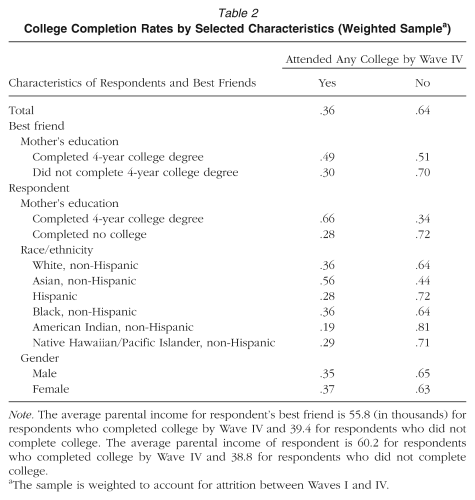
Note. The average parental income for respondent’s best friend is 55.8 (in thousands) for respondents who completed college by Wave IV and 39.4 for respondents who did not complete college. The average parental income of respondent is 60.2 for respondents who completed college by Wave IV and 38.8 for respondents who did not complete college.
The sample is weighted to account for attrition between Waves I and IV.
Table 3 measures homophily in adolescent friendships with respect to mother’s education and household income. It shows that adolescents tend to choose friends with access to similar material and cultural resources. The majority (73%) of respondents with college-educated mothers have best friends with college-educated mothers. Similar patterns emerge for respondents’ and best friends’ material resources. These results suggest that advantage and disadvantage may be concentrated by friendships. And yet, while many adolescent friendships are relatively homophilous with respect to such resources, there are also many students who choose friends from families with different levels of resources.
Best Friend’s Mother’s Education by Respondent’s Mother’s Education (Weighted Sample a )

Note. Ns for total values reflect the sample used in the analyses.
The sample is weighted to account for attrition between Waves I and IV.
What these descriptive statistics cannot say, however, is whether resource-rich best friends matter for college completion even after accounting for factors that may influence both friendship formation and educational attainment. They also cannot determine the cumulative and relative impact of best friends’ material and cultural resources or how their impact varies with the resources adolescents can access at home. Thus, we must also use multivariate models to estimate the effect of friends’ resources on adolescents’ subsequent college completion.
Multivariate Analyses
Relative resources
Table 4 presents odds ratios for fixed effects, logistic regressions of respondents’ college completion at Wave IV on Wave I explanatory variables. We first examine the relative effects of friends’ material and cultural resources. Model 1 includes only best friends’ material resources (whether the friend’s mother has a college degree). Model 2 includes only best friends’ material resources (household income). The final model includes best friends’ cultural and economic resources. When analyzed separately, best friends’ material and cultural resources each have a significant, positive effect on college completion, although the effect of friends’ cultural resources (having a mother with a college degree) is much larger (equaling that of a $100,000 increase in income). Considered together, the effects of best friends’ material and cultural resources remain large (though the coefficients decrease slightly) and highly significant. These results imply that best friends’ material and cultural resources are both associated with college attainment but that cultural resources have a stronger effect than material ones. Overall, having a best friend with a college-educated mother more than doubles an adolescent’s odds of completing college. Best friend’s household income, in turn, increases an adolescent’s odds of college completion by only 1% for every additional $1,000 in income.
Odds Ratios of Logistic Regression Models of the Relative Effects of Best Friend’s Economic and Cultural Resources on Adolescents’ Subsequent College-Completion
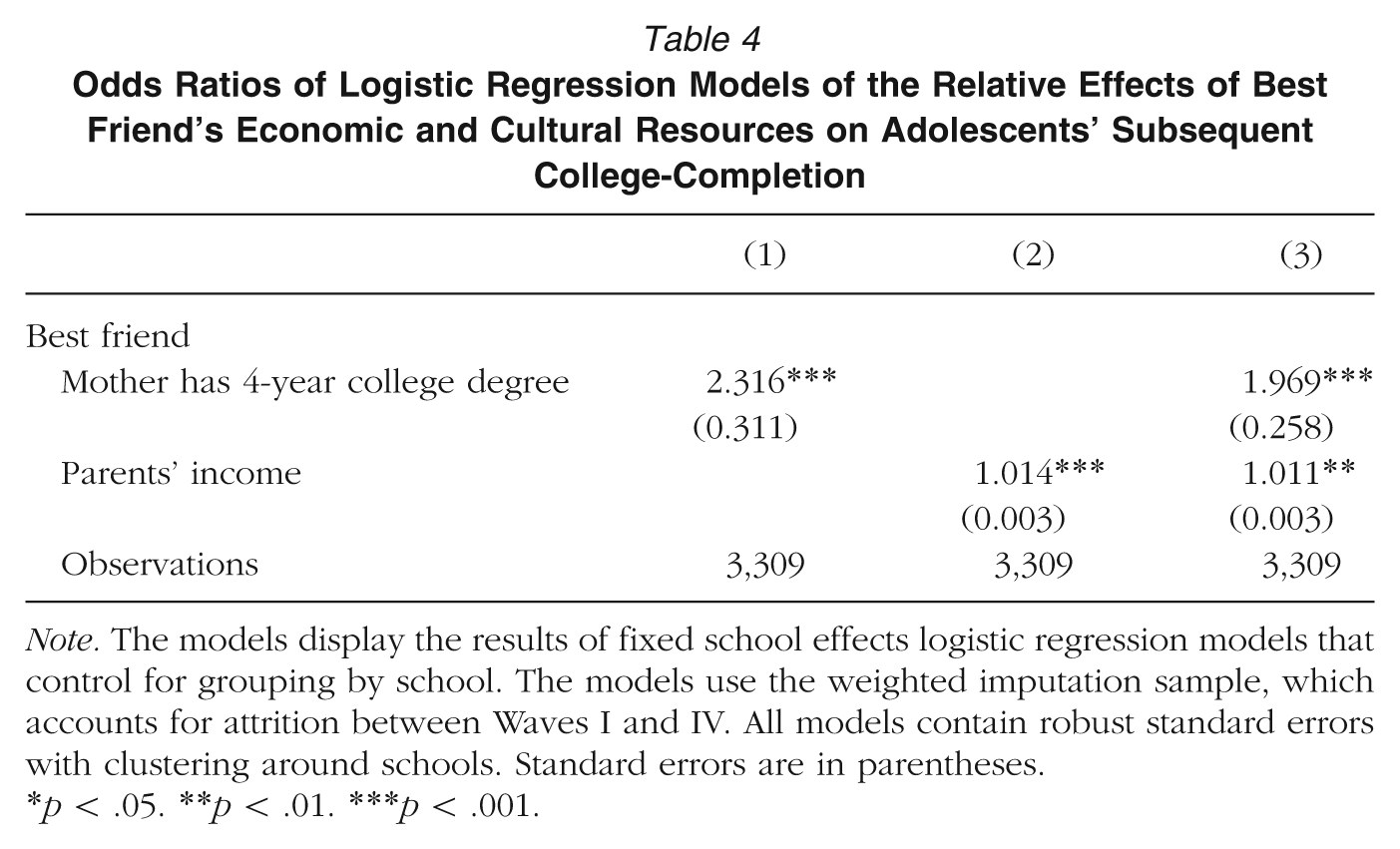
Note. The models display the results of fixed school effects logistic regression models that control for grouping by school. The models use the weighted imputation sample, which accounts for attrition between Waves I and IV. All models contain robust standard errors with clustering around schools. Standard errors are in parentheses.
p < .05. **p < .01. ***p < .001.
When and why resources count
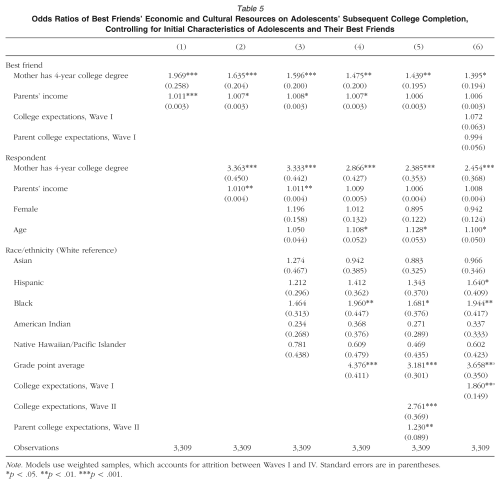
The final analyses first examine whether best friends’ resources matter beyond resources at home. Model 1 in Table 5 repeats the final model from Table 4, showing the adolescents with access to more material and cultural resources at home during their high school years have significantly higher rates of college completion. Model 2 then adds controls for best friends’ material and cultural resources. In this model, best friends’ material and cultural resources are both significantly and positively correlated with adolescents’ subsequent college completion. This suggests best friends’ resources matter even after controlling for the resources that adolescents can access at home. That said, the odds ratios for respondents’ resources are much larger than those for best friends’ resources. While having a mother with a college degree is associated with 230% greater odds of college completion, having a best friend with a college-educated mother increases these odds by 60%. Similarly, while each $10,000 of an adolescent’s own household income increases their odds of college completion by 10%, each $10,000 of best friend’s household income increases these odds by 7%. Yet, while adolescents’ own resources likely matter more for college completion, best friends may also help to equip adolescents with the kinds of material and cultural resources that support subsequent college attendance and completion.
Odds Ratios of Best Friends’ Economic and Cultural Resources on Adolescents’ Subsequent College Completion, Controlling for Initial Characteristics of Adolescents and Their Best Friends
Note. Models use weighted samples, which accounts for attrition between Waves I and IV. Standard errors are in parentheses.
p < .05. **p < .01. ***p < .001.
Having documented this persistent relationship between best friends’ resources and educational attainment, we conclude by considering other mediating factors that might explain both friend selection and subsequent college completion. Model 3 adds controls for adolescents’ race/ethnicity, gender, and age at Wave I. None of these control variables have statistically significant effects on college completion, and adding them to the models does not change the size or significance of the effects of best friends’ material or cultural resources. Having a best friend whose mother has a 4-year college degree still increases an adolescent’s odds of college completion by 60%, while having a best friend with higher household income has a small but still significant effect. This suggests that these background characteristics do not explain why the resources adolescents can access through their best friendships are correlated with their likelihood of completing college.
The final three models consider other possible mechanisms explaining the relationship between best friends’ resources and adolescents’ subsequent college completion. Because adolescents are likely to choose friends with similar levels of academic achievement (Epstein, 1983; Kandel, 1978), and because high school grades are one of the strongest predictors of both college attendance and college completion (Bowen et al., 2009), Model 4 adds controls for adolescents’ GPAs at Wave I. Not surprisingly, we find that respondents with higher GPAs at Wave I have higher odds of college completion at Wave IV. Yet, adding this control does not reduce the size or significance of the coefficients for best friends’ resources, suggesting that resource-rich best friends are not beneficial simply because they are likely to model higher levels of academic achievement.
In a similar vein, Models 5 and 6 explore how college expectations might explain the relationship between best friends’ resources and adolescents’ subsequent college completion. It seems possible, for example, that adolescents who are more college-focused in high school (either because of their desires or because of their parents’) will be more likely both to choose friends with similar orientations (see Epstein, 1983; Hallinan & Williams, 1990) and to complete a 4-year college degree. Model 5 begins by examining the college expectations of adolescents and their parents and their relationship to adolescents’ subsequent college completion. We include the respondents’ and their parents’ college expectations at Wave II rather than Wave I since respondents are closer to college-going age at Wave II and because these expectations may change from the initial survey (possibly as a result of their exposure to their best friend’s resources). We find that respondents’ and parents’ college expectations are strongly and positively correlated with adolescents’ subsequent college completion. Even with these controls, however, the effect of best friends’ cultural resources is still strong and positive (44% higher odds of college attainment at Wave IV). However, the effect of best friends’ material resources is no longer significant. This suggests, in turn, that the correlation between best friends’ resources and adolescents’ subsequent college completion is partially explained by the fact that college-focused students choose more resource-rich friends. Yet, even controlling for these expectations, we find that access to best friends’ middle-class cultural resources (though not their material ones) is still associated with significantly higher rates of college completion.
Given that college-focused adolescents might also choose college-focused best friends, the final model in Table 5 controls for the college expectations of adolescents, best friends, and best friends’ parents at Wave I. 14 As this model suggests, however, the college expectations of best friends and their parents do not have a significant effect on adolescents’ subsequent college completion, at least after controlling for adolescents’ own college expectations. Their inclusion in the model also does not seem to reduce the size or significance of the correlation between best friends’ (cultural) resources and adolescents’ college completion. This suggests, in turn, that while resource-rich best friends may be more college-focused, this does not explain why having resource-rich friends is associated with higher levels of subsequent educational attainment.
While not directly related to our central questions of interest, the final model of Table 5 shows that after controlling for adolescents’ and best friends’ resources, college expectations, and GPAs, Hispanic and Black adolescents have significantly higher likelihoods of college completion than do their White counterparts. These findings are consistent with previous literature showing a college advantage for some minorities that appears after controlling for socioeconomic characteristics (Bennett & Lutz, 2009; Bennett & Xie, 2003; Charles et al., 2007).
Where resources count most
While the results are not reported here, we tested for interactions between all of the independent variables included in the analysis. Because none of these interactions were significant, we do not show them here, though we will briefly discuss their implications for interpreting our findings. We conclude, for example, that because there were no significant interactions between best friends’ resources and adolescents’ background characteristics, adolescents of different gender, racial/ethnic backgrounds, socioeconomic statuses, and achievement levels benefit similarly from having resource-rich best friends. Similarly, because we find no significant interaction between adolescents’ resources (material or cultural) and those of their friends, we conclude that resource-rich friends benefit all adolescents equally, regardless of their own family resources. And finally, because there is no significant interaction between friendship reciprocity and best friends’ resources, it seems that having resource-rich friends is beneficial regardless of whether friendships are reciprocated.
In all of these analyses, we focus on the importance of access to middle-class resources. And yet, it is important to note that just as having a best friend with a college-educated mother has a positive impact on an adolescent’s subsequent college completion, having a best friend whose mother does not have a college degree has an equal and negative impact on such outcomes.
Discussion
As college degrees—and particularly 4-year degrees—become increasingly important for individual life outcomes (Arum & Roksa, 2011; Bowen et al., 2009; Goyette, 2008), scholars have sought to understand factors that push adolescents toward success in higher education. While such research often highlights the importance of cultural and economic resources that adolescents acquire from their families at home (Bowen et al., 2009; Elliot & Beverly, 2011), scholars have not fully considered whether adolescents can also access these critical resources through other relationships in their lives. To answer these questions, we explore the resources adolescents can access through the friendships that they form before going to college, finding that adolescents with resource-rich best friends—those with college-educated mothers—are significantly more likely to complete a 4-year college degree. This relationship holds even after controlling for adolescents’ family resources and for other factors (including adolescents’ and friends’ academic achievement and expectations, parental expectations, as well as school characteristics) that might influence both friend selection and educational attainment. More broadly, these findings suggest that best friends could be a critical source of social capital. While they have a less direct impact on higher education decisions than do adolescents’ families, best friends may still provide access to the kinds of cultural and material resources that support college attendance and completion. Such findings, then, expand our understanding of adolescent social capital, recognizing that parents (Carbonaro, 1998; Coleman, 1988; Horvat et al., 2003; Lareau & Horvat, 1999; McNeal, 1999) and other adult institutional agents (Stanton-Salazar & Dornbusch, 1995) may not be the only source of resources for adolescents.
A number of interesting findings emerge from our results. First, while an individual’s family material and cultural resources both matter for college completion, only best friends’ cultural resources (and not their material ones) have a significant effect, net of expectations. This could mean that while families have systems for distributing various types of resources to their members (Bourdieu, 1977; Bronfenbrenner, 1958; Lareau, 2000, 2003; Maccoby, 1992), friendships are better equipped for sharing cultural resources than material ones.
Second, friends’ cultural resources are robust even with expectations. While friends’ cultural resources may matter for college-going in part through their effects on adolescents’ college expectations, these cultural resources are not simply a proxy for academic orientations. Thus, resource-rich best friends matter in part through the access they provide to college-educated, adult role models. By modeling the behaviors necessary to achieve middle-class success in American society, college-educated (and, to a lesser extent, affluent) parents may establish and enforce norms (Coleman, 1988) for college attendance and completion that affect not only their own children’s behavior but also that of their children’s friends. While future research—for example, observational studies of adolescent friendships—should consider this in more depth, it seems that a best friend’s parent could also play a more direct mentoring role, sharing information about the college process or even allowing the adolescent to “go along for the ride” on college visits.
Our findings, then, offer empirical evidence of a positive association of social networks on youth and also contribute to our theoretical understanding of social capital and how adolescents may gain useful cultural tools for future success. Bourdieu (1977) suggested that an individual’s disposition, or habitus, is largely formed through interactions with parents at home, although he recognized that dispositions can also be acquired in other settings. Our findings suggest that these other settings may include adolescent friendships (Alvarado & Turley, 2010; J. E. Rosenbaum, Deil-Amen, & Person, 2010). Such friendships may provide access to successful adult role models who can, by virtue of both the expectations they enforce and the example they set, shape adolescents’ orientations toward college and also equip them with the skills, strategies, and information necessary to achieve a college degree. By the same token, however, these findings also imply that adolescent friendships can have a negative impact on adolescents’ long-term outcomes. Exposure to less affluent and educated adult role models, it seems, can undermine the college chances of even those students with college-educated parents.
Taken together with findings of other previous empirical studies, our research suggests a potential mechanism for resource transfer among friends. Children of more educated mothers could share with their friends important knowledge about the benefits of college, about different college options, and about the procedures for applying. If these adolescents apply for college themselves, they could model such processes for their friends and provide them with important emotional support for pursuing a similar path (Call & Mortimer, 2001). Receiving this kind of information and support might in turn influence adolescents’ decisions not only about whether to attend and complete college but also in terms of their academic orientations more generally (as evidenced by our findings that best friends’ resources affect college-going in part through their relationship to adolescents’ achievement and aspirations). Today’s students are expected to more independently make important decisions about course-taking and college-going, decisions once made primarily by school officials (Lucas, 1999; Stevens, 2007). Thus, the information and support that students receive from their friends might play an increasingly important role in students’ decisions about whether and how to prepare for college.
The results also have a number of practical implications for policymakers and educators. Given the high level of homophily in adolescent friendships (Doyle & Kao, 2007; Kandel, 1978; Kao & Joyner, 2004; McPherson et al., 2001), these results suggest that the adolescents who benefit most from access to resource-rich best friends may not be the ones most needing this benefit. Hence, efforts to encourage more cross-class friendships (e.g., by increasing the socioeconomic diversity of schools or encouraging diverse afterschool environments) could potentially help to offset the disadvantage of students’ own socioeconomic status in terms of college completion. And while there are negative effects of having friends with fewer resources at home, the effect of adolescents’ home resources are still stronger on college completion, suggesting that the benefit to adolescents from less privileged families would be greater than the negative effects on those from more advantaged families.
Our article also provides support for policies that promote diversity in youths’ social networks. Smaller school environments may enable students to interact in a more intimate setting with peers (Mintrom, 2009; V. E. Lee & Ready, 2007; V. E. Lee & Smith, 1993; Wasley et al., 2000) and may encourage youth to form the kinds of strong friendships that research shows are beneficial for adolescent outcomes (Vaquera & Kao, 2008). Our research also points to the importance of exposing adolescents to college-educated adult role models. While friendships provide one avenue of access to such role models (and our results certainly support policies that would expand access to college degrees), other mentoring programs like “Big Brother Big Sister” may also have similar benefits.
However, the interpretation of our findings comes with a number of caveats. Foremost is the issue of friend selection: Teenagers are likely to seek out friends with similar background characteristics. To partially address these selection issues, our regression analyses control for characteristics associated with homophily. We also conducted analyses using propensity score matching (see Appendix in online journal), which produce results consistent with our main findings here. Both methods are limited, however, by the variables included in the analyses in that there is likely still bias reflecting variables (e.g., temperament and beliefs about the importance of college) that we cannot include. Additionally, our analysis is also limited in that we cannot assess the relative influence of friends’ and respondents’ own resources for adolescents who do not name any friends. Finally, there is a significant amount of missing data due to incomplete friend reports, which despite our various approaches to handling this problem may also influence results.
Future research should further explore causal inferences inferred in this article. It should also investigate more fully the mechanisms by which adolescents access and utilize their friends’ resources in making important long-term decisions like those regarding college completion. For example, since we find a “role model” effect exerted specifically for friends’ mothers’ college education, this influence may be stronger for female, rather than male, respondents.
Although we find in our article a better understanding of social and cultural capital transfer among adolescent friends, this does not mean that the benefits of such friendships are equally distributed. Rather, as our descriptive results indicate, adolescents from more resource-rich families are also more likely to have resource-rich friends. Thus, while students from more resource-rich families are often doubly advantaged, those from less resource-rich families are instead doubly disadvantaged. This implies, in turn, that alleviating inequalities will require not only bolstering the well-being of individual families but also alleviating persistent social class–based segregation in American schools and society (J. Lee & Wong, 2004; Rumberger & Palardy, 2008). As research on racial segregation suggests, opportunities for cross-racial interaction promote more favorable attitudes about those of other races and more development of interracial friendships (Hallinan & Teixeira, 1987; Moody, 2001). Moreover, alleviating barriers to cross-class friendships, including class-based segregation at the school level and in academic tracks (Kahlenberg, 2001; Oakes, 2005; Rumberger & Palardy, 2008), can help ensure that all adolescents have equal access to the benefits of resource-rich friends.
Footnotes
Notes
H
J
G