




Abstract
To understand the presence and positioning of Latina faculty in humanities and social science scholarship, the authors analyzed articles published between 2000 and 2016 and developed three findings. First, few papers centered Latina professors. Second, when Latina faculty were featured in scholarship, it was often in the context of research concerning other minoritized and underrepresented faculty, more generally. Third, Latina faculty were frequently elevated as intellectuals when Latina-identifying scholars conducted the work.
Imagination [allows us to] have a vision of a better social order [to] find an existing set of deficiencies “unendurable.” Finding them “unendurable,” you then may act to heal and repair. It is a matter of recognizing the space between what is and what could be.
Introduction
In the summer of 2016, Dr. Grisel Y. Acosta (2016) published a blog titled The Invisible Latina Intellectual. In her post, Acosta lamented that Latinas are rarely positioned as intellectuals in the U.S. context. Drawing on cursory internet searches, Acosta (2016) went on to argue that U.S. society has a limited imagination when it comes to Latinas, casting them as either poor domestic workers or overly sexualized clichés (Guzmán & Valdivia, 2004). This limited imaginary, according to Acosta (2016), “simply refuses to see . . . Latinas as hard-working nerds, scholars, and intellectuals.”
Although Acosta’s critique was targeted at mega institutions, like the media and news outlets, Dr. Mariana Ortega (2016), a self-identifying Latina philosopher, suggested that Acosta’s analysis holds in academia as well. Just consider the opening of Ortega’s book: Feeling comfortable in the world of philosophy has not been easy for me. This book is my hometactic, my attempt at finding a sense of belonging and ease within a discipline that forgets the contributions of those regarded as “others.” If philosophy remembers them, it does so with piercing abstraction and condescension. (p. 1, italics added for emphasis)
Holding both Acosta’s observations and Ortega’s writing in mind, the authors of this article wondered how often and how Latina 1 faculty are presented in peer-reviewed humanities and social science scholarship. To address these curiosities, the authors searched, reviewed, and analyzed peer-reviewed scholarship appearing across 873 humanities and social science journals and asked the following questions:
The first question addresses Latinas’ numerical presence, whereas the second question asks how Latina faculty members were positioned, or situated, in the research. Finally, the third question attempts to get at the kind of images that authors created about Latina professors when they did include them in scholarship.
Significance
The significance of this work is threefold. First, because peer-reviewed scholarship is weighed so heavily within faculty evaluation processes (e.g., hiring, tenure, promotion), it represents subject matter that scholars find worthy of their and, perhaps more importantly, their readers’ time. In turn, when scholars invest in subject matter, it suggests they want to encourage others to engage in future conversation. Although with limitations, this article can highlight if and to what extent humanities and social science scholars have ascribed value to documenting and understanding the lives of Latina faculty members. Second, how scholars frame their subject matter is never a neutral process, but one that is laden with politics and power (Tuhiwai-Smith, 1999). When authors write a paper, they decide how to portray their topics or populations. In turn, consumers of research (e.g., undergraduates, graduate students, scholars) then go on to search, retrieve, and consume the choices that researchers previously made. When the literature narrowly or stereotypically conceptualizes a topic or population, consumers are likely (not always) to form a limited understanding about said topic or population (Mott & Cockayne, 2017; Nobel, 2018). Accordingly, this article has the potential to broaden, complicate, challenge, and/or amplify the images that previous authors created about Latina professors. Third and finally, although this article has its limitations, it lays the groundwork for future scholars to explore the presence, experiences, outcomes, and contributions that Latina professors are making to the academy. Given the current size and projected growth of Latinas in the United States, it is critical that any educator with power, including researchers in academia, consider the full realm of possibilities for Latinas. To set up the article, a brief overview of Latinas’ educational profile is presented and followed by a description of the theoretical grounding for this project.
Latinas’ Education and Presence in the U.S. Academic Profession
Estimates suggest that about 29 million people within the U.S. Hispanic population are women and that, by 2060, Latinas will comprise about one-third of the entire U.S. population (Gándara, 2015). The National Center for Education Statistics (NCES, 2018a) reported that 23.2% of Latinas aged 25 to 29 years held a bachelor’s degree and 3.8% held a master’s degree in 2018. According to the same report, about 0.07% of the U.S. Latina population held a doctoral degree in 2018 (NCES, 2018c). Unfortunately, these data also show that only 0.05% of Latinas held full-time faculty positions (NCES, 2018b), meaning that less than 1% of the entire Latina population held a faculty position in academia. Looking inside the professoriate, NCES (2016) estimated that, of the 1.5 million professors in U.S. higher education, Latinas held only 2% of full-time faculty positions across all ranks (e.g., assistant, associate, full). At the highest and most powerful rank, Latinas only held 2% of full professorships, which represents little progress since the 1980s when Latinas held an estimated 0% of full professorships (Exum et al., 1984).
In sum, although Hispanic-identifying women currently represent a tiny portion of academics, their presence is steadily increasing. Finkelstein et al. (2016) found that Latinas, like other women seem to be gaining ground, although Latinas are gaining amongst the least secure appointment types (e.g., nontenure track, part-time) and in community colleges and comprehensive universities rather than research universities. In terms of disciplinary representation, Latina/o/x professors tend to be concentrated in the humanities and social sciences and are generally underrepresented in science, technology, engineering, and mathematics (STEM) fields (Sanchez-Peña et al., 2016). Taken together, Latinas are slowly gaining presence in the academy, so it is an opportune time to examine how researchers are accounting for Latina professors.
Theoretical Grounding
Maxine Greene’s (1995/2000) work on imagination grounds this project. By imagination, Greene referred to expanding individuals’ perceptions of people, places, and ideas. Greene tended to write for K–12 educators, but argued that educators, overall, have a powerful opportunity to expand the imagination of students and, thereby, of society. Unfortunately, because education is bound up in White, patriarchal, capitalistic ideologies, norms, and positionalities, so too are the learning opportunities that tend to be provided in educational institutions. Greene urged educators to capitalize on their curricular power to introduce voices, views, and ideas that have historically been marginalized and sometimes silenced altogether. Greene suggested that when educators help others reimagine the world, especially by opening up new ways to think about historically marginalized people, they do imperative work. Of this, Greene wrote, Imagination seeks meaning and widens perceptions, but it also gives rise to glimpses of possibility, to what is not yet, to what ought to be . . . Associated with the nurture of imagination, therefore, must be a critical self-reflectiveness, a demand that people ponder what they imagine, that they articulate the principles that govern the choices they make as they live. (Greene as cited in Ayers, 1995, p. 322)
In sum, the authors of this article understand faculty members in the way that Greene understood K–12 teachers: 2 as educators with opportunity to help individuals (re)imagine people, places, and/or phenomena. Moreover, just as Greene (1995/2000) unveiled the willful politic and agency involved in K–12 educators’ curricular and teaching choices, the authors view scholars as having the agency to take up research in various ways. Thus, the authors understand the production of scholarship as a process where scholars make choices about their work and how they choose to represent (or not) various peoples, topics, and ideas. In this way, given their position in academia—with access to the research and publishing infrastructure—researchers are empowered to inform how others—namely, students and other scholars— think about the academic profession, who belongs, and what they do.
Method
This article follows guidelines for H. M. Cooper’s (1982) systematic review process. Cooper wrote that systematic reviews are conducted to analyze a large body of literature in relation to various kinds of research questions, including questions that are quantitative (e.g., How often does x appear in the literature?) or qualitative questions (e.g., How is x characterized in the literature?). Cooper noted that quality systematic reviews follow five steps: (a) clear problem/question formulation, (b) data collection, (c) data evaluation, (d) data analysis, and (e) interpretation for dissemination. Each of these steps was followed and is described next.
Question Formulation
This study was guided by three research questions. The first question concerned the presence of Latina professors in published social science and humanities scholarship. Essentially, the authors wanted to understand how often Latina faculty members were featured in scholarship. The second question concerned the positioning of Latina faculty members in said scholarship, meaning the authors were interested in understanding how Latina faculty members figured into existing scholarship (e.g., as the only unit of analysis, among women, among People of Color). The third question was more qualitative in nature and explored what could be learned about Latinas from this select body of scholarship. The last question was largely inspired by the theoretical frame and addressed the imaginary that has been painted about Latina professors in published work.
Data Collection and Data Sources
To begin the review, the authors consulted with two university librarians for advice. Both librarians suggested that the authors use JSTOR, an online database that archives literature from major academic disciplines. JSTOR allows researchers to define a search according to keywords, publication type(s), disciplinary area(s), including subdisciplines, time period, and language preferences. JSTOR also works well with online shareable libraries, like Zotero, which the authors used to store and manage their data set (Lester et al., 2017). Using the JSTOR search refinement function, the authors searched across the following social sciences and humanities disciplines: (a) Anthropology, (b) Communication Studies, (c) Education, (d) Feminist/Women’s Studies, (e) Latin American Studies, (f) Philosophy, (g) Psychology, and (h) Sociology. In adopting the above disciplinary areas, the search included 870 unique academic journals (see Table 1).
Disciplinary Spread of Journals in JSTOR Search.

Unfortunately, JSTOR does not archive content from three journals that regularly publish work on Latinx populations, faculty careers, or higher education (Lester et al., 2017). Thus, the authors conducted individual searches in Journal of Latinos and Education (JLE), Journal of Hispanic Higher Education (JHHE), and The Review of Higher Education (RHE) bringing the total number of journals included in the search to 873.
Search process
A key decision involved in systematic reviews is the selection of search terms for literature retrieval. This project required search terms for (a) Latinas and (b) faculty members. Given that language is an exercise of power, the authors were concerned that search terms be generative and inclusive, yet they realized that no search term would be perfect. To search for literature concerning professors, the authors chose “faculty members,” “professors,” “intellectuals,” and “scholars” as synonyms. However, choosing a referent for Latinas or Hispanic-identifying women was much more complicated. Ultimately, the authors chose the referent “Latina” because it is a panethnic category, meaning that it refers to a broad spectrum of people from multiple racial and ethnic backgrounds and others authors might have used it to capture a broader population. The authors used “Hispanic” for a similar reason, recognizing that there was a period of time when “Hispanic” was the most widely used referent (Passel & Taylor, 2009) to describe People of Spanish-speaking and Latin American backgrounds. They acknowledge that the “Latina” and “Hispanic” categories are not acceptable to all people. Many Indigenous people and groups reject these labels as Latinidad privileges a north American positionality and often erases the role and experience of Indigenous peoples from the “global south” (Martínez-Prieto, 2018). In addition, the authors also acknowledge that Hispanic and Latina are ethnic, not racial categories, which means that Latinas of color as well as White Latinas were probably considered in the scholarship reviewed. Unless previous social science and humanities scholars accounted for this racial diversity, the authors of this article are also unable to account for racial difference. Together, when combined, the authors’ search terms yielded eight unique searches (see Table 2).
All Search Term Combinations.
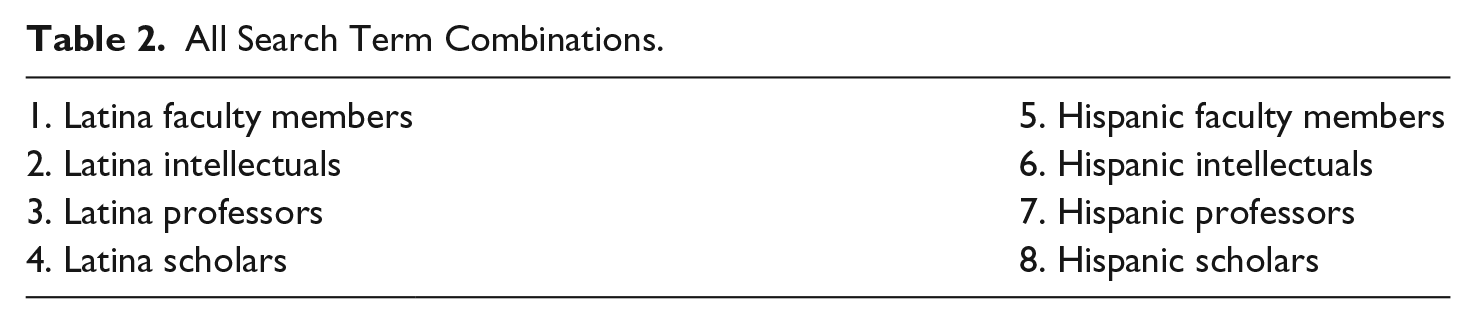
In addition to key terms, the authors’ search process was bound by three additional parameters. First, only peer-reviewed articles were included. Second, to make the project manageable, only scholarship published between 2000 and 2016 was included. Adopting 2000 as a starting point seemed an acceptable decision because much of the literature concerning faculty of color and Women of Color, more specifically, did not appear until the late 1990s (Turner et al., 1999). Third, the search was limited to English-language journals because only one author is fully bilingual.
Data Evaluation
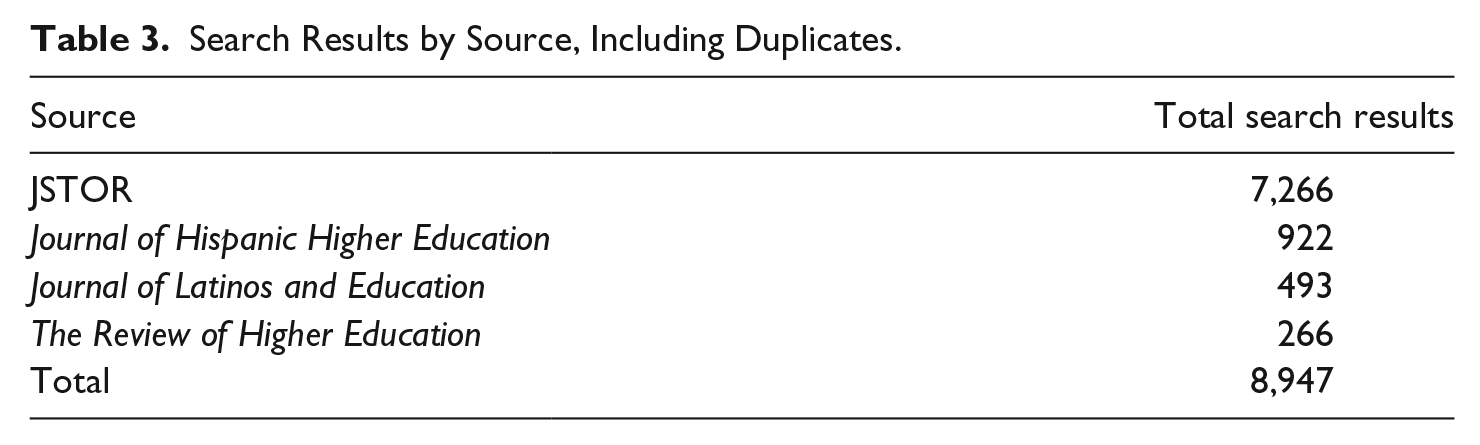
Searching 873 journals from 2000 to 2016 yielded more than 20,000 articles. However, JSTOR limits researchers’ access to the first 1,000 results per search, which translated to 7,266 articles from JSTOR. JHHE, JLE, and RHE yielded an additional 1,681 articles (see Table 3).
Search Results by Source, Including Duplicates.
Following H. M. Cooper’s (1982) third step, the authors evaluated each paper to determine its fit with the project. First, they skimmed keywords, titles, and abstracts and retained articles that mentioned Latinas, faculty of color, Women of Color, women, generally, and faculty generally. This initial evaluation process was slow, took approximately 1 year, and presented unanticipated dilemmas. For example, several papers in the data set addressed Latina artists, journalists, poets, playwrights, or novelists. Because the authors believed that some of these women might have also held a faculty appointment, they retained these papers and conducted web searches to determine whether the Latinas featured in such papers did, in fact, hold a faculty appointment. After these web searches, they eliminated most of these papers because the Latinas in the papers did not hold a faculty post. After the initial review, the vast majority of papers, including duplicates, were eliminated (see Table 4) because they did not fit the project’s purpose.
JSTOR Search Results, Results by Journals, and Results from First and Second Reviews.
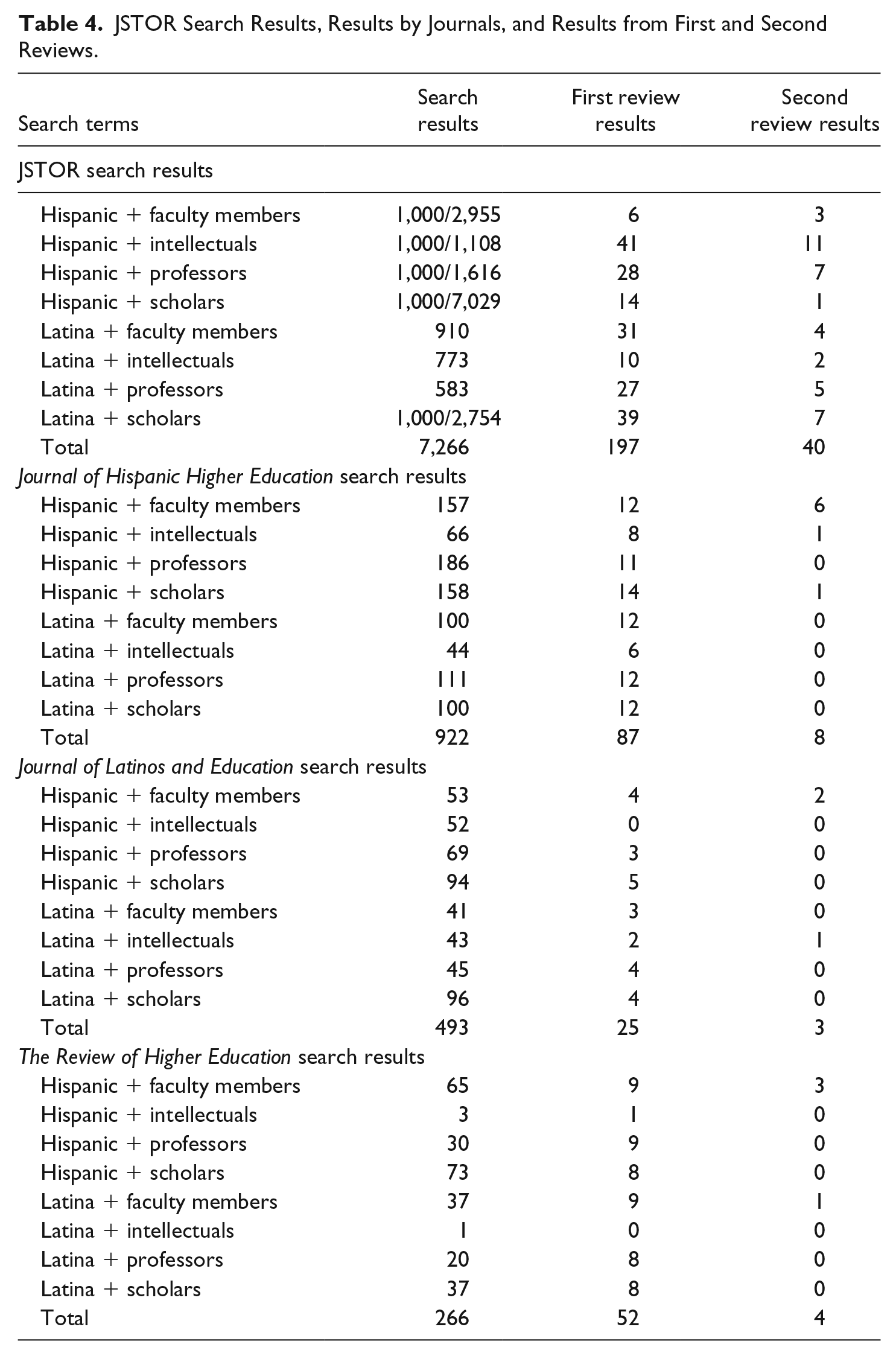
In a second review, the authors closely read paper abstracts and methodologies and eliminated several papers focused on the academic profession, but that failed to specify any group, including Latinas. During this second review, the authors started to realize that many of the papers remaining in the data set featured women faculty, Latino/x faculty, or faculty of color, more generally, but said little about Latina faculty in any explicit way. By the end of Round 2, the authors determined that 55 papers featured Latina faculty in some fashion, either as the sole unit of analysis or as part of larger studies focused on faculty of color (see Table 4). Their next step was to analyze the content of these 55 papers more closely.
Data Analysis
As described above, the data evaluation process revealed that few papers actually fit the purpose of this study. Said more explicitly and in relation to the first research question, out of thousands of papers, only 55 addressed Latina faculty in some fashion. Then, to assess how Latinas were positioned or situated in this select literature, the authors created three exclusionary categories: (a) a paper featuring Latina professors as the central and only unit of analysis, (b) a paper focused on Latina/o/x faculty generally, and (c) a paper focused on marginalized faculty, more broadly (e.g., any group that is nondominant, non-White, not male identifying). Finally, to consider what imaginaries scholars constructed about Latina professors, the authors conducted a thematic analysis. Specifically, they independently read each paper and asked, “What does this paper teach about Latina professors?” Each author journaled their impressions and, over several weeks of meetings, they discussed and consolidated their impressions into two themes, presented next.
Findings
In terms of the first question concerning presence, the authors found that Latina faculty were rarely featured in humanities and social science scholarship. Although they anticipated that Latina faculty would not often be at the center of published scholarship, they did not expect so few papers to feature Latina faculty. Indeed, after multiple rounds of review, starting with thousands of papers, they found only 55 papers featuring Latina faculty members in some fashion. It is important to note that although this first question sheds light on the frequency at which Latina faculty appeared in a select body of social science literature, the authors are unable to show how this finding compares to how often other groups, particularly historically underrepresented groups of faculty, appear in social science and humanities research.
Then, in relation to the second research question, which was to understand how Latinas were positioned in this select scholarship, the authors separated the 55 papers into three categories and found that only 26 papers centered Latina professors as the sole unit of analysis. The authors determined that the remaining 29 papers featured Latinas in the context of studies or arguments concerning women and People of Color (n = 19) or Latinxs (n = 10), as a whole. The authors argue that this particular positioning of Latina faculty meant that Latina voices, experiences, and perspectives tended to be subsumed in analyses that did not account for the intersecting importance of race, gender, and ethnicity, among other identifying markers. In other words, when authors did include Latina professors in their work, they tended to elevate ethnicity over gender or gender over ethnicity, but rarely included their simultaneous intersection. The authors address this finding at length in the discussion.
Finally, to understand what kinds of imaginaries that scholars created about Latina professors, the authors conducted a thematic analysis of the 26 papers that centered Latina professors. The dominant theme (n = 23), Knowledge Makers, indicates that Latina faculty members were framed as producers of knowledge. Papers in this theme elevated the intellectual contributions of Latina professors, meaning that they highlighted how a Latina professor had contributed to the world via knowledge production. The second theme (n = 3), Survivors, foregrounded how Latina professors survived rampant sexism, racism, and ethnocentrism in academia in relation to both their personhood and their academic work.
Knowledge Makers
Journal articles within the Knowledge Makers theme portrayed Latina professors, first and foremost, as producers of knowledge—as intellectuals that offered significant contributions to academia. For instance, Duany (2010) spotlighted Latina anthropologist Helen Safa stating, “Safa’s monograph helped move anthropology into a field of study with numerous practical implications—in this case, public housing policy” (p. 46). Similarly, Miller (2005) noted that Gabriela Mistral, a Chilean poet, “challenged the main tenet of intellectuality as it came to be conceived during the 1920s in Latin America . . .” (p. 145). One more example was Castillo-Garsow’s (2012) paper, in which she described how Gloria Anzaldua’s work impacted her field of study and enabled her individual scholarship.
A notable pattern within the Knowledge Makers theme is that authors often invited a Latina professor to reflect on their work. For instance, in Ruiz and Meyer (2008), Meyer wrote that “Ruiz is one of the most prolific scholars of and fiercest advocates for Chicana/Latina studies and history” (p. 23). Then, within the body of the paper, both Meyer and Ruiz go on to describe the history and evolution of Ruiz’s work. Ruiz is given the space to articulate and complicate her intellectual work and the contributions she hoped/hopes to make. Similarly, in Viramontes and Flys-Junquera (2001), Flys-Junquera framed “Viramontes as one of the most socially and politically conscious writers of today . . .” (p. 223) and then asked Viramontes to detail the goals of her work. Viramontes, an American Fiction Writer and a scholar of English, went on to share that many of her stories focus on “voicing . . . the often-silenced struggles of many women against the dominating patriarchy” (p. 223). Viramontes detailed how important it is to her to create women characters with a sense of agency in her scholarship.
An additional pattern within the Knowledge Makers theme and one that the authors had not anticipated, was that Latina-identifying scholars were often the authors of papers that fell in the Knowledge Makers theme. In fact, 15 of the 23 articles in this theme were written by Latina-identifying scholar(s). The authors return to this finding in the discussion section.
Survivors
Three of the 26 Latina-professor-focused papers portrayed them as Survivors. These papers noted how Latina professors endure loneliness and marginalization that lead them to question their belonging in the academy. For instance, Medina and Luna (2000) noted that “with so few Latina women earning doctorates, the [three Latinas in our study] often felt tokenized . . . the need to prove themselves to other faculty in their department” (p. 57). However, papers in the Survivors theme also celebrated the resilience of Latina faculty and highlighted the strength required to disclose such experiences and share them as lessons for others. Of this, Reyes and Ríos (2005) wrote, We hope to give voice to a silenced discourse that is often concealed for fear of appearing weak, confrontational, self-pitying, or unscholarly for fear of numerous other labels that restrain Latina academics and others from discussing issues that need to be examined. (p. 391)
In the body of the paper, Reyes and Ríos (2005) described their own experiences as Latina academics in hopes that their stories would show other Latinas that they were not alone. They also described persistent isolation in graduate school and racist experiences early in their professional careers. Reyes shared that one of her students wrote, “I don’t know if I can stay in this class. I can’t learn from a person of Color” (p. 386). They went on to clarify that although their experiences were painful, they hoped that in sharing they were helping to lay a path for future professors, especially Women of Color. Of this, they noted, “From the struggle to survive in the academy . . . Chicanas . . . created a diverse otherness from which they craft new intellectual and political agendas-praxis-to wrest meaning from the new context” (p. 48).
Similarly, the two other papers in the Survivors theme addressed the intellectual approaches of Latina faculty and showed how Latinas survive what can best be described as epistemological racism (see Scheurich & Young, 1997). For instance, Segura (2003) interviewed several Chicana-identifying faculty and found, like Anzaldúa (1987), Delgado Bernal (1998), and the authors, that Chicanas/Latinas/Women of Color must not only survive racism and sexism related to their personal background, but also epistemological biases related to the evaluation of knowledge within western academia. Segura noted that Chicanas often struggle because they are situated in interdisciplinary departments or their work has an interdisciplinary basis and academia marginalizes work that resists normative academic disciplinary boundaries. Similarly, Delgado Bernal, in a paper that did not emerge in our search, argued that there is a cultural connection or intuition that is often present in the work of Women of Color, for which they are penalized given western, white norms that undergird typical evaluation processes. In sum, the papers in the Survivors theme show that Latina professors navigate many types of marginalization based on racism, sexism, and class and that such marginalization shows up in both personal and professional ways. Similar to the first theme, all of the papers within this theme were written by Latina-identifying authors, which means that, in total, 18 of the 26 papers Latina-professor-focused papers were written by Latina-identifying authors.
Discussion
The authors’ research questions concerned Latinas’ presence and positioning in published social science and humanities scholarship. In plain terms, the authors wanted to understand how often and how Latinas figured into select social science and humanities scholarship—to understand what could be learned about Latina professors from existing scholarship, what kinds of images other authors painted about Latina professors. Before moving into the discussion, it is important to note that the authors do not expect every scholar everywhere to write about Latina professors every time they write about faculty careers. However, the authors do argue that there is merit in elevating Latina faculty more often in scholarship in order to understand how they access, experience, and contribute to academia. As Reyes and Ríos (2005) suggested, the authors believe that much can be learned from studying Latina faculty careers. After reviewing more than 8,900 papers and finding that only 55 papers featured Latina professors in some fashion, the authors hope others take up scholarship that centers Latina professors.
In terms of the second research question, which asked how Latina professors were positioned in this select scholarship, the authors found that Latina professors were often positioned in the context of broader papers addressing minoritized faculty groups, overall. Specifically, 29 of the 55 papers in the final data set were focused on women, faculty of color, or Latinx faculty, and only 26 papers solely focused on Latina faculty. As a result, Latinas’ experiences and perspectives were often submerged in the “Latino experience” or in analyses that failed to capture the intersection of gender, ethnicity, race, and so on. Thus, moving forward, when scholars study the experiences or wish to elevate the voices or experiences of Latinas (or any group of people), they should consider applying an intersectional lens (Crenshaw, 1991) and disaggregating groups in more nuanced ways. When applying an intersectional lens, a researcher shines a light on differential privilege and power tied to race, colorism, class, nationality, language, and citizenship within and across communities (Smith, 2016).
In terms of the qualitative findings where the authors sought to make sense of what could be learned about Latina faculty in the 26 Latina-focused papers, the authors found that 23 papers framed Latina faculty members as Knowledge Makers, meaning that the papers elevated Latina professors’ intellectual contributions. This was a powerful finding because these papers lay the foundation for understanding how Latina scholars are contributing to the production of knowledge within the humanities and social sciences. Still, specific disciplinary-based work is needed. Tracing the contributions of Latinas shows that Latinas are not only surviving, but thriving and creating knowledge, and, thereby, affecting practice, policy, and how others are able to understand and imagine the world (B. Cooper, 2017). In fact, the second qualitative finding— Survivors— consist of stories of survival and provide guidance to aspirational Latina faculty.
Finally, it is both important and fascinating to note that Latina-identifying scholars were the authors of the majority of the 26 papers that centered Latina professors, meaning that Latina-identifying scholars are leading the effort to create an imaginary that not only includes but centers Latinas and their intellectual work. Although the authors did not anticipate this finding, the fact that Latina-identifying scholars are primarily studying and elevating the intellectual work of Latina professors is, in fact, another rationale for diversifying the faculty. Indeed, too often, cases for diversifying the professoriate rest on a representational rationale, meaning efforts to diversify are based on the faculty should be more diverse because today’s students are more diverse. The authors agree with both of these rationales, but the finding that Latinas are mostly responsible for scholarship focused on Latina professors also suggests that a more diverse faculty enables more diverse knowledge production. In other words, the authors suggest that historically underrepresented faculty are likely to raise different questions, offer fresh analyses, and foster imaginations that have yet to be fostered inside the academy.
Limitations
Like all studies, this one has limitations. Given the speed of scholarly production, it was impossible to conduct a completely exhaustive literature review. If conducted today, the authors’ search would likely produce yield different results. However, as Nobel (2018) argued, there is value in examining how populations, particularly historically marginalized populations, are cast in the literature because published work creates a storyline about people. Additional limitations include the fact that the the authors adopted search parameters to manage the literature search process. Also, the authors relied exclusively on JSTOR as well as three additional journals, but in doing so they may have inadvertently reproduced the privilege assigned to articles while minimizing the important contributions that can be found in books, chapters, blogs, and other platforms. The authors encourage future authors to explore not only books and chapters, but also online platforms, zines, and art-based outlets. Moreover, because the authors chose to rely exclusively on JSTOR for their search, they privileged the journals stored in JSTOR and may have missed other sources, although it is notable that Sanchez-Peña and colleagues (2016) used multiple search engines (e.g., ERIC, Google Scholar) to conduct a review concerning Latina faculty and retrieved only 69 articles. Finally, the authors of this article reviewed work written by others, which means that the choices of the original researchers (e.g., language choices, recruitment practices) impacted the search process. Still, given these limitations, this article sheds light on how scholars, across the humanities and social sciences, have studied and framed Latina professors.
Footnotes
Acknowledgements
The authors are thankful to the Michigan State librarians and to Drs. Jeni Hart, Catherine Horn, and Patricia Marin for methodological and data management advice for this paper.
Declaration of Conflicting Interests
The author(s) declared no potential conflicts of interest with respect to the research, authorship, and/or publication of this article.
Funding
The author(s) received no financial support for the research, authorship, and/or publication of this article.