




Abstract
Using data from the Montreal Longitudinal Study, the current study investigates whether age of onset is informative about the dynamic aspects of violent behaviors in males over time, in terms of violent offending frequency, crime trajectory, and, most importantly, crime specialization in violence. Self-reported data at three time points were used. Group-based modeling showed much heterogeneity in the shape of violent trajectories, which were associated with various crime specialization patterns over time. Most importantly, the number and shape of these trajectories were not accounted for by overall age of onset. Study findings show that while age of onset, especially the age of onset of violence, might be informative of the likelihood of committing a violent crime in middle adolescence, it is not informative about the dynamic process of violent offending. Of importance, violent adult offenders specializing in such crimes in adulthood were not necessarily early starters.
Introduction
In recent years, clinical assessment of juvenile offenders has been influenced by a classification scheme that has emerged from developmental studies (Loeber & Farrington, 2001; Moffitt, 1993; Patterson & Yoerger, 1993). The Diagnostic and Statistical Manual of Mental Disorders-Fourth Edition-Text Revision (DSM-IV-TR), which is regularly used as part of clinical assessment with delinquent youth, distinguishes between two types of conduct disorder: childhood onset (prior to age 10) and adolescent onset (American Psychiatric Association, 2000). This classification is based on the assumption that age of onset is informative of specific etiological mechanisms and risk factors, distinct developmental course, and different prognostics, all having important assessment and treatment implications. While several empirical studies have shown findings in line with this classification scheme (e.g., Le Blanc & Loeber, 1998; Moffitt & Caspi, 2003; Piquero & Moffitt, 2008), several conceptual, methodological, and empirical issues have been raised by scholars. For example, the age distribution of onset is somewhat normally distributed from childhood to early adulthood, and not bimodal, as suggested by this classification scheme (e.g., Thornberry, 2005) suggesting that the threshold between early and late onset is arbitrary. Furthermore, the classification scheme is based on an aggregate measure of onset that does not take into consideration the type of behaviors manifested. An aggregate measure of onset might mask significant differences regarding onset, course, and termination of different kinds of antisocial (e.g., overt, covert) and criminal behaviors (e.g., violence, property; e.g., Tremblay, 2010). In spite of unresolved issues, the influence of this classification scheme has extended to risk assessment protocols used by risk assessors. Risk assessment protocols typically include an indicator of “early onset” as a static, historical risk factor. Static, historical risk factors are said to inform risk assessors about the likelihood of reoffending, but are also those that cannot be modified through treatment. In other words, in spite of treatment, youth with an early onset will maintain a higher risk status, as the age of onset cannot be modified through intervention. Interestingly, risk assessment protocols have a different understanding and operationalization of what early onset is, as evidenced by different age cut-offs (e.g., 11, 13), and the type of behaviors considered (e.g., general offending, violence; e.g., Barnoski, 2002; Borum, Bartel, & Forth, 2000). These risk assessment instruments are essentially summative scales that place youth in a category based on their score; they do not match profiles or interventions with youth.
Longitudinal data and techniques are required to examine the patterns of an individuals’ behavior through time. Although longitudinal research on the relationship between age and crime has been conducted for several decades (e.g., Blumstein & Cohen, 1987; Farrington, 1986; Hirschi & Gottfredson, 1983), the advent of statistical techniques able to identify distinct developmental trajectories (e.g., Nagin & Land, 1993) has resulted in a plethora of studies examining the trajectories of different types of behavior over time (for a review, see Piquero, 2008). Studies employing the group-based modeling technique have provided considerable information regarding the patterns and shapes of offending trajectories over time. While some of the findings from these studies have shown support for this classification (Moffitt, 2006; Nagin, Farrington, & Moffitt, 1995), concern has also been raised as to whether the resulting evidence is convincing (Skardhamar, 2009). Others have questioned whether this technique is even capable of testing taxonomic theories (Sampson & Laub, 2005) or should be viewed as atheoretical (Osgood, 2005). Nonetheless, numerous studies using other statistical approaches have examined the relationship between early onset, offending, and violence. An association between early age of onset and persistence in future offending is fairly well established (Farrington, 1986; Le Blanc & Loeber, 1998; Loeber & Le Blanc, 1990; Piquero, Farrington, & Blumstein, 2003; Thornberry & Krohn, 2003), and early onset has also been shown to predict violent offending at some future point (Elliot, 1994; Farrington, 1989; Piquero, MacDonald, Dobrin, Daigle, & Cullen, 2005). These findings suggest that an early onset of general offending is predictive of future violence because criminal careers rarely start with violence. In fact, violence usually tends to appear at the third or fourth stage of offending development, which has shown by studies based on self-reported offending data (Le Blanc & Fréchette, 1989). Moreover, the degree to which onset and persistence in offending are independent, and the magnitude of the association between the two has also been questioned (Piquero, Paternoster, Mazerolle, Brame, & Dean, 1999; Thornberry, 2005). Furthermore, it is unclear whether age of onset is able to capture the dynamic aspects of violent offending trajectories. As a result, using both an onset and trajectory approach simultaneously to examine the role of onset and developmental trajectories could clarify some of these inconsistencies and be of value for assessment purposes in a clinical context (see Le Blanc, 2009). Specifically, the current study aims to determine if the timing of onset is informative of violent offending trajectories. In other words, the study examines whether an early age of onset should be understood as a launch (i.e., long-term; e.g., Moffitt, 1993; Patterson & Yoerger, 1993) or contemporaneous effect on violence (Morizot & Le Blanc, 2007). Although the likelihood of being violent is complex and dynamic over time, further understanding the link between early onset and violent offending over the life-course is important considering the significant role onset plays within clinical and risk assessment protocols. Using data from the Montreal Longitudinal Study (Le Blanc & Fréchette, 1989), the current study aims to investigate the onset-trajectory link to determine whether onset captures the developmental course of violence in males from adolescence to adulthood. First, we review the scientific literature on onset, violent offending trajectories and the theoretical framework linking the two.
Literature Review
Developmental psychologists and criminologists have been concerned with the age of onset because it carries information for prevention purposes about both the initiation of deviance (i.e., participation) and the timing of it (Loeber & Le Blanc, 1990). Distinct initiation patterns occurring at different developmental stages have been theoretically and conceptually associated with different behavioral courses over time. The formalization of the conceptual link between the onset and the course of deviance can be referred to as the “launch effect.” The launch effect embodies the idea that an early onset is a marker for long-lasting effects; thus, the earlier individuals begin offending, the longer they will persist (Morizot & Le Blanc, 2007). A number of empirical verifications of the launch effect have been examined using prospective longitudinal data on offending. According to Krohn and Thornberry (2003), the relationship between an earlier age of offending with chronic and serious delinquent careers has been one of the most consistent findings from various longitudinal studies (e.g., see Huizinga, Weiher, Espiritu, & Esbensen, 2003; Lipsey & Derzon, 1998; Tolan & Thomas, 1995). The launch effect has, however, been operationalized a number of ways with different types of early predictors being used to examine the long-term effects on behavior. What constitutes “early” has also been conceptualized differently (i.e., infancy, early, middle, and late childhood), as have the cutoffs for these developmental periods. In the empirical literature, the type of onset examined (e.g., delinquency, violence, antisocial behavior) and how onset is measured (e.g., categorical, continuous) has varied as well. Categorical studies have examined “early” onset, while those examining it on a continuum have looked at “earlier” onset. An association between early onset and later involvement in serious and violent offending has been found, although some studies have relied on ad hoc classifications of onset and have selected different age cutoffs (e.g., 12 and 13) for early onset (Huizinga et al., 2003; Mazerolle & Maahs, 2002). On the other hand, when onset has been examined from a continuous perspective, and over a longer time period, the link between earlier onset and serious offending has been less clear. For example, in both the 1945 and 1958 Philadelphia birth cohorts, Tracy, Wolfgang, and Figlio (1990) found that early age of onset (i.e., continuous variable from age 7 to 17), as measured by first police contact, was not strongly related to measures of career severity (i.e., participation and rate of seriousness scale).
The link between age of onset and violence may also be behavior or crime specific; in effect, it may be dependent on the type of onset and the type of outcome. Different kinds of early onset behaviors can differentially predict violence in adolescence. For instance, Tolan, Gorman-Smith, and Loeber (2000) found that an earlier onset of problem behavior was associated with participation and frequency of serious behavior during adolescence, but the same was not found for an earlier onset of violence. Moreover, the relationship may also vary depending on the type of violent outcome or the specific parameters of violent offending (i.e., specialization). For example, early onset as measured by childhood conduct problems was associated with violence specialization in early adulthood (Lynam, Piquero, & Moffitt, 2004). However, when the relationship between early onset of offending and two different measures of versatility (Diversity Index and forward specialization coefficient) was examined, a significant inverse relationship was found, but it disappeared when the effects of age were accounted for (Piquero et al., 1999). In other words, with aging, the tendency to specialize was independent of the timing of onset. While these studies have found that early onset has an effect on later serious delinquent behavior, the link between onset and trajectories of violence has not been clearly established. This link could be informative of how violence changes over different developmental periods and the dynamic aspect of violent offending over time. According to some conceptualizations of the launch effect, Moffitt’s theory in particular, the timing of onset is considered an important predictor which sets the stage for particular trajectories of offending over time.
Moffitt’s (1993, 2003) life-course persistent (LCP) theory of antisocial behavior is one conceptualization of the launch effect. If the LCP theory is a characterization of the launch effect, it can be said that Moffitt’s adolescent-limited (AL) model is a representation of the contemporaneous effect of the age of onset. Of interest here is that the LCP model and the AL model are describing two offending trajectories that are activated at two different time points, childhood (LCP) versus adolescence (AL). Hence, Moffitt argues that age of onset may be indicative of two distinct courses of offending. In fact, at the core of Moffitt’s theoretical formalization of the dual taxonomy are assumptions for both LCP and AL individuals regarding their respective age of onset of offending, patterns of offending over time, crime seriousness and specialization, as well as causal factors operating for each group of offenders. Although onset of offending is expected to peak from age 8 to 14 for both types, onset for LCP individuals is expected to occur much earlier than for AL individuals (Piquero & Moffitt, 2008). Specific predictions are made regarding these manifestations for LCP individuals. For instance, their offenses should account for more victim oriented offenses including serious offending and violence in adulthood (Moffitt, 1993, 2006). LCP individuals should also commit a wider variety of offenses including crimes by lone offenders (Moffitt, 1993). Thus, their overall offending is expected to be more versatile rather than specialized, but they will tend to specialize in serious offenses (e.g., carrying a hidden weapon, assault, robbery; Moffitt, 2003, 2006). On the other hand, specific predictions regarding AL individuals consist of offending which primarily serves adolescent privilege and acknowledgment such as theft, vandalism, public order offenses, substance abuse, status offenses (Moffitt, 1993), and which seldom involves violence (Piquero & Moffitt, 2008), but does not exclude participation in violence for ALs. Moffitt (2006) has also mentioned the existence of a third small group of low-level chronic offenders that offend persistently but at a low rate from childhood to adulthood, but without elaborating on their offense types. Therefore, this conceptualization of the launch effect suggests that an early onset of offending should be associated with a more persistent, versatile, serious, and violent offending pattern than those showing a later onset, and well as predict particular trajectories of violent offending. While Moffitt’s theoretical formulation has shown some indication of a risk of involvement in violence, it is unclear whether it can account for its course over time.
Trajectory studies are informative about the various patterns of violent offending over a certain period of time. While numerous studies have been conducted to identify general offending trajectories (e.g., Bushway, Thornberry, & Krohn, 2003; D’Unger, Land, McCall, & Nagin, 1998; Laub, Nagin, & Sampson, 1998; Nagin & Land, 1993), only seven studies were identified which specifically examined violence trajectories (e.g., Barker et al., 2007; Brame, Bushway, Paternoster, & Thornberry, 2005; Brame, Mulvey, & Piquero, 2001; Herrenkohl, Hill, Hawkins, Chung, & Nagin, 2006; Loeber, Farrington, Stouthamer-Loeber, & Raskin White, 2008; Piquero, Robert, & Paul, 2002; Sampson & Laub, 2003). The number of violence trajectories identified by these studies range from two to five. Not surprisingly, examining the findings of these studies reveals that there was more heterogeneity in the number and shape of trajectories for those which consisted of delinquent or high-risk samples (Loeber et al., 2008; Piquero et al., 2002; Sampson & Laub, 2003), compared to those based on general populations which typically found evidence for a two or three group solution (Barker et al., 2007; Brame et al., 2001). This was expected since studies based on general population samples are not expected to include a large number of violent offenders, thus limiting the possibilities of identifying multiple patterns of violence. The high-rate group identified in these violence trajectory studies generally consisted of the smallest proportion of individuals, and varied from 4% to 21% depending on the study and the nature of the sample. The number of offending trajectories identified varies across studies due to different observational periods, use of self-report versus official data, and different indicators to measure violence.
Findings from trajectory studies have shown some contradictions regarding certain aspects of Moffitt’s theory. Although overall evidence from trajectory studies is presented as strongly supporting Moffitt’s taxonomy, Skardhamar (2009) has mentioned that these findings should at best be regarded as imprecise since they have not clearly reproduced the hypothesized types and the results are ambiguously related to the theory. Concern has also been raised that not all offending trajectories are included in Moffitt’s taxonomy, such as common delinquency (Le Blanc, 2008). Longitudinal studies have found evidence of a mid-rate and high-rate violent group that typically consists of more than the predicted group size (>10%) that LCP offenders should theoretical represent according to Moffitt’s model (1993). It is difficult to draw a firm conclusion here since these studies did not examine the general age of onset of offending for these trajectories. Moreover, not all trajectories showing relatively high levels of violence consist of early-starters when violence is used as an indicator of onset. For instance, a few studies identified late starter violence trajectories (Herrenkohl et al., 2006; Loeber et al., 2008; Sampson & Laub, 2003). Some studies did identify trajectories that are consistent with Moffitt’s taxonomy (i.e., two distinct groups or three groups with one nonviolent group), but these studies did not include follow-ups in mid to late adulthood (Barker et al. 2007; Brame et al., 2005). In most of the violence trajectory studies, the high-rate violence trajectory identified does start early and remains at high levels in comparison to the other trajectories identified. However, other relatively high-rate groups were also identified, raising the possibility that LCP offenders may be characterized by more than one violent pattern or have different trajectories of violent offending. Another possibility is that violent offending patterns develop irrespective of the age of onset. Furthermore, because general age of onset was not examined, it is unclear whether AL offenders take part in violence offenses, and what their violent offending pattern resembles. Based on prior studies, it is unclear whether the violent offending trajectories identified in past research are in line with Moffitt’s dual taxonomy. As a result, it is difficult to draw conclusions about the launch and contemporaneous effects that onset might have on the course of violence over time.
Aim of Study
The aim of the current study is to examine the link between age of onset and violent offending patterns from adolescence to adulthood using a sample of adjudicated youth from the Montreal Longitudinal Study (Le Blanc & Fréchette, 1989). Moffitt asserted that onset might be indicative of patterns of versatility, specialization, and seriousness. More specifically, she argued that LCP offenders characterized by an early onset are more likely to be violent and specialized in person-oriented offenses than AL offenders. The current study examines these two overarching points: first, by examining the association between onset and violence at different time points in adolescence and adulthood; second, by investigating the number and shape of violent offending trajectories from adolescence to adulthood; third, by assessing the link between onset and patterns of violent offending; and fourth, by examining whether onset is associated with patterns of specialization in violent offenses. While early onset has generally been conceptualized as general onset (or onset of delinquency for any crime), the study also explores the more specific role of early onset of violence as an indicator of patterns of violent offending.
Methodology
Sample
The data used for the current study is from the Montreal Two-Sample Longitudinal Study (MTSLS), a prospective longitudinal study which followed two groups of Caucasian French-speaking adolescents, a delinquent sample (N = 470) and a general population sample (N = 1,654), into their early 40s (Le Blanc & Fréchette, 1989). The 470 adjudicated males were recruited in 1974–1975 from the Montreal Juvenile Courts and structured interviews were conducted in early to mid-adolescence (mean age of 15.1; N = 470), mid to late adolescence (mean age of 17.1; N = 396), and early 30s (mean age of 31.7; N = 247). During each interview, participants were questioned regarded a large variety of topics such as: family functioning, school experience, peer relationships, routine activities, attitude toward behavioral norms, personality, and deviant and delinquent activities. The current study is based on a subsample of 210 individuals for whom complete offending data is available at three developmental periods: early to mid-adolescence, mid to late adolescence, and early 30s. These three periods were selected in order to retain the largest sample size and to be able to examine the transition from adolescence to adulthood. Attrition for this sample has been examined elsewhere (Le Blanc & Fréchette, 1989), and other studies have found that those who continued to participate in the study are representative of the initial sample regarding offending (Kazemian & Le Blanc, 2004) and personality (Morizot & Le Blanc, 2003). In the current study, attrition was examined for violent offending by conducting logistic regressions using participation at age 15 to predict those individuals lost to attrition at age 17 and age 30 including all of the variables used in the subsequent analyses (violent offending frequency, onset of offending, onset of violence, variety, violence specialization). Results indicated that the variables at age 15 predicted 2.5% of those missing at age 17, and those at age 15 and 17 predicted 4.1% of those missing at age 30, and neither model was statistically significant indicating that those individuals lost to attrition are not significantly different than those who remained in the sample. For presentation purposes, the terms early to mid-adolescence, mid to late adolescence, and early 30s are used interchangeably with age 15, age 17, and age 30, respectively.
Measures
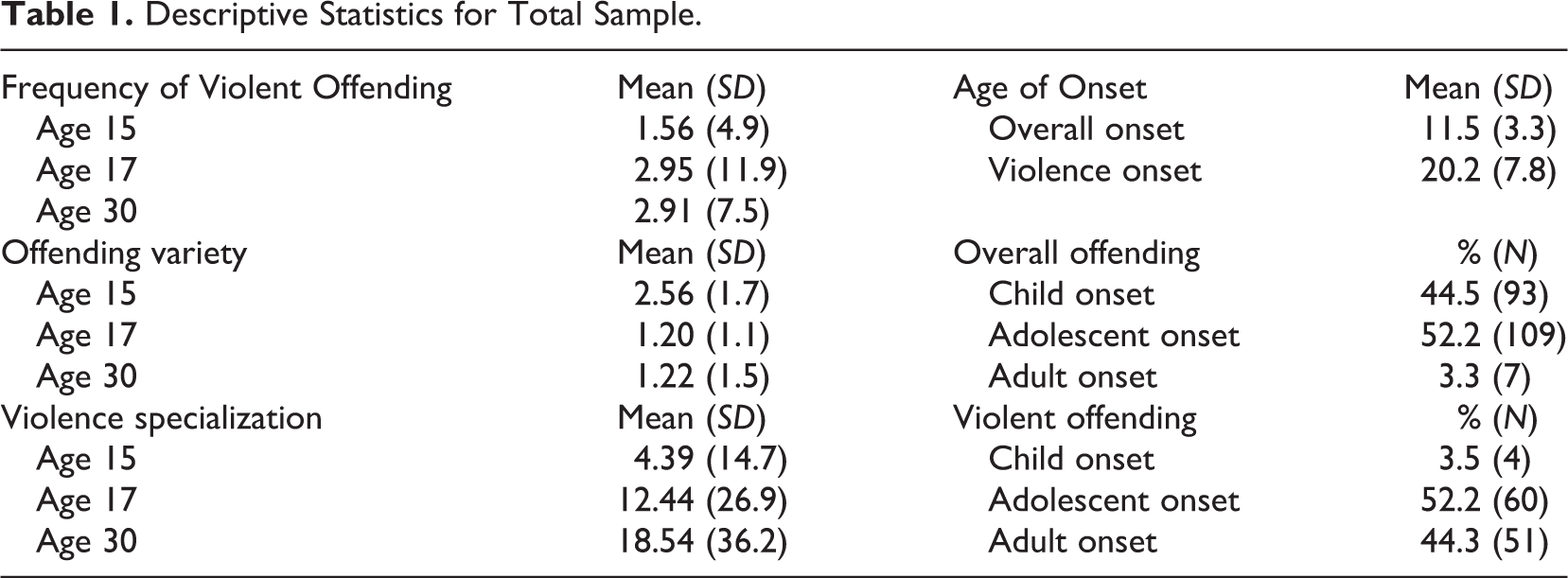
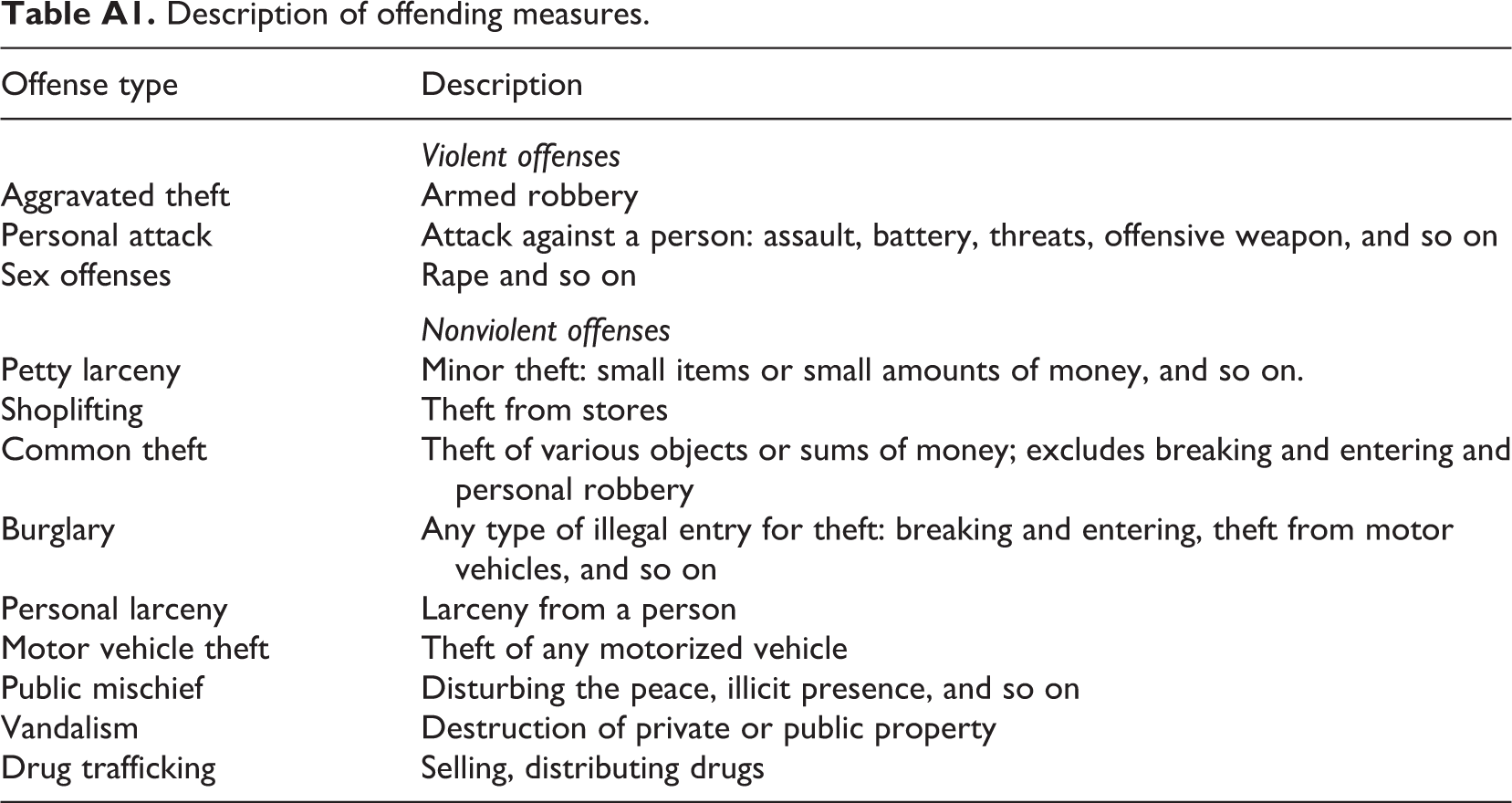
During each interview participants were questioned regarding 12 different types of offenses they had committed in the previous year (see Appendix A). Violent offending frequencies for each individual were calculated by summing the number of times each of the following three violent offenses were committed: aggravated theft, personal attack, and sex offenses. Participants in the current study were asked about homicide, but none of the youth reported it during the assessments. This violence measure is in line with other longitudinal studies (e.g., Elliott, 1994; Sampson & Laub, 2003). It was possible to analyze the total number of violent offenses at each interview because the data was reasonably distributed. An indicator of violence prevalence at each interview was also computed. The means for violent offending at ages 15, 17, and 30 for the total sample, as well as other descriptive statistics, are presented in Table 1. Repeated measures analysis of variance indicated no significant effect for the means of violence frequency over time, F(1.61, 337.38) = 1.88, p > .05, η 2 = .01. Indicators of age of onset of general offending (mean = 11.5, SD = 3.3) as well as age of onset of violent offending (mean = 20.2, SD = 7.8) were also included. 1 Age of onset of general offending refers to the self-reported earliest onset for any of the 12 crime types examined in the study. Age of onset for violent offending refers to the earliest onset of the three violent offenses. Participants were asked about their onset of each offense type at every interview, and the earliest occurrence of the behavior was used. A categorical approach was also pursued by analyzing age of onset for both overall and violent offending as follows: (a) childhood (4–11 years old); (b) adolescence (12–17 years old); and (c) adulthood (18 and over). Measures of specialization and versatility (Le Blanc & Fréchette, 1989) were computed in order to be able to examine individual level patterns of offending within the violence trajectories over the three time points. A Variety Index was computed at ages 15, 17, and 30 by adding the number of offense types each individual reported committing out of the 12 possible categories listed previously. Repeated measures analysis of variance indicated a significant and moderate effect with the means of offending variety decreasing into adulthood, F(1.91, 398.89) = 73.17, p ≤ .001, η 2 = .26. Furthermore, in order to assess crime specialization in violence, a Specialization Index was calculated at each time point (ages 15, 17, and 30). This Violence Specialization Index was computed by dividing the total number of violent offenses by the total number of offenses committed by each individual. Note that the analysis did not reveal significant differences between the Violence Specialization Index measures taken at three time points, F(1.08, 253.50) = .90, p > .05, η 2 = .00.
Descriptive Statistics for Total Sample.
Analytic Strategy
The relationship between age of onset and violence was first examined using logistic and negative binomial regression. Logistic regressions were completed at ages 15, 17, and 30 for violence prevalence (presence or absence of a violence offense) with a continuous measure of age of onset (overall offending onset and violent offending onset). Similarly, negative binomial regressions were completed at each time point for violent offending frequency with overall and violent onset. Negative binomial regression was used because it is useful in cases where data is overdispersed (Hilbe, 2011). 2 In order to be able to consider individual-level changes over time in violent offending, semiparametric group-based modeling was also employed. First introduced by Nagin and Land (1993), this method essentially allows for the identification of individuals with similar patterns of repeated measurements over time. This approach was developed to complement hierarchical and latent growth curve modeling (Jones, Nagin, & Roeder, 2001). The semiparametric group-based latent trajectory analyses are distinct from taxonometric methods (e.g., MAXCOV procedure). The group-based method is ideal to uncover a continuum of offending trajectories, but is not designed to identify natural taxons. Group-based modeling is based on a semiparametric group-based strategy and is an application of finite mixture modeling and an extension of maximum likelihood estimation (Nagin, 2005; Nagin & Tremblay, 2005). The analyses were conducted in SAS 9.2® using the PROC TRAJ macro (Jones et al., 2001). A Poisson model was selected as it is best suited the distribution of the data. The Bayesian Information Criterion (BIC) and the Bayes factor approximation was used for model selection in order to infer the number of trajectories. The BIC is the most widely used option for model selection and it is considered to reward parsimony as it imposes a penalty for adding more groups to the model (Nagin, 2005). In the current study, the group-based method was used to analyze the MTSLS data with violent frequency at ages 15, 17, and 30. The trajectories resulting from these three time points represent a snapshot of violent offending trajectories. Since yearly data were not available, measures of onset (general and violent) were required to be able to assess the relationship between the course of violent offending and onset.
Results
Age of Onset and Overall Prevalence and Frequency of Violence
The relationship between age of onset and violence frequency and prevalence at ages 15, 17, and 30 was examined by conducting a series of logistic and negative binomial regression analyses. The results of logistic regression analyses using overall offending age of onset as a continuous independent variable were not statistically significant at age 15, or at 30. 3 On the other hand, when examining onset of violence, results were significant at age 15, Exp(B) = .21; CI 95% [.10–.41]; p < .001, at 17, Exp(B) = .75; CI 95% [.68, .83]; p < .001, and at 30, Exp(B) = .86; CI 95% [.82, .90]; p < .001. 4 Negative binomial regressions were also conducted to inspect the association between overall age of onset and the frequency of violent offending at ages 15, 17, and 30. A statistically significant association was found at age 15 (β = −.143; SE = .03; p < .001) and at age 17 (β = −.058; SE = .03; p < .05), but not at age 30. 5 Negative binomial regressions were also completed including age of violence onset, and results were significant while somewhat decreasing over the three time points as follows: age 15 (β = −.596; SE = .08; p < .001), age 17 (β = −.413; SE = .05; p < .001), age 30 (β = −.206; SE = .01; p < .001). In sum, general onset was more strongly linked to frequency of violence, particularly in adolescence, while onset of violence proved to be a more important predictor of participation and frequency of violent offending.
Group-Based Modeling of Violence Trajectories
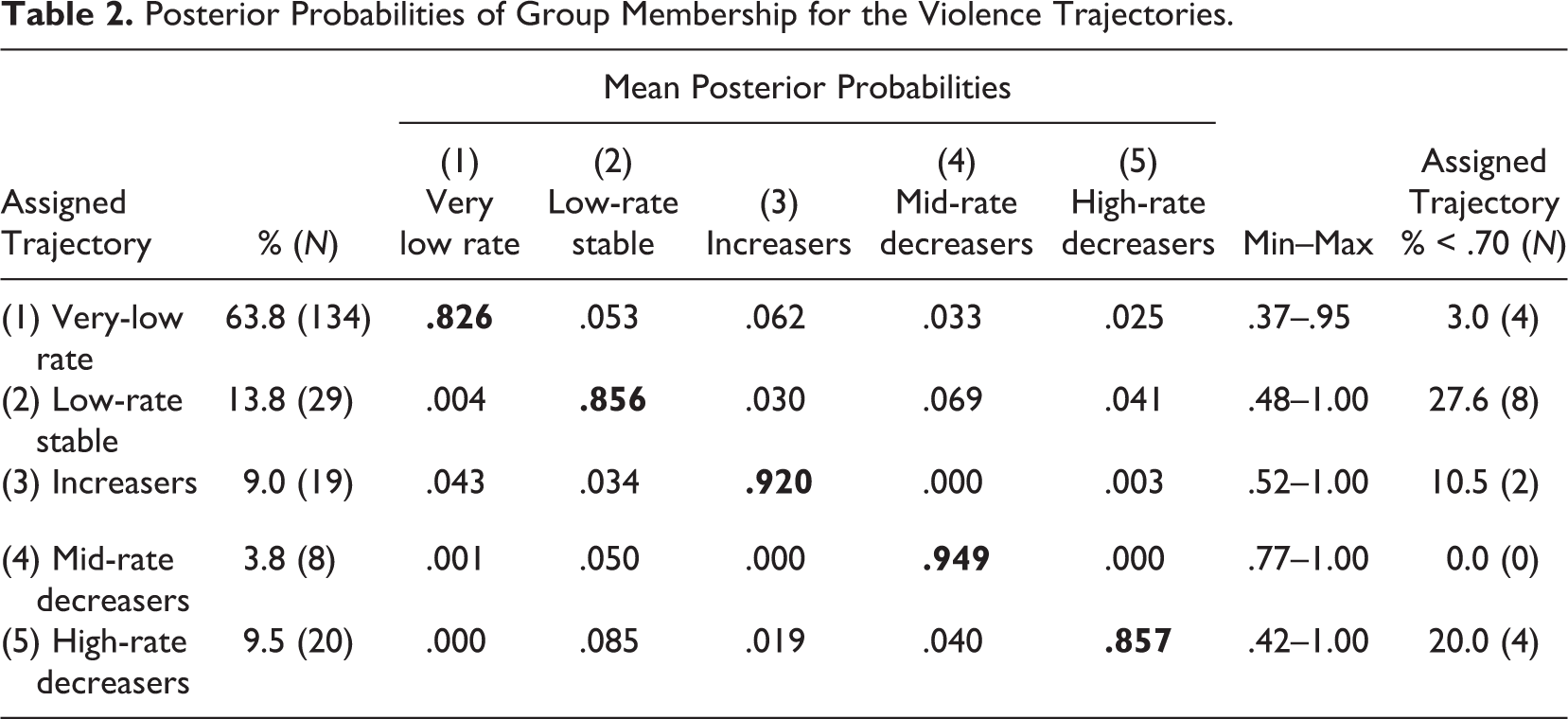
The group-based modeling analyses showed a steady rise in the BIC from a two group (BIC = −1122.59) to a six group solution (BIC = −858.21); however, the five group solution (BIC = −860.35) was selected since the difference between the five and six group model is not substantive. 6 The resulting five violence trajectories are shown in Figure 1. The shapes of the violence trajectories identified can be described as follows: (1) very low-rate (64%), (2) low-rate stable (14%), (3) increasers (9%), (4) mid-rate decreasers (4%), (5) high-rate decreasers (10%). Violent offending ranged from none to just over 16 depending on the trajectory. Over three quarters of the sample (very low-rate and low-rate stable) committed violent offenses at stable and lower levels from mid-adolescence to adulthood. The increasers committed very few violent offenses during either adolescent time point, but by age 30 committed the most violence offenses. The high-rate decreasers committed the most violent offenses in adolescence, and continued to offend violently in adulthood, but at a lower level. The mid-rate decreasers only began violent offending at age 17, and by age 30 they decreased significantly, reaching similar levels as the low-rate stable trajectory. The posterior probabilities were examined as a model fit diagnostic in order to verify the classification of individuals into the different trajectories. The diagonal in Table 2 shows that the average probability of being assigned into the correct group was high, ranging from .826 to .949, and that the probabilities of being incorrectly assigned into another trajectory were very low. 7
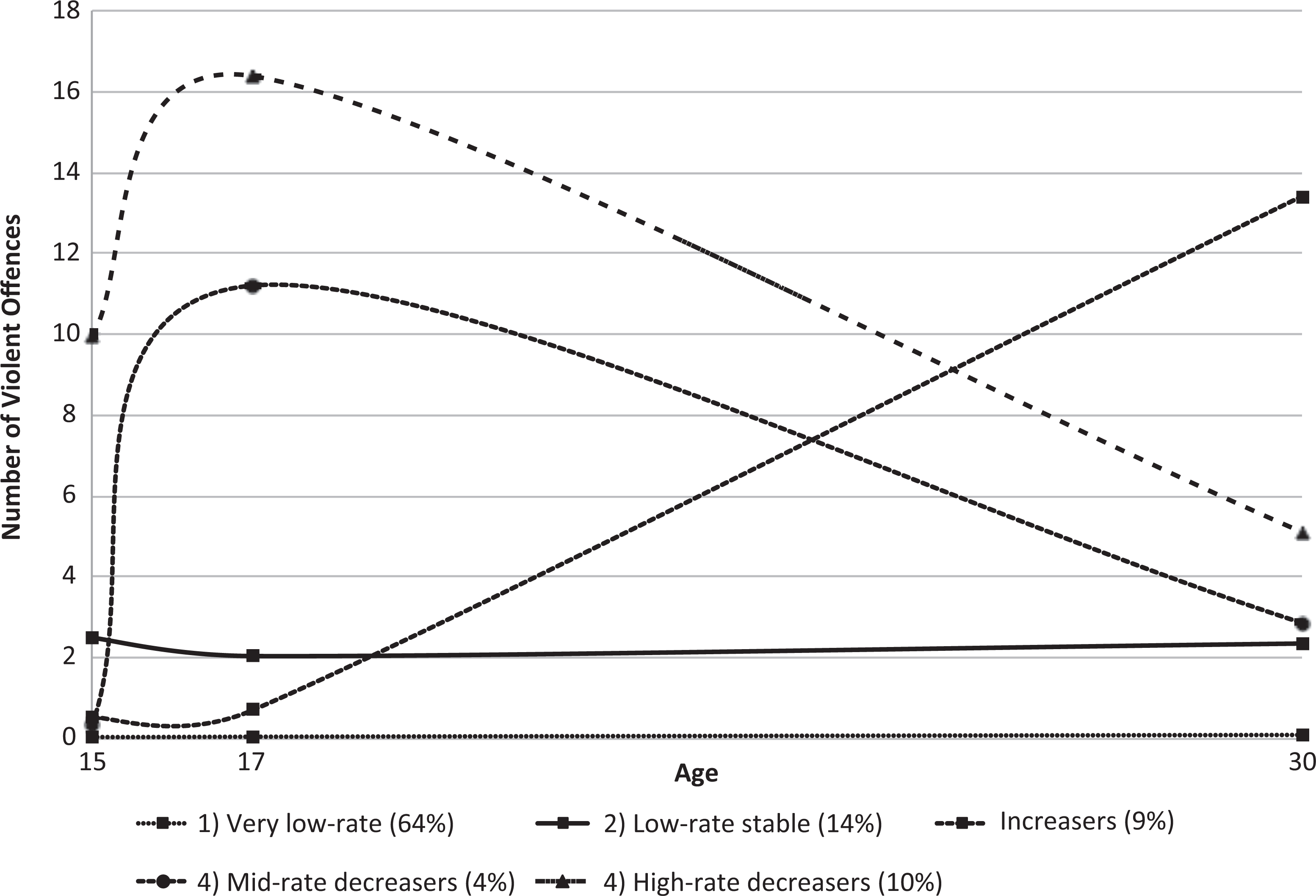
Violence trajectories.
Posterior Probabilities of Group Membership for the Violence Trajectories.
Age of Onset and Violence Trajectories
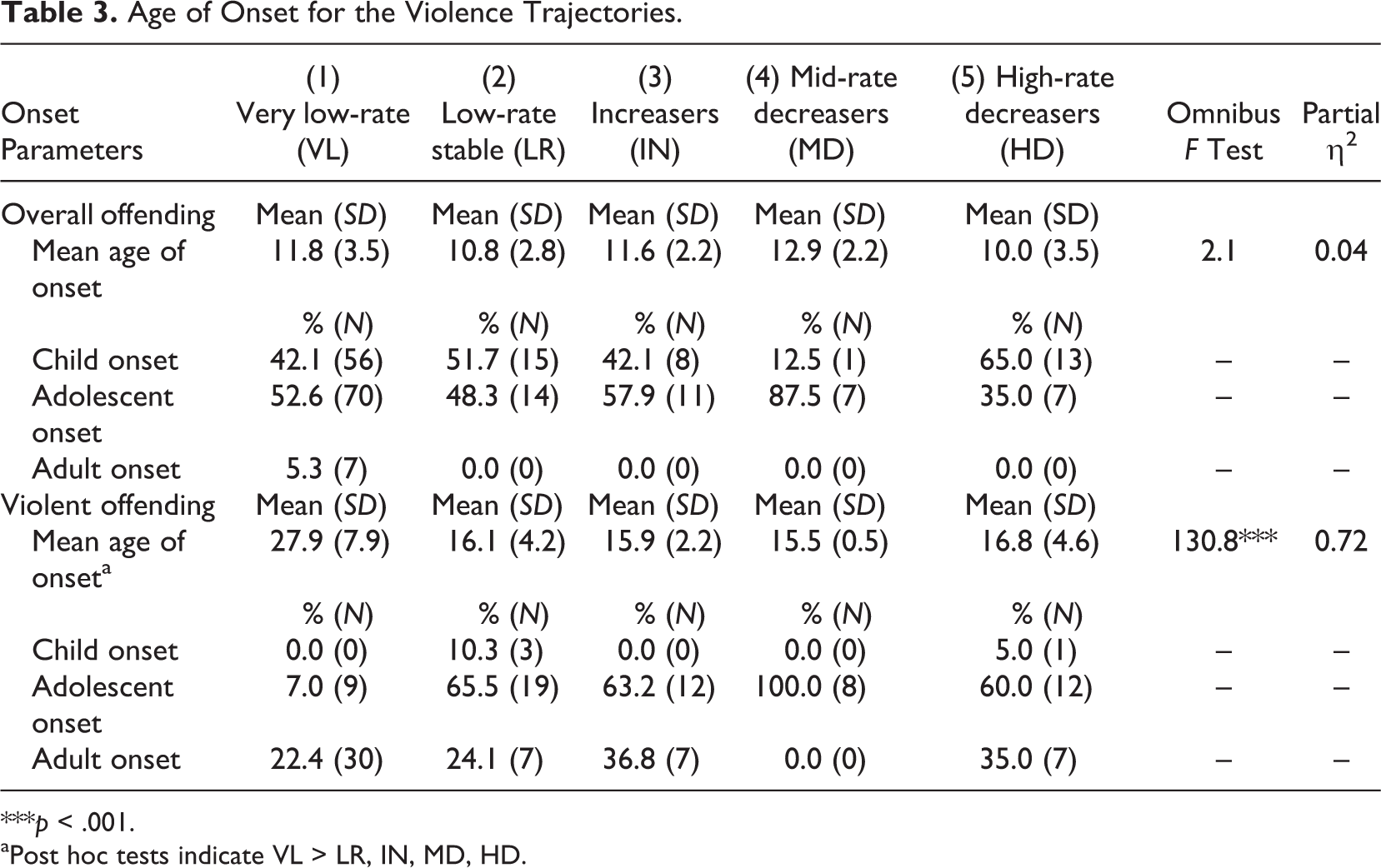
Table 3 presents the mean ages of onset of overall and violent offending for the different violence trajectories identified. Analyses of variance were conducted for age of onset across the violence trajectories. Results for overall onset were not statistically significant, while violence onset was significant, although the only differences were between the very low-rate trajectory and the other trajectories. The proportions of child onset, adolescent onset, and adult onset of offending for the violence trajectories are also shown in Table 3. More than half of those in the very low-rate violence trajectory began offending in adolescence; this was also the only group with any adult-onset offenders (5%). The low-rate stable trajectory was almost evenly split between childhood and adolescence, while the violence increaser trajectory began offending slightly more in adolescence (58%) than in childhood (42%). The mid-rate decreasers primarily began offending in adolescence (88%), while the high-rate decreasers tended to initiate offending in childhood (65%). The highest proportion of child-onset offenders were thus found in the high-rate decreasers (65%), followed by the low-rate stable trajectory (52%). On the other hand, violent offending began primarily in adolescence across the trajectories, the exception being the very low-rate trajectory that mostly began in adulthood, if at all.
Age of Onset for the Violence Trajectories.
***p < .001.
aPost hoc tests indicate VL > LR, IN, MD, HD.
Dynamic Aspect of Offending
The five trajectories were compared as to their crime specialization and versatility at ages 15, 17, and 30 using analysis of variance (Table 4). The findings showed much discrepancy across trajectories regarding their level of crime specialization in violence. The post hoc tests indicated that the significant differences were mainly between the very low-rate trajectory and the low-rate trajectory, and to a lesser degree between the very low-rate trajectory and both the mid-rate decreasers and increasers. Means for both the mid-rate and high-rate decreasers showed an increase in violence specialization into adulthood, while their frequency of violent offending decreased as per their trajectories (Figure 1). Analyses for the Variety Index were also significant at all three time points, but the effect size was somewhat lower in adulthood (η 2 = .08), compared to adolescence (η 2 = .14; η 2 = .13). 8 In general, the means of the Variety Index decreased into adulthood across the trajectories, while the post hoc tests showed that the significant differences were also primarily between the very low-rate trajectory and the low-rate trajectory.
Means of Variety and Specialization Indices for the Violence Trajectories.
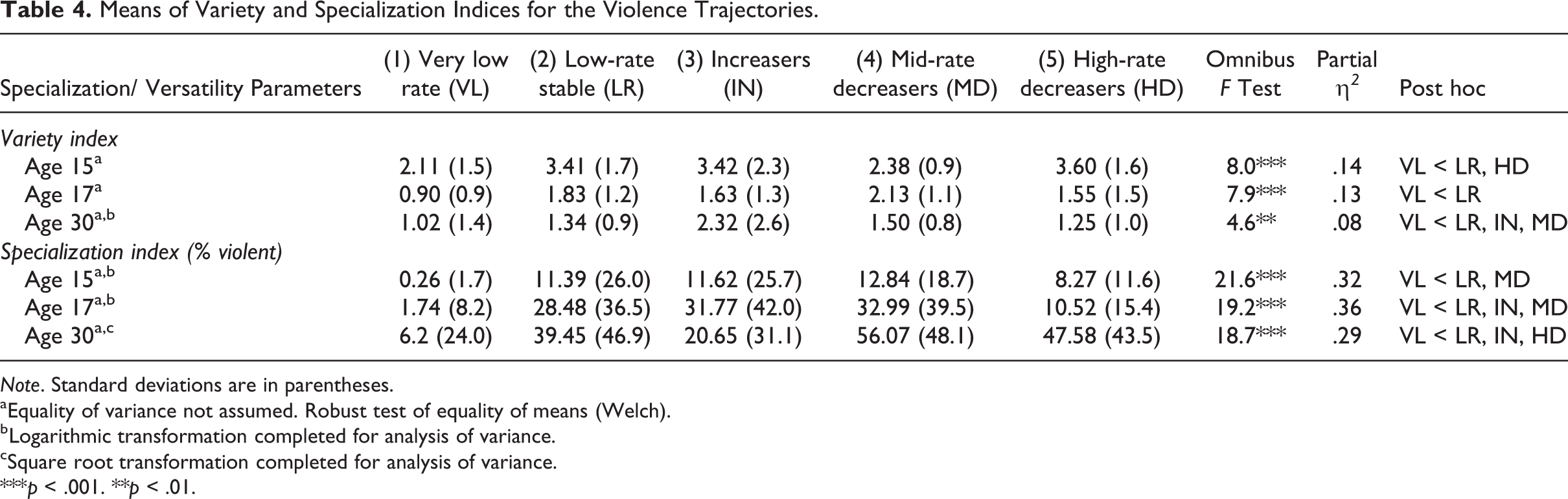
Note. Standard deviations are in parentheses.
aEquality of variance not assumed. Robust test of equality of means (Welch).
bLogarithmic transformation completed for analysis of variance.
cSquare root transformation completed for analysis of variance.
***p < .001. **p < .01.
The same analyses were conducted with age of onset (overall and violence) 9 added as a covariate (Table 5). After including age of overall onset in the analysis, the violence trajectories retained their statistical significance, and the effect sizes remained almost identical, while age of overall onset was only significant at age 15. Moreover, age of overall onset was negatively associated with overall variety at age 15 (t = −8.38, p < .001), and positively associated with violence specialization at age 15 (t = 2.03, p < .05), meaning that in mid-adolescence those who started general offending early were more versatile in their offenses, while those who started later tended to specialize in violence. The pattern was different when onset of violent offending was included as a covariate. Regarding violence specialization, age of violence onset was negatively associated with violence specialization at age 15 (t = −10.53, p < .001) and age 17 (t = −3.00, p < .01), meaning that those who started offending violently earlier were more likely to specialize in violence. However, the effect size was higher at age 15 (η 2 = .38), diminished substantially by age 17 (η 2 = .06), and was no longer significant at age 30. Findings for variety of offending and age of violence onset were not significant at any of the three time points. 10
Variety and Specialization Indices for the Violence Trajectories Adjusting for Age of Onset.
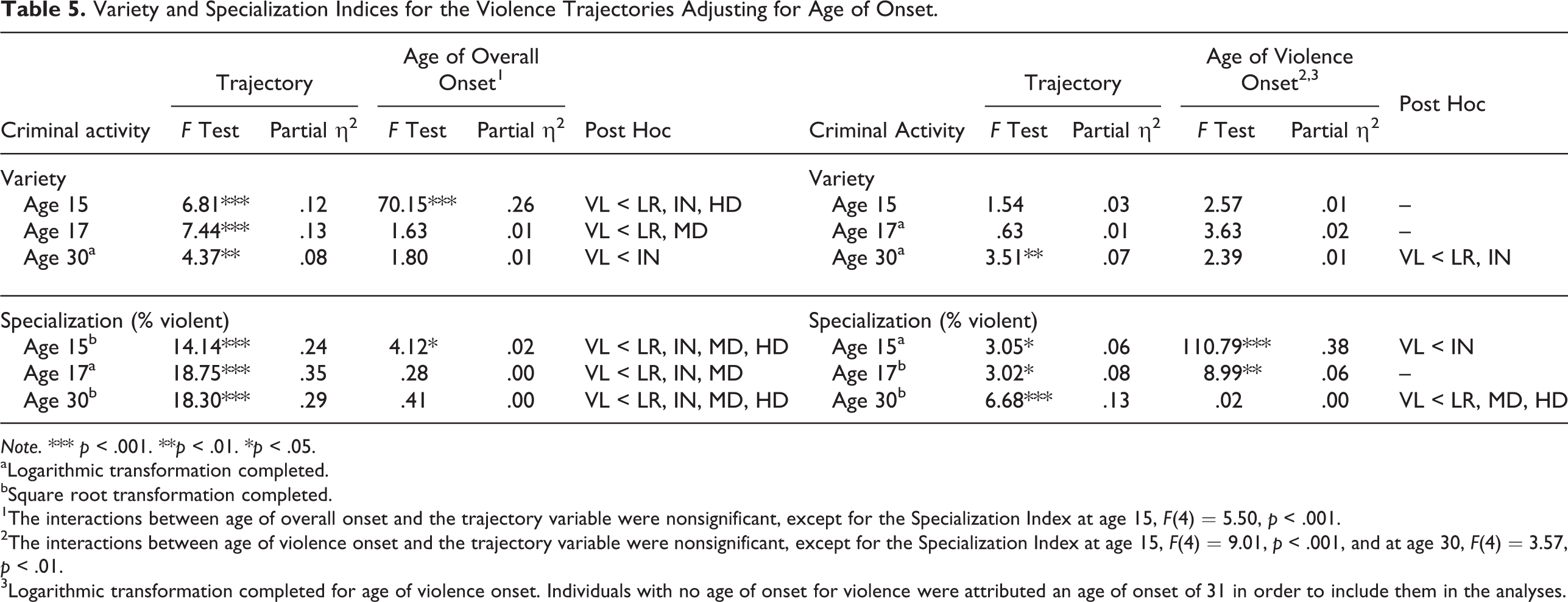
Note. *** p < .001. **p < .01. *p < .05.
aLogarithmic transformation completed.
bSquare root transformation completed.
1The interactions between age of overall onset and the trajectory variable were nonsignificant, except for the Specialization Index at age 15, F(4) = 5.50, p < .001.
2The interactions between age of violence onset and the trajectory variable were nonsignificant, except for the Specialization Index at age 15, F(4) = 9.01, p < .001, and at age 30, F(4) = 3.57, p < .01.
3Logarithmic transformation completed for age of violence onset. Individuals with no age of onset for violence were attributed an age of onset of 31 in order to include them in the analyses.
Discussion
The current study aimed to examine the effect of onset on violent offending trajectories and crime specialization in violence in a male sample of Canadian adjudicated youth. In particular, the roles of both overall onset and violence onset on the course of violence from adolescence to adulthood were investigated. This is essential because of the importance of onset, or, more specifically of an early age of onset, within theoretical and assessment frameworks. Findings indicated that the age of onset differentially affected youth’s participation, frequency, course, as well as specialization in violence. In other words, the study findings suggested that the age of onset is a modest indicator of the violent criminal careers in youth and adulthood. Violent youth and violent adults are not well identified by age of onset, especially if the age of onset is not specific to the predicted outcome. Such a conclusion is warranted, considering the four main findings of the study. First, and in line with prior studies, a moderate relationship was found between onset and violence participation and frequency. Second, using group-based trajectory analyses, much heterogeneity was found in the rate and shape of the five violence trajectories identified that no single indicator was able to grasp (e.g., age of onset). Third, different patterns of violence specialization were found within the violence trajectories suggesting that crime specialization in violence is complex and not confined to a single offending trajectory. Fourth, general age of onset of delinquency was not related to violent offending trajectories, suggesting that the course of violence is not well accounted for by the dual taxonomy of young offenders based on their age of onset. Taken together, these findings call for more scrutiny as to the predicting and screening value of the age of onset on the course of violent offending and the ability to make long-term predictions about juvenile offenders. Key findings of the study and their implications for the launch effect as well as for Moffitt’s dual taxonomy with respect to violent offending are discussed.
Onset and Violent Offending
The current study examined the age of onset of both overall and violent offending in a sample of adjudicated youth. Several issues had to be taken into consideration in examining the age of onset. First, whether age of onset should be conceptualized as a qualitative or a quantitative variable. More specifically, is age of onset best conceptualized as a categorical variable defined as the developmental stages marking the onset of delinquency (e.g., Moffitt, 1993) or conceptualized as a continuum of onsets (e.g., Thornberry, 2005). A conservative approach was taken in the current study by analyzing the age of onset both as a qualitative and a quantitative indicator. Similar results were observed independently of the method used. Second, defining an early-starter and a late-starter group presents some challenge. Several approaches have emerged in the scientific literature, some suggesting age 11, some proposing age 12, and others that age 13 should be considered (e.g., Tibbetts, 2009). This discussion, however, has not always considered whether onset is based on the actual (self-report) or official (arrest) act of delinquency. Research has shown that there is generally a two year gap between actual and official mean group age of onset (e.g., Hawkins, Smith, & Hill, 2003; Loeber & Le Blanc, 1990). Considering that the current study was based on self-report data, a conservative cutoff age was used (11 years old), and in spite of this lower threshold point, forty-five percent of the sample was categorized as early-starters. Comparatively speaking, less than four percent of the sample was defined as early-starter when using violence as the criterion to operationalize age of onset, which is not surprising since violence usually appears in later stages of offending development (third or fourth stage; Le Blanc & Fréchette, 1989). This brings us to our next point. While much attention has been given to the conceptualization of the “early-starter,” and has been focused on finding an age-point marking the early start, less has been given to the behaviors that should be considered in defining an early start. Two strategies were followed in the current study by analyzing both the general age of onset and the age of onset of violence. The findings of this study show that conclusions do differ if one is looking at the onset of general versus onset of violent offending. In fact, we found that onset of violence was associated with both participation and frequency of violent offending in adolescence and adulthood, while the overall onset was only associated with frequency of violence, more particularly in adolescence, and the association was modest. It was hypothesized that these modest associations could be explained, at least in part, by the heterogeneity of violent offending patterns in adulthood. In order to test for this, group-based modeling, which is an ideal method to uncover a continuum of longitudinal offending patterns was used to examine violent offending trajectories.
Trajectories of Violence
Taxonomic studies suggest that the early-starter group is the one most likely to escalate to violent offending (e.g., Moffitt, 1993). Using group-based latent trajectory analyses, the current study found much heterogeneity in the patterns of violence from adolescence to adulthood irrespective of whether or not there was an onset of delinquency in childhood, adolescence, or later. Previous studies have found between two and five different violent offending trajectories, and we identified five heterogeneous violence trajectories. The high number of trajectories identified is more in line with studies based on delinquent or at-risk samples 11 (Loeber et al., 2008; Sampson & Laub, 2003) rather than population-based ones (Barker et al., 2007; Brame et al., 2001), which could suggest different patterns of violent offending may not be revealed in normative samples. The discrepancies found between delinquent or at-risk samples and population-based samples may have to do with the combined lack of variance in violent offending and the low number of violent individuals in the latter group of studies. The low number of violent individuals in population-based studies may limit researchers from finding the patterns found in this study. In fact, even when using a sample of adjudicated youth and self-report data, the prevalence and frequency of violent offending were both relatively low. Indeed, in the current study, the trajectory that consisted of the highest proportion of youth was characterized by the lowest levels of violence frequency. The fact that most adjudicated youth do not follow a violent path is in line with other investigations. For example, in the Pittsburgh Youth Study, using an at-risk sample of schoolboys, 59% of the sample followed a no/low trajectory of violence from age 13 to 25 (Lacourse, Dupéré, & Loeber, 2008). This is a consistent finding across the violence trajectory studies reviewed and highlights that most delinquents do not escalate to the most serious forms of delinquency (e.g., Brame at al., 2005; Herrenkohl et al., 2006; Piquero et al., 2002). It also suggests that most nonviolent young offenders do not become violent offenders in adulthood. The two most active trajectories (mid- and high-rate decreasers) peaked in adolescence followed by a decrease in adulthood, which resembles the age-crime curve. This pattern has also been reported by other studies that have examined trajectories of violence (Barker et al., 2007; Loeber et al., 2008; Sampson & Laub, 2003). On the other hand, an increasing group was identified which was characterized by very low levels of violence in adolescence followed by a substantial increase in adulthood. A similar late-onset group following this pattern of violent offending has been reported previously in one study (Sampson & Laub, 2003). Frequency of violent offending alone does not capture the level of crime specialization, more specifically, whether the most active violent offending patterns were reflecting patterns of versatile offending or specialization in violence.
Crime Specialization Patterns in Violence
The early-starters have been hypothesized to be both more likely to be criminally versatile and at-risk of specializing in person-oriented offenses and violence (e.g., Moffitt, 1993; Piquero & Moffitt, 2008). The two hypotheses may appear contradictory given that some may view versatility and specialization as two opposite end of a continuum. However, from a developmental life-course perspective, versatility and specialization are seen as two distinct stages of the course of offending. Versatility is considered part of the activation of the criminal career where offending becomes more diversified, while specialization reflects a slowing down of the criminal career, and marks the desistance phase of offending (Le Blanc & Fréchette, 1989). One could expect, therefore, that early-starters would be more versatile in youth and show evidence of crime specialization in violence later on in adulthood. Analyzing these two hypotheses simultaneously, therefore, requires the longitudinal perspective taken in the current study. Although numerous studies have shown that most offenders exhibit versatility in offending rather than any form of specialization (Blumstein ,Cohen, Roth, & Visher, 1986; Farrington, Snyder, & Finnegan, 1988; Piquero et al., 2003; Rojek & Erickson, 1982) or violence specialization in particular (Capaldi & Patterson, 1996; Farrington 1989; Miller, Dinitz, & Conrad, 1982), this has rarely been examined within offending trajectories (e.g., Moffitt, Caspi, Harrington, & Milne, 2002) or using repetitive measures of versatility or specialization over life-course. The findings of the current study further highlighted the limitations of the early-starter hypothesis, especially when early onset was broadly defined. Indeed, the overall age of onset was strongly related to offending versatility and weakly related to crime specialization at age 15, but not related to the other measures of versatility and specialization. In other words, the early-starters were more versatile at age 15, but not subsequently, nor were they more likely to specialize in person-oriented offenses in adulthood. Therefore, the overall age of onset did not carry a long-term effect on both versatility and specialization. This is reminiscent of the Piquero et al. (1999) study showing that specialization occurs in adulthood irrespective of the age of onset. In fact, our findings are in line with this observation, as the level of crime specialization in violence increased over time even reaching the 50% mark in adulthood for the most active offending patterns (mid- and high-rate). However, we did find more evidence of an early-starter effect on crime specialization in violence when age of onset was defined at the age of first violence offense. The “early-starter-specialization” effect was limited to the period of adolescence, also in line with Piquero et al.’s (1999) findings, which further suggests that early onset has an impact on both versatility and specialization, but that this effect is more contemporaneous than long-term.
A Contemporaneous Effect of Onset
The current study examined whether age of onset carries a launch or a long-term effect on violent offending. One conceptualization of the launch effect is Moffitt’s taxonomy, which makes specific predictions regarding onset and violent offending. Findings from the current study showed some departure from what would be expected from the theory. First, the number and the heterogeneous shapes of the trajectories were not congruent with predictions of the taxonomy. Second, patterns of offending versatility and violence specialization were not in line with the theory. Third, the relationship between early onset and violence was not consistently found. By examining the two high-rate patterns identified in an attempt to reconcile the LCP model with our findings, it can be said that these two are to some extent similar to the LCP model due to their involvement in violence during adolescence and persistence in adulthood. However, the two trajectories differed in terms of frequency of violent offending in middle adolescence: one was more explosive (mid-rate decreasers) than the other, as characterized by a sharp increase from mid to late adolescence, and by age 30 a desistance process seemed to operate for both. Moreover, LCP theory suggests that early onset should predict LCP and thus more violent offending. However, child-onset offenders were not disproportionately found in the higher violence trajectories, and both of the lower violence trajectories showed a relatively high proportion of child-onset offenders. Attempting to reconcile the very low-rate trajectory, which consisted of an important portion of this sample, with the AL trajectory is also problematic. First, because there was a relatively high proportion of child onset, but also because when we examined their specific crime types (common theft, motor vehicle theft, burglary, etc.), they did not resemble what would be expected of AL adolescent privilege offenses (public mischief, vandalism, etc.). Additionally, examining patterns of specialization showed that violent specialists were not necessarily LCP individuals because trajectories consisting of later onset individuals also showed some evidence of violence specialization in adulthood. Moreover, those offenders whose overall age of onset was later were more likely to show specialization in adolescence. Both of these findings are incongruent with predictions of the theory that early onset offenders tend to specialize in violence. Thus, early onset was not necessarily predictive of violence specialization over time, which is not consistent with the LCP model that asserts that LCPs should be affected by onset into adulthood. While the dual taxonomy might be informative of the likelihood of committing a violent crime, it is not necessarily the case for the dynamic process of violent offending over time, or for explaining violence in the context of human lives.
Limitations
This study is based on a sample of adjudicated male youth recruited from the juvenile courts in Montreal during the mid-1970s. Thus, it is not representative of the general male population but rather of a delinquent one. Moreover, the findings cannot be generalized to female offenders. An important limitation of this study is the relatively small sample size, which resulted in small cell sizes for the post hoc analyses with the different trajectories. Consequently, this limited the types of analyses that could be completed. Moreover, the group-based modeling technique was not used to its full extent, as the shapes of the resulting trajectories were limited by using three waves of data. Having additional time points, or annual data, would have been optimal, and perhaps would have allowed for a better idea as to the shapes of the trajectories, particularly the trends into later adulthood. However, the study includes measures of offending in both adolescence and adulthood using self-report data, which allowed to test for patterns of continuity and discontinuity of offending from adolescence to adulthood, an important aspect of the launch effect. Furthermore, although there is a large gap between assessments, the trajectories identified provide valuable insight to violent offending from adolescence to adulthood, and are in line with studies that examined violent offending trajectories using annual data (e.g., Lacourse et al., 2008). This suggests that annual data might not be a requirement to estimate violent offending patterns from youth to adulthood. Given the costs and resources associated with the collection of self-reported annual data on offending, these findings are worth closer scrutiny in future research. Data on detention and incarceration was not available, and as a result, the analyses do not account for time spent in detention, which could affect the shape of the trajectories.
Conclusion
Onset has begun to play a larger role in the context of clinical and risk assessment schemes, highlighting the importance of investigating the role it has on the course of violence. This is especially significant since onset is included in several risk assessment instruments (Augimeri, Koegl, Ferrante, & Slater, 2006; Barnoski, 2002; Borum et al., 2000), and is also a static risk factor, which cannot be altered through intervention. Moreover, many instruments as well as empirical studies have not disaggregated measures of onset, which could conceal important findings (Tremblay, 2010). The trajectories identified in this study demonstrated the heterogeneity of male violent offending in terms of frequency, onset, and specialization. This suggests that prior frequency and the onset of past offending do not necessarily predict patterns of future violence. If violence unfolds in such heterogeneous way, assessing violence risk based on past behavior can be problematic. This is especially highlighted by the fact that the only two trajectories showing stable levels of violence are also those with the lowest levels of violence overall. This means that those committing violent offenses at higher levels will not be properly captured by instruments relying on past violent behavior. Consequently, a heavy reliance on both onset and prior participation and frequency of violence in the context of risk assessment may not be the most accurate approach. Thus, the efficacy of risk assessment tools in predicting future violence frequency based these measures is questionable, particularly for the higher level violent offenders for whom these tools are intended. The developmental courses of violence from adolescence to adulthood are complex and heterogeneous. Focusing on early onset has possibly contributed unintentionally to simplify the development of violence over the life-course.
Footnotes
Appendix A
Description of offending measures.
| Offense type | Description |
|---|---|
| Violent offenses | |
| Aggravated theft | Armed robbery |
| Personal attack | Attack against a person: assault, battery, threats, offensive weapon, and so on |
| Sex offenses | Rape and so on |
| Nonviolent offenses | |
| Petty larceny | Minor theft: small items or small amounts of money, and so on. |
| Shoplifting | Theft from stores |
| Common theft | Theft of various objects or sums of money; excludes breaking and entering and personal robbery |
| Burglary | Any type of illegal entry for theft: breaking and entering, theft from motor vehicles, and so on |
| Personal larceny | Larceny from a person |
| Motor vehicle theft | Theft of any motorized vehicle |
| Public mischief | Disturbing the peace, illicit presence, and so on |
| Vandalism | Destruction of private or public property |
| Drug trafficking | Selling, distributing drugs |
Authors’ Note
An earlier version of this study was presented at the annual meeting of the American Society of Criminology, in San Francisco, USA, in 2010.
Declaration of Conflicting Interests
The author(s) declared no potential conflicts of interest with respect to the research, authorship, and/or publication of this article.
Funding
The Montreal Two Samples Longitudinal Study (MTSLS) was supported throughout the years by grants from the Social Sciences and Humanities Research Council of Canada (SSHRC), the Fonds québécois pour la recherche sociale (FQRS), and the Fonds pour la formation des chercheurs et l'action concertée du Québec (FCAC).