



Abstract
At least one third of youth involved with juvenile justice experienced child maltreatment. Child welfare samples thus provide a means to examine how child welfare services moderate the relationship between maltreatment and delinquency, producing information essential for tailoring services to disrupt this link. This article contributes to understandings of which youth are likely to become involved with juvenile justice by examining its relationships with child welfare experiences and mental health and substance abuse service receipt, with particular attention to racial and gender differences. In multivariate analyses of a birth cohort of child welfare-involved youth, mental health services are associated with juvenile justice, and substance abuse services are predictive for White boys and out-of-home placement for girls. For youth experiencing out-of-home placement, mental health services are associated with increased likelihood of juvenile justice and substance abuse services with decreased likelihood, while congregate care predicts juvenile justice for girls and White youth.
There is substantial evidence that young people with a history of childhood abuse and neglect are more likely to engage in delinquent and criminal behavior than those who do not experience such maltreatment (Courtney & Heuring, 2005; Courtney, Piliavin, Grogan-Kaylor, & Nesmith, 2001; Currie & Tekin, 2006; Ireland, Smith, & Thornberry, 2002; Jonson-Reid & Barth, 2000a; Kelley, Thornberry, & Smith, 1997; Ryan, 2006; Ryan & Testa, 2005; Thornberry, Ireland, & Smith, 2001; Widom, 1989). The consequences of this relationship are considerable. Engaging in delinquent behavior increases the risks that young people face, particularly the likelihood that they will become involved in the justice systems. While most maltreated youth do not end up in juvenile justice; maltreated youth comprise a large proportion of juvenile justice–involved youth. In fact, research suggests that between 30% and 70% of young people (40–90% of girls and 25–65% of boys) in the juvenile justice system experienced childhood maltreatment (Holsinger, Belknap, & Sutherland, 1999; Sedlak & McPherson, 2010; Wiebush, Freitag, & Baird, 2001). These findings raise substantial concern, in light of the numerous studies that have documented the negative consequences of justice system involvement and the challenges it poses across the life course, including inhibiting one’s ability to find and maintain a job, achieve educational goals, and develop and maintain family and community attachments (Bernburg & Krohn, 2003; Chung, Little, & Steinberg, 2005; Holzer, Raphael, & Stoll, 2003; Uggen & Wakefield, 2005).
Explanations for the relationships among maltreatment and delinquent or criminal behavior have drawn on social learning (Felson & Lane, 2009; Widom, 2000), social control (Zingraff, Leiter, Johnsen, & Myers, 1994), and/or strain (Agnew, 2002; Maschi, Bradley, & Morgen, 2008) theories, as well as on ecological (Jonson-Reid, 2004) or economic frameworks (Currie & Tekin, 2006). Because not all people who are abused or neglected as children engage in delinquent and criminal behaviors, however, scholars have sought to identify factors that moderate the relationship between childhood maltreatment and delinquent or criminal behavior. Thus, some research has examined whether child welfare system involvement increases the likelihood that maltreated youth will end up in the justice systems (e.g., Berzin, 2008; Doyle, 2008; Jonson-Reid, 2002; Jonson-Reid & Barth, 2000a). While this research is inconclusive, we know definitively that child welfare-involved youth are more likely than youth in the general population to become involved with the juvenile justice system (Jonson-Reid & Barth, 2000b; Kelley et al., 1997; Ryan & Testa, 2005; Stouthamer-Loeber, Loeber, Homish, & Wei, 2001).
Because the vast majority of young people in the child welfare system have experienced childhood maltreatment and are likely to be receiving services through their involvement in the system, studies of child welfare samples provide an excellent opportunity to understand how differences in individual characteristics, child welfare system experiences, and other service receipt are related to justice system involvement (Jonson-Reid, 2004; Ryan, 2006). In particular, the use of child welfare samples offers a means to examine how child welfare services moderate the relationship between maltreatment and delinquency, which can provide information essential for tailoring services to disrupt this link (Jonson-Reid, 2004). Toward this end, this article uses administrative data from a 10-year birth cohort of youth involved with child welfare 1 in Allegheny County, Pennsylvania (Pittsburgh) to identify predictors of juvenile justice involvement among child welfare-involved youth. Specifically, this article contributes to efforts to better understand which youth are likely to become involved with the juvenile justice system by (1) replicating and extending research on the relationships between child welfare system experiences and juvenile justice involvement, (2) enhancing the sparse literature on the relationships between receipt of mental health and substance abuse services and subsequent juvenile justice involvement, and (3) exploring how these factors are differentially related for girls and boys and for African American and White youth.
Literature Review
Although some of the increased risk of juvenile justice involvement among child welfare-involved youth is likely due to the effects of the maltreatment itself, there is a need to better understand the role of various child welfare system experiences in order to ensure that child welfare involvement is not enhancing this risk and to better tailor services to disrupt this system drift. Thus, this study employs an ecological framework to consider the effects of child welfare system experiences on the relationship between maltreatment and delinquency. It also builds on strain theory, in recognizing that mental health and substance abuse problems are frequently the result of maltreatment. In the following literature review, we examine the relationships between juvenile justice involvement and (1) a variety of child welfare system experiences, (2) mental health and substance abuse problems, and (3) other child characteristics (race and gender).
Child Welfare System Experiences
Age at maltreatment/system involvement
Research suggests that age at maltreatment and child welfare system involvement are significant predictors of delinquency and juvenile justice involvement. In general, research has demonstrated that youth who are involved with the child welfare system exclusively at very young ages are much less likely to have juvenile justice involvement than youth who are involved in child welfare when older (Jonson-Reid & Barth, 2000b; Stewart, Livingston, & Dennison, 2008; Widom, 1991). In fact, two analyses of data from the Rochester Youth Study found no relationship between childhood-only maltreatment and subsequent delinquency and juvenile justice involvement but significant associations between adolescent maltreatment and juvenile justice (Ireland et al., 2002; Thornberry et al., 2001). This may be because the family problems leading to childhood-only maltreatment have been resolved by adolescence when juvenile justice involvement is most likely.
Out-of-home placement
While early studies did not find differences in delinquent behavior between youth receiving in-home child welfare services and those in out-of-home placement (Runyan & Gould, 1985; Widom, 1991), more recent work has found that placement in out-of-home care increases the likelihood of juvenile justice involvement (Doyle, 2007; Jonson-Reid, 2002; Ryan & Testa, 2005). This is likely related to the fact that youth removed from home have generally experienced more severe abuse and neglect than those receiving in-home services and supported by research demonstrating that severely maltreated youth are more likely to have justice system involvement than those less severely maltreated (Kelley et al., 1997; Ryan & Testa, 2005). At the same time, researchers have suggested that the association between out-of-home placement and justice system involvement may also be related to the disruption and trauma youth experience in being taken out of their homes, particularly if they are not able to form stable attachments in their new living situations (DeGue & Widom, 2009; Doyle, 2007).
Placement stability
Thus, some research has indicated that perhaps it is not out-of-home placement, per se, that can be problematic for youth but placement instability. For those youth placed in out-of-home care, research has explored the relationship between placement stability and juvenile justice involvement. Multiple placements have been associated with greater likelihood of delinquency and juvenile justice involvement (DeGue & Widom, 2009; Jonson-Reid & Barth, 2000a; Runyan & Gould, 1985; Widom, 1991). However, it is not clear whether placement instability is the cause of delinquent behavior or if youth who act out are more likely to have placement changes because of their disruptive behavior (Ryan & Testa, 2005). Further, placement instability may not affect all youth equally. Ryan and Testa (2005) found that placement instability increases risk of juvenile justice involvement for boys but not for girls. Specifically, they found that boys with one out-of-home placement had about the same risk of juvenile justice involvement as those not placed outside the home but that multiple placements increased their risk. On the other hand, for girls, being placed outside of home doubled the risk of juvenile justice involvement but additional placements did not enhance this risk.
Placement type
Researchers have also begun to examine whether type of out-of-home placement is related to juvenile justice involvement. Ryan, Marshall, Herz, and Hernandez (2008) found that youth placed in group homes were more than twice as likely as youth placed in foster homes to have juvenile arrests. Yet, as they acknowledge, this relationship might be due to effects of the congregate care setting, or it might be due to the fact that youth who are beginning to act out may be more likely than other youth to be placed in such settings. Like placement instability, the effects of type of out-of-home placement may be different for boys and girls. DeGue and Widom (2009) found that boys placed in both foster care and other types of out-of-home placement, as well as those just in other types of out-of-home placement, were more likely than those not removed from the home or those placed only in foster care to be arrested as adults. By contrast, girls in their sample placed only in foster care were less likely to have an adult arrest than those never removed from the home or those with some other type of out-of-home placement (alone or in combination with foster care), with no differences between these latter three groups. While these analyses predict adult rather than juvenile justice system involvement, they highlight the fact that effects of placement type may differ by gender.
Running away
While there are no studies that have specifically examined the relationship between running away and juvenile justice involvement for child welfare-involved youth, past research suggests there might be an association. For example, youth in congregate care settings are more likely than youth in foster homes to run away (Courtney & Wong, 1996). Because running away is itself a status offense and also leads many youth to engage in illegal behaviors in order to survive on their own, we might expect running away from placement to be associated with juvenile justice involvement (Bender, 2010; Kempf-Leonard & Johansson, 2007). In addition, research has demonstrated that girls, African American youth, and youth with mental health and substance abuse problems are more likely to run away from placement, further indication that this is a predictor worth exploring (Courtney & Zinn, 2009).
Mental Health and Substance Abuse System Involvement
As the preceding discussion elucidates, much can be learned about the risk of juvenile justice involvement by examining youths’ child welfare system experiences. However, as Jonson-Reid (2002) notes, “One of the difficulties in assessing an association between child welfare intervention and later outcomes is that few studies can take into account additional preexisting risk factors, such as mental health or behavioral problems, that might also be associated with delinquent behavior” (p. 561). Because of the well-established association between mental health and substance abuse problems and justice system involvement (Bender, 2010; Chung et al., 2005; Davis, Banks, Fisher, & Grudzinskas, 2004; Graves, Frabutt, & Shelton, 2007; Pullmann, 2010; Rosenblatt, Rosenblatt, & Biggs, 2000), we might expect that these factors would also be related among child welfare-involved youth (Bender, 2010). Unfortunately, there is little work in this area. An exception is the work of Jonson-Reid (2002), who found mental health and substance abuse service receipt to be associated with greater risk of juvenile justice commitment in a sample of child welfare youth with maltreatment reports at age 5 or older, particularly for girls and for youth with conduct disorder and substance abuse problems. A limitation of this study, however, was its exclusion of youth with child welfare involvement at very young ages, which restricts the ability to generalize its findings to all child welfare-involved youth. In analyses of a nationally representative sample of child welfare-involved youth, Postlethwait, Barth, and Guo (2010) found that depression was related to increases in delinquent behavior over time for girls, while substance use was related to changes in delinquent behavior for boys. However, they did not examine actual justice system involvement.
Other Child Characteristics
As the preceding review of the literature on the relationships between child welfare experiences and juvenile justice system involvement has highlighted, race and gender are salient characteristics in understanding these relationships. However, few of these studies have taken an intersectional approach and examined race and gender simultaneously. In this section, we discuss the relevance of race and gender and then explain the importance of an intersectional analysis.
Race
African American youth are overrepresented among both the child welfare and juvenile justice system populations (Chung et al., 2005; Courtney et al., 1996). Many believe that this overrepresentation is, at least in part, related to socioeconomic status, in that African American youth are more likely than White youth to live in poverty, and poverty is associated with both child welfare and juvenile justice involvement (McCabe et al., 1999). However, the overrepresentation of African American youth in both of these systems has also been associated with the increased surveillance to which African American families are subjected in the United States (Roberts, 2000, 2002) and with discrimination by police and other justice system officials (Bishop, 2005). Thus, it is not surprising that research indicates that even within samples of child welfare-involved youth, African American youth are more likely than White youth to have juvenile justice involvement (Jonson-Reid, 2002; Jonson-Reid & Barth, 2000b; Ryan, Marshall, Herz, & Hernandez, 2008; Ryan & Testa, 2005; Testa, 2004). A recent study, however, found no racial differences in the delinquent behaviors of a nationally representative sample of child welfare-involved youth (Grogan-Kaylor, Ruffolo, Ortega, & Clarke, 2008), providing evidence that racial differences in the justice system involvement of child welfare-involved youth are not merely a function of differences in behavior.
Gender
While gender is not significantly related to likelihood of child welfare involvement, it is the single largest predictor of juvenile justice involvement, in that boys have much higher rates of involvement than girls (Puzzanchera, Adams, & Sickmund, 2010). Research on girls in the juvenile justice system has focused on the different pathways by which girls (when compared with boys) enter the system (Belknap & Holsinger, 2006; Bright & Jonson-Reid, 2008; Chesney-Lind & Pasko, 2004), which would suggest that there may be different relationships among child welfare, mental health, and substance abuse system experiences and juvenile justice involvement for child welfare-involved boys and girls (Bender, 2010). In a sample of such youth, Jonson-Reid and Barth (2000a) found that boys were more likely than girls to be involved in juvenile justice, a finding supported by other studies in this area (Jonson-Reid & Barth, 2000b; Ryan et al., 2008). They discovered, however, that the likelihood of juvenile justice involvement increased for girls as their level of child welfare system involvement increased (from investigation, to in-home services, to out-of-home placement), whereas the level of child welfare intervention did not make a difference for boys. Thus, they highlight the need for further work in this area to explore potential gender differences in the relationship between child welfare and delinquency.
Intersectionality
Much of the research in this area that includes both race and gender examines them separately. Yet, feminist scholars have highlighted the necessity of looking at race and gender simultaneously, as the effects of gender may, for example, be different for African American and White youth and race may, similarly, have different meaning and effect for girls and boys (Crenshaw, 1990; hooks, 2000). Termed intersectionality, such an approach is necessary given that both race and gender are such important predictors of juvenile justice involvement. Studies of child welfare-involved youth that have used an intersectional approach have found that racial differences in justice system involvement are more pronounced for boys (e.g., Bright & Jonson-Reid, 2008); in fact, in multivariate analyses, Jonson-Reid (2002) found that non-White girls were less likely than White girls to have juvenile justice involvement.
Methodological Challenges
There are a number of methodological challenges involved in examining the relationship between child welfare and justice system involvement that limit understandings of this link. One is that data limitations require scholars to primarily use administrative data to examine this link. Although administrative data provide a number of benefits, they often lack the depth of measures that other types of research designs can provide and typically come from one jurisdiction. Consequently, there is a need both to replicate these studies to ensure that the findings are not the results of jurisdictional anomalies and to add additional data elements to extend their findings.
Another challenge or limitation in this work is sampling. While some studies of the relationships between child welfare system experiences and juvenile justice involvement have excluded children who were very young at the time of child welfare involvement (e.g., Jonson-Reid, 2002), others have excluded those who were adolescents at the time of child welfare involvement (e.g., Widom, 1991). To gain a better understanding of the effects of age at child welfare involvement, some scholars have argued for the use of birth cohorts (e.g., Ryan & Testa, 2005). The use of birth cohorts enables a longitudinal approach that follows individuals who have entered and exited the child welfare system multiple times as well as moved back and forth between the child welfare and juvenile justice systems.
Specifying the timing of events is also a challenge in this type of research. For example, as Ryan and Testa (2005) have noted, a limitation of previous studies is that it is not always apparent whether placement instability is a cause or consequence of delinquency, because they are not able to account for the timing of these occurrences. Likewise, many youth receive mental health or substance abuse services as part of their involvement with juvenile justice, so it is important to include only events that occur prior to justice system involvement. Another limitation of many studies in this area is that, in order to avoid violating assumptions of independence, they include only one child per child welfare-involved family (e.g., Jonson-Reid & Barth, 2000a). Multilevel statistical techniques make it possible to account for the lack of independence by nesting children within their families, so that substantial portions of samples are not excluded from analyses, thus enhancing the ability to generalize findings.
As this brief review indicates, more work is needed that examines the relationships among child welfare system experiences, other service receipt, and justice system involvement within inclusive samples of child welfare-involved youth, accounting for race, gender, and timing of system involvement. Given the strong relationship between child welfare and justice system involvement, this work is important and can help to inform interventions in both the child welfare and justice systems that seek to reduce the movement across these systems. The analyses presented here, described in detail in the next section, examine these relationships. Specifically, these analyses address the following research questions:
How are various child welfare system experiences related to subsequent juvenile justice involvement?
How are mental health and substance abuse service receipt related to subsequent juvenile justice involvement?
Do these relationships vary by race and gender?
Based on our review of the literature, we hypothesize that youth whose child welfare cases are open during adolescence will be more likely to have juvenile justice involvement, which we expect to be the case regardless of race or gender. We also hypothesize that youth who experience out-of-home placement will be more likely than those not removed from their homes to have juvenile justice involvement, an effect which we expect to be stronger for girls than for boys based on prior research. Given this research, we hypothesize that placement instability will have a greater effect on the juvenile justice involvement of boys than girls. We also expect to find positive relationships with juvenile justice for both congregate care placement and running away from placement, although there is not enough previous research to hypothesize gender or racial differences. We hypothesize that youth receiving mental health and substance abuse services, girls in particular, will be more likely to have juvenile justice involvement. The lack of previous research examining racial differences and of intersectional research in particular makes it difficult to hypothesize about racial differences and about interactions of race and gender with regard to specific subgroups (e.g., African American girls, White boys, etc.), although the pronounced racial and gender differences in the juvenile justice involvement of the general population suggest these to be important areas of investigation.
Method
Data
The sample for these analyses includes all individuals born between 1985 and 1994 whose families received in-home services from the child welfare system and/or who were placed in out-of-home care for any length of time in Allegheny County, Pennsylvania. Allegheny County is an urban county in Western Pennsylvania that includes the city of Pittsburgh and some of its suburbs. The data were obtained from the Department of Human Services (DHS), which was created in 1997 to coordinate and consolidate the provision of publicly funded human services in the county. In addition to operating the child welfare system, DHS operates numerous other systems, including the Office of Behavioral Health, which coordinates mental health and substance abuse services. Given the structure of the department, DHS developed a data warehouse to integrate data across its internal systems, including child welfare, mental health, substance abuse, and others. In addition, DHS works with other agencies and institutions in the county to include data from other systems, such as juvenile justice, the county jail, and the Department of Public Welfare. This data system is rare because it integrates data at the individual level across multiple systems and, because it is time variant and nonvolatile, provides an opportunity to understand the movement of youth across these systems over time.
The overall birth cohort includes 42,735 different children from 23,754 families. Of this group, 9,703 children were in an out-of-home placement for some period of time. Given the overrepresentation of children of color in the juvenile justice system, we are particularly interested in racial differences in the relationships between child welfare and juvenile justice involvement. Because 87% of our sample are either White or African American (with the remaining 13% distributed among six other categories or missing information on race), 2 we are limited to comparisons of White and African American youth and thus include only youth in these two groups in these analyses. We also include only those youth aged 18 and above at the time of data extraction, so that their risk period for juvenile justice involvement is over.
As expected in any large administrative data set, there were a number of errors contained in the files and missing data that required us to exclude some individuals. Cases were removed when child’s age was less than 0 at the date of last family involvement and when the gender of the child was missing. Individuals who were adopted were removed because DHS sometimes assigns a new case number to adopted youth (particularly when there is a name change), and it is not possible to accurately track their subsequent justice system involvement.
As detailed subsequently, we present two sets of analyses. The first includes the full sample of all child welfare-involved youth. The second includes only those who have experienced out-of-home placement, so that we can analyze the effects of various placement experiences. For both sets of analyses, we exclude youth who had juvenile justice involvement prior to their child welfare involvement (n = 224 or 1.3%), since we are interested in the subsequent justice system experiences of child welfare-involved youth. In addition, the analyses of youth who experienced out-of-home placement include only those who had a child welfare placement prior to their juvenile justice involvement. Thus, the first set of analyses includes 17,471 youth from 12,630 families and the second 3,712 youth from 2,918 families.
Measures
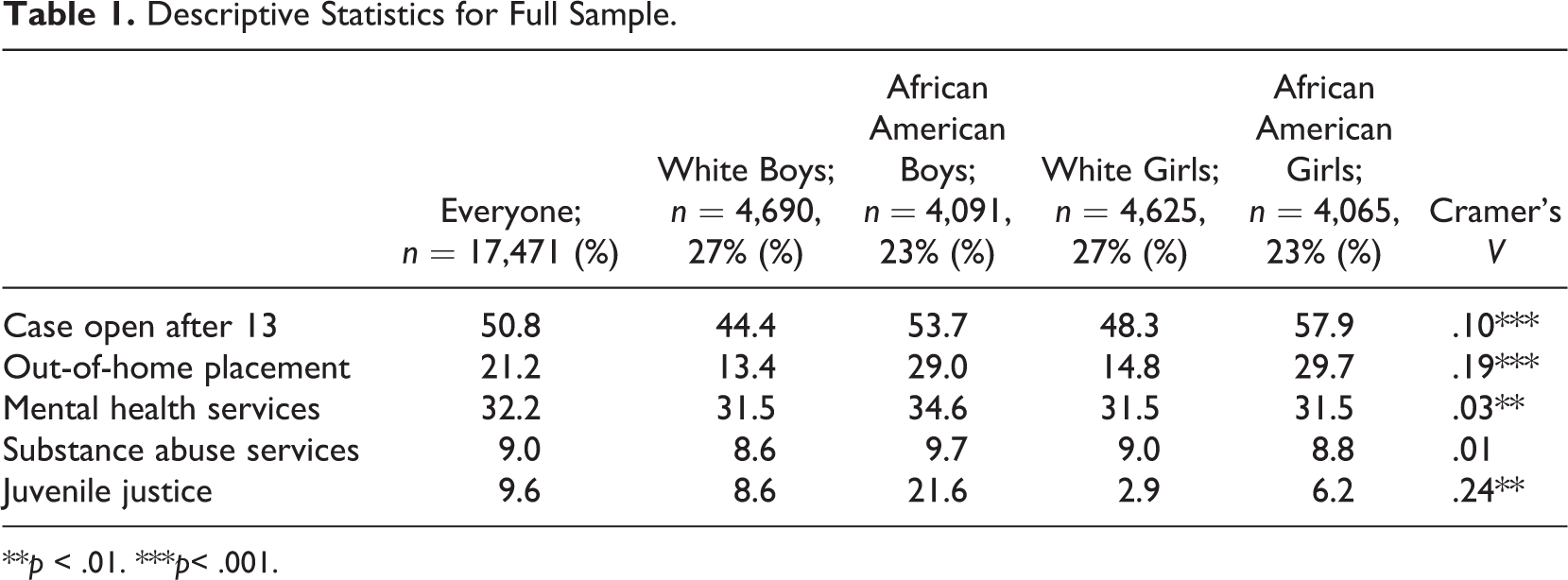
The dependent variable we employ indicates whether a youth has spent time in a juvenile justice facility, including both detention and residential facilities. We refer to this as juvenile justice involvement. Studies examining the relationships between child welfare and juvenile justice involvement have used a variety of measures of involvement including arrests, petitions, and residential placement. The measure we use is not as broad as using petitions or arrests, as it denotes a decision to hold a youth in secure detention and/or to place a youth in a juvenile residential facility. Consequently, it misses youth who come into contact with the juvenile justice system but are not detained or placed. Yet, this measure is broader than those that only include placement in residential or secure facilities. As noted in Table 1, 10% of the full sample had juvenile justice involvement, as we define it. Of these, 42% experienced detention only, 2% experienced residential placement only, and 56% experienced both. In Allegheny County, half of the youth referred to the juvenile court are detained (Allegheny County Juvenile Court, 2009) and it is likely that child welfare-involved youth are more likely to be detained than youth in the general population. Thus, this measure is neither too broad nor overly conservative because it includes a large portion of youth who come in contact with the juvenile justice system and is likely to include youth engaged in more than just minor forms of delinquency or otherwise deemed to be at risk. 3
Descriptive Statistics for Full Sample.
**p < .01. ***p< .001.
A number of demographic, child welfare, and other system involvement variables are included in the model incorporating the full sample. Race is represented by a dichotomous variable differentiating between White and African American youth and gender by a dichotomous variable differentiating girls and boys. Because we are interested in differences by both race and gender, these variables are interacted to produce four subgroups—African American boys, White boys, African American girls, and White girls.As indicated in Table 1, in the full sample, these four groups are of very similar size. However, in the sample that includes only those who experienced out-of-home child welfare placement, there are approximately twice as many African American youth as White youth (see Table 2).
Descriptive Statistics for Placement Sample.

Note. Means with different subscripts are significantly different from each other.
***p < .001.
Mental health is an indicator of whether a youth received mental health services prior to involvement with juvenile justice, or, if not involved in juvenile justice, whether the youth ever received mental health services. In instances where a youth received mental health services only after juvenile justice involvement, the youth is coded as not receiving mental health services. Substance abuse is an indicator of whether a youth received substance abuse services prior to juvenile justice involvement and is coded similarly to mental health. 4 As noted previously, timing is important because about half of the youth who receive substance abuse services and experience juvenile justice involvement receive the substance abuse services after the juvenile justice involvement (49%), while 51% receive substance abuse services prior to their juvenile justice involvement. The vast majority of youth who are involved in both mental health and juvenile justice, however, receive mental health services prior to juvenile justice involvement (86%). Thus, while there is substantial co-occurrence of mental health and substance abuse service receipt and juvenile justice involvement, there are differences in the timing of specific services relative to juvenile justice involvement.
Several other variables are also included in this model. Case open after 13 is a dichotomous variable that indicates whether the child welfare case was open during adolescence (vs. closed when the child was aged 13 and below). This variable represents whether the problems that brought the child into child welfare ended prior to adolescence or were ongoing through adolescence when delinquent behavior is much more likely. Although it is based upon whether the family was involved during these periods of a child’s life, not necessarily whether the problems fully ended, it provides a proxy of family functioning that is likely to be related to juvenile justice. The child welfare agency or juvenile court requires that family conditions be at an acceptable level before they allow a case to be closed. We also utilize a measure of whether a child was in an out-of-home child welfare placement prior to juvenile justice involvement. These children are compared to those whose families received only in-home child welfare services.
All of the variables included in the full sample model (except, of course the variable indicating out-of-home placement) are incorporated in the placement sample model as well, which includes additional variables designed to capture experiences in out-of-home child welfare placement. For our purposes, congregate care is a dichotomous indicator of a child welfare placement in either a group home or residential treatment facility for any length of time prior to any juvenile justice involvement. Length of time in out-of-home placement measures the total amount of time (in years) that a youth spent in out-of-home child welfare placement. Number of placements represents the total number of out-of-home child welfare placements prior to juvenile justice involvement. Runaway is an indicator of whether the youth has ever run away from child welfare placement, prior to any juvenile justice involvement.
Descriptive Statistics
Table 1 reports the descriptive statistics for the full sample, including results of chi-square tests for significant differences among the four groups. As shown in the table, 10% of these youth have spent time in a juvenile justice facility, with the rate for African American males substantially higher (22%) than for any other group. Approximately 32% of the sample has received mental health services and 9% substance abuse services. Twenty-one percent of the youth have had an out-of-home placement, although the rates for White and African American youth differ substantially (13–15% and 29–30%, respectively). For about half of the sample, the family’s case was closed when the child was 13 and younger, while the other half have cases open after age 13. African American youth are more likely than White youth, and girls more likely than boys, to have cases open after age 13.
Table 2 presents the descriptive statistics for the placement sample, as well as results of chi-square and analysis of variance tests for significant differences among the four groups. Approximately 20% of this sample has had juvenile justice involvement. More than one third (34%) of African American boys have juvenile justice involvement compared to 18% of White boys, 13% of African American girls, and 11% of White girls. Over half of these youth have had an experience in congregate care, with higher rates among White youth and among girls. White youth also have higher rates of mental health and substance abuse service receipt. Further, substantially higher percentages of youth in the placement sample have received mental health (68%) and substance abuse services (25%) than in the full sample. Eighteen percent of the placement sample has run away from placement, with girls more likely than boys to run away. Almost 83% of youth are in families that have cases open after age 13, with girls more likely to have an open case during adolescence than boys. The average number of years in placement is over two, with African American youth spending almost one more year in placement, on average, than White youth. The average number of placements is close to five, with African American youth averaging more than one additional placement, compared with White youth.
Analysis plan
In order to examine the factors associated with juvenile justice system involvement, we use generalized estimating equations (GEE). GEE is an extension of the generalized linear model for longitudinal or clustered data (Liang & Zeger, 1986). The advantage of using a GEE model is that it provides unbiased marginal (population average) regression coefficients regardless of the correlation structure of the errors (Ghisletta & Spini, 2004). This occurs because the procedure allows for the specification of a working correlation matrix to account for the form of the within-subject correlation of responses of the dependent variable (Ballinger, 2004). Since children from the same family will on average be more similar than children from different families, the assumption of statistical independence may be violated, necessitating a model that allows for nesting of children within families. We employ one such covariance structure, which is the exchangeable form that specifies a constant relationship between all subjects nested within a cluster. Since, the outcome variable is dichotomous the binomial distribution along with the logit function are employed.
Two different sets of GEE models are presented here—one including all youth in the sample and the second including only youth who were in out-of-home placement for some period of time. As discussed previously, this article focuses on the relationships of specific prior events (e.g., child welfare placement, mental health, and substance abuse service receipt) to juvenile justice involvement and how these relationships differ by race and gender. Consequently, these analyses predict juvenile justice involvement using only events that occurred prior to first juvenile justice system involvement. 5 Because the literature suggests that there may be racial and gender differences in relationships among predictors, we tested the interaction of race and gender, as well as all possible two- and three-way interactions involving Race, Gender, and Other predictors. Interaction effects were first tested individually, and then all those significant individually were tested jointly to establish the final models. We also examined confidence intervals for the effect sizes and R2 changes, comparing interaction models with the main effect models, in order to ensure that statistically significant interaction effects were meaningful and not simply an artifact of our large sample size.
Results
Full Sample
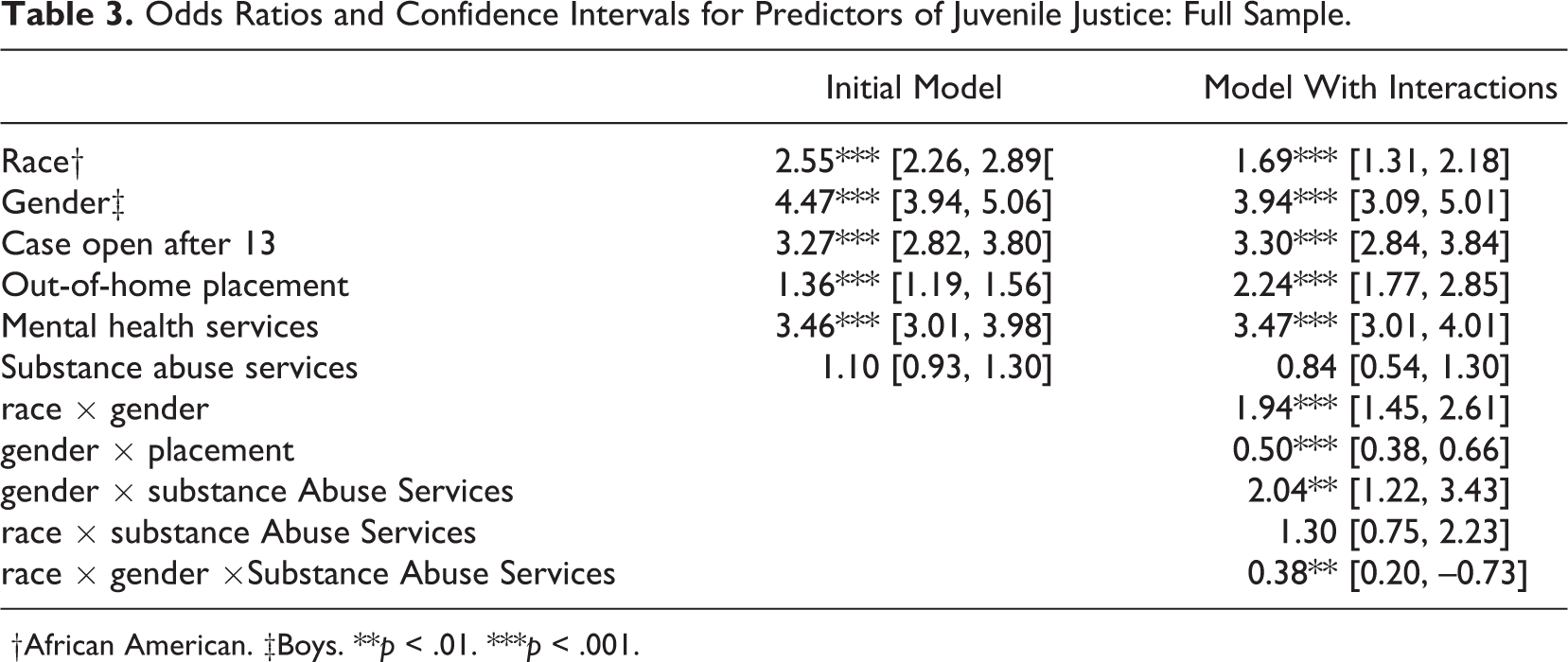
In the first set of analyses, predicting juvenile justice system involvement in the full sample, all of the effects included in the model are significant except for substance abuse service receipt (see Table 3). African American youth are more than twice as likely as White youth to have juvenile justice involvement; while boys are more than four times as likely as girls to have such involvement. Age at child welfare involvement is also significantly related to juvenile justice involvement; youth whose families’ cases are open after age 13 are more than three times as likely to have juvenile justice involvement as those whose cases closed at 13 or younger. Out-of-home placement is associated with a 36% increased likelihood of juvenile justice involvement, and mental health service receipt increases its likelihood more than threefold.
Odds Ratios and Confidence Intervals for Predictors of Juvenile Justice: Full Sample.
†African American. ‡Boys. **p < .01. ***p < .001.
Since the theoretical and empirical literatures suggest that race and gender may interact with each other as well as with other predictors of juvenile justice involvement, we test these interaction effects. The second model in Table 3 includes significant interaction effects, which are found for gender by out-of-home placement and race by gender by substance abuse service receipt. 6 As evident in Figure 1, which presents the predicted probabilities of juvenile justice involvement for the interaction effect of gender and placement after adjusting for other predictors, out-of-home placement has a much stronger effect on the likelihood of juvenile justice involvement for girls (more than doubling their predicted probability of juvenile justice involvement) than for boys (for whom placement increases the predicted probability of juvenile justice involvement by just 23%). Figure 2 presents predicted probabilities of juvenile justice involvement for the three-way interaction effect of race, gender, and substance Abuse. This shows that substance abuse service receipt is associated with an increased likelihood of juvenile justice involvement for White boys but not for any other group (in fact, for African American boys and White girls, it is associated with a slight decrease in the likelihood of juvenile justice involvement).
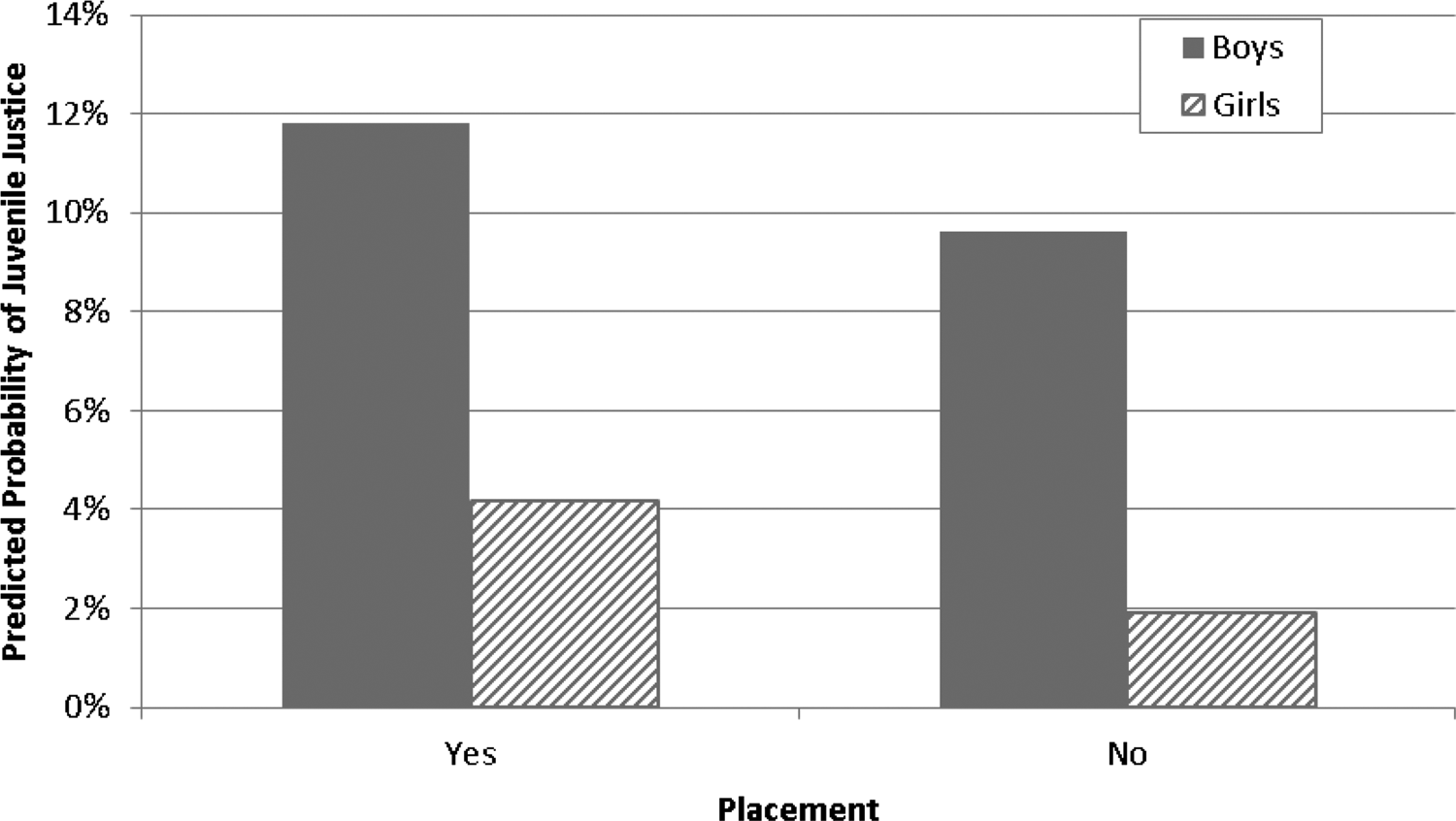
Predicted probabilities of juvenile justice involvement, full sample, and interaction of Gender and Placement.
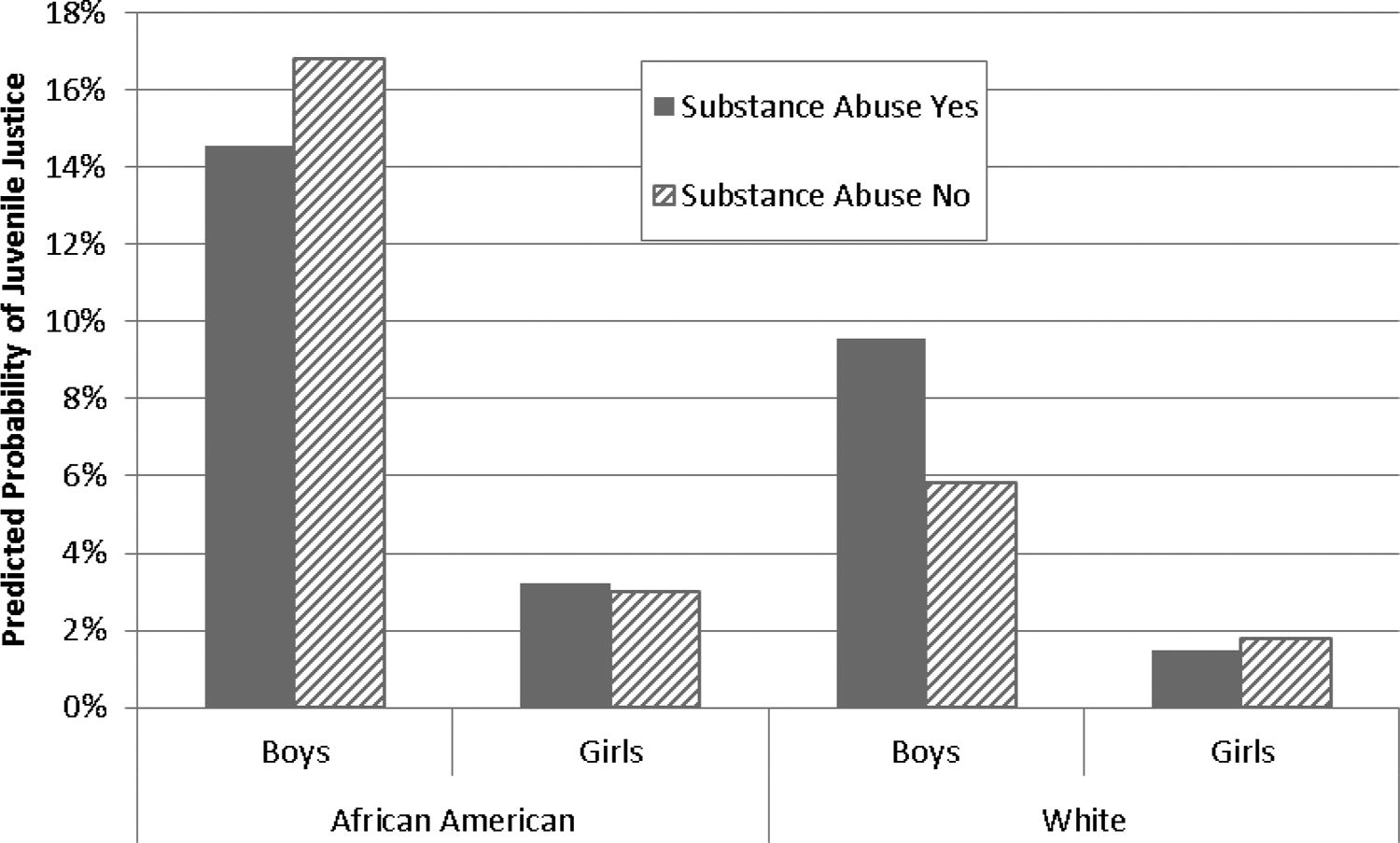
Predicted probabilities of juvenile justice involvement, full sample, and interaction of Race, Gender, and Substance Abuse Services.
Placement Sample
Each effect in the initial model predicting juvenile justice involvement for youth who experienced out-of-home child welfare placement is significant (see Table 4). Race and gender are significant predictors of juvenile justice involvement in the same directions as in the full sample, although the odds ratios are somewhat smaller. Once again, youth with child welfare cases open after age 13 are more likely than those with cases closed at 13 or younger to have juvenile justice involvement. Mental health service receipt is also positively associated with juvenile justice involvement, although its effects are less pronounced than in the full sample model. In contrast to its insignificance in the full sample model, substance abuse service receipt is associated with a decreased likelihood of juvenile justice involvement. Variables representing placement experiences also demonstrate significant associations with juvenile justice involvement. Each additional placement is associated with an 11% increase in likelihood of juvenile justice involvement, while total length of time in placement, when number of placements is held constant, is related to a decreased likelihood of juvenile justice involvement. Thus, the longer a youth spends in placement, the less likely he or she is to have juvenile justice involvement. Ever having been in congregate care indicates a 25% increase in likelihood of juvenile justice involvement, while running away is associated with a decreased risk.
Odds Ratios and Confidence Intervals for Predictors of Juvenile Justice: Placement Sample.

†African American. ‡Boys. *p < .05. **p < .01. ***p < .001.
Once again, we test all possible two- and three-way interaction effects of Race and Gender with each other and all Other predictors in the model. Figure 3 presents the predicted probabilities of juvenile justice involvement for the interaction of Race and Gender. This reveals a much larger racial difference for boys than for girls, evidenced by the fact that African American boys are more than twice as likely as White boys to have juvenile justice involvement, whereas African American girls have only a 50% increased likelihood of juvenile justice involvement when compared with White girls. Figure 4 presents the predicted probabilities of juvenile justice involvement for the interaction effect of race and congregate care placement. This shows that congregate care placement has a much larger effect on the juvenile justice involvement of White youth (for whom it more than doubles its predicted probability) than on that of African American youth (for whom it increases its predicted probability by just 15%). Figure 5 presents the predicted probabilities of juvenile justice involvement for the interaction effect of Gender and Congregate Care Placement. This demonstrates that congregate care placement has a much larger effect on the juvenile justice involvement of girls (more than doubling its predicted probability) than on that of boys (for whom it makes almost no difference, about 5%).

Predicted probabilities of juvenile justice involvement, placement sample, and interaction of Race and Gender.

Predicted probabilities of juvenile justice involvement, placement sample, and interaction of Race and Congregate Care.
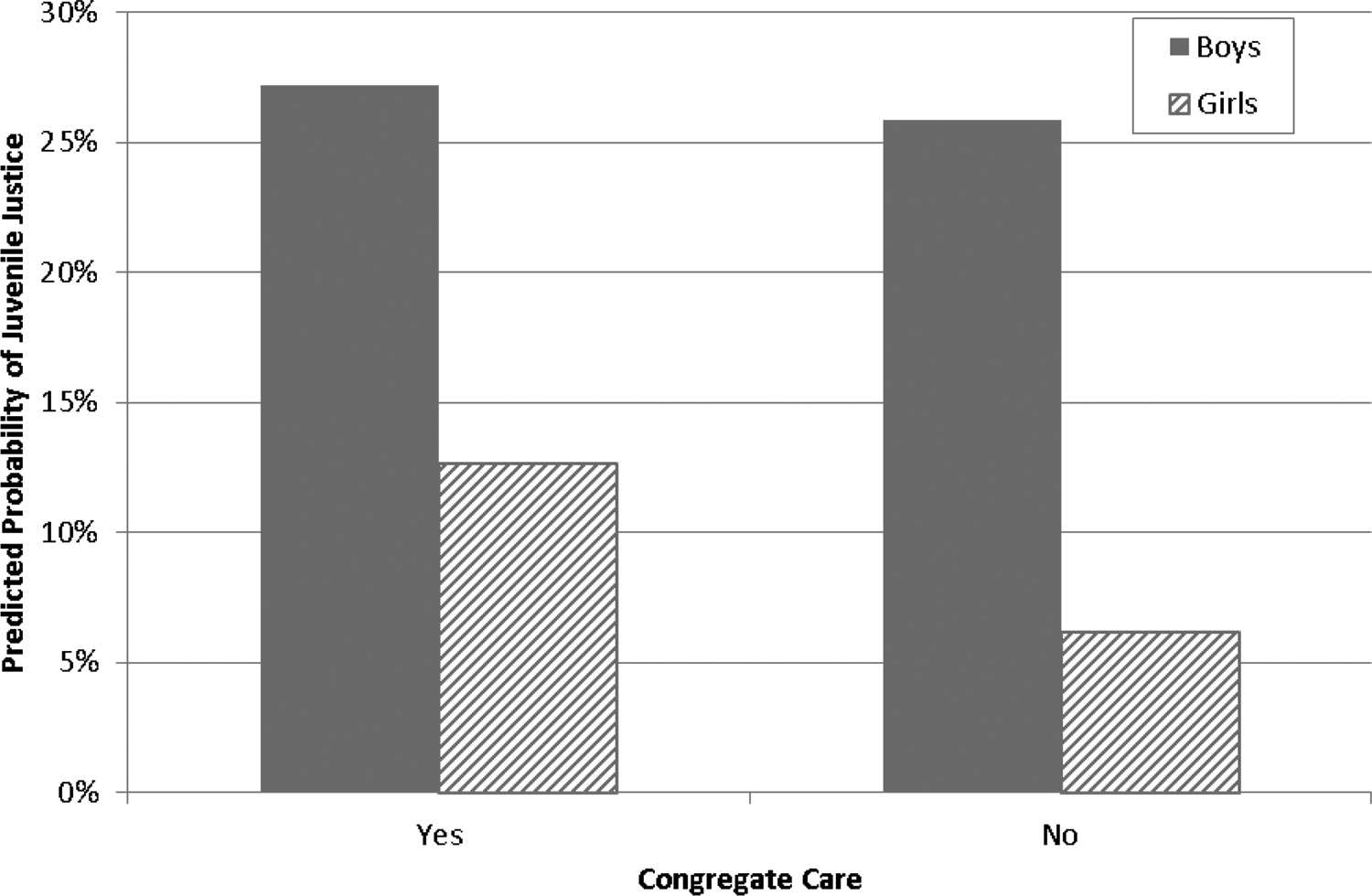
Predicted probabilities of juvenile justice involvement, placement sample, and interaction of Gender and Congregate Care.
Discussion
Analyses presented here examine relationships between child welfare, mental health, and substance abuse system experiences and juvenile justice involvement among a birth cohort of child welfare-involved youth, with particular attention to racial and gender differences. Such work is an important part of efforts to understand the strong link between child maltreatment and juvenile delinquency and the resulting high rates of justice system involvement among youth formerly involved with child welfare. Samples of child welfare-involved youth present a means for assessing how child welfare services moderate the relationship between maltreatment and delinquency, which offers useful knowledge for designing services to prevent this drift. Thus, we have contributed to understandings of which youth are likely to become involved with the juvenile justice system by (1) replicating and extending research on the relationships between child welfare system experiences and juvenile justice involvement, (2) enhancing the sparse literature on the relationships between receipt of mental health and substance abuse services and subsequent juvenile justice involvement, and (3) exploring how these factors are differentially related for girls and boys and for African American and White youth.
Similar to findings from other studies of the involvement of child welfare youth in the juvenile justice system (e.g., Jonson-Reid, 2002; Jonson-Reid & Barth, 2000a,b; Ryan et al., 2008; Ryan & Testa, 2005; Testa, 2004), race and gender are significant predictors of juvenile justice involvement in analyses of both the full and placement samples. In the full sample, African American youth are more than twice as likely as White youth and boys more than four times as likely as girls to have juvenile justice involvement. Analyses of the placement sample reveal, within this sample, a larger racial difference in the likelihood of juvenile justice involvement for boys than for girls, congruent with prior research which has also documented more pronounced racial differences for boys (Bright & Jonson-Reid, 2008; Jonson-Reid, 2002).
However, much of the research on the movement of youth from child welfare to juvenile justice uses official data sources (e.g., arrests, petitions, and incarceration) to indicate justice system involvement. One limitation of such sources is that they reflect cases that come in contact with authorities, not necessarily actual differences in behavior. For example, our measure includes individuals who were placed out of the home in a detention or residential facility. Yet, research has found that children of color are more likely to be detained than White youth (Bishop, 2005). Thus, the racial differences that we find are likely to reflect, at least in part, racial disparities in the processing of youth and not necessarily actual behavior. This point is particularly salient in light of recent research which found no racial differences in the delinquent behaviors of child welfare-involved youth (Grogan-Kaylor et al., 2008). Consequently, this suggests a need for further research into racial disproportionality in the processing of child welfare-involved youth in the juvenile justice system, with a particular focus on the experiences of boys.
Like other recent research (e.g., Ireland et al., 2002; Thornberry et al., 2001), we find that age at involvement with the child welfare system is a significant predictor of juvenile justice involvement. Generally, youth with their families’ child welfare cases open when they are adolescents are much more likely to become involved with juvenile justice than those whose cases are closed at younger ages. In other analyses, we have found this increased rate of juvenile justice involvement among youth with adolescent child welfare involvement regardless of whether a permanent placement is achieved prior to aging out of child welfare (Shook et al., 2011). This indicates a need for additional attention to this broader group of youth with adolescent child welfare involvement, and not just those who “age out” of the system.
Analyses of the full sample demonstrate that out-of-home placement is associated with an increased likelihood of juvenile justice involvement, which is congruent with recent studies in this area (e.g., Doyle, 2007; Jonson-Reid, 2002; Ryan & Testa, 2005). Our analyses further reveal that placement has a much stronger effect on juvenile justice involvement for girls than for boys. This may indicate that girls are more affected than boys by the disruption of out-of-home placement, and it supports Jonson-Reid and Barth’s (2000a) finding that girls’ (but not boys’) juvenile justice system involvement increases with level of child welfare intervention. By comparison, Ryan and Testa (2005) found out-of-home placement to be similarly predictive of juvenile justice involvement for boys and girls, increasing its likelihood by about two times for both groups. Differences between the results of our analyses and those of Ryan and Testa could be related to the fact that we include measures related to mental health and substance abuse, factors highly related to juvenile justice involvement, which few other studies have done.
Analyses of the placement sample indicate that congregate care placement is associated with an increased likelihood of juvenile justice involvement. These analyses reveal a similar, even more pronounced gender difference with regard to its effects; congregate care doubles the likelihood of juvenile justice involvement for girls but has very little effect on that of boys. There is also an interaction of Race and Congregate Care Placement, such that it increases the likelihood of juvenile justice involvement much more for Whites than for African Americans. This supports recent work by Ryan and colleagues (2008) who found that youth in group homes were twice as likely as youth in foster homes to have juvenile arrests. Our analyses, however, demonstrate only a 25% increase in juvenile justice involvement among all those in congregate care, which may be related to the fact that we include mental health and substance abuse service receipt, both of which are positively correlated with congregate care placement. Whether mental health and substance abuse problems are the cause or result (or, most likely, some combination therein) of congregate care placement is an area in need of further exploration.
Our findings add to the literature by revealing, more specifically, which youth are affected by congregate care placement, namely girls and White youth. Why are girls so much more affected by placement in these types of settings? And why is there almost no effect of congregate care placement on juvenile justice involvement among boys? Freundlich, Avery, and Padgett (2007) discuss at length the lack of safety in these settings; perhaps girls develop skills and behaviors to cope with these insecure environments that result in their subsequent justice system involvement, behaviors which may already be more common among boys who are required by the mandates of masculinity in our society to develop such skills in multiple environments. Detail on the nature of their juvenile justice involvement might be helpful in addressing these questions, as would ethnographic research in congregate care settings. Clearly, these are questions in need of further exploration. Nevertheless, the gender difference in the effects of congregate care placement is an important finding, particularly given the fact that well over half of the girls in the placement sample have experienced placement in a congregate care setting. Certainly it would suggest that alternatives are needed to congregate care placement for girls, whereas congregate care does not seem to have as negative an effect on boys, at least with regard to juvenile justice involvement. 7
Why does congregate care affect the likelihood of juvenile justice involvement of White more than African American youth? This is a particularly interesting question given that there is not a racial difference in the effects of out-of-home placement in the full sample. White and African American youth each constitute about half of the full sample (which nonetheless indicates an overrepresentation of African American youth in child welfare relative to their population in the county, which is just 17%). Yet, in the placement sample, there are about twice as many African American as White youth. This means that once involved with child welfare in this county, African American youth are more likely than White youth to be removed from home. While we do not know if this disparity is because of racial biases in removal decisions or due to more serious maltreatment in African American homes (or some combination of the two), the fact that there is likely some bias involved suggests that perhaps White youth in the placement sample are, on average, more troubled, or at least concentrated at that end of the continuum, while African American youth in this group may have a broader spectrum of experiences. This may be evidenced by the fact that White youth have higher rates of mental health service receipt than African American youth in this sample. However, this fact may instead be an indicator of a discrepancy documented in other studies in which White youth in child welfare are referred to, and receive, mental health services at higher rates than African American youth (Courtney et al., 1996; Garland, Landsverk, Hough, & Ellis-MacLeod, 1996; Garland, Landsverk, & Lau, 2003), even though they may not have higher rates of mental health problems (Shin, 2005).
Like many other studies, we find that placement instability increases the likelihood of juvenile justice involvement (DeGue & Widom, 2009; Jonson-Reid & Barth, 2000a; Runyan & Gould, 1985; Widom, 1991). In comparison to the work of Ryan and Testa (2005), however, who found placement instability to affect the juvenile justice involvement of boys but not that of girls, we did not find a significant interaction of placement instability with gender. While it remains difficult to disentangle which comes first, placement changes or acting out, by accounting for timing we are able to determine that placement instability often precedes justice system involvement and thus is an identifiable risk factor. It is likely, nonetheless, that acting out contributes to placement changes; however, our work emphasizes the importance of working toward placement stability. That length of time in placement is actually protective, when number of placements is held constant, might suggest that we focus more on stabilizing current placements and less on establishing formal permanent placements, since, as noted previously, establishing permanency does not decrease the likelihood of justice system involvement for youth with adolescent child welfare involvement (Shook et al., 2011).
Based on our review of the literature, we anticipated running away from child welfare placement to predict juvenile justice involvement. However, this is not what we found. In fact, running away actually has a negative relationship with juvenile justice involvement. Why might this be the case? In contrast to youth who run away from home to escape abuse and engage in illegal activities to survive on their own on the streets, there is evidence that many youth who run from placement have a specific destination in mind and often go home or to the homes of other relatives or friends (Finkelstein, Wamsley, Currie, & Miranda, 2004). Similarly to Courtney and Wong (1996), we find that youth in congregate care settings are much more likely than those in foster care to run from placement. Given the lack of safety in congregate care settings (Freundlich, Avery, & Padgett, 2007), some of these youth may be running to escape discomfort or mistreatment there. Interestingly, when we include in analyses running away at any point, regardless of timing, we find running away from placement to be positively related to juvenile justice involvement, suggesting that once youth have been involved with juvenile justice they become more likely to run away from placement. However, the fact that prior instances of running away are not associated with an increase in juvenile justice involvement means that this experience should not be held against youth in detention decisions, which is contrary to current practices in many locations (Schwalbe, Fraser, Day, & Cooley, 2006). That child welfare involvement itself may sometimes count against youth in detention decisions makes this all the more important (Conger & Ross, 2006).
While we can learn a great deal about the risk of juvenile justice involvement through an examination of child welfare system experiences, much is missed if we are not able to account for preexisting risk factors like mental health problems (Jonson-Reid, 2002). Our study is one of few of its kind to include measures of mental health and substance abuse service receipt (and to assess the effects of these two types of services separately from each other), which we employ as indicators of mental health and substance abuse problems. Within the full sample, the most important predictor of juvenile justice involvement, aside from gender, is prior receipt of mental health services. Mental health is also significantly related to juvenile justice involvement in analyses of the placement sample, although to a lesser degree. This finding supports an extensive body of research not focused specifically on child welfare youth, which has documented an important link between mental health problems and juvenile justice involvement (e.g., Davis et al., 2004; Graves et al., 2007; Pullmann, 2010; Rosenblatt et al., 2000). Given the trauma and neglect that child welfare-involved youth experience at home and, in some cases, when removed from the home, it is not surprising that they would have high rates of mental health problems, nor that these problems would be associated with juvenile justice involvement. Our measure is limited, however, because it does not account for variation in the severity or type of mental health problems. Additional research is needed, then, to examine the relationships among mental health needs, services, and justice system involvement.
In contrast to what the literature led us to expect, prior substance abuse service receipt is positively associated with juvenile justice involvement only for White boys in the full sample. Even more surprisingly, substance abuse service receipt is associated with a lower likelihood of juvenile justice involvement for African American boys and White girls in the full sample and for everyone in the placement sample. While this may reveal that these services are effective and therefore having a protective effect for most groups, it may also be indicative of an unmet need for substance abuse treatment. When we run our analyses without taking timing into account, in other words using variables that indicate whether a youth has ever received substance abuse (or mental health) services, the findings are different, for both the full and placement samples. In these analyses, we find receipt of substance abuse services to be positively associated with juvenile justice involvement for everyone (and mental health services to be even more strongly associated with juvenile justice involvement), 8 implying perhaps that there are unmet treatment needs among these youth that are identified after juvenile justice involvement. 9 While we hoped that prior mental health and substance abuse service receipt would serve as proxies for preexisting mental health and substance abuse problems, the fact that there may be significant unmet needs in these areas suggests that they may not be ideal indicators, as there may be youth with mental health and particularly substance abuse problems not receiving services. The positive relationship found between substance abuse receipt and juvenile justice involvement for White boys may then be related to the previously discussed fact that White youth in child welfare are more often tracked into treatment than African American youth. Thus, they may be the only group, in this case, for whom substance abuse treatment needs were identified prior to juvenile justice involvement.
Despite the possibility of unmet treatment needs, rates of mental health service receipt are high. That 68% of the young people in the placement sample have received mental health services prior to any justice system involvement suggests that many services offered to young people in care come through involvement in the mental health system. While it seems positive that youth are being assessed and offered support, analyses of the type of support provided reveal the fact that approximately 60% of the youth in the placement sample who received mental health services prior to juvenile justice involvement have had at least one mental health medication management appointment. Shin (2005) hypothesizes that child welfare youth may be referred more often to mental health for externalizing than for internalizing behaviors. Medication use can be a convenient means to control youths’ “troubling” behaviors (Finn, 2001) and may help to account for the fact mental health medication use is higher among boys than girls in the placement sample, when we know that girls generally have higher rates of depression (Nolen-Hoeksema, 2001). The use of mental health services to address externalizing problems may help explain why we find a significant relationship between prior mental health services and juvenile justice involvement at the same time that results suggest unmet treatment needs.
Conclusion
Analyses reported here confirm and specify previous research linking race, gender, age at child welfare system involvement, and placement experiences to juvenile justice involvement. They extend knowledge about pathways from child welfare to juvenile justice by revealing significant relationships between mental health and substance abuse service receipt and juvenile justice, even though not all of these relationships are in the directions expected. Our analyses have limitations which should be taken into account when considering their implications and generalizability. These include the fact that data come from just one county and that we had to exclude youth who were adopted from child welfare in analyses. Our measure of juvenile justice involvement comes from official reports and includes young people who were placed in detention or committed to a residential facility; it is likely that better understandings of the relationships between other system experiences and juvenile justice involvement could be developed with measures differentiating type and extent of involvement. Understandings of the relationships between mental health service receipt and juvenile justice could also be enhanced with information on diagnosis; however, our separation of prior mental health and substance abuse service receipt was useful, as they sometimes have effects in opposing directions.
Given the high rates of child welfare involvement among youth in the juvenile justice system, this research has important implications for practitioners and researchers in both the child welfare and juvenile justice systems. Clearly, it highlights the necessity of communication and coordination among these two systems. Within the juvenile justice system, there is often not enough attention to what came before, so awareness of youths’ child welfare involvement and its effects is important, as is ensuring that they are not penalized for such involvement in justice system decision making. By utilizing an interactional approach, this study has highlighted important racial and gender differences in the relationships between child welfare experiences and juvenile justice involvement. These are deserving of attention and additional research to ensure that our systems are not perpetuating racial biases and are meeting the gender-specific needs of the young people they serve.
Footnotes
Declaration of Conflicting Interests
The author(s) declared no potential conflicts of interest with respect to the research, authorship, and/or publication of this article.
Funding
The author(s) disclosed receipt of the following financial support for the research, authorship, and/or publication of this article: This research was funded by grants from the Pittsburgh and Eden Hall Foundations.