



Abstract
Moffitt’s taxonomy remains an influential theoretical framework within criminology. Despite much empirical scrutiny, comparatively less time has been spent testing the snares component of Moffitt’s work. Specifically, are there factors that might engender continued criminal involvement for individuals otherwise likely to desist? The current study tested whether gang membership increased the odds of contact with the justice system for each of the offender groups specified in Moffitt’s original developmental taxonomy. Our findings provided little evidence that gang membership increased the odds of either adolescence-limited or life-course persistent offenders being processed through the criminal justice system. Moving forward, scholars may wish to shift attention to alternative variables—beyond gang membership—when testing the snares hypothesis.
Moffitt’s (1993) developmental taxonomy accomplished much in the way of explaining the development of both chronic and intermittent criminal behavior over the life course. Aside from describing the developmental trajectories into crime (Moffitt, 2006; Sampson & Laub, 2005), one of the key features of Moffitt’s work was the specification of pathways leading to desistance (Bushway, Piquero, Broidy, Cauffman, & Mazerolle, 2001). In other words, the developmental taxonomy attempted to explain why most members of the population (i.e., adolescence-limited [AL] offenders) stop committing crime. In the intervening years, identifying the factors that encourage desistance has occupied a considerable amount of attention among researchers (Barnes & Beaver, 2010; Kazemian & Maruna, 2009; Sweeten, Pyrooz, & Piquero, 2013). What has remained lacking, though, is a more developed literature regarding explanations for why some individuals fail at desistance (Higgins, Bush, Marcum, Ricketts, & Kirchner, 2010).
Regarding pathways out of crime, AL offenders—in contrast to life-course persistent (LCP) offenders (who possess a stable propensity for antisocial behavior)—are expected to return to a pattern of prosocial behavior in their early 20s (Moffitt, 1993). While most AL offenders adhere to this general pattern, some do not. To account for this, Moffitt (1993) proposed the concept of snares. Snares generally refer to factors that reduce the probability of criminal desistance (Moffitt, Caspi, Dickson, Silva, & Stanton, 1996). While empirical support for the snares hypothesis exists, research in this particular area has generally been limited to the study of alcohol and substance use (Higgins et al., 2010; Hussong, Curran, Moffitt, Caspi, & Carrig, 2004). Although both studies found evidence that alcohol and substance use served to slow or prohibit desistance from crime, these studies did not examine the snares hypothesis within the different offender groups identified by Moffitt’s theory. As a result, the ability to make inferences as to whether a snare has a differential impact on desistance across offender typologies remains limited. In other words, a snare might matter for AL offenders, yet exert no influence on the probability that an LCP offender will continue to engage in antisocial behavior.
The current study, then, expands the scope of Moffitt’s snares hypothesis by examining a potential snare that has previously received little attention: gang membership. Gang membership is a risk factor that has been shown to elevate the probability of criminal offending and victimization while also constraining ties to conventional institutions (Decker & Van Winkle, 1996; DeLisi, Barnes, Beaver, & Gibson, 2009; Krohn & Thornberry, 2008; Krohn, Ward, Thornberry, Lizotte, & Chu, 2011; Melde & Esbensen, 2012; Pyrooz & Decker, 2011; Pyrooz, Sweeten, & Piquero, 2012). With this idea in mind, we examine whether membership in a gang acts as a snare for AL offenders, thus preventing them from experiencing age-typical patterns of desistance. Additionally, we investigate whether gang involvement might further elevate the probability that LCP offenders will become entrenched in a lifestyle marked by criminal involvement.
Continuity, Desistance, and the Problem of Snares
Moffitt (1993) identified several mechanisms that, if present, might increase the likelihood of desistance from antisocial behavior. If these mechanisms are absent, then continuity in behavior becomes more likely. Part of the underlying reason for continuity is a failure on the part of the adolescent to develop prosocial alternatives to delinquency (Moffitt, 1993). What this means is the behavioral repertoire of LCPs, for instance, may be restricted due in large part to specific personality traits that correlate with offending behaviors (e.g., impulsivity, neurocognitive deficits, callousness, etc.). ALs, on the other hand, would have learned and practiced prosocial behaviors—even though they sometimes avoided them during the years surrounding puberty—and thus are considered to be at less of a risk for continued involvement in antisocial behavior (Moffitt, 1993).
In some situations, however, desistance may be inhibited due to certain life events, termed “snares” (Moffitt, 1993). Snares behave like an accelerant for antisocial behavior by blocking opportunities to engage in prosocial behavior. In doing so, snares make antisocial behavior the more likely option. Snares effectively interrupt social development by disrupting opportunities that are essential for success later in life. Moffitt (1993) suggested that considerably more effort would be required to achieve desistance in the aftermath of encountering a snare. Juvenile delinquency, for instance, might lead to a variety of outcomes ranging from incarceration to addiction (Moffitt, 1993). As a result, an ensnared adolescent may find it difficult to become employed, which may lead to financial distress and therefore promote the continuance of antisocial behavior (Moffitt, 1993).
As an additional component of the snares hypothesis, Moffitt (1993) suggested that adolescents may actively forego or “knife-off” their previous attachments to positive influences in order to reinforce their desire to appear autonomous, independent, and mature. Dissociating oneself from prosocial relationships may increase the chance that adolescents encounter snares (see generally, Greenberg, 1977), which may increase the difficultly of desistance later in life (Melde & Esbensen, 2011; Moffitt, 1993). Perhaps one of the most prominent examples of knifing off prosocial influences occurs when one joins a gang.
Gangs, Snares and Unfortunate Outcomes
Among the most consistent observations in criminological research is that gang membership increases the likelihood of engaging in criminal behaviors (Krohn & Thornberry, 2008). On average, gang members are more likely to be both arrested and convicted for committing a range of offenses than nonmembers, including drug, property, and violent offenses (Esbensen & Huizinga, 1993; Decker, 2000; Thornberry, Krohn, Lizotte, & Chard-Wierschem, 1993; Thornberry, Krohn, Lizotte, Smith, & Tobin, 2003). Although gang membership is typically a transient experience, restricted to a few years in adolescence, involvement in crime does not appear to be isolated to the time spent in the gang (Krohn et al., 2011; Pyrooz, Decker, & Webb, 2014). Many former gang members retain ties to the gang, and these individuals have been found to experience both violent victimization and arrest at twice the rate of those who do not retain gang ties (Pyrooz & Decker, 2011).
In addition to the criminogenic consequences of gang membership, the onset of involvement in gangs also corresponds with the “knifing off” process described by Moffitt (1993). In order to achieve status or membership within the gang, individuals forego sources of social capital, such as education or employment, to gain criminal capital (Hagan & McCarthy, 1997; Moule, Decker, & Pyrooz, 2013). Although a high degree of criminal capital is beneficial while embedded within the gang, it may be deleterious to one’s prospects of rejoining conventional institutions. Those who are more immersed or embedded in the gang during their tenure have been found to desist at a slower rate, not only because they are more constrained by the gang, but because they have relinquished more prosocial resources than those less embedded (Pyrooz et al., 2012).
Gang membership may represent the prototypical snare described in Moffitt’s taxonomy. Gang membership itself appears to be a risk factor for delinquency as well as processing by the criminal justice (CJ) system. Gang membership, then, may work to ensnare an adolescent offender in a trajectory of antisocial behavior. Moreover, gang involvement may serve to breach ties to prosocial influences. Along similar lines, Pyrooz (2014) recently reported that the negative effect of gang membership on educational attainment was persistent and only strengthened over time. Gang membership, ultimately, may represent an important snare that could impede the building of ties among certain offender types in the population.
There is a final point worth noting regarding gang membership, snares, and persistent offending. Primarily, this issue concerns the role of selection factors in predicting gang membership. It is possible that selection bias could threaten the results of studies examining gang effects on various outcomes (Krohn & Thornberry, 2008). For the current study, this may be especially relevant for LCP offenders. Namely, because LCPs are disproportionately antisocial, it is possible that gang membership may not represent a snare so much as it simply represents another incarnation of LCP offending. Joining a gang, for example (and perhaps rising in the ranks of that gang), may reflect the general propensity of LCP offenders to act in ways that are overtly antisocial or violent. Put differently, gang membership may simply represent another opportunity for engaging in antisocial behavior for LCPs. This is important to emphasize because it suggests that with or without the avenue of the gang, the LCP offender should have little trouble finding themselves in contact with the CJ system (Barnes, 2014). The impact of gangs as a snare, therefore, may be superfluous for LCP offenders.
In contrast, however, joining a gang may create criminal opportunities for, or amplify the antisocial behavior of, AL offenders. To date, the few studies that have examined the potential for heterogeneous criminal consequences of gang membership have done so in the context of stable/transient gang membership (e.g., Thornberry et al., 2003) or gang embeddedness (Sweeten et al., 2013), as opposed to the criminal pathways outlined by Moffitt (1993). Moffitt’s developmental pathways may provide a useful lens through which to observe and explain heterogeneity in CJ consequences, as the selection bias for joining a gang may correspond to Moffitt’s offender types.
Current Study
With the above-mentioned research in mind, the current study aims to expand the modest amount of literature on snares (Higgins et al., 2010; Hussong et al., 2004) by examining the impact of gang membership on involvement in the CJ system. Along these lines, we examine two hypotheses:
Method
Sample
Data drawn from the National Longitudinal Study of Adolescent to Adult Health (Add Health) were analyzed in order to examine the ensnaring effects of gang membership. The Add Health has been used extensively, so we devote only a brief amount of time to describing the data and sampling methodology here (see Harris, 2009 for a more thorough account). Currently, four waves of data are available and we utilize measures collected across all four of the phases in the Add Health. A total of 20,745 adolescents participated during the in-home portion of the first wave, which was collected during 1994 and 1995. At Wave 1, respondents were between 11 and 18 years of age. The second wave began in the spring of 1996, when respondents were between 12 and 20 years old. Roughly, 70% of the respondents from Wave 1 were retained at Wave 2. Given the proximate time gap between waves, many of the survey items used at Wave 1 were repeated for Wave 2. The third wave of data collection was initiated during 2001 when the respondents were nearing young adulthood (i.e., 18–26 years old). Some items, during the third wave, were changed in order to reflect the aging sample. Wave 4 recently concluded in 2008, when respondents were between 24 and 32 years of age. Survey items largely mirrored those from the third wave.
Key Independent and Dependent Variables
LCP offenders
Barnes, Beaver, and Boutwell (2011) developed a method for identifying the different offending typologies described by Moffitt (1993). Because the measures are based on involvement in a variety of delinquent activities, the initial step was to create a scale capturing each respondent’s involvement in delinquency across all four waves of data. During Wave 1 and Wave 2, participants reported on their frequency of involvement in 17 antisocial activities in the past 12 months, ranging from minor forms of acting out to serious criminal acts. These items included acts such as getting into a physical fight, painting graffiti, running away from home, carrying a weapon to school or work, stealing from homes or stores, damaging property, and selling drugs. Responses were coded so that 0 = never, 1 = 1 or 2 times, 2 = 3 or 4 times, and 3 = 5 or more times (α = .84). An identical delinquency scale was created at Wave 2 (α = .83; see previous research by Barnes, Beaver, & Boutwell, 2011 for more thorough descriptions of the Add Health delinquency measures).
Substantively similar strategies were utilized at Waves 3 (α = .73) and 4 (α = .71) which yielded a total of four delinquency measures—one for each wave of data collection—for respondents in the sample. Once all of the delinquency scales were in place, a new variable intended to identify respondents falling in to the LCP category was generated in the data. Specifically, cases were coded as an LCP offender (=1) if they reported one or more acts of crime/deviance across all four waves of data collection. Approximately 6% of the full Add Health sample was coded an LCP offender. All other respondents were assigned a score of 0 (this would include abstainers, AL offenders, and other respondents who reported intermittent patterns of offending). Respondents who reported zero offenses across all four waves (abstainers) were dropped from the data. 1
An important point to mention regarding the LCP measure concerns the logic underpinning the strategy for constructing an offender typology in the current study versus what Moffitt (1993) says about that particular typology in her original theory. Specifically, Moffitt suggested that LCP offending represents the intersection of neurological deficits in childhood coupled with environmental adversity in the home. The Add Health, however, lacks information concerning cognitive functioning when the participants were children as well as reliable measures of the home environment during childhood. Moreover, other techniques that might also distinguish offending patterns over time (e.g., group based trajectory models) would still lack the relevant information concerning neurological functioning, home environment in childhood, and would also have to be restricted to only four time points. The current method was therefore adopted because it allowed for an approximation of offender groups using data available in the Add Health that yielded results closely in line with Moffitt’s predictions. Note that Moffitt argued LCPs account for a small proportion of all offenders. The results from our identification strategy are consistent with this statement. Perhaps, most important is that our strategy aligns with the logic of the LCP offending patterns exhibited by LCPs. Specifically, we only identify an individual as an LCP offender if they admitted to being involved in crime/deviance at all four waves of data; life-course persistence.
AL offenders
Once again, the creation of an AL offending measure was based on the respondent’s self-reported acts of delinquency across the four waves of data collection. A new variable was generated and in this case subjects who reported a value of 1 or higher on the Wave 1 delinquency scale or on the Wave 2 delinquency scale and who also reported a 0 on the Wave 3 delinquency scale and on the Wave 4 scale were coded as 1 on the new measure of AL offending. All other respondents with nonmissing delinquency data were coded as 0.
Gang membership
Following the lead of prior researchers, we utilized a self-reported measure of gang membership in order to construct our indicator of gang involvement (Barnes, Beaver, & Miller, 2010; Esbensen, Winfree, He, & Taylor, 2001; Thornberry et al., 2003). Recent research found that self-nomination as a gang member, currently or formerly, was the strongest predictor of gang embeddedness among several other gang-specific variables (Decker, Pyrooz, Sweeten, & Moule, 2014). During Wave 2, participants were asked if they had joined a named gang in the last 12 months. Responses were coded dichotomously such that 0 = no and 1 = yes.
CJ processing
Wave 4 of the Add Health contained information about the respondent’s experiences with the CJ system. Subjects were asked to indicate if they had (1) ever been arrested, (2) ever been incarcerated, (3) ever been convicted (or pled guilty to any charges, other than a minor traffic violation), or (4) ever been placed on probation (Beaver, 2011). Responses to these items were coded dichotomously so that 0 = no and 1 = yes. Descriptive statistics and bivariate correlations for/between all the variables included in our analyses are presented in Tables 1 and 2.
Descriptive Statistics.

Note. LPC = life-course persistent; AL = adolescence limited; Min = minimum; Max = maximum.
Correlation Matrix (Abstainers Excluded).

Note. LPC = life-course persistent; AL = adolescence limited.
*Significant at the .05 level.
Covariates
IQ
Participants completed the Peabody Picture Vocabulary Test during Wave 3 of the Add Health (Beaver, Vaughn, DeLisi, Barnes, & Boutwell, 2012; Rowe, Jacobson, & Van den Oord, 1999). For the current analysis, we included the respondents’ standardized scores on PPVT in order to account for the influence of neuropsychological function and intelligence on measures of antisocial and delinquent behavior detected in prior research (Barnes et al., 2010).
Low self-control
Low self-control is a widely supported correlate of antisocial outcomes (Pratt & Cullen, 2000). Importantly, research has also shown that gang members are more impulsive than adolescents who do not join a gang (Esbensen & Deschenes, 1998). We included a measure of self-control drawn from the Wave 3 interviews (Beaver, Ratchford, & Ferguson, 2009). Specifically, the measure included in the current study was comprised of 20 items corresponding to various aspects of impulse control and attention span. For example, respondents were asked if they enjoyed life, liked to take risks, had trouble keeping their mind focused, could maintain control when excited, often followed their instincts, or were able to easily lie or stretch the truth. These items were coded so that higher scores would reflect lower levels of self-control (α = .83).
Drug use
Wave 2 of data collection contained a series of items pertaining to the use of both illegal and addictive substances, which prior researchers have utilized (Barnes, Boutwell, & Beaver, 2012). Respondents reported on their experimentation with cigarettes, alcohol, cocaine, crystal methamphetamine, injectable drugs, as well as other illicit substances. Responses to the individual items were coded dichotomously so that 0 = no and 1 = yes. The responses were then summed to create a drug use index where higher scores reflected increased consumption of various drugs (Barnes et al., 2012).
Victimization
Prior research has linked victimization with gang involvement (Decker & Curry, 2000; Peterson, Taylor, & Esbensen, 2004). To account for this relationship, we include information taken from four questions at Wave 2. Respondents, for example, were asked to recall if they had experienced violent victimization (e.g., had they been shot, stabbed, jumped, or had a gun or knife pulled on them) in the past year. Responses were coded into one of three categories, including never (=0), once (=1), and more than once (=2). These responses were summed to create a scale of victimization where higher scores represented more victimization experiences in the past year (α = .64).
Demographics
The participant’s age (measured in years at Wave 4), sex (0 = female and 1 = male), and race (0 = non-Black, 1 = Black) were included as control variables.
Plan of Analysis
We followed a sequential approach to our analyses utilizing a series of logistic regression equations to predict the CJ-processing outcomes. The initial step involved analyzing whether being an AL offender predicted CJ processing. The second step addressed whether belonging to a gang moderated the relationship between AL offending and CJ processing. To the extent that it does, this would be a step in the direction of arguing that gang involvement represents a snare. The next portion of the analysis attempted to deal with the possibility that LCP offenders are more likely to be gang members (i.e., the possibility of a selection bias). To account for the possibility of selection bias, we analyzed the influence of gang membership on CJ outcomes among LCPs only (i.e., a within-group analysis). Next, we examined the same association (i.e., gangs and CJ processing) for AL offenders in the sample only (i.e., a within-group analysis). The results from the analyses are presented and discussed in detail subsequently. 2
Results
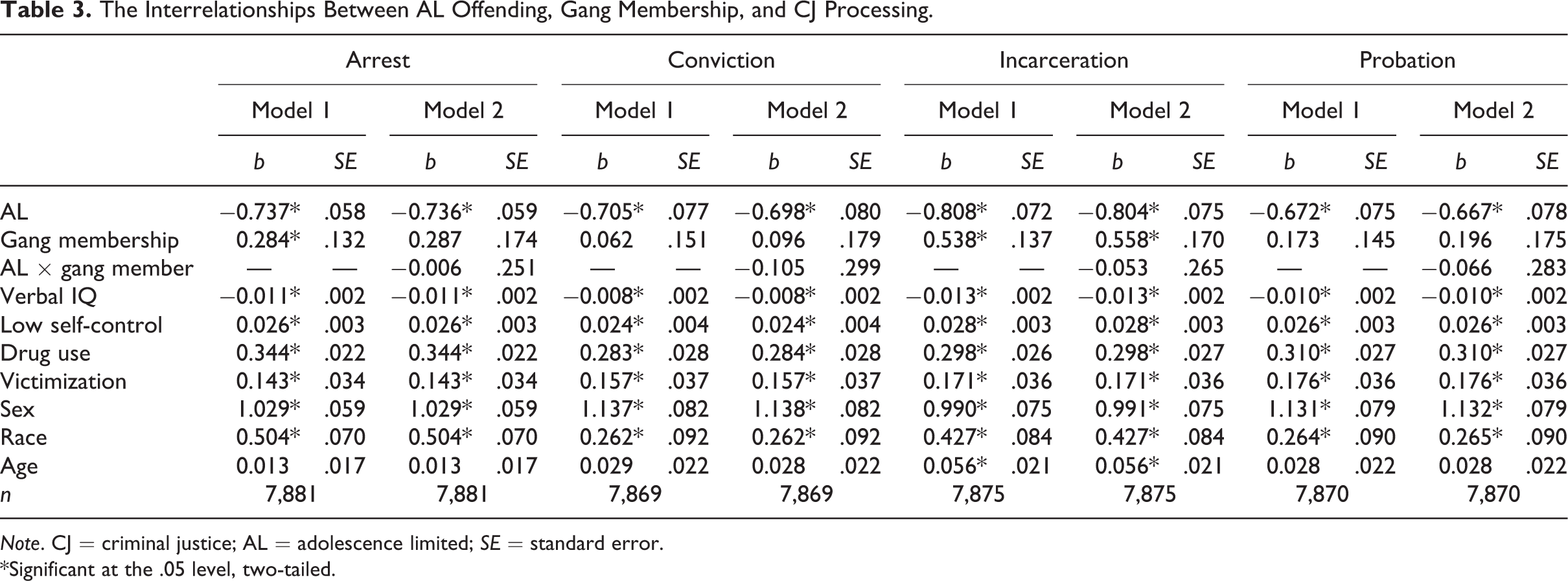
Table 3 presents the findings from a series of logistic regression models. Two points about the table are worth considering before progressing further. First, the AL variable is included (first row) and is coded so that 0 = non-ALs and 1 = ALs. Second, note that there are two models for each CJ outcome. In each case, Model 1 presents the main effects of AL offending and gang membership on the CJ outcome. Model 2 enters a multiplicative interaction between gang membership and AL offending. The interaction term will identify whether gang membership operates differently for ALs as compared to non-AL offenders.
The Interrelationships Between AL Offending, Gang Membership, and CJ Processing.
Note. CJ = criminal justice; AL = adolescence limited; SE = standard error.
*Significant at the .05 level, two-tailed.
As the results in Table 3 reveal, AL offending correlated negatively and significantly with each CJ-processing outcome (holding constant each of the controls). Thus, AL offenders were less likely to report being arrested, convicted, incarcerated, and placed on probation as compared to other members of the sample (which would be expected given the suggestions by Moffitt, 1993). Interestingly, there was no evidence that gang involvement moderated the relationship between AL offending and CJ outcomes. The parameter estimates gleaned from these models, however, do not fully reveal whether heterogeneous effects in gang membership are present (see Ai & Norton, 2003). Thus, we turn next to models examining the influence of gang membership within each offender type.
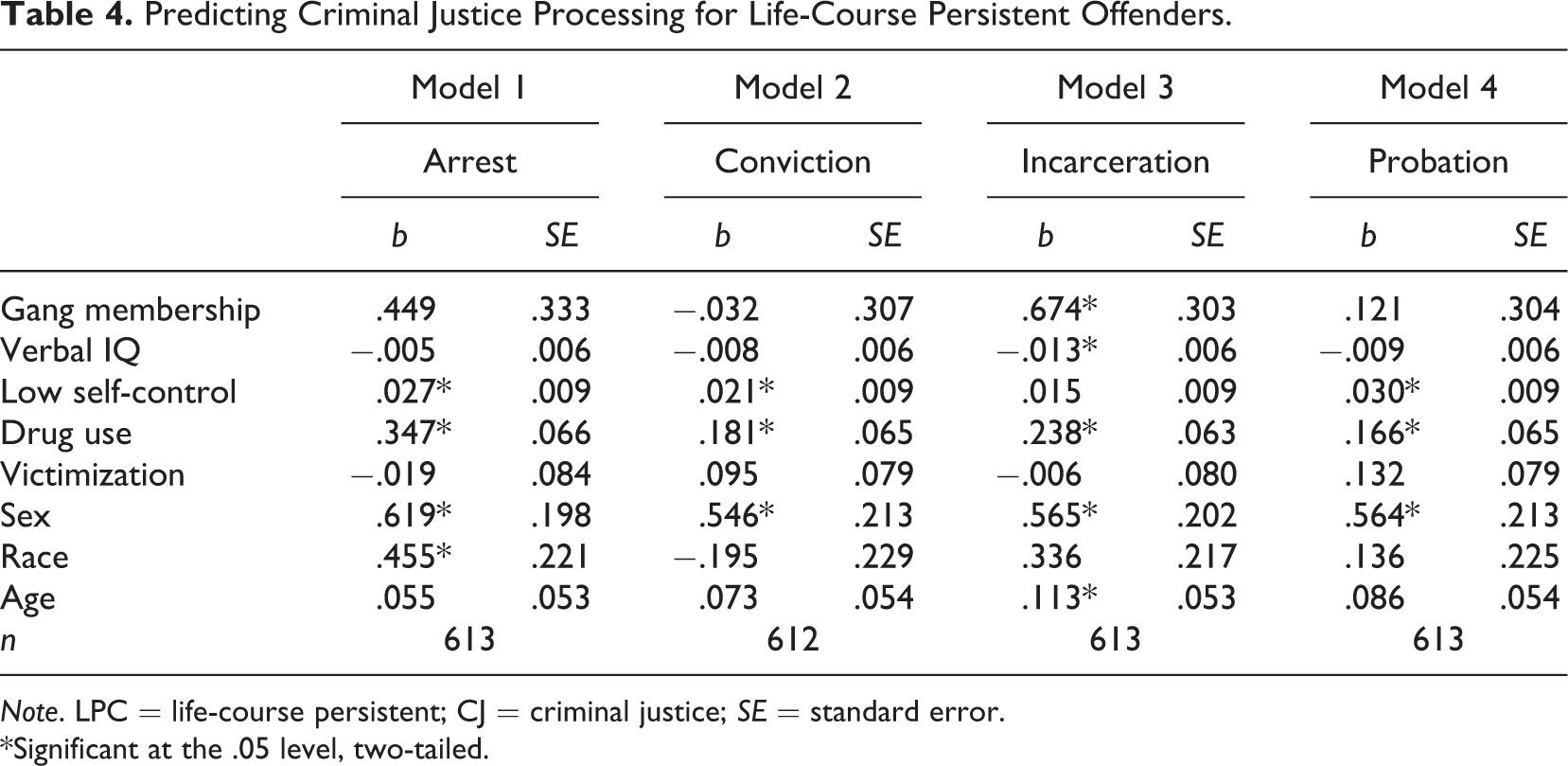
Table 4 presents the association between gang membership and CJ processing for LCPs. As can be seen, the general pattern of results did not suggest that belonging to a gang exerted much of an influence on CJ-processing net of the other controls included in the regression equation. The lone exception was for the outcome of incarceration. In this case, gang membership was positively and significantly associated with the experience of incarceration for persistent offenders in the Add Health.
Predicting Criminal Justice Processing for Life-Course Persistent Offenders.
Note. LPC = life-course persistent; CJ = criminal justice; SE = standard error.
*Significant at the .05 level, two-tailed.
Moving to the next phase in the plan of analysis, Table 5 presents the associations between gang membership and CJ outcomes for only AL offenders. In contrast to the LCPs, none of the models showed a statistically significant gang effect. On the whole, the pattern of findings suggests that gang membership exerts little in the way of impact for CJ processing among AL offenders.
Predicting Criminal Justice Processing for Adolescent-Limited Offenders.

Note. AL = adolescence limited; CJ = criminal justice; SE = standard error.
*Significant at the .05 level, two-tailed.
Discussion
The current study was intended to reexamine the snares hypothesis within the context of gang effects on CJ-processing variables. To date, there is a vast literature testing various aspects of gang influence on outcomes ranging from crime and delinquency to victimization (Decker, Melde, & Pyrooz, 2012). At the same time, the developmental literature testing components of Moffitt’s taxonomy (1993) has exploded in the last several years yielding an impressive amount of support for Moffitt’s predictions. An important aspect of Moffitt’s theory involved specifying mechanisms for desistance and continuity in the patterns of offending for the different offender typologies (i.e., LCPs and ALs). In this vein, Moffitt (1993) proposed the idea that certain events may “knife-off” prosocial opportunities and diminish the likelihood of desistance from crime. The extent to which gang membership operates in this capacity (i.e., as a snare), however, has been less thoroughly tested.
Our analysis of the Add Health data revealed several findings that were of note. First, there appeared to be little effect of gang membership on CJ processing for LCP offenders. The only significant effect to emerge for LCPs was in the prediction of incarceration. Second, gang effects did not emerge for AL offenders. On the whole, what this means is that gang membership likely exerts little in the way of an ensnaring effect for outcomes such as arrest, conviction, or probation for either ALs or LCPs. 3
The current study was host to several limitations that warrant discussion and consideration prior to concluding. First, while the results of the study provide little support for the snare-like effects of gang membership, it is important to recognize that the consequences of gang membership could operate indirectly. Melde and Esbensen (2011), for instance, found that joining a gang had negative effects on prosocial and delinquent peers, school and peer commitment, guilt, neutralizations, and unstructured socializing (see Sweeten et al., 2013 for similar findings). To the extent that gang membership might influence variation in these traits, one might begin to suspect a mediation effect of the ensnaring influence. What may also be the case is that each of these traits loads on an underlying propensity to join gangs as well as to offend. As a result, excluding them would have more than likely represented a confounded model. Future research should be helpful in further clarifying these associations.
Second, despite the inclusion of important covariates, it still remains possible that our findings reflect unobserved selection effects between gang members and nongang members. It is likely that much of the unobserved heterogeneity that may exist between groups was accounted for by examining gang effects within offender typologies. Even so, unaccounted-for heterogeneity could have influenced our findings. Third, the measure of CJ processing asked respondents to indicate whether they had ever been arrested. Although this was asked at Wave 4 and gang involvement was assessed at Wave 2, it is possible that the time ordering between gang membership and CJ processing is out of sequence. For example, an individual could have theoretically been processed by the CJ system and then joined a gang (perhaps a prison gang). Even so, prior research has shown this type of relationship (arrests → gang membership) to be rare compared to the alternative arrangement (gang membership → arrests; Katz, Webb, & Schaefer, 2001; Thornberry et al., 2003). It should be noted, however, that individuals who reported being arrested prior to Wave 2 represented only a small proportion of the Add Health sample.
The fourth limitation addresses the ability of the current study to properly test the snares hypothesis. Previous research has primarily examined snares as they impact desistance from criminal involvement across the life course (Higgins et al., 2010; Hussong et al., 2004). Certainly, this sets the current study apart and perhaps limits the inferences that can be drawn about the role of gangs as an actual snare (as envisioned by Moffitt, 1993). Essentially, our argument is that gangs represent continued opportunities for crime, which could ensnare adolescents. Moreover, this type of ensnarement could presumably manifest itself as contact with the CJ system (e.g., being arrested). Although it has limitations, the current study adds to the current understanding of snares and how they may or may not function within offender typologies.
Finally, it remains likely that genetic influences have confounded some of the relationships identified in our study (Turkheimer, 2000). Recent research has revealed strong genetic influences on our offender typology measures (Barnes et al., 2011) as well as the outcome measures of CJ processing (Beaver, 2011; Beaver & Chiavano, 2011). As research in this area progresses further, future studies utilizing twins and siblings will help to further disentangle the effects of genes, offender type, gangs, and CJ outcomes (Barnes et al., 2014; Barnes, Boutwell, Beaver, Gibson, & Wright, 2014). We see our results as a starting point in this regard. Ultimately, however, clearly explicating the events that ensnare or exacerbate antisocial and illegal behavior may prove vital in specifying effective intervention or prevention efforts for certain members of the population. The current study may offer some guidance toward that goal.
Footnotes
Acknowledgments
The authors wish to thank Dr David Pyrooz for his very thoughtful and helpful comments on a previous version of this article. Special acknowledgment is due to Ronald R. Rindfuss and Barbara Entwisle for assistance in the original design. This research uses data from Add Health, a program project directed by Kathleen Mullan Harris and designed by J. Richard Udry, Peter S. Bearman, and Kathleen Mullan Harris at the University of North Carolina at Chapel Hill. Information on how to obtain the Add Health data files is available on the Add Health website ( ).
).
Declaration of Conflicting Interests
The author(s) declared no potential conflicts of interest with respect to the research, authorship, and/or publication of this article.
Funding
The author(s) disclosed receipt of the following financial support for the research, authorship, and/or publication of this article: This research was funded by grant P01-HD31921 from the Eunice Kennedy Shriver National Institute of Child Health and Human Development, with cooperative funding from 23 other federal agencies and foundations. No direct support was received from grant P01-HD31921 for this analysis.