



Abstract
This study supported the emergence of a transformative learning and planning community among marginalized informal settlers in Manila, Philippines. The research was rooted in transformative learning theory while drawing from systems theory, planning, and development participation. We adapted the Search Conference (SC) to examine the process of transformative learning within one community. We customized the SC to local learning styles and culture, incorporating more visual and kinesthetic activities by using participatory development tools. With their involvement in participatory action research, participants drove the process from design, to evaluation, and follow-up through cycles of reflection and action. The findings suggest that a community-driven planning process, undertaken in an environment supportive of transformative learning, can foster meaning making, empowerment, and the emergence of a self-managing group. Our research demonstrated that when people engage in critical systemic thinking about their poverty, this can result in learning and actions that transform their lives.
Keywords
Planning as Transformative Learning
In our practice as community workers in the Philippines, we have seen organizations in poor communities often struggle to sustain their program, as they operate on the margins, forgotten by mainstream society. The grassroots context suggests many of these groups struggle with sustainability and fostering participation (Fernandez, Matsuda, & Subade, 2000, p. 7). Reflecting little on their actions and plans, they fail to learn from them. Often, learning and growth among group members do not materialize. Disappointed members may become passive or frustrated disengaging and losing hope that the organization can make a difference. The Search Conference (SC) method was used as a tool to facilitate transformative learning in a particular group struggling to sustain their efforts in their community. Action research, the adaptation of the tool, and the Asian urban poor context provide compelling angles in this study of transformation.
The SC is a large group participatory planning tool created by Fred Emery and based on the principles of (a) planning in a turbulent environment, (b) open systems thinking, (c) democratic learning, and (d) collaborative action. The process guides people to scan their external environment as well as their organizational or system. Then the group synthesizes both by creating their picture of the ideal future and by identifying the constraints of achieving the same. Finally, they develop action plans to deal with the constraints and to achieve the future they desire. The SC can be an action-learning strategy, which leads to transformation in both understanding and action (M. Emery & Devane, 2007; M. Emery & Purser, 1996; Jimenez-Guzman, 2008; Trist & Emery, 1960).
The purpose of the research was to explore the ways of strengthening learning and planning communities among poor people 1 where they are creating new meaning through transformative learning as described by Mezirow (1981). Another goal was to facilitate planning in a way that empowers people through a learning process enabling them to take greater control over their lives and situations and plan for the future they deeply desire. A further aim of strategic planning in the urban poor culture of Manila, Philippines, was to explore and link transformative adult learning theory and lessons from organizational learning with holistic community development.
The main research questions this study tried to answer were: (1) How can a unique application of the SC planning method facilitate transformative learning and empowerment among urban poor people in the Philippines in an engaging way? and (2) what does transformation look like in practice and what results does it achieve?
For the SC to work in a Philippine urban poor context, adaptation to the contextual and cultural factors of the community is necessary. Experience within the Philippine grassroots context suggests that, to achieve satisfactory results, planning tools need to be based on proven theories and methods that are (a) empowering and (b) adapted to the context and dominant epistemology. Culture-specific strategies have, such as community organizing (Valdecanas, Tuazon, & Barcelona, 1997), proven more effective in grassroots work. Also Yorks, Marsick, Kasl, and Dechant (2003) point out that group learning activities need cultural flexibility.
The study was carried out in collaboration with one organization that had emerged within an urban poor community in Quezon City, Philippines, and was involved with the authors for several years. Residents of the 4-hectare 5,000-person barrio “F. Carlos,” in Quezon City, Metro Manila, faced many challenges. They were informal settlers (illegal squatters) on privately owned land, subject to eviction at any time. Many of them earned day-to-day subsistence income as informal or day laborers while few were fortunate enough to hold minimum wage jobs (US$10/day) with which they may have supported a whole family. In Manila, these communities are perceived as the lowest in society, often stereotyped as the neighborhoods of criminals, drug users, and sex workers, ignorant lazy people who will never improve themselves. In reality, most people in F. Carlos worked extremely hard wanting nothing more than for their children to attend school and become successful. Clearly, this community is marginalized from mainstream society. Within F. Carlos was the “Ecological, Empowered, Entrepreneur Multi-purpose Cooperative” or in short “3E-Coop.” The 40-member 3E-Coop started in 2003 with nearly 40 members and ran a recycling business and community store.
One of the authors, a European national, lived in the middle of this community from 1997 to 2005 as a volunteer development worker, and built strong relationships with the people. He married a Filipina, and acquired in-depth knowledge of the culture and speaks the local language fluently. While in the community, he was involved in a number of community-initiated activities, including advising the start of the organization in 2003. The other researcher, an American national, has conducted participatory action research (PAR) in the Philippines since 1994 and resided there since 1999, specializing in adult learning, transformational change, teaching, and consulting in many developing countries. Still, both relied strongly on key informants within the research context to provide finer nuances and cultural cues to the meaning.
Transformative Learning and SC Principles
Important aspects of transformative learning correspond to the Open System Theory basis of the SC. Both can be applied in the Philippine context. A holistic emphasis on transformative learning is a starting point. An interesting discussion comes from Baumgartner (2001) using Dirkx’s (1997) “four lenses” approach. This approach describes how Mezirow (1981) focuses mainly on cognitive rational thought, which is the first lens and Freire (1970) on social justice, which is the second lens. She also mentions Daloz (1986), who expands the third lens, using stories in a learning process that is intuitive, holistic, and contextually based (Baumgartner, 2001). The fourth lens stresses the spiritual dimension of transformative learning, facilitating learning through the soul, which is extrarational, using feelings and images (Baumgartner, 2001, p. 18). Taylor (1997) critiques Mezirow for lacking a holistic approach and overemphasizing the cognitive. He argues that affective learning has to take place before critical reflection is possible. Besides this, unconscious knowing plays an important role, as well as recognizing relationships. He continues to explain the need for looking beyond self and exploring the collective unconscious, which means a thorough study of context and historical background (Taylor, 1997, pp. 51–53). Cranton points out that a holistic stance in respect of transformational learning will lead to greater authenticity (Cranton & Roy, 2003).
Yorks and Marsick (2000, p. 275) stress that transformation in learning is also necessary in organizations to make such organizations more effective by changing habits of mind that make organizations less effective. This means that group planning plays an important part in facilitating such transformation.
Regarding planning, M. Emery points out planning enables people to make meaning (M. Emery & Purser, 1996, p. 16). One of the most important learning tasks in adulthood, according to Mezirow (1991) is making meaning. In planning, people are gaining power as they take charge of their lives. However, a pedagogy for planning, as M. Emery (M. Emery & Purser, 1996) notes, is strongly influenced by politics and both affects and is affected by power dynamics.
In a process of learning and empowerment, the learner regains control through reflecting, planning, and acting (M. Emery & Purser, 1996). Menegat’s (2002) research points out that this requires people to act within a framework of power decentralization, democracy, and social inclusiveness. In this way, planning becomes, as Forrester (1989, p. 162) explains, “one piece of the puzzle of creating a more just, decent and healthy society.”
The theoretical framework of the SC aims to incorporate these aspects of learning and gaining power into its approach to planning. The SC builds on four major principles, which also connect to transformative learning. These are (a) planning in a turbulent environment, (b) open systems thinking, (c) democratic learning, and (c) collaborative action.
The rapidly changing world affects organizations directly and indirectly, as there are interconnections between organizations and systems on all levels. Fred Emery calls this the turbulent environment. He points out that planning needs to be flexible and adaptable for organizations to succeed in a turbulent and chaotic environment, termed “active adaptation” (F. E. Emery, 1977).
Emery’s (1994) framework of “Open Systems Thinking” reflects the elements of systems theory and organizational learning. She explains that organizations, which operate according to the open systems model, interact purposefully with their environment, based on internally shared purpose, vision, core processes, and primary tasks. Emery (M. Emery & Purser, 1996) further notes through the SC that groups can start to move toward open systems that become more effective on a long-term basis as continuous learning engages the whole system. This process requires open communication where people freely share different views. Such dialogue provides a holistic context, in which to understand the complex interrelationships of the various systems which influence us (Flood, 1999, p. 96).
The idea of democratic learning assumes that learning is most genuine when it actively engages groups of learners (Argyris & Schön, 1996). Emery points out: As planning becomes learning, people themselves become their own educators and accept the responsibility that this entails. In this educational paradigm, learning to learn means participants are learning to learn from their own perceptions and learning to accept that their views are a legitimate form of knowledge. (M. Emery & Purser, 1996, p. 116)
This form of learning stresses the potential of all people to form purpose and meaning. M. Emery further explains that better active adaptive strategies develop through the learning produced by using the knowledge of the whole system. Mezirow (1991) stresses that a philosophy of adult education should help learners develop self-guided, self-reflective, and rational learning. It should help support learning communities of discourse, which honor and foster these qualities.
The use of such basic democratic processes is a major factor in promoting sustainable development (Jepson, 2004). Also, Harrill (1999) points out that the political ecology of pragmatism and critical theory links with planning theory as democratic search procedures and collective responsibility create knowledge, which leads to action. Yorks and Marsick (2000) expand this, pointing out “liberating structures” are necessary in organizations for transformational learning to occur (p. 270). The concept of self-managing teams, as employed by the SC, provides such a “liberating structure.”
The underlying value of creative collaboration, according to Emery, (M. Emery & Purser, 1996) is trust. The SC aims to establish trust among the participants; this leads to open communication. She explains that creative collaboration is expressed through self-managing teams, which behave according to Asch’s conditions of effective groups. These conditions are openness, a mutually shared, objective field, and the assumptions of psychological similarity, through which trust will develop. Because of trust, the group tends to enter a creative work mode, by means of which collaborative action and learning can take place.
Laverack (2001) shows that poor communities with a sense of belonging, connectedness, and personal relationships were more empowered and able to move toward community transformation. Cranton and Wright (2008) expand this view by arguing that a nurturing environment for transformative learning provides a sense of safety, a sense of trust, and a sense of possibility.
How does the SC work in practice? The SC is a large group planning tool. It started with the fieldwork of Australian researcher, Fred Emery, who designed the first conference in 1959 with the Tavistock Institute of Human Relations in the United Kingdom for two aero-engine companies (M. Emery & Purser, 1996, p. 293; Trist & Emery, 1960).
The SC requires from 2 to 3 days to complete. The overall process consists of preparing the organization, holding the SC planning event, and implementing action plans. The aim is to bring the “right system” of an organization or community together to strategically develop action plans, which the group will carry out afterward. Participants normally have knowledge of the system, potential to take action, and diverse perspectives (M. Emery & Purser, 1996, p. 10). The participants need to work on three fields during an SC event. These are (1) the environment of the system, (2) the condition of the system, and (3) how to integrate the two into an action plan to move toward its desirable future. Figure 1 depicts the process.
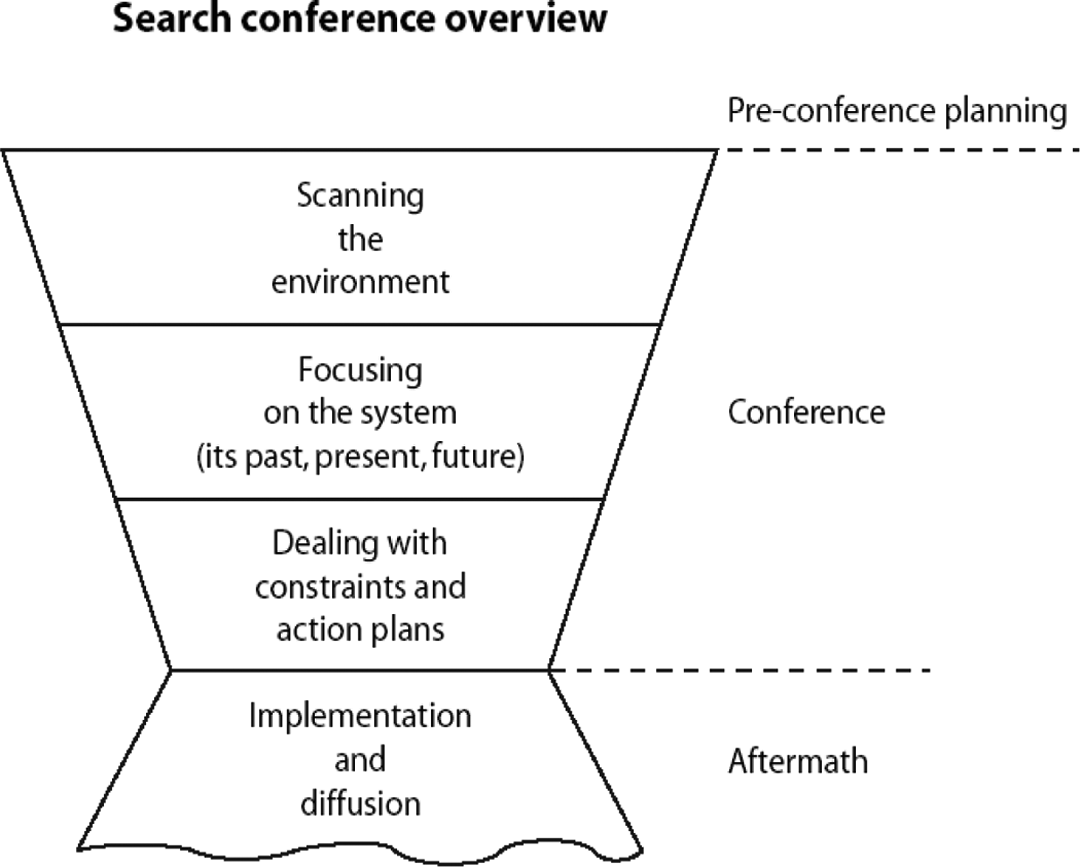
The Search Conference outline.
Hurworth (2007), in her case studies, reported successful implementation of the action plans even 18 months after the event. The reasons for their success were the commitment and ownership of the people who took responsibility for their plans. Jimenez-Guzman (2008) also reported successful implementation of action plans with follow-up meetings and mentoring to encourage and keep people going.
M. Emery and Devane (2007) report three primary SC results: a shared learning process, understanding and motivation, and effective communication. They define visible outputs as (1) goals expressing the vision, with a time frame for achieving them; (2) action plans to achieve the goals; and (3) a community that can actively adapt to changes in the environment.
According to Hurworth (2007), the tool has been successful in various fields, including health, education, business, environment, community-based initiatives, and in development work among aboriginal peoples in Australia. Further, studies and reports from different parts of the world and different settings suggest the SC has the potential to create powerful transformative results (Alvarez & E. Emery, 2000; Concepcion, 1999; Granata, 2005; Jimenez-Guzman, 2008; Pelletier, McCullum, Kraak, & Asher, 2003).
Various aspects of Philippine culture were important considerations in adapting the SC. Hofstede has identified Filipino culture as high on “power distance,” which means the gap between powerful and less powerful is high, but Filipinos value a communal setting rather than individualism. They tend to be short-term oriented, as well as emphasizing face-saving (Hofstede, Hofstede, & Minkov, 2010). Even though, as Yorks et al. (2003) have shown, national cultures are more diverse and complex, they stress the need to develop a theory of team learning for different types of cultures. Jocano (2002) explains that poor people in the Philippines have adapted well to surviving in their adverse situations through a reactive form of learning. This means that people have chosen to adapt their lives, as they do not feel powerful and confident enough to be able to change their situations. For them to be able to become change agents, they need to learn to move from a reactive learning mode to a generative or transformative learning mode. This is possible. As Jocano points out, poor people have dreams of a better life, but just do not see any way to achieve their dreams.
Normally, the SC requires much group writing on flip charts. However, Filipinos have an oral culture. Poor people, especially, find it far more natural, meaningful, and effective to express themselves through stories, drawings, graphs, skits, or role-plays, as opposed to written output. However, during some parts of the adapted SC, writing was necessary and useful to consolidate their work. The success of visual facilitation in large group interventions was also documented and promoted by Tyler, Valek, and Rowland (2006, p. 394). Marange, Mukute, and Woodend (2006, p. 54) point out that using visual and creative means for strategic planning will stimulate both sides of the brain and draw out creativity as well as analytical thinking. This also caters to the Filipino’s more affective mode of relating to reality and their “high context” more holistic cognitive orientation (Maggay, 1993, p. 14), where expression tends to be imaginative and intuitive, rather than analytical and abstract. With adaptation, the SC became a meaning-making experience and as Jocano (1999) mentions, Filipinos in general make meaning together.
Finally, the epistemological principle of the SC of valuing experiential knowledge through a concrete, self-directed, communal, and action-focused approach fits the Philippine urban poor learner well. Kolb (1984) believes “learning is the process whereby knowledge is created through transforming experience” (p. 38). He locates this process in his four-stage experiential learning cycle: moving from a concrete experience, to reflective observation, then abstract conceptualization, and finally active experimentation. All of which are present in the SC.
The SC Method as PAR
PAR, and its accompanying epistemology, provided the framework for the research methodology while the SC was the practical method. The research thus functioned at two levels. The more pragmatic PAR process, in which the researcher facilitated the SC method, was accompanied by study and reflection concerning the use of PAR and the adaptation of the SC as a way of supporting transformative learning. The community was deeply engaged in the SC and somewhat engaged in reflection on their own process of change, though free from academic concerns.
The project collaborated with the “3-E Coop,” the organization involved in this study, in which the entire process from conceptualization through conclusion tying the SC method to the principles of PAR. PAR, according to Greenwood, has three parts: The first, research, creates knowledge; the second, action, uses knowledge to change the situation or address a problem; and the third, participation, employs more democratic processes, whereby people gain control over their lives and their circumstances and take responsibility for the change they create (Greenwood & Levin, 1998, p. 7). The process is rarely linear, often cyclical, and has no time boundary—in some circumstances it could last a week, in others a decade, as it grows and extends to new concerns involving more people.
Since the 1960s, the use of sets of participatory tools has spread among rural poor communities in developing countries. One family of tools, Participatory Learning and Action (PLA), has replaced some of the more text-based exercises of the SC and suggested more participatory ways to gather and analyze data. PLA is a bottom-up approach to development, with participatory tools for analysis, monitoring, and evaluation (Pretty, Guijt, Scoones, & Thompson, 1995) and planning (Halkatti, Purushothaman, & Brook, 2003). PLA evolved from participatory rural appraisal, and earlier, rapid rural appraisal, which built on the work of Chambers (1994) and many others.
The study examined the outputs of the SC, the action plans and their results, and the changes happening within the organization and in individuals, and the reasons for these changes. The results of the whole process were to contribute to a model for strategic planning in a Philippine urban poor organization that leads to transformational learning and tangible change, empowering all involved stakeholders.
The period for the research included 3 months of preparation for designing and planning the SC. The SC itself took 2 days. A final evaluation ended this study 3 months after the SC to see if the actions taken during and after were showing initial signs of success.
This SC, its preparation, and follow-up relied on participatory tools and group discussions. These gatherings produced outputs on flip charts, which were a principal source of data. A group of documenters recorded statements from the dialogues and the reporting parts of the workshops, not captured on flip charts. Further, the whole SC was videotaped. After the event, five participants were interviewed in depth, three longtime members with leadership positions and two new members with minimal involvement. Four were female, one male, and two of the women were micro-entrepreneurs, and the other two, teachers in a community preschool. The man was a truck driver and mechanic. These semistructured interviews were recorded and transcribed. The extent and detail of documentation exceeded that of a typical SC as the larger questions about transformative learning and the potential of adapted methods exceeded the community’s primary interest of strengthening their cooperative to better serve its members and neighbors.
Consistent with PAR, the group collectively processed and analyzed the data, the output of the SC group exercises. The processing and analysis led to new understandings and action. The group activities and participatory tools used for all three stages of the research were main avenues for processing and analysis. Specifically, processing and analysis were dialogical and supported by problem posing, as the group members created new meaning and developed critical consciousness leading to transformation (Gonsalves et al., 2005). The researchers coded transcripts and journal entries, triangulating SC and evaluation outputs with interview data, and observations made from viewing videos of participants. The authors analyzed the qualitative data identifying emergent categories and themes regarding transformative learning. Applying Guba and Lincoln’s (1989) quality criteria, the study emphasizes the trustworthiness of our findings focusing on credibility, fairness, and catalytic authenticity, the extent to which the research stimulated action.
The SC Event: A Transformative Learning Community Emerges
The SC strengthened learning and planning community that fostered transformative learning within a marginalized urban neighborhood in the Philippines. By “a learning and planning community,” we mean people engaged in deeper dialogue, thereby questioning their assumptions about why poverty is so hard to overcome and how the political, socioeconomic, and cultural systems in their local community reinforce the status quo. The process led toward transformational learning individually and communally—and helped them gain power over their world by being able to describe it. Their action plan was the tangible expression of this power.
Though the study was limited to one homogeneous group in the Philippines, observations drawn from this one strong case can inform theory and practice in other settings, particularly in poor communities. Summarizing the process, preparations for the SC started in October 2009. The Conference took place on 2 days during the following February with 18 participants, of which 12 were female, mostly mothers from the two squatter communities, where the 3-E coop operates. The follow-up lasted through the end of May 2010.
Within these boundaries, we observed the emergence of transformational learning and empowerment as our main focus.
The preparation phase itself was a process of dialogue with community leaders to build trust and facilitate creative thinking. We were learning from one another and fostering participation and ownership. During the preparation for the SC, a team of three people, including two Filipinos, who were leaders from the local organization, adapted and detailed each session of the SC by integrating visual participatory development tools to replace or augment some text-based sessions. We still followed the overall design of the search moving from environmental analysis to organizational (system) analysis to integration (action planning). Moreover, we were careful that any modification to the SC did not violate the principles or the conditions laid out by Emery for its effectiveness.
The conference followed the funnel design as people first examined and reflected on the environment in which the organization operates. They named significant changes that had taken place within the last 10 years. They dealt mostly with negative aspects of urbanization like the increase in traffic and air pollution and the decrease in green spaces due to population pressure. They analyzed these changes according to their political, social–economic, and cultural impact. They also drew connections across these themes, as one mother mentioned, “as long as there is no accountability to power in our country, corruption will not stop!” Through dialogue, people came to a better understanding of the complex layers of entrenched injustice that hinder their community’s progress. After this, they imagined probable and desirable future scenarios, which were expressed in photo collages. The probable future scenarios were mostly negative, one group depicting the corrupt government system with a picture of a huge crocodile, which made everyone laugh. These scenarios helped them identify common ideals and create a shared sense of responsibility to work toward a more desirable future, looking mostly at social justice and environmental protections. One participant expressed the sentiment this way, “We must no longer keep quiet about the wrongs in our society! We have to unite and start to bring changes into our families and communities!” (In this case, the participants were talking about the problem of corruption and powerlessness [all quotes from participants have been translated from Tagalog into English]). A young father expressed his discovery, “The visual experience about the possible future, using the pictures from the magazines. It occurred to me right away that we need to protect nature and fight pollution.”
The next phase analyzed the organization. During the first session, participants drew and filled in a time line of their organization; each gave their stories, thereby creating an oral history of the group. Honest and open storytelling uncovered successes as well as failures. A new sense of community emerged and a stronger bond developed among the members, which produced new commitment. One interviewee later described their impressions, “I saw others valued my opinion, and accepted my suggestions. I could join in;” or “…actually I’m a quiet person, but they gave me space and listened to me, even though I’m a new member. I felt welcome to get involved.”
Later, one newer member shared how the history session was the most significant for her in the whole SC, “I won’t forget the history session. I was so impressed about the power struggle and sacrifice people had to go through. They continued, even when they were threatened.” The sense of common history, marked by shared failures and successes, increased trust.
Next, drawing flowcharts helped the group to better understand better the functions and processes within the Coop. This helped people analyze the organization and identify aspects they would like to keep and carry on into the future, to drop or stop practicing, or create new results filling the gaps in their current experience. The participants ended the second phase of the SC by drawing pictures of the desirable future of their organization. From this creative task, where they “dreamed big,” the group identified the three strategic directions discussed below. These were: (1) recruiting new members for the coop, (2) starting new businesses, and (3) starting a composting project for biodegradable waste in the community. As members identified with them, these directions generated further commitment, “I saw that I can be part of something bigger, more meaningful;” or “I can become a change agent through working for a great goal and purpose.”
In the third and final phase of the SC, people planned actions using these three agreed strategic directions. Before developing action plans, they identified constraints to their goals, which would prevent their achieving the directions, and positive forces, which could overcome these constraints. Without any consideration of constraints and the means to overcome them, many participants could be skeptical, estimating that the goals were unrealistic and hold back during action planning. One participant noted, “This is not like other action planning processes where we are ‘boxing the moon.’” This session validated local knowledge and was confirmed subsequently when constraints and positive factors identified during the SC influenced the way action plans were carried out. The participants divided into three action groups according to the strategic directions: (1) recruiting new members, (2) creating new business, and (3) a Zero-Waste program. However, action planning went well for only one group. The others faced difficulties. One group was only able to establish action plans only for 3 months, as they got lost in time-consuming details. The other group was able to brainstorm some ideas, but not agree on which path to take. However, they were confident they would be able to put the 3-month plan into action. As one younger participant declared, “It will be exciting if we can get the action plans for the first three months done.” One middle-aged mother was more cautious, “The plans are good and challenging, but we will need to work together and be committed, if we want to get it done.”
The SC concluded with an evaluation, where people shared what they learned. One older widow explained, “my view of what we can do expanded a lot through this event.” A new member expressed, “I got to know everybody much better and it was encouraging to see the respect and understanding people treated each other with.” This was followed by a closing reflection, underlining the holistic way of learning by including a spiritual component symbolizing each persons’ deepened commitment. As one person remarked, “I was so touched by the closing that I cried, because I became aware of how serious it is what we are doing.”
In March, the board evaluated the event according to the previously identified indicators: (1) level of participation, (2) quality of learning, (3) quality of output, (4) level of commitment, and (5) building of community. Most indicators received a high rating from the group. However, people were more interested in exchanging stories and experiences rather than looking at indicators. They especially remembered the pictures of their shared dreams and the energy created by drawing these pictures, where one board member realized, “Each one of us has a vision, but talking about it and sharing it with others encouraged me a lot!”
Within 3 months after the SC, the action groups became a new substructure of the organization. As the groups started working together and supporting one another, they contributed to refining the action plans. The groups, which had not created plans at the event, took the ideas generated at the SC to build and structure do-able plans and carried out most of them. The new membership group led a workshop in the community. Twenty new people participated and some joined the cooperative immediately. The New Business action group organized an educational trip to a successful cooperative and started a new business selling school supplies. The Zero-Waste action group started a composting project, segregating their kitchen waste and collecting the kitchen waste of their neighbors.
The final evaluation using the “Most Significant Change” tool (Davis & Dart, 2005), helped participants reflect on previous actions, reinforced the process of learning through dialogue, where people shared their stories of what they perceived to be the most significant change since the SC. Some of these experiences were simple, as one mother described how she learned to segregate waste and compost her biodegradable waste, based on a new environmental awareness coming from the scenarios created during the SC. One committee member noted a sentiment held by many, “I am not only excited that we were able to do a lot as a group in a short time, but we also grew as a group to work together!” Further action planning widened collaboration between the groups, for example, in a situation where one action group was struggling, a member from another group helped solve the problem and volunteered to take on one of their tasks.
Promoting Transformative Learning Through the SC
Our adapted SC fostered transformative learning in the aspects of (1) meaning making, (2) communal and individual transformation, (3) holistic learning, (4) validation of local knowledge, and (5) action as learning.
Democratic learning within the organization, using visual exercises supported the process of meaning making (Marange, Mukute, & Woodend, 2006). People mainly created meaning by naming their world (Freire, 1970) through drawing future scenarios, like the crocodile depicting the corrupt system and committing to change through group action. However, as this study emphasizes, in an urban poor setting people make meaning together, similar to Merriam and Ntseane’s (2008) research in Botswana, where people became more aware of being interdependent. It further confirmed that planning helps people find a common purpose in different contexts through creating shared ideals and directions (M. Emery & Purser, 1996, p. 16).
Individual and communal transformational learning took place during the SC as people expressed individual voices or perspectives within small and large groups, while negotiating products for the community as a whole. Henderson (2002) describes the significance of integrating individual and communal learning as a condition for transformational change. It appears that the atmosphere of trust and openness, in which people could collaborate freely, supported this integration (Cranton & Wright, 2008).
People engaged in holistic learning as the activities combined rational learning with affective, intuitive, and spiritual ways of knowing, which are also important for transformational learning (Baumgartner, 2001; Cranton & Roy, 2003; Dirkx, 1997; Marange et al., 2006; Taylor, 1997). During interviews, participants reported experiencing these different dimensions of learning: First, the affective—strengthening internal commitment; then the intuitive—deciding what group to join to use their abilities best; subsequently the spiritual domain—people related the internal commitment to the group goals and their faith. The new sense of community also had a social impact, people started to trust one another, establishing common ground, which is a condition not only for creative collaboration (M. Emery & Purser, 1996) but also for team learning (Yorks, Marsick, Kasl, & Dechant, 2003).
The SC and resulting activities emphasized the validity of local knowledge, in contrast to an overreliance on expert planning. People felt affirmed as knowers, raising self-esteem and self-efficacy. They described a new confidence and strong commitment to carry out action plans. This trust in local knowledge for planning led to action with positive results (Deyle & Slotterback, 2009; Hibbard, Lane, & Rasmussen, 2008). Through this process, people acted as their own educators in a self-directed way, but they did so by staying connected and not working autonomously (M. Emery & Purser, 1996; Merriam & Ntseane, 2008; J. Mezirow, 1991). This was demonstrated throughout the SC. People assessed their environment and described their oppression. They were aware of which strategic direction would be the most difficult to carry out and then put together action plans with this in mind. Nonetheless, putting good plans together was not easy for them.
Participants in this SC also learned in experiential and action-oriented ways. In the self-managing setting, people created pictures and drawings of their situation as well as of their dreams for society as a whole and their particular community. They were actively involved in learning from one another, drawing from each other’s personal experiences. This was confirmed, as one participant stated she had contributed in creating new directions for the organization and had taken on an active role in generating the goals and plans of the SC.
Engaging in action is an important part of transformative learning, not only in the SC (M. Emery & Purser, 1996, p. 96) but also in the framework of the learning organization (Yorks & Marsick, 2000). Planning in this SC was an action-oriented way of learning, in which the participants were deeply engaged. The experience of taking action afterward strengthened and grounded the learning, because action was also followed by reflection (Chettiparamb, 2006). The new individual and collective self-efficacy and understanding described above suggest that the SC challenged assumptions about what future is possible for the organization, thus building hope and confidence, as demonstrated by the participants’ confident expressions about implementing their action plans.
From the start, the SC developed a learning culture by encouraging the organization to deal with and to analyze the environment. Perhaps surprisingly, people from an urban poor setting were able to pick this up from the outset. PLA tools helped people see complex interconnections within the environment that oppresses them. These tools fostered a deeper analysis of the situation and helped develop a critical awareness. Further, they supported the original process of the SC to create a learning community based on Asch’s principles of openness, trust, a shared field, and psychological similarity, confirmed as new members, shared the importance of being taken seriously. Interestingly, as the event progressed, people became more confident in their ability to dialogue and think together, for example, in deciding their future directions together. Participants mentioned several times how they had developed trust by listening carefully to one another plus confidence and unity to move forward. Sharing and gaining respect for their ideas across the group displayed the trust built in such a short time.
The self-managing structure, along with action plans developed by integrating the analyses of their environment and organizational systems, helped people move from reactive responses to active (anticipatory) adaptation. This significant change allowed them to decide on their strategic direction based on their analysis, as opposed to lapsing into a typical problem-solving focus. Visual tools strengthened creative thinking, further stimulating active adaptation (Beard, 2003; Davies, 1989; Marange et al., 2006).
The adapted SC fostered transformative learning and empowerment, which created a planning and learning community within the organization for the time-span of the event. The follow-up seems to have contributed to sustaining the output of the SC, beyond the event through the final evaluation. With outputs, we mean not only the action plans but also the creation of a learning community, as one member observed their growth as a community by implementing the plans. Though this study did not compare the original text-based SC with the adapted form, the data seem to suggest that using the adapted form of the SC was a better “fit” for the Philippine urban poor communities’ context than using the more text-based design. The visual exercises generated more excitement, creativity, and dialogue, not only about the content but also about the process of bringing the product to life, as the board members still talked about their drawings during the evaluation 2 weeks after the event. The exercises also supported the “liberating structure” to facilitate transformative learning in the SC (Yorks & Marsick, 2000), because people were self-managing in generating the images and other creative works. This responded to the kinesthetic learning style of Filipinos, as well as the emphasis on stories and narratives in oral and collective cultures which enhances group learning according to Yorks et al. (2003).
In these aspects, the SC facilitated what Yorks and Marsick stress in their framework for transformative learning in organizations: Learners develop a critical engagement with their organizational and social world, increasingly recognizing that the existing state of affairs does not exhaust all possibilities and arriving at alternative courses of action. (2000, p. 276)
Finally, it appeared that the different aspects of learning in the SC were connected and dependent on each other. The principles of the SC, as well as its unique design, supported the connecting of different forms of transformative learning and reinforced the same.
Our questions for further consideration are (1) How can transformative learning be sustained, strengthened or integrated in the fabric of urban marginalized communities (beyond the Philippines) and what impact will it have? What other innovative tools are suitable for supporting transformative learning in these contexts? (2) By conducting modified SCs in more communities, it would be possible to confirm, strengthen, and expand the method’s connection to transformative learning. More work is essential to further support the formation of theory for transformative group learning in marginalized communities, and (3) how can robust critical learning practice influence the evolution of cognitive-oriented theories of transformational learning?
Footnotes
Declaration of Conflicting Interests
The author(s) declared no potential conflicts of interest with respect to the research, authorship, and/or publication of this article.
Funding
The author(s) received no financial support for the research, authorship, and/or publication of this article.