



Abstract
This article discusses the theory and practices associated with a methodology for leadership capacity development that utilizes Collaborative Developmental Action Inquiry to support adults in understanding the connections between transformative learning and adaptive leadership. Discussion is focused on transformative learning, ways of knowing, or action logics and single-, double-, and triple-loop learning.
Introduction
We live in turbulent times: volatile, uncertain, complex, and ambiguous (Kinsinger & Walch, 2012). The lingering depression of the world economy, the catastrophic results of climate change, and the instability and ineffectiveness of political and social institutions around the globe have strained any sense of security, even in the developed world. The impacts of these conditions are felt in corporate settings, nonprofit, political, and nongovernmental organizations. Even the long stable higher educational sector in the United States, the setting in which both authors work, has been so destabilized by disruptive circumstances and intense competition that institutions are beginning to take desperate measures. These conditions have been compared to the kind of evolutionary challenges that demand profound adaptation in order for survival (McIntosh, 2012). We need not look beyond today’s newspaper headlines to understand that the way we have been handling global and local challenges is inadequate, often leading to repetitive cycles of dysfunction and escalating crisis. Truly transformative approaches to the conditions of early 21st-century life demand a quality of leadership, learning, and creativity that largely lies beyond our current capacity (Kegan, 1994). We propose a methodology that builds the capacity for the type of learning needed for leadership today. In this article, we will further describe the characteristics of the kind of adaptive leadership necessary to meet these evolutionary challenges (Heifetz & Linsky, 2002; Heifetz, Linsky, & Grashow, 2009) and explain how Collaborative Developmental Action Inquiry (CDAI; Torbert, 1991, 1999, 2003; Torbert & Associates, 2004) provides a theoretical foundation and practical means upon which to build both capacity (complexity of meaning making) and competence (skillful means) for transformative learning. This theoretical foundation and the practices associated with it are of particular value to leaders across sectors, leadership educators, executive coaches, and organizational development professionals.
The Current Context: Accelerated Change, Growing Complexities, and Increasing Interdependence
Due to the powerful, dynamic, and systemic nature of the evolutionary challenges described previously, we suggest that there is barely any sector of society that is entirely exempt from these forces and that the need for increased developmental capacity, transformational learning, and adaptive leadership is being felt globally and across life and work domains. The 2013 findings of the Organization for Economic Cooperation and Development (OECD, 2013) survey of Adult Skill highlight this interdependence. “The way we live and work has changed profoundly—and so has the set of skills we need to participate fully in and benefit from our hyper-connected societies and increasingly knowledge-based economies” (OECD, 2013, p. 3). The report discussed three types of skills adults 1 need to make the most of their potential. These skills include literacy (the ability to develop one’s knowledge and potential), numeracy (the ability to access, use, interpret, and communicate mathematical information and ideas in order to engage in and manage a range of situations in adult life), and problem solving in technology-rich environments (the ability to solve problems for personal, work, and civic purposes in technology-rich contexts). 2 In the context of our life and work, adults are asked to more skillfully apply what they know and to intentionally continue lifelong learning in order to meet the profound changes of these times (OECD, 2013). The types of complex change and the challenges that adults face require the skillful means discussed previously and include types of learning liberated from habituated ways of knowing and acting (Mezirow, 2000). Our individual and collective capacities to act in a constructive, transforming manner will demand an evolution of the way we learn and the way we lead.
In his recent work, Senge, Smith, Kruschwitz, Laur, and Schley (2008)described how leadership in these complex and challenging times is about creating capacity for adults to shape the future they desire, individually and collectively. This capacity building requires the kind of inquiry that helps us unlearn the old assumptions and biases that obstruct our discovery of shared purpose and to learn the means to enact new collective visions. Heifetz, Linsky, and Grashow (2009) describe this as the challenge of recoding the old DNA that has structured and determined our past ways of proceeding. Essentially, both Senge and Heifetz are making the case for not only single-loop learning that would help us learn to improve performance at an increasing rate but also double-loop learning that helps us learn how to inquire into our assumptions and the mental models governing our actions (Argyris & Schön, 1974; Tosey, Visser, & Saunders, 2012). We will illustrate that in addition to single- and double-loop learning, the challenges we face demand triple-loop learning, or what Bateson (1973) described as Learning Level III, “learning as corrective change in the systems of sets of alternatives from which choice is made” (p. 272). Triple-loop learning is a type of learning grounded in our being, from which emerges the volitional choice that aligns knowing and doing (Bateson, 1973; Torbert, 1991, 2003; Torbert & Associates, 2004; Tosey et al., 2012). We suggest that triple-loop learning involves a figure ground shift of being that opens up degrees of freedom from self- and collective identifications (subjective and intersubjective egoic attachments); that opens individuals and groups to multilateral agendas; and that creates the possibility for expanded creativity, deeper innovation, and self-/collective transformation. And so, we ask what are the methods and practices needed to develop our capacity for transformational learning and adaptive leadership? Essentially, how do we help build adaptive capacity to lead in the face of evolutionary challenges?
Adaptive Leadership
When we use the term “adaptive leadership,” we refer in particular to the work of Ronald Heifetz and his colleagues at Harvard University’s Kennedy School of Government. Heifetz uses this term to distinguish a mode of leadership oriented toward the engagement of complex challenges—challenges that do not have conventional solutions or that are nonetheless new to the stakeholders facing them. Unlike technical challenges that have a clear problem definition and can be resolved using existing methods, tools, and the exercise of traditional authority, adaptive challenges such as the aforementioned require unlearning old assumptions and attitudes and learning new ways of knowing, doing, and being (Heifetz, 1994; Heifetz & Linsky, 2002; Heifetz et al., 2009). Once leaders have first diagnosed the degree to which the problems they face include both technical and adaptive challenges, then on the basis of that diagnosis, they work to mobilize people to tackle tough challenges and make necessary changes in the direction of their thriving (Heifetz et al., 2009). This mobilization does not happen on the basis of a conventional exercise of authority from the top down but rather requires a shift in mind-set that redefines traditional notions of leadership and distributes authority to all key stakeholders, often across multiple systems (Senge, Smith, Kruschwitz, Laur, & Schley, 2008).
Unlike any model of leadership that can be encapsulated by a list of personal characteristics, or a predictable set of procedures and practices, the best analogy for adaptive leadership is the educator who calls for learners to discover, invent, and take collective responsibility for their situation (Argyris, 1976; Heifetz, 1994). “Leadership is a special sort of educating in which teachers raise problems, questions, options, interpretations, and perspectives, often without answers, gauging all the while when to push through and when to hold steady” (Heifetz, 1994, p. 244). As John F. Kennedy wrote in his undelivered speech to the Dallas Citizens Council, “leadership and learning are indispensable to one another” (November 22, 1963), and we suggest that leaders must serve as the “chief learning officers” of their organizations. As learners, leaders must practice a kind of inquiry that reframes problems in such a way as to invite curiosity and exploration rather than reactivity or automaticity and that questions prevailing assumptions about the way things should be or the way that we should respond. Leaders must at times help their constituencies unlearn outmoded or habituated ways of construing opportunities or challenges, and at times, help them toward innovation by pushing against cherished belief or culturally embedded assumptions.
Obviously, this way of leading requires leaders to bear intense resistance to change and personal attacks, without losing a sense of the bigger picture or jeopardizing the emerging vision. Heifetz describes how leaders need to balance intense action with the practice of constant perspective taking and reflection using the analogy of moving from the dance floor to the balcony (Heifetz, 1994, p. 252). It is by going to the balcony that a leader is able to gauge gaps between goals and current performance, to diagnose and interpret patterns of distress or resistance, explore and evaluate assumptions and mental models, and discover related patterns across multiple embedded systems. It is also from the balcony that leaders rediscover their sense of purpose and reorient themselves when overwhelmed with confusion or uncertainty. While Heifetz does not use the language of single-, double-, and triple-loop or transformative learning, we suggest that this is the kind of learning he portrays in this balcony metaphor. The process of this in-the-moment inquiry, perspective taking, interpretation, and decision making requires considerable cognitive capacity, developmental maturity, and practiced discipline (Torbert, 2003). The question of how one acquires capacity for adaptive leadership entails further consideration of ways of knowing, processes of learning, and of CDAI.
Adaptive Leadership Requires Transformative Learning and Inquiry in Action
While single-loop learning, the level of learning and behavioral adaptation that bring about more effective performance, might in some cases be enough to survive elements of the current challenges we face in society, in our professional communities and the organizations we serve, double- and triple-loop learning are increasingly necessary to adapt and thrive. For example, in a case that will be developed later in this article, early career scientists entering a governmental health care agency are expected to participate in collaborative cross-disciplinary teams without any previous experience in how to work, learn, and lead such groups. When these scientists find themselves at a loss, and anxious about meeting performance goals, they often resort to what has worked in the past and to exercising expert power based on their technical knowledge, rather than opening themselves to the new challenge and learning their way through together. This experience of being thrown into the deep end of collaboration often ends in unintended early departures from the agency (Banerjee, 2013). In light of this, transformative learning is essential for leaders and their fellow stakeholders to transcend the limits of informational and behavioral single-loop learning. In order to foster the conversion of strategies, goals, and guiding intentions entailed in double-loop learning and to reach the level of volitional freedom, what we are calling the figure ground shift of being necessary for triple-loop learning (Argyris & Schön, 1974; Bateson, 1973; Torbert, 1991,1999, 2003; Torbert & Associates, 2004; Tosey et al., 2012), specific conditions and practices are needed. Such conditions and methods are associated with what is known as “transformative learning” (Mezirow, 1990; Mezirow & Associates, 2000).
Transformative learning brings together two distinct and yet interconnected conceptual frameworks: educational theories of adult learning (Knowles, 1976; Kolb, 1984) and the psychological theory of constructive developmentalism (Kegan, 1982, 1994, 2000). According to Mezirow and Associates (2000), “transformative learning refers to the process by which we transform our taken-for-granted frames of reference (meaning perspectives, habits, or mind-sets) to make them more inclusive, discriminating, open, emotionally capable of change, and reflective so that they may generate beliefs and opinions that will prove more true or justified to guide action” (pp. 7–8). This is precisely the kind of learning needed in the process of adaptive change, yet it will not occur without sufficient capacity and conditions in place. Constructive developmental theory (Belenky, Clinchy, Goldberger, & Tarule, 1986; Kegan, 1982, 1994; Kohlberg, 1984) attends to the natural evolution of the forms of our meaning making. There is an interdependent relationship between developmental capacity and transformative learning, such that double-loop learning both requires and builds cognitive capacity. This interdependence means that one’s developmental way of knowing may determine whether one has the capacity to do transformative learning or at least to do it with some facility; at the same time, it suggests that transformative learning can promote developmental growth (Kegan, 2000).
While adaptive leadership requires transformative learning and depends on mature developmental capacity, unfortunately, many contemporary leaders are still working on the basis of assumptions drawn from a traditional command and control notion of authority. Argyris’ (1976; Argyris & Schön, 1974) work is still highly relevant here, as he describes two models of “theory-in-use” that emerged from his research observing leadership behaviors of executives. Model I theories-in-use were found to be consistent with four governing values: (1) achieve purpose in a unilateral fashion, (2) win, do not lose, (3) suppress negative feelings, and (4) emphasize rationality (Argyris, 1976). One of the most salient findings from Argyris’ (1976, p. 19) study was that primary “behavioral strategies are to control unilaterally the relevant environment, the tasks, and to protect themselves and others unilaterally”. Given that these strategies are rooted in deeply held values for maximum control, predictability, and security, they tend to produce defensiveness in people and undermine effective change because such values do not produce the valid feedback that invites timely action (Argyris, 1976). Such a model of action is incapable of leading to adaptive change.
Given the counterproductive nature of Model I theories for leading in current complexity, what conditions will increase the likelihood for the double-loop or transformational learning required for adaptive leadership and change? Model II governing variables are not opposite to Model I, but rather, they invite a process for a transformed epistemology described as (1) availability of valid information, (2) free and informed choice, and (3) internal commitment (Argyris, 1976). These variables are consistent with Mezirow’s (Mezirow & Associates, 2000; Mezirow, Taylor, & Associates, 2009) conditions for transformative learning; learning that reforms our frames of reference and meaning making. Model II does not preclude Model I goals for solving problems; however, Model II emphasizes processes of learning that involve sharing power with anyone who has competence and who is relevant in decision making or in implementation of action plans. This model describes the conditions adaptive leadership and change, as outlined by Heifetz (1994), and involves mature individual and collective capacity for collaboration.
How Do We Get There From Here?
Argyris’ research suggested that since Model I assumptions about unilateral control are more common, leaders and organizations need bridges to help them cross over into the learning approaches, logics of action, and models of authority described in Model II. One such bridge is Torbert’s CDAI (1991, 1999, 2003; Torbert & Associates, 2004). Torbert (1991) builds a theory of single-, double-, and triple-loop learning and takes into account the difficulty and risk involved in transforming our ways of knowing, what he calls developmental “action logics.” In light of theories of psychological development such as constructive developmental theory (Kegan, 1982, 1994, 2000), ego maturity (Loevinger, 1976), and moral development (Gilligan, 1982; Kohlberg, 1984), Torbert suggests that adults can develop their capacity for double- and triple-loop learning by engaging in practices that simultaneously promote their growth in cognitive capacity and their levels of learning, reflecting, and adapting in action.
Torbert’s (1997, 2003; Torbert & Associates, 2004) model of CDAI identifies three main units of experience: the first person (subjective), the second person interpersonal (intersubjective), and the third person (objective and systemic). Based on principles of action research (Chandler & Torbert, 2003; Lewin, 1997; Reason & Bradbury, 2001/2006) and action science (Argyris & Schön, 1974), CDAI proposes a means of personal, interpersonal, and organizational development that integrates inquiry and action. More specifically, CDAI directs attention toward gaps that exist between individual, team, and organizational intentions, strategies, actions, and outcomes using feedback loops of learning and adaptation. Each successive loop requires a greater level of developmental capacity to initiate, learn through, and to close/complete.
As Figure 1 (see subsequently) shows, single-loop learning identifies how gaps between action and outcome might be closed through changes in the intensity, rate, or manner of behavior used to achieve a goal. An individual, team, or organization may inquire: Could I achieve my intention by changing the rate, pace, volume, or intensity of what I am doing? Or what my organization is doing? Am I following the guidelines, protocols, or instructions correctly? Are my tactics aligned with my strategy? Did I miss a step? Did I ensure that I established the facilitative conditions needed for success (environment, resources, timing, motivation, sense of urgency, etc.)? Can I achieve my intention by enlisting help or other resources that I had not considered previously? Do I have the people with the right skills working in the right roles? Is there a way I can modify my performance to bring about better results? How might inaction be a better form of action?
Double-loop learning inquires into the assumptions that guide the development of strategies/design plans, which requires greater awareness and a more challenging degree of learning to surface, understand, and revise those assumptions. An individual, team, or organization might inquire: What is my strategy for achieving my goal? What are the assumptions that my strategy is based on? Are these assumptions based on data or upon beliefs? Is the data timely? Is it accurate? Is my perspective, assessment, or problem diagnosis in need of more or better information? Are there any key stakeholders missing from the conversation? Given the complexity of conditions or relationships that I am facing, am I framing things from a dualistic (either/or) or dialectical (both/and) perspective? Are the conceptual frameworks I am employing adequate for interpreting my situation? Might they be filtering reality in a way that is not helpful? Do I suspect I might have some blind spots or hidden biases worth exploring? For instance, might there be a systemic or structural reality that is manifesting “locally,” but which must be managed in a comprehensive manner? Am I/Are we working on the basis of tacit norms that need reconsideration? Are there covert dynamics at play that require illumination? For example, is there unspoken competition at work? Are there political tensions exerting influence? Might there be defensive routines at play that are subverting my/our intention? Is there an unspoken yet unproductive reality that must be named (an elephant in the room?)?
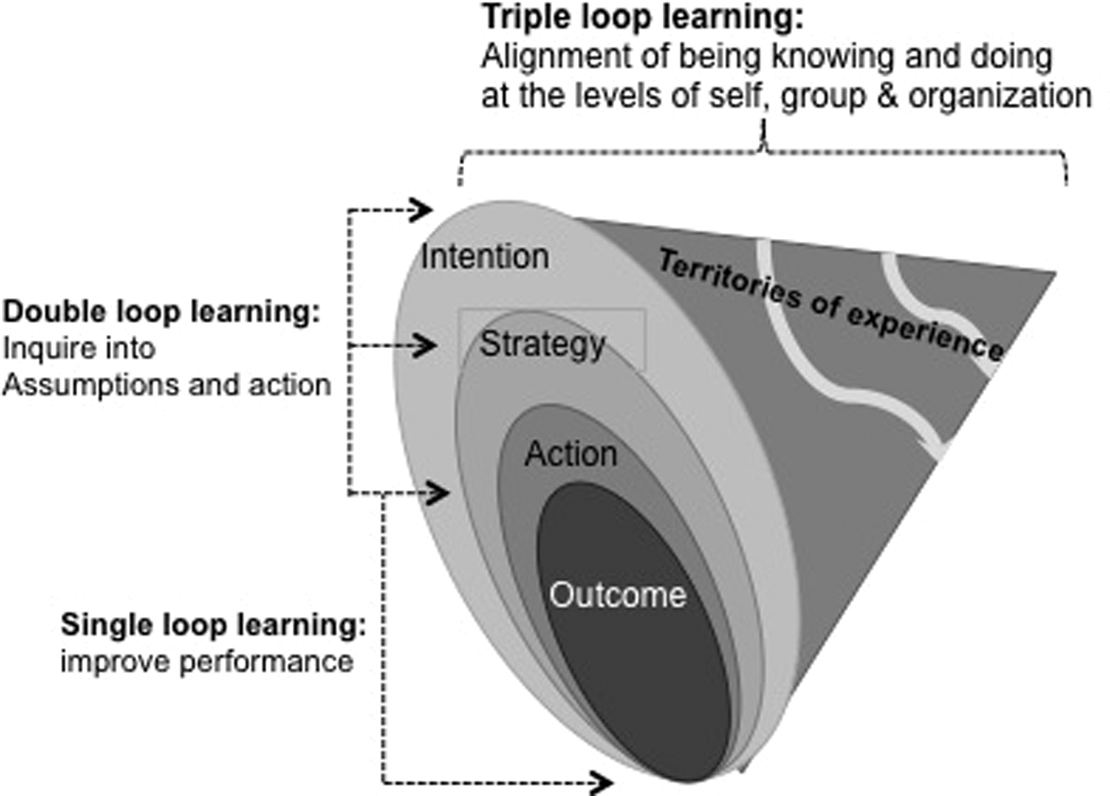
Triple-loop learning.
Triple-loop learning involves unpredictable and uncontrolled learning (Yorks & Marsick, 2000; Yorks & Nicolaides, 2013). Such learning is governed at first by the unconscious and aesthetic dimensions of our being guiding how we know and how we choose to act (Bateson, 1973; Bateson & Bateson, 1988; Tosey et al., 2012). In the field of organizational development, triple-loop learning has been the subject of many years of research and theory building (Flood & Romm, 1996; Isaccs, 1993; Romme & van Witteloostuijin, 1999; Snell & Clark, 1998; Swieringa & Wierdsma, 1992; Tosey et al., 2012; Yuthas, Dillard, & Rogers, 2004), and yet it is difficult to find good illustrations. One way to bring some descriptive detail to triple-loop learning is by deepening our understanding of ontology, the nature of our being. Our logic follows that if the single loop of inquiry and adaptation is focused on the nature of “doing”—of how we are attempting to accomplish our goals, and double loop inquiry and adaptation is focused on “knowing” what the right goals are, which includes the mental models and assumptions undergirding our strategies, then triple-loop inquiry and adaptation occurs at the level of our being—the volitional will to consciously reshape our intentions, purposes, and motives. (Bateson, 1973; Torbert & Associates, 2004; Tosey & Matheson, 2008). An individual, team, or organizations might inquire: What do I/we feel is my/our purpose? What is taking shape as I let go of my instrumental knowing or even my transformational intention? Is the goal unilateral or multilateral? Is the goal at stake in service of a greater whole? How do I/we serve others now? Is my quality of presence charged with the right energy to communicate my intention, my commitment, and my desire? Am I exercising the kind of sincere and humble power to achieve my/our goal? Do I sense how I fear loss of control, of my habitual way of knowing or even my identity? Am I willing to stand still in this vulnerability? Is there courage in this organization to change its very way of organizing? How am I offering energy for that? Or am I resisting that level of change? What are the subjective and intersubjective egoic attachments impeding freedom for creativity, innovation, or transformation (e.g., what am I holding back? What am I holding onto?)
As discussed previously, each of the inquiry loops of learning and adaptation (i.e., single, double, and triple loop) can occur in the three main units of experience (Chandler & Torbert, 2003), namely the first person (subjective experience), second person (interpersonal experience), and third person (objective experience). In Figure 1, we attempt to capture the dynamics of the loops of learning as they engage each level of experience. The figure captures the distinction of triple-loop learning as an integration of single- and double-loop learning, a “figure ground” shift from one’s epistemology (way of knowing) leading action and learning to one’s ontology (way of being) governing our choice in knowing and doing (Bateson, 1973; Nicolaides, 2008; Tosey et al., 2012). The implication of triple-loop learning as illustrated previously is the capacity for timely choice in knowledge and action, responding appropriately to the conditions and challenges at hand. In essence, choice emerges while we pause even for a moment on the reflective “balcony” to discern the right action on “the dance floor.” We assert that CDAI is a method that develops the capacity for timely single-, double-, and triple-loop learning. This means that an individual and group could use CDAI to evaluate the gaps between his, her, or their goals and the outcomes of his, her, or their actions, identifying whether or not the gap was caused by issues at the level of behavior/performance (single loop), at the level of design/strategies (double loop), or at the level of being, which would involve a spontaneous and conscious reshaping of intentions, purposes, and motives—what Bateson (1973) referred to as a union of knowing, doing in being—(triple loop).
The Practices of CDAI and Adaptive Leadership
In the past, the use of sophisticated learning loops for reflection on experience might have been sufficient for leading change in a slower paced and less complex milieu; however, current conditions require a moment to moment capacity to switch attention from experience of the dance floor to the balcony view, as Heifetz points out (Heifetz, 1994; Heifetz & Linksy, 2002; Heifetz et al., 2009). Practices that enhance our capacity for transformational learning, or double-loop learning, are essential for engaging with the challenge of leading from the balcony and the dance floor. Adaptive leadership demands a consistent willingness to engage with transformational types of learning, leading to double-loop insights and adaptations in knowing and doing. In addition, opening to triple-loop learning at the level of being transforms choice in action by creating freedom for an expanded range of intentions, a wider inclusion of stakeholders, a more multilateral agenda, and deeper innovation. CDAI can function as a practice to increase adaptive leadership capacity by intentionally developing the skillful means to recognize and diagnose the right action for informational knowledge through single-loop learning, build facility for double-loop learning, while also increasing the potential for triple-loop learning. To attain and sustain these levels of meaning making and learning in action, a leader recognizes and remains in relationship with (1) intuition, intention, and attention; (2) critical and strategic thinking; (3) vigilant and meaningful actions; and (4) impacts, outcomes, and feedback (Torbert, 2003). In the short case that follows, we describe the findings of an extensive action research project that illustrates individual and collective single-, double-, and triple-loop learning. We illuminate how the method of CDAI facilitated, over a period of 12 months, the capacity of a group of early career scientists to respond to the adaptive challenges they faced at a large governmental health care agency.
In a large, governmental health care agency, a group of early career scientists participated in a yearlong CDAI learning program. The group included seven early career scientists, five late career scientists who were mentors or supervisors to the seven early career scientists, one director of educational programming at the agency, and two coresearchers, one who worked within the agency as a deputy director of educational programming and the other as an external leader educator. The group convened 17 times over the course of 1 year in several configurations; the entire group, the early career scientists, the mentors and supervisors, and two coresearcher/educators. Three findings emerged: The first showed that CDAI provided a method for participants to learn how to name and recognize the adaptive challenges they faced. The second finding had three parts: (a) that CDAI helped create a protected space for connection among the participants across unit and role boundaries; (b) a developmental approach for exploring the implications of meaning making of individual and collective choice in action; and (c) ways to distinguish types of learning (single, double, and triple loop) that grew their individual and collective capacity as well as the skillful means to respond to the adaptive challenges they faced. The third finding was that CDAI created a micro space for sustained transformational learning and the practice of adaptive leadership over a period of time. This adaptive leadership resulted in an unprecedented, agency-wide forum that covered people from all levels of the agency, beyond the agency, and across disciplines. The impacts of this CDAI took shape beyond the agency and resulted in the development of a new educational research partnership with an economics department at a leading university in the region. At the agency level, the findings are informing the reorganization of the educational programming unit. At the individual level, two of the early career scientists have been hired by prestigious policy-making agencies; one scientist realized that his passion is in education-based research and was invited to lead a research program at a prestigious regional institution of higher learning, and the four remaining members have accepted offers for positions at the agency. 3
The results of this action research project using CDAI as its method of learning and change demonstrates impacts at both the individual and collective levels. Individual double-loop learning is illustrated through the professional placement of the scientists within the agency, beyond the agency, and in a completely different discipline. Collective double-loop learning is evidenced in the unprecedented organization of an intra-agency forum unsanctioned by the hierarchy of the agency and through important impacts beyond the agency as evidenced by the establishment of a new agency–university partnership. Triple-loop learning, the figure ground shift of being that opens up a new range of choices and creates the possibility for ongoing innovation and transformation is evidenced at the educational program level where the director of the unit has initiated a unit-level reorganization that integrates practices of CDAI to inform the change process.
Increasingly, the complex and fast changing conditions that leaders face in their organizations and social contexts require processes for sustained transformational learning. CDAI is one such method that integrates informational single-loop learning, sustains connection to transformational double-loop learning, and encourages the figure ground shift of triple-loop learning. These capacities are described concisely as having a “re-framing spirit” (Torbert, 2003, p. 164) that creates the possibility for ongoing adaptation and self-transformation. As we illustrated in the short case previously, CDAI is a method that intentionally generates the conditions and a “space” for developing the capacity for a reframing spirit.
Conclusion
In this article, we propose that the volatile, uncertain, complex, and ambiguous conditions of the early 21st century require transformational learning and adaptive leadership across sectors. The skills of early 21st-century life, work and civic engagement demand that adults have the capacity to apply their knowledge, continuously learn skillful means for applying their knowledge to meet the complex demands they face. According to the OECD 2013 report, learning how to learn is a critical 21st-century skill (OECD, 2013). CDAI is a method to intentionally develop the capacities that adaptive leaders must develop. Such skills as the capacity to reflect and act with an agility evident in the decisions they make, the stakeholders they convene, and the collective responses that they cogenerate with partners across systems are essential. This theoretical foundation and the practices associated with it are of particular value to leaders across sectors, leadership educators, executive coaches, and organizational development professionals.
Adaptive leaders are challenged to regularly engage in single-, and double-loop learning and to sense when triple-loop learning is needed in order to generate greater degrees of freedom for choices in how to respond to complex challenges. We propose CDAI as a method for creating spaces of inquiry (transformational learning) and that the reframing spirit of adaptive leadership helps to transform the old DNA of leaders and build individual and collective capacity for creative future building.
Footnotes
Authors’ Note
A version of this article was presented at the International Transformative Learning conference in Athens Greece in 2011.
Declaration of Conflicting Interests
The author(s) declared no potential conflicts of interest with respect to the research, authorship, and/or publication of this article.
Funding
The author(s) received no financial support for the research, authorship, and/or publication of this article.