




Abstract
In this article, we take a retrospective look at a workshop where Jasna, a nurse educator, was a participant, and Kathy, a preservice teacher educator, was both a participant and the facilitator of an artful inquiry process she calls co-creative writing. By putting forward our stories, we share our experiences as well as contribute to ongoing discussions on the value of engaging in cocreative arts-based approaches to enhancing transformative learning. More specifically, we engage in a critical reflective dialogue to illustrate how the process of making art together can create space for transformative learning and thus help to deepen our understanding of our teaching–learning relationships. Particular attention is given to organic collaborative artistic processes and how they support dialogue, encourage critical reflection, nurture authentic relationships, and foster creative and expressive ways of knowing and being, as well as a more holistic orientation toward transformative learning.
Prologue
It is cloudy and damp on this Saturday morning in late October and I have just entered the grounds at the Geneva Park Conference Centre in Orillia, which is just north of Toronto, Ontario, in Canada. I sense that I have entered a sacred place; this location was not an accident. The theme for this year’s conference is “Soulful Spaces: Transforming Self/Transforming the World.” Its purpose is to explore holistic learning as a process that engages body, mind, emotions, and spirit. Since the conference theme spoke to me, I felt compelled to participate in some way and offered conference goers the opportunity to participate in a workshop entitled, “Connecting, Learning and Transforming Through Co-creative Processes, activities and Emerging Artful Forms.” After I find the room where I will be facilitating my workshop, I begin to carry in all the art materials—safely packed in boxes and bags. It takes me several trips to unload them from my car. Once this is done, and while I wait for the current session to end, I sit at a nearby table in the dining area, sip on warm coffee and review my workshop notes. After years of being a teacher, artist-researcher and now, most recently, a pre-service teacher educator in art education, I have come to know that beginnings are critical to all processes, including teaching, learning and artmaking. I have, therefore, put a lot of thought, as is evident in my workshop facilitation notes, into how I will begin and the overall flow of the workshop—even though I know its unfolding is determined to a great extent by the participants themselves, as well as the direction in which the emerging art images wish to move. As soon as most of the participants from the previous workshop wander out, I carry in all my workshop materials and art supplies, and begin to transform the room, which I see for the first time, into a studio-like space. I want the room to feel welcoming. It is a very physical process and I work quickly and intuitively. I am both excited and anxious; this is the first time I will be facilitating this process in an unfamiliar space for participants I do not yet know, within a seventy-five minute time frame. I begin to wonder if this will be a meaningful learning experience for the participants. I conclude that it will be difficult to know for certain, especially in the context of a workshop where participants are moving rather quickly from one session to another with a limited opportunity for follow-up discussion. (Kathy’s reflective vignette, March 2010)
Introduction
Although it is difficult to know the influence of an arts-based workshop on the learning experiences of the participants, and the facilitators, we understand the ongoing nature of teaching–learning and recognize that we are all at the same time both teachers and learners. We are both arts-informed practitioners who have discovered that by infusing the arts into our practice, we can create spaces that foster transformative learning. In this article, we, from the standpoint of learners, take a retrospective look at an arts-based workshop where Jasna, a nurse educator and an arts-informed Narrative Inquiry researcher, was a participant and where Kathy, a preservice teacher educator in art education and an arts-informed researcher, was both a participant and the facilitator of an artful inquiry process she calls cocreative artmaking (Mantas, 2004, 2007, 2012; Mantas & Di Rezze, 2011; Mantas & Miezitis, 2008).
By engaging primarily in a crucial reflective dialogue, we demonstrate how the process of making art together—an arts-based approach—can create opportunities for transformative learning to occur. For us, transformative learning is closely aligned with a more holistic understanding and practice of the teaching–learning relationship and the environment. Therefore, like Dirkx (cited in Dirkx, Mezirow, & Cranton, 2006), we believe that “[t]his view suggests a more integrated and holistic understanding of our subjectivity, one that reflects the intellectual, emotional, [embodied, social,] moral, and spiritual dimensions of our being in the world” (p. 125).
More specifically, we reveal through our reflective dialogue how cocreative artmaking, supports dialogue, encourages critical reflection and nurtures relationships (McNiff, 2003; see also Bickel et al., 2010; Bickel, McConachy, Jordan, & Bartley, 2011; Di Rezze & Mantas, 2006; Mantas & Miezitis, in press). Also, it encompasses a holistic orientation to transformative learning which is complemented by more imaginative, emotive, intuitive, soulful, creative, and expressive ways of being and knowing (Allen, 1995, 2005; Butterwick & Lawrence, 2009; Dirkx, 2001a, 2001b, 2006b; Green, 1995; Greene, 1978; Knowles & Cole, 2002, 2008; McNiff, 1998, 2004; Moore, 1994, 1996).
In what follows, we share with you parts of our dialogue, presented here in three dialogue fragments, the cocreated image and concluding reflections on the experience. By putting forward segments of our conversation, we hope to contribute to the ongoing discussions on the value of engaging in arts-based approaches to transformative learning. Also, we wish to make aspects of Kathy’s cocreative artmaking process more explicit for others who might consider making art in this way. Additionally, we hope to encourage other educators in professional programs to think about embracing arts-based approaches in their practice and ongoing personal and professional learning, as we see the two, personal/private and professional/public, as inseparable.
Staying with the essence of cocreative artmaking—making art with others through an organic artistic and creative process—we invite you, the reader, to come along as co-inquirers, as we explore the ways in which this creative activity can deepen our understanding of its transformative nature in our teaching–learning situations. Perhaps a story, a question, a metaphor, an image, or a different way of looking at and/or approaching creative processes that are artistic in nature will arise for you in the process (Mantas, 2004).
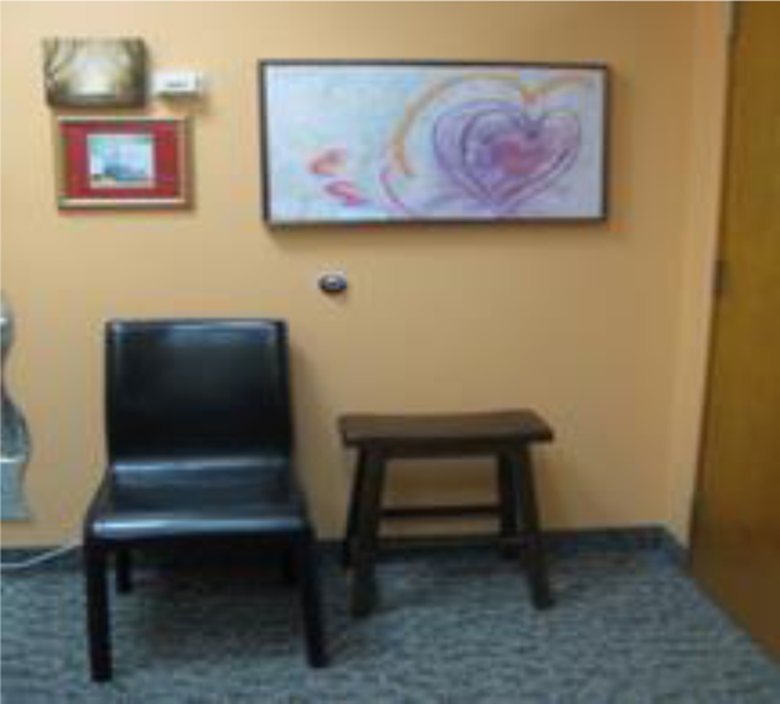
Jasna Schwind's university office. Photograph by Kathy Mantas, 2012.
Dialogue Fragment I: On Creating a Studio-Like Space for Transformative Learning
I arrived to your workshop early and was in the room when you were setting up. Can you say a little more about this part of your process?
Since I believe that the space has a fundamental role to play in the creative process I spent a lot of time, prior to the conference, thinking about how I was going to transform the conference room into a studio-like space. I had only 15 minutes to do this, therefore, I worked quickly and intuitively to make the necessary changes. For me, a studio-like space has to be welcoming, comfortable, and safe for risk-taking, if it is to be supportive of creative processes and artistic exploration. It must also be inclusive and accepting of everyone’s prior experiences with art and artmaking. Here I am talking about learners who are open to more artistic and creative ways of knowing, as is often the case with workshop participants who choose to be there. I also think of those individuals who come into a learning space with prior “mis-educative” (Dewey, 1938, p. 25) experiences with art and are sometimes there because they have to be there and not because they choose to be there, as it may be the case in a classroom and/or a mandatory program course.
Essentially, as an adult educator, I desire learning spaces that value the cultural knowledge both students and teachers bring to the classroom (Dubose Brunner, 1994) and spaces where both the learner and the teacher can bring the fullness of who they are to the teaching–learning relationship. I yearn for more learning experiences, for learners and teachers who provoke us to see each other, ourselves, our creations, and our world with more wonderment, revelry, and enchantment. I often wonder what kind of teaching–learning relationships and experiences would unfold, if we were to visualize the classroom as an art studio—as a space where artful learning (creative, imaginative, intuitive, and soulful in nature) finds a safe space to take form? What would happen if we made a conscious effort to create studio-like spaces for learning that revere the complexity, uncertainty, and messiness of everyday life, living, and learning (Dirkx, 1997)? Like McNiff (1998), “I envision the studio [and the studio-like classroom] as a nucleus of creation, a source from which creative expression flows outward to other areas of life and the place to which it returns again” (p. 7).
Could you expand on the way you began the session?
How we begin making art together is critical to the process too as it sets the tone for everything else that is to follow. For this workshop, I decided to begin the cocreative artmaking session by inviting participants to briefly introduce themselves and then say something about what they were hoping to get out of the workshop. I opened up the studio space/circle by lighting my candle and sharing my story. I then lit the candle of the person to my right. This process continued until we all had a chance to share with others what we felt comfortable disclosing. My intention in beginning this way was to invite us to slow down, be attentive and listen mindfully to each other’s stories. As well, I wanted to create a safe space in which we could create and make us feel more comfortable with the ambiguity and mystery involved in working this way with others. In addition, I wanted to create a space that would open us up to a more organic unfolding of the artmaking process and help us develop trust in the creative process (McNiff, 1998)—that it would take us to where we needed to go.
Tell me about the art materials you brought in for us to use.
I brought in a variety of drawing papers and materials for us to use—chalk and oil pastel, conte, markers, pencils, and pencil crayons, for example. As well, I brought in painting materials, but noticed that very few people gravitated toward the paint for this workshop. In addition, I brought scissors, glue sticks, masking tape, and other craft supplies. I wanted to bring in art materials that were somewhat familiar and that participants would feel comfortable using because I really wanted to invite exploration instead of instruction on “how to” use the art materials.
Why do you think participants did not choose to work with the paint?
Perhaps, the participants were not as familiar with paint as a medium for making art. From past experience, however, I have come to know that participants/learners in workshop settings and/or in courses, especially if they are in a room without a sink or there isn’t easy access for clean-up, will avoid working with media that is thought to be messy, such as paint, for example.
What was your purpose in offering this conference session?
Since expressions of a learner’s creativity in a group setting is, to some degree, “dependent on the creativity and openness of the [facilitator]” (Kind, 2008, p. 169), I feel it is important for us as educators to be open to engaging arts-based approaches and be connected to our own creative process, if we are to more successfully facilitate this process for others. In essence, the facilitator/teacher is primarily responsible for “providing an atmosphere conducive to inventiveness, exploration” (Lowenfeld & Lambert Brittain, 1987, p. 156), and creativity. Therefore, in this workshop, I wanted to offer the participants a safe space in which to reconnect to their own creativity. Additionally, my hope was to invite the participants to experience the joy of making art in a studio-like context that is supportive, nonjudgmental, inclusive, collaborative and not solitary in nature, and through a more organic process that is not tied down to a predetermined end result or product. Jasna what were you hoping to experience in the workshop?
I too use arts-informed approaches in my teaching–learning–research. I first began using creative self-expression activities in my auto/biographical Narrative Inquiry on how nurse-teachers experience a serious personal illness, and how such an event could impact our teaching and nursing practice. Although I was interested in hearing the illness stories, I found that inviting artistic expression into data collection helped “elicit depths of our being unreachable by words” (Schwind, 2003, p. 25). Since that original study, and others that followed, I have also used Narrative Reflective Process (Schwind, 2008). This is a creative experiential teaching–learning tool that includes storytelling, metaphor, drawing, creative writing, and reflective dialogue. By engaging students in this creative reflective process, I support them in exploring self-awareness and personal knowing (Chinn & Kramer, 2008). In this way they begin to understand who they are and what they bring into their therapeutic relationships with those in their care, a significant aspect of their professional roles. I believe it is within the professional and therapeutic relationships that the humanness of care becomes visible. I am beginning to develop a more complete definition of humanness of care, but at present I define it as: seeing and connecting with self and those in our care, in education and practice, as persons first, and then as our/their social roles; we are first and foremost human beings, and therefore equal (Schwind, in press).
What especially enticed me to your workshop was not only the artistic expression facilitated by visual arts, and in part by music, but the notion of cocreation. As a narrativist, I believe that we coconstruct knowledge with our coparticipants, in research, and with our students, in the classroom. Looking to expand my creative and academic options, I wanted to learn how you use cocreative artistic expression in reflective practice in order to augment personal knowing in education. This holistic approach to teaching–learning intrigued me, and I wanted to see how I could use it in nursing education and practice. Once I engaged in the artistic process, however, I not only deepened my understanding of the central phenomenon of my program of research: humanness of care, but I also learned valuable skills I can implement with my own students in the classroom. For example, I now engage senior undergraduate nursing students in cocreating a visual representation of their developing professional identity. This then becomes the basis for individual reflective work, as well as a group discussion on professional identity development and its role in nursing practice.

Jasna Schwind & Co-creators. What does the humanness of care look like? Color photograph by Kathy Mantas, 2012.
Dialogue Fragment II: On an Arts-Based Approach to Transformative Learning
Kathy, would you explain in more detail the activities, or activities as you call them, you introduced us to in the workshop? In this particular part of the workshop, I invited the participants to help me transform the room once again—we pushed all the chairs out of the way and dragged a few of the tables to the centre of the room, forming a circular surface area on which to work—before we began to cocreate. I then invited the participants to pick up their art materials of choice, along with a large piece of drawing paper, set out on tables located closest to the side door. After this, participants were asked to write, on the back of their drawing paper, an intention or a question on something that was puzzling them and then to let it go from their conscious mind. While instrumental music played softly in the background, I encouraged everyone to spontaneously begin making marks on their sheet of paper. After 2 to 3 minutes, I suggested everyone move around the tables in a linear or nonlinear fashion, sort of like an improvisational dance, and continue to add marks, shapes, colours, textures, and lines, to the emerging images on all the papers. This cocreative dance continued until we arrived back to where we started or until we felt that the piece onto which we put our original marks was done. Participants were then asked to revisit the intention or question on the back of their drawing paper, look at their final image to which the others had contributed, and reflect upon and write about—on the back of their paper if they wished—what they have just experienced. They were also asked to take note of any mind chatter, feelings, images, memories, and stories that were evoked in the process.
In the second activity, all the participants cocreated again, but this time in pairs and not as a large group. In this second activity, however, I invited everyone to jump into the process and not necessarily begin with a question and/or intention in mind. Afterwards, I encouraged the participants to transform the artwork into a different art form; for example, write a poem, a story, create movements, or an improvisational dance that resonates with and/or is inspired by the original cocreated artwork. Towards the end, the participants were invited to share their original cocreated and newly formed pieces of artwork with the other participants, if they wished. Everyone seemed to be engaged with the process, provoked by their creations, and intrigued with what was being shared. Similarly, almost all of the participants chose to share their cocreated artwork with the larger group. It was unfortunate, however, that we ran out of time to follow this second activity up with more a more in-depth and open conversation. To address this issue, I made myself available to those who wanted to stay and talk to me more after the workshop. As well, I invited any interested participants/cocreators to contact me through telephone and/or e-mail.
Can you elaborate further on the cocreative artmaking process? Cocreation is a way of coming to know (Allen, 1995) through a more organic process of making art and by engaging with the creative process and the artful forms that emerge, both imaginatively and critically, and in community. By community, I mean a way of being with oneself, others, the creative process, and the artful forms that surface, as well as an awareness of who and what, community makeup is (Campana, 2011). Essentially, when we cocreate we come together “to create something that would have been impossible to make alone” (Paley, 1995, p. 55). Here, “[t]he work comes from neither one artist nor the other” (Nachmanovitch, 1990, p. 94). What’s more, cocreation “disintegrates any appearance of separation between the observer and observed” (Glesne, 1999, p. 183); that is, between “the witness and the one being witnessed, the co-creator and the creation, the process and the product, the image and the word, the knower and the known” (Mantas, 2012, p. 232) and more importantly for me, the student and the teacher, and/or the facilitator and the participant. Initially, this was my way of moving away from disconnected and depersonalized ways of seeing, knowing, and being in my teaching–learning–research relationships (Mantas, 2004). Cocreation enables understanding and empathy for others’ points of view. As Nachmanovitch (1990) states, and I concur, “[s]hared art making is, in and of itself, the expression of, the vehicle for, and the stimulus to human relationships” (p. 99). When did you first start to cocreate art? It was over 12 years ago, when I was a doctoral student and working on a larger inquiry entitled, Becoming AIR-BORNe: Women cocreating, expressing and in-forming our lives (Mantas, 2004), that I first experienced a deep desire to connect in more meaningful ways to my participants, cocreators as I like to call them, and our artful forms. In this arts-informed (Knowles & Cole, 2008) reflexive inquiry, an exploration with women educators on creativity and learning through creative processes—from which I drew to prepare for this workshop—art processes were used to collect and represent the data as well as inform the overall form of the inquiry. In what ways is cocreative artmaking connected to transformative learning? As an arts-based approach, cocreative artmaking “generates a transformative …energy that finds its way to people in different ways” (McNiff, 1998, p. 104) and in the process taps into some core elements that are consistent with transformative approaches to learning (see Taylor, 2009, pp. 3–17). First, making art with others invites dialogue. Dialogue, in a safe space, is central to the practice of making meaning (Bohm, 1996) of our complex cocreative artmaking processes, experiences, images and/or art forms that emerge from such practices. Also, cocreation can foster dialogue that is open and imaginative in nature and, therefore, can help to situate the student in a space that fosters collaborative learning. As well, I believe that through the act of witnessing and being witnessed (Allen, 1995, 2005) a trust in the cocreative process and relationships is deepened. Hence, “[t]o witness is to be-with. The witness is changed in this being-with, enlarged by witnessing the unfamiliar or strengthened by witnessing the resonate” (Allen, 1995, p. 110). Witnessing helps to affirm, validate, and connect us to each other, our creative processes, images, and experiences. Fundamentally, cocreating art with others leads not only to a witnessing but to a “wit(h)nessing” (as cited in Bickel et al., 2011, p. 160) that is to “understanding art as community-making” (Bickel et al., 2011, p. 154). Second, cocreation invites critical reflection. Through cocreation, we are provoked to look, look again, and look some more and more mindfully at how we see/view/take in the world and why—by mindful, I mean “bringing [an] awareness to acts [of seeing] that we do each day” (Miller, 1994, p. 62). As well, cocreation encourages us to “join together in emotional connection in a situation where people respond in free flow to each other’s feelings and perceptions” (Surrey, 1991, p. 176). Furthermore, “artworks produced within a community, and used to connect with others, do so in ways that are multiple, mutual, and where meaning is continually negotiated according to various perspectives, practices, and positions of power” (Sullivan, 2005, p. 160).
Third, the process of making art with others helps to build—through the processes of witnessing and being witnessed, open dialogue, and ‘looking together’—as already alluded to above, more genuine relationships. Moreover, making art with others gives rise to a space which nurtures in profound ways “[t]he experience of mutual empathy and empowerment” as well as “the creative process itself” (Surrey, 1991, pp. 172–173). I do not think that it is an accident that I continue to maintain meaningful personal and professional relationships with all three women that I cocreated with, for close to 100 hours with each one, when I was doing my doctoral work. Nor am I surprised that we continue to dialogue on this arts-based experience and our teaching since this workshop occurred in the fall of 2009. Ultimately, relationships that are cultivated through cocreative artmaking processes “allow individuals to have questioning discussions, share information openly, and achieve greater mutual and consensual understanding” (Taylor, 2009, p. 13) as well as help to develop trust which I believe is at the heart of building more sincere teaching–learning relationships.
Finally, as well as engaging more collaboratively with others to co-construct meaning, taking part in cocreative artmaking processes can lead to transformative learning opportunities that are more holistically oriented (R. Miller, 1990; J. P. Miller, 1993, 1996). In cocreation, we are truly invited to bring all of who we are—what we define as experiences that acknowledge the physical, emotional, intuitive, intellectual, social, aesthetic, spiritual, and unconscious aspects of ourselves—to the community, the art, and meaning-making process through the making of our own images. Time spent together cocreating, over a longer period of time, for a more organic cocreative process to unfold—as is the case in a classroom setting or a multisession workshop, for example—is more beneficial. Therefore, here, I do not want to claim that if people make art together, especially within the confines of a workshop setting, that the conditions for dialogue, trust, relationship building, and meaning making will naturally occur. I am, however, saying that the possibility for open dialogue to unfold is fostered, that trusting relationships can be nurtured, that the potential for meaning making that is collaborative in nature, and that a more holistic learning experience is more likely to transpire through the practice of cocreative artmaking. As well, when we cocreate, we “provide both irritation and inspiration for each other—the grist for each other’s [art] making” (Nachmanovitch, 1990, p. 95). Moreover, I would like to emphasize that working with images and making art in this way helps to develop more inclusive and participatory environments. What's more, it adds “to transformative learning by deepening both the meaning of what we are studying and what it means to us in the course of our lives” (Dirkx, 2006b, p. 24)—especially, as it applies to images that emerge from within. As Allen (2005) states, [i]mages and stories that are thrust upon us by others, rather than growing naturally from the soil of our own experience, have little potential to expand our consciousness [or lead to transformation]. Rather, they cause a kind of imaginative constriction that maintains its hold over time. (p. 180)
At first I was more focused on my own question, as it had puzzled me for some time. When you asked us to write on the back of our large piece of paper an idea or question we are seeking to answer, I quickly jotted down, “What does the humanness of care look like?” As I listened to the music, following your instruction, I walked over to the art-supply table and intuitively picked up my art supplies, without conscious intention of crayon and chalk colour choices. When you asked us to turn the paper over and to start drawing while listening to the music, I continued to focus on my question and the music; I intuitively picked crayons and moved them across the paper. But then, when you directed us to move one space to the right, while continuing to listen to the music and to draw, I felt a momentary anxiety: “I can’t leave my artwork! Others don’t know what my question is. Someone else will ruin it!” During this very brief moment I became aware of “ownership”: this was “my” drawing and others would ruin it, as they did not know my question. But, after that short-lived resistance, I took a deep breath and decided to let the process unfold and see where it would take me. I moved to the next space, and the next, and the next, all the way back to my own drawing. When I returned to my space, I noticed my page was filled in with all sorts of colours and shapes. I observed my drawing, while keeping in mind my original question. I felt excitement about what this new cocreation could potentially reveal to me about the phenomenon of humanness of care.
Upon my return home, I looked at the cocreated drawing and reflected on what the humanness of care might look like. In recognizing the value of this artistic activity, I framed the drawing and hung it on the wall of my university office where I see it daily. I continue to reflect on this artwork, and so moving forward my conceptualization of humanness of care.
Dialogue Fragment III: On Learning and Transforming Through our Images
Can you describe the journey that led you to frame and then place the art piece in a prominent place in your university office, allowing you the opportunity for daily contemplation?
When I saw the finished product, at the end of your workshop, I realized how powerful this “activity” was. At first I was anxious to have others draw on my paper, but then I realized that tacit knowing, the wisdom not yet reachable by words (Polanyi, 1966/2009; Schwind, 2003), extends beyond individual human borders. It is universal, and its portal to realization may be different for individuals. This recognition allowed me to further reflect on my own sense of trust, accepting assistance from others, as well as the important notion of where I end and another individual begins; all significant aspects of the concept of humanness of care.
What are the memories, images, and stories that arose for you as you reflected on the image and continue to reflect on the image?
It is not so much the stories, but fragments of events, thoughts, and ideas. Like I stated above, “my” drawing has allowed me to engage with it, to contemplate it on a daily basis. I think of it when I meet with my students, and wonder how my professional relationship is reflected in the drawing. When I am listening to patients’ stories, as I do when exploring their experiences of illness, I ponder how the therapeutic relationships between caregivers and care receivers are situated in this drawing. It is the energy within and between that needs to be considered and explored through creative reflective processes, such as the one I engaged in at the workshop.
How and when did you originally arrive at your question?
The outcome of my doctoral study (Schwind, 2004) suggests that nurses, and other caregivers, reliably demonstrate knowledge and skill in care of patients, but the caring component is inconsistently revealed. As a nurse-teacher I was curious to learn how I could teach my nursing students, future caregivers, the art of caring that is embodied and moves beyond the theories of caring. I believe that caring happens when we connect on a human level with the person in our care, and so the term “humanness of care” came about. By “human level” I mean the basic person to person, two human beings, connecting to one another in the present moment. In other words, in my role as nurse or teacher I need to be response-able to the needs of the person in my care, be it a patient or a student, respectively. The notion of care in such roles is the ability to respond appropriately to the needs of the person being tended to and thus cocreate optimal conditions for the intended purpose in that particular context: in health care it is healing, and in education it is transformative teaching–learning.
What understandings or deeper meanings arose for you as you further contemplated your question in relationship to the cocreated image?
I have moved forward my thinking on what humanness of care looks like, thus providing me with the theoretical foundation for further work. For example, I see caring as an exchange of subtle energies that, when we are mindfully present with another, we both have the potential to synergistically expand our consciousness towards wholeness. This notion builds on the foundational work of both Newman’s (2008) and Watson’s (1999) theories, respectively. Newman’s theory of health as expanding consciousness, a “unitary, transformative paradigm,” focuses on “the person, the pattern of the evolving whole, of transformations within transformations, including the unpredictability of chaotic systems” (p. 8). She goes on to suggest that the new order that emerges out of the chaos requires “unconditional love, which manifests itself in sensitivity to self, attention to others, and creativity” for both ourselves, and our patients (Newman, 2008, p. 8). Similarly, Watson (1999) envisions a “caring field to convey the quantum concept of waves radiating from each person and becoming part of a new field of possibility, all within a caring moment, affected by one’s consciousness and intentionality” (p. 109). Based on the eminent work of these two theorists, and on my own evolving philosophy of care, I am now contemplating the prospect of creating a conceptual framework of humanness of care that is strongly informed by “my” art piece. It is the notion of the subtle, quantum waves of energy that do not have the boundaries, we falsely assume exist between individuals, where caring practices play out. Cocreating the art piece allowed me to let go of this notion of artificial “separateness” from others.
What has changed for you in your professional practice as a consequence of this exploration?
What has transformed is my awareness of how I am in professional and therapeutic relationships with those in my care. My tacit knowing, which became manifested through my engagement in this cocreative artistic expression, is impacting my teaching–learning encounters. For example, I have become even more mindful of how I engage with my students so that I can be more effective in my teaching role. I listen beyond their words and mindfully wait for my own response to arise before offering guidance. In terms of my inquiry into the humanness of care, through the ongoing reflection on “my” artwork I am giving words and descriptions to that, which was to me previously, nebulous and indescribable. The aspects of care that are usually described by others as step-by-step actions, while missing the intangible, are now becoming clearer to me as the subtle energies that vibrate between us all. It is through the embodied self-awareness and personal knowing that we can mindfully access these, and then intentionally create space for the potential of transformation of both the caregiver and the care receiver. For me, it is an exciting process within which to dwell and explore. Kathy, what arose or has changed for you as a result of this cocreative artmaking experience and exploration?
I was so excited to receive your e-mail, a few months after this workshop, indicating your desire to continue our conversation with respect to this shared workshop experience and the cocreated image that is now hanging in your office. In facilitating and participating in this particular cocreative artmaking experience, I was reminded once again that to mindfully create a safe studio-like space for risk-taking and for this process to unfold, really speaks to a “commitment to the arts as processes of meaning making and inquiry, to relational educational practices, and to an artistic, living pedagogy that is always kept open to new encounters…change” (Kind, 2008, p. 168), uncertainty, mess, and mystery. In the studio-like classroom, the process really does unfold differently for everyone. Each time I cocreate with someone else or a group of people, I make a conscious effort to let go of what I think I know about cocreating, creativity, artistic processes, and art in order to enter the process wholeheartedly as one of the cocreators. Ultimately, I have to move away from being the “all knowing” facilitator/teacher and cocreate “as if for the first time” when I am making art with others.
In regards to images, I have come to know that “[a]s a form of human expression, an artwork can be considered to be a site where knowledge is created and meanings are made” (Sullivan, 2010, p. 71). How we engage with the images we make, however, is of the utmost importance to the cocreative experience and the process of making meaning. Allen (1995) reminds us that “the image is the messenger of your soul and never comes to harm you” (p. 60). She encourages us to contemplate our image on our own and with our witness/cocreator and be aware of any resistance, emotions, and feelings, and even questions that may arise. McNiff (2004) encourages us to see our images as angels and engage with them more imaginatively. He states that “[a]pproaching images as angels suggests new ways of relating to them and implies that they carry medicine” (p. 102) and, therefore, a transformative potential. By relating to our images in this way—as messengers, angels, guides—we are thus engaging in a form of spiritual practice through art (Allen 1995, 2005; Dirkx, 1997; Malchiodi, 2002; McNiff, 2004; Moore, 1994, 1996) and in “an exploration in mythopoeisis, in soul making, for it gives us some sense of how the soul, our soul, is given its shape through poetry, through [our] images” (Downing, 1999, p. 27).
More specifically with your cocreated image Jasna, when I look at it in its fullness, I am drawn to its warmth, whimsical essence—a softness that does not feel forced—its movement, and the open space on the page. I am also intrigued by the concentric heart shapes that encircle the original heart and seem to vibrate their way outwards and inwards with a continuous playful and free-flowing energy. The image evokes in me memories of Jack Miller’s Concentric Circles (1996, p. 134) and O’Sullivan and Taylor’s Nested World Contexts of Life in the Universe (2004, p. 14) where both diagrams speak to the deep relational quality of all of life. For me, the concentric hearts lead me to a more profound “understanding of s/Self that is fluid, co-constituting, and deeply relational, evolving, and transforming in nested contexts of personal self, family, community, peoples, land, earth, and universe” (O’Neill, 2004, p. 198).
What is key for me here is that these “nested hearts” are not fixed, but are instead, forever growing, developing, surfacing, budding, expanding, inhaling and exhaling, expiring, and inspiring. I feel that this is a hopeful image of living, teaching, learning—how it can be—and even healing since I believe that “good” teaching ultimately can lead to a sense of well-being in the learner and the teacher. As well, the image speaks to the fact that learning is “not something confined to formal educational institutions. Learning, meta-learning, indeed, transformative learning, occurs in all dimensions of life” (O’Sullivan & Taylor, 2004, p. 22) and is ongoing. We have gone back, for example, to revisit this image together and alone many times since it was cocreated in 2009 and each time the relationship with it seems to deepen further—more layers, complexities, and understandings arise with each revisit.
Furthermore, this image bids me to revisit and contemplate further, especially now as a new school year is about to begin, one of my teaching mottos—Art is at the heART of Teaching and Learning—which appears on my course website, course outlines, office door, and under my signature in my e-mail. While I was contemplating the image, I wondered what it was here to bring to my awareness and teach me. More questions than answers arose for me, for example: What happens to our teaching–learning relationships—and on a larger scale, our personal and professional lives, relationships, and world—when we lose heart (Palmer, 1998), or heART, as I like to call it? How does my heART approach to teaching help to shape the experiences of those in my classes? What in my heART approach to teaching–learning do I have to change so that I am better able to respond to the learners, in a manner that is caring, mindful, and nurturing of their creativity and imagination in my classes? By heART-ful approach to teaching–learning, in this context (in my role as a visual arts educator, prominently of nonart specialist teacher candidates), I am more specifically talking about the artistry or soulfulness involved in teaching—where the how, where, and why I teach something is as important as what I teach, and how I am in the teaching–learning relationship is as important, if not of more significance, than who I am or what role I play, in this context. When I think about education in a broad and more holistic sense, I find myself asking the same question that Klein (2000) asks, “What if the primary concerns of [transformative] education offered possibilities for fulfillment, wonder, awe, joy, caring, compassion, [creativity, imagination,] and enchantment?” (p. 7)
Concluding Reflections
In this article, we shared our encounters with a cocreative artmaking workshop—a way of creating and facilitating transformative learning spaces and processes through making art with others. Although we briefly outlined the two activities presented by Kathy, who was both the facilitator and one of the cocreators, in the context of this workshop, we focused primarily on the first activity where participants were asked to cocreate as one large group. Additionally, we revealed aspects of our meaning-making process through our dialogue, presented here, in three fragments. Finally, by sharing, we added to the conversation on the importance of engaging in and advocating for more artful ways to transformative learning.
We believe that “art experiences can lead to empowering events, transforming both the individual and the community into lifelong learners and appreciators of the power of art” (Harris Lawton & La Porte, 2013, p. 316). For us, this shared arts-based workshop encounter, the critical reflective dialogue we engaged in through the cocreated image, and the coauthoring of this article, serves as an example of a self-directed professional development opportunity and interdisciplinary coinquiry. Since “self-knowing…is at the centre of authenticity in teaching” and “is grounded in a deep sense of soul” (Dirkx, 2006a, p. 30), we worked on ourselves to become more conscious (J. P. Miller, 1993) teachers and arts-informed researchers through this experience. Likewise, we deepened further our relationship—as we got to know each other more intimately—and our understanding of how the process of making art with others can create spaces for creativity to be fostered and transformation to occur. Also, we reconnected to our own creative processes, an important step, if we are to be more effective facilitators of arts-based activities for those in our care, in the classroom and in health care.
Additionally, we have come to better understand how the act of making art with others can become a vehicle for critical reflection. For example, it was in the process of “looking together” (Surrey, 1991) at the cocreated image and engaging in a form of coinquiry through dialogue and the coauthoring of this article, over a period of time, that we came to realize we might be allowing the privilege of vision to play out in our understanding of Jasna’s question. Maybe, in the future, it would also be helpful to ask, “What does the humanness of care feel, smell, taste, sound, and move like?” As well, in regards to the notion of care, specifically as it pertains to the learners in our classrooms/studios and the patients in our hospitals/clinics, we have come to realize through our ongoing discussions that “care…represents the highest and most fertile expression of creativity” (Kinget, 1975, p. 92).
Similarly, through cocreating, we have become more aware of how our images—especially images that emerge from within—can “give shape and meaning to experience” (Mullen & Diamond, 1999, p. 16). Moreover, we have become more mindful of how such processes and activities bring to awareness our assumptions and perspectives, as well as the more aesthetic qualities of our experiences and complexities of our lives (Black, 2011). Furthermore, we experienced directly how cocreative artmaking can invite critical reflective dialogue, engage our imagination, help us build more trusting relationships of coinquiry, elicit further creations, such as the arts-based workshop we cofacilitated 2 years later at the same conference and our first coauthored article (Schwind & Mantas, 2012).
Finally, as we revisit this past experience, we are certain of one thing, our personal and professional relationship is forever unfolding and our learning, especially with respect to including arts-based approaches in our practice, is ongoing. Regarding this particular workshop, we see it as an access point into a process of making art that is collaborative in nature and has the potential to lead to transformative learning for both teachers and learners alike. Here, we briefly described how to create the studio-like space and how to facilitate the cocreative artmaking process. However, individual educators choose to facilitate such a process in their own classroom or workshop setting involves making some informed decisions about the intent of offering such an experience to others; how to create a studio-like space that is conducive to cocreative artmaking; what art materials will be shared and how; how the process will be introduced; how the process may unfold; how the images/art forms that emerge will be held, how the meaning-making process will be facilitated over a period of time, and how some sense of closure will be brought to the session/experience.
Having said this, we would like to urge more educators to take the risk and welcome the richness that arts-based approaches have to offer, especially if they are interested in moving towards a more holistic orientation to transformative learning, for those in their care. “A more holistic conception of transformation involves an understanding of the self through spiritual, [embodied, intellectual, social,] emotional, and mythological dimensions of experience; it is grounded in the idea of…soul consciousness” (Dirkx, 1997, p. 79). We trust this is where arts-based approaches to transformative learning can have the most impact. However, like Dirkx (1997), we believe that “[w]e need to better understand what it means to foster transformation that is informed by a sense of mythos, as well as logos, and learning that is rooted in a consciousness of soul” (p. 87). For us, this exploration continues.
Footnotes
Authors’ Note
This article grows out of an experiential workshop and has not been previously presented in an oral or print form.
Declaration of Conflicting Interests
The author(s) declared no potential conflicts of interest with respect to the research, authorship, and/or publication of this article.
Funding
The author(s) received no financial support for the research, authorship, and/or publication of this article.