




Abstract
This article describes the findings from a study of the transformation experiences of African war survivors to understand how the process of transformative learning is experienced in posttrauma contexts. A narrative inquiry was conducted based on 12 interviews of African war survivors in Canada and 6 autobiographical accounts of survivors living in Canada, United States, and England. The results show that the following six themes of a postwar narrative define the process of transformation: (1) resonance as transformative learning moment, (2) realizing purpose in the postwar narrative, (3) social consciousness as an outcome of transformation learning, (4) determination: the will to achieve postwar goals, (5) spiritual and moral development, and (6) value of life. The theme of resonance as transformative learning moment is the core of this process and raises questions for the practice of transformative learning where trauma and social change are part of the context.
Keywords
Introduction
The overall context for the intentional practice of transformative learning has shifted from andragogy to include workplaces, communities, and international settings, where informal learning is significant (Mejiuni, 2012; Mezirow, Taylor, & Associates, 2009; Ntesane, 2012; Taylor, Cranton, & Associates, 2012; Watkins, Marsick, & Faller, 2012). By transformative learning, I mean learning that occurs when individuals and society arrive at broader meaning perspectives and worldviews as a result of reconceptualizing previously unquestioned assumptions through rational and extrarational processes (Cranton & Roy, 2003; Dirkx, Mezirow, & Cranton, 2006; Sands & Tennant, 2010).
Transformative learning has been applied to facilitate change in developing world contexts where social trauma or traumatic events have required social healing, social justice, and social change (Belenky & Stanton, 2000; Bloom, 1998; Brookfield, 2000; Daloz, 2000; Mezirow et al., 2009). However, the intersection of transformative learning and posttrauma contexts remains largely unexplored. Existing studies of transformation in the context of trauma tend to be studies of individuals surviving individually traumatic or chronic events (Rosner & Powell, 2006; Sands & Tennant, 2010). This article provides a summary of findings from a study of the transformational experiences of war-affected African immigrants and refugees in Canada, the United States, and England.
The Process of Transformation Learning in the Context of Trauma
One missing piece in the theory and practice of transformative learning in broader sociocultural and non-Western contexts is an understanding of how the process is experienced in these arenas. The default for the transformative learning process in practice is Mezirow’s 10-step process of transformation (Mezirow, 1991). This is a process oriented in Western understanding and the individual psychocritical approach to transformative learning, not the sociocultural and holistic perspectives to transformation that apply in this case. This raises the question, how do people in posttraumatic contexts that require social change, experience the process of transformative learning?
Some insights from traumatic learning theory and neurobiology have contributed to our understanding of how transformation occurs in posttraumatic contexts. Neurobiology research from Janik (2005) has shown that structural changes occur in the brain that support learning in posttrauma contexts, proposing among other things that, “transformative learning (1) requires discomfort prior to discovery; (2) is rooted in students’ experiences, needs, and interests; (3) is strengthened by emotive, sensory, and kinesthetic experiences…” (Janik, 2005; Taylor, 2008, p. 8). A biopsychosocial perspective also shows that in posttrauma situations, transformative learning is possible because the metaschema which includes concepts of self, society, and nature are shattered and requires reconstitution such that metalearning and posttraumatic growth can be expected outcomes after trauma (Christopher, 2004). Most relevant for this study was the work of Sands and Tennant (2010). Their study showed that transformative learning in the context of bereavement trauma generally aligns with Mezirow’s process but also highlights emotional engagement as the heart of the transformative learning process (Sands & Tennant, 2010).
Posttraumatic Growth and Transformative Learning
A significant body of work that has contributed to knowledge of growth and transformation in posttrauma situations is the literature on posttraumatic growth (PTG). PTG refers to the experiences (inclusive of the process and the outcome) of individuals who attain greater growth and develop more humane social behaviors following a trauma of seismic proportions (Calhoun & Tedeschi, 1998, 2006a, 2006b; Tedeschi & Calhoun, 1995, 2004; Tedeschi, Park, & Calhoun, 1998). A trauma of seismic proportion means a trauma that deeply challenges existing cognitive schemas such that cognitive structures holding fundamental assumptions about the world must be replaced. PTG is defined in three growth outcomes identified by Tedeschi and Calhoun (1995) through qualitative research as perceived changes in self, interpersonal relationships, and philosophy of life or worldview.
The congruence between PTG and transformative learning is self-evident. Meaning making, perspective transformation, and a trigger event or process that challenges one’s presuppositions and assumptions are all shared requirements of the two processes. Overall, we can expect to see both epistemological and ontological changes realized from transformative learning and PTG (Kegan, 2000; Lange, 2004; Mezirow, 1991, 2000; Morland, Butler, & Leskin, 2008; O'Leary, Alday, & Ickovics, 1998; Sands & Tennant, 2010).
Therefore, the maturation of the PTG process could inform an expanded view of transformative learning in sociocultural context where individual and social change agendas intersect in posttraumatic contexts. The PTG process more fully accounts for sociocultural influences and the role of multiple ways of knowing in both the attainment and the outcomes associated with growth. For example, the impact of sociocultural influences on how the process is experienced has been articulated and the role of narrative, wisdom, religion, and spirituality more fully integrated (Aldwin & Sutton, 1998; Calhoun, Cann, & Tedeschi, 2010; Calhoun, Cann, Tedeschi, & McMillan, 2000; Weiss & Berger, 2010). Thus, an understanding of the PTG process was also used to inform the research methodology.
The Contextual Influences of War and Immigration
It is necessary to hold awareness of the contexts of war and immigration from which the transformational growth and development experiences of the participants described in this study emerged.
Multiple factors have been identified as causes of African wars, and there is no single or simple cause (Mazrui, 2008; Zeleza, 2008). There, however, are two distinct strands into which various arguments and explanations of the causes of African wars seem to fall. One strand covers the local or internal causes of war within the borders of the country or subregion (Amoako, 1999; de Waal, 2000; Docking, 2002; Granville, 2008). By contrast, the critical examination suggests that the oft-cited internal causes of war are merely symptoms and consequences of deep and complex historical, colonial, economic, and political problems, exacerbated in the context of a world system that marginalizes Africa (Collier & Hoeffler, 2002; de Waal, 2000; Elbadawi & Sambanis, 2000; Hawkins, 2008; Mazrui, 2008; Shah, 2010; Tshitereke, 2003; Zeleza, 2008).
For the purpose of this study, I wish to highlight through the debate on African wars that the African situation is complex, systemic, and local as well as global, with many actors and many competing interests. For example, the Sierra Leonean and Liberian wars are notable examples of war transference across borders, where Sierra Leone has been explained as an ahistorical civil war of social banditry fueled by an economic world system that facilitated export of blood diamonds traded for unwanted arms (HistoryWorld.net, 2009). As reported, “Liberia's Charles Taylor shows how successful war entrepreneurs think globally but act locally, using violence to exploit marketable natural resources without necessarily controlling the state” (Luckham, Ahmed, Muggah, & White, 2001, p. 1). The goal is to use social banditry, tactics of violence, and widespread chaos against the state, social institutions, and civilians, to show the inability of the powers that be to govern and protect the people (Zeleza, 2008, pp. 7–8). Other African countries that have experienced social banditry include Congos, Somalia, Ethiopia, and Uganda. The wars in the Great Lakes of East and Central Africa have interlocked histories and genesis rooted in ethnic violence and genocide. It has been argued that it is a moot point as to whether these wars in the Democratic Republic of Congo, Rwanda, and Burundi are viewed as separate or as a single conflict zone (Luckham et al., 2001). The wars in Northern Uganda and both Sudan’s are likewise characterized by a combination of internal and external factors, ranging from ethno-religious reprisals to regional and international collusion for the furtherance of the resource-driven, economic and political agendas of self-interested parties (P'Okot, 1997; Suliman, 1994).
Survivors of African wars have described the human impact in terms of lives lost and destroyed, families separated, atrocities suffered, violence enacted, children forced into becoming soldiers, forced acts of cannibalism, violence, rape (including children), and mutilation of own family members (Stepakoff, 2007). The impact of wars in Africa has further social and economic repercussions. It destroys the economy and infrastructure and promotes capital flight. Amoako projected back in 1999 that as a result of wars, Africa had not accomplished the economic growth needed to reduce poverty to half by 2015: as we saw so tragically in Rwanda, Liberia and Sierra Leone, civil war not only devastates the lives of civilians: it damages the environment; it wreaks havoc on social, education and health services; it traumatizes whole generations of youth; and it forces people to abandon homes and farming land, engulfing once stable family units in a flood of refugees. (Amoako, 1999, p. 3)
The traumatic impacts of wars are not always mitigated by immigration. In fact, immigration experiences can compound traumatic war experiences. Immigrants and refugees are exposed to complex stressors at every level of their individual and social selves. At the individual level, newcomers are faced with cognitive, physical/biological, social, psychological, spiritual, and cultural challenges as a result of migration (Este, 1999; Fong, 2004). In addition, for refugees, war and violence exposes these individuals to multilayered and often prolonged periods of emotional distress and trauma specifically because migration is involuntary (Aldous, 1999; Weiss & Berger, 2008). Research shows that the migration process exposes immigrants to significant stress due to the challenges they experience in transit and in adapting to their country of settlement (Berry, 1997; Reitmanova & Gustafson, 2009; Shakespeare-Finch & Wickham, 2009).
As such, African postwar narratives are depicted as narratives of trauma within Western-defined constructs of psychopathology such as posttraumatic stress disorder (de Jong & Kleber, 2006; de Jong, Mulham, & van der Kam, 2000; Galea et al., 2010; Kienzler, 2008). Africa postwar experiences have been essentialized with little regard paid to African worldviews and human development perspectives (Nsamenang, 2003, 2005, 2007; Ntesane, 2012). This is in spite of the fact that African sociogenic, community-based, and holistic ways of knowing and being do support transformation possibilities, especially posttrauma (Arenliu & Landsman, 2010; Shakespeare-Finch & Enders, 2008; Shakespeare-Finch & Wickham, 2009; Simich, Maiter, & Ochocka, 2009; Weiss & Berger, 2008). This study presents a fuller picture of the African war narrative—that of people who not only have defied the trauma narrative but have thrived and are living out positive lives despite the harm they have suffered.
Methodology
The study was a narrative inquiry to explore how African war survivors describe their transformational growth and development experiences. In attempting to understand the philosophies, ways of knowing, and being of Africans, Bell (2002) explained that Africans have a long tradition of story and narrative in literary and iconic forms as a basis for critical reflection and expression. Fictional and autobiographical accounts of African experiences are therefore a means of understanding African experiences. They provide aesthetic entryways into African experiences as is and present a forum to “see and hear the realities that are African;…enable non-Africans to encounter” “‘an aspect of’ that experience…[and] become ‘present to’ how an African gives voice to the truths of her world” (Bell, 2002, p. 14). This type of understanding of experience is at the heart of this study, and Bell (2002) asserts that non-African audiences must be open to seeing and understanding African experiences from within the ways that they give expression to their lives. Narrative is also congruent with the theoretical constructs of transformative learning and posttraumatic growth.
The study included analysis of 6 published autobiographical accounts of African war narratives and 12 accounts collected through narrative interviews. Focusing on a few cases is seen as common practice within the narrative research tradition (Chase, 2005). Indeed, a study targeted at Ghanaian and Nigerian women has shown that meta-themes emerge as early as at 6 interviews, with 12 interviews marking the point of theoretical saturation (Guest, Bunce, & Johnson, 2006). My conceptualization of narrative followed the “phenomenological assumption that experience can, through stories, become part of consciousness” (Squire, 2008, p. 1). This orientation presumes that experience can be re-presented and reconstructed to create meaning and transformation.
The 12 narrative interviews were designed to uncover stories of transformational growth and development following war experiences. All 12 interviewees were Canadian immigrants and refugees who had been through a recent civil war or prolonged armed conflict defined as a war that took place or was ongoing from 1990 to date. Interviewees were nominated by community members who identified themselves as leaders, advocates, or active participants in their communities or who are otherwise taking actions that constitute significant personal, professional, and social interest/change following their war experience. The published works were selected because they were autobiographical, based on accounts of Africans who experienced an African war. Although interviewees were all immigrants and refugees in Canada, these autobiographies added texture by including the immigration contexts of England and the United States also.
The final group of 12 interviewees included five Sierra Leoneans, two Liberians, one Burundian, one from Congo Brazzaville, one Ethiopian, and two Rwandans. The published autobiographies represented narratives from Sierra Leone, Uganda, the Sudans (South Sudan and Darfur), and Rwanda. There was an exact 50% gender balance in the final group, with six men and six women interviewees. The age range of participants was 25–62 years, with four participants in the age range of 25–35, seven in their 40s, and one over 60. The combined interviewees and autobiographers represented a variety of war perspectives and experiences, including internally displaced people, genocide survivors, refugees who escaped and lived in camps, victims of atrocities such as rape and amputation, forced combatants—both a girl and boy soldier, a war hostage, and asylum seekers.
I allocated up to 2 hrs for the interviews, which is standard practice for narratives that include aspects of life stories (Atkinson, 2002, 2007). I used thematic narrative analysis and the zoom model to analyze a total of 144 pages of transcripts generated from the interviews as well as the selected narratives for interpretation within each autobiography (Pamphilon, 1999; Riessman, 2008). The selected narratives from the autobiographies were bounded segments of text that felt like narratives of transformation or growth, whether defined by theme, structure, metaphor, poetry, affect, or otherwise. The zoom model is a narrative analysis model that provides a systemic way of analyzing narratives at four levels of focus, the macrozoom, mesozoom, microzoom, and interactional zoom (Pamphilon, 1999). I used the first three of the zoom levels for analysis as described in the findings and chose to diminish the interactional zoom in service of focusing on the content and process described by participants.
Findings
The macrozoom is the zoom level that focuses on uncovering dominant discourses, narrative forms, and cohort effects that are inherent in and frame participants’ narration. Dominant discourses refer to sociocultural influences narrators refer to that impact their postwar growth. Narrative forms refer to the type of story narrators signify and cohort effects refer to the subsequent influence of external and historical events on the groups of people affected. Cohort effects were not examined.
In this study, the macrozoom surfaced three dominant sociocultural discourses: (a) holistic knowing; (b) social norms: family, community, and taboos; and (c) storytelling. Holistic knowing reflected a spiritual and existential frame of reference that participants arrived at through extrarational cognition. The narrators’ stories were bounded within social norms surrounding family values, connection to community, and social taboos. Storytelling and related oral genres were reflected in how the stories were told and in how narrators made meaning of their experiences.
The dominant sociocultural discourses combined to unveil a narrative form of transformation, confirming that participants perceive themselves to have experienced transformation from their war trauma. Each narrator included at some point, a signal to how they had arrived at a narrative of transformation, using metaphors and key phrases that signaled their overcoming of trials and war trauma. Some of the metaphors and key phrases included rising from death, born for more, no longer a victim, reaching up, being shaped, flying, light above the shadows, keep moving/walking, restarting life, becoming gold, and shooting for the golden star. These narrators were able to acknowledge and integrate their war experience in order to move forward. One autobiographer summed up perfectly, a definition of the narrative of transformative, “Something in me had changed. I knew now that I could look forward and back—without any regrets—at the same time” (Kamara & McClelland, 2008, p. 212). The question that followed was how do they describe their experience of the process of transformation?
The Process of Transformative Learning in Sociocultural and Traumatic Contexts
I discovered the following six themes from the combination of the zoom into narrative processes, themes, and key phrases (mesozoom) and the zoom into emotions and pauses (microzoom): (1) resonance as transformative learning moment, (2) realizing purpose in the postwar narrative, (3) social consciousness as outcome of postwar learning, (4) determination: the will to achieve postwar meaning, (5) spiritual and moral development, and (6) value of life. These six themes were described and given meaning by the participants within the bounds of the macrozoom findings and defined how participants experienced the process of transformation.
Resonance as transformative learning moment
I refer to the theme of resonance as the core of transformation and have illustrated it here in more depth than the subsequent themes. I use the term “resonance” to describe a moment of awakening that opens space or creates an opportunity for conscious engagement in transformational learning. It signals the moments when narrators began to integrate their experiences, shifted out of a narrative of despair or hopelessness, and moved forward into a narrative of transformation. It is a pivotal moment of growth and change marked by a turning point of realization that moved the narrators forward. The realization associated with resonance is the conscious integration and meaning making of narrators’ war experiences, with full recognition of the present reality of their postwar circumstances and a deep desire and choice to move forward. This was particularly evident in the autobiographies where events were somewhat chronological and a moment of resonance was followed by a turning point in the narratives.
Moments of resonance were often bounded by trusted disclosure and created space for personal insight, learning, and deep reflection. Although resonance became apparent in specific moments, the effect reverberated forward in the actions and consequences that followed. Resonance is embedded in a core or nucleus of the narratives of growth participants told. The insights gained in moments of resonance are the pivotal points from which the rest of the themes and narratives emerged. The themes of realizing purpose, social consciousness, and spiritual development often emerged in interconnected ways and provided focus for determination. For example, a spiritual insight may result in a purpose being realized and a broader consciousness that fueled determination. Likewise, purpose and subsequently determination may be realized through conscientization. The value of life theme may emerge through a separate resonance moment or along with the other themes.
Resonance is also where the participants became particularly emotional in their telling and drew on narrative processes that signify meaning making, such as re-enactments. Resonance was triggered when narrators were able to resonate with someone or something or relate trigger events or circumstances to their prewar context or a lesson learned during the war. Resonance was also a spiritual experience in some cases. Therefore, resonance in the postwar narrative could be a reflection on something positive or something deeply negative because it was often tied to losses and atrocities of war. I illustrate these various forms and contexts of resonance with examples subsequently.
The interviewee Elizabeth’s example of resonance illustrates how it can be triggered by something physical, and the interconnectedness of resonance with the other mesothemes. Elizabeth expressed resonance and was deeply moved by a portrait of a beggar child. The portrait places her back in the Rwandan genocide, and she feels connected to the story in the portrait from the perspective of being a mother. The portrait drives Elizabeth’s sense of social consciousness, purpose, and determination to make a difference in her community through her nongovernmental organizations that supports education in Rwanda—all of which are descriptive themes of the narrative of growth: I have a picture downstairs in the basement.…It’s on the wall like that. When I look at it all the time, I can see that child is just looking at my eyes…he’s so poor.…Sometimes I don’t understand why we still have people who are suffering. There are so many kids like that boy. He’s maybe like 3 or 4 and he’s sitting with a ragged clothing and a cup. He looks like he’s saying, “Can you give me a drink? I’m thirsty” or something like that. It’s just a picture. It’s a painting actually, but it’s real. When I look at that, sometimes I just—sometimes I cry actually and that’s why as I said, seeing the kids suffering is one of the things that pushed me to say, “Do what you can,” even though sometimes I can’t do much…but you look at that and you feel like, this can change me and it does because of the kids. Even if you go here in Vancouver, you go for instance downtown, you see those people who are homeless and drug addicts. I don’t know how to explain it.…As a mother, I’ve seen so many kids being killed during the genocide. I’ve seen that. When I see the eyes of the kids—[that’s] actually what’s pushing me. My writing frenzy had been triggered by a simple head cold my daughter caught in May 2000. Her crying had awakened me in the middle of the night and started an emotional chain reaction that would take 100,000 words to quell. Nikki’s suffering made me think about my mother and how I needed her to teach me how to care for my little one. That made me think about how Nikki would have loved her grandmother, which made me think about how much my entire family would have spoiled my baby rotten. And that made me think about how I’d lost everyone in the genocide…I believe that God had talked to me through Nikki’s sobs, reminding me that the millions of tears I’d shed myself since the genocide now made up the ink to write my story…three weeks after typing my first sentence, the bulk of the manuscript for Left to Tell had been completed. (Ilibagiza & Erwin, 2008, pp. 185–186) …
Come here my love,
I have a life for you … I hug my little boy close to my pounding, fearful heart. It is you who gave me life, and the will to live, the spirit to go on. And because of you-and the countless other women and children who never made it through the horror alive-I am going to sit at this desk in our tiny apartment while you peacefully sleep, and I am going to start to write my story. (Bashir & Lewis, 2008, p. 5)
The challenge with attaining trusted disclosure that could support resonance is that family and communities are often separated or depleted as a result of war and especially due to immigration. In the interviewee Furaha’s case, she lost her entire family in the Rwandan genocide and then immigrated to Canada in 1998, leaving her also without community. Furaha attributes a large part of her ability to heal and grow to a move that allowed her to find sisterhood and opportunities to disclose: So I have been here in Canada 13 years and I moved to BC in 2005 so to be close to my friend who went through the same stuff is how, sitting with her and trying to find out, because I have been in school with her [name] the one we started [the organization] together. So being close to her, we started to share exactly what happened in Rwanda and try to see what the reason was behind…And for her-I trust-I take her as like a sister for me because we went through the same stuff and we knew each other when we were like 14 years old. For me she is somebody I really trust, so she helped me to go through this. The next afternoon I went to visit Esther and she could tell that something was bothering me…She sat quietly beside me. The quietness lasted for a while, and for some reason I began to tell her my dream. At first she just listened to me, and then gradually she started asking questions to make me talk about the lives I had lived before and during the war. “None of these things are your fault,” she would always say sternly at the end of the conversation. Even though I had heard that phrase from every staff member—and frankly I had always hated it—I began to believe it…it lightened my burdensome memories and gave me strength to think about things. (Beah, 2007, pp. 165–166) The moon was out that night and we sat at the jetty and watched it. I told Esther about the shapes I used to see in the moon when I was much younger. She was fascinated. We looked at the moon and described the shapes we saw to each other. I saw the woman cradling the baby in her arms, just as I used to. On our way back to her house, I didn’t look at the city lights any longer. I looked into the sky and felt as if the moon was following us. When I was a child, my grandmother told me that the sky speaks to those who look and listen to it. She said, “In the sky there are always answers and explanations for everything: every pain, every suffering, joy and confusion.” That night I wanted the sky to talk to me. (Beah, 2007, p. 166) Most of the facilitators worked for NGOs, but there was a short white woman with long dark hair and bright eyes who said, “I am a storyteller.” I was surprised at this and gave her all my attention. She used elaborate gestures and spoke very clearly, enunciating every word. She said her name was Laura Simms…Before Laura finished talking, I had already decided that I will take her workshop. She said she would teach us how to tell our stories in a more compelling way. I was curious to find out how this white woman, born in New York City, had become a storyteller. (Beah, 2007, p. 196)
Another autobiographer Mariatu described her disclosure to her chaperone also in terms of the need to be listened to and heard: “I’ve never really talked about the attack,” I said to her. “The only people I spoke to were the doctors and journalists. All of them were so busy writing things down that they barely looked at me. Half the time, I didn’t even know if they were listening…” why don't you tell me then.”…She held me as I let my life story unravel. (Kamara & McClelland, 2008, p. 146) The final scene had the boy rebels and victims walking out on stage, arm in arm, and singing about peace.…As I sat on the ground and watched, I realized that the boy rebels who had hurt me must have families somewhere.…When it was my turn to be in the center, I closed my eyes. My knees bent. My torso moved down toward the ground and up again, then side to side. I repeated the pattern, immersing myself in the music. I felt really alive [added emphasis] for the first time in ages…and I decided to join the theatre troupe onstage after all. We had an important purpose: to help raise awareness for my country’s problems. (Kamara & McClelland, 2008, pp. 119–121)
The complex of resonance and insight was also described by narrators in terms of lessons learned from negative circumstances. Autobiographer Valentino Achak Deng’s entire narrative is structured as one of resonance triggered by a burglary in Atlanta where he is beaten and tied up. He compares his trials through the burglary and as an immigrant and refugee in America to his days in South Sudan before and during the war, and later on in Ethiopia and Kenya. After reflecting on his trials and the shock of the burglary, he demonstrates insight in being ready to move forward with life in America and out of his days of suffering as such: I will not file fabric samples again. I will not haul television sets or sweep tinsel from the floors of a Christmas-themed shop. I will not butcher animals in Nebraska or Kansas. I have no prejudice against these jobs, for I have done most of them. But I won’t go back to that kind of work. I will reach upward. I will attempt to do better. I will not be a burden upon those who have helped me too much already. I will always be grateful for what pleasures I have enjoyed, what joys I have yet to experience. I will take opportunities as they come. (p. 533) And looking at my cousins and looking at my relatives after the war and the fact that those events had sort of crushed them is devastating because some of them, it seemed as if they do not have any hope. Looking at what they had lost and their age, some of them are over 40 or 50…and when I looked at the situation that they found themselves, I resoluted in my mind that there is no way, that I am going to allow myself to remain in the past, or to dwell in the past. I looked at my cousin that I had lost and all the goals and aspirations we had. This would have been a process through which we walk towards achieving our goals and because he is gone, I owe it to myself to maintain that ambition and work hard toward achieving the goal. [pause and clap] Every day, every time, every day we are given, let us not take it for granted. Every single day, let us do what we are supposed to do, because we don’t know about tomorrow. I remember my husband was telling me, if you have something to do on Monday, don’t do it on Tuesday because that Monday will never come back. So every moment we breathe, let us take opportunity to do good things.…Don’t try to-probably, I’m gonna tell you in Christian way—every day, be thankful about the air you breathe because we don’t know about tomorrow. We don’t know what will happen in a few days or in a few weeks.…Because I didn’t think—like—When like-I was married with my husband, he asked me to have like, to have like—a kid. I said, no, no, no, no, we still young and we are going to have only two kids so what’s the point to have the kids too early. We’ll have them, we still have time. But you know what, we did as human being, but we don’t know our future…This is God’s secret…[clap]…That’s the experience I got from the war and always do good. Do good, because you are spirit. I remember one time we were at a church camp and the pastor was delivering a message. I don’t even remember exactly what the subject was or the title of the message, but he touched on something about just holding back and that took me down in memory lane. It took me—you go down memory lane and—I mean the feelings were raw. There was nothing I could do at that point. I could not hide it. I felt it and there’s a bit of healing that took place. I think actually at that point in time I cried and I cried and I cried and there was healing. So there have been instances like this and people like this good friend of mine who asks probing questions that have enabled me to talk about some of the things that maybe are painful from the past and things like that, painful experience from the war, and one gets healing through this means and also these days I am very open about it and I talk about it to people who want to hear.
Realizing purpose in postwar narrative
Purpose is clarity of a vision that the narrators aspire to achieve in their postwar narrative. Purpose was articulated as the reason for narrators’ existence in the postwar context. Purpose appeared to give narrators a sense of urgency and focus for their lives. The narratives were filled with purpose and vision, tied to both the individual and the social transformative learning evident in the narrators’ lives. Narrators have a clear sense of wanting to make a difference related to their war experiences and to social change.
The realization of a purpose was also often tied to meaning making for the narrators and a sense of humility in being spared from death. As narrators struggled with this, they often concluded that there is a reason, spiritually and existentially, for their survival and that drives their purpose. In the context of ongoing war, narrators want an end to war and want peace. In postwar contexts, they seek development, a change in social values and hope for the next generation.
Social consciousness as outcome of postwar learning
The theme of social consciousness described participants’ awareness of the social and global precursors and consequences of war. In addition to their individual transformative learning, the narrators described growing social awareness resulting from their experiences and the learning mind-set they adopt. They made meaning of the social problems that contributed to their war experience and how this learning compels them to help others. At least 15 of the narrators (9 interviewees and all the autobiographers) make meaning of the war through specific reference to the context of the global world system, such as Africa’s postcolonial history, impacts of the cold war, democratization pressures, and internal and external self-interested parties vying for Africa’s resources. Narrators are aware of the cohort effects and lasting impacts of war and are driven to change that course. The narrators depict social consciousness in terms of their desire to advocate for and give voice to others, be altruistic, and their drive to be examples of agents for change to others. Another finding related to social consciousness is that narrators are not only interested in making change in their African country of origin but recognize social problems and are interested in making change in their countries of immigration also. One interviewee said simply, “I am a dual citizen. I am a Canadian, I am a Liberian, and so I will help both countries.”
Narrators’ social consciousness was also depicted in the realization of humanity’s connectedness and a sense of oneness and global responsibility for social justice in the world. It was further described in reflections on the inhumane side of war and the impact of letting that inhumanity rage. Although the narrators demonstrated narratives of transformation, part of their social consciousness was described as an awareness of the capacity for human evil that has made them worldly wise and politically savvy.
Determination: The will to achieve postwar goals
Determination defines participants’ will to act on their learnings. This theme described participants’ drive to take individual actions needed to accomplish their goals and become agents of social change. Determination is the will to succeed in the narrators’ purpose and act on their social consciousness, in spite of roadblocks and challenges. It includes narrators’ descriptions of how they continue to find motivation to take on agency as actors and subjects in the social systems they live in and effect change. Narrators described their growth in a sense of determination to set and reach goals. Narrators also often reflected that current challenges are small in comparison to what they have experienced. They describe a will to defy the “poor immigrant” narrative and make the most of all the opportunities available in the immigrant context. They are also motivated in these goals by words of wisdom from family and a sense of responsibility to family and community. They are likewise spurred on when they learn that their examples are encouraging others.
Spiritual and moral development
In this study, spiritual and moral development refers to the interior depth participants attained by their cognitive and affective engagement with the existential, philosophical, and spiritual questions of human existence. Spiritual and moral development moves beyond spiritual knowing that was defined externally and socioculturally, into narrators’ personal deepening spirituality, a sense of morality, or both, resulting from their war experience. It represents a shift in their spiritual awareness, knowing and living, relative to their prewar selves. The spiritual and moral development described by participants includes peak and gradual spiritual development experiences. It is clear that the spiritual development and personal spirituality described by the narrators were less about religious affiliation and more about personal faith, even when it was tied to a religious conversion or deepened commitment. It is also developmental, a process of ongoing questioning and integration of faith. As described earlier, spiritual development can support resonance by creating space and openness for healing, disclosure, and attaining a sense of purpose that is meaningful and connected beyond one’s existential being. It is described as both a process and outcome of the postwar growth experience.
Value of life
Value of life defines a sense of sacredness for human existence and respect for the life of others. It entails the valuing of life on a level at which being alive is no longer taken for granted. This was a theme that was apparent in the interviews and implied in the autobiographies. Participants described this theme through concepts of living in the moment, worrying about nothing and enjoying the existential experience of living. Six of the interviewees described the value they place on life in terms of inner humility, respect and tolerance for all people, and servant leadership. They place deep value on people and not on a material existence. Three described the need to place value on life as critical to ensure that human dignity is not lost in inhumane acts such as those they experienced during their war experiences.
Summary and Conclusions
The findings of this study are summarized in Figure 1. African war survivors reported that they experienced transformation through the contexts of holistic knowing, social norms, and storytelling. The six thematic descriptions of the transformative process described by the narrators depict what can be seen as an affective and holistic orientation to transformative learning embedded in the concept of resonance. Resonance appears to be the core of the postwar growth and transformation process, out of which deep learning is realized and the other themes emerge.
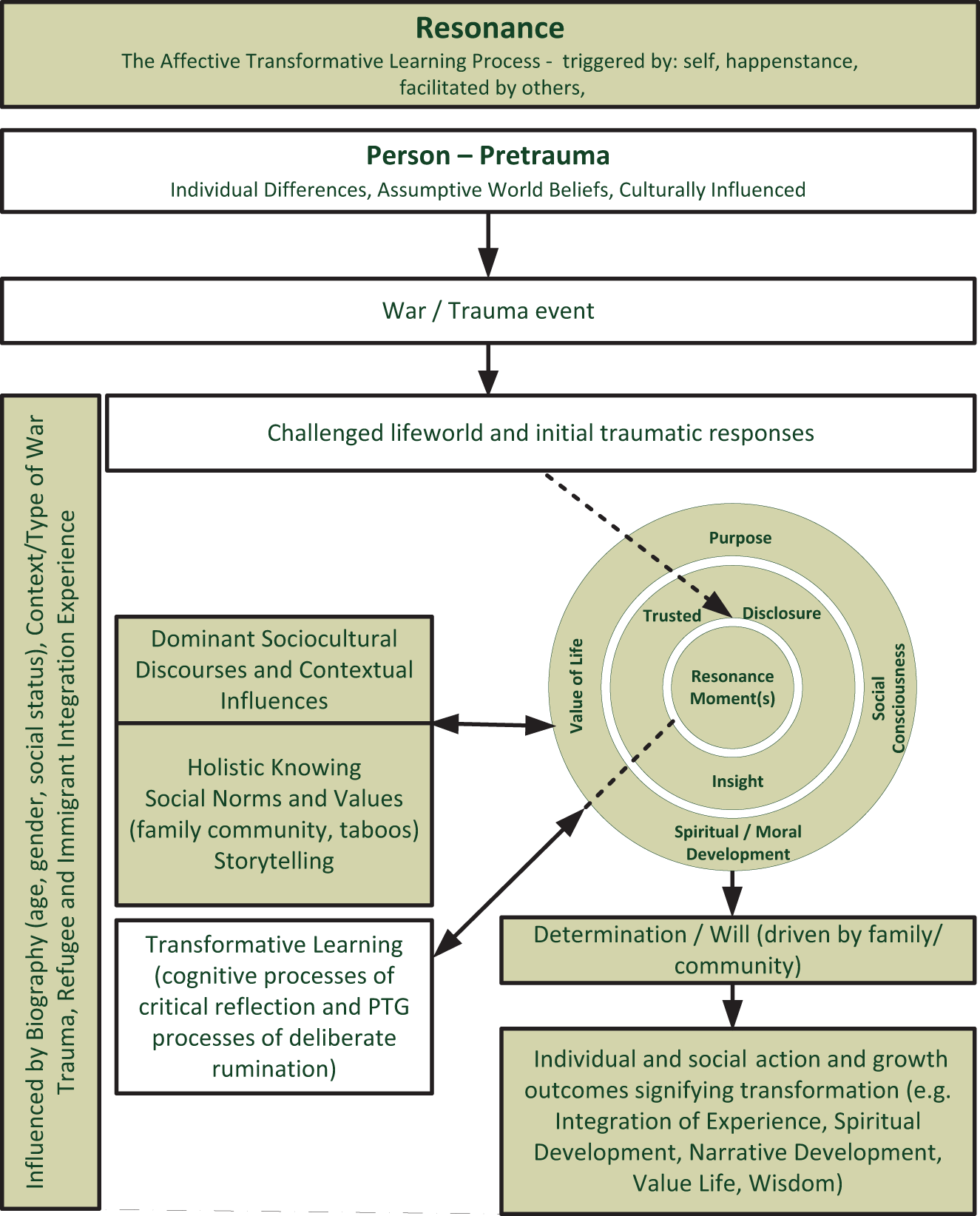
Transformative learning process as described by African War Survivors. Note that the unshaded elements represent the parts of the process informed by posttraumatic growth as described in this article and depicted in Calhoun, Cann, and Tedeschi (2010) and transformative learning theories as also described here.
As a qualitative study, these findings are not generalizable to all contexts or even all types of trauma; however, analytical transferability of this process model is possible (Yin, 2011). This study adds an affective process to Mezirow’s traditional 10-step process of transformative learning, which is mostly a cognitive psychocritical process. Although Mezirow’s process of transformative learning hinges on critical reflection, this process in the context of trauma and social change hinges on connection to resonance moments (Mezirow, 1998). It accounts for and confirms the role of the affective and extrarational processes of transformative learning in posttrauma contexts (Lange, 2004; Sands & Tennant, 2010; Weiss & Berger, 2010). I therefore propose that what this study contributes is an understanding of a parallel affective process that works in concert with what is presently known about the cognitive processes of transformative learning. The narrators in this study did indeed engage in critical reflection or from a posttraumatic growth lens, deliberate rumination. However, what was also clear in this study was that participants consciously and deliberately moved into those cognitive processes after experiencing an affective turning point that resulted in a choice to move forward into growth and transformation.
From this study, we can theorize that the cognitive transformation process is intertwined, coexists, and works in parallel, with an affective, noncognitive process in the context of trauma. This affective process is also a mature form of emotion, not the automatic emotional state associated with initial stress and shock of trauma. The emotions associated with resonance were most often tied to healing and transformation. The role of affect and emotion was evident in participants’ learning, decision making, and choices that followed their resonance.
Implications for Research and Practice
This study has significant implications for both the theory and practice of transformative learning. It has been acknowledged that further development of transformative learning theory requires a more unified theory that attends among other things to issues of context and a holistic, integrated view of the role of the rational and extrarational in transformative learning (Cranton & Taylor, 2012). As Cranton and Taylor (2012, p. 13) assert: The relationship between emotions and transformative learning is not yet well understood, and we know little about emotions and feelings in relation to other factors, such as how they foster and inhibit reflection; how they relate to the transformation of epistemic, sociolinguistic and psychological perspectives; and how they manifest themselves in different cultures.
Furthermore, this study responds to the call for an integrated view of transformative learning (Cranton & Taylor, 2012). It shows how individual transformative learning can be embedded and intertwined with the social, revealing the role of community belonging and sociocultural norms both as input and as outcome of transformation.
In addition, this study shows how the social and theoretical voice of the margins can significantly further theory building (Johnson-Bailey, 2012; Mejiuni, 2012; Ntesane, 2012; Taylor & Cranton, 2012). By attending to African ways of knowing and positionality of immigrants and refugees both in their countries of origin and settlement, this study has expanded knowledge of transformative learning by describing how the growth process is experienced and what specific outcomes of transformative learning in posttrauma contexts can be. It presents meta-themes that emerge from the process of transformative learning. Further studies are needed to test whether these findings support the ecological worldview within which the African perspectives they represent are framed (Berry, 2003; Nsamenang, 2003, 2005, 2007). The possibility is that these meta-themes hold universal promise with behavioral adaptations across culture. Also specific to this study, the findings show that awareness and knowledge of how to foster transformative learning where trauma is part of the context is crucial going forward. Questions that must be raised and addressed for the practice of transformative learning in sociocultural and trauma contexts include the following: What are the relevant ways of knowing and dominant discourses that impact posttraumatic development in the particular context? How can the affective process of resonance as transformative learning moment be safely fostered? What conditions (e.g. trusted disclosure in this case) need to be set for resonance as transformative learning moment to emerge? The broader question this study raises for further research is: how is resonance as transformative learning moment described in other sociocultural and trauma contexts?
A significant practical implication of this study, given that all the included participants (autobiographers and interviewees) were immigrants and refugees, is how these findings might influence policies for immigrant and refugee development and integration. A secondary finding of this study was that the immigration experience impacted the narrators’ growth. Across all the autobiographies and interviews, I observed that those who had positive immigration integration experiences were able to move through their recovery and growth and did not elaborate on the impact of immigration on their narratives. The immigration narrative is, however, integral to the postwar growth stories for those who had less positive immigration experiences. The less positive narratives of immigration integration represented many moments of despair and retraumatization. The study provided examples of cases where ongoing economic hardship or conditions that suppressed developmental potentials were detrimental to growth all along the refugee and immigrant continuum.
This study represented people who were lucky enough to get out and who have been able to rise above postwar migration challenges even when they continued to be negatively affected. This raises the question, how much continued hardship can a person take before they break and sink into a narrative of trauma? The literature indicates that disasters that deplete communities, ongoing instability, and a postwar environment of continued stressors will inhibit growth (Aldwin & Sutton, 1998; Schaefer & Moos, 1998). The practical implications of this then is the need for refugee and immigration policies, systems and structures that work to create narratives of transformation for African and other refugees and immigrants. This is beneficial to refugee-receiving countries because as the narrators in this study demonstrate, they are poised to be change agents in their countries of origin as well as their countries of immigration if given the right resources and opportunities. The barrier to integration that refugees and immigrants experience, therefore, is creating a backlog of untapped potential—people who could truly be global leaders because of their transnational identities.
A move to immigration policies and programs on a platform of transformation is called for at the micro level (psychosocial development programs), meso level (within communities as well as immigrant and social service organizations), and at the macro level (immigration, education, economic, and social policies). It is crucial that the global community engage in supporting and creating this transformation agenda along the continuum of refugeedom and not just as internal policies in the West and Global North—as the current statistics show, “developing countries hosted over 80 per cent of the world’s refugees…the 49 Least Developed Countries were providing asylum to 2.4 million refugees by year-end” (UNHCR, 2012, p. 2). The human connectedness participants in this study realized is called upon for the social and global transformations required. How can transformative learning and resonance be used to engender this change?
Footnotes
Author’s Note
Research and findings summarized in this article were presented at the 8th Annual Transformative Learning for Social Justice Symposium at Fielding Graduate University, January 12, 2012.
Declaration of Conflicting Interests
The author(s) declared no potential conflicts of interest with respect to the research, authorship, and/or publication of this article.
Funding
The author(s) disclosed receipt of the following financial support for the research, authorship, and/or publication of this article: Research partially funded by the Institute for Social Innovation, Fielding Graduate University.