




Abstract
This article explores how teachers’ perceptions of social justice issues are developed through experiential learning opportunities and maps their transformations in thinking onto the three levels of responsibility identified by Berger’s “growing edge.” The study looked at where teachers were on the growing edge and examples of how they navigated that edge. The findings showed teachers’ navigation as a cyclical process where they would return to the process of discovering and recognizing the edge once they felt they had build a firm ground and were on solid footing at their new edge.
Introduction
In 2004, Berger (2004) published an article in this journal elaborating on her notion of the “growing edge” where she grappled with the idea of transformation as she asked “students to read texts that unsettle them, focus on conversations that failed, and unpack their assumptions about students, parents, and communities” (p. 337). Nine years after the publication of that article, we as teacher education faculty struggle to extend and deepen the conversation on transformation for practicing teachers (our students), and experiment with new innovations within teacher education curriculum to see lasting and progressive transformation, not only for teachers but also for the students with whom they are working.
The need to unsettle, reflect, and unpack assumptions is well situated in the literature on adult learning (e.g., Brookfield, 1987; Brookfield, 1995; Magolda, 1999; Ritchie & Wilson, 2000) as well as in the context of social justice education for teachers (e.g., Adams, Bell, & Griffin, 2007; Darling-Hammond, French, & Garcia-Lopez, 2002; Hinchey, 2004a, 2004b, Richert, Donahue, & Laboskey, 2009, Torres, 2009). As critical teacher educators working with in-service teachers, we struggle with how to engage our students (the teachers), in more meaningful dialogue and action on issues related to social injustice in schools. The homogeneity of the U.S. teaching force (Cushner, McClelland, & Safford, 2009) compared to the heterogeneity of the student population has made it increasingly challenging for teachers to understand the multiplicity of experiences that percolate in the schoolhouses today. Teacher educators working with preservice teachers take great pains to ensure that teacher candidates are offered multiple diverse placements, from grade level to student populations and income levels—but with in-service teachers whose classrooms and schools are their context, it is more complicated for teacher educators to promote experiences that lead to teachers’ revisiting their beliefs and rethinking the notions of fairness and equity in their classrooms.
Through our teaching in what we are calling the Education for Social Change (ESC) master’s program for the purposes of this article, we have found that in-service teachers evolve through their careers to master their content, build strong skills related to their classroom functions, and become more comfortable with the reality of teaching. Offering in-service teachers this space to reflect and act offers a high value, as teaching is a profession with certain inalienable functions, requiring teachers to challenge the inequalities of access and opportunity for particular individuals and groups who desire the freedom to obtain a high-quality education (Cochran-Smith, Barnatt, Lahann, Shakman, & Terrell, 2009).
For us, this struggle has evolved over the last few years, where our curriculum has shifted from simply utilizing books and/or films and school-community walks to the development of more complex curriculum offering teachers an opportunity to shift their equilibrium through experiences designed to address social justice issues. Grounding the curriculum in the belief that teachers must get out of the classroom for opportunities to more fully understand the ways of the world, we as faculty and a graduate of the program sought to better understand how innovations in our curriculum might deepen the notions of teachers’ social justice perspectives.
Looking at experiential exercises and assignments developed with different cohorts to bridge the gap between the lived experiences of the teachers and the experiences of their students in the larger world to promote a socially just curriculum, this article draws systematic understandings of how teachers transformed their thinking. This article explores how teachers’ perceptions of social justice issues are developed through experiential learning opportunities and maps their transformations in thinking onto the three levels of responsibility identified by Berger (2004) as essential for authentic transformation.
Why the Growing Edge?
In 2004, Berger sought to better describe the tangible nature of transformational reflection and to present the boundaries of reflection “that takes us to the edge of our meaning,” which she believed was where reflection best had the power to transform and to “move outside the form of current understanding and into a new place” (p. 338). Her study pulled data from 20 interviews with a wide variety of participants and evolved into a theory supporting the idea that to engage people on the edge meant that one had to be aware that they would struggle to stay in (they would be tempted to “shy away”). Yet by offering “openings for people to push against the edge and then be company for them as they stand at the precipice…the growing edge (would become) its own teacher” progressing to where transformative teachers could be expected to help students find and recognize the edge, be good company at the edge, and build firm ground beyond the edge (pp. 345–346).
Identifying, supporting, and facilitating the edge to engage teachers strongly resonate with us when we think about social justice and equity issues in teacher education. The growing edge offers a conceptual space where additional literature on transformational learning and adult development, teacher dispositions around social justice, and experiential learning further supports the grounding and value of this study.
Transformational Learning and Adult Development
Constructive-developmental theorists (e.g., Kegan, 1982; Mezirow, 1991) agree that meaning making through critical reflection is essential for transformative learning and development. Critical reflection includes opportunities to examine assumptions one holds about the world and the ways in which one interacts within that world; as Brookfield (1987) states, “identifying and challenging the assumptions by which we live is central to thinking critically” (p. 89). As an individual examines assumptions through critical reflection, her or his cognitive, interpersonal, and intrapersonal development moves hierarchically from simple to more complex and elastic understandings of the world. Through critical reflection that includes perspective taking and dialogue with others, individuals often arrive at “a more inclusive, differentiated, permeable and integrated perspective” (Mezirow, 1990, p. 14). This more complex understanding of the world can best be achieved when working along the growing edge.
Zull (2002) offers additional insights into how learning occurs. Drawing on the work of Kolb (1984), he describes a learning cycle that depends on experience followed by reflecting, developing abstractions, testing those abstractions, and finally circling back to concrete experiences (Zull, 2002, p. 17). Zull (2002) argues that “all parts of the learning cycle are influenced by emotion” (p. 223) and activating these will help impact the learner’s thinking. We contend that working along the growing edge is an emotional endeavor; the fear of falling off the edge and the trust necessary to stay the course as solid ground is constructed beneath can have the impact of stimulating the learning cycle described by Zull and can lead to true transformational learning.
Fostering Social Justice as a Disposition Through Teacher Education
An underlying belief we hold as critical teacher educators is that to ready teachers for the classroom, a significant component of their preparation depends on their awareness of different worldviews to “better understand how their interactions with their students are influenced by their social and cultural location” (Darling-Hammond & Bransford, 2005, p. 36). Part of working on the edge requires teachers to evolve in their profession where the development of their identity “influences how teachers treat the students they teach as well as how they see their role in confronting social and institutional barriers to equity” (Hammerness, Darling-Hammond, & Bransford, 2005, p. 384). This developmental process is important to recognize especially since experiences in the classroom build and require critical reflection at regular intervals. While Hammerness, Darling-Hammond, and Bransford (2005) say teacher educators’ can facilitate these processes—if teacher educators can in fact support—and we would add, deepen the scope and impact of the experiences, this is dependent on the teacher educator’s own comfort and willingness to explore such issues. While there might be a natural disposition on the parts of certain teacher educator’s to engage in these processes (Shaklee & Baily, 2012), this is not always the norm.
Focusing on issues of diversity and social justice in teacher education programs allows practicing teachers the opportunity to cultivate powerful educational environments within their own classrooms that support learning and schooling in a democratic society. Teachers understand more intimately that “knowledge and justice are not dichotomous but complementary goals” (Cochran-Smith et al., 2009). Research shows that social justice needs to move beyond a superficial notion and become a more powerful element in our work with teachers. McDonald and Zeichner (2009) argue we must move beyond rhetoric to challenge teacher educators to “negotiate difficult political differences both within and outside the teacher education community and to develop and identify specific program practices that prepare teachers to teach from a social justice perspective” (p. 596). Teacher educators must create curriculum that gives explicit attention to structures in society that perpetuate injustice. In order for social justice to be approached in any teacher education program, every effort must be made to prepare teachers to take both individual and collective action toward mitigating oppression (McDonald & Zeichner, 2009).
While the literature strongly supports the need for teacher educators and teachers to actively engage in social justice issues and curriculum, the challenges and questions still abound. How does one encourage teachers to look critically at their experiences? How can the field of education, which is overrun by standards and streamlining, allow for a developmental approach to social justice? How can teacher educators, who are increasingly working within the confines of national and state standards, allow for a safe space to engage teachers to approach and act on issues of injustice? These are all important questions, and we sought to explore how these questions would look, especially in a graduate program that advocates such a critical stance while also exploring the benefits of experiential learning in the context of teacher education.
Experiential Learning as Transformation
While we understand the foundational building blocks of adult development and agree with the value of a socially just disposition for teachers, we were curious about the role and value of field trips and experiential learning for teachers. The work of early 20th-century scholars such as Dewey, Lewin, Piaget, and Freire found that experience was a key component in learning and development (Kolb & Kolb, 2005). Kolb (1984) defined experiential learning theory as “the process whereby knowledge is created through the transformation of experience…(resulting in) the combination of grasping and transforming experience” (p. 41). According to Kolb (1984), experiential learning depends on six principles that cultivate a holistic model of the experiential learning practice and a multilinear model of adult development including conceiving learning as a process that is not based on outcomes, learning as relearning, learning to resolve conflicts that leads to dialectically opposed modes of adaptation, a holistic process of adaptation to the world, learning resulting from synergetic transactions between the person and the environment, and finally, learning as the process of creating knowledge (Kolb & Kolb, 2005).
The use of field trips to promote student (PK–12) learning has been well documented (Coughlin, 2010; Dierking & Falk, 1997; Noel, 2007), but research on how such experiences assist adult learners has been far more limited. Dierking and Falk (as cited in Coughlin, 2010) concluded that field trips are not trivial experiences; “Field trips are a valuable teaching tool. What strengthens the use of that tool is careful, purposeful planning and evaluation by teachers and site educators. While field trips can be enjoyable, they must be educational, engaging, integrative, and worthwhile” (p. 210). There are some examples of field trips in postsecondary education aimed at undergraduate students enrolled in science courses (Lei, 2010), anthropology courses (Rone, 2008), and geography courses (Davidson et al., 2009). A literature search uncovered a study that examined a field trip to a P-12 schoolhouse meant to help preservice teachers examine their assumptions about teaching and learning in rural communities (Todd & Agnello, 2006). Other studies report certain preservice teacher programs have started to include community-based field experiences that allow student teachers to learn about the sanctions of knowledge, social structures, and social networks that exist in the communities where their pupils live (McDonald & Zeichner, 2009). However, these types of programs typically focus on service learning as a vehicle to develop the student teachers’ cultural competences and as an effort to expose prospective teachers to potential resources in the school’s community (McDonald & Zeichner, 2009). Very little, however, has been done to explore the role field trips might play in the professional development of in-service teachers particularly related to their engagement with social justice issues and their development as critical educators.
It is complicated for teachers to work along the growing edge. As teacher educators we look to provide authentic opportunities that identify, support, and facilitate teachers’ experiences as they revisit their beliefs and rethink notions of fairness and equity in their classrooms. Transformational learning and adult development, teacher dispositions around social justice, and experiential learning support such efforts, and this study demonstrates how experiential learning can map teachers’ transformative thinking as they work their way along the growing edge.
Method
The ESC program is a graduate program for practicing teachers of all content areas and grade levels. Teachers typically have certification and must be currently teaching in a classroom in order to enroll in the program; they join in school teams, with other teachers from their schools or from neighboring schools. Faculty model the collaborative process by working in teams of two to five faculty to coplan and coteach the curriculum for the 30-credit, 2-year program. Over the course of the 2 years, teachers (in cohorts of 45–105 students) attend 41 eight-hour-long class days (5 weeks or 25 days over 3 summers and 16 days over 2 academic years). The structure of the program allows cohorts the ability to develop long-term relationships that offer a safe environment through which the faculty develop curriculum that, among other topics, addresses issues of power, privilege, social justice, and diversity. Faculty spend a significant amount of time early in the program to ensure time for relationship community building. ESC espouses the same values as what Berger (2004) defines as helping “students recognize and begin to really understand that much of what they see as the truth is in fact their own construction . . created by a set of unquestioned assumptions and perceptions (and) individual and social forces” (p. 346).
Historically, ESC assigned days where teachers would go back to walk their communities, but noting the depth and richness of the dialogue post “community walk” (connecting back the experiences on the walk to issues of power and justice), some faculty were intrigued to discover what would happen if more challenging and focused experiences beyond the university walls were planned. Therefore, to further understand the nature of what was happening, a more systematic research approach was implemented.
We simultaneously collected and analyzed data, which allowed us to amend the curriculum over time as well as to develop more focused forms of data collection. For example, our anecdotal notes from the initial “community walks” led us to incorporate more targeted field experiences focusing on specific issues of social justice in the larger community on which teachers could reflect and connect back to their classroom practices. We also shifted the ways in which we collected data, moving from survey questions to artistic interpretations to written assignments. Along the way, we remained active participant observers who not only interpreted the data but constructed theories grounded in the data to help us better understand how field experiences might impact in-service teachers’ understanding of social justice issues.
Data were collected over the course of four cohort cycles encompassing a time frame of nearly 6 years and were based on six different field trips. These field trips were designed to address the best practices for teacher development including increasing in-service teacher’s understandings of action research, collaboration, diversity, enhancement of curriculum offerings for their classrooms, and further opportunities to engage in their own reflective practice. In addition to the daylong experiences at the location, long-term assignments, group projects, and presentations that required an examination of critical questions were developed to capture the learning that occurred before, during, and after the experience. The locations for the field trips occurred around the mid-Atlantic region where this university was located and were quite diverse. None of the cohorts returned to the same location with the same assignment. Field trips included visits to: a cathedral to examine issues of religion and pluralism in the United States through an exploration of the stained glass windows; a museum special exhibit on propaganda to deepen teacher’s understandings of the power of language and discrimination in education; a library to explore the foundations of knowledge in the United States and its relevance in the multicultural, multiethnic, and multilingual United States of today; another museum to better understand what it means to “be American”; an international folk festival where students explored how dynamic ways of knowing are contrasted to knowledge that is more static as defined by many school curricula; various local “community walks” where teachers walked, talked, and better understood their school communities.
Although assignments and outcomes varied for each of these experiences, some common directives including interviewing and engaging in informal conversations with multiple people during the experience, journaling, or taking field notes to help process their understandings of their time spent and detailed discussion questions to unlock potential common understandings among teachers during small group conversations during and after the field trips. Teachers were asked to reflect on their experiences in brief responses and analyze broader insights into more extensive articles and projects occurring in later stages of the program.
Over the course of the 6 years, nearly 250 PK–12 teachers participated in course work that included one or more field trips for which data were collected. Data were collected through reflections of the experience, surveys, student projects and articles, and online discussions. A process of reading and coding the data allowed themes to emerge that informed our understanding of teachers’ transformational thinking and the ways in which their perceptions of social justice issues were developed through experiential learning opportunities.
Data were initially coded using the constant comparative method (Glaser & Strauss, 1967; Lincoln & Guba, 1985). Three stages of coding—initial, focused, and axial—were conducted throughout the course of the study. The first author engaged in initial coding with a few sets of data, remaining open to what the data were conveying. In the next stage of analysis, the third author embarked on focused coding using the codes that emerged in the initial coding stage, while the first and second authors took additional sets of data for further initial coding to make sure that saturation was reached. Following this stage, all three authors proceeded with focused coding comparing data to data in order to refine the themes that were emerging. Finally, we explored the dimensions of each category through axial coding, “bringing [the] data back together again in a coherent whole” (Charmaz, 2006, p. 60). The themes uncovered helped us better understand the ways in which in-service teachers grappled with issues of social justice through their experiences in the field.
Findings
Using Berger’s (2004) framework of the growing edge, we sought to better understand how teachers developed and transformed their thinking to embrace a deeper socially just perspective. We looked at where teachers were on the growing edge (see Figure 1) and examples of how they navigated that edge. We saw their navigation as a cyclical process where teachers would return to the process of finding and recognizing the edge once they felt they had build a firm ground and were on solid footing at their new edge.
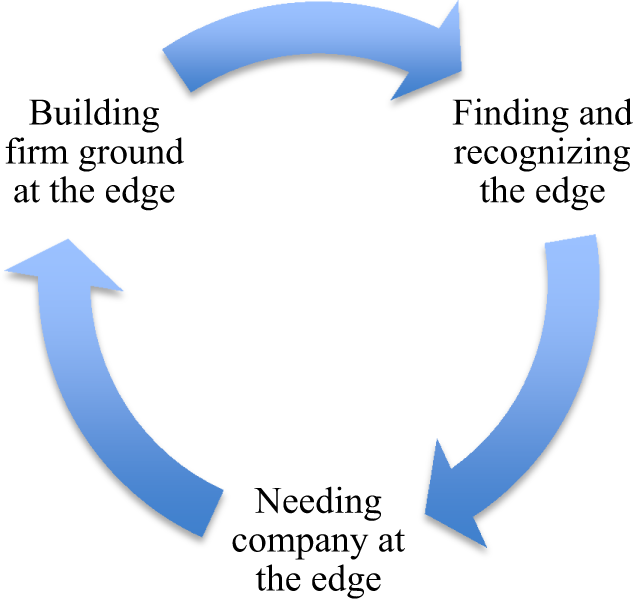
The growing edge cycle adapted from Berger (2004).
In our analysis of the data, we found evidence of how students were becoming aware of their status needing to move from cursory knowledge (moving from the tourist state or finding and recognizing the edge) to wanting to discuss both the duality of ideas and the discomfort they became aware of in their own transformation (needing good company at the edge) and finally engaging more actively as a socially just educator (building a new foundation at the edge). We also could see evidence at that point hinting at the teachers finding and recognizing new edges leading us to present Berger’s (2004) theory as a model of cyclical development. The subsequent sections highlight the ways our students reflected on these transformations.
Moving Beyond the Tourist—Finding and Recognizing the Edge
The teachers articulated the fact that they experienced “deeper” learning when engaged in the field trip assignments. In many instances, teachers spoke of how being out of the classroom allowed them a greater understanding of each other (building collaborative relationships), offered them increased opportunities to revisit areas of study they had forgotten or become unfamiliar with, and allowed them the chance to move beyond a superficial and cursory exploration of a space and more deeply engage with the people involved and represented at the locations. These experiences afforded teachers the opportunity to recognize the edge of their understanding of social justice issues; they bumped up against their comfortable ways of seeing the world by digging deeper and considering alternative perspectives and experiences. As one teacher stated: Many times when I visit museums, I tend to see the singularity of the experience, only recognizing and absorbing the obvious. But this time, it was different. I dug deeper. I searched for the hidden truth, the unspoken voice, the imageless images. And I came away feeling much more aware, much more enlightened and much more insightful.
Many teachers attributed their ability to “dig deeper” to the scaffolding provided in the program curriculum. Teachers were able to take what they had learned from the readings and discussions around critical pedagogy and apply these concepts to their field experiences, opening up new ways of looking at the “ordinary.” One teacher articulated, “Going to the…museums is always sure to be an enjoyable experience. However, I have learned that going for a [program] assignment helps me to see things, sometimes things I’ve seen many times before, through a new lens.” Ultimately, the teachers valued their deeper learning as a way to more completely understand the world in which they live and teach. A teacher illustrates this feeling when she states, “After visiting this exhibit I realized that all of this really matters. It is important to ponder on the lives of others. Too many people live their whole lives in a box and they see only what they know from their own experience.”
Another stated: It [the field trip] has also helped me understand more about my students and the challenges they face, whether it be economic, language, cultural, or other barriers. We need to understand where our students ‘come from’ so that we really and truly can help them reach their highest potential and be ready for the real world out there.
Along the edge, many teachers discovered opposing, complimentary, conflicting, or parallel ideas that spurred them to critically question their responsibilities as teachers. In a time when there is greater dependence on textbooks, pacing guides, prescribed teaching methods, and content as well as common assessments, the field trips offered the teachers a chance to better understand the various “truths” that exist and better recognize their own responsibility toward sharing multiple perspectives with their students.
Teachers also grappled with the hidden curriculum particularly regarding students who are English language learners. A teacher reflects: I am heartbroken by the mandates that were put in place to teach English! Native American children sent to boarding school to ‘assimilate’ into the American culture were prohibited from speaking their own language. How much culture and history and religion and knowledge have we lost by the neglect of native languages? Oral traditions can only survive as long as there are storytellers and a comprehending audience to continue the cycle. How can I prevent this from happening today with my own students who are learning English in my classroom?
More often than not, teachers were appreciative of the opportunity to find their growing edge. It was a place they had not been challenged to explore in the past, so the experience flooded them with insights and critical questions that inspired them to rethink social justice issues and their responsibility to acknowledge and address these issues as classroom teachers.
Duality and Discomfort—Needing Company at the Edge
The duality of ideas presented to the teachers through the field experiences did not always lead to greater insights or thoughtful questions to explore; sometimes it led to a discomfort that necessitated company at the edge in order to stay there and engage in transformational learning. The sense of discomfort evident in the data was linked to experiences that pushed against teachers’ closely held beliefs. Part of the need for company at the edge was a desire to talk about the discomfort attached to the critical dimensions of the experiences. Teachers felt uncomfortable pushing out of their own “comfort zones” and challenging notions of authority, power, and privilege. Although it was often through this “discomfort” that the greatest learning took place: The field trips offered during the course of this program have served to increase my field of vision with regard to social issues and educational thought. From the beginning I feel that I have stepped out of my comfort zone with some of the assignments and the first field trip…was a leap. I have become aware of my “zone” and the benefits of pushing that line further away.
Teachers were honest about the time and effort required to examine closely held beliefs and assumptions. The process was not always comfortable as this teacher explains: I find myself in a sort of limbo, perhaps my ideas are changing, but I am definitely ‘not there’ yet in terms of really seeing the big pictures in all of this and how it effects me. For now, I find myself more in question mode. I am questioning the ideas of power and privilege more than drawing my own conclusion. I am trying to step outside myself and see others’ points of view on these ideas, but for me, this is a slow process, but I am still not quite sure why.
The process of “see[ing] others’ points of view” is where company at the edge becomes critical. As instructors, we spend a lot of time listening, questioning, and offering these alternative perspectives through readings and field experiences. We, however, were not the only ones in a position to be good company; the people teachers interacted with on the field trips as well as their own teammates also provided the company needed to transform their thinking. After a field trip to one of the museums, one teacher wrote: The [person] we interviewed left the biggest impression on me. He opened my eyes to see how [this group of people] had contributed and sacrificed so much to our country yet we were slow to give them the recognition they deserve by waiting until 2005 to make a museum for them. They are such a strong part of our history and forming who we are today, that it opened my eyes to see how much they suffered and some are still suffering today.
Another teacher reflected on the role her teammates played in supporting her learning: The biggest impact the field trips have had on me are that I collaborated with others in the process of going through the field trip and any work that we had to do, I always learned something interesting from the experiences, and they made sense for what ESC was trying to do to help us become better teachers…Working with others in comparing notes, discussing ideas, and creating a product was a learning experience for me and taught me a lot about the art of compromise and communication.
Discomfort that emerged from confronting different perspectives along the edge was often manifested in the notions of American hegemony and patriotism. Many responses addressed the notion that to look at social justice issues was a criticism of the United States and in fact “we” had it better than most and should appreciate that. For instance one teacher said: I don't really feel that the trip has impacted me that much. I have always felt proud to be an American and proud of our country. I recognize that there are definitely areas we as a country could improve, but I don't think what I saw that day changed that view at all.
This need to cling to patriotism struck us as another form of discomfort, one that was exhibited by pushback against closely held beliefs on loyalty to country. This is a space where we continue to search for the most effective balance in offering good company as teachers grapple with these issues without pushing them over the edge where a new foundation has yet to be built.
Engaging More Actively as a Socially Just Educator—Building New Foundations at the Edge
Exploring power and privilege is not often easy for teachers, but repeatedly these assignments allowed them to ask critical questions such as “Who decides what goes into the exhibit?” “Who had the final say?” and “Why is it in this space?” These questions allowed the teachers to start to engage in both an internal and external dialogue of who controls education and to what end and purpose.
Teachers identified a general shift in their thinking about knowledge through their critical questioning. As one teacher commented: Knowledge takes many different forms. The importance and substance of knowledge is affected by factors such as culture, social position, and opportunity. Most of my evolution of thought is due to beginning to think about things from multiple perspectives and evaluating ideas within the lens of my pedagogical beliefs. I tend to stop and think about “why” more often now.
Due to the nature of the field trips, teachers had an opportunity to focus specifically on their understanding of historical perspectives. One teacher stated: I learned how history typically reveals the perspective of those that had the means to tell their story and the voice of the underrepresented many times surfaces by chance, by duty, or by guilt. What makes powerful and privileged groups eventually feel it necessary to be inclusive? Is it just empathy, empathy disguised as pity, or pressure to appear sensitive?
After visiting (one of the) museums in particular, many teachers questioned the rationale for including certain perspectives and not others. This teacher began connecting the inclusion and exclusion of perspectives to issues of power, “We questioned whether or not the museum had been persuaded by the power and privilege of certain groups, and therefore, made those tribes more recognized in the movie and possibly throughout the different exhibits of the museum.”
While critical questioning might dishearten many and lead them to feel “powerless” within the system, many teachers experienced the opposite. Instead, they used their examination of power and privilege to find the spaces in which they could affect change. One teacher said, “I’ve realized the difference I can make in my classroom despite the politics behind the educational system. I realized I, as well as my students, do have a voice…and we can use it.” Another teacher was able to reframe her responsibility to her students when she stated, “We don’t have to TEACH them what to think, just allow them to think.” Change was not limited to what went on within the classroom walls; after the experience of the community walk, one teacher felt committed to sharing power with families in the community. She wrote, We need to make sure that our school’s organizational structure is clear to all parents and that everyone is familiar with the language of our schools so that everyone has equal power. We also need to ensure that all families have equal opportunity to interact with the school staff and they feel welcome to take part in school activities.
These changes in perspectives and practices indicate the new foundations that were built at the edge of teachers’ understandings of the role of social justice issues in education.
Coming Full Circle—Returning to the Edge
We also saw a resurgence of arguments and rationales to support the status quo or to return to a state of redefining the edge. Oftentimes, our interpretation of the data suggested that teachers are still trying to justify their own understandings related to inequity and injustice in education in general and society more broadly. For instance in conjunction with the field trips, teachers read articles on class and socioeconomic status and one response from a White male was: My family has always been in the middle class. Just like many other people in the middle class my parents did not go to college. They both have good jobs, but do not make anywhere near $100,000 combined. They both are hard workers, but neither of them have a lot of power. My mom works as a secretary in one of the best dental schools in the country. She often has to deal with rich dental students being rude to her. They think they can talk to her anyway they want just because they have a lot of money and are going to a good school.
It is often the case that teachers look at their own “up by their bootstraps” experiences and don’t see the privilege that comes with being a Caucasian or being a male. Sometimes the responses tried to convince themselves or others that although there may be privilege in other situations, it was clearly not the case with them and therefore they were better able to think in a more socially just way.
Others would be quick to see themselves as powerless and while we have often talked about how in a classroom with shifting student populations, they often have more power than they realize. The collective lack of power also came up as a universalizing experience: The field trip showed me how much power and/or privilege does play a part in our lives. (italics inserted). There are always people who want to be superior and control others…it is not right, but people need to be treated fairly.
Insights of this nature are of critical importance as it allows teacher educators a chance to explore more thoroughly the nature of “fairness” as it is often not enough to be fair in the classroom as the students come with lived experiences that are never fair.
Discussion and Conclusions
In Richert, Donahue, and Laboskey’s (2009) article on preparing White teachers to teach in a “racist nation,” the authors discuss the need for teaching and learning to challenge the preexisting notions of race (and we would expand that to include all forms of social injustice), yet we hear a familiar refrain among teacher educators questioning how they should do that. The fact remains that the more we excuse ourselves by being unclear on how to promote critical cultural consciousness, the more we ascribe to the status quo as it stands. Rather than excuse ourselves, we sought to use experiential learning as a tool through which we could create situations of discomfort and learning for our students while using Berger’s (2004) framework to understand their growth and development. What we found shows that teachers look more critically at their identity; refresh their awareness of how knowledge is created, maintained; and passed on, and absorb ideas around discomfort. In terms of social justice, they are aware of how decisions affect power structures in education but are also often unwilling to recognize that some structures may be more unequal than others and return to the mind-set of universalizing experiences. As teacher educators, these findings tell us there is a need to continuously engage teachers in these experiences because there is often a preference to fall back to previously held assumptions or a more passive reaction to curriculum and pedagogy. The purpose of these field trips was to engage teachers to move beyond simply recognizing cultural differences to helping teachers to further conceptualize social justice practices as well as prepare teachers to teach from a social justice perspective (McDonald & Zeichner, 2009). Still we find general feelings of discomfort when we press too hard or come too close to deeply held beliefs on national loyalty. This is a critical finding especially since we know that schools are expected to foster feelings of national unity and patriotism, the willingness of teachers to question national policies and goals is vital if we are to develop a social just community.
While we set this study within the context of a rather unique graduate program, we see broader ramifications for teacher education, especially as it relates to in-service teacher development. It is at the intersection of prodding teachers to challenge closely held beliefs and preventing the reversal back to day-to-day habits of the classroom where experiential learning theory (ELT) becomes valuable. Returning to Kolb (1984) who defined ELT as “the process whereby knowledge is created through the transformation of experience,” we find that allowing teachers to describe how they approached a deeper learning, while simultaneously experiencing discomfort, leads to greater engagement with issues of social justice (p. 41). This ultimately results in some personal transformation and an increased articulation of some areas of “private privilege” which teacher educators can then use to scaffold deeper learning. What we found is that through ELT, teachers authentically engaged with their own development. For example, the way the teachers characterized their insights gained from the field trip showed how they valued their learning as a process that is not based on outcomes. During the field trips, the teachers were engaged in a process that best enhanced their learning by being pushed out of their comfort zones. Teachers also demonstrated the learning as relearning principle during the field trips because they talked about experiencing a deeper learning as they moved from tourist to partner to researcher. As the teachers revisited places they had been before, their learning caused them to draw out their beliefs and ideas about certain topics, in order to examine, test, and integrate new, more refined ideas (Kolb & Kolb, 2005). The above-mentioned evidence demonstrates how the teachers’ learning and ideas moved back and forth between opposing modes of reflection, action, feeling, and thinking. Finally, the findings aligned with Kolb’s (1984) last experiential learning principle, learning as the process of creating knowledge. As teachers talked about the commonalities of the human experience, they constructed new forms of social knowledge, which ultimately allowed for their own recreation of personal knowledge as a learner (Kolb & Kolb, 2005).
As teacher educators, this experience has been transforming for us as well. We do recognize that teachers’ contexts matter, and it is our responsibility to offer multiple opportunities to shift that context and alter the equilibrium of what teachers know and think they know. It requires for teacher educators to be prepared to be good company at the edge by preparing for complex questions and by being willing to face their own predilections toward comfort with curriculum and day-to-day classroom habits. Yet if we shirk our responsibility, then we cannot expect teachers to embrace theirs. This article sought to look at what happened over the course of multiple field trips to different groups of teachers. The data do not specifically show that the teachers changed their curriculum or their practice, but for the duration of the experience, and in the subsequent articles, assignments and class discussions, they were quite aware of the levels of injustice and inequity. While our findings show some clarity on what happens during and after the field trips, some responses are still located in the grey area of confusion, denial and defensiveness, important information as it allows us an opportunity to better prepare for the next layer of scaffolding and learning and continued growth along the edge.
Footnotes
Declaration of Conflicting Interests
The author(s) declared no potential conflicts of interest with respect to the research, authorship, and/or publication of this article.
Funding
The author(s) received no financial support for the research, authorship, and/or publication of this article.