



Abstract
Transformative learning has usually been defined as transformations of meaning perspectives, frames of reference, and habits of mind—as proposed initially by Jack Mezirow. However, several authors have found this definition too narrow and too cognitively oriented, and Mezirow has later emphasized that emotional and social conditions are also important. Thus, there is a need for a broader, more up-to-date, and still significant definition. This article suggests that the target area of transformative learning should be defined by the term “identity,” which explains what this term implies, argues why it is the best possible choice, and gives examples of how the concepts of transformative learning and identity can mutually enrich each other and lead to new understandings in both of these areas.
The Issue of Transformative Learning
According to Jack Mezirow transformative learning is defined as the transformation of the learners’ meaning perspectives, frames of reference, and habits of mind (Mezirow, 2006). The original background and inspiration were taken from the women’s liberation movement in the United States in the 1970s and basically referred to the development of consciousness about and liberation from conditions that caused societal and personal suppression of women. This can be seen as a parallel to Paulo Freire’s endeavor to help illiterate Brazilian agricultural workers liberate themselves through a combination of education and consciousness raising (Freire, 1970)—to which Mezirow also referred (Mezirow, 1978)—and Oskar Negt’s similar work in relation to unskilled German industrial workers (Illeris, 2007; Negt, 1968).
By focusing on the development of consciousness, these three contemporary and path-breaking projects placed the main psychological emphasis on the cognitive processes of understanding the hidden power structures behind the oppression as a necessary condition for working actively and determinedly with liberation and empowerment.
However, Mezirow also took the women’s liberation movement as his point of departure for the development of his general theory and ideas about transformative learning (Mezirow, 1978). Up through the following decades, Mezirow’s theory and ideas have become an internationally well-known and recognized contribution to the understanding of what may be perceived as the most advanced kind of human learning.
The Precedence of the Cognitive Dimension
The purpose of the above-mentioned brief historical introduction to the issue of transformative learning is to explain how and why, right from the beginning, this concept has had what seen from the perspective of a general understanding of learning appears as a tendency to stress the cognitive dimension at the expense of the emotional and social dimensions and the situatedness of learning processes (Illeris, 2004). This imbalance has subsequently been addressed by several centrally placed observers such as Patricia Cranton (2005 [1994]), John Dirkx (1997, 2006), and Edward Taylor (2009)—all of whom have in particular argued for increased attention to the emotional dimension—and probably most comprehensively by Robert Kegan (2000) who formulated the crucial question about “what form transforms?” that is, what is actually the target area of transformative learning.
Mezirow has certainly been open to this criticism, and in his later writings, he has clearly accepted it and remembered to mention the emotional aspects in various relevant connections (Mezirow, 2006, 2009). However, at the same time, he has maintained the precedence of the cognitive area and especially the notion of the meaning perspectives as the central target area, whereby the emotional, social, and situated dimensions have indirectly been placed as a type of concomitant phenomena. And Kegan, who most clearly set the stage for a new designation or definition of the target area, did not suggest a new specific term for this but instead advocated a general “constructive-developmental” approach (Kegan, 2000).
The Need for a New Definition
Today, all of this has created a situation, in which, although the issue of transformative learning is more demanded and also more celebrated than ever, there is basic conceptual uncertainty and even confusion as to what this term actually includes, covers, and implies. Kegan’s (2000) very direct question has never been answered clearly and satisfactorily!
This is in effect a highly problematic situation, at least if transformative learning is regarded as not merely a fascinating and thrilling challenge of the time but as a crucial academic issue illuminating an important topic of learning in theory and practice. Moreover, it is not only problematic in an academic and professional perspective but much more so because the uncertainty invites all kinds of learning endeavors and processes differing in any way from traditional classroom teaching to regard themselves and be accepted as cases of transformative learning. For example, in relation to the last book in which Mezirow was involved, Michael Newman has claimed that “many of the case studies that appear in Transformative Learning in Practice (Mezirow et al., 2009) are simply examples of good adult education practice” (Newman, 2012, p. 45).
How risky or even dangerous this may be for the concept, understanding, and esteem of transformative learning can be illustrated by the recent example of the rather similar issue of experiential learning, which—with roots in John Dewey’s work in the early years of the twentieth century—experienced a significant revival in the 1980s and 1990s, partly due to David Kolb’s now well-known book on this topic (Kolb, 1984) and partly because it attracted a very large international group of learning researchers and practicians. A number of inspiring conferences were held, articles were published, and the volume of selected papers from the first conference in London in 1987 (Weil & McGill, 1989) served as an important common reference for many years. However, after having reached a summit at the Cape Town conference in 1996, this movement gradually declined and has now almost vanished. An important part of the background for this was without doubt that there were neither any clear definition nor any visible boundaries and that almost any kind of learning was accepted as experiential.
The issue of transformative learning may risk the same fate. Some of the same conditions are obviously at hand—no clear understanding of the central concept and no formal organization—and in spite of a great deal of activity, there were also signs of general uncertainty at the two most recent international conferences in Athens 2014 and San Francisco 2012. Probably, to some extent at least, this has to do with a similar lack of a clear and immediately understandable definition that can separate transformative from nontransformative learning, a precise term for what is transformed by transformative learning and what is outside the target area. The aim of this article is therefore to investigate possible formulations of such a definition and provide a substantiated proposal and description of the term to choose. There is an urgent need that a discussion of these matters be opened to secure the healthy and flourishing continuation of dealing with an issue which in the present incalculable and ever-changing state of the world has become more necessary than ever.
Considerations Regarding Possible Terms
The first need to take into consideration is that the term for the target area of transformative learning must, in a balanced way, cover all dimensions of human mental capacity and learning—that is, as already mentioned the cognitive, the emotional, and the social dimensions—as well as situatedness and societal and environmental embeddedness. From that point of view, the following terms could be relevant:
The person, the individual, and the learner are the usual terms for the learning subject as a whole. As early as in the beginning of the 20th century, German Gestalt Psychology claimed—partly in opposition to the dominant American behaviorism—that psychological phenomena must always be considered as a whole (Ash, 1995). In addition and more recently, in his later works both in general and in his definition of human learning, the well-known British learning theorist Peter Jarvis has strongly emphasized that it is always the person as a whole who learns (Jarvis, 2009, 2012). However, it is immediately apparent that for the present purpose, the terms mentioned for the whole person are too general, as they also can be used in relation to all other kinds of learning that are by no means transformative.
The personality could therefore be a better choice, as this term is much more specific. It does not refer to the person as such but to the structures, dispositions, and traits that are characteristic of human beings in general and the single individual in particular. However, such traits and qualities are partly inborn and partly modified by learning; the two parts cannot be separated. Therefore, as a term for the outcome of learning the personality is unclear, and in relation to transformative learning, the great interest in the measurement of personality qualities may also be problematic.
The self could, then, be a better term, as it is clearly a psychological instance or structure which, as the center of the individual consciousness, collects and holds together the outcomes of important learning. It can also be noted that Carl Rogers—who already in 1951 launched the concept of “significant learning” which in its content is very close to transformative learning—defined this as learning involving “a change in the organization of the self” (Rogers, 1951, p. 390). More recently, Australian Mark Tennant—who is well known as the author of “Psychology and Adult Learning” (Tennant 2005 [1988]) and has concentrated his work on the psychology of the self in later years (Tennant, 2009)—has published a new book that is highly relevant in the present connection because it deals with “The Learning Self: Understanding the Potential for Transformation” (Tennant, 2012) and as it actually sees the self as the target area for transformative learning.
The identity is a similar term, in its content rather close to the self, but with the important difference that ever since this term was taken up as a central issue by the German–American psychoanalyst Erik Erikson (1950, 1968, 1982), its definition has been understood not just as a psychological but specifically as a psychosocial concept, that is, a concept explicitly including the combination and interaction between the individual and the social environment and how this influences the development of the individual. This is part of the reason why since the late 1980s modern sociology has focused on the identity as the instance through which the development of society influences individual understandings, reactions, and way of life (Bauman, 2000; Côté & Levine, 2002; Giddens, 1991; Jenkins, 2004).
The soul is a term used specifically by American John Dirkx in direct relation to transformative learning and with reference to the psychoanalyst Carl Gustav Jung (Dirkx, 1997, 2012). In using this term, Dirkx wishes to emphasize that transformative learning very often involves not only the learner’s conscious understanding but also the deeper and unconscious mental layers and that making unconscious conditions part of the conscious ego is often the most significant outcome of transformative learning. This is a very important and challenging addition to the more rationally oriented understanding of Mezirow and others. But at the same time, it is obvious that the more emotional, even spiritual and sometimes religious, term of the soul cannot function as a designation for the general target area of transformative learning. Neither is this what Dirkx proposes—his endeavor is concentrated on drawing more attention to the deeper mental aspects of the transformations. Thus, just as Mezirow’s terms of meaning perspectives and the like, in terms of covering the target area in a way that is general and valid, overemphasize the cognitive aspects, the term of the soul attaches too much weight to the emotional and unconscious aspects. The solution must be a term that includes both of these positions in a balanced way.
Biographicity is a term used in current biographical research for individual responses and sensitivity in relation to social conditions and societal developments, that is, how the subjective experience of the life story is influenced by important changes in the environment and life conditions. The German sociologist Peter Alheit may be mentioned as a key representative of this approach (Alheit, 2009). However, when this term is used, it is the life course as a process and not structural construction and development which comes into focus, making the term difficult to apply in relation to the way in which transformative learning is dealt with.
Competence is also a topical concept that could be taken into consideration in the present connection, not least because the international educational authorities focus strongly on this term. However, competence can be developed both by transformative learning and by other, often more simple or direct, types of learning, and the authorities mentioned see competence development not so much in relation to individual mental structures but more so in relation to demands from the outside (Illeris, 2009; Organization for Economic Cooperation and Development, 2003).
Why Identity is the Right Term?
The considerations mentioned earlier indicate that the terms self and identity could be appropriate choices for the target area of transformative learning. They also indicate that of these two terms, identity has the clear advantage of more explicitly including the social environment and interaction with the individual, which was in point of fact part of the demands and conditions that were set up. To make the reasons for choosing the term identity quite clear, I shall here briefly list and try to clarify the main arguments substantiating this choice.
First of all, it is important to find and agree on a concept and a term that clearly indicates what mental changes can be understood and defined as transformative learning, that is, to reply concretely and precisely to Kegan’s question about “what form transforms?” It undermines the whole idea and issue of transformative learning both theoretically and practically that this question has not found a generally accepted answer, and this could develop into a source of uncertainty and disagreement that can erode the concept so much that it becomes meaningless. It seems to be a widespread and generally accepted notion that Mezirow’s concepts of meaning perspectives, frames of reference, and habits of mind are insufficient to capture the full range of the area in which transformative learning can take place, but on the other hand, the various proposals for more adequate terms or formulations that briefly and adequately could form a sustainable answer to Kegan’s question seem to be rather different and diffuse.
As far back as Erikson’s understanding of the concept of identity, it has been important that this term includes self-perception in an integrated and equal way, both internally in relation to the individual and externally in relation to the individual’s interaction with the surrounding world (whereas the concept of the self rather prioritizes the internal dimension and understands the external interaction as a function of this, and the concept of the personality similarly prioritizes the external connections and interaction). So identity is the most balanced term to cover and include the learning dimensions as a coherent whole.
In relation to understanding and dealing with the situation of the individual under the ever-changing and globalized conditions of today, in both psychology and sociology, comprehensive and differentiated arguments have been developed that explain the importance and functions of identity in the interaction between the individual and the society. When transformative learning is defined in relation to identity, it becomes possible to establish a direct connection to the current conditions and frames of society that create both the growing need for and the conditions of the transforming processes (this will be further elaborated in the following).
By referring to the concept of identity in relation to transformative learning, the very definition will comprise a criterion of importance concerning changes that can be considered transformations because the concept of identity obviously only includes matters of a certain importance in relation to the mental totality of the individual. In this way, a boundary is set for the previously mentioned tendency to disseminate the concept of transformative learning to include all of the endless minor and major changes that constantly take place in the modern society, thereby avoiding transformative learning gradually becoming what has been called a “floating signifier,” that is, a positive term that includes everything and can therefore be used to support any open or hidden interest of the user (Mehlman, 1972).
Finally, it is important that identity today is not only an academic concept but also a term in the general use in everyday language that everybody understands immediately and fairly precisely.
The Concept of Identity Today
In order to further qualify the appropriateness of the concept of identity as the key word in an up-to-date and adequate definition of transformative learning, the current position and use of this term will be explained here in more detail, as an important development has taken place within both contemporary psychology and sociology in this area during the last few decades. The discussion will especially focus on how this term is used today and how it relates to transformative learning. Finally, some examples will be given, showing how the concepts of identity and transformative learning can be mutually enriched by being brought together and seen in relation to each other. In this connection, it will be assumed that the readers of this article are already familiar with the concept and practice of transformative learning.
As already mentioned, the modern understanding of the concept of identity is usually ascribed to Erik Erikson who defined it as a combination of the personal experience of being the same in all the different situations of life and how we wish to present ourselves to others. The concept thus has both an internal psychological aspect and an external aspect referring to our relationship with other people and the outside world. According to Erikson, this identity is mainly developed during the life age of youth and maintained as a core of self-understanding for the rest of our lives (Erikson, 1950, 1968).
But already during the 1970s, the stability of the identity began to be questioned. In clinical psychology, symptoms such as lack of self-perception, feelings of emptiness, of not really existing, lack of job satisfaction and initiative, absurdity, and an increased tendency toward routine behavior emerged (Kohut, 1971, 1977; Kernberg, 1975). Later the psychological approach of social constructionism more consistently claimed that qualities such as identity, meaning, attitudes, and understandings do not exist in individuals but only in the interaction with others (Gergen, 1991, 1994).
However, the most thorough renewal of the understanding of identity today has been developed in contemporary sociology, fundamentally demonstrating that it is not possible to develop and maintain a stable identity in a world that has the nature of what the Polish–British sociologist Zygmunt Bauman has called liquid modernity (Bauman, 2000). German sociologist Ulrich Beck has described how detraditionalization and individualization have undermined the ideal of a stable identity (Beck 1992 [1986]). Furthermore, the British sociologist Anthony Giddens has claimed that identity is today constantly stretched out between the need for the fundamental experience of having a coherent existence and the threat of feeling unable to realize and express who one is in any balanced way. Thus, identity has the nature of a “reflexive project,” implying a constant necessity to change in order to maintain the feeling of being oneself, a balance between stability and flexibility, and between being oneself and changing oneself (Giddens, 1991).
In this way, from a sociological point of departure, Giddens (1991) has come close to a psychological position, and other sociologists have subsequently developed a concept of “social identity” (Ashmore, Jussim, & Wilder, 2001, Jenkins, 2004) resembling Erikson’s position but, of course, with a more up-to-date content and with a sociological rather than a psychological line of approach. Finally, in their book “Identity Formation, Agency, and Culture,” the Canadian sociologists James Côté and Charles Levine have formulated “a social psychological synthesis” of a modern understanding of identity, covering a broad range of psychological and sociological topics (Côté & Levine, 2002).
The most important points of these various approaches may be summarized as follows: For the new generations growing up since the 1980s, the task or duty of creating, maintaining, and changing their own identities has become increasingly important and fundamental. Who am I? Who do I want to be? How can I fulfill my dreams? The possibilities may be great and never ending for some. But for others, the many choices can become a strain, a continuous demonstration of their insufficient individual capacity to make things function. It is very difficult to obtain so much contact with one’s identity that it can function as a yardstick for making the right choices when things constantly change. Identity development has therefore become a central issue. This is both very complicated, dealing with the most significant and decisive linking between the individual and society, and at the same time of crucial importance for the understanding of learning in general and of transformative learning in particular.
The Structure of Identity
When dealing with the concept of identity as a target area for important learning processes, it becomes essential not only to define and understand the nature and the current role and position of this issue but also to have a notion of the structure and main elements of the identity. Several researchers have dealt with this issue, and various models have been developed (Côté & Levine, 2002; Jørgensen, 2008). The following model is an attempt to set up a simple and up-to-date model of the typical identity structure (in Western countries) with consideration for transformative learning. In the following, this model is summarized briefly and succinctly in simple everyday language; a more detailed account is published in my book on Transformative Learning and Identity (Illeris, 2014).
First of all, there seems to be general agreement—except among the most hard core social constructionists—on the existence and central position of what has been called the core identity, the self-identity, or the biographical identity that “normal” people develop and try to maintain in spite of all tendencies toward instability and fragmentation.
The American psychoanalyst and developmental psychologist Daniel Stern has shown how the basic elements of the core identity are established already during the first months of life when the infant experiences being a separate being, and how this core is gradually supported by a growing amount of individual experience (Stern, 1985). Later, the young child discovers other fundamental identity elements such as gender, family relations, environmental conditions, appearance, characteristics, temperament, desires, emotionality, and so on and the idea of being a unique and specific person takes form. When fully developed by the end of youth, this core unit is generally stable, but it is distinctive that in “liquid modernity” important changes take place considerably more frequently than ever before, and almost all adults will find themselves in situations in which changes in the core identity are relevant, required, or necessary.
However, there are also other elements of the identity that can be thought of as layers situated around the core. Here, two main levels can be identified: the personality layer and the layer of preferences, respectively (Figure 1).
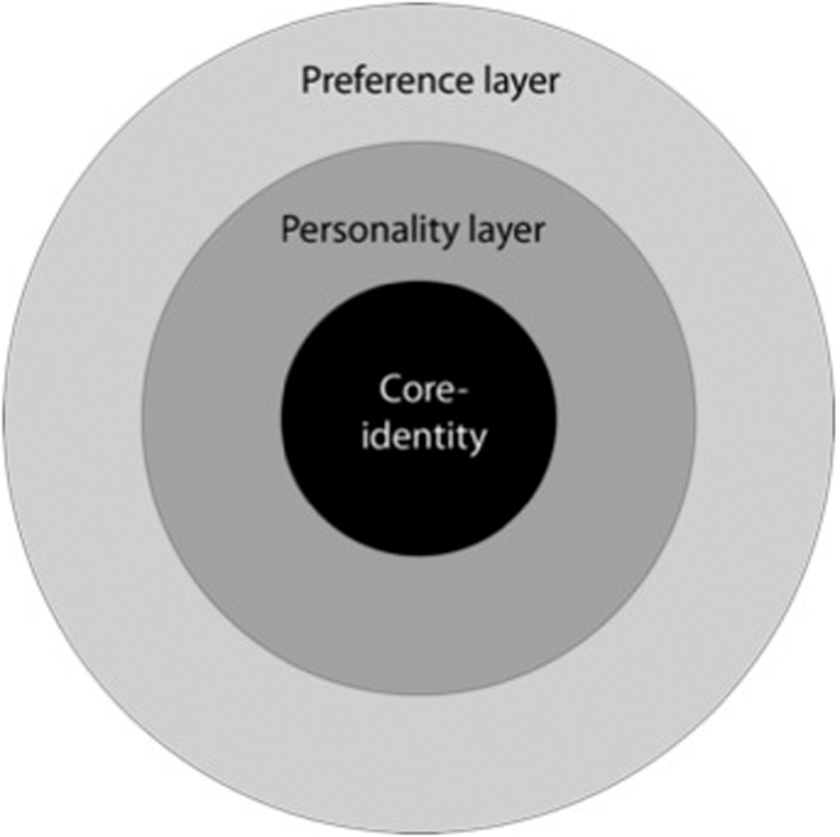
The structure of personal identity (Illeris, 2014, p. 71).
The personality layer is, in contrast to the core, not so much about the relationship with oneself but rather about how one relates to others, communities and groups, important issues and instances, significant events, and incidents—overall to the outside world, society, and environment of which one is a part. It would seem that the demand to be able and willing to make changes in this part of the identity has grown rapidly in recent decades through radical changes in both the life situation in general and all sorts of technical, organizational, political, and private changes in everyday life. We are all constantly confronted with new events; situations; conditions; rules and regulations; ideas; demands and arguments; and things to discuss, to decide on, to relate to, and to have an opinion about. It is also in this area that we find what Mezirow has referred to as our meaning perspectives, frames of reference, and habits of mind. This is a layer in which we are usually willing to make changes if there are good reasons for these changes, but on the other hand, these are not matters we change without being convinced about the relevance and appropriateness of the new content. Thus, in general, the demands for and the relevance of transformative learning, as this expression is usually understood and defined, are very much concentrated in the personality layer.
The layer of preferences is the most peripheral layer of the identity. Here we find all the many things and issues we meet in our everyday life that are meaningful and of some importance to us but not very crucial matters. It has to do with how we do all the many things we are used to doing, our routines, our more or less automatic reactions in different situations, what we say and how we say it, and what we instantly feel in and about all the many everyday situations we deal with but are not so strongly committed to. In this layer, we find most of what Mezirow has termed meaning schemes, and in general changes in this area are not so dependent on what we feel and think but rather whether we actually are able and willing to mobilize the energy to change. We are not so committed, but it is all right if the reason for a change is acceptable and we are able to exert ourselves to do it.
Finally, it should be mentioned that the above is related to what is usually understood as personal identity. There are also other identity areas such as work identity, family identity, national identity, religious identity, and so on, and each of these part identities contains the same types of layers and can be analyzed in similar ways (Figure 2).
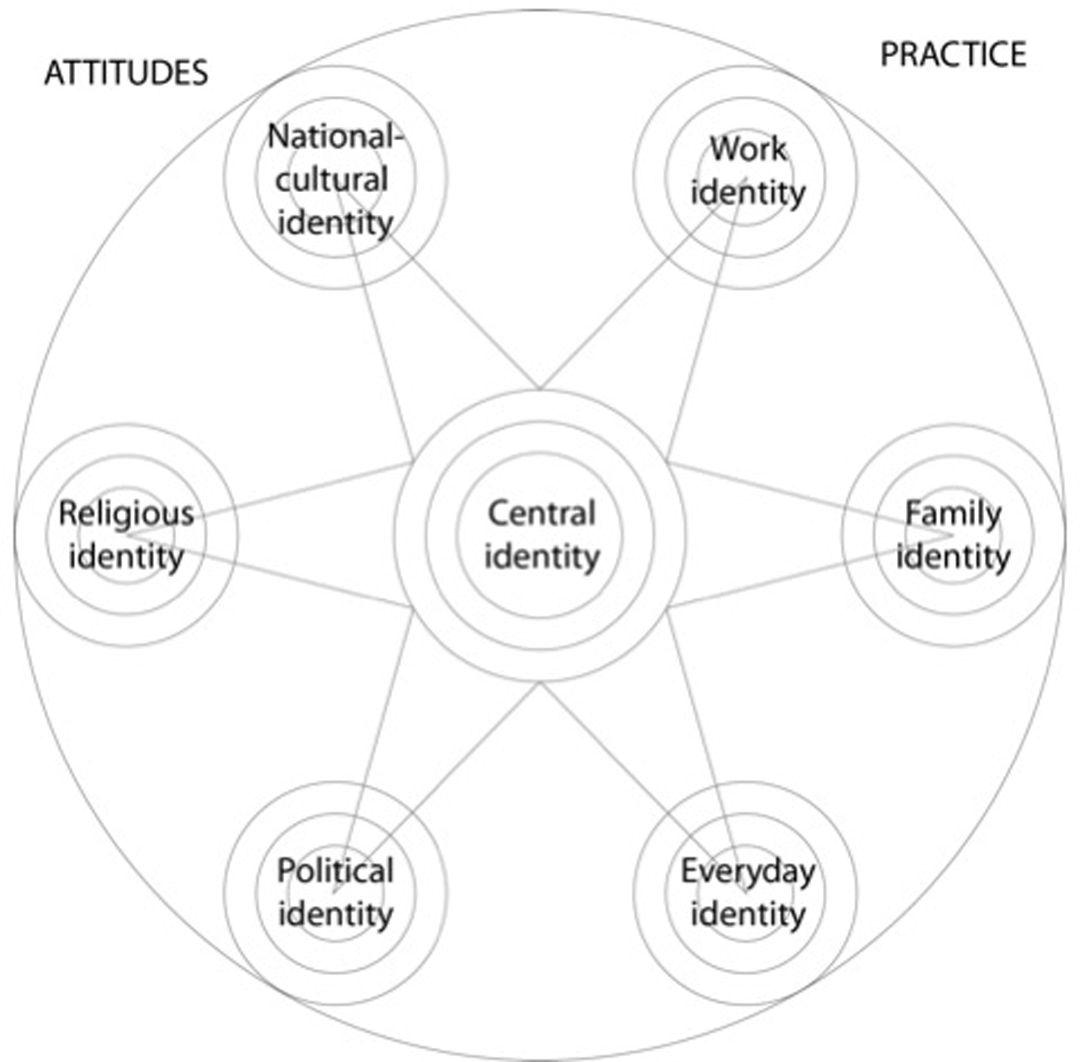
An example of personal identity and part identities (Illeris, 2014, p. 76).
The general picture is that identity is a complex structure and that our inclination to make changes in elements of the identity mainly depends on how close to the core identity the changes are subjectively experienced to be. In the following, some examples will be given of areas in which the combination of the concepts of transformative learning and identity can contribute to a better and more differentiated understanding and/or practice (again a more detailed account is given in Illeris, 2014).
Identity Development and Transformative Learning in Childhood and Youth
The concept of transformative learning has always been used mainly in relation to adults, but obviously, there must be a development through childhood and youth setting the scene and conditions on which the transformations take place. Relating transformative learning to changes in the identity can give access to a more detailed understanding of how this development takes place.
As already mentioned, Erikson related the development of the identity to the age of youth, and he regarded the various mental formations in childhood that paved the way for this development as “identifications,” indicating that they relate to what the child has taken over from others (Erikson, 1950, 1968). However, Daniel Stern (1985), as mentioned, has shown that the core identity is basically established from the very first year of life. This does not happen by transformation, but by development, because there is not yet anything to transform. Accordingly, the conclusion must be that real transformative learning cannot normally take place in childhood.
The life age of youth starts at early puberty about the age of 11–13 years, and the identifications of childhood do not obtain the qualities of identity elements before they have been personally elaborated and acquired through the youth identity process. This implies that identity development in youth is of great importance for the individual possibilities of transformative learning in adulthood. How this development takes place in liquid modernity has probably been studied most thoroughly by the German psychologist Thomas Ziehe (2009) but also by the author of this article (Illeris, 2003, 2007).
Here it is significant that identity development commences with what has been termed search processes, that is, an advanced kind of trial-and-error learning in which a lot of more or less diffuse drafts of behavior and understanding are tried out, gradually adjusted and often rejected again, whereupon new trials are constructed. This process can be very demanding and also confusing for both the youngsters themselves and their peers, parents, teachers, and others. However, more stable attitudes and ways of behaving and acting are gradually taking form, and usually about the age of 16–18 years, it is possible to identify new provisional elements of identity that clearly go beyond the self-centered core. A full identity with a practicable balance between stability and flexibility is today usually not obtained until in the last half of the 20s, at which point the psychological life age of youth is terminated.
Thus, today, youth is psychologically a lengthy life age, usually lasting about 15–18 years. But with the importance of individualization in liquid modernity, this seems to be necessary for both the individual and the society—as individualization implies the ability to make choices, not only of what to do, to think, and to buy but also in broader areas such as behavior, lifestyle, and identity. Consequently, transformative learning during youth becomes by degree the means of development and learning concerning the various elements of the identity, at first through very unsteady trials but gradually by means of more consistent thinking and behaving. To deal with transformative learning in youth is both important and demanding for the learners as well as for those who try to help and support them.
Motivation, Defence, and Competence Development
In adulthood, when a relatively stable identity has been developed, motivation becomes a quite central issue in relation to possibilities of changes in the identity. The type and strength of the motivation involved is crucial: Adults do not transform elements of their identity if they do not have serious reasons for doing so. These reasons may be internal, external, or both, but analytically, the important thing is that transformations imply strong motivation and cannot be expected to occur without such motivation.
As most teachers, instructors, managers, or supervisors consciously or unconsciously are aware of this, they try to motivate their students, employees, or clients. But in doing so they often make the mistake of trying to create motivation instead of finding it, not realizing that a motivation that is strong enough to trigger transformative learning must be deeply rooted in the person and cannot merely be created or imposed (cf. Illeris, 2007). The key challenge of promoting transformative learning is to find and connect to the psychological or practical, internal or external potentials in the learners’ existence, and life world that are so strong that they can justify the exertion involved in a transformation.
It is also important to be aware that all learning, and especially more demanding learning, very often will have to overcome learning barriers in the form of defence or resistance. In liquid modernity, we are all confronted with so many new situations and learning possibilities that we have to protect ourselves against being overwhelmed and destabilized by constant change. We therefore develop a learning defence that is partly unconscious and automatic. We cannot take in all learning possibilities and not even cope with consciously deciding which to take in and which to refuse (cf. Illeris, 2007).
An especially strong part of this defence system is identity defence, which protects us against too much transformative learning. This must be accepted, understood, and respected—and again, the way to deal with this is not to employ some cunning methods and activities but rather to try to detect whether the learners actually have any serious interest in the intended transformations and, if so, where these interests are subjectively rooted and how they can be addressed.
Finally, in this connection, it should be mentioned that if and when genuine transformative learning takes place, we have to do with processes that pave the way for what truly can measure up to the buzzword of competence development when changes in mind and behavior are followed by more concrete changes in understanding and acting.
Progressive, Regressive, and Restoring Transformations
Connecting transformative learning to the concept of identity can also serve to draw attention to the fact that not all transformations are progressive. Of course, the aim and idea of transformative learning is basically to overcome personal limitations and difficulties and develop qualitatively new possibilities. But sometimes, it becomes important and necessary to realize that progressive transformations can be too demanding and challenging for the learner so that the outcome rather becomes withdrawal or regression, which can in fact also be a kind of transformation. It is in general not very difficult for an adult teacher or instructor to identify cases in which intended transformations appeared to be too much but to realize this was certainly also a transformative experience for the learner. Some of these cases also involve learners setting new and more realistic goals, which imply what can be called restoring transformative learning (cf. Illeris, 2014).
Concluding Remarks
Viewed in relation to the issue of transformative learning, the concept of identity is obviously of interest as meaning perspectives, frames of reference, and habits of mind are substantial parts of the identity. But identity is more than this, as it spans all the dimensions of learning and mental processes: the cognitive, the emotional, and the social as well as the environmental and societal situatedness of this totality (Illeris, 2004, 2007).
Of course, the maturity and stability with which Mezirow’s mainly cognitive concepts were connected are still important positive qualities, although to some extent they are also in contrast to the notions of continuous growth and flexibility, which have become dominating ideals. Hence, the critique that Mezirow’s notion of transformative learning is too strongly cognitively oriented when seen in relation to contemporary life and work conditions is well established and has also in general been accepted by Mezirow himself (Mezirow, 2006, 2009). For several years, he has carefully mentioned in his writings that emotions and social relations are also involved in transformative processes. But at the same time, he has maintained meaning perspectives, frames of reference, and sometimes also habits of mind as the target areas of transformative learning so that emotions and social abilities have gained a position as something connected to transformative learning but not really what it is about. And the extent to which dimensions other than the cognitive have really found acceptance as equal elements in the general notion and understanding of transformative learning remains an open question.
What is needed would appear to be another, broader, and more inclusive definition of the concept covering all the mental dimensions and with the qualities to function as a general and coherent term for the mental target area of transformative learning. The concept of identity seems to be the best choice for this because it covers all the relevant fields and over the last decades has become the generally accepted term within both psychology and sociology for the central personal mental area, as this has been developed in interaction with the conditions of liquid modernity today.
As a consequence of all this, some sort of agreement or common notion on accepting and using the term identity, which includes the cognitive, emotional, and social dimensions and elements and understood as the general link between the individual and its practical, cultural, social, and societal environment, would be an appropriate and up-to-date opening and the same time a necessary delimitation of the approach and practice of transformative learning.
Footnotes
Declaration of Conflicting Interests
The author(s) declared no potential conflicts of interest with respect to the research, authorship, and/or publication of this article.
Funding
The author(s) received no financial support for the research, authorship, and/or publication of this article.