



Abstract
This article introduces the concept of personal empowerment as a form of transformative learning. It focuses on commonly ignored but enhancing elements of mathematics learning and argues that crucial personal resources can be essentially promoted by high engagement in mathematical problem solving, inquiry, and collaboration. This personal empowerment is considered in three forms: self-empowerment, cognitive empowerment, and social empowerment. We report results from semi-structured interviews with undergraduate students who participated in college mathematics classes that implemented inquiry-based learning at four research universities. The findings support the idea that learning mathematics in classroom situations that use student activity, deep engagement, and collaboration can be strongly transformative for individual students. Not only do these courses enhance students’ thinking and problem-solving skills but they also significantly promote self-perceptions, agency and self-regulatory activity, and social skills. Positive elements of these classroom practices for students’ personal empowerment and transformative learning are discussed.
Introduction
Mathematics carries many cognitive, psychological, and sociocultural features that are distinctive relative to other academic subjects, offering both a powerful gateway and a barrier for enhancing personal academic resources, social resources, and power (Manigault, 1997; Schoenfeld, 2004). Common views of mathematics as a difficult subject, and schools’ use of mathematical skills as a measure of academic and cognitive abilities, place high social value on studying and knowing mathematics. Moreover, successful learning of mathematics requires mental stretch and engagement in solving challenging problems. Indeed, the education literature acknowledges difficulties in students’ mathematical thinking and problem solving due to their negative attitudes, poor self-concept, or lack of motivation (Malmivuori, 2008; McLeod, 1992). Yet facing the personal, social, and cognitive challenges in mathematics learning also offers opportunities for transformative experiences and personal development. What kinds of experiences, reflection, and activity might lead to students’ powerful personal growth in learning mathematics, and how are these related to the learning contexts in which students work?
In this article, we address transformation through learning mathematics. In contrast to most mathematics education studies, we highlight the opportunity for empowering changes in students’ perceptions and activities, as they study mathematics and solve problems in classes that use inquiry, peer interaction, and communication. We introduce the concept of personal empowerment to gather these transformative aspects of mathematics learning. It consists of students’ self-empowerment, cognitive empowerment, and social empowerment. This article thus aims at deepening the understanding of students’ personal processes in transformative learning experiences that are fostered by active and collaborative learning (King, 2000; Mezirow, 1997; Taylor, 2007). Furthermore, we will elaborate how these transformative experiences and processes translate into enhanced personal resources and empowerment.
First, a review of relevant literature introduces the concept of empowerment. Drawing upon notions of transformative learning, we then define personal empowerment and introduce its main aspects in learning mathematics based on a literature review and previous research results. These theoretical perspectives are then followed by results from a qualitative study on undergraduate students’ experiences in college mathematics classes that apply instructional practices known as inquiry-based learning (IBL). In this analysis, we both apply and further develop the theoretical construct of personal empowerment for understanding the potential transformative aspects of learning mathematics.
Literature Review
Concepts of Empowerment
The term empowerment is used in sociological theories of emancipation that address power and power relations within a society (Cummins, 2000). According to Rappaport (1984), empowerment is a construct that links individual strengths and competencies, natural helping systems, and proactive behaviors to social policy and social change. Robbins, Chatterjee, and Canda (1998) likewise consider empowerment as a “process by which individuals and groups gain power, access to resources and control over their own lives” (p. 91). These viewpoints are emphasized in critical learning theories (Giroux, 1983), feminist studies (Walkerdine, 1998), and transformative learning theories (Taylor & Cranton, 2012). In mathematics education, ideas of empowerment emerge in studies about representation or achievement of women and minorities, capacity building in adults with poor basic mathematical and numeracy skills (Benn, 1997; Nasir & Cobb, 2002; Tucker, 1999), and power relations in mathematics classrooms (Lave & Wenger, 1991).
In our use of the term empowerment, we refer to the theoretical distinction made by Perkins and Zimmerman (1995) between traditional psychological constructs and community-based concepts of empowerment. In this article, we emphasize the personal psychological aspects of empowerment, called here personal empowerment. Drawing upon notions of transformative learning, we connect this to students’ increased reflection, sense of self, agency, responsibility for their own and others’ learning, and their willingness and ability to contribute to in-class mathematics knowledge construction and problem solving. Personal empowerment is then reflected in students’ positive self-perceptions, internal locus of control, and enhanced cognitive and social skills, thereby making mathematical study more efficient, enjoyable, and personally rewarding (Malmivuori, 2001; Manigault, 1997).
In reviewing the literature, we introduce key aspects of personal empowerment and their importance in mathematics learning. These consist of self-empowerment in the form of positive self-perceptions and identity development, enjoyment, and personal agency and self-regulation; cognitive empowerment in the form of enhanced thinking and learning; and social empowerment in the form of increased social skills. These three main aspects serve here as a theoretical framework for understanding students’ personal empowerment and transformative learning in mathematics.
Self-Empowerment
Students’ self-perceptions and interpretations of their experiences have an essential role in personal empowerment and transformative learning as a basis for identity development and capacity building. According to Mezirow (1994), “the most significant learning involves critical reflection around premises about oneself” (p. 224). Dirkx (2012) considers that the transformative process occurs in the relationship with unknown aspects of the self as well as with others and with broader society. Similarly, development of mathematical identity is tightly connected to powerful experiences and interpretations of the self in mathematics performance situations (Cobb, Gresalfi, & Hodge, 2009; Nasir, 2002). Changes in self-perceptions have transformative power, especially when students see mathematical achievement as important for their academic and personal endeavors. Numerous studies show that self-perceptions can significantly mediate the positive or negative effects of previous mathematical achievements and experiences on students’ future endeavors. In particular, weak confidence and a strong negative affect toward mathematics account for students’ poor mathematics achievement and participation, while positive self-perceptions and behaviors such as increased perseverance, risk taking, and the use of improved cognitive and self-regulatory strategies are connected to efficient and deep learning (Deci & Ryan, 2002; Malmivuori, 2001, 2008). Self-perceptions thus can either empower or disempower students’ identity development and mathematics learning. We consider positive self-perceptions and enjoyment of learning to lie at the core of personal empowerment, manifested as high self-esteem, confidence, and self-efficacy in studying mathematics.
Self-reflection and agency are central features of transformative learning theories. Changing the meaning of one’s experience, or “meaning schemes,” requires awareness and critical reflection (Mezirow, 1991) or expansion of consciousness through group work (Boyd, 1989). Furthermore, awareness and critical reflection promote autonomy and self-directed learning in transformation (Boyd & Myers, 1988; Merriam, 2001; Mezirow, 1997). There exists a close, reciprocal relationship between individuals’ learning and their sense of self and identity, which is both shaped by and shapes individuals’ agency and intentionality (Billiett & Somerville, 2004). Personal agency means that students exercise internal control, responsibility, and efficacy in learning and regulating their own actions (Deci & Ryan, 2002). In a classroom, it also means that students share responsibility for creating a social learning environment that promotes transformative learning (Imel, 1998).
Personal agency is characterized by active self-reflection and self-regulation. Being aware of their own strategies and resources that they can apply to solve challenging problems increases students’ ability to regulate their cognitive, affective, and motivational processes (Malmivuori, 2001, 2006; Paris & Paris, 2001). In mathematics education research, self-regulation represents both an important characteristic and a goal of mathematics education. Self-aware students learn mathematics independently; they are able to persist in the face of difficulties and are flexible and creative in their thinking and problem solving. They also select, structure, and create environments that optimize their learning (De Corte, Verschaffel, & Eynde, 2000). Self-regulated mathematics learners approach tasks with confidence, diligence, and resourcefulness. Our concept of self-empowerment combines both students’ positive sense of self and identity and their exercise of control and efficacy in learning and regulating their own actions.
Cognitive Empowerment
Transformative learning calls for higher order cognitive functioning involved in critical reflection, reasoning, and rational discourse (Merriam, 2004; Mezirow, 1998). We also connect personal empowerment to growth in mathematical knowledge and higher level thinking and problem-solving skills. Engagement in advanced mathematical activities such as stating and modifying problems, articulating assumptions, reasoning logically to reach conclusions, and interpreting results intelligently will significantly foster both students’ mathematical thinking and their general cognitive capability (Hanna, 1991). Successful learning of advanced mathematics involves conceptual thinking, understanding, and logical reasoning (Pirie & Kieren, 1994) but also the use of a wide range of cognitive and metacognitive strategies, inquiry, and persistence in solving problems (Schoenfeld, 2004).
Challenging mathematical activities thus promote both students’ general cognitive resources and their exercise of control and efficiency in their learning, as they move toward becoming what Schoenfeld (1992, p. 335) calls “mathematically powerful” students who are quantitatively literate, flexible, and analytical thinkers. We refer to these thinking, problem-solving, and learning skills as cognitive empowerment. Such enhanced cognitive capacity increases students’ possibilities for success and effective learning, thus further promoting their self-empowerment.
Social Empowerment
The nature of classroom interactions plays a significant role in students’ perceptions and transformative learning (Boyd, 1989; Lave & Wenger, 1991; Nasir, 2002). In an active mathematics class, students must manage social interactions, such as presenting, arguing, and participating in public discussions, which often arouse strong feelings and heightened perceptions of their own mathematical capability (Goldin, Epstein, & Schorr, 2007). These can be significant moments for students’ identity development around learning mathematics. Moreover, classroom communication practices mediate sociocultural impacts on students’ perceptions and learning behaviors (Lave, 1988; Yackel & Cobb, 1996), as “Discourse is central to human communication and learning” (Mezirow, 1994, p. 225). In particular, critical reflection and changes in perspective are fostered through reflective discourse in an ideal speech situation that is free from internal and external constraints and also provides for equality of opportunity to participate and for reciprocity in the roles in the discourse (Mezirow, 1985, 1991; Taylor, 1998). Social empowerment denotes here the enhancement of students’ social skills through mathematical learning and problem solving. This enhancement results from increases in students’ willingness and ability to collaborate with their peers, to communicate their own ideas, and to understand and appreciate others’ ideas. Socially empowered students can competently and actively contribute to constructing knowledge and conditions for empowerment in mathematics classrooms (Lave & Wenger, 1991; Taylor, 1998). These skills reinforce students’ personal empowerment directly and indirectly through cognitive empowerment and self-empowerment as seen in their positive sense of self and identity, enjoyment, and personal agency.
Method
Research Questions
This study focuses on transformative aspects of learning mathematics in the form of personal empowerment. We consider both empowered outcomes (e.g., perceived control or competence) and the processes (e.g., deep engagement and problem-solving activities) through which individuals gain personal power (Zimmerman, 1995). The study sought to answer the following research questions. What kinds of experiences, reflection, and activity in mathematical learning contribute to students’ personal empowerment in college classes that implement IBL? How do personally empowered outcomes and processes relate to mathematics learning situations and contexts in these classes?
Data and Subjects
This empirical study of personal empowerment is based on data from semistructured interviews with undergraduate mathematics students, gathered as part of a comprehensive, mixed-methods study of IBL in college mathematics at four research universities (Laursen, Hassi, Kogan, Hunter, & Weston, 2011). IBL represents a form of “active learning,” the goal of which is to engage students in the learning process and thereby activate responsibility for their own learning processes (Prince, 2004). Like discovery learning (Bruner, 1961), problem-based learning (Savin-Baden & Major, 2004), and other inductive teaching approaches (Prince & Felder, 2007), the method invites students to work out ill structured but meaningful challenges. It addresses many desirable outcomes of undergraduate education and of transformative learning, including critical thinking, the ability to analyze and solve complex problems, efficient use of learning resources, and demonstration of versatile and effective communication skills (Duch, Groh, & Allen, 2001). Moreover, critical reflection, discourse, and rationality itself are argued to develop only as a consequence of inquiry (Mezirow, 1998). Thus, the study offered an important context for studying personal empowerment and transformative learning.
Each university offered its own IBL courses in a variety of mathematical content areas and spanning a wide range of student audiences from first to senior year; students majoring in mathematics, science, engineering, and economics; and students preparing to teach school mathematics. Observation of these courses showed that they emphasized the exploration of challenging problems or proofs, whole class or small group discussion, and student presentations of problem solutions or proofs to their peers. On average, 60% of IBL class time was spent on such student-centered activities (Laursen, Hassi, Kogan, & Weston, 2014).
The interviews investigated students’ experiences in IBL mathematics courses, the outcomes of IBL instruction, and classroom learning and teaching processes. Students were asked what they had gained or learned (or not) from their IBL class and what contributed to or detracted from their learning. The interview protocol also included questions probing specific gains such as understanding content or the nature of mathematics, changes in attitudes (confidence, enjoyment, and interest) and ways of learning or problem solving, and communication skills. These questions were based on data from preliminary interviews with students and instructors in IBL classes.
Interview samples were constructed from course lists provided by each department and balanced by gender, race/ethnicity, and academic major. Interviews were solicited and scheduled by e-mail and carried out during in-person visits to each campus. Nineteen students were interviewed individually and 49 students in 1 of 22 focus group interviews with 2–4 students each. In all, 41 interviews were conducted with 68 students who had taken an IBL mathematics course in the current or prior semester. During the study period, the 4 institutions graduated a combined average of 500 mathematics majors per year. Of these, an average of 33% were women (ranging from 26% to 37% by department). This is somewhat lower than the national average near 44% for this period (National Center for Education Statistics [NCES], 2010). An average of 12% of the mathematics majors at the four institutions were students from underrepresented minority groups, including African American, Hispanic, and Native American/Pacific Islander students. This figure varied from 2% to 22% by institution but was overall comparable to the national average of 12% for this time (NCES, 2010). Over half of all students interviewed were female, and nearly three quarters were White. Just over half of students were enrolled in an advanced mathematics class for upper class students, while 28% were in a course for first-year students, and 21% were taking an IBL course designated for preservice K–12 teachers (Laursen et al., 2011).
Analysis
Digitally recorded interviews were transcribed verbatim and coded in NVivo 8 qualitative data analysis software (QSR International, 2009). The data analysis applied a theory-driven approach in addition to an inductive, conceptual content analysis (Patton, 2002; Strauss & Corbin, 1990). The themes of personal empowerment were drawn both from theory and from student interviews. Data analysis was conducted in two phases. First, the researchers searched the transcribed text data for students’ reports of their learning gains. Text segments referencing distinct ideas were tagged by code names, and each new code marked a discrete idea not previously raised. The same codes were then reused to mark similar passages. Thus, codes and their associated text passages were linked, amassing a data set of code names and their frequency of use across the data set. Once all the text data were coded, codes similar in nature were grouped together to define working analytical themes. Overall, 24% of student observations in the interviews noted specific learning gains from IBL, while smaller bodies addressed gains not made (3%) or mixed gains made in partial or qualified degree (1%; Laursen et al., 2011).
In the second phase, the grouped codes on learning gains and how they arose were reorganized into the three main types of personal empowerment. As codes and their associated text passages were reviewed, new subcategories were developed and some text passages were recoded. The subcategories were compared in order to determine their coherence and relationship with each other and with the theoretical concepts. Finally, the subcategories were clustered into seven major categories under the three types of personal empowerment. In all, 85% of observations on learning gains coded in the first phase were included in the categories in the second phase. The final categories describe the range of issues in personal empowerment, and the frequencies characterize the relative weighting of these issues. We also analyzed the student interview data by gender to track possible variation in experiences between women and men. Gender differences of note are indicated in the results, and quotations are denoted F for female and M for male students.
Findings
Elements of Personal Empowerment
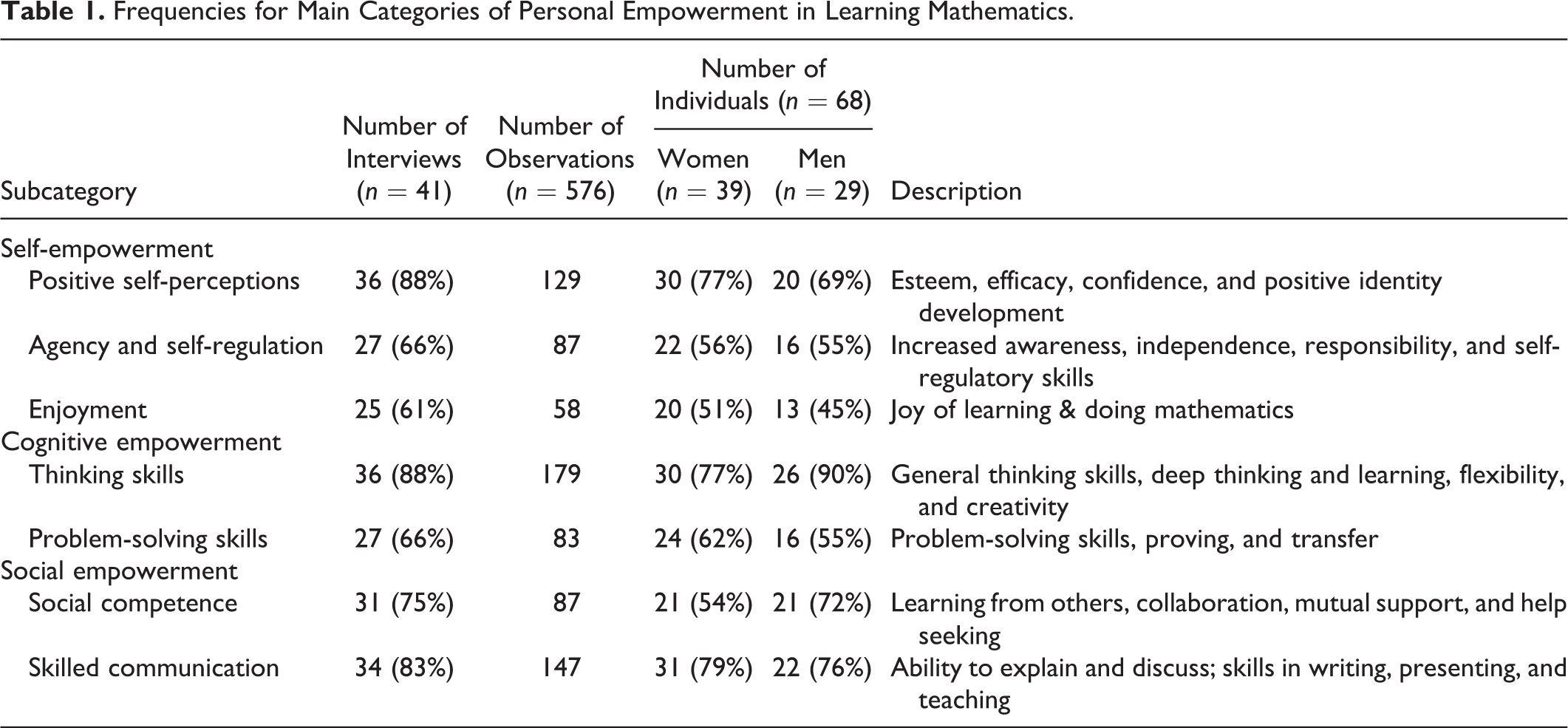
The framework for presenting results from the interview data consists of three interrelated aspects of personal empowerment introduced in the literature review: students’ self-empowerment, cognitive empowerment, and social empowerment. The first theme, self-empowerment (Tucker, 1999), reflects students’ positive self-perceptions and mathematical identity development, their enhanced agency and self-regulation, and their increased joy in learning mathematics. The second theme, cognitive empowerment, is characterized by the promotion of students’ thinking and problem-solving skills. The third theme, social empowerment, denotes students’ enhanced social competence and communication skills in learning. Self-empowerment represents an integrative theme in students’ personal empowerment, while cognitive empowerment and social empowerment are treated here as essential subsidiary themes interconnected to self-empowerment. Table 1 displays the frequencies for the main categories within each theme by the number of interviews, observations, and students. Percentages in the table indicate proportions of the interviews, women, or men represented in each category of personal empowerment.
Frequencies for Main Categories of Personal Empowerment in Learning Mathematics.
Self-Empowerment
Positive self-perceptions
Most of the interviews (88%) included reports of students’ enhanced self-esteem and increased self-efficacy and confidence in their mathematical ability after an IBL experience. In particular, nearly 40% of the women but 24% of the men reported enhanced self-esteem and pride for their mathematical accomplishments. Perceptions of their own capabilities further reinforced students’ fondness of and interest in studying mathematics, as in the following examples. F: … [My prior class] just made me feel like I couldn’t do math, it was inaccessible to me, it was very hard. This math class is reinforcing my belief that I am good at math, I can do math—it’s the right thing that I’ve chosen to study. M: Yeah, it was definitely a good thing for me. It definitely encouraged me in other classes. It gave me confidence to know that I could figure it out for myself, just by giving me the chance to do so. I definitely feel a little more confident in trying things out on my own first, to try to figure something out, rather than just depending on someone completely introducing every idea to me first. So I think that was useful. F: [gives example of her work] I actually thought, I can do this stuff instead of just looking at notes from a professor and doing the same thing. I can actually think of stuff for myself and use the tools that they gave me to accomplish something. Whereas—probably everybody’s proof in the class is similar but no one’s is exactly like yours—so even if you are doing the same basic thing, you still have [the feeling that] that’s my work that I can actually say is mine. F: So in terms of like higher-level math, I’ve never been very confident in it. But I think, I kind of wish I had taken a class like this before I took those classes, because I think it would have been helpful for me to figure things out and be more confident in the way that I could address those issues in discussing it with others. I think, in terms of smaller problems like this, I do feel more confident. I feel more confident about going into a classroom, definitely, and teaching it to students. I’ve never felt confident in math—but like I said, if I had done something like this before and then taken those classes, I would be more confident in my abilities. M: I think I’m actually thinking a lot more like a mathematician after having taken this course, compared to what I’ve done before. Because before it was like, well, I mean they really weren’t great proof-laden courses, so it was basically “solve a problem, here’s an answer.” But with this, I really feel like I’m developing some sort of problem-solving proof approach method that is coming a lot more [from] the approach that this course takes, as compared to a lecture. M: It’s actually even more exciting, because in a way you’re approaching the material the same way that the mathematicians at the time approached it, where they didn’t necessarily have the answers either. We just have the benefit of—we don’t chase the false paths, and we were led the right direction—but at the same way we are kind of making these discoveries ourselves.
Agency and self-regulation
Students became more aware of their own skills and developed learning, agency, and self-regulatory skills in IBL classes. Data from 27 (66%) interviews reflected this kind of self-empowerment, with more than three observations in each. Consistent with notions of transformative learning (Boyd & Myers, 1988; Mezirow, 1997; Taylor, 1998), student-centered and collaborative IBL practices fostered students’ need and ability to be reflective in studying mathematics. The next quotation shows such heightened awareness and transformation of perspective. F: It did open my eyes to how I learn math, how my kids potentially learn math, and how you talk about math. So it was definitely a necessary pre-requisite—because the classes that we’ve taken thus far, [or teaching] methodology courses, have never really gone quite back into that sort of mindset. F: I’m a F: … I think I approach not only, like, specific math problems but, like, situations in my life differently, because I can think about different ways to approach it and realize why. I am starting to realize why things that I’ve done forever work. So I think I’ve just been able to analyze my own processes more than I could before. F: Maybe just the fact that a lot of times, if I come across a hard problem, I would think, “Okay, I just don’t really care if I learn this or not.” And now it’s more like, “I can come back to it later.” I’ve learned to cope with my frustrations more, I guess. F: I mean, I had never really done problem solving … I mean, I’m sure I had, but never so explicitly. And I think the biggest thing that I learned about problem solving was just perseverance.
Enjoyment
The data also showed evidence of powerful positive affect linked to a positive sense of self and learning (Malmivuori, 2001, 2006) or soul-level transformative experience (Boyd, 1989; Dirkx, 2012). Overall, 33 students in 25 interviews described excitement or joy in learning mathematics. These self-empowering experiences related to aspects such as having fun in class, working together, and enjoying inquiry and “hands-on” problem solving. The next quotation is an example of such positive experiences. F: The
Cognitive Empowerment
Transformative learning theories emphasize the development of higher order thinking and problem-solving skills (Merriam, 2004; Taylor & Cranton, 2012). Such cognitive empowerment due to gains in thinking, understanding, and problem solving was strongly reflected in students’ statements. Nearly all the interviews (39) dealt with such gains, with 244 observations in total. Moreover, this cognitive empowerment showed up in other academic subjects and even in the areas of students’ everyday life.
Thinking skills
In all, 56 students reported enhanced thinking skills. Most frequently (36 interviews and 104 observations), students talked about deeper understanding, thinking, and learning in an IBL class, as reflected in the following statements by two students. M: I feel like after this I really understand the concepts better, and know how it all fits together and everything—and that’s very much deeper learning. M: I like it a lot more. I feel like I just actually understand where everything comes from, and one thing follows from another better. It’s like no memorization or anything like that. F: I guess it teaches you, like, reasoning skills. And we worked a lot on proofs and how to formulate a proof and organize it and stuff, which I think was helpful just in organizing your ideas in general. M: It’s kinda coming back to the same thing I keep saying over and over: when someone else presents something different, particularly if they claim to have the answer to a problem already, [I’m] coming around to, “Okay, well, this isn’t the way I would do it.” Not only what did they do, [but] how did they do it, how did they arrive here, and what might be the potential problems … F: … It’s definitely introduced me to just the fact that you can approach math from so many ways … And you can make it fun, and you can use other approaches, and you can apply it to other contexts. M: … So being able to kind of pull myself out of the way, [how] I would do a problem in someone else’s shoes … I think that’s definitely a thinking skill that I have developed a lot in this class.
Problem solving
Increased skills in problem solving represented another significant area of cognitive empowerment in IBL college mathematics classes, as reported in 27 interviews and 83 observations. Students considered problem solving and constructing proofs to be powerful mental exercise that developed efficient, personal forms of thinking useful in other problem-solving situations, as expressed by the following student. F: … You know things a little bit better, and you don’t have to memorize things [because] you’re able to re-derive everything on your own. And you really learn problem-solving skills more than you just memorize formulas and ways to approach specific problems. You learn ways to approach all problems—so that’s a difference that I see. M: … The best thing’s probably, for me, the problem solving just in general. Really just the ability to look at something that you’re not used to, and to be like not intimidated by it, and to feel like you can solve it, has been helpful in a lot of ways, not only in math but also in other subjects. F: … Not only you are learning the material, you are learning ways to approach problems and ways to attack them. You can definitely take that outside and into everything even beyond math.
Social Empowerment
Increases in communication skills and social competence constituted significant features of IBL students’ personal empowerment. Solving problems in small groups, presenting problems, and critiquing and discussing each other’s proofs enhanced students’ social skills. Fifty-three students (34 interviews) noted increases in communication skills, and 41 students (31 interviews) noted aspects of social competence, men (72%) more frequently than women (54%).
Social competence
Gains in social competence included increased appreciation of learning from other students and improvement in students’ ability to interact and collaborate with others. Consistent with the ideas of transformative group learning and communities of practice (Cranton, 1994; Wenger, 1998), students reported they were more inclined to see other students as resources and took collective responsibility for everyone’s learning. Active collaboration both enhanced students’ own understanding and made them want to do their best for the class, as expressed in the next example. M: It definitely reduces the stress level involved. I guess it encourages group work. I’ve definitely gotten better at working with other people in solving math problems, because of this class. There’s always an incentive to do your best for each class, to prepare as well as you can the theorems for the next class. M: … There’s just kind of this collective thing that kind of builds in the IBL course. You feel like you’re part of something … when we’re all putting our efforts towards this problem. M: Just, this does make it easier to get up in front of someone, show them what you did and feel more comfortable in defending on what you did, compared to someone who didn’t take this class.
Skilled communication
Many observations (147) referred to enhanced communication skills from an IBL class. Presenting solutions at the board and class discussions were important sources of this social empowerment. Students in 34 interviews described their enhanced confidence and skills in presenting, writing, and teaching, with 115 observations in total. The following two quotations reflect this kind of social empowerment. M: And [I’ve gained] presenting skills—as in, I get less nervous, I can be more confident, I think. F: Just communicating. I find myself talking in very
Preservice teachers in particular reported strengthened ability and skills in teaching. Some reflected on how they expected IBL teaching and learning would affect their own classes in the future, such as the following student. F: So it’s given me a good look at how the classroom is run, and how you can actually approach teaching a topic—and that there are really different various ways in how to teach it to the students. So I think it’s really preparing me in terms of teaching and what to expect. M: Every time you solve a problem, you have to write in a fashion where somebody who has no knowledge of the class can understand it. And I think that’s a really good advantage, and not even just for the class, but for anything else that you may [think]. M: … The biggest thing I’ve noticed is just sitting and talking about mathematical thinking— … not just limited to mathematics, but it’s really a skill that can be applied … I would definitely say I feel more comfortable discussing … I’m necessarily more confident in articulating my own thoughts, … [being] able to listen to others, explaining what I’m saying. F: I also think that it’s given me an opportunity to explain things to other people—which, to me, it’s
To summarize our key findings from college classes that use inquiry, peer interaction, and communication, we can conclude that active learning, personal engagement, and collaboration can essentially foster students’ transformative learning and personal empowerment in studying advanced mathematics. We perceived profound changes in three interrelated areas of personal empowerment: self-empowerment, cognitive empowerment, and social empowerment. Positive changes were discerned in students’ self-perceptions and mathematical identity, their enjoyment of learning, and their personal agency and self-regulation. This self-empowerment was further strengthened by students’ recognition of their own clearly improved thinking and problem-solving skills. Furthermore, our results reveal how collaborative work and supportive learning environments can empower students by enhancing their social competence and communication skills. We discuss these results and their instructional context in the next section.
Discussion
Mathematics Learning as Transformation
Experience and development through crucial changes in making meaning from experience are central features of transformative learning (Mezirow, 1991, 1997; Taylor, 1998)—learning that shapes people in such a profound way that it affects all their subsequent learning. Our study of personal empowerment reflects these kind of powerful processes and outcomes in learning college mathematics, such that learning mathematics can be strongly transformative for individual students. The undergraduate IBL mathematics classes applied active and collaborative teaching practices by engaging students in challenging problem solving, either alone or in small groups, through individual effort, class discussions, and student presentations. The study thus helps illuminate the nature of transformative personal processes and outcomes in learning conditions that are marked by deep engagement, active interaction, and critical discourse. Students’ observations about their experiences were organized under three interrelated types of empowerment: self-empowerment, cognitive empowerment, and social empowerment. Each of these types reflected transformations in students’ perceptions, capacities, and behaviors (Cranton, 1994; Mezirow, 1997).
Mathematics learning situations in IBL classes fostered students’ self-empowerment in the form of enhanced self-esteem, pride, self-efficacy, and confidence in their mathematical ability. These courses were especially empowering for women’s self-perceptions and seemed to carry over to other problem-solving settings (Laursen et al., 2014). Students’ mathematical identities were strengthened through thinking and working like research mathematicians and beginning to develop their own personal style of solving problems. Such positive self-perceptions and identity development further reinforced students’ engagement and independence in studying mathematics.
Experiential and transformative learning theories emphasize individuals’ conscious reflection on their own learning that then promotes changes in meaning schemes and deepens learning and information processing over superficial learning and information scanning (Moon, 2004; Mezirow, 1991). Consistent with these ideas, students reported increased awareness of their own knowledge, thinking, and problem solving as well as greater independence and responsibility for their own learning and performance. Students’ statements also reflected increased internal control and regulation of their own learning activities, thus reinforcing their personal agency. They frequently reported a transfer of this self-empowerment to other contexts.
Moving from elementary to advanced mathematical thinking involves significant transitions from describing to defining and from convincing to proving in a logical manner (Tall, 1991). Cognitive empowerment in learning college mathematics thus requires development of sophisticated thinking and problem-solving skills. In IBL courses, undergraduate students faced unfamiliar and challenging mathematical problems, and many interviewees spoke of how these fostered deep understanding and improved their general thinking skills. Moreover, inquiry, collaborative problem solving, and class discussions seemed to foster students’ creativity and flexibility, growth that also improved their learning in other classes, and in everyday life. More generally, these results address the importance for deep learning and cognitive empowerment of personal and collaborative engagement in advanced mathematical thinking and problem solving.
Social empowerment featured students’ enhanced social competence and skilled communication. Prior work shows that high educational gains and improved social skills result from teaching approaches that emphasize collaboration and group work, foster student dialogue, build positive interdependence among group members, promote higher order thinking, and encourage students to accept responsibility for their own learning (Johnson, Johnson, & Smith, 1998; King, 2002). In IBL courses, presenting solutions at the board and class discussions importantly supported students’ social empowerment, and it is noteworthy that these social outcomes may be especially powerful for men. Consistent with transformative learning ideas (Boyd, 1989; Mezirow, 1997; Taylor, 1998), active collaboration and conversation enhanced students’ individual reflection and understanding as well as their ability to collaborate and take responsibility for other students’ knowledge construction. Gains in communication skills were empowering for many students and extended beyond their mathematics class. For preservice teachers, such gains were linked to teaching skills in particular. Improved social competence and communication skills helped students’ learning and cognitive empowerment but also promoted self-empowerment by enhancing their self-perceptions, identity development, and personal agency.
Our study provides additional information on several key dimensions of the transformative learning experience: (1) the overall learning environment, (2) the processes used in transformative learning, and (3) key outcomes associated with these processes. We introduced the concept of personal empowerment in describing students’ capacity building through transformative learning experiences. This consists of self-empowerment, cognitive empowerment, and social empowerment that elaborate the areas of profound changes in students’ perceptions, activities, and skills in a challenging but also supportive mathematics learning environment. Students became cognitively empowered by deep engagement in mathematical problem solving, inquiry, and collaborative work that improved their general cognitive resources but also reinforced their higher order cognitive functioning, such as critical reflection, awareness, and exercise of internal control that are necessary for transformative learning. Likewise, the important role of self-perceptions, critical reflection, and self-regulation in successful mathematical problem solving offers an excellent context for examining transformative learning processes and outcomes involved in self-empowerment. Indeed, mathematical problem solving and classroom situations that used inquiry and critical discourse importantly reinforced students’ self-perceptions, identity development, and personal agency. Moreover, our study showed that a supportive class environment and reflective discourse in challenging collaborative work empowered students socially by increasing their social competence, responsibility, and willingness to contribute to in-class knowledge construction. Overall, this study of inquiry-based mathematics classes strengthens the important idea that students’ increased awareness and critical reflection promote crucial changes in their meaning schemes, foster their autonomy, and deepen their learning.
What aspects of a learning environment foster this kind of processes and personal empowerment in students? Wilson, Switzer, Parrish, and the IDEAL Research Lab (2007) suggest various layers of instructional design that promote deeper engagement and transformative learning experiences, including complex, problem based; authentic, realistic; scaffolded, guided; active, participatory; and reflective, intentional activities. Many of these layers are evident in the IBL courses that we studied. In our larger study (Laursen et al., 2011; Laursen et al., 2014), we could directly link student outcomes to course practices. Student learning gains correlated statistically significantly with the fraction of class time spent doing student-centered activities (small group work, student presentation, computer work, and discussion) and inversely related to the fraction of time spent listening to instructors talk. Moreover, students’ shared responsibility for setting the course pace and direction made a measurable difference in the strength of their learning gains. In open-ended survey items, IBL students described the important roles of both collaborative and individual work in their engagement and learning processes. In contrast with students in lecture-based classes, they reported the greatest help to their learning as coming from their own active participation and interaction during class. Challenging and meaningful problem solving and collaborative work fostered their learning and positive experiences.
Similarly, the students we interviewed mentioned the benefits of a positive class atmosphere and freedom to think on their own. Inquiry and guided discovery seemed to foster enjoyment, creativity, and flexibility in thinking and independence in solving problems. Reflecting about challenging mathematics problems alone and with others, seeing different approaches to problems, and communicating about mathematical ideas encouraged clear thinking and self-awareness. Moreover, IBL classrooms offered equal learning opportunities for men and women. In our larger study (Laursen et al., 2014), IBL courses strengthened women’s confidence and motivation to study mathematics relative to lecture-based teaching. Interactive and collaborative course experiences also appeared especially important for first-year students (Laursen, 2013).
According to Taylor’s (1998) view of transformative learning, a horizontal student-teacher relationship in which students and the teacher work on the same level should create an atmosphere where students feel comfortable sharing and communicating. Similarly, Cummins (2000) describes collaborative power relations in which power is “generated” for all participants through interaction and where the voices of all are listened to and respected. Our study provides useful information on the overall environment in transformative learning experience but points to the importance of these kinds of collaborative relationships within a class. Students worked hard to solve problems and prepare proofs but were also strongly supported by active discussion, presentations, and feedback offered by other students and the instructor, whom they came to view as a helpful guide or facilitator of learning. Consistent with Nasir’s (2002) and Wenger’s (1998) ideas, students’ identity, goals, and mathematics learning seemed to be transformed by participating in a more open and active social learning environment.
Directions for Future Research
The complexity of everyday life has increased the significance of mathematics for all citizens, at least in well-developed countries. Yet, this trend contrasts with often expressed concerns about the scarcity of students studying mathematics or science and the generally low level of mathematical skills (Barry & Davis, 1999; Coben, 2006). In contrast to studies that focus on students’ difficulties in mathematics, we concentrate here on the potential for positive and transformative aspects in mathematics learning. Learning mathematics can be highly rewarding at a personal level, but too many students have instructional experiences that instead dissuade them from pursuing mathematics. Better approaches to mathematics learning will not only emphasize the immediate and easily measurable cognitive outcomes favored in accountability systems but will also provide important occasions for meaningful engagement and personal cognitive, affective, and social growth.
The present article offers insight into transformative aspects of mathematics learning using a conceptual framework of personal empowerment and acknowledges the importance of cognitive, affective, and social processes in such learning (Merriam, 2004; Taylor, 1998; Taylor & Cranton, 2012). Future research should test this conceptual framework with larger and comparative data sets in order to further elucidate the relationships between the three types of personal empowerment that we introduce.
Recent sociocultural studies of education have enriched our collective picture of the important role of the social environment in learning mathematics (Nasir & Cobb, 2002) and for transformative learning more generally. But more research is needed to clarify the social and cultural conditions and practices that best support personal empowerment and transformative learning at different stages of mathematics education and among different student populations such as women and underrepresented minority groups. Finally, future work should explore how personal empowerment in mathematics may transfer to deeper learning, positive experiences, and problem solving outside mathematical situations.
Conclusion
As Perkins and Tishman (2001) suggest, a disposition toward wondering, problem finding, and investigating, and the ability to be metacognitive and intellectually careful provide young people with the best leverage on modern challenges. Likewise, abilities such as critical reflection, autonomous thinking, and social responsibility are necessary tools to fully participate in a democracy and perform successfully in the modern society (Mezirow, 1997). However, instruction often fails to achieve these goals. This study shows that high engagement in mathematical problem solving, inquiry, and collaboration can offer students a path to these desired tools, skills, and dispositions that are valuable well beyond college classrooms and that also help to achieve desired societal goals such as enhancing citizens’ mathematical skills and increasing the number of students pursuing mathematical fields (MacKenzie, 2002; Manigault, 1997). We need to promote the kind of learning environments and instructional practices that will increase all students’ opportunities for transformative learning and personal empowerment.
Footnotes
Acknowledgments
We thank the students who participated in the interviews for their time, candor and insights, and the colleagues on each campus who provided information and assistance. Anne-Barrie Hunter assisted with conducting interviews and initial coding.
Declaration of Conflicting Interests
The author(s) declared no potential conflicts of interest with respect to the research, authorship, and/or publication of this article.
Funding
The author(s) disclosed receipt of the following financial support for the research, authorship, and/or publication of this article: This work was supported under a grant from the Educational Advancement Foundation.